Tips on Designing for the
Internet of Things
q  This webinar will be available afterwards at
www.designworldonline.com & via email
q  Q&A at the end of the presentation
q  Hashtag for this webinar: #DWwebinar
Before We Start
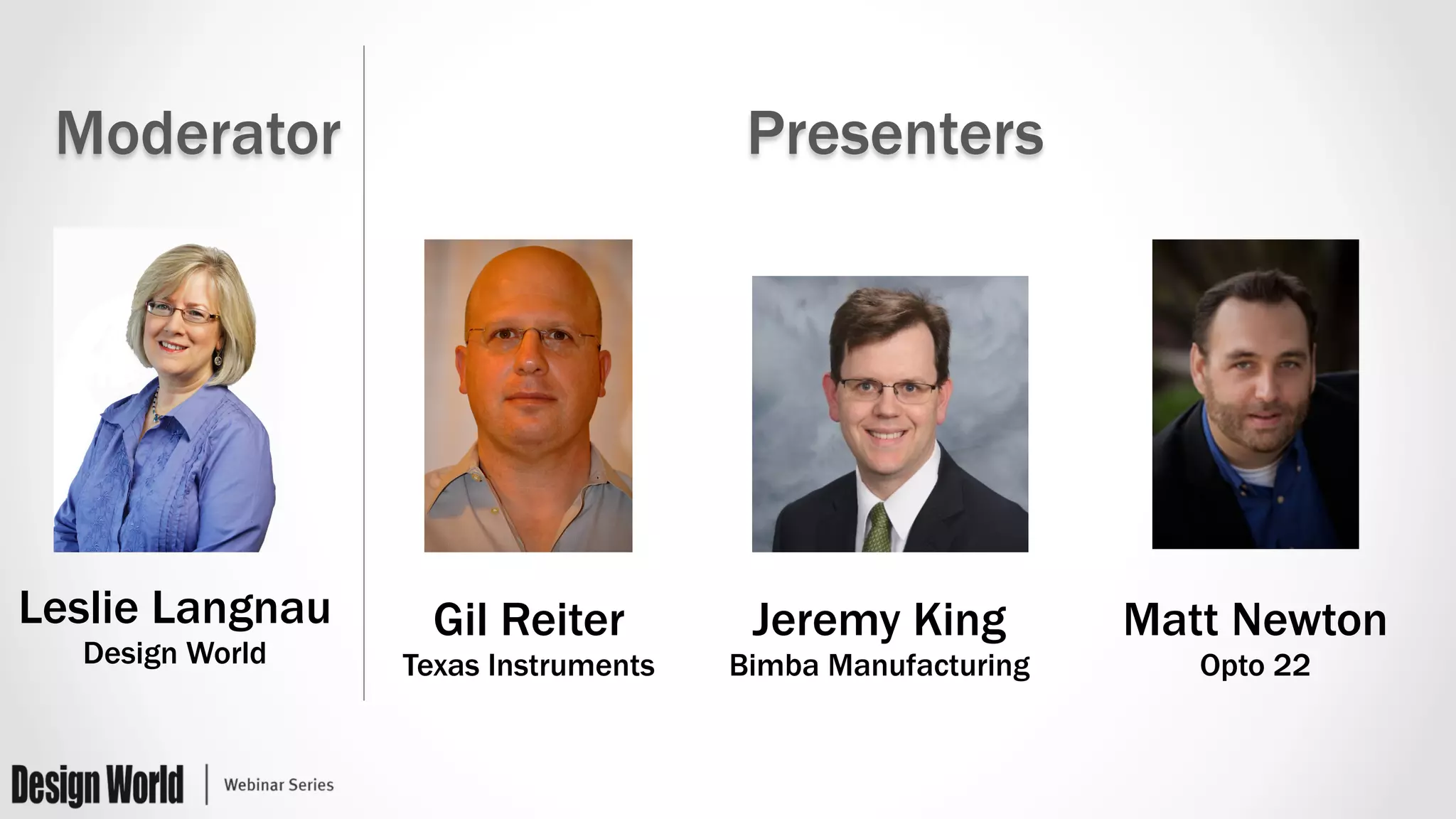
Moderator Presenters
Leslie Langnau
Design World
Gil Reiter
Texas Instruments
Jeremy King
Bimba Manufacturing
Matt Newton
Opto 22
The Internet of Industrial Things:
Opportunities & Challenges
Gil  Reiter	
IoT  strategic  marketing
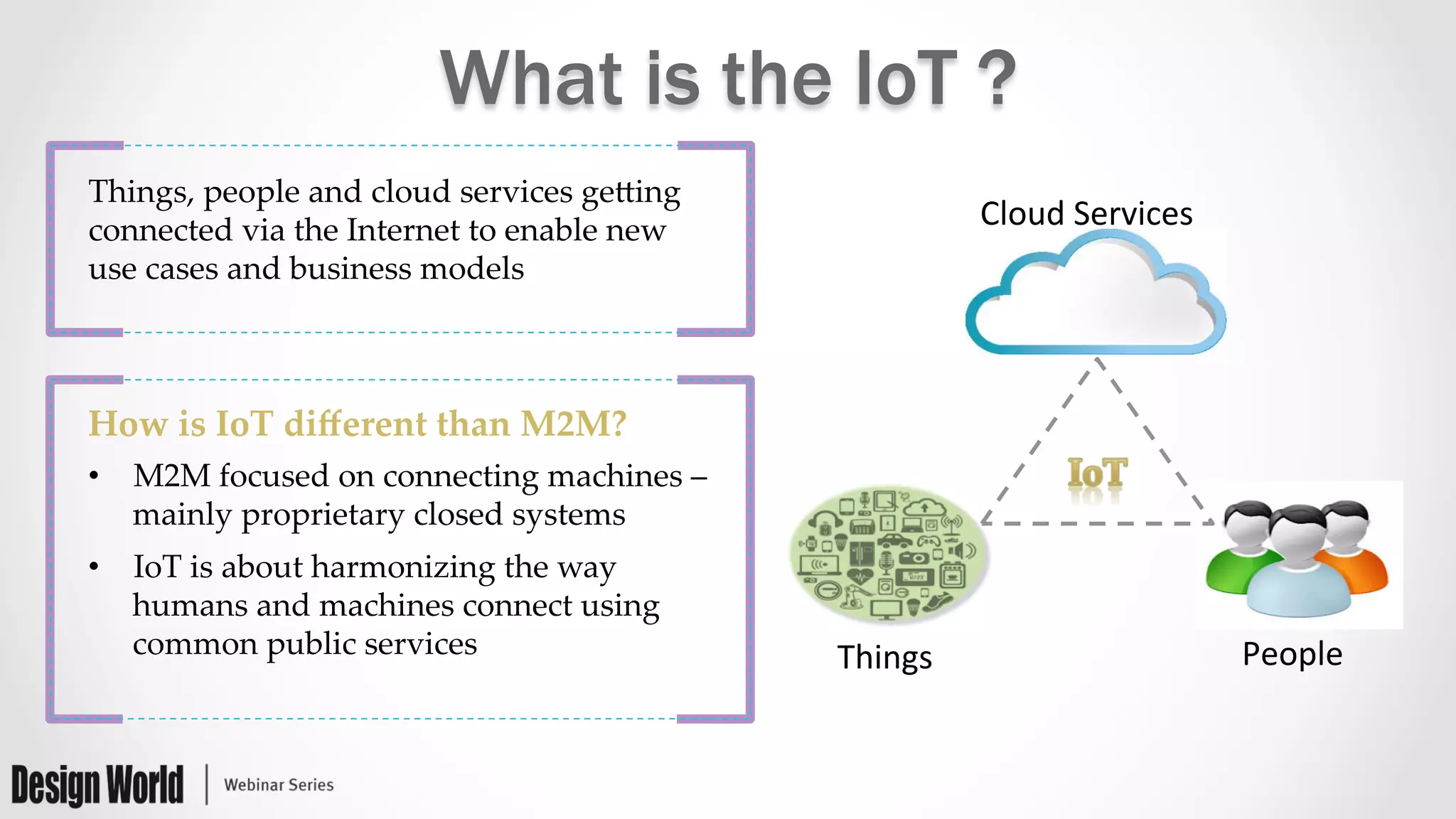
What is the IoT ?
How  is  IoT  different  than  M2M?	
•  M2M  focused  on  connecting  machines  –  
mainly  proprietary  closed  systems	
•  IoT  is  about  harmonizing  the  way  
humans  and  machines  connect  using  
common  public  services	
 People	
  Things	
  
Cloud	
  Services	
  
Things,  people  and  cloud  services  geBing  
connected  via  the  Internet  to  enable  new  
use  cases  and  business  models
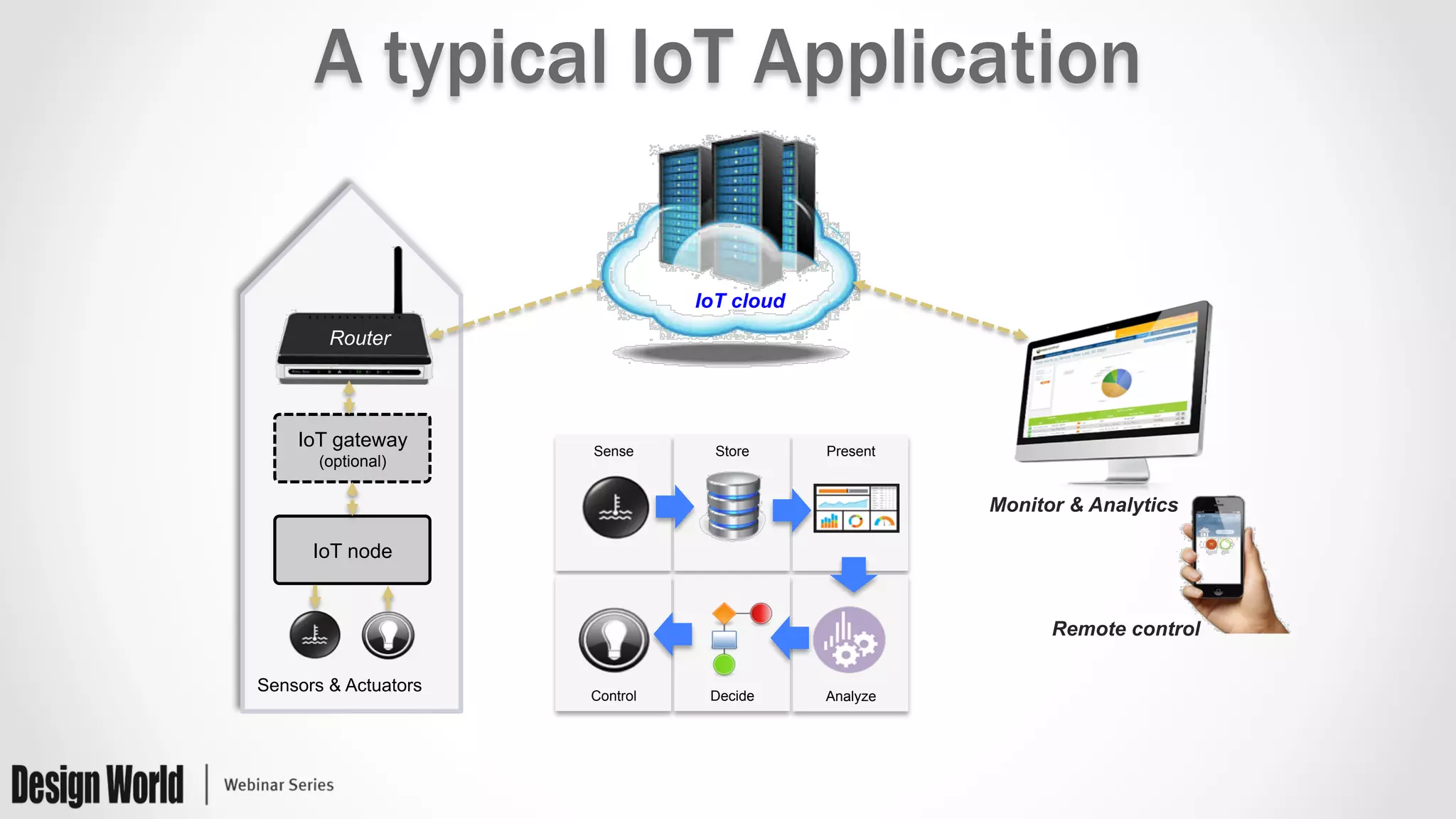
A typical IoT Application
IoT cloud
IoT node
Sensors & Actuators
IoT gateway
(optional)
Router
Remote control
Monitor & Analytics
Sense Store Present
AnalyzeDecideControl
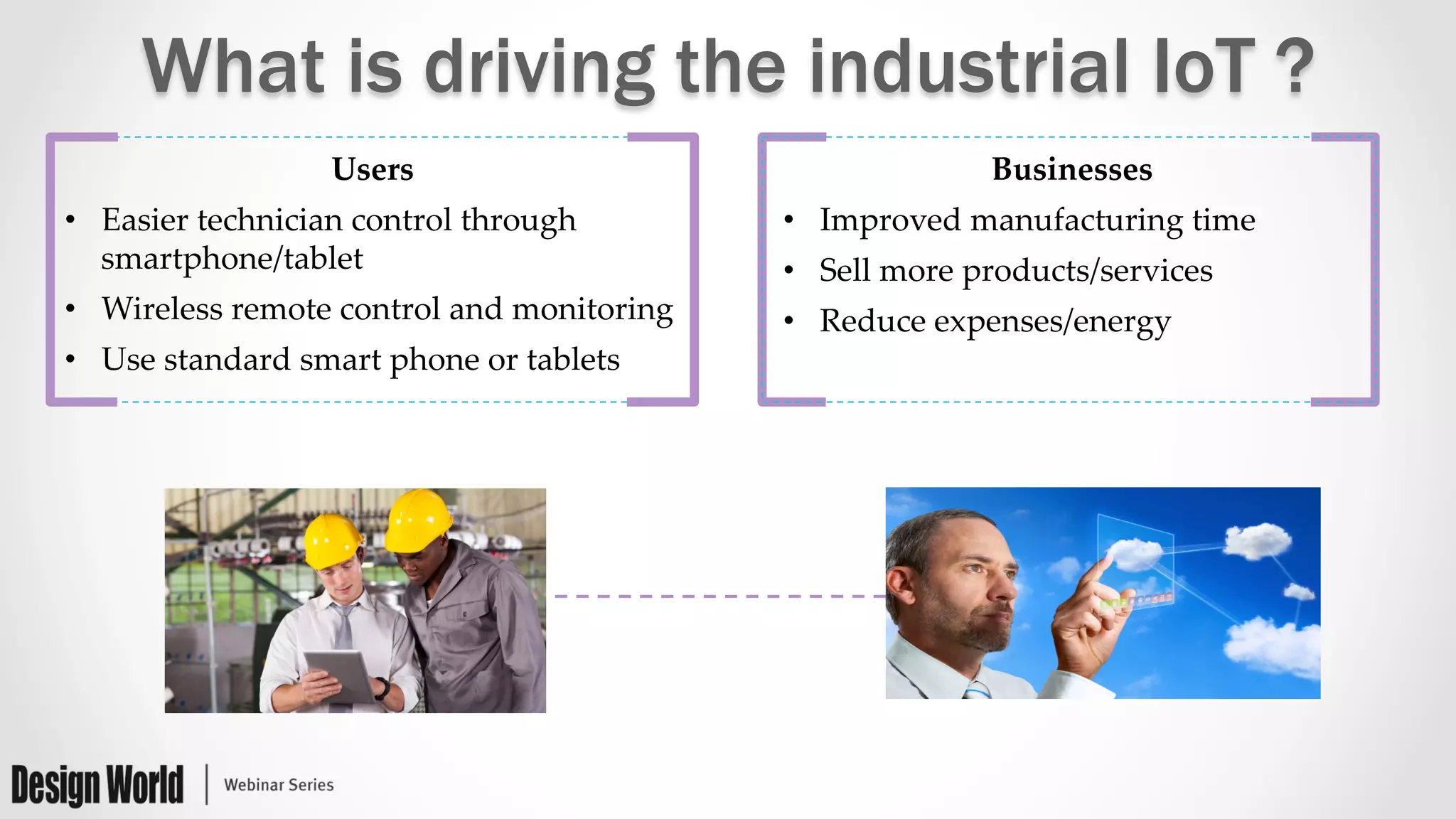
What is driving the industrial IoT ?
Users	
•  Easier  technician  control  through  
smartphone/tablet	
•  Wireless  remote  control  and  monitoring	
•  Use  standard  smart  phone  or  tablets	
Businesses	
•  Improved  manufacturing  time	
•  Sell  more  products/services	
•  Reduce  expenses/energy
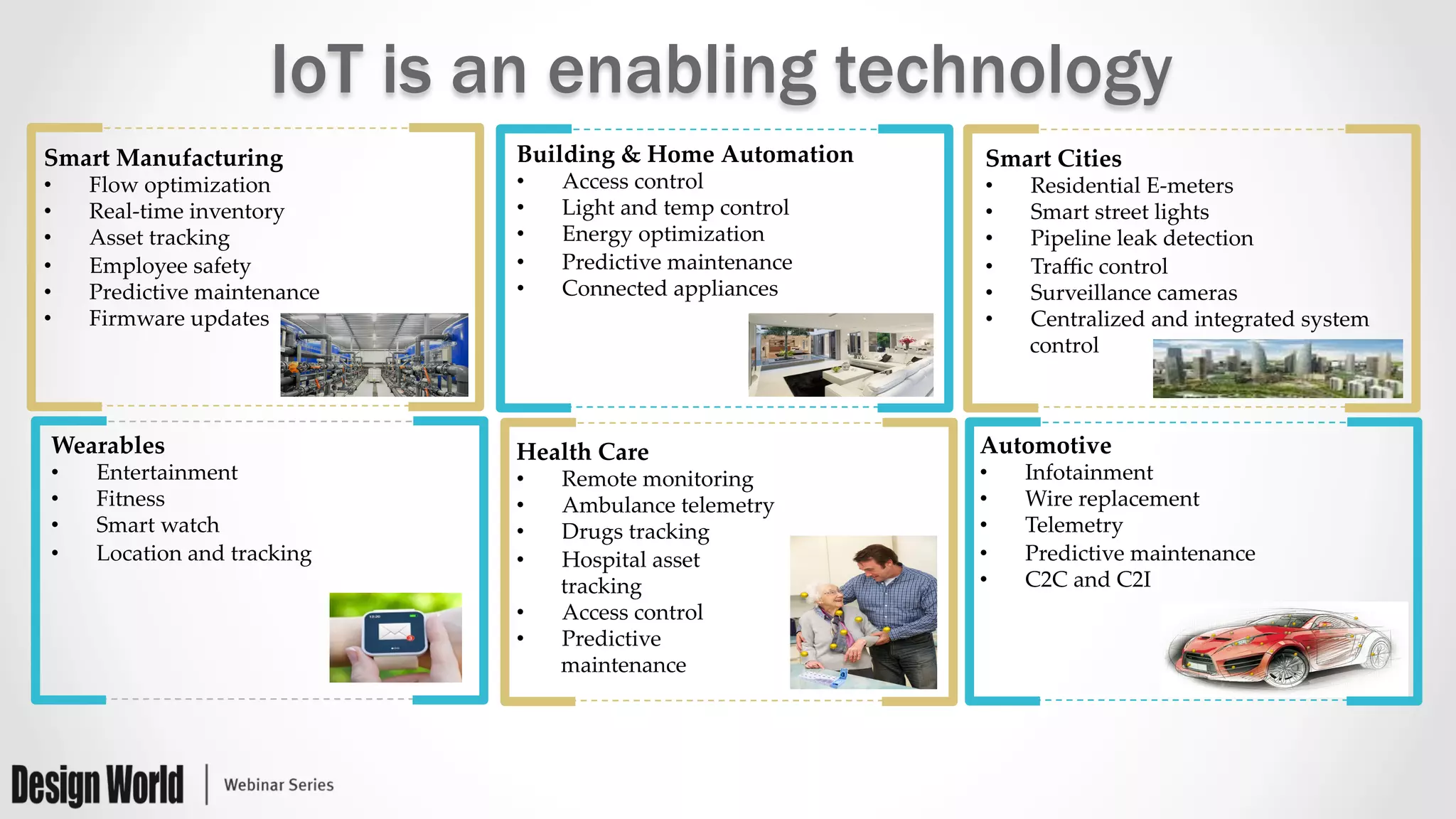
IoT is an enabling technology
Health  Care	
•  Remote  monitoring	
•  Ambulance  telemetry	
•  Drugs  tracking	
•  Hospital  asset    
tracking	
•  Access  control	
•  Predictive    
maintenance	
Smart  Manufacturing	
•  Flow  optimization	
•  Real-­‐‑time  inventory	
•  Asset  tracking	
•  Employee  safety	
•  Predictive  maintenance	
•  Firmware  updates	
Automotive	
•  Infotainment	
•  Wire  replacement	
•  Telemetry	
•  Predictive  maintenance	
•  C2C  and  C2I	
Wearables	
•  Entertainment	
•  Fitness	
•  Smart  watch	
•  Location  and  tracking	
Smart  Cities	
•  Residential  E-­‐‑meters	
•  Smart  street  lights	
•  Pipeline  leak  detection	
•  Traffic  control	
•  Surveillance  cameras	
•  Centralized  and  integrated  system  
control	
Building  &  Home  Automation	
•  Access  control	
•  Light  and  temp  control	
•  Energy  optimization	
•  Predictive  maintenance	
•  Connected  appliances
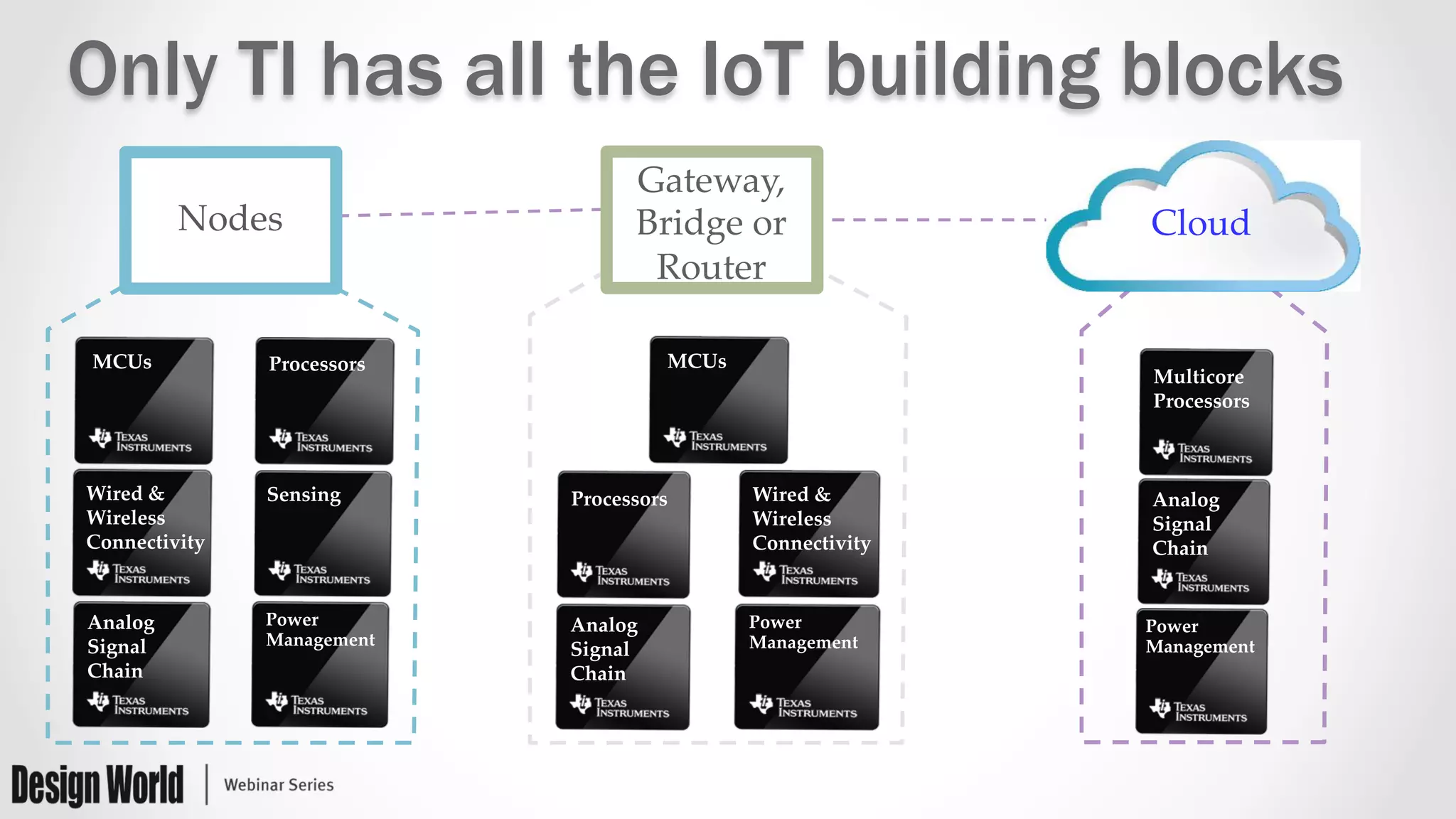
Only TI has all the IoT building blocks
Processors	
MCUs	
Wired  &  
Wireless  
Connectivity	
Sensing	
Analog  
Signal  
Chain	
Power  
Management	
Nodes	
MCUs	
Processors	
 Wired  &  
Wireless  
Connectivity	
Multicore  
Processors	
Analog  
Signal  
Chain	
Power  
Management	
Analog  
Signal  
Chain	
Power  
Management	
Cloud	
Gateway,  
Bridge  or  
Router
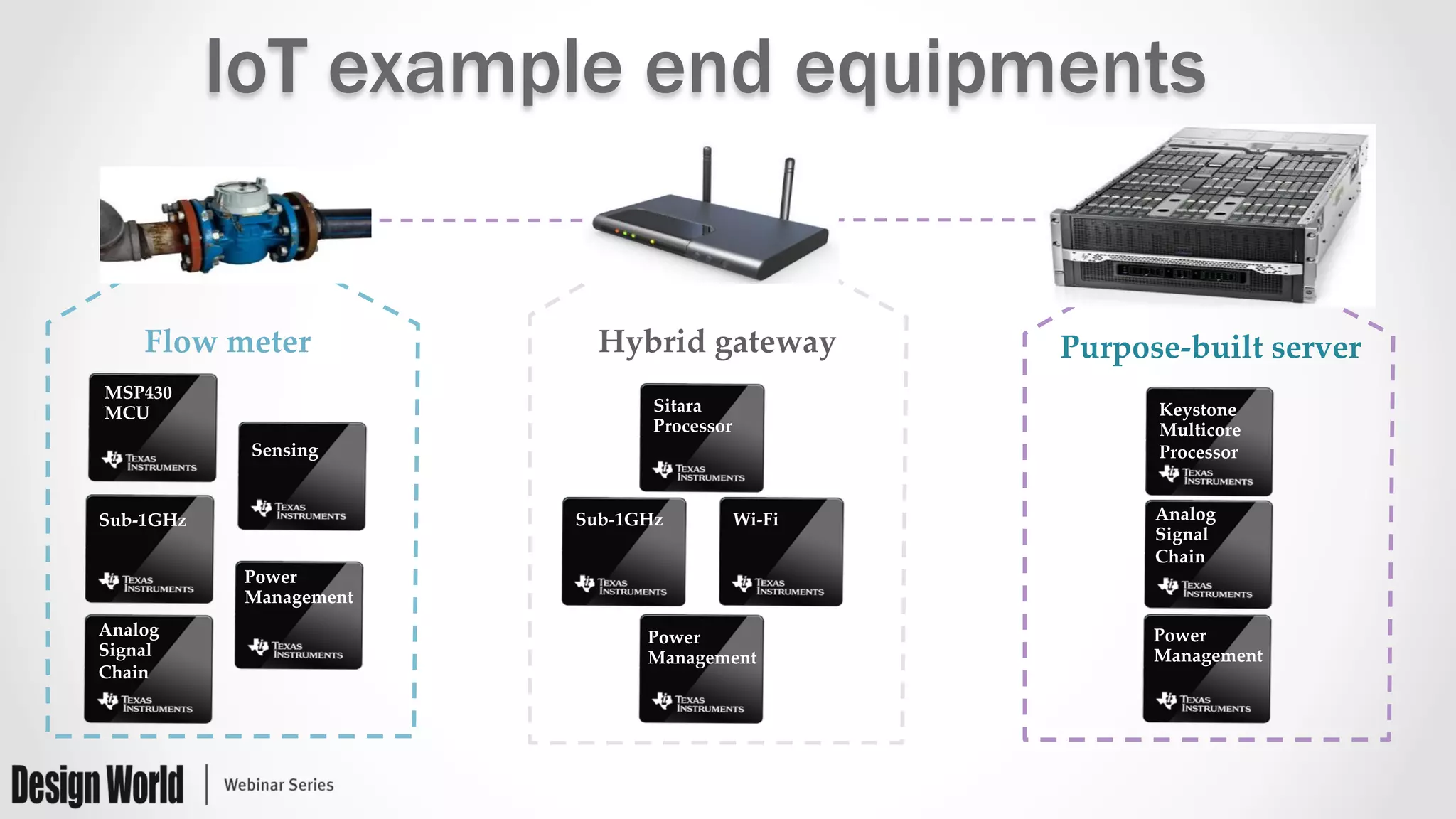
IoT example end equipments
Cloud	
Hybrid  gateway  	
Wi-­‐‑Fi	
Sitara  
Processor	
Sub-­‐‑1GHz	
Power  
Management	
Keystone  
Multicore	
Purpose-­‐‑built  server	
Keystone  
Multicore  
Processor	
Power  
Management	
Analog	
Signal	
Chain	
MSP430  	
MCU	
Sub-­‐‑1GHz	
Sensing	
Analog  
Signal  
Chain	
Power  
Management	
Flow  meter
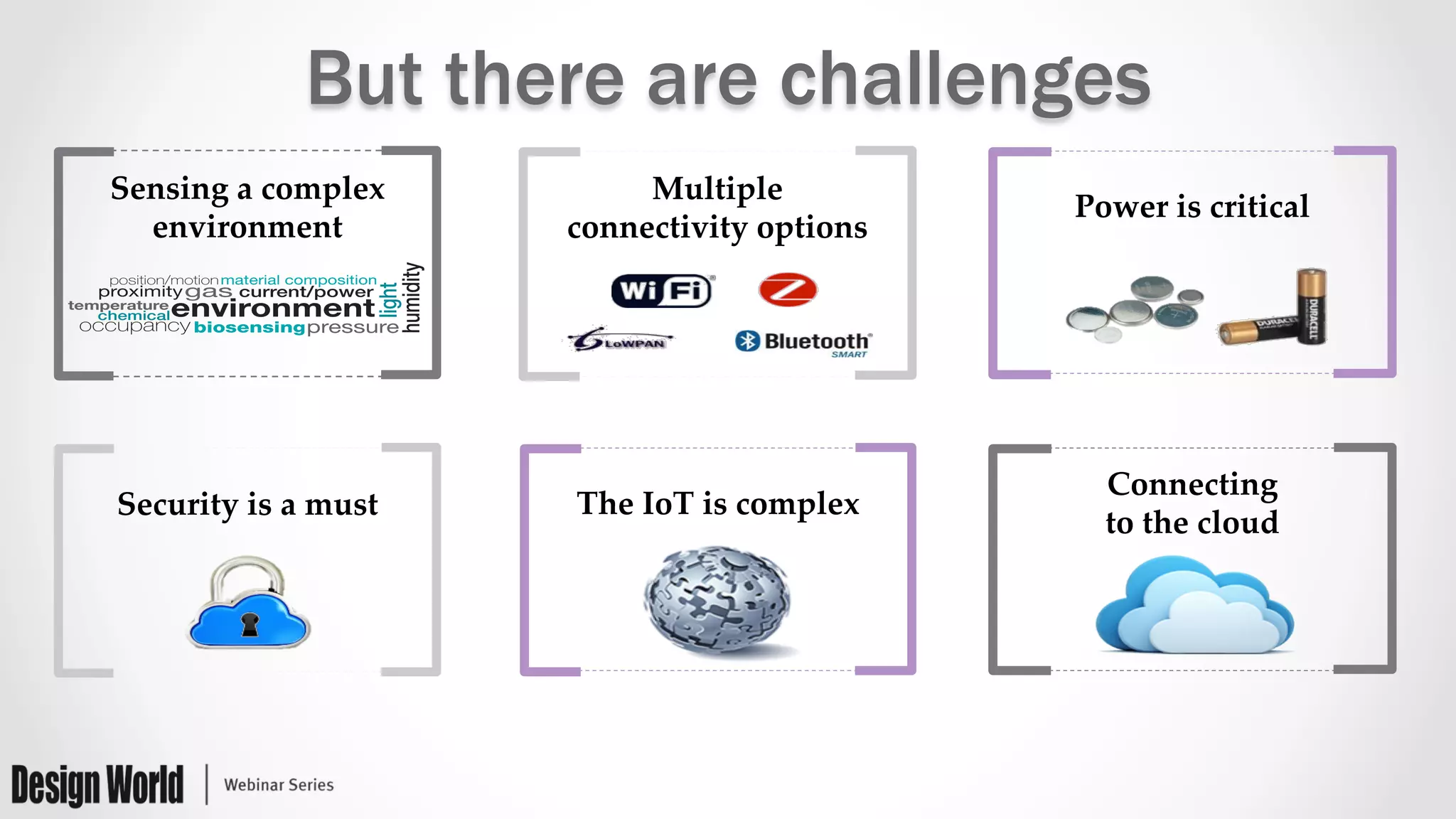
But there are challenges
Sensing  a  complex  
environment	


Multiple  	
connectivity  options	


Security  is  a  must	


Power  is  critical	


The  IoT  is  complex	


Connecting  	
to  the  cloud	


environment
pressure
humidity
light
chemical
biosensing
gas current/power
material composition
occupancy
temperature
proximity
position/motion
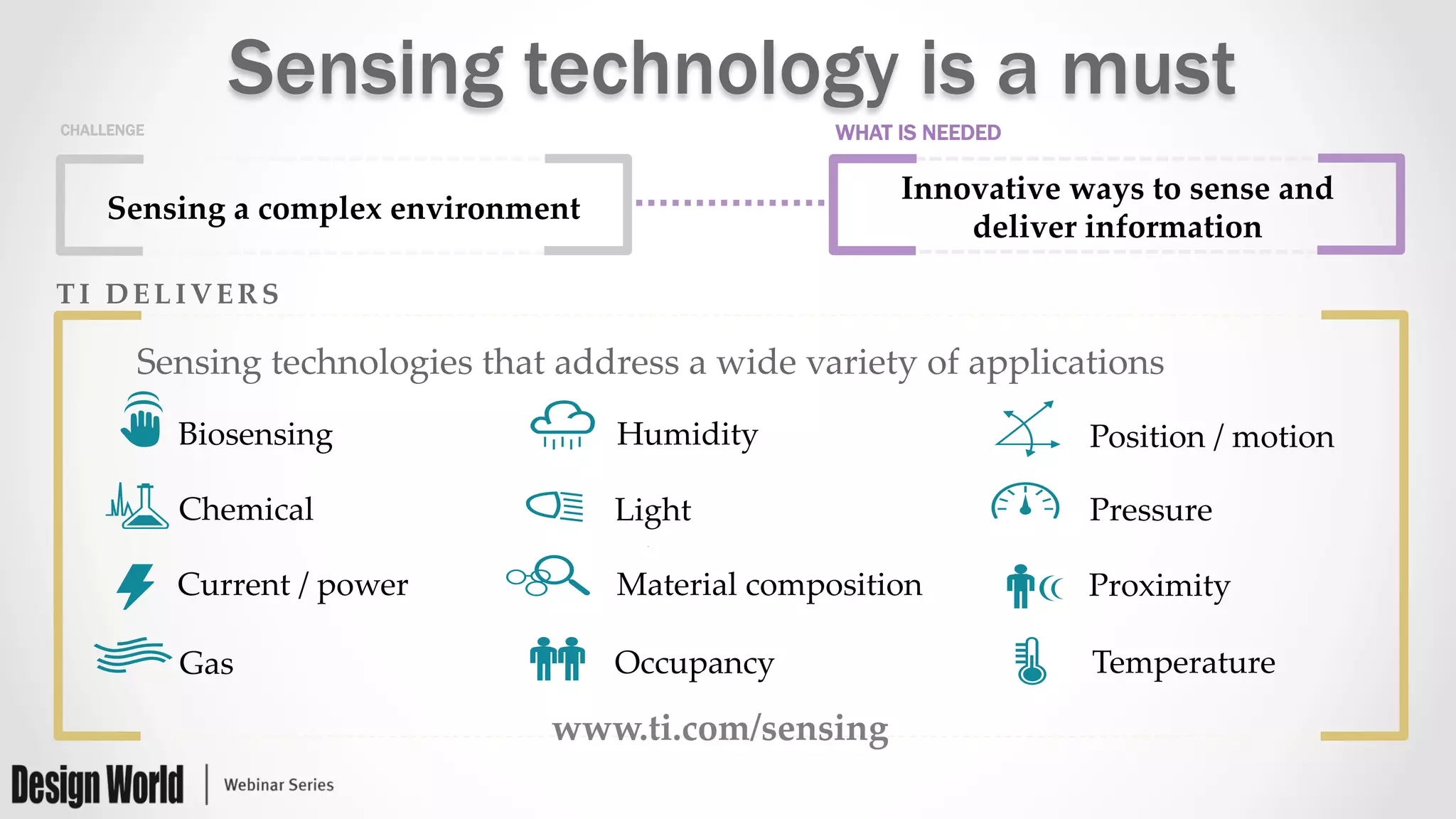
Sensing technology is a must
CHALLENGE WHAT IS NEEDED
Sensing  a  complex  environment	
Innovative  ways  to  sense  and  
deliver  information	
TI  DELIVERS	
Biosensing	
Chemical	
Current  /  power	
Light	
Humidity	
Gas	
Material  composition	
Occupancy	
Position  /  motion	
Pressure	
Proximity	
Temperature	
Sensing  technologies  that  address  a  wide  variety  of  applications  	
www.ti.com/sensing
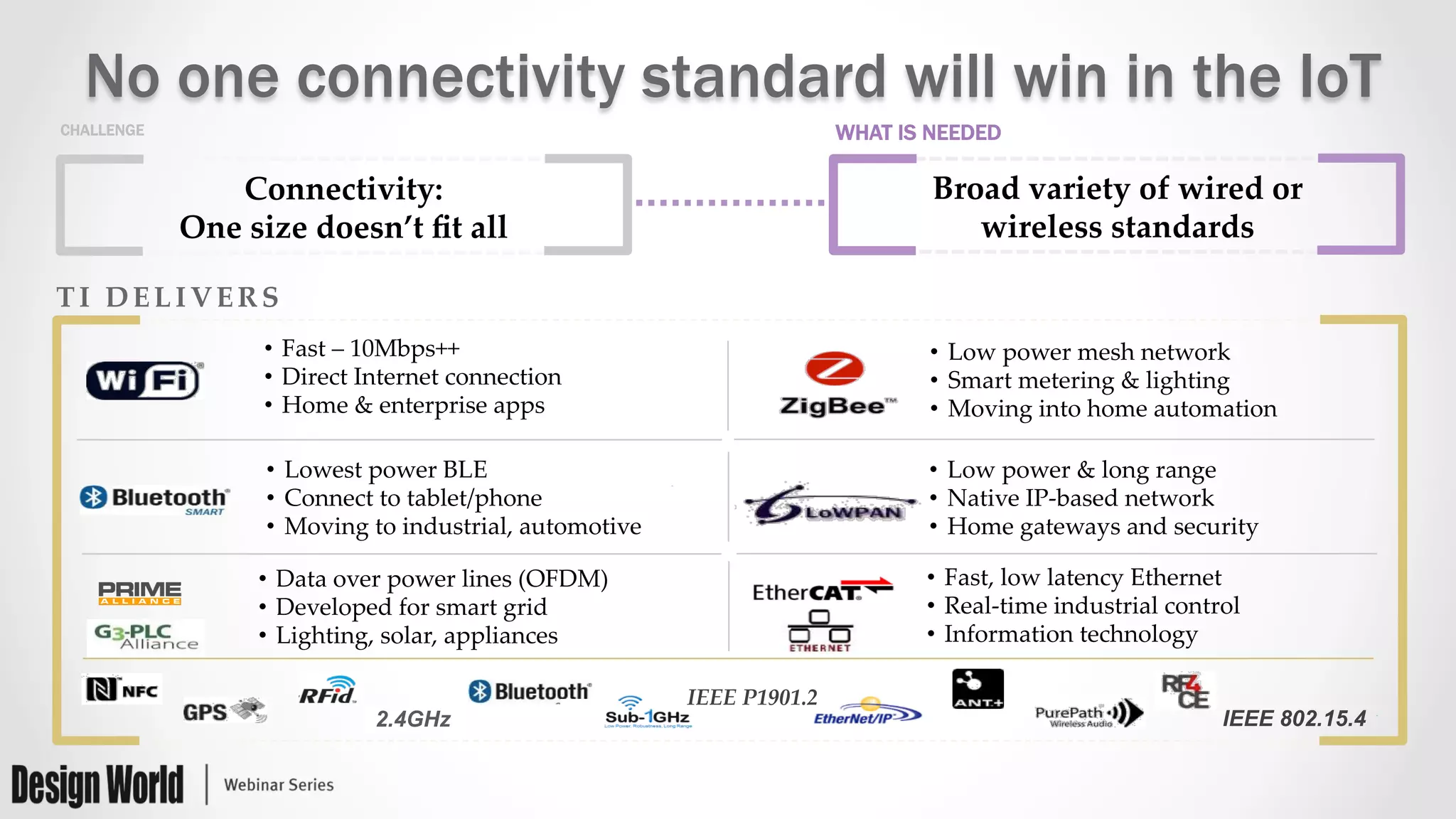
No one connectivity standard will win in the IoT
CHALLENGE WHAT IS NEEDED
Connectivity:  	
One  size  doesn’t  fit  all	
Broad  variety  of  wired  or    
wireless  standards	
TI  DELIVERS	
•  Low  power  mesh  network	
•  Smart  metering  &  lighting	
•  Moving  into  home  automation	
•  Fast,  low  latency  Ethernet	
•  Real-­‐‑time  industrial  control	
•  Information  technology	
•  Fast  –  10Mbps++	
•  Direct  Internet  connection	
•  Home  &  enterprise  apps	
•  Data  over  power  lines  (OFDM)	
•  Developed  for  smart  grid	
•  Lighting,  solar,  appliances	
•  Lowest  power  BLE	
•  Connect  to  tablet/phone	
•  Moving  to  industrial,  automotive	
•  Low  power  &  long  range	
•  Native  IP-­‐‑based  network	
•  Home  gateways  and  security	
2.4GHz IEEE 802.15.4
IEEE  P1901.2  
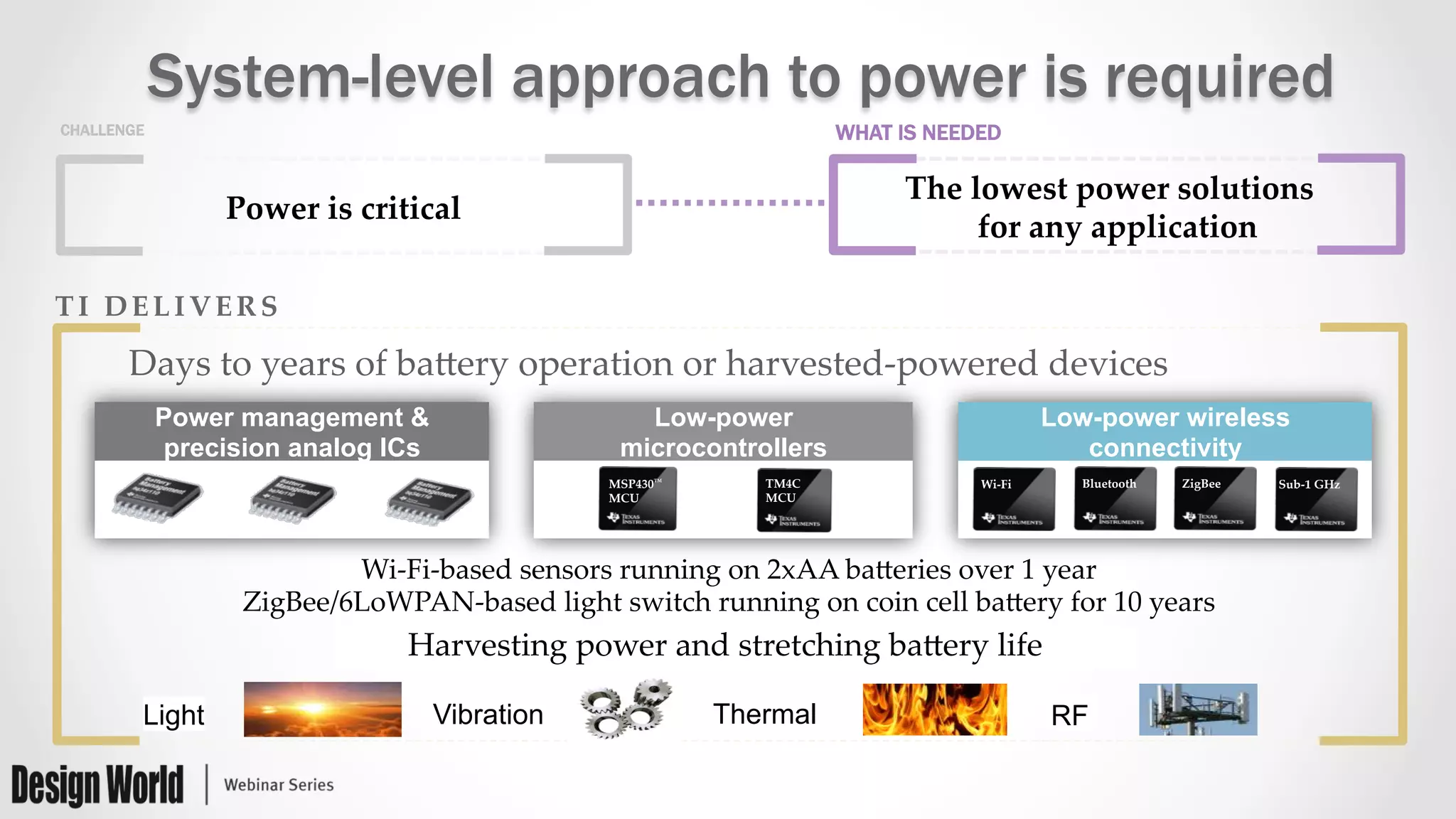
System-level approach to power is required
CHALLENGE WHAT IS NEEDED
Power  is  critical	
The  lowest  power  solutions    
for  any  application	
TI  DELIVERS	
Harvesting  power  and  stretching  baBery  life	
Thermal RFLight Vibration
Days  to  years  of  baBery  operation  or  harvested-­‐‑powered  devices	
Power management &
precision analog ICs
Low-power
microcontrollers
MSP430™	
MCU	
TM4C	
MCU	
Low-power wireless
connectivity
Wi-­‐‑Fi	
 Bluetooth	
 ZigBee	
 Sub-­‐‑1  GHz	
Wi-­‐‑Fi-­‐‑based  sensors  running  on  2xAA  baBeries  over  1  year	
ZigBee/6LoWPAN-­‐‑based  light  switch  running  on  coin  cell  baBery  for  10  years
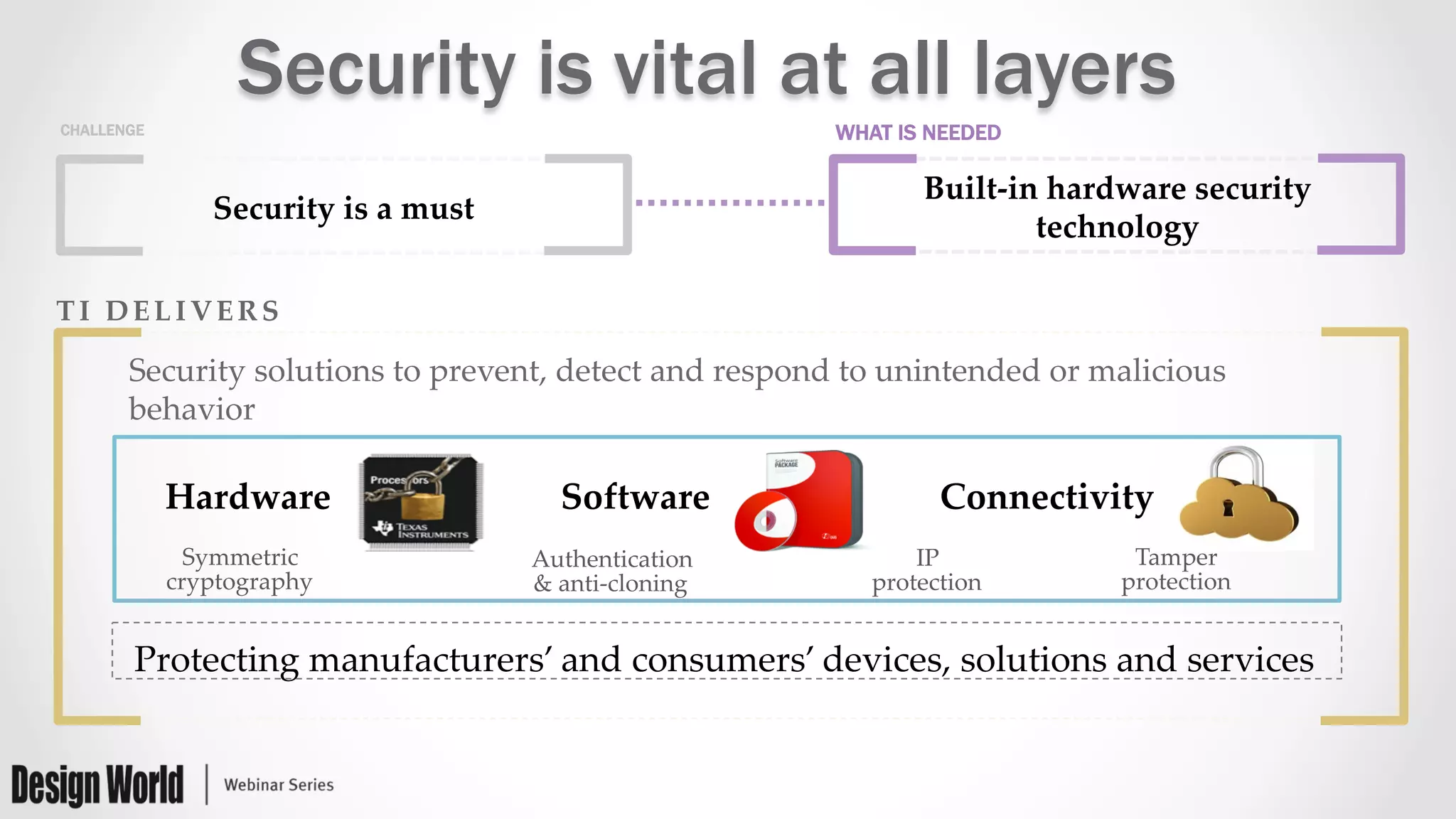
Security is vital at all layers
CHALLENGE WHAT IS NEEDED
Security  is  a  must	
Built-­‐‑in  hardware  security  
technology	
TI  DELIVERS	
Security  solutions  to  prevent,  detect  and  respond  to  unintended  or  malicious  
behavior	
Protecting  manufacturers’  and  consumers’  devices,  solutions  and  services	
Hardware  	
 Connectivity  	
Software  	
Symmetric    
cryptography  	
IP    
protection	
Authentication    
&  anti-­‐‑cloning  	
Tamper    
protection  
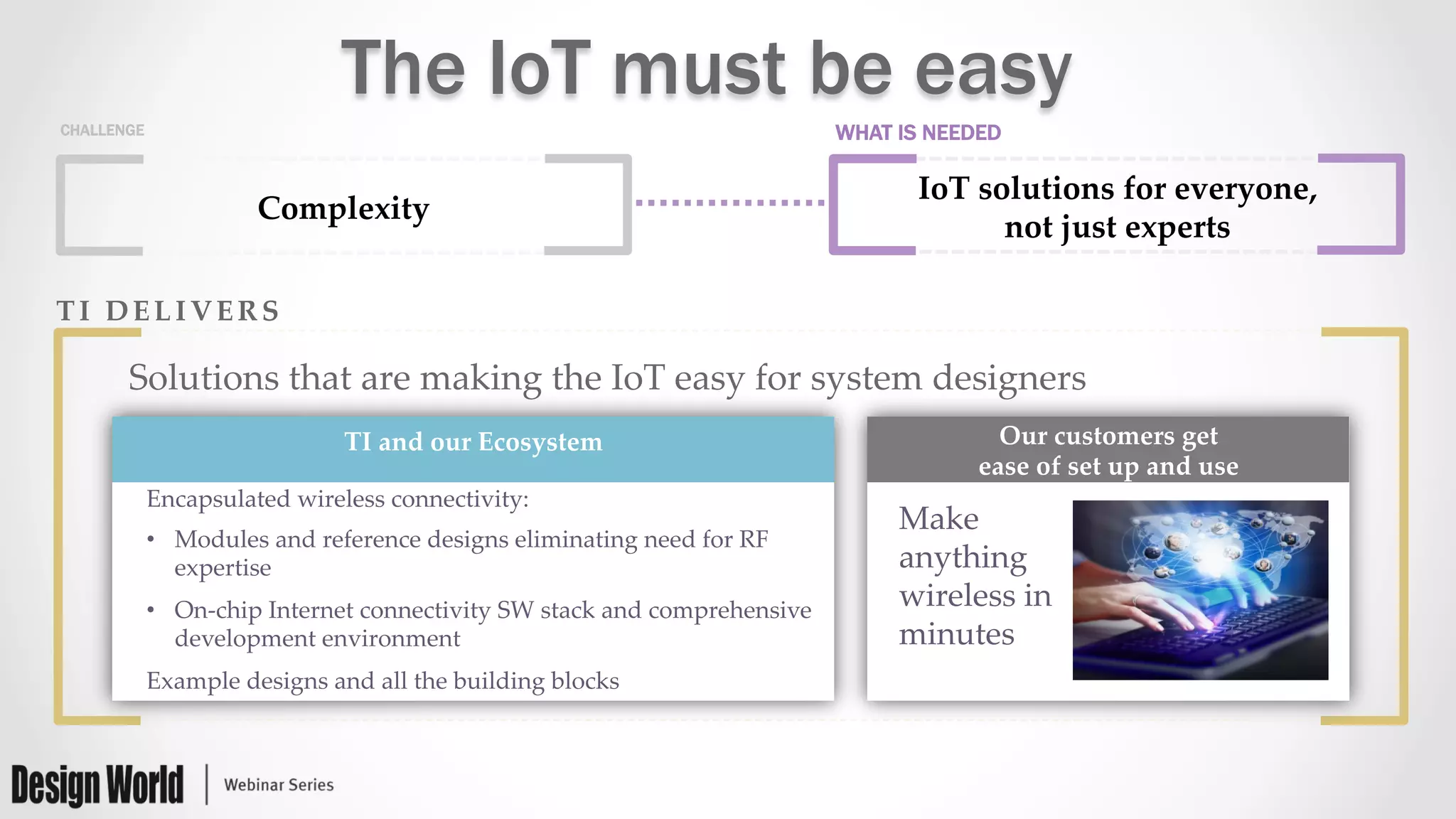
The IoT must be easy
CHALLENGE WHAT IS NEEDED
Complexity	
IoT  solutions  for  everyone,  	
not  just  experts	
TI  DELIVERS	
Solutions  that  are  making  the  IoT  easy  for  system  designers	
Our  customers  get  
ease  of  set  up  and  use	
TI  and  our  Ecosystem  
	
Encapsulated  wireless  connectivity:	
•  Modules  and  reference  designs  eliminating  need  for  RF  
expertise	
•  On-­‐‑chip  Internet  connectivity  SW  stack  and  comprehensive  
development  environment	
Example  designs  and  all  the  building  blocks  	
Make  
anything  
wireless  in  
minutes
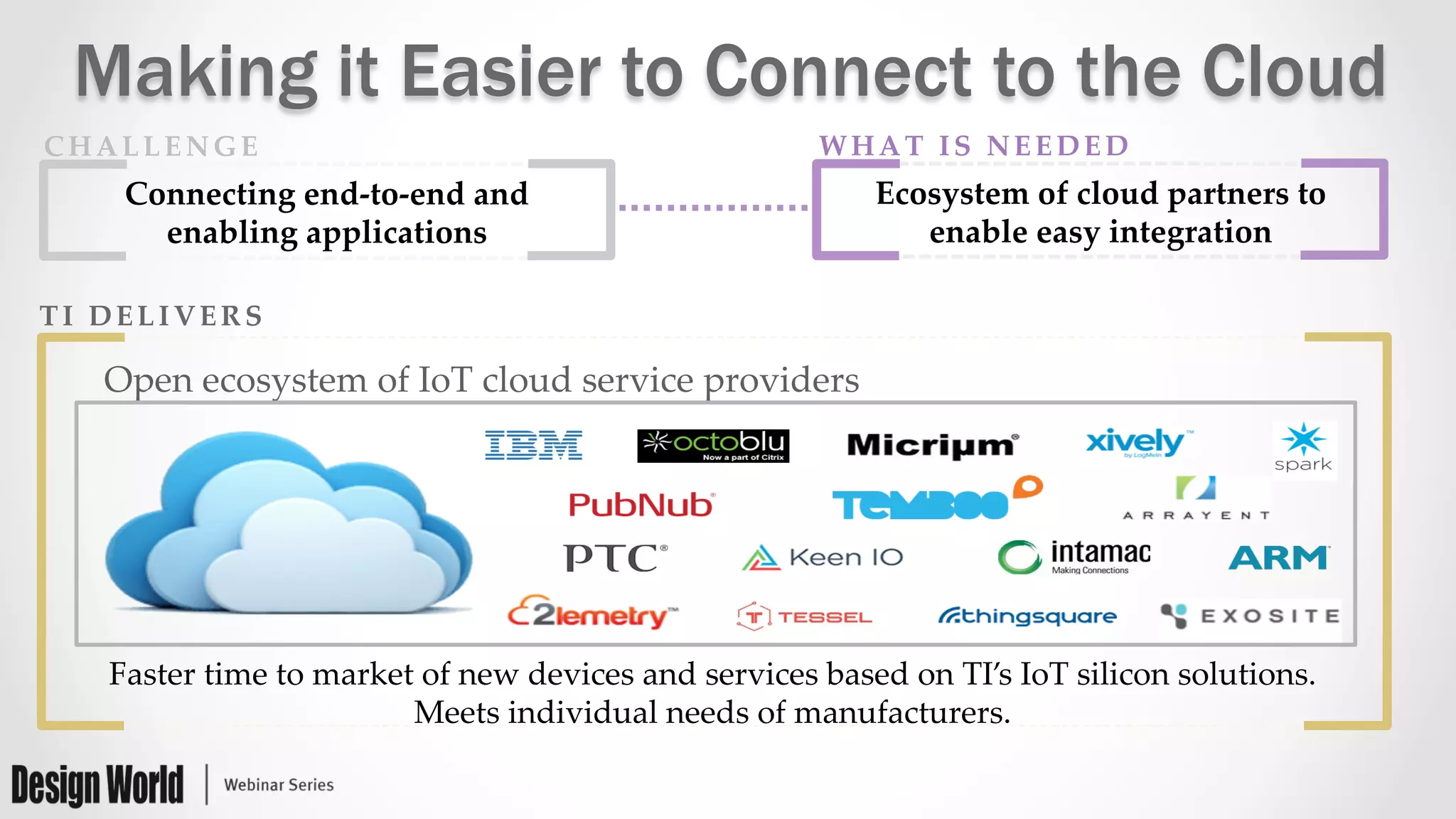
Making it Easier to Connect to the Cloud
CHALLENGE	
 WHAT  IS  NEEDED	
Connecting  end-­‐‑to-­‐‑end  and  
enabling  applications	
Ecosystem  of  cloud  partners  to  
enable  easy  integration	
TI  DELIVERS	
Open  ecosystem  of  IoT  cloud  service  providers  	
Faster  time  to  market  of  new  devices  and  services  based  on  TI’s  IoT  silicon  solutions.  
Meets  individual  needs  of  manufacturers.
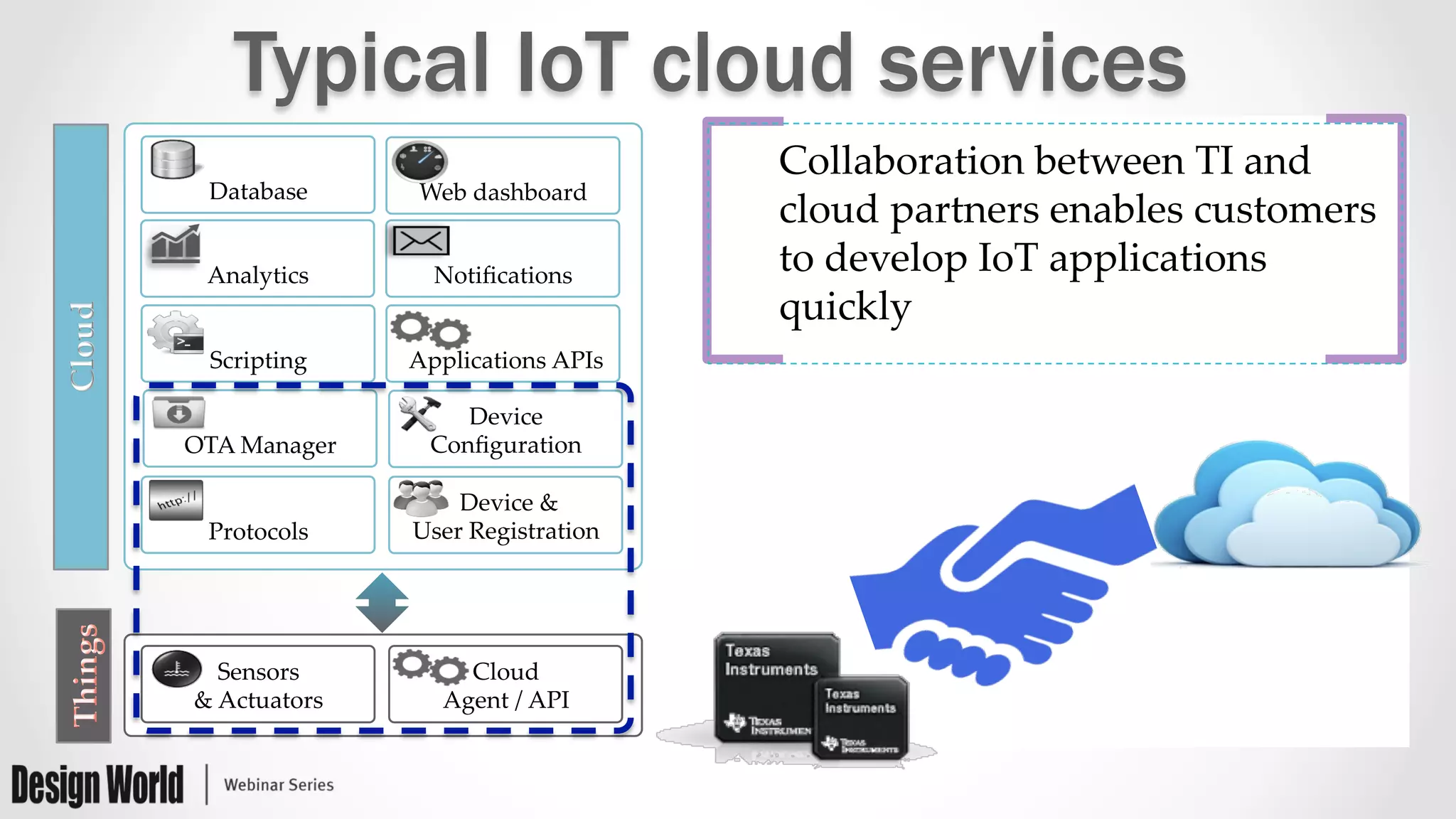
Typical IoT cloud servicesThings	
Scripting	
Notifications	
Web  dashboard	
Database	
Analytics	
  Applications  APIs	
OTA  Manager	
Device  
Configuration	
Protocols	
  Device  &	
User  Registration	
Cloud	
Cloud  	
Agent  /  API	
Sensors    
&  Actuators	
Collaboration  between  TI  and  
cloud  partners  enables  customers  
to  develop  IoT  applications  
quickly  
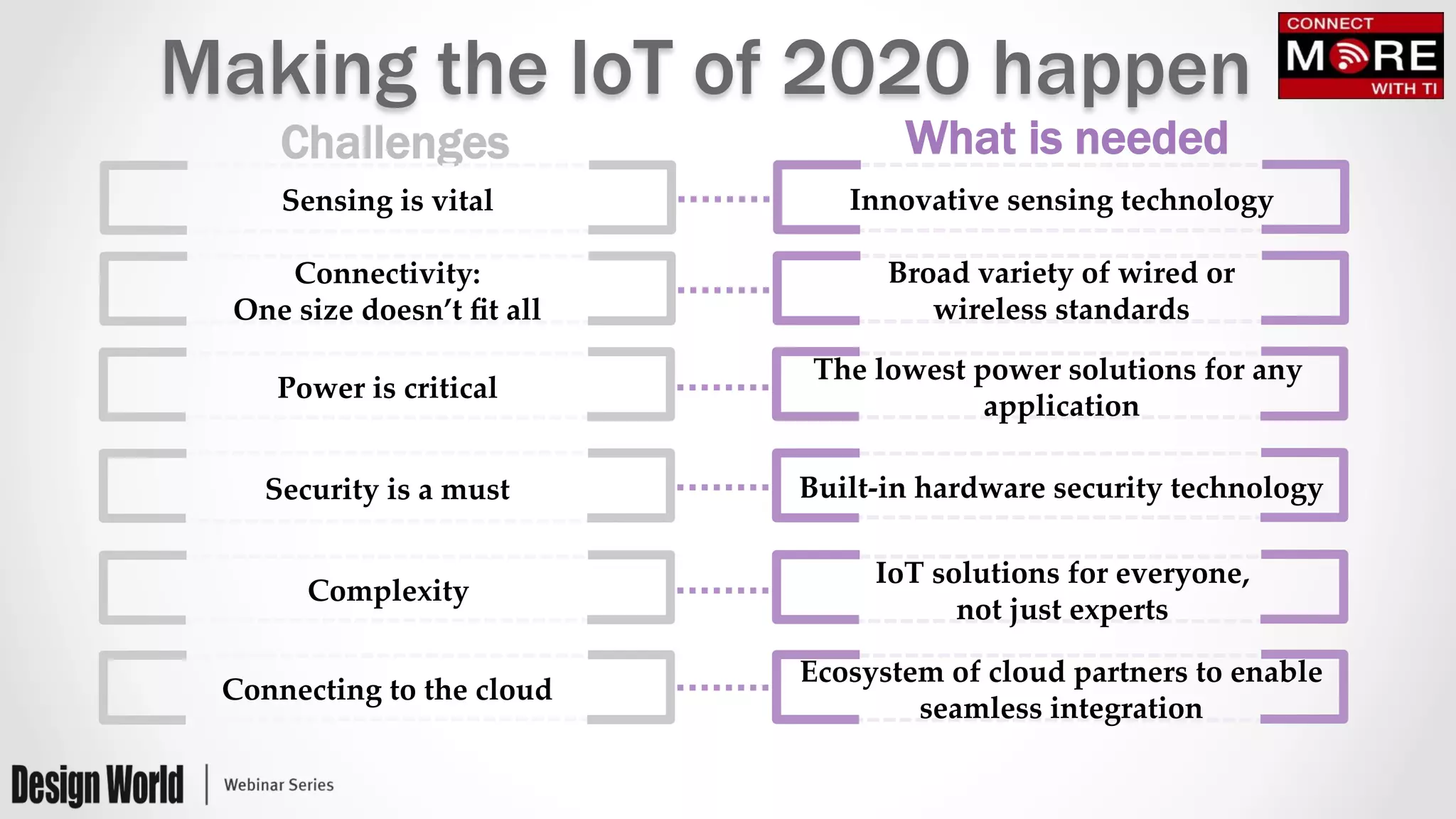
Making the IoT of 2020 happen
Challenges What is needed
Connectivity:  	
One  size  doesn’t  fit  all	
Broad  variety  of  wired  or    
wireless  standards	
Power  is  critical	
The  lowest  power  solutions  for  any  
application	
Security  is  a  must	
 Built-­‐‑in  hardware  security  technology	
Complexity	
IoT  solutions  for  everyone,  	
not  just  experts	
Connecting  to  the  cloud	
Ecosystem  of  cloud  partners  to  enable  
seamless  integration	
Sensing  is  vital  	
 Innovative  sensing  technology
Designing for the
Internet of Things
Matt Newton
mnewton@opto22.com
IoT Benefits
•  Smart products take corrective action to prevent
equipment failure and keep production running
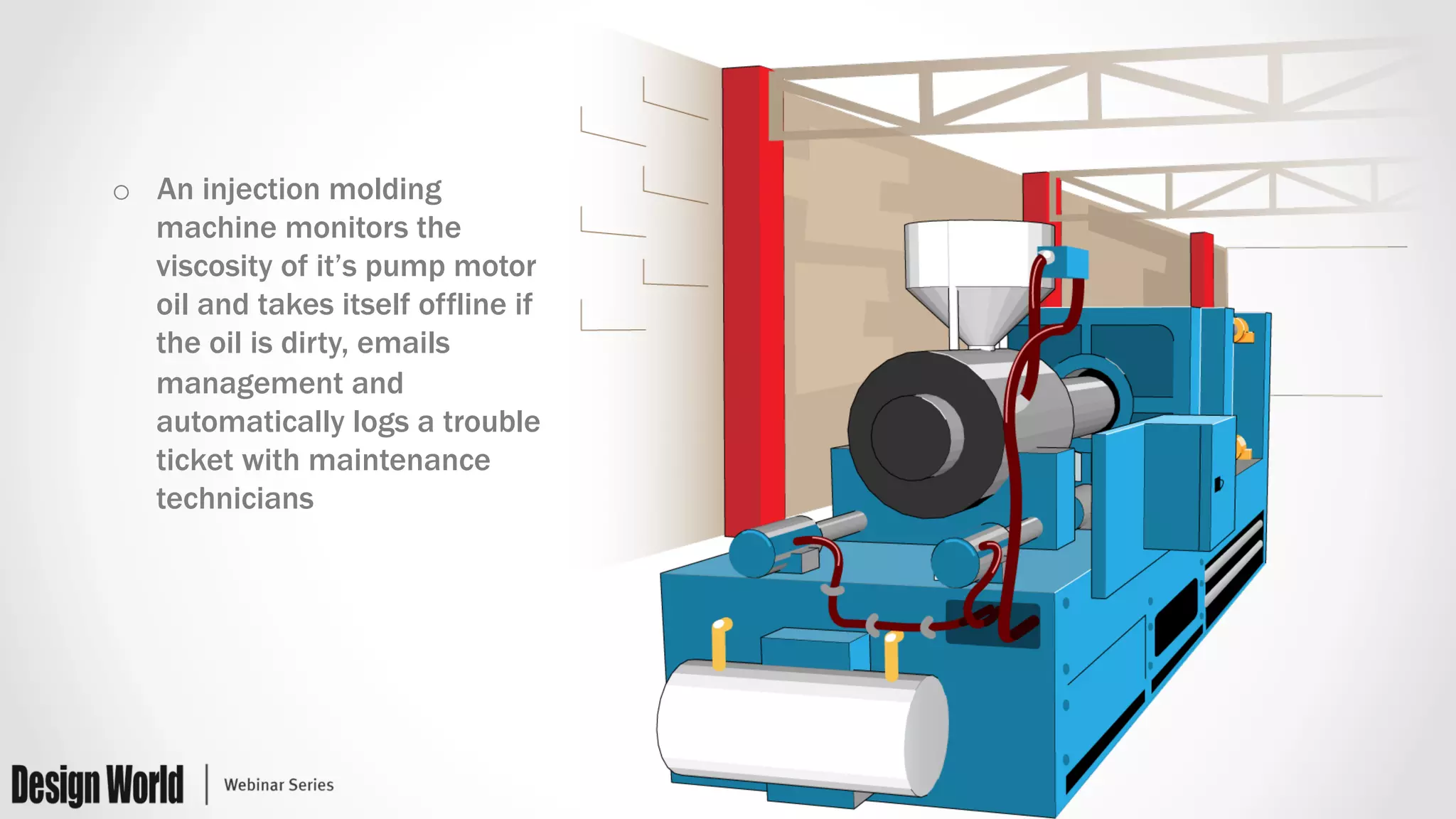
o  An injection molding
machine monitors the
viscosity of it’s pump motor
oil and takes itself offline if
the oil is dirty, emails
management and
automatically logs a trouble
ticket with maintenance
technicians
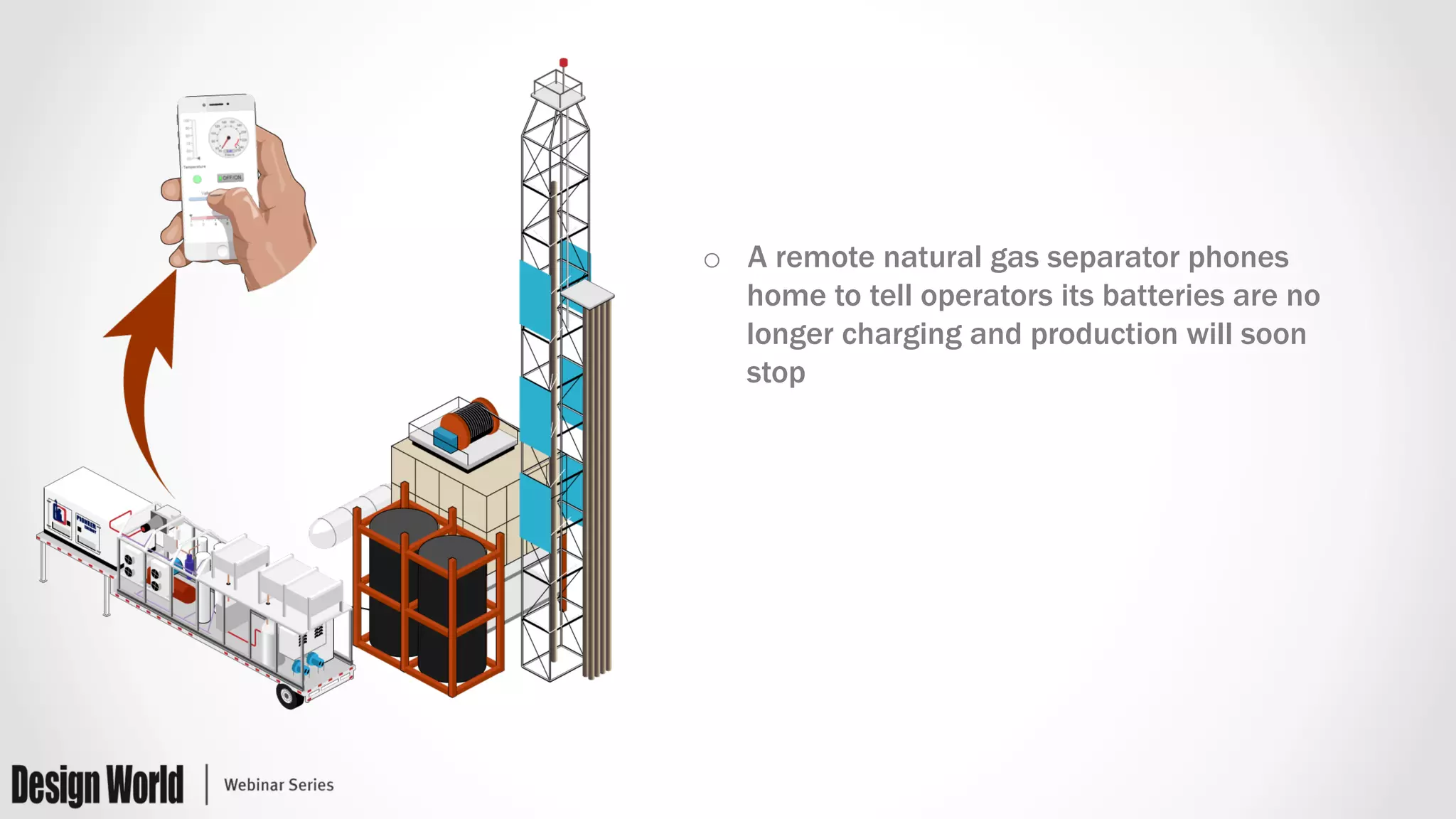
o  A remote natural gas separator phones
home to tell operators its batteries are no
longer charging and production will soon
stop
IoT Benefits
•  Data is easily shared among peer groups for faster
problem identification and resolution
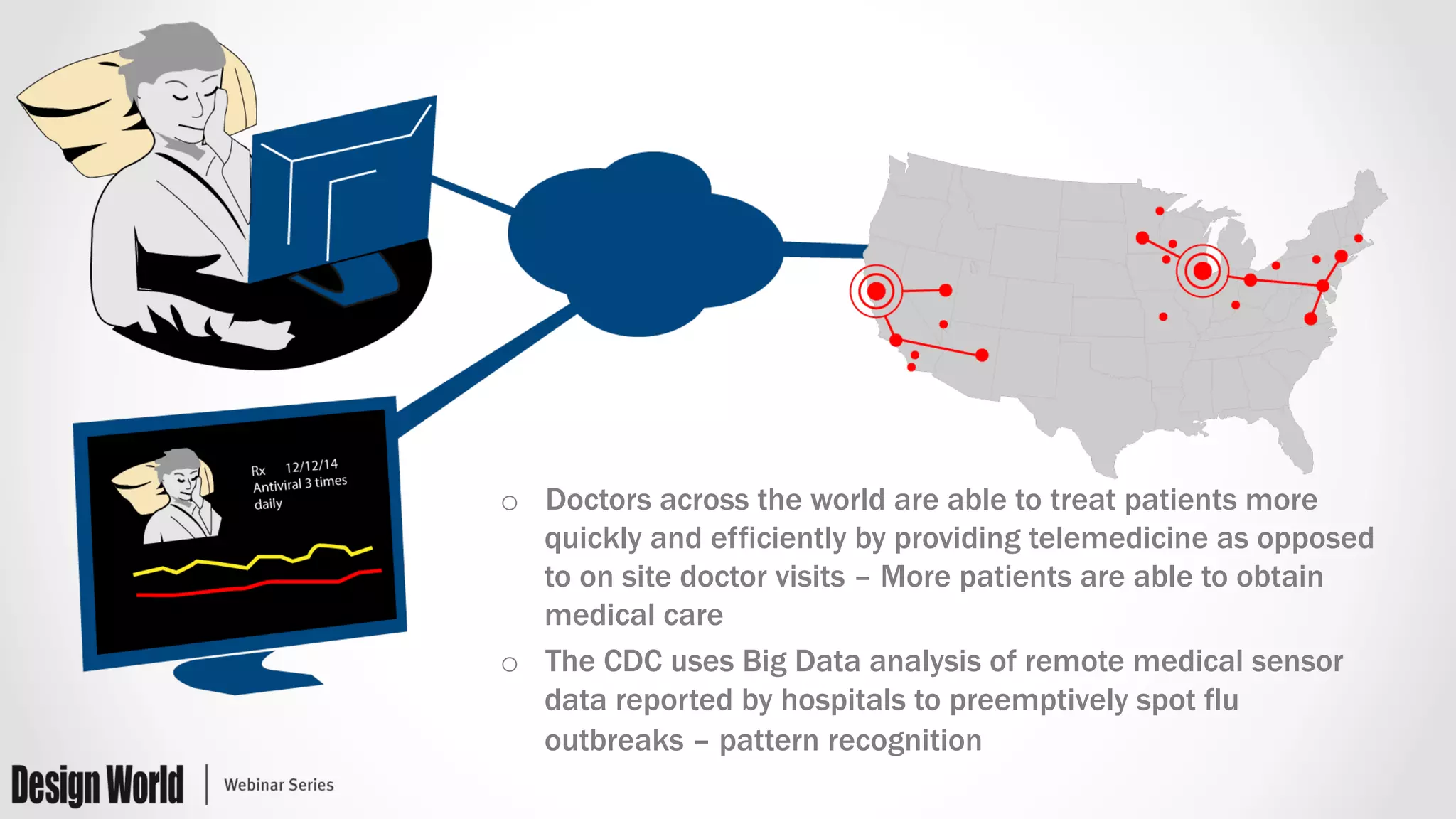
o  Doctors across the world are able to treat patients more
quickly and efficiently by providing telemedicine as opposed
to on site doctor visits – More patients are able to obtain
medical care
o  The CDC uses Big Data analysis of remote medical sensor
data reported by hospitals to preemptively spot flu
outbreaks – pattern recognition
IoT Benefits
•  Your home becomes “smart” and proactively solves
problems for you
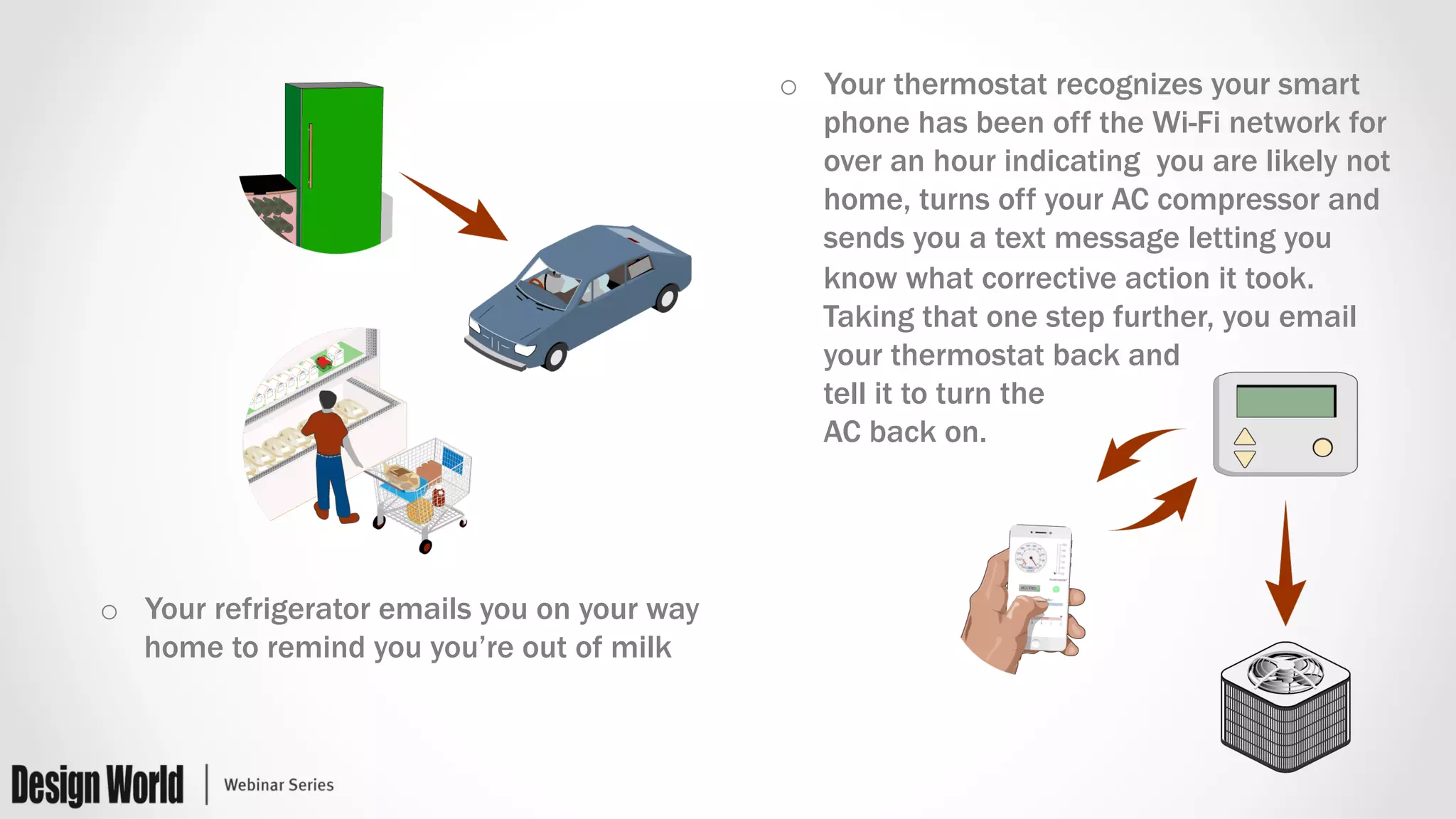
o  Your refrigerator emails you on your way
home to remind you you’re out of milk
o  Your thermostat recognizes your smart
phone has been off the Wi-Fi network for
over an hour indicating you are likely not
home, turns off your AC compressor and
sends you a text message letting you
know what corrective action it took.
Taking that one step further, you email
your thermostat back and
tell it to turn the
AC back on.
A New Paradigm
•  It’s no longer about how fast a business can react to
events
•  IoT and Big Data can provide real-time insight into all
aspects of a business’s operations
•  The future will be about anticipating events before they
occur to achieve the largest competitive advantage
How do we get there?
•  There are some inherent challenges with IoT
o  How do we all speak the same language?
o  Bridging the gap between embedded systems languages such as C and web
languages such as JavaScript
•  It’s not just about hardware, but hardware is important.
Software design is key
•  Leverage existing technologies, standards and
architectures – it’s all available today!
Hardware Considerations
•  First we need to get the device on a network
•  Ethernet (MAC/PHY) or Wi-Fi connectivity (802.11 chipset)
•  TCP/IP stack
•  Enough processing power and RAM to handle security
o  Encryption/SSL
o  Authentication
Software Considerations
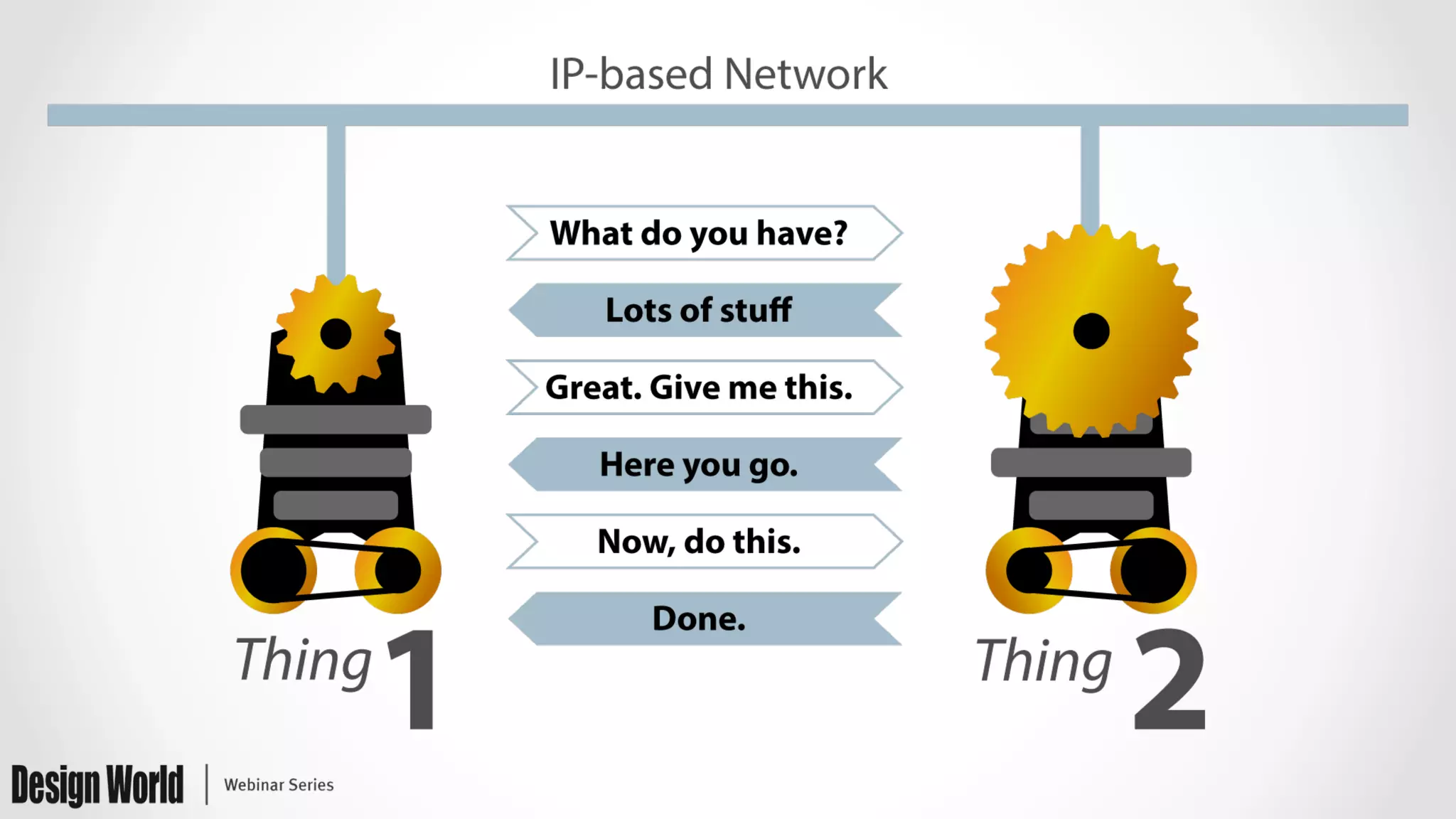
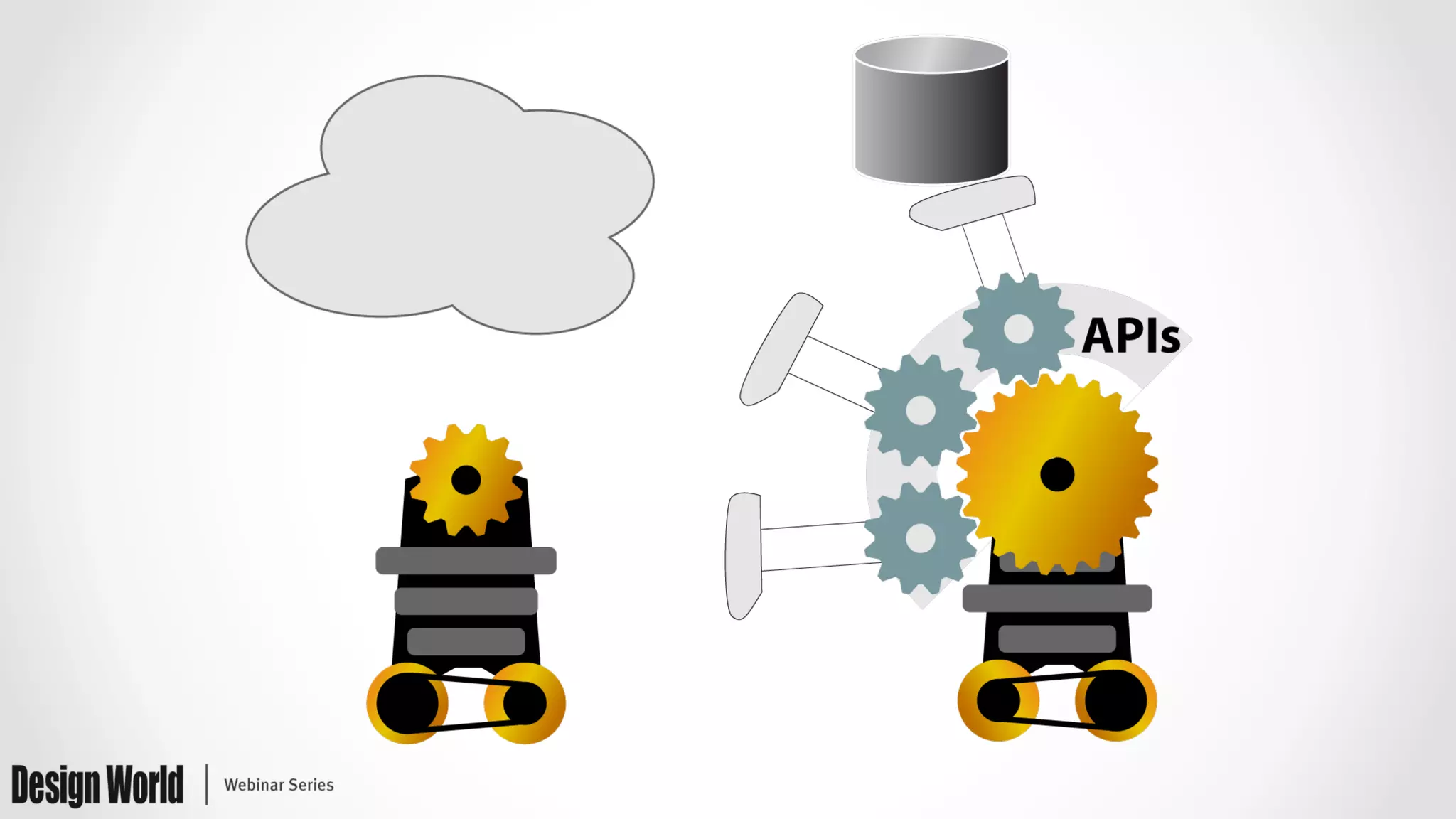
•  Data will move on the internet of things via web protocols
o  API’s, ideally in a RESTful architecture, will be used to bridge different
communication protocols and programming languages
o  API’s are the key to moving data from an embedded development platform using
languages such as C to something the Internet of Things can understand and
interact with
•  Designing your APIs could be as important as your
hardware design!
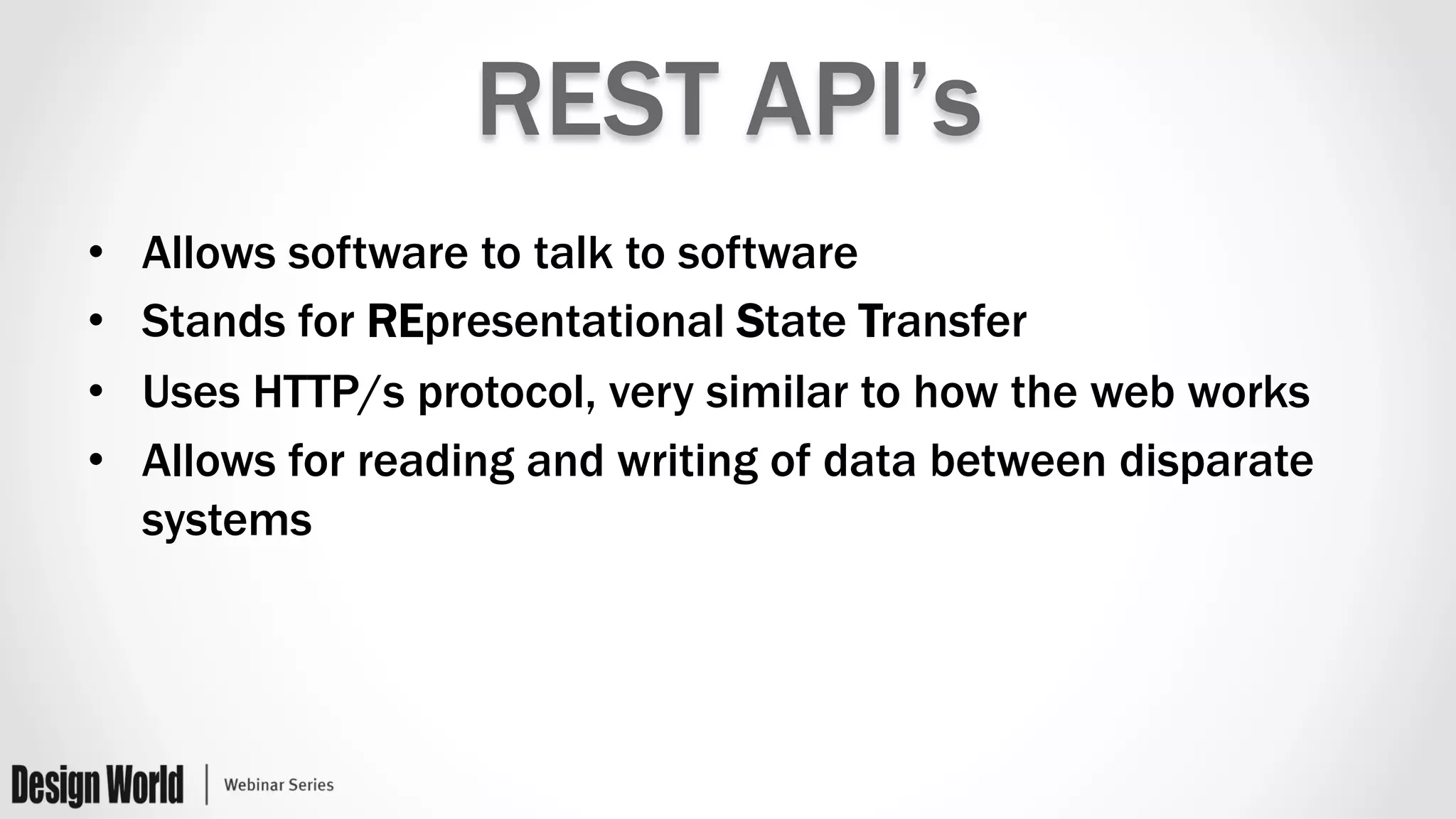
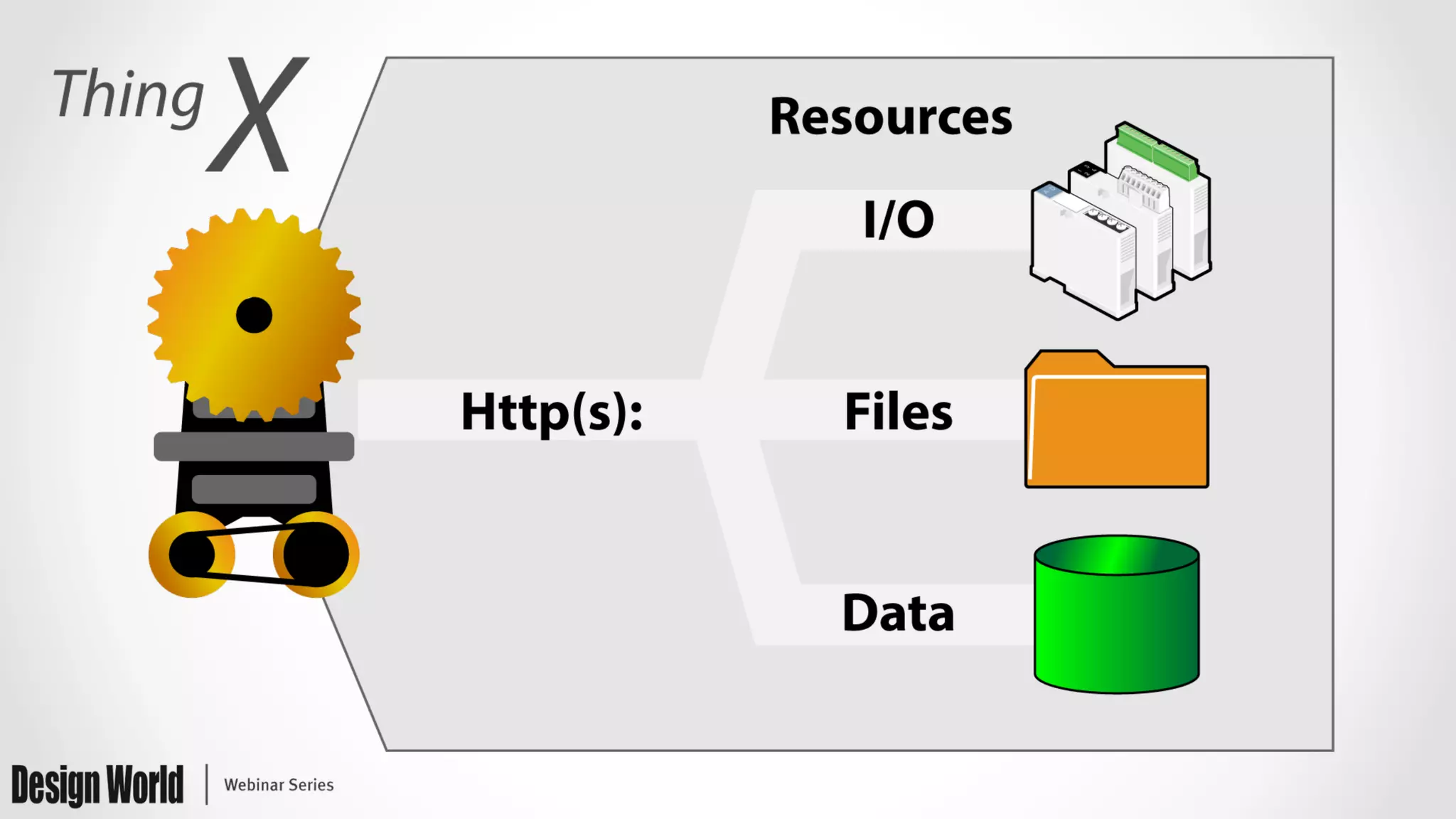
REST API’s
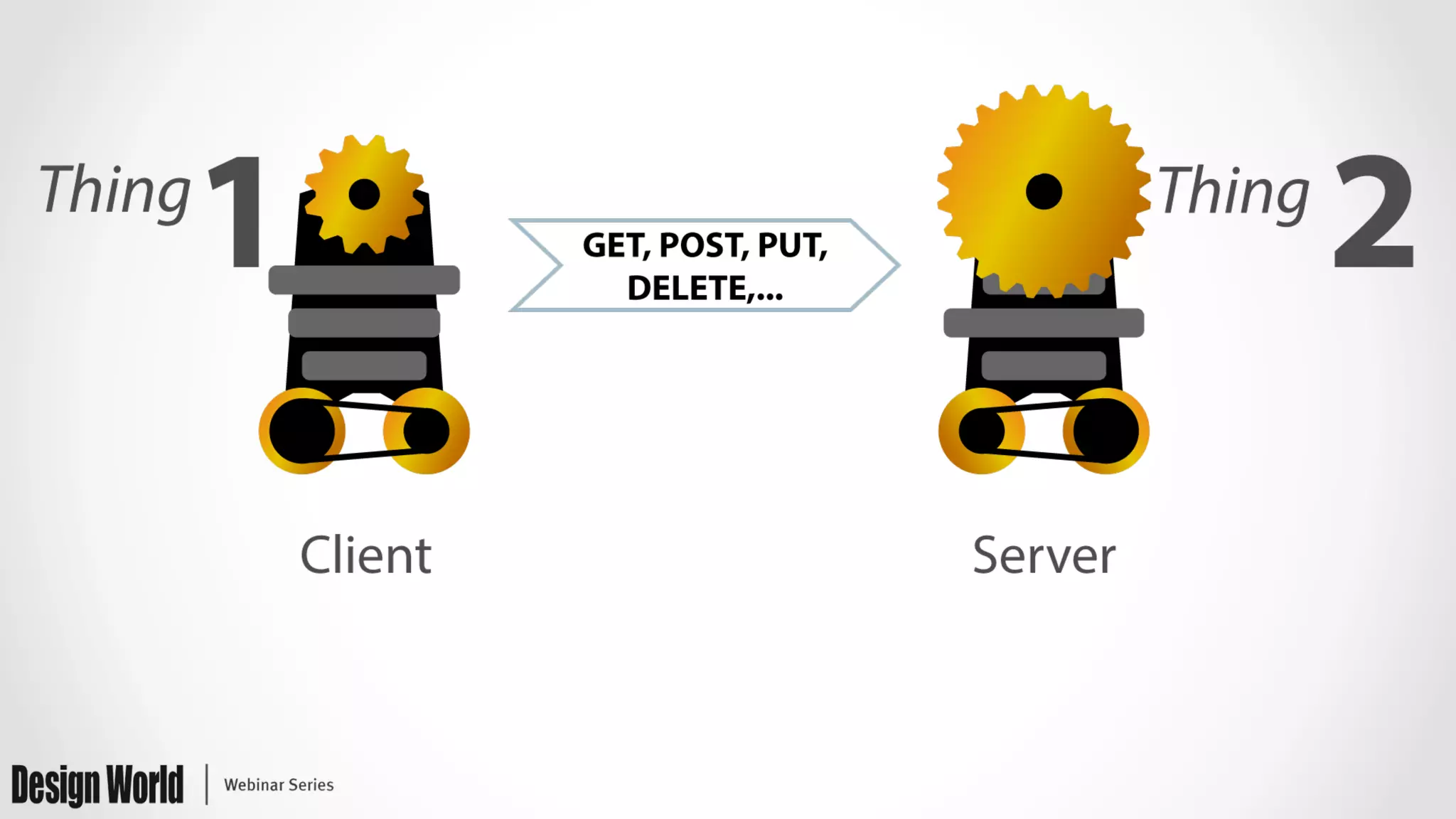
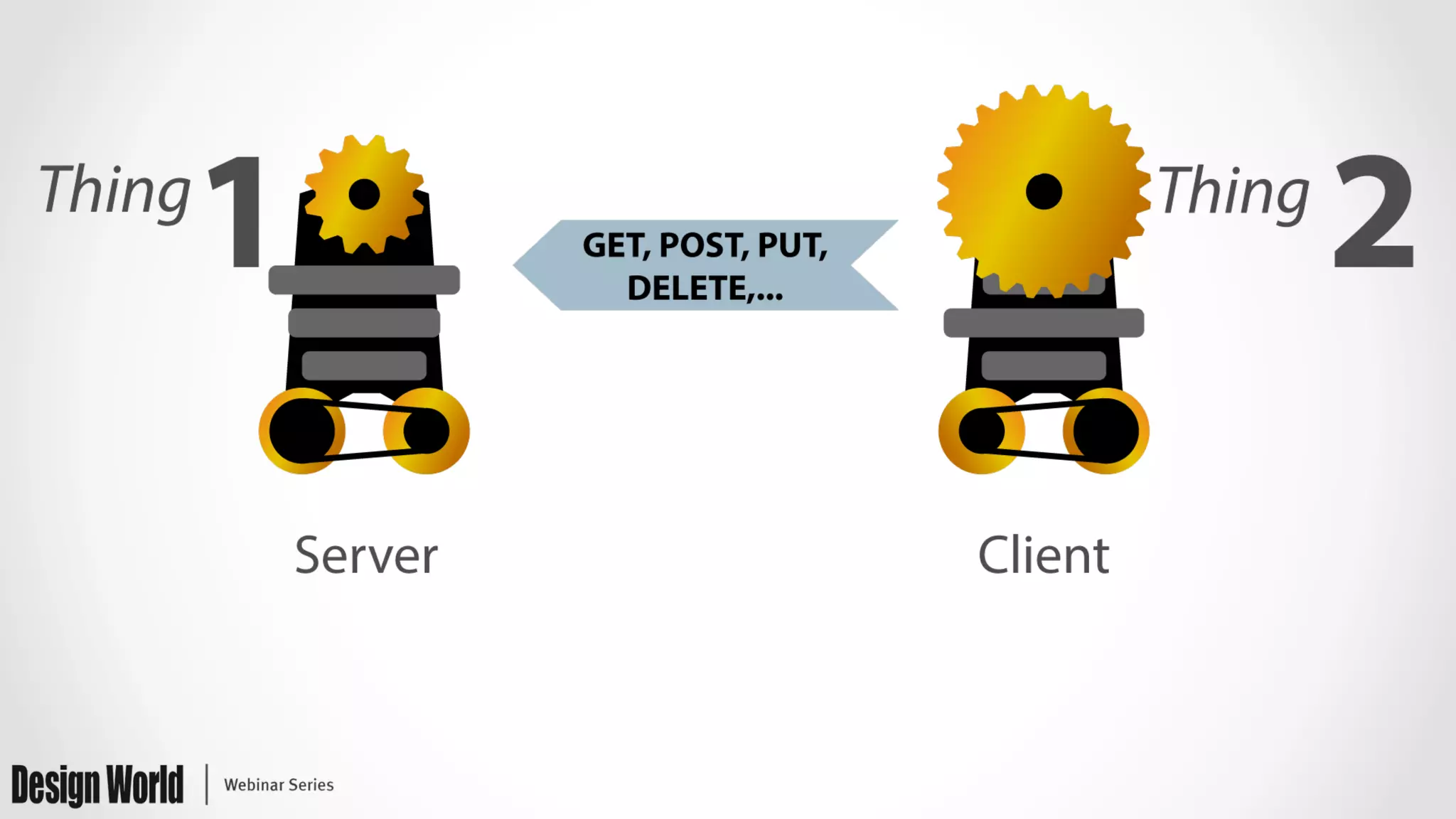
•  Allows software to talk to software
•  Stands for REpresentational State Transfer
•  Uses HTTP/s protocol, very similar to how the web works
•  Allows for reading and writing of data between disparate
systems
A few notes on security
•  When mission critical systems start connecting to the
internet, it’s imperative that they’re well secured
•  Encryption and Authentication should be a design
requirement for all devices going forward
•  It’s easier to design security into a system from the
beginning than it is to add security down the road
IoT Authentication
•  OAuth – Designed to solve the application to application
security problem
o  Version 2.0 uses SSL to generate authentication tokens – Makes it easier to
implement (not an IETF standard, yet; be prepared to change your code)
o  Version 1.0a has more available code libraries to choose from
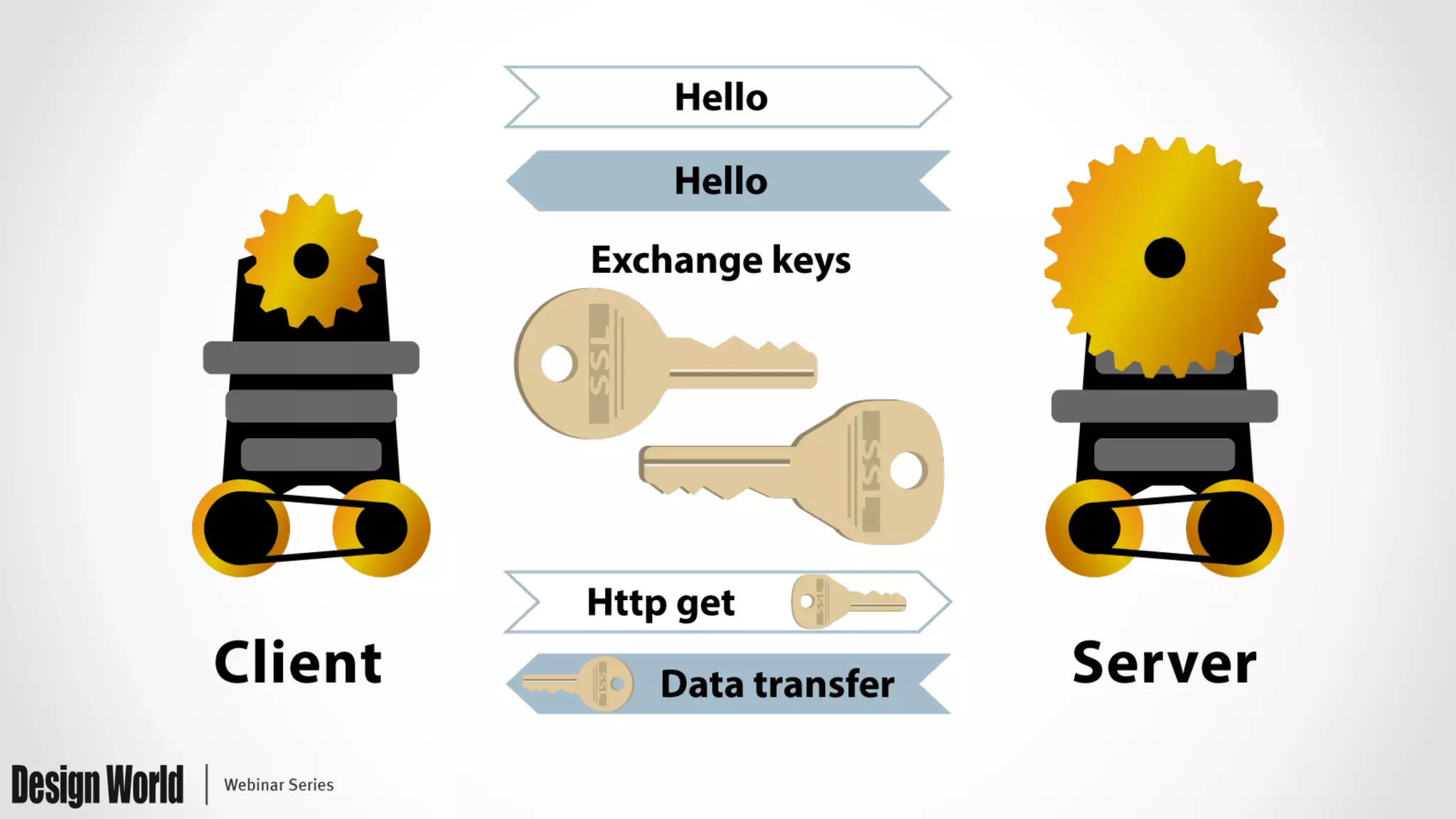
•  API Key – Process to authenticate by exchanging keys
•  Username/Password – Least ideal, requires SSL
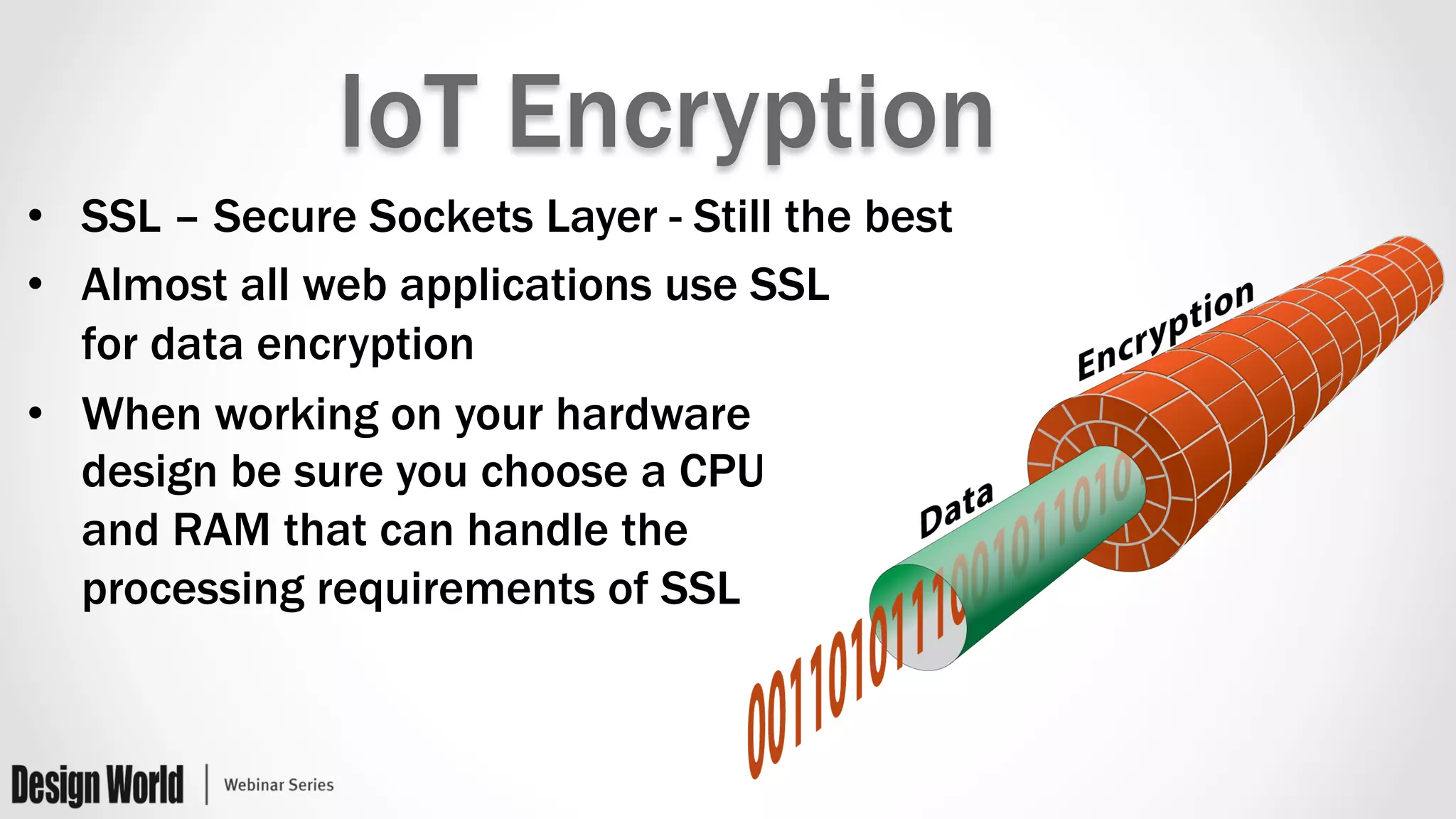
IoT Encryption
•  SSL – Secure Sockets Layer - Still the best
•  Almost all web applications use SSL
for data encryption
•  When working on your hardware
design be sure you choose a CPU
and RAM that can handle the
processing requirements of SSL
IoT in Industrial Automation
•  No standards yet
o  This is good and bad
o  Using an open architecture as opposed to a standard allows for faster development
time and the ability to tailor implementations to specific applications while
maintaining a common thread for general communication
•  The key to rapid adoption of IoT in industrial automation is
the development and publishing of API’s from industrial
automation equipment OEM’s
The Data Problem
•  Last year “things” surpassed humans for generating the
most data on the internet
•  A “connected car” can generate 300 MB of data per
second per car
•  We’re going to run out of bandwidth
•  The price of bandwidth and communication is not going
down as fast as the price of storage and computing power
The Data Solution
•  Push intelligence to the network edge
•  Data mining performed at the sensor aggregation location
can greatly reduce the amount of data sent to the cloud
•  Smart systems such as programmable automation
controllers (PAC’s) can process data and report by
exception as opposed to just dumping data on the network
to be mined later
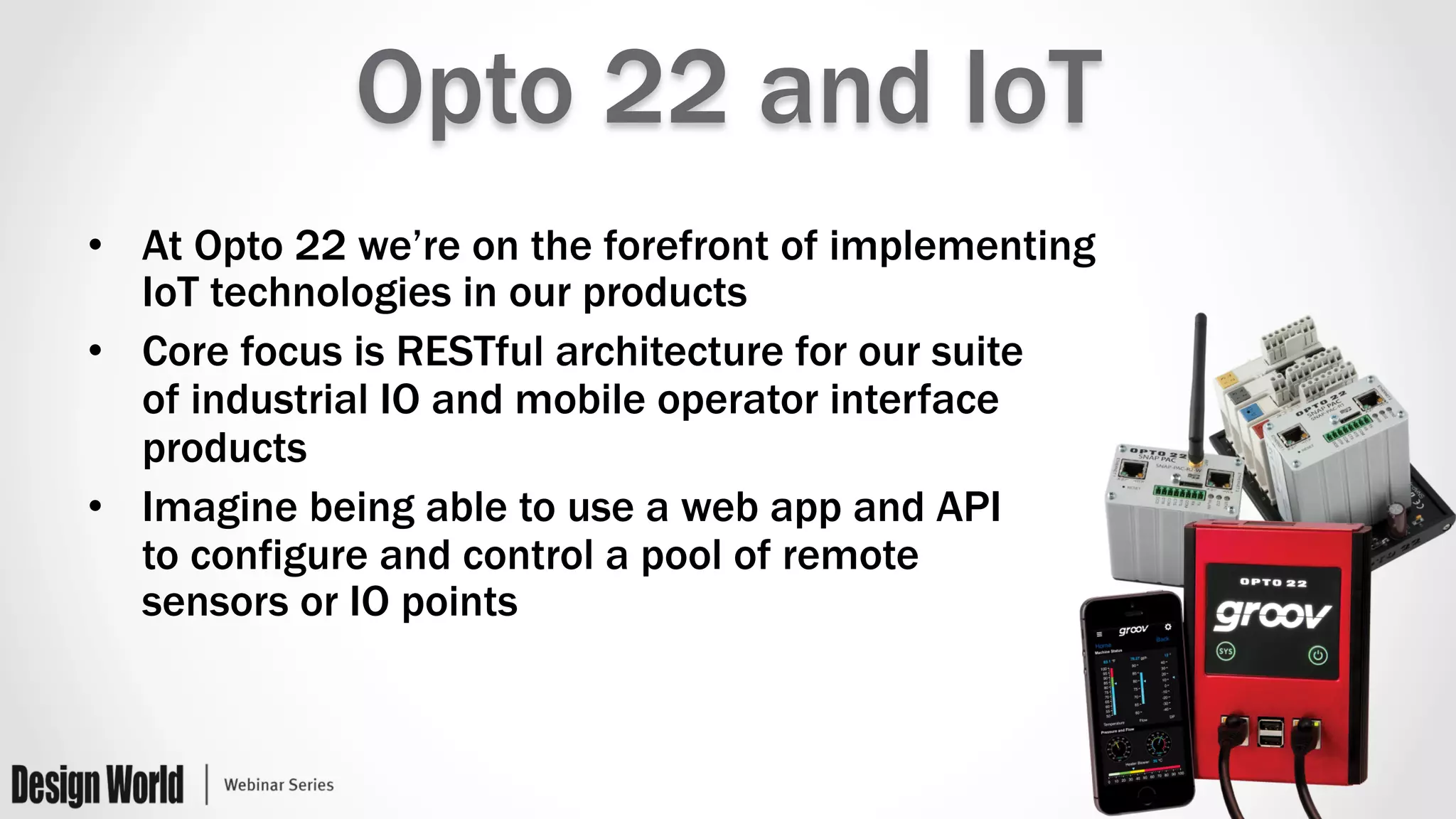
Opto 22 and IoT
•  At Opto 22 we’re on the forefront of implementing
IoT technologies in our products
•  Core focus is RESTful architecture for our suite
of industrial IO and mobile operator interface
products
•  Imagine being able to use a web app and API
to configure and control a pool of remote
sensors or IO points
In conclusion
•  Design systems for IoT from the perspective of a hardware
developer and a software developer
•  RESTful architecture is at the core of IoT
•  Think about security at the beginning of your design
•  Utilize technologies that are already widely available
(RESTful API’s, SSL, HTTP, TCP/IP, etc.)
Thank you
Matt Newton
mnewton@opto22.com / @mnewton7822
The Internet of Things in the design of IntelliSense®
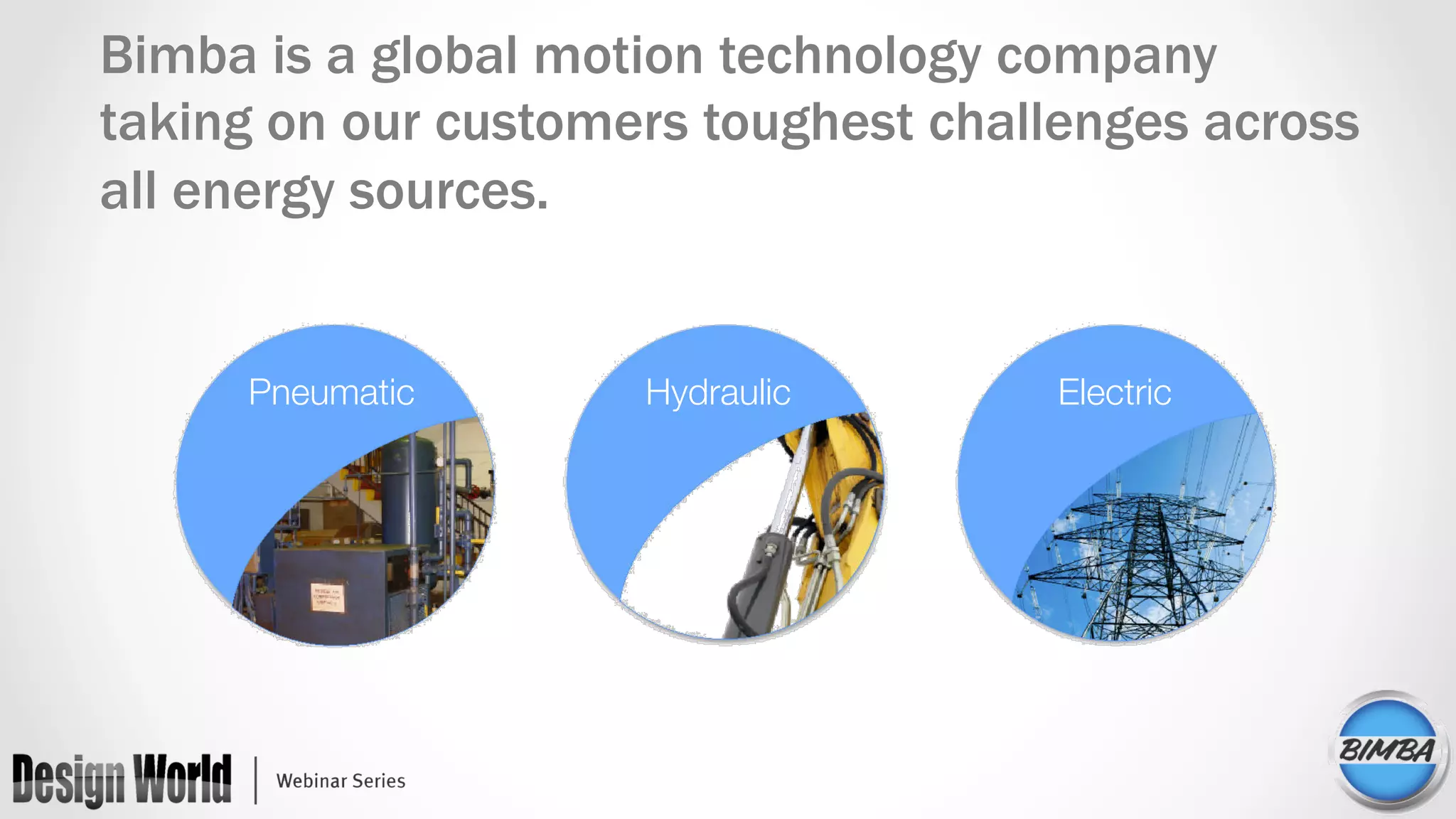
Pneumatic
 Electric
Hydraulic
Bimba is a global motion technology company
taking on our customers toughest challenges across
all energy sources.
Pneumatic
 Electric
Hydraulic
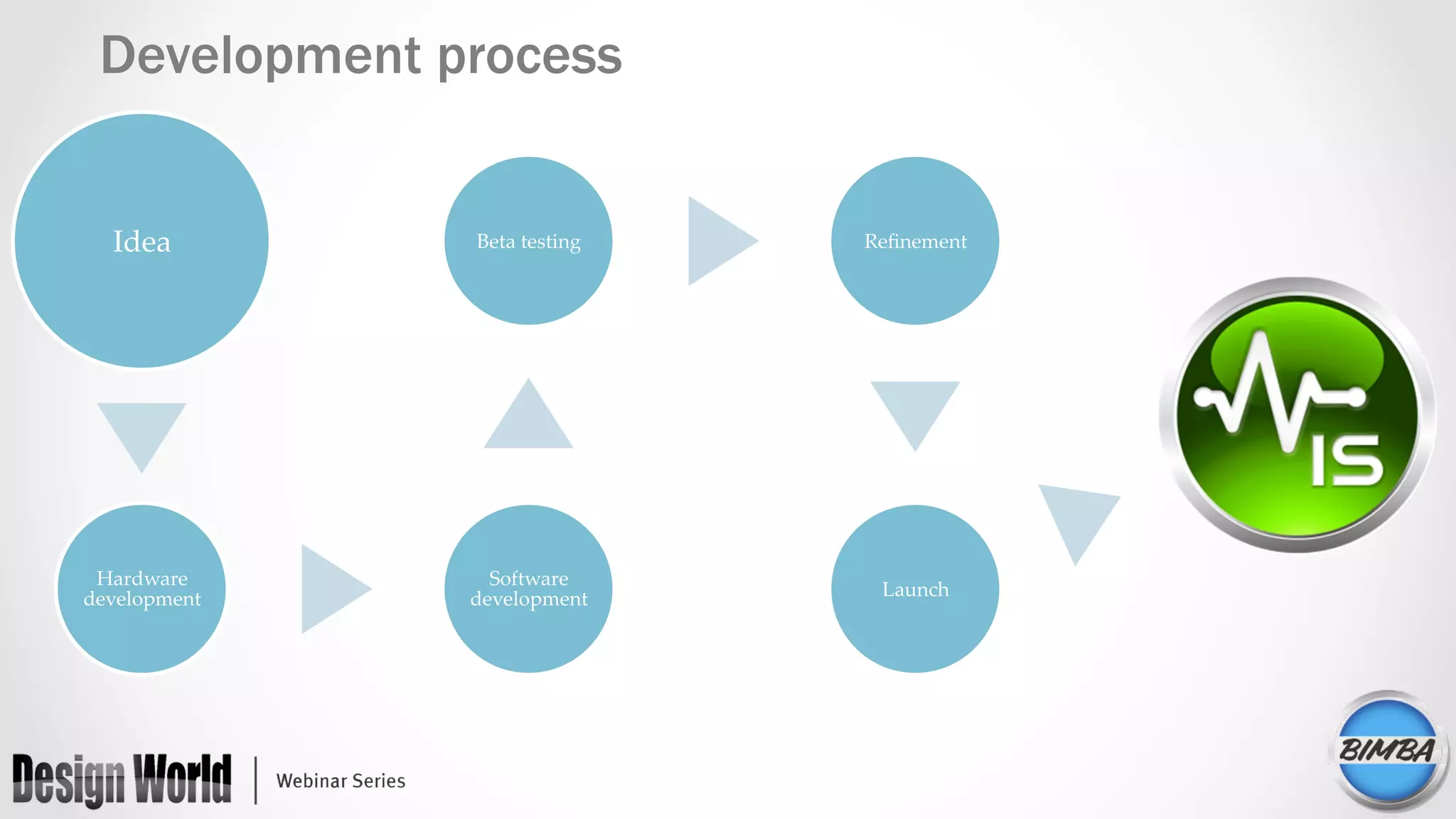
Idea	
Hardware  
development	
Software  
development	
Beta  testing	
 Refinement	
Launch	
IntelliSense®	
Development process
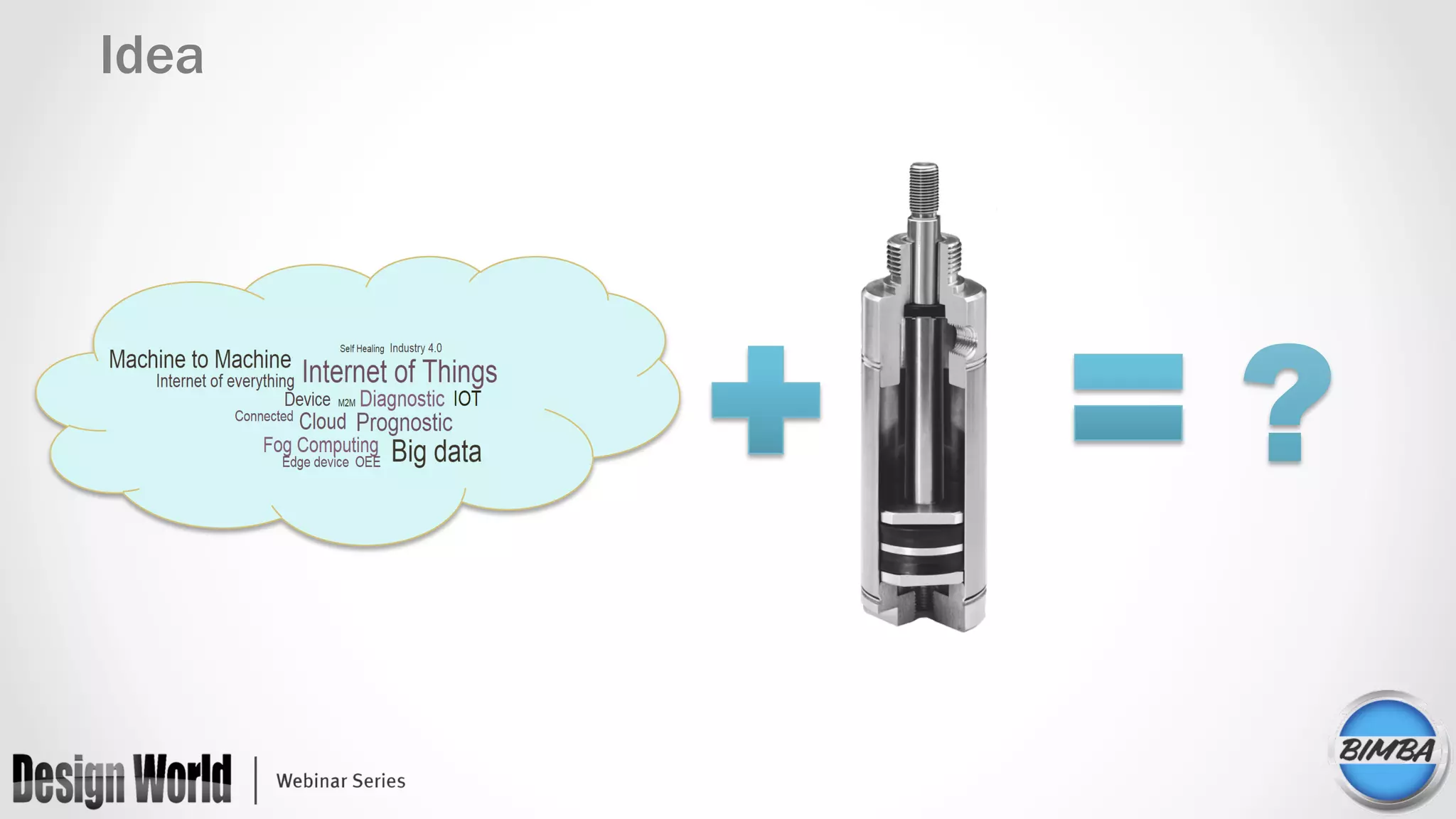
Idea
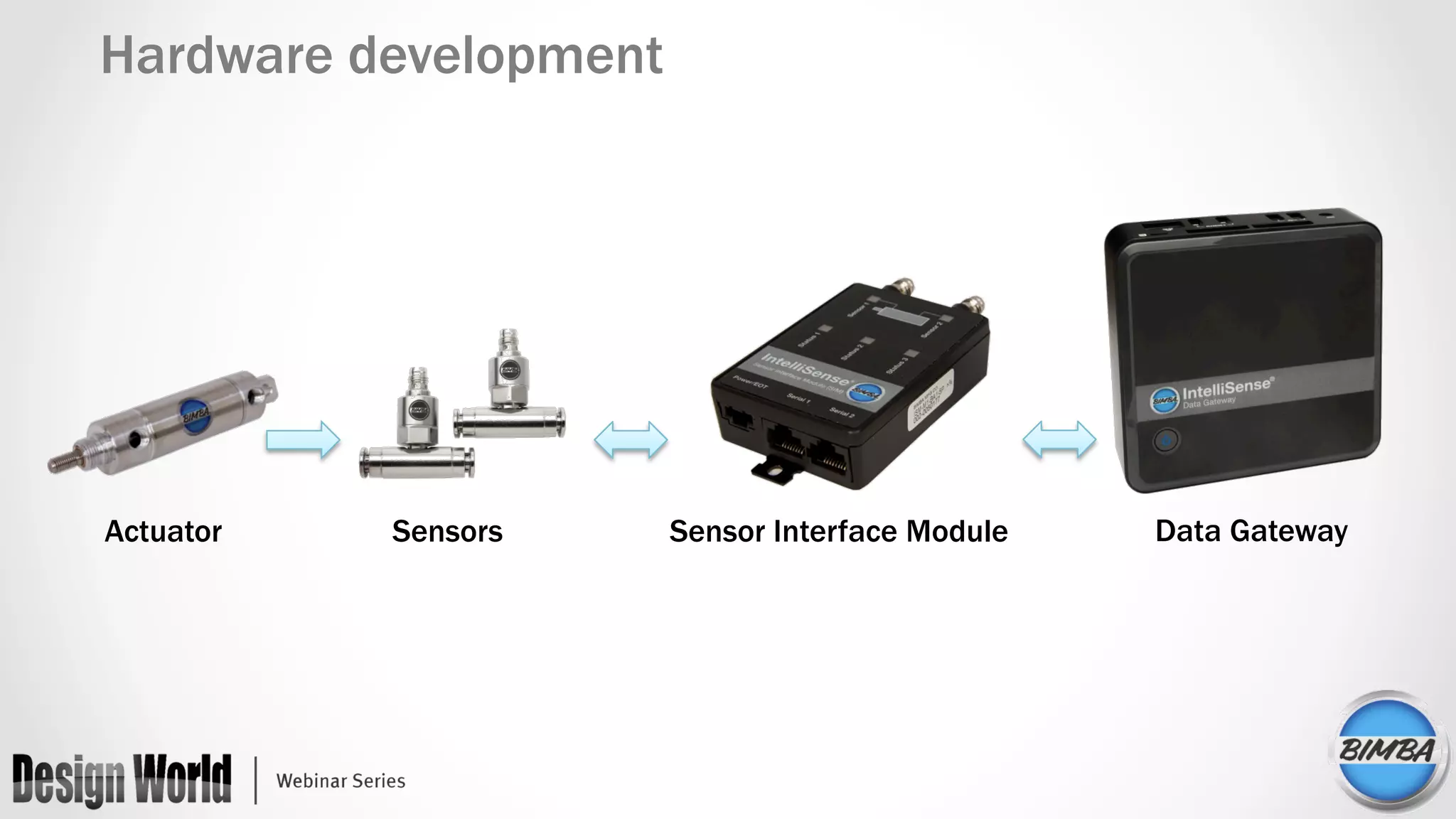
Hardware development
Sensors Sensor Interface Module Data GatewayActuator
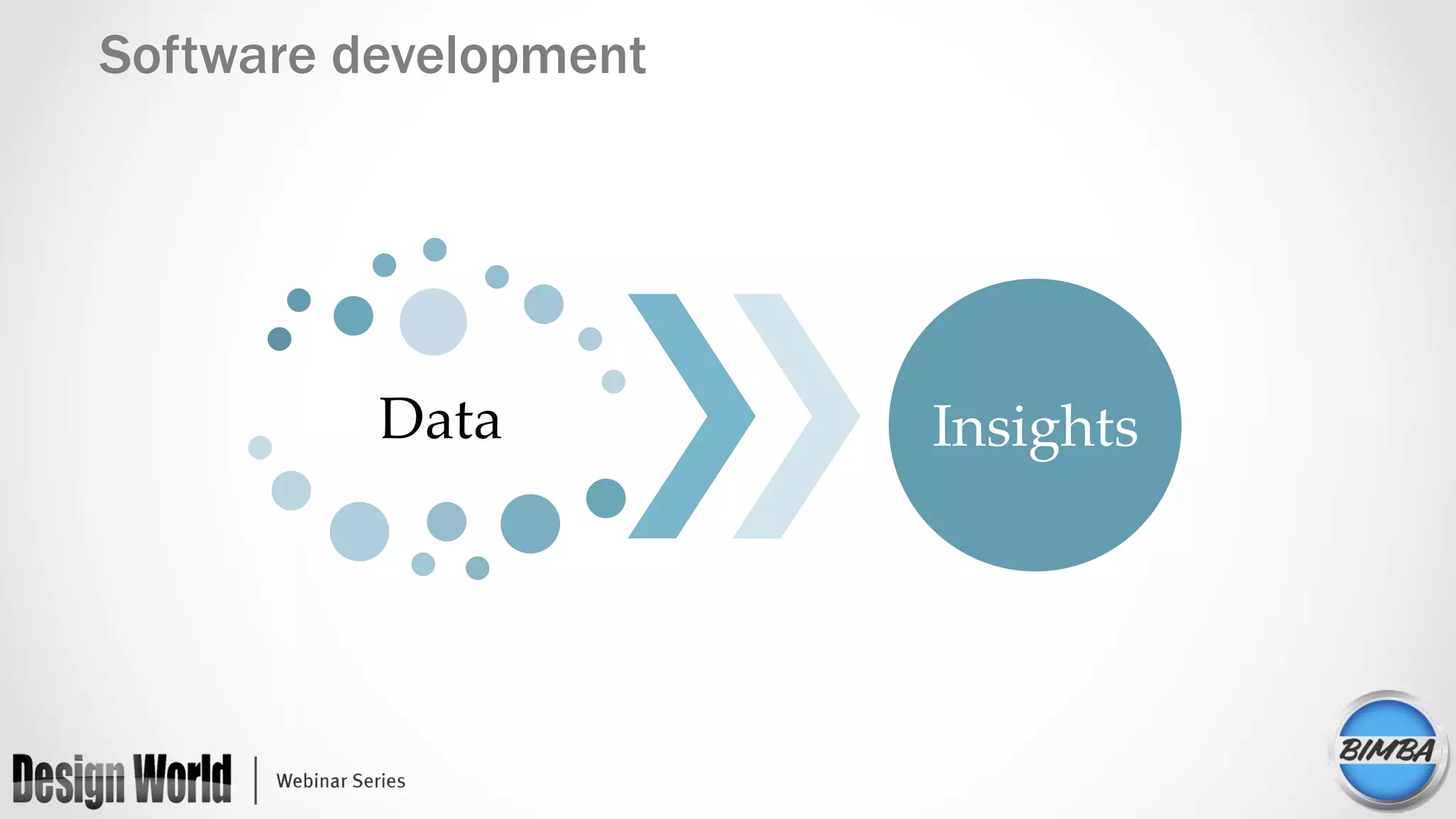
Software development
Data	
 Insights	
  
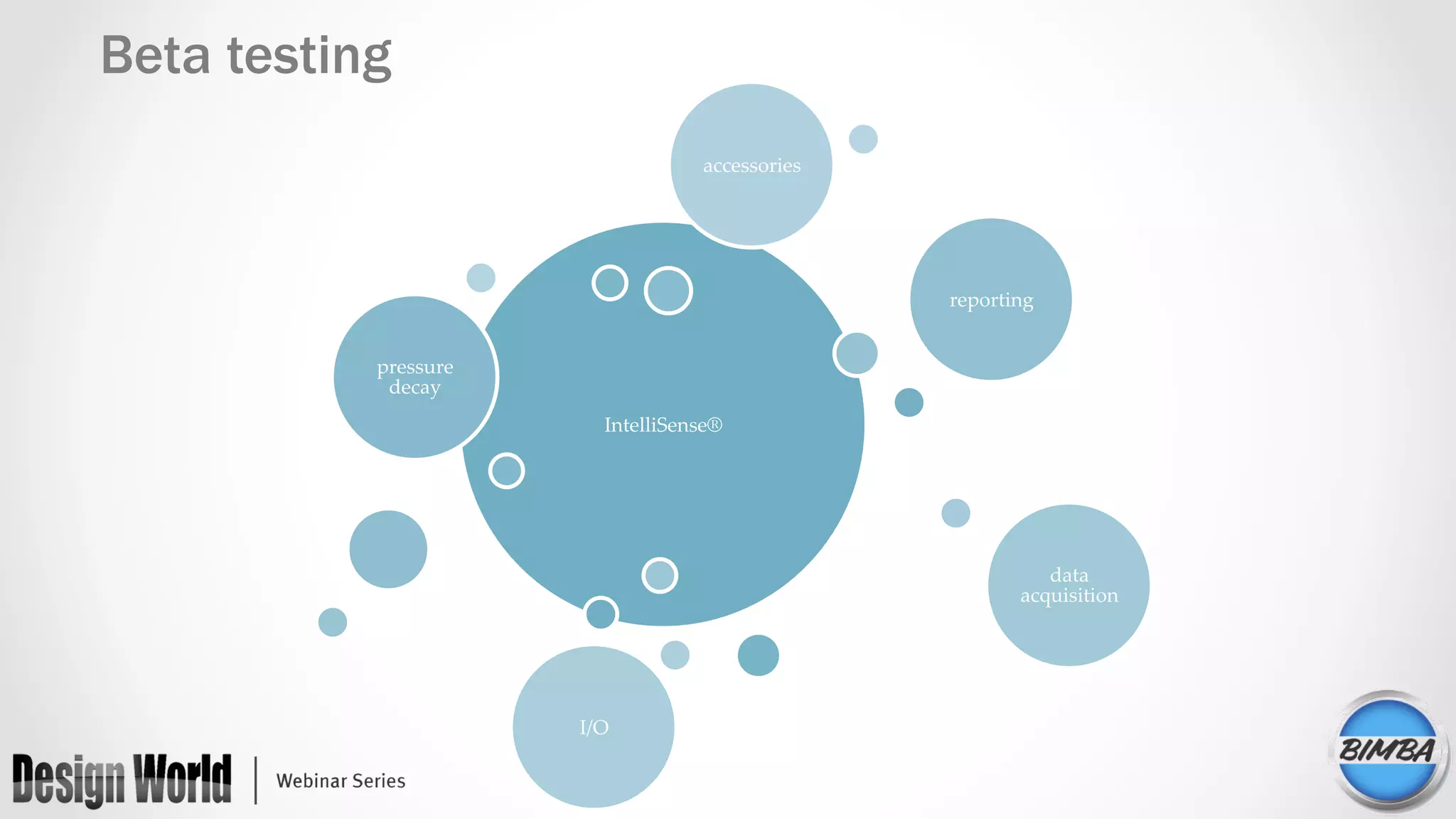
Beta testing
IntelliSense®  	
pressure  
decay	
reporting	
data  
acquisition	
I/O	
accessories
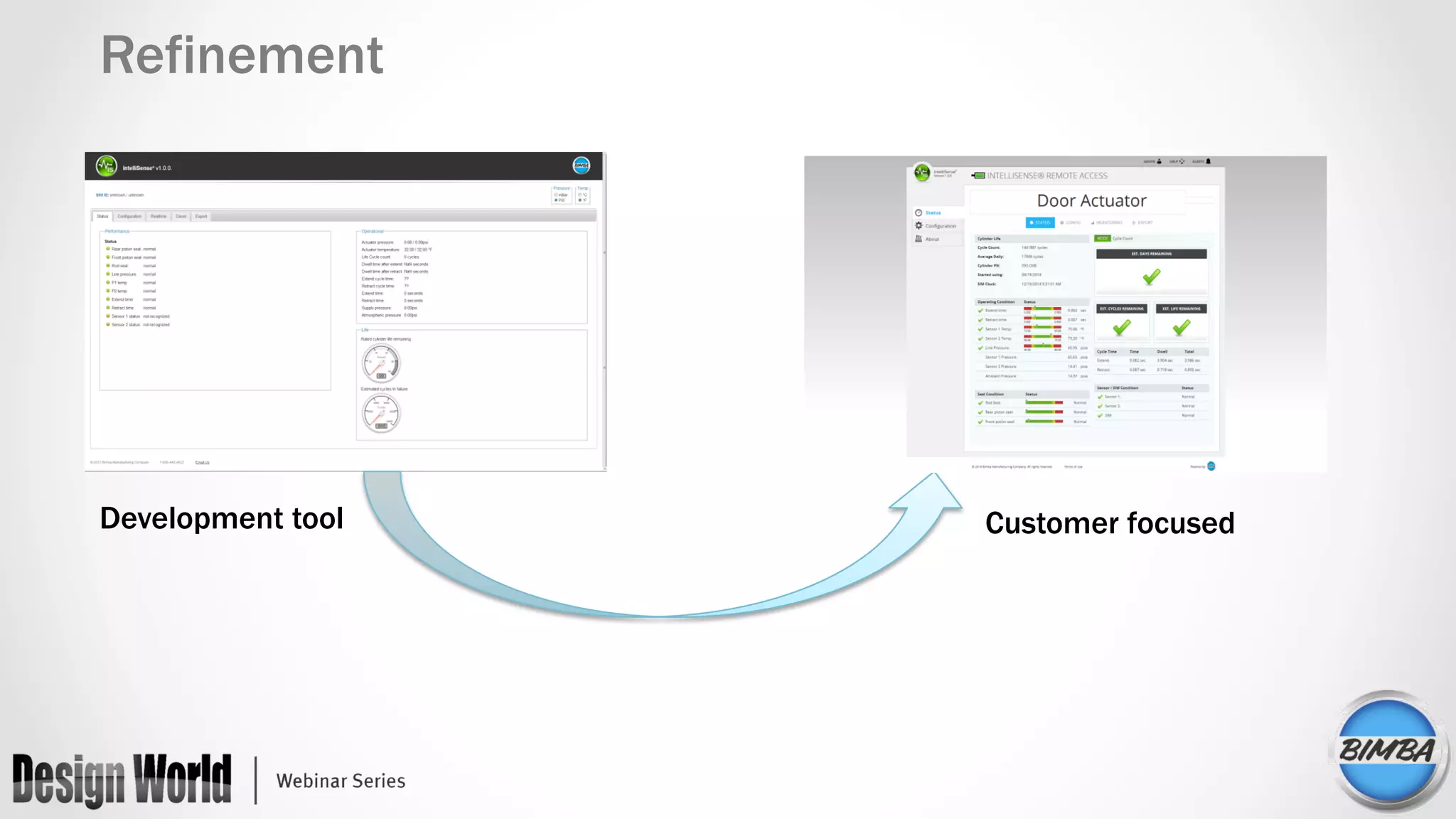
Refinement
Development tool Customer focused
Launch
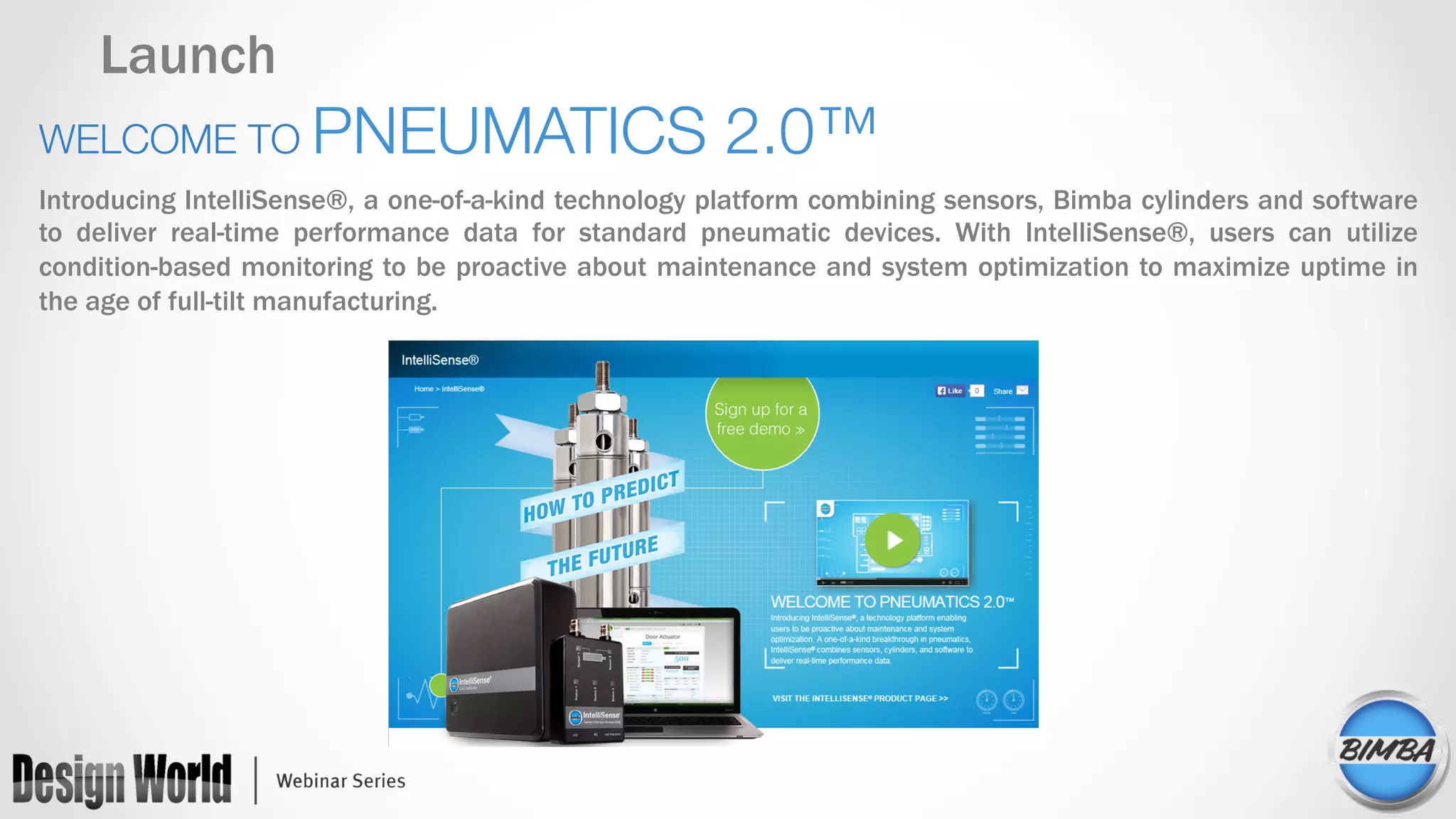
WELCOME TO PNEUMATICS 2.0™
Introducing IntelliSense®, a one-of-a-kind technology platform combining sensors, Bimba cylinders and software
to deliver real-time performance data for standard pneumatic devices. With IntelliSense®, users can utilize
condition-based monitoring to be proactive about maintenance and system optimization to maximize uptime in
the age of full-tilt manufacturing.
•  IoT Value to product design
o  More information
o  New opportunities
•  Approaching design for the IoT
o  First question is how can we connect our products to the IoT
o  Know your capabilities
•  Customers view of IoT
o  Enhanced control
o  Better documentation
o  More informed decision
•  Challenges in implementing the IoT
o  Competing standards
o  Scalability
•  Design consideration for the IoT
o  User experience
o  Scope creep
Summary
Questions?
Leslie Langnau
Design World
llangnau@wtwhmedia.com
Gil Reiter
Texas Instruments
gilre@ti.com
Jeremy King
Bimba Manufacturing
kingj@bimba.com
Matt Newton
Opto 22
mnewton@opto22.com
Thank You
q  This webinar will be available at
designworldonline.com & email
q  Tweet with hashtag #DWwebinar
q  Connect with Design World
q  Discuss this on EngineeringExchange.com

Tips on designing for the Internet of Things

  • 1.
    Tips on Designingfor the Internet of Things
  • 2.
    q  This webinarwill be available afterwards at www.designworldonline.com & via email q  Q&A at the end of the presentation q  Hashtag for this webinar: #DWwebinar Before We Start
  • 3.
    Moderator Presenters Leslie Langnau DesignWorld Gil Reiter Texas Instruments Jeremy King Bimba Manufacturing Matt Newton Opto 22
  • 4.
    The Internet ofIndustrial Things: Opportunities & Challenges Gil  Reiter IoT  strategic  marketing
  • 5.
    What is theIoT ? How  is  IoT  different  than  M2M? •  M2M  focused  on  connecting  machines  –   mainly  proprietary  closed  systems •  IoT  is  about  harmonizing  the  way   humans  and  machines  connect  using   common  public  services People  Things   Cloud  Services   Things,  people  and  cloud  services  geBing   connected  via  the  Internet  to  enable  new   use  cases  and  business  models
  • 6.
    A typical IoTApplication IoT cloud IoT node Sensors & Actuators IoT gateway (optional) Router Remote control Monitor & Analytics Sense Store Present AnalyzeDecideControl
  • 7.
    What is drivingthe industrial IoT ? Users •  Easier  technician  control  through   smartphone/tablet •  Wireless  remote  control  and  monitoring •  Use  standard  smart  phone  or  tablets Businesses •  Improved  manufacturing  time •  Sell  more  products/services •  Reduce  expenses/energy
  • 8.
    IoT is anenabling technology Health  Care •  Remote  monitoring •  Ambulance  telemetry •  Drugs  tracking •  Hospital  asset     tracking •  Access  control •  Predictive     maintenance Smart  Manufacturing •  Flow  optimization •  Real-­‐‑time  inventory •  Asset  tracking •  Employee  safety •  Predictive  maintenance •  Firmware  updates Automotive •  Infotainment •  Wire  replacement •  Telemetry •  Predictive  maintenance •  C2C  and  C2I Wearables •  Entertainment •  Fitness •  Smart  watch •  Location  and  tracking Smart  Cities •  Residential  E-­‐‑meters •  Smart  street  lights •  Pipeline  leak  detection •  Traffic  control •  Surveillance  cameras •  Centralized  and  integrated  system   control Building  &  Home  Automation •  Access  control •  Light  and  temp  control •  Energy  optimization •  Predictive  maintenance •  Connected  appliances
  • 9.
    Only TI hasall the IoT building blocks Processors MCUs Wired  &   Wireless   Connectivity Sensing Analog   Signal   Chain Power   Management Nodes MCUs Processors Wired  &   Wireless   Connectivity Multicore   Processors Analog   Signal   Chain Power   Management Analog   Signal   Chain Power   Management Cloud Gateway,   Bridge  or   Router
  • 10.
    IoT example endequipments Cloud Hybrid  gateway   Wi-­‐‑Fi Sitara   Processor Sub-­‐‑1GHz Power   Management Keystone   Multicore Purpose-­‐‑built  server Keystone   Multicore   Processor Power   Management Analog Signal Chain MSP430   MCU Sub-­‐‑1GHz Sensing Analog   Signal   Chain Power   Management Flow  meter
  • 11.
    But there arechallenges Sensing  a  complex   environment Multiple   connectivity  options Security  is  a  must Power  is  critical The  IoT  is  complex Connecting   to  the  cloud environment pressure humidity light chemical biosensing gas current/power material composition occupancy temperature proximity position/motion
  • 12.
    Sensing technology isa must CHALLENGE WHAT IS NEEDED Sensing  a  complex  environment Innovative  ways  to  sense  and   deliver  information TI  DELIVERS Biosensing Chemical Current  /  power Light Humidity Gas Material  composition Occupancy Position  /  motion Pressure Proximity Temperature Sensing  technologies  that  address  a  wide  variety  of  applications   www.ti.com/sensing
  • 13.
    No one connectivitystandard will win in the IoT CHALLENGE WHAT IS NEEDED Connectivity:   One  size  doesn’t  fit  all Broad  variety  of  wired  or     wireless  standards TI  DELIVERS •  Low  power  mesh  network •  Smart  metering  &  lighting •  Moving  into  home  automation •  Fast,  low  latency  Ethernet •  Real-­‐‑time  industrial  control •  Information  technology •  Fast  –  10Mbps++ •  Direct  Internet  connection •  Home  &  enterprise  apps •  Data  over  power  lines  (OFDM) •  Developed  for  smart  grid •  Lighting,  solar,  appliances •  Lowest  power  BLE •  Connect  to  tablet/phone •  Moving  to  industrial,  automotive •  Low  power  &  long  range •  Native  IP-­‐‑based  network •  Home  gateways  and  security 2.4GHz IEEE 802.15.4 IEEE  P1901.2  
  • 14.
    System-level approach topower is required CHALLENGE WHAT IS NEEDED Power  is  critical The  lowest  power  solutions     for  any  application TI  DELIVERS Harvesting  power  and  stretching  baBery  life Thermal RFLight Vibration Days  to  years  of  baBery  operation  or  harvested-­‐‑powered  devices Power management & precision analog ICs Low-power microcontrollers MSP430™ MCU TM4C MCU Low-power wireless connectivity Wi-­‐‑Fi Bluetooth ZigBee Sub-­‐‑1  GHz Wi-­‐‑Fi-­‐‑based  sensors  running  on  2xAA  baBeries  over  1  year ZigBee/6LoWPAN-­‐‑based  light  switch  running  on  coin  cell  baBery  for  10  years
  • 15.
    Security is vitalat all layers CHALLENGE WHAT IS NEEDED Security  is  a  must Built-­‐‑in  hardware  security   technology TI  DELIVERS Security  solutions  to  prevent,  detect  and  respond  to  unintended  or  malicious   behavior Protecting  manufacturers’  and  consumers’  devices,  solutions  and  services Hardware   Connectivity   Software   Symmetric     cryptography   IP     protection Authentication     &  anti-­‐‑cloning   Tamper     protection  
  • 16.
    The IoT mustbe easy CHALLENGE WHAT IS NEEDED Complexity IoT  solutions  for  everyone,   not  just  experts TI  DELIVERS Solutions  that  are  making  the  IoT  easy  for  system  designers Our  customers  get   ease  of  set  up  and  use TI  and  our  Ecosystem   Encapsulated  wireless  connectivity: •  Modules  and  reference  designs  eliminating  need  for  RF   expertise •  On-­‐‑chip  Internet  connectivity  SW  stack  and  comprehensive   development  environment Example  designs  and  all  the  building  blocks   Make   anything   wireless  in   minutes
  • 17.
    Making it Easierto Connect to the Cloud CHALLENGE WHAT  IS  NEEDED Connecting  end-­‐‑to-­‐‑end  and   enabling  applications Ecosystem  of  cloud  partners  to   enable  easy  integration TI  DELIVERS Open  ecosystem  of  IoT  cloud  service  providers   Faster  time  to  market  of  new  devices  and  services  based  on  TI’s  IoT  silicon  solutions.   Meets  individual  needs  of  manufacturers.
  • 18.
    Typical IoT cloudservicesThings Scripting Notifications Web  dashboard Database Analytics  Applications  APIs OTA  Manager Device   Configuration Protocols  Device  & User  Registration Cloud Cloud   Agent  /  API Sensors     &  Actuators Collaboration  between  TI  and   cloud  partners  enables  customers   to  develop  IoT  applications   quickly  
  • 19.
    Making the IoTof 2020 happen Challenges What is needed Connectivity:   One  size  doesn’t  fit  all Broad  variety  of  wired  or     wireless  standards Power  is  critical The  lowest  power  solutions  for  any   application Security  is  a  must Built-­‐‑in  hardware  security  technology Complexity IoT  solutions  for  everyone,   not  just  experts Connecting  to  the  cloud Ecosystem  of  cloud  partners  to  enable   seamless  integration Sensing  is  vital   Innovative  sensing  technology
  • 20.
    Designing for the Internetof Things Matt Newton mnewton@opto22.com
  • 21.
    IoT Benefits •  Smartproducts take corrective action to prevent equipment failure and keep production running
  • 22.
    o  An injectionmolding machine monitors the viscosity of it’s pump motor oil and takes itself offline if the oil is dirty, emails management and automatically logs a trouble ticket with maintenance technicians
  • 23.
    o  A remotenatural gas separator phones home to tell operators its batteries are no longer charging and production will soon stop
  • 24.
    IoT Benefits •  Datais easily shared among peer groups for faster problem identification and resolution
  • 25.
    o  Doctors acrossthe world are able to treat patients more quickly and efficiently by providing telemedicine as opposed to on site doctor visits – More patients are able to obtain medical care o  The CDC uses Big Data analysis of remote medical sensor data reported by hospitals to preemptively spot flu outbreaks – pattern recognition
  • 26.
    IoT Benefits •  Yourhome becomes “smart” and proactively solves problems for you
  • 27.
    o  Your refrigeratoremails you on your way home to remind you you’re out of milk o  Your thermostat recognizes your smart phone has been off the Wi-Fi network for over an hour indicating you are likely not home, turns off your AC compressor and sends you a text message letting you know what corrective action it took. Taking that one step further, you email your thermostat back and tell it to turn the AC back on.
  • 29.
    A New Paradigm • It’s no longer about how fast a business can react to events •  IoT and Big Data can provide real-time insight into all aspects of a business’s operations •  The future will be about anticipating events before they occur to achieve the largest competitive advantage
  • 30.
    How do weget there? •  There are some inherent challenges with IoT o  How do we all speak the same language? o  Bridging the gap between embedded systems languages such as C and web languages such as JavaScript •  It’s not just about hardware, but hardware is important. Software design is key •  Leverage existing technologies, standards and architectures – it’s all available today!
  • 31.
    Hardware Considerations •  Firstwe need to get the device on a network •  Ethernet (MAC/PHY) or Wi-Fi connectivity (802.11 chipset) •  TCP/IP stack •  Enough processing power and RAM to handle security o  Encryption/SSL o  Authentication
  • 32.
    Software Considerations •  Datawill move on the internet of things via web protocols o  API’s, ideally in a RESTful architecture, will be used to bridge different communication protocols and programming languages o  API’s are the key to moving data from an embedded development platform using languages such as C to something the Internet of Things can understand and interact with •  Designing your APIs could be as important as your hardware design!
  • 33.
    REST API’s •  Allowssoftware to talk to software •  Stands for REpresentational State Transfer •  Uses HTTP/s protocol, very similar to how the web works •  Allows for reading and writing of data between disparate systems
  • 39.
    A few noteson security •  When mission critical systems start connecting to the internet, it’s imperative that they’re well secured •  Encryption and Authentication should be a design requirement for all devices going forward •  It’s easier to design security into a system from the beginning than it is to add security down the road
  • 40.
    IoT Authentication •  OAuth– Designed to solve the application to application security problem o  Version 2.0 uses SSL to generate authentication tokens – Makes it easier to implement (not an IETF standard, yet; be prepared to change your code) o  Version 1.0a has more available code libraries to choose from •  API Key – Process to authenticate by exchanging keys •  Username/Password – Least ideal, requires SSL
  • 42.
    IoT Encryption •  SSL– Secure Sockets Layer - Still the best •  Almost all web applications use SSL for data encryption •  When working on your hardware design be sure you choose a CPU and RAM that can handle the processing requirements of SSL
  • 43.
    IoT in IndustrialAutomation •  No standards yet o  This is good and bad o  Using an open architecture as opposed to a standard allows for faster development time and the ability to tailor implementations to specific applications while maintaining a common thread for general communication •  The key to rapid adoption of IoT in industrial automation is the development and publishing of API’s from industrial automation equipment OEM’s
  • 44.
    The Data Problem • Last year “things” surpassed humans for generating the most data on the internet •  A “connected car” can generate 300 MB of data per second per car •  We’re going to run out of bandwidth •  The price of bandwidth and communication is not going down as fast as the price of storage and computing power
  • 45.
    The Data Solution • Push intelligence to the network edge •  Data mining performed at the sensor aggregation location can greatly reduce the amount of data sent to the cloud •  Smart systems such as programmable automation controllers (PAC’s) can process data and report by exception as opposed to just dumping data on the network to be mined later
  • 46.
    Opto 22 andIoT •  At Opto 22 we’re on the forefront of implementing IoT technologies in our products •  Core focus is RESTful architecture for our suite of industrial IO and mobile operator interface products •  Imagine being able to use a web app and API to configure and control a pool of remote sensors or IO points
  • 47.
    In conclusion •  Designsystems for IoT from the perspective of a hardware developer and a software developer •  RESTful architecture is at the core of IoT •  Think about security at the beginning of your design •  Utilize technologies that are already widely available (RESTful API’s, SSL, HTTP, TCP/IP, etc.)
  • 48.
  • 49.
    The Internet ofThings in the design of IntelliSense® Pneumatic Electric Hydraulic
  • 50.
    Bimba is aglobal motion technology company taking on our customers toughest challenges across all energy sources. Pneumatic Electric Hydraulic
  • 51.
    Idea Hardware   development Software   development Beta testing Refinement Launch IntelliSense® Development process
  • 52.
  • 53.
    Hardware development Sensors SensorInterface Module Data GatewayActuator
  • 54.
  • 55.
    Beta testing IntelliSense®   pressure  decay reporting data   acquisition I/O accessories
  • 56.
  • 57.
    Launch WELCOME TO PNEUMATICS2.0™ Introducing IntelliSense®, a one-of-a-kind technology platform combining sensors, Bimba cylinders and software to deliver real-time performance data for standard pneumatic devices. With IntelliSense®, users can utilize condition-based monitoring to be proactive about maintenance and system optimization to maximize uptime in the age of full-tilt manufacturing.
  • 58.
    •  IoT Valueto product design o  More information o  New opportunities •  Approaching design for the IoT o  First question is how can we connect our products to the IoT o  Know your capabilities •  Customers view of IoT o  Enhanced control o  Better documentation o  More informed decision •  Challenges in implementing the IoT o  Competing standards o  Scalability •  Design consideration for the IoT o  User experience o  Scope creep Summary
  • 59.
    Questions? Leslie Langnau Design World llangnau@wtwhmedia.com GilReiter Texas Instruments gilre@ti.com Jeremy King Bimba Manufacturing kingj@bimba.com Matt Newton Opto 22 mnewton@opto22.com
  • 60.
    Thank You q  Thiswebinar will be available at designworldonline.com & email q  Tweet with hashtag #DWwebinar q  Connect with Design World q  Discuss this on EngineeringExchange.com