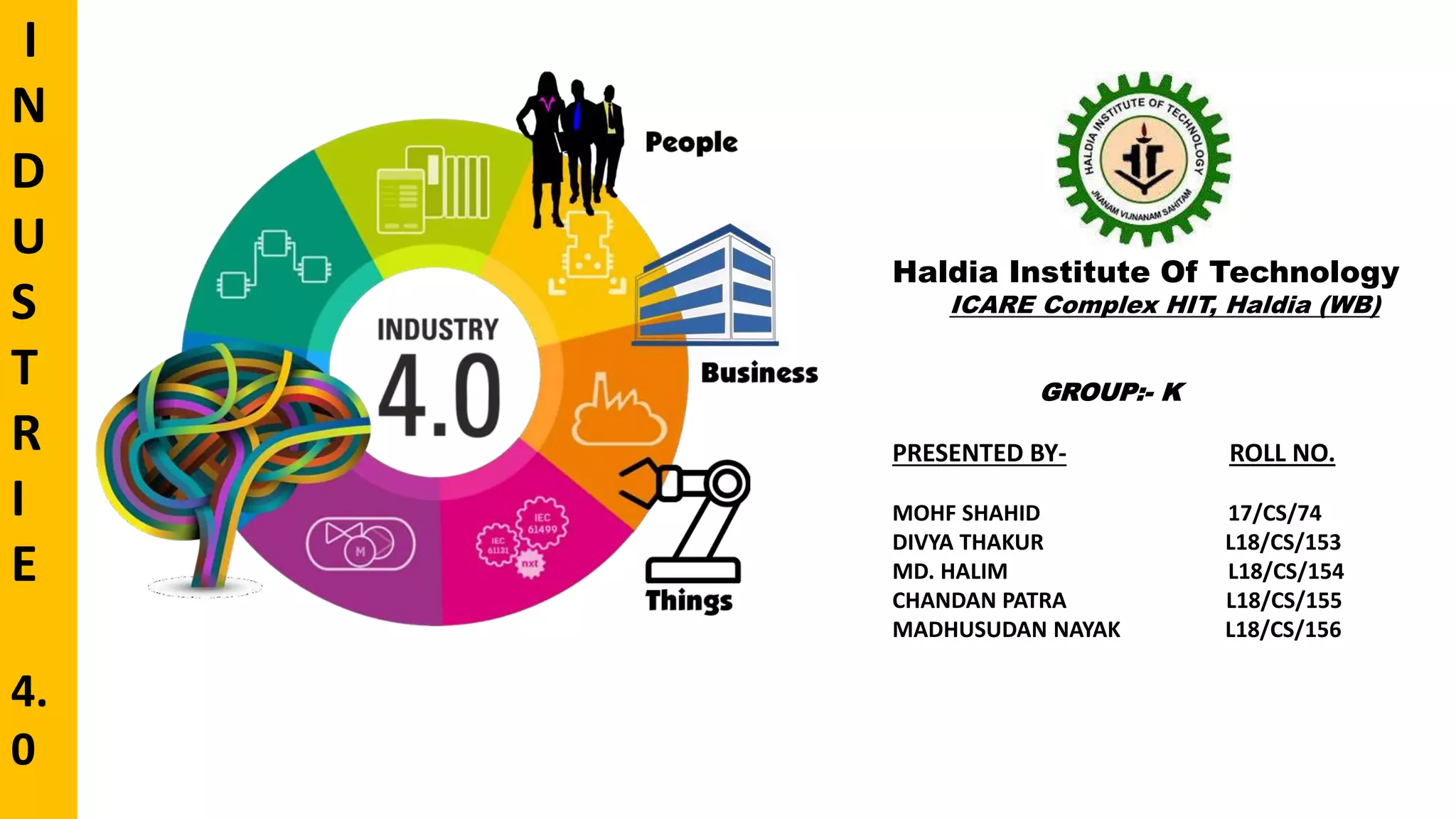
I
N
D
U
S
T
R
I
E
4.
0
Haldia Institute Of Technology
ICARE Complex HIT, Haldia (WB)
GROUP:- K
PRESENTED BY- ROLL NO.
MOHF SHAHID 17/CS/74
DIVYA THAKUR L18/CS/153
MD. HALIM L18/CS/154
CHANDAN PATRA L18/CS/155
MADHUSUDAN NAYAK L18/CS/156
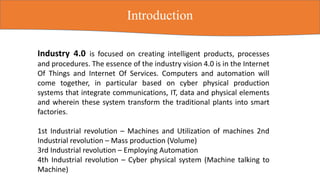
Industry 4.0 is focused on creating intelligent products, processes
and procedures. The essence of the industry vision 4.0 is in the Internet
Of Things and Internet Of Services. Computers and automation will
come together, in particular based on cyber physical production
systems that integrate communications, IT, data and physical elements
and wherein these system transform the traditional plants into smart
factories.
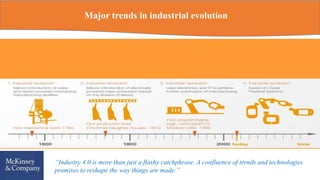
1st Industrial revolution – Machines and Utilization of machines 2nd
Industrial revolution – Mass production (Volume)
3rd Industrial revolution – Employing Automation
4th Industrial revolution – Cyber physical system (Machine talking to
Machine)
Introduction
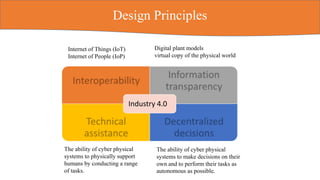
Internet of Things (IoT)
Internet of People (IoP)
Digital plant models
virtual copy of the physical world
The ability of cyber physical
systems to physically support
humans by conducting a range
of tasks.
The ability of cyber physical
systems to make decisions on their
own and to perform their tasks as
autonomous as possible.
Industry 4.0
Design Principles
Major trends in industrial evolution
“Industry 4.0 is more than just a flashy catchphrase. A confluence of trends and technologies
promises to reshape the way things are made.”
Industry 4.0 In India Today
Industry 4.0 needs to be differentiated from prevailing concepts such as;
 IOT (Internet Of Things)
 Big Data
 3D Printing
 Automation (Siloes)
It will be the combination of Intelligent machines, Informed manufacturing and processes.
 Create new routes towards lighter capital intensity and increased value.
Reduce capital employed utilization and increase profit.
 India has a long way to travel to become world’s preferred manufacturing destination. Majority of the
problem lies in Infrastructure issues, Bureaucracy and availability of energy sources.
Indian Manufacturing Companies heading towards Industry 4.0
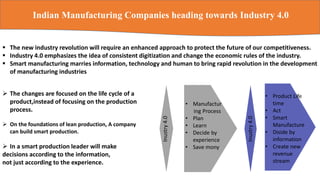
 The changes are focused on the life cycle of a
product,instead of focusing on the production
process.
 On the foundations of lean production, A company
can build smart production.
 In a smart production leader will make
decisions according to the information,
not just according to the experience.
 The new industry revolution will require an enhanced approach to protect the future of our competitiveness.
 Industry 4.0 emphasizes the idea of consistent digitization and change the economic rules of the industry.
 Smart manufacturing marries information, technology and human to bring rapid revolution in the development
of manufacturing industries
Inustry4.0
• Manufactur
ing Process
• Plan
• Learn
• Decide by
experience
• Save mony
• Product Life
time
• Act
• Smart
Manufacture
• Diside by
information
• Create new
revenue
stream
Inustry4.0
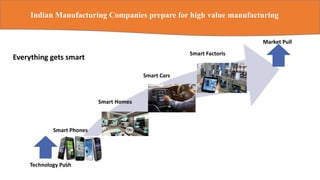
Indian Manufacturing Companies prepare for high value manufacturing
Everything gets smart
Technology Push
Smart Phones
Smart Homes
Smart Cars
Smart Factoris
Market Pull
Key Challenges for the Indian manufacturing industries
 The ownership of adopting new technologies and change Management will have to be driven by the
C- suite team (at present it is short term mindset).
 Top Management needs to give way for next generation.
 Accelerate and Embrace beyond Digitization.
 The current state is still at Industry 2.0
 Shortage of skill sets
 Increase in Data volume, therefore adequate IT system to analyze the data
 Needs long term commitment
 Is a major upheaval and not a smooth change
 Is not a single industry solution but has widespread impact
 Needs interdisciplinary collaboration
 Is closely linked to Cloud and Big Data
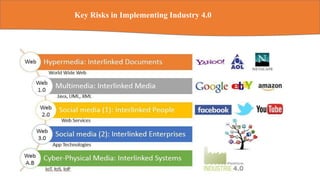
Key Risks in Implementing Industry 4.0
Priority areas for action in Manufacturing Industries
 Resources and processes
 The use of property
 Operation
 Inventories
 Quality
 Supply and Demand
 Time to market
 Service and maintenance
Conclusions
 Fundamentally this is about developing product and service solutions to our
customers. Companies can evolve their market offerings across moving from a
traditional physical core product to a comprehensive digital ecosystem.
 In part this lack is due to the fact that these types of systems involve multiple
technological requirements in fields such as communication, computing,
interoperability and information management. However, as can be seen in this
article, the technologies and standards that compose the industry 4.0 aid the
implementation of these theories and allow the re-configurability of
manufacturing systems to be addressed.
References
 [1] K. Linsu, “Stages of development of industrial technology in a developing country: A model,”
Res. Policy, 2002.
 [2] M. Blanchet, T. Rinn, G. Von tharden, and G. De Thieulloy, “Industry 4.0 The new industrial
revolution how europe will succeed,” Think Act, 2014.
 [3] H. Kagermann, W. Wahlster, and J. Helbig, “Recommendations for implementing the
strategic initiative INDUSTRIE 4.0,” 2013.
 [4] M. Hermann, T. Pentek, and B. Otto, “Design Principles for Industrie 4.0 Scenarios: A
Literature Review,” 2015.
 [5] H. Lasi, P. Fettke, and T. Feld, “Industry 4.0,” Bus. Inf. Syst. Eng., vol. 4, pp. 239–242,
2014.Plattform Industrie 4.0, “Industrie 4.0 - Whitepaper FuE Themen,” 2013. [Online].
Available: http://www.plattformi40.de/sites/default/files/Whitepaper_Forschung Stand 3. April
2014_0.pdf.
 [6] P. Adolphs, H. Bedenbender, and D. Dirzus, “Reference Architecture Model Industrie 4.0
(RAMI4.0),” 2015.

INDUSTRY 4.0 (Economics for Engineers)

  • 1.
    I N D U S T R I E 4. 0 Haldia Institute OfTechnology ICARE Complex HIT, Haldia (WB) GROUP:- K PRESENTED BY- ROLL NO. MOHF SHAHID 17/CS/74 DIVYA THAKUR L18/CS/153 MD. HALIM L18/CS/154 CHANDAN PATRA L18/CS/155 MADHUSUDAN NAYAK L18/CS/156
  • 2.
    Industry 4.0 isfocused on creating intelligent products, processes and procedures. The essence of the industry vision 4.0 is in the Internet Of Things and Internet Of Services. Computers and automation will come together, in particular based on cyber physical production systems that integrate communications, IT, data and physical elements and wherein these system transform the traditional plants into smart factories. 1st Industrial revolution – Machines and Utilization of machines 2nd Industrial revolution – Mass production (Volume) 3rd Industrial revolution – Employing Automation 4th Industrial revolution – Cyber physical system (Machine talking to Machine) Introduction
  • 3.
    Internet of Things(IoT) Internet of People (IoP) Digital plant models virtual copy of the physical world The ability of cyber physical systems to physically support humans by conducting a range of tasks. The ability of cyber physical systems to make decisions on their own and to perform their tasks as autonomous as possible. Industry 4.0 Design Principles
  • 4.
    Major trends inindustrial evolution “Industry 4.0 is more than just a flashy catchphrase. A confluence of trends and technologies promises to reshape the way things are made.”
  • 5.
    Industry 4.0 InIndia Today Industry 4.0 needs to be differentiated from prevailing concepts such as;  IOT (Internet Of Things)  Big Data  3D Printing  Automation (Siloes) It will be the combination of Intelligent machines, Informed manufacturing and processes.  Create new routes towards lighter capital intensity and increased value. Reduce capital employed utilization and increase profit.  India has a long way to travel to become world’s preferred manufacturing destination. Majority of the problem lies in Infrastructure issues, Bureaucracy and availability of energy sources.
  • 6.
    Indian Manufacturing Companiesheading towards Industry 4.0  The changes are focused on the life cycle of a product,instead of focusing on the production process.  On the foundations of lean production, A company can build smart production.  In a smart production leader will make decisions according to the information, not just according to the experience.  The new industry revolution will require an enhanced approach to protect the future of our competitiveness.  Industry 4.0 emphasizes the idea of consistent digitization and change the economic rules of the industry.  Smart manufacturing marries information, technology and human to bring rapid revolution in the development of manufacturing industries Inustry4.0 • Manufactur ing Process • Plan • Learn • Decide by experience • Save mony • Product Life time • Act • Smart Manufacture • Diside by information • Create new revenue stream Inustry4.0
  • 7.
    Indian Manufacturing Companiesprepare for high value manufacturing Everything gets smart Technology Push Smart Phones Smart Homes Smart Cars Smart Factoris Market Pull
  • 8.
    Key Challenges forthe Indian manufacturing industries  The ownership of adopting new technologies and change Management will have to be driven by the C- suite team (at present it is short term mindset).  Top Management needs to give way for next generation.  Accelerate and Embrace beyond Digitization.  The current state is still at Industry 2.0  Shortage of skill sets  Increase in Data volume, therefore adequate IT system to analyze the data  Needs long term commitment  Is a major upheaval and not a smooth change  Is not a single industry solution but has widespread impact  Needs interdisciplinary collaboration  Is closely linked to Cloud and Big Data
  • 9.
    Key Risks inImplementing Industry 4.0
  • 10.
    Priority areas foraction in Manufacturing Industries  Resources and processes  The use of property  Operation  Inventories  Quality  Supply and Demand  Time to market  Service and maintenance
  • 11.
    Conclusions  Fundamentally thisis about developing product and service solutions to our customers. Companies can evolve their market offerings across moving from a traditional physical core product to a comprehensive digital ecosystem.  In part this lack is due to the fact that these types of systems involve multiple technological requirements in fields such as communication, computing, interoperability and information management. However, as can be seen in this article, the technologies and standards that compose the industry 4.0 aid the implementation of these theories and allow the re-configurability of manufacturing systems to be addressed.
  • 12.
    References  [1] K.Linsu, “Stages of development of industrial technology in a developing country: A model,” Res. Policy, 2002.  [2] M. Blanchet, T. Rinn, G. Von tharden, and G. De Thieulloy, “Industry 4.0 The new industrial revolution how europe will succeed,” Think Act, 2014.  [3] H. Kagermann, W. Wahlster, and J. Helbig, “Recommendations for implementing the strategic initiative INDUSTRIE 4.0,” 2013.  [4] M. Hermann, T. Pentek, and B. Otto, “Design Principles for Industrie 4.0 Scenarios: A Literature Review,” 2015.  [5] H. Lasi, P. Fettke, and T. Feld, “Industry 4.0,” Bus. Inf. Syst. Eng., vol. 4, pp. 239–242, 2014.Plattform Industrie 4.0, “Industrie 4.0 - Whitepaper FuE Themen,” 2013. [Online]. Available: http://www.plattformi40.de/sites/default/files/Whitepaper_Forschung Stand 3. April 2014_0.pdf.  [6] P. Adolphs, H. Bedenbender, and D. Dirzus, “Reference Architecture Model Industrie 4.0 (RAMI4.0),” 2015.