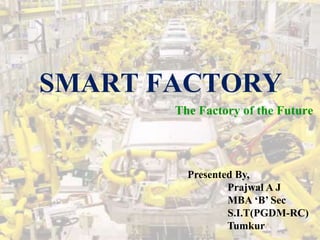
The document discusses smart factories, which use cyber-physical systems to merge the virtual and physical worlds. This allows manufacturing companies to benefit from increased production and reduced costs and errors through the use of information and communication technology. A smart factory implementation at a Caterpillar plant is presented as a case study, where real-time location tracking systems were used to ensure hydraulic valves and hoses were properly assembled by monitoring the correct torque applied during tightening. The conclusion states that smart industries can eliminate many human errors and make processes more efficient to gain a competitive advantage.