

What is a Smart
Factory
PAUL YOUNG CPA, CGA
MAY 17, 2017
Paul Young - Bio
• CPA, CGA
• Academia (PF1, FA4 and MS2)
• SME – Risk Management
• SME – Close, Consolidate and Reporting
• SME – Public Policy
• SME – Financial Solutions
• SME – Supply Chain Management
Contact information:
Paul_Young_CGA@Hotmail.com
What is a Smart Factory?
Source – Wikipedia
Industry 4.0 is the current trend of automation and data
exchange in manufacturing technologies. It includes
cyber-physical systems, the Internet of things and
cloud computing. Industry 4.0 creates what has been
called a "smart factory"
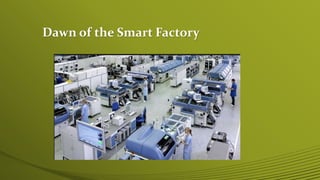
Dawn of the Smart Factory
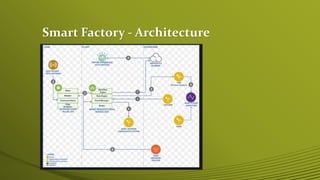
Smart Factory - Architecture
Market Size / Smart Factory
Source - http://www.bizjournals.com/prnewswire/press_releases/2017/04/18/MN64580
The smart factory market is forecast to reach $205.42
billion by 2022 from $120.98 billion in 2016 at a CAGR of
9.3% during (2017-2022) driven by the increase in
adoption of industrial robots, the evolution of Internet of
Things (IoT), growth in demand for smart automation
solutions and increase in emphasis on regulatory
compliances.
Smart Factory / Employment
Source - http://www.information-age.com/smart-factories-add-500bn-global-economy-next-5-years-123466253/
The shift to smart factories will transform the global labor market, and
while previous waves of automation have reduced low-skill jobs,
organisations have recognised the skills imperative and are now acting on
it.
Respondents see automation as a means to remove inefficiencies and
overheads, rather than jobs, so more than half (54%) of respondents are
providing digital skills training to their employees and 44% are investing in
digital talent acquisition to bridge the skill gap. For highly skilled workers
in areas such as automation, analytics and cyber security, there are even
more employment opportunities.
John Deere
• IBM and John Deere - https://www.ibm.com/blogs/bluemix/ or https://www.ibm.com/blogs/bluemix/2017/04/iot-industrie-40-reference-architecture/or https://worldindustrialreporter.com/john-deere-ibm-pilot-create-futuristic-model-manufacturing/
The machinery manufacturer prides itself on providing one of the most
customizable agricultural equipment in the industry. The pilot project will
see John Deere transitioning the production workflows to smart
manufacturing. Watson AI platform will provide workers with precise
instructions while the logistics processes will control themselves.
Increased customization is a major challenge for manufacturing
systems and requires a high amount of flexibility. Adoption of digital
factory concept is an important step for John Deere to achieve this.

What is a smart factory

  • 1.
    What is aSmart Factory PAUL YOUNG CPA, CGA MAY 17, 2017
  • 2.
    Paul Young -Bio • CPA, CGA • Academia (PF1, FA4 and MS2) • SME – Risk Management • SME – Close, Consolidate and Reporting • SME – Public Policy • SME – Financial Solutions • SME – Supply Chain Management Contact information: Paul_Young_CGA@Hotmail.com
  • 3.
    What is aSmart Factory? Source – Wikipedia Industry 4.0 is the current trend of automation and data exchange in manufacturing technologies. It includes cyber-physical systems, the Internet of things and cloud computing. Industry 4.0 creates what has been called a "smart factory"
  • 4.
    Dawn of theSmart Factory
  • 5.
    Smart Factory -Architecture
  • 6.
    Market Size /Smart Factory Source - http://www.bizjournals.com/prnewswire/press_releases/2017/04/18/MN64580 The smart factory market is forecast to reach $205.42 billion by 2022 from $120.98 billion in 2016 at a CAGR of 9.3% during (2017-2022) driven by the increase in adoption of industrial robots, the evolution of Internet of Things (IoT), growth in demand for smart automation solutions and increase in emphasis on regulatory compliances.
  • 7.
    Smart Factory /Employment Source - http://www.information-age.com/smart-factories-add-500bn-global-economy-next-5-years-123466253/ The shift to smart factories will transform the global labor market, and while previous waves of automation have reduced low-skill jobs, organisations have recognised the skills imperative and are now acting on it. Respondents see automation as a means to remove inefficiencies and overheads, rather than jobs, so more than half (54%) of respondents are providing digital skills training to their employees and 44% are investing in digital talent acquisition to bridge the skill gap. For highly skilled workers in areas such as automation, analytics and cyber security, there are even more employment opportunities.
  • 8.
    John Deere • IBMand John Deere - https://www.ibm.com/blogs/bluemix/ or https://www.ibm.com/blogs/bluemix/2017/04/iot-industrie-40-reference-architecture/or https://worldindustrialreporter.com/john-deere-ibm-pilot-create-futuristic-model-manufacturing/ The machinery manufacturer prides itself on providing one of the most customizable agricultural equipment in the industry. The pilot project will see John Deere transitioning the production workflows to smart manufacturing. Watson AI platform will provide workers with precise instructions while the logistics processes will control themselves. Increased customization is a major challenge for manufacturing systems and requires a high amount of flexibility. Adoption of digital factory concept is an important step for John Deere to achieve this.