


Fazla Rabbi Mashrur
Roll:1515020
DEPARTMENT OF BIOMEDICAL
ENGINEERING, KUET
BME 2101
Human Anatomy
Human Brain Project
And
Blue Brain Project
Contents
▪ What is Human Brain Project?
▪ Goals of Human Brain Project
▪ Introduction to Artificial Brain
▪ Human Brain and the Blue Brain
Project
▪ Founder of HBP and BBP
▪ What is Blue Brain Project?
▪ Blue Brain Project Objectives
▪ Brain Simulation
▪ Modeling
▪ Uploading Human Brain
▪ Research Work
▪ Hardware and Software
Requirements
▪ Advantages
▪ Disadvantages
▪ Applications
▪ Conclusion
What is Human Brain Project?
▪ The Human Brain Project (HBP) is a large ten-year scientific
research project that aims to build a collaborative ICT-based
scientific research infrastructure to allow researchers across the
globe to advance knowledge in the fields of neuroscience,
computing, and brain-related medicine
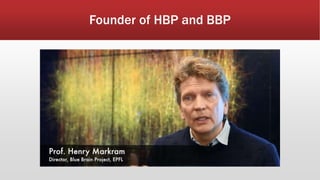
▪ Founder : Henry Markram
▪ Around 100 scientists from 13
different institutions around the
world is working on it
▪ The HBP is coordinated by the École Polytechnique Fédérale de
Lausanne and is largely funded by the European Union.The project
is based in Geneva, Switzerland.
Goals of Human Brain Project
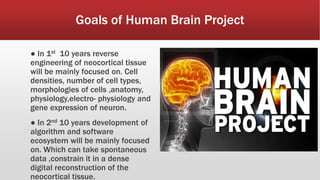
● In 1st 10 years reverse
engineering of neocortical tissue
will be mainly focused on. Cell
densities, number of cell types,
morphologies of cells ,anatomy,
physiology,electro- physiology and
gene expression of neuron.
● In 2nd 10 years development of
algorithm and software
ecosystem will be mainly focused
on. Which can take spontaneous
data ,constrain it in a dense
digital reconstruction of the
neocortical tissue.
Introduction to Artificial Brain
 Human brain, the most
valuable creation of god.
The man is called intelligent
because of the brain.
 But we loss the knowledge
of a brain when the body is
destroyed after the death .
 Is it really possible to create
a artificial human brain?
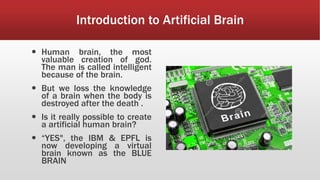
 “YES", the IBM & EPFL is
now developing a virtual
brain known as the BLUE
BRAIN
Introduction to Artificial Brain
● IBM’s Blue Gene supercomputer allows a quantum leap in the
level of detail at which the brain can be modelled.
● It would be the worlds first virtual brain.
● In 2025, we will be able to scan ourselves into the computers.
Human Brain and the Blue Brain Project
● The central vision for the Human Brain Project (HBP) -
reconstructing and simulating the human brain - was
developed by Henry Markram, based on the research
strategy developed in the Blue Brain Project.
● In January 2013, after multiple rounds of peer review,
the project was funded with 1 billion euro over 10 years.
The project began operations in October of the same year.
The project currently includes 112 partners.
Founder of HBP and BBP
What is Blue Brain Project?
● The Blue Brain Project is an
attempt to create a synthetic
brain by reverse-engineering
the mammalian brain down
to the molecular level in order
to understand brain function
through detailed simulations.
● Simply modeling of
Mammalian Brain
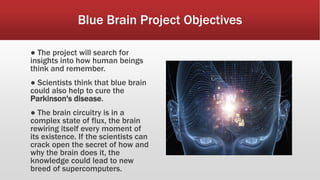
Blue Brain Project Objectives
● The project will search for
insights into how human beings
think and remember.
● Scientists think that blue brain
could also help to cure the
Parkinson's disease.
● The brain circuitry is in a
complex state of flux, the brain
rewiring itself every moment of
its existence. If the scientists can
crack open the secret of how and
why the brain does it, the
knowledge could lead to new
breed of supercomputers.
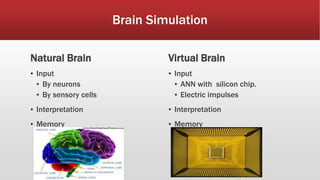
Brain Simulation
Natural Brain
▪ Input
▪ By neurons
▪ By sensory cells
▪ Interpretation
▪ Memory
Virtual Brain
▪ Input
▪ ANN with silicon chip.
▪ Electric impulses
▪ Interpretation
▪ Memory
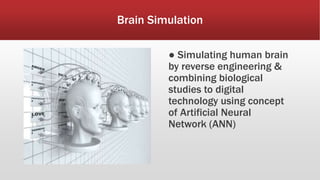
Brain Simulation
● Simulating human brain
by reverse engineering &
combining biological
studies to digital
technology using concept
of Artificial Neural
Network (ANN)
Modeling
● Neurons receive inputs from thousands of other neurons, and
has branches of highly complex dendritic trees and require
tens of thousands of compartments to accurately represent
them.
● Therefore a massive increase in computational power is
required to make this quantum leap — an increase that is
provided by IBM’s Blue Gene supercomputer.
● Using a Blue Gene supercomputer running Michael Hines's
NEURON software, the simulation does not consist simply of an
artificial neural network, but involves a biologically realistic
model of neurons.
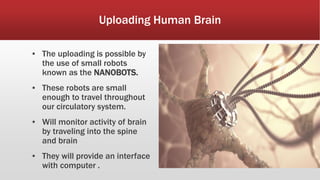
Uploading Human Brain
▪ The uploading is possible by
the use of small robots
known as the NANOBOTS.
▪ These robots are small
enough to travel throughout
our circulatory system.
▪ Will monitor activity of brain
by traveling into the spine
and brain
▪ They will provide an interface
with computer .
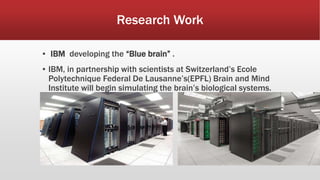
Research Work
▪ IBM developing the “Blue brain” .
▪ IBM, in partnership with scientists at Switzerland’s Ecole
Polytechnique Federal De Lausanne’s(EPFL) Brain and Mind
Institute will begin simulating the brain’s biological systems.
Hardware and Software Requirements
● A Super computer.
● Memory with a very large storing capacity.
● Processor with a very high processing power.
● A very wide network.
● A program to convert the electric impulses from the brain
to input signal, which is to be received by the computer and
vice versa.
● Very powerful Nanobots to act as the interface between
the natural brain and the computer.
Advantages
Intelligence of a person is not lost even after his death
Things can be remembered easily without much effort
Allowing deaf to hear via nerve simulation
Making decisions without the presence of the person
in processing speed and memory could make entire
human brain simulated
The activity of different animals can be understood
Disadvantages
We become dependent upon the computer
Others may use technical knowledge against us
Another fear is found today with respect to human
cloning
A very costly procedure of regaining the memory
back
Applications
▪ gathering and testing 100 years of data
▪ cracking the neural code
▪ a foundation for molecular modeling of brain function
▪ understanding neocortical information processing
▪ a novel tool for drug discovery for brain disorders
▪ a global facility
▪ a foundation for whole brain simulations
Conclusion
▪ We will be able to transfer ourselves into
computers at some point.
▪ It will bring both benefits and harm to human
society .
▪ Very soon this technology will be highly accepted
whole over the world.
ANY QUERIES…..
?????

Human Brain Project and Blue Brain Project

  • 1.
    Fazla Rabbi Mashrur Roll:1515020 DEPARTMENTOF BIOMEDICAL ENGINEERING, KUET BME 2101 Human Anatomy Human Brain Project And Blue Brain Project
  • 2.
    Contents ▪ What isHuman Brain Project? ▪ Goals of Human Brain Project ▪ Introduction to Artificial Brain ▪ Human Brain and the Blue Brain Project ▪ Founder of HBP and BBP ▪ What is Blue Brain Project? ▪ Blue Brain Project Objectives ▪ Brain Simulation ▪ Modeling ▪ Uploading Human Brain ▪ Research Work ▪ Hardware and Software Requirements ▪ Advantages ▪ Disadvantages ▪ Applications ▪ Conclusion
  • 3.
    What is HumanBrain Project? ▪ The Human Brain Project (HBP) is a large ten-year scientific research project that aims to build a collaborative ICT-based scientific research infrastructure to allow researchers across the globe to advance knowledge in the fields of neuroscience, computing, and brain-related medicine ▪ Founder : Henry Markram ▪ Around 100 scientists from 13 different institutions around the world is working on it ▪ The HBP is coordinated by the École Polytechnique Fédérale de Lausanne and is largely funded by the European Union.The project is based in Geneva, Switzerland.
  • 4.
    Goals of HumanBrain Project ● In 1st 10 years reverse engineering of neocortical tissue will be mainly focused on. Cell densities, number of cell types, morphologies of cells ,anatomy, physiology,electro- physiology and gene expression of neuron. ● In 2nd 10 years development of algorithm and software ecosystem will be mainly focused on. Which can take spontaneous data ,constrain it in a dense digital reconstruction of the neocortical tissue.
  • 5.
    Introduction to ArtificialBrain  Human brain, the most valuable creation of god. The man is called intelligent because of the brain.  But we loss the knowledge of a brain when the body is destroyed after the death .  Is it really possible to create a artificial human brain?  “YES", the IBM & EPFL is now developing a virtual brain known as the BLUE BRAIN
  • 6.
    Introduction to ArtificialBrain ● IBM’s Blue Gene supercomputer allows a quantum leap in the level of detail at which the brain can be modelled. ● It would be the worlds first virtual brain. ● In 2025, we will be able to scan ourselves into the computers.
  • 7.
    Human Brain andthe Blue Brain Project ● The central vision for the Human Brain Project (HBP) - reconstructing and simulating the human brain - was developed by Henry Markram, based on the research strategy developed in the Blue Brain Project. ● In January 2013, after multiple rounds of peer review, the project was funded with 1 billion euro over 10 years. The project began operations in October of the same year. The project currently includes 112 partners.
  • 8.
  • 9.
    What is BlueBrain Project? ● The Blue Brain Project is an attempt to create a synthetic brain by reverse-engineering the mammalian brain down to the molecular level in order to understand brain function through detailed simulations. ● Simply modeling of Mammalian Brain
  • 10.
    Blue Brain ProjectObjectives ● The project will search for insights into how human beings think and remember. ● Scientists think that blue brain could also help to cure the Parkinson's disease. ● The brain circuitry is in a complex state of flux, the brain rewiring itself every moment of its existence. If the scientists can crack open the secret of how and why the brain does it, the knowledge could lead to new breed of supercomputers.
  • 11.
    Brain Simulation Natural Brain ▪Input ▪ By neurons ▪ By sensory cells ▪ Interpretation ▪ Memory Virtual Brain ▪ Input ▪ ANN with silicon chip. ▪ Electric impulses ▪ Interpretation ▪ Memory
  • 12.
    Brain Simulation ● Simulatinghuman brain by reverse engineering & combining biological studies to digital technology using concept of Artificial Neural Network (ANN)
  • 13.
    Modeling ● Neurons receiveinputs from thousands of other neurons, and has branches of highly complex dendritic trees and require tens of thousands of compartments to accurately represent them. ● Therefore a massive increase in computational power is required to make this quantum leap — an increase that is provided by IBM’s Blue Gene supercomputer. ● Using a Blue Gene supercomputer running Michael Hines's NEURON software, the simulation does not consist simply of an artificial neural network, but involves a biologically realistic model of neurons.
  • 14.
    Uploading Human Brain ▪The uploading is possible by the use of small robots known as the NANOBOTS. ▪ These robots are small enough to travel throughout our circulatory system. ▪ Will monitor activity of brain by traveling into the spine and brain ▪ They will provide an interface with computer .
  • 15.
    Research Work ▪ IBMdeveloping the “Blue brain” . ▪ IBM, in partnership with scientists at Switzerland’s Ecole Polytechnique Federal De Lausanne’s(EPFL) Brain and Mind Institute will begin simulating the brain’s biological systems.
  • 16.
    Hardware and SoftwareRequirements ● A Super computer. ● Memory with a very large storing capacity. ● Processor with a very high processing power. ● A very wide network. ● A program to convert the electric impulses from the brain to input signal, which is to be received by the computer and vice versa. ● Very powerful Nanobots to act as the interface between the natural brain and the computer.
  • 17.
    Advantages Intelligence of aperson is not lost even after his death Things can be remembered easily without much effort Allowing deaf to hear via nerve simulation Making decisions without the presence of the person in processing speed and memory could make entire human brain simulated The activity of different animals can be understood
  • 18.
    Disadvantages We become dependentupon the computer Others may use technical knowledge against us Another fear is found today with respect to human cloning A very costly procedure of regaining the memory back
  • 19.
    Applications ▪ gathering andtesting 100 years of data ▪ cracking the neural code ▪ a foundation for molecular modeling of brain function ▪ understanding neocortical information processing ▪ a novel tool for drug discovery for brain disorders ▪ a global facility ▪ a foundation for whole brain simulations
  • 20.
    Conclusion ▪ We willbe able to transfer ourselves into computers at some point. ▪ It will bring both benefits and harm to human society . ▪ Very soon this technology will be highly accepted whole over the world.
  • 22.