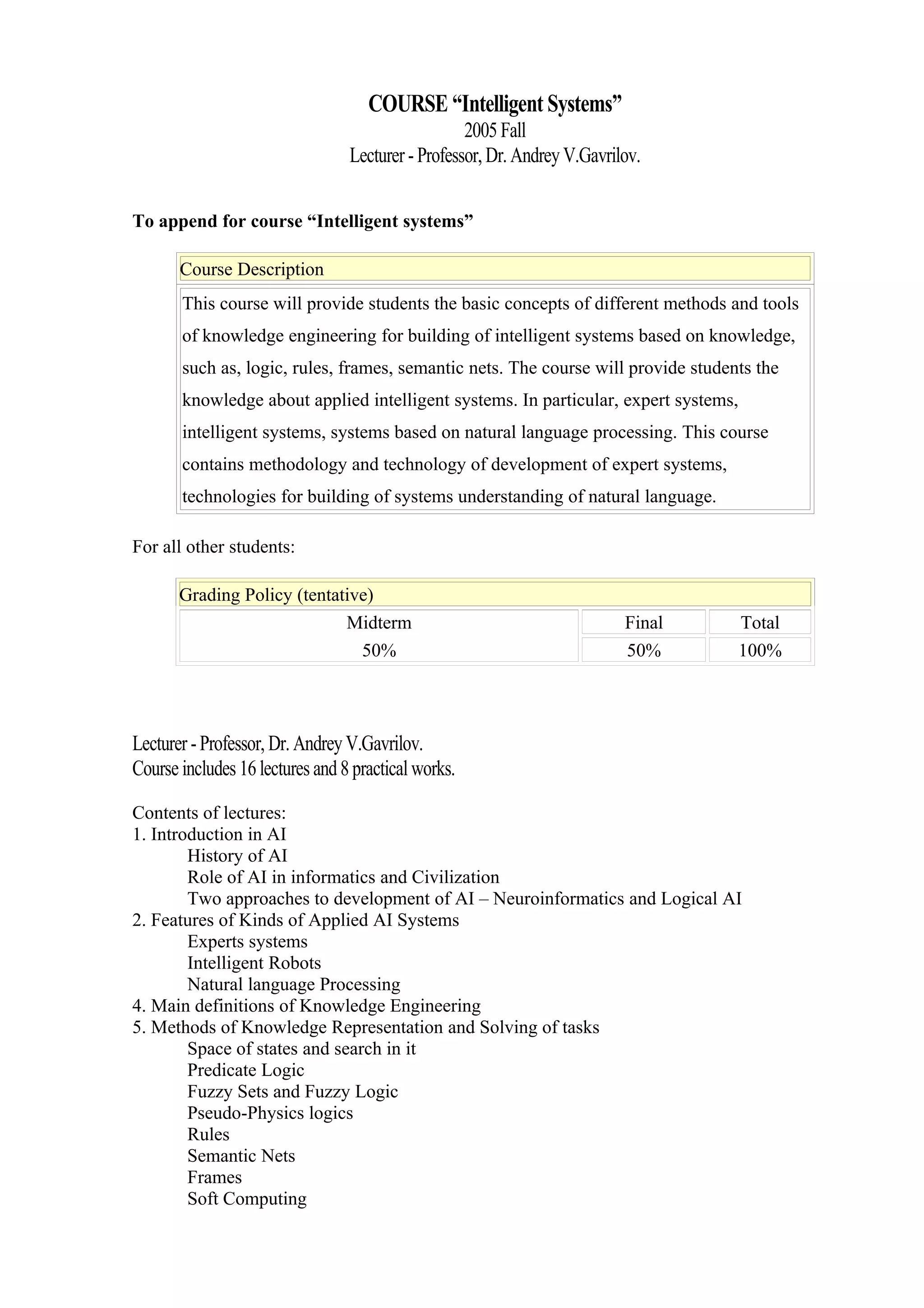
COURSE “Intelligent Systems”
                                                   2005 Fall
                                 Lecturer - Professor, Dr. Andrey V.Gavrilov.

To append for course “Intelligent systems”

       Course Description
       This course will provide students the basic concepts of different methods and tools
       of knowledge engineering for building of intelligent systems based on knowledge,
       such as, logic, rules, frames, semantic nets. The course will provide students the
       knowledge about applied intelligent systems. In particular, expert systems,
       intelligent systems, systems based on natural language processing. This course
       contains methodology and technology of development of expert systems,
       technologies for building of systems understanding of natural language.

For all other students:

       Grading Policy (tentative)
                             Midterm                                      Final      Total
                               50%                                        50%        100%


Lecturer - Professor, Dr. Andrey V.Gavrilov.
Course includes 16 lectures and 8 practical works.

Contents of lectures:
1. Introduction in AI
        History of AI
        Role of AI in informatics and Civilization
        Two approaches to development of AI – Neuroinformatics and Logical AI
2. Features of Kinds of Applied AI Systems
        Experts systems
        Intelligent Robots
        Natural language Processing
4. Main definitions of Knowledge Engineering
5. Methods of Knowledge Representation and Solving of tasks
        Space of states and search in it
        Predicate Logic
        Fuzzy Sets and Fuzzy Logic
        Pseudo-Physics logics
        Rules
        Semantic Nets
        Frames
        Soft Computing
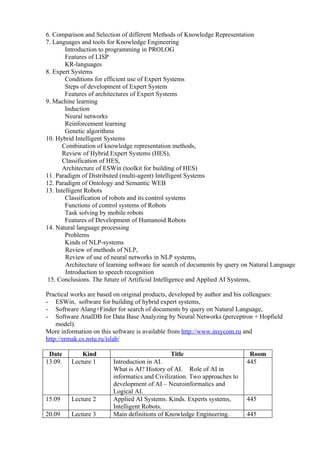
6. Comparison and Selection of different Methods of Knowledge Representation
7. Languages and tools for Knowledge Engineering
        Introduction to programming in PROLOG
        Features of LISP
        KR-languages
8. Expert Systems
        Conditions for efficient use of Expert Systems
        Steps of development of Expert System
        Features of architectures of Expert Systems
9. Machine learning
        Induction
        Neural networks
        Reinforcement learning
        Genetic algorithms
10. Hybrid Intelligent Systems
       Combination of knowledge representation methods,
       Review of Hybrid Expert Systems (HES),
       Classification of HES,
       Architecture of ESWin (toolkit for building of HES)
11. Paradigm of Distributed (multi-agent) Intelligent Systems
12. Paradigm of Ontology and Semantic WEB
13. Intelligent Robots
        Classification of robots and its control systems
        Functions of control systems of Robots
        Task solving by mobile robots
        Features of Development of Humanoid Robots
14. Natural language processing
        Problems
        Kinds of NLP-systems
        Review of methods of NLP,
        Review of use of neural networks in NLP systems,
        Architecture of learning software for search of documents by query on Natural Language
        Introduction to speech recognition
 15. Conclusions. The future of Artificial Intelligence and Applied AI Systems,

Practical works are based on original products, developed by author and his colleagues:
- ESWin, software for building of hybrid expert systems,
- Software Alang+Finder for search of documents by query on Natural Language,
- Software AnalDB for Data Base Analyzing by Neural Networks (perceptron + Hopfield
    model).
More information on this software is available from http://www.insycom.ru and
http://ermak.cs.nstu.ru/islab/

 Date        Kind                              Title                        Room
13.09.   Lecture 1       Introduction in AI.                               445
                         What is AI? History of AI. Role of AI in
                         informatics and Civilization. Two approaches to
                         development of AI – Neuroinformatics and
                         Logical AI.
15.09    Lecture 2       Applied AI Systems. Kinds. Experts systems,       445
                         Intelligent Robots.
20.09    Lecture 3       Main definitions of Knowledge Engineering.        445
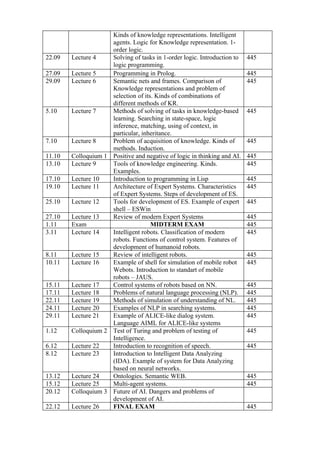
Kinds of knowledge representations. Intelligent
                     agents. Logic for Knowledge representation. 1-
                     order logic.
22.09   Lecture 4    Solving of tasks in 1-order logic. Introduction to   445
                     logic programming.
27.09   Lecture 5    Programming in Prolog.                               445
29.09   Lecture 6    Semantic nets and frames. Comparison of              445
                     Knowledge representations and problem of
                     selection of its. Kinds of combinations of
                     different methods of KR.
5.10    Lecture 7    Methods of solving of tasks in knowledge-based       445
                     learning. Searching in state-space, logic
                     inference, matching, using of context, in
                     particular, inheritance.
7.10    Lecture 8    Problem of acquisition of knowledge. Kinds of        445
                     methods. Induction.
11.10   Colloquium 1 Positive and negative of logic in thinking and AI.   445
13.10   Lecture 9    Tools of knowledge engineering. Kinds.               445
                     Examples.
17.10   Lecture 10   Introduction to programming in Lisp                  445
19.10   Lecture 11   Architecture of Expert Systems. Characteristics      445
                     of Expert Systems. Steps of development of ES.
25.10   Lecture 12   Tools for development of ES. Example of expert       445
                     shell – ESWin
27.10   Lecture 13   Review of modern Expert Systems                      445
1.11    Exam                         MIDTERM EXAM                         445
3.11    Lecture 14   Intelligent robots. Classification of modern         445
                     robots. Functions of control system. Features of
                     development of humanoid robots.
8.11    Lecture 15   Review of intelligent robots.                        445
10.11   Lecture 16   Example of shell for simulation of mobile robot      445
                     Webots. Introduction to standart of mobile
                     robots – JAUS.
15.11   Lecture 17   Control systems of robots based on NN.               445
17.11   Lecture 18   Problems of natural language processing (NLP).       445
22.11   Lecture 19   Methods of simulation of understanding of NL.        445
24.11   Lecture 20   Examples of NLP in searching systems.                445
29.11   Lecture 21   Example of ALICE-like dialog system.                 445
                     Language AIML for ALICE-like systems
1.12    Colloquium 2 Test of Turing and problem of testing of             445
                     Intelligence.
6.12    Lecture 22   Introduction to recognition of speech.               445
8.12    Lecture 23   Introduction to Intelligent Data Analyzing
                     (IDA). Example of system for Data Analyzing
                     based on neural networks.
13.12   Lecture 24   Ontologies. Semantic WEB.                            445
15.12   Lecture 25   Multi-agent systems.                                 445
20.12   Colloquium 3 Future of AI. Dangers and problems of
                     development of AI.
22.12   Lecture 26   FINAL EXAM                                           445
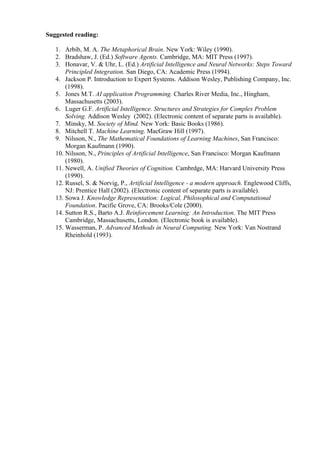
Suggested reading:

   1. Arbib, M. A. The Metaphorical Brain. New York: Wiley (1990).
   2. Bradshaw, J. (Ed.) Software Agents. Cambridge, MA: MIT Press (1997).
   3. Honavar, V. & Uhr, L. (Ed.) Artificial Intelligence and Neural Networks: Steps Toward
       Principled Integration. San Diego, CA: Academic Press (1994).
   4. Jackson P. Introduction to Expert Systems. Addison Wesley, Publishing Company, Inc.
       (1998).
   5. Jones M.T. AI application Programming. Charles River Media, Inc., Hingham,
       Massachusetts (2003).
   6. Luger G.F. Artificial Intelligence. Structures and Strategies for Complex Problem
       Solving. Addison Wesley (2002). (Electronic content of separate parts is available).
   7. Minsky, M. Society of Mind. New York: Basic Books (1986).
   8. Mitchell T. Machine Learning. MacGraw Hill (1997).
   9. Nilsson, N., The Mathematical Foundations of Learning Machines, San Francisco:
       Morgan Kaufmann (1990).
   10. Nilsson, N., Principles of Artificial Intelligence, San Francisco: Morgan Kaufmann
       (1980).
   11. Newell, A. Unified Theories of Cognition. Cambrdge, MA: Harvard University Press
       (1990).
   12. Russel, S. & Norvig, P., Artificial Intelligence - a modern approach. Englewood Cliffs,
       NJ: Prentice Hall (2002). (Electronic content of separate parts is available).
   13. Sowa J. Knowledge Representation: Logical, Philosophical and Computational
       Foundation. Pacific Grove, CA: Brooks/Cole (2000).
   14. Sutton R.S., Barto A.J. Reinforcement Learning: An Introduction. The MIT Press
       Cambridge, Massachusetts, London. (Electronic book is available).
   15. Wasserman, P. Advanced Methods in Neural Computing. New York: Van Nostrand
       Rheinhold (1993).

syllabus-IS.doc

  • 1.
    COURSE “Intelligent Systems” 2005 Fall Lecturer - Professor, Dr. Andrey V.Gavrilov. To append for course “Intelligent systems” Course Description This course will provide students the basic concepts of different methods and tools of knowledge engineering for building of intelligent systems based on knowledge, such as, logic, rules, frames, semantic nets. The course will provide students the knowledge about applied intelligent systems. In particular, expert systems, intelligent systems, systems based on natural language processing. This course contains methodology and technology of development of expert systems, technologies for building of systems understanding of natural language. For all other students: Grading Policy (tentative) Midterm Final Total 50% 50% 100% Lecturer - Professor, Dr. Andrey V.Gavrilov. Course includes 16 lectures and 8 practical works. Contents of lectures: 1. Introduction in AI History of AI Role of AI in informatics and Civilization Two approaches to development of AI – Neuroinformatics and Logical AI 2. Features of Kinds of Applied AI Systems Experts systems Intelligent Robots Natural language Processing 4. Main definitions of Knowledge Engineering 5. Methods of Knowledge Representation and Solving of tasks Space of states and search in it Predicate Logic Fuzzy Sets and Fuzzy Logic Pseudo-Physics logics Rules Semantic Nets Frames Soft Computing
  • 2.
    6. Comparison andSelection of different Methods of Knowledge Representation 7. Languages and tools for Knowledge Engineering Introduction to programming in PROLOG Features of LISP KR-languages 8. Expert Systems Conditions for efficient use of Expert Systems Steps of development of Expert System Features of architectures of Expert Systems 9. Machine learning Induction Neural networks Reinforcement learning Genetic algorithms 10. Hybrid Intelligent Systems Combination of knowledge representation methods, Review of Hybrid Expert Systems (HES), Classification of HES, Architecture of ESWin (toolkit for building of HES) 11. Paradigm of Distributed (multi-agent) Intelligent Systems 12. Paradigm of Ontology and Semantic WEB 13. Intelligent Robots Classification of robots and its control systems Functions of control systems of Robots Task solving by mobile robots Features of Development of Humanoid Robots 14. Natural language processing Problems Kinds of NLP-systems Review of methods of NLP, Review of use of neural networks in NLP systems, Architecture of learning software for search of documents by query on Natural Language Introduction to speech recognition 15. Conclusions. The future of Artificial Intelligence and Applied AI Systems, Practical works are based on original products, developed by author and his colleagues: - ESWin, software for building of hybrid expert systems, - Software Alang+Finder for search of documents by query on Natural Language, - Software AnalDB for Data Base Analyzing by Neural Networks (perceptron + Hopfield model). More information on this software is available from http://www.insycom.ru and http://ermak.cs.nstu.ru/islab/ Date Kind Title Room 13.09. Lecture 1 Introduction in AI. 445 What is AI? History of AI. Role of AI in informatics and Civilization. Two approaches to development of AI – Neuroinformatics and Logical AI. 15.09 Lecture 2 Applied AI Systems. Kinds. Experts systems, 445 Intelligent Robots. 20.09 Lecture 3 Main definitions of Knowledge Engineering. 445
  • 3.
    Kinds of knowledgerepresentations. Intelligent agents. Logic for Knowledge representation. 1- order logic. 22.09 Lecture 4 Solving of tasks in 1-order logic. Introduction to 445 logic programming. 27.09 Lecture 5 Programming in Prolog. 445 29.09 Lecture 6 Semantic nets and frames. Comparison of 445 Knowledge representations and problem of selection of its. Kinds of combinations of different methods of KR. 5.10 Lecture 7 Methods of solving of tasks in knowledge-based 445 learning. Searching in state-space, logic inference, matching, using of context, in particular, inheritance. 7.10 Lecture 8 Problem of acquisition of knowledge. Kinds of 445 methods. Induction. 11.10 Colloquium 1 Positive and negative of logic in thinking and AI. 445 13.10 Lecture 9 Tools of knowledge engineering. Kinds. 445 Examples. 17.10 Lecture 10 Introduction to programming in Lisp 445 19.10 Lecture 11 Architecture of Expert Systems. Characteristics 445 of Expert Systems. Steps of development of ES. 25.10 Lecture 12 Tools for development of ES. Example of expert 445 shell – ESWin 27.10 Lecture 13 Review of modern Expert Systems 445 1.11 Exam MIDTERM EXAM 445 3.11 Lecture 14 Intelligent robots. Classification of modern 445 robots. Functions of control system. Features of development of humanoid robots. 8.11 Lecture 15 Review of intelligent robots. 445 10.11 Lecture 16 Example of shell for simulation of mobile robot 445 Webots. Introduction to standart of mobile robots – JAUS. 15.11 Lecture 17 Control systems of robots based on NN. 445 17.11 Lecture 18 Problems of natural language processing (NLP). 445 22.11 Lecture 19 Methods of simulation of understanding of NL. 445 24.11 Lecture 20 Examples of NLP in searching systems. 445 29.11 Lecture 21 Example of ALICE-like dialog system. 445 Language AIML for ALICE-like systems 1.12 Colloquium 2 Test of Turing and problem of testing of 445 Intelligence. 6.12 Lecture 22 Introduction to recognition of speech. 445 8.12 Lecture 23 Introduction to Intelligent Data Analyzing (IDA). Example of system for Data Analyzing based on neural networks. 13.12 Lecture 24 Ontologies. Semantic WEB. 445 15.12 Lecture 25 Multi-agent systems. 445 20.12 Colloquium 3 Future of AI. Dangers and problems of development of AI. 22.12 Lecture 26 FINAL EXAM 445
  • 4.
    Suggested reading: 1. Arbib, M. A. The Metaphorical Brain. New York: Wiley (1990). 2. Bradshaw, J. (Ed.) Software Agents. Cambridge, MA: MIT Press (1997). 3. Honavar, V. & Uhr, L. (Ed.) Artificial Intelligence and Neural Networks: Steps Toward Principled Integration. San Diego, CA: Academic Press (1994). 4. Jackson P. Introduction to Expert Systems. Addison Wesley, Publishing Company, Inc. (1998). 5. Jones M.T. AI application Programming. Charles River Media, Inc., Hingham, Massachusetts (2003). 6. Luger G.F. Artificial Intelligence. Structures and Strategies for Complex Problem Solving. Addison Wesley (2002). (Electronic content of separate parts is available). 7. Minsky, M. Society of Mind. New York: Basic Books (1986). 8. Mitchell T. Machine Learning. MacGraw Hill (1997). 9. Nilsson, N., The Mathematical Foundations of Learning Machines, San Francisco: Morgan Kaufmann (1990). 10. Nilsson, N., Principles of Artificial Intelligence, San Francisco: Morgan Kaufmann (1980). 11. Newell, A. Unified Theories of Cognition. Cambrdge, MA: Harvard University Press (1990). 12. Russel, S. & Norvig, P., Artificial Intelligence - a modern approach. Englewood Cliffs, NJ: Prentice Hall (2002). (Electronic content of separate parts is available). 13. Sowa J. Knowledge Representation: Logical, Philosophical and Computational Foundation. Pacific Grove, CA: Brooks/Cole (2000). 14. Sutton R.S., Barto A.J. Reinforcement Learning: An Introduction. The MIT Press Cambridge, Massachusetts, London. (Electronic book is available). 15. Wasserman, P. Advanced Methods in Neural Computing. New York: Van Nostrand Rheinhold (1993).