Workshop on Robo-Ethics, Barcelona, April 18th, 2005

 Ethical issues involved in hybrid
     bionic systems research
            Paolo Dario
    Scuola Superiore Sant’Anna
Outline of the talk
 Bionics: the connection of natural and
 artificial
 Case-study 1: the CYBERHAND Project
   Developing a hand prostheses to be connected to
   the nervous system
 Case study 2: the NEUROBOTICS Project
   Investigating the development of hybrid bionic
   systems
 Conclusions: the new role and ethical
 responsibilities of robotics researchers
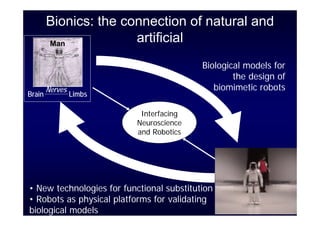
Bionics: the connection of natural and
        Man
                       artificial
                                           Biological models for
                                                   the design of
        Nerves                                biomimetic robots
Brain            Limbs

                            Interfacing
                           Neuroscience
                           and Robotics


• New technologies for functional substitution
• Robots as physical platforms for validating
biological models
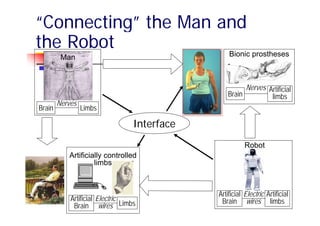
“Connecting” the Man and
the Robot             Bionic prostheses
         Man


                                                      Nerves Artificial
                                                Brain         limbs
        Nerves
Brain            Limbs

                                Interface
                                                       Robot
           Artificially controlled
                    limbs


                                            Artificial Electric Artificial
            Artificial Electric              Brain wires limbs
             Brain wires Limbs
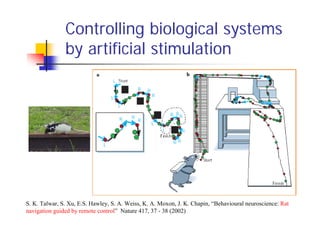
Controlling biological systems
               by artificial stimulation


S. K. Talwar, S. Xu, E.S. Hawley, S. A. Weiss, K. A. Moxon, J. K. Chapin, “Behavioural neuroscience: Rat
navigation guided by remote control” Nature 417, 37 - 38 (2002)
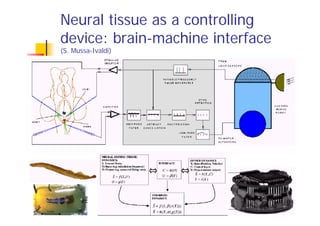
Neural tissue as a controlling
device: brain-machine interface
(S. Mussa-Ivaldi)
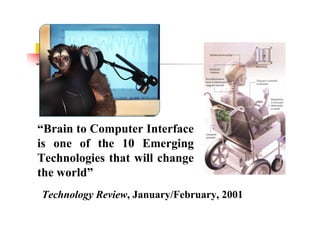
“Brain to Computer Interface
is one of the 10 Emerging
Technologies that will change
the world”
Technology Review, January/February, 2001
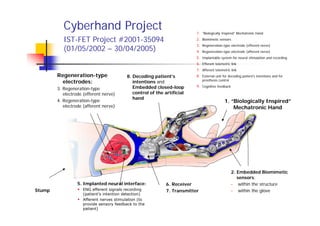
Cyberhand Project                                              1. “Biologically Inspired” Mechatronic Hand
           IST-FET Project #2001-35094                                    2. Biomimetic sensors
                                                                          3. Regeneration-type electrode (efferent nerve)
           (01/05/2002 – 30/04/2005)                                      4. Regeneration-type electrode (afferent nerve)
                                                                          5. Implantable system for neural stimulation and recording
                                                                          6. Efferent telemetric link
                                                                          7. Afferent telemetric link
        Regeneration-type                 8. Decoding patient’s           8. External unit for decoding patient’s intentions and for
                                                                              prosthesis control
          electrodes:                        intentions and
                                             Embedded closed-loop         9. Cognitive feedback
        3. Regeneration-type
           electrode (efferent nerve)        control of the artificial
                                             hand
        4. Regeneration-type                                                                 1. “Biologically Inspired”
           electrode (afferent nerve)                                                            Mechatronic Hand


                                                                                                   2. Embedded Biomimetic
                                                                                                      sensors:
                  5. Implanted neural interface:             6. Receiver                           - within the structure
Stump               ENG efferent signals recording           7. Transmitter                        - within the glove
                    (patient’s intention detection)
                    Afferent nerves stimulation (to
                    provide sensory feedback to the
                    patient)
6

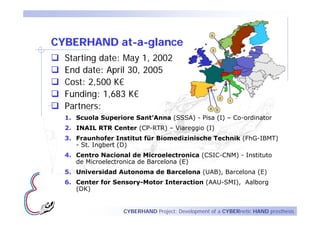
CYBERHAND at-a-glance
                                                      3

  Starting date: May 1, 2002
  End date: April 30, 2005
  Cost: 2,500 K€
  Funding: 1,683 K€                                           2
                                                                  1

  Partners:                                       4       5

  1. Scuola Superiore Sant’Anna (SSSA) - Pisa (I) – Co-ordinator
  2. INAIL RTR Center (CP-RTR) – Viareggio (I)
  3. Fraunhofer Institut für Biomedizinische Technik (FhG-IBMT)
     - St. Ingbert (D)
  4. Centro Nacional de Microelectronica (CSIC-CNM) - Instituto
     de Microelectronica de Barcelona (E)
  5. Universidad Autonoma de Barcelona (UAB), Barcelona (E)
  6. Center for Sensory-Motor Interaction (AAU-SMI), Aalborg
     (DK)


                   CYBERHAND Project: Development of a CYBERnetic HAND prosthesis
Objectives of the CYBERHAND project
 Long-Term Objective:
 to increase the basic knowledge of neural
 regeneration and sensory-motor control of the
 hand in humans
 Middle-Term Objective:
 to exploit this knowledge to develop a new kind of
 hand prosthesis which will overcome some of the
 drawbacks of current hand prostheses. This new
 prosthesis will:
      be felt by an amputee as the lost natural limb delivering her/him a
      natural sensory feedback by means of the stimulation of some
      specific afferent nerves;
      be controlled in a very natural way by processing the efferent
      neural signals coming from the central nervous system


                     CYBERHAND Project: Development of a CYBERnetic HAND prosthesis
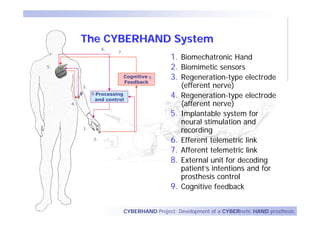
The CYBERHAND System
                    6.
                         7.
                                               1. Biomechatronic Hand
5.                                             2. Biomimetic sensors
                              Cognitive 9.
                              Feedback
                                               3. Regeneration-type electrode
          3.                                        (efferent nerve)
               8.Processing
                and control
                                               4.   Regeneration-type electrode
     4.                                             (afferent nerve)
                                               5.   Implantable system for
                                                    neural stimulation and
          1.
                                                    recording
               2.
                                               6.   Efferent telemetric link
                                               7.   Afferent telemetric link
                                               8.   External unit for decoding
                                                    patient’s intentions and for
                                                    prosthesis control
                                               9.   Cognitive feedback


                              CYBERHAND Project: Development of a CYBERnetic HAND prosthesis
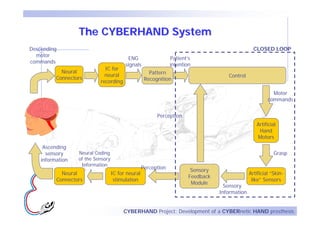
The CYBERHAND System
Descending                                                                                         CLOSED LOOP
  motor
                                          ENG                   Patient’s
commands
                                         signals                intention
                             IC for
            Neural                                    Pattern
                             neural                                                   Control
          Connectors                                Recognition
                           recording

                                                                                                            Motor
                                                                                                          commands


                                                         Perception
                                                                                                    Artificial
                                                                                                     Hand
                                                                                                    Motors
     Ascending
      sensory     Neural Coding                                                                              Grasp
    information   of the Sensory
                   Information
                                                   Perception            Sensory
            Neural                 IC for neural                                                 Artificial “Skin-
                                                                        Feedback
          Connectors                stimulation                                                   like” Sensors
                                                                         Module
                                                                                     Sensory
                                                                                   Information


                                        CYBERHAND Project: Development of a CYBERnetic HAND prosthesis
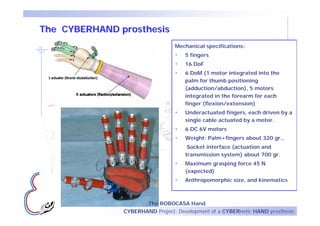
The CYBERHAND prosthesis
                                 Mechanical specifications:
                                 •   5 fingers
                                 •   16 DoF
                                 •   6 DoM (1 motor integrated into the
                                     palm for thumb positioning
                                     (adduction/abduction), 5 motors
                                     integrated in the forearm for each
      5
                                     finger (flexion/extension)
                                 •   Underactuated fingers, each driven by a
                                     single cable actuated by a motor.
                                 •   6 DC 6V motors
                                 •   Weight: Palm+fingers about 320 gr.,
                                      Socket interface (actuation and
                                     transmission system) about 700 gr.
                                 •   Maximum grasping force 45 N
                                     (expected)
                                 •   Anthropomorphic size, and kinematics


                      The ROBOCASA Hand
               CYBERHAND Project: Development of a CYBERnetic HAND prosthesis
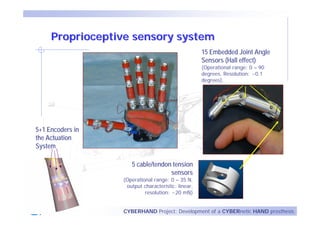
Proprioceptive sensory system
                                                    15 Embedded Joint Angle
                                                    Sensors (Hall effect)
                                                    (Operational range: 0 – 90
                                                    degrees, Resolution: ~0.1
                                                    degrees).


5+1 Encoders in
the Actuation
System

                     5 cable/tendon tension
                                   sensors
                  (Operational range: 0 – 35 N,
                   output characteristic: linear,
                           resolution: ~20 mN)


                  CYBERHAND Project: Development of a CYBERnetic HAND prosthesis
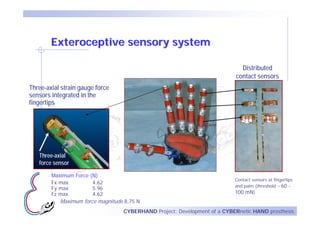
Exteroceptive sensory system

                                                                            Distributed
                                                                          contact sensors
Three-axial strain gauge force
sensors integrated in the
fingertips


   Three-axial
   force sensor

        Maximum Force (N)
                                                                          Contact sensors at fingertips
        Fx max         4.62
                                                                          and palm (threshold ~60 -
        Fy max         5.96
        Fz max         4.62                                               100 mN)
           Maximum force magnitude 8,75 N
                                  CYBERHAND Project: Development of a CYBERnetic HAND prosthesis
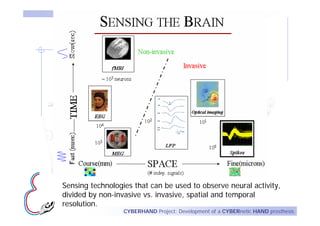
Sensing technologies that can be used to observe neural activity,
divided by non-invasive vs. invasive, spatial and temporal
resolution.
                  CYBERHAND Project: Development of a CYBERnetic HAND prosthesis
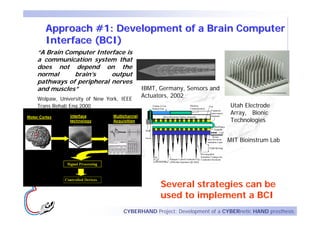
Approach #1: Development of a Brain Computer
   Interface (BCI)
“A Brain Computer Interface is
a communication system that
does not depend on the
normal     brain’s     output
pathways of peripheral nerves
and muscles”                           IBMT, Germany, Sensors and
Wolpaw, University of New York, IEEE
                                       Actuators, 2002
Trans Rehab Eng 2000                                                  Utah Electrode
                                                                      Array, Bionic
                                                                      Technologies


                                                                     MIT Bioinstrum Lab


                                             Several strategies can be
                                             used to implement a BCI
                                CYBERHAND Project: Development of a CYBERnetic HAND prosthesis
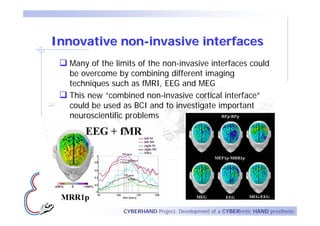
Innovative non-invasive interfaces
  Many of the limits of the non-invasive interfaces could
  be overcome by combining different imaging
  techniques such as fMRI, EEG and MEG
  This new “combined non-invasive cortical interface”
  could be used as BCI and to investigate important
  neuroscientific problems


                CYBERHAND Project: Development of a CYBERnetic HAND prosthesis
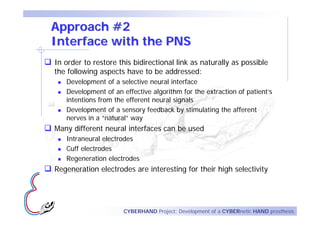
Approach #2
Interface with the PNS
In order to restore this bidirectional link as naturally as possible
the following aspects have to be addressed:
   Development of a selective neural interface
   Development of an effective algorithm for the extraction of patient’s
   intentions from the efferent neural signals
   Development of a sensory feedback by stimulating the afferent
   nerves in a “natural” way
Many different neural interfaces can be used
   Intraneural electrodes
   Cuff electrodes
   Regeneration electrodes
Regeneration electrodes are interesting for their high selectivity


                      CYBERHAND Project: Development of a CYBERnetic HAND prosthesis
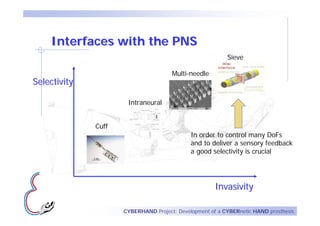
Interfaces with the PNS
                                                          Sieve

                                      Multi-needle
Selectivity

                      Intraneural


              Cuff
                                             In order to control many DoFs
                                             and to deliver a sensory feedback
                                             a good selectivity is crucial


                                                      Invasivity

                     CYBERHAND Project: Development of a CYBERnetic HAND prosthesis
The NEUROBOTICS
                                          IP Project (Duration: 5 years)
Information Society Future and Emerging
Technologies        Technologies


                                          The fusion of NEUROscience and RoBOTICS for
                                                         augmenting human capabilities

Participants
1. SSSA: Scuola Superiore Sant'Anna, Pisa, Italy (prof. Paolo Dario) – Project Coordinator
2. CDF: Collège de France, CNRS, Paris, France (prof. Alain Berthoz)
3. DLR: Deutsches Zentrum fur Luft und Raumfahrt, Oberpfaffenhofen, Germany (prof. Gerd Hirzinger)
4. IBMT: Fraunhofer Institute for Biomedical Engineering, St. Ingbert, Germany (Dr. Thomas Stieglitz)
5. KI: Karolinska Institutet, Stockholm, Sweden (prof. Sten Grillner)
6. KUL: KU Leuven, Belgium (prof. Guy Orban)
7. KTH: Kungl Tekniska Högskolan, Stockholm, Sweden (prof. Henrik Christensen)
8. NTUA: National Technical University of Athens, Greece (prof. Kostas Kyriakopoulos)
9. UMEA: Umea Universitet, Sweden (prof. Roland Johansson)
10. UAB: Universitat Autònoma de Barcelona, Spain (prof. Xavier Navarro)
11. UGDIST: University of Genova, Italy (prof. Giulio Sandini)
12. UNIPR: University of Parma, Italy (prof. Giacomo Rizzolatti)
13. UPMC: Université P. et M. Curie / INSERM U483, Paris, France (prof. Yves Burnod)

International Partners:
Brown University, Providence, RI, USA (Prof. John Donoghue)
Waseda University, Tokyo, Japan (Prof. Atsuo Takanishi)
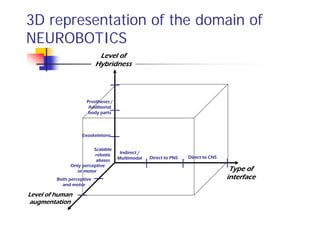
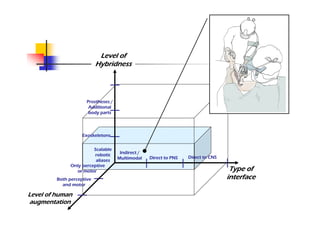
3D representation of the domain of
NEUROBOTICS
                            Level of
                           Hybridness


                      Prostheses /
                       Additional
                       body parts


                    Exoskeletons


                        Scalable
                                      Indirect /
                        robotic
                                     Multimodal    Direct to PNS   Direct to CNS
                         aliases
              Only perceptive
                or motor                                                            Type of
         Both perceptive                                                           interface
           and motor

Level of human
augmentation
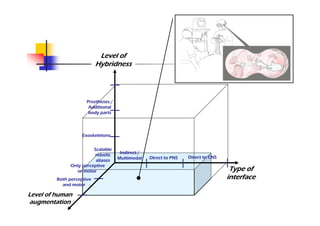
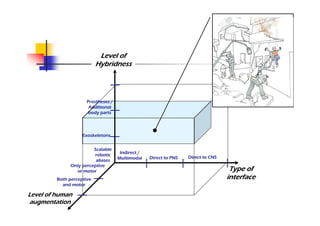
Level of
                           Hybridness


                      Prostheses /
                       Additional
                       body parts


                    Exoskeletons


                        Scalable
                                      Indirect /
                        robotic
                                     Multimodal    Direct to PNS   Direct to CNS
                         aliases
              Only perceptive
                or motor                                                            Type of
         Both perceptive                                                           interface
           and motor

Level of human
augmentation
Level of
                           Hybridness


                      Prostheses /
                       Additional
                       body parts


                    Exoskeletons


                        Scalable
                                      Indirect /
                        robotic
                                     Multimodal    Direct to PNS   Direct to CNS
                         aliases
              Only perceptive
                or motor                                                            Type of
         Both perceptive                                                           interface
           and motor

Level of human
augmentation
Level of
                           Hybridness


                      Prostheses /
                       Additional
                       body parts


                    Exoskeletons


                        Scalable
                                      Indirect /
                        robotic
                                     Multimodal    Direct to PNS   Direct to CNS
                         aliases
              Only perceptive
                or motor                                                            Type of
         Both perceptive                                                           interface
           and motor

Level of human
augmentation
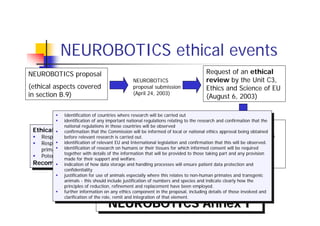
NEUROBOTICS ethical events
NEUROBOTICS proposal                                                                Request of an ethical
                                                 NEUROBOTICS                        review by the Unit C3,
(ethical aspects covered                         proposal submission                Ethics and Science of EU
in section B.9)                                  (April 24, 2003)
                                                                                    (August 6, 2003)

              Identification of countries where research will be carried out
               Identification of countries where research will be carried out
              identification of any important national regulations relating to the research and confirmation that the
               identification of any important national regulations relating to the research and confirmation that the
              national regulations in those countries will be observed                 Ethical review
 Ethical Issues Raised the in those countries will be observed or national ethics approval being obtained
               national regulations
  Ethical Issues Raised
              confirmation that theCommission will be informed of local or national ethics approval being obtained
               confirmation that
    Respect for human dignity
                                        Commission will be informed of local
              before relevant research isiscarried out.                                (Leuven, September 9,
     Respect for human dignity
               before relevant research carried out.
                                                                                       2003)
    Respect for dignity ofof otheranimals inInternational legislation and confirmation that this will be observed.
              identification ofrelevant EU and particular
     Respect for dignity ofother animals inInternational legislation and confirmation that this willrequired
               identification relevant EU and particular                                                 be observed.
              identification of research on humans or their tissues for which informed consent will be required
    primates identification of research on humans or their tissues for which informed consent will be
     primates together with details of the information that will be provided to those taking part and any provision
    Potential misuse ofwith details of the information that will be provided to thoseComments any provision
     Potentialmade for ofthesupport and welfare. warfare
               misuse their technology e.g. warfare
               together
                             the technology e.g.
                                                                                        taking part and from the
               made for their support and welfare.
                                                                                       Ethical Panel
 Recommendations how data storage and Panel processes will ensure patient data protection and
  Recommendationsby the Ethical handling processes will ensure patient data protection and
              indication of how data storage and Panel
               indication of by the Ethical handling
              confidentiality
               confidentiality
              justification for use of animals especially where this relates to non-human primates and transgenic
               justification for use of animals especially where this relates to non-human primates and transgenic
              animals - -this should include justification of numbers and species and indicate clearly how the
               animals this should include justification of numbers and species and indicate clearly how the
                                       Modification of the
                                       Modification of the
              principles of reduction, refinement and replacement have been employed.
               principles of reduction, refinement and replacement have been employed.
              further information on any ethics component in the proposal, including details of those involved and
               further information on any ethics component in the proposal, including details of those involved and
              clarification of the role, remit and integration of that element.
                                     NEUROBOTICS Annex I
               clarification of the role, remit and integration of that element.
                                     NEUROBOTICS Annex I
Recommendations by the
  Ethical Panel to the proposal

The Panel strongly recommends a new
workpackage on the ethical and social implications
of the research and its potential uses. This must
have wide and multidisciplinary involvement across
the EU from experts and the general public.
In particular the issues of warfare and
enhancement of the able-bodied should be
addressed.
The Panel recommends that the applicants abandon
Key Research Action 3.2
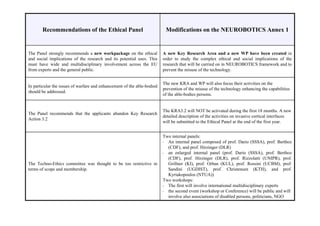
Recommendations of the Ethical Panel                               Modifications on the NEUROBOTICS Annex 1


The Panel strongly recommends a new workpackage on the ethical           A new Key Research Area and a new WP have been created in
and social implications of the research and its potential uses. This     order to study the complex ethical and social implications of the
must have wide and multidisciplinary involvement across the EU           research that will be carried on in NEUROBOTICS framework and to
from experts and the general public.                                     prevent the misuse of the technology.

                                                                         The new KRA and WP will also focus their activities on the
In particular the issues of warfare and enhancement of the able-bodied
                                                                         prevention of the misuse of the technology enhancing the capabilities
should be addressed.
                                                                         of the able-bodies persons.


                                                                         The KRA3.2 will NOT be activated during the first 18 months. A new
The Panel recommends that the applicants abandon Key Research
                                                                         detailed description of the activities on invasive cortical interfaces
Action 3.2
                                                                         will be submitted to the Ethical Panel at the end of the first year.


                                                                         Two internal panels:
                                                                         • An internal panel composed of prof. Dario (SSSA), prof. Berthoz
                                                                           (CDF), and prof. Hirzinger (DLR)
                                                                         • an enlarged internal panel (prof. Dario (SSSA), prof. Berthoz
                                                                           (CDF), prof. Hirzinger (DLR), prof. Rizzolatti (UNIPR), prof.
The Techno-Ethics committee was thought to be too restrictive in           Grillner (KI), prof. Orban (KUL), prof. Rossini (UCBM), prof.
terms of scope and membership.                                             Sandini (UGDIST), prof. Christensen (KTH), and prof.
                                                                           Kyriakopoulos (NTUA))
                                                                         Two workshops:
                                                                         • The first will involve international multidisciplinary experts
                                                                         • the second event (workshop or Conference) will be public and will
                                                                           involve also associations of disabled persons, politicians, NGO
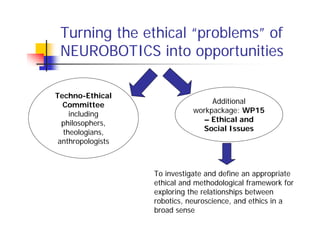
Turning the ethical “problems” of
 NEUROBOTICS into opportunities

Techno-Ethical
  Committee                        Additional
    including                 workpackage: WP15
  philosophers,                 – Ethical and
  theologians,                  Social Issues
 anthropologists


                   To investigate and define an appropriate
                   ethical and methodological framework for
                   exploring the relationships between
                   robotics, neuroscience, and ethics in a
                   broad sense
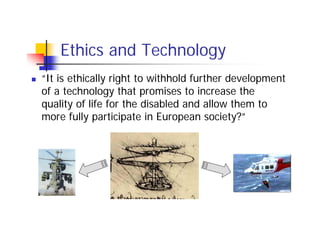
Ethics and Technology
“It is ethically right to withhold further development
of a technology that promises to increase the
quality of life for the disabled and allow them to
more fully participate in European society?”
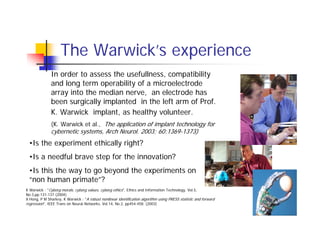
The Warwick’s experience
              In order to assess the usefullness, compatibility
              and long term operability of a microelectrode
              array into the median nerve, an electrode has
              been surgically implanted in the left arm of Prof.
              K. Warwick implant, as healthy volunteer.
              (K. Warwick et al., The application of implant technology for
              cybernetic systems, Arch Neurol. 2003; 60:1369-1373)
 •Is the experiment ethically right?
 •Is a needful brave step for the innovation?
 •Is this the way to go beyond the experiments on
 “non human primate”?
K Warwick : "Cyborg morals, cyborg values, cyborg ethics", Ethics and Information Technology, Vol.5,
No.3,pp.131-137 (2004)
X Hong, P M Sharkey, K Warwick : "A robust nonlinear identification algorithm using PRESS statistic and forward
regression", IEEE Trans on Neural Networks, Vol.14, No.2, pp454-458. (2003)
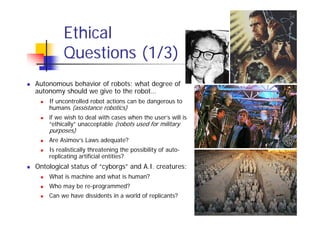
Ethical
         Questions (1/3)
Autonomous behavior of robots: what degree of
autonomy should we give to the robot…
    If uncontrolled robot actions can be dangerous to
    humans (assistance robotics)
    if we wish to deal with cases when the user’s will is
    “ethically” unacceptable (robots used for military
    purposes)
    Are Asimov’s Laws adequate?
    Is realistically threatening the possibility of auto-
    replicating artificial entities?
Ontological status of “cyborgs” and A.I. creatures:
    What is machine and what is human?
    Who may be re-programmed?
    Can we have dissidents in a world of replicants?
Ethical Questions (2/3)
About Robotic Assistants/Rehabilitation
  Can humans be suitably substituted by robots in
  assistive tasks in which emotions and empathy are
  involved?
  Is it ethically right to eliminate less qualifying jobs?
About Augmentation
  Is socially desirable to extend the length of working life?
  Can augmentation generate dangerous feelings of
  omnipotence or powerful super-humans?
Is robotics affordable only by rich people?
Ethical Questions
             (3/3)
   “What kind of privacy safeguards are needed if a
   machine can read your thoughts?
   Will cognition enhancers exacerbate differences
   between rich and poor?
   Or, instead, will they relegate social diversity to
   the status of historical artifact?
   What happens if we deduce through
   neuroimaging the physiological basis for morality?
   Or, and by the way, what happens to free will?”

Scientific American (Editorial), September 2003
Methodology for the identification
        of ethical questions
1. to start with a list of fundamental rights of humans and
   animals (based on the Charter of Fundamental Rights of
   the EU)
2. to identify the effects of the
   i.   results
   ii. methods
   of the NEUROBOTICS research
3. for each fundamental right, effect of a result, effect of a
   method, to istantiate the following schematic question:


 in which way will the effects of NEUROBOTICS results and
        methods affect this particular fundamental right?
Charter of
Fundamental
Rights of the
European Union
 the Cologne European Council (3-4 June 1999) entrusted the task of
 drafting the Charter to a Convention,
 the Convention held its constituent meeting in December 1999 (see
 annex for its composition) and adopted the draft on 2 October 2000,
 the Biarritz European Council (13-14 October 2000) unanimously
 approved the draft and forwarded it to the European Parliament and the
 Commission,
 the European Parliament gave its agreement on 14 November 2000 and
 the Commission on 6 December 2000,
 the Presidents of the European Parliament, the Council and the
 Commission signed and proclaimed the Charter on behalf of their
 institutions on 7 December 2000 in Nice
Intended functions, misuses
 and side-effects of technology


Assuming an ‘ethically right’ use
   of technology, we must be
 aware of possible misuses and
       side-effects of our
    technological innovations
Effects to be avoided: misuses
  and side-effects
Misuses: improper use of technology
  Not voluntary (culpable):
  improper use of technology (possibly due to
  ignorance of advertisements) causing involuntary
  damages
  Malicious (fraudulent):
  voluntarily improper use of technology
Effects to be avoided: misuses
    and side-effects
Side-effects: proper use of technology, also
causing effects different than those expected
  Not yet known
  Only vaguely known
  (typical of just released technologies, whose side-effects have not
  been yet exhaustively investigated)
  Exhaustively known
  (affecting people in a low percentage)
First list of NEUROBOTICS
          ethical issues
Bionic technologies could be fraudulently applied for military purposes, thus limiting personal
freedom and security.
The research on hybrid bionic systems could allow one to override one’s intentions, to disrupt
personal free will or manipulate thoughts and ideas.
The research on hybrid bionic systems could threaten the personal freedom of expression and
information.
What degree of autonomy should we give to neuro-robotic platforms if uncontrolled robot
actions can be dangerous to humans?
Bionic technologies could endanger right to life for humans by, for example, creating extremely
powerful super-humans.
New-generation exoskeletons could be used for physically controlling people, thus creating new
forms of slavery and forced labour.
What is machine and what is human? Which dignity and rights do hybrid bionic systems have?
Is it socially desirable to extend the length of working life?
Invasive research on humans could involve inhuman or degrading procedures.
Invasive research on humans could lead to new torture or inhumane punishment techniques.
Can humans be suitably substituted by robots in assistive tasks in which emotions and empathy
are involved?
Will be neuro-robotics results affordable only by rich people? Will cognitive and motor
enhancers exacerbate differences between rich and poor?
Events in the background
Talks on “Techno-Ethics” by Prof. José M. Galvàn at the Scuola Superiore
Sant’Anna (Pisa, Italy) in 2001 and 2002
Italy-Japan 2001 Workshop “Humanoids: a Techno-Ontological
Approach”, Tokyo, Japan, November 2001
Panel discussion at ICRA 2002 (IEEE International Conference on
Robotics and Automation), Washington DC, USA, May 2002
Discussion at the 11th International Symposium on Robotics Research,
Siena, Italy, October 2003
Paper by José Maria Galvan, “On Technoethics”, IEEE Robotics and
Automation Magazine, December 2003
Creation of an IEEE-RAS (Robotics and Automation Society) Technical
Committee on RoboEthics (December 2003)
First International Symposium on Roboethics, Sanremo, January 2004
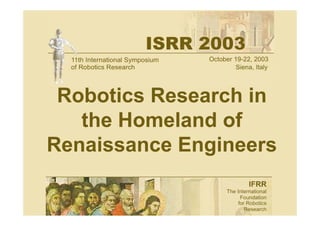
Robotics Research in
   the Homeland of
Renaissance Engineers
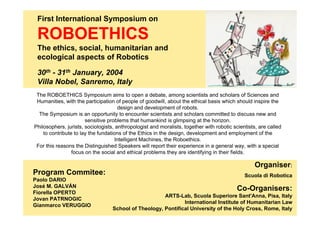
First International Symposium on

 ROBOETHICS
 The ethics, social, humanitarian and
 ecological aspects of Robotics

 30th - 31th January, 2004
 Villa Nobel, Sanremo, Italy
 The ROBOETHICS Symposium aims to open a debate, among scientists and scholars of Sciences and
 Humanities, with the participation of people of goodwill, about the ethical basis which should inspire the
                                      design and development of robots.
  The Symposium is an opportunity to encounter scientists and scholars committed to discuss new and
                       sensitive problems that humankind is glimpsing at the horizon.
Philosophers, jurists, sociologists, anthropologist and moralists, together with robotic scientists, are called
    to contribute to lay the fundations of the Ethics in the design, development and employment of the
                                     Intelligent Machines, the Roboethics.
 For this reasons the Distinguished Speakers will report their experience in a general way, with a special
                 focus on the social and ethical problems they are identifying in their fields.

                                                                                                   Organiser:
Program Commitee:                                                                             Scuola di Robotica
Paolo DARIO
José M. GALVÁN
Fiorella OPERTO
                                                                                           Co-Organisers:
                                                       ARTS-Lab, Scuola Superiore Sant'Anna, Pisa, Italy
Jovan PATRNOGIC
                                                               International Institute of Humanitarian Law
Gianmarco VERUGGIO
                                   School of Theology, Pontifical University of the Holy Cross, Rome, Italy
ETHICBOTS project
Emerging Technoethics of Human Interaction with
Communication, Bionic, robOTic Systems
   Proposal for a Coordination Action on Technoethics for Call 9
   of the “Science and Society” Priority
   Partners:
   1.    University “Federico II”, Naples, Department of Physical Sciences and Department of
         Computer and Systems Engineering , Italy (DSF) (Guglielmo Tamburrini,
         Coordinator)
   2.    Fraunhofer Institute for Autonomous intelligent Systems, Sankt Augustin, Germany
         (FhG/AIS)
   3.    Scuola di Robotica, Genova, Italy (Scuola di Robotica)
   4.    Institute of Applied Philosophy, Faculty of Theology, Lugano, Switzerland (IsFA)
   5.    University of Reading, department of Cybernetics, UK (UNIRDG)
   6.    Hochschule der Medien University of Applied Sciences, Stuttgart, Germany (HdM)
   7.    LAAS-CNRS, Toulouse, France (CNRS)
   8.    Scuola Superiore Sant’Anna, Pisa, Italy (SSSA)
   9.    University of Pisa, Department of Philosophy, Italy (UNIPI)
   10.   Middlesex University, Interaction Design Centre, School of Computing, London, UK
         (UM)
The robotics researcher
  assumes a new role
    and new ethical
    responsibilities
José Maria Galvan, “On Technoethics”,
IEEE Robotics and Automation Magazine,
December 2003
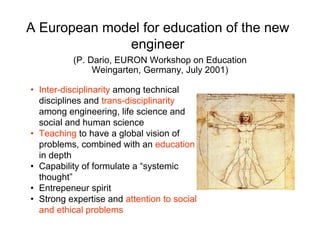
A European model for education of the new
              engineer
          (P. Dario, EURON Workshop on Education
               Weingarten, Germany, July 2001)

• Inter-disciplinarity among technical
  disciplines and trans-disciplinarity
  among engineering, life science and
  social and human science
• Teaching to have a global vision of
  problems, combined with an education
  in depth
• Capability of formulate a “systemic
  thought”
• Entrepeneur spirit
• Strong expertise and attention to social
  and ethical problems
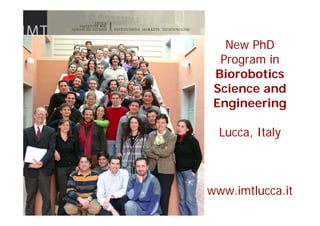
New PhD
  Program in
 Biorobotics
 Science and
 Engineering

  Lucca, Italy


www.imtlucca.it

Ethical issues involved in hybrid bionic systems

  • 1.
    Workshop on Robo-Ethics,Barcelona, April 18th, 2005 Ethical issues involved in hybrid bionic systems research Paolo Dario Scuola Superiore Sant’Anna
  • 2.
    Outline of thetalk Bionics: the connection of natural and artificial Case-study 1: the CYBERHAND Project Developing a hand prostheses to be connected to the nervous system Case study 2: the NEUROBOTICS Project Investigating the development of hybrid bionic systems Conclusions: the new role and ethical responsibilities of robotics researchers
  • 3.
    Bionics: the connectionof natural and Man artificial Biological models for the design of Nerves biomimetic robots Brain Limbs Interfacing Neuroscience and Robotics • New technologies for functional substitution • Robots as physical platforms for validating biological models
  • 4.
    “Connecting” the Manand the Robot Bionic prostheses Man Nerves Artificial Brain limbs Nerves Brain Limbs Interface Robot Artificially controlled limbs Artificial Electric Artificial Artificial Electric Brain wires limbs Brain wires Limbs
  • 5.
    Controlling biological systems by artificial stimulation S. K. Talwar, S. Xu, E.S. Hawley, S. A. Weiss, K. A. Moxon, J. K. Chapin, “Behavioural neuroscience: Rat navigation guided by remote control” Nature 417, 37 - 38 (2002)
  • 6.
    Neural tissue asa controlling device: brain-machine interface (S. Mussa-Ivaldi)
  • 7.
    “Brain to ComputerInterface is one of the 10 Emerging Technologies that will change the world” Technology Review, January/February, 2001
  • 8.
    Cyberhand Project 1. “Biologically Inspired” Mechatronic Hand IST-FET Project #2001-35094 2. Biomimetic sensors 3. Regeneration-type electrode (efferent nerve) (01/05/2002 – 30/04/2005) 4. Regeneration-type electrode (afferent nerve) 5. Implantable system for neural stimulation and recording 6. Efferent telemetric link 7. Afferent telemetric link Regeneration-type 8. Decoding patient’s 8. External unit for decoding patient’s intentions and for prosthesis control electrodes: intentions and Embedded closed-loop 9. Cognitive feedback 3. Regeneration-type electrode (efferent nerve) control of the artificial hand 4. Regeneration-type 1. “Biologically Inspired” electrode (afferent nerve) Mechatronic Hand 2. Embedded Biomimetic sensors: 5. Implanted neural interface: 6. Receiver - within the structure Stump ENG efferent signals recording 7. Transmitter - within the glove (patient’s intention detection) Afferent nerves stimulation (to provide sensory feedback to the patient)
  • 9.
    6 CYBERHAND at-a-glance 3 Starting date: May 1, 2002 End date: April 30, 2005 Cost: 2,500 K€ Funding: 1,683 K€ 2 1 Partners: 4 5 1. Scuola Superiore Sant’Anna (SSSA) - Pisa (I) – Co-ordinator 2. INAIL RTR Center (CP-RTR) – Viareggio (I) 3. Fraunhofer Institut für Biomedizinische Technik (FhG-IBMT) - St. Ingbert (D) 4. Centro Nacional de Microelectronica (CSIC-CNM) - Instituto de Microelectronica de Barcelona (E) 5. Universidad Autonoma de Barcelona (UAB), Barcelona (E) 6. Center for Sensory-Motor Interaction (AAU-SMI), Aalborg (DK) CYBERHAND Project: Development of a CYBERnetic HAND prosthesis
  • 10.
    Objectives of theCYBERHAND project Long-Term Objective: to increase the basic knowledge of neural regeneration and sensory-motor control of the hand in humans Middle-Term Objective: to exploit this knowledge to develop a new kind of hand prosthesis which will overcome some of the drawbacks of current hand prostheses. This new prosthesis will: be felt by an amputee as the lost natural limb delivering her/him a natural sensory feedback by means of the stimulation of some specific afferent nerves; be controlled in a very natural way by processing the efferent neural signals coming from the central nervous system CYBERHAND Project: Development of a CYBERnetic HAND prosthesis
  • 11.
    The CYBERHAND System 6. 7. 1. Biomechatronic Hand 5. 2. Biomimetic sensors Cognitive 9. Feedback 3. Regeneration-type electrode 3. (efferent nerve) 8.Processing and control 4. Regeneration-type electrode 4. (afferent nerve) 5. Implantable system for neural stimulation and 1. recording 2. 6. Efferent telemetric link 7. Afferent telemetric link 8. External unit for decoding patient’s intentions and for prosthesis control 9. Cognitive feedback CYBERHAND Project: Development of a CYBERnetic HAND prosthesis
  • 12.
    The CYBERHAND System Descending CLOSED LOOP motor ENG Patient’s commands signals intention IC for Neural Pattern neural Control Connectors Recognition recording Motor commands Perception Artificial Hand Motors Ascending sensory Neural Coding Grasp information of the Sensory Information Perception Sensory Neural IC for neural Artificial “Skin- Feedback Connectors stimulation like” Sensors Module Sensory Information CYBERHAND Project: Development of a CYBERnetic HAND prosthesis
  • 13.
    The CYBERHAND prosthesis Mechanical specifications: • 5 fingers • 16 DoF • 6 DoM (1 motor integrated into the palm for thumb positioning (adduction/abduction), 5 motors integrated in the forearm for each 5 finger (flexion/extension) • Underactuated fingers, each driven by a single cable actuated by a motor. • 6 DC 6V motors • Weight: Palm+fingers about 320 gr., Socket interface (actuation and transmission system) about 700 gr. • Maximum grasping force 45 N (expected) • Anthropomorphic size, and kinematics The ROBOCASA Hand CYBERHAND Project: Development of a CYBERnetic HAND prosthesis
  • 14.
    Proprioceptive sensory system 15 Embedded Joint Angle Sensors (Hall effect) (Operational range: 0 – 90 degrees, Resolution: ~0.1 degrees). 5+1 Encoders in the Actuation System 5 cable/tendon tension sensors (Operational range: 0 – 35 N, output characteristic: linear, resolution: ~20 mN) CYBERHAND Project: Development of a CYBERnetic HAND prosthesis
  • 15.
    Exteroceptive sensory system Distributed contact sensors Three-axial strain gauge force sensors integrated in the fingertips Three-axial force sensor Maximum Force (N) Contact sensors at fingertips Fx max 4.62 and palm (threshold ~60 - Fy max 5.96 Fz max 4.62 100 mN) Maximum force magnitude 8,75 N CYBERHAND Project: Development of a CYBERnetic HAND prosthesis
  • 16.
    Sensing technologies thatcan be used to observe neural activity, divided by non-invasive vs. invasive, spatial and temporal resolution. CYBERHAND Project: Development of a CYBERnetic HAND prosthesis
  • 17.
    Approach #1: Developmentof a Brain Computer Interface (BCI) “A Brain Computer Interface is a communication system that does not depend on the normal brain’s output pathways of peripheral nerves and muscles” IBMT, Germany, Sensors and Wolpaw, University of New York, IEEE Actuators, 2002 Trans Rehab Eng 2000 Utah Electrode Array, Bionic Technologies MIT Bioinstrum Lab Several strategies can be used to implement a BCI CYBERHAND Project: Development of a CYBERnetic HAND prosthesis
  • 18.
    Innovative non-invasive interfaces Many of the limits of the non-invasive interfaces could be overcome by combining different imaging techniques such as fMRI, EEG and MEG This new “combined non-invasive cortical interface” could be used as BCI and to investigate important neuroscientific problems CYBERHAND Project: Development of a CYBERnetic HAND prosthesis
  • 19.
    Approach #2 Interface withthe PNS In order to restore this bidirectional link as naturally as possible the following aspects have to be addressed: Development of a selective neural interface Development of an effective algorithm for the extraction of patient’s intentions from the efferent neural signals Development of a sensory feedback by stimulating the afferent nerves in a “natural” way Many different neural interfaces can be used Intraneural electrodes Cuff electrodes Regeneration electrodes Regeneration electrodes are interesting for their high selectivity CYBERHAND Project: Development of a CYBERnetic HAND prosthesis
  • 20.
    Interfaces with thePNS Sieve Multi-needle Selectivity Intraneural Cuff In order to control many DoFs and to deliver a sensory feedback a good selectivity is crucial Invasivity CYBERHAND Project: Development of a CYBERnetic HAND prosthesis
  • 21.
    The NEUROBOTICS IP Project (Duration: 5 years) Information Society Future and Emerging Technologies Technologies The fusion of NEUROscience and RoBOTICS for augmenting human capabilities Participants 1. SSSA: Scuola Superiore Sant'Anna, Pisa, Italy (prof. Paolo Dario) – Project Coordinator 2. CDF: Collège de France, CNRS, Paris, France (prof. Alain Berthoz) 3. DLR: Deutsches Zentrum fur Luft und Raumfahrt, Oberpfaffenhofen, Germany (prof. Gerd Hirzinger) 4. IBMT: Fraunhofer Institute for Biomedical Engineering, St. Ingbert, Germany (Dr. Thomas Stieglitz) 5. KI: Karolinska Institutet, Stockholm, Sweden (prof. Sten Grillner) 6. KUL: KU Leuven, Belgium (prof. Guy Orban) 7. KTH: Kungl Tekniska Högskolan, Stockholm, Sweden (prof. Henrik Christensen) 8. NTUA: National Technical University of Athens, Greece (prof. Kostas Kyriakopoulos) 9. UMEA: Umea Universitet, Sweden (prof. Roland Johansson) 10. UAB: Universitat Autònoma de Barcelona, Spain (prof. Xavier Navarro) 11. UGDIST: University of Genova, Italy (prof. Giulio Sandini) 12. UNIPR: University of Parma, Italy (prof. Giacomo Rizzolatti) 13. UPMC: Université P. et M. Curie / INSERM U483, Paris, France (prof. Yves Burnod) International Partners: Brown University, Providence, RI, USA (Prof. John Donoghue) Waseda University, Tokyo, Japan (Prof. Atsuo Takanishi)
  • 22.
    3D representation ofthe domain of NEUROBOTICS Level of Hybridness Prostheses / Additional body parts Exoskeletons Scalable Indirect / robotic Multimodal Direct to PNS Direct to CNS aliases Only perceptive or motor Type of Both perceptive interface and motor Level of human augmentation
  • 23.
    Level of Hybridness Prostheses / Additional body parts Exoskeletons Scalable Indirect / robotic Multimodal Direct to PNS Direct to CNS aliases Only perceptive or motor Type of Both perceptive interface and motor Level of human augmentation
  • 24.
    Level of Hybridness Prostheses / Additional body parts Exoskeletons Scalable Indirect / robotic Multimodal Direct to PNS Direct to CNS aliases Only perceptive or motor Type of Both perceptive interface and motor Level of human augmentation
  • 25.
    Level of Hybridness Prostheses / Additional body parts Exoskeletons Scalable Indirect / robotic Multimodal Direct to PNS Direct to CNS aliases Only perceptive or motor Type of Both perceptive interface and motor Level of human augmentation
  • 26.
    NEUROBOTICS ethical events NEUROBOTICSproposal Request of an ethical NEUROBOTICS review by the Unit C3, (ethical aspects covered proposal submission Ethics and Science of EU in section B.9) (April 24, 2003) (August 6, 2003) Identification of countries where research will be carried out Identification of countries where research will be carried out identification of any important national regulations relating to the research and confirmation that the identification of any important national regulations relating to the research and confirmation that the national regulations in those countries will be observed Ethical review Ethical Issues Raised the in those countries will be observed or national ethics approval being obtained national regulations Ethical Issues Raised confirmation that theCommission will be informed of local or national ethics approval being obtained confirmation that Respect for human dignity Commission will be informed of local before relevant research isiscarried out. (Leuven, September 9, Respect for human dignity before relevant research carried out. 2003) Respect for dignity ofof otheranimals inInternational legislation and confirmation that this will be observed. identification ofrelevant EU and particular Respect for dignity ofother animals inInternational legislation and confirmation that this willrequired identification relevant EU and particular be observed. identification of research on humans or their tissues for which informed consent will be required primates identification of research on humans or their tissues for which informed consent will be primates together with details of the information that will be provided to those taking part and any provision Potential misuse ofwith details of the information that will be provided to thoseComments any provision Potentialmade for ofthesupport and welfare. warfare misuse their technology e.g. warfare together the technology e.g. taking part and from the made for their support and welfare. Ethical Panel Recommendations how data storage and Panel processes will ensure patient data protection and Recommendationsby the Ethical handling processes will ensure patient data protection and indication of how data storage and Panel indication of by the Ethical handling confidentiality confidentiality justification for use of animals especially where this relates to non-human primates and transgenic justification for use of animals especially where this relates to non-human primates and transgenic animals - -this should include justification of numbers and species and indicate clearly how the animals this should include justification of numbers and species and indicate clearly how the Modification of the Modification of the principles of reduction, refinement and replacement have been employed. principles of reduction, refinement and replacement have been employed. further information on any ethics component in the proposal, including details of those involved and further information on any ethics component in the proposal, including details of those involved and clarification of the role, remit and integration of that element. NEUROBOTICS Annex I clarification of the role, remit and integration of that element. NEUROBOTICS Annex I
  • 27.
    Recommendations by the Ethical Panel to the proposal The Panel strongly recommends a new workpackage on the ethical and social implications of the research and its potential uses. This must have wide and multidisciplinary involvement across the EU from experts and the general public. In particular the issues of warfare and enhancement of the able-bodied should be addressed. The Panel recommends that the applicants abandon Key Research Action 3.2
  • 28.
    Recommendations of theEthical Panel Modifications on the NEUROBOTICS Annex 1 The Panel strongly recommends a new workpackage on the ethical A new Key Research Area and a new WP have been created in and social implications of the research and its potential uses. This order to study the complex ethical and social implications of the must have wide and multidisciplinary involvement across the EU research that will be carried on in NEUROBOTICS framework and to from experts and the general public. prevent the misuse of the technology. The new KRA and WP will also focus their activities on the In particular the issues of warfare and enhancement of the able-bodied prevention of the misuse of the technology enhancing the capabilities should be addressed. of the able-bodies persons. The KRA3.2 will NOT be activated during the first 18 months. A new The Panel recommends that the applicants abandon Key Research detailed description of the activities on invasive cortical interfaces Action 3.2 will be submitted to the Ethical Panel at the end of the first year. Two internal panels: • An internal panel composed of prof. Dario (SSSA), prof. Berthoz (CDF), and prof. Hirzinger (DLR) • an enlarged internal panel (prof. Dario (SSSA), prof. Berthoz (CDF), prof. Hirzinger (DLR), prof. Rizzolatti (UNIPR), prof. The Techno-Ethics committee was thought to be too restrictive in Grillner (KI), prof. Orban (KUL), prof. Rossini (UCBM), prof. terms of scope and membership. Sandini (UGDIST), prof. Christensen (KTH), and prof. Kyriakopoulos (NTUA)) Two workshops: • The first will involve international multidisciplinary experts • the second event (workshop or Conference) will be public and will involve also associations of disabled persons, politicians, NGO
  • 29.
    Turning the ethical“problems” of NEUROBOTICS into opportunities Techno-Ethical Committee Additional including workpackage: WP15 philosophers, – Ethical and theologians, Social Issues anthropologists To investigate and define an appropriate ethical and methodological framework for exploring the relationships between robotics, neuroscience, and ethics in a broad sense
  • 30.
    Ethics and Technology “Itis ethically right to withhold further development of a technology that promises to increase the quality of life for the disabled and allow them to more fully participate in European society?”
  • 31.
    The Warwick’s experience In order to assess the usefullness, compatibility and long term operability of a microelectrode array into the median nerve, an electrode has been surgically implanted in the left arm of Prof. K. Warwick implant, as healthy volunteer. (K. Warwick et al., The application of implant technology for cybernetic systems, Arch Neurol. 2003; 60:1369-1373) •Is the experiment ethically right? •Is a needful brave step for the innovation? •Is this the way to go beyond the experiments on “non human primate”? K Warwick : "Cyborg morals, cyborg values, cyborg ethics", Ethics and Information Technology, Vol.5, No.3,pp.131-137 (2004) X Hong, P M Sharkey, K Warwick : "A robust nonlinear identification algorithm using PRESS statistic and forward regression", IEEE Trans on Neural Networks, Vol.14, No.2, pp454-458. (2003)
  • 32.
    Ethical Questions (1/3) Autonomous behavior of robots: what degree of autonomy should we give to the robot… If uncontrolled robot actions can be dangerous to humans (assistance robotics) if we wish to deal with cases when the user’s will is “ethically” unacceptable (robots used for military purposes) Are Asimov’s Laws adequate? Is realistically threatening the possibility of auto- replicating artificial entities? Ontological status of “cyborgs” and A.I. creatures: What is machine and what is human? Who may be re-programmed? Can we have dissidents in a world of replicants?
  • 33.
    Ethical Questions (2/3) AboutRobotic Assistants/Rehabilitation Can humans be suitably substituted by robots in assistive tasks in which emotions and empathy are involved? Is it ethically right to eliminate less qualifying jobs? About Augmentation Is socially desirable to extend the length of working life? Can augmentation generate dangerous feelings of omnipotence or powerful super-humans? Is robotics affordable only by rich people?
  • 34.
    Ethical Questions (3/3) “What kind of privacy safeguards are needed if a machine can read your thoughts? Will cognition enhancers exacerbate differences between rich and poor? Or, instead, will they relegate social diversity to the status of historical artifact? What happens if we deduce through neuroimaging the physiological basis for morality? Or, and by the way, what happens to free will?” Scientific American (Editorial), September 2003
  • 35.
    Methodology for theidentification of ethical questions 1. to start with a list of fundamental rights of humans and animals (based on the Charter of Fundamental Rights of the EU) 2. to identify the effects of the i. results ii. methods of the NEUROBOTICS research 3. for each fundamental right, effect of a result, effect of a method, to istantiate the following schematic question: in which way will the effects of NEUROBOTICS results and methods affect this particular fundamental right?
  • 36.
    Charter of Fundamental Rights ofthe European Union the Cologne European Council (3-4 June 1999) entrusted the task of drafting the Charter to a Convention, the Convention held its constituent meeting in December 1999 (see annex for its composition) and adopted the draft on 2 October 2000, the Biarritz European Council (13-14 October 2000) unanimously approved the draft and forwarded it to the European Parliament and the Commission, the European Parliament gave its agreement on 14 November 2000 and the Commission on 6 December 2000, the Presidents of the European Parliament, the Council and the Commission signed and proclaimed the Charter on behalf of their institutions on 7 December 2000 in Nice
  • 37.
    Intended functions, misuses and side-effects of technology Assuming an ‘ethically right’ use of technology, we must be aware of possible misuses and side-effects of our technological innovations
  • 38.
    Effects to beavoided: misuses and side-effects Misuses: improper use of technology Not voluntary (culpable): improper use of technology (possibly due to ignorance of advertisements) causing involuntary damages Malicious (fraudulent): voluntarily improper use of technology
  • 39.
    Effects to beavoided: misuses and side-effects Side-effects: proper use of technology, also causing effects different than those expected Not yet known Only vaguely known (typical of just released technologies, whose side-effects have not been yet exhaustively investigated) Exhaustively known (affecting people in a low percentage)
  • 40.
    First list ofNEUROBOTICS ethical issues Bionic technologies could be fraudulently applied for military purposes, thus limiting personal freedom and security. The research on hybrid bionic systems could allow one to override one’s intentions, to disrupt personal free will or manipulate thoughts and ideas. The research on hybrid bionic systems could threaten the personal freedom of expression and information. What degree of autonomy should we give to neuro-robotic platforms if uncontrolled robot actions can be dangerous to humans? Bionic technologies could endanger right to life for humans by, for example, creating extremely powerful super-humans. New-generation exoskeletons could be used for physically controlling people, thus creating new forms of slavery and forced labour. What is machine and what is human? Which dignity and rights do hybrid bionic systems have? Is it socially desirable to extend the length of working life? Invasive research on humans could involve inhuman or degrading procedures. Invasive research on humans could lead to new torture or inhumane punishment techniques. Can humans be suitably substituted by robots in assistive tasks in which emotions and empathy are involved? Will be neuro-robotics results affordable only by rich people? Will cognitive and motor enhancers exacerbate differences between rich and poor?
  • 41.
    Events in thebackground Talks on “Techno-Ethics” by Prof. José M. Galvàn at the Scuola Superiore Sant’Anna (Pisa, Italy) in 2001 and 2002 Italy-Japan 2001 Workshop “Humanoids: a Techno-Ontological Approach”, Tokyo, Japan, November 2001 Panel discussion at ICRA 2002 (IEEE International Conference on Robotics and Automation), Washington DC, USA, May 2002 Discussion at the 11th International Symposium on Robotics Research, Siena, Italy, October 2003 Paper by José Maria Galvan, “On Technoethics”, IEEE Robotics and Automation Magazine, December 2003 Creation of an IEEE-RAS (Robotics and Automation Society) Technical Committee on RoboEthics (December 2003) First International Symposium on Roboethics, Sanremo, January 2004
  • 42.
    Robotics Research in the Homeland of Renaissance Engineers
  • 43.
    First International Symposiumon ROBOETHICS The ethics, social, humanitarian and ecological aspects of Robotics 30th - 31th January, 2004 Villa Nobel, Sanremo, Italy The ROBOETHICS Symposium aims to open a debate, among scientists and scholars of Sciences and Humanities, with the participation of people of goodwill, about the ethical basis which should inspire the design and development of robots. The Symposium is an opportunity to encounter scientists and scholars committed to discuss new and sensitive problems that humankind is glimpsing at the horizon. Philosophers, jurists, sociologists, anthropologist and moralists, together with robotic scientists, are called to contribute to lay the fundations of the Ethics in the design, development and employment of the Intelligent Machines, the Roboethics. For this reasons the Distinguished Speakers will report their experience in a general way, with a special focus on the social and ethical problems they are identifying in their fields. Organiser: Program Commitee: Scuola di Robotica Paolo DARIO José M. GALVÁN Fiorella OPERTO Co-Organisers: ARTS-Lab, Scuola Superiore Sant'Anna, Pisa, Italy Jovan PATRNOGIC International Institute of Humanitarian Law Gianmarco VERUGGIO School of Theology, Pontifical University of the Holy Cross, Rome, Italy
  • 44.
    ETHICBOTS project Emerging Technoethicsof Human Interaction with Communication, Bionic, robOTic Systems Proposal for a Coordination Action on Technoethics for Call 9 of the “Science and Society” Priority Partners: 1. University “Federico II”, Naples, Department of Physical Sciences and Department of Computer and Systems Engineering , Italy (DSF) (Guglielmo Tamburrini, Coordinator) 2. Fraunhofer Institute for Autonomous intelligent Systems, Sankt Augustin, Germany (FhG/AIS) 3. Scuola di Robotica, Genova, Italy (Scuola di Robotica) 4. Institute of Applied Philosophy, Faculty of Theology, Lugano, Switzerland (IsFA) 5. University of Reading, department of Cybernetics, UK (UNIRDG) 6. Hochschule der Medien University of Applied Sciences, Stuttgart, Germany (HdM) 7. LAAS-CNRS, Toulouse, France (CNRS) 8. Scuola Superiore Sant’Anna, Pisa, Italy (SSSA) 9. University of Pisa, Department of Philosophy, Italy (UNIPI) 10. Middlesex University, Interaction Design Centre, School of Computing, London, UK (UM)
  • 45.
    The robotics researcher assumes a new role and new ethical responsibilities José Maria Galvan, “On Technoethics”, IEEE Robotics and Automation Magazine, December 2003
  • 46.
    A European modelfor education of the new engineer (P. Dario, EURON Workshop on Education Weingarten, Germany, July 2001) • Inter-disciplinarity among technical disciplines and trans-disciplinarity among engineering, life science and social and human science • Teaching to have a global vision of problems, combined with an education in depth • Capability of formulate a “systemic thought” • Entrepeneur spirit • Strong expertise and attention to social and ethical problems
  • 47.
    New PhD Program in Biorobotics Science and Engineering Lucca, Italy www.imtlucca.it