International Journal on Recent and Innovation Trends in Computing and Communication ISSN: 2321-8169
Volume: 5 Issue: 8 220 – 223
_______________________________________________________________________________________________
220
IJRITCC | August 2017, Available @ http://www.ijritcc.org
_______________________________________________________________________________________
On Cubic Graceful Labeling
Mathew Varkey T. K 1
,
1
Asst.Prof, Department of Mathematics,
T.K.M College of Engineering,
Kollam, Kerala, India
Email: mathewvarkeytk@gmail.com
Mini. S. Thomas 2
2
Research Scholar, Department of Mathematics
St. Albert’s College,
Eranakulam, Kerala, India
minirenjan1994@gmail.com
Abstract- A graph with n vertex and m edges is said to be cubic graceful labeling if its vertices are labeled with distinct integers
{0,1,2,3,……..,m3
} such that for each edge f*
( uv) induces edge mappings are {13,
23
,33
,……,m3
}. A graph admits a cubic graceful labeling is
called a cubic graceful graph. In this paper, we proved that < K1,a , K1,b , K1c , K1,d>, associate urp with u(r+1)1 of K1,P, fixed vertices vr and ur
of two copies of Pn are cubic graceful.
Keywords: Cubic graceful graph, cubic graceful labeling, Path graph, Star graph,
__________________________________________________*****_________________________________________________
I. INTRODUCTION
Graphs labeling, where the vertices are assigned values subject to certain conditions, have often been motivated by practical
problems. Labeled graphs serves as useful mathematical models for a broad range of applications such as coding theory,
including the design of good radar type codes, missile guidance codes and convolution codes with optimal autocorrelation
properties. They facilitate the optimal nonstandard encoding of integers. For all terminology and notation in this paper we follow
Harary[1].
A function f is called a graceful labeling of a (p,q) graph G= (V,E) if f is an injection from the vertices of G to the set
{0,1,2,3,….q} such that, each edge uv is assigned the label |f(u)-f(v), the resulting edge labels are distinct. T. Tharmaraj and
P.B.Sarasija [5] introduced square graceful labeling concept in 2014. The concept of cubic graceful labeling of graphs was
introduced in [4]. A systematic presentation of survey of graph labeling is presented in [2]. We use the following definitions in the
subsequent sections.
Definition 1.1
The Path graph Pn is the n- vertex graph with n-1 edges, all on a single path.
Definition1.2
A complete bipartite graph K1,n is called a star and it has (n+1) vertices and n edges
Definition 1.3
The Trivial graph K1 or P1 is the graph with one vertex and no edges.
Definition 1.4
A graph G = (V,E) with n vertices and m edges is said be Cubic Graceful Graph (CGG) if there exists an injective function f:
V(G)→{0,1,2,……,m3
} such that the induced mapping f * : E(G)→ {13
,23
,……,m3
} defined by f *(uv): →|f(u)- f(v)| is a bijection .
The function f is called a Cubic Graceful Labeling (CGL) of G
International Journal on Recent and Innovation Trends in Computing and Communication ISSN: 2321-8169
Volume: 5 Issue: 8 220 – 223
_______________________________________________________________________________________________
221
IJRITCC | August 2017, Available @ http://www.ijritcc.org
_______________________________________________________________________________________
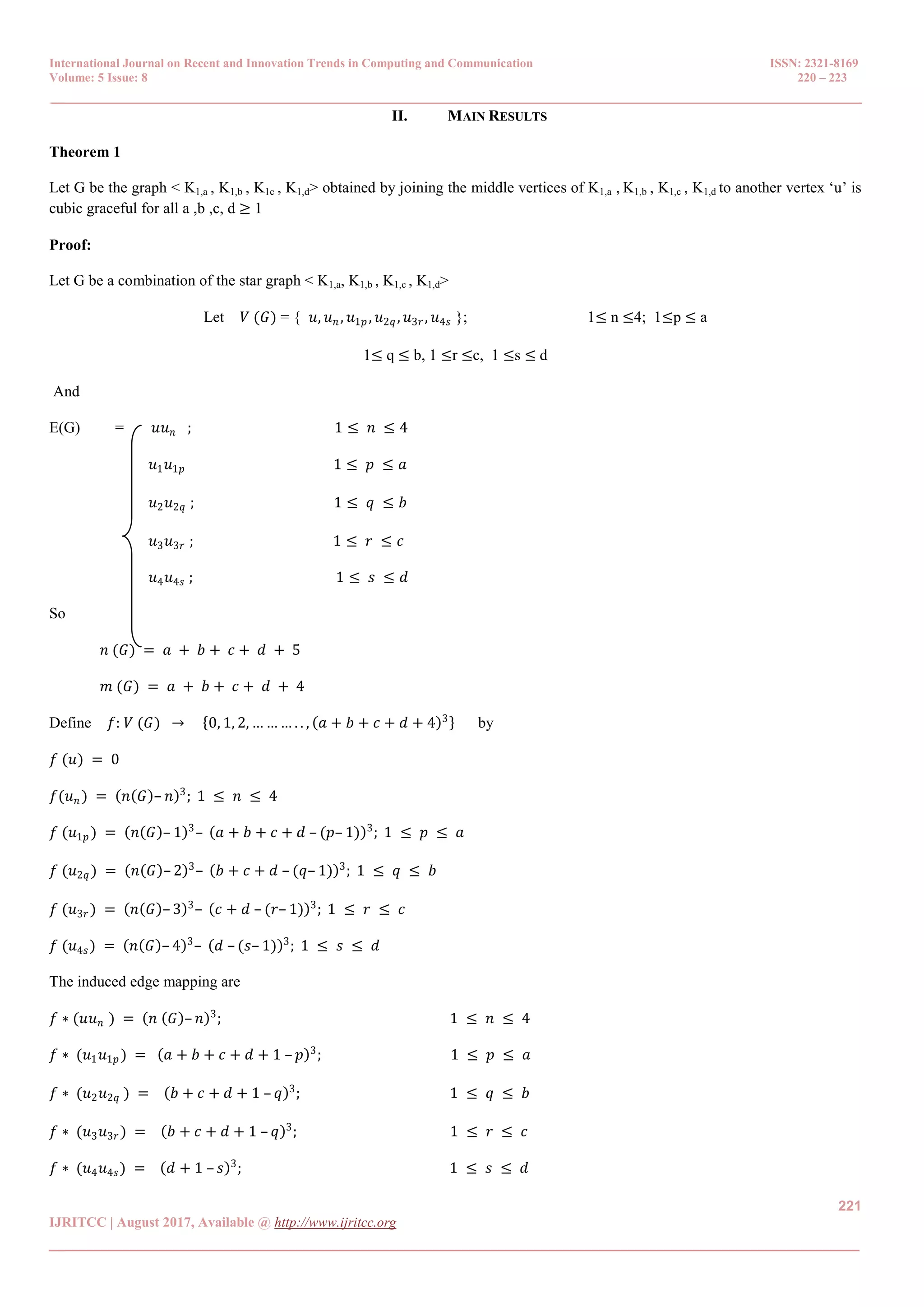
II. MAIN RESULTS
Theorem 1
Let G be the graph < K1,a , K1,b , K1c , K1,d> obtained by joining the middle vertices of K1,a , K1,b , K1,c , K1,d to another vertex ‘u’ is
cubic graceful for all a ,b ,c, d ≥ 1
Proof:
Let G be a combination of the star graph < K1,a, K1,b , K1,c , K1,d>
Let 𝑉 (𝐺) = { 𝑢, 𝑢 𝑛 , 𝑢1𝑝, 𝑢2𝑞 , 𝑢3𝑟, 𝑢4𝑠 }; 1≤ n ≤4; 1≤p ≤ a
1≤ q ≤ b, 1 ≤r ≤c, 1 ≤s ≤ d
And
E(G) = 𝑢𝑢 𝑛 ; 1 ≤ 𝑛 ≤ 4
𝑢1 𝑢1𝑝 1 ≤ 𝑝 ≤ 𝑎
𝑢2 𝑢2𝑞 ; 1 ≤ 𝑞 ≤ 𝑏
𝑢3 𝑢3𝑟 ; 1 ≤ 𝑟 ≤ 𝑐
𝑢4 𝑢4𝑠 ; 1 ≤ 𝑠 ≤ 𝑑
So
𝑛 (𝐺) = 𝑎 + 𝑏 + 𝑐 + 𝑑 + 5
𝑚 (𝐺) = 𝑎 + 𝑏 + 𝑐 + 𝑑 + 4
Define 𝑓: 𝑉 (𝐺) → 0, 1, 2, … … … . . , 𝑎 + 𝑏 + 𝑐 + 𝑑 + 4 3
by
𝑓 (𝑢) = 0
𝑓(𝑢 𝑛 ) = 𝑛 𝐺 – 𝑛 3
; 1 ≤ 𝑛 ≤ 4
𝑓 (𝑢1𝑝) = 𝑛 𝐺 – 1 3
– 𝑎 + 𝑏 + 𝑐 + 𝑑 – (𝑝– 1) 3
; 1 ≤ 𝑝 ≤ 𝑎
𝑓 (𝑢2𝑞 ) = 𝑛 𝐺 – 2 3
– 𝑏 + 𝑐 + 𝑑 – (𝑞– 1) 3
; 1 ≤ 𝑞 ≤ 𝑏
𝑓 (𝑢3𝑟) = 𝑛 𝐺 – 3 3
– 𝑐 + 𝑑 – (𝑟– 1) 3
; 1 ≤ 𝑟 ≤ 𝑐
𝑓 (𝑢4𝑠) = 𝑛 𝐺 – 4 3
– 𝑑 – (𝑠– 1) 3
; 1 ≤ 𝑠 ≤ 𝑑
The induced edge mapping are
𝑓 ∗ (𝑢𝑢 𝑛 ) = 𝑛 𝐺 – 𝑛 3
; 1 ≤ 𝑛 ≤ 4
𝑓 ∗ (𝑢1 𝑢1𝑝) = 𝑎 + 𝑏 + 𝑐 + 𝑑 + 1 – 𝑝 3
; 1 ≤ 𝑝 ≤ 𝑎
𝑓 ∗ (𝑢2 𝑢2𝑞 ) = 𝑏 + 𝑐 + 𝑑 + 1 – 𝑞 3
; 1 ≤ 𝑞 ≤ 𝑏
𝑓 ∗ (𝑢3 𝑢3𝑟) = 𝑏 + 𝑐 + 𝑑 + 1 – 𝑞 3
; 1 ≤ 𝑟 ≤ 𝑐
𝑓 ∗ (𝑢4 𝑢4𝑠) = 𝑑 + 1 – 𝑠 3
; 1 ≤ 𝑠 ≤ 𝑑
International Journal on Recent and Innovation Trends in Computing and Communication ISSN: 2321-8169
Volume: 5 Issue: 8 220 – 223
_______________________________________________________________________________________________
222
IJRITCC | August 2017, Available @ http://www.ijritcc.org
_______________________________________________________________________________________
The vertex labels are in the set {0,1,2, … . , [ 𝑎 + 𝑏 + 𝑐 + 𝑑 + 4 ]3
} Then the edge label arranged in the set
{13
, 23
, 33
, . . … … , (𝑎 + 𝑏 + 𝑐 + 𝑑 + 4)3
}. So the vertex labels are distinct and edge labels are also distinct and cubic. So the
graph G is cubic graceful for all 𝑎, 𝑏 , 𝑐, 𝑑 ≥ 1.
Theorem 2
If 𝐺𝑟 = 𝐾1,𝑝 be the given graph for 1 ≤ 𝑟 ≤ 𝑞 with vertex 𝑠𝑒𝑡 𝑉(𝐺𝑟 ) = 𝑢 𝑟, 𝑢 𝑟𝑠 ; 1 ≤ 𝑟 ≤ 𝑞, 1 ≤ 𝑠 ≤ 𝑝 Let G be the given
graph formulated by associate 𝑣𝑟𝑝 with 𝑣 𝑟+1 1 for 1 ≤ 𝑟 ≤ 𝑞 − 1. Then G is a cubic graceful for all p and q.
Proof :
The graph G consisting of the vertex set 𝑉(𝐺) = 𝑈𝑟, 𝑈𝑟𝑠 ; 1 ≤ 𝑟 ≤ 𝑞, 1 ≤ 𝑠 ≤ 𝑝 and the edge set E(G) = 𝑢 𝑟 𝑢 𝑟𝑠 ; 1 ≤ 𝑟 ≤
𝑞, 1≤ 𝑠≤ 𝑝
Then 𝑛 (𝐺) = 𝑝𝑞 and m(G) = pq
Let 𝑓: 𝑉(𝐺) → 0, 1, 2, 3, … … , 𝑝𝑞 3
be defined as follows.
𝑓(𝑢𝑖) = 0
𝑓 𝑢1,𝑠 = 𝑝𝑞 – 𝑠 + 1 3
; 1 ≤ 𝑠 ≤ 𝑝
𝑓 𝑢 𝑟 = 𝑓 𝑢 𝑟−1 𝑝 – 𝑝 𝑞– 𝑟 + 1 3
; 2 ≤ 𝑟 ≤ 𝑞
𝑓 𝑢 𝑟𝑠 = 𝑓 𝑢 𝑟 + [𝑞 – (𝑟– 1)𝑝 – (𝑠– 1) ]3
; 2 ≤ 𝑟 ≤ 𝑞 , 2 ≤ 𝑠 ≤ 𝑛
Then f induces a bijection
𝑓 ∗
𝑢 𝑟 𝑢 𝑟𝑠 = 𝑝𝑞– 𝑠 + 1 3
; 𝑟 = 1, 1 ≤ 𝑠 ≤ 𝑛
𝑓 ∗
(𝑢 𝑟 𝑢 𝑟−1 𝑝) = 𝑝 𝑞– 𝑟 + 1 3
, 2 ≤ 𝑟 ≤ 𝑝 , 𝑠 = 𝑝
𝑓 ∗
𝑢 𝑟 𝑢 𝑟𝑠 = 𝑝 𝑞– 𝑟 + 1 − 𝑖 3
; 2 ≤ 𝑟 ≤ 𝑞 , 2 ≤ 𝑠 ≤ 𝑝 1 ≤ 𝑖 ≤ 𝑝 – 1,
The vertex labels are in the set 0, 1, 2 … … 𝑝𝑞 3
. Then the edge label arranged in the set 13
, 23
, … … . . (𝑝𝑞)3
. So the vertex
labels are distinct and edge labels are also distinct and cubic. So the graph G is cubic graceful for all 𝑝, 𝑞 ≥ 1.
Theorem 3
Let G be the graph obtained from two copies of Pn with vertices v1, v2,.... ,vn and u1, u2, u3... ,un by joining the fixed vertices vr and
ur by means of an edge, for 1≤r≤n. Then the graph (Pn: G) is cubic graceful.
Proof: Let G denote the graph (Pn: G)
Let V(G) = 𝑢𝑖 𝑓𝑜𝑟 𝑖 = 1,2,3, … … … , 𝑛– 1
𝑣𝑖 𝑓𝑜𝑟 𝑖 = 1,2,3, . . . . . . . . , (𝑛– 1)
and E(G)= 𝑢𝑖 𝑢𝑖 for 𝑖 = 1,2,3. . . . . . . . . (𝑛– 1)
𝑣𝑖 𝑣𝑖++1 for 𝑖 = 1,2,3. . . . . . . . . . , (𝑛– 1)
𝑢 𝑟 𝑣𝑟 for 𝑟 = 1,2, . . . . . . . . , 𝑛 where `𝑟` is a fixed vertex
International Journal on Recent and Innovation Trends in Computing and Communication ISSN: 2321-8169
Volume: 5 Issue: 8 220 – 223
_______________________________________________________________________________________________
223
IJRITCC | August 2017, Available @ http://www.ijritcc.org
_______________________________________________________________________________________
So, 𝑝 = 2𝑛 and 𝑞 = 2𝑛– 1
Define 𝑓: 𝑉(𝐺) → 0,1,2, … . . , (2𝑛 + 1)3
by
𝑓 (𝑢𝑖) = 0
𝑓(𝑢𝑖+1) = (– 1) 𝑘+1𝑖
𝑘=1 (2𝑛– 𝑘)3
for 𝑖 = 1, 2, . . . . . , (𝑛 + 1)
𝑓 (𝑣𝑟 ) = 𝑓(𝑢 𝑟) – 𝑛3
; for 𝑟 = 1,2, . . . . . , 𝑛 and it is a fixed vertex.
𝑓 (𝑣𝑟 − 𝑗) = 𝑓(𝑣𝑟 ) + (– 1) 𝐾𝑗
𝑘=1 (𝑛– 𝑟 + 𝑗)3
; for 𝑗 = 1,2, . . . . . , (𝑟– 1)
𝑓 (𝑣𝑟 + 𝑗) = 𝑓(𝑣𝑟 ) + (– 1) 𝐾𝑗
𝑘=1 (𝑛– 𝑟– 𝑗 + 1)3
; for 𝑗 = 1,2, . . . . . , (𝑛– 𝑟)
The induced edge mapping are
𝑓∗
(𝑢𝑖 𝑢𝑖+1 + 1) = (2𝑛– 𝑖)3
for 𝑖 = 1,2, . . . . . , (𝑛– 1)
𝑓∗
(𝑢 𝑟 𝑣𝑟 ) = 𝑛3
for 𝑟 = 1,2, . . . . . , 𝑛; where ‘𝑟’ is a fixed vertex
𝑓∗
(𝑣𝑖 𝑣𝑖+1) = (𝑛– 1)3
for 𝑖 = 1,2, . . . . . . , (𝑛– 1)
The vertex labels are in the set 0,1,2 … . (2𝑛– 1)3
. Then the edge labels are arranged in the set 13
, 23
, 33
… . (2𝑛– 1)3
So the
vertex labels are distinct and the edge labels are also cubic and distinct . So the graph (Pn:G)) is a cubic graceful.
REFERENCES
[1] Frank Harary, Graph Theory, Narosa Publishing House, New Delhi, 2001[6]
[2] J.A . Gallian, A dynamic survey of graph labeling, The Electronic journal of Combinatrorics,(2016)
[3] V.J.Kaneria and H.M.Makadia, Some Graceful Graphs J. of Math. Research, 4 (1),(2012) 54-57
[4] Mini.S.Thomas and Mathew Varkey T.K, Cubic Graceful Labeling . Global Journal of Pure And Applied Mathematics, June (2017)
[5] T. Tharmaraj and P.B.Sarasija, International Journal of Mathematics and Soft Computing Vol.4 No.1(2014).129-137.

On Cubic Graceful Labeling

  • 1.
    International Journal onRecent and Innovation Trends in Computing and Communication ISSN: 2321-8169 Volume: 5 Issue: 8 220 – 223 _______________________________________________________________________________________________ 220 IJRITCC | August 2017, Available @ http://www.ijritcc.org _______________________________________________________________________________________ On Cubic Graceful Labeling Mathew Varkey T. K 1 , 1 Asst.Prof, Department of Mathematics, T.K.M College of Engineering, Kollam, Kerala, India Email: mathewvarkeytk@gmail.com Mini. S. Thomas 2 2 Research Scholar, Department of Mathematics St. Albert’s College, Eranakulam, Kerala, India minirenjan1994@gmail.com Abstract- A graph with n vertex and m edges is said to be cubic graceful labeling if its vertices are labeled with distinct integers {0,1,2,3,……..,m3 } such that for each edge f* ( uv) induces edge mappings are {13, 23 ,33 ,……,m3 }. A graph admits a cubic graceful labeling is called a cubic graceful graph. In this paper, we proved that < K1,a , K1,b , K1c , K1,d>, associate urp with u(r+1)1 of K1,P, fixed vertices vr and ur of two copies of Pn are cubic graceful. Keywords: Cubic graceful graph, cubic graceful labeling, Path graph, Star graph, __________________________________________________*****_________________________________________________ I. INTRODUCTION Graphs labeling, where the vertices are assigned values subject to certain conditions, have often been motivated by practical problems. Labeled graphs serves as useful mathematical models for a broad range of applications such as coding theory, including the design of good radar type codes, missile guidance codes and convolution codes with optimal autocorrelation properties. They facilitate the optimal nonstandard encoding of integers. For all terminology and notation in this paper we follow Harary[1]. A function f is called a graceful labeling of a (p,q) graph G= (V,E) if f is an injection from the vertices of G to the set {0,1,2,3,….q} such that, each edge uv is assigned the label |f(u)-f(v), the resulting edge labels are distinct. T. Tharmaraj and P.B.Sarasija [5] introduced square graceful labeling concept in 2014. The concept of cubic graceful labeling of graphs was introduced in [4]. A systematic presentation of survey of graph labeling is presented in [2]. We use the following definitions in the subsequent sections. Definition 1.1 The Path graph Pn is the n- vertex graph with n-1 edges, all on a single path. Definition1.2 A complete bipartite graph K1,n is called a star and it has (n+1) vertices and n edges Definition 1.3 The Trivial graph K1 or P1 is the graph with one vertex and no edges. Definition 1.4 A graph G = (V,E) with n vertices and m edges is said be Cubic Graceful Graph (CGG) if there exists an injective function f: V(G)→{0,1,2,……,m3 } such that the induced mapping f * : E(G)→ {13 ,23 ,……,m3 } defined by f *(uv): →|f(u)- f(v)| is a bijection . The function f is called a Cubic Graceful Labeling (CGL) of G
  • 2.
    International Journal onRecent and Innovation Trends in Computing and Communication ISSN: 2321-8169 Volume: 5 Issue: 8 220 – 223 _______________________________________________________________________________________________ 221 IJRITCC | August 2017, Available @ http://www.ijritcc.org _______________________________________________________________________________________ II. MAIN RESULTS Theorem 1 Let G be the graph < K1,a , K1,b , K1c , K1,d> obtained by joining the middle vertices of K1,a , K1,b , K1,c , K1,d to another vertex ‘u’ is cubic graceful for all a ,b ,c, d ≥ 1 Proof: Let G be a combination of the star graph < K1,a, K1,b , K1,c , K1,d> Let 𝑉 (𝐺) = { 𝑢, 𝑢 𝑛 , 𝑢1𝑝, 𝑢2𝑞 , 𝑢3𝑟, 𝑢4𝑠 }; 1≤ n ≤4; 1≤p ≤ a 1≤ q ≤ b, 1 ≤r ≤c, 1 ≤s ≤ d And E(G) = 𝑢𝑢 𝑛 ; 1 ≤ 𝑛 ≤ 4 𝑢1 𝑢1𝑝 1 ≤ 𝑝 ≤ 𝑎 𝑢2 𝑢2𝑞 ; 1 ≤ 𝑞 ≤ 𝑏 𝑢3 𝑢3𝑟 ; 1 ≤ 𝑟 ≤ 𝑐 𝑢4 𝑢4𝑠 ; 1 ≤ 𝑠 ≤ 𝑑 So 𝑛 (𝐺) = 𝑎 + 𝑏 + 𝑐 + 𝑑 + 5 𝑚 (𝐺) = 𝑎 + 𝑏 + 𝑐 + 𝑑 + 4 Define 𝑓: 𝑉 (𝐺) → 0, 1, 2, … … … . . , 𝑎 + 𝑏 + 𝑐 + 𝑑 + 4 3 by 𝑓 (𝑢) = 0 𝑓(𝑢 𝑛 ) = 𝑛 𝐺 – 𝑛 3 ; 1 ≤ 𝑛 ≤ 4 𝑓 (𝑢1𝑝) = 𝑛 𝐺 – 1 3 – 𝑎 + 𝑏 + 𝑐 + 𝑑 – (𝑝– 1) 3 ; 1 ≤ 𝑝 ≤ 𝑎 𝑓 (𝑢2𝑞 ) = 𝑛 𝐺 – 2 3 – 𝑏 + 𝑐 + 𝑑 – (𝑞– 1) 3 ; 1 ≤ 𝑞 ≤ 𝑏 𝑓 (𝑢3𝑟) = 𝑛 𝐺 – 3 3 – 𝑐 + 𝑑 – (𝑟– 1) 3 ; 1 ≤ 𝑟 ≤ 𝑐 𝑓 (𝑢4𝑠) = 𝑛 𝐺 – 4 3 – 𝑑 – (𝑠– 1) 3 ; 1 ≤ 𝑠 ≤ 𝑑 The induced edge mapping are 𝑓 ∗ (𝑢𝑢 𝑛 ) = 𝑛 𝐺 – 𝑛 3 ; 1 ≤ 𝑛 ≤ 4 𝑓 ∗ (𝑢1 𝑢1𝑝) = 𝑎 + 𝑏 + 𝑐 + 𝑑 + 1 – 𝑝 3 ; 1 ≤ 𝑝 ≤ 𝑎 𝑓 ∗ (𝑢2 𝑢2𝑞 ) = 𝑏 + 𝑐 + 𝑑 + 1 – 𝑞 3 ; 1 ≤ 𝑞 ≤ 𝑏 𝑓 ∗ (𝑢3 𝑢3𝑟) = 𝑏 + 𝑐 + 𝑑 + 1 – 𝑞 3 ; 1 ≤ 𝑟 ≤ 𝑐 𝑓 ∗ (𝑢4 𝑢4𝑠) = 𝑑 + 1 – 𝑠 3 ; 1 ≤ 𝑠 ≤ 𝑑
  • 3.
    International Journal onRecent and Innovation Trends in Computing and Communication ISSN: 2321-8169 Volume: 5 Issue: 8 220 – 223 _______________________________________________________________________________________________ 222 IJRITCC | August 2017, Available @ http://www.ijritcc.org _______________________________________________________________________________________ The vertex labels are in the set {0,1,2, … . , [ 𝑎 + 𝑏 + 𝑐 + 𝑑 + 4 ]3 } Then the edge label arranged in the set {13 , 23 , 33 , . . … … , (𝑎 + 𝑏 + 𝑐 + 𝑑 + 4)3 }. So the vertex labels are distinct and edge labels are also distinct and cubic. So the graph G is cubic graceful for all 𝑎, 𝑏 , 𝑐, 𝑑 ≥ 1. Theorem 2 If 𝐺𝑟 = 𝐾1,𝑝 be the given graph for 1 ≤ 𝑟 ≤ 𝑞 with vertex 𝑠𝑒𝑡 𝑉(𝐺𝑟 ) = 𝑢 𝑟, 𝑢 𝑟𝑠 ; 1 ≤ 𝑟 ≤ 𝑞, 1 ≤ 𝑠 ≤ 𝑝 Let G be the given graph formulated by associate 𝑣𝑟𝑝 with 𝑣 𝑟+1 1 for 1 ≤ 𝑟 ≤ 𝑞 − 1. Then G is a cubic graceful for all p and q. Proof : The graph G consisting of the vertex set 𝑉(𝐺) = 𝑈𝑟, 𝑈𝑟𝑠 ; 1 ≤ 𝑟 ≤ 𝑞, 1 ≤ 𝑠 ≤ 𝑝 and the edge set E(G) = 𝑢 𝑟 𝑢 𝑟𝑠 ; 1 ≤ 𝑟 ≤ 𝑞, 1≤ 𝑠≤ 𝑝 Then 𝑛 (𝐺) = 𝑝𝑞 and m(G) = pq Let 𝑓: 𝑉(𝐺) → 0, 1, 2, 3, … … , 𝑝𝑞 3 be defined as follows. 𝑓(𝑢𝑖) = 0 𝑓 𝑢1,𝑠 = 𝑝𝑞 – 𝑠 + 1 3 ; 1 ≤ 𝑠 ≤ 𝑝 𝑓 𝑢 𝑟 = 𝑓 𝑢 𝑟−1 𝑝 – 𝑝 𝑞– 𝑟 + 1 3 ; 2 ≤ 𝑟 ≤ 𝑞 𝑓 𝑢 𝑟𝑠 = 𝑓 𝑢 𝑟 + [𝑞 – (𝑟– 1)𝑝 – (𝑠– 1) ]3 ; 2 ≤ 𝑟 ≤ 𝑞 , 2 ≤ 𝑠 ≤ 𝑛 Then f induces a bijection 𝑓 ∗ 𝑢 𝑟 𝑢 𝑟𝑠 = 𝑝𝑞– 𝑠 + 1 3 ; 𝑟 = 1, 1 ≤ 𝑠 ≤ 𝑛 𝑓 ∗ (𝑢 𝑟 𝑢 𝑟−1 𝑝) = 𝑝 𝑞– 𝑟 + 1 3 , 2 ≤ 𝑟 ≤ 𝑝 , 𝑠 = 𝑝 𝑓 ∗ 𝑢 𝑟 𝑢 𝑟𝑠 = 𝑝 𝑞– 𝑟 + 1 − 𝑖 3 ; 2 ≤ 𝑟 ≤ 𝑞 , 2 ≤ 𝑠 ≤ 𝑝 1 ≤ 𝑖 ≤ 𝑝 – 1, The vertex labels are in the set 0, 1, 2 … … 𝑝𝑞 3 . Then the edge label arranged in the set 13 , 23 , … … . . (𝑝𝑞)3 . So the vertex labels are distinct and edge labels are also distinct and cubic. So the graph G is cubic graceful for all 𝑝, 𝑞 ≥ 1. Theorem 3 Let G be the graph obtained from two copies of Pn with vertices v1, v2,.... ,vn and u1, u2, u3... ,un by joining the fixed vertices vr and ur by means of an edge, for 1≤r≤n. Then the graph (Pn: G) is cubic graceful. Proof: Let G denote the graph (Pn: G) Let V(G) = 𝑢𝑖 𝑓𝑜𝑟 𝑖 = 1,2,3, … … … , 𝑛– 1 𝑣𝑖 𝑓𝑜𝑟 𝑖 = 1,2,3, . . . . . . . . , (𝑛– 1) and E(G)= 𝑢𝑖 𝑢𝑖 for 𝑖 = 1,2,3. . . . . . . . . (𝑛– 1) 𝑣𝑖 𝑣𝑖++1 for 𝑖 = 1,2,3. . . . . . . . . . , (𝑛– 1) 𝑢 𝑟 𝑣𝑟 for 𝑟 = 1,2, . . . . . . . . , 𝑛 where `𝑟` is a fixed vertex
  • 4.
    International Journal onRecent and Innovation Trends in Computing and Communication ISSN: 2321-8169 Volume: 5 Issue: 8 220 – 223 _______________________________________________________________________________________________ 223 IJRITCC | August 2017, Available @ http://www.ijritcc.org _______________________________________________________________________________________ So, 𝑝 = 2𝑛 and 𝑞 = 2𝑛– 1 Define 𝑓: 𝑉(𝐺) → 0,1,2, … . . , (2𝑛 + 1)3 by 𝑓 (𝑢𝑖) = 0 𝑓(𝑢𝑖+1) = (– 1) 𝑘+1𝑖 𝑘=1 (2𝑛– 𝑘)3 for 𝑖 = 1, 2, . . . . . , (𝑛 + 1) 𝑓 (𝑣𝑟 ) = 𝑓(𝑢 𝑟) – 𝑛3 ; for 𝑟 = 1,2, . . . . . , 𝑛 and it is a fixed vertex. 𝑓 (𝑣𝑟 − 𝑗) = 𝑓(𝑣𝑟 ) + (– 1) 𝐾𝑗 𝑘=1 (𝑛– 𝑟 + 𝑗)3 ; for 𝑗 = 1,2, . . . . . , (𝑟– 1) 𝑓 (𝑣𝑟 + 𝑗) = 𝑓(𝑣𝑟 ) + (– 1) 𝐾𝑗 𝑘=1 (𝑛– 𝑟– 𝑗 + 1)3 ; for 𝑗 = 1,2, . . . . . , (𝑛– 𝑟) The induced edge mapping are 𝑓∗ (𝑢𝑖 𝑢𝑖+1 + 1) = (2𝑛– 𝑖)3 for 𝑖 = 1,2, . . . . . , (𝑛– 1) 𝑓∗ (𝑢 𝑟 𝑣𝑟 ) = 𝑛3 for 𝑟 = 1,2, . . . . . , 𝑛; where ‘𝑟’ is a fixed vertex 𝑓∗ (𝑣𝑖 𝑣𝑖+1) = (𝑛– 1)3 for 𝑖 = 1,2, . . . . . . , (𝑛– 1) The vertex labels are in the set 0,1,2 … . (2𝑛– 1)3 . Then the edge labels are arranged in the set 13 , 23 , 33 … . (2𝑛– 1)3 So the vertex labels are distinct and the edge labels are also cubic and distinct . So the graph (Pn:G)) is a cubic graceful. REFERENCES [1] Frank Harary, Graph Theory, Narosa Publishing House, New Delhi, 2001[6] [2] J.A . Gallian, A dynamic survey of graph labeling, The Electronic journal of Combinatrorics,(2016) [3] V.J.Kaneria and H.M.Makadia, Some Graceful Graphs J. of Math. Research, 4 (1),(2012) 54-57 [4] Mini.S.Thomas and Mathew Varkey T.K, Cubic Graceful Labeling . Global Journal of Pure And Applied Mathematics, June (2017) [5] T. Tharmaraj and P.B.Sarasija, International Journal of Mathematics and Soft Computing Vol.4 No.1(2014).129-137.