National Aeronautics and Space Administration


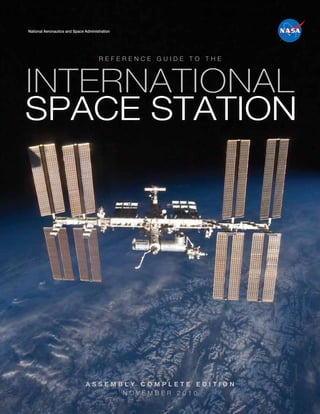
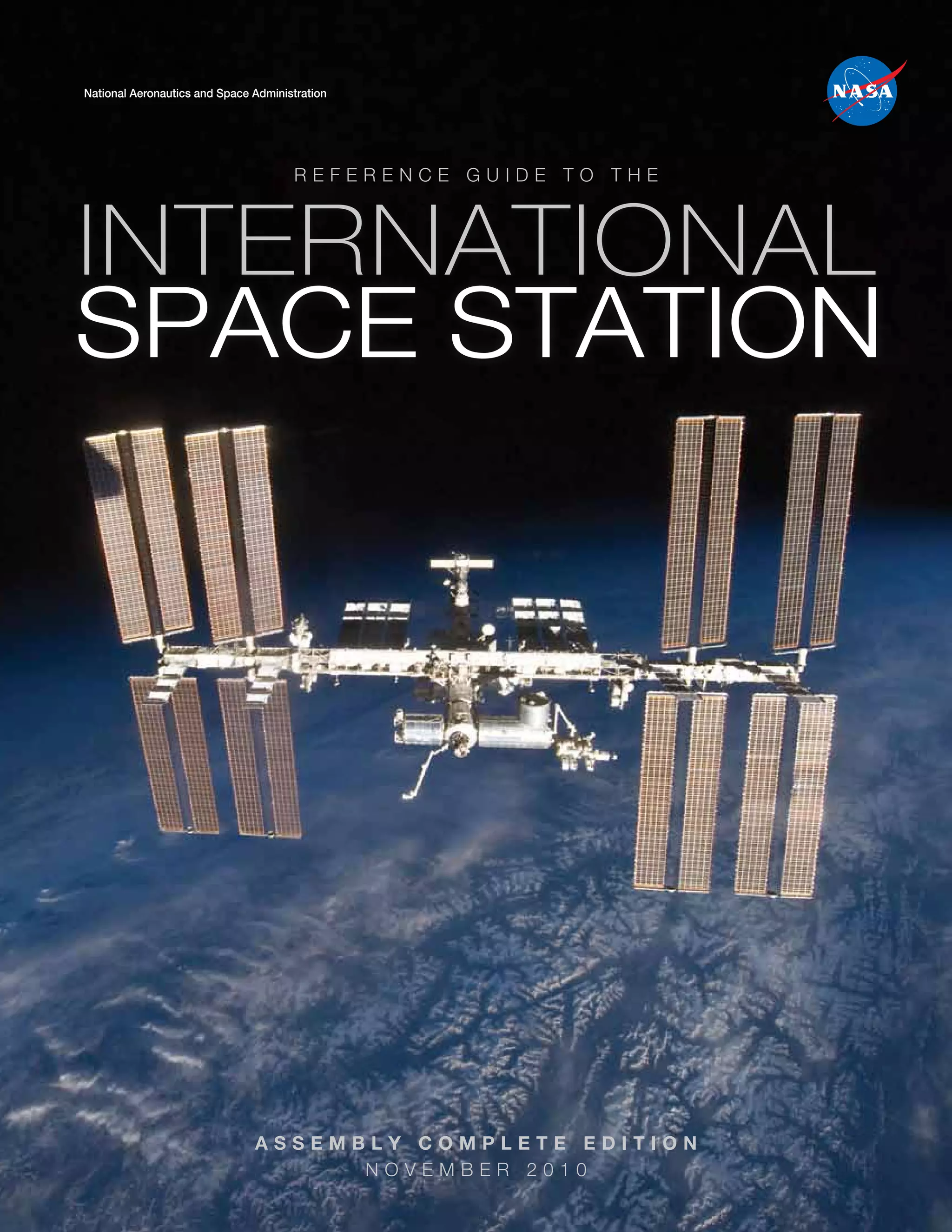
                                      REFERENCE GUIDE TO THE


INTERNATIONAL
SPACE STATION


                               ASSEMBLY COMPLETE EDITION
                                     NOVEMBER 2010
ISS
                  2009 Robert J. Collier Trophy winner
                  The Collier Trophy is awarded annually “for the greatest
                  achievement in aeronautics or astronautics in America, with
                  respect to improving the performance, efficiency, and safety of
                  air or space vehicles, the value of which has been thoroughly
                  demonstrated by actual use during the preceding year.”


Library of Congress Cataloging-in-Publication Data

Reference guide to the International Space Station. -- Assembly complete ed.
    p. cm.
 Rev. ed. of the NASA document: Reference guide to the International Space Station.
August 2006.
 “November 2010.”
 “NP-2010-09-682-HQ.”
 ISBN 0-16-086517-4
1. International Space Station. 2. Space stations--International cooperation. 3.
Manned space flight. I. United States. National Aeronautics and Space Administration.
 TL797.R44 2010
 629.44’2--dc22
                                     2010040473
REFERENCE GUIDE TO THE


INTE R N A T I O NAL
SPACE STATION


    ASSEMBLY COMPLETE EDITION
          NOVEMBER 2010

         National Aeronautics and Space Administration
                        Washington, DC

                     NP-2010-09-682-HQ
REFERENCE GUIDE TO THE ISS
                CONTENTS
                             2
REFERENCE GUIDE TO THE ISS
                                   CONTENTS
                              3


What It Does              7
Research Guide           21
How It’s Put Together    45
How It’s Supported       63
How the Crew Lives       79
How It Works             85
How It’s Built           97
Missions                111


                                              contents
Appendix                129


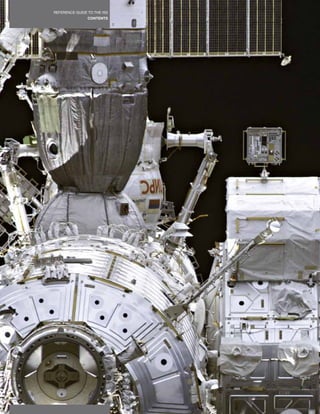
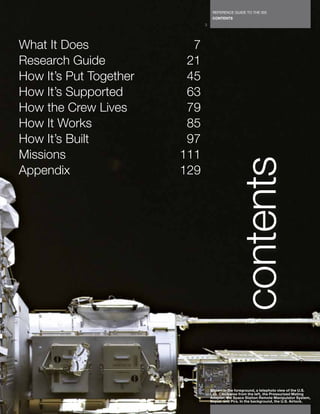
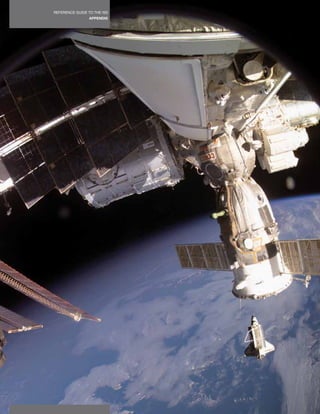
                                  Shown in the foreground, a telephoto view of the U.S.
                                  Lab. Clockwise from the left, the Pressurized Mating
                                  Adapter, the Space Station Remote Manipulator System,
                                  Soyuz, and Pirs. In the background, the U.S. Airlock.
REFERENCE GUIDE TO THE ISS


                             4
REFERENCE GUIDE TO THE ISS
                                                                                       A LETTER FROM THE ASSOCIATE ADMINISTRATOR
                                                                                   5   SPACE OPERATIONS MISSION DIRECTORATE


Assembly of the International Space Station (ISS) is a remarkable
achievement. Since November 2, 2000, humankind has maintained a
continuous presence in space. Over this timespan, the ISS International
Partnership has flourished. We have learned much about construction
and about how humans and spacecraft systems function on orbit. But
there is much more to do and learn, and this voyage of research and
discovery is just beginning. We now shift our focus from ISS assembly to
full ISS utilization for scientific research, technology development,
exploration, commerce, and education. We need to approach this next
research phase with the same dedication, zeal, and innovation that we
used to assemble the ISS. United States research concentrates on biology,
human research, physical science and materials, Earth and space science,
and technology for exploration beyond low-Earth orbit. As a national
laboratory, the ISS is beginning to provide new opportunities for other
agencies, academia, and commercial and other partners to pursue novel
avenues of research and development, and to promote science,
technology, engineering, and math education. We cannot now foresee all
that may be uncovered on this voyage, but we look forward to the
voyage and returning knowledge to extend the human presence beyond
and improve life here on Earth.


                                            —William H. Gerstenmaier
                                                         Associate Administrator
                                       NASA Space Operations Mission Directorate
REFERENCE GUIDE TO THE ISS


                             6
REFERENCE GUIDE TO THE ISS
                                                                                 WHAT IT DOES
                                                                             7


The International Space Station (ISS) is the unique blend of unified and


                                                                                           what it does
diversified goals among the world’s space agencies that will lead to
improvements in life on Earth for all people of all nations. While the
various space agency partners may emphasize different aspects of
research to achieve their goals in the use of the ISS, they are unified in
several important overarching goals.
   All of the agencies recognize the importance of leveraging the ISS as
an education platform to encourage and motivate today’s youth to pursue
careers in math, science, engineering, and technology (STEM): educating
the children of today to be the leaders and space explorers of tomorrow.
   Advancing our knowledge in the areas of human physiology,
biology, and material and physical sciences and translating that
knowledge to health, socioeconomic, and environmental benefits on
Earth is another common goal of the agencies: returning the knowledge
gained in space research for the benefit of society.
   Finally, all the agencies are unified in their goals to apply knowledge
gained through ISS research in human physiology, radiation, materials
science, engineering, biology, fluid physics, and technology: enabling
future space exploration missions.
REFERENCE GUIDE TO THE ISS
             WHAT IT DOES
                             8
REFERENCE GUIDE TO THE ISS
                                                                                                                                                WHAT IT DOES
                                                                                                                                            9   PLANS BECOMING A REALITY


         Plans Becoming a Reality

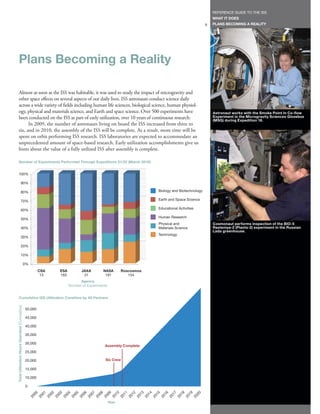
         Almost as soon as the ISS was habitable, it was used to study the impact of microgravity and
         other space effects on several aspects of our daily lives. ISS astronauts conduct science daily
         across a wide variety of fields including human life sciences, biological science, human physiol-
         ogy, physical and materials science, and Earth and space science. Over 500 experiments have                                            Astronaut works with the Smoke Point In Co-flow
         been conducted on the ISS as part of early utilization, over 10 years of continuous research.                                          Experiment in the Microgravity Sciences Glovebox
                                                                                                                                                (MSG) during Expedition 18.
               In 2009, the number of astronauts living on board the ISS increased from three to
         six, and in 2010, the assembly of the ISS will be complete. As a result, more time will be
         spent on orbit performing ISS research. ISS laboratories are expected to accommodate an
         unprecedented amount of space-based research. Early utilization accomplishments give us
         hints about the value of a fully utilized ISS after assembly is complete.

         Number of Experiments Performed Through Expeditions 21/22 (March 2010)


        100%

                             90%

                             80%                                                                                Biology and Biotechnology

                             70%                                                                                Earth and Space Science

                             60%                                                                                Educational Activities

                                                                                                                Human Research
                             50%
                                                                                                                Physical and                    Cosmonaut performs inspection of the BIO-5
                             40%                                                                                Materials Science               Rasteniya-2 (Plants-2) experiment in the Russian
                                                                                                                                                Lada greenhouse.
                                                                                                                Technology
                             30%

                             20%

                             10%

                                                0%
                                                         CSA   ESA          JAXA       NASA         Roscosmos
                                                          13   163           31         191            154
                                                                           Agency
                                                                     Number of Experiments


         Cumulative ISS Utilization Crewtime by All Partners
Total Utilization Hours Operated (Cumulative)


                                                50,000

                                                45,000

                                                40,000

                                                35,000

                                                30,000
                                                                                        Assembly Complete
                                                25,000

                                                20,000                                   Six Crew

                                                15,000

                                                10,000                                                5000
                                                0
                                                       00

                                                       01

                                                       02

                                                       03

                                                       04

                                                       05

                                                       06

                                                       07

                                                       08

                                                       09

                                                       10

                                                       11

                                                       12

                                                       13

                                                       14

                                                       15

                                                       16

                                                       17

                                                       18

                                                       19

                                                       20
                                                     20

                                                     20

                                                     20

                                                     20

                                                     20

                                                     20

                                                     20

                                                     20

                                                     20

                                                     20

                                                     20

                                                     20

                                                     20

                                                     20

                                                     20

                                                     20

                                                     20

                                                     20

                                                     20

                                                     20

                                                     20


                                                                                             Year
REFERENCE GUIDE TO THE ISS
                                 WHAT IT DOES
               KNOWLEDGE FOR ALL HUMANKIND         10


                                                        Knowledge for All Humankind

                                                        Scientists from all over the world are already using ISS facilities, putting their talents
                                                        to work in almost all areas of science and technology, and sharing their knowledge to
                                                        make life on Earth better for people of all nations. We may not yet know what will be
                                                        the most important knowledge gained from the ISS, but we do know that there are some
                                                        amazing discoveries on the way! Several recent patents and partnerships have already
                                                        demonstrated benefits of the public’s investment in ISS research back on Earth.


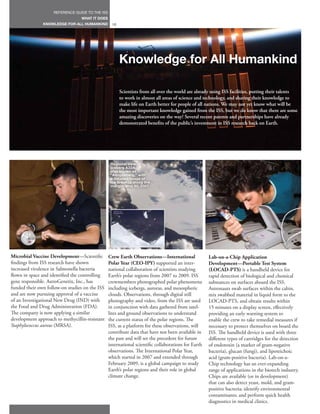
                                                  Regional view of
                                                  Iceberg A22A,
                                                  also known as
                                                  “Amigosberg,” with
                                                  a detailed image of
                                                  ice breakup along the
                                                  margin. May 30, 2007.


Microbial Vaccine Development—Scientific         Crew Earth Observations—International               Lab-on-a-Chip Application
findings from ISS research have shown            Polar Year (CEO-IPY) supported an inter-            Development—Portable Test System
increased virulence in Salmonella bacteria       national collaboration of scientists studying       (LOCAD-PTS) is a handheld device for
flown in space and identified the controlling    Earth’s polar regions from 2007 to 2009. ISS        rapid detection of biological and chemical
gene responsible. AstroGenetix, Inc., has        crewmembers photographed polar phenomena            substances on surfaces aboard the ISS.
funded their own follow-on studies on the ISS    including icebergs, auroras, and mesospheric        Astronauts swab surfaces within the cabin,
and are now pursuing approval of a vaccine       clouds. Observations, through digital still         mix swabbed material in liquid form to the
of an Investigational New Drug (IND) with        photography and video, from the ISS are used        LOCAD-PTS, and obtain results within
the Food and Drug Administration (FDA).          in conjunction with data gathered from satel-       15 minutes on a display screen, effectively
The company is now applying a similar            lites and ground observations to understand         providing an early warning system to
development approach to methycillin-resistant    the current status of the polar regions. The        enable the crew to take remedial measures if
Staphylococcus aureus (MRSA).                    ISS, as a platform for these observations, will     necessary to protect themselves on board the
                                                 contribute data that have not been available in     ISS. The handheld device is used with three
                                                 the past and will set the precedent for future      different types of cartridges for the detection
                                                 international scientific collaborations for Earth   of endotoxin (a marker of gram-negative
                                                 observations. The International Polar Year,         bacteria), glucan (fungi), and lipoteichoic
                                                 which started in 2007 and extended through          acid (gram-positive bacteria). Lab-on-a-
                                                 February 2009, is a global campaign to study        Chip technology has an ever-expanding
                                                 Earth’s polar regions and their role in global      range of applications in the biotech industry.
                                                 climate change.                                     Chips are available (or in development)
                                                                                                     that can also detect yeast, mold, and gram-
                                                                                                     positive bacteria; identify environmental
                                                                                                     contaminants; and perform quick health
                                                                                                     diagnostics in medical clinics.
REFERENCE GUIDE TO THE ISS
                                                                                                       WHAT IT DOES
                                                                                                 11    KNOWLEDGE FOR ALL HUMANKIND


The Plasma Crystal experiment was one of the first scientific experiments performed
on the ISS in 2001. Complex plasma is a low-temperature gaseous mixture composed
of ionized gas, neutral gas, and micron-sized particles. Under specific conditions, the
interactions of these microparticles lead to a self-organized structure of a “plasma crystal”
state of matter. Gravity causes the microparticles to sediment due to their relatively high
mass compared to that of the ions, and so they have to be electrostatically levitated for
proper development. The microgravity environment of the ISS allowed the development
of larger three-dimensional plasma crystal systems in much weaker electric fields than
those necessary for the levitation on the ground, revealing unique structural details of the
crystals. The European Space Agency (ESA) is now building the next generation of complex
plasma experiments for the ISS in collaboration with a large international science team.
Understanding the formation and structure of these plasma crystal systems can also lead to            Electron density maps of HQL-79 crystals grown on Earth
improvements in industrial process development on Earth.                                              show a smaller three-dimensional structure (resolution
                                                                                                      of 1.7 Angströms, top left) as compared to the HQL-79
                                                                                                      crystals grown in space (resolution of 1.28 Angströms,
                                                                                                      lower right).

                                                                                                      New Treatment Options for Duchenne Muscular
                                                                                                      Dystrophy: Collaborative High Quality Protein
                                                                                                      Crystal Growth—This JAXA- and Roscosmos-
                                                                                                      sponsored investigation was a unique collaboration
                                                                                                      between several ISS International Partners. The
                                                                                                      HQL-79 (human hematopoietic prostaglandin D2
                                                                                                      synthase inhibitor) protein is a candidate treatment
                                                                                                      in inhibiting the effects of Duchenne muscular
                                                                                                      dystrophy. Investigators used the microgravity
                                                                                                      environment of the ISS to grow larger crystals and
                                                                                                      more accurately determine the three-dimensional
                                                                                                      structures of HQL-79 protein crystals. The findings
                                                                                                      led to the development of a more potent form of
                                                                                                      the protein, which is important for the development
   Dusty plasma in microgravity.
                                                                                                      of a novel treatment for Duchenne muscular
                                                                                                      dystrophy. Russian investigators have collaborated
     Plasma Crystal 3 Plus [Roscosmos, DLR (German Aerospace Center), ESA], as                        internationally to grow macromolecular crystals on
well as previous experiments of this series, is one example of a complex set of plasma crystal        ISS since 2001, including genetically engineered
experiments that allow scientists to study crystallization and melting of dusty plasma in             human insulin (deposited into protein data
microgravity by direct viewing of those phenomenon. The equipment includes a tensor unit,             bank in 2008), tuberculosis, and cholera-derived
turbo pump, and two TEAC Aerospace Technologies video tape recorders are part of the                  pyrophosphatase. The next generation of Russian-
telescience equipment. Video recordings of the plasma crystal formation process, along with           Japanese collaboration is the JAXA-High Quality
parameters such as gas pressure, high-frequency radiated power and the size of dust particles         Protein Crystal Growth experiment installed in
are downlinked to Earth for analysis.                                                                 Kibo in August 2009.
REFERENCE GUIDE TO THE ISS
                                      WHAT IT DOES
                  KNOWLEDGE FOR ALL HUMANKIND          12


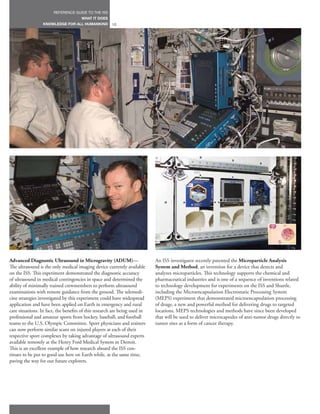
Advanced Diagnostic Ultrasound in Microgravity (ADUM)—                      An ISS investigator recently patented the Microparticle Analysis
The ultrasound is the only medical imaging device currently available       System and Method, an invention for a device that detects and
on the ISS. This experiment demonstrated the diagnostic accuracy            analyzes microparticles. This technology supports the chemical and
of ultrasound in medical contingencies in space and determined the          pharmaceutical industries and is one of a sequence of inventions related
ability of minimally trained crewmembers to perform ultrasound              to technology development for experiments on the ISS and Shuttle,
examinations with remote guidance from the ground. The telemedi-            including the Microencapsulation Electrostatic Processing System
cine strategies investigated by this experiment could have widespread       (MEPS) experiment that demonstrated microencapsulation processing
application and have been applied on Earth in emergency and rural           of drugs, a new and powerful method for delivering drugs to targeted
care situations. In fact, the benefits of this research are being used in   locations. MEPS technologies and methods have since been developed
professional and amateur sports from hockey, baseball, and football         that will be used to deliver microcapsules of anti-tumor drugs directly to
teams to the U.S. Olympic Committee. Sport physicians and trainers          tumor sites as a form of cancer therapy.
can now perform similar scans on injured players at each of their
respective sport complexes by taking advantage of ultrasound experts
available remotely at the Henry Ford Medical System in Detroit.
This is an excellent example of how research aboard the ISS con-
tinues to be put to good use here on Earth while, at the same time,
paving the way for our future explorers.
REFERENCE GUIDE TO THE ISS
                                                                                                           WHAT IT DOES
                                                                                                      13   LABORATORY RESEARCH


 Laboratory Research


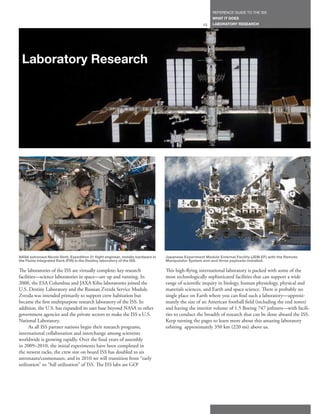
NASA astronaut Nicole Stott, Expedition 21 flight engineer, installs hardware in   Japanese Experiment Module External Facility (JEM EF) with the Remote
the Fluids Integrated Rack (FIR) in the Destiny laboratory of the ISS.             Manipulator System arm and three payloads installed.

The laboratories of the ISS are virtually complete; key research                   This high-flying international laboratory is packed with some of the
facilities—science laboratories in space—are up and running. In                    most technologically sophisticated facilities that can support a wide
2008, the ESA Columbus and JAXA Kibo laboratories joined the                       range of scientific inquiry in biology, human physiology, physical and
U.S. Destiny Laboratory and the Russian Zvezda Service Module.                     materials sciences, and Earth and space science. There is probably no
Zvezda was intended primarily to support crew habitation but                       single place on Earth where you can find such a laboratory—approxi-
became the first multipurpose research laboratory of the ISS. In                   mately the size of an American football field (including the end zones)
addition, the U.S. has expanded its user base beyond NASA to other                 and having the interior volume of 1.5 Boeing 747 jetliners—with facili-
government agencies and the private sectors to make the ISS a U.S.                 ties to conduct the breadth of research that can be done aboard the ISS.
National Laboratory.                                                               Keep turning the pages to learn more about this amazing laboratory
      As all ISS partner nations begin their research programs,                    orbiting approximately 350 km (220 mi) above us.
international collaboration and interchange among scientists
worldwide is growing rapidly. Over the final years of assembly
in 2009–2010, the initial experiments have been completed in
the newest racks, the crew size on board ISS has doubled to six
astronauts/cosmonauts, and in 2010 we will transition from “early
utilization” to “full utilization” of ISS. The ISS labs are GO!
REFERENCE GUIDE TO THE ISS
                                          WHAT IT DOES
                                 LABORATORY FACILITIES    14


 Laboratory Facilities


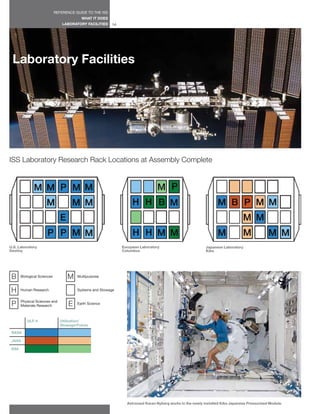
ISS Laboratory Research Rack Locations at Assembly Complete


U.S. Laboratory                                                European Laboratory                          Japanese Laboratory
Destiny                                                        Columbus                                     Kibo


 B     Biological Sciences         M    Multipurpose


 H     Human Research                   Systems and Stowage


 P     Physical Sciences and
       Materials Research           E   Earth Science


          ULF-4                 Utilization/
                                Stowage/Future

 NASA

 JAXA

 ESA


                                                                 Astronaut Karen Nyberg works in the newly installed Kibo Japanese Pressurized Module.
REFERENCE GUIDE TO THE ISS
                                                                                                   WHAT IT DOES
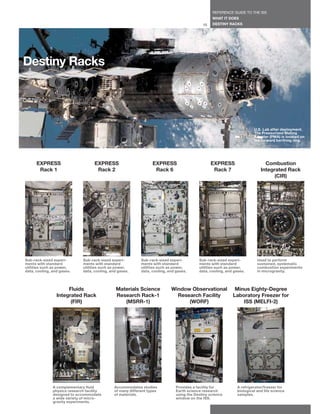
                                                                                              15   DESTINY RACKS


Destiny Racks


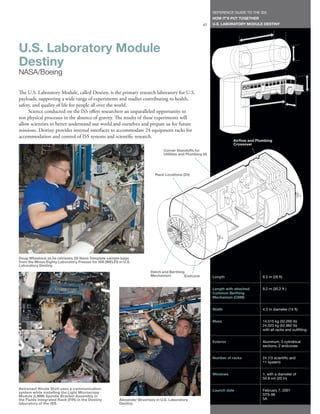
                                                                                                                          U.S. Lab after deployment.
                                                                                                                          The Pressurized Mating
                                                                                                                          Adapter (PMA) is located on
                                                                                                                          the forward berthing ring.


      EXPRESS                       EXPRESS                        EXPRESS                         EXPRESS                      Combustion
       Rack 1                        Rack 2                         Rack 6                          Rack 7                    Integrated Rack
                                                                                                                                    (CIR)


Sub-rack-sized experi-        Sub-rack-sized experi-         Sub-rack-sized experi-         Sub-rack-sized experi-          Used to perform
ments with standard           ments with standard            ments with standard            ments with standard             sustained, systematic
utilities such as power,      utilities such as power,       utilities such as power,       utilities such as power,        combustion experiments
data, cooling, and gases.     data, cooling, and gases.      data, cooling, and gases.      data, cooling, and gases.       in microgravity.


                      Fluids                    Materials Science            Window Observational              Minus Eighty-Degree
                 Integrated Rack                Research Rack-1                Research Facility              Laboratory Freezer for
                       (FIR)                       (MSRR-1)                        (WORF)                         ISS (MELFI-2)


               A complementary fluid           Accommodates studies             Provides a facility for          A refrigerator/freezer for
               physics research facility       of many different types          Earth science research           biological and life science
               designed to accommodate         of materials.                    using the Destiny science        samples.
               a wide variety of micro-                                         window on the ISS.
               gravity experiments.
REFERENCE GUIDE TO THE ISS
                                    WHAT IT DOES
                                      KIBO RACKS      16


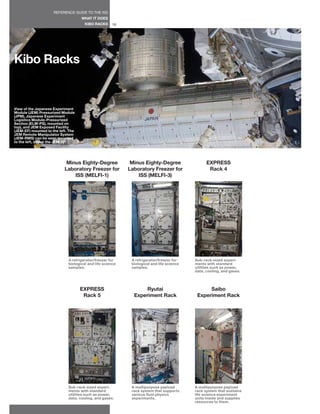
Kibo Racks


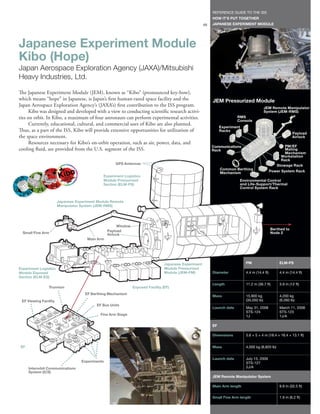
View of the Japanese Experiment
Module (JEM) Pressurized Module
(JPM), Japanese Experiment
Logistics Module-Pressurized
Section (ELM-PS), mounted on
top), and JEM Exposed Facility
(JEM-EF) mounted to the left. The
JEM Remote Manipulator System
(JEM-RMS) can be seen mounted
to the left, above the JEM-EF.


                            Minus Eighty-Degree             Minus Eighty-Degree                 EXPRESS
                           Laboratory Freezer for          Laboratory Freezer for                Rack 4
                               ISS (MELFI-1)                   ISS (MELFI-3)


                             A refrigerator/freezer for     A refrigerator/freezer for    Sub-rack-sized experi-
                             biological and life science    biological and life science   ments with standard
                             samples.                       samples.                      utilities such as power,
                                                                                          data, cooling, and gases.


                                    EXPRESS                       Ryutai                        Saibo
                                     Rack 5                  Experiment Rack               Experiment Rack


                             Sub-rack-sized experi-         A multipurpose payload        A multipurpose payload
                             ments with standard            rack system that supports     rack system that sustains
                             utilities such as power,       various fluid physics         life science experiment
                             data, cooling, and gases.      experiments.                  units inside and supplies
                                                                                          resources to them.
REFERENCE GUIDE TO THE ISS
                                                                                                     WHAT IT DOES
                                                                                               17    COLUMBUS RACKS


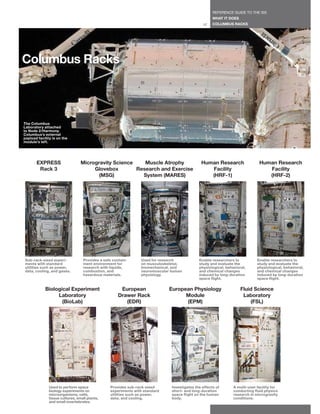
Columbus Racks


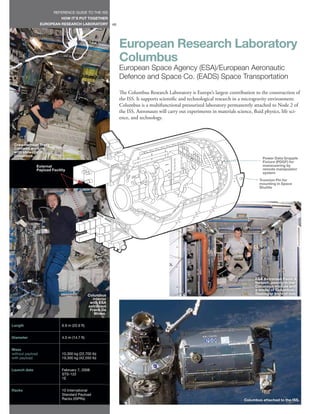
The Columbus
Laboratory attached
to Node 2/Harmony.
Columbus’s external
payload facility is on the
module’s left.


       EXPRESS                    Microgravity Science    Muscle Atrophy                      Human Research                  Human Research
        Rack 3                         Glovebox        Research and Exercise                     Facility                        Facility
                                         (MSG)           System (MARES)                          (HRF-1)                         (HRF-2)


Sub-rack-sized experi-             Provides a safe contain-     Used for research            Enable researchers to           Enable researchers to
ments with standard                ment environment for         on musculoskeletal,          study and evaluate the          study and evaluate the
utilities such as power,           research with liquids,       biomechanical, and           physiological, behavioral,      physiological, behavioral,
data, cooling, and gases.          combustion, and              neuromuscular human          and chemical changes            and chemical changes
                                   hazardous materials.         physiology.                  induced by long-duration        induced by long-duration
                                                                                             space flight.                   space flight.


            Biological Experiment                      European              European Physiology                    Fluid Science
                 Laboratory                           Drawer Rack                  Module                            Laboratory
                   (BioLab)                              (EDR)                     (EPM)                                (FSL)


               Used to perform space             Provides sub-rack-sized      Investigates the effects of       A multi-user facility for
               biology experiments on            experiments with standard    short- and long-duration          conducting fluid physics
               microorganisms, cells,            utilities such as power,     space flight on the human         research in microgravity
               tissue cultures, small plants,    data, and cooling.           body.                             conditions.
               and small invertebrates.
REFERENCE GUIDE TO THE ISS
                                           WHAT IT DOES
            EXTERNAL RESEARCH ACCOMMODATIONS              18

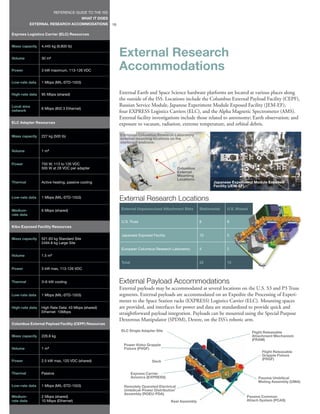
Express Logistics Carrier (ELC) Resources


Mass capacity    4,445 kg (9,800 lb)


Volume           30 m3
                                                               External Research
Power            3 kW maximum, 113-126 VDC                     Accommodations
Low-rate data    1 Mbps (MIL-STD-1553)


High-rate data   95 Mbps (shared)                              External Earth and Space Science hardware platforms are located at various places along
                                                               the outside of the ISS. Locations include the Columbus External Payload Facility (CEPF),
Local area                                                     Russian Service Module, Japanese Experiment Module Exposed Facility (JEM-EF),
                 6 Mbps (802.3 Ethernet)
network                                                        four EXPRESS Logistics Carriers (ELC), and the Alpha Magnetic Spectrometer (AMS).
                                                               External facility investigations include those related to astronomy; Earth observation; and
ELC Adapter Resources                                          exposure to vacuum, radiation, extreme temperature, and orbital debris.

Mass capacity    227 kg (500 lb)                               European Columbus Research Laboratory
                                                               external mounting locations on the
                                                               starboard endcone.

Volume           1 m3


Power            750 W, 113 to 126 VDC
                 500 W at 28 VDC per adapter                                                    Columbus
                                                                                                External
                                                                                                Mounting
                                                                                                Locations
Thermal          Active heating, passive cooling                                                                    Japanese Experiment Module Exposed
                                                                                                                    Facility (JEM-EF)


Low-rate data    1 Mbps (MIL-STD-1553)
                                                               External Research Locations
Medium-          6 Mbps (shared)                                External Unpressurized Attachment Sites      Stationwide   U.S. Shared
rate data
                                                                U.S. Truss                                   8             8
Kibo Exposed Facility Resources

                                                                Japanese Exposed Facility                    10            5
Mass capacity    521.63 kg Standard Site
                 2494.8 kg Large Site
                                                                European Columbus Research Laboratory        4             2
Volume           1.5 m3
                                                                Total                                        22            15
Power            3 kW max, 113-126 VDC


Thermal          3–6 kW cooling                                External Payload Accommodations
                                                               External payloads may be accommodated at several locations on the U.S. S3 and P3 Truss
Low-rate data    1 Mbps (MIL-STD-1553)                         segments. External payloads are accommodated on an Expedite the Processing of Experi-
                                                               ments to the Space Station racks (EXPRESS) Logistics Carrier (ELC). Mounting spaces
High-rate data   High Rate Data: 43 Mbps (shared)              are provided, and interfaces for power and data are standardized to provide quick and
                 Ethernet: 10Mbps                              straightforward payload integration. Payloads can be mounted using the Special Purpose
                                                               Dexterous Manipulator (SPDM), Dextre, on the ISS’s robotic arm.
Columbus External Payload Facility (CEPF) Resources
                                                                ELC Single Adapter Site                                                  Flight Releasable
Mass capacity    226.8 kg                                                                                                                Attachment Mechanism
                                                                                                                                         (FRAM)
                                                                 Power Video Grapple
Volume           1 m3                                            Fixture (PVGF)
                                                                                                                                             Flight Releasable
                                                                                                                                             Grapple Fixture
Power            2.5 kW max, 120 VDC (shared)                                                                                                (FRGF)
                                                                                   Deck


Thermal          Passive                                                Express Carrier
                                                                        Avionics (EXPRESS)                                                  Passive Umbilical
                                                                                                                                            Mating Assembly (UMA)
Low-rate data    1 Mbps (MIL-STD-1553)                           Remotely Operated Electrical
                                                                 Umbilical-Power Distribution
                                                                 Assembly (ROEU-PDA)
Medium-          2 Mbps (shared)                                                                                                     Passive Common
rate data        10 Mbps (Ethernet)                                                          Keel Assembly                           Attach System (PCAS)
REFERENCE GUIDE TO THE ISS
                                                                                                                WHAT IT DOES
                                                                                                           19   INTERNAL RESEARCH ACCOMMODATIONS


Internal Research
Accommodations
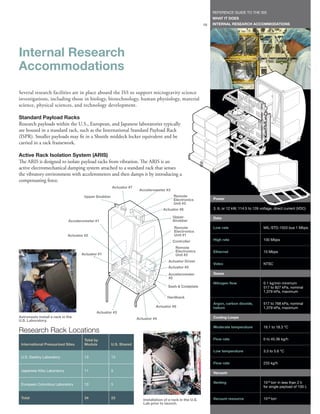
Several research facilities are in place aboard the ISS to support microgravity science
investigations, including those in biology, biotechnology, human physiology, material
science, physical sciences, and technology development.

Standard Payload Racks
Research payloads within the U.S., European, and Japanese laboratories typically
are housed in a standard rack, such as the International Standard Payload Rack
(ISPR). Smaller payloads may fit in a Shuttle middeck locker equivalent and be
carried in a rack framework.

Active Rack Isolation System (ARIS)
The ARIS is designed to isolate payload racks from vibration. The ARIS is an
active electromechanical damping system attached to a standard rack that senses
the vibratory environment with accelerometers and then damps it by introducing a
compensating force.
                                                     Actuator #7
                                                                    Accelerometer #3
                                     Upper Snubber                                       Remote
                                                                                         Electronics            Power
                                                                                         Unit #3
                                                                                  Actuator #8                   3, 6, or 12 kW, 114.5 to 126 voltage, direct current (VDC)

                                                                                        Upper                   Data
                             Accelerometer #1                                           Snubber
                                                                                         Remote                 Low rate                       MIL-STD-1553 bus 1 Mbps
                                                                                         Electronics
                             Actuator #2                                                 Unit #1
                                                                                        Controller              High rate                      100 Mbps

                                                                                          Remote
                                                                                          Electronics           Ethernet                       10 Mbps
                                    Actuator #1                                           Unit #2
                                                                                     Actuator Driver
                                                                                                                Video                          NTSC
                                                                                     Actuator #5
                                                                                     Accelerometer              Gases
                                                                                     #2
                                                                                                                Nitrogen flow                  0.1 kg/min minimum
                                                                                     Sash & Coldplate                                          517 to 827 kPa, nominal
                                                                                                                                               1,379 kPa, maximum
                                                                                     Hardback
                                                                                                                Argon, carbon dioxide,         517 to 768 kPa, nominal
                                                                             Actuator #6                        helium                         1,379 kPa, maximum
                                             Actuator #3
Astronauts install a rack in the                                   Actuator #4                                  Cooling Loops
U.S. Laboratory.
                                                                                                                Moderate temperature           16.1 to 18.3 °C
Research Rack Locations
                                      Total by                                                                  Flow rate                      0 to 45.36 kg/h
 International Pressurized Sites      Module         U.S. Shared
                                                                                                                Low temperature                3.3 to 5.6 °C
 U.S. Destiny Laboratory              13             13
                                                                                                                Flow rate                      233 kg/h

 Japanese Kibo Laboratory             11             5
                                                                                                                Vacuum


 European Columbus Laboratory         10             5                                                          Venting                        10–3 torr in less than 2 h
                                                                                                                                               for single payload of 100 L


 Total                                34             23                                                         Vacuum resource                10–3 torr
                                                                      Installation of a rack in the U.S.
                                                                      Lab prior to launch.
REFERENCE GUIDE TO THE ISS
             WHAT IT DOES
                             20
REFERENCE GUIDE TO THE ISS
                                                                                 RESEARCH GUIDE
                                                                            21


                                                                                           research guide
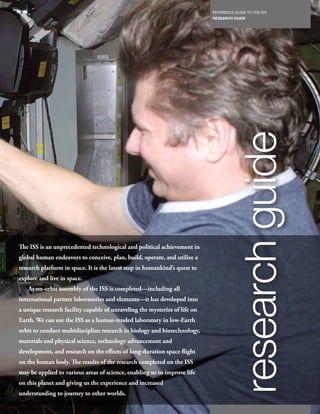
The ISS is an unprecedented technological and political achievement in
global human endeavors to conceive, plan, build, operate, and utilize a
research platform in space. It is the latest step in humankind’s quest to
explore and live in space.
   As on-orbit assembly of the ISS is completed—including all
international partner laboratories and elements—it has developed into
a unique research facility capable of unraveling the mysteries of life on
Earth. We can use the ISS as a human-tended laboratory in low-Earth
orbit to conduct multidiscipline research in biology and biotechnology,
materials and physical science, technology advancement and
development, and research on the effects of long-duration space flight
on the human body. The results of the research completed on the ISS
may be applied to various areas of science, enabling us to improve life
on this planet and giving us the experience and increased
understanding to journey to other worlds.
REFERENCE GUIDE TO THE ISS
          RESEARCH GUIDE
                             22
REFERENCE GUIDE TO THE ISS
                                                                                    RESEARCH GUIDE
                                                                               23   MULTIPURPOSE FACILITIES


Multipurpose Facilities

                                         European Drawer Rack (EDR) [ESA] is a multidiscipline facility to support up to
                                         seven modular experiment modules. Each payload will have its own cooling, power, data
                                         communications, vacuum, venting, and nitrogen supply. EDR facilitates autonomous
                                         operations of subrack experiments in a wide variety of scientific disciplines.
                                              Protein Crystallization Diagnostics Facility (PCDF) is the first ESA experiment
                                         performed with the EDR rack. Its main science objectives are to study the protein crystal
                                         growth conditions by way of nonintrusive optical techniques like Dynamic Light Scattering
                                         (DLS), Mach-Zehnder Interferometry (MZI), and classical microscopy. Understanding
                                         how crystals grow in purely diffusive conditions helps define the best settings to get organic
                                         crystals as perfect as possible. Later on these crystals will be preserved and analyzed via
                                         X-rays on Earth to deduce the three-dimensional shape of proteins.


Expedite the Processing of
Experiments to Space Station
(EXPRESS) Racks [NASA] are
modular multipurpose payload racks
that store and support experiments
aboard the ISS. The rack provides
structural interfaces, power, data,
cooling, water, and other items
needed to operate the science
experiments on the ISS. Experiments
are exchanged in and out of the
EXPRESS Rack as needed; some
subrack multi-user facilities (like
the European Modular Cultivation
System [EMCS]) will remain in
EXPRESS for the life of the ISS,
while others are used for only a short
period of time.
                                                                                        Multipurpose Small Payload Rack (MSPR)
                                                                                        [JAXA] has two workspaces and one workbench
                                                                                        and can hold equipment, supply power, and
                                                                                        enable communication and video transmission.
                                                                                        With such general characteristics, MSPR can
                                                                                        be used in various fields of space environment
                                                                                        use not only for science, but also for cultural
                                                                                        missions.
REFERENCE GUIDE TO THE ISS
                                      RESEARCH GUIDE
                            MULTIPURPOSE FACILITIES      24


    Portable Glove Box (PGB) [ESA] is a small
    glovebox that can be transported around the ISS
    and used to provide two levels of containment for
    experiments in any laboratory module. Three levels
    of containment can be achieved by placing the
    PGB inside the larger volume of the MSG.
        Gloveboxes provide containment of
    experiments, ensuring that hazardous materials
    do not float about the cabin. The Microgravity
    Science Glovebox (MSG) has been the most
    heavily used facility during ISS construction.
    In one short period in 2008, it was used for a            Microgravity Science Glovebox (MSG) [ESA, NASA] provides a safe environment
    combustion experiment, for a study of complex             for research with liquids, combustion, and hazardous materials on board the ISS.
    fluids, and to harvest plants. A wide variety of
    experiments will be using the versatile MSG               Crewmembers access the work area through ports equipped with rugged, sealed gloves.
    accommodation and functional capabilities.                     A video system and data downlinks allow for control of the enclosed experiments from
                                                              the ground. Built by ESA and operated by NASA, MSG is the largest glovebox flown in space.


Microgravity Experiment Research Locker/
Incubator (MERLIN) [NASA] can be used
as either a freezer, refrigerator, or incubator
(between –20.0 °C to 48.5 °C) and has a volume
of 4.17 L.
      General Laboratory Active Cryogenic ISS
Equipment Refrigerator (GLACIER) [NASA]
serves as an on-orbit ultra-cold freezer (as low as
–165 °C) and has a volume of 11.35 L.
                                                              Minus Eighty-Degree Laboratory Freezer for ISS (MELFI) [ESA, NASA] is a refrigera-
                                                              tor/freezer for biological and life science samples collected on the ISS. These ESA-built
                                                              and NASA-operated freezers store samples at temperatures of +4 °C to as low as –80 °C,
                                                              and each has a volume of 175 L of samples.
REFERENCE GUIDE TO THE ISS
                                                                                                 RESEARCH GUIDE
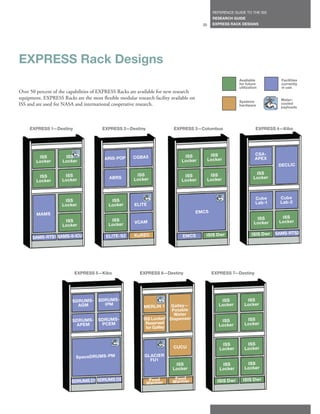
                                                                                          25     EXPRESS RACK DESIGNS


EXPRESS Rack Designs
                                                                                                              Available           Facilities
                                                                                                              for future          currently
                                                                                                              utilization         in use
Over 50 percent of the capabilities of EXPRESS Racks are available for new research
equipment. EXPRESS Racks are the most flexible modular research facility available on                                             Water-
                                                                                                              Systems
ISS and are used for NASA and international cooperative research.                                             hardware            cooled
                                                                                                                                  payloads


     EXPRESS 1—Destiny                  EXPRESS 2—Destiny                 EXPRESS 3—Columbus                            EXPRESS 4—Kibo


                                                                               ISS              ISS                    CSA-
         ISS          ISS                ARIS-POP      CGBA5                                                           APEX
        Locker       Locker                                                   Locker           Locker
                                                                                                                                 DECLIC

                                                        ISS                                     ISS                    ISS
         ISS         ISS                                                       ISS
                                           ABRS        Locker                                  Locker                 Locker
        Locker      Locker                                                    Locker


                                                                                                                        Cube      Cube
                     ISS                    ISS                                                                                   Lab-2
                                                       ELITE                                                            Lab-1
                    Locker                 Locker
                                                                                        EMCS
        MAMS
                                                                                                                        ISS       ISS
                      ISS                   ISS        VCAM                                                                      Locker
                                           Locker                                                                      Locker
                     Locker

                                                       KuREC                               ISIS Dwr                  ISIS Dwr   SAMS-RTS2
      SAMS-RTS1 SAMS-II-ICU               ELITE-S2                             EMCS


                          EXPRESS 5—Kibo                  EXPRESS 6—Destiny                     EXPRESS 7—Destiny


                         SDRUMS - SDRUMS -                                                           ISS          ISS
                           AGM      IPM                                  Galley—                    Locker       Locker
                                                            MERLIN 1
                                                                         Potable
                                                                          Water
                         SDRUMS - SDRUMS -                  ISS Locker/ Dispenser                    ISS          ISS
                          APEM     PCEM                      Reserved                               Locker       Locker
                                                             for Galley


                                                                                                     ISS          ISS
                                                                          CUCU                      Locker       Locker
                           SpaceDRUMS -PM                   GLACIER
                                                              FU1
                                                                           ISS                       ISS          ISS
                                                                          Locker                    Locker       Locker

                                                                           Food
                         SDRUMS D1 SDRUMS D2                  Food
                                                             Warmer       Warmer                   ISIS Dwr     ISIS Dwr
REFERENCE GUIDE TO THE ISS
                                        RESEARCH GUIDE
                                 BIOLOGICAL RESEARCH     26


                                                              Biological Research

Biological Laboratory (BioLab) [ESA] is
used to perform space biology experiments on
microorganisms, cells, tissue cultures, small plants,
and small invertebrates, and it will allow a better
understanding of the effects of microgravity
and space radiation on biological organisms.
BioLab includes an incubator with a microscope,
spectrophotometer, and two centrifuges to
provide artificial gravity. It also has a glovebox and
two cooler/freezer units.


     Biotechnology Specimen Temperature
     Controller (BSTC) [NASA] includes a
     refrigerator, incubator, and cryo-drawer, as well
     as envrionmental and atmospheric control to
     grow and maintain mammalian cell cultures in
     microgravity.
REFERENCE GUIDE TO THE ISS
                                                                                            RESEARCH GUIDE
                                                                                       27   BIOLOGICAL RESEARCH


                                                                                               Advanced Biological Research System (ABRS)
                                                                                               [NASA] is a single locker system with two growth
                                                                                               chambers. Each growth chamber is a closed
                                                                                               system capable of independently controlling
                                                                                               temperature, illumination, and atmospheric
Mice Drawer System (MDS) [NASA, ASI] is hardware provided by the Italian Space                 composition to grow a variety of biological
                                                                                               organisms including plants, microorganisms, and
Agency (ASI) that uses a validated mouse model to investigate the genetic mechanisms           small arthropods (insects and spiders).
underlying bone mass loss in microgravity. MDS is a multifunctional and multiuser                 The first plant experiments in ABRS will
system that allows experiments in various areas of biomedicine, from research on               include the first trees flown in space (willows for
organ function to the study of the embryonic development of small mammals under                a Canadian study of cambium formation), and
                                                                                               an American study will use green fluorescent
microgravity conditions. Research conducted with the MDS is an analog to the human             proteins as environmental stress indicators.
research program, which has the objective to extend the human presence safely beyond
low-Earth orbit.


                                                                                                         Waving and Coiling of Arabidopsis
                                                                                                         Roots at Different g-levels (WAICO)
                                                                                                         was the first experiment conducted
                                                                                                         in BioLab. Plant growth is impacted
                                                                                                         by several factors (i.e., temperature,
                                                                                                         humidity, gravitropism, phototropism,
                                                                                                         and circumnutation). Shoots/stems
Exposure Experiment (Expose) [ESA] is a                                                                  and roots develop following complex
                                                                                                         phenomena at micro-/macroscopic
multi-user facility accommodating experiments                                                            levels. The goal of this experiment
in the following disciplines: photo processing,                                                          was to understand the interaction of
                                                                                                         circumnutation (the successive bowing
photo-biology, and exobiology. Expose allows                                                             or bending in different directions of the
short- and long-term exposure of experiments                                                             growing tip of the stems and roots) and
                                                                                                         gravitropism (a tendency to grow toward
to space conditions and solar UV radiation on                                                            or away from gravity) in microgravity and
the ISS. The Expose facilities are installed on the                                                      1-g of Arabidopsis thaliana wild type and
                                                                                                         an agravitropic mutant.
external surfaces of Zvezda service module and
Columbus module.
REFERENCE GUIDE TO THE ISS
                                         RESEARCH GUIDE
                                 BIOLOGICAL RESEARCH         28


Kriogem-3M [Roscosmos] is a refrigerator-
incubator used for stowage of biological samples
and for the culture and incubation of bioreactors
such as Recomb-K. Bioreactors are specialized
hardware for growing cells, tissues, and
microorganisms.


                                                                  Saibo Experiment Rack (Saibo) [JAXA] is a multipurpose payload rack system that sustains
                                                                  life science experiment units inside and supplies resources to them. Saibo consists of a Clean
                                                                  Bench, a glovebox with a microscope, and a Cell Biology Experiment Facility (CBEF), which
                                                                  has incubators, a centrifuge, and sensors to monitor the atmospheric gases.
                                                                     Saibo means “living cell.” The first use of Saibo was for studies of the effects of
                                                                  radiation on immature immune cells.


    eOSTEO Bone Culture System [CSA] provides the
                                                                                                                                 Aquatic Habitat (AQH) [JAXA]
    right conditions to grow bone cells in microgravity.                                                                         enables breeding experiments
    This culture system has been used successfully on
    U.S. Space Shuttle and Russian Foton recoverable
                                                                                                                                 with medaka or zebrafish in
    orbital flights, and is also available for use in bone                                                                       space, and those small freshwater
    cell culture on ISS.
                                                                                                                                 fish have many advantages as one
       Understanding the cellular changes in bone                                                                                of the model animals for study.
    cells in orbit could be key for understanding the
    bone loss that occurs in astronauts while they are                                                                           The AQH is composed of two
    in space.                                                                                                                    aquariums, which have automatic
                                                                                                                                 feeding systems, LED lights to
                                                                                                                                 generate day/night cycle, and
                                                                                                                                 charge-coupled device (CCD)
                                                                                                                                 cameras for observation.
REFERENCE GUIDE TO THE ISS
                                                                                                RESEARCH GUIDE
                                                                                           29   BIOLOGICAL RESEARCH


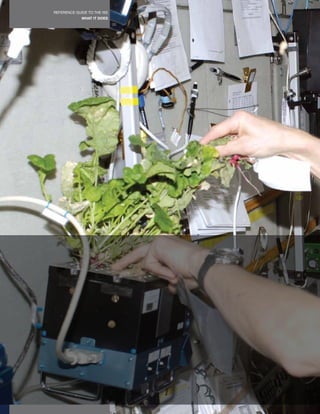
LADA Greenhouse [Roscosmos] – Since its launch in 2002, the LADA greenhouse has
been in almost continous use for growing plants in the Russian segment. It has supported
a series of experiments on fundamental plant biology and space farming, growing multiple
generations of sweet peas, wheat, tomatoes, and lettuce.
     NASA and Roscosmos have used the LADA greenhouse in cooperative tests to
determine the best ways to keep roots moist in space. Bioregenerative life support from
photosynthesis may be an important component of future spacecraft systems.


                                                                                                   Commercial Generic Bioprocessing Apparatus
                                                                                                   (CGBA) [NASA] provides programmable, accurate
                                                                                                   temperature control—from cold stowage to a
                                                                                                   customizable incubator—for experiments that
                                                                                                   examine the biophysical and biochemical actions
                                                                                                   of microorganisms in microgravity. CGBA can be
                                                                                                   used in a wide variety of biological studies, such
                                                                                                   as protein crystal growth, small insect habitats,
                                                                                                   plant development, antibiotic-producing bacteria,
                                                                                                   and cell culture studies.
                                                                                                      CGBA, operated by Bioserve Space
                                                                                                   Techologies, is a key facility being used by
                                                                                                   U.S. investigators as part of the ISS National
                                                                                                   Laboratory initiative.


  European Modular Cultivation System (EMCS)
  [ESA, NASA] allows for cultivation, stimulation,
  and crew-assisted operation of biological
  experiments under well-controlled conditions
  (e.g., temperature, atmospheric composition,
  water supply, and illumination). It is being used
  for multi-generation experiments and studies of
  gravitational effects on early development and
  growth in plants and other small organisms.
     The EMCS has two centrifuges, spinning at
  up to twice Earth’s gravity. Different experiment
  containers can hold a variety of organisms,
  such as worms and fruit flies, as well as seeds
  and plants. The EMCS has already supported a
  number of plant growth experiments operated by
  ESA, NASA, and JAXA.
REFERENCE GUIDE TO THE ISS
                                RESEARCH GUIDE
                  HUMAN PHYSIOLOGY RESEARCH         30


                                                         Human Physiology Research


                                        SLAMMD


                              Clinical Ultrasound


                                                           SLAMMD and PFS are used by flight
                                                           surgeons during periodic medical
                                                           exams on the ISS. Understanding the
                                                           gradual deconditioning of astronauts
                                                           and cosmonauts during their stay on
                                                           the ISS is critical for developing better
                                                           exercise capabilities for exploration
                          Refrigerated Centrifuge          beyond Earth orbit.


Human Research Facility (HRF-1 and HRF-2) [NASA] enables human life science                            European Physiology Module (EPM)
researchers to study and evaluate the physiological, behavioral, and chemical changes induced          [ESA] is designed for investigating the
by long-duration space flight. HRF-1 houses medical equipment including a Clinical                     effects of microgravity on short-term and
Ultrasound, the Space Linear Acceleration Mass Measurement Device (SLAMMD)                             long-duration space flights on the human
for measuring on-orbit crewmember mass, devices for measuring blood pressure and heart                 body and includes equipment for studies
function, and a Refrigerated Centrifuge for processing blood samples. The equipment is                 in neuroscience, and in cardiovascular,
being used to study the effects of long-duration space flight on the human body. Researchers           bone, and muscle physiology, as well as
will use the ISS to understand the physiology and to test countermeasures that will prevent            investigations of metabolic processes. The
negative effects of space travel, and enable humans to travel beyond Earth orbit.                      cardiolab instrument was provided by the
     Techniques developed for using ultrasound technology on the ISS are now being used in             French Space Agency (CNES) and German
trauma facilities to more rapidly assess serious patient injuries.                                     Aerospace Center (DLR).
REFERENCE GUIDE TO THE ISS
      RESEARCH GUIDE
31    HUMAN PHYSIOLOGY RESEARCH


     Anomalous Long Term Effects in Astronaut’s
     Central Nervous System (ALTEA) [ASI, NASA,
     ESA] ALTEA is a helmet-shaped device holding
     six silicon particle detectors that has been used to
     measure the effect of the exposure of crewmembers
     to cosmic radiation on brain activity and visual
     perception, including astronauts’ perceptions
     of light flashes behind their eyelids as a result
     of high-energy radiation. Because of its ability
     to be operated without a crewmember, it is also
     being used as a portable dosimeter to provide
     quantitative data on high-energy radiation particles
     passing into the ISS.
           ALTEA-Dosi capabilities are also used to
     give additional information on the exposure of
     crewmembers to radiation during their stays on
     ISS for use in health monitoring. ALTEA-Shield
     will provide data about radiation shielding effects
     by a variety of special materials.


         Pulmonary Function System (PFS) [ESA,
         NASA] is hardware developed collaboratively
         by ESA and NASA. It includes four components
         that are needed to make sophisticated studies
         of lung function by measuring respired gases in
         astronaut subjects. It includes two complimentary
         analyzers to measure the gas composition of
         breath, the capability to make numerous different
         measurements of lung capacity and breath
         volume, and a system to deliver special gas
         mixtures that allow astronauts to perform special
         tests of lung performance. ESA will also be
         operating a small portable version of the system
         (portable PFS) that can be used in the various
         laboratory modules.
REFERENCE GUIDE TO THE ISS
                                       RESEARCH GUIDE
                      HUMAN PHYSIOLOGY RESEARCH            32


  COLBERT                                                       ARED                               CEVIS


     The Combined Operational Load Bearing External Resistive Exercise Treadmill
(COLBERT) [NASA] can collect data such as body loading, duration of session, and
speed for each crewmember.
     The Advanced Resistive Exercise Device (ARED) [NASA] is systems hardware that
provides exercise capabilities to crewmembers on the ISS. The ARED also collects data
regarding the parameters (loads, repetitions, stroke, etc.) associated with crew exercise and
transmits it to the ground.
     The Cycle Ergometer with Vibration Isolation System (CEVIS) [NASA] provides
the ability for recumbent cycling to provide aerobic exercise as a countermeasure to
cardiovascular deconditioning on orbit.
     The second generation of exercise equipment used for daily exercise on board the ISS
collects information on protocols and forces that are used as supplemental data for studies
of muscle and bone loss and cardiovascular health during long-duration space flight.


    Percutaneous Electrical Muscle Stimulator
    (PEMS) [ESA] is a self-contained, locker-stowed
    item. Its purpose is to deliver electrical pulse
    stimulation to nonthoracic muscle groups of the
    human test subject, thereby creating contractile                                            Muscle Atrophy Research Exercise System
    responses from the muscles. The PEMS supports                                               (MARES)[ESA] will be used for research on
    neuromuscular research. It provides single pulses or
    pulse trains according to a preadjusted program.                                            musculoskeletal, biomechanical, and neuromuscular
                                                                                                human physiology to better understand the effects
                                                                                                of microgravity on the muscles. This instrument is
                                                                                                capable of assessing the strength of isolated muscle
                                                                                                groups around joints by controlling and measuring
                                                                                                relationships between position/velocity and torque/
                                                                                                force as a function of time.
REFERENCE GUIDE TO THE ISS
                                     RESEARCH GUIDE
                               33    HUMAN PHYSIOLOGY RESEARCH


EVARM                 PMDIS
                                          Human Research Hardware [CSA] is
                                          used cooperatively with other international
                                          hardware for better understanding of the
                                          physiological responses to space flight. The
                                          hardware includes radiation dosimeters
                                          (Extravehicular Activity Radiation
                                          Monitoring [EVARM]) and hardware and
                                          software for studying hand-eye coordination
                                          and visual perception (Perceptual Motor
                                          Deficits in Space [PMDIS], Bodies In
                                          the Space Environment [BISE]) and
                                          neurophysiology (Effects of Altered Gravity
                                          on Spinal Cord Excitability [H-Reflex]).


BISE             H-REFLEX


        Measuring Radiation Hazards in Space (Matryoshka) [ESA, Roscosmos, NASA,
        JAXA] is a series of investigations to measure radiation doses experienced by
        astronauts in space outside (MTR-1) and at various locations inside (MTR-2) the
        ISS. Matryoshka uses a mannequin of a human torso made of plastic, foam, and a
        real human skeleton. The torso is equipped with dozens of radiation sensors that
        are placed in strategic locations throughout its surface and interior to measure how
        susceptible different organs and tissue may be to radiation damage experienced by
        astronauts in space. Research institutes from around the world have collaborated
        and shared data from the project. The results will give the radiation dose distribution
        inside a human phantom torso for a better correlation between skin and organ dose
        and for better risk assessment in future long-duration space flight.
           Participants from 10 countries provided dosimeters and other components of
        Matryoshka, making it one of the largest multinational collaborative investigations
        on the ISS. The Matryoshka program started in 2004 and will incrementally
        continue for some years.
REFERENCE GUIDE TO THE ISS
                               RESEARCH GUIDE
                  HUMAN PHYSIOLOGY RESEARCH       34

  Weightless                                                                                       Digital Holter ECG
  Adaptation


                                                                                                 Crew PADLES


                                                               Human Research Hardware [JAXA] includes a
                                                               portable Digital Holter ECG recorder for 24-hour
                                                               electrocardiogram monitoring of cardiovascular
                                                               and autonomic function of the astronauts.
                                                                    The recorded data are downlinked through
                                                               the Multi-Protocol Converter (MPC) and crew
                                                               Passive Dosimeter for Lifescience Experiment
                                                               in Space (PADLES), which is a passive dosimeter
                                                               that records the personal dose of the astronauts.
                                                               The dose records are used to assess a radiation
                                                               exposure limit of each astronaut.
                                                                    Human physiology research is coordinated
                                                               by an internal working group to coordinate
                                                               experiments and share data. An astronaut or
                                                   Locomotor
                                                               cosmonaut can participate in as many as 20
Human Life Research [Roscosmos]                    System      physiology experiments during his or her stay
includes a variety of devices and systems                      on the ISS.
designed to study human life in space.
Components of the system of equipment
include the Cardiovascular System Research
Rack, Weightlessness Adaptation Study Kit,
Immune System Study Kit, and Locomotor
System Study Facility.


                                                                   Hand Posture Analyser (HPA) [NASA, ASI] is
                                                                   composed of the Handgrip Dynamometer/Pinch
                                                                   Force Dynamometer, the Posture Acquisition
                                                                   Glove and the Inertial Tracking System (ITS) for
                                                                   the measurement of finger position and upper
                                                                   limb kinematics. The HPA examines the way
                                                                   hand and arm muscles are used differently during
                                                                   grasping and reaching tasks in weightlessness.
REFERENCE GUIDE TO THE ISS
                                                                                                     RESEARCH GUIDE
                                                                                               35    PHYSICAL SCIENCE AND MATERIALS RESEARCH


Physical Science and
Materials Research
                                                          Fluid Science Laboratory (FSL) [ESA] is a multi-user facility for conducting fluid
                                                          physics research in microgravity conditions. The FSL provides a central location to
                                                          perform fluid physics experiments on board the ISS that will give insight into the physics
                                                          of fluids in space, including aqueous foams, emulsions, convection, and fluid motions.
                                                          Understanding how fluids behave in microgravity will lead to development of new fluid
                                                          delivery systems in future spacecraft design and development.


                                                                                                                 1                                          80º
                                                                                                                                                            100º
                                                                                                               0.5
                                                                                                                                                            60º


                                                                                                                                                                  temperature T
                                                                                                          z     0

                                                                                                              -0.5                                          40º
                                                                                                                -1
                                                                                                                  1                                         20º
                                                                                                                   0.5                                  1
                                                                                                                         0                        0.5
                                                                                                                          -0.5                0
                                                                                                                                                            0º
                                                                                                                                 -1 -1 -0.5
                                                                                                                     y                            x


                                                                                                               GEOFLOW was the first experiment
                                                                                                               container processing FSL. The first
                                                                                                               experiment in the FSL studied a model of
                                                                                                               liquid core planets.
                                                            Geoflow Interferogram Image


                                                                                                    Combustion Integrated Rack (CIR) [NASA]
                                                                                                    is used to perform sustained, systematic combus-
                                                                                                    tion experiments in microgravity. It consists of
                                                                                                    an optics bench, a combustion chamber, a fuel
                                                                     An example of a burning        and oxidizer management system, environmental
                                                                     droplet from a previous
                                                                     space combustion               management systems, and interfaces for science
                                                                     experiment.
                                                                                                    diagnostics and experiment-specific equipment,
                                                                                                    as well as five different cameras to observe the
                                                                                                    patterns of combustion in microgravity for a wide
 The Multi-User Droplet Combustion Apparatus—Flame Extinguishment Experiment (MDCA-
 FLEX) [NASA] creates droplets of fuel that ignite while suspended in a containment chamber.        variety of gases and materials.
REFERENCE GUIDE TO THE ISS
                                 RESEARCH GUIDE
     PHYSICAL SCIENCE AND MATERIALS RESEARCH        36


Kobairo Rack with Gradient Heating Furnace (GHF) [JAXA] is              Fluids Integrated Rack (FIR) [NASA] is a complementary fluid
an electrical furnace to be used for generating high-quality crystals   physics research facility designed to accommodate a wide variety
from melting materials. It consists of a vacuum chamber and three       of microgravity fluid experiments and the ability to image these
independently movable heaters, which can realize high temperature       experiments. The FIR features a large user-configurable volume
gradient up to 150 °C/cm.                                               for experiments. The FIR provides data acquisition and control,
                                                                        sensor interfaces, laser and white light sources, advanced imaging
                                                                        capabilities, power, cooling, and other resources. The FIR will
                                                                        host fluid physics investigations into areas such as complex fluids
                                                                        (colloids, gels), instabilities (bubbles), interfacial phenomena
                                                                        (wetting and capillary action), and phase changes (boiling and
                                                                        cooling). Fluids under microgravity conditions perform differently
                                                                        than those on Earth. Understanding how fluids react in these
                                                                        conditions will lead to improved designs on fuel tanks, water
                                                                        systems, and other fluid-based systems.
                                                                              The FIR includes the Light Microscopy Module (LMM). The
                                                                        LMM is a remotely controllable (commanded from the ground),
                                                                        automated microscope that allows flexible imaging (bright field, dark
                                                                        field, phase contrast, etc.) for physical and biological experiments.
REFERENCE GUIDE TO THE ISS
                                                                                                RESEARCH GUIDE
                                                                                           37   PHYSICAL SCIENCE AND MATERIALS RESEARCH


                                                                                                   Materials Science Research Rack (MSRR-1)
                                                                                                   [ESA, NASA] provides a powerful, multi-user
                                                                                                   Materials Science Laboratory (MSL) in the
                                                                                                   microgravity environment of the ISS and can
                                                                                                   accommodate studies of many different types
                                                                                                   of materials. Experiment modules that contain
                                                                                                   metals, alloys, polymers, semiconductors,
                                                                                                   ceramics, crystals, and glasses can be studied to
                                                                                                   discover new applications for existing materials
                                                                                                   and new or improved materials (crystal growth,
                                                                                                   longer polymer chains, and purer alloys). MSRR
                                                                                                   will enable this research by providing hardware
                                                                                                   to control the thermal, environmental, and
                                                                                                   vacuum conditions of experiments; monitoring
                                                                                                   experiments with video; and supplying power
                                                                                                   and data handling for specific experiment
                                                                                                   instrumentation.


                                                                                                Sample Cartridge Assembly


                                                                                                   Experiments in the MSRR are coordinated by
                                                                                                   international teams that share different parts
                                                                                                   of the samples. There are 25 investigators
                                                                                                   on 3 research teams participating in the first
                                                                                                   of these investigations. MSL—Columnar-
                                                                                                   to-Equiaxed Transition in Solidification
                                                                                                   Processing and Microstructure Formation in
                                                                                                   Casting of Technical Alloys under Diffusive
                                                                                                   (MSL-CETSOL) and Magnetically Controlled
                                                                                                   Convective Conditions (MICAST) are two
                                                                                                   investigations that support research into
                                                                                                   metallurgical solidification, semiconductor
                                                                                                   crystal growth (Bridgman and zone melting), and
Ryutai Experiment Rack (Ryutai) [JAXA] is a multipurpose payload rack system that                  measurement of thermo-physical properties of
supports various fluid physics experiments. Ryutai consists of four sub-rack facilities:           materials.
Fluid Physics Experiment Facility (FPEF); Solution Crystallization Observation
Facility (SCOF); Protein Crystallization Research Facility (PCRF); and Image
Processing Unit (IPU). Ryutai enables teleoperations of the experiments providing the
electrical power, ground command and telemetry monitoring, water cooling, and gas
supply to those sub-rack facilities.
     Ryutai means “fluid.” The JAXA experiment Ice Crystal examines the factors that
lead to the pattern formation in ice crystals in microgravity.
REFERENCE GUIDE TO THE ISS
                                   RESEARCH GUIDE
PHYSICAL SCIENCE AND MATERIALS RESEARCH              38


Device for the study of Critical Liquids and
Crystallization (DECLIC) [CNES, NASA] is a
multi-user facility developed by the ESA-member           Materials International Space Station Experiment (MISSE) [NASA] is a series of
agency Centre National d’Études Spatiales
(French Space Agency, [CNES]) and flown in                external exchangeable test beds for studying the durability of materials such as optics,
collaboration with NASA. It was designed to               sensors, electronics, communications devices, coatings, and structural materials. To date,
conduct experiments in the fields of fluid physics
and materials science. A special insert allows the        a total of seven different MISSE experiments have been attached to the outside of the ISS
study of both ambient-temperature critical point          and evaluated for the effects of atomic oxygen, vacuum, solar radiation, micrometeorites,
fluids and high-temperature super-critical fluids.
Another class of insert will study the dynamics           direct sunlight, and extremes of heat and cold. This experiment allows the development
and morphology of the fronts that form as a liquid        and testing of new materials to better withstand the rigors of space environments. Results
material solidifies.
                                                          will provide a better understanding of the durability of various materials when they are
                                                          exposed to such an extreme environment. Many of the materials may have applications in
                                                          the design of future spacecraft.
                                                               Results from MISSE tests have led to changes in materials used in dozens of
                                                          spacecraft built over the last 5 years.


                                                                                                            Super-High temperature Synthesis
                                                                                                            in space (SHS) [Roscosmos] This
                                                                                                            experiment is designed to develop a very
                                                                                                            interesting field of material science in
                                                                                                            space for fabrication and repair (welding,
                                                                                                            joining, cutting, coating, near-net-shape
                                                                                                            production, etc.) in microgravity and even
                                                                                                            on the Moon and other planets. Russian
                                                                                                            scientists have a very good collaboration
                                                                                                            in this field of investigation on the ISS
                                                                                                            with other partners (Europe, Japan,
                                                                                                            Canada). This process is a combination
                                                                                                            of several gravity-affected physical
                                                                                                            and chemical processes, operating at
                                                                                                            temperatures of synthesis up to 3,000 K.
REFERENCE GUIDE TO THE ISS
                                                                                                  RESEARCH GUIDE
                                                                                             39   PHYSICAL SCIENCE AND MATERIALS RESEARCH


Replaceable Cassette-Container (SKK or CKK) [Roscosmos] is mounted on the
outside of the ISS to test materials that are directly exposed to the harsh environment of
space. CKKs are detachable cassette containers that measure the level and composition of
contamination and monitor the change in operating characteristics for samples of materials
from the outside surfaces of the ISS Russian segment. The CKK is a two-flap structure
and consists of a casing and spool holders containing samples of materials of the outside
surfaces of the ISS Russian segment modules, which are exposed within the cassettes.


                                                                                                     Bar and Expert Experiments [Roscosmos]
                                                                                                     use a unique set of instruments for temperature
                                                                                                     cartography, ultrasonic probing, and pyro-
                                                                                                     endoscopic analysis of potentially dangerous places
                                                                                                     on board the ISS. Zones of possible formation of
                                                                                                     condensation have been revealed, and potential
                                                                                                     corrosion damage has been evaluated.


   Space Dynamically Responding Ultrasonic
   Matrix System (SpaceDRUMS) [NASA]
   will provide a suite of hardware capable of
   facilitating containerless advanced materials
   science, including combustion synthesis and
   fluid physics. SpaceDRUMS uses ultrasound
   to completely suspend a baseball-sized solid
   or liquid sample during combustion without
   the materials ever contacting the container
   walls. Such advanced ceramics production
   may have applications in new spacecraft or
   extraterrestrial outposts, such as bases on
   the Moon.
REFERENCE GUIDE TO THE ISS
                    RESEARCH GUIDE
           EARTH AND SPACE SCIENCE        40


                                               Earth and Space Science

                                               The presence of the ISS in low-Earth orbit provides a unique vantage point for collecting
                      51.6° Inclination        Earth and space science data. From an average altitude of about 400 km, details in such
                                               features as glaciers, agricultural fields, cities, and coral reefs taken from the ISS can
                                               be layered with other sources of data, such as orbiting satellites, to compile the most
                                               comprehensive information available.

Equator

                                                 Shuttle Primary Launch                          Primary Russian
                                                    and Landing Site                               Launch Site


                   –Lat. 52°N


                                DFRC                             KSC                               Baikonur


                   –Lat. 52°S


                                  Shuttle Secondary                                                            Population Coverage –95%
                                    Landing Site


                                               Diatomia [Roscosmos] is an investigation
                                               aimed at the detection and study of ocean
                                               bioproductivity. Experiment “Seiner” is
                                               targeted on monitoring of ocean fish-rich areas
                                               and on communication with fishing boats.
REFERENCE GUIDE TO THE ISS
                                                                                                 RESEARCH GUIDE
                                                                                           41    EARTH AND SPACE SCIENCE


                                                                                                   Solar


                                                                                                Columbus-External Payload Facility
                                                                                                (Columbus-EPF) [ESA] provides four powered
                                                                                                external attachment site locations for scientific
                                                                                                payloads or facilities and is being used by ESA
          ELC-2     ELC-4      AMS                   CEPF       ELC-3   ELC-1   JEM-EF
                                                                                                and NASA. The first two European payloads
                        External Universal Workstations (9) on the                              on Columbus-EPF are major multi-user
                                 Russian Service Module
                                                                                                facilities in themselves. EuTEF (European
External Earth and space science hardware platforms are located at various places along         Technology Exposure Facility) is a set of nine
the outside of the ISS. Locations include the Columbus External Payload Facility (CEPF),        different instruments and samples to support
Russian Service Module, Japanese Experiment Module Exposed Facility (JEM-EF), four              multidisciplinary studies of the ISS external
EXPRESS Logistic Carriers (ELC) and the Alpha Magnetic Spectrometer (AMS).                      environment, from radiation and space
                                                                                                environment characterization to organic and
                                                                                                technology materials exposure. Solar (Sun
                                                                                                Monitoring on the External Payload Facility)
                                                                                                is a triple spectrometer observatory that is
                                                                                                currently measuring solar spectral irradiance.
                                                                                                Knowledge of the solar energy irradiance into
                                                                                                Earth’s atmosphere and its variations is of
                                                                                                great importance for atmospheric modeling,
                                                                                                atmospheric chemistry, and climatology.


                                                                                                Two external facilities, EuTEF and Solar, provide
                                                                                                sites for a variety of external material science and
                                                                                                solar research experiments. In the future, the ACES
                                                                                                payload with two high-precision atomic clocks and the
                                                                                                Atmosphere Space Interaction Monitor (ASIM) will
                                                                                                be deployed on CEPF.
                                                               EuTEF
REFERENCE GUIDE TO THE ISS
                                 RESEARCH GUIDE
                       EARTH AND SPACE SCIENCE      42
                                                                                                    Expedite the Processing of Experiments
                                                                                                    to the Space Station (EXPRESS) Logistics
                                                                                                    Carrier (ELC) [NASA] is designed to support
                                                                                                    external payloads mounted to the the ISS
                                                                                                    trusses, as well as store external spares (called
                                                                                                    Orbital Replacement Units) needed over
                                                                                                    the life of the ISS. Two ELCs are currently
                                                                                                    on board the ISS, and two additional ELCs
                                                                                                    will be delivered as part of the final assembly
                                                                                                    missions. Two ELCs are attached to the
                                                                                                    starboard truss 3 (S3), and two ELCs are
                                                                                                    attached to the port truss 3 (P3). Attaching at
                                                                                                    the S3/P3 sites enables a variety of views such
                                                                                                    as zenith (deep space) or nadir (Earthward)
                                                                                                    direction with a combination of ram
                                                                                                    (forward) or wake (aft) pointing that allows
                                                                                                    for many possible viewing opportunities.


                                                                                                                                              Rusalka


                                                                                                                                                Fialka


           SEDA-AP                     ICS                          MAXI


JEM Exposed Facility (JEM-EF) [JAXA] is an unpressurized pallet structure attached to the
Japanese Experiment Module (JEM), Kibo. This external platform will be used for research in areas
such as communications, space science, engineering, materials processing, and Earth observation.
The ICS (Inter-Orbit Communication System) is used to downlink data to Earth.
     The first JAXA experiments for the JEM-EF are SEDA-AP (Space Environment Data
Acquisition equipment-Attached Payload), which measures the space environment around the                 Earth Resources Sensing and
                                                                                                         Geophysics Instruments [Roscosmos]
ISS), MAXI (Monitor of All-sky X-ray Image), an instrument to monitor the X-ray sources in               are used in studies of geophysics, natural
space), and SMILES (Superconducting Submillimeter-wave Limb-emission Sounder), which                     resources, and ecology. Fialka is an
                                                                                                         ultraviolet imager and spectrometer used
enables global observation of trace gases in the stratosphere.                                           to study radiation emitted by reactions of
                                                                                                         propulsion system exhaust products from
                                                                                                         ISS, Progress, and Soyuz vehicles with
                                                                                                         atomic oxygen. It is also used to study the
                                                                                                         spatial distribution and emission spectra
                                                                                                         of atmospheric phenomena such as
                                                                                                         airglow. Rusalka is a microspectrometer for
                                                                                                         collecting detailed information on observed
                                                                                                         spectral radiance in the near IR waveband
                                                                                                         for measurement of greenhouse gas
                                                                                                         concentrations in the Earth atmosphere.
REFERENCE GUIDE TO THE ISS
                                                                                                  RESEARCH GUIDE
                                                                                             43   EARTH AND SPACE SCIENCE
The Alpha Magnetic Spectrometer (AMS-02) [NASA] is a state-of-the-art particle
physics detector constructed, tested, and operated by an international team composed
of 60 institutes from 16 countries and organized under United States Department of
Energy (DOE) sponsorship. The AMS-02 will use the unique environment of space to
advance knowledge of the universe and lead to the understanding of the universe’s origin
by searching for antimatter and dark matter and measuring cosmic rays. As the first long-
duration magnetic spectrometer in space, AMS-02 will collect information from cosmic
sources emanating from stars and galaxies millions of light-years beyond the Milky Way.


                                                                                                     Cosmic Ray Detectors and Ionosphere Probes
                                                                                                     [Roscosmos] are important for studies of
                                                                                                     cosmic rays and the low-Earth orbit environment.
                                                                                                     Platan is an external detector for cosmic rays,
                                                                                                     BTN is an external detector measuring neutron
                                                                                                     flux, and Vsplesk is an external detector for
                                                                                                     gamma rays and high-energy charged particles.
                                                                                                     Two packages, Impulse and Obstanovka,
                                                                                                     include ionosphere probes and pulsed plasma
                                                                                            BTN      source (IPI-100) for making measurements of
                                                                                                     the ionosphere parameters and plasma-wave
                                                                                                     characteristics and are planned for launch and
                                                                                                     mounting outside the ISS in the future.


                                                                                                    Vsplesk
                                             Platan


                                                                                                     Window Observational Research Facility
  GTS                                                 WORF
                                                                                                     (WORF) [NASA] provides a facility for
                                                                                                     Earth science research using the Destiny
                                                                                                     optical-quality science window on the
                                                                                                     ISS. WORF provides structural hardware,
                                                                                                     avionics, thermal conditioning, and an
                                                                                                     optical-quality window to support a wide
                                                                                                     variety of remote sensing instruments
                                                                                                     operating in the shirtsleeve environment of
                                                                                                     the pressurized ISS laboratory.
                                                                                                          Destiny features an Earth observation
                                                                                                     window with the highest quality optics ever
                                                                                                     flown on a human-occupied spacecraft.The
                                                                                                     sensing instrument to be used in WORF,
                                                                                                     ISSAC (International Space Station
                                                                                                     Agricultural Camera) is an infrared camera
    The Global Transmission Services (GTS)
                                                                                                     that will take frequent images of growing
    Experiment is continuously operating                                                             crops to help farmers manage their lands.
    within an ESA/Russian cooperation on the
    Russian segment of the ISS and is testing
    the receiving conditions of a time and data
    signal for dedicated receivers on the ground.
    The time signal has special coding to allow
    the receiver to determine the local time
    anywhere on Earth. The main objectives of
    the experiment are to verify the performance
    and accuracy of a time signal transmitted
    to Earth’s surface; the signal quality and
    data rates achieved on the ground; and
    measurement of disturbing effects such
    as Doppler shifts, multipath reflections,
    shadowing, and elevation impacts.
REFERENCE GUIDE TO THE ISS
                              RESEARCH GUIDE
                     EARTH AND SPACE SCIENCE     44


   Expedition 20 represented a milestone on board the ISS. It was the first time each
   international partner had a representative on board the station at the same time.


                                                               Frank De Winne
                                                                  Belgium
                                                                    ESA


Roman Romanenko                                                                         Gennady Padalka
Russia                                                                                           Russia
Roscosmos                                                                                   Roscosmos


Michael Barratt                                                                         Robert Thirsk
United States                                                                                Canada
NASA                                                                                            CSA


                                                                Koichi Wakata
                                                                    Japan
                                                                    JAXA
REFERENCE GUIDE TO THE ISS
                                                                            HOW IT’S PUT TOGETHER
                                                                       45


The International Space Station (ISS) was an experiment in design,
development, and assembly of an orbital space facility. Its modular
                                                                                      how it’s put together
design was dictated in part by the launch vehicle payload bay size
and the requirement to make system components maintainable,
replaceable, and able to fit through a hatch.
   The ISS modules serve as a habitat for its crew and provide ports
for docking and berthing resupply ships. The ISS functions as a
microgravity and life sciences laboratory, test bed for new
technologies, and platform for Earth and celestial observations.
REFERENCE GUIDE TO THE ISS
   HOW IT’S PUT TOGETHER
                             46
REFERENCE GUIDE TO THE ISS
                                                                                                              HOW IT’S PUT TOGETHER
                                                                                                        47    U.S. LABORATORY MODULE DESTINY


U.S. Laboratory Module
Destiny
NASA/Boeing

The U.S. Laboratory Module, called Destiny, is the primary research laboratory for U.S.
payloads, supporting a wide range of experiments and studies contributing to health,
safety, and quality of life for people all over the world.
     Science conducted on the ISS offers researchers an unparalleled opportunity to
test physical processes in the absence of gravity. The results of these experiments will
allow scientists to better understand our world and ourselves and prepare us for future
missions. Destiny provides internal interfaces to accommodate 24 equipment racks for
accommodation and control of ISS systems and scientific research.
                                                                                                                         Airflow and Plumbing
                                                                                                                         Crossover
                                                                                 Corner Standoffs for
                                                                                 Utilities and Plumbing (4)


                                                                            Rack Locations (24)


Doug Wheelock as he retrieves 2D Nano Template sample bags
from the Minus Eighty Laboratory Freezer for ISS (MELFI) in U.S.
Laboratory Destiny.
                                                                          Hatch and Berthing
                                                                          Mechanism         Endcone           Length                    8.5 m (28 ft)


                                                                                                              Length with attached      9.2 m (30.2 ft )
                                                                                                              Common Berthing
                                                                                                              Mechanism (CBM)


                                                                                                              Width                     4.3 m diameter (14 ft)


                                                                                                              Mass                      14,515 kg (32,000 lb)
                                                                                                                                        24,023 kg (52,962 lb)
                                                                                                                                        with all racks and outfitting


                                                                                                              Exterior                  Aluminum, 3 cylindrical
                                                                                                                                        sections, 2 endcones


                                                                                                              Number of racks           24 (13 scientific and
                                                                                                                                        11 system)


                                                                                                              Windows                   1, with a diameter of
                                                                                                                                        50.9 cm (20 in)

Astronaut Nicole Stott uses a communication                                                                   Launch date               February 7, 2001
system while installing the Light Microscopy
Module (LMM) Spindle Bracket Assembly in                                                                                                STS-98
the Fluids Integrated Rack (FIR) in the Destiny          Alexander Skvortsov in U.S. Laboratory                                         5A
laboratory of the ISS.                                   Destiny.
REFERENCE GUIDE TO THE ISS
                           HOW IT’S PUT TOGETHER
                  EUROPEAN RESEARCH LABORATORY              48


                                                                 European Research Laboratory
                                                                 Columbus
                                                                 European Space Agency (ESA)/European Aeronautic
                                                                 Defence and Space Co. (EADS) Space Transportation

                                                                 The Columbus Research Laboratory is Europe’s largest contribution to the construction of
                                                                 the ISS. It supports scientific and technological research in a microgravity environment.
                                                                 Columbus is a multifunctional pressurized laboratory permanently attached to Node 2 of
                                                                 the ISS. Astronauts will carry out experiments in materials science, fluid physics, life sci-
                                                                 ence, and technology.


 Crewmember Tracy
 Caldwell working
 with stowage in
 Columbus.
                                                                                                                                           Power Data Grapple
                                                                                                                                           Fixture (PDGF) for
              External                                                                                                                     maneuvering by
              Payload Facility                                                                                                             remote manipulator
                                                                                                                                           system
                                                                                                                                         Trunnion Pin for
                                                                                                                                         mounting in Space
                                                                                                                                         Shuttle


                                                                                                                                       ESA Astronaut Paolo A.
                                                                                                                                       Nespoli, posing in the
                                                                                                                                       Columbus module with
                                                                                                                                       a model of Columbus
                                              Columbus                                                                                 floating in front of him.
                                                 interior
                                               with ESA
                                              astronaut
                                               Frank De
                                                  Winne.


Length                      6.9 m (22.6 ft)


Diameter                    4.5 m (14.7 ft)


Mass
without payload             10,300 kg (22,700 lb)
with payload                19,300 kg (42,550 lb)


Launch date                 February 7, 2008
                            STS-122
                            1E


Racks                       10 International
                            Standard Payload
                            Racks (ISPRs)                                                                                        Columbus attached to the ISS.
REFERENCE GUIDE TO THE ISS
                                                                                                            HOW IT’S PUT TOGETHER
                                                                                                       49   JAPANESE EXPERIMENT MODULE


Japanese Experiment Module
Kibo (Hope)
Japan Aerospace Exploration Agency (JAXA)/Mitsubishi
Heavy Industries, Ltd.

The Japanese Experiment Module (JEM), known as “Kibo” (pronounced key-bow),
which means “hope” in Japanese, is Japan’s first human-rated space facility and the                         JEM Pressurized Module
Japan Aerospace Exploration Agency’s (JAXA’s) first contribution to the ISS program.                                                           JEM Remote Manipulator
      Kibo was designed and developed with a view to conducting scientific research activi-                                                    System (JEM-RMS)
ties on orbit. In Kibo, a maximum of four astronauts can perform experimental activities.                                 RMS
                                                                                                                          Console
      Currently, educational, cultural, and commercial uses of Kibo are also planned.
                                                                                                                 Experiment
Thus, as a part of the ISS, Kibo will provide extensive opportunities for utilization of                         Racks
                                                                                                                                                                Payload
the space environment.                                                                                                                                          Airlock
      Resources necessary for Kibo’s on-orbit operation, such as air, power, data, and
                                                                                                            Communications                                 PM/EF
cooling fluid, are provided from the U.S. segment of the ISS.                                               Rack                                           Mating
                                                                                                                                                           Mechanism
                                                                                                                                                         Workstation
                                                                                                                                                         Rack
                                                     GPS Antennas                                                                                      Stowage Rack
                                                                                                                 Common Berthing
                                                                                                                 Mechanism                         Power System Rack
                                              Experiment Logistics
                                              Module Pressurized                                                              Environmental Control
                                              Section (ELM-PS)                                                                and Life-Support/Thermal
                                                                                                                              Control System Rack


                       Japanese Experiment Module Remote
                       Manipulator System (JEM-RMS)


                                                      Window
                                                 Payload                                                                                           Berthed to
  Small Fine Arm                                 Airlock                                                                                           Node 2
                                      Main Arm


                                                                                 Japanese Experiment                             PM                     ELM-PS
Experiment Logistics                                                             Module Pressurized
Module Exposed                                                                   Module (JEM-PM)            Diameter             4.4 m (14.4 ft)        4.4 m (14.4 ft)
Section (ELM-ES)
                                                                                                            Length               11.2 m (36.7 ft)       3.9 m (12 ft)
                Trunnion                                       Exposed Facility (EF)
                                    EF Berthing Mechanism
                                                                                                            Mass                 15,900 kg              4,200 kg
 EF Viewing Facility                                                                                                             (35,050 lb)            (9,260 lb)
                                          EF Bus Units
                                                                                                            Launch date          May 31, 2008           March 11, 2008
                                                                                                                                 STS-124                STS-123
                                            Fine Arm Stage                                                                       1J                     1J/A

                                                                                                            EF

                                                                                                            Dimensions           5.6 × 5 × 4 m (18.4 × 16.4 × 13.1 ft)


EF                                                                                                          Mass                 4,000 kg (8,820 lb)


                                                                                                            Launch date          July 15, 2009
                                   Experiments                                                                                   STS-127
     Interorbit Communications                                                                                                   2J/A
     System (ICS)
                                                                                                            JEM Remote Manipulator System

                                                                                                            Main Arm length                             9.9 m (32.5 ft)


                                                                                                            Small Fine Arm length                       1.9 m (6.2 ft)
REFERENCE GUIDE TO THE ISS
                           HOW IT’S PUT TOGETHER
                                               NODES   50


                                                            Nodes

Mealtime in Node 1 with Expedition 23 and STS-131           Nodes are U.S. modules that connect the elements of the ISS. Node 1, called Unity, was the
crewmembers.
                                                            first U.S.-built element that was launched, and it connects the U.S. and Russian segments.
                                                                  Node 2 and Node 3 are European-built elements and are each one rack bay longer
                                                            than Node 1. Node 2 connects the U.S., European, and Japanese laboratories, as well as
                                                            PMA-2. It offers two additional berthing ports. Node 3 is attached to the port side of
                                                            Node 1 and provides accommodation for life-support equipment.


Astronaut Susan Helms floating in Node 1.


                                                                              Node 1                           Node 2                            Node 3

                                Node 2


                                                                                                           Node 1


                                                                                  Node 3


            Node 1                    Node 3                             Node 2


                                                            Mechanical assemblies—including berthing mechanisms and hatches, cable harnesses for electrical and
                                                            data systems routing, and fluid lines for thermal control—add to the complexity of the node modules.
REFERENCE GUIDE TO THE ISS
                                                                                                                  HOW IT’S PUT TOGETHER
                                                                                                             51   NODE 1 UNITY


Node 1
Unity
NASA/Boeing

Node 1’s six ports provide berthing connections to the Z1 Truss, U.S. Laboratory Module,                          Expedition 23 crewmembers in Node 1.
Airlock, Node 3, and PMAs. The Multi-Purpose Logistics Module (MPLM) logistics carri-
ers are berthed at Node 1 during some Shuttle visits.


                                                                                                                  Interior of Node 1 looking in to Node 3.


Astronaut Jeffrey N. Williams (left), Expedition 13 NASA ISS science officer and flight engineer; European
Space Agency (ESA) astronaut Thomas Reiter, flight engineer; and cosmonaut Pavel V. Vinogradov,
commander representing Russia’s Federal Space Agency, pose for a photo near the Unity node’s
growing collection of insignias representing crews who have lived and worked on the ISS.
                                                                                                                  Astronaut Frank L. Culbertson, Jr., Expedition 3
                                                                                                                  mission commander, takes a break from his duties,
                                                                                                                  as he plays with a miniature basketball and net in the
                                                                                                                  Unity node on the ISS.


                                                                                                                                                Placement of 4
                                                                                                                                                racks in Node 1.


                                                                                                                  Length                       5.5 m (18 ft)


                                                                                                                  Width (diameter)             4.3 m (14 ft)


                                                                                                                  Mass                         11,895 kg (26,225 lb)


                                                                                                                  Exterior                     Aluminum cylindrical
                                                                                                                                               sections, 2 endcones


                                                                                                                  Number of racks              4
  Node 1 is shown with the Russian
  segment FGB to the right (aft), the U.S.
  Laboratory to the left (fore), the U.S.                                                                         Launch date                  December 4, 1998
  Airlock at the bottom (starboard), and                                                                                                       STS-88
  PMA-3 at the top (port).                                                                                                                     2A
REFERENCE GUIDE TO THE ISS
                           HOW IT’S PUT TOGETHER
                                   NODE 2 HARMONY       52


                                                             Node 2
                                                             Harmony
                                                             ESA/Thales Alenia Space Italy (TAS-I)

View of Node 2 as it was being closed out for launch.        Node 2 has been built in Europe by Thales Alenia Space Italy (TAS-I) under contract of
                                                             the European Space Agency. It incorporates six docking ports: two in the longitudinal
                                                             axis and four on two radial perpendicular axes. Node 2 is attached to the forward end of
                                                             the U.S. laboratory and connects Columbus, the European laboratory, on the starboard
                                                             side; Kibo, the Japanese laboratory, on the port side; the Pressurized Mating Adaptor 2
                                                             (PMA-2) on the forward side, which provides the primary docking location for the Space
                                                             Shuttle; and the H-II Transfer Vehicle (HTV), a Japanese automatic carrier vehicle that
                                                             will bring cargo to the ISS, on the nadir (Earth-facing) side. Note that the nadir port
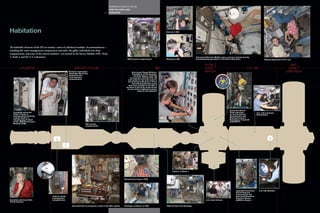
                                                             also serves as the MPLM docking port during Shuttle missions while the zenith port is a
                                                             backup port. In addition, Node 2 provides the vital functional resources for the operation
                                                             of the connected elements, namely the conversion and distribution of the electrical power,
                                                             heating, cooling resources from the ISS Integrated Truss, and support of the data and
                                                             video exchange with the ground and the rest of the ISS.
Permanent crew quarters were added to Node 2,
permitting expansion of the total ISS crew size to
6. Crew quarters are rack-sized containers built as
small state-rooms for the off-duty crewmember.
Each crew quarter contains lighting, Station Support
Computer (SSC) laptop connectivity, power, fans,
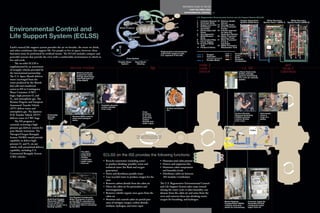
ventilation, and caution and warning.


    View looking into
    Node 2 from the PMA


                                                             Initially Node 2 was berthed on the starboard port of Node 1. The ISS’s remote manipulator moved Node
                                                             2 to the forward port of the U.S. Lab. PMA2 is berthed to the front port of Node 2.
Length                      6.7 m (22 ft)


Width (diameter)            4.3 m (14 ft)


Mass                        14,787 kg (32,599 lb)


Exterior                    Aluminum cylindrical
                            sections, 2 endcones


Number of racks             8


Launch date                 October 23, 2007
                                                             Clay Anderson, Naoko Yamazaki, Rick Mastracchio,     Node 2 after its installation during STS-120.
                            STS-120                          and Dorothy Metcalf-Lindenburger in Node 2
                            10A                              Harmony during STS-131/Expedition 23 Joint
                                                             Docked OPS.
REFERENCE GUIDE TO THE ISS
                                                                                                         HOW IT’S PUT TOGETHER
                                                                                                    53   NODE 3 TRANQUILITY


Node 3
Tranquility
ESA/Thales Alenia Space Italy (TAS-I)

                                                                                                         Node 3 hatch opening.
Node 3 was built in Europe by Thales Alenia Space Italy (TAS-I) under contract of the
European Space Agency. Node 3 is attached to the port side of Node 1, and the Cupola is
berthed on its nadir (Earth facing) port. The PMA-3 is attached to the Node 3 port. The
zenith port has been inhibited and modified to become the parking location of the ISS:
Special Purpose Dexterous Manipulator (SPDM). The forward and aft ports are available
for further ISS additions.
     Node 3 accommodates ISS air revitalization, oxygen generation, and water recovery
systems. It also accommodates the bathroom for the crew hygiene and exercising
equipment such as a treadmill and type of weight-lifting device.


STS-130 commander George Zamka is photo-
graphed in Node 3 during Expedition 22/STS-130
joint operations.


                                                      In the grasp of the Canadarm2, the
                                                      Pressurized Mating Adapter 3 (PMA-3) is
                                                      relocated from the Harmony node to the
                                                      open port on the end of the newly installed
                                                      Tranquility node.


                                                                                                         Length                  6.7 m (22 ft)


                                                                                                         Width (diameter)        4.3 m (14 ft)


                                                                                                         Mass                    17,992 kg (39,665 lb)


Crewmembers work to outfit Node 3 during         Expedition 22 commander Jeffrey Williams and            Exterior                Aluminum cylindrical
Expedition 22/STS-130 joint operations.          STS-130 mission specialist Kathryn Hire are pho-                                sections, 2 endcones
                                                 tographed in Node 3 during Expedition 22/STS-130
                                                 joint operations.
                                                                                                         Number of racks         8


                                                                                                         Launch dates            February 8, 2010
                                                                                                                                 STS-130
                                                                                                                                 20A
REFERENCE GUIDE TO THE ISS
                         HOW IT’S PUT TOGETHER
                                    JOINT AIRLOCK          54

Crewmember exits the airlock
extravehicular hatch.


                                                                     Joint Airlock
                                                                     Quest
                                                                     NASA/Boeing

                                                                     The Quest airlock provides the capability for extravehicular activity (EVA)
                                                                     using the U.S. Extravehicular Mobility Unit (EMU). The airlock consists of
                                                                     two compartments: the Equipment Lock, which provides the systems and
                                                                     volume for suit maintenance and refurbishment, and the Crew Lock, which
                                                                     provides the actual exit for performing EVAs. The Crew Lock                                  Avionics
                                                                                                                                                                  Rack
                                                                     design is based on the Space Shuttle’s airlock design.

                                                                                                                           Cabin Air
                                                                                                                           Vent
                                           Equip
                                                   men
            Power Supply                                 t Loc
                                                                 k                                                     Cabin Air
            Assembly (PSA)                                                                                             Rack
                                                                                        Crew
                                                                                               Loc k


 Battery Stowage
 Assembly (BSA)                                                              Battery Charging Assembly (BCA)

                                                                                         In-Flight Refill Unit (IRU)

                                                                                        Extravehicular Mobility Unit
                                                                                        (EMU) Water Recharge Bag
                                                                                                                                       Light
Don/Doff
Assembly


Common Berthing
Mechanism and
Node Hatch
                                                           Intravehicular
                                                           Hatch
                                                                                  EVA Hatch
  Nitrogen Tank
                                     Nitrogen Tank


Toolbox 2                                   Oxygen
                                            Tank
Toolbox 1
                                                                                                                              Astronaut Tim Kopra, next to two EMU
                                                                                                                              spacesuits, looks over a checklist in the Quest
                                                                                                                              airlock.

Oxygen                                     Oxygen
Tank                                       Tank
                   EVA Hatch


Length                   5.5 m (18 ft)


Width                    4.0 m (13.1 ft)


Mass                     9,923 kg (21,877 lb)


Launch                   July 12, 2001
date                     STS-104
                         7A                                          Space Shuttle mission STS-104 berths Quest               Crewmember entering the airlock
                                                                     to the starboard side of Node 1 in July 2001.            extravehicular hatch.
REFERENCE GUIDE TO THE ISS
                                                                                                     HOW IT’S PUT TOGETHER
                                                                                                55   CUPOLA


Cupola
ESA/Thales Alenia Italy (TAS-I)


The Cupola (named after the raised observation deck on a railroad caboose) is a small
module designed for the observation of operations outside the ISS such as robotic activities,
the approach of vehicles, and extravehicular activity (EVA). It was built in Europe by
Thales Alenia Space Italy (TAS-I) under contract of the European Space Agency. It
provides spectacular views of Earth and celestial objects. The Cupola has six side windows
         and a top window, all of which are equipped with shutters to protect them from
             contamination and collisions with orbital debris or micrometeorites. The
                Cupola is designed to house the robotic workstation that controls the
                 ISS’s remote manipulator arm. It can accommodate two crewmembers
                  simultaneously and is berthed to the Earth facing side of Node-3 using a           The Cupola in development.
                                         Common Berthing Mechanism (CBM).

                                                    Forged/Machined
                                                    Aluminum Dome


                                                                 Window Assembly
                                                                 (1 top and 6 side
                                                                 windows with
                                                                 fused silica and
                                                                 borosilicate glass
                                                                 panes, window
                                                                 heaters, and
                                                                 thermistors)


                                                                                                     Height                       1.5 m (4.7 ft)

                                                            Payload Data Grapple
                                                            Fixture (PDGF)                           Diameter                     3 m (9.8 ft)


                                                                                                     Mass                         1,880 kg (4,136 lb)


                                                                                                     Capacity                     2 crewmembers with
                                                                                                                                  portable workstation


Command and control workstation based on portable
computer system.
                                                                                                     Launch date                  February 8, 2010
                                                                                                                                  STS-130
                                                                                                                                  20A


                                                                                                     Crewmember George Zamka looking out through
Crewmember TJ Creamer with a view of Earth through the Cupola’s windows.                             the Cupola’s windows with shutters open.
REFERENCE GUIDE TO THE ISS
                           HOW IT’S PUT TOGETHER
         PERMANENT MULTIPURPOSE MODULE (PMM)          56


                                                           Permanent Multipurpose
                                                           Module (PMM)
                                                           NASA/ASI (Italian Space Agency)

                                                           Derived from the Leonardo Multi-Purpose Logistics Module (MPLM), the Italian-built
                                                           Permanent Multi-Purpose Module (PMM) is berthed to the nadir port of Node 1. It
                                                           can host up to 16 racks containing equipment, experiments, and supplies, and it has an
                                                           additional storage space for bags in the aft endcone.
                                                           Mounted in the Shuttle’s cargo bay for launch, the module will be transferred to the ISS
                                                           using the ISS’s robotic arm after the Shuttle has docked.
                                                                It will be then activated and integrated to the ISS, providing an additional stowage
                                                           place and a location to perform science and other activities.


The station’s robotic Canadarm2 grapples the
Leonardo Multi-Purpose Logistics Module (MPLM)
from the payload bay of the docked Space Shuttle
Discovery (STS-131) for relocation to a port on the
Harmony node of the ISS. Earth’s horizon and the           Astronaut Nicole Stott in Leonardo.
blackness of space provide the backdrop for the
scene. Canadian-built Dextre, also known as the
Special Purpose Dexterous Manipulator (SPDM), is
visible at bottom center.


                                                           Sandra Magnus works with stowage in the Leonardo
                                                           Multi-Purpose Logistics Module (MPLM) during
                                                           Expedition 18/STS-126 joint operations.


MPLM Raffaello berthed on Node 1.


Length                     6.67 m (21.7 ft)


Diameter
Exterior                   4.5 m (14.76 ft)
Interior                   4.21 m (13.81 ft)


Mass                       4,428 kg (9,784 lb)


Pressurized volume         76.7 m3 (2708.6 ft3)


Cargo capability           9,000 kg (20,000 lb)                            Permanent Multipurpose
                                                                           Module (PMM)

Pressurized habitable
                           31 m3 (1,095 ft3)
volume
REFERENCE GUIDE TO THE ISS
                                                                                                                        HOW IT’S PUT TOGETHER
                                                                                                               57       FUNCTIONAL CARGO BLOCK (FGB)


Functional Cargo Block (FGB)
Zarya (Sunrise)
NASA/Boeing/Khrunichev State Research and Production
Space Center

The FGB was the first launched element of the ISS, built in Russia under a U.S. contract.                               View of the FGB on orbit flanked by the Service
During the early stages of ISS assembly, the FGB was self-contained, providing power,                                   Module and PMA-1.

communications, and attitude control functions. Now, the FGB module is used primarily
for storage and propulsion. The FGB was based on the modules of Mir.

                         Micrometeorite
                         Protection


                                      Propellant      Primary
    Nadir Docking                     Tanks           Propulsion
    Port                                              System


                                                           Attitude Control                                             Russian cosmonaut Oleg Kotov moves a stowage
     Androgynous                                           Engines                                                      bag in the Zarya Functional Cargo Block (FGB).
     Peripheral
     Docking System
     and Forward Axial
     Docking Port                                                                                                   20
                                                       Thermal                                            2                            28       30
                                                                                                                             27
                                                       Control
                                                       Radiator                                                    16
                                                                                            25
                                                                                                      6                                                   16
                                                                                  22
           Kurs Rendezvous
           Antenna                                                                     11
                                                                24           12                                                                            31

1    Air Ducts                    Attitude Control
                                  Engines                               14                                                                                      30
2    Communications Panel                              26     13
3    Caution and Warning                                                                                                                                                 3
     Systems Panel                               15
4    Contaminant Filters                                                                                                                                             23
5    Contingency Transfer (Water)
     Container Bag
6    Contingency Transfer (Water)
     Container Connections                                                                                                                                          29
7    Dust Collectors
8    Electrical Outlet
9    Flex Airduct Container
10   Fuse
11   Fuse Panels (behind
     close-outs)                                                                                                                      20    1                                9
12   Gas Analyzer                                                                                                                                    18        23
13   Gas Mask
14   Handrail                                                                                                            8
                                                                                                                                  5
15   Hatch Protection
16   Instrument Containers                                                                           32       19        Length                             12,990 m (42.6 ft)
17   Docking Port to PMA                                                                         4
18   Laptop Outlets
19   Lighting Panel                                                                    10
                                                                         1                                              Maximum diameter                   4.1 m (13.5 ft)
20   Lights                       17
21   Nadir Docking Port                                        7
                                                      21
22   Onboard Documentation
23   Onboard Network Receptacle                                                                                         Mass                               24,968 kg (55,045 lb)
     Outlets
24   Pole and Hook
25   Portable Fans                                                                                                      Pressurized volume                 71.5 m3 (2,525 ft3)
26   Removable Fire Extinguisher
27   Power Outlet
28   Pressurized Valve Unit                                                                                             Solar array span                   24.4 m (80 ft)
29   Caution and Warning Panel
30   Smoke Detector
31   TV Outlet                                                                                                          Array surface area                 28 m2 (301 ft2)
32   Wipes/Filters

                                                                                                                        Power supply (avg.)                3 kW


                                                                                                                        Propellant mass                    3,800 kg (8,377 lb)


                                                                                                                        Launch date                        November 20, 1998
                                                                                                                                                           Proton rocket
                                      Russian cosmonaut Maxim Suraev using the communications                                                              1A/R
                                      system in the FGB.
REFERENCE GUIDE TO THE ISS
                              HOW IT’S PUT TOGETHER
                         DOCKING COMPARTMENT (DC)         58


                                                               Docking Compartment (DC)
                                                               Pirs (Pier)
                                                               Russian Federal Space Agency (Roscosmos)/S.P. Korolev
                                                               Rocket and Space Corporation Energia (RSC Energia)

                                                               Pirs serves as a docking port for the Russian Segment. Pirs also provides the capability for
View of the zenith end                                         extravehicular activity (EVA) using Russian Orlan spacesuits. Additionally, Pirs provides
of the DC, with probe
extended, as it prepares to                                    systems for servicing and refurbishing the Orlan spacesuits. The nadir Docking System
dock with the ISS in 2001.                                     on Pirs provides a port for the docking of Soyuz and Progress vehicles. When the final
                                                               Russian science module arrives, Pirs will be deorbited.
                                                                                                                                                     Attitude Control
                                                                                                                                                     and Wide-Beam
                                                                                                                                                     Antenna
                                                                                                      High-Gain
                                                                                                      Kurs Antenna

                              Docking
                              System                                                                                                                        EVA
                              Probe                                            Stela Manipulator
                                                                               Boom for Moving                                                              Hatch 2
                                                                               Crew and Cargo
    Zenith Docking
    System (male)
    and Hatch                                                             Wide-Beam
    Entrance to                                                           Antenna
    Service Module


       High-Gain                                                           Drain Valve
       Kurs Antenna                                                                                                                                        Cover Over
                                                                           Attitude Control                                                                Refueling
                                                                           Antenna                                                                         Hydraulic
                                                                                                                                                           Valves

                                                                            High-Gain
                                                                            Kurs Antenna

                                                                            EVA Hatch 2
                                                                                                        Nadir Docking
                                                                                                        System and Hatch
         EVA Hatch 1                                                                                    Port for Soyuz or              View of the nadir end of the DC.
                                                                              Movable Handrail
                                 Position of Crew While                                                 Progress
                                 Preparing for EVA


              Interior                                                        Pressure and Deposit
              Orlan                                                           Monitoring Unit
              Storage

                                                                                    Interior
                                                                                    Control Console


    Nadir Docking
    System and Hatch                                                                     Refueling
    Port for Soyuz or                                                                    Hydraulic Valves
    Progress


                                                                                                                     DC in preparation for launch.


Length                         4.9 m (16 ft)


Maximum diameter               2.55 m (8.4 ft)


Mass                           3,838 kg (8,461 lb)


Volume                         13 m3 (459 ft3)


Launch date                    September 15, 2001
                               Progress M
                               4R                              Cosmonaut Maxim Suraev poses with two Orlan
                                                               spacesuits inside Pirs.                               Pirs Module location at Service Module nadir.
REFERENCE GUIDE TO THE ISS
                                                                                                          HOW IT’S PUT TOGETHER
                                                                                                   59     MINI-RESEARCH MODULE 2 (MRM2)


Mini-Research Module 2 (MRM2)
Poisk (Explore)
Russian Federal Space Agency (Roscosmos)/S.P. Korolev
Rocket and Space Corporation Energia (RSC Energia)

Poisk, also known as the MRM2, is almost identical to the Pirs Docking Compartment.
Poisk provides the capability for extravehicular activity (EVA) using Russian Orlan spacesuits.
Additionally, Poisk provides systems for servicing and refurbishing the Orlan spacesuits.
The zenith docking system on Poisk provides a port for the docking of Soyuz and Progress
vehicles. Poisk will also provide extra space for scientific experiments, including power supply
outlets and data transmission interfaces for five external workstations. The module is also
equipped with three temporary internal workstations near the module’s side windows to
observe a local horizon plane and to accommodate payloads equipped with vacuum interfaces.


                                           Strela Cargo Boom


     EV Hatch                                             Refueling                                                                  Nadir Docking
                                                          Hydraulic Valves                                                           System and Hatch
                                                                                                                                     Port for Soyuz or
                                                                                                                                     Progress


                                                      Interior
                                                      Control Console

                                                                                                                                      Interior Orlan
                                                        Pressure and Deposit                                                          Storage
                                                        Monitoring Unit

                                                                                                        Position of Crew While
                                                                                                        Preparing for EVA
                                                          Movable Handrail
                                                                                                                                        EVA Hatch 1


                                                                 EVA Hatch 2

                                                                 High-Gain
          Science Hardware                                       Kurs Antenna

                                                                 Attitude Control
                                                                 Antenna

                                                                   Drain Valve                                                               High-Gain Kurs
                                                                                                                                             Antenna


                                                                    Wide-Beam
                                                                    Antenna                                                      Zenith Docking
                                                                                                                                 System (male) and
                                                                                                                                 Hatch Entrance to
                                                                                                                                 Service Module


                                                                                 Docking System
                                                                                 Probe                    Length                         4.9 m (16 ft)


                                                                                                          Maximum diameter               2.55 m (8.4 ft)


                                                                                                          Mass                           3,795 kg (8,367 lb)


                                                                                                          Volume                         14.8 m3 (523 ft3)


                                                                                                          Launch date                    November 10, 2009
                                                                                                                                         Progress M
                                                                                                                                         5R
REFERENCE GUIDE TO THE ISS
                            HOW IT’S PUT TOGETHER
                    MINI-RESEARCH MODULE 1 (MRM1)    60


                                                          Mini-Research Module 1 (MRM1)
                                                          Rassvet (Dawn)
                                                          Russian Federal Space Agency (Roscosmos)/S.P. Korolev
                                                          Rocket and Space Corporation Energia (RSC Energia)

View of Rassvet Mini-Research Module 1 (MRM1)             Rassvet, also known as the MRM1, is used for docking and cargo storage. It is also
taken during Expedition 23 / STS-132 Joint
Operations.                                               equipped with eight internal workstations so it can serve as a mini research laboratory. The
                                                          nadir docking system on Rassvet provides the fourth docking port on the Russian segment
                                                          for the docking of Soyuz and Progress vehicles. It was built from the pressurized hull of
                                                          the Science Power Platform (SPP) dynamic test article. Moreover, the exterior of Rassvet
                                                          carries a spare elbow joint for the European Robotic Arm (ERA)and outfitting equipment
                                                          for the Russian Multi-Purpose Laboratory Module (MLM), including a radiator, an
                                                          airlock for payloads, and a Portable Work Platform (PWP) that provide an external
                                                          worksite for ERA activation, checkout, and nominal operations.

                                                                                MLM Airlock
                                                          Portable Work         for payloads.
                                                          Platform (PWP)
                                                          provides EVA                                                                  MLM Radiator
MRM1 Flight Article is manufactured from the              worksite on MLM
pressurized compartment of the Science Power              for ERA activation,
Platform (SPP) Dynamic Test Article.                      checkout, and
                                                          nominal ops.


                                                                                                                                              Airlock,
                                                                                                                                              radiator,
                                                                                                                                              and PWP
                                                                                                                                              will be
                                                                                                                                              stored on
                                                                                                                                              MRM1 until
MRM1 Flight Article being assembled.                                                                                                          MLM docks.
                                                                                                                                              (Currently
                                                                                                                                              planned for
                                                                                                                                              2012.)


                                                                                                                      Spare Elbow unit for European
                                                                                                                      Robotic Arm (ERA) will stay stored
                                                                                                                      on MRM1 until it is needed, if ever;
                                                                                                                      ERA flight unit will launch on MLM.


 Length                      6.0 m (19.7 ft)


 Maximum diameter            2.35 m (7.7 ft)


 Mass                        5,075 kg (11,188 lb)


 Volume                      17.4 m3 (614 ft3)


 Launch date                 May 2010
                             STS-132
                             ULF4


 Attitude control            32 engines


 Orbital maneuvering         2 engines
REFERENCE GUIDE TO THE ISS
                                                                                                                 HOW IT’S PUT TOGETHER
                                                                                                           61    SERVICE MODULE (SM)

                                                                                                                     Cosmonaut Yury V.
                                                                                                                     Usachev in his crew

Service Module (SM)
                                                                                                                     compartment.


Zvezda (Star)
Russian Federal Space Agency (Roscosmos)/S.P. Korolev
Rocket and Space Corporation Energia (RSC Energia)

The Service Module was the first fully Russian contribution, providing early living
quarters, life-support system, electrical power distribution, data processing system, flight
control system, and propulsion system. Its communications system still enables remote
command capabilities from ground flight controllers. Although some of these systems
were subsequently supplemented by U.S. systems, the Service Module remains the                                               19                   1
                                                                                                                                  7        3
structural and functional center of the Russian segment of the ISS. The Service Module
                                                                                                                                                                27
was intended primarily to support crew habitation but became the first multipurpose                                                                                    29
research laboratory on the ISS.                                                                        26       20
                                                                                                                     6   5
                                                                                                       9
Attitude                                                                                     13
Control Engines
(6 clusters,                                                                                      18
32 engines,                                                                             16
14 kgf each)
                                             Zenith Docking Port                   17
                                             Forward FGB
                                             Docking Port                          12
                                             Kurs                             11
                                             Rendezvous
                                             Antenna
Luch                                                                     21                                                                                            10
Satellite
Antenna                                                             5

                                                            25
Kurs
Rendezvous                                                                                                                                                       23
Antenna
             Maneuvering
             Reboost Engines                        28
             (2,300 kgf each)
                                                                                                                                                 24

                                                                                                                     2
1    Airflow Vent
2    Body Mass Measurement Device
3    Camera                                                                                                22
4    Caution and Warning Panel, Clock, and
     Monitors
5    Communications Panel                                                                         15
6    Condensate Water Processor              8                                               4
7    Crew Sleep Compartment
8    Forward Docking Port (to FGB)                                       14
9    Fuses
10   Galley Table                                 20     Solid Fuel Oxygen Generators (SFOG)
11   Integrated Control Panel                     21     Toru Rendezvous Control Station
12   Lighting Control Panels                      22     Toru Seat
13   Maintenance Box                              23     Treadmill & Vibration Isolation System
14   Nadir Docking Port                           24     Vela Ergometer
15   Navigation Sighting Station                  25     Ventilation Screen
16   Night-Lights                                 26     Vozdukh Control Panel
17   Power Distribution Panel                     27     Waste Management Compartment
18   Recessed Cavity & Valve Panel                28     Zenith Docking Port                                     Length                        13.1 m (43 ft)
19   Smoke Detector                               29     Soyuz and Progress Docking Port

                                                                                                                 Diameter                      4.2 m (13.5 ft)


                                                                                                                 Wingspan                      29.7 m (97.5 ft)


                                                                                                                 Weight                        24,604 kg (54,242 lb)


                                                                                                                 Launch date                   July 12, 2000
                                                                                                                                               Proton
                                                                                                                                               1R


                                                                                                                 Attitude control              32 engines

The SM’s hull under construction at Khrunichev    Leroy Chiao exercises in the SM.
State Research and Production Space Center in                                                                    Orbital maneuvering           2 engines
Moscow.
REFERENCE GUIDE TO THE ISS
                        HOW IT’S PUT TOGETHER
          PRESSURIZED MATING ADAPTERS (PMAS)      62


                                                       Pressurized Mating
                                                       Adapters (PMAs)
                                                       NASA/Boeing

                                                       Three conical docking adapters, called Pressurized Mating Adapters, attach to the Nodes’
                                                       berthing mechanisms. The other sides of the adapters allow for docking with Russian
                                                       modules and the Space Shuttle. PMA-1 links the U.S. and Russian segments, while PMA-
                                                       2 and PMA-3 serve as the primary and backup docking ports for the Space Shuttle.
                                                            The PMA-1, 2, and 3 structures are identical and provide a pressurized interface
                                                       between the U.S. and Russian ISS modules and between the U.S. modules and the Space
                                                       Shuttle orbiter. The PMA structure is a truncated conical shell with a 28-inch axial offset
                                                       in the diameters between the end rings.


                                                                                                        PMA-1


                                                                          PMA-3


                                                                PMA-2


                                                        PMA-1 is being attached
                                                        to the Common Berthing
                                                        Mechanism of Node 1.


Astronaut Michael
Lopez-Alegria
participates in a
spacewalk during
STS-113. The Space
Shuttle Endeavour
is docked to the
Pressurized Mating
Adapter 2 (PMA-2).

Length                   1.86 m (6.1 ft)


Width                    1.9 m (6.25 ft) at
                         wide end, 1.37 m
                         (4.5 ft) at narrow end


Mass of
PMA-1                    1,589 kg (3,504 lb)
PMA-2                    1,376 kg (3,033 lb)
PMA-3                    1,183 kg (2,607 lb)


Launch date


PMAs 1 and 2             December 4, 1998
                         STS-88
                         ISS-2A


PMA-3                    October 11, 2000
                                                                                                                PMA structure shows
                         STS-92                                                                                 a series of offset
                                                        PMA-2 on the forward berthing ring of Node 1.
                         ISS-3A                                                                                 aluminum cylinders.
REFERENCE GUIDE TO THE ISS
                                                                               HOW IT’S SUPPORTED
                                                                          63


                                                                                         how it’s supported
The ISS program’s greatest accomplishment is as much a human
achievement as a technological one. The global partnership of space
agencies exemplifies meshing of cultural differences and political
intricacies to plan, coordinate, provide, and operate the complex
elements of the ISS. The program also brings together international
flight crews and globally distributed launch, operations, training,
engineering, communications networks, and scientific research
communities.
   Maintaining the ISS is a arduous task, requiring an international
fleet of vehicles and launch locations to rotate crewmembers; replenish
propellant; provide science experiments, necessary supplies, and
maintenance hardware; and remove and dispose of waste. All of these
important deliveries sustain a constant supply line crucial to the
operations of the ISS.
REFERENCE GUIDE TO THE ISS
                          HOW IT’S SUPPORTED
            ISS OPERATIONS AND MANAGEMENT          64


                                                          ISS Operations and
                                                          Management

                                                               CSA Headquarters
                                                               ISS Program Management
                                                               MSS Operation Complex
                                                               CSA Payload Telescience Science Operations Center (PTOC)
                                                               Saint-Hubert, Quebec, Canada


                                  Glenn Research Center
                                  Telescience Support Center
                                  Cleveland, Ohio, U.S.


                                                                                                  NASA Headquarters
                                                                                                  Washington, DC, U.S.


                                                                             Marshall Space Flight Center
Ames Research Center                                                         Payload Operations and Integration Center (POIC)
                                                                             Huntsville, Alabama, U.S.
Telescience Support Center
Moffett Field, California, U.S.

                                                                                 Kennedy Space Center
                                                                                 Shuttle Launch Control
                                                                                 Cape Canaveral, Florida, U.S.

                          Johnson Space Center
                          ISS Program Management
                          ISS Mission Control Center (MCC)
                          ISS Training
                          Houston, Texas, U.S.


                                                                                      Ariane Launch Control
                                                                                      Kourou, French Guiana
REFERENCE GUIDE TO THE ISS
                                                                                             HOW IT’S SUPPORTED
                                                                                        65   ISS OPERATIONS AND MANAGEMENT


                                 ESA European Space Research and
                                 Technology Centre (ESTEC)
                                 ISS Program Management
                                 Noordwijk, Netherlands

      ESA Headquarters
      Paris, France


                                              TsUP (Moscow Mission Control Center)
                                              Korolev, Russia


                                                           Gagarin Cosmonaut
                                                                                                       JAXA Tsukuba Space Center
                                                           Training Center (GCTC)
                                                           Star City, Russia                           ISS Program Management
                                                                                                       JEM Mission Control (JEMMC)
                                              Roscosmos Headquarters                                   HTV Control Center (HTVCC)
                                              ISS Program Management                                   Astronaut Training Facility (ATF)
                                              Moscow, Russia                                           Tsukuba, Japan


                      European Astronaut Centre
                      Microgravity User Support
                      Centre (MUSC)
                      Cologne, Germany
                                                                               Russian Launch Control
                                                                               Baikonur Cosmodrome,
                                                                               Baikonur, Kazakhstan


                                                                                    Tanegashima Space Center
                                                                                    H-II Launch Control
                                   Columbus Control Center (C OL-CC)                Tanegashima, Japan
                                   Oberpfaffenhofen, Germany


                                                                                                      JAXA Headquarters
ATV Control Center (ATV-CC)                                                                           Tokyo, Japan

Centre d’Aide au Développement des
activités en Micro-pesanteur et des
Opérations Spatiales (CADMOS)
Toulouse, France
REFERENCE GUIDE TO THE ISS
      HOW IT’S SUPPORTED
                  CANADA     66


                                  Canada
                                  Canadian Space Agency (CSA)
                                  Mobile Servicing System (MSS) Operations Complex (MOC)
                                  Located in Saint Hubert, Quebec, the MSS Operations Complex is composed of
                                  the following facilities:

                                  •   Space Operations Support Centre (SOSC)
                                  •   MSS Operations and Training System (MOTS)
                                  •   Virtual Operations Training Environment (VOTE)
                                  •   Canadian MSS Training Facility (CMTF)

                                  These facilities provide the resources, equipment and expertise for the engineering
                                  and monitoring of the MSS and provide crew training on Canadian systems.

                                  Payload Telescience Operations Centre (PTOC)
                                  The PTOC in Saint Hubert supports real time operations for Canadian Payloads
                                  onboard the ISS.

                                  Space Station Remote Manipulator System (SSRMS)
                                  Design and Development
                                  The SSRMS was designed and built for the CSA by MDA of Brampton, Ontario.

                                  http://www.asc-csa.gc.ca
REFERENCE GUIDE TO THE ISS
                                                                                            HOW IT’S SUPPORTED
                                                                                       67   EUROPE


Europe
European Space Agency (ESA)
European Space Research and Technology Centre (ESTEC)
The European Space Research and Technology Centre in Noordwijk, the Netherlands,
is the largest ESA establishment, a test center and hub for European space activities. It
has responsibility for the technical preparation and management of ESA space projects
and provides technical support to ESA’s ongoing satellite, space exploration, and
human space activities.

Columbus Control Centre (COL-CC) and Automated Transfer Vehicle
CONTROL Centre (ATV-CC)
Two ground control centers are responsible for controlling and operating the
European contribution to the ISS program. These are the Columbus Control Centre
and the Automated Transfer Vehicle Control Centre. The COL-CC, located at the
German Aerospace Center (DLR), in Oberpfaffenhofen, near Munich, Germany,
controls and operates the Columbus laboratory and coordinates the operation of
European experiments. The ATV-CC, located in Toulouse, France, on the premises of
the French Space Agency, CNES, operates the European ATV during the active and
docked mission phases of the ATV.

Guiana Space Centre (GSC)
Europe’s Spaceport is situated in the northeast of South America in French Guiana.
Initially created by CNES, it is jointly funded and used by both the French space
agency and ESA as the launch site for the Ariane 5 vehicle.

European Astronaut Centre (EAC)
The European Astronaut Centre of the European Space Agency is situated in Cologne,
Germany. It was established in 1990 and is the home base of the 13 European
astronauts who are members of the European Astronaut Corps.

User Centers
User Support and Operation Centers (USOCs) are based in national
centers distributed throughout Europe. These centers are responsible for
the use and implementation of European payloads aboard the ISS.

http://www.esa.int
REFERENCE GUIDE TO THE ISS
      HOW IT’S SUPPORTED
                    JAPAN    68


                                  Japan
                                  Japan Aerospace Exploration Agency (JAXA)
                                  In addition to the JAXA headquarters in Tokyo and other field centers throughout the
                                  country, Tsukuba Space Center and Tanegashima Launch Facility are JAXA’s primary
                                  ISS facilities.

                                  Tsukuba Space Center (TKSC)
                                  JAXA’s Tsukuba Space Center (TKSC), located in Tsukuba Science City, opened
                                  its doors in 1972. The TKSC is a consolidated operations facility with world-class
                                  equipment, testing facilities, and crew training capabilities. The Japanese Experiment
                                  Module (JEM) “Kibo” was developed and tested at TKSC for the ISS. The Kibo
                                  Control Center plays an important role in control and tracking of the JEM.

                                  Tanegashima Space Center (TNSC)
                                  The Tanegashima Space Center is the largest rocket-launch complex in Japan
                                  and is located in the south of Kagoshima Prefecture, along the southeast coast of
                                  Tanegashima. The Yoshinobu launch complex is on site for H-IIA and H-IIB launch
                                  vehicles. There are also related developmental facilities for test firings of liquid- and
                                  solid-fuel rocket engines.

                                  http://www.jaxa.jp/index_e.html
REFERENCE GUIDE TO THE ISS
                                                                                        HOW IT’S SUPPORTED
                                                                                   69   RUSSIA


Russia
Roscosmos, Russian Federal Space Agency
Roscosmos oversees all Russian human space flight activities.

Moscow Mission Control Center (TsUP)
Moscow Mission Control Center is the primary Russian facility for the control
of Russian human spaceflight activities and operates the ISS Russian segment.
It is located in Korolev, outside of Moscow, at the Central Institute of Machine
building (TsNIIMASH) of Roscosmos.

Gagarin Research and Test Cosmonaut Training Center (GCTC)
The Gagarin cosmonaut training center, at Zvezdny Gorodok (Star City), near
Moscow, provides full-size trainers and simulators of all Russian ISS modules, a
water pool used for spacewalk training, centrifuges to simulate g-forces during
liftoff, and a planetarium used for celestial navigation.

Baikonur Cosmodrome
The Baikonur Cosmodrome, in Kazakhstan, is the chief launch center for both
piloted and unpiloted space vehicles. It supports the Soyuz and Proton launch
vehicles and plays an essential role in the deployment and operation of the ISS.

http://www.roscosmos.ru
REFERENCE GUIDE TO THE ISS
      HOW IT’S SUPPORTED
UNITED STATES OF AMERICA     70


                                  United States of America
                                  National Aeronautics and Space Administration
                                  (NASA)
                                  NASA Headquarters (HQ)
                                  NASA Headquarters in Washington, DC, exercises management over the
                                  NASA Field Centers, establishes management policies, and analyzes all phases
                                  of the ISS program.

                                  Johnson Space Center (JSC)
                                  Johnson Space Center in Houston, TX, directs the ISS program. Mission
                                  control operates the U.S. On-orbit Segment (USOS) and manages activities
                                  across the ISS in close coordination with the international partner control
                                  centers. JSC is the primary center for spacecraft design, development, and
                                  mission integration. JSC is also the primary location for crew training.

                                  Kennedy Space Center (KSC)
                                  Kennedy Space Center in Cape Canaveral, FL, prepares the ISS modules and
                                  Space Shuttle orbiters for each mission, coordinates each countdown, and
                                  manages Space Shuttle launch and post-landing operations.

                                  Marshall Space Flight Center (MSFC)
                                  Marshall Space Flight Center’s Payload Operations and Integration Center
                                  (POIC) controls the operation of U.S. experiments and coordinates partner
                                  experiments aboard the ISS. MSFC oversaw development of most U.S.
                                  modules and the ISS ECLSS system.

                                  Telescience Support Centers (TSCs)
                                  Telescience Support Centers around the country are equipped to conduct sci-
                                  ence operations on board the ISS. These TSCs are located at Marshall Space
                                  Flight Center in Huntsville, AL; Ames Research Center (ARC) in Moffett
                                  Field, CA; Glenn Research Center (GRC) in Cleveland, OH; and Johnson
                                  Space Center in Houston, TX.

                                  http://www.nasa.gov
REFERENCE GUIDE TO THE ISS
                                                                                                            HOW IT’S SUPPORTED
                                                                                                    71


         Soyuz                    Proton                                 H-IIB                      Ariane                             Shuttle
                      Roscosmos                                          JAXA                         ESA                                NASA
                        Russia                                           Japan                       Europe                          United States

                                              Russia                               Japan            Europe                              U.S.

                             Soyuz SL-4                Proton SL-12                H-IIB           Ariane 5                        Space Shuttle


First launch to ISS               2000                      1998                   2009              2008                               1998


Launch site(s)                Baikonur                   Baikonur            Tanegashima           Guiana
                                                                                                                              Kennedy Space Center
                            Cosmodrome                 Cosmodrome            Space Center        Space Center

                                                                                                                                     18,600 kg
Launch performance             7,150 kg                  20,000 kg               16,500 kg        18,000 kg                         (41,000 lb)
payload capacity              (15,750 lb)                (44,000 lb)             (36,400 lb)      (39,700 lb)                 105,000 kg (230,000 lb),
                                                                                                                                    orbiter only

                                                                                                                                     18,600 kg
Return performance                                                                                                                  (41,000 lb)
payload capacity                  N/A                       N/A                     N/A               N/A
                                                                                                                              105,000 kg (230,000 lb),
                                                                                                                                    orbiter only

Number of stages            2 + 4 strap-ons            4 + 6 strap-ons      2 + 4 strap-ons     2 + 2 strap-ons                   1.5 + 2 strap-ons


                                                                                                                                      56.14 m
                                49.5 m                      57 m                   57 m              51 m                              (18.2 ft)
Length
                                (162 ft)                   (187 ft)               (187 ft)          (167 ft)                     37.24 m (122.17 ft),
                                                                                                                                     orbiter only


                             310,000 kg                  690,000 kg            531,000 kg          746,000 kg                       2,040,000 kg
Mass
                             (683,400 lb)              (1,521,200 lb)        (1,170,700 lb)      (1,644,600 lb)                     (4,497,400 lb)


                               6,000 kN                   9,000 kN             5,600 kN           11,400 kN                          34,677 kN
Launch thrust
                            (1,348,800 lbf)            (2,023,200 lbf)      (1,258,900 lbf)     (2,562,820 lbf)                    (7,795,700 lbf)


                                                    Service Module
                                Soyuz                 Functional                  H-II         Ariane Automated                    Shuttle Orbiter,
Payload examples               Progress            Cargo Block (FGB)        Transfer Vehicle    Transfer Vehicle             Nodes 1–3, U.S. Lab, JEM,
                                 Pirs              Multipurpose Lab              (HTV)               (ATV)                Truss elements, Airlock, SSRMS
                                                    Module (MLM)
REFERENCE GUIDE TO THE ISS
                                HOW IT’S SUPPORTED
                             TAURUS II AND CYGNUS         72


                                      Cygnus
                                      spacecraft.
                                                               Taurus II and Cygnus
                                                               Orbital Sciences Corporation


                                                               The Cygnus spacecraft is an automated logistical resupply vehicle design to rendezvous
                                                               with the ISS and then be grappled and berthed using the Space Station Remote
                                                               Manipulator System (SSRMS). The Cygnus offers the capability to carry ISS pressurized
                                                               cargo (logistics and utilization) within the Pressurized Cargo Module (PCM). The Cygnus
                                                               is launched aboard a new launch vehicle known as the Taurus II from the NASA Wallops
                                                               Flight Facility in Wallops Island, VA. The Cygnus can bring dry cargo, gas, water, and
                                                               payloads. After the cargo is transferred to the ISS, the Cygnus can be loaded with trash
                                                               and waste products. After departing the ISS, the Cygnus will be destroyed (incinerated)
                                                               upon reentry into Earth’s atmosphere.


 Taurus II                                                                                                                  PCM—Active Configuration
 launch vehicle.                                                                                                            with no cargo bags loaded.


Taurus II


Height                      40.1 m (131.56 ft)


Diameter                    3.9 m (12.80 ft)


Mass at launch              275,000 kg (606,271 lb)
                                                               Middeck Lockers
                                                               (active and passive)
First stage thrust          3.45 MN (775,000 lb)


Second stage thrust         320 kN (72,000 lb)


Cygnus


Height                      5.1 m (16.73 ft)


Diameter                    3.05 m (10 ft)
                                                                         PCM—Passive Configuration
                                                                         with cargo bags fully loaded.
Maximum Pressurized Cargo
Up mass/volume            2,000 kg (4,409 lb)
                          18.75 m3 (662 ft3)

Down mass/volume            2,000 kg (4,409 lb)
                            18.75 m3 Disposed (662 ft3)


Maximum Unpressurized
Cargo
Up mass/volume              0

Down mass/volume            0


Payload volume
Pressurized                 7.6 m3 (25 ft3)
                                                               Taurus II Castor 30 2nd Stage Motor.         Cygnus pressurized cargo module.
REFERENCE GUIDE TO THE ISS
                                                                                                   HOW IT’S SUPPORTED
                                                                                              73   FALCON 9 AND DRAGON


Falcon 9 and Dragon                                                                                                                    Dragon
                                                                                                                                       spacecraft.

SpaceX Exploration Technologies


The SpaceX missions are launched on a new launch vehicle called the Falcon 9 from
Kennedy Space Center in Cape Canaveral, FL. The first stage is powered by nine SpaceX
Merlin engines, and the second stage is also a single SpaceX Merlin engine. The spacecraft
that will visit the ISS is called the Dragon.
     The Dragon spacecraft is an automated logistical resupply vehicle designed to
rendezvous with the ISS and then be grappled and berthed to Node 2 using the Space
Station Remote Manipulator System (SSRMS).
                                                                                                      Falcon 9
     The Dragon has a capsule for delivering pressurized cargo and is the element that will           launch vehicle.
berth to Node 2. The Dragon also has what is called the “trunk,” which is attached to the
capsule and provides for the delivery of unpressurized cargo to the ISS. Once the mission
is complete, the Dragon will unberth from the ISS and the trunk will be jettisoned and
destroyed during reentry into the atmosphere. The capsule will contain pressurized return
cargo, survive reentry, and land in the ocean with the use of parachutes.
          Nosecone        Pressurized      Service                      Trunk
                          Section (PS)   Section (SS)


                                                                                                   Falcon 9


                                                                                                   Height                      48.1 m (157.80 ft)


                                                                                                   Diameter                    3.66 m (12 ft)


                                                                                                   Mass at launch              313,000 kg (690,047 lb)


                                                                                                   First stage thrust          3.80 MN (854,000 lb)


                                                                                                   Second stage thrust         414 kN (93,000 lb)


                                                                                                   Dragon


                                                                                                   Height                      5.1 m (16.73 ft)
                Capsule

                                           Dragon                                                  Diameter                    3.66 m (12 ft)


                                                                                                   Maximum Pressurized Cargo
                                                                                                   Up mass/volume            3,310 kg (7,297 lb)
                                                                                                                             6.8 m3 (240 ft3)

                                                                                                   Down mass/volume            2,500 kg (5,512 lb)
                                                                                                                               6.8 m3 (240 ft3)


                                                                                                   Maximum Unpressurized
                                                                                                   Cargo                       3,310 kg (7,297 lb)
                                                                                                   Up mass/volume              14 m3 (494 ft3)

                                                                                                   Down mass/volume            2,600 kg (5,732 lb)
                                                                                                                               14 m3 Disposed (494 ft3)


                                                                                                   Payload volume
                                                                                                   Pressurized                 10 m3 (245 ft3)

                                                                                                   Unpressurized               14 m3 (490 ft3)
REFERENCE GUIDE TO THE ISS
                                HOW IT’S SUPPORTED
                            SPACE SHUTTLE ORBITER           74


                                                                 Space Shuttle Orbiter/
                                                                 Columbia, Discovery,
                                                                 Atlantis, Endeavour
                                                                 NASA/Boeing
                                                                 The U.S. Space Shuttle provides Earth-to-orbit and return capabilities and in-orbit support.
                                                                 The diversity of its missions and customers is testimony to the adaptability of its design. The
                                                                 Space Shuttle was used to deliver most of the ISS modules and major components. It also pro-
                                                                 vided crew rotation capability and science and maintenance cargo delivery, and it is the only
                                                                 vehicle that provided the capability to return significant payloads.

                            Crew                                                                                   Maneuvering
                            Access Hatch         Payload                                                           Engines
                                                 Bay Door                           Orbital and
               Star                              Hinges                             Attitude Maneuvering
               Tracker                                                              System Pod


   Nose Cap


                                                                                                                                                            Aft Bulkhead


                                                                                                                                                            Body Flap

                           Air Data
                           Probe                                 External Tank
   Forward Reaction                                                                                                                                        Aileron/Elevon
                                            Main Landing         Umbilical Door
   Control Primary
   Engines                                  Gear Door                         Reinforced Carbon-
                                                                              Carbon Leading Edge

                                                                                                  Hydrazine and Nitrogen
Length                      37.2 m (122.2 ft)                                                     Tetroxide Tanks
                                                                 Rudder and                                                           Remote
                                                                 Speed Brake                                       Thermal Control
                                                                                                                   Radiators          Manipulator      Forward Attitude
Height                      17.3 m (56.7 ft)                                                                                                           Control Engines
                                                                 Main Engines
Wingspan                    23.8 m (78 ft)                       Orbital
                                                                 Maneuvering
                                                                 Engines
Typical mass                104,000 kg (230,000 lb)
                                                                 Aft Attitude
                                                                 Control Engines
Cargo capacity              16,000 kg (35,000 lb)
                            (typical launch and return           Body Flap                                                                                    Nose
                            to ISS)                                                                                                                           Landing
                                                                 Elevon                                                                           Flight      Gear
                                                                                                                                                  Deck
Pressurized habitable       74 m3 (2,625 ft3)                                                                              Main Landing
                                                                                                                           Gear                            Middeck
volume
                                                                                                                                          Fuel Cells

Mission length              7–16 days, typical


Number of crew              7, typical


Atmosphere                  oxygen-nitrogen


Cargo Bay


Length                      18.3 m (60 ft)

                                                                 The Shuttle approaches the          Shuttle berthed at the U.S. Lab, PMA 2.
Diameter                    4.6 m (15 ft)                        ISS carrying the Multi-Purpose
                                                                 Logistics Module (MPLM).
REFERENCE GUIDE TO THE ISS
                                                                                                             HOW IT’S SUPPORTED
                                                                                                        75   SOYUZ


Soyuz
Russian Federal Space Agency (Roscosmos)/S.P. Korolev                                                        Soyuz departs
Rocket and Space Corporation Energia (RSC Energia)                                                           the ISS.


Soyuz spacecraft have been in use since the mid-1960s and have been upgraded
periodically. Soyuz can support independently three suited crewmembers for up to 5.2
days and be docked to the ISS up to 200 days. The vehicle has an automatic docking
                                                                                                             VHF
system and may be piloted automatically or by a crewmember. The Soyuz TMA used for                           Radio
                                                                                                             Antenna
the ISS includes changes to accommodate larger and smaller crewmembers, an improved
                                                                                                                           Primary
landing system, and digital electronic controls and displays.                 Command                                      Propulsion System
                                                                                             Radio Antenna
                                                                         Solar Array
                                                                                                                                        Kurs Antenna

                                                                     Controls and Displays                                                   Booster
                                                                                                                                             Attachment
                                                                 Reentry Module Hatch                                                        Structure


                                                                                                                                             Attitude Control
                                                                                                                                             Engines


                                                  High-Gain           Stowage
                                                  Kurs                                                Crew      Environmental
Orbital Module                                    Antenna                                                       Control Electronics
                                                                                                Periscope


                                                                                                             Launch mass                 7,190 kg (15,851 lb)


  Descent                                                                                                    Descent module              2,900 kg (6,393 lb)
  Module

                                                                                                             Orbital module              1,300 kg (2,866 lb)


                                                                                                             Instrumentation/            2,600 kg (5,732 lb)
                                        Pressurized                                                          propulsion module
                                        Section
Instrumentation/
Propulsion                                                                                                   Delivered payload
Module                                                                                                       with two crewmembers        230 kg (507 lb)
                                                                                                             with three crewmembers      170 kg (375 lb)


                                                                                                             Returned payload            50 kg (110 lb)


                                                                                                             Length                      7 m (22.9 ft)
                                                           Shannon Walker and Fyodor Yurchikhin, wearing
                                                           Russian Sokol launch and entry suits in Soyuz
                                                           TMA-19.                                           Maximum diameter            2.7 m (8.9 ft)
Mission Sequence
                                                             Launch and Aborts                               Diameter of habitable       2.2 m (7.2 ft)
                   4                                          1 Launch                                       modules
                                                             1A Abort using escape rocket

                                                              2 Escape rocket jettison, nose shroud
      3                5
                           6   7                                separation (160 seconds in full)             Solar array span            10.6 m (34.8 ft)
                                   7A                         3 Staging (186 seconds)
                                         8
                 3A                                          3A Abort by separation of Soyuz

                                              9               4 Orbital velocity (526 seconds)               Volume of orbital module    6.5 m3 (229.5 ft3)
  2

                                                             Return
          1A                                          10      5 Soyuz retrofire, orbital module              Volume of descent           4 m3 (141.3 ft3)
                                                                separation, reentry module separation        module
                                                              6 Pilot parachute deploys
          1                                                   7 Drogue parachute deploys

                                                             7A Main parachute reefed
                                                                                                             Descent g-loads             4–5 g
                                                              8 Main parachute fully deployed

                                                              9 Reentry heatshield jettison

                                                             10 Landing, retro rocket firing
                                                                                                             Final landing speed         2 m/s (6.6 ft/s)
REFERENCE GUIDE TO THE ISS
                                 HOW IT’S SUPPORTED
                                                 PROGRESS        76

Progress
approaches ISS.


                                                                      Progress
                                                                      Russian Federal Space Agency (Roscosmos)/S.P. Korolev
                                                                      Rocket and Space Corporation Energia (RSC Energia)


                                                                      Progress is a resupply vehicle used for dry cargo, propellant, water, and gas deliveries to
                                                                      the ISS. Once docked to the ISS, Progress engines can boost the ISS to higher altitudes
                                                                      and control the orientation of the ISS in space. Typically, four to six Progress vehicles
                                                                      bring supplies to the ISS each year. Progress is based upon the Soyuz design, and it can
                                                                      either work autonomously or can be flown remotely by crewmembers aboard the ISS.
                                                                      After a Progress vehicle is filled with trash from the ISS, and after undocking and deorbit,
                                                                      it is incinerated in Earth’s atmosphere at the end of its mission. During its autonomous
                                                                      flight (up to 30 days), Progress can serve as a remote free-flying research laboratory for
                                               Primary                conducting space experiments.
                                               Propulsion
                                               System              Stepped Scan
                                                                   Array Antenna
                   Solar Array
                                                                                                              VHF Radio
                                                                                                              Antenna


                                                                                                                       Kurs
                                                                                                                       Antenna
                         Command
                         Radio Antenna
                                                                                                                  Booster
               Kurs                                                                                               Attachment
               Antenna                                                                                            Structure             Progress cargo module interior.

                                                                                                                  Attitude
                                                                                                                  Control
Probe and Drogue                                                                                                  Engines
Docking System


                                                                                            Pressurized
                                                                                            Instrumentation
                                                                                            Section
                                                                      Fluids Storage
                                                                      Tanks
                                                                           g
                                                                      li n
                                                                    ue e
                                                                  ef d u l
                                                                 R o
                                                                  M
                                                           o
                                                         rg e
                                                      Ca d u l
                                                        o
                                                      M
Length                        7.4 m (24.3 ft)


Maximum diameter              2.7 m (8.9 ft)

                                                                                          Progress prior to reentry.                    Progress prelaunch processing.
Span with solar arrays        10.7 m (35.1 ft)


Launch mass                   7,440 kg (16,402 lb)                         Cargo Load

                                                                                                 Maximum         Typical*
Cargo upload capacity         2,250 kg (4,960 lb)
                                                                               Dry cargo         1,800 kg        1,070 kg
                                                                               such as bags      (3,968 lb)      (2,360 lb)
Pressurized habitable
                              7.0 m3 (247.2 ft3)                               Water             420 kg          300 kg
volume
                                                                                                 (925 lb)        (660 lb)

                                                                               Air               50 kg           47 kg
Engine thrust                 2,942 N (661 lbf)                                                  (110 lb)        (103 lb)

                                                                               Refueling         1,700 kg        870 kg
Orbital life                  6 mo                                             propellant        (3,748 lb)      (1,918 lb)

                                                                               Reboost           250 kg          250 kg
Dry cargo max                 1,700 kg (3,748 lb)                              propellant        (550 lb)        (550 lb)

                                                                               Waste             2,140 kg        2,000 kg        * Measurements are
Refueling propellant          870 kg (1,918 lb)                                                  (4,718 lb)      (4,409 lb)        from the 21 P flight.
                                                                               capacity
REFERENCE GUIDE TO THE ISS
                                                                                                                              HOW IT’S SUPPORTED
                                                                                                                         77   JAXA H-II TRANSFER VEHICLE (HTV)


JAXA H-II Transfer Vehicle (HTV)
Japan Aerospace Exploration Agency (JAXA)/
Mitsubishi Heavy Industries, Ltd.


The H-II Transfer Vehicle is an autonomous logistical resupply vehicle designed to berth
to the ISS using the Space Station Remote Manipulation System (SSRMS). HTV offers                                             The HTV awaits grappling by the SSRMS.
the capability to carry logistics materials in both its internal pressurized carrier and in
an unpressurized carrier for exterior placement. It is launched on the H-II unmanned
                    launch vehicle and can carry dry cargo, gas and water, and propellant.
                         After fresh cargo is unloaded at the ISS, the HTV is loaded with
                                trash and waste products; after unberthing and deorbit, it is
                                      incinerated during reentry.


                                                                                                                       io n
                                                                                                                  puls
                                                                                                               Pro odule
                                                                                                                 M
                                                                                                         ule
                                                                                                   Mod
                                                                                          n ic s
                                                                                     Avio                                                                         Interior view of
                                                                                er                                                                                HTV pressurized
                                                                         arri                                                                                     carrier.
                                                                     ed C
                                                               u r iz
                                                      r es s
                                                Unp

                                           er
                                    arri
                            ize   dC
                    s   sur
                Pre


                                                                                                                                   Propellant
                                                                                                                                   Tanks


                                                                                                    Avionics

                                                                                                           Lithium Ion
                                                                         Exposed                           Batteries
Hatch and                                                                Pallet
Berthing Ring                                                            Payload
(to ISS Node)                                                                         Exposed
                                                                                      Pallet

                                                 International                                                                Length                  9.2 m (30 ft)
         Forward Attitude                        Standard Payload
         Control Engines                         Racks (ISPRs)
                                                                                                                              Maximum diameter        4.4 m (14.4 ft)


                                                                                                                              Launch mass             16,500 kg (36,375 lb)


                                                                                                                              Cargo upload
                                                                                                                                                      5,500 kg (12,125 lb)
                                                                                                                              capacity


                                                                                                                              Pressurized habitable
                                                                                                                                                      14 m3 (495 ft3)
                                                                                                                              volume


                                                                                                                              Unpressurized
                                                                                                                                                      16 m3 (565 ft3)
                                                                                                                              volume


Canadarm2 unberths the HTV in preparation                  A close-up view of the HTV.                                        Orbital life            6 mo
for its release from the ISS.
REFERENCE GUIDE TO THE ISS
                               HOW IT’S SUPPORTED
                AUTOMATED TRANSFER VEHICLE (ATV)      78


                                                           Automated Transfer Vehicle (ATV)
                                                           European Space Agency (ESA)/European Aeronautic
                                                           Defence and Space Co. (EADS)


                                                           The European Space Agency Automated Transfer Vehicle is an autonomous logistical resup-
ATV late cargo access in Kourou, French Guiana,            ply vehicle designed to dock to the ISS and provide the crew with dry cargo, atmospheric
before launch.
                                                           gas, water, and propellant. After the cargo is unloaded, the ATV is reloaded with trash and
                                                           waste products, undocks, and is incinerated during reentry.


                                                                                            S pa      A
                                                                                                   c ec T V
                                                                                                       raf t
                                                            Attitude Control                                 B   us
                                                            Engines (20)                                                           In
                                                                                                                                 Car tegrat
                                                                                                                                    go      ed
                                                                                                                                  bas Carri
                                                                                                                                MP e d o er
                                                                                                                                  LM
                                                           Primary                                                                    d es n
                                                           Maneuvering                                                                    ig n
                                                           Engines (4)
                                                                                                                                                         IS
                                                                                                                                                      S er S
Image of ATV-1 as                                                                                                                                     Modvice
it approached the                                                                                                                                         ule
ISS in April 2008.


                            Titanium Tanks
                            for carrying water,
                            propellant, and oxygen.


Length                      10.3 m (33.8 ft)


Maximum diameter            4.5 m (14.8 ft)
                                                                                                                      Cargo
                                                                                        Environmental                 Compartment
Span across solar arrays    22.3 m (73.2 ft)                                            Control System
                                                                                                                                         ISPRs (8)
Launch mass                 20,750 kg (45,746 lb)           Solar
                                                            Array
Cargo upload capacity       7,667 kg (16,903 lb)


Engine thrust               1,960 N (441 lbf)
                                                                               ATV
                                                                               Spacecraft
                                                                               Bus
Orbital life                6 mo
                                                       Integrated
                                                       Cargo Carrier
Cargo Load


Dry cargo such as bags      5,500 kg (12,125 lb)
                                                                                                    Russian-built
                                                                                                    probe and
Water                       840 kg (1,852 lb)                                                       drogue docking
                                                                                                    system.

Air (O2, N2)                100 kg (220 lb)


Refueling propellant        860 kg (1,896 lb)


Reboost propellant          4,700 kg (10,360 lb)           Probe and Drogue
                                                           Docking System

Waste capacity              6,500 kg (14,330 lb)
                                                                                                                        The ATV during manufacture.
REFERENCE GUIDE TO THE ISS
                                                                         HOW THE CREW LIVES
                                                                    79


The ISS has had a continuous human presence since November 2,
2000. In 2009, the number of astronauts living on board the space
                                                                                   how the crew lives
station increased from three to six.
   The flight systems provide a safe, comfortable, and livable
environment in which crewmembers can perform scientific research.
These flight systems include habitation accommodations,
environmental controls, medical and health support, and computing
and data management.
REFERENCE GUIDE TO THE ISS
      HOW THE CREW LIVES
                             80
REFERENCE GUIDE TO THE ISS
                                                                                                     HOW THE CREW LIVES
                                                                                                81   HABITATION


Habitation                                                                                                                                                  Haircut in SM.


The habitable elements of the ISS are mainly a series of cylindrical modules. Accommodations—
including the waste management compartment and toilet, the galley, individual crew sleep
compartments, and some of the exercise facilities—are located in the Service Module (SM), Node
2, Node 3, and the U.S. Laboratory.                                                                                                                                                     Astronaut Shannon Walker uses a vacuum cleaner during
                                                                                                                       SM forward compartment.              Shaving in SM.              housekeeping operations in the Kibo laboratory.                    Playing keyboard in U.S. Lab.


                                                                                                                                                                                                node 3                                                                               jem
          progress                                             service module                                                                         fgb                                       node 1                                    u.s. lab                                 node 2
                                                          Russian cosmonaut
                                                          Alexander Skvortsov
                                                                                                                            Astronauts Peggy Whitson,                                           airlock                                                                           columbus
                                                                                                                             Expedition 16 commander,
                                                          pictured in his                                                     and Pam Melroy, STS-120
                                                          crew quarters                                                   commander, add the STS-120
                                                          compartment.                                                  crew patch in the Unity node to
                                                                                                                        the growing collection of those
                                                                                                                            representing Shuttle crews
                                                                                                                         who have worked on the ISS. A
                                                                                                                      location in the Unity node serves
                                                                                                                       as one of the traditional posting
                                                                                                                                   sites for the patches.


                                                                                                                                                                                                                         Astronaut Nicole
   Canadian astronaut                                                                                                                                                                                                    Stott exercises            U.S. Lab Computer
   Robert Thirsk is                                                                                                                                                                                                      on the Combined            Workstation.
   photographed wearing                                                                                                                                                                                                  Operational Load
   a sleep mask in a                                                                                                                                                                                                     Bearing External
   sleeping bag located                                                                                                                                                                                                  Resistance Treadmill
   in the JEM Pressurized                                                                                                                                                                                                (COLBERT).
   Module (JPM).                                                           SM transfer
                                                                           compartment.


                                                                                                                                                                  Interior of Node 1.


                                                                                                                    Stowed food trays in FGB.


                                                                                                                                                                                                                               Japanese astronaut     U.S. Lab Window.
                                                                                                                                                                                                                               Soichi Noguchi
                                                                                                                                                                                                                               exercising on the
                                        Toilet in waste                                                                                                                                                                        Advanced Resistive
                                        management                                                                                                                                                                             Exercise Device
Canadian astronaut Bob                  compartment.                                                                                                                                              U.S./Joint Airlock.          (ARED) in Node 1.
Thirsk shaving.

                                                             Astronaut Ed Liu prepares a meal in the SM’s galley.   Stowage container in FGB.               FGB Corridor and Stowage.
REFERENCE GUIDE TO THE ISS
                                                                                                                                                                                                      HOW THE CREW LIVES
                                                                                                                                             Temp.
                                                                                                                                             Humid &                        Ai                   ENVIRONMENTAL CONTROL        82
                                                                                                                                             Controit y   A i r Re               r
                                                                                                                                                                                        CO2
                                                                                                                                                    l                turn
                                                                                                                                                                                                             U.S. Regenerative Environmental Control and Life Support System (ECLSS)
                                                                                                                                                                     CO2
                                                                                                                                                                     Removal                                 1  Catalytic Reactor    12 Reactor Health       Oxygen Generation             Water Recovery          Water Recovery
                                                                                                                      Waste        Cabin Air      Cabin Return                                                                                               System (OGS) Rack          System Rack 1 (WRS-1)   System Rack 2 (WRS-2)
                                                                                                                      Mgmt.                                             Tr ace mina nt                       2  Deionizer Beds          Sensor
                                                                                                                                                                        Cont aol                             3  Digital Controller   13 Storage Tanks

Environmental Control and
                                                                                                                                                                            nt r                             4  Distillation         14 Urine Processor
                                                                                                              Waste Products                                       Air Cobassembly                              Assembly                Pumps
                                                                                                                                                                                                                                                                        2                       8                  14
                                                                                                                                                                        Su                                                                                   15
                                                                                                                                                                                                             5 Electrolysis Cell     15 Volume reserved
                                                                                                                      Urine              e                             O2                                       Stack                   for later CO2                                                              14
                                                                                                                                  Urin

Life Support System (ECLSS)
                                                                                                                      Recover y                                                                                                                                                                 12


                                                                                                           Con
                                                                                                                                                                                  en                         6 Gas Separator            Reduction System                                             6                       17
                                                                                                                                                             O2 /N         O x yg r a t i o n
                                                                                                                                                                                 e                           7 Multifiltration       16 Water Processor
                                                                                                                                                                                                                                                                                11
                                                                                                                 ns                                                        Gen                                                                                                                                          13


                                                                                                             de
                                                                                                                              Processed                      Cont2 lro                                          Beds                    Delivery Pump
                                                                                                                 at           Urine                                                                                                                                                                      1
                                                                                                                    e                                    N2                                                  8 Particulate Filter    17 Water Processor
                                                                                                                                       le                                 ter                                                                                                                                                18
                                                                                                               ater           Po t a b                                 Wa                                    9 Power Supply             Pump &                                                  3
                                                                                                          ct W                       r                       Pr o duct                                       10 Product Water           Separator                           3
                                                                                                       od
                                                                                                         u                    Wate ssing
                                                                                                                              Pr o ce                                                                           Tank                 18 Water Processor
Earth’s natural life-support system provides the air we breathe, the water we drink,


                                                                                                  Pr
                                                                                                                                                                                                             11 Pumps & Valves          Wastewater Tank                                                            4
and other conditions that support life. For people to live in space, however, these                                                                                                                                                                               9                                                          7


                                                                                                                          er
                                                                                                                                                                                                                                                                            5              16
                                                                                                                                                     Regenerative environmental


                                                                                                                         at
                                                                                                                w                                                                                                                                                                                    10
functions must be performed by artificial means. The ECLSS includes compact and                             ste                                      control life support in the                                                                 =    Process Water
                                                                                                         Wa                                          U.S. segment of the ISS.                                     =    Oxygen                    =    Urine
powerful systems that provide the crew with a comfortable environment in which to                                                                                                                                 =    Hydrogen                  =    Brine
                                                                                                                Crew System                                                                                            (vented overboard)        =    Humidity
live and work.                                                                                                                                                                                                    =    Potable Water                  Condensate
                                                                                                      Potable Water     Hand Wash/
     The on-orbit ECLSS is
supplemented by an assortment
                                                                                                         System           Shaving
                                                                                                                                                                                                                 node 3                                                                                         jem
of resupply vehicles provided by
                                                         service module                                                                   fgb                                                                    node 1                                       u.s. lab                                        node 2
the international partnership.                                  Elektron produces                                                                                                                                airlock                                   Lithium Hydroxide
                                                                                                                                                                                                                                                           (LiOH) cartridge
                                                                                                                                                                                                                                                                                                             columbus
                                                                oxygen from water
The U.S. Space Shuttle delivers                                 through electrolysis;                                                                                                                                                                      used for eliminating
                                                                vents hydrogen out                                                                                                                                                                         CO 2 from air, backup
water (scavenged from the                                       of the station.                                                                                                                                                                            system.
water produced by the Shuttle
fuel cells and transferred
across to ISS in Contingency
Water Container (CWC)
bags), high-pressure O2 and
N2, and atmospheric gas. The
Russian Progress and European
Automated Transfer Vehicle                                                            Vozdukh absorbs
                                                                                      carbon dioxide
(ATV) deliver water and                                                               from crew.                                                            Airflow ventilation
                                                                                                                                                            fan.
atmospheric gas. The Japanese                                                                                                   Crew
                                                                                                                                breathes                                                                                                              Carbon Dioxide                 Astronauts
H-II Transfer Vehicle (HTV)         Freshwater                                                                                  in air and                                                                                                            Removal Assembly               share a
                                    Storage                 Russian EDVs used to                                                                                                                                                                      (CDRA) adsorbs                 meal at a
delivers water in CWC bags.         Tanks.                  store and transport                                                 generates
                                                                                                                                                                                                                                                      carbon dioxide                 galley.
                                                            water.                                                              carbon
     The ISS program is                                                                                                         dioxide and                                                                                                           from crew.
                                                                                                                                water vapor.
currently reviewing a high-
pressure gas delivery system for
post-Shuttle retirement. The
Nitrogen/Oxygen Resupply
                                                                                                                         Fans and filters circulate air
System (NORS) would provide                                                                                              and filter out contaminants.
capability to deliver high-
pressure O2 and N2 on any
vehicle with pressurized delivery
capability, including U.S.
                                                                      The SKV,
Commercial Resupply System
(CRS) vehicles.
                                                                      equivalent
                                                                      to the U.S.       ECLSS on the ISS provides the following functions:
                                                                      CCAAs,
                                                                      condenses
                                                                      water vapor          • Recycles wastewater (including urine)                                     • Maintains total cabin pressure
                                                                      from air.              to produce drinking (potable) water and                                   • Detects and suppresses fire
                                                                                             technical water (for flush and oxygen                                     • Maintains cabin temperature
                                                                                             generation)                                                                 and humidity levels
                                                                                           • Stores and distributes potable water                                      • Distributes cabin air between
                                                                                           • Uses recycled water to produce oxygen for the                                ISS modules (ventilation)
                                                                                             crew
                                                                                           • Removes carbon dioxide from the cabin air                                 The U.S. Regenerative Environmental Control
                                                                                           • Filters the cabin air for particulates and                                and Life Support System takes steps toward
                                                                                             microorganisms                                                            closing the water cycle; it takes humidity con-
                                                                                           • Removes volatile organic trace gases from the                             densate from the cabin air and urine from the
                                                          The Russian Condensate
                                                                                             cabin air                                                                 crew and converts these into drinking water,
                                    Solid Fuel Oxygen     Water Processor is known         • Monitors and controls cabin air partial pres-                             oxygen for breathing, and hydrogen.
                                    Generator (SFOG),     as the SRV-K, equivalent to                                                                                                                                                       Waste Hygiene             Common Cabin Air
                                    burns candles to      the US WPA, processes the          sures of nitrogen, oxygen, carbon dioxide,                                                                                                     Compartment (WHC)         Assembly (CCAA)
                                    produce oxygen as a   condensate that is reclaimed                                                                                                                                                      collects urine and        condenses water
                                    backup system.        by the SKV.                        methane, hydrogen, and water vapor                                                                                                             waste for processing.     vapor from air.
REFERENCE GUIDE TO THE ISS
                                                                                                  HOW THE CREW LIVES
                                                                                            83    CREW HEALTH CARE SYSTEM


Crew Health Care System
(CHeCS)/Integrated Medical
System
The Crew Health Care System (CHeCS)/Integrated Medical System is a suite of                                                                                                                                                                                                           Defibrillator.

hardware on the ISS that provides the medical and environmental capabilities necessary
                                                                                                                                                                                                    Cosmonaut Roman Romanenko and and Astronaut Michael Barratt perform
to ensure the health and safety of crewmembers during long-duration missions. CHeCS              A Microbial Air Sampler (MAS) floats in front of          Astronaut Leland Melvin exercises
                                                                                                                                                                                                    a detailed checkout and inspection of the HMS CMRS (Health Maintenance
                                                                                                 Japanese astronaut Koichi Wakata as he performs a         on the Advanced Resistive Exercise
is divided into three subsystems:                                                                Surface Sample Kit (SSK) collection and incubation.       Device (ARED).                           System/Crew Medical Restraint System) in the U.S. Lab. The boardlike CMRS
                                                                                                                                                                                                    allows strapping down a patient on the board with a harness for medical
                                                                                                                                                                                                    attention by the CMO who is also provided with restraints around the device.
Countermeasures System
(CMS)—The CMS provides
                                                                                                                                                                                                 node 3                                                                               jem
the equipment and protocols
                                                             service module                                                                      fgb                                             node 1                                       u.s. lab                              node 2
for the performance of daily
                                                                                                                                                                                                 airlock                                                                           columbus
and alternative regimens
(e.g., exercise) to mitigate the
deconditioning effects of living
in a microgravity environment.
The CMS also monitors
crewmembers during exercise
regimens, reduces vibrations
during the performance of these                                                                                                                                                                                                                           Astronaut Nicole
                                                                                                                                                                                                                                                          Stott conducts
regimens, and makes periodic                                                                                                                                                                                                                              a water quality
fitness evaluations possible.                  Japanese    Belgian astronaut Frank                         Microbial air sampler.                                   EHS TOCA                                                                              analysis using
                                               astronaut   DeWinne takes water                                                                                      (Environmental                                                                        the Colorimetric
                                               Koichi      samples for ground                                                                                       Health Systems/                                                  Astronaut            Water Quality
                                                           analysis of contamination.                                               Astronaut Shannon               Total Organic                                                    Mike Fincke          Monitoring Kit
Environmental Health                           Wakata
                                               on the                                                                               Walker exercises                Carbon                                                           uses Cycle           (CWQMK).
                                                                                                                                    on the Combined                 Analyzer).                                                       Ergometer
System (EHS)—The EHS                           Treadmill
                                                                                                                                    Operational Load                                                                                 with Vibration
                                               Vibration
monitors the atmosphere for                    Isolation                                                                            Bearing External                                                                                 Isolation
                                               System                                   Potable water                               Resistance Treadmill                                                                             System
gaseous contaminants (i.e.,                    (TVIS).                                  sampler.                                    (COLBERT).                                                                                       (CEVIS).
from nonmetallic materials
off-gassing, combustion
products, and propellants),
microbial contaminants (i.e.,
from crewmembers and station
activities), water quality,
acoustics, and radiation levels.

Health Maintenance
System (HMS)—The HMS
provides in-flight life support
and resuscitation, medical
care, and health monitoring                                                     Radiation Area
                                                                                Monitor (RAM)                                                                    SSK sample
capabilities.                                                                   (Dosimeter).                                                                     in the Waste
                                                                                                                                                                      Hygiene
                                                                                                                 Acoustic Dosimeter.                            Compartment
                                                                                                                                                                       (WHC).


                                                                                                                                                                    Close-up
                                                                                                                                                                     view of a
                                                                                                                                                                      Surface
                                                                                                                                                                   Sample Kit
                                                                                                                                                                (SSK) surface
                                                                                                                                                                        slide.
                                       Astronaut Bill Shepherd    The Tissue Equiavlent                          Canadian astronaut     Acoustics
                                                                                                                 Bob Thirsk with the                                                        Canadian astronaut
                                       exercises on the Velo      Proportional Counter (TEPC)                                           measurement                                         Robert Thirsk uses the
S0, Extravehicular Charged Particle    Ergometer Bike.            measures radiation dose and                    Sound Level Meter      kit.
                                                                                                                 (SLM).                                                                     Surface Sample Kit (SSK)
Directional Spectrometer (EVCPDS).                                dose equivalents.                                                                                                         to collect and incubate                           Crew Health Care
                                                                                                                                                                                            microbiology samples.                             System (CHeCS) Rack.
REFERENCE GUIDE TO THE ISS
                                                                                                                                                                           HOW THE CREW LIVES
                                                                                                                                                              COMPUTERS AND DATA MANAGEMENT 84


Computers and Data
Management
                                                                                             Data bus architecture consists of:
                                                                                             • 100+ MIL-STD-          • 190 payload
                                                                                                1553B data buses          remote terminals
                                                                                             • 60+ computers          • 600+ international                                                                                                    Multiplexer/Demultiplexer
The system for storing and transferring information essential to operating the ISS              into which                partner and                           Maneuvering Truss Segments into                                               Mass Memory Unit (MMU)
                                                                                                software can              firmware                                                                                                            Processor Data Cards in
has been functioning since the first module was placed on orbit. From a single                  be loaded as              controller devices
                                                                                                                                                                Place at SSRMS Workstation.
                                                                                                                                                                                                                                              U.S. Lab.
module to a large complex of elements from many international partners, the                     necessary             • 90+ unique types
                                                                                             • 1,200+ remote              of remote devices                                                        SSRMS Control and Robotics Workstations.
system provides control of the ISS from the U.S., Russian, Canadian, European,                  terminals
and Japanese segments.
                                                                                                                                                                                    node 3                                                          jem
     progress                                           service module                                                                   fgb                                        node 1                 u.s. lab                               node 2
                                                                                                                                                                                    airlock                                                      columbus


      Laptop (in SM crew
      quarters).
                                          Primary Command Workstation in SM.                                  Crew uses Progress Remote Control workstation                                           Multiplexer/Demultiplexer
                                                                                                              in SM.                                                                                  (computer).


                                                                                                                                                                             Multiplexer/
                                                                                                                                                                             Demultiplexers
                                                                                                                                                                             (mounted externally
                                                                                                                                                                             on the truss).


             Laptop and TVIS Control                                           TORU Remote Progress
             (located near galley).                                            Docking Workstation.


                                                                                                                                                                                                          Human Research Facility
                                              Russian Segment Workstations.                                                                                                                               Workstation.
REFERENCE GUIDE TO THE ISS
                                                                              HOW IT WORKS
                                                                         85


The operations of the ISS are based on a core functional infrastructure.
The Integrated Truss Assembly is the backbone of the ISS, providing
power, thermal controls, navigation, propulsion, and communications.
                                                                                           how it works
Each capability is vital to providing the crew with a safe, practical, and
efficient environment for performing science.
   Maintenance and operations outside the ISS are accomplished with
extravhehicular activities (EVAs), or spacewalks, and robotics. Operational
lessons in spacesuit maintainability, training, and ground support may
prove critical for longer duration human exploration missions.
REFERENCE GUIDE TO THE ISS
            HOW IT WORKS
                             86
REFERENCE GUIDE TO THE ISS
                                                                                                      HOW IT WORKS
                                                                                                 87   EXTRAVEHICULAR MOBILITY UNIT (EMU)


Extravehicular Mobility Unit (EMU)
NASA/Hamilton Sundstrand/ILC Dover


The EMU provides a crewmember with life support and an enclosure that enables EVA.
The unit consists of two major subsystems: the Primary Life Support Subsystem (PLSS)
and the Space Suit Assembly (SSA). The EMU provides atmospheric containment,
thermal insulation, cooling, solar radiation protection, and micrometeoroid/orbital debris
(MMOD) protection.

                                Communications Carrier
TV Camera
                                                     Caution
                                                     and Warning
                                                     Computer
   Light
                                                                   Radio
                                                Sublimator

 Display and
 Control Console
                                                                           Antenna


                                                                                 Water Tank


                                                                                  Contaminant
Oxygen                                                                            Control
Control                                                                           Cartridge
Actuator
                                                                                      Primary
                                                                                      O2 Tanks

                                                                                                      Suit
Space Suit
Assembly                                                                                                                                                      1
(SSA)                                                                                Secondary
                                                                                     O2 System                                                            2
                                       Connection
                                       for Service
                                       and Cooling
                                       Umbilical
                                                                           Primary Life Support
                                                                                                      Layers                           3
                                                                                                                                                    6
                                                                                                                                                      4
                                                                                                                                                        5

                                                                           System (PLSS)              1   Thermal Micrometeoroid Garment (TMG). Cover:
                                     Temperature                                                          Ortho/KEVLAR® reinforced with GORE-TEX®.
                                     Control Valve                                                    2   TMG Insulation. Five to seven layers of aluminized
                                                                                                          Mylar® (more layers on arms and legs).
                                                                                                      3   TMG liner. Neoprene-coated nylon ripstop.
                                                                                                      4   Pressure garment cover. Restraint: Dacron®.
                                        Colored                                                       5   Pressure garment bladder. Urethane-coated
                                        ID Stripe                                                         nylon oxford fabric.
                                                                                                      6   Liquid cooling garment. Neoprene tubing.


                                         Liquid Cooling
                                         and Ventilation
                                         Garment                                                      Suit’s nominal pressure     0.3 atm (4.3 psi)


                                                                                                      Atmosphere                  100% oxygen


                                                                                                      Primary oxygen tank         900 psi
                                                                                                      pressure


                                                                                                      Secondary oxygen tank       6,000 psi (30-min backup
  The Simplified Aid For EVA Rescue (SAFER) provides                                                  pressure                    supply)
  a compressed nitrogen-powered backpack that permits a
  crewmember to maneuver independently of the ISS. Its                                                Maximum EVA duration        8h
  principal use is that it allows a crewmember to maneuver
  back to the station if he or she becomes detached from                                              Mass of entire EMU          178 kg (393 lb)

  the ISS.
                                                                                                      Suit life                   30 yr
REFERENCE GUIDE TO THE ISS
                                        HOW IT WORKS
                                    ORLAN SPACESUIT       88


                                                               Orlan Spacesuit
                                                               Russian Federal Space Agency (Roscosmos)/Science
                                                               Production Enterprise Zvezda


                                                               The Orlan-MK spacesuit is designed to protect an EVA crewmember from the vacuum of
                                                               space, ionizing radiation, solar energy, and micrometeoroids. The main body and helmet of the
                                                               suit are integrated and are constructed of aluminum alloy. Arms and legs are made of a flexible
                                                               fabric material. Crewmembers enter from the rear via the backpack door, which allows rapid
                                                               entry and exit without assistance. The Orlan-MK spacesuit is a “one-size-fits-most” suit.
                                                                   Liquid Cooling Garment
                                                                                                                                     Suit Pressure
                                                                                                                                     Gauge
                                                                                                              Communications Cap
            Backpack
                                                                                                                                                       Helmet
                                                                                            O2 Regulator                                               Lights (2)
       Reserve O2
       Bottle                                                                                                   Display and
                                                                                                                Control
                                                                                                                Panel
               Water
               Bag

                                                                                                             Fluid Umbilical
             Lithium                                                                                         Connector
             Hydroxide
             Cartridge

     CO2 Sensor
     Filter

      Water Filter

     Moisture
     Collector
     Separator                                                                                                 Safety
     Primary O2                                                                                                Tethers (2)
     Bottle
                                                                                                                                                     Emergency
     Battery                                                                                                 O2 Control Panel                        O2 Hose
     Radio
     Telemetry
     Apparatus

                                                                                                                                                     Electrical
                                                                                                                                                     Umbilical

                                                                                       Colored ID Stripe
                                                                                       Red—Commander
                                                                                       Blue—Flight Engineer


Suit’s nominal pressure      0.4 atm (5.8 psi)


Atmosphere                   100% oxygen


Maximum EVA duration         7h


Mass of entire EMU           108 kg (238 lb)


Suit life                    15 EVAs or 4 years without
                             return to Earth                                                       Expedition 22 cosmonauts Oleg Kotov (left) and Maxim Suraev
                                                                                                   check out their Orlan suits in preparation for a spacewalk.
REFERENCE GUIDE TO THE ISS
                                                                                                 HOW IT WORKS
                                                                                            89   MOBILE SERVICING SYSTEM (MSS)


Mobile Servicing System (MSS)
Space Station Remote Manipulator System (SSRMS)
Special Purpose Dexterous Manipulator (SPDM/Dextre)
Mobile Base System (MBS)
Canadian Space Agency (CSA)
The Mobile Servicing System (MSS) is a sophisticated robotics suite that plays a critical        SSRMS during testing.
role in the assembly, maintenance, and resupply of the ISS. The MSS Operations Complex
in Saint Hubert, Quebec, is the ground base for the MSS, which is composed of three
                                                                                                     Roll Joint                     Yaw Joint
robots that can work together or independently.

                                                                                                 Latching End
                                                                                                 Effector B


 The MSS has three parts:
                   The Space Station Remote Manipulator System
                   (SSRMS), known as Canadarm2, is a 56-foot-
                   long robotic arm that assembled the ISS module
                                                                                                              Pitch Joint
                   by module in space. It is also used to move
                   supplies, equipment, and even astronauts, and
                   captures free-flying spacecraft to berth them
                                                                                                                                    Video
                   to the ISS.                                                                                                      Distribution
                                                                                                                                    Unit (VDU)
                   The Mobile Base System (MBS) provides a
                   movable work platform and storage facility for                                                                 Arm Control
                                                                                                 Camera, Light,                   Unit (ACU)
                   astronauts during spacewalks. With four grapple                               and Pan and
                   fixtures, it can serve as a base for both the                                 Tilt Unit

                   Canadarm2 and the Special Purpose Dexterous
                   Manipulator (SPDM) simultaneously. Since
                   it is mounted on the U.S.-provided Mobile
                   Transporter (MT), the MBS can move key
                   elements to their required worksites by moving
                   along a track system mounted on the ISS truss.                                               SSRMS        MBS              SPDM

                                                                                                 Length/        17.6 m                        3.5 m (11.4
                   The Special Purpose Dexterous                                                 height         (57 ft)                       ft)
                   Manipulator (SPDM), also                                                      Maximum        .36 m                         .88 m
                   known as Dextre, performs                                                     diameter       (1.2 ft)                      (2.9 ft)
                   routine maintenance on the                                                    Dimensions                  5.7 × 4.5 ×
                                                                            Pitch Joint                                      2.9 m
                   ISS. Equipped with lights, video
                   equipment, a tool platform, and                                                                           (18.5 × 14.6 ×
                                                                                                                             9.4 ft)
                   four tool holders, Dextre’s dual-                        Yaw Joint
                                                                                                 Mass           1,497 kg     1,450 kg         1,662 kg
                   arm design and precise handling               Camera, Light, and                             (3,300 lb)   (3,196 lb)       (3,664 lb)
                   capabilities can reduce the need              Pan and Tilt Unit
                                                                                                 Degrees        7
                   for spacewalks.                                                               of freedom


                                                                                                   MBS Capture Latch

                                                                                                   Power Data Grapple Fixture (PDGF)


                                                                                                   Camera and Light
                                                                                                   Assembly


                                                                                                     Payload and Orbital
                                                                                                     Replacement Unit (ORU)
                                                                                                     Accommodation
                                  Canadian Remote Power
                                  Controller Module
                                  (CRPCM)
REFERENCE GUIDE TO THE ISS
                                     HOW IT WORKS
                    ELECTRICAL POWER SYSTEM (EPS)     90


                                                           Electrical Power System (EPS)

Crewmember Mike Fincke replaces the Remote                 The EPS generates, stores, and distributes power and converts and distributes secondary
Power Controller Module (RPCM) on the S0 Truss.
                                                           power to users.
                                                               Each Solar Array Wing (SAW) has 2 blankets of 32,800 solar cells,
                                                               converting sunlight to DC power and producing a maximum of 31
                                                               kW at the beginning of its life and degrading to 26 kW after 15 years.
                                                               Each cell is approximately 14% efficient, which was state-of-the-art
                                                               at the time of design.

                                                                                                                           Photovoltaic Radiator circulates
                                                                                                                           cooling fluid to maintain EPS/
                                                                 Sequential                                                battery temperature.
                                                                 Shunt          Direct Current (DC) Switching
                                                                 Unit (SSU)     Unit (DCSU) routes power from
                                                                 maintains      the solar array to the MBSUs in
                                                                 constant       the S0 Truss that control power to
                                                                 voltage at     different ISS locations.
                                                                 160 V.

                                                                                 Nickel-Hydrogen Batteries
                                                                                 store electrical energy for use
                                                                                 during the night. They will be
                                                                                 replaced over time with
                                                                                 Lithium Ion batteries.                           Solar (Array) Alpha
                                                                                 The Battery Charge                               Rotation Joint (SARJ)
         Sunlight                                                                Discharge Unit                                   tracks the Sun throughout
                                                                                 (BCDU) controls                                  Earth orbit.
                                                                                 each battery’s
                                                                                 charge.


                                                                                                                     Main Bus Switching Units
                                                                                                                     (MBSUs) route power to
                                                                                                                     proper locations in the ISS.

 Beta Gimbals are                                                                                 Primary Electric
 used for tracking                                                                                Power (160 V
 the seasonal                                                                                     DC).
 changes of the Sun.


                                                                                        Power coming
                                                                                        in from arrays
                                                                                        and batteries
                                                                                                                                                    Remote Power
                                                                                    Electronics Control                                             Controllers
                                                                                    Unit (ECU) controls                                             (RPCs) control
                                                                                    pointing of solar                                               the flow of
                                                                                    arrays.                                                         electric power to
                                                                                                                                                    users.

                                                                                                                                    DC-to-DC Converter Units
                 Integrated Equipment                                                                                               (DDCUs) convert primary 160 V
                 Assembly (IEA) Truss                                                                                               power to secondary 124 V power.
                 houses EPS hardware.                                                                U.S. Laboratory                Some are located on the truss and
                                                                                                                                    some are located in modules.


Crewmember Mike Fincke holds an RPCM in the                Astronaut Scott Parazynski, anchored to the Articulating Portable Foot Restraint (APFR) on the Orbiter
Quest Airlock. It was later used to replace an RPCM        Boom Sensor System (OBSS), assesses repair work on the P6 4B Solar Array Wing (SAW) as the array is
on the S0 Truss.                                           deployed during an extravehicular activity (EVA).
REFERENCE GUIDE TO THE ISS
                                                                                                                 HOW IT WORKS
                                                                                                            91   GUIDANCE, NAVIGATION, AND CONTROL (GN&C)

                                                                                                                 GPS antenna on S0 Truss.


Guidance, Navigation,
and Control (GN&C)
The ISS is a large, free-flying vehicle. The attitude or orientation of the ISS with respect to
Earth and the Sun must be controlled; this is important for maintaining thermal, power,
and microgravity levels, as well as for communications.
     The GN&C system tracks the Sun, communications and navigation satellites, and
ground stations. Solar arrays, thermal radiators, and communications antennas aboard the
ISS are pointed using the tracking information.                                                                                                 GPS
     The preferred method of attitude control is the use of Control Moment Gyroscopes                                                           Antennas

(CMGs), sometimes called gyrodynes in other programs, mounted on the Z1 Truss seg-
ment. CMGs are 98-kilogram (220-pound) steel wheels that spin at 6,600 revolutions per
minute (rpm). The high-rotation velocity and large mass allow a considerable amount of
angular momentum to be stored. Each CMG has gimbals and can be repositioned to any
attitude. As the CMG is repositioned, the resulting force causes the ISS to move. Using
multiple CMGs permits the ISS to be moved to new positions or permits the attitude to
be held constant. The advantages of this system are that it relies on electrical power gener-
ated by the solar arrays and that it provides smooth, continuously variable attitude control.
CMGs are, however, limited in the amount of angular momentum they can provide and
the rate at which they can move the station. When CMGs can no longer provide the req-
uisite energy, rocket engines are used.


                         Service Module
                         Star Sensor
                                                                            U.S. Global Positioning              Control Moment Gyroscopes on the Z1 Truss.
                                                                            System (GPS) Navigation
                                         Service Module                     Signal Timing and Ranging
                                         Sun Sensor                         (NAVSTAR) Satellites


       Russian Global
       Navigation Satellite System
       (GLONASS) Satellites


                                                                                         Service Module
                                                                                         Horizon Sensor

                                                                                                                 Control Moment Gyroscope gimbals used for
                                                                                                                 orienting the ISS.


                                                                                                                         HCMG 2                     HCMG 3
                                                  Fringe Pattern
                                                                                                                                       HCMG 1
                                      Detector            Corner Prism

                                                                   Mirrors (3)
                            Optical Cavity
                                                                                                                             HCMG 1              HCMG 3
 Output Pulses
                                                                            Anode (2)                                        HCMG 2              HCMG 4
                           Laser
                           Discharge
                                                                                    Counterclockwise Beam                              HNET

The Rate Gyroscope
Assemblies (RGAs) are
the U.S. attitude rate
sensors used to measure the                                                                                                  HNET 1             HNET 3
changing orientation of the          Transducer Cathode        Sensor                        Input
ISS. RGAs are installed on the                                                               Rate
                                                                                                                             HNET 2             HNET 4
back of the Truss, under the
GPS antennas, and they are                       Path Length
impossible to see on the ISS                     Control
                                                 Circuit                                                         Forces are induced as CMGs are repositioned.
unless shielding is removed.
REFERENCE GUIDE TO THE ISS
                                  HOW IT WORKS
                 THERMAL CONTROL SYSTEM (TCS)      92

                        Image with all radiators
                        deployed.


                                                        Thermal Control System (TCS)

                                                        The TCS maintains ISS temperatures within defined limits. The four components used in
                                                        the Passive Thermal Control System (PTCS) are insulation, surface coatings, heaters, and
                                                        heat pipes.
Starboard radiator
                                                             The Active Thermal Control System (ATCS) is required when the environment or
panel after                                             the heat loads exceed the capabilities of the PTCS. The ATCS uses mechanically pumped
deployment.
                                                        fluids in closed-loop circuits to perform three functions: heat collection, heat transporta-
                                                        tion, and heat rejection.
                                                             Inside the habitable modules, the internal ATCS uses circulating water to transport
                                                        heat and cool equipment. Cabin air is used to cool the crewmembers and much of the
                                                        electrical equipment. The air passes heat to the water-based cooling system in the air con-
                                                        ditioner, which also collects water from the humidity in the air for use by the life support
                                                        system. Outside the habitable modules, the external ATCS uses circulating anhydrous
                                                        ammonia to transport heat and cool equipment.


                                                                                                                                          Radiator


                                                                                                                                               Radiators


                                                                                  Radiators
                          Radiator


                                                                         External Ammonia Coolant Loops remove heat through radiators
                                                                         (2.6–6.1 °C, 36–43 °F).
                                                                         Moderate Temperature Water Coolant Loops (12.6–17 °C, 55–63 °F).
                                                                         Low Temperature Water Coolant Loops (4–10 °C, 39–50 °F).
                                                                         Russian internal coolant is Triol Fluid.
                                                                         Russian external coolant is Polymethyl Siloxane.
REFERENCE GUIDE TO THE ISS
                                                                                                                   HOW IT WORKS
                                                                                                        93         INTEGRATED TRUSS ASSEMBLY


                                                                                                                                                                                                                                                                                                                                                                       31                                                5

                                                                                                                                                                                                                                                                                                                                                                                                          10

Integrated Truss Assembly                                                                                                                                                                                                                                                                                  31
                                                                                                                                                                                                                                                                                                                                                                             25
                                                                                                                                                                                                                                                                                                                                                                                                  5
                                                                                                                                                                                                                                                                                                                                                                                                      9
                                                                                                                                                                                                                                                                                                                                                                                                                    15

                                                                                                                                                                                                                                                                                                                                                                                                                         6
                                                                                                                                                                                                                                                                                                                                                                                             10                              15
                                                                                                                                                                                                                                                                                                                                                                       32
                                                                                                                                                                                                                                                                                                                                                                                  12
                                                                                                                                                                                                                                                                                                                                                                                                                              37
                                                                                                                                                                                                                                                                                                                                                             37
                                                                                                                                                                                                                                                                                                                                                                       37
The truss assemblies provide attachment points for the solar arrays, thermal control radiators,                                                                                                                                                                                                                                            5       15
and external payloads. Truss assemblies also contain electrical and cooling utility lines, as well                                                                                                                                                                                                                                    24
                                                                                                                                                                                                                                                                                                                             10                     37
as the mobile transporter rails. The Integrated Truss Structure (ITS) is made up of 11 segments                                                                                                                                                                                                                    5                                                                                      4
                                                                                                                                                                                                   11                                                                                                                                                    6                              32                      4
plus a separate component called Z1. These segments, which are shown in the figure, will be
                                                                                                                                                                                                                                                                                                 41                                                                                          22                              31
installed on the station so that they extend symmetrically from the center of the ISS.                                                                                                                                                                                                42
                                                                                                                                                                                                                                                                                                                                                                                  12
                                                                                                                                                                                                                                                                                                              30                                                                                               22
     At full assembly, the truss reaches 108.5 meters (356 feet) in length across the extended                                                                                                                                                              26                                                                                                          37             37
                                                                                                                                                                                                                                                                                            37
solar arrays. ITS segments are labeled in accordance with their location. P stands for “port,” S                                                                                                                                                                                                                                                                  15
                                                                                                                                                                                                                                                  38                      37
stands for “starboard,” and Z stands for “Zenith.”                                                                                                                                                                                                                17
                                                                                                                                                                                                                                             37                                                                                                          4                                                20
     Initially, through Stage 8A, the first truss segment, Zenith 1 (Z1), was attached to the                                                                                                                          16      29


                                                                                                                                                                                                                                                                                                                                                                                                                P6
                                                                                                                                                                                                                                                                                                                                  4
Unity Node zenith berthing mechanism. Then truss segment P6 was mounted on top of                                                                                                                        37                   36                                                                                       1              22
                                                                                                                                                                                                                                    7                                                                                                          9
Z1 and its solar arrays and radiator panels deployed to support the early ISS. Subsequently,                                                                                            37                        27


                                                                                                                                                                                                                                                                                                                                                                                       P5
                                                                                                                                                                                              27                                                                                                              30
S0 was mounted on top of the U.S. Lab Destiny, and the horizontal truss members P1 and                                                                                                                                  2                                                                        16
                                                                                                                                                                                                                                                                                           10                                                                 31
                                                                                                                                                                              8                         10                                                                                               39
S1 were then attached to S0. As the remaining members of the truss are added, P6 will be
removed from its location on Z1 and moved to the outer end of the port side.
                                                                                                             11

                                                                                                                                     37            7
                                                                                                                                                            37
                                                                                                                                                                 29 36
                                                                                                                                                                              10
                                                                                                                                                                                                                                                       39
                                                                                                                                                                                                                                                                 7
                                                                                                                                                                                                                                                                       34
                                                                                                                                                                                                                                                                            34   39
                                                                                                                                                                                                                                                                                 28
                                                                                                                                                                                                                                                                                           27

                                                                                                                                                                                                                                                                                           19
                                                                                                                                                                                                                                                                                                                                                             P4
                                                                                                                                                                                                                                             3


                                                                                                                                                                                                                                                                                                                       P3
                                                                                                                                                                                                                                                            18
                                                                                                                                                                                                                              39                                     23
                                                                                                        41                                                                                                               14                  13
                                                                                 10       21                           16
                                                                            5                                                                                                                                                  17       10
    2003–06                                                       15


                                                                                                                                                                                                                                                                               P1
    configuration,                                                     37                                                                                                                               14
                                                                                      9             1                                                                                                                                   40
    looking from nadir.                                                                                  37                                                                         17
                                                                                                                                                                                         39                                     U.S. Laboratory                                                                                       20
                                                                                               5                                                                         39                                                     Destiny
                                                                                                                                                                                                                                                                                                                                                                  19 Outboard Lower Camera
                                                                                                                                                                  23


                                                                                                                                                                                                                         S0
                                                                                                                                                                                   18              40                                                                                                                                                             20 Photovoltaic Radiator
              37                                                                                                                                                                        3
                                                                                                                                              17                                                                                                                                                                                                                  21 Pump Flow Control Assembly
                                                                                                                                                            28
                                                   31                                                                                                               35                                             33                                                                       8        Charged Particle Directional Spectrometer                    22 Pump Flow Control Subassembly
                   10            37                                                                                                  10
                                                                                                                                                       39
                            21                                                                                         27       39        7                                                                                                                                                 9        Direct Current Switching Unit (DCSU)                         23 Pump Module


    15
              5         9
                             5                          6
                                                                                                                  30
                                                                                                                            17
                                                                                                                                     19
                                                                                                                                                                         S1                                                                                                                 10 DC-to-DC Converter Unit (DDCU)
                                                                                                                                                                                                                                                                                            11 Deployed Thermal System Radiator
                                                                                                                                                                                                                                                                                                                                                                  24 PVR Controller Unit
                                                                                                                                                                                                                                                                                                                                                                  25 PVR Grapple Fixture Bar


                                                                                                                                      S3
                                                                                                                            4
                                                                                                                                                                                                              1        Solar Array Alpha Rotary Joint                                       12 Grapple Fixture                                                    26 Radiator Beam Valve Module
                                                                                                                                                                                                              2        Ammonia Tank Assembly                                                13 Inboard Lower Camera                                               27 Remote Power Control Modules


                                                                                                        S4
                                                                                                                                                                                                              3        Assembly Contingency                                                 14 Main Bus Switching Units                                           28 Rotary Joint Motor Controller
                                                                                                                                                                                                                       Baseband Signal Processor
                                                                                                                                                                                                                                                                                            15 Mast Storage Canister                                              29 S-Band Antenna
                                                                                                                                                                                                              4        Batteries
                                                                                                                                                                                                                                                                                            16 Mobile Transporter Rails                                           30 Solar Array Alpha Rotary Joint Drive
                                                                                               31                                                                                                             5        Battery Charge Discharge Unit                                                                                                                 Lock Assembly
                                                                                                                                                                                                                                                                                            17 Multiplexer/De-Multiplexers
                                              12


                                                             S5
                                                                                                                                                                                                              6        Beta Gimbal Assemblies                                                                                                                     31 Solar Array Wing
                                      4                                                                                                                                                                                                                                                     18 Nitrogen Tank Assembly (interior to truss)
                                                                                                                                                                                                              7        Cable Trays                                                                                                                                32 Stowed Photovoltaic Radiator
                                                                                                                                                                                                                                                                                                                                                                  33 Struts
         6


                                 S6
                                                                                                                                                                                                                                    Manual                                                                                                                        34 Thermal Control System Radiator Beam
                                                                                20                                                                                                                                                  Berthing
                                                                                                                                                                                                                                    Mechanism                                                                                                                     35 Thermal Radiator Rotary Joint with Flex
                                                                                                                                                                                                                                                                                                                                                                     Hose Rotary Coupler
                                                                                                                                                                                                                                                                 Space to
                                                                                                                                                                                                                                                                 Ground                         Z1                                    S0                          36 Transponder
                                                                                                                                                                                                                                                                 Antenna
                                                                                                                                                                                                              Z1-to-U.S. Lab                                     (SGANT)                                                                                          37 Trunnion
                                                                                                                                                                                                              Umbilical
                                                                                                                                                                                                                                                                                       U.S.                                                                       38 UHF Antenna
                                                                                                                                                                                                                                                                  Z1-to-U.S. Lab       Airlock
                                                                                                                                                                                                                                                                  Umbilical                                                                                       39 Umbilical Mechanism Assemblies
                                 31                                                                                                                                                                                                                                                                                                                               40 Umbilicals
         20
                                                                                                                                                                                                                                                                                                                                                                  41 Unpressurized Cargo Carrier Attachment
                                                                                                                                                                                                                                                                 Z1-to-S0                              Node 1              U.S. Lab            Node 2             42 Wireless Video System Antenna
                                                                                                                                                                                                              S-Band Antenna                                     Umbilical
                                                                                                                                                                                                              Structural Assembly
                                                                                                                  View of the ISS taken during STS-131 Flyaround.                                             (SASA)
                                                                                                                                                                                                                                                            MOUNTING LOCATIONS OF TRUSS ELEMENTS
                                                                                                                                                                                                                              VIEW OF TOP/FORWARD/STARBOARD ON NODE 1 AND U.S. LAB, STARBOARD SIDE VIEW
REFERENCE GUIDE TO THE ISS
                                                                                                                                                                             HOW THE CREW LIVES
                                                                                                                                                                                     PROPULSION     94


Propulsion


          progress                                             service module                                                              fgb                                     node/airlock                          u.s. lab                    jem/columbus


                              3
                                                                                                                                             7
    1                                                                                                                   10
                   2
                                                                                                                                                                                                         The ISS orbits Earth at an altitude ranging from 370 to 460
                                                                                                                                             9
                                                                                    6
                                                                                          4                                                                                                              kilometers (230 to 286 miles) and at a speed of 28,000 kilometers
                                                                                5                                                                                                                        per hour (17,500 miles per hour). Due to atmospheric drag, the
                                                                                                                                                 8
1       Progress Cargo Module               4   Main Engines (2)                                          7    Correction and Docking Engines (2)
                                                                                                                                                                                                         ISS is constantly slowed and must be re-boosted periodically to
2       Propellant Resupply Tanks           5   Attitude Control Engines (32)                             8    Correction and Docking Engines (2)
3       Progress Propulsion System          6   Propellant Tanks (4)                                      9    Accurate Stabilization Engines (16)                                                       maintain its altitude. The ISS must be maneuvered to assist in
                                                                                                          10   Propellant Tanks (16)
                                                                                                                                                                                                         rendezvous and docking of visiting vehicles and to avoid debris.
                                                                                                                                                                                                             Thrusters located on the Service Module, as well as on the
                                            6
                                                                                                                                                     10
                                                                                                                                                                                                         docked vehicles are used to perform these maneuvers.
                                                5                                                                   7
    3                  2             1
                                                                                                                    8
                                                                                                                                                                                                             The Service Module provides thirty-two 13.3-kilograms force
                                                    4                                                               9                                                                                    (29.3-pounds force) attitude control engines. The engines are
                                                                                                                                                                                                         combined into two groups of 16 engines each, taking care of pitch,
                                                                                                                                                                                                         yaw, and roll control. Each Progress provides 24 engines similar to
Progress Rocket Engines                  Service Module Rocket Engines                                    FGB Rocket Engines                                                                             those on the Service Module. When a Progress is docked at the aft
Progress is used for propellant          Main Engines: 2,300 kgf (661 lbf), lifetime of 25,000            FGB engines are deactivated once the Service Module is in use.
resupply and for performing              seconds; one or both main engines can be fired at a time; they
                                                                                                                                                                                                         Service Module port, these engines can be used for pitch and yaw
reboosts. For the latter,                are fed from the Service Module’s propellant storage system      Correction and Docking Engines:                                                                control. When the Progress is docked at the Russian Docking
Progress is preferred over the                                                                            2 axis, 417 kgf (919 lbf)
Service Module. Progress uses            Attitude Control Engines: 32 multidirectional, 13.3 kgf                                                                                                         Module, the Progress engines can be used for roll control.
four or eight attitude control           (29.3 lbf); attitude control engines can accept propellant fed   Docking and Stabilization Engines:                                                                 Besides being a resupply vehicle, the Progress provides a
engines, all firing in the               from the Service Module, the attached Progress, or the FGB       24 multidirectional, 40 kgf (88 lbf)
direction for reboost.                   propellant tanks                                                                                                                                                primary method for reboosting the ISS. Eight 13.3-kilograms
                                                                                                          Accurate Stabilization Engines:                                                                force (29.3-pounds force) Progress engines can be used for
Orbital Correction Engine:               Service Module Propellant Storage                                16 multidirectional, 1.3 kgf (2.86 lbf)
1 axis, 300 kgf (661 lbf)                Two pairs of 200-L (52.8-gal) propellant tanks (two nitrogen                                                                                                    reboosting. The Service Module engines can also be used for
                                         tetroxide N2O4 and two unsymmetrical dimethyl hydrazine          FGB Propellant Storage
                                                                                                                                                                                                         reboosting. The Progress can also be used to resupply propellants
Attitude Control Engines:                [UDMH]) provide a total of 860 kg (1,896 lb) of usable pro-      There are two types of propellant tanks in the Russian
28 multidirectional, 13.3 kgf            pellant. The propulsion system rocket engines use the hyper-     propulsion system: bellows tanks (SM, FGB), able both                                          stored in the FGB that are used in the Service Module engines.
(29.3 lbf)                               golic reaction of UDMH and N2O4. The Module employs a            to receive and to deliver propellant, and diaphragm tanks
                                         pressurization system using N2 to manage the flow of propel-     (Progress), able only to deliver fuel.                                                         The ESA ATV and JAXA HTV will also provide propulsion and
                                         lants to the engines.                                                                                                                                           reboost capability.
                                                                                                          Sixteen tanks provide 5,760 kg (12,698 lb) of N2O4 and
                                                                                                          UDMH storage: eight long tanks, each holding 400 L (105.6
                                                                                                          gal), and eight short tanks, each holding 330 L (87.17 gal).
REFERENCE GUIDE TO THE ISS
                                                                                                          HOW IT WORKS
                                                                                                     95   COMMUNICATIONS


Communications

The radio and satellite communications network allows ISS crews to talk to the ground con-                Ku band radio in U.S. Lab.
trol centers and visiting vehicles. It also enables ground control to monitor and maintain ISS
systems and operate payloads, and it permits flight controllers to send commands to those
systems. The network routes payload data to the different control centers around the world.

The communications system provides the following:
• Two-way audio and video communication among crewmembers aboard the ISS,
  including crewmembers who participate in an extravehicular activity (EVA).
• Two-way audio, video, and file transfer communication between the ISS and flight
  control teams located in the Mission Control Center-Houston (MCC-H), other ground
  control centers, and payload scientists on the ground.
• Transmission of system and payload telemetry from the ISS to the MCC-H and the                          UHF antenna on the P1 Truss.
  Payload Operations Center (POC).
• Distribution of ISS experiment data through the POC to payload scientists.
• Control of the ISS by flight controllers through commands sent via the MCC-H.


                                             Tracking and Data Relay Satellites (TDRS) in
                                             geosynchronous orbit


                                                         S Band
                        Soyuz                                                                             Ku band radio on exterior of ISS.


                                                                     Ku Band
                                   EVA Crewmembers

                    VHF
                    Band


                                                         UHF
                  Russian Lira                           Band                                             Yuri Onufrienko during communications pass.
                  transmits directly
                  to the ground

                        UHF Band                     EVA Crew-
                        and VHF Band                 members


                                            Ham Radio transmits                        Ka Band
                                            directly to the ground


                                       Mission Control
                                       Center relays
                                       communications
          S Band and Ku Band           to remote
          relayed from the ISS         locations
                                                                                                          Expedition 22 crewmembers performing a public
          via TDRS satellite                                              Japanese Data Relay             affairs event in Kibo.
                                                                          Test Satellite (DRTS) in
                                                                          geosynchronous orbit
REFERENCE GUIDE TO THE ISS
                                           HOW IT WORKS
MICROMETEOROID AND ORBITAL DEBRIS PROTECTION                    96


                                                                     Micrometeoroid and Orbital
                                                                     Debris (MMOD) Protection
                                                                     Spacecraft in low-Earth orbit are continually impacted by meteoroids and orbital debris.
                                                                     Most of the meteoroids and debris are small and cause little damage. A small fraction of
                                                                     the meteoroid and debris populations, however, are larger and can cause severe damage in
                                                                     a collision with a spacecraft.
A Pressure shell penetrations unlikely
                                                                          The International Space Station (ISS) is the largest spacecraft ever built. With the
B Possible penetrations that can be mitigated with
  shields                                                            completion of assembly, more than 11,000 m2 (118, 400 ft2) of surface area is exposed
C Larger debris is tracked and ISS is maneuvered out of              to the space environment. Due to its large surface area, its long planned lifetime, and the
  impact path
                                                                     potential for a catastrophic outcome of a collision, protecting the ISS from meteoroids
                                                                     and debris poses a unique challenge.
                                                                          Many ISS elements are shielded from impacts. There are three primary shielding
                                                                     configurations:
                                                                     • Whipple shield is a two layer shield consisting of an outer bumper, usually aluminum,
                                                                        spaced some distance from the module pressure shell wall; the bumper plate is intended
                                                                        to break up, melt, or vaporize a particle on impact.
A 1.4-mm-diameter               This 6-cm (2.4-in) x                 • Stuffed Whipple shield consists of an outer bumper, an underlying blanket of Nextel
(inside) hole found             3-cm (1.2-in) hole in the
in March 2001 in an             thermal blanket over                    ceramic cloth, and Kevlar fabric to further disrupt and disperse the impactor, spaced a
ISS mini-pressurized
logistics module outer
                                the MMOD shield on
                                the FGB module was
                                                                        distance from the module pressure shell.
bumper panel (no                found by crew in June                • Multi-layer shields consist of multiple layers of either fabric and/or metallic panels
damage reported to              2007.
pressure shell).                                                        protecting the critical item.
                                                                     Other critical areas, such as electrical, data, and fluid lines on the truss and radiator panels,
Micrometeorites may approach the ISS from any direction
but are less likely from below, where Earth acts as a shield.
                                                                     are toughened with additional protective layers to prevent loss from MMOD impacts.
Debris will typically approach ISS on a path roughly parallel
with Earth’s surface and from the side or front.
                                                                                                                                U.S. Lab
                                 Zenith                                                                                         Module
Threat                                                                                                                          window
                                          Micrometeoroid                                                                        protected
Directions                                                                                                                      by window
                                                                                                                                shutter.


                                                                     U.S. Lab in orbit, above, Ken
                                                                     Bowersox uses camera at              U.S. Lab Module
                                                                     window with partially deployed       Prior to instal-
                                                                     shutter; to right, window shutter    lation of most
                                                                     fully deployed; outer debris         micrometeoroid
                                                                     shields are visible.                 and orbital debris
                                                                                                          outer shields.
                                                                                                                                       Intermediate Debris
                                                   Velocity                                                                            Shield, Nextel, and   Outer Debris
                                                                                                                                       Kevlar Blankets.      Shield, Aluminum
       Debris and
       meteoroids

Risk computations based on exposure and shielding.


Number


                                                                                                            U.S. Lab Module
                                                                                                         during installation
                                                                                                         of micrometeoroid
                                                                     Deployed shutters for                and orbital debris
                                                                     Cupola windows.                               shielding.


                                                      Impact
                                                      angle
      Velocity                                                                      Typical Glass Windowpane Design                            Typical Debris Shield Design
REFERENCE GUIDE TO THE ISS
                                                                               HOW IT’S BUILT
                                                                         97


                                                                                            how it’s built
The ISS design evolved over a decade. Like a Lego set, each piece of the ISS
was launched and assembled in space, using complex robotics systems and
humans in spacesuits connecting fluid lines and electrical wires.
   The ISS components were built in various countries around the world,
with each piece performing once connected in space, a testament to the
teamwork and cultural coordination.
REFERENCE GUIDE TO THE ISS
            HOW IT’S BUILT
                             98
REFERENCE GUIDE TO THE ISS
                         HOW IT’S BUILT
                    99   ISS EXPANDED VIEW


                         ISS Assembly Complete


ISS Expanded View        Length                  74 m
                                                 (243 ft)


                         Width                   110 m
                                                 (361 ft)


                         Mass                    419,600 kg
                                                 (925,000 lb)


                         Pressurized volume      935 m3
                                                 (33,023 ft3)


                         Array surface area      2,500 m2
                                                 (27,000 ft2)


                         Power                   110 kW
REFERENCE GUIDE TO THE ISS
                                         HOW IT’S BUILT
             PRINCIPAL STAGES IN CONSTRUCTION               100


                                                                  Principal Stages in
                                                                  Construction
                                                                  The ISS, at assembly complete in 2010, is to be the largest humanmade object ever to
                                                                  orbit Earth. The ISS is to have a pressurized volume of 860 m3
                                                                  (30,385 ft3) and a mass of 399,380 kg (880,483 lb) including Soyuz vehicles. Its solar
                                                                  arrays will cover an area of 2,247 m2 (24,187 ft2) and can generate 735,840 kW-hours
                                                                  of electrical power per year. The ISS will have a structure that measures 109 m (358 ft)
                                                                  (across arrays) by 51 m (168 ft) (module length from the forward end of PMA2 to the aft
                ISS stage number/letter conventions:              end of the SM), an orbital altitude of 370–460 km (200–250 nmi), an orbital inclination
                                         A=U.S. Assembly          of 51.6°, and a crew of six.
                                  E=European Assembly                  Building the ISS requires 36 Space Shuttle assembly flights and 5 Russian launches.
                                  J=Japanese Assembly
                                                                  Currently, logistics and resupply are provided through a number of vehicles including the
                                            LF=Logistics
                                                                  Space Shuttle, Russian Progress and Soyuz, Japanese H-II Transfer Vehicle (HTV), and
                                   R=Russian Assembly
                                                                  European Automated Transfer Vehicle (ATV).
                                                                       Future logistics/resupply missions will also be provided by the U.S. Crew Exploration
                                           UF=Utilization
                                                                  Vehicle (CEV) and commercial systems.
                               ULF=Utilization/Logistics

Stage/
            Element Added                                                         Launch Vehicle   ISS Picture
Date


1A/R
November
1998        Functional Cargo Block (FGB)                                          Proton


2A                                                                                Space Shuttle
December
1998        Node 1, Pressurized Mating Adapter (PMA) 1, 2                         STS-88


1R
July 2000   Service Module (SM)                                                   Proton


3A                                                                                Space Shuttle
October
2000        Zenith 1 (Z1) Truss, PMA 3                                            STS-92
REFERENCE GUIDE TO THE ISS
                                                                                       HOW IT’S BUILT
                                                                                 101   PRINCIPAL STAGES IN CONSTRUCTION

Stage/
           Element Added                                     Launch Vehicle   ISS Picture
Date


4A                                                           Space Shuttle
December
2000       Port 6 (P6) Truss                                 STS-97


5A
                                                             Space Shuttle
February
2001       U.S. Laboratory (Lab)                             STS-98


5A.1                                                         Space Shuttle
March
2001       External Stowage Platform (ESP) 1                 STS-98


6A
                                                             Space Shuttle
April
2001       Space Station Remote Manipulator System (SSRMS)   STS-100
REFERENCE GUIDE TO THE ISS
                                      HOW IT’S BUILT
             PRINCIPAL STAGES IN CONSTRUCTION            102
Stage/
            Element Added                                           Launch Vehicle   ISS Picture
Date


7A                                                                  Space Shuttle
July
2001        U.S. Airlock                                            STS-104


4R
September
2001        Russian Docking Compartment (DC) and Airlock            Soyuz


8A
                                                                    Space Shuttle
April
2002        Starboard Zero (S0) Truss and Mobile Transporter (MT)   STS-110


UF-2                                                                Space Shuttle
June
2002        Mobile Base System                                      STS-111
REFERENCE GUIDE TO THE ISS
                                                                                               HOW IT’S BUILT
                                                                                         103   PRINCIPAL STAGES IN CONSTRUCTION

Stage/
           Element Added                                             Launch Vehicle   ISS Picture
Date


9A                                                                   Space Shuttle
October
2002       S1 Truss and Crew Equipment Translation Aid (CETA) Cart   STS-112


11A                                                                  Space Shuttle
November
2002       P1 Truss and CETA Cart                                    STS-113


LF1                                                                  Space Shuttle
July
2005       ESP-2                                                     STS-114
REFERENCE GUIDE TO THE ISS
                                       HOW IT’S BUILT
             PRINCIPAL STAGES IN CONSTRUCTION           104
Stage/
            Element Added                                     Launch Vehicle   ISS Picture
Date


12A                                                           Space Shuttle
September
2006        P3/P4 Truss                                       STS-115


12A.1                                                         Space Shuttle
December
2006        P5 Truss, retracting P6 arrays                    STS-116


13A                                                           Space Shuttle
June
2007        S3/S4 Truss                                       STS-117
REFERENCE GUIDE TO THE ISS
                                                            HOW IT’S BUILT
                                                      105   PRINCIPAL STAGES IN CONSTRUCTION

Stage/
           Element Added          Launch Vehicle   ISS Picture
Date


13A.1                             Space Shuttle
August
2007       S5 Truss and ESP-3     STS-118


10A                               Space Shuttle
October
2007       Node 2, P6 relocated   STS-120


1E                                Space Shuttle
February
2008       ESA Columbus Module    STS-122
REFERENCE GUIDE TO THE ISS
                                 HOW IT’S BUILT
          PRINCIPAL STAGES IN CONSTRUCTION         106
Stage/
         Element Added                                          Launch Vehicle   ISS Picture
Date


1J/A     Japanese Experiment Module Experiment Logistics        Space Shuttle
March    Module Pressurized Section (JEM-ELM-PS) and Canadian
2008     Special Purpose Dexterous Manipulator (Dextre)         STS-123


1J                                                              Space Shuttle
June
2008     JEM Pressurized Module (PM)                            STS-124


15A                                                             Space Shuttle
March
2009     S6 Truss                                               STS-119
REFERENCE GUIDE TO THE ISS
                                                                             HOW IT’S BUILT
                                                                       107   PRINCIPAL STAGES IN CONSTRUCTION

Stage/
           Element Added                           Launch Vehicle   ISS Picture
Date


2J/A                                               Space Shuttle
July
2009       JEM Exposed Facility (JEM-EF)           STS-127


5R
November
2009       Russian Mini-Research Module 2          Soyuz


ULF3                                               Space Shuttle
November
2009       ExPRESS Logistics Carriers (ELC) 1, 2   STS-129
REFERENCE GUIDE TO THE ISS
                                   HOW IT’S BUILT
            PRINCIPAL STAGES IN CONSTRUCTION        108
Stage/
           Element Added                                   Launch Vehicle   ISS Picture
Date


20A
February                                                   Space Shuttle
2010       Node 3 and Cupola                               STS-130


ULF4
May                                                        Space Shuttle
2010       Russian Mini-Research Module 1 (MRM-1)          STS-132


                                                           Space Shuttle
ULF5       Permanent Multipurpose Module (PMM) and ELC-4   STS-133
REFERENCE GUIDE TO THE ISS
                                                                                 HOW IT’S BUILT
                                                                           109   PRINCIPAL STAGES IN CONSTRUCTION

Stage/
         Element Added                                 Launch Vehicle   ISS Picture
Date


                                                       Space Shuttle
ULF6     Alpha Magnetic Spectrometer (AMS) and ELC-3   STS-134


         Russian Multipurpose Laboratory Module
3R       and European Robotic Arm (ERA)                Proton
REFERENCE GUIDE TO THE ISS
            HOW IT’S BUILT
                             110
REFERENCE GUIDE TO THE ISS
                                                                             MISSIONS
                                                                       111


                                                                                        missions
High-performing personnel are key to International Space Station (ISS)
mission success. International crewmembers and ground controllers
who support assembly, logistics, and long-duration missions have
highly specialized skills and training. They also utilize procedures and
tools developed especially for the ISS.
   The experience gained from the ISS program has improved the
interaction between the flight crews and ground-team members and has
made missions safer and more effective. Moreover, working with teams
from many countries and cultures on the ground and in space has
provided (and continues to provide) innovative solutions to critical
operational challenges.
REFERENCE GUIDE TO THE ISS
                 MISSIONS
                             112
REFERENCE GUIDE TO THE ISS
                                                                                MISSIONS
                                                                       113      ISS EXPEDITIONS AND CREWS


ISS Expeditions and Crews

Expedition   Expedition patch   Crew photo   Crew                                              Expedition Start/End/Duration


   1
                                             William Shepherd, U.S.                            Start on November 2, 2001
                                             Yuri Gidzenko, Russia (Roscosmos)                 End on March 18, 2001
                                             Sergei Krikalev, Russia (Roscosmos)               136 days on ISS


   2
                                             Yuri Usachev, Russia (Roscosmos)                  Start March 10, 2001
                                             Jim Voss, U.S.                                    End August 20, 2001
                                             Susan Helms, U.S.                                 163 days on ISS


   3
                                             Frank Culbertson, U.S.                            Begin August 12, 2001
                                             Vladimir Dezhurov, Russia (Roscosmos)             End December 15, 2001
                                             Mikhail Tyurin, Russia (Roscosmos)                125 days on ISS


   4
                                             Yury Onufrienko, Russia (Roscosmos)               Start December 7, 2001
                                             Carl Walz, U.S.                                   End June 15, 2001
                                             Daniel Bursch, U.S.                               190 days on ISS


   5
                                             Valery Korzun, Russia (Roscosmos)                 Start June 7, 2002
                                             Sergei Treschev, Russia (Roscosmos)               December 2, 2002
                                             Peggy Whitson, U.S.                               178 days on ISS


   6
                                             Kenneth Bowersox, U.S.                            Start November 25, 2002
                                             Nikolai Budarin, Russia (Roscosmos)               End May 3, 2003
                                             Donald Pettit, U.S.                               159 days on ISS
REFERENCE GUIDE TO THE ISS
                                   MISSIONS
                  ISS EXPEDITIONS AND CREWS     114


Expedition   Expedition Patch      Crew Photo         Crew                                    Launch, Return, Duration


   7
                                                                                              Start April 28, 2003
                                                      Yuri Malenchenko, Russia (Roscosmos)
                                                                                              End October 27, 2003
                                                      Edward Lu, U.S.
                                                                                              183 days on ISS


   8
                                                                                              Start October 20, 2003
                                                      Michael Foale, U.S.
                                                                                              End April 29, 2004
                                                      Alexander Kaleri, Russia (Roscosmos)
                                                                                              193 days on ISS


   9
                                                                                              Start April 21, 2004
                                                      Gennady Padalka, Russia (Roscosmos)
                                                                                              End October 23, 2004
                                                      E. Michael Fincke, U.S.
                                                                                              186 days on ISS


10
                                                                                              Start October 16, 2004
                                                      Leroy Chiao, U.S.
                                                                                              End April 24, 2005
                                                      Salizhan Sharipov, Russia (Roscosmos)
                                                                                              191 days on ISS


 11
                                                                                              Start April 17, 2005
                                                      Sergei Krikalev, Russia (Roscosmos)
                                                                                              End October 10, 2005
                                                      John Phillips, U.S.
                                                                                              177 days on ISS


12
                                                                                              Start October 3, 2005
                                                      William McArthur, U.S.
                                                                                              End April 8, 2006
                                                      Valery Tokarev, Russia (Roscosmos)
                                                                                              188 days on ISS


13
                                                      Pavel Vinogradov, Russia (Roscosmos)    Start April 1, 2006
                                                      Jeffrey Williams, U.S.                  End September 28, 2006
                                                      Thomas Reiter, Germany (ESA)            181 days on ISS
REFERENCE GUIDE TO THE ISS
                                                                              MISSIONS
                                                                       115    ISS EXPEDITIONS AND CREWS


Expedition   Expedition Patch   Crew Photo   Crew                                            Launch, Return, Duration


 14
                                             Michael Lopez-Alegria, U.S.
                                                                                             Start September 18, 2006
                                             Mikhail Tyurin, Russia (Roscosmos)
                                                                                             End April 21, 2007
                                             Thomas Reiter, Germany (ESA)
                                                                                             205 days on ISS
                                             Sunita Williams, U.S.


15
                                             Fyodoro Yurchikhin, Russia (Roscosmos)
                                                                                             Start April 7, 2007
                                             Oleg Kotov, Russia (Roscosmos)
                                                                                             End October 21, 2007
                                             Sunita Williams, U.S.
                                                                                             197 days on ISS
                                             Clayton Anderson, U.S.


                                             Peggy Whitson, U.S.


16
                                             Yuri Malenchenko, Russia (Roscosmos)
                                                                                             Start October 10, 2007
                                             Clayton Anderson, U.S.
                                                                                             End April 19, 2008
                                             Daniel Tani, U.S.
                                                                                             192 days on ISS
                                             Léopold Eyharts, France (ESA)
                                             Garrett Reisman, U.S.


 17
                                             Sergey Vokov, Russia (Roscosmos)
                                                                                             Start April 8, 2008
                                             Oleg Kononenko, Russia (Roscosmos)
                                                                                             End October, 23 2008
                                             Garrett Reisman, U.S.
                                                                                             198 days on ISS
                                             Gregory Chamitoff, U.S.


                                             Michael Finke, U.S.


18
                                             Yuri Lonchakov, Russia (Roscosmos)              Start October 12, 2008
                                             Gregory Chamitoff, U.S.                         End April 8, 2009
                                             Sandra Magnus, U.S.                             178 days on ISS
                                             Kochi Wakata, Japan (JAXA)


19
                                             Gennady Padalka, Russia (Roscosmos)             Start April 8, 2009
                                             Michael Barratt, U.S.                           End May 29, 2009
                                             Kochi Wakata, Japan (JAXA)                      62 days on ISS


                                             Gennady Padalka, Russia (Roscosmos)
                                             Michael Barratt, U.S.


20
                                             Kochi Wakata, Japan (JAXA)
                                                                                             Start May 29, 2009
                                             Timothy Kopra, U.S.
                                                                                             End October 11, 2009
                                             Nicole Stott, U.S.
                                                                                             135 days on ISS
                                             Frank De Winne, Belgium (ESA)
                                             Roman Romanenko, Russia (Roscosmos)
                                             Robert Thirsk, Canada (CSA)
REFERENCE GUIDE TO THE ISS
                                   MISSIONS
                  ISS EXPEDITIONS AND CREWS     116


Expedition   Expedition Patch      Crew Photo         Crew                                      Launch, Return, Duration


                                                      Frank De Winne, Belgium (ESA)


21
                                                      Roman Romanenko, Russia (Roscosmos)
                                                                                                Start October 11, 2009
                                                      Robert Thirsk, Canada (CSA)
                                                                                                End December 1, 2009
                                                      Jeffrey Williams, U.S.
                                                                                                51 days on ISS
                                                      Maksim Surayev, Russia (Roscosmos)
                                                      Nicole Stott, U.S.


                                                      Jeffrey Williams, U.S.


22
                                                      Maksim Surayev, Russia (Roscosmos)        Start December 1, 2009
                                                      Oleg Kotov, Russia (Roscosmos)            End March 18, 2010
                                                      Soichi Noguchi, Japan (JAXA)              107 days on ISS
                                                      Timothy Creamer, U.S.


                                                      Oleg Kotov, Russia (Roscosmos)


23
                                                      Soichi Noguchi, Japan (JAXA)
                                                                                                Start March 18, 2010
                                                      Timothy Creamer, U.S.
                                                                                                End June 2, 2010
                                                      Aleksandr Skvortsov, Russia (Roscosmos)
                                                                                                76 days on ISS
                                                      Mikhail Korniyenko, Russia (Roscosmos)
                                                      Tracy Caldwell Dyson, U.S.


                                                      Aleksandr Skvortsov, Russia (Roscosmos)


24
                                                      Mikhail Korniyenko, Russia (Roscosmos)
                                                      Tracy Caldwell Dyson, U.S.
                                                                                                Start June 2, 2010
                                                      Fyodor Yurchikhin, Russia (Roscosmos)
                                                      Shannon Walker, U.S.
                                                      Douglas Wheelock, U.S.
REFERENCE GUIDE TO THE ISS
                                                                            MISSIONS
                                                                     117    STS MISSIONS AND CREWS


STS Missions and Crews
Space Shuttle Missions to the ISS


Flight                                                                                                     Launch, Return,
Numbers         Mission Patch   Crew Photo   Launch Package Patch   Crew                                   Duration


                                                                    Robert Cabana, U.S.


  88
Space Shuttle
                                                                    Nancy Currie, U.S.
                                                                    Sergei Krikalev, Russia (Roscosmos)
                                                                                                           Launched December
                                                                                                           4, 1998
                                                                                                           Returned December
                                                                    James Newman, U.S.                     15, 1998
 Endeavour
                                                                    Jerry Ross, U.S.                       12 days
  ISS flight
    2A                                                              Frederick Sturckow, U.S.


                                                                    Kent Rominger, U.S.


  96
                                                                    Daniel Barry, U.S.
                                                                                                           Launched May 27,
                                                                    Rick Husband, U.S.                     1999

Space Shuttle                                                       Tamara Jernigan, U.S.                  Returned June 6,
 Discovery                                                                                                 1999
                                                                    Ellen Ochoa, U.S.
  ISS flight                                                                                               10 days
                                                                    Julie Payette, Canada (CSA)
   2A.1                                                             Valery Tokarev, Russia (Roscosmos)


                                                                    James Halsell, U.S.


 101
                                                                    Susan Helms, U.S.
                                                                                                           Launched May 19,
                                                                    Scott Horowitz, U.S.                   2000

Space Shuttle                                                       Yury Usachev, Russia (Roscosmos)       Returned May 29,
  Atlantis                                                                                                 2000
                                                                    James Voss, U.S.
  ISS flight                                                                                               10 days
                                                                    Mary Weber, U.S.
  2A.2a                                                             Jeffrey Williams, U.S.


                                                                    Terrence Wilcutt, U.S.


106
                                                                    Scott Altman, U.S.
                                                                                                           Launched
                                                                    Daniel Burbank, U.S.                   September 8, 2000

Space Shuttle                                                       Edward Lu, U.S.                        Returned September
  Atlantis                                                                                                 19, 2000
                                                                    Yuri Malenchenko, Russia (Roscosmos)
  ISS flight                                                                                               12 days
                                                                    Richard Mastracchio, U.S.
  2A.2b                                                             Boris Morukov, Russia (Roscosmos)


                                                                    Leroy Chiao, U.S.


  92
                                                                    Brian Duffy, U.S.
                                                                                                           Launched October
                                                                    Michael Lopez-Alegria, U.S.            11, 2000

Space Shuttle                                                       William McArthur, U.S.                 Returned October
 Discovery                                                                                                 24, 2000
                                                                    Pamela Melroy, U.S.
  ISS flight                                                                                               13 days
                                                                    Koichi Wakata, Japan (NASDA)
    3A                                                              Peter Wisoff, U.S.


  97
                                                                    Michael Bloomfield, U.S.
                                                                                                           Launched November
                                                                    Marc Garneau, Canada (CSA)             30, 2000

Space Shuttle                                                       Brent Jett, U.S.                       Landed December
 Endeavour                                                                                                 11, 2000
                                                                    Carlos Noriega, U.S.
  ISS flight                                                                                               11 days
                                                                    Joseph Tanner, U.S.
    4A
REFERENCE GUIDE TO THE ISS
                                      MISSIONS
                        STS MISSIONS AND CREWS     118
Flight                                                                                                                        Launch, Return,
Numbers         Mission Patch         Crew Photo         Launch Package Patch   Crew                                          Duration


 98
                                                                                Kenneth Cockrell, U.S.
                                                                                                                              Launched February
                                                                                Robert Curbeam, U.S.                          7, 2001

Space Shuttle                                                                   Marsha Ivins, U.S.                            Returned February
  Atlantis                                                                                                                    20, 2001
                                                                                Thomas Jones, U.S.
  ISS flight                                                                                                                  13 days
                                                                                Mark Polansky, U.S.
    5A

                                                                                James Wetherbee, U.S.
                                                                                James Kelly, U.S.
                                                                                Paul Richards, U.S.


102
Space Shuttle
                                                                                Andrew Thomas, U.S.
                                                                                Yuri Usachev, Russia (Roscosmos), up
                                                                                                                              Launched March
                                                                                                                              8, 2001
                                                                                                                              Returned March 21,
                                                                                James Voss, U.S., up                          2001
 Discovery
                                                                                Susan Helms, U.S., up                         13 days
  ISS flight
   5A.1                                                                         William Shepherd, U.S., down
                                                                                Yuri Gidzenko, Russia (Roscosmos), down
                                                                                Sergei Krikalev, Russia (Roscosmos), down

                                                                                Jeffrey Ashby, U.S.


100
                                                                                Umberto Guidoni, Italy (ESA)
                                                                                                                              Launched April 19,
                                                                                Chris Hadfield, Canada (CSA)                  2001

Space Shuttle                                                                   Scott Parazynski, U.S.                        Returned May 1,
  Atlantis                                                                                                                    2001
                                                                                John Phillips, U.S.
  ISS flight                                                                                                                  12 days
                                                                                Kent Rominger, U.S.
    6A                                                                          Yuri Lonchakov, Russia (Roscosmos)


104
                                                                                Michael Gernhardt, U.S.
                                                                                                                              Launched July 12,
                                                                                Charles Hobaugh, U.S.                         2001

Space Shuttle                                                                   Janet Kavandi, U.S.                           Returned July 24,
  Atlantis                                                                                                                    2001
                                                                                Steven Lindsey, U.S.
  ISS flight                                                                                                                  13 days
                                                                                James Reilly, U.S.
    7A

                                                                                Daniel Barry, U.S.
                                                                                Patrick Forrester, U.S.
                                                                                Scott Horowitz, U.S.


105
Space Shuttle
                                                                                Frederick Sturckow, U.S.
                                                                                Frank Culbertson, U.S., up*
                                                                                                                              Launched August
                                                                                                                              10, 2001
                                                                                                                              Returned August
                                                                                Vladimir Dezhurov, Russia (Roscosmos), up*    22, 2001
 Discovery
                                                                                Mikhail Turin, Russia (Roscosmos), up*        12 days
  ISS flight
   7A.1                                                                         Yuri Usachev, Russia (Roscosmos), down*
                                                                                James Voss, U.S., down*
                                                                                Susan Helms, U.S., down*

                                                                                Daniel Tani, U.S.
                                                                                Linda Godwin, U.S.
                                                                                Dominic Gorie, U.S.


108
Space Shuttle
                                                                                Mark Kelly, U.S.
                                                                                Daniel Bursch, U.S., up*
                                                                                                                              Launched December
                                                                                                                              5, 2001
                                                                                                                              Returned December
                                                                                Yuri Onufrienko, Russia (Roscosmos), up       17, 2001
 Endeavour
                                                                                Carl Walz, U.S., up                           12 days
  ISS flight
  UF-1                                                                          Frank Culbertson, U.S., down
                                                                                Vladimir Dezhurov, Russia (Roscosmos), down
                                                                                Mikhail Turin, Russia (Roscosmos), down
REFERENCE GUIDE TO THE ISS
                                                                            MISSIONS
                                                                     119    STS MISSIONS AND CREWS

Flight                                                                                                            Launch, Return,
Numbers         Mission Patch   Crew Photo   Launch Package Patch   Crew                                          Duration

                                                                    Michael Bloomfield, U.S.


110
                                                                    Stephen Frick, U.S.
                                                                                                                  Launched April 8,
                                                                    Lee Morin, U.S.                               2002

Space Shuttle                                                       Ellen Ochoa, U.S.                             Returned April 19,
  Atlantis                                                                                                        2002
                                                                    Jerry Ross, U.S.
  ISS flight                                                                                                      11 days
                                                                    Steven Smith, U.S.
    8A                                                              Rex Walheim, U.S.


                                                                    Franklin Chang-Diaz, U.S.
                                                                    Kenneth Cockrell, U.S.
                                                                    Paul Lockhart, U.S.


111
Space Shuttle
                                                                    Philippe Perrin, France (CNES)
                                                                    Valery Korzun, Russia (Roscosmos), up
                                                                                                                  Launched June 5,
                                                                                                                  2002
                                                                                                                  Returned June 19,
                                                                    Sergei Treschev, Russia (Roscosmos), up       2002
 Endeavour
                                                                    Peggy Whitson, U.S., up                       14 days
  ISS flight
   5A.1                                                             Daniel Bursch, U.S., down
                                                                    Yuri Onufrienko, Russia (Roscosmos), down
                                                                    Carl Walz, U.S., down


                                                                    Jeffrey Ashby, U.S.


112
                                                                    Umberto Guidoni, Italy (ESA)
                                                                                                                  Launched October
                                                                    Chris Hadfield, Canada (CSA)                  7, 2002

Space Shuttle                                                       Scott Parazynski, U.S.                        Returned October
  Atlantis                                                                                                        18, 2002
                                                                    John Phillips, U.S.
  ISS flight                                                                                                      11 days
                                                                    Kent Rominger, U.S.
    9A                                                              Yuri Lonchakov, Russia (Roscosmos)


                                                                    John Herrington, U.S.
                                                                    Paul Lockhart, U.S.
                                                                    Michael Lopez-Alegria, U.S.


113
Space Shuttle
                                                                    James Wetherbee, U.S.
                                                                    Kenneth Bowersox, U.S., up
                                                                                                                  Launched November
                                                                                                                  23, 2002
                                                                                                                  Returned December
                                                                    Nikolai Budarin, Russia (Roscosmos), up       7, 2002
 Endeavour
                                                                    Donald Pettit, U.S., up                       14 days
  ISS flight
   11A                                                              Valery Korzun, Russia (Roscosmos), down
                                                                    Sergei Treschev, Russia (Roscosmos), down
                                                                    Peggy Whitson, U.S., down


                                                                    Eileen Collins, U.S.


114
                                                                    James Kelly, U.S.
                                                                                                                  Launched July 26,
                                                                    Soichi Noguchi, Japan (JAXA)                  2005

Space Shuttle                                                       Stephen Robinson, U.S.                        Returned August 9,
 Discovery                                                                                                        2005
                                                                    Andrew Thomas, U.S.
  ISS flight                                                                                                      14 days
                                                                    Wendy Lawrence, U.S.
   LF1                                                              Charles Camarda, U.S.


                                                                    Daniel Tani, U.S.
                                                                    Linda Godwin, U.S.
                                                                    Dominic Gorie, U.S.


121
Space Shuttle
                                                                    Mark Kelly, U.S.
                                                                    Daniel Bursch, U.S., up
                                                                                                                  Launched July 4,
                                                                                                                  2006
                                                                                                                  Returned July 17,
                                                                    Yuri Onufrienko, Russia (Roscosmos), up       2006
 Discovery
                                                                    Carl Walz, U.S., up                           13 days
  ISS flight
 ULF1.1                                                             Frank Culbertson, U.S., down
                                                                    Vladimir Dezhurov, Russia (Roscosmos), down
                                                                    Mikhail Turin, Russia (Roscosmos), down
REFERENCE GUIDE TO THE ISS
                                      MISSIONS
                        STS MISSIONS AND CREWS     120
Flight                                                                                                               Launch, Return,
Numbers         Mission Patch         Crew Photo         Launch Package Patch   Crew                                 Duration


                                                                                Brent Jett, U.S.


115
                                                                                                                     Launched
                                                                                Christopher Ferguson, U.S.           September 9, 2006
                                                                                Heidemarie Stefanyshyn-Piper, U.S.   Returned
Space Shuttle                                                                   Joseph Tanner, U.S.                  September 21,
 Discovery                                                                                                           2006
                                                                                Daniel Burbank, U.S.
  ISS flight                                                                                                         12 days
   12A                                                                          Steven MacLean, Canada (CSA)


                                                                                Mark L. Polansky, U.S.


116
                                                                                William A. Oefelein, U.S.
                                                                                                                     Launched
                                                                                Nicholas J.M. Patrick, U.S.          December 10, 2006

Space Shuttle                                                                   Robert L. Curbeam, U.S.              Returned December
 Discovery                                                                                                           22, 2006
                                                                                Christer Fuglesang, Sweden (ESA)
  ISS flight                                                                                                         13 days
                                                                                Joan E. Higginbotham, U.S.
  12A.1                                                                         Sunita L. Williams, U.S.


                                                                                Frederick W. Sturckow, U.S.


117
                                                                                Lee J. Archambault, U.S.
                                                                                                                     Launched June 08,
                                                                                Patrick G. Forrester, U.S.           2007

Space Shuttle                                                                   Steven R. Swanson, U.S.              Returned June 22,
  Atlantis                                                                                                           2007
                                                                                John D. Olivas, U.S.
  ISS flight                                                                                                         14 days
                                                                                James F. Reilly, U.S.
   13A                                                                          Clayton C. Anderson, U.S.


                                                                                Scott J. Kelly, U.S.


118
                                                                                Charles O. Hobaugh, U.S.
                                                                                                                     Launched August
                                                                                Tracy E. Caldwell Dyson, U.S.        8, 2007

Space Shuttle                                                                   Richard A. Mastracchio, U.S.         Returned August
  Atlantis                                                                                                           21, 2007
                                                                                Dafydd R. Williams, Canada (CSA)
  ISS flight                                                                                                         13 days
                                                                                Barbara R. Morgan, U.S.
  13A.1                                                                         Benjamin A. Drew, U.S.


                                                                                Pamela A. Melroy, U.S.


120
                                                                                George D. Zamka, U.S.
                                                                                                                     Launched October
                                                                                Scott E. Parazynski, U.S.            23, 2007

Space Shuttle                                                                   Stephanie D. Wilson, U.S.            Returned
 Discovery                                                                                                           November 7, 2007
                                                                                Douglas H. Wheelock, U.S.
  ISS flight                                                                                                         15 days
                                                                                Paolo Nespoli, Italy (ESA)
   10A                                                                          Daniel M. Tani, U.S.


                                                                                Stephen N. Frick, U.S.


122
                                                                                Alan G. Poindexter, U.S.
                                                                                Leland D. Melvin, U.S.               Launched February
                                                                                                                     7, 2008
Space Shuttle                                                                   Rex J. Walheim, U.S.
                                                                                                                     Returned February
 Endeavour                                                                      Hans Schlegel, Germany (ESA)         20, 2008
  ISS flight                                                                    Stanley G. Love, U.S.
    1E                                                                          Léopold Eyharts, France (ESA)
REFERENCE GUIDE TO THE ISS
                                                                             MISSIONS
                                                                     121     STS MISSIONS AND CREWS

Flight                                                                                                      Launch, Return,
Numbers         Mission Patch   Crew Photo   Launch Package Patch   Crew                                    Duration

                                                                    Dominic L. Pudwill Gorie, U.S.


123
                                                                    Gregory H. Johnson, U.S.
                                                                    Robert L. Behnken, U.S.                 Launched March 11,
                                                                                                            2008
Space Shuttle                                                       Michael J. Foreman, U.S.
                                                                                                            Returned March 27,
  Atlantis                                                          Richard M. Linnehan, U.S.               2008
  ISS flight                                                        Takao Doi, Japan (JAXA)
   1J/A                                                             Garrett E. Reisman, U.S.


                                                                    Mark E. Kelly, U.S.


124
                                                                    Kenneth T. Ham, U.S.
                                                                                                            Launched May 31,
                                                                    Karen L. Nyberg, U.S.                   2008

Space Shuttle                                                       Ronald J. Garan, U.S.                   Returned June 14,
 Endeavour                                                                                                  2008
                                                                    Michael E. Fossum, U.S.
  ISS flight                                                                                                14 days
                                                                    Akihiko Hoshide, Japan (JAXA)
    1J                                                              Gregory E. Chamitoff, U.S.


                                                                    Christopher J. Ferguson, U.S.


126
                                                                    Eric A. Boe, U.S.
                                                                                                            Launched November
                                                                    Donald R. Pettit, U.S.                  15, 2008

Space Shuttle                                                       Stephen G. Bowen, U.S.                  Returned November
  Atlantis                                                                                                  30, 2008
                                                                    Heidemarie M. Stefanyshyn-Piper, U.S.
  ISS flight                                                                                                16 days
                                                                    Robert S. Kimbrough, U.S.
  ULF2                                                              Sandra H. Magnus, U.S.


                                                                    Lee J. Archambault, U.S.


119
                                                                    Dominic A. Antonelli, U.S.
                                                                                                            Launched March 15,
                                                                    Joseph M. Acaba, U.S.                   2009

Space Shuttle                                                       Steven R. Swanson, U.S.                 Returned March 28,
 Endeavour                                                                                                  2009
                                                                    Richard R. Arnold, U.S.
  ISS flight                                                                                                13 days
                                                                    John L. Phillips, U.S.
   15A                                                              Koichi Wakata, Japan (JAXA)


                                                                    Mark L. Polansky, U.S.


127
                                                                    Douglas G. Hurley, U.S.
                                                                    Christopher J. Cassidy, U.S.            Launched July 15,
                                                                                                            2009
Space Shuttle                                                       Thomas H. Marshburn, U.S.
                                                                                                            Returned July 31,
 Discovery                                                          David A. Wolf, U.S.                     2009
  ISS flight                                                        Julie Payette, Canada (CSA)
   2J/A                                                             Timothy L. Kopra, U.S.


                                                                    Frederick W. Sturckow, U.S.


128
                                                                    Kevin A. Ford, U.S.
                                                                    Patrick G. Forrester, U.S.              Launched August
                                                                                                            29, 2009
Space Shuttle                                                       Jose M. Hernández, U.S.
                                                                                                            Returned September
 Discovery                                                          Christer Fuglesang, Sweden (ESA)        12, 2009
  ISS flight                                                        John D. Olivas, U.S.
   17A                                                              Nicole P. Stott, U.S.
REFERENCE GUIDE TO THE ISS
                                      MISSIONS
                        STS MISSIONS AND CREWS     122
Flight                                                                                                                  Launch, Return,
Numbers         Mission Patch         Crew Photo         Launch Package Patch   Crew                                    Duration


                                                                                Charles O. Hobaugh, U.S.


129
Space Shuttle
                                                                                Barry E. Wilmore, U.S.
                                                                                Michael J. Foreman, U.S.
                                                                                                                        Launched
                                                                                                                        November 16, 2009
                                                                                                                        Returned
                                                                                Randolph J. Bresnik, U.S.               November 27, 2009
 Discovery
                                                                                Leland D. Melvin, U.S.                  16 days
  ISS flight
  ULF3                                                                          Robert L. Satcher, U.S.


                                                                                George D. Zamka, U.S.


130
Space Shuttle
                                                                                Terry W. Virts, U.S.
                                                                                Kathryn P. Hire, U.S.
                                                                                                                        Launched February
                                                                                                                        8, 2010
                                                                                                                        Returned February
                                                                                Stephen K. Robinson, U.S.               21, 2010
 Discovery
                                                                                Nicholas J. Patrick, U.S.               13 days
  ISS flight
   20A                                                                          Robert L. Behnken, U.S.


                                                                                Alan G. Poindexter, U.S.


131
                                                                                James P. Dutton, U.S.
                                                                                                                        Launched April 5,
                                                                                Richard A. Mastracchio, U.S.            2010

Space Shuttle                                                                   Clayton C. Anderson, U.S.               Returned April 20,
  Atlantis                                                                                                              2010
                                                                                Dorothy M. Metcalf-Lindenburger, U.S.
  ISS flight                                                                                                            15 days
                                                                                Stephanie D. Wilson, U.S.
   19A                                                                          Naoko Yamazaki, Japan (JAXA)


                                                                                Kenneth T. Ham, U.S.


132
Space Shuttle
                                                                                Dominic A. Antonelli, U.S.
                                                                                Stephen G. Bowen, U.S.
                                                                                                                        Launched May 14,
                                                                                                                        2010
                                                                                                                        Returned May 26,
                                                                                Michael T. Good, U.S.                   2010
  Atlantis
                                                                                Piers J. Sellers, U.S.                  11 days
  ISS flight
  ULF4                                                                          Garrett E. Reisman, U.S.


                                                                                Steven W. Lindsey, U.S.
                                                                                Eric A. Boe, U.S.
                                                                                Benjamin A. Drew, U.S.
Space Shuttle                                                                   Michael R. Barratt, U.S.
 Discovery
                                                                                Timothy L. Kopra, U.S.
  ISS flight
  ULF5                                                                          Nicole P. Stott, U.S.


                                                                                Mark E. Kelly, U.S.
                                                                                Gregory H. Johnson, U.S.
                                                                                Michael Fincke, U.S.
Space Shuttle                                                                   Gregory E. Chamitoff, U.S.
 Endeavour
                                                                                Andrew J. Feustel, U.S.
  ISS flight
  ULF6                                                                          Roberto Vittori, Italy (ESA)
REFERENCE GUIDE TO THE ISS
                                                                                 MISSIONS
                                                                          123    SOYUZ ISS MISSIONS


Soyuz ISS Missions

Flight
Numbers        Mission patch   Crew photo   Crew                                                Launch, Return, Duration


                                            Yuri Gidzenko, Russia (Roscosmos), up


  31
                                            Sergei Krikalev, U.S., up
                                                                                                Launched October 31, 2000
                                            William M. Shepherd, U.S., up
                                                                                                Returned May 6, 2001
                                            Talgat Musabayev, Russia (Roscosmos), down
  ISS flight                                                                                    186 days
                                            Yuri Baturin, Russia (Roscosmos), down
    2R
                                            Dennis Tito, U.S. (SFP), down


                                            Talgat Musabayev, Russia (Roscosmos), up
                                            Yuri Baturin, Russia (Roscosmos), up

 32
  ISS flight
                                            Dennis Tito, U.S. (SFP), up
                                            Viktor Afansayev, Russia (Roscosmos), down
                                                                                                Launched April 28, 2001
                                                                                                Returned October 31, 2001
                                                                                                186 days
                                            Claudie Hagniere, France (ESA), down
    2S
                                            Konstantin Kozayev, Russia (Roscosmos), down


                                            Viktor Afansayev, Russia (Roscosmos), up
                                            Claudie Hagniere, France (ESA), up

 33
  ISS flight
                                            Konstantin Kozayev, Russia (Roscosmos), up
                                            Yuri Gidzenko, Russia (Roscosmos), down
                                                                                                Launched October 21, 2001
                                                                                                Returned April 5, 2002
                                                                                                196 days
                                            Roberto Vittori, Italy (ESA), down
    3S
                                            Konstantin Kozayev, Russia (Roscosmos), down


                                            Yuri Gidzenko, Russia (Roscosmos), up
                                            Roberto Vittori, Italy (ESA), up

 34
  ISS flight
                                            Mark Shuttleworth, South Africa (SFP), up
                                            Sergei Zalyotin, Russia (Roscosmos), down
                                                                                                Launched April 25, 2002
                                                                                                Returned November 10, 2002
                                                                                                198 days
                                            Frank De Winne, Belgium (ESA), down
    4S
                                            Yuri Lonchakov, Russia (Roscosmos), down


                                            Sergei Zalyotin, Russia (Roscosmos), up
                                            Frank De Winne, Belgium (ESA), up

    1
  ISS flight
                                            Yuri Lonchakov, Russia (Roscosmos), up
                                            Nikolai Budarin, Russia (Roscosmos), down
                                                                                                Launched October 30, 2002
                                                                                                Returned April 4, 2003
                                                                                                186 days
                                            Kenneth Bowersox, U.S., down
    5S
                                            Donald Pettit, U.S., down


    2
  ISS flight
                                            Yuri Malenchenko, Russia (Roscosmos)
                                            Edward Lu, U.S.
                                            Pedro Duque, Spain (ESA), down
                                                                                                Launched April 26, 2003
                                                                                                Returned October 28, 2003
                                                                                                185 days
    6S
REFERENCE GUIDE TO THE ISS
                                        MISSIONS
                               SOYUZ ISS MISSIONS    124
Flight
Numbers        Mission patch            Crew photo         Crew                                        Launch, Return, Duration


    3
                                                           Alexander Kaleri, Russia (Roscosmos)
                                                                                                       Launched October 18, 2003
                                                           Michael Foale, U.S.
                                                                                                       Returned April 30, 2004
                                                           Pedro Duque, Spain (ESA), up
  ISS flight                                                                                           192 days
                                                           André Kuipers, Netherlands (ESA), down
    7S


                                                           Gennady Padalka, Russia (Roscosmos)

    4
  ISS flight
                                                           E. Michael Fincke, U.S., up
                                                           André Kuipers, Netherlands (ESA), up
                                                                                                       Launched April 19, 2004
                                                                                                       Returned October 24, 2004
                                                                                                       187 days
                                                           Yuri Shargin, Russia (Roscosmos), down
    8S


                                                           Salizhan Sharipov, Russia (Roscosmos)

    5
  ISS flight
                                                           Leroy Chiao, U.S.
                                                           Yuri Shargin, Russia (Roscosmos), up
                                                                                                       Launched October 14, 2004
                                                                                                       Returned April 24, 2005
                                                                                                       193 days
                                                           Roberto Vittori, Italy (ESA), down
    9S


                                                           Sergei Krikalev, Russia (Roscosmos)

    6
  ISS flight
                                                           John Phillips, U.S.
                                                           Roberto Vittori, Italy (ESA), up
                                                                                                       Launched April 15, 2005
                                                                                                       Returned October 11, 2005
                                                                                                       180 days
                                                           Gregory Olsen, U.S. (SFP), down
   10S


                                                           Valery Tokarev, Russia (Roscosmos)

    7
  ISS flight
                                                           William McArthur, U.S.
                                                           Gregory Olsen, U.S. (SFP), up
                                                                                                       Launched October 1, 2005
                                                                                                       Returned April 8, 2006
                                                                                                       190 days
                                                           Marcos Pontes, Brazil (SFP), down
   11S


                                                           Pavel Vinogradov, Russia (Roscosmos)

    8
  ISS flight
                                                           Jeffrey Williams, U.S.
                                                           Marcos Pontes, Brazil (SFP), up
                                                                                                       Launched March 30, 2006
                                                                                                       Returned September 29, 2006
                                                                                                       182 days
                                                           Anousheh Ansari, U.S. (SFP), down
   12S


                                                           Mikhail Tyurin, Russia (Roscosmos)

    9
  ISS flight
                                                           Michael Lopez-Alegria, Spain/U.S.
                                                           Anousheh Ansari, U.S. (SFP), up
                                                                                                       Launched September 18, 2006
                                                                                                       Returned April 21, 2007
                                                                                                       215 days
                                                           Charles Simonyi, Hungary/U.S. (SFP), down
   13S
REFERENCE GUIDE TO THE ISS
                                                                                 MISSIONS
                                                                        125      SOYUZ ISS MISSIONS

Flight
Numbers        Mission patch   Crew photo   Crew                                                Launch, Return, Duration


  10
                                            Oleg Kotov, Russia (Roscosmos)
                                                                                                Launched April 7, 2007
                                            Fyodor Yurchikhin, Russia (Roscosmos)
                                                                                                Returned October 21, 2007
                                            Charles Simonyi, Hungary/U.S. (SFP), up
  ISS flight                                                                                    196 days
                                            Sheikh Muszaphar Shukor, Malaysia (SFP), down
   14S


                                            Yuri Malenchenko, Russia (Roscosmos)

  11
  ISS flight
                                            Peggy Whitson, U.S.
                                            Sheikh Muszaphar Shukor, Malaysia (SFP), up
                                                                                                Launched October 10, 2007
                                                                                                Returned April 19, 2008
                                                                                                191 days
                                            Yi So-Yeon, South Korea (SFP), down
   15S


                                            Sergei Volkov, Russia (Roscosmos)

  12
  ISS flight
                                            Oleg Kononenko, Russia (Roscosmos)
                                            Yi So-Yeon, South Korea (SFP), up
                                                                                                Launched April 8, 2008
                                                                                                Returned October 24, 2008
                                                                                                199 days
                                            Richard Garriott, U.S. (SFP), down
   16S


                                            Yuri Lonchakov, Russia (Roscosmos)

  13
  ISS flight
                                            Michael Fincke, U.S.
                                            Richard Garriott, U.S. (SFP), up
                                                                                                Launched October 12, 2008
                                                                                                Returned April 8, 2009
                                                                                                178 days
                                            Charles Simonyi, Hungary/U.S. (SFP), down
   17S


                                            Gennady Padalka, Russia (Roscosmos)

  14
  ISS flight
                                            Michael Barratt, U.S.
                                            Charles Simonyi, Hungary/U.S. (SFP), up
                                                                                                Launched March 26, 2009
                                                                                                Returned October 11, 2009
                                                                                                199 days
                                            Guy Laliberté, Canada (SFP), down
   18S


  15
  ISS flight
                                            Roman Romanenko, Russia (Roscosmos)
                                            Frank De Winne, Belgium (ESA)
                                            Robert Thirsk, Canada (CSA)
                                                                                                Launched May 27, 2009
                                                                                                Returned December 1, 2009
                                                                                                188 days
   19S


  16
  ISS flight
                                            Maksim Surayev, Russia (Roscosmos)
                                            Jeffrey Williams, U.S.
                                            Guy Laliberté, Canada (SFP), up
                                                                                                Launched September 30, 2009
                                                                                                Returned March 18, 2010
                                                                                                169 days
   20S
REFERENCE GUIDE TO THE ISS
                                        MISSIONS
                               SOYUZ ISS MISSIONS    126
Flight
Numbers        Mission patch            Crew photo         Crew                                      Launch, Return, Duration


  17
  ISS flight
                                                           Oleg Kotov, Russia (Roscosmos)
                                                           Timothy Creamer, U.S.
                                                           Soichi Noguchi, Japan (JAXA)
                                                                                                     Launched December 20, 2009
                                                                                                     Returned June 2, 2010
                                                                                                     164 days
    7S


  18
  ISS flight
                                                           Aleksandr Skvortsov, Russia (Roscosmos)
                                                           Mikhail Korniyenko, Russia (Roscosmos)
                                                           Tracy Caldwell Dyson, U.S.
                                                                                                     Launched April 2, 2010


   22S


  19
  ISS flight
                                                           Fyodor Yurchikhin, Russia (Roscosmos)
                                                           Shannon Walker, U.S.
                                                           Douglas H. Wheelock, U.S.
                                                                                                     Launched June 15, 2010


   23S
REFERENCE GUIDE TO THE ISS
                                                                                          MISSIONS
                                                                                 127      UNMANNED ISS MISSIONS


Unmanned ISS Missions

Flight Number    ISS Flight Number   Launch Date          Deorbit              Type

Progress M1-3    ISS 1P              August 6, 2000       November 1, 2000     Supplies

Progress M1-4    ISS 2P              November 18, 2000    December 1, 2000     Supplies

Progress M1-5    ISS 3P              February 26, 2001    April 16, 2001       Supplies

Progress M1-6    ISS 4P              May 21, 2001         August 22, 2001      Supplies

Progress M-45    ISS 5P              August 21, 2001      November 22, 2001    Supplies

Progress M1-7    ISS 6P              November 26, 2001    March 19, 2002       Supplies

Progress M1-8    ISS 7P              March 21, 2002       June 25, 2002        Supplies

Progress M-46    ISS 8P              June 26, 2002        September 24, 2002   Supplies

Progress M1-9    ISS 9P              September 25, 2002   February 1, 2003     Supplies

Progress M-47    ISS 10P             February 2, 2003     August 27, 2003      Supplies

Progress M1-10   ISS 11P             June 8, 2003         September 4, 2003    Supplies

Progress M-48    ISS 12P             August 29, 2003      January 28, 2004     Supplies

Progress M1-11   ISS 13P             January 29, 2004     May 24, 2004         Supplies

Progress M-49    ISS 14P             May 25, 2004         July 30, 2004        Supplies

Progress M-50    ISS 15P             August 11, 2004      December 22, 2004    Supplies

Progress M-51    ISS 16P             December 23, 2004    February 27, 2005    Supplies

Progress M-52    ISS 17P             February 28, 2005    June 15, 2005        Supplies

Progress M-53    ISS 18P             June 16, 2005        September 7, 2005    Supplies

Progress M-54    ISS 19P             September 8, 2005    March 3, 2006        Supplies

Progress M-55    ISS 20P             December 21, 2005    June 19, 2006        Supplies

Progress M-56    ISS 21P             April 24, 2006       September 19, 2006   Supplies

Progress M-57    ISS 22P             June 24, 2006        January 16, 2006     Supplies

Progress M-58    ISS 23P             October 23, 2006     March 27, 2007       Supplies

Progress M-59    ISS 24P             January 18, 2007     August 1, 2007       Supplies

Progress M-60    ISS 25P             May 12, 2007         September 19, 2007   Supplies

Progress M-61    ISS 26P             August 2, 2007       December 22, 2007    Supplies

Progress M-62    ISS 27P             December 23, 2007    February 4, 2008     Supplies

Progress M-63    ISS 28P             February 5, 2008     April 7, 2008        Supplies
REFERENCE GUIDE TO THE ISS
                                      MISSIONS
                     UNMANNED ISS MISSIONS       128


Flight Number     ISS Flight Number     Launch Date          Deorbit              Type
                                                                                  Demonstration of European Automated Transfer Vehicle Jules Verne
ATV Jules Verne   ISS-ATV1              March 9, 2008        September 29, 2008   (ATV), Supplies

Progress M-64     ISS 29P               May 14, 2008         September 1, 2008    Supplies

Progress M-65     ISS 30P               September 10, 2008   November 14, 2008    Supplies

Progress M-01M    ISS 31P               November 26, 2008    February 6, 2009     Supplies

Progress M-66     ISS 32P               February 10, 2009    May 6, 2009          Supplies

Progress M-02M    ISS 33P               May 7, 2009          July 13, 2009        Supplies

Progress M-67     ISS 34P               July 24, 2009        September 27, 2009   Supplies


HTV-1             ISS-HTV1              September 10, 2009   November 1, 2009     Demonstration of Japanese H-II Transfer Vehicle (HTV), Supplies

Progress M-03M    ISS 35P               October 15, 2009     April 27, 2010       Supplies

Progress M-04M    ISS 36P               February 3, 2010     July 1, 2010         Supplies

Progress M-05M    ISS 37P               April 28, 2010                            Supplies

Progress M-06M    ISS 38P               June 30, 2010                             Supplies
REFERENCE GUIDE TO THE ISS
      APPENDIX
129


                 appendix
REFERENCE GUIDE TO THE ISS
                 APPENDIX
                             130


                                   NASA wishes to acknowledge the use of
                                   images provided by these organizations:
                                   Canadian Space Agency

                                   European Space Agency

                                   Japan Aerospace Exploration Agency

                                   Roscosmos, the Russian Federal Space Agency

                                   Orbital Sciences Corporation

                                   SpaceX Exploration Technologies Corporation

                                   Thales Alenia Space

                                   S.P. Korolev Rocket and Space Corporation Energia
REFERENCE GUIDE TO THE ISS
                                                                                         APPENDIX
                                                                                   131   TO LEARN MORE


To Learn More

Space Station Science
   http://www.nasa.gov/mission_pages/station/science/


Facilities
   http://www.nasa.gov/mission_pages/station/science/experiments/Discipline.html


ISS Interactive Reference Guide
   http://www.nasa.gov/externalflash/ISSRG


Canadian Space Agency (CSA)
   http://www.asc-csa.gc.ca/eng/iss/


European Space Agency (ESA)
   http://www.esa.int/esaHS/iss.html


Japan Aerospace Exploration Agency (JAXA)
   http://iss.jaxa.jp/en/


Russian Federal Space Agency (Roscosmos)
   http://knts.rsa.ru/
   http://www.energia.ru/english/index.html
REFERENCE GUIDE TO THE ISS
                 APPENDIX
            ACRONYM LIST     132


                                   Acronym List

                                   A                                         CCAA      Common Cabin Air Assembly
                                   ABRS     Advanced Biological Research     CCD       Charge-Coupled Device
                                            System                           CDRA      Carbon Dioxide Removal
                                   ACES     Atomic Clock Ensemble in                   Assembly
                                            Space                            CEo-IPY   Crew Earth Observations-
                                   ACU      Arm Control Unit                           International Polar Year
                                   ADUM     Advanced Diagnostic              CEPF      Columbus External Payload
                                            Ultrasound in Microgravity                 Facility
                                   ALTEA    Anomalous Long Term              CEVIS     Cycle Ergometer with
                                            Effects in Astronauts’ Central             Vibration Isolation System
                                            Nervous System                   CGBA      Commercial Generic
                                   AMS      Alpha Magnetic Spectrometer                Bioprocessing Apparatus
                                   APFR     Articulating Portable Foot       CHECS     Crew Health Care System
                                            Restraint                        CIR       Combustion Integrated Rack
                                   AQH      Aquatic Habitat                  CKK       Replaceable Cassette-Container
                                   ARC      Ames Research Center             CM        centimeter
                                   ARED     Advanced Resistive Exercise      CMG       Control Moment Gyroscope
                                            Device                           CMRS      Crew Medical Restraint
                                   ARIS     Active Rack Isolation System               System
                                   ASI      Italian Space Agency             CMS       Countermeasures System
                                   ASIM     Atmosphere Space Interaction     CNES      Centre National d’Études
                                            Monitor                                    Spatiales (French Space
                                   ATCS     Active Thermal Control                     Agency)
                                            System                           Co2       carbon dioxide
                                   ATF      Astronaut Training Facility      CoLBERT   Combined Operational Load
                                   ATV      Automated Transfer Vehicle                 Bearing External Resistive
                                   ATV-CC   ATV Control Center                         Exercise Treadmill
                                                                             CoL-CC    Columbus Control Center
                                   B                                         CRPCM     Canadian Remote Power
                                   BCA      Battery Charging Assembly                  Controller Module
                                   BCDU     Battery Charge Discharge         CRS       Commercial Resupply System
                                            Unit                             CSA       Canadian Space Agency
                                   BIoLAB   Biological Laboratory            CWC       Contingency Water Container
                                   BISE     Bodies In the Space
                                            Environment                      D
                                   BSA      Battery Stowage Assembly         DC        Docking Compartment
                                   BSTC     Biotechnology Specimen           DC        Direct Current
                                            Temperature Controller           DCSU      Direct Current Switching
                                                                                       Unit
                                   C                                         DDCU      DC-to-DC Converter Unit
                                   C        Celsius                          DECLIC    Device for the study
                                   CADMoS   Centre d’Aide au                           of Critical Liquids and
                                            Développement des activités                Crystallization
                                            en Micropesanteur et des         DLR       Deutsches Zentrum für Luft-
                                            Opérations Spatiales                       und Raumfahrt e.V. (German
                                   CB       Clean Bench                                Aerospace Center)
                                   CBEF     Cell Biology Experiment          DLS       Dynamic Light Scattering
                                            Facility                         DoE       Department of Energy
                                   CBM      Common Berthing                  DRTS      Data Relay Test Satellite
                                            Mechanism
REFERENCE GUIDE TO THE ISS
                                                                                            APPENDIX
                                                                                      133   ACRONYM LIST


E                                              G                                               ITS         Inertial Tracking System
EAC        European Astronaut Centre           GASMAP     Gas Analyzer System for              ITS         Integrated Truss Structure
EADS       European Aeronautic Defence                    Metabolic Analysis Physiology        IV-CPDS     Intravehicular Charged Particle
           and Space Company                   GCM        Gas Calibration Module                           Directional Spectrometer
ECG        electrocardiogram                   GCTC       Gagarin Cosmonaut Training
ECLSS      Environmental Control and Life                 Center                               J
           Support System                      GHF        Gradient Heating Furnace             JAxA        Japan Aerospace Exploration
ECU        Electronics Control Unit            GLACIER    General Laboratory Active                        Agency
EDR        European Drawer Rack                           Cryogenic ISS Equipment              JEM         Japanese Experiment Module
EF         Exposed Facility                               Refrigerator                         JEMMC       JEM Mission Control
EHS        Environmental Health System         GLoNASS    Global Navigation Satellite          JPM         Japanese Pressurized Module
ELC        EXPRESS Logistics Carriers                     System                               JSC         Johnson Space Center
ELITE-S2   ELaboratore Immagini                GN&C       Guidance, Navigation, and
           Televisive-Space 2                             Control                              K
ELM-PS     Experiment Logistics Module-        GPS        Global Positioning System            K           Kelvin
           Pressurized Section                 GRC        Glenn Research Center                KG          kilogram
EMCS       European Modular Cultivation        GSC        Guiana Space Centre                  KM          kilometer
           System                              GTS        Global Transmission Services         KPA         kilopascals
EMU        Extravehicular Mobility Unit                                                        KSC         Kennedy Space Center
EPM        European Physiology Module          H                                               KW          kilowatt
EPS        Electrical Power System             H2         hydrogen
ERA        European Robotic Arm                H2o        water                                L
ESA        European Space Agency               HEPA       High Efficiency Particulate Air      L           liters
ESTEC      European Space Research and         HMS        Health Maintenance System            LB          pound
           Technology Centre                   HPA        Hand Posture Analyzer                LBF         pound-force
EUTEF      European Technology Exposure        HQ         Headquarters                         LED         Light Emitting Diode
           Facility                            HQL-79     human hematopoietic                  LIoH        Lithium Hydroxide
EVA        extravehicular activity                        prostaglandin D2 synthase            LMM         Light Microscopy Module
EVARM      EVA Radiation Monitor                          inhibitor                            LoCAD-PTS   Lab-on-a-Chip Application
ExPCA      EXPRESS Carrier Avionics            HR         hour                                             Development-Portable Test
ExPoSE     Exposure Experiment                 H-REFLEx   Hoffman Reflex                                   System
ExPRESS    Expedite the Processing of          HRF        Human Research Facility
           Experiments to the Space Station    HTV        H-II Transfer Vehicle                M
                                               HTVCC      HTV Control Center                   M          meter
F                                                                                              M3         cubic meter
F          Farenheit                           I                                               MARES      Muscle Atrophy Research
FDA        Food and Drug Administration        ICS        Interorbit Communications                       Exercise System
FGB        Functional Cargo Block                         System                               MATRYoSHKA Measuring Radiation Hazards in
FIR        Fluids Integrated Rack              IEA        Integrated Equipment Assembly                   Space
FooT       Foot Reaction Forces During         IFU        In-Flight Refill Unit                MAxI       Monitor of All-sky X-ray Image
           Spaceflight                         IMBP RAS   Institute for Medical and            MBPS       Megabits Per Second
FPEF       Fluid Physics Experiment Facility              Biological Problems of Russian       MBSU       Main Bus Switching Unit
FRAM       Flight Releasable Attachment                   Academy of Sciences                  MCC        Mission Control Center
           Mechanism                           IN         inch                                 MDS        Mice Drawer System
FRGF       Flight Releasable Grapple           IND        Investigational New Drug             MELFI      Minus Eighty-Degree
           Fixture                             IPU        Image Processing Unit                           Laboratory Freezer for ISS
FSA        Farm Service Agency                 ISIS       International Subrack Interface      MEPS       Microencapsulation Electrostatic
FSA        Russian Federal Space Agency                   Standard                                        Processing System
FSL        Fluid Science Laboratory            ISPR       International Standard Payload       MERLIN     Microgravity Experiment
FT         foot                                           Rack                                            Research Locker/Incubator
REFERENCE GUIDE TO THE ISS
                                     APPENDIX
                                 ACRONYM LIST     134


MICAST     Microstructure Formation in           P                                             SEDA-AP    Space Environment Data
           Casting of Technical Alloys           PBG        Portable Glove Box                            Acquisition equipment-Attached
           under Diffusive and Magnetically      PCAS       Passive Common Attach System                  Payload
           Controlled Convective Conditions      PCDF       Protein Crystallization            SFoG       Solid Fuel Oxygen Generator
MIL-STD    Military Standard                                Diagnostics Facility               SGANT      Space to Ground Antenna
MISSE      Materials International Space         PCRF       Protein Crystallization Research   SHS        Super-High temperature
           Station Experiment                               Facility                                      Synthesis
MLM        Multi-Purpose Laboratory              PDGF       Power Data Grapple Fixture         SLAMMD     Space Linear Acceleration Mass
           Module                                PEMS       Percutaneous Electrical Muscle                Measurement Device
MMoD       Micrometeoroid and Orbital                       Stimulator                         SM         Service Module
           Debris                                PFS        Pulmonary Function System          SMILES     Superconducting Submillimeter-
MMU        Multiplexer/Demultiplexer Mass        PLANTS-2   BIO-5 Rasteniya-2                             wave Limb-emission Sounder
           Memory Unit                           PLSS       Primary Life Support Subsystem     SPDM       Special Purpose Dexterous
MoC        MSS Operations Complex                PMA        Pressurized Mating Adaptor                    Manipulator
MPLM       Multi-Purpose Logistics Module        PMDIS      Perceptual Motor Deficits in       SPP        Science Power Platform
MRM        Mini-Research Module                             Space                              SRV-K      Russian Condensate Water
MRSA       methycillin-resistant                 PMM        Permanent Multipurpose                        Processor
           Staphylococcus aureus                            Module                             SSA        Space Suit Assembly
MSFC       Marshall Space Flight Center          PoIC       Payload Operations and             SSC        Space Station Computer
MSG        Microgravity Sciences Glovebox                   Integration Center                 SSRMS      Space Station Remote
MSL        Materials Science Laboratory          PSA        Power Supply Assembly                         Manipulator System
MSL-CETSoL Materials Science Laboratory—         PTCS       Passive Thermal Control System     SSU        Sequential Shunt Unit
           Columnar-to-Equiaxed                  PToC       Payload Telescience Science
           Transition in Solidification                     Operations Center                  T
MSPR       Multipurpose Small Payload            PVGF       Power Video Grapple Fixture        TAS-I     Thales Alenia Space Italy
           Rack                                  PWP        Portable Work Post                 TCS       Thermal Control System
MSRR       Materials Science Research Rack                                                     TDRS      Tracking and Data Relay
MSS        Mobile Servicing System               R                                                       Satellites
MT         Mobile Transporter                    RGA         Rate Gyroscope Assembly           TEPC      Tissue Equivalent Proportional
MUSC       Microgravity User Support             RMS         Remote Manipulator System                   Counter
           Centre                                RoEU-PDA Remotely Operated Electrical         TMA       Transportation Modified
MZI        Mach-Zehnder Interferometry                       Umbilical-Power Distribution                Anthropometric
                                                             Assembly                          TMG       Thermal Micrometeoroid
N                                                RPC         Remote Power Controller                     Garment
N2         nitrogen                              RPCM        Remote Power Controller           TNSC      Tanegashima Space Center
N2o4       nitrogen tetroxide                                Module                            ToRU      American Usage of Russian
NASA       National Aeronautics and Space        RPM         revolutions per minute                      Term (TOPY)
           Administration                        RSC ENERGIA S.P. Korolev Rocket and Space     TSC       Telescience Support Centers
NAVSTAR    Navigation Signal Timing and                      Corporation Energia               TSKC      Tsukuba Space Center
           Ranging                                                                             TSNIIMASH Central Scientific Research
NoRS       Nitrogen/Oxygen Resupply              S                                                       Institute for Machine Building
           System                                SAFER      Simplified Aid For EVA Rescue      TSUP      Moscow Mission Control
NTSC       National Television Standards         SARJ       Solar (Array) Alpha Rotation                 Center
           Committee                                        Joint                              TVIS      Treadmill Vibration Isolation
                                                 SASA       S-Band Antenna Structural                    System
O                                                           Assembly
o2         oxygen                                SAW        Solar Array Wing                   U
oBSS       Orbiter Boom Sensor System            SCoF       Solution Crystallization           U.S.       United States
oGS        Oxygen Generation System                         Observation Facility               UDMH       unsymmetrical dimethyl
oRU        Orbital Replacement Unit                                                                       hydrazine
REFERENCE GUIDE TO THE ISS
                                                                                       APPENDIX
                                                                                135    DEFINITIONS


                                         Definitions

UHF     Ultra High Frequency             ASSEMBLY CoMPLETE                                 PoRT
UMA     Umbilical Mating Assembly                   Final integrated arrangement of                   Direction to the left side
USoC    User Support and Operation                  the International Space Station                   (opposite starboard)
        Centers                                     elements                               RENDEZVoUS
USoS    U.S. On-orbit Segment            ASSEMBLY STAGE                                               Movement of two spacecraft
                                                    Integrated arrangement of                         toward one another
V                                                   International Space Station            SPACE FLIGHT PARTICIPANT
VDC     voltage, direct current                     elements                                          Nonprofessional astronaut
VDU     Video Distribution Unit          BERTHING                                          STARBoARD
VHF     very high frequency                         Mating or linking operations                      Direction to the right side
VoA     Volatile Organics Analyzer                  of two spacecraft, modules,                       (opposite port)
                                                    or elements where an inactive          ZENITH
W                                                   module/vehicle is placed into                     Directly above, opposite nadir
WAICo   Waving and Coiling of                       the mating interface using a
        Arabidopsis Roots at Different              Remote Manipulator System
        g-levels                         DoCKING
WHC     Waste Hygiene Compartment                   Mating or linking operations
WoRF    Window Observational                        of two spacecraft, modules,
        Research Facility                           or elements where an active
WPA     Water Processing Assembly                   vehicle flies into the mating
WRS     Water Recovery System                       interface under its own power
                                         ELEMENT
                                                    A structural component such as
                                                    a module or truss segment
                                         ExPEDITIoN
                                                    A long-duration crew during a
                                                    stay on the space station
                                         INCREMENT
                                                    Period of time from launch of
                                                    a vehicle rotating International
                                                    Space Station crewmembers to
                                                    the undocking of the return
                                                    vehicle for that crew
                                         MISSIoN
                                                    Flight of a “visiting” Space
                                                    Shuttle, Soyuz, or other vehicle
                                                    not permanently attached to
                                                    the International Space Station
                                         MoDULE
                                                    An internally pressurized
                                                    element intended for habitation
                                         MULTIPLExER
                                                    A computer that interleaves
                                                    multiple data management
                                                    functions
                                         NADIR
                                                    Direction directly below
                                                    (opposite zenith)
REFERENCE GUIDE TO THE ISS
                 APPENDIX
                             136
United States of America
                www.nasa.gov


                Canada
                www.space.gc.ca/asc/eng/default.asp


ISS Partners:   Japan
                www.jaxa.jp/index_e.html


                Russian Federation
                www.roscosmos.ru


                European Space Agency
                www.esa.int
www.nasa.gov


NASA NP-2010-09-682-HQ
ISBN 978-0-16-086517-6

International Space Station Reference Guide

  • 1.
    National Aeronautics andSpace Administration REFERENCE GUIDE TO THE INTERNATIONAL SPACE STATION ASSEMBLY COMPLETE EDITION NOVEMBER 2010
  • 2.
    ISS 2009 Robert J. Collier Trophy winner The Collier Trophy is awarded annually “for the greatest achievement in aeronautics or astronautics in America, with respect to improving the performance, efficiency, and safety of air or space vehicles, the value of which has been thoroughly demonstrated by actual use during the preceding year.” Library of Congress Cataloging-in-Publication Data Reference guide to the International Space Station. -- Assembly complete ed. p. cm. Rev. ed. of the NASA document: Reference guide to the International Space Station. August 2006. “November 2010.” “NP-2010-09-682-HQ.” ISBN 0-16-086517-4 1. International Space Station. 2. Space stations--International cooperation. 3. Manned space flight. I. United States. National Aeronautics and Space Administration. TL797.R44 2010 629.44’2--dc22 2010040473
  • 3.
    REFERENCE GUIDE TOTHE INTE R N A T I O NAL SPACE STATION ASSEMBLY COMPLETE EDITION NOVEMBER 2010 National Aeronautics and Space Administration Washington, DC NP-2010-09-682-HQ
  • 4.
    REFERENCE GUIDE TOTHE ISS CONTENTS 2
  • 5.
    REFERENCE GUIDE TOTHE ISS CONTENTS 3 What It Does 7 Research Guide 21 How It’s Put Together 45 How It’s Supported 63 How the Crew Lives 79 How It Works 85 How It’s Built 97 Missions 111 contents Appendix 129 Shown in the foreground, a telephoto view of the U.S. Lab. Clockwise from the left, the Pressurized Mating Adapter, the Space Station Remote Manipulator System, Soyuz, and Pirs. In the background, the U.S. Airlock.
  • 6.
  • 7.
    REFERENCE GUIDE TOTHE ISS A LETTER FROM THE ASSOCIATE ADMINISTRATOR 5 SPACE OPERATIONS MISSION DIRECTORATE Assembly of the International Space Station (ISS) is a remarkable achievement. Since November 2, 2000, humankind has maintained a continuous presence in space. Over this timespan, the ISS International Partnership has flourished. We have learned much about construction and about how humans and spacecraft systems function on orbit. But there is much more to do and learn, and this voyage of research and discovery is just beginning. We now shift our focus from ISS assembly to full ISS utilization for scientific research, technology development, exploration, commerce, and education. We need to approach this next research phase with the same dedication, zeal, and innovation that we used to assemble the ISS. United States research concentrates on biology, human research, physical science and materials, Earth and space science, and technology for exploration beyond low-Earth orbit. As a national laboratory, the ISS is beginning to provide new opportunities for other agencies, academia, and commercial and other partners to pursue novel avenues of research and development, and to promote science, technology, engineering, and math education. We cannot now foresee all that may be uncovered on this voyage, but we look forward to the voyage and returning knowledge to extend the human presence beyond and improve life here on Earth. —William H. Gerstenmaier Associate Administrator NASA Space Operations Mission Directorate
  • 8.
  • 9.
    REFERENCE GUIDE TOTHE ISS WHAT IT DOES 7 The International Space Station (ISS) is the unique blend of unified and what it does diversified goals among the world’s space agencies that will lead to improvements in life on Earth for all people of all nations. While the various space agency partners may emphasize different aspects of research to achieve their goals in the use of the ISS, they are unified in several important overarching goals. All of the agencies recognize the importance of leveraging the ISS as an education platform to encourage and motivate today’s youth to pursue careers in math, science, engineering, and technology (STEM): educating the children of today to be the leaders and space explorers of tomorrow. Advancing our knowledge in the areas of human physiology, biology, and material and physical sciences and translating that knowledge to health, socioeconomic, and environmental benefits on Earth is another common goal of the agencies: returning the knowledge gained in space research for the benefit of society. Finally, all the agencies are unified in their goals to apply knowledge gained through ISS research in human physiology, radiation, materials science, engineering, biology, fluid physics, and technology: enabling future space exploration missions.
  • 10.
    REFERENCE GUIDE TOTHE ISS WHAT IT DOES 8
  • 11.
    REFERENCE GUIDE TOTHE ISS WHAT IT DOES 9 PLANS BECOMING A REALITY Plans Becoming a Reality Almost as soon as the ISS was habitable, it was used to study the impact of microgravity and other space effects on several aspects of our daily lives. ISS astronauts conduct science daily across a wide variety of fields including human life sciences, biological science, human physiol- ogy, physical and materials science, and Earth and space science. Over 500 experiments have Astronaut works with the Smoke Point In Co-flow been conducted on the ISS as part of early utilization, over 10 years of continuous research. Experiment in the Microgravity Sciences Glovebox (MSG) during Expedition 18. In 2009, the number of astronauts living on board the ISS increased from three to six, and in 2010, the assembly of the ISS will be complete. As a result, more time will be spent on orbit performing ISS research. ISS laboratories are expected to accommodate an unprecedented amount of space-based research. Early utilization accomplishments give us hints about the value of a fully utilized ISS after assembly is complete. Number of Experiments Performed Through Expeditions 21/22 (March 2010) 100% 90% 80% Biology and Biotechnology 70% Earth and Space Science 60% Educational Activities Human Research 50% Physical and Cosmonaut performs inspection of the BIO-5 40% Materials Science Rasteniya-2 (Plants-2) experiment in the Russian Lada greenhouse. Technology 30% 20% 10% 0% CSA ESA JAXA NASA Roscosmos 13 163 31 191 154 Agency Number of Experiments Cumulative ISS Utilization Crewtime by All Partners Total Utilization Hours Operated (Cumulative) 50,000 45,000 40,000 35,000 30,000 Assembly Complete 25,000 20,000 Six Crew 15,000 10,000 5000 0 00 01 02 03 04 05 06 07 08 09 10 11 12 13 14 15 16 17 18 19 20 20 20 20 20 20 20 20 20 20 20 20 20 20 20 20 20 20 20 20 20 20 Year
  • 12.
    REFERENCE GUIDE TOTHE ISS WHAT IT DOES KNOWLEDGE FOR ALL HUMANKIND 10 Knowledge for All Humankind Scientists from all over the world are already using ISS facilities, putting their talents to work in almost all areas of science and technology, and sharing their knowledge to make life on Earth better for people of all nations. We may not yet know what will be the most important knowledge gained from the ISS, but we do know that there are some amazing discoveries on the way! Several recent patents and partnerships have already demonstrated benefits of the public’s investment in ISS research back on Earth. Regional view of Iceberg A22A, also known as “Amigosberg,” with a detailed image of ice breakup along the margin. May 30, 2007. Microbial Vaccine Development—Scientific Crew Earth Observations—International Lab-on-a-Chip Application findings from ISS research have shown Polar Year (CEO-IPY) supported an inter- Development—Portable Test System increased virulence in Salmonella bacteria national collaboration of scientists studying (LOCAD-PTS) is a handheld device for flown in space and identified the controlling Earth’s polar regions from 2007 to 2009. ISS rapid detection of biological and chemical gene responsible. AstroGenetix, Inc., has crewmembers photographed polar phenomena substances on surfaces aboard the ISS. funded their own follow-on studies on the ISS including icebergs, auroras, and mesospheric Astronauts swab surfaces within the cabin, and are now pursuing approval of a vaccine clouds. Observations, through digital still mix swabbed material in liquid form to the of an Investigational New Drug (IND) with photography and video, from the ISS are used LOCAD-PTS, and obtain results within the Food and Drug Administration (FDA). in conjunction with data gathered from satel- 15 minutes on a display screen, effectively The company is now applying a similar lites and ground observations to understand providing an early warning system to development approach to methycillin-resistant the current status of the polar regions. The enable the crew to take remedial measures if Staphylococcus aureus (MRSA). ISS, as a platform for these observations, will necessary to protect themselves on board the contribute data that have not been available in ISS. The handheld device is used with three the past and will set the precedent for future different types of cartridges for the detection international scientific collaborations for Earth of endotoxin (a marker of gram-negative observations. The International Polar Year, bacteria), glucan (fungi), and lipoteichoic which started in 2007 and extended through acid (gram-positive bacteria). Lab-on-a- February 2009, is a global campaign to study Chip technology has an ever-expanding Earth’s polar regions and their role in global range of applications in the biotech industry. climate change. Chips are available (or in development) that can also detect yeast, mold, and gram- positive bacteria; identify environmental contaminants; and perform quick health diagnostics in medical clinics.
  • 13.
    REFERENCE GUIDE TOTHE ISS WHAT IT DOES 11 KNOWLEDGE FOR ALL HUMANKIND The Plasma Crystal experiment was one of the first scientific experiments performed on the ISS in 2001. Complex plasma is a low-temperature gaseous mixture composed of ionized gas, neutral gas, and micron-sized particles. Under specific conditions, the interactions of these microparticles lead to a self-organized structure of a “plasma crystal” state of matter. Gravity causes the microparticles to sediment due to their relatively high mass compared to that of the ions, and so they have to be electrostatically levitated for proper development. The microgravity environment of the ISS allowed the development of larger three-dimensional plasma crystal systems in much weaker electric fields than those necessary for the levitation on the ground, revealing unique structural details of the crystals. The European Space Agency (ESA) is now building the next generation of complex plasma experiments for the ISS in collaboration with a large international science team. Understanding the formation and structure of these plasma crystal systems can also lead to Electron density maps of HQL-79 crystals grown on Earth improvements in industrial process development on Earth. show a smaller three-dimensional structure (resolution of 1.7 Angströms, top left) as compared to the HQL-79 crystals grown in space (resolution of 1.28 Angströms, lower right). New Treatment Options for Duchenne Muscular Dystrophy: Collaborative High Quality Protein Crystal Growth—This JAXA- and Roscosmos- sponsored investigation was a unique collaboration between several ISS International Partners. The HQL-79 (human hematopoietic prostaglandin D2 synthase inhibitor) protein is a candidate treatment in inhibiting the effects of Duchenne muscular dystrophy. Investigators used the microgravity environment of the ISS to grow larger crystals and more accurately determine the three-dimensional structures of HQL-79 protein crystals. The findings led to the development of a more potent form of the protein, which is important for the development Dusty plasma in microgravity. of a novel treatment for Duchenne muscular dystrophy. Russian investigators have collaborated Plasma Crystal 3 Plus [Roscosmos, DLR (German Aerospace Center), ESA], as internationally to grow macromolecular crystals on well as previous experiments of this series, is one example of a complex set of plasma crystal ISS since 2001, including genetically engineered experiments that allow scientists to study crystallization and melting of dusty plasma in human insulin (deposited into protein data microgravity by direct viewing of those phenomenon. The equipment includes a tensor unit, bank in 2008), tuberculosis, and cholera-derived turbo pump, and two TEAC Aerospace Technologies video tape recorders are part of the pyrophosphatase. The next generation of Russian- telescience equipment. Video recordings of the plasma crystal formation process, along with Japanese collaboration is the JAXA-High Quality parameters such as gas pressure, high-frequency radiated power and the size of dust particles Protein Crystal Growth experiment installed in are downlinked to Earth for analysis. Kibo in August 2009.
  • 14.
    REFERENCE GUIDE TOTHE ISS WHAT IT DOES KNOWLEDGE FOR ALL HUMANKIND 12 Advanced Diagnostic Ultrasound in Microgravity (ADUM)— An ISS investigator recently patented the Microparticle Analysis The ultrasound is the only medical imaging device currently available System and Method, an invention for a device that detects and on the ISS. This experiment demonstrated the diagnostic accuracy analyzes microparticles. This technology supports the chemical and of ultrasound in medical contingencies in space and determined the pharmaceutical industries and is one of a sequence of inventions related ability of minimally trained crewmembers to perform ultrasound to technology development for experiments on the ISS and Shuttle, examinations with remote guidance from the ground. The telemedi- including the Microencapsulation Electrostatic Processing System cine strategies investigated by this experiment could have widespread (MEPS) experiment that demonstrated microencapsulation processing application and have been applied on Earth in emergency and rural of drugs, a new and powerful method for delivering drugs to targeted care situations. In fact, the benefits of this research are being used in locations. MEPS technologies and methods have since been developed professional and amateur sports from hockey, baseball, and football that will be used to deliver microcapsules of anti-tumor drugs directly to teams to the U.S. Olympic Committee. Sport physicians and trainers tumor sites as a form of cancer therapy. can now perform similar scans on injured players at each of their respective sport complexes by taking advantage of ultrasound experts available remotely at the Henry Ford Medical System in Detroit. This is an excellent example of how research aboard the ISS con- tinues to be put to good use here on Earth while, at the same time, paving the way for our future explorers.
  • 15.
    REFERENCE GUIDE TOTHE ISS WHAT IT DOES 13 LABORATORY RESEARCH Laboratory Research NASA astronaut Nicole Stott, Expedition 21 flight engineer, installs hardware in Japanese Experiment Module External Facility (JEM EF) with the Remote the Fluids Integrated Rack (FIR) in the Destiny laboratory of the ISS. Manipulator System arm and three payloads installed. The laboratories of the ISS are virtually complete; key research This high-flying international laboratory is packed with some of the facilities—science laboratories in space—are up and running. In most technologically sophisticated facilities that can support a wide 2008, the ESA Columbus and JAXA Kibo laboratories joined the range of scientific inquiry in biology, human physiology, physical and U.S. Destiny Laboratory and the Russian Zvezda Service Module. materials sciences, and Earth and space science. There is probably no Zvezda was intended primarily to support crew habitation but single place on Earth where you can find such a laboratory—approxi- became the first multipurpose research laboratory of the ISS. In mately the size of an American football field (including the end zones) addition, the U.S. has expanded its user base beyond NASA to other and having the interior volume of 1.5 Boeing 747 jetliners—with facili- government agencies and the private sectors to make the ISS a U.S. ties to conduct the breadth of research that can be done aboard the ISS. National Laboratory. Keep turning the pages to learn more about this amazing laboratory As all ISS partner nations begin their research programs, orbiting approximately 350 km (220 mi) above us. international collaboration and interchange among scientists worldwide is growing rapidly. Over the final years of assembly in 2009–2010, the initial experiments have been completed in the newest racks, the crew size on board ISS has doubled to six astronauts/cosmonauts, and in 2010 we will transition from “early utilization” to “full utilization” of ISS. The ISS labs are GO!
  • 16.
    REFERENCE GUIDE TOTHE ISS WHAT IT DOES LABORATORY FACILITIES 14 Laboratory Facilities ISS Laboratory Research Rack Locations at Assembly Complete U.S. Laboratory European Laboratory Japanese Laboratory Destiny Columbus Kibo B Biological Sciences M Multipurpose H Human Research Systems and Stowage P Physical Sciences and Materials Research E Earth Science ULF-4 Utilization/ Stowage/Future NASA JAXA ESA Astronaut Karen Nyberg works in the newly installed Kibo Japanese Pressurized Module.
  • 17.
    REFERENCE GUIDE TOTHE ISS WHAT IT DOES 15 DESTINY RACKS Destiny Racks U.S. Lab after deployment. The Pressurized Mating Adapter (PMA) is located on the forward berthing ring. EXPRESS EXPRESS EXPRESS EXPRESS Combustion Rack 1 Rack 2 Rack 6 Rack 7 Integrated Rack (CIR) Sub-rack-sized experi- Sub-rack-sized experi- Sub-rack-sized experi- Sub-rack-sized experi- Used to perform ments with standard ments with standard ments with standard ments with standard sustained, systematic utilities such as power, utilities such as power, utilities such as power, utilities such as power, combustion experiments data, cooling, and gases. data, cooling, and gases. data, cooling, and gases. data, cooling, and gases. in microgravity. Fluids Materials Science Window Observational Minus Eighty-Degree Integrated Rack Research Rack-1 Research Facility Laboratory Freezer for (FIR) (MSRR-1) (WORF) ISS (MELFI-2) A complementary fluid Accommodates studies Provides a facility for A refrigerator/freezer for physics research facility of many different types Earth science research biological and life science designed to accommodate of materials. using the Destiny science samples. a wide variety of micro- window on the ISS. gravity experiments.
  • 18.
    REFERENCE GUIDE TOTHE ISS WHAT IT DOES KIBO RACKS 16 Kibo Racks View of the Japanese Experiment Module (JEM) Pressurized Module (JPM), Japanese Experiment Logistics Module-Pressurized Section (ELM-PS), mounted on top), and JEM Exposed Facility (JEM-EF) mounted to the left. The JEM Remote Manipulator System (JEM-RMS) can be seen mounted to the left, above the JEM-EF. Minus Eighty-Degree Minus Eighty-Degree EXPRESS Laboratory Freezer for Laboratory Freezer for Rack 4 ISS (MELFI-1) ISS (MELFI-3) A refrigerator/freezer for A refrigerator/freezer for Sub-rack-sized experi- biological and life science biological and life science ments with standard samples. samples. utilities such as power, data, cooling, and gases. EXPRESS Ryutai Saibo Rack 5 Experiment Rack Experiment Rack Sub-rack-sized experi- A multipurpose payload A multipurpose payload ments with standard rack system that supports rack system that sustains utilities such as power, various fluid physics life science experiment data, cooling, and gases. experiments. units inside and supplies resources to them.
  • 19.
    REFERENCE GUIDE TOTHE ISS WHAT IT DOES 17 COLUMBUS RACKS Columbus Racks The Columbus Laboratory attached to Node 2/Harmony. Columbus’s external payload facility is on the module’s left. EXPRESS Microgravity Science Muscle Atrophy Human Research Human Research Rack 3 Glovebox Research and Exercise Facility Facility (MSG) System (MARES) (HRF-1) (HRF-2) Sub-rack-sized experi- Provides a safe contain- Used for research Enable researchers to Enable researchers to ments with standard ment environment for on musculoskeletal, study and evaluate the study and evaluate the utilities such as power, research with liquids, biomechanical, and physiological, behavioral, physiological, behavioral, data, cooling, and gases. combustion, and neuromuscular human and chemical changes and chemical changes hazardous materials. physiology. induced by long-duration induced by long-duration space flight. space flight. Biological Experiment European European Physiology Fluid Science Laboratory Drawer Rack Module Laboratory (BioLab) (EDR) (EPM) (FSL) Used to perform space Provides sub-rack-sized Investigates the effects of A multi-user facility for biology experiments on experiments with standard short- and long-duration conducting fluid physics microorganisms, cells, utilities such as power, space flight on the human research in microgravity tissue cultures, small plants, data, and cooling. body. conditions. and small invertebrates.
  • 20.
    REFERENCE GUIDE TOTHE ISS WHAT IT DOES EXTERNAL RESEARCH ACCOMMODATIONS 18 Express Logistics Carrier (ELC) Resources Mass capacity 4,445 kg (9,800 lb) Volume 30 m3 External Research Power 3 kW maximum, 113-126 VDC Accommodations Low-rate data 1 Mbps (MIL-STD-1553) High-rate data 95 Mbps (shared) External Earth and Space Science hardware platforms are located at various places along the outside of the ISS. Locations include the Columbus External Payload Facility (CEPF), Local area Russian Service Module, Japanese Experiment Module Exposed Facility (JEM-EF), 6 Mbps (802.3 Ethernet) network four EXPRESS Logistics Carriers (ELC), and the Alpha Magnetic Spectrometer (AMS). External facility investigations include those related to astronomy; Earth observation; and ELC Adapter Resources exposure to vacuum, radiation, extreme temperature, and orbital debris. Mass capacity 227 kg (500 lb) European Columbus Research Laboratory external mounting locations on the starboard endcone. Volume 1 m3 Power 750 W, 113 to 126 VDC 500 W at 28 VDC per adapter Columbus External Mounting Locations Thermal Active heating, passive cooling Japanese Experiment Module Exposed Facility (JEM-EF) Low-rate data 1 Mbps (MIL-STD-1553) External Research Locations Medium- 6 Mbps (shared) External Unpressurized Attachment Sites Stationwide U.S. Shared rate data U.S. Truss 8 8 Kibo Exposed Facility Resources Japanese Exposed Facility 10 5 Mass capacity 521.63 kg Standard Site 2494.8 kg Large Site European Columbus Research Laboratory 4 2 Volume 1.5 m3 Total 22 15 Power 3 kW max, 113-126 VDC Thermal 3–6 kW cooling External Payload Accommodations External payloads may be accommodated at several locations on the U.S. S3 and P3 Truss Low-rate data 1 Mbps (MIL-STD-1553) segments. External payloads are accommodated on an Expedite the Processing of Experi- ments to the Space Station racks (EXPRESS) Logistics Carrier (ELC). Mounting spaces High-rate data High Rate Data: 43 Mbps (shared) are provided, and interfaces for power and data are standardized to provide quick and Ethernet: 10Mbps straightforward payload integration. Payloads can be mounted using the Special Purpose Dexterous Manipulator (SPDM), Dextre, on the ISS’s robotic arm. Columbus External Payload Facility (CEPF) Resources ELC Single Adapter Site Flight Releasable Mass capacity 226.8 kg Attachment Mechanism (FRAM) Power Video Grapple Volume 1 m3 Fixture (PVGF) Flight Releasable Grapple Fixture Power 2.5 kW max, 120 VDC (shared) (FRGF) Deck Thermal Passive Express Carrier Avionics (EXPRESS) Passive Umbilical Mating Assembly (UMA) Low-rate data 1 Mbps (MIL-STD-1553) Remotely Operated Electrical Umbilical-Power Distribution Assembly (ROEU-PDA) Medium- 2 Mbps (shared) Passive Common rate data 10 Mbps (Ethernet) Keel Assembly Attach System (PCAS)
  • 21.
    REFERENCE GUIDE TOTHE ISS WHAT IT DOES 19 INTERNAL RESEARCH ACCOMMODATIONS Internal Research Accommodations Several research facilities are in place aboard the ISS to support microgravity science investigations, including those in biology, biotechnology, human physiology, material science, physical sciences, and technology development. Standard Payload Racks Research payloads within the U.S., European, and Japanese laboratories typically are housed in a standard rack, such as the International Standard Payload Rack (ISPR). Smaller payloads may fit in a Shuttle middeck locker equivalent and be carried in a rack framework. Active Rack Isolation System (ARIS) The ARIS is designed to isolate payload racks from vibration. The ARIS is an active electromechanical damping system attached to a standard rack that senses the vibratory environment with accelerometers and then damps it by introducing a compensating force. Actuator #7 Accelerometer #3 Upper Snubber Remote Electronics Power Unit #3 Actuator #8 3, 6, or 12 kW, 114.5 to 126 voltage, direct current (VDC) Upper Data Accelerometer #1 Snubber Remote Low rate MIL-STD-1553 bus 1 Mbps Electronics Actuator #2 Unit #1 Controller High rate 100 Mbps Remote Electronics Ethernet 10 Mbps Actuator #1 Unit #2 Actuator Driver Video NTSC Actuator #5 Accelerometer Gases #2 Nitrogen flow 0.1 kg/min minimum Sash & Coldplate 517 to 827 kPa, nominal 1,379 kPa, maximum Hardback Argon, carbon dioxide, 517 to 768 kPa, nominal Actuator #6 helium 1,379 kPa, maximum Actuator #3 Astronauts install a rack in the Actuator #4 Cooling Loops U.S. Laboratory. Moderate temperature 16.1 to 18.3 °C Research Rack Locations Total by Flow rate 0 to 45.36 kg/h International Pressurized Sites Module U.S. Shared Low temperature 3.3 to 5.6 °C U.S. Destiny Laboratory 13 13 Flow rate 233 kg/h Japanese Kibo Laboratory 11 5 Vacuum European Columbus Laboratory 10 5 Venting 10–3 torr in less than 2 h for single payload of 100 L Total 34 23 Vacuum resource 10–3 torr Installation of a rack in the U.S. Lab prior to launch.
  • 22.
    REFERENCE GUIDE TOTHE ISS WHAT IT DOES 20
  • 23.
    REFERENCE GUIDE TOTHE ISS RESEARCH GUIDE 21 research guide The ISS is an unprecedented technological and political achievement in global human endeavors to conceive, plan, build, operate, and utilize a research platform in space. It is the latest step in humankind’s quest to explore and live in space. As on-orbit assembly of the ISS is completed—including all international partner laboratories and elements—it has developed into a unique research facility capable of unraveling the mysteries of life on Earth. We can use the ISS as a human-tended laboratory in low-Earth orbit to conduct multidiscipline research in biology and biotechnology, materials and physical science, technology advancement and development, and research on the effects of long-duration space flight on the human body. The results of the research completed on the ISS may be applied to various areas of science, enabling us to improve life on this planet and giving us the experience and increased understanding to journey to other worlds.
  • 24.
    REFERENCE GUIDE TOTHE ISS RESEARCH GUIDE 22
  • 25.
    REFERENCE GUIDE TOTHE ISS RESEARCH GUIDE 23 MULTIPURPOSE FACILITIES Multipurpose Facilities European Drawer Rack (EDR) [ESA] is a multidiscipline facility to support up to seven modular experiment modules. Each payload will have its own cooling, power, data communications, vacuum, venting, and nitrogen supply. EDR facilitates autonomous operations of subrack experiments in a wide variety of scientific disciplines. Protein Crystallization Diagnostics Facility (PCDF) is the first ESA experiment performed with the EDR rack. Its main science objectives are to study the protein crystal growth conditions by way of nonintrusive optical techniques like Dynamic Light Scattering (DLS), Mach-Zehnder Interferometry (MZI), and classical microscopy. Understanding how crystals grow in purely diffusive conditions helps define the best settings to get organic crystals as perfect as possible. Later on these crystals will be preserved and analyzed via X-rays on Earth to deduce the three-dimensional shape of proteins. Expedite the Processing of Experiments to Space Station (EXPRESS) Racks [NASA] are modular multipurpose payload racks that store and support experiments aboard the ISS. The rack provides structural interfaces, power, data, cooling, water, and other items needed to operate the science experiments on the ISS. Experiments are exchanged in and out of the EXPRESS Rack as needed; some subrack multi-user facilities (like the European Modular Cultivation System [EMCS]) will remain in EXPRESS for the life of the ISS, while others are used for only a short period of time. Multipurpose Small Payload Rack (MSPR) [JAXA] has two workspaces and one workbench and can hold equipment, supply power, and enable communication and video transmission. With such general characteristics, MSPR can be used in various fields of space environment use not only for science, but also for cultural missions.
  • 26.
    REFERENCE GUIDE TOTHE ISS RESEARCH GUIDE MULTIPURPOSE FACILITIES 24 Portable Glove Box (PGB) [ESA] is a small glovebox that can be transported around the ISS and used to provide two levels of containment for experiments in any laboratory module. Three levels of containment can be achieved by placing the PGB inside the larger volume of the MSG. Gloveboxes provide containment of experiments, ensuring that hazardous materials do not float about the cabin. The Microgravity Science Glovebox (MSG) has been the most heavily used facility during ISS construction. In one short period in 2008, it was used for a Microgravity Science Glovebox (MSG) [ESA, NASA] provides a safe environment combustion experiment, for a study of complex for research with liquids, combustion, and hazardous materials on board the ISS. fluids, and to harvest plants. A wide variety of experiments will be using the versatile MSG Crewmembers access the work area through ports equipped with rugged, sealed gloves. accommodation and functional capabilities. A video system and data downlinks allow for control of the enclosed experiments from the ground. Built by ESA and operated by NASA, MSG is the largest glovebox flown in space. Microgravity Experiment Research Locker/ Incubator (MERLIN) [NASA] can be used as either a freezer, refrigerator, or incubator (between –20.0 °C to 48.5 °C) and has a volume of 4.17 L. General Laboratory Active Cryogenic ISS Equipment Refrigerator (GLACIER) [NASA] serves as an on-orbit ultra-cold freezer (as low as –165 °C) and has a volume of 11.35 L. Minus Eighty-Degree Laboratory Freezer for ISS (MELFI) [ESA, NASA] is a refrigera- tor/freezer for biological and life science samples collected on the ISS. These ESA-built and NASA-operated freezers store samples at temperatures of +4 °C to as low as –80 °C, and each has a volume of 175 L of samples.
  • 27.
    REFERENCE GUIDE TOTHE ISS RESEARCH GUIDE 25 EXPRESS RACK DESIGNS EXPRESS Rack Designs Available Facilities for future currently utilization in use Over 50 percent of the capabilities of EXPRESS Racks are available for new research equipment. EXPRESS Racks are the most flexible modular research facility available on Water- Systems ISS and are used for NASA and international cooperative research. hardware cooled payloads EXPRESS 1—Destiny EXPRESS 2—Destiny EXPRESS 3—Columbus EXPRESS 4—Kibo ISS ISS CSA- ISS ISS ARIS-POP CGBA5 APEX Locker Locker Locker Locker DECLIC ISS ISS ISS ISS ISS ISS ABRS Locker Locker Locker Locker Locker Locker Cube Cube ISS ISS Lab-2 ELITE Lab-1 Locker Locker EMCS MAMS ISS ISS ISS ISS VCAM Locker Locker Locker Locker KuREC ISIS Dwr ISIS Dwr SAMS-RTS2 SAMS-RTS1 SAMS-II-ICU ELITE-S2 EMCS EXPRESS 5—Kibo EXPRESS 6—Destiny EXPRESS 7—Destiny SDRUMS - SDRUMS - ISS ISS AGM IPM Galley— Locker Locker MERLIN 1 Potable Water SDRUMS - SDRUMS - ISS Locker/ Dispenser ISS ISS APEM PCEM Reserved Locker Locker for Galley ISS ISS CUCU Locker Locker SpaceDRUMS -PM GLACIER FU1 ISS ISS ISS Locker Locker Locker Food SDRUMS D1 SDRUMS D2 Food Warmer Warmer ISIS Dwr ISIS Dwr
  • 28.
    REFERENCE GUIDE TOTHE ISS RESEARCH GUIDE BIOLOGICAL RESEARCH 26 Biological Research Biological Laboratory (BioLab) [ESA] is used to perform space biology experiments on microorganisms, cells, tissue cultures, small plants, and small invertebrates, and it will allow a better understanding of the effects of microgravity and space radiation on biological organisms. BioLab includes an incubator with a microscope, spectrophotometer, and two centrifuges to provide artificial gravity. It also has a glovebox and two cooler/freezer units. Biotechnology Specimen Temperature Controller (BSTC) [NASA] includes a refrigerator, incubator, and cryo-drawer, as well as envrionmental and atmospheric control to grow and maintain mammalian cell cultures in microgravity.
  • 29.
    REFERENCE GUIDE TOTHE ISS RESEARCH GUIDE 27 BIOLOGICAL RESEARCH Advanced Biological Research System (ABRS) [NASA] is a single locker system with two growth chambers. Each growth chamber is a closed system capable of independently controlling temperature, illumination, and atmospheric Mice Drawer System (MDS) [NASA, ASI] is hardware provided by the Italian Space composition to grow a variety of biological organisms including plants, microorganisms, and Agency (ASI) that uses a validated mouse model to investigate the genetic mechanisms small arthropods (insects and spiders). underlying bone mass loss in microgravity. MDS is a multifunctional and multiuser The first plant experiments in ABRS will system that allows experiments in various areas of biomedicine, from research on include the first trees flown in space (willows for organ function to the study of the embryonic development of small mammals under a Canadian study of cambium formation), and an American study will use green fluorescent microgravity conditions. Research conducted with the MDS is an analog to the human proteins as environmental stress indicators. research program, which has the objective to extend the human presence safely beyond low-Earth orbit. Waving and Coiling of Arabidopsis Roots at Different g-levels (WAICO) was the first experiment conducted in BioLab. Plant growth is impacted by several factors (i.e., temperature, humidity, gravitropism, phototropism, and circumnutation). Shoots/stems Exposure Experiment (Expose) [ESA] is a and roots develop following complex phenomena at micro-/macroscopic multi-user facility accommodating experiments levels. The goal of this experiment in the following disciplines: photo processing, was to understand the interaction of circumnutation (the successive bowing photo-biology, and exobiology. Expose allows or bending in different directions of the short- and long-term exposure of experiments growing tip of the stems and roots) and gravitropism (a tendency to grow toward to space conditions and solar UV radiation on or away from gravity) in microgravity and the ISS. The Expose facilities are installed on the 1-g of Arabidopsis thaliana wild type and an agravitropic mutant. external surfaces of Zvezda service module and Columbus module.
  • 30.
    REFERENCE GUIDE TOTHE ISS RESEARCH GUIDE BIOLOGICAL RESEARCH 28 Kriogem-3M [Roscosmos] is a refrigerator- incubator used for stowage of biological samples and for the culture and incubation of bioreactors such as Recomb-K. Bioreactors are specialized hardware for growing cells, tissues, and microorganisms. Saibo Experiment Rack (Saibo) [JAXA] is a multipurpose payload rack system that sustains life science experiment units inside and supplies resources to them. Saibo consists of a Clean Bench, a glovebox with a microscope, and a Cell Biology Experiment Facility (CBEF), which has incubators, a centrifuge, and sensors to monitor the atmospheric gases. Saibo means “living cell.” The first use of Saibo was for studies of the effects of radiation on immature immune cells. eOSTEO Bone Culture System [CSA] provides the Aquatic Habitat (AQH) [JAXA] right conditions to grow bone cells in microgravity. enables breeding experiments This culture system has been used successfully on U.S. Space Shuttle and Russian Foton recoverable with medaka or zebrafish in orbital flights, and is also available for use in bone space, and those small freshwater cell culture on ISS. fish have many advantages as one Understanding the cellular changes in bone of the model animals for study. cells in orbit could be key for understanding the bone loss that occurs in astronauts while they are The AQH is composed of two in space. aquariums, which have automatic feeding systems, LED lights to generate day/night cycle, and charge-coupled device (CCD) cameras for observation.
  • 31.
    REFERENCE GUIDE TOTHE ISS RESEARCH GUIDE 29 BIOLOGICAL RESEARCH LADA Greenhouse [Roscosmos] – Since its launch in 2002, the LADA greenhouse has been in almost continous use for growing plants in the Russian segment. It has supported a series of experiments on fundamental plant biology and space farming, growing multiple generations of sweet peas, wheat, tomatoes, and lettuce. NASA and Roscosmos have used the LADA greenhouse in cooperative tests to determine the best ways to keep roots moist in space. Bioregenerative life support from photosynthesis may be an important component of future spacecraft systems. Commercial Generic Bioprocessing Apparatus (CGBA) [NASA] provides programmable, accurate temperature control—from cold stowage to a customizable incubator—for experiments that examine the biophysical and biochemical actions of microorganisms in microgravity. CGBA can be used in a wide variety of biological studies, such as protein crystal growth, small insect habitats, plant development, antibiotic-producing bacteria, and cell culture studies. CGBA, operated by Bioserve Space Techologies, is a key facility being used by U.S. investigators as part of the ISS National Laboratory initiative. European Modular Cultivation System (EMCS) [ESA, NASA] allows for cultivation, stimulation, and crew-assisted operation of biological experiments under well-controlled conditions (e.g., temperature, atmospheric composition, water supply, and illumination). It is being used for multi-generation experiments and studies of gravitational effects on early development and growth in plants and other small organisms. The EMCS has two centrifuges, spinning at up to twice Earth’s gravity. Different experiment containers can hold a variety of organisms, such as worms and fruit flies, as well as seeds and plants. The EMCS has already supported a number of plant growth experiments operated by ESA, NASA, and JAXA.
  • 32.
    REFERENCE GUIDE TOTHE ISS RESEARCH GUIDE HUMAN PHYSIOLOGY RESEARCH 30 Human Physiology Research SLAMMD Clinical Ultrasound SLAMMD and PFS are used by flight surgeons during periodic medical exams on the ISS. Understanding the gradual deconditioning of astronauts and cosmonauts during their stay on the ISS is critical for developing better exercise capabilities for exploration Refrigerated Centrifuge beyond Earth orbit. Human Research Facility (HRF-1 and HRF-2) [NASA] enables human life science European Physiology Module (EPM) researchers to study and evaluate the physiological, behavioral, and chemical changes induced [ESA] is designed for investigating the by long-duration space flight. HRF-1 houses medical equipment including a Clinical effects of microgravity on short-term and Ultrasound, the Space Linear Acceleration Mass Measurement Device (SLAMMD) long-duration space flights on the human for measuring on-orbit crewmember mass, devices for measuring blood pressure and heart body and includes equipment for studies function, and a Refrigerated Centrifuge for processing blood samples. The equipment is in neuroscience, and in cardiovascular, being used to study the effects of long-duration space flight on the human body. Researchers bone, and muscle physiology, as well as will use the ISS to understand the physiology and to test countermeasures that will prevent investigations of metabolic processes. The negative effects of space travel, and enable humans to travel beyond Earth orbit. cardiolab instrument was provided by the Techniques developed for using ultrasound technology on the ISS are now being used in French Space Agency (CNES) and German trauma facilities to more rapidly assess serious patient injuries. Aerospace Center (DLR).
  • 33.
    REFERENCE GUIDE TOTHE ISS RESEARCH GUIDE 31 HUMAN PHYSIOLOGY RESEARCH Anomalous Long Term Effects in Astronaut’s Central Nervous System (ALTEA) [ASI, NASA, ESA] ALTEA is a helmet-shaped device holding six silicon particle detectors that has been used to measure the effect of the exposure of crewmembers to cosmic radiation on brain activity and visual perception, including astronauts’ perceptions of light flashes behind their eyelids as a result of high-energy radiation. Because of its ability to be operated without a crewmember, it is also being used as a portable dosimeter to provide quantitative data on high-energy radiation particles passing into the ISS. ALTEA-Dosi capabilities are also used to give additional information on the exposure of crewmembers to radiation during their stays on ISS for use in health monitoring. ALTEA-Shield will provide data about radiation shielding effects by a variety of special materials. Pulmonary Function System (PFS) [ESA, NASA] is hardware developed collaboratively by ESA and NASA. It includes four components that are needed to make sophisticated studies of lung function by measuring respired gases in astronaut subjects. It includes two complimentary analyzers to measure the gas composition of breath, the capability to make numerous different measurements of lung capacity and breath volume, and a system to deliver special gas mixtures that allow astronauts to perform special tests of lung performance. ESA will also be operating a small portable version of the system (portable PFS) that can be used in the various laboratory modules.
  • 34.
    REFERENCE GUIDE TOTHE ISS RESEARCH GUIDE HUMAN PHYSIOLOGY RESEARCH 32 COLBERT ARED CEVIS The Combined Operational Load Bearing External Resistive Exercise Treadmill (COLBERT) [NASA] can collect data such as body loading, duration of session, and speed for each crewmember. The Advanced Resistive Exercise Device (ARED) [NASA] is systems hardware that provides exercise capabilities to crewmembers on the ISS. The ARED also collects data regarding the parameters (loads, repetitions, stroke, etc.) associated with crew exercise and transmits it to the ground. The Cycle Ergometer with Vibration Isolation System (CEVIS) [NASA] provides the ability for recumbent cycling to provide aerobic exercise as a countermeasure to cardiovascular deconditioning on orbit. The second generation of exercise equipment used for daily exercise on board the ISS collects information on protocols and forces that are used as supplemental data for studies of muscle and bone loss and cardiovascular health during long-duration space flight. Percutaneous Electrical Muscle Stimulator (PEMS) [ESA] is a self-contained, locker-stowed item. Its purpose is to deliver electrical pulse stimulation to nonthoracic muscle groups of the human test subject, thereby creating contractile Muscle Atrophy Research Exercise System responses from the muscles. The PEMS supports (MARES)[ESA] will be used for research on neuromuscular research. It provides single pulses or pulse trains according to a preadjusted program. musculoskeletal, biomechanical, and neuromuscular human physiology to better understand the effects of microgravity on the muscles. This instrument is capable of assessing the strength of isolated muscle groups around joints by controlling and measuring relationships between position/velocity and torque/ force as a function of time.
  • 35.
    REFERENCE GUIDE TOTHE ISS RESEARCH GUIDE 33 HUMAN PHYSIOLOGY RESEARCH EVARM PMDIS Human Research Hardware [CSA] is used cooperatively with other international hardware for better understanding of the physiological responses to space flight. The hardware includes radiation dosimeters (Extravehicular Activity Radiation Monitoring [EVARM]) and hardware and software for studying hand-eye coordination and visual perception (Perceptual Motor Deficits in Space [PMDIS], Bodies In the Space Environment [BISE]) and neurophysiology (Effects of Altered Gravity on Spinal Cord Excitability [H-Reflex]). BISE H-REFLEX Measuring Radiation Hazards in Space (Matryoshka) [ESA, Roscosmos, NASA, JAXA] is a series of investigations to measure radiation doses experienced by astronauts in space outside (MTR-1) and at various locations inside (MTR-2) the ISS. Matryoshka uses a mannequin of a human torso made of plastic, foam, and a real human skeleton. The torso is equipped with dozens of radiation sensors that are placed in strategic locations throughout its surface and interior to measure how susceptible different organs and tissue may be to radiation damage experienced by astronauts in space. Research institutes from around the world have collaborated and shared data from the project. The results will give the radiation dose distribution inside a human phantom torso for a better correlation between skin and organ dose and for better risk assessment in future long-duration space flight. Participants from 10 countries provided dosimeters and other components of Matryoshka, making it one of the largest multinational collaborative investigations on the ISS. The Matryoshka program started in 2004 and will incrementally continue for some years.
  • 36.
    REFERENCE GUIDE TOTHE ISS RESEARCH GUIDE HUMAN PHYSIOLOGY RESEARCH 34 Weightless Digital Holter ECG Adaptation Crew PADLES Human Research Hardware [JAXA] includes a portable Digital Holter ECG recorder for 24-hour electrocardiogram monitoring of cardiovascular and autonomic function of the astronauts. The recorded data are downlinked through the Multi-Protocol Converter (MPC) and crew Passive Dosimeter for Lifescience Experiment in Space (PADLES), which is a passive dosimeter that records the personal dose of the astronauts. The dose records are used to assess a radiation exposure limit of each astronaut. Human physiology research is coordinated by an internal working group to coordinate experiments and share data. An astronaut or Locomotor cosmonaut can participate in as many as 20 Human Life Research [Roscosmos] System physiology experiments during his or her stay includes a variety of devices and systems on the ISS. designed to study human life in space. Components of the system of equipment include the Cardiovascular System Research Rack, Weightlessness Adaptation Study Kit, Immune System Study Kit, and Locomotor System Study Facility. Hand Posture Analyser (HPA) [NASA, ASI] is composed of the Handgrip Dynamometer/Pinch Force Dynamometer, the Posture Acquisition Glove and the Inertial Tracking System (ITS) for the measurement of finger position and upper limb kinematics. The HPA examines the way hand and arm muscles are used differently during grasping and reaching tasks in weightlessness.
  • 37.
    REFERENCE GUIDE TOTHE ISS RESEARCH GUIDE 35 PHYSICAL SCIENCE AND MATERIALS RESEARCH Physical Science and Materials Research Fluid Science Laboratory (FSL) [ESA] is a multi-user facility for conducting fluid physics research in microgravity conditions. The FSL provides a central location to perform fluid physics experiments on board the ISS that will give insight into the physics of fluids in space, including aqueous foams, emulsions, convection, and fluid motions. Understanding how fluids behave in microgravity will lead to development of new fluid delivery systems in future spacecraft design and development. 1 80º 100º 0.5 60º temperature T z 0 -0.5 40º -1 1 20º 0.5 1 0 0.5 -0.5 0 0º -1 -1 -0.5 y x GEOFLOW was the first experiment container processing FSL. The first experiment in the FSL studied a model of liquid core planets. Geoflow Interferogram Image Combustion Integrated Rack (CIR) [NASA] is used to perform sustained, systematic combus- tion experiments in microgravity. It consists of an optics bench, a combustion chamber, a fuel An example of a burning and oxidizer management system, environmental droplet from a previous space combustion management systems, and interfaces for science experiment. diagnostics and experiment-specific equipment, as well as five different cameras to observe the patterns of combustion in microgravity for a wide The Multi-User Droplet Combustion Apparatus—Flame Extinguishment Experiment (MDCA- FLEX) [NASA] creates droplets of fuel that ignite while suspended in a containment chamber. variety of gases and materials.
  • 38.
    REFERENCE GUIDE TOTHE ISS RESEARCH GUIDE PHYSICAL SCIENCE AND MATERIALS RESEARCH 36 Kobairo Rack with Gradient Heating Furnace (GHF) [JAXA] is Fluids Integrated Rack (FIR) [NASA] is a complementary fluid an electrical furnace to be used for generating high-quality crystals physics research facility designed to accommodate a wide variety from melting materials. It consists of a vacuum chamber and three of microgravity fluid experiments and the ability to image these independently movable heaters, which can realize high temperature experiments. The FIR features a large user-configurable volume gradient up to 150 °C/cm. for experiments. The FIR provides data acquisition and control, sensor interfaces, laser and white light sources, advanced imaging capabilities, power, cooling, and other resources. The FIR will host fluid physics investigations into areas such as complex fluids (colloids, gels), instabilities (bubbles), interfacial phenomena (wetting and capillary action), and phase changes (boiling and cooling). Fluids under microgravity conditions perform differently than those on Earth. Understanding how fluids react in these conditions will lead to improved designs on fuel tanks, water systems, and other fluid-based systems. The FIR includes the Light Microscopy Module (LMM). The LMM is a remotely controllable (commanded from the ground), automated microscope that allows flexible imaging (bright field, dark field, phase contrast, etc.) for physical and biological experiments.
  • 39.
    REFERENCE GUIDE TOTHE ISS RESEARCH GUIDE 37 PHYSICAL SCIENCE AND MATERIALS RESEARCH Materials Science Research Rack (MSRR-1) [ESA, NASA] provides a powerful, multi-user Materials Science Laboratory (MSL) in the microgravity environment of the ISS and can accommodate studies of many different types of materials. Experiment modules that contain metals, alloys, polymers, semiconductors, ceramics, crystals, and glasses can be studied to discover new applications for existing materials and new or improved materials (crystal growth, longer polymer chains, and purer alloys). MSRR will enable this research by providing hardware to control the thermal, environmental, and vacuum conditions of experiments; monitoring experiments with video; and supplying power and data handling for specific experiment instrumentation. Sample Cartridge Assembly Experiments in the MSRR are coordinated by international teams that share different parts of the samples. There are 25 investigators on 3 research teams participating in the first of these investigations. MSL—Columnar- to-Equiaxed Transition in Solidification Processing and Microstructure Formation in Casting of Technical Alloys under Diffusive (MSL-CETSOL) and Magnetically Controlled Convective Conditions (MICAST) are two investigations that support research into metallurgical solidification, semiconductor crystal growth (Bridgman and zone melting), and Ryutai Experiment Rack (Ryutai) [JAXA] is a multipurpose payload rack system that measurement of thermo-physical properties of supports various fluid physics experiments. Ryutai consists of four sub-rack facilities: materials. Fluid Physics Experiment Facility (FPEF); Solution Crystallization Observation Facility (SCOF); Protein Crystallization Research Facility (PCRF); and Image Processing Unit (IPU). Ryutai enables teleoperations of the experiments providing the electrical power, ground command and telemetry monitoring, water cooling, and gas supply to those sub-rack facilities. Ryutai means “fluid.” The JAXA experiment Ice Crystal examines the factors that lead to the pattern formation in ice crystals in microgravity.
  • 40.
    REFERENCE GUIDE TOTHE ISS RESEARCH GUIDE PHYSICAL SCIENCE AND MATERIALS RESEARCH 38 Device for the study of Critical Liquids and Crystallization (DECLIC) [CNES, NASA] is a multi-user facility developed by the ESA-member Materials International Space Station Experiment (MISSE) [NASA] is a series of agency Centre National d’Études Spatiales (French Space Agency, [CNES]) and flown in external exchangeable test beds for studying the durability of materials such as optics, collaboration with NASA. It was designed to sensors, electronics, communications devices, coatings, and structural materials. To date, conduct experiments in the fields of fluid physics and materials science. A special insert allows the a total of seven different MISSE experiments have been attached to the outside of the ISS study of both ambient-temperature critical point and evaluated for the effects of atomic oxygen, vacuum, solar radiation, micrometeorites, fluids and high-temperature super-critical fluids. Another class of insert will study the dynamics direct sunlight, and extremes of heat and cold. This experiment allows the development and morphology of the fronts that form as a liquid and testing of new materials to better withstand the rigors of space environments. Results material solidifies. will provide a better understanding of the durability of various materials when they are exposed to such an extreme environment. Many of the materials may have applications in the design of future spacecraft. Results from MISSE tests have led to changes in materials used in dozens of spacecraft built over the last 5 years. Super-High temperature Synthesis in space (SHS) [Roscosmos] This experiment is designed to develop a very interesting field of material science in space for fabrication and repair (welding, joining, cutting, coating, near-net-shape production, etc.) in microgravity and even on the Moon and other planets. Russian scientists have a very good collaboration in this field of investigation on the ISS with other partners (Europe, Japan, Canada). This process is a combination of several gravity-affected physical and chemical processes, operating at temperatures of synthesis up to 3,000 K.
  • 41.
    REFERENCE GUIDE TOTHE ISS RESEARCH GUIDE 39 PHYSICAL SCIENCE AND MATERIALS RESEARCH Replaceable Cassette-Container (SKK or CKK) [Roscosmos] is mounted on the outside of the ISS to test materials that are directly exposed to the harsh environment of space. CKKs are detachable cassette containers that measure the level and composition of contamination and monitor the change in operating characteristics for samples of materials from the outside surfaces of the ISS Russian segment. The CKK is a two-flap structure and consists of a casing and spool holders containing samples of materials of the outside surfaces of the ISS Russian segment modules, which are exposed within the cassettes. Bar and Expert Experiments [Roscosmos] use a unique set of instruments for temperature cartography, ultrasonic probing, and pyro- endoscopic analysis of potentially dangerous places on board the ISS. Zones of possible formation of condensation have been revealed, and potential corrosion damage has been evaluated. Space Dynamically Responding Ultrasonic Matrix System (SpaceDRUMS) [NASA] will provide a suite of hardware capable of facilitating containerless advanced materials science, including combustion synthesis and fluid physics. SpaceDRUMS uses ultrasound to completely suspend a baseball-sized solid or liquid sample during combustion without the materials ever contacting the container walls. Such advanced ceramics production may have applications in new spacecraft or extraterrestrial outposts, such as bases on the Moon.
  • 42.
    REFERENCE GUIDE TOTHE ISS RESEARCH GUIDE EARTH AND SPACE SCIENCE 40 Earth and Space Science The presence of the ISS in low-Earth orbit provides a unique vantage point for collecting 51.6° Inclination Earth and space science data. From an average altitude of about 400 km, details in such features as glaciers, agricultural fields, cities, and coral reefs taken from the ISS can be layered with other sources of data, such as orbiting satellites, to compile the most comprehensive information available. Equator Shuttle Primary Launch Primary Russian and Landing Site Launch Site –Lat. 52°N DFRC KSC Baikonur –Lat. 52°S Shuttle Secondary Population Coverage –95% Landing Site Diatomia [Roscosmos] is an investigation aimed at the detection and study of ocean bioproductivity. Experiment “Seiner” is targeted on monitoring of ocean fish-rich areas and on communication with fishing boats.
  • 43.
    REFERENCE GUIDE TOTHE ISS RESEARCH GUIDE 41 EARTH AND SPACE SCIENCE Solar Columbus-External Payload Facility (Columbus-EPF) [ESA] provides four powered external attachment site locations for scientific payloads or facilities and is being used by ESA ELC-2 ELC-4 AMS CEPF ELC-3 ELC-1 JEM-EF and NASA. The first two European payloads External Universal Workstations (9) on the on Columbus-EPF are major multi-user Russian Service Module facilities in themselves. EuTEF (European External Earth and space science hardware platforms are located at various places along Technology Exposure Facility) is a set of nine the outside of the ISS. Locations include the Columbus External Payload Facility (CEPF), different instruments and samples to support Russian Service Module, Japanese Experiment Module Exposed Facility (JEM-EF), four multidisciplinary studies of the ISS external EXPRESS Logistic Carriers (ELC) and the Alpha Magnetic Spectrometer (AMS). environment, from radiation and space environment characterization to organic and technology materials exposure. Solar (Sun Monitoring on the External Payload Facility) is a triple spectrometer observatory that is currently measuring solar spectral irradiance. Knowledge of the solar energy irradiance into Earth’s atmosphere and its variations is of great importance for atmospheric modeling, atmospheric chemistry, and climatology. Two external facilities, EuTEF and Solar, provide sites for a variety of external material science and solar research experiments. In the future, the ACES payload with two high-precision atomic clocks and the Atmosphere Space Interaction Monitor (ASIM) will be deployed on CEPF. EuTEF
  • 44.
    REFERENCE GUIDE TOTHE ISS RESEARCH GUIDE EARTH AND SPACE SCIENCE 42 Expedite the Processing of Experiments to the Space Station (EXPRESS) Logistics Carrier (ELC) [NASA] is designed to support external payloads mounted to the the ISS trusses, as well as store external spares (called Orbital Replacement Units) needed over the life of the ISS. Two ELCs are currently on board the ISS, and two additional ELCs will be delivered as part of the final assembly missions. Two ELCs are attached to the starboard truss 3 (S3), and two ELCs are attached to the port truss 3 (P3). Attaching at the S3/P3 sites enables a variety of views such as zenith (deep space) or nadir (Earthward) direction with a combination of ram (forward) or wake (aft) pointing that allows for many possible viewing opportunities. Rusalka Fialka SEDA-AP ICS MAXI JEM Exposed Facility (JEM-EF) [JAXA] is an unpressurized pallet structure attached to the Japanese Experiment Module (JEM), Kibo. This external platform will be used for research in areas such as communications, space science, engineering, materials processing, and Earth observation. The ICS (Inter-Orbit Communication System) is used to downlink data to Earth. The first JAXA experiments for the JEM-EF are SEDA-AP (Space Environment Data Acquisition equipment-Attached Payload), which measures the space environment around the Earth Resources Sensing and Geophysics Instruments [Roscosmos] ISS), MAXI (Monitor of All-sky X-ray Image), an instrument to monitor the X-ray sources in are used in studies of geophysics, natural space), and SMILES (Superconducting Submillimeter-wave Limb-emission Sounder), which resources, and ecology. Fialka is an ultraviolet imager and spectrometer used enables global observation of trace gases in the stratosphere. to study radiation emitted by reactions of propulsion system exhaust products from ISS, Progress, and Soyuz vehicles with atomic oxygen. It is also used to study the spatial distribution and emission spectra of atmospheric phenomena such as airglow. Rusalka is a microspectrometer for collecting detailed information on observed spectral radiance in the near IR waveband for measurement of greenhouse gas concentrations in the Earth atmosphere.
  • 45.
    REFERENCE GUIDE TOTHE ISS RESEARCH GUIDE 43 EARTH AND SPACE SCIENCE The Alpha Magnetic Spectrometer (AMS-02) [NASA] is a state-of-the-art particle physics detector constructed, tested, and operated by an international team composed of 60 institutes from 16 countries and organized under United States Department of Energy (DOE) sponsorship. The AMS-02 will use the unique environment of space to advance knowledge of the universe and lead to the understanding of the universe’s origin by searching for antimatter and dark matter and measuring cosmic rays. As the first long- duration magnetic spectrometer in space, AMS-02 will collect information from cosmic sources emanating from stars and galaxies millions of light-years beyond the Milky Way. Cosmic Ray Detectors and Ionosphere Probes [Roscosmos] are important for studies of cosmic rays and the low-Earth orbit environment. Platan is an external detector for cosmic rays, BTN is an external detector measuring neutron flux, and Vsplesk is an external detector for gamma rays and high-energy charged particles. Two packages, Impulse and Obstanovka, include ionosphere probes and pulsed plasma BTN source (IPI-100) for making measurements of the ionosphere parameters and plasma-wave characteristics and are planned for launch and mounting outside the ISS in the future. Vsplesk Platan Window Observational Research Facility GTS WORF (WORF) [NASA] provides a facility for Earth science research using the Destiny optical-quality science window on the ISS. WORF provides structural hardware, avionics, thermal conditioning, and an optical-quality window to support a wide variety of remote sensing instruments operating in the shirtsleeve environment of the pressurized ISS laboratory. Destiny features an Earth observation window with the highest quality optics ever flown on a human-occupied spacecraft.The sensing instrument to be used in WORF, ISSAC (International Space Station Agricultural Camera) is an infrared camera The Global Transmission Services (GTS) that will take frequent images of growing Experiment is continuously operating crops to help farmers manage their lands. within an ESA/Russian cooperation on the Russian segment of the ISS and is testing the receiving conditions of a time and data signal for dedicated receivers on the ground. The time signal has special coding to allow the receiver to determine the local time anywhere on Earth. The main objectives of the experiment are to verify the performance and accuracy of a time signal transmitted to Earth’s surface; the signal quality and data rates achieved on the ground; and measurement of disturbing effects such as Doppler shifts, multipath reflections, shadowing, and elevation impacts.
  • 46.
    REFERENCE GUIDE TOTHE ISS RESEARCH GUIDE EARTH AND SPACE SCIENCE 44 Expedition 20 represented a milestone on board the ISS. It was the first time each international partner had a representative on board the station at the same time. Frank De Winne Belgium ESA Roman Romanenko Gennady Padalka Russia Russia Roscosmos Roscosmos Michael Barratt Robert Thirsk United States Canada NASA CSA Koichi Wakata Japan JAXA
  • 47.
    REFERENCE GUIDE TOTHE ISS HOW IT’S PUT TOGETHER 45 The International Space Station (ISS) was an experiment in design, development, and assembly of an orbital space facility. Its modular how it’s put together design was dictated in part by the launch vehicle payload bay size and the requirement to make system components maintainable, replaceable, and able to fit through a hatch. The ISS modules serve as a habitat for its crew and provide ports for docking and berthing resupply ships. The ISS functions as a microgravity and life sciences laboratory, test bed for new technologies, and platform for Earth and celestial observations.
  • 48.
    REFERENCE GUIDE TOTHE ISS HOW IT’S PUT TOGETHER 46
  • 49.
    REFERENCE GUIDE TOTHE ISS HOW IT’S PUT TOGETHER 47 U.S. LABORATORY MODULE DESTINY U.S. Laboratory Module Destiny NASA/Boeing The U.S. Laboratory Module, called Destiny, is the primary research laboratory for U.S. payloads, supporting a wide range of experiments and studies contributing to health, safety, and quality of life for people all over the world. Science conducted on the ISS offers researchers an unparalleled opportunity to test physical processes in the absence of gravity. The results of these experiments will allow scientists to better understand our world and ourselves and prepare us for future missions. Destiny provides internal interfaces to accommodate 24 equipment racks for accommodation and control of ISS systems and scientific research. Airflow and Plumbing Crossover Corner Standoffs for Utilities and Plumbing (4) Rack Locations (24) Doug Wheelock as he retrieves 2D Nano Template sample bags from the Minus Eighty Laboratory Freezer for ISS (MELFI) in U.S. Laboratory Destiny. Hatch and Berthing Mechanism Endcone Length 8.5 m (28 ft) Length with attached 9.2 m (30.2 ft ) Common Berthing Mechanism (CBM) Width 4.3 m diameter (14 ft) Mass 14,515 kg (32,000 lb) 24,023 kg (52,962 lb) with all racks and outfitting Exterior Aluminum, 3 cylindrical sections, 2 endcones Number of racks 24 (13 scientific and 11 system) Windows 1, with a diameter of 50.9 cm (20 in) Astronaut Nicole Stott uses a communication Launch date February 7, 2001 system while installing the Light Microscopy Module (LMM) Spindle Bracket Assembly in STS-98 the Fluids Integrated Rack (FIR) in the Destiny Alexander Skvortsov in U.S. Laboratory 5A laboratory of the ISS. Destiny.
  • 50.
    REFERENCE GUIDE TOTHE ISS HOW IT’S PUT TOGETHER EUROPEAN RESEARCH LABORATORY 48 European Research Laboratory Columbus European Space Agency (ESA)/European Aeronautic Defence and Space Co. (EADS) Space Transportation The Columbus Research Laboratory is Europe’s largest contribution to the construction of the ISS. It supports scientific and technological research in a microgravity environment. Columbus is a multifunctional pressurized laboratory permanently attached to Node 2 of the ISS. Astronauts will carry out experiments in materials science, fluid physics, life sci- ence, and technology. Crewmember Tracy Caldwell working with stowage in Columbus. Power Data Grapple Fixture (PDGF) for External maneuvering by Payload Facility remote manipulator system Trunnion Pin for mounting in Space Shuttle ESA Astronaut Paolo A. Nespoli, posing in the Columbus module with a model of Columbus Columbus floating in front of him. interior with ESA astronaut Frank De Winne. Length 6.9 m (22.6 ft) Diameter 4.5 m (14.7 ft) Mass without payload 10,300 kg (22,700 lb) with payload 19,300 kg (42,550 lb) Launch date February 7, 2008 STS-122 1E Racks 10 International Standard Payload Racks (ISPRs) Columbus attached to the ISS.
  • 51.
    REFERENCE GUIDE TOTHE ISS HOW IT’S PUT TOGETHER 49 JAPANESE EXPERIMENT MODULE Japanese Experiment Module Kibo (Hope) Japan Aerospace Exploration Agency (JAXA)/Mitsubishi Heavy Industries, Ltd. The Japanese Experiment Module (JEM), known as “Kibo” (pronounced key-bow), which means “hope” in Japanese, is Japan’s first human-rated space facility and the JEM Pressurized Module Japan Aerospace Exploration Agency’s (JAXA’s) first contribution to the ISS program. JEM Remote Manipulator Kibo was designed and developed with a view to conducting scientific research activi- System (JEM-RMS) ties on orbit. In Kibo, a maximum of four astronauts can perform experimental activities. RMS Console Currently, educational, cultural, and commercial uses of Kibo are also planned. Experiment Thus, as a part of the ISS, Kibo will provide extensive opportunities for utilization of Racks Payload the space environment. Airlock Resources necessary for Kibo’s on-orbit operation, such as air, power, data, and Communications PM/EF cooling fluid, are provided from the U.S. segment of the ISS. Rack Mating Mechanism Workstation Rack GPS Antennas Stowage Rack Common Berthing Mechanism Power System Rack Experiment Logistics Module Pressurized Environmental Control Section (ELM-PS) and Life-Support/Thermal Control System Rack Japanese Experiment Module Remote Manipulator System (JEM-RMS) Window Payload Berthed to Small Fine Arm Airlock Node 2 Main Arm Japanese Experiment PM ELM-PS Experiment Logistics Module Pressurized Module Exposed Module (JEM-PM) Diameter 4.4 m (14.4 ft) 4.4 m (14.4 ft) Section (ELM-ES) Length 11.2 m (36.7 ft) 3.9 m (12 ft) Trunnion Exposed Facility (EF) EF Berthing Mechanism Mass 15,900 kg 4,200 kg EF Viewing Facility (35,050 lb) (9,260 lb) EF Bus Units Launch date May 31, 2008 March 11, 2008 STS-124 STS-123 Fine Arm Stage 1J 1J/A EF Dimensions 5.6 × 5 × 4 m (18.4 × 16.4 × 13.1 ft) EF Mass 4,000 kg (8,820 lb) Launch date July 15, 2009 Experiments STS-127 Interorbit Communications 2J/A System (ICS) JEM Remote Manipulator System Main Arm length 9.9 m (32.5 ft) Small Fine Arm length 1.9 m (6.2 ft)
  • 52.
    REFERENCE GUIDE TOTHE ISS HOW IT’S PUT TOGETHER NODES 50 Nodes Mealtime in Node 1 with Expedition 23 and STS-131 Nodes are U.S. modules that connect the elements of the ISS. Node 1, called Unity, was the crewmembers. first U.S.-built element that was launched, and it connects the U.S. and Russian segments. Node 2 and Node 3 are European-built elements and are each one rack bay longer than Node 1. Node 2 connects the U.S., European, and Japanese laboratories, as well as PMA-2. It offers two additional berthing ports. Node 3 is attached to the port side of Node 1 and provides accommodation for life-support equipment. Astronaut Susan Helms floating in Node 1. Node 1 Node 2 Node 3 Node 2 Node 1 Node 3 Node 1 Node 3 Node 2 Mechanical assemblies—including berthing mechanisms and hatches, cable harnesses for electrical and data systems routing, and fluid lines for thermal control—add to the complexity of the node modules.
  • 53.
    REFERENCE GUIDE TOTHE ISS HOW IT’S PUT TOGETHER 51 NODE 1 UNITY Node 1 Unity NASA/Boeing Node 1’s six ports provide berthing connections to the Z1 Truss, U.S. Laboratory Module, Expedition 23 crewmembers in Node 1. Airlock, Node 3, and PMAs. The Multi-Purpose Logistics Module (MPLM) logistics carri- ers are berthed at Node 1 during some Shuttle visits. Interior of Node 1 looking in to Node 3. Astronaut Jeffrey N. Williams (left), Expedition 13 NASA ISS science officer and flight engineer; European Space Agency (ESA) astronaut Thomas Reiter, flight engineer; and cosmonaut Pavel V. Vinogradov, commander representing Russia’s Federal Space Agency, pose for a photo near the Unity node’s growing collection of insignias representing crews who have lived and worked on the ISS. Astronaut Frank L. Culbertson, Jr., Expedition 3 mission commander, takes a break from his duties, as he plays with a miniature basketball and net in the Unity node on the ISS. Placement of 4 racks in Node 1. Length 5.5 m (18 ft) Width (diameter) 4.3 m (14 ft) Mass 11,895 kg (26,225 lb) Exterior Aluminum cylindrical sections, 2 endcones Number of racks 4 Node 1 is shown with the Russian segment FGB to the right (aft), the U.S. Laboratory to the left (fore), the U.S. Launch date December 4, 1998 Airlock at the bottom (starboard), and STS-88 PMA-3 at the top (port). 2A
  • 54.
    REFERENCE GUIDE TOTHE ISS HOW IT’S PUT TOGETHER NODE 2 HARMONY 52 Node 2 Harmony ESA/Thales Alenia Space Italy (TAS-I) View of Node 2 as it was being closed out for launch. Node 2 has been built in Europe by Thales Alenia Space Italy (TAS-I) under contract of the European Space Agency. It incorporates six docking ports: two in the longitudinal axis and four on two radial perpendicular axes. Node 2 is attached to the forward end of the U.S. laboratory and connects Columbus, the European laboratory, on the starboard side; Kibo, the Japanese laboratory, on the port side; the Pressurized Mating Adaptor 2 (PMA-2) on the forward side, which provides the primary docking location for the Space Shuttle; and the H-II Transfer Vehicle (HTV), a Japanese automatic carrier vehicle that will bring cargo to the ISS, on the nadir (Earth-facing) side. Note that the nadir port also serves as the MPLM docking port during Shuttle missions while the zenith port is a backup port. In addition, Node 2 provides the vital functional resources for the operation of the connected elements, namely the conversion and distribution of the electrical power, heating, cooling resources from the ISS Integrated Truss, and support of the data and video exchange with the ground and the rest of the ISS. Permanent crew quarters were added to Node 2, permitting expansion of the total ISS crew size to 6. Crew quarters are rack-sized containers built as small state-rooms for the off-duty crewmember. Each crew quarter contains lighting, Station Support Computer (SSC) laptop connectivity, power, fans, ventilation, and caution and warning. View looking into Node 2 from the PMA Initially Node 2 was berthed on the starboard port of Node 1. The ISS’s remote manipulator moved Node 2 to the forward port of the U.S. Lab. PMA2 is berthed to the front port of Node 2. Length 6.7 m (22 ft) Width (diameter) 4.3 m (14 ft) Mass 14,787 kg (32,599 lb) Exterior Aluminum cylindrical sections, 2 endcones Number of racks 8 Launch date October 23, 2007 Clay Anderson, Naoko Yamazaki, Rick Mastracchio, Node 2 after its installation during STS-120. STS-120 and Dorothy Metcalf-Lindenburger in Node 2 10A Harmony during STS-131/Expedition 23 Joint Docked OPS.
  • 55.
    REFERENCE GUIDE TOTHE ISS HOW IT’S PUT TOGETHER 53 NODE 3 TRANQUILITY Node 3 Tranquility ESA/Thales Alenia Space Italy (TAS-I) Node 3 hatch opening. Node 3 was built in Europe by Thales Alenia Space Italy (TAS-I) under contract of the European Space Agency. Node 3 is attached to the port side of Node 1, and the Cupola is berthed on its nadir (Earth facing) port. The PMA-3 is attached to the Node 3 port. The zenith port has been inhibited and modified to become the parking location of the ISS: Special Purpose Dexterous Manipulator (SPDM). The forward and aft ports are available for further ISS additions. Node 3 accommodates ISS air revitalization, oxygen generation, and water recovery systems. It also accommodates the bathroom for the crew hygiene and exercising equipment such as a treadmill and type of weight-lifting device. STS-130 commander George Zamka is photo- graphed in Node 3 during Expedition 22/STS-130 joint operations. In the grasp of the Canadarm2, the Pressurized Mating Adapter 3 (PMA-3) is relocated from the Harmony node to the open port on the end of the newly installed Tranquility node. Length 6.7 m (22 ft) Width (diameter) 4.3 m (14 ft) Mass 17,992 kg (39,665 lb) Crewmembers work to outfit Node 3 during Expedition 22 commander Jeffrey Williams and Exterior Aluminum cylindrical Expedition 22/STS-130 joint operations. STS-130 mission specialist Kathryn Hire are pho- sections, 2 endcones tographed in Node 3 during Expedition 22/STS-130 joint operations. Number of racks 8 Launch dates February 8, 2010 STS-130 20A
  • 56.
    REFERENCE GUIDE TOTHE ISS HOW IT’S PUT TOGETHER JOINT AIRLOCK 54 Crewmember exits the airlock extravehicular hatch. Joint Airlock Quest NASA/Boeing The Quest airlock provides the capability for extravehicular activity (EVA) using the U.S. Extravehicular Mobility Unit (EMU). The airlock consists of two compartments: the Equipment Lock, which provides the systems and volume for suit maintenance and refurbishment, and the Crew Lock, which provides the actual exit for performing EVAs. The Crew Lock Avionics Rack design is based on the Space Shuttle’s airlock design. Cabin Air Vent Equip men Power Supply t Loc k Cabin Air Assembly (PSA) Rack Crew Loc k Battery Stowage Assembly (BSA) Battery Charging Assembly (BCA) In-Flight Refill Unit (IRU) Extravehicular Mobility Unit (EMU) Water Recharge Bag Light Don/Doff Assembly Common Berthing Mechanism and Node Hatch Intravehicular Hatch EVA Hatch Nitrogen Tank Nitrogen Tank Toolbox 2 Oxygen Tank Toolbox 1 Astronaut Tim Kopra, next to two EMU spacesuits, looks over a checklist in the Quest airlock. Oxygen Oxygen Tank Tank EVA Hatch Length 5.5 m (18 ft) Width 4.0 m (13.1 ft) Mass 9,923 kg (21,877 lb) Launch July 12, 2001 date STS-104 7A Space Shuttle mission STS-104 berths Quest Crewmember entering the airlock to the starboard side of Node 1 in July 2001. extravehicular hatch.
  • 57.
    REFERENCE GUIDE TOTHE ISS HOW IT’S PUT TOGETHER 55 CUPOLA Cupola ESA/Thales Alenia Italy (TAS-I) The Cupola (named after the raised observation deck on a railroad caboose) is a small module designed for the observation of operations outside the ISS such as robotic activities, the approach of vehicles, and extravehicular activity (EVA). It was built in Europe by Thales Alenia Space Italy (TAS-I) under contract of the European Space Agency. It provides spectacular views of Earth and celestial objects. The Cupola has six side windows and a top window, all of which are equipped with shutters to protect them from contamination and collisions with orbital debris or micrometeorites. The Cupola is designed to house the robotic workstation that controls the ISS’s remote manipulator arm. It can accommodate two crewmembers simultaneously and is berthed to the Earth facing side of Node-3 using a The Cupola in development. Common Berthing Mechanism (CBM). Forged/Machined Aluminum Dome Window Assembly (1 top and 6 side windows with fused silica and borosilicate glass panes, window heaters, and thermistors) Height 1.5 m (4.7 ft) Payload Data Grapple Fixture (PDGF) Diameter 3 m (9.8 ft) Mass 1,880 kg (4,136 lb) Capacity 2 crewmembers with portable workstation Command and control workstation based on portable computer system. Launch date February 8, 2010 STS-130 20A Crewmember George Zamka looking out through Crewmember TJ Creamer with a view of Earth through the Cupola’s windows. the Cupola’s windows with shutters open.
  • 58.
    REFERENCE GUIDE TOTHE ISS HOW IT’S PUT TOGETHER PERMANENT MULTIPURPOSE MODULE (PMM) 56 Permanent Multipurpose Module (PMM) NASA/ASI (Italian Space Agency) Derived from the Leonardo Multi-Purpose Logistics Module (MPLM), the Italian-built Permanent Multi-Purpose Module (PMM) is berthed to the nadir port of Node 1. It can host up to 16 racks containing equipment, experiments, and supplies, and it has an additional storage space for bags in the aft endcone. Mounted in the Shuttle’s cargo bay for launch, the module will be transferred to the ISS using the ISS’s robotic arm after the Shuttle has docked. It will be then activated and integrated to the ISS, providing an additional stowage place and a location to perform science and other activities. The station’s robotic Canadarm2 grapples the Leonardo Multi-Purpose Logistics Module (MPLM) from the payload bay of the docked Space Shuttle Discovery (STS-131) for relocation to a port on the Harmony node of the ISS. Earth’s horizon and the Astronaut Nicole Stott in Leonardo. blackness of space provide the backdrop for the scene. Canadian-built Dextre, also known as the Special Purpose Dexterous Manipulator (SPDM), is visible at bottom center. Sandra Magnus works with stowage in the Leonardo Multi-Purpose Logistics Module (MPLM) during Expedition 18/STS-126 joint operations. MPLM Raffaello berthed on Node 1. Length 6.67 m (21.7 ft) Diameter Exterior 4.5 m (14.76 ft) Interior 4.21 m (13.81 ft) Mass 4,428 kg (9,784 lb) Pressurized volume 76.7 m3 (2708.6 ft3) Cargo capability 9,000 kg (20,000 lb) Permanent Multipurpose Module (PMM) Pressurized habitable 31 m3 (1,095 ft3) volume
  • 59.
    REFERENCE GUIDE TOTHE ISS HOW IT’S PUT TOGETHER 57 FUNCTIONAL CARGO BLOCK (FGB) Functional Cargo Block (FGB) Zarya (Sunrise) NASA/Boeing/Khrunichev State Research and Production Space Center The FGB was the first launched element of the ISS, built in Russia under a U.S. contract. View of the FGB on orbit flanked by the Service During the early stages of ISS assembly, the FGB was self-contained, providing power, Module and PMA-1. communications, and attitude control functions. Now, the FGB module is used primarily for storage and propulsion. The FGB was based on the modules of Mir. Micrometeorite Protection Propellant Primary Nadir Docking Tanks Propulsion Port System Attitude Control Russian cosmonaut Oleg Kotov moves a stowage Androgynous Engines bag in the Zarya Functional Cargo Block (FGB). Peripheral Docking System and Forward Axial Docking Port 20 Thermal 2 28 30 27 Control Radiator 16 25 6 16 22 Kurs Rendezvous Antenna 11 24 12 31 1 Air Ducts Attitude Control Engines 14 30 2 Communications Panel 26 13 3 Caution and Warning 3 Systems Panel 15 4 Contaminant Filters 23 5 Contingency Transfer (Water) Container Bag 6 Contingency Transfer (Water) Container Connections 29 7 Dust Collectors 8 Electrical Outlet 9 Flex Airduct Container 10 Fuse 11 Fuse Panels (behind close-outs) 20 1 9 12 Gas Analyzer 18 23 13 Gas Mask 14 Handrail 8 5 15 Hatch Protection 16 Instrument Containers 32 19 Length 12,990 m (42.6 ft) 17 Docking Port to PMA 4 18 Laptop Outlets 19 Lighting Panel 10 1 Maximum diameter 4.1 m (13.5 ft) 20 Lights 17 21 Nadir Docking Port 7 21 22 Onboard Documentation 23 Onboard Network Receptacle Mass 24,968 kg (55,045 lb) Outlets 24 Pole and Hook 25 Portable Fans Pressurized volume 71.5 m3 (2,525 ft3) 26 Removable Fire Extinguisher 27 Power Outlet 28 Pressurized Valve Unit Solar array span 24.4 m (80 ft) 29 Caution and Warning Panel 30 Smoke Detector 31 TV Outlet Array surface area 28 m2 (301 ft2) 32 Wipes/Filters Power supply (avg.) 3 kW Propellant mass 3,800 kg (8,377 lb) Launch date November 20, 1998 Proton rocket Russian cosmonaut Maxim Suraev using the communications 1A/R system in the FGB.
  • 60.
    REFERENCE GUIDE TOTHE ISS HOW IT’S PUT TOGETHER DOCKING COMPARTMENT (DC) 58 Docking Compartment (DC) Pirs (Pier) Russian Federal Space Agency (Roscosmos)/S.P. Korolev Rocket and Space Corporation Energia (RSC Energia) Pirs serves as a docking port for the Russian Segment. Pirs also provides the capability for View of the zenith end extravehicular activity (EVA) using Russian Orlan spacesuits. Additionally, Pirs provides of the DC, with probe extended, as it prepares to systems for servicing and refurbishing the Orlan spacesuits. The nadir Docking System dock with the ISS in 2001. on Pirs provides a port for the docking of Soyuz and Progress vehicles. When the final Russian science module arrives, Pirs will be deorbited. Attitude Control and Wide-Beam Antenna High-Gain Kurs Antenna Docking System EVA Probe Stela Manipulator Boom for Moving Hatch 2 Crew and Cargo Zenith Docking System (male) and Hatch Wide-Beam Entrance to Antenna Service Module High-Gain Drain Valve Kurs Antenna Cover Over Attitude Control Refueling Antenna Hydraulic Valves High-Gain Kurs Antenna EVA Hatch 2 Nadir Docking System and Hatch EVA Hatch 1 Port for Soyuz or View of the nadir end of the DC. Movable Handrail Position of Crew While Progress Preparing for EVA Interior Pressure and Deposit Orlan Monitoring Unit Storage Interior Control Console Nadir Docking System and Hatch Refueling Port for Soyuz or Hydraulic Valves Progress DC in preparation for launch. Length 4.9 m (16 ft) Maximum diameter 2.55 m (8.4 ft) Mass 3,838 kg (8,461 lb) Volume 13 m3 (459 ft3) Launch date September 15, 2001 Progress M 4R Cosmonaut Maxim Suraev poses with two Orlan spacesuits inside Pirs. Pirs Module location at Service Module nadir.
  • 61.
    REFERENCE GUIDE TOTHE ISS HOW IT’S PUT TOGETHER 59 MINI-RESEARCH MODULE 2 (MRM2) Mini-Research Module 2 (MRM2) Poisk (Explore) Russian Federal Space Agency (Roscosmos)/S.P. Korolev Rocket and Space Corporation Energia (RSC Energia) Poisk, also known as the MRM2, is almost identical to the Pirs Docking Compartment. Poisk provides the capability for extravehicular activity (EVA) using Russian Orlan spacesuits. Additionally, Poisk provides systems for servicing and refurbishing the Orlan spacesuits. The zenith docking system on Poisk provides a port for the docking of Soyuz and Progress vehicles. Poisk will also provide extra space for scientific experiments, including power supply outlets and data transmission interfaces for five external workstations. The module is also equipped with three temporary internal workstations near the module’s side windows to observe a local horizon plane and to accommodate payloads equipped with vacuum interfaces. Strela Cargo Boom EV Hatch Refueling Nadir Docking Hydraulic Valves System and Hatch Port for Soyuz or Progress Interior Control Console Interior Orlan Pressure and Deposit Storage Monitoring Unit Position of Crew While Preparing for EVA Movable Handrail EVA Hatch 1 EVA Hatch 2 High-Gain Science Hardware Kurs Antenna Attitude Control Antenna Drain Valve High-Gain Kurs Antenna Wide-Beam Antenna Zenith Docking System (male) and Hatch Entrance to Service Module Docking System Probe Length 4.9 m (16 ft) Maximum diameter 2.55 m (8.4 ft) Mass 3,795 kg (8,367 lb) Volume 14.8 m3 (523 ft3) Launch date November 10, 2009 Progress M 5R
  • 62.
    REFERENCE GUIDE TOTHE ISS HOW IT’S PUT TOGETHER MINI-RESEARCH MODULE 1 (MRM1) 60 Mini-Research Module 1 (MRM1) Rassvet (Dawn) Russian Federal Space Agency (Roscosmos)/S.P. Korolev Rocket and Space Corporation Energia (RSC Energia) View of Rassvet Mini-Research Module 1 (MRM1) Rassvet, also known as the MRM1, is used for docking and cargo storage. It is also taken during Expedition 23 / STS-132 Joint Operations. equipped with eight internal workstations so it can serve as a mini research laboratory. The nadir docking system on Rassvet provides the fourth docking port on the Russian segment for the docking of Soyuz and Progress vehicles. It was built from the pressurized hull of the Science Power Platform (SPP) dynamic test article. Moreover, the exterior of Rassvet carries a spare elbow joint for the European Robotic Arm (ERA)and outfitting equipment for the Russian Multi-Purpose Laboratory Module (MLM), including a radiator, an airlock for payloads, and a Portable Work Platform (PWP) that provide an external worksite for ERA activation, checkout, and nominal operations. MLM Airlock Portable Work for payloads. Platform (PWP) provides EVA MLM Radiator MRM1 Flight Article is manufactured from the worksite on MLM pressurized compartment of the Science Power for ERA activation, Platform (SPP) Dynamic Test Article. checkout, and nominal ops. Airlock, radiator, and PWP will be stored on MRM1 until MRM1 Flight Article being assembled. MLM docks. (Currently planned for 2012.) Spare Elbow unit for European Robotic Arm (ERA) will stay stored on MRM1 until it is needed, if ever; ERA flight unit will launch on MLM. Length 6.0 m (19.7 ft) Maximum diameter 2.35 m (7.7 ft) Mass 5,075 kg (11,188 lb) Volume 17.4 m3 (614 ft3) Launch date May 2010 STS-132 ULF4 Attitude control 32 engines Orbital maneuvering 2 engines
  • 63.
    REFERENCE GUIDE TOTHE ISS HOW IT’S PUT TOGETHER 61 SERVICE MODULE (SM) Cosmonaut Yury V. Usachev in his crew Service Module (SM) compartment. Zvezda (Star) Russian Federal Space Agency (Roscosmos)/S.P. Korolev Rocket and Space Corporation Energia (RSC Energia) The Service Module was the first fully Russian contribution, providing early living quarters, life-support system, electrical power distribution, data processing system, flight control system, and propulsion system. Its communications system still enables remote command capabilities from ground flight controllers. Although some of these systems were subsequently supplemented by U.S. systems, the Service Module remains the 19 1 7 3 structural and functional center of the Russian segment of the ISS. The Service Module 27 was intended primarily to support crew habitation but became the first multipurpose 29 research laboratory on the ISS. 26 20 6 5 9 Attitude 13 Control Engines (6 clusters, 18 32 engines, 16 14 kgf each) Zenith Docking Port 17 Forward FGB Docking Port 12 Kurs 11 Rendezvous Antenna Luch 21 10 Satellite Antenna 5 25 Kurs Rendezvous 23 Antenna Maneuvering Reboost Engines 28 (2,300 kgf each) 24 2 1 Airflow Vent 2 Body Mass Measurement Device 3 Camera 22 4 Caution and Warning Panel, Clock, and Monitors 5 Communications Panel 15 6 Condensate Water Processor 8 4 7 Crew Sleep Compartment 8 Forward Docking Port (to FGB) 14 9 Fuses 10 Galley Table 20 Solid Fuel Oxygen Generators (SFOG) 11 Integrated Control Panel 21 Toru Rendezvous Control Station 12 Lighting Control Panels 22 Toru Seat 13 Maintenance Box 23 Treadmill & Vibration Isolation System 14 Nadir Docking Port 24 Vela Ergometer 15 Navigation Sighting Station 25 Ventilation Screen 16 Night-Lights 26 Vozdukh Control Panel 17 Power Distribution Panel 27 Waste Management Compartment 18 Recessed Cavity & Valve Panel 28 Zenith Docking Port Length 13.1 m (43 ft) 19 Smoke Detector 29 Soyuz and Progress Docking Port Diameter 4.2 m (13.5 ft) Wingspan 29.7 m (97.5 ft) Weight 24,604 kg (54,242 lb) Launch date July 12, 2000 Proton 1R Attitude control 32 engines The SM’s hull under construction at Khrunichev Leroy Chiao exercises in the SM. State Research and Production Space Center in Orbital maneuvering 2 engines Moscow.
  • 64.
    REFERENCE GUIDE TOTHE ISS HOW IT’S PUT TOGETHER PRESSURIZED MATING ADAPTERS (PMAS) 62 Pressurized Mating Adapters (PMAs) NASA/Boeing Three conical docking adapters, called Pressurized Mating Adapters, attach to the Nodes’ berthing mechanisms. The other sides of the adapters allow for docking with Russian modules and the Space Shuttle. PMA-1 links the U.S. and Russian segments, while PMA- 2 and PMA-3 serve as the primary and backup docking ports for the Space Shuttle. The PMA-1, 2, and 3 structures are identical and provide a pressurized interface between the U.S. and Russian ISS modules and between the U.S. modules and the Space Shuttle orbiter. The PMA structure is a truncated conical shell with a 28-inch axial offset in the diameters between the end rings. PMA-1 PMA-3 PMA-2 PMA-1 is being attached to the Common Berthing Mechanism of Node 1. Astronaut Michael Lopez-Alegria participates in a spacewalk during STS-113. The Space Shuttle Endeavour is docked to the Pressurized Mating Adapter 2 (PMA-2). Length 1.86 m (6.1 ft) Width 1.9 m (6.25 ft) at wide end, 1.37 m (4.5 ft) at narrow end Mass of PMA-1 1,589 kg (3,504 lb) PMA-2 1,376 kg (3,033 lb) PMA-3 1,183 kg (2,607 lb) Launch date PMAs 1 and 2 December 4, 1998 STS-88 ISS-2A PMA-3 October 11, 2000 PMA structure shows STS-92 a series of offset PMA-2 on the forward berthing ring of Node 1. ISS-3A aluminum cylinders.
  • 65.
    REFERENCE GUIDE TOTHE ISS HOW IT’S SUPPORTED 63 how it’s supported The ISS program’s greatest accomplishment is as much a human achievement as a technological one. The global partnership of space agencies exemplifies meshing of cultural differences and political intricacies to plan, coordinate, provide, and operate the complex elements of the ISS. The program also brings together international flight crews and globally distributed launch, operations, training, engineering, communications networks, and scientific research communities. Maintaining the ISS is a arduous task, requiring an international fleet of vehicles and launch locations to rotate crewmembers; replenish propellant; provide science experiments, necessary supplies, and maintenance hardware; and remove and dispose of waste. All of these important deliveries sustain a constant supply line crucial to the operations of the ISS.
  • 66.
    REFERENCE GUIDE TOTHE ISS HOW IT’S SUPPORTED ISS OPERATIONS AND MANAGEMENT 64 ISS Operations and Management CSA Headquarters ISS Program Management MSS Operation Complex CSA Payload Telescience Science Operations Center (PTOC) Saint-Hubert, Quebec, Canada Glenn Research Center Telescience Support Center Cleveland, Ohio, U.S. NASA Headquarters Washington, DC, U.S. Marshall Space Flight Center Ames Research Center Payload Operations and Integration Center (POIC) Huntsville, Alabama, U.S. Telescience Support Center Moffett Field, California, U.S. Kennedy Space Center Shuttle Launch Control Cape Canaveral, Florida, U.S. Johnson Space Center ISS Program Management ISS Mission Control Center (MCC) ISS Training Houston, Texas, U.S. Ariane Launch Control Kourou, French Guiana
  • 67.
    REFERENCE GUIDE TOTHE ISS HOW IT’S SUPPORTED 65 ISS OPERATIONS AND MANAGEMENT ESA European Space Research and Technology Centre (ESTEC) ISS Program Management Noordwijk, Netherlands ESA Headquarters Paris, France TsUP (Moscow Mission Control Center) Korolev, Russia Gagarin Cosmonaut JAXA Tsukuba Space Center Training Center (GCTC) Star City, Russia ISS Program Management JEM Mission Control (JEMMC) Roscosmos Headquarters HTV Control Center (HTVCC) ISS Program Management Astronaut Training Facility (ATF) Moscow, Russia Tsukuba, Japan European Astronaut Centre Microgravity User Support Centre (MUSC) Cologne, Germany Russian Launch Control Baikonur Cosmodrome, Baikonur, Kazakhstan Tanegashima Space Center H-II Launch Control Columbus Control Center (C OL-CC) Tanegashima, Japan Oberpfaffenhofen, Germany JAXA Headquarters ATV Control Center (ATV-CC) Tokyo, Japan Centre d’Aide au Développement des activités en Micro-pesanteur et des Opérations Spatiales (CADMOS) Toulouse, France
  • 68.
    REFERENCE GUIDE TOTHE ISS HOW IT’S SUPPORTED CANADA 66 Canada Canadian Space Agency (CSA) Mobile Servicing System (MSS) Operations Complex (MOC) Located in Saint Hubert, Quebec, the MSS Operations Complex is composed of the following facilities: • Space Operations Support Centre (SOSC) • MSS Operations and Training System (MOTS) • Virtual Operations Training Environment (VOTE) • Canadian MSS Training Facility (CMTF) These facilities provide the resources, equipment and expertise for the engineering and monitoring of the MSS and provide crew training on Canadian systems. Payload Telescience Operations Centre (PTOC) The PTOC in Saint Hubert supports real time operations for Canadian Payloads onboard the ISS. Space Station Remote Manipulator System (SSRMS) Design and Development The SSRMS was designed and built for the CSA by MDA of Brampton, Ontario. http://www.asc-csa.gc.ca
  • 69.
    REFERENCE GUIDE TOTHE ISS HOW IT’S SUPPORTED 67 EUROPE Europe European Space Agency (ESA) European Space Research and Technology Centre (ESTEC) The European Space Research and Technology Centre in Noordwijk, the Netherlands, is the largest ESA establishment, a test center and hub for European space activities. It has responsibility for the technical preparation and management of ESA space projects and provides technical support to ESA’s ongoing satellite, space exploration, and human space activities. Columbus Control Centre (COL-CC) and Automated Transfer Vehicle CONTROL Centre (ATV-CC) Two ground control centers are responsible for controlling and operating the European contribution to the ISS program. These are the Columbus Control Centre and the Automated Transfer Vehicle Control Centre. The COL-CC, located at the German Aerospace Center (DLR), in Oberpfaffenhofen, near Munich, Germany, controls and operates the Columbus laboratory and coordinates the operation of European experiments. The ATV-CC, located in Toulouse, France, on the premises of the French Space Agency, CNES, operates the European ATV during the active and docked mission phases of the ATV. Guiana Space Centre (GSC) Europe’s Spaceport is situated in the northeast of South America in French Guiana. Initially created by CNES, it is jointly funded and used by both the French space agency and ESA as the launch site for the Ariane 5 vehicle. European Astronaut Centre (EAC) The European Astronaut Centre of the European Space Agency is situated in Cologne, Germany. It was established in 1990 and is the home base of the 13 European astronauts who are members of the European Astronaut Corps. User Centers User Support and Operation Centers (USOCs) are based in national centers distributed throughout Europe. These centers are responsible for the use and implementation of European payloads aboard the ISS. http://www.esa.int
  • 70.
    REFERENCE GUIDE TOTHE ISS HOW IT’S SUPPORTED JAPAN 68 Japan Japan Aerospace Exploration Agency (JAXA) In addition to the JAXA headquarters in Tokyo and other field centers throughout the country, Tsukuba Space Center and Tanegashima Launch Facility are JAXA’s primary ISS facilities. Tsukuba Space Center (TKSC) JAXA’s Tsukuba Space Center (TKSC), located in Tsukuba Science City, opened its doors in 1972. The TKSC is a consolidated operations facility with world-class equipment, testing facilities, and crew training capabilities. The Japanese Experiment Module (JEM) “Kibo” was developed and tested at TKSC for the ISS. The Kibo Control Center plays an important role in control and tracking of the JEM. Tanegashima Space Center (TNSC) The Tanegashima Space Center is the largest rocket-launch complex in Japan and is located in the south of Kagoshima Prefecture, along the southeast coast of Tanegashima. The Yoshinobu launch complex is on site for H-IIA and H-IIB launch vehicles. There are also related developmental facilities for test firings of liquid- and solid-fuel rocket engines. http://www.jaxa.jp/index_e.html
  • 71.
    REFERENCE GUIDE TOTHE ISS HOW IT’S SUPPORTED 69 RUSSIA Russia Roscosmos, Russian Federal Space Agency Roscosmos oversees all Russian human space flight activities. Moscow Mission Control Center (TsUP) Moscow Mission Control Center is the primary Russian facility for the control of Russian human spaceflight activities and operates the ISS Russian segment. It is located in Korolev, outside of Moscow, at the Central Institute of Machine building (TsNIIMASH) of Roscosmos. Gagarin Research and Test Cosmonaut Training Center (GCTC) The Gagarin cosmonaut training center, at Zvezdny Gorodok (Star City), near Moscow, provides full-size trainers and simulators of all Russian ISS modules, a water pool used for spacewalk training, centrifuges to simulate g-forces during liftoff, and a planetarium used for celestial navigation. Baikonur Cosmodrome The Baikonur Cosmodrome, in Kazakhstan, is the chief launch center for both piloted and unpiloted space vehicles. It supports the Soyuz and Proton launch vehicles and plays an essential role in the deployment and operation of the ISS. http://www.roscosmos.ru
  • 72.
    REFERENCE GUIDE TOTHE ISS HOW IT’S SUPPORTED UNITED STATES OF AMERICA 70 United States of America National Aeronautics and Space Administration (NASA) NASA Headquarters (HQ) NASA Headquarters in Washington, DC, exercises management over the NASA Field Centers, establishes management policies, and analyzes all phases of the ISS program. Johnson Space Center (JSC) Johnson Space Center in Houston, TX, directs the ISS program. Mission control operates the U.S. On-orbit Segment (USOS) and manages activities across the ISS in close coordination with the international partner control centers. JSC is the primary center for spacecraft design, development, and mission integration. JSC is also the primary location for crew training. Kennedy Space Center (KSC) Kennedy Space Center in Cape Canaveral, FL, prepares the ISS modules and Space Shuttle orbiters for each mission, coordinates each countdown, and manages Space Shuttle launch and post-landing operations. Marshall Space Flight Center (MSFC) Marshall Space Flight Center’s Payload Operations and Integration Center (POIC) controls the operation of U.S. experiments and coordinates partner experiments aboard the ISS. MSFC oversaw development of most U.S. modules and the ISS ECLSS system. Telescience Support Centers (TSCs) Telescience Support Centers around the country are equipped to conduct sci- ence operations on board the ISS. These TSCs are located at Marshall Space Flight Center in Huntsville, AL; Ames Research Center (ARC) in Moffett Field, CA; Glenn Research Center (GRC) in Cleveland, OH; and Johnson Space Center in Houston, TX. http://www.nasa.gov
  • 73.
    REFERENCE GUIDE TOTHE ISS HOW IT’S SUPPORTED 71 Soyuz Proton H-IIB Ariane Shuttle Roscosmos JAXA ESA NASA Russia Japan Europe United States Russia Japan Europe U.S. Soyuz SL-4 Proton SL-12 H-IIB Ariane 5 Space Shuttle First launch to ISS 2000 1998 2009 2008 1998 Launch site(s) Baikonur Baikonur Tanegashima Guiana Kennedy Space Center Cosmodrome Cosmodrome Space Center Space Center 18,600 kg Launch performance 7,150 kg 20,000 kg 16,500 kg 18,000 kg (41,000 lb) payload capacity (15,750 lb) (44,000 lb) (36,400 lb) (39,700 lb) 105,000 kg (230,000 lb), orbiter only 18,600 kg Return performance (41,000 lb) payload capacity N/A N/A N/A N/A 105,000 kg (230,000 lb), orbiter only Number of stages 2 + 4 strap-ons 4 + 6 strap-ons 2 + 4 strap-ons 2 + 2 strap-ons 1.5 + 2 strap-ons 56.14 m 49.5 m 57 m 57 m 51 m (18.2 ft) Length (162 ft) (187 ft) (187 ft) (167 ft) 37.24 m (122.17 ft), orbiter only 310,000 kg 690,000 kg 531,000 kg 746,000 kg 2,040,000 kg Mass (683,400 lb) (1,521,200 lb) (1,170,700 lb) (1,644,600 lb) (4,497,400 lb) 6,000 kN 9,000 kN 5,600 kN 11,400 kN 34,677 kN Launch thrust (1,348,800 lbf) (2,023,200 lbf) (1,258,900 lbf) (2,562,820 lbf) (7,795,700 lbf) Service Module Soyuz Functional H-II Ariane Automated Shuttle Orbiter, Payload examples Progress Cargo Block (FGB) Transfer Vehicle Transfer Vehicle Nodes 1–3, U.S. Lab, JEM, Pirs Multipurpose Lab (HTV) (ATV) Truss elements, Airlock, SSRMS Module (MLM)
  • 74.
    REFERENCE GUIDE TOTHE ISS HOW IT’S SUPPORTED TAURUS II AND CYGNUS 72 Cygnus spacecraft. Taurus II and Cygnus Orbital Sciences Corporation The Cygnus spacecraft is an automated logistical resupply vehicle design to rendezvous with the ISS and then be grappled and berthed using the Space Station Remote Manipulator System (SSRMS). The Cygnus offers the capability to carry ISS pressurized cargo (logistics and utilization) within the Pressurized Cargo Module (PCM). The Cygnus is launched aboard a new launch vehicle known as the Taurus II from the NASA Wallops Flight Facility in Wallops Island, VA. The Cygnus can bring dry cargo, gas, water, and payloads. After the cargo is transferred to the ISS, the Cygnus can be loaded with trash and waste products. After departing the ISS, the Cygnus will be destroyed (incinerated) upon reentry into Earth’s atmosphere. Taurus II PCM—Active Configuration launch vehicle. with no cargo bags loaded. Taurus II Height 40.1 m (131.56 ft) Diameter 3.9 m (12.80 ft) Mass at launch 275,000 kg (606,271 lb) Middeck Lockers (active and passive) First stage thrust 3.45 MN (775,000 lb) Second stage thrust 320 kN (72,000 lb) Cygnus Height 5.1 m (16.73 ft) Diameter 3.05 m (10 ft) PCM—Passive Configuration with cargo bags fully loaded. Maximum Pressurized Cargo Up mass/volume 2,000 kg (4,409 lb) 18.75 m3 (662 ft3) Down mass/volume 2,000 kg (4,409 lb) 18.75 m3 Disposed (662 ft3) Maximum Unpressurized Cargo Up mass/volume 0 Down mass/volume 0 Payload volume Pressurized 7.6 m3 (25 ft3) Taurus II Castor 30 2nd Stage Motor. Cygnus pressurized cargo module.
  • 75.
    REFERENCE GUIDE TOTHE ISS HOW IT’S SUPPORTED 73 FALCON 9 AND DRAGON Falcon 9 and Dragon Dragon spacecraft. SpaceX Exploration Technologies The SpaceX missions are launched on a new launch vehicle called the Falcon 9 from Kennedy Space Center in Cape Canaveral, FL. The first stage is powered by nine SpaceX Merlin engines, and the second stage is also a single SpaceX Merlin engine. The spacecraft that will visit the ISS is called the Dragon. The Dragon spacecraft is an automated logistical resupply vehicle designed to rendezvous with the ISS and then be grappled and berthed to Node 2 using the Space Station Remote Manipulator System (SSRMS). Falcon 9 The Dragon has a capsule for delivering pressurized cargo and is the element that will launch vehicle. berth to Node 2. The Dragon also has what is called the “trunk,” which is attached to the capsule and provides for the delivery of unpressurized cargo to the ISS. Once the mission is complete, the Dragon will unberth from the ISS and the trunk will be jettisoned and destroyed during reentry into the atmosphere. The capsule will contain pressurized return cargo, survive reentry, and land in the ocean with the use of parachutes. Nosecone Pressurized Service Trunk Section (PS) Section (SS) Falcon 9 Height 48.1 m (157.80 ft) Diameter 3.66 m (12 ft) Mass at launch 313,000 kg (690,047 lb) First stage thrust 3.80 MN (854,000 lb) Second stage thrust 414 kN (93,000 lb) Dragon Height 5.1 m (16.73 ft) Capsule Dragon Diameter 3.66 m (12 ft) Maximum Pressurized Cargo Up mass/volume 3,310 kg (7,297 lb) 6.8 m3 (240 ft3) Down mass/volume 2,500 kg (5,512 lb) 6.8 m3 (240 ft3) Maximum Unpressurized Cargo 3,310 kg (7,297 lb) Up mass/volume 14 m3 (494 ft3) Down mass/volume 2,600 kg (5,732 lb) 14 m3 Disposed (494 ft3) Payload volume Pressurized 10 m3 (245 ft3) Unpressurized 14 m3 (490 ft3)
  • 76.
    REFERENCE GUIDE TOTHE ISS HOW IT’S SUPPORTED SPACE SHUTTLE ORBITER 74 Space Shuttle Orbiter/ Columbia, Discovery, Atlantis, Endeavour NASA/Boeing The U.S. Space Shuttle provides Earth-to-orbit and return capabilities and in-orbit support. The diversity of its missions and customers is testimony to the adaptability of its design. The Space Shuttle was used to deliver most of the ISS modules and major components. It also pro- vided crew rotation capability and science and maintenance cargo delivery, and it is the only vehicle that provided the capability to return significant payloads. Crew Maneuvering Access Hatch Payload Engines Bay Door Orbital and Star Hinges Attitude Maneuvering Tracker System Pod Nose Cap Aft Bulkhead Body Flap Air Data Probe External Tank Forward Reaction Aileron/Elevon Main Landing Umbilical Door Control Primary Engines Gear Door Reinforced Carbon- Carbon Leading Edge Hydrazine and Nitrogen Length 37.2 m (122.2 ft) Tetroxide Tanks Rudder and Remote Speed Brake Thermal Control Radiators Manipulator Forward Attitude Height 17.3 m (56.7 ft) Control Engines Main Engines Wingspan 23.8 m (78 ft) Orbital Maneuvering Engines Typical mass 104,000 kg (230,000 lb) Aft Attitude Control Engines Cargo capacity 16,000 kg (35,000 lb) (typical launch and return Body Flap Nose to ISS) Landing Elevon Flight Gear Deck Pressurized habitable 74 m3 (2,625 ft3) Main Landing Gear Middeck volume Fuel Cells Mission length 7–16 days, typical Number of crew 7, typical Atmosphere oxygen-nitrogen Cargo Bay Length 18.3 m (60 ft) The Shuttle approaches the Shuttle berthed at the U.S. Lab, PMA 2. Diameter 4.6 m (15 ft) ISS carrying the Multi-Purpose Logistics Module (MPLM).
  • 77.
    REFERENCE GUIDE TOTHE ISS HOW IT’S SUPPORTED 75 SOYUZ Soyuz Russian Federal Space Agency (Roscosmos)/S.P. Korolev Soyuz departs Rocket and Space Corporation Energia (RSC Energia) the ISS. Soyuz spacecraft have been in use since the mid-1960s and have been upgraded periodically. Soyuz can support independently three suited crewmembers for up to 5.2 days and be docked to the ISS up to 200 days. The vehicle has an automatic docking VHF system and may be piloted automatically or by a crewmember. The Soyuz TMA used for Radio Antenna the ISS includes changes to accommodate larger and smaller crewmembers, an improved Primary landing system, and digital electronic controls and displays. Command Propulsion System Radio Antenna Solar Array Kurs Antenna Controls and Displays Booster Attachment Reentry Module Hatch Structure Attitude Control Engines High-Gain Stowage Kurs Crew Environmental Orbital Module Antenna Control Electronics Periscope Launch mass 7,190 kg (15,851 lb) Descent Descent module 2,900 kg (6,393 lb) Module Orbital module 1,300 kg (2,866 lb) Instrumentation/ 2,600 kg (5,732 lb) Pressurized propulsion module Section Instrumentation/ Propulsion Delivered payload Module with two crewmembers 230 kg (507 lb) with three crewmembers 170 kg (375 lb) Returned payload 50 kg (110 lb) Length 7 m (22.9 ft) Shannon Walker and Fyodor Yurchikhin, wearing Russian Sokol launch and entry suits in Soyuz TMA-19. Maximum diameter 2.7 m (8.9 ft) Mission Sequence Launch and Aborts Diameter of habitable 2.2 m (7.2 ft) 4 1 Launch modules 1A Abort using escape rocket 2 Escape rocket jettison, nose shroud 3 5 6 7 separation (160 seconds in full) Solar array span 10.6 m (34.8 ft) 7A 3 Staging (186 seconds) 8 3A 3A Abort by separation of Soyuz 9 4 Orbital velocity (526 seconds) Volume of orbital module 6.5 m3 (229.5 ft3) 2 Return 1A 10 5 Soyuz retrofire, orbital module Volume of descent 4 m3 (141.3 ft3) separation, reentry module separation module 6 Pilot parachute deploys 1 7 Drogue parachute deploys 7A Main parachute reefed Descent g-loads 4–5 g 8 Main parachute fully deployed 9 Reentry heatshield jettison 10 Landing, retro rocket firing Final landing speed 2 m/s (6.6 ft/s)
  • 78.
    REFERENCE GUIDE TOTHE ISS HOW IT’S SUPPORTED PROGRESS 76 Progress approaches ISS. Progress Russian Federal Space Agency (Roscosmos)/S.P. Korolev Rocket and Space Corporation Energia (RSC Energia) Progress is a resupply vehicle used for dry cargo, propellant, water, and gas deliveries to the ISS. Once docked to the ISS, Progress engines can boost the ISS to higher altitudes and control the orientation of the ISS in space. Typically, four to six Progress vehicles bring supplies to the ISS each year. Progress is based upon the Soyuz design, and it can either work autonomously or can be flown remotely by crewmembers aboard the ISS. After a Progress vehicle is filled with trash from the ISS, and after undocking and deorbit, it is incinerated in Earth’s atmosphere at the end of its mission. During its autonomous flight (up to 30 days), Progress can serve as a remote free-flying research laboratory for Primary conducting space experiments. Propulsion System Stepped Scan Array Antenna Solar Array VHF Radio Antenna Kurs Antenna Command Radio Antenna Booster Kurs Attachment Antenna Structure Progress cargo module interior. Attitude Control Probe and Drogue Engines Docking System Pressurized Instrumentation Section Fluids Storage Tanks g li n ue e ef d u l R o M o rg e Ca d u l o M Length 7.4 m (24.3 ft) Maximum diameter 2.7 m (8.9 ft) Progress prior to reentry. Progress prelaunch processing. Span with solar arrays 10.7 m (35.1 ft) Launch mass 7,440 kg (16,402 lb) Cargo Load Maximum Typical* Cargo upload capacity 2,250 kg (4,960 lb) Dry cargo 1,800 kg 1,070 kg such as bags (3,968 lb) (2,360 lb) Pressurized habitable 7.0 m3 (247.2 ft3) Water 420 kg 300 kg volume (925 lb) (660 lb) Air 50 kg 47 kg Engine thrust 2,942 N (661 lbf) (110 lb) (103 lb) Refueling 1,700 kg 870 kg Orbital life 6 mo propellant (3,748 lb) (1,918 lb) Reboost 250 kg 250 kg Dry cargo max 1,700 kg (3,748 lb) propellant (550 lb) (550 lb) Waste 2,140 kg 2,000 kg * Measurements are Refueling propellant 870 kg (1,918 lb) (4,718 lb) (4,409 lb) from the 21 P flight. capacity
  • 79.
    REFERENCE GUIDE TOTHE ISS HOW IT’S SUPPORTED 77 JAXA H-II TRANSFER VEHICLE (HTV) JAXA H-II Transfer Vehicle (HTV) Japan Aerospace Exploration Agency (JAXA)/ Mitsubishi Heavy Industries, Ltd. The H-II Transfer Vehicle is an autonomous logistical resupply vehicle designed to berth to the ISS using the Space Station Remote Manipulation System (SSRMS). HTV offers The HTV awaits grappling by the SSRMS. the capability to carry logistics materials in both its internal pressurized carrier and in an unpressurized carrier for exterior placement. It is launched on the H-II unmanned launch vehicle and can carry dry cargo, gas and water, and propellant. After fresh cargo is unloaded at the ISS, the HTV is loaded with trash and waste products; after unberthing and deorbit, it is incinerated during reentry. io n puls Pro odule M ule Mod n ic s Avio Interior view of er HTV pressurized arri carrier. ed C u r iz r es s Unp er arri ize dC s sur Pre Propellant Tanks Avionics Lithium Ion Exposed Batteries Hatch and Pallet Berthing Ring Payload (to ISS Node) Exposed Pallet International Length 9.2 m (30 ft) Forward Attitude Standard Payload Control Engines Racks (ISPRs) Maximum diameter 4.4 m (14.4 ft) Launch mass 16,500 kg (36,375 lb) Cargo upload 5,500 kg (12,125 lb) capacity Pressurized habitable 14 m3 (495 ft3) volume Unpressurized 16 m3 (565 ft3) volume Canadarm2 unberths the HTV in preparation A close-up view of the HTV. Orbital life 6 mo for its release from the ISS.
  • 80.
    REFERENCE GUIDE TOTHE ISS HOW IT’S SUPPORTED AUTOMATED TRANSFER VEHICLE (ATV) 78 Automated Transfer Vehicle (ATV) European Space Agency (ESA)/European Aeronautic Defence and Space Co. (EADS) The European Space Agency Automated Transfer Vehicle is an autonomous logistical resup- ATV late cargo access in Kourou, French Guiana, ply vehicle designed to dock to the ISS and provide the crew with dry cargo, atmospheric before launch. gas, water, and propellant. After the cargo is unloaded, the ATV is reloaded with trash and waste products, undocks, and is incinerated during reentry. S pa A c ec T V raf t Attitude Control B us Engines (20) In Car tegrat go ed bas Carri MP e d o er LM Primary d es n Maneuvering ig n Engines (4) IS S er S Image of ATV-1 as Modvice it approached the ule ISS in April 2008. Titanium Tanks for carrying water, propellant, and oxygen. Length 10.3 m (33.8 ft) Maximum diameter 4.5 m (14.8 ft) Cargo Environmental Compartment Span across solar arrays 22.3 m (73.2 ft) Control System ISPRs (8) Launch mass 20,750 kg (45,746 lb) Solar Array Cargo upload capacity 7,667 kg (16,903 lb) Engine thrust 1,960 N (441 lbf) ATV Spacecraft Bus Orbital life 6 mo Integrated Cargo Carrier Cargo Load Dry cargo such as bags 5,500 kg (12,125 lb) Russian-built probe and Water 840 kg (1,852 lb) drogue docking system. Air (O2, N2) 100 kg (220 lb) Refueling propellant 860 kg (1,896 lb) Reboost propellant 4,700 kg (10,360 lb) Probe and Drogue Docking System Waste capacity 6,500 kg (14,330 lb) The ATV during manufacture.
  • 81.
    REFERENCE GUIDE TOTHE ISS HOW THE CREW LIVES 79 The ISS has had a continuous human presence since November 2, 2000. In 2009, the number of astronauts living on board the space how the crew lives station increased from three to six. The flight systems provide a safe, comfortable, and livable environment in which crewmembers can perform scientific research. These flight systems include habitation accommodations, environmental controls, medical and health support, and computing and data management.
  • 82.
    REFERENCE GUIDE TOTHE ISS HOW THE CREW LIVES 80
  • 83.
    REFERENCE GUIDE TOTHE ISS HOW THE CREW LIVES 81 HABITATION Habitation Haircut in SM. The habitable elements of the ISS are mainly a series of cylindrical modules. Accommodations— including the waste management compartment and toilet, the galley, individual crew sleep compartments, and some of the exercise facilities—are located in the Service Module (SM), Node 2, Node 3, and the U.S. Laboratory. Astronaut Shannon Walker uses a vacuum cleaner during SM forward compartment. Shaving in SM. housekeeping operations in the Kibo laboratory. Playing keyboard in U.S. Lab. node 3 jem progress service module fgb node 1 u.s. lab node 2 Russian cosmonaut Alexander Skvortsov Astronauts Peggy Whitson, airlock columbus Expedition 16 commander, pictured in his and Pam Melroy, STS-120 crew quarters commander, add the STS-120 compartment. crew patch in the Unity node to the growing collection of those representing Shuttle crews who have worked on the ISS. A location in the Unity node serves as one of the traditional posting sites for the patches. Astronaut Nicole Canadian astronaut Stott exercises U.S. Lab Computer Robert Thirsk is on the Combined Workstation. photographed wearing Operational Load a sleep mask in a Bearing External sleeping bag located Resistance Treadmill in the JEM Pressurized (COLBERT). Module (JPM). SM transfer compartment. Interior of Node 1. Stowed food trays in FGB. Japanese astronaut U.S. Lab Window. Soichi Noguchi exercising on the Toilet in waste Advanced Resistive management Exercise Device Canadian astronaut Bob compartment. U.S./Joint Airlock. (ARED) in Node 1. Thirsk shaving. Astronaut Ed Liu prepares a meal in the SM’s galley. Stowage container in FGB. FGB Corridor and Stowage.
  • 84.
    REFERENCE GUIDE TOTHE ISS HOW THE CREW LIVES Temp. Humid & Ai ENVIRONMENTAL CONTROL 82 Controit y A i r Re r CO2 l turn U.S. Regenerative Environmental Control and Life Support System (ECLSS) CO2 Removal 1 Catalytic Reactor 12 Reactor Health Oxygen Generation Water Recovery Water Recovery Waste Cabin Air Cabin Return System (OGS) Rack System Rack 1 (WRS-1) System Rack 2 (WRS-2) Mgmt. Tr ace mina nt 2 Deionizer Beds Sensor Cont aol 3 Digital Controller 13 Storage Tanks Environmental Control and nt r 4 Distillation 14 Urine Processor Waste Products Air Cobassembly Assembly Pumps 2 8 14 Su 15 5 Electrolysis Cell 15 Volume reserved Urine e O2 Stack for later CO2 14 Urin Life Support System (ECLSS) Recover y 12 Con en 6 Gas Separator Reduction System 6 17 O2 /N O x yg r a t i o n e 7 Multifiltration 16 Water Processor 11 ns Gen 13 de Processed Cont2 lro Beds Delivery Pump at Urine 1 e N2 8 Particulate Filter 17 Water Processor le ter 18 ater Po t a b Wa 9 Power Supply Pump & 3 ct W r Pr o duct 10 Product Water Separator 3 od u Wate ssing Pr o ce Tank 18 Water Processor Earth’s natural life-support system provides the air we breathe, the water we drink, Pr 11 Pumps & Valves Wastewater Tank 4 and other conditions that support life. For people to live in space, however, these 9 7 er 5 16 Regenerative environmental at w 10 functions must be performed by artificial means. The ECLSS includes compact and ste control life support in the = Process Water Wa U.S. segment of the ISS. = Oxygen = Urine powerful systems that provide the crew with a comfortable environment in which to = Hydrogen = Brine Crew System (vented overboard) = Humidity live and work. = Potable Water Condensate Potable Water Hand Wash/ The on-orbit ECLSS is supplemented by an assortment System Shaving node 3 jem of resupply vehicles provided by service module fgb node 1 u.s. lab node 2 the international partnership. Elektron produces airlock Lithium Hydroxide (LiOH) cartridge columbus oxygen from water The U.S. Space Shuttle delivers through electrolysis; used for eliminating vents hydrogen out CO 2 from air, backup water (scavenged from the of the station. system. water produced by the Shuttle fuel cells and transferred across to ISS in Contingency Water Container (CWC) bags), high-pressure O2 and N2, and atmospheric gas. The Russian Progress and European Automated Transfer Vehicle Vozdukh absorbs carbon dioxide (ATV) deliver water and from crew. Airflow ventilation fan. atmospheric gas. The Japanese Crew breathes Carbon Dioxide Astronauts H-II Transfer Vehicle (HTV) Freshwater in air and Removal Assembly share a Storage Russian EDVs used to (CDRA) adsorbs meal at a delivers water in CWC bags. Tanks. store and transport generates carbon dioxide galley. water. carbon The ISS program is dioxide and from crew. water vapor. currently reviewing a high- pressure gas delivery system for post-Shuttle retirement. The Nitrogen/Oxygen Resupply Fans and filters circulate air System (NORS) would provide and filter out contaminants. capability to deliver high- pressure O2 and N2 on any vehicle with pressurized delivery capability, including U.S. The SKV, Commercial Resupply System (CRS) vehicles. equivalent to the U.S. ECLSS on the ISS provides the following functions: CCAAs, condenses water vapor • Recycles wastewater (including urine) • Maintains total cabin pressure from air. to produce drinking (potable) water and • Detects and suppresses fire technical water (for flush and oxygen • Maintains cabin temperature generation) and humidity levels • Stores and distributes potable water • Distributes cabin air between • Uses recycled water to produce oxygen for the ISS modules (ventilation) crew • Removes carbon dioxide from the cabin air The U.S. Regenerative Environmental Control • Filters the cabin air for particulates and and Life Support System takes steps toward microorganisms closing the water cycle; it takes humidity con- • Removes volatile organic trace gases from the densate from the cabin air and urine from the The Russian Condensate cabin air crew and converts these into drinking water, Solid Fuel Oxygen Water Processor is known • Monitors and controls cabin air partial pres- oxygen for breathing, and hydrogen. Generator (SFOG), as the SRV-K, equivalent to Waste Hygiene Common Cabin Air burns candles to the US WPA, processes the sures of nitrogen, oxygen, carbon dioxide, Compartment (WHC) Assembly (CCAA) produce oxygen as a condensate that is reclaimed collects urine and condenses water backup system. by the SKV. methane, hydrogen, and water vapor waste for processing. vapor from air.
  • 85.
    REFERENCE GUIDE TOTHE ISS HOW THE CREW LIVES 83 CREW HEALTH CARE SYSTEM Crew Health Care System (CHeCS)/Integrated Medical System The Crew Health Care System (CHeCS)/Integrated Medical System is a suite of Defibrillator. hardware on the ISS that provides the medical and environmental capabilities necessary Cosmonaut Roman Romanenko and and Astronaut Michael Barratt perform to ensure the health and safety of crewmembers during long-duration missions. CHeCS A Microbial Air Sampler (MAS) floats in front of Astronaut Leland Melvin exercises a detailed checkout and inspection of the HMS CMRS (Health Maintenance Japanese astronaut Koichi Wakata as he performs a on the Advanced Resistive Exercise is divided into three subsystems: Surface Sample Kit (SSK) collection and incubation. Device (ARED). System/Crew Medical Restraint System) in the U.S. Lab. The boardlike CMRS allows strapping down a patient on the board with a harness for medical attention by the CMO who is also provided with restraints around the device. Countermeasures System (CMS)—The CMS provides node 3 jem the equipment and protocols service module fgb node 1 u.s. lab node 2 for the performance of daily airlock columbus and alternative regimens (e.g., exercise) to mitigate the deconditioning effects of living in a microgravity environment. The CMS also monitors crewmembers during exercise regimens, reduces vibrations during the performance of these Astronaut Nicole Stott conducts regimens, and makes periodic a water quality fitness evaluations possible. Japanese Belgian astronaut Frank Microbial air sampler. EHS TOCA analysis using astronaut DeWinne takes water (Environmental the Colorimetric Koichi samples for ground Health Systems/ Astronaut Water Quality analysis of contamination. Astronaut Shannon Total Organic Mike Fincke Monitoring Kit Environmental Health Wakata on the Walker exercises Carbon uses Cycle (CWQMK). on the Combined Analyzer). Ergometer System (EHS)—The EHS Treadmill Operational Load with Vibration Vibration monitors the atmosphere for Isolation Bearing External Isolation System Potable water Resistance Treadmill System gaseous contaminants (i.e., (TVIS). sampler. (COLBERT). (CEVIS). from nonmetallic materials off-gassing, combustion products, and propellants), microbial contaminants (i.e., from crewmembers and station activities), water quality, acoustics, and radiation levels. Health Maintenance System (HMS)—The HMS provides in-flight life support and resuscitation, medical care, and health monitoring Radiation Area Monitor (RAM) SSK sample capabilities. (Dosimeter). in the Waste Hygiene Acoustic Dosimeter. Compartment (WHC). Close-up view of a Surface Sample Kit (SSK) surface slide. Astronaut Bill Shepherd The Tissue Equiavlent Canadian astronaut Acoustics Bob Thirsk with the Canadian astronaut exercises on the Velo Proportional Counter (TEPC) measurement Robert Thirsk uses the S0, Extravehicular Charged Particle Ergometer Bike. measures radiation dose and Sound Level Meter kit. (SLM). Surface Sample Kit (SSK) Directional Spectrometer (EVCPDS). dose equivalents. to collect and incubate Crew Health Care microbiology samples. System (CHeCS) Rack.
  • 86.
    REFERENCE GUIDE TOTHE ISS HOW THE CREW LIVES COMPUTERS AND DATA MANAGEMENT 84 Computers and Data Management Data bus architecture consists of: • 100+ MIL-STD- • 190 payload 1553B data buses remote terminals • 60+ computers • 600+ international Multiplexer/Demultiplexer The system for storing and transferring information essential to operating the ISS into which partner and Maneuvering Truss Segments into Mass Memory Unit (MMU) software can firmware Processor Data Cards in has been functioning since the first module was placed on orbit. From a single be loaded as controller devices Place at SSRMS Workstation. U.S. Lab. module to a large complex of elements from many international partners, the necessary • 90+ unique types • 1,200+ remote of remote devices SSRMS Control and Robotics Workstations. system provides control of the ISS from the U.S., Russian, Canadian, European, terminals and Japanese segments. node 3 jem progress service module fgb node 1 u.s. lab node 2 airlock columbus Laptop (in SM crew quarters). Primary Command Workstation in SM. Crew uses Progress Remote Control workstation Multiplexer/Demultiplexer in SM. (computer). Multiplexer/ Demultiplexers (mounted externally on the truss). Laptop and TVIS Control TORU Remote Progress (located near galley). Docking Workstation. Human Research Facility Russian Segment Workstations. Workstation.
  • 87.
    REFERENCE GUIDE TOTHE ISS HOW IT WORKS 85 The operations of the ISS are based on a core functional infrastructure. The Integrated Truss Assembly is the backbone of the ISS, providing power, thermal controls, navigation, propulsion, and communications. how it works Each capability is vital to providing the crew with a safe, practical, and efficient environment for performing science. Maintenance and operations outside the ISS are accomplished with extravhehicular activities (EVAs), or spacewalks, and robotics. Operational lessons in spacesuit maintainability, training, and ground support may prove critical for longer duration human exploration missions.
  • 88.
    REFERENCE GUIDE TOTHE ISS HOW IT WORKS 86
  • 89.
    REFERENCE GUIDE TOTHE ISS HOW IT WORKS 87 EXTRAVEHICULAR MOBILITY UNIT (EMU) Extravehicular Mobility Unit (EMU) NASA/Hamilton Sundstrand/ILC Dover The EMU provides a crewmember with life support and an enclosure that enables EVA. The unit consists of two major subsystems: the Primary Life Support Subsystem (PLSS) and the Space Suit Assembly (SSA). The EMU provides atmospheric containment, thermal insulation, cooling, solar radiation protection, and micrometeoroid/orbital debris (MMOD) protection. Communications Carrier TV Camera Caution and Warning Computer Light Radio Sublimator Display and Control Console Antenna Water Tank Contaminant Oxygen Control Control Cartridge Actuator Primary O2 Tanks Suit Space Suit Assembly 1 (SSA) Secondary O2 System 2 Connection for Service and Cooling Umbilical Primary Life Support Layers 3 6 4 5 System (PLSS) 1 Thermal Micrometeoroid Garment (TMG). Cover: Temperature Ortho/KEVLAR® reinforced with GORE-TEX®. Control Valve 2 TMG Insulation. Five to seven layers of aluminized Mylar® (more layers on arms and legs). 3 TMG liner. Neoprene-coated nylon ripstop. 4 Pressure garment cover. Restraint: Dacron®. Colored 5 Pressure garment bladder. Urethane-coated ID Stripe nylon oxford fabric. 6 Liquid cooling garment. Neoprene tubing. Liquid Cooling and Ventilation Garment Suit’s nominal pressure 0.3 atm (4.3 psi) Atmosphere 100% oxygen Primary oxygen tank 900 psi pressure Secondary oxygen tank 6,000 psi (30-min backup The Simplified Aid For EVA Rescue (SAFER) provides pressure supply) a compressed nitrogen-powered backpack that permits a crewmember to maneuver independently of the ISS. Its Maximum EVA duration 8h principal use is that it allows a crewmember to maneuver back to the station if he or she becomes detached from Mass of entire EMU 178 kg (393 lb) the ISS. Suit life 30 yr
  • 90.
    REFERENCE GUIDE TOTHE ISS HOW IT WORKS ORLAN SPACESUIT 88 Orlan Spacesuit Russian Federal Space Agency (Roscosmos)/Science Production Enterprise Zvezda The Orlan-MK spacesuit is designed to protect an EVA crewmember from the vacuum of space, ionizing radiation, solar energy, and micrometeoroids. The main body and helmet of the suit are integrated and are constructed of aluminum alloy. Arms and legs are made of a flexible fabric material. Crewmembers enter from the rear via the backpack door, which allows rapid entry and exit without assistance. The Orlan-MK spacesuit is a “one-size-fits-most” suit. Liquid Cooling Garment Suit Pressure Gauge Communications Cap Backpack Helmet O2 Regulator Lights (2) Reserve O2 Bottle Display and Control Panel Water Bag Fluid Umbilical Lithium Connector Hydroxide Cartridge CO2 Sensor Filter Water Filter Moisture Collector Separator Safety Primary O2 Tethers (2) Bottle Emergency Battery O2 Control Panel O2 Hose Radio Telemetry Apparatus Electrical Umbilical Colored ID Stripe Red—Commander Blue—Flight Engineer Suit’s nominal pressure 0.4 atm (5.8 psi) Atmosphere 100% oxygen Maximum EVA duration 7h Mass of entire EMU 108 kg (238 lb) Suit life 15 EVAs or 4 years without return to Earth Expedition 22 cosmonauts Oleg Kotov (left) and Maxim Suraev check out their Orlan suits in preparation for a spacewalk.
  • 91.
    REFERENCE GUIDE TOTHE ISS HOW IT WORKS 89 MOBILE SERVICING SYSTEM (MSS) Mobile Servicing System (MSS) Space Station Remote Manipulator System (SSRMS) Special Purpose Dexterous Manipulator (SPDM/Dextre) Mobile Base System (MBS) Canadian Space Agency (CSA) The Mobile Servicing System (MSS) is a sophisticated robotics suite that plays a critical SSRMS during testing. role in the assembly, maintenance, and resupply of the ISS. The MSS Operations Complex in Saint Hubert, Quebec, is the ground base for the MSS, which is composed of three Roll Joint Yaw Joint robots that can work together or independently. Latching End Effector B The MSS has three parts: The Space Station Remote Manipulator System (SSRMS), known as Canadarm2, is a 56-foot- long robotic arm that assembled the ISS module Pitch Joint by module in space. It is also used to move supplies, equipment, and even astronauts, and captures free-flying spacecraft to berth them Video to the ISS. Distribution Unit (VDU) The Mobile Base System (MBS) provides a movable work platform and storage facility for Arm Control Camera, Light, Unit (ACU) astronauts during spacewalks. With four grapple and Pan and fixtures, it can serve as a base for both the Tilt Unit Canadarm2 and the Special Purpose Dexterous Manipulator (SPDM) simultaneously. Since it is mounted on the U.S.-provided Mobile Transporter (MT), the MBS can move key elements to their required worksites by moving along a track system mounted on the ISS truss. SSRMS MBS SPDM Length/ 17.6 m 3.5 m (11.4 The Special Purpose Dexterous height (57 ft) ft) Manipulator (SPDM), also Maximum .36 m .88 m known as Dextre, performs diameter (1.2 ft) (2.9 ft) routine maintenance on the Dimensions 5.7 × 4.5 × Pitch Joint 2.9 m ISS. Equipped with lights, video equipment, a tool platform, and (18.5 × 14.6 × 9.4 ft) four tool holders, Dextre’s dual- Yaw Joint Mass 1,497 kg 1,450 kg 1,662 kg arm design and precise handling Camera, Light, and (3,300 lb) (3,196 lb) (3,664 lb) capabilities can reduce the need Pan and Tilt Unit Degrees 7 for spacewalks. of freedom MBS Capture Latch Power Data Grapple Fixture (PDGF) Camera and Light Assembly Payload and Orbital Replacement Unit (ORU) Accommodation Canadian Remote Power Controller Module (CRPCM)
  • 92.
    REFERENCE GUIDE TOTHE ISS HOW IT WORKS ELECTRICAL POWER SYSTEM (EPS) 90 Electrical Power System (EPS) Crewmember Mike Fincke replaces the Remote The EPS generates, stores, and distributes power and converts and distributes secondary Power Controller Module (RPCM) on the S0 Truss. power to users. Each Solar Array Wing (SAW) has 2 blankets of 32,800 solar cells, converting sunlight to DC power and producing a maximum of 31 kW at the beginning of its life and degrading to 26 kW after 15 years. Each cell is approximately 14% efficient, which was state-of-the-art at the time of design. Photovoltaic Radiator circulates cooling fluid to maintain EPS/ Sequential battery temperature. Shunt Direct Current (DC) Switching Unit (SSU) Unit (DCSU) routes power from maintains the solar array to the MBSUs in constant the S0 Truss that control power to voltage at different ISS locations. 160 V. Nickel-Hydrogen Batteries store electrical energy for use during the night. They will be replaced over time with Lithium Ion batteries. Solar (Array) Alpha The Battery Charge Rotation Joint (SARJ) Sunlight Discharge Unit tracks the Sun throughout (BCDU) controls Earth orbit. each battery’s charge. Main Bus Switching Units (MBSUs) route power to proper locations in the ISS. Beta Gimbals are Primary Electric used for tracking Power (160 V the seasonal DC). changes of the Sun. Power coming in from arrays and batteries Remote Power Electronics Control Controllers Unit (ECU) controls (RPCs) control pointing of solar the flow of arrays. electric power to users. DC-to-DC Converter Units Integrated Equipment (DDCUs) convert primary 160 V Assembly (IEA) Truss power to secondary 124 V power. houses EPS hardware. U.S. Laboratory Some are located on the truss and some are located in modules. Crewmember Mike Fincke holds an RPCM in the Astronaut Scott Parazynski, anchored to the Articulating Portable Foot Restraint (APFR) on the Orbiter Quest Airlock. It was later used to replace an RPCM Boom Sensor System (OBSS), assesses repair work on the P6 4B Solar Array Wing (SAW) as the array is on the S0 Truss. deployed during an extravehicular activity (EVA).
  • 93.
    REFERENCE GUIDE TOTHE ISS HOW IT WORKS 91 GUIDANCE, NAVIGATION, AND CONTROL (GN&C) GPS antenna on S0 Truss. Guidance, Navigation, and Control (GN&C) The ISS is a large, free-flying vehicle. The attitude or orientation of the ISS with respect to Earth and the Sun must be controlled; this is important for maintaining thermal, power, and microgravity levels, as well as for communications. The GN&C system tracks the Sun, communications and navigation satellites, and ground stations. Solar arrays, thermal radiators, and communications antennas aboard the ISS are pointed using the tracking information. GPS The preferred method of attitude control is the use of Control Moment Gyroscopes Antennas (CMGs), sometimes called gyrodynes in other programs, mounted on the Z1 Truss seg- ment. CMGs are 98-kilogram (220-pound) steel wheels that spin at 6,600 revolutions per minute (rpm). The high-rotation velocity and large mass allow a considerable amount of angular momentum to be stored. Each CMG has gimbals and can be repositioned to any attitude. As the CMG is repositioned, the resulting force causes the ISS to move. Using multiple CMGs permits the ISS to be moved to new positions or permits the attitude to be held constant. The advantages of this system are that it relies on electrical power gener- ated by the solar arrays and that it provides smooth, continuously variable attitude control. CMGs are, however, limited in the amount of angular momentum they can provide and the rate at which they can move the station. When CMGs can no longer provide the req- uisite energy, rocket engines are used. Service Module Star Sensor U.S. Global Positioning Control Moment Gyroscopes on the Z1 Truss. System (GPS) Navigation Service Module Signal Timing and Ranging Sun Sensor (NAVSTAR) Satellites Russian Global Navigation Satellite System (GLONASS) Satellites Service Module Horizon Sensor Control Moment Gyroscope gimbals used for orienting the ISS. HCMG 2 HCMG 3 Fringe Pattern HCMG 1 Detector Corner Prism Mirrors (3) Optical Cavity HCMG 1 HCMG 3 Output Pulses Anode (2) HCMG 2 HCMG 4 Laser Discharge Counterclockwise Beam HNET The Rate Gyroscope Assemblies (RGAs) are the U.S. attitude rate sensors used to measure the HNET 1 HNET 3 changing orientation of the Transducer Cathode Sensor Input ISS. RGAs are installed on the Rate HNET 2 HNET 4 back of the Truss, under the GPS antennas, and they are Path Length impossible to see on the ISS Control Circuit Forces are induced as CMGs are repositioned. unless shielding is removed.
  • 94.
    REFERENCE GUIDE TOTHE ISS HOW IT WORKS THERMAL CONTROL SYSTEM (TCS) 92 Image with all radiators deployed. Thermal Control System (TCS) The TCS maintains ISS temperatures within defined limits. The four components used in the Passive Thermal Control System (PTCS) are insulation, surface coatings, heaters, and heat pipes. Starboard radiator The Active Thermal Control System (ATCS) is required when the environment or panel after the heat loads exceed the capabilities of the PTCS. The ATCS uses mechanically pumped deployment. fluids in closed-loop circuits to perform three functions: heat collection, heat transporta- tion, and heat rejection. Inside the habitable modules, the internal ATCS uses circulating water to transport heat and cool equipment. Cabin air is used to cool the crewmembers and much of the electrical equipment. The air passes heat to the water-based cooling system in the air con- ditioner, which also collects water from the humidity in the air for use by the life support system. Outside the habitable modules, the external ATCS uses circulating anhydrous ammonia to transport heat and cool equipment. Radiator Radiators Radiators Radiator External Ammonia Coolant Loops remove heat through radiators (2.6–6.1 °C, 36–43 °F). Moderate Temperature Water Coolant Loops (12.6–17 °C, 55–63 °F). Low Temperature Water Coolant Loops (4–10 °C, 39–50 °F). Russian internal coolant is Triol Fluid. Russian external coolant is Polymethyl Siloxane.
  • 95.
    REFERENCE GUIDE TOTHE ISS HOW IT WORKS 93 INTEGRATED TRUSS ASSEMBLY 31 5 10 Integrated Truss Assembly 31 25 5 9 15 6 10 15 32 12 37 37 37 The truss assemblies provide attachment points for the solar arrays, thermal control radiators, 5 15 and external payloads. Truss assemblies also contain electrical and cooling utility lines, as well 24 10 37 as the mobile transporter rails. The Integrated Truss Structure (ITS) is made up of 11 segments 5 4 11 6 32 4 plus a separate component called Z1. These segments, which are shown in the figure, will be 41 22 31 installed on the station so that they extend symmetrically from the center of the ISS. 42 12 30 22 At full assembly, the truss reaches 108.5 meters (356 feet) in length across the extended 26 37 37 37 solar arrays. ITS segments are labeled in accordance with their location. P stands for “port,” S 15 38 37 stands for “starboard,” and Z stands for “Zenith.” 17 37 4 20 Initially, through Stage 8A, the first truss segment, Zenith 1 (Z1), was attached to the 16 29 P6 4 Unity Node zenith berthing mechanism. Then truss segment P6 was mounted on top of 37 36 1 22 7 9 Z1 and its solar arrays and radiator panels deployed to support the early ISS. Subsequently, 37 27 P5 27 30 S0 was mounted on top of the U.S. Lab Destiny, and the horizontal truss members P1 and 2 16 10 31 8 10 39 S1 were then attached to S0. As the remaining members of the truss are added, P6 will be removed from its location on Z1 and moved to the outer end of the port side. 11 37 7 37 29 36 10 39 7 34 34 39 28 27 19 P4 3 P3 18 39 23 41 14 13 10 21 16 5 17 10 2003–06 15 P1 configuration, 37 14 9 1 40 looking from nadir. 37 17 39 U.S. Laboratory 20 5 39 Destiny 19 Outboard Lower Camera 23 S0 18 40 20 Photovoltaic Radiator 37 3 17 21 Pump Flow Control Assembly 28 31 35 33 8 Charged Particle Directional Spectrometer 22 Pump Flow Control Subassembly 10 37 10 39 21 27 39 7 9 Direct Current Switching Unit (DCSU) 23 Pump Module 15 5 9 5 6 30 17 19 S1 10 DC-to-DC Converter Unit (DDCU) 11 Deployed Thermal System Radiator 24 PVR Controller Unit 25 PVR Grapple Fixture Bar S3 4 1 Solar Array Alpha Rotary Joint 12 Grapple Fixture 26 Radiator Beam Valve Module 2 Ammonia Tank Assembly 13 Inboard Lower Camera 27 Remote Power Control Modules S4 3 Assembly Contingency 14 Main Bus Switching Units 28 Rotary Joint Motor Controller Baseband Signal Processor 15 Mast Storage Canister 29 S-Band Antenna 4 Batteries 16 Mobile Transporter Rails 30 Solar Array Alpha Rotary Joint Drive 31 5 Battery Charge Discharge Unit Lock Assembly 17 Multiplexer/De-Multiplexers 12 S5 6 Beta Gimbal Assemblies 31 Solar Array Wing 4 18 Nitrogen Tank Assembly (interior to truss) 7 Cable Trays 32 Stowed Photovoltaic Radiator 33 Struts 6 S6 Manual 34 Thermal Control System Radiator Beam 20 Berthing Mechanism 35 Thermal Radiator Rotary Joint with Flex Hose Rotary Coupler Space to Ground Z1 S0 36 Transponder Antenna Z1-to-U.S. Lab (SGANT) 37 Trunnion Umbilical U.S. 38 UHF Antenna Z1-to-U.S. Lab Airlock Umbilical 39 Umbilical Mechanism Assemblies 31 40 Umbilicals 20 41 Unpressurized Cargo Carrier Attachment Z1-to-S0 Node 1 U.S. Lab Node 2 42 Wireless Video System Antenna S-Band Antenna Umbilical Structural Assembly View of the ISS taken during STS-131 Flyaround. (SASA) MOUNTING LOCATIONS OF TRUSS ELEMENTS VIEW OF TOP/FORWARD/STARBOARD ON NODE 1 AND U.S. LAB, STARBOARD SIDE VIEW
  • 96.
    REFERENCE GUIDE TOTHE ISS HOW THE CREW LIVES PROPULSION 94 Propulsion progress service module fgb node/airlock u.s. lab jem/columbus 3 7 1 10 2 The ISS orbits Earth at an altitude ranging from 370 to 460 9 6 4 kilometers (230 to 286 miles) and at a speed of 28,000 kilometers 5 per hour (17,500 miles per hour). Due to atmospheric drag, the 8 1 Progress Cargo Module 4 Main Engines (2) 7 Correction and Docking Engines (2) ISS is constantly slowed and must be re-boosted periodically to 2 Propellant Resupply Tanks 5 Attitude Control Engines (32) 8 Correction and Docking Engines (2) 3 Progress Propulsion System 6 Propellant Tanks (4) 9 Accurate Stabilization Engines (16) maintain its altitude. The ISS must be maneuvered to assist in 10 Propellant Tanks (16) rendezvous and docking of visiting vehicles and to avoid debris. Thrusters located on the Service Module, as well as on the 6 10 docked vehicles are used to perform these maneuvers. 5 7 3 2 1 8 The Service Module provides thirty-two 13.3-kilograms force 4 9 (29.3-pounds force) attitude control engines. The engines are combined into two groups of 16 engines each, taking care of pitch, yaw, and roll control. Each Progress provides 24 engines similar to Progress Rocket Engines Service Module Rocket Engines FGB Rocket Engines those on the Service Module. When a Progress is docked at the aft Progress is used for propellant Main Engines: 2,300 kgf (661 lbf), lifetime of 25,000 FGB engines are deactivated once the Service Module is in use. resupply and for performing seconds; one or both main engines can be fired at a time; they Service Module port, these engines can be used for pitch and yaw reboosts. For the latter, are fed from the Service Module’s propellant storage system Correction and Docking Engines: control. When the Progress is docked at the Russian Docking Progress is preferred over the 2 axis, 417 kgf (919 lbf) Service Module. Progress uses Attitude Control Engines: 32 multidirectional, 13.3 kgf Module, the Progress engines can be used for roll control. four or eight attitude control (29.3 lbf); attitude control engines can accept propellant fed Docking and Stabilization Engines: Besides being a resupply vehicle, the Progress provides a engines, all firing in the from the Service Module, the attached Progress, or the FGB 24 multidirectional, 40 kgf (88 lbf) direction for reboost. propellant tanks primary method for reboosting the ISS. Eight 13.3-kilograms Accurate Stabilization Engines: force (29.3-pounds force) Progress engines can be used for Orbital Correction Engine: Service Module Propellant Storage 16 multidirectional, 1.3 kgf (2.86 lbf) 1 axis, 300 kgf (661 lbf) Two pairs of 200-L (52.8-gal) propellant tanks (two nitrogen reboosting. The Service Module engines can also be used for tetroxide N2O4 and two unsymmetrical dimethyl hydrazine FGB Propellant Storage reboosting. The Progress can also be used to resupply propellants Attitude Control Engines: [UDMH]) provide a total of 860 kg (1,896 lb) of usable pro- There are two types of propellant tanks in the Russian 28 multidirectional, 13.3 kgf pellant. The propulsion system rocket engines use the hyper- propulsion system: bellows tanks (SM, FGB), able both stored in the FGB that are used in the Service Module engines. (29.3 lbf) golic reaction of UDMH and N2O4. The Module employs a to receive and to deliver propellant, and diaphragm tanks pressurization system using N2 to manage the flow of propel- (Progress), able only to deliver fuel. The ESA ATV and JAXA HTV will also provide propulsion and lants to the engines. reboost capability. Sixteen tanks provide 5,760 kg (12,698 lb) of N2O4 and UDMH storage: eight long tanks, each holding 400 L (105.6 gal), and eight short tanks, each holding 330 L (87.17 gal).
  • 97.
    REFERENCE GUIDE TOTHE ISS HOW IT WORKS 95 COMMUNICATIONS Communications The radio and satellite communications network allows ISS crews to talk to the ground con- Ku band radio in U.S. Lab. trol centers and visiting vehicles. It also enables ground control to monitor and maintain ISS systems and operate payloads, and it permits flight controllers to send commands to those systems. The network routes payload data to the different control centers around the world. The communications system provides the following: • Two-way audio and video communication among crewmembers aboard the ISS, including crewmembers who participate in an extravehicular activity (EVA). • Two-way audio, video, and file transfer communication between the ISS and flight control teams located in the Mission Control Center-Houston (MCC-H), other ground control centers, and payload scientists on the ground. • Transmission of system and payload telemetry from the ISS to the MCC-H and the UHF antenna on the P1 Truss. Payload Operations Center (POC). • Distribution of ISS experiment data through the POC to payload scientists. • Control of the ISS by flight controllers through commands sent via the MCC-H. Tracking and Data Relay Satellites (TDRS) in geosynchronous orbit S Band Soyuz Ku band radio on exterior of ISS. Ku Band EVA Crewmembers VHF Band UHF Russian Lira Band Yuri Onufrienko during communications pass. transmits directly to the ground UHF Band EVA Crew- and VHF Band members Ham Radio transmits Ka Band directly to the ground Mission Control Center relays communications S Band and Ku Band to remote relayed from the ISS locations Expedition 22 crewmembers performing a public via TDRS satellite Japanese Data Relay affairs event in Kibo. Test Satellite (DRTS) in geosynchronous orbit
  • 98.
    REFERENCE GUIDE TOTHE ISS HOW IT WORKS MICROMETEOROID AND ORBITAL DEBRIS PROTECTION 96 Micrometeoroid and Orbital Debris (MMOD) Protection Spacecraft in low-Earth orbit are continually impacted by meteoroids and orbital debris. Most of the meteoroids and debris are small and cause little damage. A small fraction of the meteoroid and debris populations, however, are larger and can cause severe damage in a collision with a spacecraft. A Pressure shell penetrations unlikely The International Space Station (ISS) is the largest spacecraft ever built. With the B Possible penetrations that can be mitigated with shields completion of assembly, more than 11,000 m2 (118, 400 ft2) of surface area is exposed C Larger debris is tracked and ISS is maneuvered out of to the space environment. Due to its large surface area, its long planned lifetime, and the impact path potential for a catastrophic outcome of a collision, protecting the ISS from meteoroids and debris poses a unique challenge. Many ISS elements are shielded from impacts. There are three primary shielding configurations: • Whipple shield is a two layer shield consisting of an outer bumper, usually aluminum, spaced some distance from the module pressure shell wall; the bumper plate is intended to break up, melt, or vaporize a particle on impact. A 1.4-mm-diameter This 6-cm (2.4-in) x • Stuffed Whipple shield consists of an outer bumper, an underlying blanket of Nextel (inside) hole found 3-cm (1.2-in) hole in the in March 2001 in an thermal blanket over ceramic cloth, and Kevlar fabric to further disrupt and disperse the impactor, spaced a ISS mini-pressurized logistics module outer the MMOD shield on the FGB module was distance from the module pressure shell. bumper panel (no found by crew in June • Multi-layer shields consist of multiple layers of either fabric and/or metallic panels damage reported to 2007. pressure shell). protecting the critical item. Other critical areas, such as electrical, data, and fluid lines on the truss and radiator panels, Micrometeorites may approach the ISS from any direction but are less likely from below, where Earth acts as a shield. are toughened with additional protective layers to prevent loss from MMOD impacts. Debris will typically approach ISS on a path roughly parallel with Earth’s surface and from the side or front. U.S. Lab Zenith Module Threat window Micrometeoroid protected Directions by window shutter. U.S. Lab in orbit, above, Ken Bowersox uses camera at U.S. Lab Module window with partially deployed Prior to instal- shutter; to right, window shutter lation of most fully deployed; outer debris micrometeoroid shields are visible. and orbital debris outer shields. Intermediate Debris Velocity Shield, Nextel, and Outer Debris Kevlar Blankets. Shield, Aluminum Debris and meteoroids Risk computations based on exposure and shielding. Number U.S. Lab Module during installation of micrometeoroid Deployed shutters for and orbital debris Cupola windows. shielding. Impact angle Velocity Typical Glass Windowpane Design Typical Debris Shield Design
  • 99.
    REFERENCE GUIDE TOTHE ISS HOW IT’S BUILT 97 how it’s built The ISS design evolved over a decade. Like a Lego set, each piece of the ISS was launched and assembled in space, using complex robotics systems and humans in spacesuits connecting fluid lines and electrical wires. The ISS components were built in various countries around the world, with each piece performing once connected in space, a testament to the teamwork and cultural coordination.
  • 100.
    REFERENCE GUIDE TOTHE ISS HOW IT’S BUILT 98
  • 101.
    REFERENCE GUIDE TOTHE ISS HOW IT’S BUILT 99 ISS EXPANDED VIEW ISS Assembly Complete ISS Expanded View Length 74 m (243 ft) Width 110 m (361 ft) Mass 419,600 kg (925,000 lb) Pressurized volume 935 m3 (33,023 ft3) Array surface area 2,500 m2 (27,000 ft2) Power 110 kW
  • 102.
    REFERENCE GUIDE TOTHE ISS HOW IT’S BUILT PRINCIPAL STAGES IN CONSTRUCTION 100 Principal Stages in Construction The ISS, at assembly complete in 2010, is to be the largest humanmade object ever to orbit Earth. The ISS is to have a pressurized volume of 860 m3 (30,385 ft3) and a mass of 399,380 kg (880,483 lb) including Soyuz vehicles. Its solar arrays will cover an area of 2,247 m2 (24,187 ft2) and can generate 735,840 kW-hours of electrical power per year. The ISS will have a structure that measures 109 m (358 ft) (across arrays) by 51 m (168 ft) (module length from the forward end of PMA2 to the aft ISS stage number/letter conventions: end of the SM), an orbital altitude of 370–460 km (200–250 nmi), an orbital inclination A=U.S. Assembly of 51.6°, and a crew of six. E=European Assembly Building the ISS requires 36 Space Shuttle assembly flights and 5 Russian launches. J=Japanese Assembly Currently, logistics and resupply are provided through a number of vehicles including the LF=Logistics Space Shuttle, Russian Progress and Soyuz, Japanese H-II Transfer Vehicle (HTV), and R=Russian Assembly European Automated Transfer Vehicle (ATV). Future logistics/resupply missions will also be provided by the U.S. Crew Exploration UF=Utilization Vehicle (CEV) and commercial systems. ULF=Utilization/Logistics Stage/ Element Added Launch Vehicle ISS Picture Date 1A/R November 1998 Functional Cargo Block (FGB) Proton 2A Space Shuttle December 1998 Node 1, Pressurized Mating Adapter (PMA) 1, 2 STS-88 1R July 2000 Service Module (SM) Proton 3A Space Shuttle October 2000 Zenith 1 (Z1) Truss, PMA 3 STS-92
  • 103.
    REFERENCE GUIDE TOTHE ISS HOW IT’S BUILT 101 PRINCIPAL STAGES IN CONSTRUCTION Stage/ Element Added Launch Vehicle ISS Picture Date 4A Space Shuttle December 2000 Port 6 (P6) Truss STS-97 5A Space Shuttle February 2001 U.S. Laboratory (Lab) STS-98 5A.1 Space Shuttle March 2001 External Stowage Platform (ESP) 1 STS-98 6A Space Shuttle April 2001 Space Station Remote Manipulator System (SSRMS) STS-100
  • 104.
    REFERENCE GUIDE TOTHE ISS HOW IT’S BUILT PRINCIPAL STAGES IN CONSTRUCTION 102 Stage/ Element Added Launch Vehicle ISS Picture Date 7A Space Shuttle July 2001 U.S. Airlock STS-104 4R September 2001 Russian Docking Compartment (DC) and Airlock Soyuz 8A Space Shuttle April 2002 Starboard Zero (S0) Truss and Mobile Transporter (MT) STS-110 UF-2 Space Shuttle June 2002 Mobile Base System STS-111
  • 105.
    REFERENCE GUIDE TOTHE ISS HOW IT’S BUILT 103 PRINCIPAL STAGES IN CONSTRUCTION Stage/ Element Added Launch Vehicle ISS Picture Date 9A Space Shuttle October 2002 S1 Truss and Crew Equipment Translation Aid (CETA) Cart STS-112 11A Space Shuttle November 2002 P1 Truss and CETA Cart STS-113 LF1 Space Shuttle July 2005 ESP-2 STS-114
  • 106.
    REFERENCE GUIDE TOTHE ISS HOW IT’S BUILT PRINCIPAL STAGES IN CONSTRUCTION 104 Stage/ Element Added Launch Vehicle ISS Picture Date 12A Space Shuttle September 2006 P3/P4 Truss STS-115 12A.1 Space Shuttle December 2006 P5 Truss, retracting P6 arrays STS-116 13A Space Shuttle June 2007 S3/S4 Truss STS-117
  • 107.
    REFERENCE GUIDE TOTHE ISS HOW IT’S BUILT 105 PRINCIPAL STAGES IN CONSTRUCTION Stage/ Element Added Launch Vehicle ISS Picture Date 13A.1 Space Shuttle August 2007 S5 Truss and ESP-3 STS-118 10A Space Shuttle October 2007 Node 2, P6 relocated STS-120 1E Space Shuttle February 2008 ESA Columbus Module STS-122
  • 108.
    REFERENCE GUIDE TOTHE ISS HOW IT’S BUILT PRINCIPAL STAGES IN CONSTRUCTION 106 Stage/ Element Added Launch Vehicle ISS Picture Date 1J/A Japanese Experiment Module Experiment Logistics Space Shuttle March Module Pressurized Section (JEM-ELM-PS) and Canadian 2008 Special Purpose Dexterous Manipulator (Dextre) STS-123 1J Space Shuttle June 2008 JEM Pressurized Module (PM) STS-124 15A Space Shuttle March 2009 S6 Truss STS-119
  • 109.
    REFERENCE GUIDE TOTHE ISS HOW IT’S BUILT 107 PRINCIPAL STAGES IN CONSTRUCTION Stage/ Element Added Launch Vehicle ISS Picture Date 2J/A Space Shuttle July 2009 JEM Exposed Facility (JEM-EF) STS-127 5R November 2009 Russian Mini-Research Module 2 Soyuz ULF3 Space Shuttle November 2009 ExPRESS Logistics Carriers (ELC) 1, 2 STS-129
  • 110.
    REFERENCE GUIDE TOTHE ISS HOW IT’S BUILT PRINCIPAL STAGES IN CONSTRUCTION 108 Stage/ Element Added Launch Vehicle ISS Picture Date 20A February Space Shuttle 2010 Node 3 and Cupola STS-130 ULF4 May Space Shuttle 2010 Russian Mini-Research Module 1 (MRM-1) STS-132 Space Shuttle ULF5 Permanent Multipurpose Module (PMM) and ELC-4 STS-133
  • 111.
    REFERENCE GUIDE TOTHE ISS HOW IT’S BUILT 109 PRINCIPAL STAGES IN CONSTRUCTION Stage/ Element Added Launch Vehicle ISS Picture Date Space Shuttle ULF6 Alpha Magnetic Spectrometer (AMS) and ELC-3 STS-134 Russian Multipurpose Laboratory Module 3R and European Robotic Arm (ERA) Proton
  • 112.
    REFERENCE GUIDE TOTHE ISS HOW IT’S BUILT 110
  • 113.
    REFERENCE GUIDE TOTHE ISS MISSIONS 111 missions High-performing personnel are key to International Space Station (ISS) mission success. International crewmembers and ground controllers who support assembly, logistics, and long-duration missions have highly specialized skills and training. They also utilize procedures and tools developed especially for the ISS. The experience gained from the ISS program has improved the interaction between the flight crews and ground-team members and has made missions safer and more effective. Moreover, working with teams from many countries and cultures on the ground and in space has provided (and continues to provide) innovative solutions to critical operational challenges.
  • 114.
    REFERENCE GUIDE TOTHE ISS MISSIONS 112
  • 115.
    REFERENCE GUIDE TOTHE ISS MISSIONS 113 ISS EXPEDITIONS AND CREWS ISS Expeditions and Crews Expedition Expedition patch Crew photo Crew Expedition Start/End/Duration 1 William Shepherd, U.S. Start on November 2, 2001 Yuri Gidzenko, Russia (Roscosmos) End on March 18, 2001 Sergei Krikalev, Russia (Roscosmos) 136 days on ISS 2 Yuri Usachev, Russia (Roscosmos) Start March 10, 2001 Jim Voss, U.S. End August 20, 2001 Susan Helms, U.S. 163 days on ISS 3 Frank Culbertson, U.S. Begin August 12, 2001 Vladimir Dezhurov, Russia (Roscosmos) End December 15, 2001 Mikhail Tyurin, Russia (Roscosmos) 125 days on ISS 4 Yury Onufrienko, Russia (Roscosmos) Start December 7, 2001 Carl Walz, U.S. End June 15, 2001 Daniel Bursch, U.S. 190 days on ISS 5 Valery Korzun, Russia (Roscosmos) Start June 7, 2002 Sergei Treschev, Russia (Roscosmos) December 2, 2002 Peggy Whitson, U.S. 178 days on ISS 6 Kenneth Bowersox, U.S. Start November 25, 2002 Nikolai Budarin, Russia (Roscosmos) End May 3, 2003 Donald Pettit, U.S. 159 days on ISS
  • 116.
    REFERENCE GUIDE TOTHE ISS MISSIONS ISS EXPEDITIONS AND CREWS 114 Expedition Expedition Patch Crew Photo Crew Launch, Return, Duration 7 Start April 28, 2003 Yuri Malenchenko, Russia (Roscosmos) End October 27, 2003 Edward Lu, U.S. 183 days on ISS 8 Start October 20, 2003 Michael Foale, U.S. End April 29, 2004 Alexander Kaleri, Russia (Roscosmos) 193 days on ISS 9 Start April 21, 2004 Gennady Padalka, Russia (Roscosmos) End October 23, 2004 E. Michael Fincke, U.S. 186 days on ISS 10 Start October 16, 2004 Leroy Chiao, U.S. End April 24, 2005 Salizhan Sharipov, Russia (Roscosmos) 191 days on ISS 11 Start April 17, 2005 Sergei Krikalev, Russia (Roscosmos) End October 10, 2005 John Phillips, U.S. 177 days on ISS 12 Start October 3, 2005 William McArthur, U.S. End April 8, 2006 Valery Tokarev, Russia (Roscosmos) 188 days on ISS 13 Pavel Vinogradov, Russia (Roscosmos) Start April 1, 2006 Jeffrey Williams, U.S. End September 28, 2006 Thomas Reiter, Germany (ESA) 181 days on ISS
  • 117.
    REFERENCE GUIDE TOTHE ISS MISSIONS 115 ISS EXPEDITIONS AND CREWS Expedition Expedition Patch Crew Photo Crew Launch, Return, Duration 14 Michael Lopez-Alegria, U.S. Start September 18, 2006 Mikhail Tyurin, Russia (Roscosmos) End April 21, 2007 Thomas Reiter, Germany (ESA) 205 days on ISS Sunita Williams, U.S. 15 Fyodoro Yurchikhin, Russia (Roscosmos) Start April 7, 2007 Oleg Kotov, Russia (Roscosmos) End October 21, 2007 Sunita Williams, U.S. 197 days on ISS Clayton Anderson, U.S. Peggy Whitson, U.S. 16 Yuri Malenchenko, Russia (Roscosmos) Start October 10, 2007 Clayton Anderson, U.S. End April 19, 2008 Daniel Tani, U.S. 192 days on ISS Léopold Eyharts, France (ESA) Garrett Reisman, U.S. 17 Sergey Vokov, Russia (Roscosmos) Start April 8, 2008 Oleg Kononenko, Russia (Roscosmos) End October, 23 2008 Garrett Reisman, U.S. 198 days on ISS Gregory Chamitoff, U.S. Michael Finke, U.S. 18 Yuri Lonchakov, Russia (Roscosmos) Start October 12, 2008 Gregory Chamitoff, U.S. End April 8, 2009 Sandra Magnus, U.S. 178 days on ISS Kochi Wakata, Japan (JAXA) 19 Gennady Padalka, Russia (Roscosmos) Start April 8, 2009 Michael Barratt, U.S. End May 29, 2009 Kochi Wakata, Japan (JAXA) 62 days on ISS Gennady Padalka, Russia (Roscosmos) Michael Barratt, U.S. 20 Kochi Wakata, Japan (JAXA) Start May 29, 2009 Timothy Kopra, U.S. End October 11, 2009 Nicole Stott, U.S. 135 days on ISS Frank De Winne, Belgium (ESA) Roman Romanenko, Russia (Roscosmos) Robert Thirsk, Canada (CSA)
  • 118.
    REFERENCE GUIDE TOTHE ISS MISSIONS ISS EXPEDITIONS AND CREWS 116 Expedition Expedition Patch Crew Photo Crew Launch, Return, Duration Frank De Winne, Belgium (ESA) 21 Roman Romanenko, Russia (Roscosmos) Start October 11, 2009 Robert Thirsk, Canada (CSA) End December 1, 2009 Jeffrey Williams, U.S. 51 days on ISS Maksim Surayev, Russia (Roscosmos) Nicole Stott, U.S. Jeffrey Williams, U.S. 22 Maksim Surayev, Russia (Roscosmos) Start December 1, 2009 Oleg Kotov, Russia (Roscosmos) End March 18, 2010 Soichi Noguchi, Japan (JAXA) 107 days on ISS Timothy Creamer, U.S. Oleg Kotov, Russia (Roscosmos) 23 Soichi Noguchi, Japan (JAXA) Start March 18, 2010 Timothy Creamer, U.S. End June 2, 2010 Aleksandr Skvortsov, Russia (Roscosmos) 76 days on ISS Mikhail Korniyenko, Russia (Roscosmos) Tracy Caldwell Dyson, U.S. Aleksandr Skvortsov, Russia (Roscosmos) 24 Mikhail Korniyenko, Russia (Roscosmos) Tracy Caldwell Dyson, U.S. Start June 2, 2010 Fyodor Yurchikhin, Russia (Roscosmos) Shannon Walker, U.S. Douglas Wheelock, U.S.
  • 119.
    REFERENCE GUIDE TOTHE ISS MISSIONS 117 STS MISSIONS AND CREWS STS Missions and Crews Space Shuttle Missions to the ISS Flight Launch, Return, Numbers Mission Patch Crew Photo Launch Package Patch Crew Duration Robert Cabana, U.S. 88 Space Shuttle Nancy Currie, U.S. Sergei Krikalev, Russia (Roscosmos) Launched December 4, 1998 Returned December James Newman, U.S. 15, 1998 Endeavour Jerry Ross, U.S. 12 days ISS flight 2A Frederick Sturckow, U.S. Kent Rominger, U.S. 96 Daniel Barry, U.S. Launched May 27, Rick Husband, U.S. 1999 Space Shuttle Tamara Jernigan, U.S. Returned June 6, Discovery 1999 Ellen Ochoa, U.S. ISS flight 10 days Julie Payette, Canada (CSA) 2A.1 Valery Tokarev, Russia (Roscosmos) James Halsell, U.S. 101 Susan Helms, U.S. Launched May 19, Scott Horowitz, U.S. 2000 Space Shuttle Yury Usachev, Russia (Roscosmos) Returned May 29, Atlantis 2000 James Voss, U.S. ISS flight 10 days Mary Weber, U.S. 2A.2a Jeffrey Williams, U.S. Terrence Wilcutt, U.S. 106 Scott Altman, U.S. Launched Daniel Burbank, U.S. September 8, 2000 Space Shuttle Edward Lu, U.S. Returned September Atlantis 19, 2000 Yuri Malenchenko, Russia (Roscosmos) ISS flight 12 days Richard Mastracchio, U.S. 2A.2b Boris Morukov, Russia (Roscosmos) Leroy Chiao, U.S. 92 Brian Duffy, U.S. Launched October Michael Lopez-Alegria, U.S. 11, 2000 Space Shuttle William McArthur, U.S. Returned October Discovery 24, 2000 Pamela Melroy, U.S. ISS flight 13 days Koichi Wakata, Japan (NASDA) 3A Peter Wisoff, U.S. 97 Michael Bloomfield, U.S. Launched November Marc Garneau, Canada (CSA) 30, 2000 Space Shuttle Brent Jett, U.S. Landed December Endeavour 11, 2000 Carlos Noriega, U.S. ISS flight 11 days Joseph Tanner, U.S. 4A
  • 120.
    REFERENCE GUIDE TOTHE ISS MISSIONS STS MISSIONS AND CREWS 118 Flight Launch, Return, Numbers Mission Patch Crew Photo Launch Package Patch Crew Duration 98 Kenneth Cockrell, U.S. Launched February Robert Curbeam, U.S. 7, 2001 Space Shuttle Marsha Ivins, U.S. Returned February Atlantis 20, 2001 Thomas Jones, U.S. ISS flight 13 days Mark Polansky, U.S. 5A James Wetherbee, U.S. James Kelly, U.S. Paul Richards, U.S. 102 Space Shuttle Andrew Thomas, U.S. Yuri Usachev, Russia (Roscosmos), up Launched March 8, 2001 Returned March 21, James Voss, U.S., up 2001 Discovery Susan Helms, U.S., up 13 days ISS flight 5A.1 William Shepherd, U.S., down Yuri Gidzenko, Russia (Roscosmos), down Sergei Krikalev, Russia (Roscosmos), down Jeffrey Ashby, U.S. 100 Umberto Guidoni, Italy (ESA) Launched April 19, Chris Hadfield, Canada (CSA) 2001 Space Shuttle Scott Parazynski, U.S. Returned May 1, Atlantis 2001 John Phillips, U.S. ISS flight 12 days Kent Rominger, U.S. 6A Yuri Lonchakov, Russia (Roscosmos) 104 Michael Gernhardt, U.S. Launched July 12, Charles Hobaugh, U.S. 2001 Space Shuttle Janet Kavandi, U.S. Returned July 24, Atlantis 2001 Steven Lindsey, U.S. ISS flight 13 days James Reilly, U.S. 7A Daniel Barry, U.S. Patrick Forrester, U.S. Scott Horowitz, U.S. 105 Space Shuttle Frederick Sturckow, U.S. Frank Culbertson, U.S., up* Launched August 10, 2001 Returned August Vladimir Dezhurov, Russia (Roscosmos), up* 22, 2001 Discovery Mikhail Turin, Russia (Roscosmos), up* 12 days ISS flight 7A.1 Yuri Usachev, Russia (Roscosmos), down* James Voss, U.S., down* Susan Helms, U.S., down* Daniel Tani, U.S. Linda Godwin, U.S. Dominic Gorie, U.S. 108 Space Shuttle Mark Kelly, U.S. Daniel Bursch, U.S., up* Launched December 5, 2001 Returned December Yuri Onufrienko, Russia (Roscosmos), up 17, 2001 Endeavour Carl Walz, U.S., up 12 days ISS flight UF-1 Frank Culbertson, U.S., down Vladimir Dezhurov, Russia (Roscosmos), down Mikhail Turin, Russia (Roscosmos), down
  • 121.
    REFERENCE GUIDE TOTHE ISS MISSIONS 119 STS MISSIONS AND CREWS Flight Launch, Return, Numbers Mission Patch Crew Photo Launch Package Patch Crew Duration Michael Bloomfield, U.S. 110 Stephen Frick, U.S. Launched April 8, Lee Morin, U.S. 2002 Space Shuttle Ellen Ochoa, U.S. Returned April 19, Atlantis 2002 Jerry Ross, U.S. ISS flight 11 days Steven Smith, U.S. 8A Rex Walheim, U.S. Franklin Chang-Diaz, U.S. Kenneth Cockrell, U.S. Paul Lockhart, U.S. 111 Space Shuttle Philippe Perrin, France (CNES) Valery Korzun, Russia (Roscosmos), up Launched June 5, 2002 Returned June 19, Sergei Treschev, Russia (Roscosmos), up 2002 Endeavour Peggy Whitson, U.S., up 14 days ISS flight 5A.1 Daniel Bursch, U.S., down Yuri Onufrienko, Russia (Roscosmos), down Carl Walz, U.S., down Jeffrey Ashby, U.S. 112 Umberto Guidoni, Italy (ESA) Launched October Chris Hadfield, Canada (CSA) 7, 2002 Space Shuttle Scott Parazynski, U.S. Returned October Atlantis 18, 2002 John Phillips, U.S. ISS flight 11 days Kent Rominger, U.S. 9A Yuri Lonchakov, Russia (Roscosmos) John Herrington, U.S. Paul Lockhart, U.S. Michael Lopez-Alegria, U.S. 113 Space Shuttle James Wetherbee, U.S. Kenneth Bowersox, U.S., up Launched November 23, 2002 Returned December Nikolai Budarin, Russia (Roscosmos), up 7, 2002 Endeavour Donald Pettit, U.S., up 14 days ISS flight 11A Valery Korzun, Russia (Roscosmos), down Sergei Treschev, Russia (Roscosmos), down Peggy Whitson, U.S., down Eileen Collins, U.S. 114 James Kelly, U.S. Launched July 26, Soichi Noguchi, Japan (JAXA) 2005 Space Shuttle Stephen Robinson, U.S. Returned August 9, Discovery 2005 Andrew Thomas, U.S. ISS flight 14 days Wendy Lawrence, U.S. LF1 Charles Camarda, U.S. Daniel Tani, U.S. Linda Godwin, U.S. Dominic Gorie, U.S. 121 Space Shuttle Mark Kelly, U.S. Daniel Bursch, U.S., up Launched July 4, 2006 Returned July 17, Yuri Onufrienko, Russia (Roscosmos), up 2006 Discovery Carl Walz, U.S., up 13 days ISS flight ULF1.1 Frank Culbertson, U.S., down Vladimir Dezhurov, Russia (Roscosmos), down Mikhail Turin, Russia (Roscosmos), down
  • 122.
    REFERENCE GUIDE TOTHE ISS MISSIONS STS MISSIONS AND CREWS 120 Flight Launch, Return, Numbers Mission Patch Crew Photo Launch Package Patch Crew Duration Brent Jett, U.S. 115 Launched Christopher Ferguson, U.S. September 9, 2006 Heidemarie Stefanyshyn-Piper, U.S. Returned Space Shuttle Joseph Tanner, U.S. September 21, Discovery 2006 Daniel Burbank, U.S. ISS flight 12 days 12A Steven MacLean, Canada (CSA) Mark L. Polansky, U.S. 116 William A. Oefelein, U.S. Launched Nicholas J.M. Patrick, U.S. December 10, 2006 Space Shuttle Robert L. Curbeam, U.S. Returned December Discovery 22, 2006 Christer Fuglesang, Sweden (ESA) ISS flight 13 days Joan E. Higginbotham, U.S. 12A.1 Sunita L. Williams, U.S. Frederick W. Sturckow, U.S. 117 Lee J. Archambault, U.S. Launched June 08, Patrick G. Forrester, U.S. 2007 Space Shuttle Steven R. Swanson, U.S. Returned June 22, Atlantis 2007 John D. Olivas, U.S. ISS flight 14 days James F. Reilly, U.S. 13A Clayton C. Anderson, U.S. Scott J. Kelly, U.S. 118 Charles O. Hobaugh, U.S. Launched August Tracy E. Caldwell Dyson, U.S. 8, 2007 Space Shuttle Richard A. Mastracchio, U.S. Returned August Atlantis 21, 2007 Dafydd R. Williams, Canada (CSA) ISS flight 13 days Barbara R. Morgan, U.S. 13A.1 Benjamin A. Drew, U.S. Pamela A. Melroy, U.S. 120 George D. Zamka, U.S. Launched October Scott E. Parazynski, U.S. 23, 2007 Space Shuttle Stephanie D. Wilson, U.S. Returned Discovery November 7, 2007 Douglas H. Wheelock, U.S. ISS flight 15 days Paolo Nespoli, Italy (ESA) 10A Daniel M. Tani, U.S. Stephen N. Frick, U.S. 122 Alan G. Poindexter, U.S. Leland D. Melvin, U.S. Launched February 7, 2008 Space Shuttle Rex J. Walheim, U.S. Returned February Endeavour Hans Schlegel, Germany (ESA) 20, 2008 ISS flight Stanley G. Love, U.S. 1E Léopold Eyharts, France (ESA)
  • 123.
    REFERENCE GUIDE TOTHE ISS MISSIONS 121 STS MISSIONS AND CREWS Flight Launch, Return, Numbers Mission Patch Crew Photo Launch Package Patch Crew Duration Dominic L. Pudwill Gorie, U.S. 123 Gregory H. Johnson, U.S. Robert L. Behnken, U.S. Launched March 11, 2008 Space Shuttle Michael J. Foreman, U.S. Returned March 27, Atlantis Richard M. Linnehan, U.S. 2008 ISS flight Takao Doi, Japan (JAXA) 1J/A Garrett E. Reisman, U.S. Mark E. Kelly, U.S. 124 Kenneth T. Ham, U.S. Launched May 31, Karen L. Nyberg, U.S. 2008 Space Shuttle Ronald J. Garan, U.S. Returned June 14, Endeavour 2008 Michael E. Fossum, U.S. ISS flight 14 days Akihiko Hoshide, Japan (JAXA) 1J Gregory E. Chamitoff, U.S. Christopher J. Ferguson, U.S. 126 Eric A. Boe, U.S. Launched November Donald R. Pettit, U.S. 15, 2008 Space Shuttle Stephen G. Bowen, U.S. Returned November Atlantis 30, 2008 Heidemarie M. Stefanyshyn-Piper, U.S. ISS flight 16 days Robert S. Kimbrough, U.S. ULF2 Sandra H. Magnus, U.S. Lee J. Archambault, U.S. 119 Dominic A. Antonelli, U.S. Launched March 15, Joseph M. Acaba, U.S. 2009 Space Shuttle Steven R. Swanson, U.S. Returned March 28, Endeavour 2009 Richard R. Arnold, U.S. ISS flight 13 days John L. Phillips, U.S. 15A Koichi Wakata, Japan (JAXA) Mark L. Polansky, U.S. 127 Douglas G. Hurley, U.S. Christopher J. Cassidy, U.S. Launched July 15, 2009 Space Shuttle Thomas H. Marshburn, U.S. Returned July 31, Discovery David A. Wolf, U.S. 2009 ISS flight Julie Payette, Canada (CSA) 2J/A Timothy L. Kopra, U.S. Frederick W. Sturckow, U.S. 128 Kevin A. Ford, U.S. Patrick G. Forrester, U.S. Launched August 29, 2009 Space Shuttle Jose M. Hernández, U.S. Returned September Discovery Christer Fuglesang, Sweden (ESA) 12, 2009 ISS flight John D. Olivas, U.S. 17A Nicole P. Stott, U.S.
  • 124.
    REFERENCE GUIDE TOTHE ISS MISSIONS STS MISSIONS AND CREWS 122 Flight Launch, Return, Numbers Mission Patch Crew Photo Launch Package Patch Crew Duration Charles O. Hobaugh, U.S. 129 Space Shuttle Barry E. Wilmore, U.S. Michael J. Foreman, U.S. Launched November 16, 2009 Returned Randolph J. Bresnik, U.S. November 27, 2009 Discovery Leland D. Melvin, U.S. 16 days ISS flight ULF3 Robert L. Satcher, U.S. George D. Zamka, U.S. 130 Space Shuttle Terry W. Virts, U.S. Kathryn P. Hire, U.S. Launched February 8, 2010 Returned February Stephen K. Robinson, U.S. 21, 2010 Discovery Nicholas J. Patrick, U.S. 13 days ISS flight 20A Robert L. Behnken, U.S. Alan G. Poindexter, U.S. 131 James P. Dutton, U.S. Launched April 5, Richard A. Mastracchio, U.S. 2010 Space Shuttle Clayton C. Anderson, U.S. Returned April 20, Atlantis 2010 Dorothy M. Metcalf-Lindenburger, U.S. ISS flight 15 days Stephanie D. Wilson, U.S. 19A Naoko Yamazaki, Japan (JAXA) Kenneth T. Ham, U.S. 132 Space Shuttle Dominic A. Antonelli, U.S. Stephen G. Bowen, U.S. Launched May 14, 2010 Returned May 26, Michael T. Good, U.S. 2010 Atlantis Piers J. Sellers, U.S. 11 days ISS flight ULF4 Garrett E. Reisman, U.S. Steven W. Lindsey, U.S. Eric A. Boe, U.S. Benjamin A. Drew, U.S. Space Shuttle Michael R. Barratt, U.S. Discovery Timothy L. Kopra, U.S. ISS flight ULF5 Nicole P. Stott, U.S. Mark E. Kelly, U.S. Gregory H. Johnson, U.S. Michael Fincke, U.S. Space Shuttle Gregory E. Chamitoff, U.S. Endeavour Andrew J. Feustel, U.S. ISS flight ULF6 Roberto Vittori, Italy (ESA)
  • 125.
    REFERENCE GUIDE TOTHE ISS MISSIONS 123 SOYUZ ISS MISSIONS Soyuz ISS Missions Flight Numbers Mission patch Crew photo Crew Launch, Return, Duration Yuri Gidzenko, Russia (Roscosmos), up 31 Sergei Krikalev, U.S., up Launched October 31, 2000 William M. Shepherd, U.S., up Returned May 6, 2001 Talgat Musabayev, Russia (Roscosmos), down ISS flight 186 days Yuri Baturin, Russia (Roscosmos), down 2R Dennis Tito, U.S. (SFP), down Talgat Musabayev, Russia (Roscosmos), up Yuri Baturin, Russia (Roscosmos), up 32 ISS flight Dennis Tito, U.S. (SFP), up Viktor Afansayev, Russia (Roscosmos), down Launched April 28, 2001 Returned October 31, 2001 186 days Claudie Hagniere, France (ESA), down 2S Konstantin Kozayev, Russia (Roscosmos), down Viktor Afansayev, Russia (Roscosmos), up Claudie Hagniere, France (ESA), up 33 ISS flight Konstantin Kozayev, Russia (Roscosmos), up Yuri Gidzenko, Russia (Roscosmos), down Launched October 21, 2001 Returned April 5, 2002 196 days Roberto Vittori, Italy (ESA), down 3S Konstantin Kozayev, Russia (Roscosmos), down Yuri Gidzenko, Russia (Roscosmos), up Roberto Vittori, Italy (ESA), up 34 ISS flight Mark Shuttleworth, South Africa (SFP), up Sergei Zalyotin, Russia (Roscosmos), down Launched April 25, 2002 Returned November 10, 2002 198 days Frank De Winne, Belgium (ESA), down 4S Yuri Lonchakov, Russia (Roscosmos), down Sergei Zalyotin, Russia (Roscosmos), up Frank De Winne, Belgium (ESA), up 1 ISS flight Yuri Lonchakov, Russia (Roscosmos), up Nikolai Budarin, Russia (Roscosmos), down Launched October 30, 2002 Returned April 4, 2003 186 days Kenneth Bowersox, U.S., down 5S Donald Pettit, U.S., down 2 ISS flight Yuri Malenchenko, Russia (Roscosmos) Edward Lu, U.S. Pedro Duque, Spain (ESA), down Launched April 26, 2003 Returned October 28, 2003 185 days 6S
  • 126.
    REFERENCE GUIDE TOTHE ISS MISSIONS SOYUZ ISS MISSIONS 124 Flight Numbers Mission patch Crew photo Crew Launch, Return, Duration 3 Alexander Kaleri, Russia (Roscosmos) Launched October 18, 2003 Michael Foale, U.S. Returned April 30, 2004 Pedro Duque, Spain (ESA), up ISS flight 192 days André Kuipers, Netherlands (ESA), down 7S Gennady Padalka, Russia (Roscosmos) 4 ISS flight E. Michael Fincke, U.S., up André Kuipers, Netherlands (ESA), up Launched April 19, 2004 Returned October 24, 2004 187 days Yuri Shargin, Russia (Roscosmos), down 8S Salizhan Sharipov, Russia (Roscosmos) 5 ISS flight Leroy Chiao, U.S. Yuri Shargin, Russia (Roscosmos), up Launched October 14, 2004 Returned April 24, 2005 193 days Roberto Vittori, Italy (ESA), down 9S Sergei Krikalev, Russia (Roscosmos) 6 ISS flight John Phillips, U.S. Roberto Vittori, Italy (ESA), up Launched April 15, 2005 Returned October 11, 2005 180 days Gregory Olsen, U.S. (SFP), down 10S Valery Tokarev, Russia (Roscosmos) 7 ISS flight William McArthur, U.S. Gregory Olsen, U.S. (SFP), up Launched October 1, 2005 Returned April 8, 2006 190 days Marcos Pontes, Brazil (SFP), down 11S Pavel Vinogradov, Russia (Roscosmos) 8 ISS flight Jeffrey Williams, U.S. Marcos Pontes, Brazil (SFP), up Launched March 30, 2006 Returned September 29, 2006 182 days Anousheh Ansari, U.S. (SFP), down 12S Mikhail Tyurin, Russia (Roscosmos) 9 ISS flight Michael Lopez-Alegria, Spain/U.S. Anousheh Ansari, U.S. (SFP), up Launched September 18, 2006 Returned April 21, 2007 215 days Charles Simonyi, Hungary/U.S. (SFP), down 13S
  • 127.
    REFERENCE GUIDE TOTHE ISS MISSIONS 125 SOYUZ ISS MISSIONS Flight Numbers Mission patch Crew photo Crew Launch, Return, Duration 10 Oleg Kotov, Russia (Roscosmos) Launched April 7, 2007 Fyodor Yurchikhin, Russia (Roscosmos) Returned October 21, 2007 Charles Simonyi, Hungary/U.S. (SFP), up ISS flight 196 days Sheikh Muszaphar Shukor, Malaysia (SFP), down 14S Yuri Malenchenko, Russia (Roscosmos) 11 ISS flight Peggy Whitson, U.S. Sheikh Muszaphar Shukor, Malaysia (SFP), up Launched October 10, 2007 Returned April 19, 2008 191 days Yi So-Yeon, South Korea (SFP), down 15S Sergei Volkov, Russia (Roscosmos) 12 ISS flight Oleg Kononenko, Russia (Roscosmos) Yi So-Yeon, South Korea (SFP), up Launched April 8, 2008 Returned October 24, 2008 199 days Richard Garriott, U.S. (SFP), down 16S Yuri Lonchakov, Russia (Roscosmos) 13 ISS flight Michael Fincke, U.S. Richard Garriott, U.S. (SFP), up Launched October 12, 2008 Returned April 8, 2009 178 days Charles Simonyi, Hungary/U.S. (SFP), down 17S Gennady Padalka, Russia (Roscosmos) 14 ISS flight Michael Barratt, U.S. Charles Simonyi, Hungary/U.S. (SFP), up Launched March 26, 2009 Returned October 11, 2009 199 days Guy Laliberté, Canada (SFP), down 18S 15 ISS flight Roman Romanenko, Russia (Roscosmos) Frank De Winne, Belgium (ESA) Robert Thirsk, Canada (CSA) Launched May 27, 2009 Returned December 1, 2009 188 days 19S 16 ISS flight Maksim Surayev, Russia (Roscosmos) Jeffrey Williams, U.S. Guy Laliberté, Canada (SFP), up Launched September 30, 2009 Returned March 18, 2010 169 days 20S
  • 128.
    REFERENCE GUIDE TOTHE ISS MISSIONS SOYUZ ISS MISSIONS 126 Flight Numbers Mission patch Crew photo Crew Launch, Return, Duration 17 ISS flight Oleg Kotov, Russia (Roscosmos) Timothy Creamer, U.S. Soichi Noguchi, Japan (JAXA) Launched December 20, 2009 Returned June 2, 2010 164 days 7S 18 ISS flight Aleksandr Skvortsov, Russia (Roscosmos) Mikhail Korniyenko, Russia (Roscosmos) Tracy Caldwell Dyson, U.S. Launched April 2, 2010 22S 19 ISS flight Fyodor Yurchikhin, Russia (Roscosmos) Shannon Walker, U.S. Douglas H. Wheelock, U.S. Launched June 15, 2010 23S
  • 129.
    REFERENCE GUIDE TOTHE ISS MISSIONS 127 UNMANNED ISS MISSIONS Unmanned ISS Missions Flight Number ISS Flight Number Launch Date Deorbit Type Progress M1-3 ISS 1P August 6, 2000 November 1, 2000 Supplies Progress M1-4 ISS 2P November 18, 2000 December 1, 2000 Supplies Progress M1-5 ISS 3P February 26, 2001 April 16, 2001 Supplies Progress M1-6 ISS 4P May 21, 2001 August 22, 2001 Supplies Progress M-45 ISS 5P August 21, 2001 November 22, 2001 Supplies Progress M1-7 ISS 6P November 26, 2001 March 19, 2002 Supplies Progress M1-8 ISS 7P March 21, 2002 June 25, 2002 Supplies Progress M-46 ISS 8P June 26, 2002 September 24, 2002 Supplies Progress M1-9 ISS 9P September 25, 2002 February 1, 2003 Supplies Progress M-47 ISS 10P February 2, 2003 August 27, 2003 Supplies Progress M1-10 ISS 11P June 8, 2003 September 4, 2003 Supplies Progress M-48 ISS 12P August 29, 2003 January 28, 2004 Supplies Progress M1-11 ISS 13P January 29, 2004 May 24, 2004 Supplies Progress M-49 ISS 14P May 25, 2004 July 30, 2004 Supplies Progress M-50 ISS 15P August 11, 2004 December 22, 2004 Supplies Progress M-51 ISS 16P December 23, 2004 February 27, 2005 Supplies Progress M-52 ISS 17P February 28, 2005 June 15, 2005 Supplies Progress M-53 ISS 18P June 16, 2005 September 7, 2005 Supplies Progress M-54 ISS 19P September 8, 2005 March 3, 2006 Supplies Progress M-55 ISS 20P December 21, 2005 June 19, 2006 Supplies Progress M-56 ISS 21P April 24, 2006 September 19, 2006 Supplies Progress M-57 ISS 22P June 24, 2006 January 16, 2006 Supplies Progress M-58 ISS 23P October 23, 2006 March 27, 2007 Supplies Progress M-59 ISS 24P January 18, 2007 August 1, 2007 Supplies Progress M-60 ISS 25P May 12, 2007 September 19, 2007 Supplies Progress M-61 ISS 26P August 2, 2007 December 22, 2007 Supplies Progress M-62 ISS 27P December 23, 2007 February 4, 2008 Supplies Progress M-63 ISS 28P February 5, 2008 April 7, 2008 Supplies
  • 130.
    REFERENCE GUIDE TOTHE ISS MISSIONS UNMANNED ISS MISSIONS 128 Flight Number ISS Flight Number Launch Date Deorbit Type Demonstration of European Automated Transfer Vehicle Jules Verne ATV Jules Verne ISS-ATV1 March 9, 2008 September 29, 2008 (ATV), Supplies Progress M-64 ISS 29P May 14, 2008 September 1, 2008 Supplies Progress M-65 ISS 30P September 10, 2008 November 14, 2008 Supplies Progress M-01M ISS 31P November 26, 2008 February 6, 2009 Supplies Progress M-66 ISS 32P February 10, 2009 May 6, 2009 Supplies Progress M-02M ISS 33P May 7, 2009 July 13, 2009 Supplies Progress M-67 ISS 34P July 24, 2009 September 27, 2009 Supplies HTV-1 ISS-HTV1 September 10, 2009 November 1, 2009 Demonstration of Japanese H-II Transfer Vehicle (HTV), Supplies Progress M-03M ISS 35P October 15, 2009 April 27, 2010 Supplies Progress M-04M ISS 36P February 3, 2010 July 1, 2010 Supplies Progress M-05M ISS 37P April 28, 2010 Supplies Progress M-06M ISS 38P June 30, 2010 Supplies
  • 131.
    REFERENCE GUIDE TOTHE ISS APPENDIX 129 appendix
  • 132.
    REFERENCE GUIDE TOTHE ISS APPENDIX 130 NASA wishes to acknowledge the use of images provided by these organizations: Canadian Space Agency European Space Agency Japan Aerospace Exploration Agency Roscosmos, the Russian Federal Space Agency Orbital Sciences Corporation SpaceX Exploration Technologies Corporation Thales Alenia Space S.P. Korolev Rocket and Space Corporation Energia
  • 133.
    REFERENCE GUIDE TOTHE ISS APPENDIX 131 TO LEARN MORE To Learn More Space Station Science http://www.nasa.gov/mission_pages/station/science/ Facilities http://www.nasa.gov/mission_pages/station/science/experiments/Discipline.html ISS Interactive Reference Guide http://www.nasa.gov/externalflash/ISSRG Canadian Space Agency (CSA) http://www.asc-csa.gc.ca/eng/iss/ European Space Agency (ESA) http://www.esa.int/esaHS/iss.html Japan Aerospace Exploration Agency (JAXA) http://iss.jaxa.jp/en/ Russian Federal Space Agency (Roscosmos) http://knts.rsa.ru/ http://www.energia.ru/english/index.html
  • 134.
    REFERENCE GUIDE TOTHE ISS APPENDIX ACRONYM LIST 132 Acronym List A CCAA Common Cabin Air Assembly ABRS Advanced Biological Research CCD Charge-Coupled Device System CDRA Carbon Dioxide Removal ACES Atomic Clock Ensemble in Assembly Space CEo-IPY Crew Earth Observations- ACU Arm Control Unit International Polar Year ADUM Advanced Diagnostic CEPF Columbus External Payload Ultrasound in Microgravity Facility ALTEA Anomalous Long Term CEVIS Cycle Ergometer with Effects in Astronauts’ Central Vibration Isolation System Nervous System CGBA Commercial Generic AMS Alpha Magnetic Spectrometer Bioprocessing Apparatus APFR Articulating Portable Foot CHECS Crew Health Care System Restraint CIR Combustion Integrated Rack AQH Aquatic Habitat CKK Replaceable Cassette-Container ARC Ames Research Center CM centimeter ARED Advanced Resistive Exercise CMG Control Moment Gyroscope Device CMRS Crew Medical Restraint ARIS Active Rack Isolation System System ASI Italian Space Agency CMS Countermeasures System ASIM Atmosphere Space Interaction CNES Centre National d’Études Monitor Spatiales (French Space ATCS Active Thermal Control Agency) System Co2 carbon dioxide ATF Astronaut Training Facility CoLBERT Combined Operational Load ATV Automated Transfer Vehicle Bearing External Resistive ATV-CC ATV Control Center Exercise Treadmill CoL-CC Columbus Control Center B CRPCM Canadian Remote Power BCA Battery Charging Assembly Controller Module BCDU Battery Charge Discharge CRS Commercial Resupply System Unit CSA Canadian Space Agency BIoLAB Biological Laboratory CWC Contingency Water Container BISE Bodies In the Space Environment D BSA Battery Stowage Assembly DC Docking Compartment BSTC Biotechnology Specimen DC Direct Current Temperature Controller DCSU Direct Current Switching Unit C DDCU DC-to-DC Converter Unit C Celsius DECLIC Device for the study CADMoS Centre d’Aide au of Critical Liquids and Développement des activités Crystallization en Micropesanteur et des DLR Deutsches Zentrum für Luft- Opérations Spatiales und Raumfahrt e.V. (German CB Clean Bench Aerospace Center) CBEF Cell Biology Experiment DLS Dynamic Light Scattering Facility DoE Department of Energy CBM Common Berthing DRTS Data Relay Test Satellite Mechanism
  • 135.
    REFERENCE GUIDE TOTHE ISS APPENDIX 133 ACRONYM LIST E G ITS Inertial Tracking System EAC European Astronaut Centre GASMAP Gas Analyzer System for ITS Integrated Truss Structure EADS European Aeronautic Defence Metabolic Analysis Physiology IV-CPDS Intravehicular Charged Particle and Space Company GCM Gas Calibration Module Directional Spectrometer ECG electrocardiogram GCTC Gagarin Cosmonaut Training ECLSS Environmental Control and Life Center J Support System GHF Gradient Heating Furnace JAxA Japan Aerospace Exploration ECU Electronics Control Unit GLACIER General Laboratory Active Agency EDR European Drawer Rack Cryogenic ISS Equipment JEM Japanese Experiment Module EF Exposed Facility Refrigerator JEMMC JEM Mission Control EHS Environmental Health System GLoNASS Global Navigation Satellite JPM Japanese Pressurized Module ELC EXPRESS Logistics Carriers System JSC Johnson Space Center ELITE-S2 ELaboratore Immagini GN&C Guidance, Navigation, and Televisive-Space 2 Control K ELM-PS Experiment Logistics Module- GPS Global Positioning System K Kelvin Pressurized Section GRC Glenn Research Center KG kilogram EMCS European Modular Cultivation GSC Guiana Space Centre KM kilometer System GTS Global Transmission Services KPA kilopascals EMU Extravehicular Mobility Unit KSC Kennedy Space Center EPM European Physiology Module H KW kilowatt EPS Electrical Power System H2 hydrogen ERA European Robotic Arm H2o water L ESA European Space Agency HEPA High Efficiency Particulate Air L liters ESTEC European Space Research and HMS Health Maintenance System LB pound Technology Centre HPA Hand Posture Analyzer LBF pound-force EUTEF European Technology Exposure HQ Headquarters LED Light Emitting Diode Facility HQL-79 human hematopoietic LIoH Lithium Hydroxide EVA extravehicular activity prostaglandin D2 synthase LMM Light Microscopy Module EVARM EVA Radiation Monitor inhibitor LoCAD-PTS Lab-on-a-Chip Application ExPCA EXPRESS Carrier Avionics HR hour Development-Portable Test ExPoSE Exposure Experiment H-REFLEx Hoffman Reflex System ExPRESS Expedite the Processing of HRF Human Research Facility Experiments to the Space Station HTV H-II Transfer Vehicle M HTVCC HTV Control Center M meter F M3 cubic meter F Farenheit I MARES Muscle Atrophy Research FDA Food and Drug Administration ICS Interorbit Communications Exercise System FGB Functional Cargo Block System MATRYoSHKA Measuring Radiation Hazards in FIR Fluids Integrated Rack IEA Integrated Equipment Assembly Space FooT Foot Reaction Forces During IFU In-Flight Refill Unit MAxI Monitor of All-sky X-ray Image Spaceflight IMBP RAS Institute for Medical and MBPS Megabits Per Second FPEF Fluid Physics Experiment Facility Biological Problems of Russian MBSU Main Bus Switching Unit FRAM Flight Releasable Attachment Academy of Sciences MCC Mission Control Center Mechanism IN inch MDS Mice Drawer System FRGF Flight Releasable Grapple IND Investigational New Drug MELFI Minus Eighty-Degree Fixture IPU Image Processing Unit Laboratory Freezer for ISS FSA Farm Service Agency ISIS International Subrack Interface MEPS Microencapsulation Electrostatic FSA Russian Federal Space Agency Standard Processing System FSL Fluid Science Laboratory ISPR International Standard Payload MERLIN Microgravity Experiment FT foot Rack Research Locker/Incubator
  • 136.
    REFERENCE GUIDE TOTHE ISS APPENDIX ACRONYM LIST 134 MICAST Microstructure Formation in P SEDA-AP Space Environment Data Casting of Technical Alloys PBG Portable Glove Box Acquisition equipment-Attached under Diffusive and Magnetically PCAS Passive Common Attach System Payload Controlled Convective Conditions PCDF Protein Crystallization SFoG Solid Fuel Oxygen Generator MIL-STD Military Standard Diagnostics Facility SGANT Space to Ground Antenna MISSE Materials International Space PCRF Protein Crystallization Research SHS Super-High temperature Station Experiment Facility Synthesis MLM Multi-Purpose Laboratory PDGF Power Data Grapple Fixture SLAMMD Space Linear Acceleration Mass Module PEMS Percutaneous Electrical Muscle Measurement Device MMoD Micrometeoroid and Orbital Stimulator SM Service Module Debris PFS Pulmonary Function System SMILES Superconducting Submillimeter- MMU Multiplexer/Demultiplexer Mass PLANTS-2 BIO-5 Rasteniya-2 wave Limb-emission Sounder Memory Unit PLSS Primary Life Support Subsystem SPDM Special Purpose Dexterous MoC MSS Operations Complex PMA Pressurized Mating Adaptor Manipulator MPLM Multi-Purpose Logistics Module PMDIS Perceptual Motor Deficits in SPP Science Power Platform MRM Mini-Research Module Space SRV-K Russian Condensate Water MRSA methycillin-resistant PMM Permanent Multipurpose Processor Staphylococcus aureus Module SSA Space Suit Assembly MSFC Marshall Space Flight Center PoIC Payload Operations and SSC Space Station Computer MSG Microgravity Sciences Glovebox Integration Center SSRMS Space Station Remote MSL Materials Science Laboratory PSA Power Supply Assembly Manipulator System MSL-CETSoL Materials Science Laboratory— PTCS Passive Thermal Control System SSU Sequential Shunt Unit Columnar-to-Equiaxed PToC Payload Telescience Science Transition in Solidification Operations Center T MSPR Multipurpose Small Payload PVGF Power Video Grapple Fixture TAS-I Thales Alenia Space Italy Rack PWP Portable Work Post TCS Thermal Control System MSRR Materials Science Research Rack TDRS Tracking and Data Relay MSS Mobile Servicing System R Satellites MT Mobile Transporter RGA Rate Gyroscope Assembly TEPC Tissue Equivalent Proportional MUSC Microgravity User Support RMS Remote Manipulator System Counter Centre RoEU-PDA Remotely Operated Electrical TMA Transportation Modified MZI Mach-Zehnder Interferometry Umbilical-Power Distribution Anthropometric Assembly TMG Thermal Micrometeoroid N RPC Remote Power Controller Garment N2 nitrogen RPCM Remote Power Controller TNSC Tanegashima Space Center N2o4 nitrogen tetroxide Module ToRU American Usage of Russian NASA National Aeronautics and Space RPM revolutions per minute Term (TOPY) Administration RSC ENERGIA S.P. Korolev Rocket and Space TSC Telescience Support Centers NAVSTAR Navigation Signal Timing and Corporation Energia TSKC Tsukuba Space Center Ranging TSNIIMASH Central Scientific Research NoRS Nitrogen/Oxygen Resupply S Institute for Machine Building System SAFER Simplified Aid For EVA Rescue TSUP Moscow Mission Control NTSC National Television Standards SARJ Solar (Array) Alpha Rotation Center Committee Joint TVIS Treadmill Vibration Isolation SASA S-Band Antenna Structural System O Assembly o2 oxygen SAW Solar Array Wing U oBSS Orbiter Boom Sensor System SCoF Solution Crystallization U.S. United States oGS Oxygen Generation System Observation Facility UDMH unsymmetrical dimethyl oRU Orbital Replacement Unit hydrazine
  • 137.
    REFERENCE GUIDE TOTHE ISS APPENDIX 135 DEFINITIONS Definitions UHF Ultra High Frequency ASSEMBLY CoMPLETE PoRT UMA Umbilical Mating Assembly Final integrated arrangement of Direction to the left side USoC User Support and Operation the International Space Station (opposite starboard) Centers elements RENDEZVoUS USoS U.S. On-orbit Segment ASSEMBLY STAGE Movement of two spacecraft Integrated arrangement of toward one another V International Space Station SPACE FLIGHT PARTICIPANT VDC voltage, direct current elements Nonprofessional astronaut VDU Video Distribution Unit BERTHING STARBoARD VHF very high frequency Mating or linking operations Direction to the right side VoA Volatile Organics Analyzer of two spacecraft, modules, (opposite port) or elements where an inactive ZENITH W module/vehicle is placed into Directly above, opposite nadir WAICo Waving and Coiling of the mating interface using a Arabidopsis Roots at Different Remote Manipulator System g-levels DoCKING WHC Waste Hygiene Compartment Mating or linking operations WoRF Window Observational of two spacecraft, modules, Research Facility or elements where an active WPA Water Processing Assembly vehicle flies into the mating WRS Water Recovery System interface under its own power ELEMENT A structural component such as a module or truss segment ExPEDITIoN A long-duration crew during a stay on the space station INCREMENT Period of time from launch of a vehicle rotating International Space Station crewmembers to the undocking of the return vehicle for that crew MISSIoN Flight of a “visiting” Space Shuttle, Soyuz, or other vehicle not permanently attached to the International Space Station MoDULE An internally pressurized element intended for habitation MULTIPLExER A computer that interleaves multiple data management functions NADIR Direction directly below (opposite zenith)
  • 138.
    REFERENCE GUIDE TOTHE ISS APPENDIX 136
  • 139.
    United States ofAmerica www.nasa.gov Canada www.space.gc.ca/asc/eng/default.asp ISS Partners: Japan www.jaxa.jp/index_e.html Russian Federation www.roscosmos.ru European Space Agency www.esa.int
  • 140.