PENGERTIAN
• OLAH RAGA ?
• FAAL OLAH RAGA ?
• ADAPTASI FISIOLOGIS TERHADAP
OLAH RAGA?
SEKOLAH TINGGI ILMU KESEHATAN KOTA SUKABUMI
Program Study S1 Keperawatan
https://stikeskotasukabumi.wordpress.com
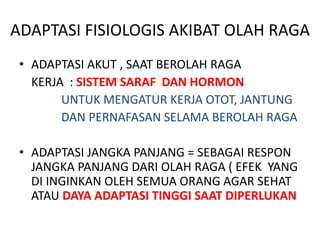
ADAPTASI FISIOLOGIS AKIBAT OLAH RAGA
• ADAPTASI AKUT , SAAT BEROLAH RAGA
KERJA : SISTEM SARAF DAN HORMON
UNTUK MENGATUR KERJA OTOT, JANTUNG
DAN PERNAFASAN SELAMA BEROLAH RAGA
• ADAPTASI JANGKA PANJANG = SEBAGAI RESPON
JANGKA PANJANG DARI OLAH RAGA ( EFEK YANG
DI INGINKAN OLEH SEMUA ORANG AGAR SEHAT
ATAU DAYA ADAPTASI TINGGI SAAT DIPERLUKAN
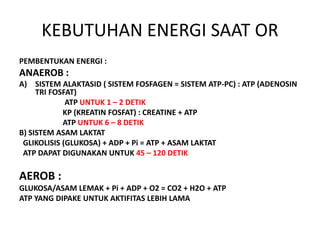
KEBUTUHAN ENERGI SAAT OR
PEMBENTUKAN ENERGI :
ANAEROB :
A) SISTEM ALAKTASID ( SISTEM FOSFAGEN = SISTEM ATP-PC) : ATP (ADENOSIN
TRI FOSFAT)
ATP UNTUK 1 – 2 DETIK
KP (KREATIN FOSFAT) : CREATINE + ATP
ATP UNTUK 6 – 8 DETIK
B) SISTEM ASAM LAKTAT
GLIKOLISIS (GLUKOSA) + ADP + Pi = ATP + ASAM LAKTAT
ATP DAPAT DIGUNAKAN UNTUK 45 – 120 DETIK
AEROB :
GLUKOSA/ASAM LEMAK + Pi + ADP + O2 = CO2 + H2O + ATP
ATP YANG DIPAKE UNTUK AKTIFITAS LEBIH LAMA
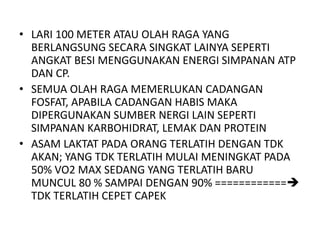
• LARI 100 METER ATAU OLAH RAGA YANG
BERLANGSUNG SECARA SINGKAT LAINYA SEPERTI
ANGKAT BESI MENGGUNAKAN ENERGI SIMPANAN ATP
DAN CP.
• SEMUA OLAH RAGA MEMERLUKAN CADANGAN
FOSFAT, APABILA CADANGAN HABIS MAKA
DIPERGUNAKAN SUMBER NERGI LAIN SEPERTI
SIMPANAN KARBOHIDRAT, LEMAK DAN PROTEIN
• ASAM LAKTAT PADA ORANG TERLATIH DENGAN TDK
AKAN; YANG TDK TERLATIH MULAI MENINGKAT PADA
50% VO2 MAX SEDANG YANG TERLATIH BARU
MUNCUL 80 % SAMPAI DENGAN 90% ============
TDK TERLATIH CEPET CAPEK
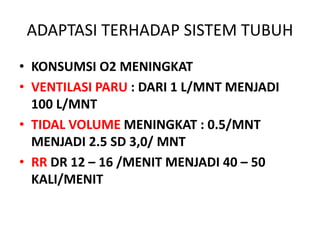
ADAPTASI TERHADAP SISTEM TUBUH
• KONSUMSI O2 MENINGKAT
• VENTILASI PARU : DARI 1 L/MNT MENJADI
100 L/MNT
• TIDAL VOLUME MENINGKAT : 0.5/MNT
MENJADI 2.5 SD 3,0/ MNT
• RR DR 12 – 16 /MENIT MENJADI 40 – 50
KALI/MENIT
CARDIOVASKULER
• C O MENINGKAT S/D 60% KAPASITAS KERJA MAKSIMAL
INDIVIDU DIAKIBATKAN OLEH :
- PENINGK HEART RATE
- STROKE VOLUME
HR MENINGKAT SEJALAN DENGAN BERATNYA OLAH RAGA
, SETIAP PENINGKATAN BERAT OLAH RAGA AKAN
MENINGKATKAN DENYUT JANTUNG, SAMPAI DENGAN
SUATU PENINGKATAN BEBAN TDK MENYEBABKAN
PENINGKATAN DENYUT JANTUNG. ORANG TERLATIH DJ
NYA TDK CEPAT NAIK ------------ DENYUT EFEKTIF , CO
MEINGKAT
ALIRAN DARAH
• ADANYA VASODILATASI DAN VASOKONTRIKSI
AKAN MENGATUR ALIRAN DARAH YANG
MENGALIR KE JARINGAN DAN KEMBALI KE
JANTUNG
• TEKANAN DARAH : TEKANAN SISTOLIK
MENINGKAT TAJAM, BS SAMPAI 200 mm Hg
SEDANGKAN DIASTOL RELATIF LEBIH SEDIKIT
MENINGKATNYA
• HEMATOLOGI
TERJADI HEMOKONSENTRASI S/D 20 –
25%
pH AKAN TERJADI PENURUNAN ---
KOMPENSASI
- CAIRAN TUBUH : HEMOKONSENTRASI
- SUHU TUBUH :
KELELAHAN SAAT OR
• ENERGI CADANGAN <<
• PENINGKATAN ASAM LAKTAT
• GANGGUAN HOMEOSTATIS : OSMOLARITAS
PLASMA, VOLUME PLASMA, pH CAIRAN
TUBUH, PENURUNAN ELEKTROLIT,
• GANGGUAN NEUROMUSKULER
• SUHU TERLALU PANAS ( LING YANG PANAS)
• KELEMBABAN UDARA TINGGI
ADAPTASI FISIOLOGIS YANG KRONIS
• TERJADI SECARA LAMBAT AKIBAT LATIHAN
SECARA TERATUR
• ENDOKRIN :
• SISTEM PERNAFASAN
• SISTEM MUSKULOSKELETAL
• SISTEM CARDIOVASKULER
• KUALITAS HIDUP SECARA KESELURUHAN
PROGRAM OLAH RAGA
• JENIS OLAH RAGA
• LAMA LATIHAN
• FREKUENSI LATIHAN
• INTENSITAS LATIHAN / BERAT
LATIHAN
JENIS OLAH RAGA
YANG SEHAT ADALAH YANG BS MENINGKATKAN
KEBUGARAN JASMANI KHUSUSNYA JANTUNG PARU
……………..> AEROBIK
CIRI CIRI OR AEROBIK :
1. MENGAKTIFKAN OTOT-OTOT TUBUH MAKSIMAL 40%
ATAU LEBIH
2. MENGAKTIFKAN OTOT-OTO SECARA SERENTAK/
SIMULTAN
3. OR TSB DILAKUKAN SECARA KONTINU DENGAN WAKTU
SEKITAR 30 – 60 MENIT
JALAN, JOGGING, LARI, BERENANG, SEPEDA,
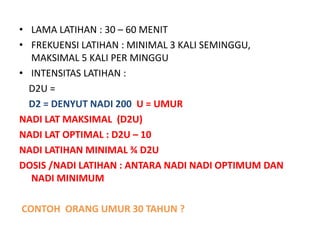
• LAMA LATIHAN : 30 – 60 MENIT
• FREKUENSI LATIHAN : MINIMAL 3 KALI SEMINGGU,
MAKSIMAL 5 KALI PER MINGGU
• INTENSITAS LATIHAN :
D2U =
D2 = DENYUT NADI 200 U = UMUR
NADI LAT MAKSIMAL (D2U)
NADI LAT OPTIMAL : D2U – 10
NADI LATIHAN MINIMAL ¾ D2U
DOSIS /NADI LATIHAN : ANTARA NADI NADI OPTIMUM DAN
NADI MINIMUM
CONTOH ORANG UMUR 30 TAHUN ?
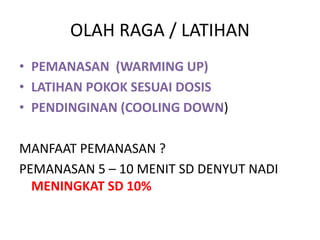
OLAH RAGA / LATIHAN
• PEMANASAN (WARMING UP)
• LATIHAN POKOK SESUAI DOSIS
• PENDINGINAN (COOLING DOWN)
MANFAAT PEMANASAN ?
PEMANASAN 5 – 10 MENIT SD DENYUT NADI
MENINGKAT SD 10%
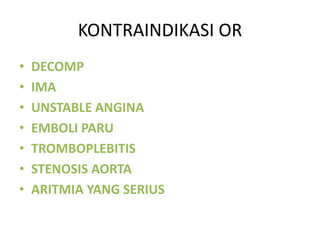
KONTRAINDIKASI OR
• DECOMP
• IMA
• UNSTABLE ANGINA
• EMBOLI PARU
• TROMBOPLEBITIS
• STENOSIS AORTA
• ARITMIA YANG SERIUS
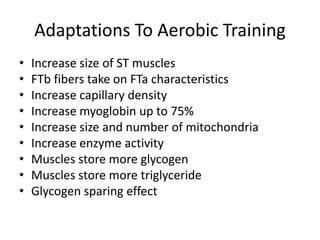
Adaptations To Aerobic Training
• Increase size of ST muscles
• FTb fibers take on FTa characteristics
• Increase capillary density
• Increase myoglobin up to 75%
• Increase size and number of mitochondria
• Increase enzyme activity
• Muscles store more glycogen
• Muscles store more triglyceride
• Glycogen sparing effect
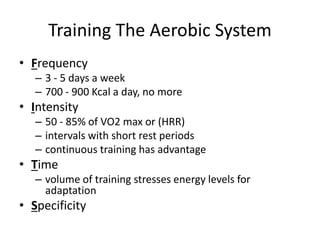
Training The Aerobic System
• Frequency
– 3 - 5 days a week
– 700 - 900 Kcal a day, no more
• Intensity
– 50 - 85% of VO2 max or (HRR)
– intervals with short rest periods
– continuous training has advantage
• Time
– volume of training stresses energy levels for
adaptation
• Specificity
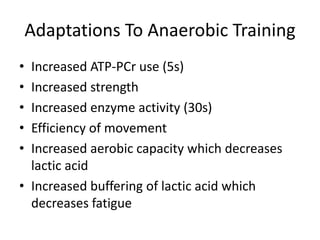
Adaptations To Anaerobic Training
• Increased ATP-PCr use (5s)
• Increased strength
• Increased enzyme activity (30s)
• Efficiency of movement
• Increased aerobic capacity which decreases
lactic acid
• Increased buffering of lactic acid which
decreases fatigue
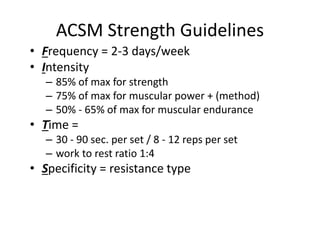
ACSM Strength Guidelines
• Frequency = 2-3 days/week
• Intensity
– 85% of max for strength
– 75% of max for muscular power + (method)
– 50% - 65% of max for muscular endurance
• Time =
– 30 - 90 sec. per set / 8 - 12 reps per set
– work to rest ratio 1:4
• Specificity = resistance type
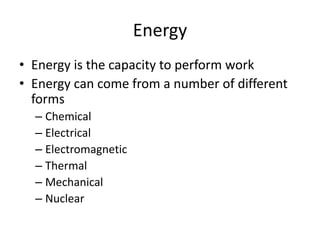
Energy
• Energy is the capacity to perform work
• Energy can come from a number of different
forms
– Chemical
– Electrical
– Electromagnetic
– Thermal
– Mechanical
– Nuclear
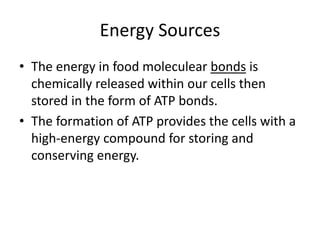
Energy Sources
• The energy in food moleculear bonds is
chemically released within our cells then
stored in the form of ATP bonds.
• The formation of ATP provides the cells with a
high-energy compound for storing and
conserving energy.
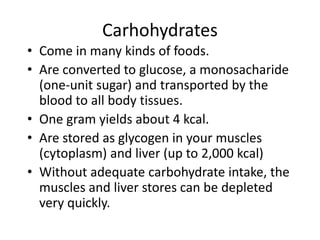
Carhohydrates
• Come in many kinds of foods.
• Are converted to glucose, a monosacharide
(one-unit sugar) and transported by the
blood to all body tissues.
• One gram yields about 4 kcal.
• Are stored as glycogen in your muscles
(cytoplasm) and liver (up to 2,000 kcal)
• Without adequate carbohydrate intake, the
muscles and liver stores can be depleted
very quickly.
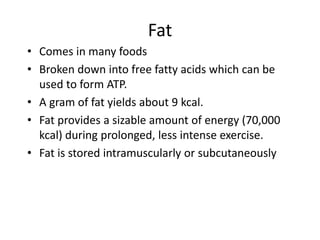
Fat
• Comes in many foods
• Broken down into free fatty acids which can be
used to form ATP.
• A gram of fat yields about 9 kcal.
• Fat provides a sizable amount of energy (70,000

kcal) during prolonged, less intense exercise.
• Fat is stored intramuscularly or subcutaneously
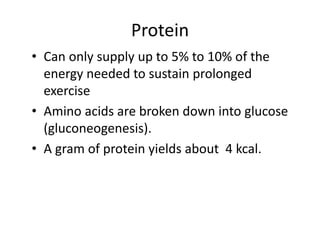
Protein
• Can only supply up to 5% to 10% of the
energy needed to sustain prolonged
exercise
• Amino acids are broken down into glucose
(gluconeogenesis).
• A gram of protein yields about 4 kcal.
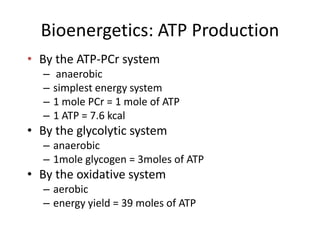
Bioenergetics: ATP Production
• By the ATP-PCr system
– anaerobic
– simplest energy system
– 1 mole PCr = 1 mole of ATP
– 1 ATP = 7.6 kcal
• By the glycolytic system
– anaerobic
– 1mole glycogen = 3moles of ATP
• By the oxidative system
– aerobic
– energy yield = 39 moles of ATP
ATP-PCr System
• The simplest of the energy systems
• Energy released by the break-down of
Creatine Phosphate (PCr), facilitated by the
enzyme creatine kinase (CK), rebuilds ATP
from ADP.
• This process is rapid
• Does not require oxygen (O2) and is
therefore anaerobic.
• Can only sustain maximum muscle work for
3-15 seconds.
The Glycolytic System
• Involves the breakdown (lysis) of glucose
via special glycolytic enzymes.
• Glucose accounts for about 99% of all
sugars circulating in the blood.
• Glucose comes from the digestion of
carbohydrates and the breakdown of
glycogen during glycogenolysis.
• Glycogen is synthesized from glucose
during glycogenisis.
The Glycolytic System
• Glucose and glycogen needs to be
converted to glucose-6-phosphate before it
can be used for energy. For glucose this
process takes 1 ATP.
• Glycolysis ultimately produces pyruvic acid
which is then converted to lactic acid in the
absence of oxygen.
• Gycolysis requires 12 enzymatic reactions
to form lactic acid which occur within the
cells cytoplasm
The Glycolytic System
• 1 glycogen = 3 ATP
• 1 glucose = 2 ATP
• Causes lactic acid accumulation in the
muscles
– This acidification discourages glycolysis
– Decreases the muscle fibers’ calcium binding
capacity and therefore impedes muscle
contraction.
The Oxidative System (Carbohydrate)
• Glycolysis:
– pyruvic acid is oxidized into acetyl coenzyme A
– 2 or 3 ATP are formed
• Krebs Cycle:
– acetyl CoA = (2ATP + H + C)
– H accepted by NAD & FAD
• Electron Transport Chain:
– the splitting of H electrons and protons provides energy
to perform oxidative phosphorylation
– (ADP+P=ATP) + H2O + CO2
– glycogen = 39 moles of ATP
The Oxidative System (Carbohydrate)
• Cellular Respiration: energy production in the
presence of oxygen.
• Occurs in the mitochondria adjacent to the
myofibrils and within the sarcoplasm.
• High energy yields (39 ATP) which are used
during aerobic events.
The Oxidative System (Fat)
• Lipolysis: Triglycerides are broken down
into glycerol and fatty acids by lipases.
• Beta Oxidation: fatty acids are broken down
into units of acetic acid and converted to
acetyl- CoA
• Krebs Cycle:
• Electron Transport Chain:
1mole of palmitic acid = 129 moles of ATP
Protein Metabolism
• Gluconeogenesis: some amino acids can be
converted into glucose, pyruvate acid, or
acetyl CoA
• ATP is spent in this process
• Biproducts include other amino acids or
nitrogen which is excreted in urine.
• Energy from protein metabolism is ignored
The Oxidative Capacity of Muscle
• Enzyme Activity
• Muscle Fiber Types
– slow twitch (type 1)
• Greater oxidative capacity
– fast twitch A (type 2a)
– fast twitch B (type 2b)
• Endurance Training
– enhances mitochondria density
– enhances enzymes for B oxidation
• Cardiovascular Function
– improved rate/depth of respiration
– increased gas exchange & H.R.
– Max VO2
Causes of Fatigue
• Decreased Energy
– ATP-PCr
• Phosphocreatine depletion
• warm-up & pacing decreases fatigue
• “hitting the wall” = no energy
– glycolysis
• Glycogen depletion in used muscles
• depletion in certain muscle fiber types
• depletion of blood glucose
– oxidation
• a lack of O2 increases lactic acid
– bicarbonate & cool down
• a causitive factor of muscle strains
• Accumulation of Metabolic Bi-products
(acidosis).
Causes of Fatigue
• Neuromoscular Fatigue
– decreased nerve transmission
• Depleted acetyl Co A
• Sarcolemma membrane threshold might increase
• Decreased potassium needed for nerve transmission
along the sarcolemma
• Calcium rentention within the sarcoplasmic reticulum.
– fatigue may be psychological and therefore
terminate exercise before the muscles are
physiologically exhausted
• verbal encouragement
• fight or flight mechanism
• perceived discomfort preceeds muscle physiological
limitations
• Delayed Onset Muscle Soreness
Olah raga dan kesehatan

Olah raga dan kesehatan

  • 1.
    PENGERTIAN • OLAH RAGA? • FAAL OLAH RAGA ? • ADAPTASI FISIOLOGIS TERHADAP OLAH RAGA? SEKOLAH TINGGI ILMU KESEHATAN KOTA SUKABUMI Program Study S1 Keperawatan https://stikeskotasukabumi.wordpress.com
  • 2.
    ADAPTASI FISIOLOGIS AKIBATOLAH RAGA • ADAPTASI AKUT , SAAT BEROLAH RAGA KERJA : SISTEM SARAF DAN HORMON UNTUK MENGATUR KERJA OTOT, JANTUNG DAN PERNAFASAN SELAMA BEROLAH RAGA • ADAPTASI JANGKA PANJANG = SEBAGAI RESPON JANGKA PANJANG DARI OLAH RAGA ( EFEK YANG DI INGINKAN OLEH SEMUA ORANG AGAR SEHAT ATAU DAYA ADAPTASI TINGGI SAAT DIPERLUKAN
  • 3.
    KEBUTUHAN ENERGI SAATOR PEMBENTUKAN ENERGI : ANAEROB : A) SISTEM ALAKTASID ( SISTEM FOSFAGEN = SISTEM ATP-PC) : ATP (ADENOSIN TRI FOSFAT) ATP UNTUK 1 – 2 DETIK KP (KREATIN FOSFAT) : CREATINE + ATP ATP UNTUK 6 – 8 DETIK B) SISTEM ASAM LAKTAT GLIKOLISIS (GLUKOSA) + ADP + Pi = ATP + ASAM LAKTAT ATP DAPAT DIGUNAKAN UNTUK 45 – 120 DETIK AEROB : GLUKOSA/ASAM LEMAK + Pi + ADP + O2 = CO2 + H2O + ATP ATP YANG DIPAKE UNTUK AKTIFITAS LEBIH LAMA
  • 4.
    • LARI 100METER ATAU OLAH RAGA YANG BERLANGSUNG SECARA SINGKAT LAINYA SEPERTI ANGKAT BESI MENGGUNAKAN ENERGI SIMPANAN ATP DAN CP. • SEMUA OLAH RAGA MEMERLUKAN CADANGAN FOSFAT, APABILA CADANGAN HABIS MAKA DIPERGUNAKAN SUMBER NERGI LAIN SEPERTI SIMPANAN KARBOHIDRAT, LEMAK DAN PROTEIN • ASAM LAKTAT PADA ORANG TERLATIH DENGAN TDK AKAN; YANG TDK TERLATIH MULAI MENINGKAT PADA 50% VO2 MAX SEDANG YANG TERLATIH BARU MUNCUL 80 % SAMPAI DENGAN 90% ============ TDK TERLATIH CEPET CAPEK
  • 5.
    ADAPTASI TERHADAP SISTEMTUBUH • KONSUMSI O2 MENINGKAT • VENTILASI PARU : DARI 1 L/MNT MENJADI 100 L/MNT • TIDAL VOLUME MENINGKAT : 0.5/MNT MENJADI 2.5 SD 3,0/ MNT • RR DR 12 – 16 /MENIT MENJADI 40 – 50 KALI/MENIT
  • 6.
    CARDIOVASKULER • C OMENINGKAT S/D 60% KAPASITAS KERJA MAKSIMAL INDIVIDU DIAKIBATKAN OLEH : - PENINGK HEART RATE - STROKE VOLUME HR MENINGKAT SEJALAN DENGAN BERATNYA OLAH RAGA , SETIAP PENINGKATAN BERAT OLAH RAGA AKAN MENINGKATKAN DENYUT JANTUNG, SAMPAI DENGAN SUATU PENINGKATAN BEBAN TDK MENYEBABKAN PENINGKATAN DENYUT JANTUNG. ORANG TERLATIH DJ NYA TDK CEPAT NAIK ------------ DENYUT EFEKTIF , CO MEINGKAT
  • 7.
    ALIRAN DARAH • ADANYAVASODILATASI DAN VASOKONTRIKSI AKAN MENGATUR ALIRAN DARAH YANG MENGALIR KE JARINGAN DAN KEMBALI KE JANTUNG • TEKANAN DARAH : TEKANAN SISTOLIK MENINGKAT TAJAM, BS SAMPAI 200 mm Hg SEDANGKAN DIASTOL RELATIF LEBIH SEDIKIT MENINGKATNYA
  • 8.
    • HEMATOLOGI TERJADI HEMOKONSENTRASIS/D 20 – 25% pH AKAN TERJADI PENURUNAN --- KOMPENSASI - CAIRAN TUBUH : HEMOKONSENTRASI - SUHU TUBUH :
  • 9.
    KELELAHAN SAAT OR •ENERGI CADANGAN << • PENINGKATAN ASAM LAKTAT • GANGGUAN HOMEOSTATIS : OSMOLARITAS PLASMA, VOLUME PLASMA, pH CAIRAN TUBUH, PENURUNAN ELEKTROLIT, • GANGGUAN NEUROMUSKULER • SUHU TERLALU PANAS ( LING YANG PANAS) • KELEMBABAN UDARA TINGGI
  • 10.
    ADAPTASI FISIOLOGIS YANGKRONIS • TERJADI SECARA LAMBAT AKIBAT LATIHAN SECARA TERATUR • ENDOKRIN : • SISTEM PERNAFASAN • SISTEM MUSKULOSKELETAL • SISTEM CARDIOVASKULER • KUALITAS HIDUP SECARA KESELURUHAN
  • 11.
    PROGRAM OLAH RAGA •JENIS OLAH RAGA • LAMA LATIHAN • FREKUENSI LATIHAN • INTENSITAS LATIHAN / BERAT LATIHAN
  • 12.
    JENIS OLAH RAGA YANGSEHAT ADALAH YANG BS MENINGKATKAN KEBUGARAN JASMANI KHUSUSNYA JANTUNG PARU ……………..> AEROBIK CIRI CIRI OR AEROBIK : 1. MENGAKTIFKAN OTOT-OTOT TUBUH MAKSIMAL 40% ATAU LEBIH 2. MENGAKTIFKAN OTOT-OTO SECARA SERENTAK/ SIMULTAN 3. OR TSB DILAKUKAN SECARA KONTINU DENGAN WAKTU SEKITAR 30 – 60 MENIT JALAN, JOGGING, LARI, BERENANG, SEPEDA,
  • 13.
    • LAMA LATIHAN: 30 – 60 MENIT • FREKUENSI LATIHAN : MINIMAL 3 KALI SEMINGGU, MAKSIMAL 5 KALI PER MINGGU • INTENSITAS LATIHAN : D2U = D2 = DENYUT NADI 200 U = UMUR NADI LAT MAKSIMAL (D2U) NADI LAT OPTIMAL : D2U – 10 NADI LATIHAN MINIMAL ¾ D2U DOSIS /NADI LATIHAN : ANTARA NADI NADI OPTIMUM DAN NADI MINIMUM CONTOH ORANG UMUR 30 TAHUN ?
  • 14.
    OLAH RAGA /LATIHAN • PEMANASAN (WARMING UP) • LATIHAN POKOK SESUAI DOSIS • PENDINGINAN (COOLING DOWN) MANFAAT PEMANASAN ? PEMANASAN 5 – 10 MENIT SD DENYUT NADI MENINGKAT SD 10%
  • 15.
    KONTRAINDIKASI OR • DECOMP •IMA • UNSTABLE ANGINA • EMBOLI PARU • TROMBOPLEBITIS • STENOSIS AORTA • ARITMIA YANG SERIUS
  • 16.
    Adaptations To AerobicTraining • Increase size of ST muscles • FTb fibers take on FTa characteristics • Increase capillary density • Increase myoglobin up to 75% • Increase size and number of mitochondria • Increase enzyme activity • Muscles store more glycogen • Muscles store more triglyceride • Glycogen sparing effect
  • 17.
    Training The AerobicSystem • Frequency – 3 - 5 days a week – 700 - 900 Kcal a day, no more • Intensity – 50 - 85% of VO2 max or (HRR) – intervals with short rest periods – continuous training has advantage • Time – volume of training stresses energy levels for adaptation • Specificity
  • 18.
    Adaptations To AnaerobicTraining • Increased ATP-PCr use (5s) • Increased strength • Increased enzyme activity (30s) • Efficiency of movement • Increased aerobic capacity which decreases lactic acid • Increased buffering of lactic acid which decreases fatigue
  • 19.
    ACSM Strength Guidelines •Frequency = 2-3 days/week • Intensity – 85% of max for strength – 75% of max for muscular power + (method) – 50% - 65% of max for muscular endurance • Time = – 30 - 90 sec. per set / 8 - 12 reps per set – work to rest ratio 1:4 • Specificity = resistance type
  • 20.
    Energy • Energy isthe capacity to perform work • Energy can come from a number of different forms – Chemical – Electrical – Electromagnetic – Thermal – Mechanical – Nuclear
  • 21.
    Energy Sources • Theenergy in food moleculear bonds is chemically released within our cells then stored in the form of ATP bonds. • The formation of ATP provides the cells with a high-energy compound for storing and conserving energy.
  • 22.
    Carhohydrates • Come inmany kinds of foods. • Are converted to glucose, a monosacharide (one-unit sugar) and transported by the blood to all body tissues. • One gram yields about 4 kcal. • Are stored as glycogen in your muscles (cytoplasm) and liver (up to 2,000 kcal) • Without adequate carbohydrate intake, the muscles and liver stores can be depleted very quickly.
  • 23.
    Fat • Comes inmany foods • Broken down into free fatty acids which can be used to form ATP. • A gram of fat yields about 9 kcal. • Fat provides a sizable amount of energy (70,000 kcal) during prolonged, less intense exercise. • Fat is stored intramuscularly or subcutaneously
  • 24.
    Protein • Can onlysupply up to 5% to 10% of the energy needed to sustain prolonged exercise • Amino acids are broken down into glucose (gluconeogenesis). • A gram of protein yields about 4 kcal.
  • 25.
    Bioenergetics: ATP Production •By the ATP-PCr system – anaerobic – simplest energy system – 1 mole PCr = 1 mole of ATP – 1 ATP = 7.6 kcal • By the glycolytic system – anaerobic – 1mole glycogen = 3moles of ATP • By the oxidative system – aerobic – energy yield = 39 moles of ATP
  • 26.
    ATP-PCr System • Thesimplest of the energy systems • Energy released by the break-down of Creatine Phosphate (PCr), facilitated by the enzyme creatine kinase (CK), rebuilds ATP from ADP. • This process is rapid • Does not require oxygen (O2) and is therefore anaerobic. • Can only sustain maximum muscle work for 3-15 seconds.
  • 27.
    The Glycolytic System •Involves the breakdown (lysis) of glucose via special glycolytic enzymes. • Glucose accounts for about 99% of all sugars circulating in the blood. • Glucose comes from the digestion of carbohydrates and the breakdown of glycogen during glycogenolysis. • Glycogen is synthesized from glucose during glycogenisis.
  • 28.
    The Glycolytic System •Glucose and glycogen needs to be converted to glucose-6-phosphate before it can be used for energy. For glucose this process takes 1 ATP. • Glycolysis ultimately produces pyruvic acid which is then converted to lactic acid in the absence of oxygen. • Gycolysis requires 12 enzymatic reactions to form lactic acid which occur within the cells cytoplasm
  • 29.
    The Glycolytic System •1 glycogen = 3 ATP • 1 glucose = 2 ATP • Causes lactic acid accumulation in the muscles – This acidification discourages glycolysis – Decreases the muscle fibers’ calcium binding capacity and therefore impedes muscle contraction.
  • 30.
    The Oxidative System(Carbohydrate) • Glycolysis: – pyruvic acid is oxidized into acetyl coenzyme A – 2 or 3 ATP are formed • Krebs Cycle: – acetyl CoA = (2ATP + H + C) – H accepted by NAD & FAD • Electron Transport Chain: – the splitting of H electrons and protons provides energy to perform oxidative phosphorylation – (ADP+P=ATP) + H2O + CO2 – glycogen = 39 moles of ATP
  • 31.
    The Oxidative System(Carbohydrate) • Cellular Respiration: energy production in the presence of oxygen. • Occurs in the mitochondria adjacent to the myofibrils and within the sarcoplasm. • High energy yields (39 ATP) which are used during aerobic events.
  • 32.
    The Oxidative System(Fat) • Lipolysis: Triglycerides are broken down into glycerol and fatty acids by lipases. • Beta Oxidation: fatty acids are broken down into units of acetic acid and converted to acetyl- CoA • Krebs Cycle: • Electron Transport Chain: 1mole of palmitic acid = 129 moles of ATP
  • 33.
    Protein Metabolism • Gluconeogenesis:some amino acids can be converted into glucose, pyruvate acid, or acetyl CoA • ATP is spent in this process • Biproducts include other amino acids or nitrogen which is excreted in urine. • Energy from protein metabolism is ignored
  • 34.
    The Oxidative Capacityof Muscle • Enzyme Activity • Muscle Fiber Types – slow twitch (type 1) • Greater oxidative capacity – fast twitch A (type 2a) – fast twitch B (type 2b) • Endurance Training – enhances mitochondria density – enhances enzymes for B oxidation • Cardiovascular Function – improved rate/depth of respiration – increased gas exchange & H.R. – Max VO2
  • 35.
    Causes of Fatigue •Decreased Energy – ATP-PCr • Phosphocreatine depletion • warm-up & pacing decreases fatigue • “hitting the wall” = no energy – glycolysis • Glycogen depletion in used muscles • depletion in certain muscle fiber types • depletion of blood glucose – oxidation • a lack of O2 increases lactic acid – bicarbonate & cool down • a causitive factor of muscle strains • Accumulation of Metabolic Bi-products (acidosis).
  • 36.
    Causes of Fatigue •Neuromoscular Fatigue – decreased nerve transmission • Depleted acetyl Co A • Sarcolemma membrane threshold might increase • Decreased potassium needed for nerve transmission along the sarcolemma • Calcium rentention within the sarcoplasmic reticulum. – fatigue may be psychological and therefore terminate exercise before the muscles are physiologically exhausted • verbal encouragement • fight or flight mechanism • perceived discomfort preceeds muscle physiological limitations • Delayed Onset Muscle Soreness