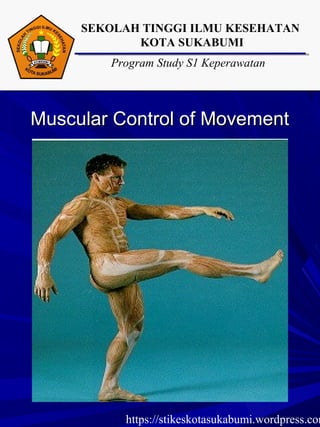
Muscular Control of MovementMuscular Control of Movement
SEKOLAH TINGGI ILMU KESEHATAN
KOTA SUKABUMI
Program Study S1 Keperawatan
https://stikeskotasukabumi.wordpress.com
Review of AnatomyReview of Anatomy
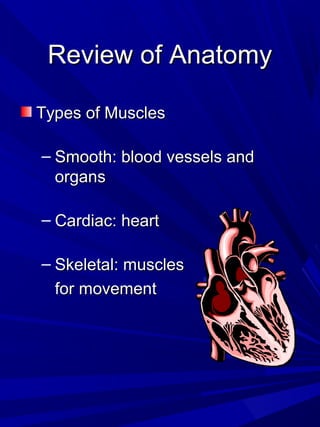
Types of MusclesTypes of Muscles
– Smooth: blood vessels andSmooth: blood vessels and
organsorgans
– Cardiac: heartCardiac: heart
– Skeletal: musclesSkeletal: muscles
for movementfor movement
Review of AnatomyReview of Anatomy
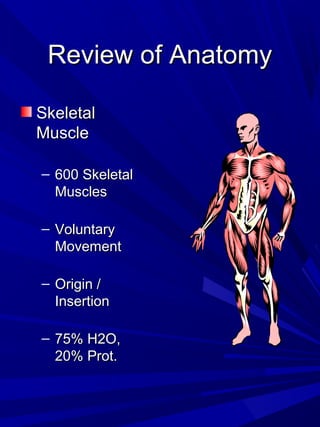
SkeletalSkeletal
MuscleMuscle
– 600 Skeletal600 Skeletal
MusclesMuscles
– VoluntaryVoluntary
MovementMovement
– Origin /Origin /
InsertionInsertion
– 75% H2O,75% H2O,
20% Prot.20% Prot.
The Structure ofThe Structure of
Skeletal MuscleSkeletal Muscle
EpimysiumEpimysium
– Covers the entire muscleCovers the entire muscle
PerimysiumPerimysium
– Covers the FasciculiCovers the Fasciculi
EndomysiumEndomysium
– Covers the muscle fiberCovers the muscle fiber
SarcoplasmSarcoplasm
– Surrounds the myofibrilSurrounds the myofibril
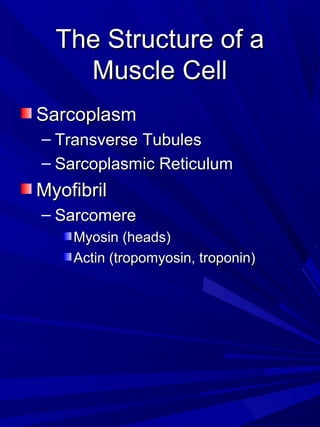
The Structure of aThe Structure of a
Muscle CellMuscle Cell
SarcoplasmSarcoplasm
– Transverse TubulesTransverse Tubules
– Sarcoplasmic ReticulumSarcoplasmic Reticulum
MyofibrilMyofibril
– SarcomereSarcomere
Myosin (heads)Myosin (heads)
Actin (tropomyosin, troponin)Actin (tropomyosin, troponin)
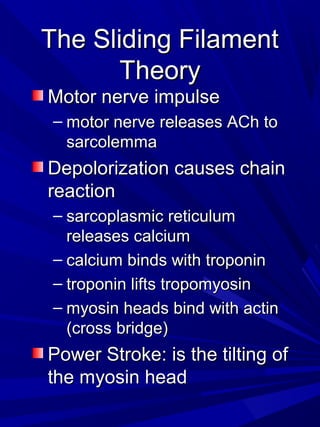
The Sliding FilamentThe Sliding Filament
TheoryTheory
Motor nerve impulseMotor nerve impulse
– motor nerve releases ACh tomotor nerve releases ACh to
sarcolemmasarcolemma
Depolorization causes chainDepolorization causes chain
reactionreaction
– sarcoplasmic reticulumsarcoplasmic reticulum
releases calciumreleases calcium
– calcium binds with troponincalcium binds with troponin
– troponin lifts tropomyosintroponin lifts tropomyosin
– myosin heads bind with actinmyosin heads bind with actin
(cross bridge)(cross bridge)
Power Stroke: is the tilting ofPower Stroke: is the tilting of
the myosin headthe myosin head
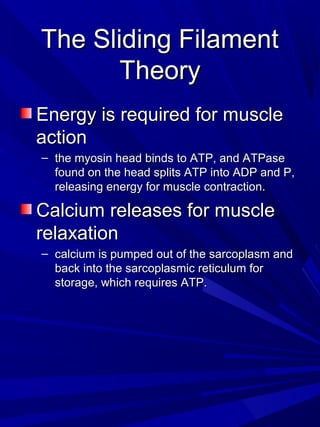
The Sliding FilamentThe Sliding Filament
TheoryTheory
Energy is required for muscleEnergy is required for muscle
actionaction
– the myosin head binds to ATP, and ATPasethe myosin head binds to ATP, and ATPase
found on the head splits ATP into ADP and P,found on the head splits ATP into ADP and P,
releasing energy for muscle contraction.releasing energy for muscle contraction.
Calcium releases for muscleCalcium releases for muscle
relaxationrelaxation
– calcium is pumped out of the sarcoplasm andcalcium is pumped out of the sarcoplasm and
back into the sarcoplasmic reticulum forback into the sarcoplasmic reticulum for
storage, which requires ATP.storage, which requires ATP.
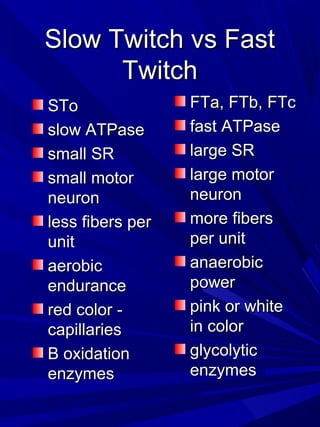
Slow Twitch vs FastSlow Twitch vs Fast
TwitchTwitch
SToSTo
slow ATPaseslow ATPase
small SRsmall SR
small motorsmall motor
neuronneuron
less fibers perless fibers per
unitunit
aerobicaerobic
enduranceendurance
red color -red color -
capillariescapillaries
B oxidationB oxidation
enzymesenzymes
FTa, FTb, FTcFTa, FTb, FTc
fast ATPasefast ATPase
large SRlarge SR
large motorlarge motor
neuronneuron
more fibersmore fibers
per unitper unit
anaerobicanaerobic
powerpower
pink or whitepink or white
in colorin color
glycolyticglycolytic
enzymesenzymes
Muscle FiberMuscle Fiber
RecruitmentRecruitment
Motor units:Motor units: consists of a single motorconsists of a single motor
neuron and all of the muscle fibers is supplies.neuron and all of the muscle fibers is supplies.
All-or-None Response:All-or-None Response:
Gradation of recruitmentGradation of recruitment
– force production:force production: is due to the numberis due to the number
of fibers recruited, not the force generated byof fibers recruited, not the force generated by
each fibereach fiber
– conditioning response:conditioning response: trainingtraining
effects the coordination and recruitment ofeffects the coordination and recruitment of
muscles for specific activitiesmuscles for specific activities
FTb & FTc fibers aren’t easilyFTb & FTc fibers aren’t easily
recruitedrecruited
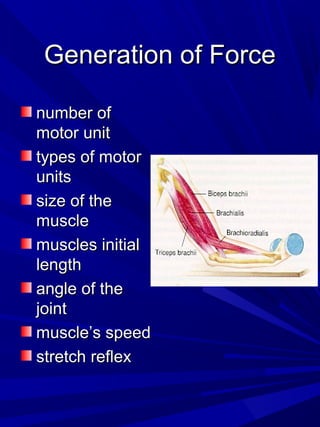
Generation of ForceGeneration of Force
number ofnumber of
motor unitmotor unit
types of motortypes of motor
unitsunits
size of thesize of the
musclemuscle
muscles initialmuscles initial
lengthlength
angle of theangle of the
jointjoint
muscle’s speedmuscle’s speed
stretch reflexstretch reflex
Use of MusclesUse of Muscles
Types ofTypes of
MovementMovement
– agonistsagonists
– antagonistsantagonists
– synergistssynergists
Types ofTypes of
ContractionContraction
– concentricconcentric
– staticstatic
– eccentriceccentric
Requirements ForRequirements For
Large MuscleLarge Muscle
DevelopmentDevelopment
Proper NutritionProper Nutrition
– 65% CHO, 20% Fat, 15%65% CHO, 20% Fat, 15%
ProteinProtein
Resistance TrainingResistance Training
GeneticsGenetics
Hormonal Secretion LevelsHormonal Secretion Levels
– testosteronetestosterone
– androgensandrogens
ACSM StrengthACSM Strength
GuidelinesGuidelines
FFrequency = 2-3 days/weekrequency = 2-3 days/week
IIntensityntensity
– 85% of max for strength85% of max for strength
– 75% of max for muscular75% of max for muscular
power + (method)power + (method)
– 50% - 65% of max for50% - 65% of max for
muscular endurancemuscular endurance
TTime =ime =
– 30 - 90 sec. per set / 8 - 1230 - 90 sec. per set / 8 - 12
reps per setreps per set
– work to rest ratio 1:4work to rest ratio 1:4
SSpecificity = resistance typepecificity = resistance type
Strength Training MythsStrength Training Myths
Strength training will cause “muscleStrength training will cause “muscle
boundness”boundness”
Women who strength train willWomen who strength train will
become masculinizedbecome masculinized
Strength training reduces speedStrength training reduces speed
““No pain - No gain”No pain - No gain”
It takes hours of daily training to gainIt takes hours of daily training to gain
muscle massmuscle mass
Food supplements will speed upFood supplements will speed up
muscle developmentmuscle development
Anabolic steroids are safe andAnabolic steroids are safe and
effectiveeffective
Amino Acids are safe and effectiveAmino Acids are safe and effective
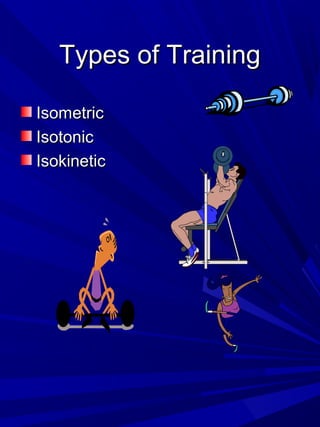
Types of TrainingTypes of Training
IsometricIsometric
IsotonicIsotonic
IsokineticIsokinetic
Modes of TrainingModes of Training
Free weightsFree weights
NautilusNautilus
HydraulicsHydraulics
FrictionFriction
Rubber tubingRubber tubing
CybexCybex
Bow-flexBow-flex
Box-jumpsBox-jumps
HydrotherapyHydrotherapy
Etc.Etc.

Soprts 1

  • 1.
    Muscular Control ofMovementMuscular Control of Movement SEKOLAH TINGGI ILMU KESEHATAN KOTA SUKABUMI Program Study S1 Keperawatan https://stikeskotasukabumi.wordpress.com
  • 2.
    Review of AnatomyReviewof Anatomy Types of MusclesTypes of Muscles – Smooth: blood vessels andSmooth: blood vessels and organsorgans – Cardiac: heartCardiac: heart – Skeletal: musclesSkeletal: muscles for movementfor movement
  • 3.
    Review of AnatomyReviewof Anatomy SkeletalSkeletal MuscleMuscle – 600 Skeletal600 Skeletal MusclesMuscles – VoluntaryVoluntary MovementMovement – Origin /Origin / InsertionInsertion – 75% H2O,75% H2O, 20% Prot.20% Prot.
  • 4.
    The Structure ofTheStructure of Skeletal MuscleSkeletal Muscle EpimysiumEpimysium – Covers the entire muscleCovers the entire muscle PerimysiumPerimysium – Covers the FasciculiCovers the Fasciculi EndomysiumEndomysium – Covers the muscle fiberCovers the muscle fiber SarcoplasmSarcoplasm – Surrounds the myofibrilSurrounds the myofibril
  • 5.
    The Structure ofaThe Structure of a Muscle CellMuscle Cell SarcoplasmSarcoplasm – Transverse TubulesTransverse Tubules – Sarcoplasmic ReticulumSarcoplasmic Reticulum MyofibrilMyofibril – SarcomereSarcomere Myosin (heads)Myosin (heads) Actin (tropomyosin, troponin)Actin (tropomyosin, troponin)
  • 6.
    The Sliding FilamentTheSliding Filament TheoryTheory Motor nerve impulseMotor nerve impulse – motor nerve releases ACh tomotor nerve releases ACh to sarcolemmasarcolemma Depolorization causes chainDepolorization causes chain reactionreaction – sarcoplasmic reticulumsarcoplasmic reticulum releases calciumreleases calcium – calcium binds with troponincalcium binds with troponin – troponin lifts tropomyosintroponin lifts tropomyosin – myosin heads bind with actinmyosin heads bind with actin (cross bridge)(cross bridge) Power Stroke: is the tilting ofPower Stroke: is the tilting of the myosin headthe myosin head
  • 7.
    The Sliding FilamentTheSliding Filament TheoryTheory Energy is required for muscleEnergy is required for muscle actionaction – the myosin head binds to ATP, and ATPasethe myosin head binds to ATP, and ATPase found on the head splits ATP into ADP and P,found on the head splits ATP into ADP and P, releasing energy for muscle contraction.releasing energy for muscle contraction. Calcium releases for muscleCalcium releases for muscle relaxationrelaxation – calcium is pumped out of the sarcoplasm andcalcium is pumped out of the sarcoplasm and back into the sarcoplasmic reticulum forback into the sarcoplasmic reticulum for storage, which requires ATP.storage, which requires ATP.
  • 8.
    Slow Twitch vsFastSlow Twitch vs Fast TwitchTwitch SToSTo slow ATPaseslow ATPase small SRsmall SR small motorsmall motor neuronneuron less fibers perless fibers per unitunit aerobicaerobic enduranceendurance red color -red color - capillariescapillaries B oxidationB oxidation enzymesenzymes FTa, FTb, FTcFTa, FTb, FTc fast ATPasefast ATPase large SRlarge SR large motorlarge motor neuronneuron more fibersmore fibers per unitper unit anaerobicanaerobic powerpower pink or whitepink or white in colorin color glycolyticglycolytic enzymesenzymes
  • 9.
    Muscle FiberMuscle Fiber RecruitmentRecruitment Motorunits:Motor units: consists of a single motorconsists of a single motor neuron and all of the muscle fibers is supplies.neuron and all of the muscle fibers is supplies. All-or-None Response:All-or-None Response: Gradation of recruitmentGradation of recruitment – force production:force production: is due to the numberis due to the number of fibers recruited, not the force generated byof fibers recruited, not the force generated by each fibereach fiber – conditioning response:conditioning response: trainingtraining effects the coordination and recruitment ofeffects the coordination and recruitment of muscles for specific activitiesmuscles for specific activities FTb & FTc fibers aren’t easilyFTb & FTc fibers aren’t easily recruitedrecruited
  • 10.
    Generation of ForceGenerationof Force number ofnumber of motor unitmotor unit types of motortypes of motor unitsunits size of thesize of the musclemuscle muscles initialmuscles initial lengthlength angle of theangle of the jointjoint muscle’s speedmuscle’s speed stretch reflexstretch reflex
  • 11.
    Use of MusclesUseof Muscles Types ofTypes of MovementMovement – agonistsagonists – antagonistsantagonists – synergistssynergists Types ofTypes of ContractionContraction – concentricconcentric – staticstatic – eccentriceccentric
  • 12.
    Requirements ForRequirements For LargeMuscleLarge Muscle DevelopmentDevelopment Proper NutritionProper Nutrition – 65% CHO, 20% Fat, 15%65% CHO, 20% Fat, 15% ProteinProtein Resistance TrainingResistance Training GeneticsGenetics Hormonal Secretion LevelsHormonal Secretion Levels – testosteronetestosterone – androgensandrogens
  • 13.
    ACSM StrengthACSM Strength GuidelinesGuidelines FFrequency= 2-3 days/weekrequency = 2-3 days/week IIntensityntensity – 85% of max for strength85% of max for strength – 75% of max for muscular75% of max for muscular power + (method)power + (method) – 50% - 65% of max for50% - 65% of max for muscular endurancemuscular endurance TTime =ime = – 30 - 90 sec. per set / 8 - 1230 - 90 sec. per set / 8 - 12 reps per setreps per set – work to rest ratio 1:4work to rest ratio 1:4 SSpecificity = resistance typepecificity = resistance type
  • 14.
    Strength Training MythsStrengthTraining Myths Strength training will cause “muscleStrength training will cause “muscle boundness”boundness” Women who strength train willWomen who strength train will become masculinizedbecome masculinized Strength training reduces speedStrength training reduces speed ““No pain - No gain”No pain - No gain” It takes hours of daily training to gainIt takes hours of daily training to gain muscle massmuscle mass Food supplements will speed upFood supplements will speed up muscle developmentmuscle development Anabolic steroids are safe andAnabolic steroids are safe and effectiveeffective Amino Acids are safe and effectiveAmino Acids are safe and effective
  • 15.
    Types of TrainingTypesof Training IsometricIsometric IsotonicIsotonic IsokineticIsokinetic
  • 16.
    Modes of TrainingModesof Training Free weightsFree weights NautilusNautilus HydraulicsHydraulics FrictionFriction Rubber tubingRubber tubing CybexCybex Bow-flexBow-flex Box-jumpsBox-jumps HydrotherapyHydrotherapy Etc.Etc.

Editor's Notes

  • #3 Smooth Muscle: is called involuntary muscle because it is not directly under conscious control Skeletal muscles are also used for involuntary movement Origins: Usually the more proximal and more stable skeletal part Insertion: Usually the more distal and more mobile skeletal part
  • #5 Epimysium: covers the entire muscle Perimysium: covers the fasiculi Fasiculi: are bundles of muscle fibers Endomysium: coverseach muscle fiber (cell) Sarcolemma: is a membrane that covers each muscle fiber (cell)
  • #6 Sarcoplasma: contains a large supply of stored glycogen and myoglabin * Transverse Tubules: are a pathway into the muscle which carries glucose, oxygen and ions * Sarcoplasmic Reticulum: serves as a storage site for calcium which is important for muscle cont.l Myofibril: These are the contractile elements of the muscle fiber * Sarcomere: is the smallest functinal unit of a muscle - Myosin: thick - Actin: thin Tropomyosin: covers the active sites Troponin: attracts calcium and releases the tromomyosin
  • #7 Motor Unit: consists of a single motor neuron and all of the muscle fibers that it supplies