ENERGY SYSTEMS OR
PATHWAYS
SEKOLAH TINGGI ILMU KESEHATAN KOTA SUKABUMI
Program Study S1 Keperawatan
https://stikeskotasukabumi.wordpress.com
EATING FOR ENERGY
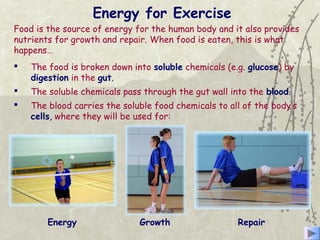
Energy for Exercise
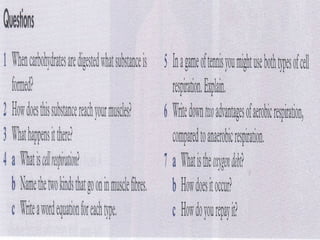
 The food is broken down into soluble chemicals (e.g. glucose) by
digestion in the gut.
 The soluble chemicals pass through the gut wall into the blood.
 The blood carries the soluble food chemicals to all of the body’s
cells, where they will be used for:
Energy Growth Repair
Food is the source of energy for the human body and it also provides
nutrients for growth and repair. When food is eaten, this is what
happens…
TRAINING FOR FITNESS-FOOD FOR ENERGY
Making Energy Available to the Cells of the Body
The muscles of the body use both carbohydrates and fats to produce
energy. The following diagram shows how carbohydrates are used.
The muscles of the body use both carbohydrates and fats to produce
energy. The following diagram shows how carbohydrates are used.
Making Energy Available to the Cells of the Body
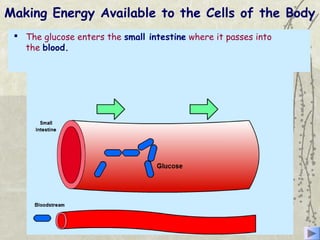
 Carbohydrates in the form of starch gained from foods such as
pasta, bread and potatoes are eaten.
 The starch is digested in the gut and turned into glucose molecules.
 The glucose enters the small intestine where it passes into
the blood.
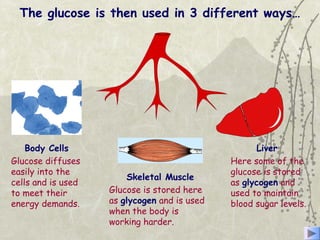
The glucose is then used in 3 different ways…
Here some of the
glucose is stored
as glycogen and
used to maintain
blood sugar levels.
Glucose is stored here
as glycogen and is used
when the body is
working harder.
Glucose diffuses
easily into the
cells and is used
to meet their
energy demands.
Skeletal Muscle
LiverBody Cells
HOW DO MUSCLESWORK
• Anything you do needs energy.
• When muscles work they have to lengthen and shorten.
• For this to work your muscles need energy
ADENOSINE TRI-PHOSPHATE (ATP)
•This is a chemical which is vital for muscle contraction.
•Without ATP muscle contraction cannot go on.
•However the body only has enough ATP for 1 explosive act
•After this there is no ATP left.
•Muscle Contraction cannot take place.
•Therefore physical activity can no longer continue.
Exercise Physiology-
ATP Splitting
SO ENERGY HAS TO BE CREATED BY OTHER MEANS.
Exercise Physiology-
Energy from ATP
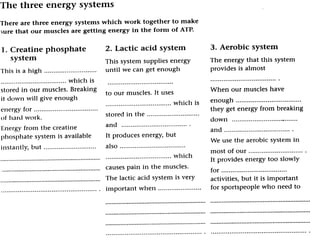
THE CREATINE PHOSPHATE SYSTEM
ADENOSINE PHOSPHATE(ADP) + CREATINE PHOSPHATE = ATP (ENERGY)
• This system is extremely efficient
• It does not need oxygen
• It leaves no waste products
HOWEVER
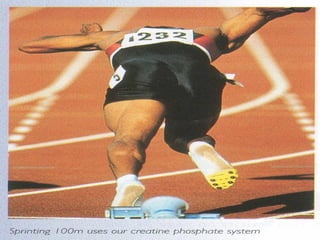
• WE ARE ONLY ABLE TO USE THIS FOR ABOUT 10-15
SECONDS BEFORE THIS SYSTEM RUNS OUT.
THINK 100 metres
Exercise Physiology-
CP Splitting
THE GLUCOSE/LACTIC ACID SYSTEM or
anaerobic glycolysis
ADENOSINE DI-PHOSPHATE + GLUCOSE = ATP (ENERGY)
• When Creatine Phosphate runs out, the muscles call upon the stores of
GLUCOSE ( Glycogen ).
• But there is a side effect with this type of energy system.
• A waste product called PYRUVIC ACID is produced.
• This in itself is OK if levels of activity are reduced to enable this
Pyruvic Acid to be broken down by OXYGEN into CARBON DIOXIDE
and WATER.
• However, if levels of activity are not reduced and not enough oxygen is
being breathed in, then this Pyruvic Acid is not broken down and
converts into LACTIC ACID.
• LACTIC ACID is a poison.
Lactic Acid
•After a while it will make the muscle ache and eventually it will cause
cramp, and the muscles will stop working.
• The athlete has to rest while blood brings fresh supplies of oxygen to
the muscles.
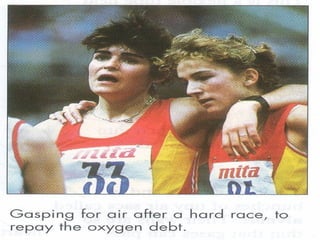
• He/She is repaying back the OXYGEN DEBT.
Exercise Physiology-
Anaerobic Glycolysis
THE AEROBIC (glucose, fats, oxygen) system or aerobic
metabolism
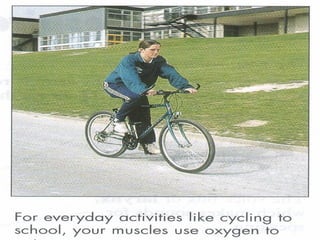
• This system is used during lower levels of activity when there is
enough energy being delivered to the working muscles to clear away
ALL the Pyruvic Acid.
• At lower levels of activity FATS can be used as a muscle fuel.
• This preserves its stores of GLUCOSE for as long as possible.
• As a general rule, the more intense the activity, the more GLUCOSE is
used instead of FAT.
Exercise Physiology-
Aerobic Metabolism
revision
Training for Fitness- The
3 Energy Systems
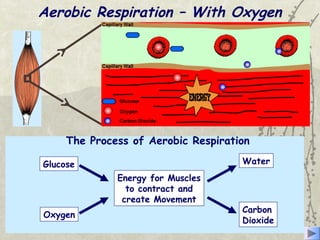
Aerobic Respiration – With Oxygen
1. Glucose and oxygen are transported to the working muscles by
the blood.
Aerobic respiration involves the release of energy from the slow
breakdown of glucose using oxygen, inside the cells.
2. Glucose and oxygen are then used by the muscles of the body
to produce energy.
3. This process creates carbon dioxide and water.
4. The carbon dioxide passes back into the blood for removal.
The Process of Aerobic Respiration
Energy for Muscles
to contract and
create Movement
Water
Carbon
Dioxide
Glucose
Oxygen
Facts about Aerobic Respiration
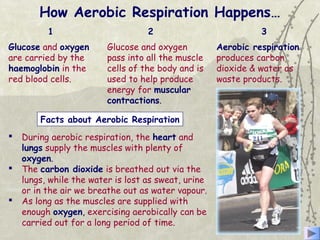
How Aerobic Respiration Happens…
Glucose and oxygen
are carried by the
haemoglobin in the
red blood cells.
Glucose and oxygen
pass into all the muscle
cells of the body and is
used to help produce
energy for muscular
contractions.
Aerobic respiration
produces carbon
dioxide & water as
waste products.
 During aerobic respiration, the heart and
lungs supply the muscles with plenty of
oxygen.
 The carbon dioxide is breathed out via the
lungs, while the water is lost as sweat, urine
or in the air we breathe out as water vapour.
 As long as the muscles are supplied with
enough oxygen, exercising aerobically can be
carried out for a long period of time.
1 2 3
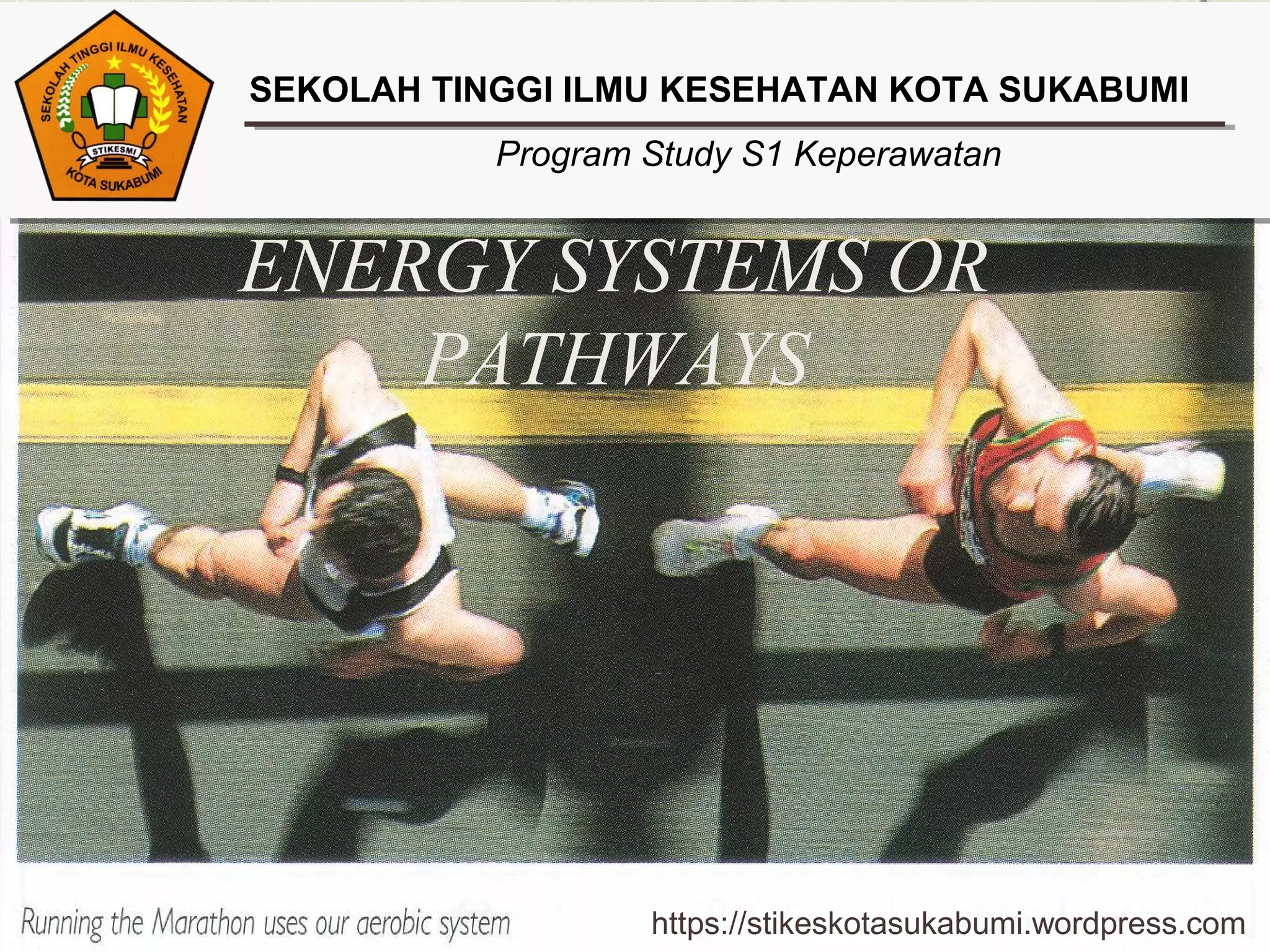
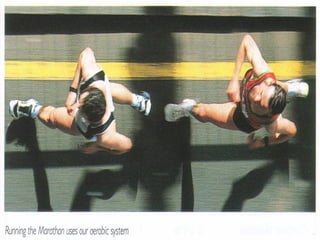
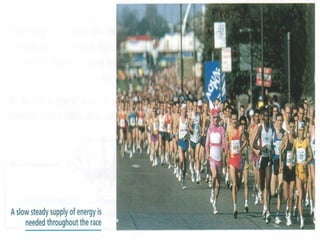
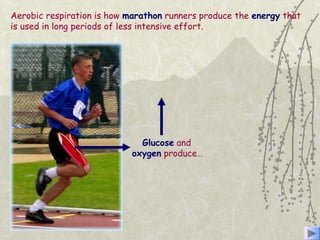
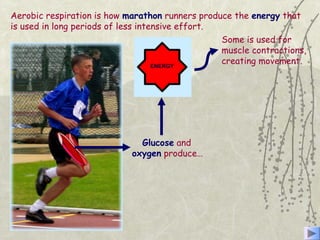
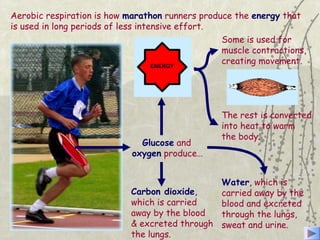
Aerobic respiration is how marathon runners produce the energy that
is used in long periods of less intensive effort.
Glucose and
oxygen produce…
Aerobic respiration is how marathon runners produce the energy that
is used in long periods of less intensive effort.
Glucose and
oxygen produce…
Some is used for
muscle contractions,
creating movement.
Aerobic respiration is how marathon runners produce the energy that
is used in long periods of less intensive effort.
Glucose and
oxygen produce…
Carbon dioxide,
which is carried
away by the blood
& excreted through
the lungs.
Water, which is
carried away by the
blood and excreted
through the lungs,
sweat and urine.
Some is used for
muscle contractions,
creating movement.
The rest is converted
into heat to warm
the body.
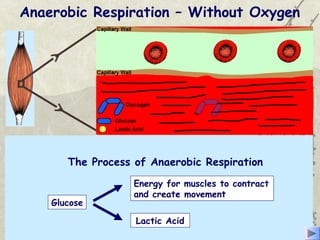
Anaerobic respiration involves the release of a little energy, very
quickly from the incomplete breakdown of glucose without using oxygen,
inside the cells.
1. Glucose is made available by the breakdown of glycogen stored
in the working muscles.
2. The glucose is used by the muscles of the body to produce energy,
without the use of oxygen.
3. This process creates lactic acid, which passes back into the blood
for removal.
Anaerobic Respiration – Without Oxygen
The Process of Anaerobic Respiration
Glucose
Energy for muscles to contract
and create movement
Lactic Acid
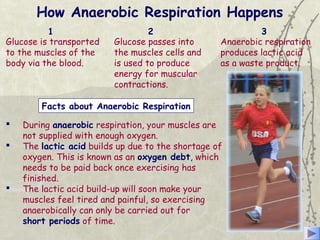
Glucose is transported
to the muscles of the
body via the blood.
How Anaerobic Respiration Happens
Glucose passes into
the muscles cells and
is used to produce
energy for muscular
contractions.
Anaerobic respiration
produces lactic acid
as a waste product.
Facts about Anaerobic Respiration
 During anaerobic respiration, your muscles are
not supplied with enough oxygen.
 The lactic acid builds up due to the shortage of
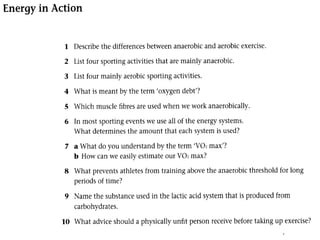
oxygen. This is known as an oxygen debt, which
needs to be paid back once exercising has
finished.
 The lactic acid build-up will soon make your
muscles feel tired and painful, so exercising
anaerobically can only be carried out for
short periods of time.
1 2 3
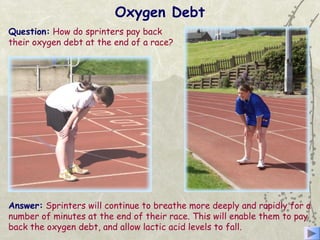
Oxygen Debt
Question: How do sprinters pay back
their oxygen debt at the end of a race?
Answer: Sprinters will continue to breathe more deeply and rapidly for a
number of minutes at the end of their race. This will enable them to pay
back the oxygen debt, and allow lactic acid levels to fall.
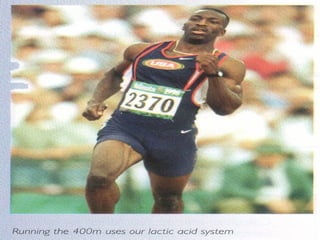
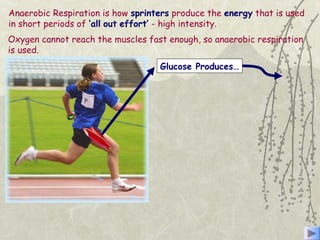
Anaerobic Respiration is how sprinters produce the energy that is used
in short periods of ‘all out effort’ - high intensity.
Glucose Produces…
Oxygen cannot reach the muscles fast enough, so anaerobic respiration
is used.
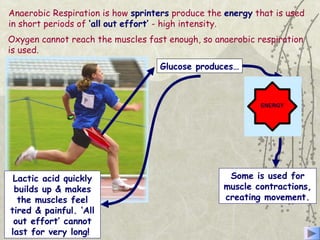
Anaerobic Respiration is how sprinters produce the energy that is used
in short periods of ‘all out effort’ - high intensity.
Glucose produces…
Lactic acid quickly
builds up & makes
the muscles feel
tired & painful. ‘All
out effort’ cannot
last for very long!
Oxygen cannot reach the muscles fast enough, so anaerobic respiration
is used.
Some is used for
muscle contractions,
creating movement.
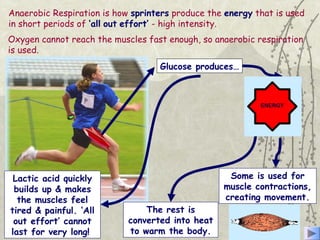
Anaerobic Respiration is how sprinters produce the energy that is used
in short periods of ‘all out effort’ - high intensity.
Glucose produces…
Lactic acid quickly
builds up & makes
the muscles feel
tired & painful. ‘All
out effort’ cannot
last for very long!
The rest is
converted into heat
to warm the body.
Oxygen cannot reach the muscles fast enough, so anaerobic respiration
is used.
Some is used for
muscle contractions,
creating movement.
Anaerobic respiration
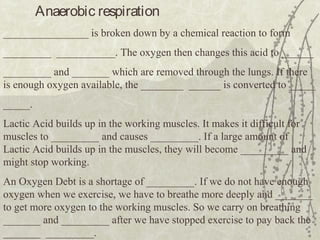
________________ is broken down by a chemical reaction to form
_________ ___________. The oxygen then changes this acid to ______
_________ and _______ which are removed through the lungs. If there
is enough oxygen available, the ________ ______ is converted to _____
_____.
Lactic Acid builds up in the working muscles. It makes it difficult for
muscles to _________ and causes _________. If a large amount of
Lactic Acid builds up in the muscles, they will become _________ and
might stop working.
An Oxygen Debt is a shortage of _________. If we do not have enough
oxygen when we exercise, we have to breathe more deeply and _______
to get more oxygen to the working muscles. So we carry on breathing
_______ and _________ after we have stopped exercise to pay back the
_______ _________.
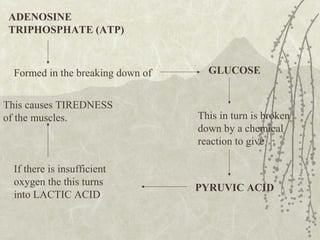
ADENOSINE
TRIPHOSPHATE (ATP)
Formed in the breaking down of GLUCOSE
This in turn is broken
down by a chemical
reaction to give
PYRUVIC ACID
If there is insufficient
oxygen the this turns
into LACTIC ACID
This causes TIREDNESS
of the muscles.
ENERGY SOURCES
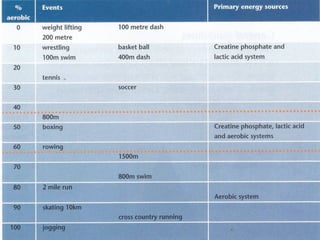
WHICH OF THE THREE ENERGY SYSTEMS DO VARIOUS SPORT
USE.
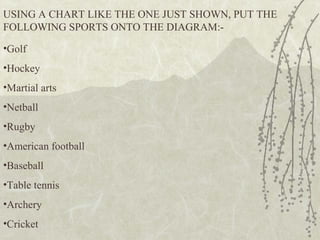
USING A CHART LIKE THE ONE JUST SHOWN, PUT THE
FOLLOWING SPORTS ONTO THE DIAGRAM:-
•Golf
•Hockey
•Martial arts
•Netball
•Rugby
•American football
•Baseball
•Table tennis
•Archery
•Cricket
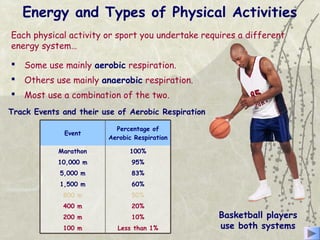
Energy and Types of Physical Activities
Each physical activity or sport you undertake requires a different
energy system…
Track Events and their use of Aerobic Respiration
Basketball players
use both systems
 Some use mainly aerobic respiration.
 Others use mainly anaerobic respiration.
 Most use a combination of the two.
Event
Percentage of
Aerobic Respiration
Less than 1%100 m
10%200 m
20%400 m
50%800 m
60%1,500 m
83%5,000 m
95%10,000 m
100%Marathon

Energy systems

  • 1.
    ENERGY SYSTEMS OR PATHWAYS SEKOLAHTINGGI ILMU KESEHATAN KOTA SUKABUMI Program Study S1 Keperawatan https://stikeskotasukabumi.wordpress.com
  • 2.
  • 3.
    Energy for Exercise The food is broken down into soluble chemicals (e.g. glucose) by digestion in the gut.  The soluble chemicals pass through the gut wall into the blood.  The blood carries the soluble food chemicals to all of the body’s cells, where they will be used for: Energy Growth Repair Food is the source of energy for the human body and it also provides nutrients for growth and repair. When food is eaten, this is what happens…
  • 4.
  • 5.
    Making Energy Availableto the Cells of the Body The muscles of the body use both carbohydrates and fats to produce energy. The following diagram shows how carbohydrates are used.
  • 6.
    The muscles ofthe body use both carbohydrates and fats to produce energy. The following diagram shows how carbohydrates are used. Making Energy Available to the Cells of the Body  Carbohydrates in the form of starch gained from foods such as pasta, bread and potatoes are eaten.  The starch is digested in the gut and turned into glucose molecules.  The glucose enters the small intestine where it passes into the blood.
  • 7.
    The glucose isthen used in 3 different ways… Here some of the glucose is stored as glycogen and used to maintain blood sugar levels. Glucose is stored here as glycogen and is used when the body is working harder. Glucose diffuses easily into the cells and is used to meet their energy demands. Skeletal Muscle LiverBody Cells
  • 8.
    HOW DO MUSCLESWORK •Anything you do needs energy. • When muscles work they have to lengthen and shorten. • For this to work your muscles need energy
  • 9.
    ADENOSINE TRI-PHOSPHATE (ATP) •Thisis a chemical which is vital for muscle contraction. •Without ATP muscle contraction cannot go on.
  • 10.
    •However the bodyonly has enough ATP for 1 explosive act •After this there is no ATP left. •Muscle Contraction cannot take place. •Therefore physical activity can no longer continue.
  • 11.
  • 12.
    SO ENERGY HASTO BE CREATED BY OTHER MEANS.
  • 13.
  • 14.
    THE CREATINE PHOSPHATESYSTEM ADENOSINE PHOSPHATE(ADP) + CREATINE PHOSPHATE = ATP (ENERGY) • This system is extremely efficient • It does not need oxygen • It leaves no waste products HOWEVER • WE ARE ONLY ABLE TO USE THIS FOR ABOUT 10-15 SECONDS BEFORE THIS SYSTEM RUNS OUT. THINK 100 metres
  • 16.
  • 17.
    THE GLUCOSE/LACTIC ACIDSYSTEM or anaerobic glycolysis ADENOSINE DI-PHOSPHATE + GLUCOSE = ATP (ENERGY) • When Creatine Phosphate runs out, the muscles call upon the stores of GLUCOSE ( Glycogen ). • But there is a side effect with this type of energy system. • A waste product called PYRUVIC ACID is produced. • This in itself is OK if levels of activity are reduced to enable this Pyruvic Acid to be broken down by OXYGEN into CARBON DIOXIDE and WATER. • However, if levels of activity are not reduced and not enough oxygen is being breathed in, then this Pyruvic Acid is not broken down and converts into LACTIC ACID.
  • 18.
    • LACTIC ACIDis a poison.
  • 19.
  • 20.
    •After a whileit will make the muscle ache and eventually it will cause cramp, and the muscles will stop working. • The athlete has to rest while blood brings fresh supplies of oxygen to the muscles. • He/She is repaying back the OXYGEN DEBT.
  • 23.
  • 24.
    THE AEROBIC (glucose,fats, oxygen) system or aerobic metabolism • This system is used during lower levels of activity when there is enough energy being delivered to the working muscles to clear away ALL the Pyruvic Acid. • At lower levels of activity FATS can be used as a muscle fuel. • This preserves its stores of GLUCOSE for as long as possible. • As a general rule, the more intense the activity, the more GLUCOSE is used instead of FAT.
  • 28.
  • 29.
    revision Training for Fitness-The 3 Energy Systems
  • 30.
    Aerobic Respiration –With Oxygen 1. Glucose and oxygen are transported to the working muscles by the blood. Aerobic respiration involves the release of energy from the slow breakdown of glucose using oxygen, inside the cells. 2. Glucose and oxygen are then used by the muscles of the body to produce energy. 3. This process creates carbon dioxide and water. 4. The carbon dioxide passes back into the blood for removal. The Process of Aerobic Respiration Energy for Muscles to contract and create Movement Water Carbon Dioxide Glucose Oxygen
  • 31.
    Facts about AerobicRespiration How Aerobic Respiration Happens… Glucose and oxygen are carried by the haemoglobin in the red blood cells. Glucose and oxygen pass into all the muscle cells of the body and is used to help produce energy for muscular contractions. Aerobic respiration produces carbon dioxide & water as waste products.  During aerobic respiration, the heart and lungs supply the muscles with plenty of oxygen.  The carbon dioxide is breathed out via the lungs, while the water is lost as sweat, urine or in the air we breathe out as water vapour.  As long as the muscles are supplied with enough oxygen, exercising aerobically can be carried out for a long period of time. 1 2 3
  • 32.
    Aerobic respiration ishow marathon runners produce the energy that is used in long periods of less intensive effort. Glucose and oxygen produce…
  • 33.
    Aerobic respiration ishow marathon runners produce the energy that is used in long periods of less intensive effort. Glucose and oxygen produce… Some is used for muscle contractions, creating movement.
  • 34.
    Aerobic respiration ishow marathon runners produce the energy that is used in long periods of less intensive effort. Glucose and oxygen produce… Carbon dioxide, which is carried away by the blood & excreted through the lungs. Water, which is carried away by the blood and excreted through the lungs, sweat and urine. Some is used for muscle contractions, creating movement. The rest is converted into heat to warm the body.
  • 35.
    Anaerobic respiration involvesthe release of a little energy, very quickly from the incomplete breakdown of glucose without using oxygen, inside the cells. 1. Glucose is made available by the breakdown of glycogen stored in the working muscles. 2. The glucose is used by the muscles of the body to produce energy, without the use of oxygen. 3. This process creates lactic acid, which passes back into the blood for removal. Anaerobic Respiration – Without Oxygen The Process of Anaerobic Respiration Glucose Energy for muscles to contract and create movement Lactic Acid
  • 36.
    Glucose is transported tothe muscles of the body via the blood. How Anaerobic Respiration Happens Glucose passes into the muscles cells and is used to produce energy for muscular contractions. Anaerobic respiration produces lactic acid as a waste product. Facts about Anaerobic Respiration  During anaerobic respiration, your muscles are not supplied with enough oxygen.  The lactic acid builds up due to the shortage of oxygen. This is known as an oxygen debt, which needs to be paid back once exercising has finished.  The lactic acid build-up will soon make your muscles feel tired and painful, so exercising anaerobically can only be carried out for short periods of time. 1 2 3
  • 37.
    Oxygen Debt Question: Howdo sprinters pay back their oxygen debt at the end of a race? Answer: Sprinters will continue to breathe more deeply and rapidly for a number of minutes at the end of their race. This will enable them to pay back the oxygen debt, and allow lactic acid levels to fall.
  • 38.
    Anaerobic Respiration ishow sprinters produce the energy that is used in short periods of ‘all out effort’ - high intensity. Glucose Produces… Oxygen cannot reach the muscles fast enough, so anaerobic respiration is used.
  • 39.
    Anaerobic Respiration ishow sprinters produce the energy that is used in short periods of ‘all out effort’ - high intensity. Glucose produces… Lactic acid quickly builds up & makes the muscles feel tired & painful. ‘All out effort’ cannot last for very long! Oxygen cannot reach the muscles fast enough, so anaerobic respiration is used. Some is used for muscle contractions, creating movement.
  • 40.
    Anaerobic Respiration ishow sprinters produce the energy that is used in short periods of ‘all out effort’ - high intensity. Glucose produces… Lactic acid quickly builds up & makes the muscles feel tired & painful. ‘All out effort’ cannot last for very long! The rest is converted into heat to warm the body. Oxygen cannot reach the muscles fast enough, so anaerobic respiration is used. Some is used for muscle contractions, creating movement.
  • 41.
    Anaerobic respiration ________________ isbroken down by a chemical reaction to form _________ ___________. The oxygen then changes this acid to ______ _________ and _______ which are removed through the lungs. If there is enough oxygen available, the ________ ______ is converted to _____ _____. Lactic Acid builds up in the working muscles. It makes it difficult for muscles to _________ and causes _________. If a large amount of Lactic Acid builds up in the muscles, they will become _________ and might stop working. An Oxygen Debt is a shortage of _________. If we do not have enough oxygen when we exercise, we have to breathe more deeply and _______ to get more oxygen to the working muscles. So we carry on breathing _______ and _________ after we have stopped exercise to pay back the _______ _________.
  • 42.
    ADENOSINE TRIPHOSPHATE (ATP) Formed inthe breaking down of GLUCOSE This in turn is broken down by a chemical reaction to give PYRUVIC ACID If there is insufficient oxygen the this turns into LACTIC ACID This causes TIREDNESS of the muscles.
  • 43.
    ENERGY SOURCES WHICH OFTHE THREE ENERGY SYSTEMS DO VARIOUS SPORT USE.
  • 46.
    USING A CHARTLIKE THE ONE JUST SHOWN, PUT THE FOLLOWING SPORTS ONTO THE DIAGRAM:- •Golf •Hockey •Martial arts •Netball •Rugby •American football •Baseball •Table tennis •Archery •Cricket
  • 50.
    Energy and Typesof Physical Activities Each physical activity or sport you undertake requires a different energy system… Track Events and their use of Aerobic Respiration Basketball players use both systems  Some use mainly aerobic respiration.  Others use mainly anaerobic respiration.  Most use a combination of the two. Event Percentage of Aerobic Respiration Less than 1%100 m 10%200 m 20%400 m 50%800 m 60%1,500 m 83%5,000 m 95%10,000 m 100%Marathon