Semisolid dosage form
Murat Kizaibek
Ointments
Ophthalmic ointments
Suppository
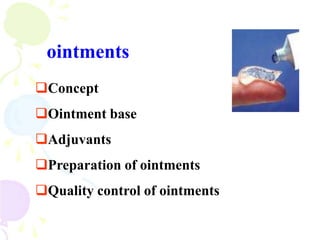
ointments
Concept
Ointment base
Adjuvants
Preparation of ointments
Quality control of ointments
Concept
• Definition: semisolid preparations intended for
external application are termed ointments.
• Ingredient: drug substance +bases+ adjuvants
Classification
 According to the
dispersion system:
(1) solutions type
(2) suspension type
(3) emulsions type
 According to the bases:
(1) oleaginous dosage form
(2) emulsions dosage form
(3) pastes dosage form
(4) collodions dosage form
(5) ophthalmic dosage form
 Quality requirement
the product is required smooth and uniform with
certain stickiness to skin
the drug in bases even distributed
stability of the ointment
Skin infection preparations are designed to be sterile
Ointment bases
Ointment bases are classified into four general groups:
• (1) Hydrocarbon bases
• (2) Absorption bases
• (3) Water-Removable Bases
• (4) Water-Soluble Bases
(1) hydrocarbon bases
 Hydrocarbon bases (oleaginous bases) are water-free, and
aqueous preparations may be incorporated into them only in
small amounts and then with difficulty.
 Hydrocarbon bases are retained on the skin for prolonged
periods, do not permit the escape of moisture from the skin
to the atmosphere, and are difficult to wash off.
 As such they act as occlusive dressings. They do not "dry
out" or change noticeably upon aging.
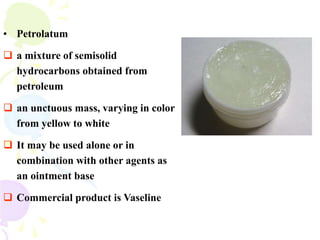
• Petrolatum
 a mixture of semisolid
hydrocarbons obtained from
petroleum
 an unctuous mass, varying in color
from yellow to white
 It may be used alone or in
combination with other agents as
an ointment base
 Commercial product is Vaseline
• Paraffin
 A purified mixture of solid hydrocarbons obtained from petroleum.
 A colorless or white, more or less translucent mass that may be used
to harden or stiffen oleaginous semisolid ointment bases.
• Liquid paraffin
• a colorless, odorless
oily liquid consisting
of a mixture of
hydrocarbons obtained
from petroleum
• has the same character
with paraffin
• be used in
combination with
paraffin to adjust
viscosity
•Hydrophilic Petrolatum
 is composed of cholesterol, stearyl alcohol, white wax, and white
petrolatum
 has the ability to absorb water, with the formation of a water-in-
oil emulsion.
 Aquaphor is a highly refined variation of Hydrophilic Petrolatum
and because it can absorb up to 3 times its weight in water, it has
proven useful to incorporate extemporaneously a water-soluble
drug into an oleaginous base.
 may contain no more than
0.25% of water.
 insoluble in water, but mixes
without separation with about
twice its weight of water
 The incorporation of water
results in the formation of a
water-in-oil emulsion.
Anhydrous Lanolin (refined wool fat)
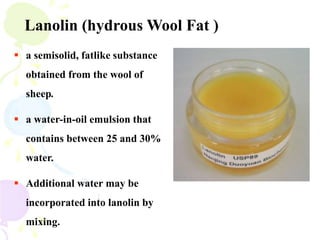
 a semisolid, fatlike substance
obtained from the wool of
sheep.
 a water-in-oil emulsion that
contains between 25 and 30%
water.
 Additional water may be
incorporated into lanolin by
mixing.
Lanolin (hydrous Wool Fat )
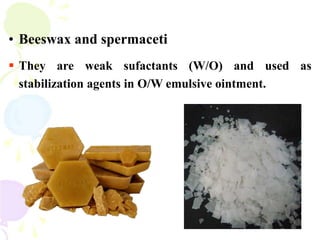
• Beeswax and spermaceti
 They are weak sufactants (W/O) and used as
stabilization agents in O/W emulsive ointment.
Mineral Oil
• a mixture of liquid hydrocarbons.
• It is useful as a levigating
substance to wet and to
incorporate solid substances into
the preparation of ointments that
consist of oleaginous bases as
their vehicle.
(2) Absorption bases
Absorption bases may be of two types:
(1)those that permit the incorporation of aqueous
solutions, resulting in the formation of water-in-oil
emulsions (e.g. Hydrophilic Petrolatum and
Anhydrous lanolin) and those that are already water-
in-oil emulsions (emulsion bases) that permit the
incorporation of small, additional quantities of
aqueous solutions (e.g. lanolin and Cold Cream).
These bases are useful as emollients although they do
not provide the degree of occlusion afforded by the
oleaginous bases.
Absorption bases are not easily removed from the
skin with water washing.
They are also useful pharmaceutically to incorporate
aqueous solutions of drugs, e g., sodium
sulfacetamide, into oleaginous bases.
(3)Water-Removable Bases
 oil-in-water emulsions that are capable of being
washed from skin or clothing with water. For this
reason, they are frequently referred to as "water-
washable" ointment bases
 may be diluted with water or with aqueous solutions.
 have the ability to absorb serous discharges in
dermatologic conditions.
 Certain medicinal agents may be better absorbed by
the skin when present in a base of this type than in
other types of bases.
•Emulsifying agents
sodium lauryl sulfate :O/W emulsion
stearyl alcohol and cetyl alcohol representing the
oleaginous phase of the W/O emulsion to improve
the stabilization and viscosity.
 sodium stearate and calcium stearate.
Glyceryl monostearate: weak W/O emulsifying
agents and used as stabilization agents and emollient
in the O/W emulsion.
• Spans: W/O emulsifying agents
• Tweens: O /W emulsifying agents
• Peregal O and emulsive OP: O/W
• Stearic acid, beewax and paraffin are the main
oleaginous bases.
• propylene glycol and water representing the aqueous
phase
• Methylparaben and propylparaben are used to preserve
the ointment against microbial growth
(4) Water-Soluble Bases
• contain only water-soluble components.
• are water washable
• Because they soften greatly with the addition of water,
aqueous solutions are not effectively incorporated into
these bases. Rather, they are better used for the
incorporation of nonaqueous or solid substances.
•Polyethylene Glycol Ointment
Polyethylene glycols are polymers of ethylene oxide
and water
The chain length may be varied to achieve polymers
having desired viscosity and physical (liquid,
semisolid, or solid) form.
The general formula for this base calls for the
combining of polyethylene glycol 3350(a solid) and
polyethylene glycol 400 (a liquid) to prepare base.
Adjuvants
• Antioxidants
• Antimicrobial preservatives
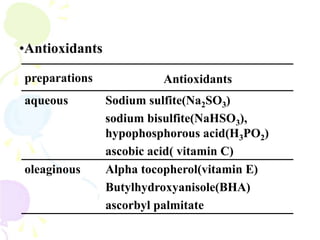
•Antioxidants
preparations Antioxidants
aqueous Sodium sulfite(Na2SO3)
sodium bisulfite(NaHSO3),
hypophosphorous acid(H3PO2)
ascobic acid( vitamin C)
oleaginous Alpha tocopherol(vitamin E)
Butylhydroxyanisole(BHA)
ascorbyl palmitate
•Antimicrobial preservatives
frequently require the addition of chemical
antimicrobial preservatives to the formulation to
inhibit the growth of contaminating microorganisms
These preservatives include: para-hydroxybenzoates
(parabens), phenols, benzoic acid, sorbic acid,
quaternary ammonium salts and other compounds.
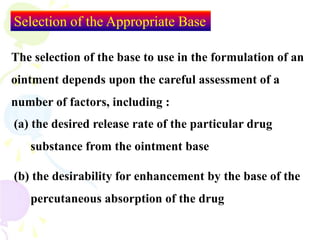
Selection of the Appropriate Base
The selection of the base to use in the formulation of an
ointment depends upon the careful assessment of a
number of factors, including :
(a) the desired release rate of the particular drug
substance from the ointment base
(b) the desirability for enhancement by the base of the
percutaneous absorption of the drug
(c) the advisability of occlusion of moisture from the
skin by the base
(d) the short-term and long-term stability of the drug
in the ointment base
(e) the influence, if any, of the drug on the consistency
or other features of the ointment base.
(f) patient factors also play an important role in a
base's selection
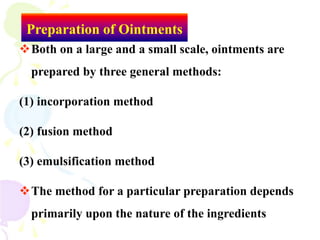
Preparation of Ointments
Both on a large and a small scale, ointments are
prepared by three general methods:
(1) incorporation method
(2) fusion method
(3) emulsification method
The method for a particular preparation depends
primarily upon the nature of the ingredients
(1) incorporation
the components of the ointment are mixed together by
various means until a uniform preparation has been
attained.
On a small scale, the pharmacist may mix the
components of an ointment in a mortar with a pestle,
or a spatula and an ointment slab (a large glass or
porcelain plate) may be used to rub the ingredients
together.
(2) fusion
 By the fusion method, all or some of the components of an
ointment are combined by being melted together and cooled
with constant stirring until congealed.
 Those components not melted are generally added to the
congealing mixture as it is being cooled and stirred.
 Naturally, heat-labile substances and any volatile components
are added last when the temperature of the mixture is low
enough not to cause decomposition of volatilization of the
components.
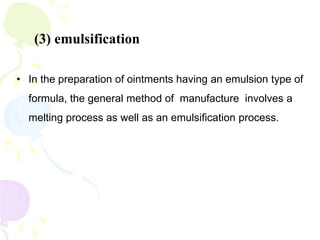
• In the preparation of ointments having an emulsion type of
formula, the general method of manufacture involves a
melting process as well as an emulsification process.
(3) emulsification
the water-immiscible components such as the oil and
waxes are melted together in a steam bath to about 70 to
75°C
Meantime, an aqueous solution of all of the heat-stable,
water-soluble components is being prepared in the
amount of purified water specified in the formula and
heated to the same temperature as the oleaginous
components.
 Then the aqueous solution is slowly added, with
constant stirring (usually with a mechanical stirrer),
to the melted oleaginous mixture, the temperature is
maintained for 5 to 10 minutes to prevent
crystallization of waxes
 the mixture is slowly cooled with the stirring
continued until the mixture is congealed.
Notice:
• If the aqueous solution were not the same
temperature as the oleaginous melt, there would
be solidification of some of the waxes upon the
addition of the colder aqueous solution to the
melted mixture.
Emulsification ointments
Ⅱophthalmic ointments
• Concept
 semisolid preparations intended for
application to the eye are specially prepared
and are termed ophthalmic ointments.
•Preparation of ophthalmic ointments
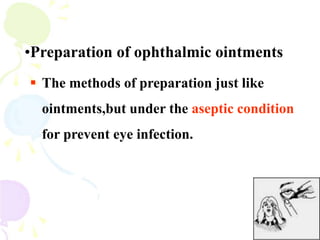
 The methods of preparation just like
ointments,but under the aseptic condition
for prevent eye infection.
•The bases
 must be non-irritating to the eye and must permit the diffusion of
the medicinal substance throughout the secretions bathing the
eye.
 Ointment bases utilized for ophthalmics have a melting or
softening point close to body temperature.
 In most instances, mixtures of petrolatum and liquid petrolatum
(mineral oil) are utilized as the ointment base.
 Sometimes a water-miscible agent as lanolin is added. This
permits water and water-insoluble drugs to be retained within the
delivery system.
•The advantage and disadvantage
The primary advantage of an ophthalmic ointment
over an ophthalmic solution is the increased ocular
contact time of the drug.
One disadvantage to ophthalmic ointment use is the
blurred vision which occurs as the ointment base
melts and is spread across the lens.
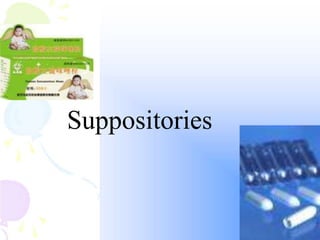
Suppositories
Suppositories are semisolid dosage forms intended for
insertion into body orifices where they melt, soften, or
dissolve and exert localized or systemic effects.
1.Definition
Suppositories are commonly employed rectally,
vaginally and occasionally urethrally.
They have various shapes and weights depending
upon the density of the base and the medicaments
present in it, and the individual manufacturer's
product.
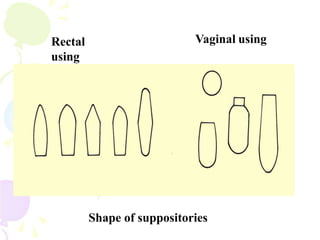
2. Body orifices for using
Rectal
using
Vaginal using
Shape of suppositories
3.character of action
 Rectal suppositories are most frequently employed to relieve
constipation or the pain, irritation, itching, and inflammation
associated with hemorrhoids or other anorectal conditions.
 Vaginal suppositories or inserts are employed mainly as
contraceptives, antiseptics in feminine hygiene, and as
specific agents to combat an invading pathogen.
 Urethral suppositories may be used as antibacterial and as a
local anesthetic preparative to urethral examination.
1)Local Action
(a) for the relief of nausea and vomiting and as a tranquilizer
(b) for narcotic analgesia
(c) for the relief of migraine syndrome
(d) anti-inflammatory analgesic and antipyretic.
2)Systemic Action
administered rectally in the form of suppositories for
systemic effects include:
3) advantages over oral therapy
(rectal route for achieving systemic effects )
(a) drugs destroyed or inactivated by the pH or enzymatic
activity of the stomach or intestines need not be exposed
to these destructive environments;
(b) drugs irritating to the stomach may be given without
causing such irritation;
(c) drugs destroyed by portal circulation may bypass the liver
after rectal absorption (drugs enter the portal circulation
after oral administration and absorption);
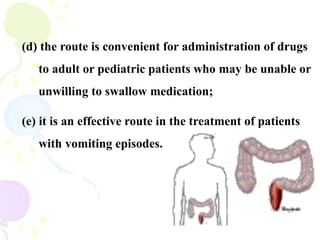
(d) the route is convenient for administration of drugs
to adult or pediatric patients who may be unable or
unwilling to swallow medication;
(e) it is an effective route in the treatment of patients
with vomiting episodes.
4.Quality control of suppository
 the medicaments and base mixed uniformly with certain
hardness under condition of shipment and storage
 capable of being easily inserted into the intended body
orifice without causing undue distension.
 once inserted, the base melts, softens, or dissolves,
distributing the medicaments it carries to the tissues of the
region. It must be retained for the appropriate period of time
for local effects or quickly absorbed for systemic effects .
The shape and size of a suppository must be such that
contains drug,base and other adjuvant ,which the
affecting factors for preparation are the
physicochemical nature of the drug, the nature of the
suppository vehicle and its capacity to release the drug
and clinical desired effects from administration 。
Drug
properties as the relative solubility of the drug in lipid
and in water , the particle size of a dispersed drug.
Ⅱ Ingredients of suppositories
1.requisites for a suppository base is that :
1)it remains solid at room temperature but softens,
melts, or dissolves readily at body temperature so that
the drug it contains may be made fully available soon
after insertion
2)with certain hydrophilic or hydrophobic character
3)melting point near to solidifying point
4) easily ejectable from mold
5) don’t irritate to the mucous membranes
Base
2.Classification of Suppository Bases
According to bases physical characteristics the
bases can be classified into
(1) fatty or oleaginous bases
(2)water-soluble or water-miscible bases
(1) fatty or oleaginous bases:
 Fatty bases are perhaps the most frequently employed
suppository bases . A lipophilic drug that is distributed
in a fatty suppository base in low concentration has less
of a tendency to escape to the surrounding aqueous
fluids than would a hydrophilic substance present in a
fatty base to an extent approaching its saturation.
 fatty bases contains:
(a) Cocoa Butter and (b) compounds of glycerin
the fat obtained from the
roasted seed of theobroma
cacao.
At room temperature it is a
yellowish, white solid
having a faint, agreeable
chocolate-like odor.
(a) Cocoa Butter
Chemically, it is a triglyceride (combination of
glycerin and one or different fatty acids)
primarily of oleopalmitostearin and oleodistearin.
It melts between 30℃ to 36 ℃, an ideal
suppository base, melting just below body
temperature and yet maintaining its solidity at
usual room temperatures.
 because of its triglyceride content, cocoa butter
exhibits marked polymorphism, or different
crystalline forms α, β,β’,γ.
 Because of this, when cocoa butter is hastily or
carelessly melted at a temperature greatly exceeding
the minimum required temperature and then quickly
chilled, As a result a metastable crystalline form (α
crystals) with a melting point much lower than the
original cocoa butter that the cocoa butter will not
solidify at room temperature.
 Since the form represents a metastable condition,
there is a slow transition to the more stable β form of
crystals having the greater stability and the higher
melting point.
 Cocoa butter must be slowly and evenly melted.
Preferably over a water bath of warm water, to avoid
the formation of the unstable crystalline form and
ensure the retention in the liquid of the more stable β
crystals that will constitute nuclei upon which the
congealing may occur during chilling of the liquid.
 Substances such as phenol and chloral hydrate have a
tendency to lower the melting point of cocoa butter
when incorporated with it.
 If the mp is lowered to such an extent that it is not
feasible to prepare a solid suppository using cocoa
butler alone as the base, solidifying agents like cetyl
esters wax (about 20%) or beeswax (about 4%) may
be melted with the cocoa butter to compensate for the
softening effect of the added substance.
However, the additions of hardening agents must
 not be so excessive as to prevent the melting of
the base after the suppository has been inserted
into the body,
 nor must the wax material interfere with the
therapeutic agent in any way so as to alter the
efficacy of the product.
 The higher molecular weight fatty acids, such
as palmitic and stearic acids, may be found in
fatty suppository bases.
 Such compounds as glyceryl monostearate and
glyceryl monopalmitate are examples of this
type of agent.
(b) compounds of glycerin
 This base is slower to soften and mix with the
physiologic fluids , therefore provides a more
prolonged release;
 Because it have a tendency to absorb moisture due to
the hygroscopic nature of glycerin, the suppository
must be protected from atmospheric moisture in order
for them to maintain their shape and consistency
 Due also to the hygroscopicity of the glycerin, the
suppository may have a dehydrating effect and be
irritating to the tissues upon insertion.
(2) water-soluble or water-miscible bases
(a) Glycerinated gelatin
 The water present in the formula for the suppositories
minimizes this action; however, if necessary, the
suppositories may be moistened with water prior to
their insertion to reduce the initial tendency of the
base to draw water from the mucous membranes and
irritate the tissues.
A glycerinated gelatin base is most frequently used in the
preparation of vaginal suppositories, where the
prolonged localized action of the medicinal agent is
usually desired.
vaginal suppositories are much more easily inserted than
suppositories with a cocoa butter base, owing to the
brittleness of cocoa butter and its rapid softening at body
temperature.
 They are available in a number of molecular weight
ranges, the more commonly used being polyethylene
glycol 200,400, 600,1000,1500,1540, 3350, 4000,6000,
and 8000. The numerical designations refer to the
average molecular weights of each of the polymers.
(b) Polyethylene glycols
Various combinations of these polyethylene glycols
may be combined by fusion, using two or more of the
various types to achieve a suppository base of the
desired consistency and characteristics.
 Polyethylene glycol suppositories do not melt at
body temperature but rather dissolve slowly in
the body's fluids.
If the polyethylene glycol suppositories do not
contain at least 20%of water to avoid the irritation
of the mucous membranes after insertion, they
should be dipped in water just prior to use.
 a surface-active agent with the average polymer
length being equivalent to about 40 oxyethylene
units.
 The substance is a waxy, white to light tan solid
that is water-soluble. Its melting point is generally
between 39℃ and 45 ℃.
(c) polyoxyl 40 stearate
Ⅲ Preparation of Suppositories
Suppositories are prepared by two methods:
(1) Preparation by compression
(2) Fusion or preparation by mold
(1) Preparation by Compression:
 Suppositories may be prepared by forcing the mixed
mass of the suppository base and the medicaments
into special molds using suppository making machines.
 In preparation for compression into the molds, the
suppository base and the other formulative
ingredients are combined by thorough mixing, the
friction of the process causing the base to soften into a
paste-like consistency.
(a)cold Compression:
The process of compression is especially suited for the
making of suppositories containing medicinal
substances that are heat labile and for suppositories
containing a great deal of substances insoluble in the
base.
(b) hand rolling and shaping:
 With the ready availability of suppository molds of
accommodating shapes and sizes, there is little
requirement for today's pharmacist to shape
suppositories by hand.
 Hand rolling and shaping is a historic part of the
art of the pharmacist.
(2) Fusion or preparation by mold
 The method is most frequently employed in the
preparation of suppositories both on a small scale and
on an industrial scale.
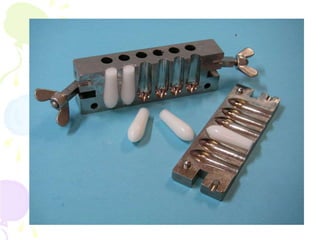
Mold shape
 Molds in common use today are made from stainless
steel.
 The molds, which separate into sections, generally
longitudinally, are opened for cleaning before and
after the preparation of a batch of suppositories.
 Care must be exercised in cleaning the mold for the
desired smoothness of the resulting suppositories.
LUBRICATION OF THE MOLD
Depending upon the formulation, suppository molds
may require lubrication before the melt is poured to
facilitate the clean and easy removal of the molded
suppositories.
Lubrication is seldom necessary when the suppository
base is cocoa butter or polyethylene glycol.
Lubrication is usually necessary when glycerinated
gelatin suppositories are prepared.
Any materials which might cause irritation to the
mucous membranes should not be employed as a mold
lubricant.
(a) the melting of the base
(b) incorporating of any required medicaments
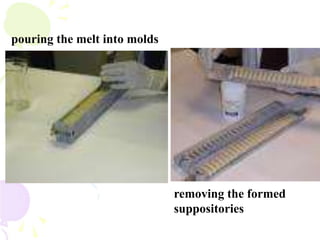
(c) pouring the melt into molds
(d) allowing the melt to cool and congeal into suppositories
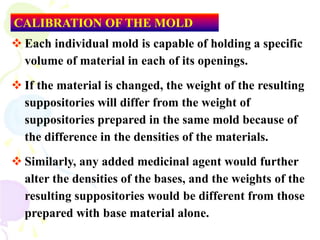
(e) removing the formed suppositories from the mold.
 Notice:Suppositories of cocoa butler, glycerinated gelatin,
polyethylene glycol, and most other suppository bases are
suitable for preparation by molding.
the steps in molding
pouring the melt into molds
removing the formed
suppositories
 Each individual mold is capable of holding a specific
volume of material in each of its openings.
 If the material is changed, the weight of the resulting
suppositories will differ from the weight of
suppositories prepared in the same mold because of
the difference in the densities of the materials.
 Similarly, any added medicinal agent would further
alter the densities of the bases, and the weights of the
resulting suppositories would be different from those
prepared with base material alone.
CALIBRATION OF THE MOLD
It is important that the pharmacist calibrate each of
his suppository molds for the suppository bases that
he generally employs in order that he may prepare
medicated suppositories each having the proper
quantity of medicaments.
First step : to prepare molded suppositories from
base material alone. After removal from the mold,
the suppositories are weighed, and the total weight
and the average weight of each suppository are
recorded as G
 Second step :
 to prepare molded suppositories from base and
drug. After removal from the mold, the
suppositories are weighed, and the total weight
and the average weight of each suppository are
recorded as M
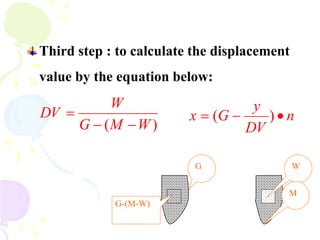
Third step : to calculate the displacement
value by the equation below:
G
G-(M-W)
W
M
)
( W
M
G
W
DV


 n
DV
y
G
x 

 )
(
 For example:
 Prepare the suppositories using cocoa buffer. The
average weight of each blank suppository is 3.5g. Then
adding 1.5g drugs into cocoa buffer and preparing a
medicated suppository. The weight of the medicated
suppository is 4.2g.
 Please calculate the dosage of cocoa buffer if 10
medicated suppositories, every medicated
suppositories contain 1.0g drug, want to be prepared.
 individually wrapped in either foil or a plastic material. Some
are packaged in a continuous strip with suppositories being
separated by tearing along perforations placed between
suppositories
 Suppositories are also commonly packaged in slide boxes or
in plastic boxes.
 maintain in a cool place.
 stored in environments of fitting humidity
Ⅳ Packaging and Storage
Most commercially available suppositories are:
flash1 flash2
Ⅴ Treating role and Clinical applying
systemic action: medicaments may be intended to
be absorbed for the exertion of systemic effects
local action :medicaments may be intended for
retention within the cavity for localized drug effects.
Systemic Action
For systemic effects, the mucous membranes of
the rectum and vagina permit the absorption of
many soluble drugs. Although the rectum is
utilized quite frequently as the site for the
systemic absorption of drugs, the vagina is not as
frequently used for this purpose.
Absorption route:
According to the course of venous flow, a drug
absorbed in the lower part of the rectum should
enter the vena cava;
A drug placed in the upper part of the rectum
should diffuse into blood vessels which lead to the
liver.
The factors affecting the rectal absorption of a drug
administered in the form of a suppository may be divided
into :
(1)physiologic factors: colonic contents, circulation route, and
the pH and lack of buffering capacity of the rectal fluids
(2) physicochemical factors of the drug and the base: The
lipid-water partition coefficient;particle size; nature of the
bases
Affecting factors for absorption
Glossary
Ointments bases; oleaginous; hydrocarbon bases; absorption
bases; water-removable bases;water-soluble bases ;
Petrolatum ; Vaseline; Paraffin ; Anhydrous lanolin ;
Hydrophilic; Antioxidants; incorporation method; fusion
method; emulsification method; ophthalmic ointments;
Suppositories; Body orifices ; Rectal; Vaginal; melting point ;
Cocoa Butter ; polymorphism; hygroscopicity; Glycerinated
gelatin ; Polyethylene glycols; polyoxyl 40 stearate;
displacement value

20120507-semisolid-dosage-form.ppt

  • 1.
  • 2.
  • 3.
  • 4.
    Concept • Definition: semisolidpreparations intended for external application are termed ointments. • Ingredient: drug substance +bases+ adjuvants
  • 5.
    Classification  According tothe dispersion system: (1) solutions type (2) suspension type (3) emulsions type  According to the bases: (1) oleaginous dosage form (2) emulsions dosage form (3) pastes dosage form (4) collodions dosage form (5) ophthalmic dosage form
  • 6.
     Quality requirement theproduct is required smooth and uniform with certain stickiness to skin the drug in bases even distributed stability of the ointment Skin infection preparations are designed to be sterile
  • 7.
    Ointment bases Ointment basesare classified into four general groups: • (1) Hydrocarbon bases • (2) Absorption bases • (3) Water-Removable Bases • (4) Water-Soluble Bases
  • 8.
    (1) hydrocarbon bases Hydrocarbon bases (oleaginous bases) are water-free, and aqueous preparations may be incorporated into them only in small amounts and then with difficulty.  Hydrocarbon bases are retained on the skin for prolonged periods, do not permit the escape of moisture from the skin to the atmosphere, and are difficult to wash off.  As such they act as occlusive dressings. They do not "dry out" or change noticeably upon aging.
  • 9.
    • Petrolatum  amixture of semisolid hydrocarbons obtained from petroleum  an unctuous mass, varying in color from yellow to white  It may be used alone or in combination with other agents as an ointment base  Commercial product is Vaseline
  • 10.
    • Paraffin  Apurified mixture of solid hydrocarbons obtained from petroleum.  A colorless or white, more or less translucent mass that may be used to harden or stiffen oleaginous semisolid ointment bases.
  • 11.
    • Liquid paraffin •a colorless, odorless oily liquid consisting of a mixture of hydrocarbons obtained from petroleum • has the same character with paraffin • be used in combination with paraffin to adjust viscosity
  • 12.
    •Hydrophilic Petrolatum  iscomposed of cholesterol, stearyl alcohol, white wax, and white petrolatum  has the ability to absorb water, with the formation of a water-in- oil emulsion.  Aquaphor is a highly refined variation of Hydrophilic Petrolatum and because it can absorb up to 3 times its weight in water, it has proven useful to incorporate extemporaneously a water-soluble drug into an oleaginous base.
  • 13.
     may containno more than 0.25% of water.  insoluble in water, but mixes without separation with about twice its weight of water  The incorporation of water results in the formation of a water-in-oil emulsion. Anhydrous Lanolin (refined wool fat)
  • 14.
     a semisolid,fatlike substance obtained from the wool of sheep.  a water-in-oil emulsion that contains between 25 and 30% water.  Additional water may be incorporated into lanolin by mixing. Lanolin (hydrous Wool Fat )
  • 15.
    • Beeswax andspermaceti  They are weak sufactants (W/O) and used as stabilization agents in O/W emulsive ointment.
  • 16.
    Mineral Oil • amixture of liquid hydrocarbons. • It is useful as a levigating substance to wet and to incorporate solid substances into the preparation of ointments that consist of oleaginous bases as their vehicle.
  • 17.
    (2) Absorption bases Absorptionbases may be of two types: (1)those that permit the incorporation of aqueous solutions, resulting in the formation of water-in-oil emulsions (e.g. Hydrophilic Petrolatum and Anhydrous lanolin) and those that are already water- in-oil emulsions (emulsion bases) that permit the incorporation of small, additional quantities of aqueous solutions (e.g. lanolin and Cold Cream).
  • 18.
    These bases areuseful as emollients although they do not provide the degree of occlusion afforded by the oleaginous bases. Absorption bases are not easily removed from the skin with water washing. They are also useful pharmaceutically to incorporate aqueous solutions of drugs, e g., sodium sulfacetamide, into oleaginous bases.
  • 19.
    (3)Water-Removable Bases  oil-in-wateremulsions that are capable of being washed from skin or clothing with water. For this reason, they are frequently referred to as "water- washable" ointment bases  may be diluted with water or with aqueous solutions.  have the ability to absorb serous discharges in dermatologic conditions.  Certain medicinal agents may be better absorbed by the skin when present in a base of this type than in other types of bases.
  • 20.
    •Emulsifying agents sodium laurylsulfate :O/W emulsion stearyl alcohol and cetyl alcohol representing the oleaginous phase of the W/O emulsion to improve the stabilization and viscosity.  sodium stearate and calcium stearate. Glyceryl monostearate: weak W/O emulsifying agents and used as stabilization agents and emollient in the O/W emulsion.
  • 21.
    • Spans: W/Oemulsifying agents • Tweens: O /W emulsifying agents • Peregal O and emulsive OP: O/W
  • 22.
    • Stearic acid,beewax and paraffin are the main oleaginous bases. • propylene glycol and water representing the aqueous phase • Methylparaben and propylparaben are used to preserve the ointment against microbial growth
  • 23.
    (4) Water-Soluble Bases •contain only water-soluble components. • are water washable • Because they soften greatly with the addition of water, aqueous solutions are not effectively incorporated into these bases. Rather, they are better used for the incorporation of nonaqueous or solid substances.
  • 24.
    •Polyethylene Glycol Ointment Polyethyleneglycols are polymers of ethylene oxide and water The chain length may be varied to achieve polymers having desired viscosity and physical (liquid, semisolid, or solid) form. The general formula for this base calls for the combining of polyethylene glycol 3350(a solid) and polyethylene glycol 400 (a liquid) to prepare base.
  • 25.
  • 26.
    •Antioxidants preparations Antioxidants aqueous Sodiumsulfite(Na2SO3) sodium bisulfite(NaHSO3), hypophosphorous acid(H3PO2) ascobic acid( vitamin C) oleaginous Alpha tocopherol(vitamin E) Butylhydroxyanisole(BHA) ascorbyl palmitate
  • 27.
    •Antimicrobial preservatives frequently requirethe addition of chemical antimicrobial preservatives to the formulation to inhibit the growth of contaminating microorganisms These preservatives include: para-hydroxybenzoates (parabens), phenols, benzoic acid, sorbic acid, quaternary ammonium salts and other compounds.
  • 28.
    Selection of theAppropriate Base The selection of the base to use in the formulation of an ointment depends upon the careful assessment of a number of factors, including : (a) the desired release rate of the particular drug substance from the ointment base (b) the desirability for enhancement by the base of the percutaneous absorption of the drug
  • 29.
    (c) the advisabilityof occlusion of moisture from the skin by the base (d) the short-term and long-term stability of the drug in the ointment base (e) the influence, if any, of the drug on the consistency or other features of the ointment base. (f) patient factors also play an important role in a base's selection
  • 30.
    Preparation of Ointments Bothon a large and a small scale, ointments are prepared by three general methods: (1) incorporation method (2) fusion method (3) emulsification method The method for a particular preparation depends primarily upon the nature of the ingredients
  • 31.
    (1) incorporation the componentsof the ointment are mixed together by various means until a uniform preparation has been attained. On a small scale, the pharmacist may mix the components of an ointment in a mortar with a pestle, or a spatula and an ointment slab (a large glass or porcelain plate) may be used to rub the ingredients together.
  • 32.
    (2) fusion  Bythe fusion method, all or some of the components of an ointment are combined by being melted together and cooled with constant stirring until congealed.  Those components not melted are generally added to the congealing mixture as it is being cooled and stirred.  Naturally, heat-labile substances and any volatile components are added last when the temperature of the mixture is low enough not to cause decomposition of volatilization of the components.
  • 33.
    • In thepreparation of ointments having an emulsion type of formula, the general method of manufacture involves a melting process as well as an emulsification process. (3) emulsification
  • 34.
    the water-immiscible componentssuch as the oil and waxes are melted together in a steam bath to about 70 to 75°C Meantime, an aqueous solution of all of the heat-stable, water-soluble components is being prepared in the amount of purified water specified in the formula and heated to the same temperature as the oleaginous components.
  • 35.
     Then theaqueous solution is slowly added, with constant stirring (usually with a mechanical stirrer), to the melted oleaginous mixture, the temperature is maintained for 5 to 10 minutes to prevent crystallization of waxes  the mixture is slowly cooled with the stirring continued until the mixture is congealed.
  • 36.
    Notice: • If theaqueous solution were not the same temperature as the oleaginous melt, there would be solidification of some of the waxes upon the addition of the colder aqueous solution to the melted mixture. Emulsification ointments
  • 37.
    Ⅱophthalmic ointments • Concept semisolid preparations intended for application to the eye are specially prepared and are termed ophthalmic ointments.
  • 38.
    •Preparation of ophthalmicointments  The methods of preparation just like ointments,but under the aseptic condition for prevent eye infection.
  • 39.
    •The bases  mustbe non-irritating to the eye and must permit the diffusion of the medicinal substance throughout the secretions bathing the eye.  Ointment bases utilized for ophthalmics have a melting or softening point close to body temperature.  In most instances, mixtures of petrolatum and liquid petrolatum (mineral oil) are utilized as the ointment base.  Sometimes a water-miscible agent as lanolin is added. This permits water and water-insoluble drugs to be retained within the delivery system.
  • 40.
    •The advantage anddisadvantage The primary advantage of an ophthalmic ointment over an ophthalmic solution is the increased ocular contact time of the drug. One disadvantage to ophthalmic ointment use is the blurred vision which occurs as the ointment base melts and is spread across the lens.
  • 41.
  • 42.
    Suppositories are semisoliddosage forms intended for insertion into body orifices where they melt, soften, or dissolve and exert localized or systemic effects. 1.Definition
  • 43.
    Suppositories are commonlyemployed rectally, vaginally and occasionally urethrally. They have various shapes and weights depending upon the density of the base and the medicaments present in it, and the individual manufacturer's product. 2. Body orifices for using
  • 44.
  • 45.
    3.character of action Rectal suppositories are most frequently employed to relieve constipation or the pain, irritation, itching, and inflammation associated with hemorrhoids or other anorectal conditions.  Vaginal suppositories or inserts are employed mainly as contraceptives, antiseptics in feminine hygiene, and as specific agents to combat an invading pathogen.  Urethral suppositories may be used as antibacterial and as a local anesthetic preparative to urethral examination. 1)Local Action
  • 46.
    (a) for therelief of nausea and vomiting and as a tranquilizer (b) for narcotic analgesia (c) for the relief of migraine syndrome (d) anti-inflammatory analgesic and antipyretic. 2)Systemic Action administered rectally in the form of suppositories for systemic effects include:
  • 47.
    3) advantages overoral therapy (rectal route for achieving systemic effects ) (a) drugs destroyed or inactivated by the pH or enzymatic activity of the stomach or intestines need not be exposed to these destructive environments; (b) drugs irritating to the stomach may be given without causing such irritation; (c) drugs destroyed by portal circulation may bypass the liver after rectal absorption (drugs enter the portal circulation after oral administration and absorption);
  • 48.
    (d) the routeis convenient for administration of drugs to adult or pediatric patients who may be unable or unwilling to swallow medication; (e) it is an effective route in the treatment of patients with vomiting episodes.
  • 49.
    4.Quality control ofsuppository  the medicaments and base mixed uniformly with certain hardness under condition of shipment and storage  capable of being easily inserted into the intended body orifice without causing undue distension.  once inserted, the base melts, softens, or dissolves, distributing the medicaments it carries to the tissues of the region. It must be retained for the appropriate period of time for local effects or quickly absorbed for systemic effects . The shape and size of a suppository must be such that
  • 50.
    contains drug,base andother adjuvant ,which the affecting factors for preparation are the physicochemical nature of the drug, the nature of the suppository vehicle and its capacity to release the drug and clinical desired effects from administration 。 Drug properties as the relative solubility of the drug in lipid and in water , the particle size of a dispersed drug. Ⅱ Ingredients of suppositories
  • 51.
    1.requisites for asuppository base is that : 1)it remains solid at room temperature but softens, melts, or dissolves readily at body temperature so that the drug it contains may be made fully available soon after insertion 2)with certain hydrophilic or hydrophobic character 3)melting point near to solidifying point 4) easily ejectable from mold 5) don’t irritate to the mucous membranes Base
  • 52.
    2.Classification of SuppositoryBases According to bases physical characteristics the bases can be classified into (1) fatty or oleaginous bases (2)water-soluble or water-miscible bases
  • 53.
    (1) fatty oroleaginous bases:  Fatty bases are perhaps the most frequently employed suppository bases . A lipophilic drug that is distributed in a fatty suppository base in low concentration has less of a tendency to escape to the surrounding aqueous fluids than would a hydrophilic substance present in a fatty base to an extent approaching its saturation.  fatty bases contains: (a) Cocoa Butter and (b) compounds of glycerin
  • 54.
    the fat obtainedfrom the roasted seed of theobroma cacao. At room temperature it is a yellowish, white solid having a faint, agreeable chocolate-like odor. (a) Cocoa Butter
  • 55.
    Chemically, it isa triglyceride (combination of glycerin and one or different fatty acids) primarily of oleopalmitostearin and oleodistearin. It melts between 30℃ to 36 ℃, an ideal suppository base, melting just below body temperature and yet maintaining its solidity at usual room temperatures.
  • 56.
     because ofits triglyceride content, cocoa butter exhibits marked polymorphism, or different crystalline forms α, β,β’,γ.  Because of this, when cocoa butter is hastily or carelessly melted at a temperature greatly exceeding the minimum required temperature and then quickly chilled, As a result a metastable crystalline form (α crystals) with a melting point much lower than the original cocoa butter that the cocoa butter will not solidify at room temperature.
  • 57.
     Since theform represents a metastable condition, there is a slow transition to the more stable β form of crystals having the greater stability and the higher melting point.  Cocoa butter must be slowly and evenly melted. Preferably over a water bath of warm water, to avoid the formation of the unstable crystalline form and ensure the retention in the liquid of the more stable β crystals that will constitute nuclei upon which the congealing may occur during chilling of the liquid.
  • 58.
     Substances suchas phenol and chloral hydrate have a tendency to lower the melting point of cocoa butter when incorporated with it.  If the mp is lowered to such an extent that it is not feasible to prepare a solid suppository using cocoa butler alone as the base, solidifying agents like cetyl esters wax (about 20%) or beeswax (about 4%) may be melted with the cocoa butter to compensate for the softening effect of the added substance.
  • 59.
    However, the additionsof hardening agents must  not be so excessive as to prevent the melting of the base after the suppository has been inserted into the body,  nor must the wax material interfere with the therapeutic agent in any way so as to alter the efficacy of the product.
  • 60.
     The highermolecular weight fatty acids, such as palmitic and stearic acids, may be found in fatty suppository bases.  Such compounds as glyceryl monostearate and glyceryl monopalmitate are examples of this type of agent. (b) compounds of glycerin
  • 61.
     This baseis slower to soften and mix with the physiologic fluids , therefore provides a more prolonged release;  Because it have a tendency to absorb moisture due to the hygroscopic nature of glycerin, the suppository must be protected from atmospheric moisture in order for them to maintain their shape and consistency  Due also to the hygroscopicity of the glycerin, the suppository may have a dehydrating effect and be irritating to the tissues upon insertion. (2) water-soluble or water-miscible bases (a) Glycerinated gelatin
  • 62.
     The waterpresent in the formula for the suppositories minimizes this action; however, if necessary, the suppositories may be moistened with water prior to their insertion to reduce the initial tendency of the base to draw water from the mucous membranes and irritate the tissues.
  • 63.
    A glycerinated gelatinbase is most frequently used in the preparation of vaginal suppositories, where the prolonged localized action of the medicinal agent is usually desired. vaginal suppositories are much more easily inserted than suppositories with a cocoa butter base, owing to the brittleness of cocoa butter and its rapid softening at body temperature.
  • 64.
     They areavailable in a number of molecular weight ranges, the more commonly used being polyethylene glycol 200,400, 600,1000,1500,1540, 3350, 4000,6000, and 8000. The numerical designations refer to the average molecular weights of each of the polymers. (b) Polyethylene glycols Various combinations of these polyethylene glycols may be combined by fusion, using two or more of the various types to achieve a suppository base of the desired consistency and characteristics.
  • 65.
     Polyethylene glycolsuppositories do not melt at body temperature but rather dissolve slowly in the body's fluids. If the polyethylene glycol suppositories do not contain at least 20%of water to avoid the irritation of the mucous membranes after insertion, they should be dipped in water just prior to use.
  • 66.
     a surface-activeagent with the average polymer length being equivalent to about 40 oxyethylene units.  The substance is a waxy, white to light tan solid that is water-soluble. Its melting point is generally between 39℃ and 45 ℃. (c) polyoxyl 40 stearate
  • 67.
    Ⅲ Preparation ofSuppositories Suppositories are prepared by two methods: (1) Preparation by compression (2) Fusion or preparation by mold
  • 68.
    (1) Preparation byCompression:  Suppositories may be prepared by forcing the mixed mass of the suppository base and the medicaments into special molds using suppository making machines.  In preparation for compression into the molds, the suppository base and the other formulative ingredients are combined by thorough mixing, the friction of the process causing the base to soften into a paste-like consistency.
  • 69.
    (a)cold Compression: The processof compression is especially suited for the making of suppositories containing medicinal substances that are heat labile and for suppositories containing a great deal of substances insoluble in the base.
  • 70.
    (b) hand rollingand shaping:  With the ready availability of suppository molds of accommodating shapes and sizes, there is little requirement for today's pharmacist to shape suppositories by hand.  Hand rolling and shaping is a historic part of the art of the pharmacist.
  • 71.
    (2) Fusion orpreparation by mold  The method is most frequently employed in the preparation of suppositories both on a small scale and on an industrial scale.
  • 72.
    Mold shape  Moldsin common use today are made from stainless steel.  The molds, which separate into sections, generally longitudinally, are opened for cleaning before and after the preparation of a batch of suppositories.  Care must be exercised in cleaning the mold for the desired smoothness of the resulting suppositories.
  • 74.
    LUBRICATION OF THEMOLD Depending upon the formulation, suppository molds may require lubrication before the melt is poured to facilitate the clean and easy removal of the molded suppositories. Lubrication is seldom necessary when the suppository base is cocoa butter or polyethylene glycol. Lubrication is usually necessary when glycerinated gelatin suppositories are prepared. Any materials which might cause irritation to the mucous membranes should not be employed as a mold lubricant.
  • 75.
    (a) the meltingof the base (b) incorporating of any required medicaments (c) pouring the melt into molds (d) allowing the melt to cool and congeal into suppositories (e) removing the formed suppositories from the mold.  Notice:Suppositories of cocoa butler, glycerinated gelatin, polyethylene glycol, and most other suppository bases are suitable for preparation by molding. the steps in molding
  • 76.
    pouring the meltinto molds removing the formed suppositories
  • 77.
     Each individualmold is capable of holding a specific volume of material in each of its openings.  If the material is changed, the weight of the resulting suppositories will differ from the weight of suppositories prepared in the same mold because of the difference in the densities of the materials.  Similarly, any added medicinal agent would further alter the densities of the bases, and the weights of the resulting suppositories would be different from those prepared with base material alone. CALIBRATION OF THE MOLD
  • 78.
    It is importantthat the pharmacist calibrate each of his suppository molds for the suppository bases that he generally employs in order that he may prepare medicated suppositories each having the proper quantity of medicaments. First step : to prepare molded suppositories from base material alone. After removal from the mold, the suppositories are weighed, and the total weight and the average weight of each suppository are recorded as G
  • 79.
     Second step:  to prepare molded suppositories from base and drug. After removal from the mold, the suppositories are weighed, and the total weight and the average weight of each suppository are recorded as M
  • 80.
    Third step :to calculate the displacement value by the equation below: G G-(M-W) W M ) ( W M G W DV    n DV y G x    ) (
  • 81.
     For example: Prepare the suppositories using cocoa buffer. The average weight of each blank suppository is 3.5g. Then adding 1.5g drugs into cocoa buffer and preparing a medicated suppository. The weight of the medicated suppository is 4.2g.  Please calculate the dosage of cocoa buffer if 10 medicated suppositories, every medicated suppositories contain 1.0g drug, want to be prepared.
  • 82.
     individually wrappedin either foil or a plastic material. Some are packaged in a continuous strip with suppositories being separated by tearing along perforations placed between suppositories  Suppositories are also commonly packaged in slide boxes or in plastic boxes.  maintain in a cool place.  stored in environments of fitting humidity Ⅳ Packaging and Storage Most commercially available suppositories are: flash1 flash2
  • 83.
    Ⅴ Treating roleand Clinical applying systemic action: medicaments may be intended to be absorbed for the exertion of systemic effects local action :medicaments may be intended for retention within the cavity for localized drug effects.
  • 84.
    Systemic Action For systemiceffects, the mucous membranes of the rectum and vagina permit the absorption of many soluble drugs. Although the rectum is utilized quite frequently as the site for the systemic absorption of drugs, the vagina is not as frequently used for this purpose.
  • 85.
    Absorption route: According tothe course of venous flow, a drug absorbed in the lower part of the rectum should enter the vena cava; A drug placed in the upper part of the rectum should diffuse into blood vessels which lead to the liver.
  • 87.
    The factors affectingthe rectal absorption of a drug administered in the form of a suppository may be divided into : (1)physiologic factors: colonic contents, circulation route, and the pH and lack of buffering capacity of the rectal fluids (2) physicochemical factors of the drug and the base: The lipid-water partition coefficient;particle size; nature of the bases Affecting factors for absorption
  • 88.
    Glossary Ointments bases; oleaginous;hydrocarbon bases; absorption bases; water-removable bases;water-soluble bases ; Petrolatum ; Vaseline; Paraffin ; Anhydrous lanolin ; Hydrophilic; Antioxidants; incorporation method; fusion method; emulsification method; ophthalmic ointments; Suppositories; Body orifices ; Rectal; Vaginal; melting point ; Cocoa Butter ; polymorphism; hygroscopicity; Glycerinated gelatin ; Polyethylene glycols; polyoxyl 40 stearate; displacement value