POULTICES
A Poultice is a soft , moist mass that is spread on a
cloth and than applied on the skin to treat
various ailments.
Ailments such as insect bites , arthritis , boils ,
infections and more ……
It is also called CATAPLASM
FORMATION OF POULTICES
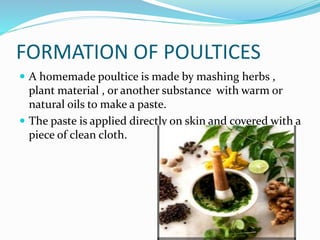
 A homemade poultice is made by mashing herbs ,
plant material , or another substance with warm or
natural oils to make a paste.
 The paste is applied directly on skin and covered with a
piece of clean cloth.
TYPES OF POUTICES
 Some major types of poultices are ;
 Onion poultice
 Potato poultice
 Mustard poultice
 Plantain poultice
 Comfrey poultice
 Tumeric poultice
STAIN REMOVAL FROM STONES
 Greas gather in marble pores can be removed by
poultices
 Poultices for removing stains are made from a
malleable mass of a porous material ( paper , whiting ,
diatomaceous earth flour , limestone ) filled with a
solvent which can be applied to surface of stone .
 Solvent used are ammonia , acetone , alcohol ,
peroxide.
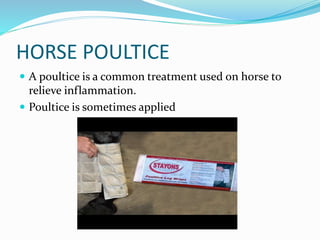
HORSE POULTICE
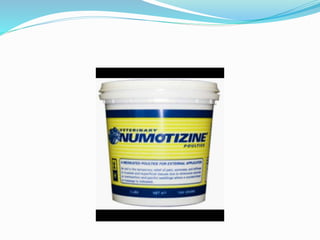
 A poultice is a common treatment used on horse to
relieve inflammation.
 Poultice is sometimes applied
Poultice Composition Advantages Disadvantages
CELLULOSE FIBERS Ph neutralizer
Flexible , soft
High water absorption
Low stability
Risk of mold formation
Bentonite , kaolin , mixed
with cellulose
High water retention
capacity
neutralizer
Risk of white residues on
skin
Become hard
Clays ( no specification ) High water retention
capaicity
Extremely hard
Increased ph values
Cellulose mixture with
high water content
With good quality sands
ph neutral
Properties very difficult to
handle
Low stability
POULTICE
COMPOSITION
ADVANTAGES DISADVANTAGES
Clay minerals light
aggregates mix ,
sometimes with cellulose
Good stability
Low shrinkage
Low density
Risk of white residues on
skin
Can become too hard
Sometimes increased ph
value
QUALITY REQUIREMENTS OF
POULTICES
 Poultice must not contain soluble salts
 The ready to use mixture should have a ph value of 6-
10 maximum at 25 temp.
 Poultice mixture should be easy to apply, It should
adhere well
 Poultice mixture should be free from dyes or colouring
agents
 After treatment it should be possible to remove the
poultice without leaving any residues
 The application of a poutice should be repeated several
times however after the second application its
effectiveness is significantly reduced
DESALINATION POULTICES
 For water bath desalination the success of the
treatment depends on the pore structure the kind of
salts and salt forming ions present and there
distribution , and should be controlled through
analysis
METHODS OF POULTICE
FORMATION
POULTICE WRAPS
EXAMPLES ;
Horse poultices;
 RUNNER RELIEF POULTICE
 Kaolin poultice
STAIN REMOVAL POULTICE;
SPIDER BITE POULTICE;
USES;
 POULTICES are used to cure arthritis.
 POULTICES are used to cure inflamation.
 To relief itching.
 To relief muscle pain muscle spasm
 For desalination
 In horses to treat joints pain.
Poultices

Poultices

  • 3.
    POULTICES A Poultice isa soft , moist mass that is spread on a cloth and than applied on the skin to treat various ailments. Ailments such as insect bites , arthritis , boils , infections and more …… It is also called CATAPLASM
  • 4.
    FORMATION OF POULTICES A homemade poultice is made by mashing herbs , plant material , or another substance with warm or natural oils to make a paste.  The paste is applied directly on skin and covered with a piece of clean cloth.
  • 5.
    TYPES OF POUTICES Some major types of poultices are ;  Onion poultice  Potato poultice  Mustard poultice  Plantain poultice  Comfrey poultice  Tumeric poultice
  • 8.
    STAIN REMOVAL FROMSTONES  Greas gather in marble pores can be removed by poultices  Poultices for removing stains are made from a malleable mass of a porous material ( paper , whiting , diatomaceous earth flour , limestone ) filled with a solvent which can be applied to surface of stone .  Solvent used are ammonia , acetone , alcohol , peroxide.
  • 10.
    HORSE POULTICE  Apoultice is a common treatment used on horse to relieve inflammation.  Poultice is sometimes applied
  • 11.
    Poultice Composition AdvantagesDisadvantages CELLULOSE FIBERS Ph neutralizer Flexible , soft High water absorption Low stability Risk of mold formation Bentonite , kaolin , mixed with cellulose High water retention capacity neutralizer Risk of white residues on skin Become hard Clays ( no specification ) High water retention capaicity Extremely hard Increased ph values Cellulose mixture with high water content With good quality sands ph neutral Properties very difficult to handle Low stability
  • 12.
    POULTICE COMPOSITION ADVANTAGES DISADVANTAGES Clay mineralslight aggregates mix , sometimes with cellulose Good stability Low shrinkage Low density Risk of white residues on skin Can become too hard Sometimes increased ph value
  • 13.
    QUALITY REQUIREMENTS OF POULTICES Poultice must not contain soluble salts  The ready to use mixture should have a ph value of 6- 10 maximum at 25 temp.  Poultice mixture should be easy to apply, It should adhere well  Poultice mixture should be free from dyes or colouring agents  After treatment it should be possible to remove the poultice without leaving any residues
  • 14.
     The applicationof a poutice should be repeated several times however after the second application its effectiveness is significantly reduced
  • 15.
    DESALINATION POULTICES  Forwater bath desalination the success of the treatment depends on the pore structure the kind of salts and salt forming ions present and there distribution , and should be controlled through analysis
  • 16.
  • 17.
  • 18.
  • 19.
  • 20.
  • 21.
  • 22.
  • 23.
    USES;  POULTICES areused to cure arthritis.
  • 24.
     POULTICES areused to cure inflamation.  To relief itching.  To relief muscle pain muscle spasm  For desalination  In horses to treat joints pain.