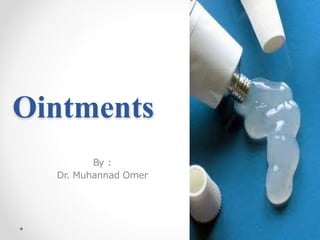
Ointments
• Ointment canbe defined as a semisolid
preparation intended for external application to the
skin or mucous membranes medically, ointments
may be divided into:
• Non _medicated ointment: This may be used as a
protector, emollient, lubricant or may be used as a
vehicle for topical application of therapeutic agent
• Medicated ointment: Used for topical
therapeutic effects.
3.
Classification of ointmentbases:
• Hydrocarbon bases (oleaginous bases).
• Absorption bases.
• Water removable bases.
• Water soluble bases.
Incorporation:
• By thismethod, the components are mixed until a
uniform preparation is attained; this is done by
using mortar and pestle or slab and spatula. We
can sub divided this method into:
• A) Incorporation of solids
• B) Incorporation of liquids:
7.
A) Incorporation ofsolids:
• The ointment base is placed on one side of the
working surface and the powdered components
(previously reduced to fine powders and
thoroughly blended in a mortar) on the other side
• a small portion of the powder is mixed with a
portion of the base until uniform ;the process is
continued until all portions of the powder and the
base are combined and thoroughly and
uniformly blended.
8.
B) Incorporation ofliquids:
• When it is necessary to add an aqueous
preparation to hydrophobic base.
• The solution first may be incorporated into
a minimum amount of a hydrophilic base and
then that mixture added to the hydrophobic base.
9.
Notes:
•
•
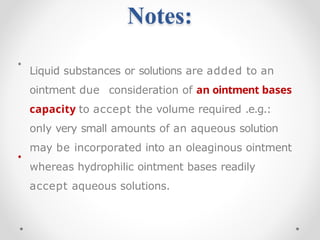
Liquid substances orsolutions are added to an
ointment due consideration of an ointment bases
capacity to accept the volume required .e.g.:
only very small amounts of an aqueous solution
may be incorporated into an oleaginous ointment
whereas hydrophilic ointment bases readily
accept aqueous solutions.
10.
Fusion
• By fusionmethod, all or some of the component
of an ointment are combined by being melted
together and cooled with constant stirring until
congealed. Component not melted are added
to the congealing mixture as it is being cooled
and stirred.
•
11.
Melting of thesubstances is done by one of
the following three methods
•
•
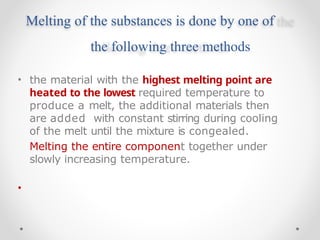
the material with the highest melting point are
heated to the lowest required temperature to
produce a melt, the additional materials then
are added with constant stirring during cooling
of the melt until the mixture is congealed.
Melting the entire component together under
slowly increasing temperature.
12.
Notes
•
•
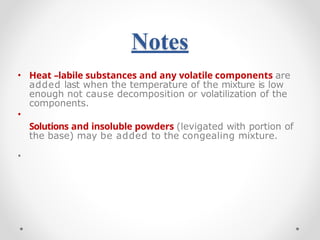
• Heat –labilesubstances and any volatile components are
added last when the temperature of the mixture is low
enough not cause decomposition or volatilization of the
components.
Solutions and insoluble powders (levigated with portion of
the base) may be added to the congealing mixture.
13.
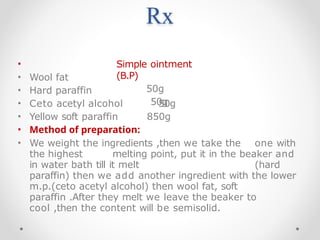
Rx
Simple ointment
(B.P)
50g
50g
50g
850g
•
• Woolfat
• Hard paraffin
• Ceto acetyl alcohol
• Yellow soft paraffin
• Method of preparation:
• We weight the ingredients ,then we take the one with
the highest melting point, put it in the beaker and
in water bath till it melt (hard
paraffin) then we add another ingredient with the lower
m.p.(ceto acetyl alcohol) then wool fat, soft
paraffin .After they melt we leave the beaker to
cool ,then the content will be semisolid.


![Ointments[1]. ppt](https://cdn.slidesharecdn.com/ss_thumbnails/ointments1-241112192150-c530c127-thumbnail.jpg?width=640&height=640&fit=bounds)


![3- lab Skin conditions and diseases [1].pptx](https://cdn.slidesharecdn.com/ss_thumbnails/3-labskincondition1-250426235724-86d8d5a1-thumbnail.jpg?width=640&height=640&fit=bounds)
![industerial 11[r5575677676756767671].pptx](https://cdn.slidesharecdn.com/ss_thumbnails/industerial111-250310082558-cc51ed29-thumbnail.jpg?width=640&height=640&fit=bounds)


![practical lecture. Antihistamine[1].pptx](https://cdn.slidesharecdn.com/ss_thumbnails/lab3-250124181034-64fb9ab8-thumbnail.jpg?width=640&height=640&fit=bounds)


![Lab_four__Nausea_and_Vomiting[1].pp powerx](https://cdn.slidesharecdn.com/ss_thumbnails/lab4nauseaandvomiting1-250114210006-ca029c9c-thumbnail.jpg?width=640&height=640&fit=bounds)


