CURDE OIL REFINING
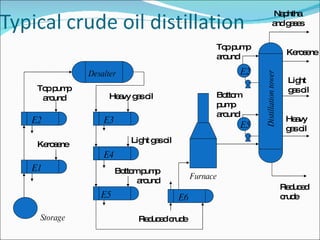
E2 E1 E3 E4 E5 E6 E2 E5 Storage Kerosene Desalter Top pump around Top pump around Naphtha and gases Kerosene Reduced crude Light gas oil Heavy gas oil Reduced crude Heavy gas oil Light gas oil Bottom pump around Distillation tower Bottom pump around Furnace
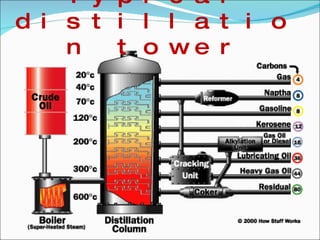
Definition of oil refining An  oil refinery  is an industrial process plant where crude oil is processed and refined into more useful petroleum products, such as  gasoline, diesel fuel, asphalt base, heating oil, kerosine, and liquefied petroleum gas Operation:-   Crude oil is separated into fractions by fractional distillation. The fractionating column is cooler at the top than at the bottom because the fractions at the top have lower boiling points than the fractions at the bottom
Typical distillation tower
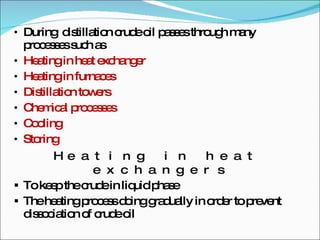
During  distillation crude oil passes through many processes such as Heating in heat exchanger Heating in furnaces Distillation towers Chemical processes Cooling Storing Heating in heat exchangers To keep the crude in liquid phase The heating process doing gradually in order to prevent dissociation of crude oil
Crude path through shell-tube heat exchanger We use in this type for heating oil steam or  a product  Of refining process to save fuel observe that  there are many types working with benzene–kerosine-solar
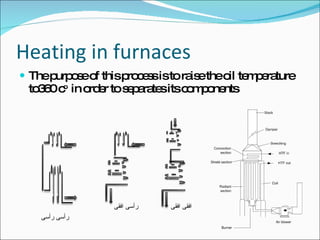
Heating in furnaces The purpose of this process is to raise the oil temperature to360 c o   in order to separates its components  افقى افقى رأسى رأسى رأسى افقى
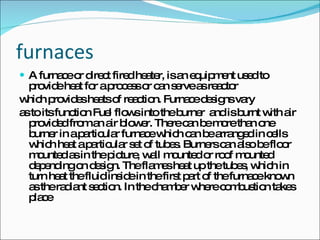
furnaces A furnace or direct fired heater, is an equipment used to provide heat for a process or can serve as reactor which provides heats of reaction. Furnace designs vary as to its function Fuel flows into the burner  and is burnt with air provided from an air blower. There can be more than one burner in a particular furnace which can be arranged in cells which heat a particular set of tubes. Burners can also be floor mounted as in the picture, wall mounted or roof mounted depending on design. The flames heat up the tubes, which in turn heat the fluid inside in the first part of the furnace known as the radiant section. In the chamber where combustion takes place
After the flue gas leaves the firebox, most furnace designs include a convection  section where more heat is recovered before venting to the atmosphere  through the flue gas stack . (HTF=Heat Transfer Fluid. Industries commonly use their furnaces to heat a secondary fluid with special additives like anti-rust and high heat transfer efficiency. This heated fluid is then circulated round the whole plant to heat exchangers to be used wherever heat is needed instead of directly heating the product line as the product or material may be volatile or prone to cracking at the furnace temperature.)
Crude oil cycle The oil enters form the top of furnace at the convection section in order to achieve a gradually heating to the oil then the oil leave this section of radiation which has higher temperature in the furnace  Observe that the oil is carried in two coils and complete cycle in the furnace then each compound of petrol leave to an distillation tower We use mazute a s a fuel in furnace  because it is available  and  cheap
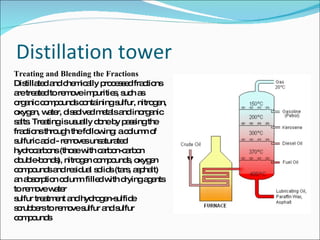
Distillation tower Treating and Blending the Fractions Distillated and chemically processed fractions are treated to remove impurities, such as organic compounds containing sulfur, nitrogen, oxygen, water, dissolved metals and inorganic salts. Treating is usually done by passing the fractions through the following: a column of sulfuric acid - removes unsaturated hydrocarbons (those with carbon-carbon double-bonds), nitrogen compounds, oxygen compounds and residual solids (tars, asphalt)  an absorption column filled with drying agents to remove water  sulfur treatment and hydrogen-sulfide scrubbers to remove sulfur and sulfur compounds
After the fractions have been treated, they are cooled and then blended together to make various products, such as: gasoline of various grades, with or without additives  lubricating oils of various weights and grades kerosene of various grades  jet fuel  diesel fuel  heating oil  chemicals of various grades for making plastics and other polymers
Chemical process You can change one fraction into another by one of three methods: breaking large hydrocarbons into smaller pieces ( cracking )  combining smaller pieces to make larger ones ( unification )  rearranging various pieces to make desired hydrocarbons ( alteration )
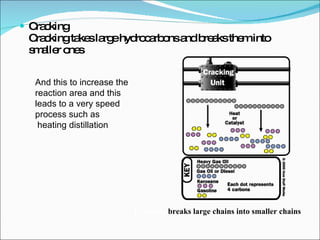
Cracking Cracking takes large hydrocarbons and breaks them into smaller ones Cracking  breaks large chains into smaller chains And this to increase the reaction area and this leads to a very speed process such as heating distillation
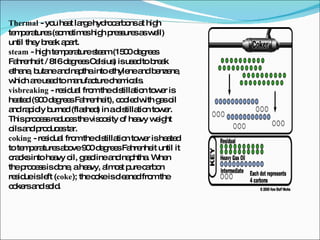
Thermal  - you heat large hydrocarbons at high temperatures (sometimes high pressures as well) until they break apart.  steam  - high temperature steam (1500 degrees Fahrenheit / 816 degrees Celsius) is used to break ethane, butane and naptha into ethylene and benzene, which are used to manufacture chemicals.  visbreaking  - residual from the distillation tower is heated (900 degrees Fahrenheit), cooled with gas oil and rapidly burned (flashed) in a distillation tower. This process reduces the viscosity of heavy weight oils and produces tar.  coking  - residual from the distillation tower is heated to temperatures above 900 degrees Fahrenheit until it cracks into heavy oil, gasoline and naphtha. When the process is done, a heavy, almost pure carbon residue is left ( coke ); the coke is cleaned from the cokers and sold.
The refining process releases numerous different chemicals into the atmosphere; consequently, there are substantial air pollution emissions [7]  and a notable odor normally accompanies the presence of a refinery. Aside from air pollution impacts there are also wastewater concerns, [3]  risks of industrial accidents such as fire and explosion, and noise health effects due to industrial noise .
The public has demanded that many governments place restrictions on contaminants that refineries release, and most refineries have installed the equipment needed to comply with the requirements of the pertinent environmental protection regulatory agencies. In the United States, there is strong pressure to prevent the development of new refineries, and no major refinery has been built in the country since Marathon's Garyville Louisiana facility in 1976. However, many existing refineries have been expanded during that time. Environmental restrictions and pressure to prevent construction of new refineries may have also contributed to rising fuel prices in the United States [8] . Additionally, many refineries (over 100 since the 1980s) have closed due to obsolescence and/or merger activity within the industry itself. This activity has been reported to Congress and in specialized studies not widely publicised.
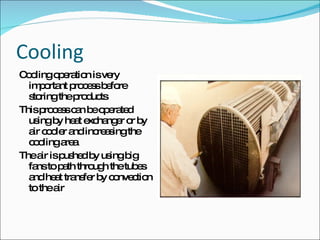
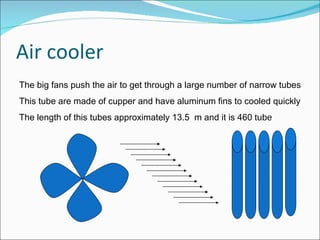
Cooling Cooling operation is very important process before storing the products This process can be operated using by heat exchanger or by air cooler and increasing the cooling area  The air is pushed by using big fans to path through the tubes and heat transfer by convection to the air
Air cooler The big fans push the air to get through a large number of narrow tubes This tube are made of cupper and have aluminum fins to cooled quickly The length of this tubes approximately 13.5  m and it is 460  tube
storing #  Gaseous fuels  such as propane, stored and shipped in  liquid form under pressure in specialized railcars to distributors #  Liquid fuels  blending (producing automotive and aviation grades of gasoline, kerosene, various aviation turbine fuels, and diesel fuels, adding dyes, detergents, antiknock additives, oxygenates, and anti-fungal compounds as required). Shipped by barge, rail, and tanker ship. May be shipped regionally in dedicated pipelines to point consumers, particularly aviation jet fuel to major airports, or piped to distributors in multi-product pipelines using product separators called  pipeline inspection gauges

Oil Refining

  • 1.
  • 2.
    E2 E1 E3E4 E5 E6 E2 E5 Storage Kerosene Desalter Top pump around Top pump around Naphtha and gases Kerosene Reduced crude Light gas oil Heavy gas oil Reduced crude Heavy gas oil Light gas oil Bottom pump around Distillation tower Bottom pump around Furnace
  • 3.
    Definition of oilrefining An oil refinery is an industrial process plant where crude oil is processed and refined into more useful petroleum products, such as gasoline, diesel fuel, asphalt base, heating oil, kerosine, and liquefied petroleum gas Operation:- Crude oil is separated into fractions by fractional distillation. The fractionating column is cooler at the top than at the bottom because the fractions at the top have lower boiling points than the fractions at the bottom
  • 4.
  • 5.
    During distillationcrude oil passes through many processes such as Heating in heat exchanger Heating in furnaces Distillation towers Chemical processes Cooling Storing Heating in heat exchangers To keep the crude in liquid phase The heating process doing gradually in order to prevent dissociation of crude oil
  • 6.
    Crude path throughshell-tube heat exchanger We use in this type for heating oil steam or a product Of refining process to save fuel observe that there are many types working with benzene–kerosine-solar
  • 7.
    Heating in furnacesThe purpose of this process is to raise the oil temperature to360 c o in order to separates its components افقى افقى رأسى رأسى رأسى افقى
  • 8.
    furnaces A furnaceor direct fired heater, is an equipment used to provide heat for a process or can serve as reactor which provides heats of reaction. Furnace designs vary as to its function Fuel flows into the burner and is burnt with air provided from an air blower. There can be more than one burner in a particular furnace which can be arranged in cells which heat a particular set of tubes. Burners can also be floor mounted as in the picture, wall mounted or roof mounted depending on design. The flames heat up the tubes, which in turn heat the fluid inside in the first part of the furnace known as the radiant section. In the chamber where combustion takes place
  • 9.
    After the fluegas leaves the firebox, most furnace designs include a convection section where more heat is recovered before venting to the atmosphere through the flue gas stack . (HTF=Heat Transfer Fluid. Industries commonly use their furnaces to heat a secondary fluid with special additives like anti-rust and high heat transfer efficiency. This heated fluid is then circulated round the whole plant to heat exchangers to be used wherever heat is needed instead of directly heating the product line as the product or material may be volatile or prone to cracking at the furnace temperature.)
  • 10.
    Crude oil cycleThe oil enters form the top of furnace at the convection section in order to achieve a gradually heating to the oil then the oil leave this section of radiation which has higher temperature in the furnace Observe that the oil is carried in two coils and complete cycle in the furnace then each compound of petrol leave to an distillation tower We use mazute a s a fuel in furnace because it is available and cheap
  • 11.
    Distillation tower Treatingand Blending the Fractions Distillated and chemically processed fractions are treated to remove impurities, such as organic compounds containing sulfur, nitrogen, oxygen, water, dissolved metals and inorganic salts. Treating is usually done by passing the fractions through the following: a column of sulfuric acid - removes unsaturated hydrocarbons (those with carbon-carbon double-bonds), nitrogen compounds, oxygen compounds and residual solids (tars, asphalt) an absorption column filled with drying agents to remove water sulfur treatment and hydrogen-sulfide scrubbers to remove sulfur and sulfur compounds
  • 12.
    After the fractionshave been treated, they are cooled and then blended together to make various products, such as: gasoline of various grades, with or without additives lubricating oils of various weights and grades kerosene of various grades jet fuel diesel fuel heating oil chemicals of various grades for making plastics and other polymers
  • 13.
    Chemical process Youcan change one fraction into another by one of three methods: breaking large hydrocarbons into smaller pieces ( cracking ) combining smaller pieces to make larger ones ( unification ) rearranging various pieces to make desired hydrocarbons ( alteration )
  • 14.
    Cracking Cracking takeslarge hydrocarbons and breaks them into smaller ones Cracking breaks large chains into smaller chains And this to increase the reaction area and this leads to a very speed process such as heating distillation
  • 15.
    Thermal -you heat large hydrocarbons at high temperatures (sometimes high pressures as well) until they break apart. steam - high temperature steam (1500 degrees Fahrenheit / 816 degrees Celsius) is used to break ethane, butane and naptha into ethylene and benzene, which are used to manufacture chemicals. visbreaking - residual from the distillation tower is heated (900 degrees Fahrenheit), cooled with gas oil and rapidly burned (flashed) in a distillation tower. This process reduces the viscosity of heavy weight oils and produces tar. coking - residual from the distillation tower is heated to temperatures above 900 degrees Fahrenheit until it cracks into heavy oil, gasoline and naphtha. When the process is done, a heavy, almost pure carbon residue is left ( coke ); the coke is cleaned from the cokers and sold.
  • 16.
    The refining processreleases numerous different chemicals into the atmosphere; consequently, there are substantial air pollution emissions [7] and a notable odor normally accompanies the presence of a refinery. Aside from air pollution impacts there are also wastewater concerns, [3] risks of industrial accidents such as fire and explosion, and noise health effects due to industrial noise .
  • 17.
    The public hasdemanded that many governments place restrictions on contaminants that refineries release, and most refineries have installed the equipment needed to comply with the requirements of the pertinent environmental protection regulatory agencies. In the United States, there is strong pressure to prevent the development of new refineries, and no major refinery has been built in the country since Marathon's Garyville Louisiana facility in 1976. However, many existing refineries have been expanded during that time. Environmental restrictions and pressure to prevent construction of new refineries may have also contributed to rising fuel prices in the United States [8] . Additionally, many refineries (over 100 since the 1980s) have closed due to obsolescence and/or merger activity within the industry itself. This activity has been reported to Congress and in specialized studies not widely publicised.
  • 18.
    Cooling Cooling operationis very important process before storing the products This process can be operated using by heat exchanger or by air cooler and increasing the cooling area The air is pushed by using big fans to path through the tubes and heat transfer by convection to the air
  • 19.
    Air cooler Thebig fans push the air to get through a large number of narrow tubes This tube are made of cupper and have aluminum fins to cooled quickly The length of this tubes approximately 13.5 m and it is 460 tube
  • 20.
    storing # Gaseous fuels such as propane, stored and shipped in liquid form under pressure in specialized railcars to distributors # Liquid fuels blending (producing automotive and aviation grades of gasoline, kerosene, various aviation turbine fuels, and diesel fuels, adding dyes, detergents, antiknock additives, oxygenates, and anti-fungal compounds as required). Shipped by barge, rail, and tanker ship. May be shipped regionally in dedicated pipelines to point consumers, particularly aviation jet fuel to major airports, or piped to distributors in multi-product pipelines using product separators called pipeline inspection gauges

Editor's Notes

  • #3 This illustrates that real flow-sheets are much more complicated than the idealised cases shown previously. The many exchangers are to heat up streams to the required temperature for distillation. The main heat input is from the furnace or fired heater shown. Also, as much heat as possible is recovered when the refined streams are cooled down. As if this were not complicated enough, many of the exchangers shown would actually be groups of exchangers.