OFFSHORE STANDARD
DET NORSKE VERITAS AS
The electronic pdf version of this document found through http://www.dnv.com is the officially binding version
DNV-OS-A201
Winterization for Cold Climate Operations
(Tentative)
OCTOBER 2013
© Det Norske Veritas AS October 2013
Any comments may be sent by e-mail to rules@dnv.com
This service document has been prepared based on available knowledge, technology and/or information at the time of issuance of this document, and is believed to reflect the best of
contemporary technology. The use of this document by others than DNV is at the user's sole risk. DNV does not accept any liability or responsibility for loss or damages resulting from
any use of this document.
FOREWORD
DNV is a global provider of knowledge for managing risk. Today, safe and responsible business conduct is both a license
to operate and a competitive advantage. Our core competence is to identify, assess, and advise on risk management. From
our leading position in certification, classification, verification, and training, we develop and apply standards and best
practices. This helps our customers safely and responsibly improve their business performance. DNV is an independent
organisation with dedicated risk professionals in more than 100 countries, with the purpose of safeguarding life, property
and the environment.
DNV service documents consist of among others the following types of documents:
— Service Specifications. Procedural requirements.
— Standards. Technical requirements.
— Recommended Practices. Guidance.
The Standards and Recommended Practices are offered within the following areas:
A) Qualification, Quality and Safety Methodology
B) Materials Technology
C) Structures
D) Systems
E) Special Facilities
F) Pipelines and Risers
G) Asset Operation
H) Marine Operations
J) Cleaner Energy
O) Subsea Systems
U) Unconventional Oil & Gas
DET NORSKE VERITAS AS
Offshore Standard DNV-OS-A201, October 2013
CHANGES – CURRENT – Page 3
CHANGES – CURRENT
General
This is a new document.
The tentative status of this standard reserves DNV the right to make adjustments in order to obtain the
intentions reflected in the standard.
DET NORSKE VERITAS AS
Offshore Standard DNV-OS-A201, October 2013
Contents – Page 4
CONTENTS
CHANGES – CURRENT................................................................................................................... 3
CH. 1 INTRODUCTION ......................................................................................... 6
Sec. 1 General................................................................................................................................. 6
1 Introduction...............................................................................................................................................6
1.1 Introduction......................................................................................................................................6
1.2 Objectives ........................................................................................................................................6
1.3 Scope................................................................................................................................................6
1.4 Application.......................................................................................................................................6
1.5 Structure...........................................................................................................................................7
2 Normative references................................................................................................................................7
2.1 General.............................................................................................................................................7
2.2 DNV Offshore Service Specifications.............................................................................................7
2.3 DNV Offshore Standards.................................................................................................................8
2.4 DNV Recommended Practices and Standards for Certification .....................................................8
2.5 Other references...............................................................................................................................8
3 Informative references..............................................................................................................................9
3.1 General.............................................................................................................................................9
4 Definitions ..................................................................................................................................................9
4.1 Verbal forms ....................................................................................................................................9
4.2 Definitions........................................................................................................................................9
4.3 Abbreviations.................................................................................................................................10
5 Documentation.........................................................................................................................................10
5.1 General...........................................................................................................................................10
CH. 2 TECHNICAL PROVISIONS..................................................................... 11
Sec. 1 General............................................................................................................................... 11
1 General.....................................................................................................................................................11
1.1 Introduction....................................................................................................................................11
2 Anti-icing, anti-freezing and de-icing ...................................................................................................11
2.1 Anti-icing and anti-freezing measures ..........................................................................................11
2.2 De-icing measures..........................................................................................................................12
Sec. 2 Requirements for all vessel types and services............................................................... 13
1 Introduction.............................................................................................................................................13
1.1 Introduction....................................................................................................................................13
2 Requirements for all vessel types ..........................................................................................................13
2.1 Materials ........................................................................................................................................13
2.2 Stability, watertight/weathertight integrity and deck drainage......................................................16
2.3 Hull Equipment..............................................................................................................................17
2.4 Electrical ........................................................................................................................................23
2.5 Safety .............................................................................................................................................29
2.6 Navigation......................................................................................................................................42
2.7 Machinery and Marine Systems.....................................................................................................44
2.8 Telecommunications......................................................................................................................54
3 Specific requirements for ship-shaped units.........................................................................................56
3.1 General...........................................................................................................................................56
4 Specific requirements for column stabilized units ...............................................................................59
4.1 General...........................................................................................................................................59
5 Specific requirements for self-elevating units.......................................................................................61
5.1 General...........................................................................................................................................61
Sec. 3 Special provisions for drilling units and well intervention units.................................. 65
1 General.....................................................................................................................................................65
1.1 General...........................................................................................................................................65
Sec. 4 Special provisions for accommodation units.................................................................. 71
1 General.....................................................................................................................................................71
DET NORSKE VERITAS AS
Offshore Standard DNV-OS-A201, October 2013
Contents – Page 5
1.1 General...........................................................................................................................................71
Sec. 5 Special provisions for floating production and storage units ....................................... 73
1 General.....................................................................................................................................................73
1.1 General...........................................................................................................................................73
CH. 3 CERTIFICATION AND CLASSIFICATION ......................................... 77
Sec. 1 Classification ..................................................................................................................... 77
1 General.....................................................................................................................................................77
1.1 Introduction....................................................................................................................................77
1.2 Application.....................................................................................................................................77
1.3 Documentation...............................................................................................................................78
Sec. 2 Equipment certification.................................................................................................... 83
1 General.....................................................................................................................................................83
1.1 General...........................................................................................................................................83
DET NORSKE VERITAS AS
Offshore Standard DNV-OS-A201, October 2013
Ch.1 Sec.1 General – Page 6
CHAPTER 1 INTRODUCTION
SECTION 1 GENERAL
1 Introduction
1.1 Introduction
1.1.1 This standard provides general principles for preparation of mobile units and offshore installations for
intended operations in cold-climate conditions.
1.1.2 The standard has been developed for general world-wide application. Governmental legislation in excess
of the provisions of this standard may apply depending on type, location and intended service of the unit or
installation.
1.2 Objectives
1.2.1 The objective of winterization is ensuring that a vessel is capable of and suitably prepared for operations
in cold climates. This is provided for by setting functional requirements to functions, systems and equipment
considered important to safety and which are intended to be in operation in cold-climate conditions.
1.2.2 The objectives of the standard are to:
— provide an internationally acceptable standard for managing the potential deterioration in functionality as
a result of cold climate operations.
— serve as a guideline for designers, suppliers, purchasers and regulators
— specify procedures and requirements for mobile units or offshore installations subject to DNV certification
and classification services.
1.3 Scope
1.3.1 The scope of the standard includes functions, systems and equipment considered important to the safety
of the vessel, personnel and the environment. Winterization is primarily focused on the adverse effects and
control of snow, freezing, sea spray and atmospheric icing on board the vessel, as well as material properties
in cold temperature. Winterization measures include:
— protecting the vessel’s functions, systems and equipment considered important to safety,
— provisioning suitable equipment and supplies, and
— implementing procedures for safe operation and personnel welfare.
1.3.2 This standard does not address those hull and machinery requirements necessary for safe navigation
through sea ice, which are addressed in the relevant ice-class standards.
1.4 Application
1.4.1 Three-tiered approach
The standard adopts a three-tiered approach. First, winterization requirements are based upon fulfilling the
stated functional requirements, which provide the fundamental rationale and intent behind a particular
winterization issue.
Second, some functional requirements are further supported by one or more performance requirements. These
explain in greater detail the type of performance a winterization measure should achieve in order to fulfill the
intent of the functional requirement, either in part or in whole.
Third, functional and performance requirements are supported by prescriptive rules and guidance notes. These
provide a set of generally acceptable solutions to meet the functional and performance requirements, either in
part or in whole.
1.4.2 Performance and prescriptive requirements do not preclude the use of other alternative solutions. Such
solutions will be considered by their ability to fulfill the relevant aspects of the functional requirements.
1.4.3 Equipment not otherwise mentioned in this standard but considered important for safety shall function
normally in cold-climate conditions. Such equipment shall be provided with anti-icing and anti-freezing
protection as appropriate, and shall be constructed of material appropriate for the envisaged cold-climate
conditions.
1.4.4 Winterization Level
For the correct use of this standard, the winterization level (‘Basic’, ‘Cold’ or ‘Polar’) shall be specified by the
DET NORSKE VERITAS AS
Offshore Standard DNV-OS-A201, October 2013
Ch.1 Sec.1 General – Page 7
end user (ref. Ch.3 Sec.1 [1.2.7]). The winterization level governs the application of the technical provisions
included in Chap.2 (ref. Ch.2 Sec.2 [1.1.3]).
1.4.5 Reference Extreme Low Air Temperature (tw)
For correct use of this standard, the reference extreme low air temperature, also referred to as the winterization
temperature (tw), shall be specified by the end user (ref. Ch.3 Sec.1 [1.2.7]). This temperature governs the
application of the technical provisions included in Ch.2.
Guidance note:
International Codes and Standards generally apply the extreme low temperature value (tw) as the basis for material
selection.
For offshore classification, material selection for structural steels (i.e. structural design temperature) has traditionally
been based on the Lowest MDAT temperature methodology (e.g. DNV-OS-C101 for Offshore Steel Structures, DNV
STC 2.22 for Lifting Appliances, DNV-OS-E401 for Helicopter Decks, etc.).
For use of this standard within offshore classification, material selection for structural steels can be based on DNV-
OS-C101, etc., subject to the condition that tw is not more than 15°C colder than the structural design temperature.
Indicative examples:
— Structural design temperature of -19°C is not appropriate for a tw of -35°C
— Structural design temperature of -20°C is appropriate for a tw of -35°C.
— Structural design temperature of -25°C is appropriate for a tw of -40°C.
---e-n-d---of---G-u-i-d-a-n-c-e---n-o-t-e---
1.4.6 In the use of this standard outside offshore classification, the suitability of steel materials and hull
strength with respect to cold climates and ice-infested waters should be considered.
1.5 Structure
1.5.1 This standard is divided into three chapters:
— Ch.1: General introduction, scope, definitions and references.
— Ch.2: Technical provisions for winterized vessels
— Ch.2 Sec.1: General Requirements
— Ch.2 Sec.2: Requirements applicable for all vessel types, including additional requirements for:
— ship-shaped vessels
— column stabilized units
— self-elevating units.
— Ch.2 Sec.3: Specific additional requirements for drilling and well-intervention units
— Ch.2 Sec.4: Specific additional requirements for accommodation units
— Ch.2 Sec.5: Specific additional requirements for floating production and storage units.
— Ch.3: Describing this use of this standard for classification purposes.
2 Normative references
2.1 General
2.1.1 The following standards include requirements that through reference in the text constitute provisions of
this offshore standard. Latest issue of the references shall be used unless otherwise agreed. Other recognised
standards may be used provided it can be demonstrated that these meet or exceed the requirements of the
standards referenced in [2.3] to [2.5].
2.1.2 Any deviations, exceptions and modifications to the codes and standards shall be documented and agreed
between the supplier, purchaser and verifier, as applicable.
2.2 DNV Offshore Service Specifications
2.2.1 Classification
For use of this standard as technical basis for offshore classification as well as description of principles,
DET NORSKE VERITAS AS
Offshore Standard DNV-OS-A201, October 2013
Ch.1 Sec.1 General – Page 8
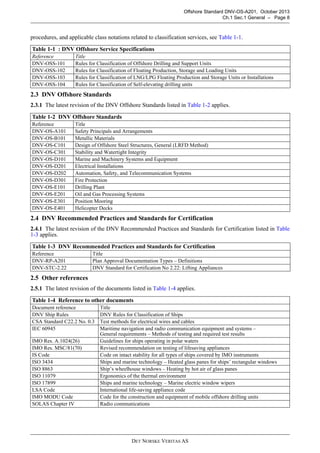
procedures, and applicable class notations related to classification services, see Table 1-1.
2.3 DNV Offshore Standards
2.3.1 The latest revision of the DNV Offshore Standards listed in Table 1-2 applies.
2.4 DNV Recommended Practices and Standards for Certification
2.4.1 The latest revision of the DNV Recommended Practices and Standards for Certification listed in Table
1-3 applies.
2.5 Other references
2.5.1 The latest revision of the documents listed in Table 1-4 applies.
Table 1-1 : DNV Offshore Service Specifications
Reference Title
DNV-OSS-101 Rules for Classification of Offshore Drilling and Support Units
DNV-OSS-102 Rules for Classification of Floating Production, Storage and Loading Units
DNV-OSS-103 Rules for Classification of LNG/LPG Floating Production and Storage Units or Installations
DNV-OSS-104 Rules for Classification of Self-elevating drilling units
Table 1-2 DNV Offshore Standards
Reference Title
DNV-OS-A101 Safety Principals and Arrangements
DNV-OS-B101 Metallic Materials
DNV-OS-C101 Design of Offshore Steel Structures, General (LRFD Method)
DNV-OS-C301 Stability and Watertight Integrity
DNV-OS-D101 Marine and Machinery Systems and Equipment
DNV-OS-D201 Electrical Installations
DNV-OS-D202 Automation, Safety, and Telecommunication Systems
DNV-OS-D301 Fire Protection
DNV-OS-E101 Drilling Plant
DNV-OS-E201 Oil and Gas Processing Systems
DNV-OS-E301 Position Mooring
DNV-OS-E401 Helicopter Decks
Table 1-3 DNV Recommended Practices and Standards for Certification
Reference Title
DNV-RP-A201 Plan Approval Documentation Types – Definitions
DNV-STC-2.22 DNV Standard for Certification No 2.22: Lifting Appliances
Table 1-4 Reference to other documents
Document reference Title
DNV Ship Rules DNV Rules for Classification of Ships
CSA Standard C22.2 No. 0.3 Test methods for electrical wires and cables
IEC 60945 Maritime navigation and radio communication equipment and systems –
General requirements – Methods of testing and required test results
IMO Res. A.1024(26) Guidelines for ships operating in polar waters
IMO Res. MSC/81(70) Revised recommendation on testing of lifesaving appliances
IS Code Code on intact stability for all types of ships covered by IMO instruments
ISO 3434 Ships and marine technology – Heated glass panes for ships’ rectangular windows
ISO 8863 Ship’s wheelhouse windows – Heating by hot air of glass panes
ISO 11079 Ergonomics of the thermal environment
ISO 17899 Ships and marine technology – Marine electric window wipers
LSA Code International life-saving appliance code
IMO MODU Code Code for the construction and equipment of mobile offshore drilling units
SOLAS Chapter IV Radio communications
DET NORSKE VERITAS AS
Offshore Standard DNV-OS-A201, October 2013
Ch.1 Sec.1 General – Page 9
3 Informative references
3.1 General
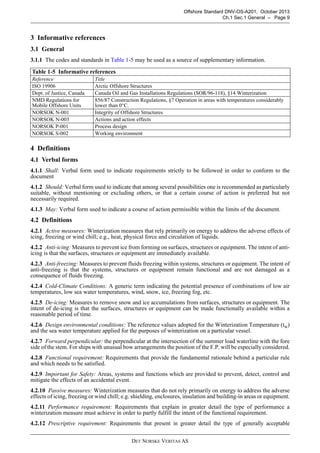
3.1.1 The codes and standards in Table 1-5 may be used as a source of supplementary information.
4 Definitions
4.1 Verbal forms
4.1.1 Shall: Verbal form used to indicate requirements strictly to be followed in order to conform to the
document
4.1.2 Should: Verbal form used to indicate that among several possibilities one is recommended as particularly
suitable, without mentioning or excluding others, or that a certain course of action is preferred but not
necessarily required.
4.1.3 May: Verbal form used to indicate a course of action permissible within the limits of the document.
4.2 Definitions
4.2.1 Active measures: Winterization measures that rely primarily on energy to address the adverse effects of
icing, freezing or wind chill; e.g., heat, physical force and circulation of liquids.
4.2.2 Anti-icing: Measures to prevent ice from forming on surfaces, structures or equipment. The intent of anti-
icing is that the surfaces, structures or equipment are immediately available.
4.2.3 Anti-freezing: Measures to prevent fluids freezing within systems, structures or equipment. The intent of
anti-freezing is that the systems, structures or equipment remain functional and are not damaged as a
consequence of fluids freezing.
4.2.4 Cold-Climate Conditions: A generic term indicating the potential presence of combinations of low air
temperatures, low sea water temperatures, wind, snow, ice, freezing fog, etc.
4.2.5 De-icing: Measures to remove snow and ice accumulations from surfaces, structures or equipment. The
intent of de-icing is that the surfaces, structures or equipment can be made functionally available within a
reasonable period of time.
4.2.6 Design environmental conditions: The reference values adopted for the Winterization Temperature (tw)
and the sea water temperature applied for the purposes of winterization on a particular vessel.
4.2.7 Forward perpendicular: the perpendicular at the intersection of the summer load waterline with the fore
side of the stem. For ships with unusual bow arrangements the position of the F.P. will be especially considered.
4.2.8 Functional requirement: Requirements that provide the fundamental rationale behind a particular rule
and which needs to be satisfied.
4.2.9 Important for Safety: Areas, systems and functions which are provided to prevent, detect, control and
mitigate the effects of an accidental event.
4.2.10 Passive measures: Winterization measures that do not rely primarily on energy to address the adverse
effects of icing, freezing or wind chill; e.g. shielding, enclosures, insulation and building-in areas or equipment.
4.2.11 Performance requirement: Requirements that explain in greater detail the type of performance a
winterization measure must achieve in order to partly fulfill the intent of the functional requirement.
4.2.12 Prescriptive requirement: Requirements that present in greater detail the type of generally acceptable
Table 1-5 Informative references
Reference Title
ISO 19906 Arctic Offshore Structures
Dept. of Justice, Canada Canada Oil and Gas Installations Regulations (SOR/96-118), §14 Winterization
NMD Regulations for
Mobile Offshore Units
856/87 Construction Regulations, §7 Operation in areas with temperatures considerably
lower than 0°C.
NORSOK N-001 Integrity of Offshore Structures
NORSOK N-003 Actions and action effects
NORSOK P-001 Process design
NORSOK S-002 Working environment
DET NORSKE VERITAS AS
Offshore Standard DNV-OS-A201, October 2013
Ch.1 Sec.1 General – Page 10
solutions for a winterization measure to partly fulfill the intent of the functional requirement/performance requirement.
4.2.13 Safety System: Systems, including required utilities, which are to prevent, detect/warn of an accidental
event/abnormal conditions and/or mitigate its effects.
4.2.14 Sea spray icing: Icing caused by the freezing of sea spray on vessel surfaces, structures and equipment.
4.2.15 Winterization: Measures taken to prepare the vessel for operations in cold climates. Winterization is
primarily focused on the adverse effects and control of freezing, icing, wind chill and material properties in
cold temperature.
4.2.16 Winterization temperature (tw): The reference extreme low air temperature used for assessing locations
where the unit can be transported, installed and operated. The winterization temperature is to be lower or equal
to the lowest extreme air temperature for the relevant locations. For seasonally restricted operations, the lowest
extreme air temperature for the season may be applied. (Note: tw is a separate criteria for location assessment
and is in addition to the structural material selection design temperature followed by the Offshore Standards
which apply the Lowest MDAT temperature methodology such as DNV-OS-C101, etc. Both criteria require to
be simultaneously satisfied for a particular location).
4.3 Abbreviations
4.3.1 The abbreviations in Table 1-6 are used.
5 Documentation
5.1 General
5.1.1 Documentation requirements shall be in accordance with the NPS DocReq (DNV Nauticus Production
System for documentation requirements) and Ch.3 Sec.1 [1.3].
Table 1-6 Abbreviations
Abbreviation In full
BOP Blow Out Preventer
CCR Centralised Control Room
CCTV Close Circuit Television
COW Crude Oil Washing
DIFFS Deck Integrated Fire-Fighting System
DNV Det Norske Veritas
EPIRB Emergency Position Indication Radio Beacon
ESD Emergency Shutdown
F & G System Fire and Gas Detection System
HAZOP Hazard and Operability Study
HLO Helicopter Landing Officer
IEC International Electrotechnical Commission
IMO International Maritime Organization
ISO International Organisation of Standardisation
JTA Job Task Analysis
LMRP Lower Marine Riser Package
MES Marine Evacuation System
MODU Mobile Offshore Drilling Unit
NPS DNV Nauticus Production System
OS Offshore Standard
OSS Offshore Service Specification
PA/GA Public Address/General Alarm
PPE Personal Protective Equipment
TR Temporary Refuge
W.L. Waterline
DET NORSKE VERITAS AS
Offshore Standard DNV-OS-A201, October 2013
Ch.2 Sec.1 General – Page 11
CHAPTER 2 TECHNICAL PROVISIONS
SECTION 1 GENERAL
1 General
1.1 Introduction
1.1.1 Winterization measures shall fulfill the functional requirements specified by this Chapter and shall be
considered for approval in each case
1.1.2 The Owner’s Winterization Operations Philosophy/Design Basis Document shall be available on the
start of the design process. This document represents the owner’s operating philosophy adopted for the vessel
to address the often conflicting aspects between winterization issues and the normal vessel design/operational
criteria. It therefore provides the essential context for assessing the particular combination of hardware,
procedural and human aspects that are applied to meet the functional requirements specified in this Chapter.
It should, as a minimum, address the following:
— identify the measures selected for addressing the technical provisions presented in this Chapter, including
the specific anti-icing, anti-freezing and/or de-icing measures selected for each applicable functional
requirement.
— indicate the intended timescale required/manpower available for any de-icing activities (e.g. helideck, etc.)
that require to be completed within a particular time period.
— address the physical proximity necessary to be achieved for any de-icing measures selected, taking account
of the related operational safety issues (e.g. working at heights, working over water, etc.).
— identify any operational temperature limitations and restraints imposed on the industrial activities onboard.
2 Anti-icing, anti-freezing and de-icing
2.1 Anti-icing and anti-freezing measures
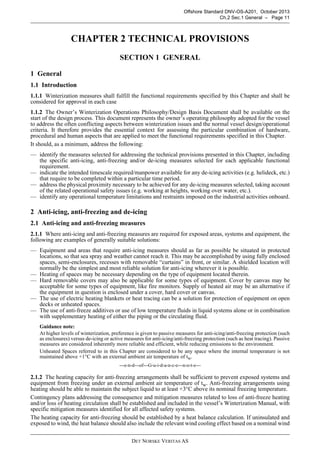
2.1.1 Where anti-icing and anti-freezing measures are required for exposed areas, systems and equipment, the
following are examples of generally suitable solutions:
— Equipment and areas that require anti-icing measures should as far as possible be situated in protected
locations, so that sea spray and weather cannot reach it. This may be accomplished by using fully enclosed
spaces, semi-enclosures, recesses with removable “curtains” in front, or similar. A shielded location will
normally be the simplest and most reliable solution for anti-icing wherever it is possible.
— Heating of spaces may be necessary depending on the type of equipment located therein.
— Hard removable covers may also be applicable for some types of equipment. Cover by canvas may be
acceptable for some types of equipment, like fire monitors. Supply of heated air may be an alternative if
the equipment in question is enclosed under a cover, hard cover or canvas.
— The use of electric heating blankets or heat tracing can be a solution for protection of equipment on open
decks or unheated spaces.
— The use of anti-freeze additives or use of low temperature fluids in liquid systems alone or in combination
with supplementary heating of either the piping or the circulating fluid.
Guidance note:
At higher levels of winterization, preference is given to passive measures for anti-icing/anti-freezing protection (such
as enclosures) versus de-icing or active measures for anti-icing/anti-freezing protection (such as heat tracing). Passive
measures are considered inherently more reliable and efficient, while reducing emissions to the environment.
Unheated Spaces referred to in this Chapter are considered to be any space where the internal temperature is not
maintained above +1°C with an external ambient air temperature of tw.
---e-n-d---of---G-u-i-d-a-n-c-e---n-o-t-e---
2.1.2 The heating capacity for anti-freezing arrangements shall be sufficient to prevent exposed systems and
equipment from freezing under an external ambient air temperature of tw. Anti-freezing arrangements using
heating should be able to maintain the subject liquid to at least +3°C above its nominal freezing temperature.
Contingency plans addressing the consequence and mitigation measures related to loss of anti-freeze heating
and/or loss of heating circulation shall be established and included in the vessel’s Winterization Manual, with
specific mitigation measures identified for all affected safety systems.
The heating capacity for anti-freezing should be established by a heat balance calculation. If uninsulated and
exposed to wind, the heat balance should also include the relevant wind cooling effect based on a nominal wind
DET NORSKE VERITAS AS
Offshore Standard DNV-OS-A201, October 2013
Ch.2 Sec.1 General – Page 12
speed of 20 m/s).
More specific requirements regarding the external ambient air temperature to be applied for particular
applications are presented in the relevant requirements in this Chapter.
2.1.3 Anti-freezing arrangements using anti-freeze additives should be based on providing protection down to
a temperature of 5°C colder than tw.
2.1.4 The heating capacity for anti-icing arrangements shall be sufficient to prevent surface ice forming under
an external ambient air temperature of tw. Anti-icing arrangements using heating should be able to maintain a
surface temperature of at least +3°C.
The heating capacity should be established by a heat balance calculation.
More specific requirements regarding the external ambient air temperature to be applied for particular cases are
given in later sections.
2.1.5 In order to minimize the potential for “Corrosion under Insulation” the heating capacity applied for anti-
freezing arrangements should, wherever practical, be self-regulating to limit the surface temperature to the
working range +3°C to +10°C for insulated surfaces.
2.1.6 In anti-icing and anti-freezing arrangements using heating, special attention shall be paid to the heat
transfer from the heating cables or pipes to the equipment or structure to be heated. The spacing and fastening
of heating cables or pipes shall be appropriate for efficient heating to keep all relevant parts of the equipment
or structure adequately heated. Appropriate spacing of heating cables or pipes shall be established by heat
balance calculations. In addition, special attention shall be paid to the protection of the heating cables or pipes,
particularly from any de-icing activities taking place in the vicinity.
2.1.7 For anti-icing and de-icing arrangements applying heating by fluids in pipes, the installation shall ensure
that the heating fluid maintains its heating effectiveness for the whole length of area to be protected, with the
appropriate level of insulation and the rate of circulation being established by heat balance calculation.
2.1.8 The anti-icing and de-icing arrangements using heat tracing (electric or heating fluid) shall be arranged
to minimize heat tracing dismantling and removal of insulation for adjacent pipework/equipment upon e.g.
change-out of valves or equipment during the in-service phase.
2.2 De-icing measures
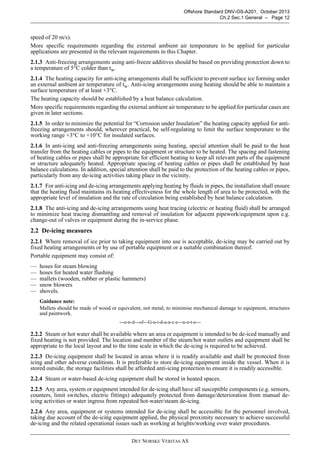
2.2.1 Where removal of ice prior to taking equipment into use is acceptable, de-icing may be carried out by
fixed heating arrangements or by use of portable equipment or a suitable combination thereof.
Portable equipment may consist of:
— hoses for steam blowing
— hoses for heated water flushing
— mallets (wooden, rubber or plastic hammers)
— snow blowers
— shovels.
Guidance note:
Mallets should be made of wood or equivalent, not metal, to minimise mechanical damage to equipment, structures
and paintwork.
---e-n-d---of---G-u-i-d-a-n-c-e---n-o-t-e---
2.2.2 Steam or hot water shall be available where an area or equipment is intended to be de-iced manually and
fixed heating is not provided. The location and number of the steam/hot water outlets and equipment shall be
appropriate to the local layout and to the time scale in which the de-icing is required to be achieved.
2.2.3 De-icing equipment shall be located in areas where it is readily available and shall be protected from
icing and other adverse conditions. It is preferable to store de-icing equipment inside the vessel. When it is
stored outside, the storage facilities shall be afforded anti-icing protection to ensure it is readily accessible.
2.2.4 Steam or water-based de-icing equipment shall be stored in heated spaces.
2.2.5 Any area, system or equipment intended for de-icing shall have all susceptible components (e.g. sensors,
counters, limit switches, electric fittings) adequately protected from damage/deterioration from manual de-
icing activities or water ingress from repeated hot-water/steam de-icing.
2.2.6 Any area, equipment or systems intended for de-icing shall be accessible for the personnel involved,
taking due account of the de-icing equipment applied, the physical proximity necessary to achieve successful
de-icing and the related operational issues such as working at heights/working over water procedures.
DET NORSKE VERITAS AS
Offshore Standard DNV-OS-A201, October 2013
Ch.2 Sec.2 Requirements for all vessel types and services – Page 13
SECTION 2 REQUIREMENTS FOR ALL VESSEL TYPES AND SERVICES
1 Introduction
1.1 Introduction
1.1.1 This section gives requirements which are applicable for all vessels, followed by additional specific
requirements applicable for ship shaped, column stabilized and self-elevating units.
1.1.2 Sec.3, 4 and 5 give additional requirements which are applicable for vessel’s with the Service Notations
Drilling Unit, Accommodation Unit and Floating Production and Storage Unit respectively.
1.1.3 Winterization measures required by Sec.2, 3, 4 and 5 shall fulfill the functional requirements indicated,
and shall be considered for approval in each case. The requirements relevant for the different Winterization
levels ‘Basic’, ‘Cold’ and ‘Polar’ are indicated by an X in the corresponding column of the included Tables.
2 Requirements for all vessel types
2.1 Materials
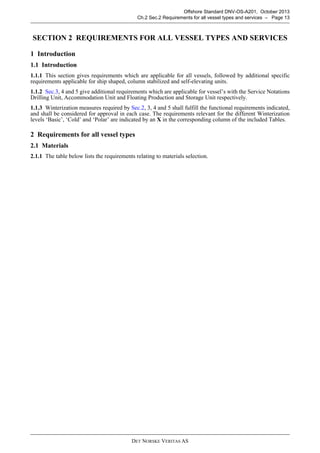
2.1.1 The table below lists the requirements relating to materials selection.
OffshoreStandardDNV-OS-A201,October2013
Ch.2Sec.2Requirementsforallvesseltypesandservices–Page14
DETNORSKEVERITASAS
Table 2-1 Requirements relating to materials selection
Ref. Object
Basic
Cold
Polar
Rule
1
Selection of
Metallic
Material
(general)
X X
Functional requirements:
— All metallic materials used in structure, equipment or systems considered important for safety or otherwise addressed in this standard, and
located in open or unheated spaces, shall have the material grade selected taking account of the cold-climate conditions.
Performance requirement:
— All metallic material, irrespective of function, exposed to cold climate conditions shall have mechanical properties appropriate for the
winterization temperature (tw), also taking into account the routine manual de-icing/snow clearing activities (i.e. impact loads from mallets,
etc.).
— The methodology for the selection of the metallic materials shall be consistent with the design code applied for the item under consideration.
Design codes with material selection based on the extreme low temperature methodology (typically pressure vessels, drilling equipment, etc.)
should apply tw as appropriate.
Design codes with material selection based on the Lowest MDAT temperature methodology (e.g. DNV-OS-C101 for Offshore Steel
Structures,
DNV STC 2.22 for Lifting Appliances, DNV-OS-E401 for Helicopter Decks, etc.) should apply structural design temperature specified for the
unit/installation, subject to the condition that it is not more than 15°C warmer than tw.
Prescriptive requirements:
— Material selection for structural members shall be based on DNV-OS-C101.
— Minor structural members and attachments, including tertiary steelwork beyond the scope of DNV-OS-C101, should have the material
selection based on the Lowest MDAT temperature methodology adopted in Ships Rules Pt.5, Ch.1, Sec.7, B201 (DAT Rules) based on the
structural design temperature specified for the unit/installation and on a Class I structural category.
Pipe material shall be selected in the same manner as for plate material above or according to DNV-OS-B101 Ch.2 Sec.2 D.
For equipment or parts of equipment fabricated from forged or cast material, the impact test temperature and energy shall be selected using
the approach from Ships Rules Pt.5, Ch.1, Sec.6, C605, Table C3).
— Aluminium and Austenitic Stainless Steels are considered suitable to all levels of winterization, without need for further demonstration.
Guidance note:
Demonstration of satisfactory mechanical properties may be documented by Manufacturers Test Report (T.R.) for tertiary steelwork provided
a higher level of documentation is not required elsewhere in the applicable DNV Offshore Standards for the unit.
---e-n-d---of---G-u-i-d-a-n-c-e---n-o-t-e---
OffshoreStandardDNV-OS-A201,October2013
Ch.2Sec.2Requirementsforallvesseltypesandservices–Page15
DETNORSKEVERITASAS
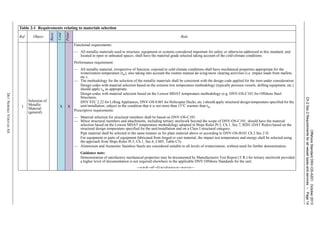
2
Non-
Metallic
Materials
(general)
X X
Functional requirements:
— All non-metallic materials (polymers, seals, ceramics, flexible hoses, fenders, etc.) used in equipment /systems considered important for safety
or otherwise addressed in this standard, and located in open or unheated spaces, shall function normally in cold-climate conditions.
Prescriptive requirements:
— The subject non-metallic materials shall be confirmed to retain their relevant functional properties to an ambient air temperature of tw.
Guidance note:
Demonstration of satisfactory properties can be documented by Manufacturers Declaration (Test Report).
---e-n-d---of---G-u-i-d-a-n-c-e---n-o-t-e---
3
Electronic
Components X X
Functional requirements:
— All electronic components used in equipment considered important for safety or otherwise addressed in this standard, and located in open or
unheated spaces, shall function normally in cold-climate conditions.
Prescriptive requirements:
— The subject electronic components are to have been tested to confirm continued satisfactory operation to an ambient air temperature of tw.
Guidance note:
Demonstration of satisfactory testing can be documented by Manufacturers Test Report (T.R.).
---e-n-d---of---G-u-i-d-a-n-c-e---n-o-t-e---
Table 2-1 Requirements relating to materials selection (Continued)
Ref. Object
Basic
Cold
Polar
Rule
OffshoreStandardDNV-OS-A201,October2013
Ch.2Sec.2Requirementsforallvesseltypesandservices–Page16
DETNORSKEVERITASAS
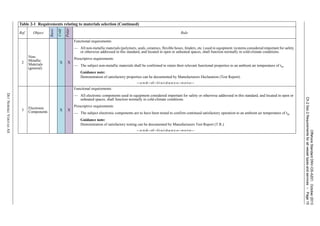
2.2 Stability, watertight/weathertight integrity and deck drainage
2.2.1 The table below lists the requirements relating to Stability, watertight/weathertight integrity and deck drainage.
Table 2-2 Requirements relating to Stability, watertight/weathertight integrity and deck drainage
Ref. Object
Basic
Cold
Polar
Rule
1 Stability: X X X
Functional requirements:
— The vessel shall retain adequate stability under conditions of icing under cold-climate conditions.
Performance requirements:
— The vessel shall satisfy the applicable intact and damage stability requirements under conditions of icing, taking into account the additional
weights due to ice accretion.
— Snow and ice accumulations on the vessel shall be controlled within the vessel’s stability requirements.
Prescriptive requirements:
— Informative reference cases for a relevant range of drafts shall be prepared. Refer to Sec.2 [3] (Ship-Shape), Sec.2 [4] (Column-Stabilized) and
Sec.2 [5] (Self-Elevating) for the reference icing loads.
(Note: Coastal state and flag authorities may have additional reference cases relating to snow loads and icing loads to be addressed).
— Information on exposed areas and height above base-line for all horizontal and lateral surfaces exposed to weather, sufficient to allow vessel
to promptly evaluate the stability effect for an anticipated or observed thickness of snow and/or icing, shall be included in the Stability Manual
and Stability Computer.
(Note: it is assumed that the snow and icing accumulations shall be managed as per standard daily procedures for controlling variable deck
load, with the accumulations being cleared from the accessible areas on an ongoing basis when stability limits are being approached).
2
Deck
Drains X X X
Functional requirements:
— Deck drains shall be not be blocked due to snow, ice or freezing water.
Prescriptive requirements:
— Deck drains, including associated drain boxes and strainers that are not located in heated spaces shall have anti-freezing protection.
— All open decks shall be arranged with drainage that has anti-freezing protection and that are located and dimensioned to ensure that melt water
and any associated wash-down water will drain away promptly.
— Where the working deck areas are not reliably maintained at a temperature of warmer than +3°C and are subject to regular cleaning/wash-down
activities, the number, location and size of the drains should be specially assessed to ensure that the dirty water generated shall drains away
promptly.
Guidance note:
Local sloping of decks should be considered wherever practical, particularly in areas where heavy cleaning/ wash-down activities are carried
out.
---e-n-d---of---G-u-i-d-a-n-c-e---n-o-t-e---
OffshoreStandardDNV-OS-A201,October2013
Ch.2Sec.2Requirementsforallvesseltypesandservices–Page17
DETNORSKEVERITASAS
2.3 Hull Equipment
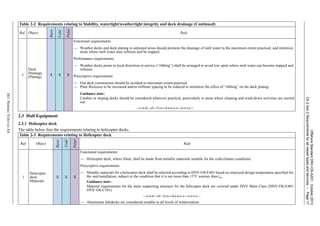
2.3.1 Helicopter deck
The table below lists the requirements relating to helicopter decks.
3
Deck
Drainage
(Plating)
X X X
Functional requirements:
— Weather decks and deck plating in unheated areas should promote the drainage of melt water to the maximum extent practical, and minimize
areas where melt water may refreeze and be trapped.
Performance requirements
— Weather decks prone to local distortion in service (“ribbing”) shall be arranged to avoid low spots where melt water can become trapped and
refreeze.
Prescriptive requirements:
— Flat deck construction should be avoided to maximum extent practical
— Plate thickness to be increased and/or stiffener spacing to be reduced to minimize the effect of “ribbing” on the deck plating.
Guidance note:
Camber or sloping decks should be considered wherever practical, particularly in areas where cleaning and wash-down activities are carried
out.
---e-n-d---of---G-u-i-d-a-n-c-e---n-o-t-e---
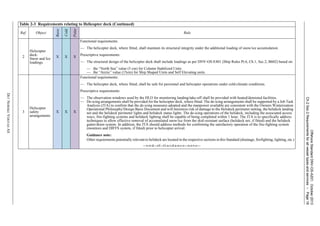
Table 2-3 Requirements relating to Helicopter deck
Ref. Object
Basic
Cold
Polar
Rule
1
Helicopter
deck:
Materials
X X X
Functional requirements:
— Helicopter deck, where fitted, shall be made from metallic materials suitable for the cold-climate conditions.
Prescriptive requirements:
— Metallic materials for a helicopter deck shall be selected according to DNV-OS-E401 based on structural design temperature specified for
the unit/installation, subject to the condition that it is not more than 15°C warmer than tw.
Guidance note:
Material requirements for the main supporting structure for the helicopter deck are covered under DNV Main Class (DNV-OS-E401/
DNV-OS-C101).
---e-n-d---of---G-u-i-d-a-n-c-e---n-o-t-e---
— Aluminium helidecks are considered suitable to all levels of winterization.
Table 2-2 Requirements relating to Stability, watertight/weathertight integrity and deck drainage (Continued)
Ref. Object
Basic
Cold
Polar
Rule
OffshoreStandardDNV-OS-A201,October2013
Ch.2Sec.2Requirementsforallvesseltypesandservices–Page18
DETNORSKEVERITASAS
2
Helicopter
deck:
Snow and Ice
loadings.
X X X
Functional requirements:
— The helicopter deck, where fitted, shall maintain its structural integrity under the additional loading of snow/ice accumulation.
Prescriptive requirements:
— The structural design of the helicopter deck shall include loadings as per DNV-OS-E401 (Ship Rules Pt.6, Ch.1, Sec.2, B602) based on:
— the “North Sea” value (5 cm) for Column Stabilized Units
— the “Arctic” value (15cm) for Ship Shaped Units and Self Elevating units.
3
Helicopter
safety
arrangements
X X X
Functional requirements:
— The helicopter deck, where fitted, shall be safe for personnel and helicopter operations under cold-climate conditions.
Prescriptive requirements:
— The observation windows used by the HLO for monitoring landing/take-off shall be provided with heated/demisted facilities.
— De-icing arrangements shall be provided for the helicopter deck, where fitted. The de-icing arrangements shall be supported by a Job Task
Analysis (JTA) to confirm that the de-icing measures adopted and the manpower available are consistent with the Owners Winterization
Operational Philosophy/Design Basis Document and will minimize risk of damage to the Helideck perimeter netting, the helideck landing
net and the helideck perimeter lights and helideck status lights. The de-icing operations of the helideck, including the associated access
ways, fire-fighting systems and helideck lighting shall be capable of being completed within 1 hour. The JTA is to specifically address
techniques to allow effective removal of accumulated snow/ice from the skid resistant surface (helideck net, if fitted) and the helideck
gutter/drain system. In addition, the JTA should address methods for confirming the satisfactory operation of the fire-fighting system
(monitors and DIFFS system, if fitted) prior to helicopter arrival.
Guidance note:
Other requirements potentially relevant to helideck are located in the respective sections in this Standard (drainage, firefighting, lighting, etc.)
---e-n-d---of---G-u-i-d-a-n-c-e---n-o-t-e---
Table 2-3 Requirements relating to Helicopter deck (Continued)
Ref. Object
Basic
Cold
Polar
Rule
OffshoreStandardDNV-OS-A201,October2013
Ch.2Sec.2Requirementsforallvesseltypesandservices–Page19
DETNORSKEVERITASAS
2.3.2 Deck cranes
The table below lists the requirements relating to deck cranes.
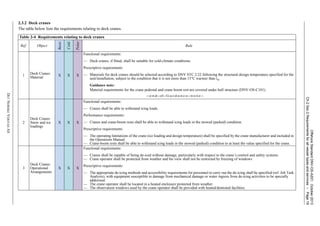
Table 2-4 Requirements relating to deck cranes
Ref. Object
Basic
Cold
Polar
Rule
1
Deck Cranes:
Material
X X X
Functional requirements:
— Deck cranes, if fitted, shall be suitable for cold-climate conditions.
Prescriptive requirements:
— Materials for deck cranes should be selected according to DNV STC 2.22 following the structural design temperature specified for the
unit/installation, subject to the condition that it is not more than 15°C warmer than tw.
Guidance note:
Material requirements for the crane pedestal and crane boom rest are covered under hull structure (DNV-OS-C101).
---e-n-d---of---G-u-i-d-a-n-c-e---n-o-t-e---
2
Deck Cranes:
Snow and ice
loadings
X X X
Functional requirements:
— Cranes shall be able to withstand icing loads.
Performance requirements:
— Cranes and crane-boom rests shall be able to withstand icing loads in the stowed (parked) condition.
Prescriptive requirements:
— The operating limitations of the crane (ice loading and design temperature) shall be specified by the crane manufacturer and included in
the Operations Manual.
— Crane-boom rests shall be able to withstand icing loads in the stowed (parked) condition to at least the value specified for the crane.
3
Deck Cranes:
Operational
Arrangements
X X X
Functional requirements:
— Cranes shall be capable of being de-iced without damage, particularly with respect to the crane’s control and safety systems.
— Crane operator shall be protected from weather and his view shall not be restricted by freezing of windows
Prescriptive requirements:
— The appropriate de-icing methods and accessibility requirements for personnel to carry out the de-icing shall be specified (ref. Job Task
Analysis), with equipment susceptible to damage from mechanical damage or water ingress from de-icing activities to be specially
addressed.
— The crane operator shall be located in a heated enclosure protected from weather.
— The observation windows used by the crane operator shall be provided with heated/demisted facilities.
OffshoreStandardDNV-OS-A201,October2013
Ch.2Sec.2Requirementsforallvesseltypesandservices–Page20
DETNORSKEVERITASAS
2.3.3 Mooring and towing equipment
The table below lists the requirements relating to for mooring and towing equipment.
4
Deck Cranes:
special safety-
related function
X X X
Functional requirements:
— Cranes that are also used for essential safety functions (e.g. crane used for launching/recovering the MOB rescue boat, primary role in
evacuation of personnel) shall operate normally under cold-climate conditions.
Prescriptive requirements:
— The relevant functions of the crane required for achieving the particular functionality shall be fitted with anti-icing protection.
— The relevant functions of the crane shall be immediately available under cold start conditions with an ambient air temperature of tw.
Table 2-5 Requirements relating to mooring and towing equipment
Ref. Object
Basic
Cold
Polar
Rule
1
Operational
Mooring:
Equipment
X X X
Functional requirements
— The crew shall be able to operate the mooring windlass in an environment that protects them from wind, water spray, ice and slippery
conditions.
— The mooring equipment fitted shall be made from materials suitable shall be suitable for cold-climate conditions.
— The mooring system shall be capable of withstanding drifting broken sea ice conditions for vessels with the appropriate Ice Class Notation
(e.g. ICE L for a Column Stabilized Unit).
Prescriptive requirements
— The local mooring windlass control station shall be located in an enclosure protected from weather.
— The observation windows used to monitor the anchor handling operations shall be arranged with heat/demisted arrangements.
— Materials for mooring equipment should be selected according to DNV-OS-E301 following the structural design temperature specified for
the unit/installation, subject to the condition that it is not more than 15°C warmer than tw.
— The mooring system shall be designed to withstand the loadings on the vessel resulting from the drifting of broken sea ice.
(Note: the loadings adopted shall be consistent with the Ice Management Plan [ref. ISO 19906] as specified in the Owners Winterization
Operations Philosophy/Design Basis Document and included in the vessel’s Winterization Operations Manual).
Table 2-4 Requirements relating to deck cranes (Continued)
Ref. Object
Basic
Cold
Polar
Rule
OffshoreStandardDNV-OS-A201,October2013
Ch.2Sec.2Requirementsforallvesseltypesandservices–Page21
DETNORSKEVERITASAS
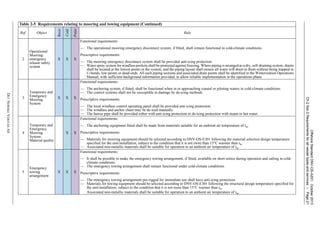
2
Operational
Mooring:
emergency
release safety
system
X X X
Functional requirements:
— The operational mooring emergency disconnect system, if fitted, shall remain functional in cold-climate conditions.
Prescriptive requirements:
— The mooring emergency disconnect system shall be provided anti-icing protection
— Water spray system for windlass pockets shall be protected against freezing. Where piping is arranged as a dry, self-draining system, drains
shall be located at the lowest points in the system, and the piping layout shall ensure all water will drain to them without being trapped in
U-bends, low points or dead-ends. All such piping sections and associated drain points shall be identified in the Winterization Operations
Manual, with sufficient background information provided, to allow reliable implementation in the operations phase.
3
Temporary and
Emergency
Mooring
System
X X X
Functional requirements:
— The anchoring system, if fitted, shall be functional when in or approaching coastal or piloting waters in cold-climate conditions.
— The control systems shall not be susceptible to damage by de-icing methods.
Prescriptive requirements:
— The local windlass control operating panel shall be provided anti-icing protection.
— The windlass and anchor chain may be de-iced manually.
— The hawse pipe shall be provided either with anti-icing protection or de-icing protection with steam or hot water.
4
Temporary and
Emergency
Mooring
System:
Material quality
X X
Functional requirements:
— The anchoring equipment fitted shall be made from materials suitable for an ambient air temperature of tw.
Prescriptive requirements:
— Materials for mooring equipment should be selected according to DNV-OS-E301 following the material selection design temperature
specified for the unit/installation, subject to the condition that it is not more than 15°C warmer than tw.
— Associated non-metallic materials shall be suitable for operation to an ambient air temperature of tw.
5
Emergency
towing
arrangement
X X X
Functional requirements:
— It shall be possible to make the emergency towing arrangement, if fitted, available on short notice during operation and sailing in cold-
climate conditions.
— The emergency towing arrangement shall remain functional under cold-climate conditions.
Prescriptive requirements:
— The emergency towing arrangement pre-rigged for immediate use shall have anti-icing protection.
— Materials for towing equipment should be selected according to DNV-OS-E301 following the structural design temperature specified for
the unit/installation, subject to the condition that it is not more than 15°C warmer than tw.
Associated non-metallic materials shall be suitable for operation to an ambient air temperature of tw.
Table 2-5 Requirements relating to mooring and towing equipment (Continued)
Ref. Object
Basic
Cold
Polar
Rule
OffshoreStandardDNV-OS-A201,October2013
Ch.2Sec.2Requirementsforallvesseltypesandservices–Page22
DETNORSKEVERITASAS
2.3.4 Misc. deck equipment
The table below lists the requirements relating to misc. deck equipment.
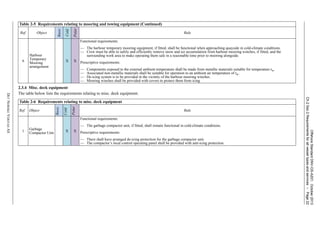
6
Harbour
Temporary
Mooring
arrangement
X X
Functional requirements:
— The harbour temporary mooring equipment, if fitted, shall be functional when approaching quayside in cold-climate conditions.
— Crew must be able to safely and efficiently remove snow and ice accumulation from harbour mooring winches, if fitted, and the
surrounding work area to make operating them safe in a reasonable time prior to mooring alongside.
Prescriptive requirements:
— Components exposed to the external ambient temperature shall be made from metallic materials suitable for temperature tw.
— Associated non-metallic materials shall be suitable for operation to an ambient air temperature of tw.
— De-icing system is to be provided in the vicinity of the harbour mooring winches.
— Mooring winches shall be provided with covers to protect them from icing.
Table 2-6 Requirements relating to misc. deck equipment
Ref. Object
Basic
Cold
Polar
Rule
1
Garbage
Compactor Unit X X
Functional requirements:
— The garbage compactor unit, if fitted, shall remain functional in cold-climate conditions.
Prescriptive requirements:
— There shall have arranged de-icing protection for the garbage compactor unit.
— The compactor’s local control operating panel shall be provided with anti-icing protection.
Table 2-5 Requirements relating to mooring and towing equipment (Continued)
Ref. Object
Basic
Cold
Polar
Rule
OffshoreStandardDNV-OS-A201,October2013
Ch.2Sec.2Requirementsforallvesseltypesandservices–Page23
DETNORSKEVERITASAS
2.4 Electrical
2.4.1 Electrical general
The table below lists the requirements relating to electrical general.
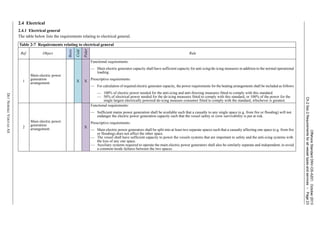
Table 2-7 Requirements relating to electrical general
Ref. Object
Basic
Cold
Polar
Rule
1
Main electric power
generation
arrangement X X
Functional requirements:
— Main electric generator capacity shall have sufficient capacity for anti-icing/de-icing measures in addition to the normal operational
loading.
Prescriptive requirements:
— For calculation of required electric generator capacity, the power requirements for the heating arrangements shall be included as follows:
— 100% of electric power needed for the anti-icing and anti-freezing measures fitted to comply with this standard.
— 50% of electrical power needed for the de-icing measures fitted to comply with this standard, or 100% of the power for the
single largest electrically powered de-icing measure consumer fitted to comply with the standard, whichever is greatest.
2
Main electric power
generation
arrangement
X
Functional requirements:
— Sufficient mains power generation shall be available such that a casualty to any single space (e.g. from fire or flooding) will not
endanger the electric power generation capacity such that the vessel safety or crew survivability is put at risk.
Prescriptive requirements:
— Main electric power generators shall be split into at least two separate spaces such that a casualty affecting one space (e.g. from fire
or flooding) does not affect the other space.
— The vessel shall have sufficient capacity to power the vessels systems that are important to safety and the anti-icing systems with
the loss of any one space.
— Auxiliary systems required to operate the main electric power generators shall also be similarly separate and independent, to avoid
a common-mode failures between the two spaces.
OffshoreStandardDNV-OS-A201,October2013
Ch.2Sec.2Requirementsforallvesseltypesandservices–Page24
DETNORSKEVERITASAS
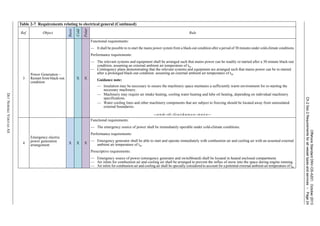
3
Power Generation –
Restart from black-out
condition
X X
Functional requirements:
— It shall be possible to re-start the mains power system from a black-out condition after a period of 30 minutes under cold-climate conditions.
Performance requirements:
— The relevant systems and equipment shall be arranged such that mains power can be readily re-started after a 30 minute black-out
condition, assuming an external ambient air temperature of tw.
— Contingency plans demonstrating that the relevant systems and equipment are arranged such that mains power can be re-started
after a prolonged black-out condition. assuming an external ambient air temperature of tw.
Guidance note:
— Insulation may be necessary to ensure the machinery space maintains a sufficiently warm environment for re-starting the
necessary machinery.
— Machinery may require air intake heating, cooling water heating and lube oil heating, depending on individual machinery
specifications.
— Water cooling lines and other machinery components that are subject to freezing should be located away from uninsulated
external boundaries.
---e-n-d---of---G-u-i-d-a-n-c-e---n-o-t-e---
4
Emergency electric
power generation
arrangement
X X X
Functional requirements:
— The emergency source of power shall be immediately operable under cold-climate conditions.
Performance requirements:
— Emergency generator shall be able to start and operate immediately with combustion air and cooling air with an assumed external
ambient air temperature of tw.
Prescriptive requirements:
— Emergency source of power (emergency generator and switchboard) shall be located in heated enclosed compartment.
— Air inlets for combustion air and cooling air shall be arranged to prevent the influx of snow into the space during engine running.
— Air inlets for combustion air and cooling air shall be specially considered to account for a potential external ambient air temperature of tw.
Table 2-7 Requirements relating to electrical general (Continued)
Ref. Object
Basic
Cold
Polar
Rule
OffshoreStandardDNV-OS-A201,October2013
Ch.2Sec.2Requirementsforallvesseltypesandservices–Page25
DETNORSKEVERITASAS
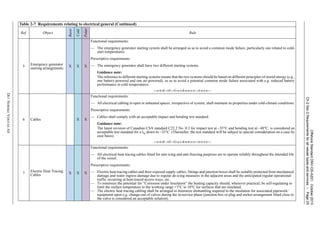
5
Emergency generator
starting arrangements
X X X
Functional requirements:
— The emergency generator starting system shall be arranged so as to avoid a common mode failure, particularly one related to cold-
start temperatures.
Prescriptive requirements:
— The emergency generator shall have two different starting systems.
Guidance note:
The reference to different starting systems means that the two systems should be based on different principles of stored energy (e.g.,
one battery-powered and one air-powered), so as to avoid a potential common mode failure associated with e.g. reduced battery
performance in cold temperatures.
---e-n-d---of---G-u-i-d-a-n-c-e---n-o-t-e---
6 Cables X X
Functional requirements:
— All electrical cabling in open or unheated spaces, irrespective of system, shall maintain its properties under cold-climate conditions.
Prescriptive requirements:
— Cables shall comply with an acceptable impact and bending test standard.
Guidance note:
The latest revision of Canadian CSA standard C22.2 No. 0.3 for impact test at –35°C and bending test at –40°C, is considered an
acceptable test standard for a tw down to –35°C. (Thereafter, the test standard will be subject to special consideration on a case by
case basis).
---e-n-d---of---G-u-i-d-a-n-c-e---n-o-t-e---
7
Electric Heat Tracing
Cables X X X
Functional requirements:
— All electrical heat tracing cables fitted for anti-icing and anti-freezing purposes are to operate reliably throughout the intended life
of the vessel.
Prescriptive requirements:
— Electric heat tracing cables and their exposed supply cables, fittings and junction boxes shall be suitably protected from mechanical
damage and water ingress damage due to regular de-icing measures in the adjacent areas and the anticipated regular operational
traffic occurring at heat-traced access ways, etc.
— To minimize the potential for “Corrosion under Insulation” the heating capacity should, wherever practical, be self-regulating to
limit the surface temperature to the working range +3°C to 10°C for surfaces that are insulated.
— The electric heat tracing cabling shall be arranged to minimize dismantling required to the insulation for associated pipework/
equipment upon e.g. change-out of valves during the in-service phase (junction box or plug and socket arrangement fitted close to
the valve is considered an acceptable solution).
Table 2-7 Requirements relating to electrical general (Continued)
Ref. Object
Basic
Cold
Polar
Rule
OffshoreStandardDNV-OS-A201,October2013
Ch.2Sec.2Requirementsforallvesseltypesandservices–Page26
DETNORSKEVERITASAS
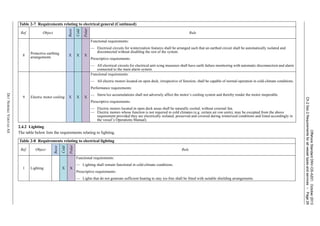
2.4.2 Lighting
The table below lists the requirements relating to lighting.
8 Protective earthing
arrangements
X X X
Functional requirements:
— Electrical circuits for winterization features shall be arranged such that an earthed circuit shall be automatically isolated and
disconnected without disabling the rest of the system.
Prescriptive requirements:
— All electrical circuits for electrical anti-icing measures shall have earth failure monitoring with automatic disconnection and alarm
connected to the main alarm system.
9 Electric motor cooling X X X
Functional requirements:
— All electric motors located on open deck, irrespective of function, shall be capable of normal operation in cold-climate conditions.
Performance requirements:
— Snow/ice accumulations shall not adversely affect the motor’s cooling system and thereby render the motor inoperable.
Prescriptive requirements:
— Electric motors located in open deck areas shall be naturally cooled, without external fan.
— Electric motors whose function is not required in cold climates (e.g. certain air con units), may be excepted from the above
requirement provided they are electrically isolated, preserved and covered during winterized conditions and listed accordingly in
the vessel’s Operations Manual).
Table 2-8 Requirements relating to electrical lighting
Ref. Object
Basic
Cold
Polar
Rule
1 Lighting X X
Functional requirements:
— Lighting shall remain functional in cold-climate conditions.
Prescriptive requirements:
— Lights that do not generate sufficient heating to stay ice-free shall be fitted with suitable shielding arrangements.
Table 2-7 Requirements relating to electrical general (Continued)
Ref. Object
Basic
Cold
Polar
Rule
OffshoreStandardDNV-OS-A201,October2013
Ch.2Sec.2Requirementsforallvesseltypesandservices–Page27
DETNORSKEVERITASAS
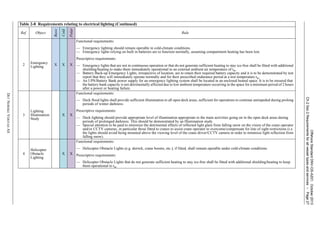
2
Emergency
Lighting X X X
Functional requirements:
— Emergency lighting should remain operable in cold-climate conditions.
— Emergency lights relying on built in batteries are to function normally, assuming compartment heating has been lost.
Prescriptive requirements:
— Emergency lights that are not in continuous operation or that do not generate sufficient heating to stay ice-free shall be fitted with additional
shielding/heating to make them immediately operational to an external ambient air temperature of tw.
— Battery Back-up Emergency Lights, irrespective of location, are to retain their required battery capacity and it is to be demonstrated by test
report that they will immediately operate normally and for their prescribed endurance period at a test temperature tw.
— An UPS/Battery Bank power supply for an emergency lighting system shall be located in an enclosed heated space. It is to be ensured that
the battery bank capacity is not detrimentally affected due to low ambient temperature occurring in the space for a minimum period of 2 hours
after a power or heating failure.
3
Lighting:
Illumination
Study
X X
Functional requirements:
— Deck flood lights shall provide sufficient illumination to all open deck areas, sufficient for operations to continue unimpeded during prolong
periods of winter darkness.
Prescriptive requirements:
— Deck lighting should provide appropriate level of illumination appropriate to the main activities going on in the open deck areas during
periods of prolonged darkness. This should be demonstrated by an Illumination study.
— Special attention to be paid to minimize the detrimental effects of reflected light glare from falling snow on the vision of the crane operator
and/or CCTV cameras, in particular those fitted to cranes to assist crane operator to overcome/compensate for line of sight restrictions (i.e.
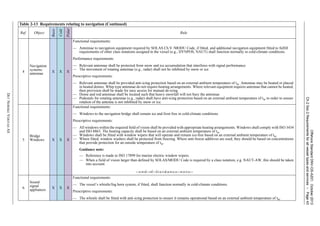
the lights should avoid being mounted above the viewing level of the crane driver/CCTV camera in order to minimize light reflection from
falling snow).
4
Helicopter
Obstacle
Lighting
X X
Functional requirements:
— Helicopter Obstacle Lights (e.g. derrick, crane booms, etc.), if fitted, shall remain operable under cold-climate conditions.
Prescriptive requirements:
— Helicopter Obstacle Lights that do not generate sufficient heating to stay ice-free shall be fitted with additional shielding/heating to keep
them operational to tw.
Table 2-8 Requirements relating to electrical lighting (Continued)
Ref. Object
Basic
Cold
Polar
Rule
OffshoreStandardDNV-OS-A201,October2013
Ch.2Sec.2Requirementsforallvesseltypesandservices–Page28
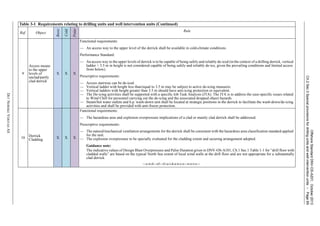
DETNORSKEVERITASAS
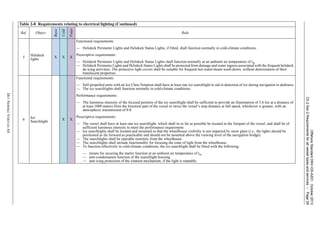
5
Helideck
lights
X X X
Functional requirements:
— Helideck Perimeter Lights and Helideck Status Lights, if fitted, shall function normally in cold-climate conditions.
Prescriptive requirements:
— Helideck Perimeter Lights and Helideck Status Lights shall function normally at an ambient air temperature of tw.
— Helideck Perimeter Lights and Helideck Status Lights shall be protected from damage and water ingress associated with the frequent helideck
de-icing activities. The protective light covers shall be suitable for frequent hot-water/steam wash-down, without deterioration of their
translucent properties.
6 Ice
Searchlight
X X
Functional requirements:
— Self-propelled units with an Ice Class Notation shall have at least one ice searchlight to aid in detection of ice during navigation in darkness.
— The ice searchlights shall function normally in cold-climate conditions.
Performance requirements:
— The luminous intensity of the focused position of the ice searchlight shall be sufficient to provide an illumination of 5.6 lux at a distance of
at least 1000 meters from the foremost part of the vessel or twice the vessel’s stop distance at full speed, whichever is greater, with an
atmospheric transmission of 0.8.
Prescriptive requirements:
— The vessel shall have at least one ice searchlight, which shall in so far as possible be located in the forepart of the vessel, and shall be of
sufficient luminous intensity to meet the performance requirement.
— Ice searchlights shall be located and mounted so that the wheelhouse visibility is not impaired by snow glare (i.e., the lights should be
positioned as far forward as practicable and should not be mounted above the viewing level of the navigation bridge).
— The searchlights shall be operable remotely from the wheelhouse.
— The searchlights shall include functionality for focusing the cone of light from the wheelhouse.
— To function effectively in cold-climate conditions, the ice searchlight shall be fitted with the following:
— means for securing the starter function at an ambient air temperature of tw.
— anti-condensation function of the searchlight housing
— anti-icing protection of the rotation mechanism, if the light is rotatable.
Table 2-8 Requirements relating to electrical lighting (Continued)
Ref. Object
Basic
Cold
Polar
Rule
OffshoreStandardDNV-OS-A201,October2013
Ch.2Sec.2Requirementsforallvesseltypesandservices–Page29
DETNORSKEVERITASAS
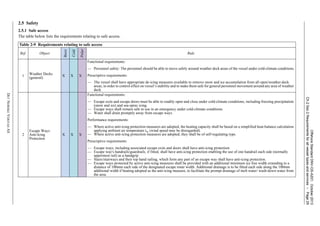
2.5 Safety
2.5.1 Safe access
The table below lists the requirements relating to safe access.
Table 2-9 Requirements relating to safe access
Ref. Object
Basic
Cold
Polar
Rule
1 Weather Decks
(general)
X X X
Functional requirements:
— Personnel safety: The personnel should be able to move safely around weather deck areas of the vessel under cold-climate conditions.
Prescriptive requirements:
— The vessel shall have appropriate de-icing measures available to remove snow and ice accumulation from all open/weather-deck
areas, in order to control effect on vessel’s stability and to make them safe for general personnel movement around any area of weather
deck.
2
Escape Ways:
Anti-Icing
Protection
X X X
Functional requirements:
— Escape exits and escape doors must be able to readily open and close under cold-climate conditions, including freezing precipitation
(snow and ice) and sea-spray icing.
— Escape ways shall remain safe to use in an emergency under cold-climate conditions.
— Water shall drain promptly away from escape ways.
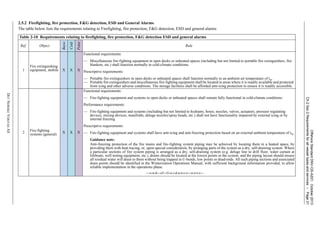
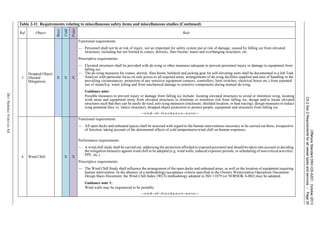
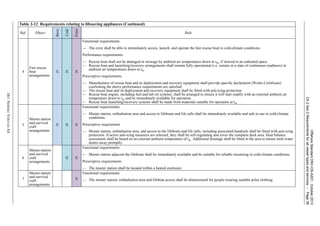
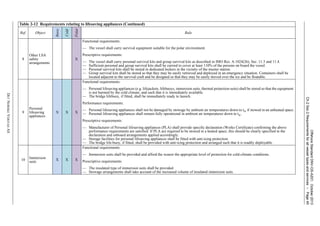
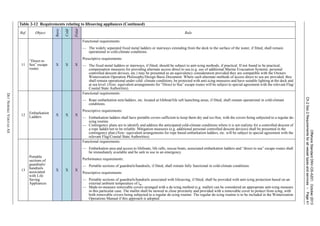
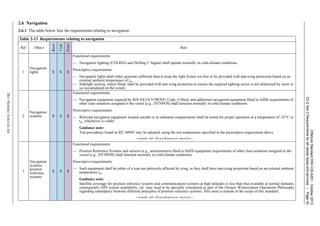
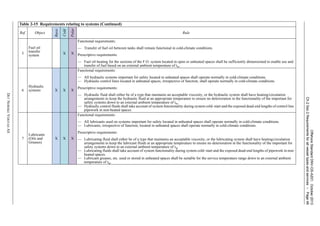
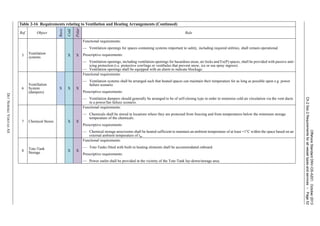
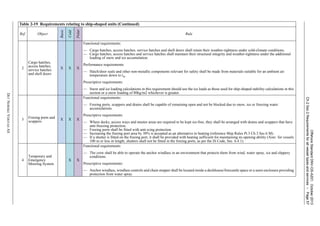
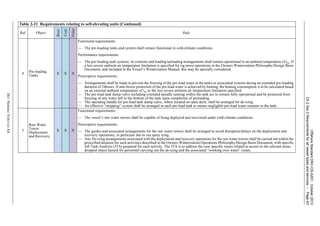
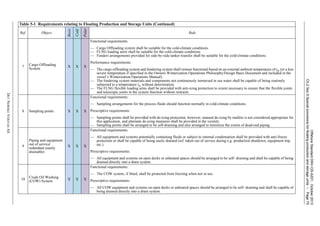
Performance requirements:
— Where active anti-icing protection measures are adopted, the heating capacity shall be based on a simplified heat-balance calculation
applying ambient air temperature tw (wind speed may be disregarded).
— Where active anti-icing protection measures are adopted, they shall be of self-regulating type.
Prescriptive requirements:
— Escape ways, including associated escape exits and doors shall have anti-icing protection.
— Escape way's handrails/guardrails, if fitted, shall have anti-icing protection enabling the use of one handrail each side (normally
uppermost rail) as a handgrip.
— Stairs/stairways and their top hand railing, which form any part of an escape way shall have anti-icing protection.
— Escape ways protected by active anti-icing measures shall be provided with an additional minimum ice free width extending to a
distance of 100mm each side of the designated escape route width. Additional drainage is to be fitted each side along the 100mm
additional width if heating adopted as the anti-icing measure, to facilitate the prompt drainage of melt water/ wash-down water from
the area.
OffshoreStandardDNV-OS-A201,October2013
Ch.2Sec.2Requirementsforallvesseltypesandservices–Page30
DETNORSKEVERITASAS
3 Escape Ways X
Functional requirements:
— Escape ways from the Muster Stations to the Lifesaving appliances shall be dimensioned so as not to hinder passage for persons
wearing suitable polar clothing.
Guidance note:
Clothing as per Owners Winterization Operations Philosophy/Design Basis Document (or IMO Res. A.1024 (26), Sec.4.3.2 if
nothing else specified).
---e-n-d---of---G-u-i-d-a-n-c-e---n-o-t-e---
4 Sliding Doors X X X
Functional requirements:
— Sliding doors, irrespective of function, shall operate reliably in cold-climate conditions.
Prescriptive requirements:
— Sliding doors on open decks shall be arranged to prevent snow/ice build-up at the roller/guides assembly (ref. blocks the door
operation upon freezing).
— Sliding doors on open decks forming part of an escape way shall be protected by passive anti-icing measures.
Table 2-9 Requirements relating to safe access (Continued)
Ref. Object
Basic
Cold
Polar
Rule
OffshoreStandardDNV-OS-A201,October2013
Ch.2Sec.2Requirementsforallvesseltypesandservices–Page31
DETNORSKEVERITASAS
2.5.2 Firefighting, fire protection, F&G detection, ESD and General Alarms
The table below lists the requirements relating to Firefighting, fire protection, F&G detection, ESD and general alarms
Table 2-10 Requirements relating to firefighting, fire protection, F&G detection ESD and general alarms
Ref. Object
Basic
Cold
Polar
Rule
1
Fire extinguishing
equipment, mobile X X X
Functional requirements:
— Miscellaneous fire-fighting equipment in open decks or unheated spaces (including but not limited to portable fire extinguishers, fire
blankets, etc.) shall function normally in cold-climate conditions.
Prescriptive requirements:
— Portable fire extinguishers in open decks or unheated spaces shall function normally to an ambient air temperature of tw.
— Portable fire extinguishers and miscellaneous fire-fighting equipment shall be located in areas where it is readily available and protected
from icing and other adverse conditions. The storage facilities shall be afforded anti-icing protection to ensure it is readily accessible.
2
Fire-fighting
systems (general)
X X X
Functional requirements:
— Fire-fighting equipment and systems in open decks or unheated spaces shall remain fully functional in cold-climate conditions.
Performance requirements:
— Fire-fighting equipment and systems (including but not limited to hydrants, hoses, nozzles, valves, actuators, pressure regulating
devices, mixing devices, manifolds, deluge nozzles/spray heads, etc.) shall not have functionality impaired by external icing or by
internal freezing
Prescriptive requirements:
— Fire-fighting equipment and systems shall have anti-icing and anti-freezing protection based on an external ambient temperature of tw.
Guidance note:
Anti-freezing protection of the fire mains and fire-fighting system piping may be achieved by locating them in a heated space, by
providing them with heat tracing, or, upon special consideration, by arranging parts of the system as a dry, self-draining system. Where
a particular sections of fire system piping is arranged as a dry, self-draining system (e.g. deluge line to drill floor, water curtain at
lifeboats, well testing equipment, etc.), drains should be located at the lowest points in the system, and the piping layout should ensure
all residual water will drain to them without being trapped in U-bends, low points or dead-ends. All such piping sections and associated
drain points should be identified in the Winterization Operations Manual, with sufficient background information provided, to allow
reliable implementation in the operations phase.
---e-n-d---of---G-u-i-d-a-n-c-e---n-o-t-e---
OffshoreStandardDNV-OS-A201,October2013
Ch.2Sec.2Requirementsforallvesseltypesandservices–Page32
DETNORSKEVERITASAS
3
Fire-fighting
systems
(extinguishing
agents)
X X X
Functional requirements:
— Fire-fighting systems and associated equipment shall remain readily available in cold climate.
Performance requirements:
— The choice of fire-fighting systems and extinguishing agents shall be appropriate for the cold-climate conditions, taking into account
low temperature effects on the extinguishing agents.
Prescriptive requirements:
— Fire extinguishing agents (foams, powders, gases) shall be suitable for operation to tw unless stored in a designated heated space and
identified accordingly in the Winterization Operations Manual.
— Fire-fighting systems exposed on helideck, open decks or unheated spaces shall be suitable for immediate operation to tw, including the
accuracy of the associated fire-fighting foam proportioning/mixing equipment.
4 Passive Fire
Protection X X X
Functional requirements:
— Passive fire protection systems are to remain fully functional in cold-climate conditions.
Prescriptive requirements:
— Passive fire protection materials are to be protected from damage from de-icing activities in the adjacent area.
— Intumescent passive fire protection materials in open or unheated spaces are to be suitable for ongoing exposure to cold-climate
conditions, including ambient air temperature of tw without deterioration in properties or in the bonding to the supporting structure.
5
Fire and gas
detection and
alarm systems
(including
associated
dampers)
X X X
Functional requirements:
— Fire and gas detection and alarm systems shall function normally and shall not be obstructed by ice or snow.
Performance requirements:
— The electronic components of the vessels F&G systems located outside or in unheated spaces shall be tested to confirm functionality/
reliability at an external ambient temperature of tw.
— Fire and gas detection sensors and system located outside or in unheated spaces shall function normally at an external ambient
temperature of tw.
Prescriptive requirements:
— Manufacturer of the vessel’s F&G system systems shall provide specific declaration (Test Report) confirming the above performance
requirements are satisfied.
— Fire and gas detection sensors and dampers located outside shall be provided anti-icing protection to ensure functionality is not impaired
by accumulation of snow or ice.
Table 2-10 Requirements relating to firefighting, fire protection, F&G detection ESD and general alarms
Ref. Object
Basic
Cold
Polar
Rule
OffshoreStandardDNV-OS-A201,October2013
Ch.2Sec.2Requirementsforallvesseltypesandservices–Page33
DETNORSKEVERITASAS
6
Emergency
Shutdown Systems
X X X
Functional requirements:
— Emergency shutdown (ESD) systems (including emergency blow-down systems, riser and mooring quick disconnect systems), where
fitted, shall remain functional in cold-climate conditions.
Performance requirements:
— The ESD systems located outside or in unheated spaces shall function normally at an external ambient temperature of tw.
— The ESD systems, irrespective of location, shall continue to function at an ambient temperature of tw, including after a prolonged period
of heating system failure.
Performance requirements:
— ESD systems (including associated valves, actuators and exposed moving parts) shall be arranged with anti-icing and anti-freezing
protection.
— ESD systems located in unheated spaces, where water spray is used for de-icing/ wash-down purposes shall be suitably protected from
icing or arranged with anti-icing protection.
— ESD systems located in unheated spaces protected by water deluge system shall be arranged with anti-icing protection.
— Hydraulic fluids and any other fluid-based system necessary for the satisfactory operation of the ESD system, irrespective of location,
shall be provided with passive anti-freeze protection.
7 PA/GA Sound
signals
X X X
Functional requirements:
— The vessel’s Communication and Alarm systems located in open areas or unheated spaces shall function normally in cold-climate
conditions.
Performance requirements:
— The PA/GA sound signals (and complementary flashing beacons in high-noise areas, if fitted) located outside or in unheated spaces shall
be capable of immediate operation to tw.
Prescriptive requirements:
— Manufacturer of the vessel’s Communication and Alarm systems shall provide specific declaration (Test Report) confirming the above
performance requirements are satisfied.
— The alarm sounding devices (such as bells, flashing beacons and/or loudspeakers) located in external locations shall be protected by anti-
icing measures to ensure functionality is not impaired by accumulation of snow or ice.
Table 2-10 Requirements relating to firefighting, fire protection, F&G detection ESD and general alarms
Ref. Object
Basic
Cold
Polar
Rule
OffshoreStandardDNV-OS-A201,October2013
Ch.2Sec.2Requirementsforallvesseltypesandservices–Page34
DETNORSKEVERITASAS
2.5.3 Miscellaneous safety items and miscellaneous studies
The table below lists the requirements relating to misc. safety items and misc. studies
Table 2-11 Requirements relating to miscellaneous safety items and miscellaneous studies
Ref. Object
Basic
Cold
Polar
Rule
1
Contingency
Planning
(general)
X X X
Functional requirements:
— Contingency planning shall take account of the consequential effects of a failure of a cold-climate mitigation measure on the normal
contingency plans.
Prescriptive requirements:
— Contingency plans addressing the consequence and mitigation measures related to loss of active anti-icing and active anti-freeze measures
and/or loss of space heating shall be established and included in the vessel’s Winterization Manual, with specific mitigation measures
identified for all affected systems.
— Contingency plans addressing mains power outage scenario shall address the escalating consequential effects of loss of active anti-icing
and active anti-freeze measures and/or loss of space heating and active de-icing measures over time.
2
Helideck Crash
Rescue
Equipment
X X X
Functional requirements:
— Helicopter crash equipment, if fitted, shall remain fully operational in cold-climate conditions.
Prescriptive requirements:
— Helicopter crash equipment using fluids (e.g. hydraulic operated cutting equipment and jacks) shall be capable of immediate operation to tw.
3
Personnel
Transfer
Baskets
X X X
Functional requirements:
— Personnel transfer baskets, if fitted, shall remain fully operational in cold-climate conditions.
Performance requirements:
— Personnel transfer baskets shall be capable of immediate operation to tw.
Prescriptive requirements:
— Manufacturer of the transfer basket shall provide specific declaration (Test Report) confirming the above performance requirements are
satisfied.
4 Protective gear X X X
Functional requirements:
— Appropriate personal protective equipment (PPE) shall be provided that protects the crew from cold climate hazards, including falling ice
and slippery decks, while working outdoors.
Prescriptive Requirements:
— Personal protective equipment (PPE) as per the Owners Winterization Operations Manual/Design Basis Document shall be provided
onboard.
OffshoreStandardDNV-OS-A201,October2013
Ch.2Sec.2Requirementsforallvesseltypesandservices–Page35
DETNORSKEVERITASAS
5
Dropped Object
(Hazard
Mitigation)
X X X
Functional requirements:
— Personnel shall not be at risk of injury, nor an important for safety system put at risk of damage, caused by falling ice from elevated
structures, including but not limited to cranes, derricks, flare booms, masts and overhanging structures, etc.
Prescriptive requirements:
— Elevated structures shall be provided with de-icing or other measures adequate to prevent personnel injury or damage to equipment from
falling ice.
— The de-icing measures for cranes, derrick, flare boom, helideck and jacking gear for self-elevating units shall be documented in a Job Task
Analysis with particular focus on safe access to all required areas, arrangements of de-icing facilities supplied and ease of handling in the
prevailing circumstances, protection of any sensitive equipment (sensors, controllers, limit switches, electrical boxes etc.) from repeated
use of steam/h.p. water jetting and from mechanical damage to sensitive components during manual de-icing.
Guidance note:
Possible measures to prevent injury or damage from falling ice include: locating elevated structures to avoid or minimize icing; locating
work areas and equipment away from elevated structures to eliminate or minimize risk from falling ice; design and/or locate elevated
structures such that they can be easily de-iced; anti-icing measures (enclosure, shielded location, or heat tracing); design measures to reduce
icing potential (box vs. lattice structure); dropped object protection to protect people, equipment and structures from falling ice.
---e-n-d---of---G-u-i-d-a-n-c-e---n-o-t-e---
6 Wind Chill X X
Functional requirements:
— All open decks and unheated spaces shall be assessed with regard to the human interventions necessary to be carried out there, irrespective
of function, taking account of the detrimental effects of cold temperatures/wind chill on human responses.
Performance requirements:
— A wind chill study shall be carried out, addressing the protection afforded to exposed personnel and should be taken into account in deciding
the mitigation measures against wind chill to be adopted (e.g. wind walls, reduced exposure periods, re-scheduling of non-critical activities,
PPE, etc.).
Prescriptive requirements:
— The Wind Chill Study shall influence the arrangement of the open decks and unheated areas, as well as the location of equipment requiring
human intervention. In the absence of a methodology/acceptance criteria specified in the Owners Winterization Operations Document/
Design Basis Document, the Wind Chill Index (WCI) methodology adopted in ISO 11079 (or NORSOK S-002) may be adopted.
Guidance note 1:
Wind walls may be engineered to be portable.
---e-n-d---of---G-u-i-d-a-n-c-e---n-o-t-e---
Table 2-11 Requirements relating to miscellaneous safety items and miscellaneous studies (Continued)
Ref. Object
Basic
Cold
Polar
Rule
OffshoreStandardDNV-OS-A201,October2013
Ch.2Sec.2Requirementsforallvesseltypesandservices–Page36
DETNORSKEVERITASAS
6
Wind Chill
(Continued)
X X
Guidance note 2:
Special attention to be paid (when deciding on the arrangements of the open decks and wind wall locations) to the operational limitations
associated with imposing restrictions to the crane operators “line of sight”.
---e-n-d---of---G-u-i-d-a-n-c-e---n-o-t-e---
— All human interventions, carried out on open decks or unheated spaces, and related to the vessel’s important to safety systems (including
regular maintenance, inspection and testing activities) shall be documented by Job Task Analysis (JTA).The JTAs should include the
location, frequency and estimated duration of the activity, any special performance requirements and tools (i.e. level of manual dexterity,
concentration, etc.) necessary to complete the activity effectively and efficiently. The JTAs should also compare the estimated duration of
the activity to the allowable exposure time for the location in question based on the WCI acceptance criteria. The JTAs shall be referenced
in the Winterization Operations Manual.
7
Weather Decks:
Paint top-coat.
X X X
Functional requirements:
— Slipping hazards on weather decks shall be managed in cold-climate conditions.
Prescriptive requirements:
— Anti-skid top coat to be applied on all weather decks (normal paint/sand mix considered satisfactory).
— Top coat shall be a contracting colour to white (normal dark green for general decks and yellow for access routes is considered satisfactory).
8
All external
surfaces:
Paint top-coat
colour.
X X X
Functional requirements:
— The visual impairment to personnel resulting from snow/ice accumulations in cold-climate conditions to be reduced.
Prescriptive requirements:
— Top coat on all external surfaces where snow/ice can accumulate to be a contracting colour to white (ref. minimize snow glare, provide
contrast for judging shapes, distances and obstructions, facilitates estimation of snow/ice thicknesses for stability purposes, etc.).
9
Mitigation of
“Corrosion
under
Insulation”
X X
Functional requirements:
— “Corrosion under insulation” hazards shall be managed.
Performance requirements:
— Piping/equipment insulated for the purposes of anti-icing/anti-freezing measures shall have the corrosion protection system selected taking
due account of “corrosion under insulation” issues.
Prescriptive requirements:
— Piping/equipment insulated for the purposes of anti-icing/anti-freezing measures shall have a protective paint coating system to the same
coating standard as an equivalent uninsulated surface.
Table 2-11 Requirements relating to miscellaneous safety items and miscellaneous studies (Continued)
Ref. Object
Basic
Cold
Polar
Rule
OffshoreStandardDNV-OS-A201,October2013
Ch.2Sec.2Requirementsforallvesseltypesandservices–Page37
DETNORSKEVERITASAS
2.5.4 Lifesaving appliances
The table below lists the requirements relating to lifesaving appliances
Table 2-12 Requirements relating to lifesaving appliances
Ref. Object
Basic
Cold
Polar
Rule
1
Life raft/MES
arrangements
X X X
Functional requirements:
— The crew shall be able to deploy/launch/lower/release the rafts normally in cold-climate conditions.
— The hydrostatic release mechanism for the life rafts shall be able to function normally and is to be protected from icing build-up.
Performance requirements:
— Life raft/MES shall not be damaged by ambient air temperatures down to tw, if stowed in an unheated space.
— Life raft/MES shall remain fully operational (i.e. remain in a state of continuous readiness) for ambient air temperatures down to tw.
Prescriptive requirements:
— Manufacturer of Life raft system shall provide specific declaration (Works Certificate) confirming the above performance requirements
are satisfied.
— Life rafts and their release and lowering systems, including hydrostatic release arrangements, shall be provided with anti-icing protection.
— Life raft and MES launching systems shall be made from materials suitable for operation at tw.
Guidance note:
Inflatable life rafts subject to annual inspection at manufacturer’s service agent onshore may require special transport instructions to
ensure they remain within the ambient temperatures for stowage declared by the manufacturer.
---e-n-d---of---G-u-i-d-a-n-c-e---n-o-t-e---
OffshoreStandardDNV-OS-A201,October2013
Ch.2Sec.2Requirementsforallvesseltypesandservices–Page38
DETNORSKEVERITASAS
2 Lifeboat
arrangements
X X X
Functional requirements:
— The crew shall be able to launch/lower/release and operate the lifeboats safely and without delay in cold-climate conditions.
Performance requirements:
— Lifeboats shall not be damaged in stowage by ambient air temperatures down to tw, if stowed in an unheated space.
— Lifeboat and launching arrangements shall remain fully operational (i.e. remain in a state of continuous readiness) in ambient air
temperatures down to tw.
Prescriptive requirements:
— Manufacturer of Lifeboat system shall provide specific declaration (Works Certificate) confirming the above performance requirements
are satisfied.
— Lifeboats and their securing and launching systems shall be fitted with anti-icing protection.
— Lifeboat davits and launching systems shall be made from materials suitable for operation at tw.
— Lifeboat windows for coxswain shall be fitted with anti-icing and internal de-misting arrangements such that lifeboat can be launched
safely and without delay.
— Lifeboat engines shall be fitted with a heater and be arranged to ensure they will start readily with an external ambient air temperature
down to tw.
— Lifeboat engine fuel oil shall be suitable for operation down to tw.
— Free-fall lifeboats are not acceptable for vessels that also have an ice class notation (i.e. an intention to operate in areas with potential for
ice pieces on the water) unless the lifeboats have alternative means for lowering with their full complement onboard or have sufficient
conventionally launched lifeboats for full complement onboard.
— Potable water and medication stored in the lifeboat shall be protected from freezing down to tw.
3
Lifeboat
arrangements
X X
Functional requirements:
— The crew shall be able to operate the lifeboats safely.
— The lifeboat occupants shall be protected from extreme cold.
Prescriptive requirements:
— Anti-icing measures adopted for lifeboats and lifeboat davits/securing and launching systems shall be arranged as passive protection.
— The lifeboat shall be outfitted with internal heating.
Table 2-12 Requirements relating to lifesaving appliances (Continued)
Ref. Object
Basic
Cold
Polar
Rule
OffshoreStandardDNV-OS-A201,October2013
Ch.2Sec.2Requirementsforallvesseltypesandservices–Page39
DETNORSKEVERITASAS
4
Fast rescue
boat
arrangements
X X X
Functional requirements:
— The crew shall be able to immediately access, launch, and operate the fast rescue boat in cold-climate conditions.
Performance requirements:
— Rescue boat shall not be damaged in stowage by ambient air temperatures down to tw, if stowed in an unheated space.
— Rescue boat and launching/recovery arrangements shall remain fully operational (i.e. remain in a state of continuous readiness) in
ambient air temperatures down to tw.
Prescriptive requirements:
— Manufacturer of rescue boat and its deployment and recovery equipment shall provide specific declaration (Works Certificate)
confirming the above performance requirements are satisfied.
— The rescue boat and its deployment and recovery equipment shall be fitted with anti-icing protection.
— Rescue boat engine, including fuel and lub oil systems, shall be arranged to ensure it will start readily with an external ambient air
temperature down to tw and be immediately available for operation.
— Rescue boat launching/recovery systems shall be made from materials suitable for operation at tw.
5
Muster station
and survival
craft
arrangements
X X X
Functional requirements:
— Muster station, embarkation area and access to lifeboats and life rafts shall be immediately available and safe to use in cold-climate
conditions.
Prescriptive requirement
— Muster station, embarkation area, and access to the lifeboats and life rafts, including associated handrails shall be fitted with anti-icing
protection. If active anti-icing measures are selected, they shall be self-regulating and cover the complete deck area. Heat balance
assessment shall be based on an external ambient temperature of tw. Additional drainage shall be fitted in the area to ensure melt-water
drains away promptly.
6
Muster station
and survival
craft
arrangements
X X
Functional requirements:
— Muster station adjacent the lifeboats shall be immediately available and be suitable for reliable mustering in cold-climate conditions.
Prescriptive requirements:
— The muster station shall be located within a heated enclosure.
7
Muster station
and survival
craft
arrangements
X
Functional requirements:
— The muster station, embarkation area and lifeboat access shall be dimensioned for people wearing suitable polar clothing.
Table 2-12 Requirements relating to lifesaving appliances (Continued)
Ref. Object
Basic
Cold
Polar
Rule
OffshoreStandardDNV-OS-A201,October2013
Ch.2Sec.2Requirementsforallvesseltypesandservices–Page40
DETNORSKEVERITASAS
8
Other LSA
safety
arrangements
X
Functional requirements:
— The vessel shall carry survival equipment suitable for the polar environment.
Prescriptive requirements:
— The vessel shall carry personal survival kits and group survival kits as described in IMO Res. A.1024(26), Sec. 11.3 and 11.4.
— Sufficient personal and group survival kits shall be carried to cover at least 110% of the persons on board the vessel.
— Personal survival kits shall be stored in dedicated lockers in the vicinity of the muster station.
— Group survival kits shall be stored so that they may be easily retrieved and deployed in an emergency situation. Containers shall be
located adjacent to the survival craft and be designed so that they may be easily moved over the ice and be floatable.
9
Personal
lifesaving
appliances
X X X
Functional requirements:
— Personal lifesaving appliances (e.g. lifejackets, lifebuoys, immersion suits, thermal protection suits) shall be stored so that the equipment
is not harmed by the cold climate, and such that it is immediately available.
— The bridge lifebuoy, if fitted, shall be immediately ready to launch.
Performance requirements:
— Personal lifesaving appliances shall not be damaged by stowage by ambient air temperatures down to tw if stowed in an unheated space.
— Personal lifesaving appliances shall remain fully operational in ambient air temperatures down to tw.
Prescriptive requirements:
— Manufacturer of Personal lifesaving appliances (PLA) shall provide specific declaration (Works Certificate) confirming the above
performance requirements are satisfied. If PLA are required to be stowed in a heated space, this should be clearly specified in the
declaration and onboard arrangements applied accordingly.
— Storage facilities for personal lifesaving appliances shall be fitted with anti-icing protection.
— The bridge life-buoy, if fitted, shall be provided with anti-icing protection and arranged such that it is readily deployable.
10
Immersion
suits X X X
Functional requirements:
— Immersion suits shall be provided and afford the wearer the appropriate level of protection for cold-climate conditions.
Prescriptive requirements:
— The insulated type of immersion suits shall be provided
— Stowage arrangements shall take account of the increased volume of insulated immersion suits.
Table 2-12 Requirements relating to lifesaving appliances (Continued)
Ref. Object
Basic
Cold
Polar
Rule
OffshoreStandardDNV-OS-A201,October2013
Ch.2Sec.2Requirementsforallvesseltypesandservices–Page41
DETNORSKEVERITASAS
11
“Direct to
Sea” escape
routes
X X X
Functional requirements:
— The widely separated fixed metal ladders or stairways extending from the deck to the surface of the water, if fitted, shall remain
operational in cold-climate conditions.
Prescriptive requirements:
— The fixed metal ladders or stairways, if fitted, should be subject to anti-icing methods, if practical. If not found to be practical,
compensation measures for providing alternate access direct to sea (e.g. use of additional Marine Evacuation Systems, personal
controlled descent devices, etc.) may be presented as an equivalency consideration provided they are compatible with the Owners
Winterization Operation Philosophy/Design Basis Document. Where such alternate methods of access direct to sea are provided, they
shall remain operational under cold- climate conditions, be protected with anti-icing measures and have suitable lighting at the deck and
at sea level. (Note: equivalent arrangements for “Direct to Sea” escape routes will be subject to special agreement with the relevant Flag/
Coastal State Authorities).
12 Embarkation
Ladders
X X X
Functional requirements:
— Rope embarkation nets/ladders, etc. located at lifeboat/life raft launching areas, if fitted, shall remain operational in cold-climate
conditions.
Prescriptive requirements:
— Embarkation ladders shall have portable covers sufficient to keep them dry and ice-free, with the covers being subjected to a regular de-
icing routine.
— Contingency plans are to identify and address the anticipated cold-climate conditions where it is not realistic for a controlled descent of
a rope ladder/net to be reliable. Mitigation measures (e.g. additional personal controlled descent devices) shall be presented in the
contingency plan.(Note: equivalent arrangements for rope based embarkation ladders, etc. will be subject to special agreement with the
relevant Flag/Coastal State Authorities).
13
Portable
sections of
guardrails/
handrails
associated
with Life
Saving
Appliances
X X X
Functional requirements:
— Embarkation area and access to lifeboats, life rafts, rescue boats, associated embarkation ladders and “direct to sea” escape routes shall
be immediately available and be safe to use in an emergency.
Performance requirements:
— Portable sections of guardrails/handrails, if fitted, shall remain fully functional in cold-climate conditions.
Prescriptive requirements:
— Portable sections of guardrails/handrails associated with lifesaving, if fitted, shall be provided with anti-icing protection based on an
external ambient temperature of tw.
— Made-to-measure removable covers arranged with a de-icing method (e.g. mallet) can be considered an appropriate anti-icing measure
in this particular case. The mallet shall be stowed in close proximity and provided with a removable cover to protect from icing, with
both removable covers being subjected to a regular de-icing routine. The regular de-icing routine is to be included in the Winterization
Operations Manual if this approach is adopted.
Table 2-12 Requirements relating to lifesaving appliances (Continued)
Ref. Object
Basic
Cold
Polar
Rule
OffshoreStandardDNV-OS-A201,October2013
Ch.2Sec.2Requirementsforallvesseltypesandservices–Page42
DETNORSKEVERITASAS
2.6 Navigation
2.6.1 The table below lists the requirements relating to navigation
Table 2-13 Requirements relating to navigation
Ref. Object
Basic
Cold
Polar
Rule
1
Navigation
lights X X X
Functional requirements:
— Navigation lighting (COLREG and Drilling U Signal) shall operate normally in cold-climate conditions.
Prescriptive requirements:
— Navigation lights shall either generate sufficient heat to keep the light fixture ice-free or be provided with anti-icing protection based on an
external ambient temperature of tw.
— Sidelight screens, where fitted, shall be provided with anti-icing protection to ensure the required lighting sector is not obstructed by snow or
ice accumulated on the screen.
2
Navigation
systems X X X
Functional requirements:
— Navigation equipment required by SOLAS Ch.V/MODU Code, if fitted, and additional navigation equipment fitted to fulfill requirements of
other class notations assigned to the vessel (e.g., DYNPOS) shall function normally in cold-climate conditions
Prescriptive requirements:
— Relevant navigation equipment located outside or in unheated compartments shall be tested for proper operation at a temperature of -25°C or
tw, whichever is colder.
Guidance note:
Test procedures found in IEC 60945 may be adopted, using the test temperature specified in the prescriptive requirement above.
---e-n-d---of---G-u-i-d-a-n-c-e---n-o-t-e---
3
Navigation
systems:
position
reference
systems
X X X
Functional requirements:
— Position Reference Systems and sensors (e.g., anemometers) fitted to fulfill equipment requirements of other class notations assigned to the
vessel (e.g., DYNPOS) shall function normally in cold-climate conditions.
Prescriptive requirements:
— Such equipment shall be either of a type not adversely affected by icing, or they shall have anti-icing protection based on an external ambient
temperature tw.
Guidance note:
Satellite coverage for position reference systems and communications systems at high latitudes is less than that available at normal latitudes,
consequently GPS system availability, etc. may need to be specially considered as part of the Owners Winterization Operations Philosophy
regarding redundancy between different principles of position reference systems. This issue is outside of the scope of this standard.
---e-n-d---of---G-u-i-d-a-n-c-e---n-o-t-e---
OffshoreStandardDNV-OS-A201,October2013
Ch.2Sec.2Requirementsforallvesseltypesandservices–Page43
DETNORSKEVERITASAS
4
Navigation
systems:
antennae X X X
Functional requirements:
— Antennae to navigation equipment required by SOLAS Ch.V /MODU Code, if fitted, and additional navigation equipment fitted to fulfill
requirements of other class notations assigned to the vessel (e.g., DYNPOS, NAUT) shall function normally in cold-climate conditions.
Performance requirements:
— Relevant antennae shall be protected from snow and ice accumulation that interferes with signal performance.
— The movement of rotating antennae (e.g., radar) shall not be inhibited by snow or ice.
Prescriptive requirements:
— Relevant antennae shall be provided anti-icing protection based on an external ambient temperature of tw. Antennae may be heated or placed
in heated domes. Whip type antennae do not require heating arrangements. Where relevant equipment requires antennae that cannot be heated,
then provision shall be made for easy access for manual de-icing.
— Dome and rod antennae shall be located such that heavy snowfall will not bury the antennae.
— Pedestals for rotating antennae (e.g., radar) shall have anti-icing protection based on an external ambient temperature of tw in order to ensure
rotation of the antenna is not inhibited by snow or ice.
5
Bridge
Windows X X X
Functional requirements:
— Windows to the navigation bridge shall remain ice and frost free in cold-climate conditions.
Prescriptive requirements:
— All windows within the required field of vision shall be provided with appropriate heating arrangements. Windows shall comply with ISO 3434
and ISO 8863. The heating capacity shall be based on an external ambient temperature of tw.
— Windows shall be fitted with window wipers that will operate and remain ice-free based on an external ambient temperature of tw.
— Where fitted, window washers shall be protected from freezing. Where anti-freeze additives are used, they should be based on concentrations
that provide protection for an outside temperature of tw.
Guidance note:
— Reference is made to ISO 17899 for marine electric window wipers.
— When a field of vision larger than defined by SOLAS/MODU Code is required by a class notation, e.g. NAUT-AW, this should be taken
into account.
---e-n-d---of---G-u-i-d-a-n-c-e---n-o-t-e---
6
Sound
signal
appliances
X X X
Functional requirements:
— The vessel’s whistle/fog horn system, if fitted, shall function normally in cold-climate conditions.
Prescriptive requirements:
— The whistle shall be fitted with anti-icing protection to ensure it remains operational based on an external ambient temperature of tw.
Table 2-13 Requirements relating to navigation (Continued)
Ref. Object
Basic
Cold
Polar
Rule
OffshoreStandardDNV-OS-A201,October2013
Ch.2Sec.2Requirementsforallvesseltypesandservices–Page44
DETNORSKEVERITASAS
2.7 Machinery and Marine Systems
2.7.1 The table below lists the requirements relating to tanks.
Table 2-14 Requirements relating to Tanks
Ref. Object
Basic
Cold
Polar
Rule
1
Tank air pipes,
vent heads and
sounding
pipes
X X X
Functional requirements:
— Air pipes and vent heads to tanks shall be able to maintain proper tank ventilation in cold climate condition.
Prescriptive requirements:
— Vent heads shall be provided with anti-icing protection based on an external ambient temperature of tw.
— Vent/sounding pipes from tanks passing through unheated spaces shall be arranged such that liquids may not accumulate in the vent pipe
( i.e. self-draining), alternatively be provided with anti-freezing protection based on an external ambient temperature of tw.
OffshoreStandardDNV-OS-A201,October2013
Ch.2Sec.2Requirementsforallvesseltypesandservices–Page45
DETNORSKEVERITASAS
2
Ballast tanks,
fresh water
tanks and
other tanks
carrying
liquids
X X X
Functional requirements:
— The vessel shall be able to safely ballast, de-ballast and shift ballast as normal in cold-climate conditions.
— Freezing of ballast water shall be controlled such that it does not cause any harm to the tank or equipment, and does not interfere with
ballasting, de-ballasting or shifting of ballast.
— For fresh water tanks and other tanks intended for holding liquids subject to freezing in cold-climate conditions, freezing of tank contents
shall be controlled such that it does not cause any harm to the tank or equipment.
— Tank air vents shall continue to function normally and shall not be impaired by ice or snow.
Prescriptive requirements:
— The vessel shall have an arrangement to prevent the complete surface of any ballast tanks, fresh water tanks and other relevant tanks from
freezing over. The assessment shall address the range of waterlines applicable for the vessel (e.g. for column stabilized unit the transit,
survival and operating conditions shall be considered).
Guidance note:
Sea water temperature applicable for the above assessment is given in Ch.3 Sec.1 [1.2.7] for classed units.
For the use of this standard outside offshore classification, the sea water temperature shall be specified by the end-user (ref. Sec.1 [1.1.2]).
---e-n-d---of---G-u-i-d-a-n-c-e---n-o-t-e---
— Tanks situated partly/fully above the waterline in the applicable loading condition may be assessed by a case-specific heat balance
calculation based on ambient air temperature, wind speed at tank/air interface, sea water temperature and heating/cooling effects from
adjacent structure.
However, a simplified heat balance calculation may be applied based on an external ambient air temperature of tw and an ambient sea water
temperature for the relevant winterized level as indicated above, and ignoring wind speed and heating effects from adjacent structure.
— GRP piping, valves & actuators and other equipment, systems and structures in the tanks that may be damaged by freezing and falling ice
shall be suitably protected.
— Tank level gauging system shall be of a type that functions normally when partial surface freezing of the fluid in the tank occurs.
— In determining the need for anti-freezing protection of fresh water and other relevant tanks, the freezing point of the worst-case tank
contents shall be used in the heat balance calculations.
— When a tank is situated partly above the waterline, an air-bubbling arrangement or a vertical heating coil, capable of maintaining an open
hole in the ice layer, will normally be accepted without further assessment for tw warmer than -11°C.
— Tank vent heads on open decks shall be provided anti-icing protection.
— Tank vent lines shall be self-draining.
Guidance note:
It is assumed that, before pumping of tanks is commenced, proper functioning of level gauging arrangements is verified and air/sounding
pipes are checked for possible blockage by ice. These precautions should be included in the Winterization Operations Manual.
---e-n-d---of---G-u-i-d-a-n-c-e---n-o-t-e---
Table 2-14 Requirements relating to Tanks (Continued)
Ref. Object
Basic
Cold
Polar
Rule
OffshoreStandardDNV-OS-A201,October2013
Ch.2Sec.2Requirementsforallvesseltypesandservices–Page46
DETNORSKEVERITASAS
2.7.2 The table below lists the requirements relating to systems
Table 2-15 Requirements relating to systems
Ref. Object
Basic
Cold
Polar
Rule
1
Piping
Systems
(general)
X X X
Functional requirements:
— Piping systems and equipment, irrespective of system function, shall not be damaged by internal freezing of liquids.
Performance requirements:
— Piping and equipment on open decks and in non-heated spaces that carry liquids susceptible to freezing at tw, including drainage systems,
shall be provided with anti-freezing protection.
Prescriptive requirements:
— Where anti-freeze additives are used in isolation, they should be based on concentrations that provide protection to at least 5°C colder than tw.
— Anti-freezing protection may also be achieved by locating piping in a heated passageway or trunk, by providing them with heat tracing, or
by arranging them as a dry, self-draining system. Where piping is arranged as a dry, self-draining system, drains shall be located at the lowest
points in the system, and the piping layout shall ensure all liquids will drain to them without being trapped in U-bends, low points, dead-
ends, etc.
— Contingency plans addressing the consequence and mitigation measures related to loss of heating and/or loss of circulation shall be
established. and presented for all safety systems.
— HAZOP Study shall be carried out as part of the design process for each system potentially subjected to freezing conditions, irrespective of function.
Guidance note:
The minimum scope of the HAZOP should be based on the HAZOP Keywords “Temperature” and “Less Than”.
The HAZOP should be reported and should, as a minimum, address the following issues as applicable:-
— water layer accumulating at bottom of tanks (e.g. fuel, base oil, etc.)
— dead-end piping
— cold start-up operations, including effect of increased viscosity on functionality e.g. hydraulic pilot lines, chemical injection pumps, etc.
— shut-down scenarios, where anti-freeze heating arrangements and /or liquid medium circulation may be stopped for a period (e.g. no
system flow due to pump trip, maintenance activities, rig move activities, power outage, etc.)
— arrangements for reliable drainage of deck water
— arrangements for easy drainage of systems, particularly for equipment and systems that may be taken out of service for periods.
— valve actuator operation and position indicator mechanism for all valves on open decks subject to accumulation of snow/ice, or in
vicinity of deluge area
— system fittings, including valve actuator/position indicator mechanism subject to mechanical de-icing (physical damage of sensitive
parts) or subject to regular wash-down/de-icing by h.p. steam/hot water
— reliability of different valve types selected w.r.t. reliability to sub-zero temperatures (ref butterfly valves disc tendency to stick to inner
seal when damp and cold).
---e-n-d---of---G-u-i-d-a-n-c-e---n-o-t-e---
OffshoreStandardDNV-OS-A201,October2013
Ch.2Sec.2Requirementsforallvesseltypesandservices–Page47
DETNORSKEVERITASAS
2
Sea chests
(Units
intending to be
operating in
ice conditions)
X X X
Functional requirements:
— Sea chests shall be arranged to ensure an uninterrupted supply of water to the vessel.
Performance requirements:
— The sea chest inlets and discharge for main and auxiliary engines shall be arranged so that blockage of strums and strainers by ice or slush
is prevented.
Prescriptive requirements:
— A Ship-Shaped Unit with an ice class notation shall comply with the respective requirements in Ship Rules Sec.2 C300, Sec.3 K200, Sec.4
I300 or Sec.8 J1000, as appropriate for their ice class notation.
— A Column-Stabilised Unit, with an ice class notation ICE T should have all sea chests located more than 5 m below transit draft.
Alternatively, sea chests should comply with the requirements in Ship Rules Pt.5, Ch.1, Sec.2 C300 or an equivalent arrangement for
prevention of blockage of strums and strainers by ice and slush taking account of the extent of ice and the depth of the sea chests at transit
draft.
3
Overboard
discharges
above
waterline
X X X
Functional requirements:
— The overboard discharges located above waterline shall not result in uncontrolled ice build-up or spray icing affecting equipment located in
the vicinity.
Prescriptive requirements:
— Overboard discharges should be located below waterline to maximum extent possible.
— Overboard discharges should not be located where the discharge can generate spray-ice building up on vessel’s equipment (e.g. LSA
equipment, “direct to sea” ladders, mooring equipment, towing equipment, jacking leg and raw water tower guides, etc.).
— The detailed design of the discharge piping is to address the need to minimize the potential for ice build-up/blockage at the discharge point,
including when small amounts of discharge.
— De-icing of the overboard discharge should be possible, with specific Job Task Analysis (JTA) prepared for each activity. The JTA is to
address the case specific issues related to access to the relevant areas and the associated “working over water” issues.
— Overboard discharge line outboard of ship-side valve shall be self-draining.
4 Compressed
air systems X X X
Functional requirements:
— The supply of compressed air, irrespective of function, shall be provided with air drying sufficient to prevent condensation in cold-climate
conditions.
Prescriptive requirements:
— Compressed air intended for use as starting/pneumatic power supply or general rig air supply shall be provided with air drying sufficient to
lower the dew point at the maximum operating pressure to -25°C or tw, whichever is colder.
— Compressed air intended for use as instrument air systems shall be provided with air drying sufficient to lower the dew point at the maximum
operating pressure to -30°C or 5°C colder than tw, whichever is colder.
Table 2-15 Requirements relating to systems (Continued)
Ref. Object
Basic
Cold
Polar
Rule
OffshoreStandardDNV-OS-A201,October2013
Ch.2Sec.2Requirementsforallvesseltypesandservices–Page48
DETNORSKEVERITASAS
5
Fuel oil
transfer
system X X
Functional requirements:
— Transfer of fuel oil between tanks shall remain functional in cold-climate conditions.
Prescriptive requirements:
— Fuel oil heating for the sections of the F.O. system located in open or unheated spaces shall be sufficiently dimensioned to enable use and
transfer of fuel based on an external ambient temperature of tw.
6
Hydraulic
systems X X X
Functional requirements:
— All hydraulic systems important for safety located in unheated spaces shall operate normally in cold-climate conditions.
— Hydraulic control lines located in unheated spaces, irrespective of function, shall operate normally in cold-climate conditions.
Prescriptive requirements:
— Hydraulic fluid shall either be of a type that maintains an acceptable viscosity, or the hydraulic system shall have heating/circulation
arrangements to keep the hydraulic fluid at an appropriate temperature to ensure no deterioration in the functionality of the important for
safety systems down to an external ambient temperature of tw.
— Hydraulic control fluids shall take account of system functionality during system cold–start and the exposed dead-end lengths of control line
pipework in non-heated spaces.
7
Lubricants
(Oils and
Greases)
X X X
Functional requirements:
— All lubricants used on systems important for safety located in unheated spaces shall operate normally in cold-climate conditions.
— Lubricants, irrespective of function, located in unheated spaces shall operate normally in cold-climate conditions.
Prescriptive requirements:
— Lubricating fluid shall either be of a type that maintains an acceptable viscosity, or the lubricating system shall have heating/circulation
arrangements to keep the lubricant fluids at an appropriate temperature to ensure no deterioration in the functionality of the important for
safety systems down to an external ambient temperature of tw.
— Lubricating fluids shall take account of system functionality during system cold–start and the exposed dead-end lengths of pipework in non-
heated spaces.
— Lubricant greases, etc. used or stored in unheated spaces shall be suitable for the service temperature range down to an external ambient
temperature of tw.
Table 2-15 Requirements relating to systems (Continued)
Ref. Object
Basic
Cold
Polar
Rule
OffshoreStandardDNV-OS-A201,October2013
Ch.2Sec.2Requirementsforallvesseltypesandservices–Page49
DETNORSKEVERITASAS
8
Heat Tracing
by hot fluids
X X X
Functional requirements:
— All heat tracing systems fitted for anti-icing purposes are to operate reliably throughout the intended life of the vessel.
Performance requirements:
— All heat tracing tubing and their supply piping shall be suitably protected from damage associated with anti-icing/de-icing measures in the
vicinity.
Prescriptive requirements:
— All heat tracing tubing for cables and their exposed supply piping, including fittings and connection manifolds shall be protected from
mechanical damage due to regular manual de-icing measures in the adjacent areas and the anticipated regular traffic occurring at heat-traced
walkways, etc.
— The heat tracing tubing shall be arranged to minimize dismantling required to the insulation for associated pipework/equipment upon e.g.
change-out of valves during the in-service phase (isolation means with disconnect arrangement fitted close to each side of the valve is
considered an acceptable solution).
9
Steam/Hot
Water
generator
X X X
Functional requirements:
— The steam and hot water system used for winterization purposes shall not be affected by a single failure of the largest capacity generator
within the system.
Performance requirements:
— The steam/hot water generator shall be redundant.
Prescriptive requirements:
— There shall be at least 150% steam/hot water generator capacity provided onboard based on the anticipated maximum consumption rate for
space heaters, anti-icing/anti-freezing measures and the largest single de-icing activity anticipated, based on an external ambient temperature
of tw.
— There shall be at least 100% steam/hot water generator capacity available onboard, based on an external ambient temperature of 5°C warmer
than tw with the loss of the largest single generator.
10 FlexibleHoses X X X
Functional requirements:
— Flexible hoses located on open decks and unheated spaces, irrespective of function, shall be suitable for cold-climate conditions.
Prescriptive requirements:
— Flexible hoses shall be documented by manufacturer declaration (Works Certificate) to relevant maximum working pressure for a
temperature of tw.
— If the flexible hoses are part of a system that will not be operational at tw, the manufacturer’s declaration shall confirm that the hoses are
suitable for storage at tw without deterioration in addition to the operating temperatures at maximum working pressure.
Table 2-15 Requirements relating to systems (Continued)
Ref. Object
Basic
Cold
Polar
Rule
OffshoreStandardDNV-OS-A201,October2013
Ch.2Sec.2Requirementsforallvesseltypesandservices–Page50
DETNORSKEVERITASAS
11
Loading
Manifold X X X
Functional requirements:
— Arrangements shall be provided adjacent to the hose manifold to facilitate the cleaning and drying of the loading hoses immediately after use.
Prescriptive requirements:
— Steam/hot water outlet and air outlet shall be provided in the vicinity of the loading manifold.
— Deck drainage arrangements shall be fitted close to the cleaning /wash-down area.
12
Sewage
Treatment
Plant
X X X
Functional requirements:
— Sewage treatment plant and associated black water systems shall function normally in cold-climate conditions.
Prescriptive requirements:
— Sewage treatment plant shall be located in a heated space.
13 Contaminated
snow/ice
X X X
Functional requirements:
— The vessel shall have arrangements onboard to manage contaminated snow/ice.
Prescriptive requirements:
— Arrangements for handling and melting of contaminated snow/ice (and eventual processing as per the equivalent contaminated deck wash-
down water) shall be provided.
14
Pollution
prevention
arrangements X
Functional requirements:
— The vessel shall be designed to reduce the possibility of polluting the Polar environment.
Prescriptive requirements:
— The vessel shall satisfy the requirements of class notation Clean.
— Non-toxic and biodegradable oil shall be used for thruster systems (or stern tube and controllable-pitch propeller systems) to the maximum
extent practical.
Table 2-15 Requirements relating to systems (Continued)
Ref. Object
Basic
Cold
Polar
Rule
OffshoreStandardDNV-OS-A201,October2013
Ch.2Sec.2Requirementsforallvesseltypesandservices–Page51
DETNORSKEVERITASAS
2.7.3 The table below lists the requirements relating to ventilation and heating arrangements
Table 2-16 Requirements relating to Ventilation and Heating Arrangements
Ref. Object
Basic
Cold
Polar
Rule
1
Accommodation
and Permanently
Manned Control
Stations heating
system
X X
Functional requirements:
— Accommodation spaces and permanently manned control stations shall be kept at a temperature that ensures the health and safety of the personnel.
Prescriptive requirements:
— Heating for accommodation spaces and permanently manned control stations shall be dimensioned to ensure they can be kept at a
temperature of at least +15°C, with a recirculation rate of 50%. The heating consumption is to be calculated based on an external ambient
temperature of 5°C warmer than tw.
2 Control Stations
heating system X X
Functional requirements:
— Control stations shall be kept at a temperature that ensures the normal emergency response reactions of the control room personnel.
Prescriptive requirements:
— The control stations shall have a redundant space heating design such that a failure of one heating source will not render a control station
without sufficient heating to maintain the room temperature above + 5°C taking no benefit of the heat generated within the room from
other systems (Note: this requirement relates to the heating source only, not to the system as a whole).
3
Machinery and
Service Spaces:
heating system
X X X
Functional requirements:
— Spaces containing systems important to safety, including required utilities, shall be kept at a temperature that ensures normal operation
of the equipment.
Performance requirements:
— Machinery and service spaces shall be kept within the temperature range applicable for normal maritime applications (e.g. OS-D101,
Ch.2, Sec.1, B204).
Prescriptive requirements:
— Machinery and service spaces shall be provided with heating as required to maintain a background internal temperature in the space
warmer than +1°C based on external ambient temperature of tw.
— The machinery and service spaces containing systems important to safety shall have a redundant space heating design such that a failure
of one heating source will not render the space without sufficient heating to maintain the space temperature warmer than +1°C based on
external ambient temperature of tw. (Note: this requirement relates to the heating source only, not to the system as a whole).
4
Ventilation
systems X
Functional requirements:
— Ventilation openings for spaces containing systems important to safety, including required utilities, shall remain operational.
Prescriptive requirements:
— Ventilation openings, including ventilation openings for hazardous areas, air locks and Ex(P) spaces shall be provided with anti-icing
protection based on an external ambient temperature tw
OffshoreStandardDNV-OS-A201,October2013
Ch.2Sec.2Requirementsforallvesseltypesandservices–Page52
DETNORSKEVERITASAS
5 Ventilation
systems
X X
Functional requirements:
— Ventilation openings for spaces containing systems important to safety, including required utilities, shall remain operational.
Prescriptive requirements:
— Ventilation openings, including ventilation openings for hazardous areas, air locks and Ex(P) spaces, shall be provided with passive anti-
icing protection (i.e. protective cowlings or vestibules that prevent snow, ice or sea spray ingress).
— Ventilation openings shall be equipped with an alarm to indicate blockage.
6
Ventillation
System
(dampers)
X X X
Functional requirements:
— Ventilation systems shall be arranged such that heated spaces can maintain their temperature for as long as possible upon e.g. power
failure scenario.
Prescriptive requirements:
— Ventilation dampers should generally be arranged to be of self-closing type in order to minimise cold air circulation via the vent ducts
in a power/fan failure scenario.
7 Chemical Stores X X
Functional requirements:
— Chemicals shall be stored in locations where they are protected from freezing and from temperatures below the minimum storage
temperature of the chemicals.
Prescriptive requirements
— Chemical storage area/rooms shall be heated sufficient to maintain an ambient temperature of at least +1°C within the space based on an
external ambient temperature of tw.
8 Tote-Tank
Storage X X
Functional requirements:
— Tote-Tanks fitted with built-in heating elements shall be accommodated onboard.
Prescriptive requirements:
— Power outlet shall be provided in the vicinity of the Tote-Tank lay-down/storage area.
Table 2-16 Requirements relating to Ventilation and Heating Arrangements (Continued)
Ref. Object
Basic
Cold
Polar
Rule
OffshoreStandardDNV-OS-A201,October2013
Ch.2Sec.2Requirementsforallvesseltypesandservices–Page53
DETNORSKEVERITASAS
2.7.4 The table below lists the requirements relating to pressure relief arrangements
Table 2-17 Requirements relating to pressure relief arrangements
Ref. Object
Basic
Cold
Polar
Rule
1
Pressure/
Vacuum
Relief
Arrangements
X X X
Functional requirements:
— All pressure and/or vacuum relief arrangements, irrespective of system, shall continue to function normally and shall not be impaired by ice
or snow.
Prescriptive requirements:
— Pressure and vacuum relief valves and associated vent heads and discharge line shall be provided anti-icing protection.
— Associated piping arrangements shall be self-draining. The drains shall be located at the lowest points in the system, and the piping layout
shall ensure all liquids will drain to them without being trapped in U-bends, low points or dead-ends.
2
Pressure/
Vacuum relief
valves
X X X
Functional requirements:
— All pressure and/or vacuum relief valves, irrespective of system, shall function normally.
Performance requirements:
— The valve shall operate normally in ambient air temperatures down to tw.
Prescriptive requirements:
— Manufacturer of Relief Valve shall provide specific declaration (Works Certificate) confirming the above performance requirements are
satisfied.
OffshoreStandardDNV-OS-A201,October2013
Ch.2Sec.2Requirementsforallvesseltypesandservices–Page54
DETNORSKEVERITASAS
2.8 Telecommunications
2.8.1 The table below lists the requirements relating to telecommunications.
Table 2-18 Requirements relating to telecommunications
Ref. Object
Basic
Cold
Polar
Rule
1
External
communication
systems
X X X
Functional requirements:
— External communications systems required by SOLAS Ch.V/MODU Code and additional communications equipment fitted to fulfill
requirements of other class notations assigned to the vessel shall function normally.
Prescriptive requirements:
— Relevant communication equipment located outside or in unheated spaces, including the externally mounted EPIRB, shall be tested by
manufacturer to confirm proper operation down to -25°C or tw, whichever is colder
— Relevant antennae shall be protected from snow and ice accumulation that interferes with signal performance.
— The movement of rotating antennae shall not be inhibited by snow or ice.
Guidance note:
— Relevant antennae shall be provided anti-icing protection. Antennae may be heated or placed in heated domes to protect them from
snow and ice accumulation. Whip type antennae do not require heating arrangements. Where relevant equipment requires antennae
that cannot be heated, then provision shall be made for easy access for manual de-icing
— Dome and rod antennae shall be located such that heavy snowfall will not bury the antennae.
— Pedestals for rotating antennae shall have anti-icing to ensure rotation of the antenna is not inhibited by snow or ice.
---e-n-d---of---G-u-i-d-a-n-c-e---n-o-t-e---
2 GMDSS – EPIRB X X X
Functional requirements:
— The EPIRB shall be kept ice-free and be immediately ready to launch.
Prescriptive requirements:
— The EPIRB shall be provided anti-icing protection and be arranged such that it is able to float free to the surface without crew
intervention. Alternatively, the EPIRB shall be arranged with de-icing protection (with established routine for frequent attention to be
included in the Winterization Operations Manual) and an additional EPIRB mounted inside the wheelhouse (or equivalent), ready for
immediate deployment by the crew.
OffshoreStandardDNV-OS-A201,October2013
Ch.2Sec.2Requirementsforallvesseltypesandservices–Page55
DETNORSKEVERITASAS
3
GMDSS – Global
maritime distress
and safety system
X
Functional requirements:
— Suitable communication equipment shall be fitted for high latitude operations.
Prescriptive requirements:
— The vessel shall meet SOLAS Ch.IV /MODU Code communication equipment requirements for Area A4.
Guidance note:
Flag requirements regarding Area A4 compliance will also apply irrespective of winterization level.
---e-n-d---of---G-u-i-d-a-n-c-e---n-o-t-e---
Table 2-18 Requirements relating to telecommunications
Ref. Object
Basic
Cold
Polar
Rule
OffshoreStandardDNV-OS-A201,October2013
Ch.2Sec.2Requirementsforallvesseltypesandservices–Page56
DETNORSKEVERITASAS
3 Specific requirements for ship-shaped units
3.1 General
The table below specifies the additional specific requirements relating to ship shaped units in addition to the requirements given in [2.2].
Table 2-19 Requirements relating to ship-shaped units
Ref. Object
Basic
Cold
Polar
Rule
1
Stability
(ref. additional
requirements for
Ship-Shaped
Units only)
X X X
Functional requirements:
— The vessel shall retain adequate stability under conditions of icing under cold-climate conditions.
(Note: this requirement to be read in conjunction with Stability requirements applicable to all vessel types, ref. [2.2].
Prescriptive requirements:
— Where there is no other damage stability requirements applicable for the vessel, the vessel shall comply with the damage stability
requirements of IMO Res. A.1024(26).
— The icing weight distribution shall be calculated from the following:
— For decks, gangways, deckhouse tops and other horizontal surfaces, the values found in the table below;
— For projected lateral (vertical) area of each side of the vessel above the water plane: 7.5 kg/m2;
— For projected lateral (vertical) area of derrick and other structures located above the water plane: 7.5 kg/m2;
— The projected lateral area of discontinuous surfaces of rail, sundry booms, spars (except masts) and rigging and the projected lateral
area of other small objects shall be computed by increasing the total projected area of continuous surfaces by 5% and the static
moments of this area by 10%.
OffshoreStandardDNV-OS-A201,October2013
Ch.2Sec.2Requirementsforallvesseltypesandservices–Page57
DETNORSKEVERITASAS
2
Cargo hatches,
access hatches,
service hatches
and shell doors
X X X
Functional requirements:
— Cargo hatches, access hatches, service hatches and shell doors shall retain their weather-tightness under cold-climate conditions.
— Cargo hatches, access hatches and service hatches shall maintain their structural integrity and weather-tightness under the additional
loading of snow and ice accumulation.
Performance requirements:
— Hatch/door seals and other non-metallic components relevant for safety shall be made from materials suitable for an ambient air
temperature down to tw.
Prescriptive requirements:
— Snow and ice loading calculations in this requirement should use the ice loads as those used for ship-shaped stability calculations in this
section or a snow loading of 80kg/m2 whichever is greater.
3
Freeing ports and
scuppers
X X X
Functional requirements:
— Freeing ports, scuppers and drains shall be capable of remaining open and not be blocked due to snow, ice or freezing water
accumulations.
Prescriptive requirements:
— Where decks, access ways and muster areas are required to be kept ice-free, they shall be arranged with drains and scuppers that have
anti-freezing protection.
— Freeing ports shall be fitted with anti-icing protection.
— Increasing the freeing port area by 30% is accepted as an alternative to heating (reference Ship Rules Pt.3 Ch.3 Sec.6 M).
— If a shutter is fitted on the freeing port, it shall be provided with heating sufficient for maintaining its opening ability (Note: for vessels
100 m or less in length, shutters shall not be fitted in the freeing ports, as per the IS Code, Sec. 6.4.1).
4
Temporary and
Emergency
Mooring System
X X
Functional requirements:
— The crew shall be able to operate the anchor windlass in an environment that protects them from wind, water spray, ice and slippery
conditions.
Prescriptive requirements:
— Anchor windlass, windlass controls and chain stopper shall be located inside a deckhouse/forecastle space or a semi-enclosure providing
protection from water spray.
Table 2-19 Requirements relating to ship-shaped units (Continued)
Ref. Object
Basic
Cold
Polar
Rule
OffshoreStandardDNV-OS-A201,October2013
Ch.2Sec.2Requirementsforallvesseltypesandservices–Page58
DETNORSKEVERITASAS
5
Temporary and
Emergency
Mooring System:
(Material quality)
X X
Functional requirements:
— The anchoring equipment fitted shall be made from materials suitable for cold-climate conditions.
Prescriptive requirements:
— Anchor chain material quality used solely for Temporary and Emergency Mooring on ship-shaped units should be chosen as follows:
— if tw warmer than -20°C, then chain type K2 or K3.
— if tw is equal to or colder than -20°C, then chain type K3.
— For anchor windlass components fabricated from plate material, Class III steel grades shall be selected according to Ship Rules Pt.5,
Ch.1, Sec.7 B.
— The anchor windlass shall have foundation bolts and shaft bearing holding bolts made from low temperature steel. Grey cast iron shall
not be used in any load bearing parts.
6
Accommodation/
Pilot Ladder
X X
Functional requirements:
— Personnel should be able to use the accommodation ladder/pilot ladder/ships gangway, if fitted, in cold-climate conditions.
Prescriptive requirements:
— The vessel shall have de-icing protection for the accommodation ladder/pilot ladder/ships gangway.
— The equipment shall be supplied with a Manufacturer’s Declaration confirming it is suitable for operation at tw.
Table 2-19 Requirements relating to ship-shaped units (Continued)
Ref. Object
Basic
Cold
Polar
Rule
OffshoreStandardDNV-OS-A201,October2013
Ch.2Sec.2Requirementsforallvesseltypesandservices–Page59
DETNORSKEVERITASAS
4 Specific requirements for column stabilized units
4.1 General
The table below specifies the additional specific requirements relating to Column Stabilised Units in addition to the requirements given in given in [2.2].
Table 2-20 Requirements relating to column stabilized units
Ref. Object
Basic
Cold
Polar
Rule
1
Stability (ref. additional
requirement for Column
Stabilized Units only)
X X X
Functional requirements:
— The vessel shall retain adequate stability under conditions of icing under cold-climate conditions.
(Note: this requirement to be read in conjunction with Stability requirements applicable to all vessel types, ref. [2.2]).
Prescriptive requirements:
— The icing weight distribution shall be calculated from the following:
— For decks, gangways, deckhouse tops and other external horizontal surfaces, the values found in the table below;
— For projected lateral (vertical) area of vessel structures above the water plane, including the derrick: the values found in
the table below;
— For the underside of the double-bottom: 50% of the relevant horizontal surface value found in the table below;
— The projected area of discontinuous surfaces of rail, sundry booms, spars (except masts) and rigging and the projected
lateral area of other small objects shall be computed by increasing the total projected area of continuous surfaces by 5%
and the static moments of this area by 10%.
OffshoreStandardDNV-OS-A201,October2013
Ch.2Sec.2Requirementsforallvesseltypesandservices–Page60
DETNORSKEVERITASAS
2
Transit: Secondary
Towing Line (Non-Self
Propelled Units)
X X X
Functional requirements:
— The vessel’s secondary (emergency) towing arrangement shall remain available during transit conditions.
Prescriptive requirements:
— The secondary (emergency) towing arrangement shall be pre-rigged for transit. Those parts of the towing arrangement
necessary to achieve the transfer and the connecting of the emergency towing line onto the towing vessel shall have anti-icing
protection. This activity is to be documented in a Job Task Analysis and included in the vessel’s Winterization Manual and/or
Emergency Contingency Plan as relevant.
Table 2-20 Requirements relating to column stabilized units (Continued)
Ref. Object
Basic
Cold
Polar
Rule
OffshoreStandardDNV-OS-A201,October2013
Ch.2Sec.2Requirementsforallvesseltypesandservices–Page61
DETNORSKEVERITASAS
5 Specific requirements for self-elevating units
5.1 General
5.1.1 The table below specifies the additional specific requirements relating to self-elevating units in addition to the requirements given in [2.2].
Table 2-21 Requirements relating to self-elevating units
Ref. Object
Basic
Cold
Polar
Rule
1
Stability
(ref. additional
requirement for
Self Elevating
Unit only)
X X X
Functional requirements:
— The vessel shall retain adequate stability under conditions of icing under the design environmental conditions.
(Note: this requirement to be read in conjunction with Stability requirements applicable to all vessel types, ref. [2.2]).
Prescriptive requirements:
— The icing weight distribution shall be calculated from the following:
— For decks, gangways, deckhouse tops and other external horizontal surfaces: the values found in below;
— For projected lateral (vertical) area of vessel structures above the water line: the values found in below;
— For large tubular-type structures (e.g. jacking legs, crane booms, unclad derrick): the values found in below, applied to the surface area
of the tubular structure;
— The projected area of discontinuous surfaces of rail, sundry booms, spars (except masts) and rigging and the projected lateral area of
other small objects shall be computed by increasing the total projected area of continuous surfaces by 5 and the static moments of this
area by 10%.
OffshoreStandardDNV-OS-A201,October2013
Ch.2Sec.2Requirementsforallvesseltypesandservices–Page62
DETNORSKEVERITASAS
2
Control of sea
spray icing
during transit/
pre-loading/
jacking
operations
X X X
Functional requirements:
— The vessel’s shall have the ability to control the increased levels of sea-spray icing (and/or mitigate its effects) anticipated when hull is on/
close to sea level.
Performance requirements:
— The vessel’s lifesaving appliances are to remain fully functional and immediately available.
— Snow and ice accumulations on the vessel to be controlled within the vessel’s stability requirements.
— The vessel’s emergency contingency plans for transit, jacking and pre-loading are to remain effective and not be compromised by cold-
climate conditions.
— Personnel working in the vicinity of the jacking houses shall be adequately protected from dropped object risks.
Prescriptive requirements:
— The vessel’s lifesaving appliances shall be provided with anti-icing protection for the arrangement associated with transit condition
— Arrangements shall be fitted to allow effective de-icing of the jack-house, jacking leg, barge structure etc. sufficient to remain within the
relevant stability criteria.
— De-icing arrangements for the jacking/locking gear and the associated sections of the jacking legs shall be sufficient to allow jacking of the
legs as per the emergency transit contingency plans for the vessel (e.g. lowering legs to increase stability, jacking up at a transit stand-by
location, soil subsidence during pre-loading). The de-icing is to be carried out within the prescribed duration for such activities described
in the Owners Winterization Operations Philosophy/Design Basis Document, with specific Job Task Analysis (JTA) prepared for each
activity. The JTA is to address the case specific issues related to access to the relevant areas, dropped object hazard for personnel carrying
out the de-icing and the associated “working over water” issues.
— Personnel greasing the jacking gear during jacking operations shall be protected from dropped objects by a protective roof (ref. snow/ice
accumulation and marine growth on the legs).
3
Transit:
Secondary
Towing Line
X X X
Functional requirements:
— The vessel’s secondary (emergency) towing arrangement shall remain available during transit conditions.
Prescriptive requirements:
— The secondary (emergency) towing arrangement shall be pre-rigged for transit. Those parts of the towing arrangement necessary to achieve
the transfer and the connecting of the emergency towing line onto the towing vessel shall have anti-icing protection. This activity is to be
documented in a Job Task Analysis and included in the vessel’s Winterization Manual and/or Emergency Contingency Plan as relevant.
Table 2-21 Requirements relating to self-elevating units (Continued)
Ref. Object
Basic
Cold
Polar
Rule
OffshoreStandardDNV-OS-A201,October2013
Ch.2Sec.2Requirementsforallvesseltypesandservices–Page63
DETNORSKEVERITASAS
4 Pre-loading
Tanks
X X X
Functional requirements:
— The pre-loading tanks and system shall remain functional in cold-climate conditions.
Performance requirements:
— The pre-loading tank systems, its contents and loading/unloading arrangements shall remain operational to an ambient temperature of tw. If
a less severe ambient air temperature limitation is specified for rig move operations in the Owners Winterization Philosophy/Design Basis
Document, and included in the Vessel’s Winterization Manual, this may be specially considered.
Prescriptive requirements:
— Arrangements shall be made to prevent the freezing of the pre-load water in the tanks or associated systems during an extended pre-loading
duration of 24hours. If anti-freeze protection of the pre-load water is achieved by heating, the heating consumption is to be calculated based
on an external ambient temperature of tw or the less severe ambient air temperature limitation specified.
— The pre-load tank dump valve including extended spindle running within the tank are to remain fully operational and be protected from
freezing of any water left in the bottom of the tank upon completion of preloading.
— The operating handle for pre-load tank dump valve, where located on open deck, shall be arranged for de-icing.
— An effective “stripping” system shall be arranged in each pre-load tank to ensure negligible pre-load water remains in the tank.
5
Raw Water
Tower:
Deployment
and Recovery.
X X X
Functional requirements:
— The vessel’s raw water towers shall be capable of being deployed and recovered under cold-climate conditions.
Prescriptive requirements:
— The guides and associated arrangements for the raw water towers shall be arranged to avoid disruption/delays on the deployment and
recovery operations, in particular due to sea spray icing.
— Any De-icing arrangements associated with the deployment and recovery operations for the raw water towers shall be carried out within the
prescribed duration for such activities described in the Owners Winterization Operations Philosophy/Design Basis Document, with specific
Job Task Analysis (JTA) prepared for each activity. The JTA is to address the case specific issues related to access to the relevant areas,
dropped object hazard for personnel carrying out the de-icing and the associated “working over water” issues.
Table 2-21 Requirements relating to self-elevating units (Continued)
Ref. Object
Basic
Cold
Polar
Rule
OffshoreStandardDNV-OS-A201,October2013
Ch.2Sec.2Requirementsforallvesseltypesandservices–Page64
DETNORSKEVERITASAS
6
Leg Jacking
and Locking
System
X X X
Functional requirements:
— The vessel’s leg jacking and locking system shall be suitable for the ambient temperatures likely to be experienced.
Performance requirements:
— The vessel’s leg jacking and locking system shall remain fully operational to an ambient temperature of tw.
— If hydraulics is used in the leg jacking and locking system and located in open or unheated space, the flexible hoses shall remain functional
to an ambient air temperature of tw at maximum working pressure.
— Hydraulic fluid shall either be of a type that maintains an acceptable viscosity, or the hydraulic system shall have heating arrangements to
keep fluids at an appropriate temperature to ensure the operability of the jacking/locking system.
— For calculation of heating capacity and/or choice of hydraulic oil for systems located outdoors or in non-heated spaces, an ambient air
temperature of tw shall be used.
Prescriptive requirements:
— Manufacturer of the leg jacking and locking system shall provide specific declaration (Works Certificate) confirming the above performance
requirements are satisfied.
7
Sea chests and
overboard
discharges.
X X X
Functional requirements:
— The vessel’s ship-side valves shall be suitable for the ambient air temperatures likely to be experienced while in the elevated condition.
Performance requirements:
— The vessel’s ship side valves (both inner and outer ship side valves, where fitted) including pre-load tank dump valves, shall remain fully
functional to an ambient temperature of tw.
Prescriptive requirements:
— Manufacturer of Valves shall provide specific declaration (Works Certificate) confirming the above performance requirements are satisfied.
8
Tanks located
adjacent to Pre-
loading Tanks
X X X
Functional requirements:
— Any internal tank, irrespective of service, with a common boundary to a pre-load tank shall be protected from freezing.
Prescriptive requirements:
— Arrangements shall be made to prevent the freezing of the tank contents and to retain the liquid at a viscosity suitable for the pumping
arrangements fitted. If anti-freeze protection of the tank is achieved by heating, the heating consumption is to be calculated based on an
external ambient temperature of tw inside the pre-load tank.
Table 2-21 Requirements relating to self-elevating units (Continued)
Ref. Object
Basic
Cold
Polar
Rule
OffshoreStandardDNV-OS-A201,October2013
Ch.2Sec.3Specialprovisionsfordrillingunitsandwellinterventionunits–Page65
DETNORSKEVERITASAS
SECTION 3 SPECIAL PROVISIONS FOR DRILLING UNITS AND WELL INTERVENTION UNITS
1 General
1.1 General
1.1.1 The table below specifies the specific requirements relating to drilling units and well intervention units in addition to the requirements given in Sec.2.
Table 3-1 Requirements relating to drilling units and well intervention units
Ref. Object
Basic
Cold
Polar
Rule
1
Drilling
Package
(general)
X X X
Functional requirements:
— The drilling systems and equipment shall operate normally in cold-climate conditions.
Prescriptive requirements:
— The drilling systems and equipment should be suitable to operate at tw (or a less severe temperature where drilling operations are suspended
if specified in the Owners Winterization Operations Philosophy/Design Basis Document and included in the vessel’s Winterization
Operations Manual).
— The drilling derrick and any other load bearing structures shall be based on an external ambient temperature of tw.
2
Well
Intervention
Package
(general)
X X X
Functional requirements:
— The well intervention systems and equipment shall operate normally in cold-climate conditions.
Prescriptive requirements:
— The well intervention systems and equipment should be suitable to operate at tw (or a less severe temperature where well intervention
operations are suspended if specified in the Owners Winterization Operations Philosophy/Design Basis Document and included in the
vessel’s Winterization Operations Manual).
— The well intervention derrick and any other load bearing structures shall be based on an external ambient temperature of tw.
OffshoreStandardDNV-OS-A201,October2013
Ch.2Sec.3Specialprovisionsfordrillingunitsandwellinterventionunits–Page66
DETNORSKEVERITASAS
3 Well Control X X X
Functional requirements:
— The mud circulation and monitoring system shall operate normally in cold-climate conditions.
Prescriptive requirements:
— The mud circulation and monitoring system should be suitable to operate at tw (or to a less severe temperature where drilling/well
intervention operations are suspended as specified in the Owners Winterization Operations Philosophy/Design Basis Document and
included in the vessel’s Winterization Operations Manual).
— The relevant parts of the drilling systems and equipment required for continued well control and eventual disconnection from the wellhead
should be suitable to operate at tw (or a less severe temperature limitation imposed for disconnection from the wellhead as specified in the
Owners Winterization Operations Philosophy/Design Basis Document and included in the vessel’s Winterization Operations Manual).
— Mud circulation and well control systems on open decks and unheated spaces shall be capable of being drained.
— Mud circulation and well control systems on open decks and unheated spaces shall be provided with anti-freeze protection down to external
ambient temperature of tw (or a less severe temperature limitation imposed for disconnection from the wellhead as specified in the Owners
Winterization Operations Philosophy/Design Basis Document and included in the vessel’s Winterization Operations Manual).
4
Well Control
(sea ice
considerations:
Ice Class
Vessels only)
X X X
Functional requirements:
— The well control systems and arrangements shall operate normally in cold-climate conditions, including sea-ice conditions for vessels with
the appropriate Ice Class Notation for encountering broken sea ice during drilling operations (e.g. ICE L for a Column Stabilized Unit).
Prescriptive requirements:
— The riser system and associated externally exposed attachments (e.g. Choke & Kill lines, guidewires, BOP umbilicals, etc.) shall be
protected from or shall be designed to withstand the loadings resulting from the drifting of broken sea ice, for both anticipated conditions
(i.e. LMRP connected/LMRP disconnected but not retrieved).
(Note: the loadings adopted shall be consistent with the Ice Management Plan (ref. ISO 19906) as specified in the Owners Winterization
Operations Philosophy/Design Basis Document and included in the vessel’s Winterization Operations Manual).
Table 3-1 Requirements relating to drilling units and well intervention units (Continued)
Ref. Object
Basic
Cold
Polar
Rule
OffshoreStandardDNV-OS-A201,October2013
Ch.2Sec.3Specialprovisionsfordrillingunitsandwellinterventionunits–Page67
DETNORSKEVERITASAS
5
Emergency
Well Control
(low
temperature
considerations)
X X X
Functional requirements:
— The emergency well control systems shall operate normally in cold-climate conditions.
Prescriptive requirements:
— The emergency well control system shall remain functional based on an external ambient temperature of tw (or a less severe temperature
if riser/LMRP disconnect temperature is specified in the Owners Winterization Operations Philosophy/Design Basis Document and
included in the vessel’s Winterization Operations Manual). (Note: riser quick-disconnect systems are also addressed generically in Ch.2
Sec.2 [2.5.2] Emergency Shutdown Systems).
— Choke & Kill mud operations, diverter operations and the associated systems/equipment, including monitoring arrangements shall
function normally down to the temperature limitation specified for disconnection of riser/LMRP.
— Choke & Kill mud circulation systems in open areas and unheated spaces that contain liquids susceptible to freezing at a temperature of
tw shall be provided with anti-freeze protection.
— The designated Emergency Well Control Pump (e.g. the diesel driven Cementing Unit) shall be able to start and operate immediately to
full capacity down to the temperature limitation specified for disconnection of riser/LMRP.
— BOP control systems shall function normally down to external ambient air temperature tw, alternatively the temperature limitation
specified for disconnection of riser/LMRP.
— BOP control systems shall be provided with anti-freeze protection.
Guidance note:
Dosing of the BOP control fluids and Choke & Kill Mud with anti-freeze additives is considered an acceptable method of anti-freeze
protection provided sufficient to maintain anti-freeze properties to a temperature of tw.
---e-n-d---of---G-u-i-d-a-n-c-e---n-o-t-e---
— The BOP and its associated handling/running systems and surface testing facilities shall operate normally at tw or a less severe temperature
for the particular activities if specified in the Owners Winterization Operations Philosophy/Design Basis Document and included in the
vessel’s Winterization Operations Manual).
— For applications where the BOP is located above water (e.g., self-elevating units or Surface BOP operations from a floater) the BOP and
its associated equipment subject to ambient air temperature shall be rated to relevant maximum working pressure for a temperature of tw.
— Passive anti-icing and anti-freezing measures should be applied to maximum extent practical for the emergency well control and wellhead
disconnection systems. Where active anti-icing and anti-freezing measures require to be adopted, additional technical features ensuring
system functionality is maintained during a mains power failure scenario shall be introduced.
Table 3-1 Requirements relating to drilling units and well intervention units (Continued)
Ref. Object
Basic
Cold
Polar
Rule
OffshoreStandardDNV-OS-A201,October2013
Ch.2Sec.3Specialprovisionsfordrillingunitsandwellinterventionunits–Page68
DETNORSKEVERITASAS
6
Drilling
Contingency
Planning
(Emergency
Contingency
Plans)
X X X
Functional requirements:
— The Emergency Contingency Plans relating to the drilling activity shall address scenarios where the prevailing cold-climate conditions
may alter the fundamental context of the contingency procedures.
Prescriptive requirements:
— “Power outage” scenarios (e.g. loss of mains power, loss of active anti-icing and active anti-freezing measures, active de-icing measures,
space heating sources, etc.) shall be addressed, taking account of the deterioration in the active anti-icing, anti-freezing and de-icing
measures adopted including the progressive cooling of normally-heated spaces, systems and equipment throughout the vessel. Drilling
contingency planning shall address how well control, emergency well control and well disconnection capability shall be reliably
maintained in such circumstances.
— The relevant contingency plans shall be included or cross-referenced in the vessel’s Winterization Operations Manual (ref also Ch.2 Sec.2
[2.5.3]).
7
Drilling
Cuttings
X X
Functional requirements:
— The arrangements for handling and disposal of the drilling cuttings are to function normally in cold-climate conditions.
Prescriptive requirements:
— The drying arrangements for the drill cuttings shall be based on an ambient air temperature equal to the designated temperature that drilling
operations are suspended.
8
Drainage of
wash down
water from
working areas
X X X
Functional requirements:
— Deck drains shall be not be blocked due to snow, ice, freezing water or the products of cleaning/ wash-down activities.
Prescriptive requirements:
— Deck drains, including associated drain boxes and strainers that are not located in heated spaces shall have anti-freezing protection.
— All open decks shall be arranged with drainage that has anti-freezing protection and that are located and dimensioned to ensure that melt
water and any associated wash-down water/solids will drain away promptly.
— Where a working deck area is not reliably maintained at a temperature of warmer than +3°C and is subject to regular cleaning/wash-down
activities, the number, location and size of the drains should be specially assessed to ensure that the dirty water generated shall drain away
promptly.
Guidance note:
Local sloping of decks should be considered wherever practical, particularly in areas where heavy cleaning/ regular wash-down activities
are carried out.
---e-n-d---of---G-u-i-d-a-n-c-e---n-o-t-e---
Table 3-1 Requirements relating to drilling units and well intervention units (Continued)
Ref. Object
Basic
Cold
Polar
Rule
OffshoreStandardDNV-OS-A201,October2013
Ch.2Sec.3Specialprovisionsfordrillingunitsandwellinterventionunits–Page69
DETNORSKEVERITASAS
9
Access means
to the upper
levels of
unclad/partly
clad derrick
X X X
Functional requirements:
— An access way to the upper level of the derrick shall be available in cold-climate conditions.
Performance Standard:
— An access way to the upper levels of derrick is to be capable of being safely and reliably de-iced (in the context of a drilling derrick, vertical
ladder > 3.5 m in height is not considered capable of being safely and reliably de-ice, given the prevailing conditions and limited access
from below).
Prescriptive requirements:
— Access stairway can be de-iced.
— Vertical ladder with height less than/equal to 3.5 m may be subject to active de-icing measures.
— Vertical ladders with height greater than 3.5 m should have anti-icing protection or equivalent.
— The De-icing activities shall be supported with a specific Job Task Analysis (JTA). The JTA is to address the case-specific issues related
to Wind Chill for personnel carrying out the de-icing and the associated dropped object hazards.
— Steam/hot water outlets and h.p. wash-down unit shall be located at strategic positions in the derrick to facilitate the wash-down/de-icing
activities and shall be provided with anti-freeze protection.
10
Derrick
Cladding X X X
Functional requirements:
— The hazardous area and explosion overpressure implications of a clad or mainly clad derrick shall be addressed.
Prescriptive requirements:
— The natural/mechanical ventilation arrangements for the derrick shall be consistent with the hazardous area classification standard applied
for the unit.
— The explosion overpressure to be specially evaluated for the cladding extent and securing arrangement adopted.
Guidance note:
The indicative values of Design Blast Overpressure and Pulse Duration given in DNV-OS-A101, Ch.1 Sec.1 Table 1-1 for “drill floor with
cladded walls” are based on the typical North Sea extent of local wind walls at the drill floor and are not appropriate for a substantially
clad derrick.
---e-n-d---of---G-u-i-d-a-n-c-e---n-o-t-e---
Table 3-1 Requirements relating to drilling units and well intervention units (Continued)
Ref. Object
Basic
Cold
Polar
Rule
OffshoreStandardDNV-OS-A201,October2013
Ch.2Sec.3Specialprovisionsfordrillingunitsandwellinterventionunits–Page70
DETNORSKEVERITASAS
11
De-icing
arrangements X X X
Functional requirements:
— Exposed drilling/well intervention equipment shall be capable of being de-iced without damage, particularly with respect to the control
and safety systems.
Prescriptive requirements:
— The appropriate de-icing methods and accessibility requirements for personnel to carry out the de-icing shall be specified, with equipment
susceptible to damage from mechanical damage or water ingress from the de-icing activities to be specially addressed.
— Job Task Analysis to be carried out for de-icing activities in/on the derrick, flare booms, BOP/Moonpool and well-test package (ref
working at heights, working over water, etc).
Table 3-1 Requirements relating to drilling units and well intervention units (Continued)
Ref. Object
Basic
Cold
Polar
Rule
OffshoreStandardDNV-OS-A201,October2013
Ch.2Sec.4Specialprovisionsforaccommodationunits–Page71
DETNORSKEVERITASAS
SECTION 4 SPECIAL PROVISIONS FOR ACCOMMODATION UNITS
1 General
1.1 General
1.1.1 The table below specifies the specific requirements relating to accommodation units in addition to the requirements given in Sec.2.
Table 4-1 Requirements relating to Accommodation units
Ref. Object
Basic
Cold
Polar
Rule
1
Walk to
Work
Gangway
X X X
Functional requirements:
— The gangway system shall operate normally in cold-climate conditions down.
Prescriptive requirements:
— Personnel should be able to use the gangway normally down to ambient air temperature tw, or a less severe temperature if the gangway
disconnect temperature is specified in the Owners Winterization Operations Philosophy/Design Basis Document and included in the vessel’s
Winterization Operations Manual.
— Gangway and boom rests shall be able to withstand icing loads in the operating and stowed (parked) conditions and shall be constructed from
suitable materials based on an ambient air temperature tw.
— The gangway shall be capable of being de-iced without damage, particularly with respect to the control and safety systems.
— The operating limitations of the gangway (ice loading and operating temperature) shall be specified by the gangway manufacturer and
included in the Winterization Operations Manual.
— The appropriate de-icing methods and accessibility requirements for personnel to carry out the de-icing shall be specified, with equipment
susceptible to damage from mechanical damage or water ingress from de-icing activities to be specially addressed. Job Task Analysis to be
carried out for the de-icing activities (ref working at heights, working over water).
— The “emergency automatic disconnect” feature shall remain operational in cold-climate conditions and shall be protected by anti-icing or
anti-freezing measures as appropriate.
2
Walk to
Work
Gangway
(local control
position).
X X X
Functional requirements:
— The local control station shall be suitable for cold-climate conditions.
Prescriptive requirements:
— The local control station shall be located in a heated enclosure.
— The observation windows used to monitor the gangway operations shall be arranged with heat/demisted arrangements.
OffshoreStandardDNV-OS-A201,October2013
Ch.2Sec.4Specialprovisionsforaccommodationunits–Page72
DETNORSKEVERITASAS
3
Walk to
Work
Gangway
(Escape
Way)
X X X
Functional requirements:
— The access way provided by the Walk to Work Gangway is considered as an escape way between the two installations and shall be safe to
use in an emergency.
Prescriptive requirements:
— While connected, the access way provided by the Walk to Work Gangway and the adjoining access ways is considered as an Escape Way
between the two installations and the requirements for escape ways apply (Note: addressed generically in Ch.2 Sec.2 [2.5.1] Requirements
relating to safe access).
Table 4-1 Requirements relating to Accommodation units (Continued)
Ref. Object
Basic
Cold
Polar
Rule
OffshoreStandardDNV-OS-A201,October2013
Ch.2Sec.5Specialprovisionsforfloatingproductionandstorageunits–Page73
DETNORSKEVERITASAS
SECTION 5 SPECIAL PROVISIONS FOR FLOATING PRODUCTION AND STORAGE UNITS
1 General
1.1 General
1.1.1 The table below specifies the specific requirements relating to Floating Production and Storage Units in addition to the requirements given in Sec.2. In the context
of this Section, Floating Production and Storage Vessel also incorporates LNG/LPG Floating Production and Storage Unit.
Table 5-1 Requirements relating to Floating Production and Storage Units
Ref. Object
Basic
Cold
Polar
Rule
1
Winterization
Temperature (tw) X X X
Functional requirements:
— For fixed offshore applications with site-specific data available, the reference extreme low air temperature adopted for compliance
with Coastal State requirements should also be applied for winterization purposes.
Prescriptive requirements:
— Where site specific data is available, tw shall be selected using the extreme low air temperature data based on the coastal state
methodology.
— Upon change of location, tw shall be re-assessed.
2 Chemical Injection
System
X X X
Functional requirements:
— The chemical injection system shall function normally in cold-climate conditions.
Prescriptive requirements:
— The viscosity of the chemicals will be controlled within the functionality of the chemical injection pumps.
— The air discharge line on air-driven chemical injection pumps shall be protected from blockage by passive anti-icing measures.
3 Process Drain Systems X X X
Functional requirements:
— The drains systems (open/closed, hazardous/non-hazardous) shall function normally in cold-climate conditions.
Prescriptive requirements:
— Piping and headers shall be arranged that fluids accumulating in the system (including potential water condensation) are adequately
managed and do not deteriorate the functionality of the system (ref HAZOP).
— Drains in open or unheated spaces shall be arranged to be self-draining and be protected from build-up of ice internally. U bends
and other forms of water seals necessary for system functionality shall be protected by anti-icing measures suitable for protection
to tw.
OffshoreStandardDNV-OS-A201,October2013
Ch.2Sec.5Specialprovisionsforfloatingproductionandstorageunits–Page74
DETNORSKEVERITASAS
4
Blow-down/Flare/
Vent system
X X X
Functional requirements:
— The Blow-down/Flare/Vent systems shall function normally in cold-climate conditions.
Prescriptive requirements:
— Flare blow-down and vent piping and headers shall be arranged that any fluids accumulating within the system (including potential
condensate drop-out and atmospheric condensation) are adequately managed and do not deteriorate the functionality of the system
(ref HAZOP).
(Note: the blow-down system is also addressed generically in Ch.2 Sec.2 [2.5.2] Emergency Shutdown Systems).
— Gas dispersion studies for cold vents should include a sensitivity assessment addressing the range of relevant ambient air
temperature down to tw.
5 Flare structure X X X
Functional requirements:
— The flare system shall function normally in cold-climate conditions.
Prescriptive requirements:
— Flare boom structure and fittings shall be made from materials selected for ambient air temperature down to tw.
— Flare boom structure and fittings shall be capable of being de-iced without damage.
— The limitations of the flare boom for snow/ice loadings shall be specified in the Owners Winterization Operations Philosophy/
Design Basis Document and included in the vessel’s Winterization Operations Manual). To address periods of production shut-
down, no benefit from the heat radiation from the flare itself should be taken.
— The appropriate de-icing methods and accessibility requirements for personnel to carry out the de-icing measures shall be specified,
with equipment susceptible to damage from mechanical damage or water ingress from de-icing activities to be specially addressed.
The de-icing arrangements shall be supported by a Job Task Analysis (JTA) which is to address the case specific issues related to
access to the relevant areas including potentially “working over water” and the safety related issues associated with being in close
proximity to the flare while in operation.
6
Cargo Offloading
System
(local control station)
X X X
Functional requirements:
— Local offloading control station shall be protected from weather and operators view shall not be restricted by freezing over of
windows.
Prescriptive requirements:
— The local offloading control station shall be located in an enclosure protected from weather.
— The observation windows used by the offloading operator shall be provided with heated/demisted facilities.
Table 5-1 Requirements relating to Floating Production and Storage Units (Continued)
Ref. Object
Basic
Cold
Polar
Rule
OffshoreStandardDNV-OS-A201,October2013
Ch.2Sec.5Specialprovisionsforfloatingproductionandstorageunits–Page75
DETNORSKEVERITASAS
7 Cargo Offloading
System
X X X
Functional requirements:
— Cargo Offloading system shall be suitable for the cold-climate conditions
— FLNG loading arms shall be suitable for the cold-climate conditions
— Fenders arrangements provided for side-by-side tanker transfer shall be suitable for the cold-climate conditions.
Performance requirements:
— The cargo offloading system and fendering system shall remain functional based on an external ambient temperature of tw (or a less
severe temperature if specified in the Owners Winterization Operations Philosophy/Design Basis Document and included in the
vessel’s Winterization Operations Manual).
— The fendering system materials and components not continuously immersed in sea water shall be capable of being routinely
subjected to a temperature tw without deterioration.
— The FLNG flexible loading arms shall be provided with anti-icing protection to extent necessary to ensure that the flexible joints
and telescopic joints in the system function without restraint.
8 Sampling points X X X
Functional requirements:
— Sampling arrangements for the process fluids should function normally in cold-climate conditions.
Prescriptive requirements:
— Sampling points shall be provided with de-icing protection, however, manual de-icing by mallets is not considered appropriate for
this application, and alternate de-icing measures shall be provided in the vicinity.
— Sampling points shall be arranged to be self-draining and also arranged to minimize the extent of dead-end piping.
9
Piping and equipment
out of service/
redundant (easily
drainable)
X X X
Functional requirements:
— All equipment and systems potentially containing fluids or subject to internal condensation shall be provided with anti-freeze
protection or shall be capable of being easily drained (ref. taken out of service during e.g. production shutdown, equipment trip,
etc.).
Prescriptive requirements:
— All equipment and systems on open decks or unheated spaces should be arranged to be self- draining and shall be capable of being
drained directly into a drain system.
10
Crude Oil Washing
(COW) System X X X
Functional requirements:
— The COW system, if fitted, shall be protected from freezing when not in use.
Prescriptive requirements:
— All COW equipment and systems on open decks or unheated spaces should be arranged to be self- draining and shall be capable of
being drained directly into a drain system.
Table 5-1 Requirements relating to Floating Production and Storage Units (Continued)
Ref. Object
Basic
Cold
Polar
Rule
OffshoreStandardDNV-OS-A201,October2013
Ch.2Sec.5Specialprovisionsforfloatingproductionandstorageunits–Page76
DETNORSKEVERITASAS
11 Instrumentation X X X
Functional requirements:
— Instrumentation located in open or unheated spaces should be positioned in a sheltered location or shall be capable of being readily
isolated and removed to a suitable heated space for testing/calibration etc. requiring a high level of manual dexterity.
Prescriptive requirements:
— The instrumentation should be located/arranged to provide the maximum shelter possible from the cold-climate conditions.
— The instrumentation should be arranged to ensure easy removal in cold-climate conditions. Where relevant, duplicate
instrumentation may require to be provided to facilitate the routine testing and maintenance activities without unnecessary
disruption to regular operations.
12
Diesel-Driven Fire
Pump X X X
Functional requirements:
— The additional diesel driven fire pump system, if fitted, shall function normally in cold-climate conditions.
Prescriptive requirements:
— The additional diesel driven fire pump system shall be provided with passive anti-icing measures and anti-freezing protection to tw.
13
ESD and Riser
Disconnection
Systems
X X X
Functional requirements:
— The ESD and the emergency riser disconnection systems shall operate normally in cold-climate conditions.
Prescriptive requirements:
— The ESD and the emergency riser disconnection systems shall remain functional based on an external ambient temperature of tw
(or a less severe temperature if riser disconnect temperature is specified in the Owners Winterization Operations Philosophy/Design
Basis Document and included in the vessel’s Winterization Operations Manual). (Note: such systems are also addressed generically
in Ch.2 Sec.2 [2.5.2] Emergency Shutdown Systems).
— Passive anti-icing and anti-freezing measures should be applied to the maximum extent practical for the ESD and riser
disconnection systems. Where active anti-icing and anti-freezing measures require to be adopted, additional technical features
ensuring system functionality is maintained during a mains power failure scenario shall be introduced.
14
Emergency
Contingency Plans
X X X
Functional requirements:
— The Emergency Contingency Plans relating to the production activity shall address scenarios where the prevailing cold-climate
conditions may alter the fundamental context of the contingency procedures.
Prescriptive requirements:
— “Power outage” scenarios (e.g. loss of mains power, loss of heating sources, etc.) shall be addressed, taking account of the
deterioration in the active anti-icing, anti-freezing and de-icing measures adopted including the progressive cooling of normally-
heated spaces, systems and equipment throughout the vessel. Contingency plans should address how emergency blowdown, ESD
and riser disconnection shall be managed in such circumstances.
— The relevant contingency plans shall be included or cross-referenced in the vessel’s Winterization Operations Manual (ref also Ch.2
Sec.2 [2.5.3]).
Table 5-1 Requirements relating to Floating Production and Storage Units (Continued)
Ref. Object
Basic
Cold
Polar
Rule
DET NORSKE VERITAS AS
Offshore Standard DNV-OS-A201, October 2013
Ch.3 Sec.1 Classification – Page 77
CHAPTER 3 CERTIFICATION AND CLASSIFICATION
SECTION 1 CLASSIFICATION
1 General
1.1 Introduction
1.1.1 As well as representing DNV’s recommendations on safe engineering practice for general use by the
offshore industry, the offshore standards also provide the technical basis for DNV classification, certification
and verification services.
1.1.2 This chapter identifies the specific documentation, certification and surveying requirements to be applied
when using this standard for certification and classification purposes.
1.1.3 A complete description of principles, procedures, applicable class notations and technical basis for
offshore classification is given by the DNV offshore service specifications for classification, see Table 1-1.
1.2 Application
1.2.1 Where codes and standards call for the extent of critical inspections and tests to be agreed between
contractor or manufacturer and client, the resulting extent is to be agreed with DNV.
1.2.2 DNV may accept alternative solutions found to represent an overall safety level equivalent to that stated
in the requirements of this standard.
1.2.3 Any deviations, exceptions and modifications to the design codes and standards given as recognised
reference codes shall be approved by DNV.
1.2.4 Vessels constructed and equipped, surveyed and tested in accordance with this offshore standard will be
assigned the class notation Winterized with qualifiers corresponding to the different Winterization levels
defined in Ch.1 Sec.1 [1.4.4].
1.2.5 Use of qualifiers
One and only one of the qualifiers Basic, Cold or Polar, is mandatory.
The qualifier tw is mandatory for Basic, Cold and Polar.
1.2.6 Syntax
Order of appearance: 1 Winterized, 2 Basic, Cold or Polar, 3 tw.
tw shall be indicated in degrees Celsius and shall be surrounded by parentheses.
Examples:
Winterized Basic (-15°C)
Winterized Cold (-30°C)
Winterized Polar (-45°C)
1.2.7 Design Environmental Conditions
The environmental conditions for qualifiers Basic, Cold and Polar are indicated below. (Note: the tw values
presented are indicative only).
Table 1-1 DNV Offshore Service Specifications
No. Title
DNV-OSS-101 Rules for Classification of Offshore Drilling and Support Units
DNV-OSS-102 Rules for Classification of Floating Production, Storage and loading Units
DNV-OSS-103 Rules for Classification of LNG/LPG Floating Production and Storage Units or Installations
DNV-OSS-104 Rules for Classification of Self-Elevating Units
DET NORSKE VERITAS AS
Offshore Standard DNV-OS-A201, October 2013
Ch.3 Sec.1 Classification – Page 78
The Winterization Temperature (tw) value shall be specified by the end user (in °C) and is subject to agreement
with the Society in each case.
The value of tw selected shall not be colder than 15°C below the structural design temperature applied in DNV-
OS-C101 for material selection of structural steels (ref. also Ch.1 Sec.1 [1.4.5].
Guidance note:
tw should be selected by the end user to represent the Lowest Anticipated Service Temperature for the air at the
intended area of operation as per ISO 19906, section 3.48, which is considered as generally compatible with the
approach adopted by coastal state authorities for establishing the extreme low temperature occurrence with an annual
probability of exceedance not greater than 10-2.
---e-n-d---of---G-u-i-d-a-n-c-e---n-o-t-e---
1.2.8 Required additional class notations
For qualifiers Basic and Cold, a relevant Ice Class notation is mandatory if intended to operate in ice-infested
waters.
For qualifier Polar, a relevant Ice Class notation and class notation Clean are mandatory.
1.3 Documentation
1.3.1 Project specific documentation for classification shall be in accordance with the NPS DocReq (DNV
Nauticus Production System for documentation requirements) and DNV-RP-A201.
1.3.2 The Owner’s Winterization Operations Philosophy/Design Basis Document shall be prepared by the
end-user in a pre-project and be available to DNV prior to receipt of a class request and commencement of
approval activities.
1.3.3 A general overview of the document requirements is given in the table below.
Qualifier “Indicative”
Winterization
Temperature (tw)
Sea water temperature
Basic -15°C +4°C without ice class
-2°C with ice class
Cold -30°C +2°C without ice class
-2°C with ice class
Polar -45°C -2°C
OffshoreStandardDNV-OS-A201,October2013
Ch.3Sec.1Classification–Page79
DETNORSKEVERITASAS
Table 1-2 Documentation requirements
Object Documentation type Additional description Info Relevant for
Winterization
levels
Accommodation and
permanently manned control
stations heating system
S120 Heat balance calculation
Indicating the heating consumption based on an external ambient temperature of tw.
FI Cold
Polar
Ballast, Drill Water, Fresh
Water, Fuel and Mud Tanks
and all other hull tanks
S010 Piping diagram (PD)
Anti-freezing and draining arrangements.
Marked up to indicate open, heated and unheated spaces. AP All
Z030 Arrangement Indicating position in relation to waterlines and un-insulated boundaries and adjacent
unheated spaces FI All
S120 Heat balance calculation Indicating anti-freezing capacity required FI All
Cables Z130 Report from test at
manufacturer
Based on an external ambient temperature of tw. FI Cold
Polar
Cables E110 Cable Data Sheets and design
drawing
Drawing indicating all cabling located in open or unheated spaces and the associated
cable data sheets.
FI Cold
Polar
Cargo hatches and service
hatches H080 Strength analysis
Snow and ice loading.
Material grades. FI All
Emergency electric power
generation arrangement S120 Heat balance calculation
Indicating the heating consumption based on an external ambient temperature of tw.
AP All
Emergency Lighting
(external battery back-up
emergency lights)
Z130 Report from test at
manufacturer
Indicating adequate battery capacity for the prescribed period and ambient
temperature. AP All
Escape routes G120 Escape route drawing
Including anti-icing.
Marked up to indicate open, heated and unheated spaces. AP All
External communications
systems
Z130 Report from test at
manufacturer
To -25°C or tw, whichever is colder
FI All
Fire-fighting systems
S011 Piping and instrumentation
diagram (P&ID)
Anti-icing, anti-freezing and draining arrangement.
Marked up to indicate open, heated and unheated spaces.
AP All
Z130 Report from test at
manufacturer
Extinguishing medium; low temperature range
FI All
S120 Heat balance calculation Anti-icing, anti-freezing capacity. FI All
Heated local enclosures on
open decks or unheated spaces S120 Heat balance calculation
Indicating the heating consumption, temperature balance evaluation in relation to anti-
icing and anti-freezing measures. FI All
Helicopter deck H080 Strength analysis
Snow and ice loading.
Material grades.
FI All
Light Illumination Study Z240 Calculation report
Indicating illumination levels for open decks and addressing snow glare issue.
FI
Cold
Polar
OffshoreStandardDNV-OS-A201,October2013
Ch.3Sec.1Classification–Page80
DETNORSKEVERITASAS
Machinery spaces heating
system
S120 Heat balance calculation
Heating consumption.
FI All
Main electric power generation E040 Electrical power consumption
balance
Including anti-icing and anti-freezing systems. AP All
Mooring system Z030 Arrangement plan
Including anti-icing/anti-freezing measures for windlass local control station and for
mooring emergency disconnect arrangements
AP All
Navigation lights Z130 Report from test at
manufacturer
To -25°C or tw, whichever is colder FI All
Navigation systems Z130 Report from test at
manufacturer
To -25°C or tw, whichever is colder FI All
Navigation systems, other
N030 Horizontal field of vision
drawing
Including anti-icing and anti-freezing arrangements for bridge windows, wipers and
washers. FI All
Passive fire protection M020 Material Specification Intumescent PFP Materials, suitability of material and bonding arrangements to tw. FI All
Radar systems
Z130 Report from test at
manufacturer
To -25°C or tw, whichever is colder
FI All
Rescue boat arrangements G160 Life-Saving arrangement plan Anti-icing and anti-freezing arrangements AP All
Stability B120 Final stability manual
Including load conditions with ice accretion and information on exposed areas (surface
areas and position above baseline).
AP All
Steam and thermal oil system S030 Capacity analysis
Indicating boiler capacity required and system redundancy for supplying anti-icing,
anti-freezing and de-icing arrangements.
Marked up to indicate open, heated and unheated spaces.
FI All
Survival craft arrangements G160 Life-Saving arrangement plan
Including anti-icing and anti-freezing arrangements.
Marked up to indicate open, heated and unheated spaces.
AP All
Table 1-2 Documentation requirements (Continued)
Object Documentation type Additional description Info Relevant for
Winterization
levels
OffshoreStandardDNV-OS-A201,October2013
Ch.3Sec.1Classification–Page81
DETNORSKEVERITASAS
Winterization arrangements
E050 Single line diagrams /
consumer list for switchboards
For anti-icing and anti-freezing systems and space heating, including: full load; cable
types and cross sections; make, type and rating of fuses, switching gear and heating
cables.
AP All
E170 Electrical schematic drawing
For anti-icing, anti-freezing systems and space heaters including: control and
instrumentation circuits, including make, type and rating of all equipment.
Marked up to indicate equipment location in relation to open, heated and unheated
spaces.
AP All
G120 Escape Route drawing
Indicating anti-icing and drainage measures.
Including associated access doors, stairways and ladders, and associated muster and
embarkation areas.
Marked up to indicate open, heated and unheated spaces.
AP All
S010 Piping diagram (PD)
All systems
Including mark-up showing area breaks for open, heated and unheated spaces.
Indicating anti-icing, anti-freezing measures and drainage arrangements.
AP All
S120 Heat balance calculation
For anti-icing and anti-freezing systems, indicating heating capacities required and
provided, including heaters located inside control panels. FI All
Z030 Arrangement plan
Marked up indicating heated, unheated and open spaces and areas. For each open area
or unheated space, including anti-icing, anti-freezing, de-icing systems and localized
space heaters; location and heating capacity indicated, fastening arrangement and
spacing of electrical cables and fluid pipes; installation protection details of electrical
cables and deck drainage arrangements for escape ways, wash-down areas and general
deck areas.
Overview of anti-icing measures applied in relation to open unheated and/or deluged
areas.
AP All
Z072 Dropped Object Assessment
Identification and mitigation of dropped object hazards relating to cold-climate
conditions.
FI All
Z080 De-Icing Assessments
General de-icing measures applied. De-icing Job Task Analysis for significant de-
icing activities.
FI All
Z080 HAZOP Indicating anti-freezing measures for all systems and the mitigation measures adopted. FI All
Z080 Wind Chill Study
Indicating wind chill exposure of personnel on the various exposed areas and the
mitigation measures adopted FI
Cold
Polar
Z140 Test procedure for quay and
sea trial
— Anti-icing, anti-freezing and de-icing systems.
— Drainage arrangements.
— Space heating arrangements.
FI All
Table 1-2 Documentation requirements (Continued)
Object Documentation type Additional description Info Relevant for
Winterization
levels
OffshoreStandardDNV-OS-A201,October2013
Ch.3Sec.1Classification–Page82
DETNORSKEVERITASAS
Winterization arrangements
(continued)
Z160 Operation manual — Assessment addressing impact of loss of anti-icing and anti-freezing measures on
existing Contingency Plans.
— Cold climate operations and planning: cold climate hazards, icing prediction,
meteorological and route planning, vessels handling in icing conditions;
— Winterization preparations and procedures: general precautionary measures;
description, location and operating procedures for installed winterization features;
system-specific winterization measures; de-icing procedures;.
— Procedures for special operations in cold climate: ballasting, crane handling
operations, mooring, anchoring, towing and other relevant operations for vessel
type.
— Job Task Analysis detailing applicable selected de-icing activities identified in the
rules (e.g. helideck, cranes, derrick, flare boom, jacking gear, raw water tower).
— Drilling operation restrictions based on e.g. design temperatures limitations
applied for particular equipment/activities.
— Personnel protection.
— Cold climate operation checklists: winterization preparations; routine
winterization checks; additional actions for special operations in cold climate.
FI All
Z210 Owners Design Brief: Owners
Winterization Operational
Philosophy/Design Basis Document
See Ch.2 Sec.1 [1.1.2].
FI All
Z210 Yard design brief Including description of the overall winterization design arrangements, indicating how
each applicable item in this Offshore Standard has been addressed in the winterization
design and relating to owners winterization design basis documentation.
AP All
Table 1-2 Documentation requirements (Continued)
Object Documentation type Additional description Info Relevant for
Winterization
levels
DET NORSKE VERITAS AS
Offshore Standard DNV-OS-A201, October 2013
Ch.3 Sec.2 Equipment certification – Page 83
SECTION 2 EQUIPMENT CERTIFICATION
1 General
1.1 General
1.1.1 Equipment shall be certified consistent with its functions and importance for safety as per normal
classification systematics.
1.1.2 In addition, the equipment manufacturer shall provide an additional statement (normally to be included
in the manufacturer’s works certificate) which confirms the suitability of the equipment in cold-climate
conditions, based on tw as applicable.

Winterisation - Winterization For Cold Climate Operations - DNV Offshore Standard (DNV-OS-A201)

  • 1.
    OFFSHORE STANDARD DET NORSKEVERITAS AS The electronic pdf version of this document found through http://www.dnv.com is the officially binding version DNV-OS-A201 Winterization for Cold Climate Operations (Tentative) OCTOBER 2013
  • 2.
    © Det NorskeVeritas AS October 2013 Any comments may be sent by e-mail to rules@dnv.com This service document has been prepared based on available knowledge, technology and/or information at the time of issuance of this document, and is believed to reflect the best of contemporary technology. The use of this document by others than DNV is at the user's sole risk. DNV does not accept any liability or responsibility for loss or damages resulting from any use of this document. FOREWORD DNV is a global provider of knowledge for managing risk. Today, safe and responsible business conduct is both a license to operate and a competitive advantage. Our core competence is to identify, assess, and advise on risk management. From our leading position in certification, classification, verification, and training, we develop and apply standards and best practices. This helps our customers safely and responsibly improve their business performance. DNV is an independent organisation with dedicated risk professionals in more than 100 countries, with the purpose of safeguarding life, property and the environment. DNV service documents consist of among others the following types of documents: — Service Specifications. Procedural requirements. — Standards. Technical requirements. — Recommended Practices. Guidance. The Standards and Recommended Practices are offered within the following areas: A) Qualification, Quality and Safety Methodology B) Materials Technology C) Structures D) Systems E) Special Facilities F) Pipelines and Risers G) Asset Operation H) Marine Operations J) Cleaner Energy O) Subsea Systems U) Unconventional Oil & Gas
  • 3.
    DET NORSKE VERITASAS Offshore Standard DNV-OS-A201, October 2013 CHANGES – CURRENT – Page 3 CHANGES – CURRENT General This is a new document. The tentative status of this standard reserves DNV the right to make adjustments in order to obtain the intentions reflected in the standard.
  • 4.
    DET NORSKE VERITASAS Offshore Standard DNV-OS-A201, October 2013 Contents – Page 4 CONTENTS CHANGES – CURRENT................................................................................................................... 3 CH. 1 INTRODUCTION ......................................................................................... 6 Sec. 1 General................................................................................................................................. 6 1 Introduction...............................................................................................................................................6 1.1 Introduction......................................................................................................................................6 1.2 Objectives ........................................................................................................................................6 1.3 Scope................................................................................................................................................6 1.4 Application.......................................................................................................................................6 1.5 Structure...........................................................................................................................................7 2 Normative references................................................................................................................................7 2.1 General.............................................................................................................................................7 2.2 DNV Offshore Service Specifications.............................................................................................7 2.3 DNV Offshore Standards.................................................................................................................8 2.4 DNV Recommended Practices and Standards for Certification .....................................................8 2.5 Other references...............................................................................................................................8 3 Informative references..............................................................................................................................9 3.1 General.............................................................................................................................................9 4 Definitions ..................................................................................................................................................9 4.1 Verbal forms ....................................................................................................................................9 4.2 Definitions........................................................................................................................................9 4.3 Abbreviations.................................................................................................................................10 5 Documentation.........................................................................................................................................10 5.1 General...........................................................................................................................................10 CH. 2 TECHNICAL PROVISIONS..................................................................... 11 Sec. 1 General............................................................................................................................... 11 1 General.....................................................................................................................................................11 1.1 Introduction....................................................................................................................................11 2 Anti-icing, anti-freezing and de-icing ...................................................................................................11 2.1 Anti-icing and anti-freezing measures ..........................................................................................11 2.2 De-icing measures..........................................................................................................................12 Sec. 2 Requirements for all vessel types and services............................................................... 13 1 Introduction.............................................................................................................................................13 1.1 Introduction....................................................................................................................................13 2 Requirements for all vessel types ..........................................................................................................13 2.1 Materials ........................................................................................................................................13 2.2 Stability, watertight/weathertight integrity and deck drainage......................................................16 2.3 Hull Equipment..............................................................................................................................17 2.4 Electrical ........................................................................................................................................23 2.5 Safety .............................................................................................................................................29 2.6 Navigation......................................................................................................................................42 2.7 Machinery and Marine Systems.....................................................................................................44 2.8 Telecommunications......................................................................................................................54 3 Specific requirements for ship-shaped units.........................................................................................56 3.1 General...........................................................................................................................................56 4 Specific requirements for column stabilized units ...............................................................................59 4.1 General...........................................................................................................................................59 5 Specific requirements for self-elevating units.......................................................................................61 5.1 General...........................................................................................................................................61 Sec. 3 Special provisions for drilling units and well intervention units.................................. 65 1 General.....................................................................................................................................................65 1.1 General...........................................................................................................................................65 Sec. 4 Special provisions for accommodation units.................................................................. 71 1 General.....................................................................................................................................................71
  • 5.
    DET NORSKE VERITASAS Offshore Standard DNV-OS-A201, October 2013 Contents – Page 5 1.1 General...........................................................................................................................................71 Sec. 5 Special provisions for floating production and storage units ....................................... 73 1 General.....................................................................................................................................................73 1.1 General...........................................................................................................................................73 CH. 3 CERTIFICATION AND CLASSIFICATION ......................................... 77 Sec. 1 Classification ..................................................................................................................... 77 1 General.....................................................................................................................................................77 1.1 Introduction....................................................................................................................................77 1.2 Application.....................................................................................................................................77 1.3 Documentation...............................................................................................................................78 Sec. 2 Equipment certification.................................................................................................... 83 1 General.....................................................................................................................................................83 1.1 General...........................................................................................................................................83
  • 6.
    DET NORSKE VERITASAS Offshore Standard DNV-OS-A201, October 2013 Ch.1 Sec.1 General – Page 6 CHAPTER 1 INTRODUCTION SECTION 1 GENERAL 1 Introduction 1.1 Introduction 1.1.1 This standard provides general principles for preparation of mobile units and offshore installations for intended operations in cold-climate conditions. 1.1.2 The standard has been developed for general world-wide application. Governmental legislation in excess of the provisions of this standard may apply depending on type, location and intended service of the unit or installation. 1.2 Objectives 1.2.1 The objective of winterization is ensuring that a vessel is capable of and suitably prepared for operations in cold climates. This is provided for by setting functional requirements to functions, systems and equipment considered important to safety and which are intended to be in operation in cold-climate conditions. 1.2.2 The objectives of the standard are to: — provide an internationally acceptable standard for managing the potential deterioration in functionality as a result of cold climate operations. — serve as a guideline for designers, suppliers, purchasers and regulators — specify procedures and requirements for mobile units or offshore installations subject to DNV certification and classification services. 1.3 Scope 1.3.1 The scope of the standard includes functions, systems and equipment considered important to the safety of the vessel, personnel and the environment. Winterization is primarily focused on the adverse effects and control of snow, freezing, sea spray and atmospheric icing on board the vessel, as well as material properties in cold temperature. Winterization measures include: — protecting the vessel’s functions, systems and equipment considered important to safety, — provisioning suitable equipment and supplies, and — implementing procedures for safe operation and personnel welfare. 1.3.2 This standard does not address those hull and machinery requirements necessary for safe navigation through sea ice, which are addressed in the relevant ice-class standards. 1.4 Application 1.4.1 Three-tiered approach The standard adopts a three-tiered approach. First, winterization requirements are based upon fulfilling the stated functional requirements, which provide the fundamental rationale and intent behind a particular winterization issue. Second, some functional requirements are further supported by one or more performance requirements. These explain in greater detail the type of performance a winterization measure should achieve in order to fulfill the intent of the functional requirement, either in part or in whole. Third, functional and performance requirements are supported by prescriptive rules and guidance notes. These provide a set of generally acceptable solutions to meet the functional and performance requirements, either in part or in whole. 1.4.2 Performance and prescriptive requirements do not preclude the use of other alternative solutions. Such solutions will be considered by their ability to fulfill the relevant aspects of the functional requirements. 1.4.3 Equipment not otherwise mentioned in this standard but considered important for safety shall function normally in cold-climate conditions. Such equipment shall be provided with anti-icing and anti-freezing protection as appropriate, and shall be constructed of material appropriate for the envisaged cold-climate conditions. 1.4.4 Winterization Level For the correct use of this standard, the winterization level (‘Basic’, ‘Cold’ or ‘Polar’) shall be specified by the
  • 7.
    DET NORSKE VERITASAS Offshore Standard DNV-OS-A201, October 2013 Ch.1 Sec.1 General – Page 7 end user (ref. Ch.3 Sec.1 [1.2.7]). The winterization level governs the application of the technical provisions included in Chap.2 (ref. Ch.2 Sec.2 [1.1.3]). 1.4.5 Reference Extreme Low Air Temperature (tw) For correct use of this standard, the reference extreme low air temperature, also referred to as the winterization temperature (tw), shall be specified by the end user (ref. Ch.3 Sec.1 [1.2.7]). This temperature governs the application of the technical provisions included in Ch.2. Guidance note: International Codes and Standards generally apply the extreme low temperature value (tw) as the basis for material selection. For offshore classification, material selection for structural steels (i.e. structural design temperature) has traditionally been based on the Lowest MDAT temperature methodology (e.g. DNV-OS-C101 for Offshore Steel Structures, DNV STC 2.22 for Lifting Appliances, DNV-OS-E401 for Helicopter Decks, etc.). For use of this standard within offshore classification, material selection for structural steels can be based on DNV- OS-C101, etc., subject to the condition that tw is not more than 15°C colder than the structural design temperature. Indicative examples: — Structural design temperature of -19°C is not appropriate for a tw of -35°C — Structural design temperature of -20°C is appropriate for a tw of -35°C. — Structural design temperature of -25°C is appropriate for a tw of -40°C. ---e-n-d---of---G-u-i-d-a-n-c-e---n-o-t-e--- 1.4.6 In the use of this standard outside offshore classification, the suitability of steel materials and hull strength with respect to cold climates and ice-infested waters should be considered. 1.5 Structure 1.5.1 This standard is divided into three chapters: — Ch.1: General introduction, scope, definitions and references. — Ch.2: Technical provisions for winterized vessels — Ch.2 Sec.1: General Requirements — Ch.2 Sec.2: Requirements applicable for all vessel types, including additional requirements for: — ship-shaped vessels — column stabilized units — self-elevating units. — Ch.2 Sec.3: Specific additional requirements for drilling and well-intervention units — Ch.2 Sec.4: Specific additional requirements for accommodation units — Ch.2 Sec.5: Specific additional requirements for floating production and storage units. — Ch.3: Describing this use of this standard for classification purposes. 2 Normative references 2.1 General 2.1.1 The following standards include requirements that through reference in the text constitute provisions of this offshore standard. Latest issue of the references shall be used unless otherwise agreed. Other recognised standards may be used provided it can be demonstrated that these meet or exceed the requirements of the standards referenced in [2.3] to [2.5]. 2.1.2 Any deviations, exceptions and modifications to the codes and standards shall be documented and agreed between the supplier, purchaser and verifier, as applicable. 2.2 DNV Offshore Service Specifications 2.2.1 Classification For use of this standard as technical basis for offshore classification as well as description of principles,
  • 8.
    DET NORSKE VERITASAS Offshore Standard DNV-OS-A201, October 2013 Ch.1 Sec.1 General – Page 8 procedures, and applicable class notations related to classification services, see Table 1-1. 2.3 DNV Offshore Standards 2.3.1 The latest revision of the DNV Offshore Standards listed in Table 1-2 applies. 2.4 DNV Recommended Practices and Standards for Certification 2.4.1 The latest revision of the DNV Recommended Practices and Standards for Certification listed in Table 1-3 applies. 2.5 Other references 2.5.1 The latest revision of the documents listed in Table 1-4 applies. Table 1-1 : DNV Offshore Service Specifications Reference Title DNV-OSS-101 Rules for Classification of Offshore Drilling and Support Units DNV-OSS-102 Rules for Classification of Floating Production, Storage and Loading Units DNV-OSS-103 Rules for Classification of LNG/LPG Floating Production and Storage Units or Installations DNV-OSS-104 Rules for Classification of Self-elevating drilling units Table 1-2 DNV Offshore Standards Reference Title DNV-OS-A101 Safety Principals and Arrangements DNV-OS-B101 Metallic Materials DNV-OS-C101 Design of Offshore Steel Structures, General (LRFD Method) DNV-OS-C301 Stability and Watertight Integrity DNV-OS-D101 Marine and Machinery Systems and Equipment DNV-OS-D201 Electrical Installations DNV-OS-D202 Automation, Safety, and Telecommunication Systems DNV-OS-D301 Fire Protection DNV-OS-E101 Drilling Plant DNV-OS-E201 Oil and Gas Processing Systems DNV-OS-E301 Position Mooring DNV-OS-E401 Helicopter Decks Table 1-3 DNV Recommended Practices and Standards for Certification Reference Title DNV-RP-A201 Plan Approval Documentation Types – Definitions DNV-STC-2.22 DNV Standard for Certification No 2.22: Lifting Appliances Table 1-4 Reference to other documents Document reference Title DNV Ship Rules DNV Rules for Classification of Ships CSA Standard C22.2 No. 0.3 Test methods for electrical wires and cables IEC 60945 Maritime navigation and radio communication equipment and systems – General requirements – Methods of testing and required test results IMO Res. A.1024(26) Guidelines for ships operating in polar waters IMO Res. MSC/81(70) Revised recommendation on testing of lifesaving appliances IS Code Code on intact stability for all types of ships covered by IMO instruments ISO 3434 Ships and marine technology – Heated glass panes for ships’ rectangular windows ISO 8863 Ship’s wheelhouse windows – Heating by hot air of glass panes ISO 11079 Ergonomics of the thermal environment ISO 17899 Ships and marine technology – Marine electric window wipers LSA Code International life-saving appliance code IMO MODU Code Code for the construction and equipment of mobile offshore drilling units SOLAS Chapter IV Radio communications
  • 9.
    DET NORSKE VERITASAS Offshore Standard DNV-OS-A201, October 2013 Ch.1 Sec.1 General – Page 9 3 Informative references 3.1 General 3.1.1 The codes and standards in Table 1-5 may be used as a source of supplementary information. 4 Definitions 4.1 Verbal forms 4.1.1 Shall: Verbal form used to indicate requirements strictly to be followed in order to conform to the document 4.1.2 Should: Verbal form used to indicate that among several possibilities one is recommended as particularly suitable, without mentioning or excluding others, or that a certain course of action is preferred but not necessarily required. 4.1.3 May: Verbal form used to indicate a course of action permissible within the limits of the document. 4.2 Definitions 4.2.1 Active measures: Winterization measures that rely primarily on energy to address the adverse effects of icing, freezing or wind chill; e.g., heat, physical force and circulation of liquids. 4.2.2 Anti-icing: Measures to prevent ice from forming on surfaces, structures or equipment. The intent of anti- icing is that the surfaces, structures or equipment are immediately available. 4.2.3 Anti-freezing: Measures to prevent fluids freezing within systems, structures or equipment. The intent of anti-freezing is that the systems, structures or equipment remain functional and are not damaged as a consequence of fluids freezing. 4.2.4 Cold-Climate Conditions: A generic term indicating the potential presence of combinations of low air temperatures, low sea water temperatures, wind, snow, ice, freezing fog, etc. 4.2.5 De-icing: Measures to remove snow and ice accumulations from surfaces, structures or equipment. The intent of de-icing is that the surfaces, structures or equipment can be made functionally available within a reasonable period of time. 4.2.6 Design environmental conditions: The reference values adopted for the Winterization Temperature (tw) and the sea water temperature applied for the purposes of winterization on a particular vessel. 4.2.7 Forward perpendicular: the perpendicular at the intersection of the summer load waterline with the fore side of the stem. For ships with unusual bow arrangements the position of the F.P. will be especially considered. 4.2.8 Functional requirement: Requirements that provide the fundamental rationale behind a particular rule and which needs to be satisfied. 4.2.9 Important for Safety: Areas, systems and functions which are provided to prevent, detect, control and mitigate the effects of an accidental event. 4.2.10 Passive measures: Winterization measures that do not rely primarily on energy to address the adverse effects of icing, freezing or wind chill; e.g. shielding, enclosures, insulation and building-in areas or equipment. 4.2.11 Performance requirement: Requirements that explain in greater detail the type of performance a winterization measure must achieve in order to partly fulfill the intent of the functional requirement. 4.2.12 Prescriptive requirement: Requirements that present in greater detail the type of generally acceptable Table 1-5 Informative references Reference Title ISO 19906 Arctic Offshore Structures Dept. of Justice, Canada Canada Oil and Gas Installations Regulations (SOR/96-118), §14 Winterization NMD Regulations for Mobile Offshore Units 856/87 Construction Regulations, §7 Operation in areas with temperatures considerably lower than 0°C. NORSOK N-001 Integrity of Offshore Structures NORSOK N-003 Actions and action effects NORSOK P-001 Process design NORSOK S-002 Working environment
  • 10.
    DET NORSKE VERITASAS Offshore Standard DNV-OS-A201, October 2013 Ch.1 Sec.1 General – Page 10 solutions for a winterization measure to partly fulfill the intent of the functional requirement/performance requirement. 4.2.13 Safety System: Systems, including required utilities, which are to prevent, detect/warn of an accidental event/abnormal conditions and/or mitigate its effects. 4.2.14 Sea spray icing: Icing caused by the freezing of sea spray on vessel surfaces, structures and equipment. 4.2.15 Winterization: Measures taken to prepare the vessel for operations in cold climates. Winterization is primarily focused on the adverse effects and control of freezing, icing, wind chill and material properties in cold temperature. 4.2.16 Winterization temperature (tw): The reference extreme low air temperature used for assessing locations where the unit can be transported, installed and operated. The winterization temperature is to be lower or equal to the lowest extreme air temperature for the relevant locations. For seasonally restricted operations, the lowest extreme air temperature for the season may be applied. (Note: tw is a separate criteria for location assessment and is in addition to the structural material selection design temperature followed by the Offshore Standards which apply the Lowest MDAT temperature methodology such as DNV-OS-C101, etc. Both criteria require to be simultaneously satisfied for a particular location). 4.3 Abbreviations 4.3.1 The abbreviations in Table 1-6 are used. 5 Documentation 5.1 General 5.1.1 Documentation requirements shall be in accordance with the NPS DocReq (DNV Nauticus Production System for documentation requirements) and Ch.3 Sec.1 [1.3]. Table 1-6 Abbreviations Abbreviation In full BOP Blow Out Preventer CCR Centralised Control Room CCTV Close Circuit Television COW Crude Oil Washing DIFFS Deck Integrated Fire-Fighting System DNV Det Norske Veritas EPIRB Emergency Position Indication Radio Beacon ESD Emergency Shutdown F & G System Fire and Gas Detection System HAZOP Hazard and Operability Study HLO Helicopter Landing Officer IEC International Electrotechnical Commission IMO International Maritime Organization ISO International Organisation of Standardisation JTA Job Task Analysis LMRP Lower Marine Riser Package MES Marine Evacuation System MODU Mobile Offshore Drilling Unit NPS DNV Nauticus Production System OS Offshore Standard OSS Offshore Service Specification PA/GA Public Address/General Alarm PPE Personal Protective Equipment TR Temporary Refuge W.L. Waterline
  • 11.
    DET NORSKE VERITASAS Offshore Standard DNV-OS-A201, October 2013 Ch.2 Sec.1 General – Page 11 CHAPTER 2 TECHNICAL PROVISIONS SECTION 1 GENERAL 1 General 1.1 Introduction 1.1.1 Winterization measures shall fulfill the functional requirements specified by this Chapter and shall be considered for approval in each case 1.1.2 The Owner’s Winterization Operations Philosophy/Design Basis Document shall be available on the start of the design process. This document represents the owner’s operating philosophy adopted for the vessel to address the often conflicting aspects between winterization issues and the normal vessel design/operational criteria. It therefore provides the essential context for assessing the particular combination of hardware, procedural and human aspects that are applied to meet the functional requirements specified in this Chapter. It should, as a minimum, address the following: — identify the measures selected for addressing the technical provisions presented in this Chapter, including the specific anti-icing, anti-freezing and/or de-icing measures selected for each applicable functional requirement. — indicate the intended timescale required/manpower available for any de-icing activities (e.g. helideck, etc.) that require to be completed within a particular time period. — address the physical proximity necessary to be achieved for any de-icing measures selected, taking account of the related operational safety issues (e.g. working at heights, working over water, etc.). — identify any operational temperature limitations and restraints imposed on the industrial activities onboard. 2 Anti-icing, anti-freezing and de-icing 2.1 Anti-icing and anti-freezing measures 2.1.1 Where anti-icing and anti-freezing measures are required for exposed areas, systems and equipment, the following are examples of generally suitable solutions: — Equipment and areas that require anti-icing measures should as far as possible be situated in protected locations, so that sea spray and weather cannot reach it. This may be accomplished by using fully enclosed spaces, semi-enclosures, recesses with removable “curtains” in front, or similar. A shielded location will normally be the simplest and most reliable solution for anti-icing wherever it is possible. — Heating of spaces may be necessary depending on the type of equipment located therein. — Hard removable covers may also be applicable for some types of equipment. Cover by canvas may be acceptable for some types of equipment, like fire monitors. Supply of heated air may be an alternative if the equipment in question is enclosed under a cover, hard cover or canvas. — The use of electric heating blankets or heat tracing can be a solution for protection of equipment on open decks or unheated spaces. — The use of anti-freeze additives or use of low temperature fluids in liquid systems alone or in combination with supplementary heating of either the piping or the circulating fluid. Guidance note: At higher levels of winterization, preference is given to passive measures for anti-icing/anti-freezing protection (such as enclosures) versus de-icing or active measures for anti-icing/anti-freezing protection (such as heat tracing). Passive measures are considered inherently more reliable and efficient, while reducing emissions to the environment. Unheated Spaces referred to in this Chapter are considered to be any space where the internal temperature is not maintained above +1°C with an external ambient air temperature of tw. ---e-n-d---of---G-u-i-d-a-n-c-e---n-o-t-e--- 2.1.2 The heating capacity for anti-freezing arrangements shall be sufficient to prevent exposed systems and equipment from freezing under an external ambient air temperature of tw. Anti-freezing arrangements using heating should be able to maintain the subject liquid to at least +3°C above its nominal freezing temperature. Contingency plans addressing the consequence and mitigation measures related to loss of anti-freeze heating and/or loss of heating circulation shall be established and included in the vessel’s Winterization Manual, with specific mitigation measures identified for all affected safety systems. The heating capacity for anti-freezing should be established by a heat balance calculation. If uninsulated and exposed to wind, the heat balance should also include the relevant wind cooling effect based on a nominal wind
  • 12.
    DET NORSKE VERITASAS Offshore Standard DNV-OS-A201, October 2013 Ch.2 Sec.1 General – Page 12 speed of 20 m/s). More specific requirements regarding the external ambient air temperature to be applied for particular applications are presented in the relevant requirements in this Chapter. 2.1.3 Anti-freezing arrangements using anti-freeze additives should be based on providing protection down to a temperature of 5°C colder than tw. 2.1.4 The heating capacity for anti-icing arrangements shall be sufficient to prevent surface ice forming under an external ambient air temperature of tw. Anti-icing arrangements using heating should be able to maintain a surface temperature of at least +3°C. The heating capacity should be established by a heat balance calculation. More specific requirements regarding the external ambient air temperature to be applied for particular cases are given in later sections. 2.1.5 In order to minimize the potential for “Corrosion under Insulation” the heating capacity applied for anti- freezing arrangements should, wherever practical, be self-regulating to limit the surface temperature to the working range +3°C to +10°C for insulated surfaces. 2.1.6 In anti-icing and anti-freezing arrangements using heating, special attention shall be paid to the heat transfer from the heating cables or pipes to the equipment or structure to be heated. The spacing and fastening of heating cables or pipes shall be appropriate for efficient heating to keep all relevant parts of the equipment or structure adequately heated. Appropriate spacing of heating cables or pipes shall be established by heat balance calculations. In addition, special attention shall be paid to the protection of the heating cables or pipes, particularly from any de-icing activities taking place in the vicinity. 2.1.7 For anti-icing and de-icing arrangements applying heating by fluids in pipes, the installation shall ensure that the heating fluid maintains its heating effectiveness for the whole length of area to be protected, with the appropriate level of insulation and the rate of circulation being established by heat balance calculation. 2.1.8 The anti-icing and de-icing arrangements using heat tracing (electric or heating fluid) shall be arranged to minimize heat tracing dismantling and removal of insulation for adjacent pipework/equipment upon e.g. change-out of valves or equipment during the in-service phase. 2.2 De-icing measures 2.2.1 Where removal of ice prior to taking equipment into use is acceptable, de-icing may be carried out by fixed heating arrangements or by use of portable equipment or a suitable combination thereof. Portable equipment may consist of: — hoses for steam blowing — hoses for heated water flushing — mallets (wooden, rubber or plastic hammers) — snow blowers — shovels. Guidance note: Mallets should be made of wood or equivalent, not metal, to minimise mechanical damage to equipment, structures and paintwork. ---e-n-d---of---G-u-i-d-a-n-c-e---n-o-t-e--- 2.2.2 Steam or hot water shall be available where an area or equipment is intended to be de-iced manually and fixed heating is not provided. The location and number of the steam/hot water outlets and equipment shall be appropriate to the local layout and to the time scale in which the de-icing is required to be achieved. 2.2.3 De-icing equipment shall be located in areas where it is readily available and shall be protected from icing and other adverse conditions. It is preferable to store de-icing equipment inside the vessel. When it is stored outside, the storage facilities shall be afforded anti-icing protection to ensure it is readily accessible. 2.2.4 Steam or water-based de-icing equipment shall be stored in heated spaces. 2.2.5 Any area, system or equipment intended for de-icing shall have all susceptible components (e.g. sensors, counters, limit switches, electric fittings) adequately protected from damage/deterioration from manual de- icing activities or water ingress from repeated hot-water/steam de-icing. 2.2.6 Any area, equipment or systems intended for de-icing shall be accessible for the personnel involved, taking due account of the de-icing equipment applied, the physical proximity necessary to achieve successful de-icing and the related operational issues such as working at heights/working over water procedures.
  • 13.
    DET NORSKE VERITASAS Offshore Standard DNV-OS-A201, October 2013 Ch.2 Sec.2 Requirements for all vessel types and services – Page 13 SECTION 2 REQUIREMENTS FOR ALL VESSEL TYPES AND SERVICES 1 Introduction 1.1 Introduction 1.1.1 This section gives requirements which are applicable for all vessels, followed by additional specific requirements applicable for ship shaped, column stabilized and self-elevating units. 1.1.2 Sec.3, 4 and 5 give additional requirements which are applicable for vessel’s with the Service Notations Drilling Unit, Accommodation Unit and Floating Production and Storage Unit respectively. 1.1.3 Winterization measures required by Sec.2, 3, 4 and 5 shall fulfill the functional requirements indicated, and shall be considered for approval in each case. The requirements relevant for the different Winterization levels ‘Basic’, ‘Cold’ and ‘Polar’ are indicated by an X in the corresponding column of the included Tables. 2 Requirements for all vessel types 2.1 Materials 2.1.1 The table below lists the requirements relating to materials selection.
  • 14.
    OffshoreStandardDNV-OS-A201,October2013 Ch.2Sec.2Requirementsforallvesseltypesandservices–Page14 DETNORSKEVERITASAS Table 2-1 Requirementsrelating to materials selection Ref. Object Basic Cold Polar Rule 1 Selection of Metallic Material (general) X X Functional requirements: — All metallic materials used in structure, equipment or systems considered important for safety or otherwise addressed in this standard, and located in open or unheated spaces, shall have the material grade selected taking account of the cold-climate conditions. Performance requirement: — All metallic material, irrespective of function, exposed to cold climate conditions shall have mechanical properties appropriate for the winterization temperature (tw), also taking into account the routine manual de-icing/snow clearing activities (i.e. impact loads from mallets, etc.). — The methodology for the selection of the metallic materials shall be consistent with the design code applied for the item under consideration. Design codes with material selection based on the extreme low temperature methodology (typically pressure vessels, drilling equipment, etc.) should apply tw as appropriate. Design codes with material selection based on the Lowest MDAT temperature methodology (e.g. DNV-OS-C101 for Offshore Steel Structures, DNV STC 2.22 for Lifting Appliances, DNV-OS-E401 for Helicopter Decks, etc.) should apply structural design temperature specified for the unit/installation, subject to the condition that it is not more than 15°C warmer than tw. Prescriptive requirements: — Material selection for structural members shall be based on DNV-OS-C101. — Minor structural members and attachments, including tertiary steelwork beyond the scope of DNV-OS-C101, should have the material selection based on the Lowest MDAT temperature methodology adopted in Ships Rules Pt.5, Ch.1, Sec.7, B201 (DAT Rules) based on the structural design temperature specified for the unit/installation and on a Class I structural category. Pipe material shall be selected in the same manner as for plate material above or according to DNV-OS-B101 Ch.2 Sec.2 D. For equipment or parts of equipment fabricated from forged or cast material, the impact test temperature and energy shall be selected using the approach from Ships Rules Pt.5, Ch.1, Sec.6, C605, Table C3). — Aluminium and Austenitic Stainless Steels are considered suitable to all levels of winterization, without need for further demonstration. Guidance note: Demonstration of satisfactory mechanical properties may be documented by Manufacturers Test Report (T.R.) for tertiary steelwork provided a higher level of documentation is not required elsewhere in the applicable DNV Offshore Standards for the unit. ---e-n-d---of---G-u-i-d-a-n-c-e---n-o-t-e---
  • 15.
    OffshoreStandardDNV-OS-A201,October2013 Ch.2Sec.2Requirementsforallvesseltypesandservices–Page15 DETNORSKEVERITASAS 2 Non- Metallic Materials (general) X X Functional requirements: —All non-metallic materials (polymers, seals, ceramics, flexible hoses, fenders, etc.) used in equipment /systems considered important for safety or otherwise addressed in this standard, and located in open or unheated spaces, shall function normally in cold-climate conditions. Prescriptive requirements: — The subject non-metallic materials shall be confirmed to retain their relevant functional properties to an ambient air temperature of tw. Guidance note: Demonstration of satisfactory properties can be documented by Manufacturers Declaration (Test Report). ---e-n-d---of---G-u-i-d-a-n-c-e---n-o-t-e--- 3 Electronic Components X X Functional requirements: — All electronic components used in equipment considered important for safety or otherwise addressed in this standard, and located in open or unheated spaces, shall function normally in cold-climate conditions. Prescriptive requirements: — The subject electronic components are to have been tested to confirm continued satisfactory operation to an ambient air temperature of tw. Guidance note: Demonstration of satisfactory testing can be documented by Manufacturers Test Report (T.R.). ---e-n-d---of---G-u-i-d-a-n-c-e---n-o-t-e--- Table 2-1 Requirements relating to materials selection (Continued) Ref. Object Basic Cold Polar Rule
  • 16.
    OffshoreStandardDNV-OS-A201,October2013 Ch.2Sec.2Requirementsforallvesseltypesandservices–Page16 DETNORSKEVERITASAS 2.2 Stability, watertight/weathertightintegrity and deck drainage 2.2.1 The table below lists the requirements relating to Stability, watertight/weathertight integrity and deck drainage. Table 2-2 Requirements relating to Stability, watertight/weathertight integrity and deck drainage Ref. Object Basic Cold Polar Rule 1 Stability: X X X Functional requirements: — The vessel shall retain adequate stability under conditions of icing under cold-climate conditions. Performance requirements: — The vessel shall satisfy the applicable intact and damage stability requirements under conditions of icing, taking into account the additional weights due to ice accretion. — Snow and ice accumulations on the vessel shall be controlled within the vessel’s stability requirements. Prescriptive requirements: — Informative reference cases for a relevant range of drafts shall be prepared. Refer to Sec.2 [3] (Ship-Shape), Sec.2 [4] (Column-Stabilized) and Sec.2 [5] (Self-Elevating) for the reference icing loads. (Note: Coastal state and flag authorities may have additional reference cases relating to snow loads and icing loads to be addressed). — Information on exposed areas and height above base-line for all horizontal and lateral surfaces exposed to weather, sufficient to allow vessel to promptly evaluate the stability effect for an anticipated or observed thickness of snow and/or icing, shall be included in the Stability Manual and Stability Computer. (Note: it is assumed that the snow and icing accumulations shall be managed as per standard daily procedures for controlling variable deck load, with the accumulations being cleared from the accessible areas on an ongoing basis when stability limits are being approached). 2 Deck Drains X X X Functional requirements: — Deck drains shall be not be blocked due to snow, ice or freezing water. Prescriptive requirements: — Deck drains, including associated drain boxes and strainers that are not located in heated spaces shall have anti-freezing protection. — All open decks shall be arranged with drainage that has anti-freezing protection and that are located and dimensioned to ensure that melt water and any associated wash-down water will drain away promptly. — Where the working deck areas are not reliably maintained at a temperature of warmer than +3°C and are subject to regular cleaning/wash-down activities, the number, location and size of the drains should be specially assessed to ensure that the dirty water generated shall drains away promptly. Guidance note: Local sloping of decks should be considered wherever practical, particularly in areas where heavy cleaning/ wash-down activities are carried out. ---e-n-d---of---G-u-i-d-a-n-c-e---n-o-t-e---
  • 17.
    OffshoreStandardDNV-OS-A201,October2013 Ch.2Sec.2Requirementsforallvesseltypesandservices–Page17 DETNORSKEVERITASAS 2.3 Hull Equipment 2.3.1Helicopter deck The table below lists the requirements relating to helicopter decks. 3 Deck Drainage (Plating) X X X Functional requirements: — Weather decks and deck plating in unheated areas should promote the drainage of melt water to the maximum extent practical, and minimize areas where melt water may refreeze and be trapped. Performance requirements — Weather decks prone to local distortion in service (“ribbing”) shall be arranged to avoid low spots where melt water can become trapped and refreeze. Prescriptive requirements: — Flat deck construction should be avoided to maximum extent practical — Plate thickness to be increased and/or stiffener spacing to be reduced to minimize the effect of “ribbing” on the deck plating. Guidance note: Camber or sloping decks should be considered wherever practical, particularly in areas where cleaning and wash-down activities are carried out. ---e-n-d---of---G-u-i-d-a-n-c-e---n-o-t-e--- Table 2-3 Requirements relating to Helicopter deck Ref. Object Basic Cold Polar Rule 1 Helicopter deck: Materials X X X Functional requirements: — Helicopter deck, where fitted, shall be made from metallic materials suitable for the cold-climate conditions. Prescriptive requirements: — Metallic materials for a helicopter deck shall be selected according to DNV-OS-E401 based on structural design temperature specified for the unit/installation, subject to the condition that it is not more than 15°C warmer than tw. Guidance note: Material requirements for the main supporting structure for the helicopter deck are covered under DNV Main Class (DNV-OS-E401/ DNV-OS-C101). ---e-n-d---of---G-u-i-d-a-n-c-e---n-o-t-e--- — Aluminium helidecks are considered suitable to all levels of winterization. Table 2-2 Requirements relating to Stability, watertight/weathertight integrity and deck drainage (Continued) Ref. Object Basic Cold Polar Rule
  • 18.
    OffshoreStandardDNV-OS-A201,October2013 Ch.2Sec.2Requirementsforallvesseltypesandservices–Page18 DETNORSKEVERITASAS 2 Helicopter deck: Snow and Ice loadings. XX X Functional requirements: — The helicopter deck, where fitted, shall maintain its structural integrity under the additional loading of snow/ice accumulation. Prescriptive requirements: — The structural design of the helicopter deck shall include loadings as per DNV-OS-E401 (Ship Rules Pt.6, Ch.1, Sec.2, B602) based on: — the “North Sea” value (5 cm) for Column Stabilized Units — the “Arctic” value (15cm) for Ship Shaped Units and Self Elevating units. 3 Helicopter safety arrangements X X X Functional requirements: — The helicopter deck, where fitted, shall be safe for personnel and helicopter operations under cold-climate conditions. Prescriptive requirements: — The observation windows used by the HLO for monitoring landing/take-off shall be provided with heated/demisted facilities. — De-icing arrangements shall be provided for the helicopter deck, where fitted. The de-icing arrangements shall be supported by a Job Task Analysis (JTA) to confirm that the de-icing measures adopted and the manpower available are consistent with the Owners Winterization Operational Philosophy/Design Basis Document and will minimize risk of damage to the Helideck perimeter netting, the helideck landing net and the helideck perimeter lights and helideck status lights. The de-icing operations of the helideck, including the associated access ways, fire-fighting systems and helideck lighting shall be capable of being completed within 1 hour. The JTA is to specifically address techniques to allow effective removal of accumulated snow/ice from the skid resistant surface (helideck net, if fitted) and the helideck gutter/drain system. In addition, the JTA should address methods for confirming the satisfactory operation of the fire-fighting system (monitors and DIFFS system, if fitted) prior to helicopter arrival. Guidance note: Other requirements potentially relevant to helideck are located in the respective sections in this Standard (drainage, firefighting, lighting, etc.) ---e-n-d---of---G-u-i-d-a-n-c-e---n-o-t-e--- Table 2-3 Requirements relating to Helicopter deck (Continued) Ref. Object Basic Cold Polar Rule
  • 19.
    OffshoreStandardDNV-OS-A201,October2013 Ch.2Sec.2Requirementsforallvesseltypesandservices–Page19 DETNORSKEVERITASAS 2.3.2 Deck cranes Thetable below lists the requirements relating to deck cranes. Table 2-4 Requirements relating to deck cranes Ref. Object Basic Cold Polar Rule 1 Deck Cranes: Material X X X Functional requirements: — Deck cranes, if fitted, shall be suitable for cold-climate conditions. Prescriptive requirements: — Materials for deck cranes should be selected according to DNV STC 2.22 following the structural design temperature specified for the unit/installation, subject to the condition that it is not more than 15°C warmer than tw. Guidance note: Material requirements for the crane pedestal and crane boom rest are covered under hull structure (DNV-OS-C101). ---e-n-d---of---G-u-i-d-a-n-c-e---n-o-t-e--- 2 Deck Cranes: Snow and ice loadings X X X Functional requirements: — Cranes shall be able to withstand icing loads. Performance requirements: — Cranes and crane-boom rests shall be able to withstand icing loads in the stowed (parked) condition. Prescriptive requirements: — The operating limitations of the crane (ice loading and design temperature) shall be specified by the crane manufacturer and included in the Operations Manual. — Crane-boom rests shall be able to withstand icing loads in the stowed (parked) condition to at least the value specified for the crane. 3 Deck Cranes: Operational Arrangements X X X Functional requirements: — Cranes shall be capable of being de-iced without damage, particularly with respect to the crane’s control and safety systems. — Crane operator shall be protected from weather and his view shall not be restricted by freezing of windows Prescriptive requirements: — The appropriate de-icing methods and accessibility requirements for personnel to carry out the de-icing shall be specified (ref. Job Task Analysis), with equipment susceptible to damage from mechanical damage or water ingress from de-icing activities to be specially addressed. — The crane operator shall be located in a heated enclosure protected from weather. — The observation windows used by the crane operator shall be provided with heated/demisted facilities.
  • 20.
    OffshoreStandardDNV-OS-A201,October2013 Ch.2Sec.2Requirementsforallvesseltypesandservices–Page20 DETNORSKEVERITASAS 2.3.3 Mooring andtowing equipment The table below lists the requirements relating to for mooring and towing equipment. 4 Deck Cranes: special safety- related function X X X Functional requirements: — Cranes that are also used for essential safety functions (e.g. crane used for launching/recovering the MOB rescue boat, primary role in evacuation of personnel) shall operate normally under cold-climate conditions. Prescriptive requirements: — The relevant functions of the crane required for achieving the particular functionality shall be fitted with anti-icing protection. — The relevant functions of the crane shall be immediately available under cold start conditions with an ambient air temperature of tw. Table 2-5 Requirements relating to mooring and towing equipment Ref. Object Basic Cold Polar Rule 1 Operational Mooring: Equipment X X X Functional requirements — The crew shall be able to operate the mooring windlass in an environment that protects them from wind, water spray, ice and slippery conditions. — The mooring equipment fitted shall be made from materials suitable shall be suitable for cold-climate conditions. — The mooring system shall be capable of withstanding drifting broken sea ice conditions for vessels with the appropriate Ice Class Notation (e.g. ICE L for a Column Stabilized Unit). Prescriptive requirements — The local mooring windlass control station shall be located in an enclosure protected from weather. — The observation windows used to monitor the anchor handling operations shall be arranged with heat/demisted arrangements. — Materials for mooring equipment should be selected according to DNV-OS-E301 following the structural design temperature specified for the unit/installation, subject to the condition that it is not more than 15°C warmer than tw. — The mooring system shall be designed to withstand the loadings on the vessel resulting from the drifting of broken sea ice. (Note: the loadings adopted shall be consistent with the Ice Management Plan [ref. ISO 19906] as specified in the Owners Winterization Operations Philosophy/Design Basis Document and included in the vessel’s Winterization Operations Manual). Table 2-4 Requirements relating to deck cranes (Continued) Ref. Object Basic Cold Polar Rule
  • 21.
    OffshoreStandardDNV-OS-A201,October2013 Ch.2Sec.2Requirementsforallvesseltypesandservices–Page21 DETNORSKEVERITASAS 2 Operational Mooring: emergency release safety system X XX Functional requirements: — The operational mooring emergency disconnect system, if fitted, shall remain functional in cold-climate conditions. Prescriptive requirements: — The mooring emergency disconnect system shall be provided anti-icing protection — Water spray system for windlass pockets shall be protected against freezing. Where piping is arranged as a dry, self-draining system, drains shall be located at the lowest points in the system, and the piping layout shall ensure all water will drain to them without being trapped in U-bends, low points or dead-ends. All such piping sections and associated drain points shall be identified in the Winterization Operations Manual, with sufficient background information provided, to allow reliable implementation in the operations phase. 3 Temporary and Emergency Mooring System X X X Functional requirements: — The anchoring system, if fitted, shall be functional when in or approaching coastal or piloting waters in cold-climate conditions. — The control systems shall not be susceptible to damage by de-icing methods. Prescriptive requirements: — The local windlass control operating panel shall be provided anti-icing protection. — The windlass and anchor chain may be de-iced manually. — The hawse pipe shall be provided either with anti-icing protection or de-icing protection with steam or hot water. 4 Temporary and Emergency Mooring System: Material quality X X Functional requirements: — The anchoring equipment fitted shall be made from materials suitable for an ambient air temperature of tw. Prescriptive requirements: — Materials for mooring equipment should be selected according to DNV-OS-E301 following the material selection design temperature specified for the unit/installation, subject to the condition that it is not more than 15°C warmer than tw. — Associated non-metallic materials shall be suitable for operation to an ambient air temperature of tw. 5 Emergency towing arrangement X X X Functional requirements: — It shall be possible to make the emergency towing arrangement, if fitted, available on short notice during operation and sailing in cold- climate conditions. — The emergency towing arrangement shall remain functional under cold-climate conditions. Prescriptive requirements: — The emergency towing arrangement pre-rigged for immediate use shall have anti-icing protection. — Materials for towing equipment should be selected according to DNV-OS-E301 following the structural design temperature specified for the unit/installation, subject to the condition that it is not more than 15°C warmer than tw. Associated non-metallic materials shall be suitable for operation to an ambient air temperature of tw. Table 2-5 Requirements relating to mooring and towing equipment (Continued) Ref. Object Basic Cold Polar Rule
  • 22.
    OffshoreStandardDNV-OS-A201,October2013 Ch.2Sec.2Requirementsforallvesseltypesandservices–Page22 DETNORSKEVERITASAS 2.3.4 Misc. deckequipment The table below lists the requirements relating to misc. deck equipment. 6 Harbour Temporary Mooring arrangement X X Functional requirements: — The harbour temporary mooring equipment, if fitted, shall be functional when approaching quayside in cold-climate conditions. — Crew must be able to safely and efficiently remove snow and ice accumulation from harbour mooring winches, if fitted, and the surrounding work area to make operating them safe in a reasonable time prior to mooring alongside. Prescriptive requirements: — Components exposed to the external ambient temperature shall be made from metallic materials suitable for temperature tw. — Associated non-metallic materials shall be suitable for operation to an ambient air temperature of tw. — De-icing system is to be provided in the vicinity of the harbour mooring winches. — Mooring winches shall be provided with covers to protect them from icing. Table 2-6 Requirements relating to misc. deck equipment Ref. Object Basic Cold Polar Rule 1 Garbage Compactor Unit X X Functional requirements: — The garbage compactor unit, if fitted, shall remain functional in cold-climate conditions. Prescriptive requirements: — There shall have arranged de-icing protection for the garbage compactor unit. — The compactor’s local control operating panel shall be provided with anti-icing protection. Table 2-5 Requirements relating to mooring and towing equipment (Continued) Ref. Object Basic Cold Polar Rule
  • 23.
    OffshoreStandardDNV-OS-A201,October2013 Ch.2Sec.2Requirementsforallvesseltypesandservices–Page23 DETNORSKEVERITASAS 2.4 Electrical 2.4.1 Electricalgeneral The table below lists the requirements relating to electrical general. Table 2-7 Requirements relating to electrical general Ref. Object Basic Cold Polar Rule 1 Main electric power generation arrangement X X Functional requirements: — Main electric generator capacity shall have sufficient capacity for anti-icing/de-icing measures in addition to the normal operational loading. Prescriptive requirements: — For calculation of required electric generator capacity, the power requirements for the heating arrangements shall be included as follows: — 100% of electric power needed for the anti-icing and anti-freezing measures fitted to comply with this standard. — 50% of electrical power needed for the de-icing measures fitted to comply with this standard, or 100% of the power for the single largest electrically powered de-icing measure consumer fitted to comply with the standard, whichever is greatest. 2 Main electric power generation arrangement X Functional requirements: — Sufficient mains power generation shall be available such that a casualty to any single space (e.g. from fire or flooding) will not endanger the electric power generation capacity such that the vessel safety or crew survivability is put at risk. Prescriptive requirements: — Main electric power generators shall be split into at least two separate spaces such that a casualty affecting one space (e.g. from fire or flooding) does not affect the other space. — The vessel shall have sufficient capacity to power the vessels systems that are important to safety and the anti-icing systems with the loss of any one space. — Auxiliary systems required to operate the main electric power generators shall also be similarly separate and independent, to avoid a common-mode failures between the two spaces.
  • 24.
    OffshoreStandardDNV-OS-A201,October2013 Ch.2Sec.2Requirementsforallvesseltypesandservices–Page24 DETNORSKEVERITASAS 3 Power Generation – Restartfrom black-out condition X X Functional requirements: — It shall be possible to re-start the mains power system from a black-out condition after a period of 30 minutes under cold-climate conditions. Performance requirements: — The relevant systems and equipment shall be arranged such that mains power can be readily re-started after a 30 minute black-out condition, assuming an external ambient air temperature of tw. — Contingency plans demonstrating that the relevant systems and equipment are arranged such that mains power can be re-started after a prolonged black-out condition. assuming an external ambient air temperature of tw. Guidance note: — Insulation may be necessary to ensure the machinery space maintains a sufficiently warm environment for re-starting the necessary machinery. — Machinery may require air intake heating, cooling water heating and lube oil heating, depending on individual machinery specifications. — Water cooling lines and other machinery components that are subject to freezing should be located away from uninsulated external boundaries. ---e-n-d---of---G-u-i-d-a-n-c-e---n-o-t-e--- 4 Emergency electric power generation arrangement X X X Functional requirements: — The emergency source of power shall be immediately operable under cold-climate conditions. Performance requirements: — Emergency generator shall be able to start and operate immediately with combustion air and cooling air with an assumed external ambient air temperature of tw. Prescriptive requirements: — Emergency source of power (emergency generator and switchboard) shall be located in heated enclosed compartment. — Air inlets for combustion air and cooling air shall be arranged to prevent the influx of snow into the space during engine running. — Air inlets for combustion air and cooling air shall be specially considered to account for a potential external ambient air temperature of tw. Table 2-7 Requirements relating to electrical general (Continued) Ref. Object Basic Cold Polar Rule
  • 25.
    OffshoreStandardDNV-OS-A201,October2013 Ch.2Sec.2Requirementsforallvesseltypesandservices–Page25 DETNORSKEVERITASAS 5 Emergency generator starting arrangements XX X Functional requirements: — The emergency generator starting system shall be arranged so as to avoid a common mode failure, particularly one related to cold- start temperatures. Prescriptive requirements: — The emergency generator shall have two different starting systems. Guidance note: The reference to different starting systems means that the two systems should be based on different principles of stored energy (e.g., one battery-powered and one air-powered), so as to avoid a potential common mode failure associated with e.g. reduced battery performance in cold temperatures. ---e-n-d---of---G-u-i-d-a-n-c-e---n-o-t-e--- 6 Cables X X Functional requirements: — All electrical cabling in open or unheated spaces, irrespective of system, shall maintain its properties under cold-climate conditions. Prescriptive requirements: — Cables shall comply with an acceptable impact and bending test standard. Guidance note: The latest revision of Canadian CSA standard C22.2 No. 0.3 for impact test at –35°C and bending test at –40°C, is considered an acceptable test standard for a tw down to –35°C. (Thereafter, the test standard will be subject to special consideration on a case by case basis). ---e-n-d---of---G-u-i-d-a-n-c-e---n-o-t-e--- 7 Electric Heat Tracing Cables X X X Functional requirements: — All electrical heat tracing cables fitted for anti-icing and anti-freezing purposes are to operate reliably throughout the intended life of the vessel. Prescriptive requirements: — Electric heat tracing cables and their exposed supply cables, fittings and junction boxes shall be suitably protected from mechanical damage and water ingress damage due to regular de-icing measures in the adjacent areas and the anticipated regular operational traffic occurring at heat-traced access ways, etc. — To minimize the potential for “Corrosion under Insulation” the heating capacity should, wherever practical, be self-regulating to limit the surface temperature to the working range +3°C to 10°C for surfaces that are insulated. — The electric heat tracing cabling shall be arranged to minimize dismantling required to the insulation for associated pipework/ equipment upon e.g. change-out of valves during the in-service phase (junction box or plug and socket arrangement fitted close to the valve is considered an acceptable solution). Table 2-7 Requirements relating to electrical general (Continued) Ref. Object Basic Cold Polar Rule
  • 26.
    OffshoreStandardDNV-OS-A201,October2013 Ch.2Sec.2Requirementsforallvesseltypesandservices–Page26 DETNORSKEVERITASAS 2.4.2 Lighting The tablebelow lists the requirements relating to lighting. 8 Protective earthing arrangements X X X Functional requirements: — Electrical circuits for winterization features shall be arranged such that an earthed circuit shall be automatically isolated and disconnected without disabling the rest of the system. Prescriptive requirements: — All electrical circuits for electrical anti-icing measures shall have earth failure monitoring with automatic disconnection and alarm connected to the main alarm system. 9 Electric motor cooling X X X Functional requirements: — All electric motors located on open deck, irrespective of function, shall be capable of normal operation in cold-climate conditions. Performance requirements: — Snow/ice accumulations shall not adversely affect the motor’s cooling system and thereby render the motor inoperable. Prescriptive requirements: — Electric motors located in open deck areas shall be naturally cooled, without external fan. — Electric motors whose function is not required in cold climates (e.g. certain air con units), may be excepted from the above requirement provided they are electrically isolated, preserved and covered during winterized conditions and listed accordingly in the vessel’s Operations Manual). Table 2-8 Requirements relating to electrical lighting Ref. Object Basic Cold Polar Rule 1 Lighting X X Functional requirements: — Lighting shall remain functional in cold-climate conditions. Prescriptive requirements: — Lights that do not generate sufficient heating to stay ice-free shall be fitted with suitable shielding arrangements. Table 2-7 Requirements relating to electrical general (Continued) Ref. Object Basic Cold Polar Rule
  • 27.
    OffshoreStandardDNV-OS-A201,October2013 Ch.2Sec.2Requirementsforallvesseltypesandservices–Page27 DETNORSKEVERITASAS 2 Emergency Lighting X XX Functional requirements: — Emergency lighting should remain operable in cold-climate conditions. — Emergency lights relying on built in batteries are to function normally, assuming compartment heating has been lost. Prescriptive requirements: — Emergency lights that are not in continuous operation or that do not generate sufficient heating to stay ice-free shall be fitted with additional shielding/heating to make them immediately operational to an external ambient air temperature of tw. — Battery Back-up Emergency Lights, irrespective of location, are to retain their required battery capacity and it is to be demonstrated by test report that they will immediately operate normally and for their prescribed endurance period at a test temperature tw. — An UPS/Battery Bank power supply for an emergency lighting system shall be located in an enclosed heated space. It is to be ensured that the battery bank capacity is not detrimentally affected due to low ambient temperature occurring in the space for a minimum period of 2 hours after a power or heating failure. 3 Lighting: Illumination Study X X Functional requirements: — Deck flood lights shall provide sufficient illumination to all open deck areas, sufficient for operations to continue unimpeded during prolong periods of winter darkness. Prescriptive requirements: — Deck lighting should provide appropriate level of illumination appropriate to the main activities going on in the open deck areas during periods of prolonged darkness. This should be demonstrated by an Illumination study. — Special attention to be paid to minimize the detrimental effects of reflected light glare from falling snow on the vision of the crane operator and/or CCTV cameras, in particular those fitted to cranes to assist crane operator to overcome/compensate for line of sight restrictions (i.e. the lights should avoid being mounted above the viewing level of the crane driver/CCTV camera in order to minimize light reflection from falling snow). 4 Helicopter Obstacle Lighting X X Functional requirements: — Helicopter Obstacle Lights (e.g. derrick, crane booms, etc.), if fitted, shall remain operable under cold-climate conditions. Prescriptive requirements: — Helicopter Obstacle Lights that do not generate sufficient heating to stay ice-free shall be fitted with additional shielding/heating to keep them operational to tw. Table 2-8 Requirements relating to electrical lighting (Continued) Ref. Object Basic Cold Polar Rule
  • 28.
    OffshoreStandardDNV-OS-A201,October2013 Ch.2Sec.2Requirementsforallvesseltypesandservices–Page28 DETNORSKEVERITASAS 5 Helideck lights X X X Functionalrequirements: — Helideck Perimeter Lights and Helideck Status Lights, if fitted, shall function normally in cold-climate conditions. Prescriptive requirements: — Helideck Perimeter Lights and Helideck Status Lights shall function normally at an ambient air temperature of tw. — Helideck Perimeter Lights and Helideck Status Lights shall be protected from damage and water ingress associated with the frequent helideck de-icing activities. The protective light covers shall be suitable for frequent hot-water/steam wash-down, without deterioration of their translucent properties. 6 Ice Searchlight X X Functional requirements: — Self-propelled units with an Ice Class Notation shall have at least one ice searchlight to aid in detection of ice during navigation in darkness. — The ice searchlights shall function normally in cold-climate conditions. Performance requirements: — The luminous intensity of the focused position of the ice searchlight shall be sufficient to provide an illumination of 5.6 lux at a distance of at least 1000 meters from the foremost part of the vessel or twice the vessel’s stop distance at full speed, whichever is greater, with an atmospheric transmission of 0.8. Prescriptive requirements: — The vessel shall have at least one ice searchlight, which shall in so far as possible be located in the forepart of the vessel, and shall be of sufficient luminous intensity to meet the performance requirement. — Ice searchlights shall be located and mounted so that the wheelhouse visibility is not impaired by snow glare (i.e., the lights should be positioned as far forward as practicable and should not be mounted above the viewing level of the navigation bridge). — The searchlights shall be operable remotely from the wheelhouse. — The searchlights shall include functionality for focusing the cone of light from the wheelhouse. — To function effectively in cold-climate conditions, the ice searchlight shall be fitted with the following: — means for securing the starter function at an ambient air temperature of tw. — anti-condensation function of the searchlight housing — anti-icing protection of the rotation mechanism, if the light is rotatable. Table 2-8 Requirements relating to electrical lighting (Continued) Ref. Object Basic Cold Polar Rule
  • 29.
    OffshoreStandardDNV-OS-A201,October2013 Ch.2Sec.2Requirementsforallvesseltypesandservices–Page29 DETNORSKEVERITASAS 2.5 Safety 2.5.1 Safeaccess The table below lists the requirements relating to safe access. Table 2-9 Requirements relating to safe access Ref. Object Basic Cold Polar Rule 1 Weather Decks (general) X X X Functional requirements: — Personnel safety: The personnel should be able to move safely around weather deck areas of the vessel under cold-climate conditions. Prescriptive requirements: — The vessel shall have appropriate de-icing measures available to remove snow and ice accumulation from all open/weather-deck areas, in order to control effect on vessel’s stability and to make them safe for general personnel movement around any area of weather deck. 2 Escape Ways: Anti-Icing Protection X X X Functional requirements: — Escape exits and escape doors must be able to readily open and close under cold-climate conditions, including freezing precipitation (snow and ice) and sea-spray icing. — Escape ways shall remain safe to use in an emergency under cold-climate conditions. — Water shall drain promptly away from escape ways. Performance requirements: — Where active anti-icing protection measures are adopted, the heating capacity shall be based on a simplified heat-balance calculation applying ambient air temperature tw (wind speed may be disregarded). — Where active anti-icing protection measures are adopted, they shall be of self-regulating type. Prescriptive requirements: — Escape ways, including associated escape exits and doors shall have anti-icing protection. — Escape way's handrails/guardrails, if fitted, shall have anti-icing protection enabling the use of one handrail each side (normally uppermost rail) as a handgrip. — Stairs/stairways and their top hand railing, which form any part of an escape way shall have anti-icing protection. — Escape ways protected by active anti-icing measures shall be provided with an additional minimum ice free width extending to a distance of 100mm each side of the designated escape route width. Additional drainage is to be fitted each side along the 100mm additional width if heating adopted as the anti-icing measure, to facilitate the prompt drainage of melt water/ wash-down water from the area.
  • 30.
    OffshoreStandardDNV-OS-A201,October2013 Ch.2Sec.2Requirementsforallvesseltypesandservices–Page30 DETNORSKEVERITASAS 3 Escape WaysX Functional requirements: — Escape ways from the Muster Stations to the Lifesaving appliances shall be dimensioned so as not to hinder passage for persons wearing suitable polar clothing. Guidance note: Clothing as per Owners Winterization Operations Philosophy/Design Basis Document (or IMO Res. A.1024 (26), Sec.4.3.2 if nothing else specified). ---e-n-d---of---G-u-i-d-a-n-c-e---n-o-t-e--- 4 Sliding Doors X X X Functional requirements: — Sliding doors, irrespective of function, shall operate reliably in cold-climate conditions. Prescriptive requirements: — Sliding doors on open decks shall be arranged to prevent snow/ice build-up at the roller/guides assembly (ref. blocks the door operation upon freezing). — Sliding doors on open decks forming part of an escape way shall be protected by passive anti-icing measures. Table 2-9 Requirements relating to safe access (Continued) Ref. Object Basic Cold Polar Rule
  • 31.
    OffshoreStandardDNV-OS-A201,October2013 Ch.2Sec.2Requirementsforallvesseltypesandservices–Page31 DETNORSKEVERITASAS 2.5.2 Firefighting, fireprotection, F&G detection, ESD and General Alarms The table below lists the requirements relating to Firefighting, fire protection, F&G detection, ESD and general alarms Table 2-10 Requirements relating to firefighting, fire protection, F&G detection ESD and general alarms Ref. Object Basic Cold Polar Rule 1 Fire extinguishing equipment, mobile X X X Functional requirements: — Miscellaneous fire-fighting equipment in open decks or unheated spaces (including but not limited to portable fire extinguishers, fire blankets, etc.) shall function normally in cold-climate conditions. Prescriptive requirements: — Portable fire extinguishers in open decks or unheated spaces shall function normally to an ambient air temperature of tw. — Portable fire extinguishers and miscellaneous fire-fighting equipment shall be located in areas where it is readily available and protected from icing and other adverse conditions. The storage facilities shall be afforded anti-icing protection to ensure it is readily accessible. 2 Fire-fighting systems (general) X X X Functional requirements: — Fire-fighting equipment and systems in open decks or unheated spaces shall remain fully functional in cold-climate conditions. Performance requirements: — Fire-fighting equipment and systems (including but not limited to hydrants, hoses, nozzles, valves, actuators, pressure regulating devices, mixing devices, manifolds, deluge nozzles/spray heads, etc.) shall not have functionality impaired by external icing or by internal freezing Prescriptive requirements: — Fire-fighting equipment and systems shall have anti-icing and anti-freezing protection based on an external ambient temperature of tw. Guidance note: Anti-freezing protection of the fire mains and fire-fighting system piping may be achieved by locating them in a heated space, by providing them with heat tracing, or, upon special consideration, by arranging parts of the system as a dry, self-draining system. Where a particular sections of fire system piping is arranged as a dry, self-draining system (e.g. deluge line to drill floor, water curtain at lifeboats, well testing equipment, etc.), drains should be located at the lowest points in the system, and the piping layout should ensure all residual water will drain to them without being trapped in U-bends, low points or dead-ends. All such piping sections and associated drain points should be identified in the Winterization Operations Manual, with sufficient background information provided, to allow reliable implementation in the operations phase. ---e-n-d---of---G-u-i-d-a-n-c-e---n-o-t-e---
  • 32.
    OffshoreStandardDNV-OS-A201,October2013 Ch.2Sec.2Requirementsforallvesseltypesandservices–Page32 DETNORSKEVERITASAS 3 Fire-fighting systems (extinguishing agents) X X X Functionalrequirements: — Fire-fighting systems and associated equipment shall remain readily available in cold climate. Performance requirements: — The choice of fire-fighting systems and extinguishing agents shall be appropriate for the cold-climate conditions, taking into account low temperature effects on the extinguishing agents. Prescriptive requirements: — Fire extinguishing agents (foams, powders, gases) shall be suitable for operation to tw unless stored in a designated heated space and identified accordingly in the Winterization Operations Manual. — Fire-fighting systems exposed on helideck, open decks or unheated spaces shall be suitable for immediate operation to tw, including the accuracy of the associated fire-fighting foam proportioning/mixing equipment. 4 Passive Fire Protection X X X Functional requirements: — Passive fire protection systems are to remain fully functional in cold-climate conditions. Prescriptive requirements: — Passive fire protection materials are to be protected from damage from de-icing activities in the adjacent area. — Intumescent passive fire protection materials in open or unheated spaces are to be suitable for ongoing exposure to cold-climate conditions, including ambient air temperature of tw without deterioration in properties or in the bonding to the supporting structure. 5 Fire and gas detection and alarm systems (including associated dampers) X X X Functional requirements: — Fire and gas detection and alarm systems shall function normally and shall not be obstructed by ice or snow. Performance requirements: — The electronic components of the vessels F&G systems located outside or in unheated spaces shall be tested to confirm functionality/ reliability at an external ambient temperature of tw. — Fire and gas detection sensors and system located outside or in unheated spaces shall function normally at an external ambient temperature of tw. Prescriptive requirements: — Manufacturer of the vessel’s F&G system systems shall provide specific declaration (Test Report) confirming the above performance requirements are satisfied. — Fire and gas detection sensors and dampers located outside shall be provided anti-icing protection to ensure functionality is not impaired by accumulation of snow or ice. Table 2-10 Requirements relating to firefighting, fire protection, F&G detection ESD and general alarms Ref. Object Basic Cold Polar Rule
  • 33.
    OffshoreStandardDNV-OS-A201,October2013 Ch.2Sec.2Requirementsforallvesseltypesandservices–Page33 DETNORSKEVERITASAS 6 Emergency Shutdown Systems X XX Functional requirements: — Emergency shutdown (ESD) systems (including emergency blow-down systems, riser and mooring quick disconnect systems), where fitted, shall remain functional in cold-climate conditions. Performance requirements: — The ESD systems located outside or in unheated spaces shall function normally at an external ambient temperature of tw. — The ESD systems, irrespective of location, shall continue to function at an ambient temperature of tw, including after a prolonged period of heating system failure. Performance requirements: — ESD systems (including associated valves, actuators and exposed moving parts) shall be arranged with anti-icing and anti-freezing protection. — ESD systems located in unheated spaces, where water spray is used for de-icing/ wash-down purposes shall be suitably protected from icing or arranged with anti-icing protection. — ESD systems located in unheated spaces protected by water deluge system shall be arranged with anti-icing protection. — Hydraulic fluids and any other fluid-based system necessary for the satisfactory operation of the ESD system, irrespective of location, shall be provided with passive anti-freeze protection. 7 PA/GA Sound signals X X X Functional requirements: — The vessel’s Communication and Alarm systems located in open areas or unheated spaces shall function normally in cold-climate conditions. Performance requirements: — The PA/GA sound signals (and complementary flashing beacons in high-noise areas, if fitted) located outside or in unheated spaces shall be capable of immediate operation to tw. Prescriptive requirements: — Manufacturer of the vessel’s Communication and Alarm systems shall provide specific declaration (Test Report) confirming the above performance requirements are satisfied. — The alarm sounding devices (such as bells, flashing beacons and/or loudspeakers) located in external locations shall be protected by anti- icing measures to ensure functionality is not impaired by accumulation of snow or ice. Table 2-10 Requirements relating to firefighting, fire protection, F&G detection ESD and general alarms Ref. Object Basic Cold Polar Rule
  • 34.
    OffshoreStandardDNV-OS-A201,October2013 Ch.2Sec.2Requirementsforallvesseltypesandservices–Page34 DETNORSKEVERITASAS 2.5.3 Miscellaneous safetyitems and miscellaneous studies The table below lists the requirements relating to misc. safety items and misc. studies Table 2-11 Requirements relating to miscellaneous safety items and miscellaneous studies Ref. Object Basic Cold Polar Rule 1 Contingency Planning (general) X X X Functional requirements: — Contingency planning shall take account of the consequential effects of a failure of a cold-climate mitigation measure on the normal contingency plans. Prescriptive requirements: — Contingency plans addressing the consequence and mitigation measures related to loss of active anti-icing and active anti-freeze measures and/or loss of space heating shall be established and included in the vessel’s Winterization Manual, with specific mitigation measures identified for all affected systems. — Contingency plans addressing mains power outage scenario shall address the escalating consequential effects of loss of active anti-icing and active anti-freeze measures and/or loss of space heating and active de-icing measures over time. 2 Helideck Crash Rescue Equipment X X X Functional requirements: — Helicopter crash equipment, if fitted, shall remain fully operational in cold-climate conditions. Prescriptive requirements: — Helicopter crash equipment using fluids (e.g. hydraulic operated cutting equipment and jacks) shall be capable of immediate operation to tw. 3 Personnel Transfer Baskets X X X Functional requirements: — Personnel transfer baskets, if fitted, shall remain fully operational in cold-climate conditions. Performance requirements: — Personnel transfer baskets shall be capable of immediate operation to tw. Prescriptive requirements: — Manufacturer of the transfer basket shall provide specific declaration (Test Report) confirming the above performance requirements are satisfied. 4 Protective gear X X X Functional requirements: — Appropriate personal protective equipment (PPE) shall be provided that protects the crew from cold climate hazards, including falling ice and slippery decks, while working outdoors. Prescriptive Requirements: — Personal protective equipment (PPE) as per the Owners Winterization Operations Manual/Design Basis Document shall be provided onboard.
  • 35.
    OffshoreStandardDNV-OS-A201,October2013 Ch.2Sec.2Requirementsforallvesseltypesandservices–Page35 DETNORSKEVERITASAS 5 Dropped Object (Hazard Mitigation) X XX Functional requirements: — Personnel shall not be at risk of injury, nor an important for safety system put at risk of damage, caused by falling ice from elevated structures, including but not limited to cranes, derricks, flare booms, masts and overhanging structures, etc. Prescriptive requirements: — Elevated structures shall be provided with de-icing or other measures adequate to prevent personnel injury or damage to equipment from falling ice. — The de-icing measures for cranes, derrick, flare boom, helideck and jacking gear for self-elevating units shall be documented in a Job Task Analysis with particular focus on safe access to all required areas, arrangements of de-icing facilities supplied and ease of handling in the prevailing circumstances, protection of any sensitive equipment (sensors, controllers, limit switches, electrical boxes etc.) from repeated use of steam/h.p. water jetting and from mechanical damage to sensitive components during manual de-icing. Guidance note: Possible measures to prevent injury or damage from falling ice include: locating elevated structures to avoid or minimize icing; locating work areas and equipment away from elevated structures to eliminate or minimize risk from falling ice; design and/or locate elevated structures such that they can be easily de-iced; anti-icing measures (enclosure, shielded location, or heat tracing); design measures to reduce icing potential (box vs. lattice structure); dropped object protection to protect people, equipment and structures from falling ice. ---e-n-d---of---G-u-i-d-a-n-c-e---n-o-t-e--- 6 Wind Chill X X Functional requirements: — All open decks and unheated spaces shall be assessed with regard to the human interventions necessary to be carried out there, irrespective of function, taking account of the detrimental effects of cold temperatures/wind chill on human responses. Performance requirements: — A wind chill study shall be carried out, addressing the protection afforded to exposed personnel and should be taken into account in deciding the mitigation measures against wind chill to be adopted (e.g. wind walls, reduced exposure periods, re-scheduling of non-critical activities, PPE, etc.). Prescriptive requirements: — The Wind Chill Study shall influence the arrangement of the open decks and unheated areas, as well as the location of equipment requiring human intervention. In the absence of a methodology/acceptance criteria specified in the Owners Winterization Operations Document/ Design Basis Document, the Wind Chill Index (WCI) methodology adopted in ISO 11079 (or NORSOK S-002) may be adopted. Guidance note 1: Wind walls may be engineered to be portable. ---e-n-d---of---G-u-i-d-a-n-c-e---n-o-t-e--- Table 2-11 Requirements relating to miscellaneous safety items and miscellaneous studies (Continued) Ref. Object Basic Cold Polar Rule
  • 36.
    OffshoreStandardDNV-OS-A201,October2013 Ch.2Sec.2Requirementsforallvesseltypesandservices–Page36 DETNORSKEVERITASAS 6 Wind Chill (Continued) X X Guidancenote 2: Special attention to be paid (when deciding on the arrangements of the open decks and wind wall locations) to the operational limitations associated with imposing restrictions to the crane operators “line of sight”. ---e-n-d---of---G-u-i-d-a-n-c-e---n-o-t-e--- — All human interventions, carried out on open decks or unheated spaces, and related to the vessel’s important to safety systems (including regular maintenance, inspection and testing activities) shall be documented by Job Task Analysis (JTA).The JTAs should include the location, frequency and estimated duration of the activity, any special performance requirements and tools (i.e. level of manual dexterity, concentration, etc.) necessary to complete the activity effectively and efficiently. The JTAs should also compare the estimated duration of the activity to the allowable exposure time for the location in question based on the WCI acceptance criteria. The JTAs shall be referenced in the Winterization Operations Manual. 7 Weather Decks: Paint top-coat. X X X Functional requirements: — Slipping hazards on weather decks shall be managed in cold-climate conditions. Prescriptive requirements: — Anti-skid top coat to be applied on all weather decks (normal paint/sand mix considered satisfactory). — Top coat shall be a contracting colour to white (normal dark green for general decks and yellow for access routes is considered satisfactory). 8 All external surfaces: Paint top-coat colour. X X X Functional requirements: — The visual impairment to personnel resulting from snow/ice accumulations in cold-climate conditions to be reduced. Prescriptive requirements: — Top coat on all external surfaces where snow/ice can accumulate to be a contracting colour to white (ref. minimize snow glare, provide contrast for judging shapes, distances and obstructions, facilitates estimation of snow/ice thicknesses for stability purposes, etc.). 9 Mitigation of “Corrosion under Insulation” X X Functional requirements: — “Corrosion under insulation” hazards shall be managed. Performance requirements: — Piping/equipment insulated for the purposes of anti-icing/anti-freezing measures shall have the corrosion protection system selected taking due account of “corrosion under insulation” issues. Prescriptive requirements: — Piping/equipment insulated for the purposes of anti-icing/anti-freezing measures shall have a protective paint coating system to the same coating standard as an equivalent uninsulated surface. Table 2-11 Requirements relating to miscellaneous safety items and miscellaneous studies (Continued) Ref. Object Basic Cold Polar Rule
  • 37.
    OffshoreStandardDNV-OS-A201,October2013 Ch.2Sec.2Requirementsforallvesseltypesandservices–Page37 DETNORSKEVERITASAS 2.5.4 Lifesaving appliances Thetable below lists the requirements relating to lifesaving appliances Table 2-12 Requirements relating to lifesaving appliances Ref. Object Basic Cold Polar Rule 1 Life raft/MES arrangements X X X Functional requirements: — The crew shall be able to deploy/launch/lower/release the rafts normally in cold-climate conditions. — The hydrostatic release mechanism for the life rafts shall be able to function normally and is to be protected from icing build-up. Performance requirements: — Life raft/MES shall not be damaged by ambient air temperatures down to tw, if stowed in an unheated space. — Life raft/MES shall remain fully operational (i.e. remain in a state of continuous readiness) for ambient air temperatures down to tw. Prescriptive requirements: — Manufacturer of Life raft system shall provide specific declaration (Works Certificate) confirming the above performance requirements are satisfied. — Life rafts and their release and lowering systems, including hydrostatic release arrangements, shall be provided with anti-icing protection. — Life raft and MES launching systems shall be made from materials suitable for operation at tw. Guidance note: Inflatable life rafts subject to annual inspection at manufacturer’s service agent onshore may require special transport instructions to ensure they remain within the ambient temperatures for stowage declared by the manufacturer. ---e-n-d---of---G-u-i-d-a-n-c-e---n-o-t-e---
  • 38.
    OffshoreStandardDNV-OS-A201,October2013 Ch.2Sec.2Requirementsforallvesseltypesandservices–Page38 DETNORSKEVERITASAS 2 Lifeboat arrangements X XX Functional requirements: — The crew shall be able to launch/lower/release and operate the lifeboats safely and without delay in cold-climate conditions. Performance requirements: — Lifeboats shall not be damaged in stowage by ambient air temperatures down to tw, if stowed in an unheated space. — Lifeboat and launching arrangements shall remain fully operational (i.e. remain in a state of continuous readiness) in ambient air temperatures down to tw. Prescriptive requirements: — Manufacturer of Lifeboat system shall provide specific declaration (Works Certificate) confirming the above performance requirements are satisfied. — Lifeboats and their securing and launching systems shall be fitted with anti-icing protection. — Lifeboat davits and launching systems shall be made from materials suitable for operation at tw. — Lifeboat windows for coxswain shall be fitted with anti-icing and internal de-misting arrangements such that lifeboat can be launched safely and without delay. — Lifeboat engines shall be fitted with a heater and be arranged to ensure they will start readily with an external ambient air temperature down to tw. — Lifeboat engine fuel oil shall be suitable for operation down to tw. — Free-fall lifeboats are not acceptable for vessels that also have an ice class notation (i.e. an intention to operate in areas with potential for ice pieces on the water) unless the lifeboats have alternative means for lowering with their full complement onboard or have sufficient conventionally launched lifeboats for full complement onboard. — Potable water and medication stored in the lifeboat shall be protected from freezing down to tw. 3 Lifeboat arrangements X X Functional requirements: — The crew shall be able to operate the lifeboats safely. — The lifeboat occupants shall be protected from extreme cold. Prescriptive requirements: — Anti-icing measures adopted for lifeboats and lifeboat davits/securing and launching systems shall be arranged as passive protection. — The lifeboat shall be outfitted with internal heating. Table 2-12 Requirements relating to lifesaving appliances (Continued) Ref. Object Basic Cold Polar Rule
  • 39.
    OffshoreStandardDNV-OS-A201,October2013 Ch.2Sec.2Requirementsforallvesseltypesandservices–Page39 DETNORSKEVERITASAS 4 Fast rescue boat arrangements X XX Functional requirements: — The crew shall be able to immediately access, launch, and operate the fast rescue boat in cold-climate conditions. Performance requirements: — Rescue boat shall not be damaged in stowage by ambient air temperatures down to tw, if stowed in an unheated space. — Rescue boat and launching/recovery arrangements shall remain fully operational (i.e. remain in a state of continuous readiness) in ambient air temperatures down to tw. Prescriptive requirements: — Manufacturer of rescue boat and its deployment and recovery equipment shall provide specific declaration (Works Certificate) confirming the above performance requirements are satisfied. — The rescue boat and its deployment and recovery equipment shall be fitted with anti-icing protection. — Rescue boat engine, including fuel and lub oil systems, shall be arranged to ensure it will start readily with an external ambient air temperature down to tw and be immediately available for operation. — Rescue boat launching/recovery systems shall be made from materials suitable for operation at tw. 5 Muster station and survival craft arrangements X X X Functional requirements: — Muster station, embarkation area and access to lifeboats and life rafts shall be immediately available and safe to use in cold-climate conditions. Prescriptive requirement — Muster station, embarkation area, and access to the lifeboats and life rafts, including associated handrails shall be fitted with anti-icing protection. If active anti-icing measures are selected, they shall be self-regulating and cover the complete deck area. Heat balance assessment shall be based on an external ambient temperature of tw. Additional drainage shall be fitted in the area to ensure melt-water drains away promptly. 6 Muster station and survival craft arrangements X X Functional requirements: — Muster station adjacent the lifeboats shall be immediately available and be suitable for reliable mustering in cold-climate conditions. Prescriptive requirements: — The muster station shall be located within a heated enclosure. 7 Muster station and survival craft arrangements X Functional requirements: — The muster station, embarkation area and lifeboat access shall be dimensioned for people wearing suitable polar clothing. Table 2-12 Requirements relating to lifesaving appliances (Continued) Ref. Object Basic Cold Polar Rule
  • 40.
    OffshoreStandardDNV-OS-A201,October2013 Ch.2Sec.2Requirementsforallvesseltypesandservices–Page40 DETNORSKEVERITASAS 8 Other LSA safety arrangements X Functional requirements: —The vessel shall carry survival equipment suitable for the polar environment. Prescriptive requirements: — The vessel shall carry personal survival kits and group survival kits as described in IMO Res. A.1024(26), Sec. 11.3 and 11.4. — Sufficient personal and group survival kits shall be carried to cover at least 110% of the persons on board the vessel. — Personal survival kits shall be stored in dedicated lockers in the vicinity of the muster station. — Group survival kits shall be stored so that they may be easily retrieved and deployed in an emergency situation. Containers shall be located adjacent to the survival craft and be designed so that they may be easily moved over the ice and be floatable. 9 Personal lifesaving appliances X X X Functional requirements: — Personal lifesaving appliances (e.g. lifejackets, lifebuoys, immersion suits, thermal protection suits) shall be stored so that the equipment is not harmed by the cold climate, and such that it is immediately available. — The bridge lifebuoy, if fitted, shall be immediately ready to launch. Performance requirements: — Personal lifesaving appliances shall not be damaged by stowage by ambient air temperatures down to tw if stowed in an unheated space. — Personal lifesaving appliances shall remain fully operational in ambient air temperatures down to tw. Prescriptive requirements: — Manufacturer of Personal lifesaving appliances (PLA) shall provide specific declaration (Works Certificate) confirming the above performance requirements are satisfied. If PLA are required to be stowed in a heated space, this should be clearly specified in the declaration and onboard arrangements applied accordingly. — Storage facilities for personal lifesaving appliances shall be fitted with anti-icing protection. — The bridge life-buoy, if fitted, shall be provided with anti-icing protection and arranged such that it is readily deployable. 10 Immersion suits X X X Functional requirements: — Immersion suits shall be provided and afford the wearer the appropriate level of protection for cold-climate conditions. Prescriptive requirements: — The insulated type of immersion suits shall be provided — Stowage arrangements shall take account of the increased volume of insulated immersion suits. Table 2-12 Requirements relating to lifesaving appliances (Continued) Ref. Object Basic Cold Polar Rule
  • 41.
    OffshoreStandardDNV-OS-A201,October2013 Ch.2Sec.2Requirementsforallvesseltypesandservices–Page41 DETNORSKEVERITASAS 11 “Direct to Sea” escape routes XX X Functional requirements: — The widely separated fixed metal ladders or stairways extending from the deck to the surface of the water, if fitted, shall remain operational in cold-climate conditions. Prescriptive requirements: — The fixed metal ladders or stairways, if fitted, should be subject to anti-icing methods, if practical. If not found to be practical, compensation measures for providing alternate access direct to sea (e.g. use of additional Marine Evacuation Systems, personal controlled descent devices, etc.) may be presented as an equivalency consideration provided they are compatible with the Owners Winterization Operation Philosophy/Design Basis Document. Where such alternate methods of access direct to sea are provided, they shall remain operational under cold- climate conditions, be protected with anti-icing measures and have suitable lighting at the deck and at sea level. (Note: equivalent arrangements for “Direct to Sea” escape routes will be subject to special agreement with the relevant Flag/ Coastal State Authorities). 12 Embarkation Ladders X X X Functional requirements: — Rope embarkation nets/ladders, etc. located at lifeboat/life raft launching areas, if fitted, shall remain operational in cold-climate conditions. Prescriptive requirements: — Embarkation ladders shall have portable covers sufficient to keep them dry and ice-free, with the covers being subjected to a regular de- icing routine. — Contingency plans are to identify and address the anticipated cold-climate conditions where it is not realistic for a controlled descent of a rope ladder/net to be reliable. Mitigation measures (e.g. additional personal controlled descent devices) shall be presented in the contingency plan.(Note: equivalent arrangements for rope based embarkation ladders, etc. will be subject to special agreement with the relevant Flag/Coastal State Authorities). 13 Portable sections of guardrails/ handrails associated with Life Saving Appliances X X X Functional requirements: — Embarkation area and access to lifeboats, life rafts, rescue boats, associated embarkation ladders and “direct to sea” escape routes shall be immediately available and be safe to use in an emergency. Performance requirements: — Portable sections of guardrails/handrails, if fitted, shall remain fully functional in cold-climate conditions. Prescriptive requirements: — Portable sections of guardrails/handrails associated with lifesaving, if fitted, shall be provided with anti-icing protection based on an external ambient temperature of tw. — Made-to-measure removable covers arranged with a de-icing method (e.g. mallet) can be considered an appropriate anti-icing measure in this particular case. The mallet shall be stowed in close proximity and provided with a removable cover to protect from icing, with both removable covers being subjected to a regular de-icing routine. The regular de-icing routine is to be included in the Winterization Operations Manual if this approach is adopted. Table 2-12 Requirements relating to lifesaving appliances (Continued) Ref. Object Basic Cold Polar Rule
  • 42.
    OffshoreStandardDNV-OS-A201,October2013 Ch.2Sec.2Requirementsforallvesseltypesandservices–Page42 DETNORSKEVERITASAS 2.6 Navigation 2.6.1 Thetable below lists the requirements relating to navigation Table 2-13 Requirements relating to navigation Ref. Object Basic Cold Polar Rule 1 Navigation lights X X X Functional requirements: — Navigation lighting (COLREG and Drilling U Signal) shall operate normally in cold-climate conditions. Prescriptive requirements: — Navigation lights shall either generate sufficient heat to keep the light fixture ice-free or be provided with anti-icing protection based on an external ambient temperature of tw. — Sidelight screens, where fitted, shall be provided with anti-icing protection to ensure the required lighting sector is not obstructed by snow or ice accumulated on the screen. 2 Navigation systems X X X Functional requirements: — Navigation equipment required by SOLAS Ch.V/MODU Code, if fitted, and additional navigation equipment fitted to fulfill requirements of other class notations assigned to the vessel (e.g., DYNPOS) shall function normally in cold-climate conditions Prescriptive requirements: — Relevant navigation equipment located outside or in unheated compartments shall be tested for proper operation at a temperature of -25°C or tw, whichever is colder. Guidance note: Test procedures found in IEC 60945 may be adopted, using the test temperature specified in the prescriptive requirement above. ---e-n-d---of---G-u-i-d-a-n-c-e---n-o-t-e--- 3 Navigation systems: position reference systems X X X Functional requirements: — Position Reference Systems and sensors (e.g., anemometers) fitted to fulfill equipment requirements of other class notations assigned to the vessel (e.g., DYNPOS) shall function normally in cold-climate conditions. Prescriptive requirements: — Such equipment shall be either of a type not adversely affected by icing, or they shall have anti-icing protection based on an external ambient temperature tw. Guidance note: Satellite coverage for position reference systems and communications systems at high latitudes is less than that available at normal latitudes, consequently GPS system availability, etc. may need to be specially considered as part of the Owners Winterization Operations Philosophy regarding redundancy between different principles of position reference systems. This issue is outside of the scope of this standard. ---e-n-d---of---G-u-i-d-a-n-c-e---n-o-t-e---
  • 43.
    OffshoreStandardDNV-OS-A201,October2013 Ch.2Sec.2Requirementsforallvesseltypesandservices–Page43 DETNORSKEVERITASAS 4 Navigation systems: antennae X XX Functional requirements: — Antennae to navigation equipment required by SOLAS Ch.V /MODU Code, if fitted, and additional navigation equipment fitted to fulfill requirements of other class notations assigned to the vessel (e.g., DYNPOS, NAUT) shall function normally in cold-climate conditions. Performance requirements: — Relevant antennae shall be protected from snow and ice accumulation that interferes with signal performance. — The movement of rotating antennae (e.g., radar) shall not be inhibited by snow or ice. Prescriptive requirements: — Relevant antennae shall be provided anti-icing protection based on an external ambient temperature of tw. Antennae may be heated or placed in heated domes. Whip type antennae do not require heating arrangements. Where relevant equipment requires antennae that cannot be heated, then provision shall be made for easy access for manual de-icing. — Dome and rod antennae shall be located such that heavy snowfall will not bury the antennae. — Pedestals for rotating antennae (e.g., radar) shall have anti-icing protection based on an external ambient temperature of tw in order to ensure rotation of the antenna is not inhibited by snow or ice. 5 Bridge Windows X X X Functional requirements: — Windows to the navigation bridge shall remain ice and frost free in cold-climate conditions. Prescriptive requirements: — All windows within the required field of vision shall be provided with appropriate heating arrangements. Windows shall comply with ISO 3434 and ISO 8863. The heating capacity shall be based on an external ambient temperature of tw. — Windows shall be fitted with window wipers that will operate and remain ice-free based on an external ambient temperature of tw. — Where fitted, window washers shall be protected from freezing. Where anti-freeze additives are used, they should be based on concentrations that provide protection for an outside temperature of tw. Guidance note: — Reference is made to ISO 17899 for marine electric window wipers. — When a field of vision larger than defined by SOLAS/MODU Code is required by a class notation, e.g. NAUT-AW, this should be taken into account. ---e-n-d---of---G-u-i-d-a-n-c-e---n-o-t-e--- 6 Sound signal appliances X X X Functional requirements: — The vessel’s whistle/fog horn system, if fitted, shall function normally in cold-climate conditions. Prescriptive requirements: — The whistle shall be fitted with anti-icing protection to ensure it remains operational based on an external ambient temperature of tw. Table 2-13 Requirements relating to navigation (Continued) Ref. Object Basic Cold Polar Rule
  • 44.
    OffshoreStandardDNV-OS-A201,October2013 Ch.2Sec.2Requirementsforallvesseltypesandservices–Page44 DETNORSKEVERITASAS 2.7 Machinery andMarine Systems 2.7.1 The table below lists the requirements relating to tanks. Table 2-14 Requirements relating to Tanks Ref. Object Basic Cold Polar Rule 1 Tank air pipes, vent heads and sounding pipes X X X Functional requirements: — Air pipes and vent heads to tanks shall be able to maintain proper tank ventilation in cold climate condition. Prescriptive requirements: — Vent heads shall be provided with anti-icing protection based on an external ambient temperature of tw. — Vent/sounding pipes from tanks passing through unheated spaces shall be arranged such that liquids may not accumulate in the vent pipe ( i.e. self-draining), alternatively be provided with anti-freezing protection based on an external ambient temperature of tw.
  • 45.
    OffshoreStandardDNV-OS-A201,October2013 Ch.2Sec.2Requirementsforallvesseltypesandservices–Page45 DETNORSKEVERITASAS 2 Ballast tanks, fresh water tanksand other tanks carrying liquids X X X Functional requirements: — The vessel shall be able to safely ballast, de-ballast and shift ballast as normal in cold-climate conditions. — Freezing of ballast water shall be controlled such that it does not cause any harm to the tank or equipment, and does not interfere with ballasting, de-ballasting or shifting of ballast. — For fresh water tanks and other tanks intended for holding liquids subject to freezing in cold-climate conditions, freezing of tank contents shall be controlled such that it does not cause any harm to the tank or equipment. — Tank air vents shall continue to function normally and shall not be impaired by ice or snow. Prescriptive requirements: — The vessel shall have an arrangement to prevent the complete surface of any ballast tanks, fresh water tanks and other relevant tanks from freezing over. The assessment shall address the range of waterlines applicable for the vessel (e.g. for column stabilized unit the transit, survival and operating conditions shall be considered). Guidance note: Sea water temperature applicable for the above assessment is given in Ch.3 Sec.1 [1.2.7] for classed units. For the use of this standard outside offshore classification, the sea water temperature shall be specified by the end-user (ref. Sec.1 [1.1.2]). ---e-n-d---of---G-u-i-d-a-n-c-e---n-o-t-e--- — Tanks situated partly/fully above the waterline in the applicable loading condition may be assessed by a case-specific heat balance calculation based on ambient air temperature, wind speed at tank/air interface, sea water temperature and heating/cooling effects from adjacent structure. However, a simplified heat balance calculation may be applied based on an external ambient air temperature of tw and an ambient sea water temperature for the relevant winterized level as indicated above, and ignoring wind speed and heating effects from adjacent structure. — GRP piping, valves & actuators and other equipment, systems and structures in the tanks that may be damaged by freezing and falling ice shall be suitably protected. — Tank level gauging system shall be of a type that functions normally when partial surface freezing of the fluid in the tank occurs. — In determining the need for anti-freezing protection of fresh water and other relevant tanks, the freezing point of the worst-case tank contents shall be used in the heat balance calculations. — When a tank is situated partly above the waterline, an air-bubbling arrangement or a vertical heating coil, capable of maintaining an open hole in the ice layer, will normally be accepted without further assessment for tw warmer than -11°C. — Tank vent heads on open decks shall be provided anti-icing protection. — Tank vent lines shall be self-draining. Guidance note: It is assumed that, before pumping of tanks is commenced, proper functioning of level gauging arrangements is verified and air/sounding pipes are checked for possible blockage by ice. These precautions should be included in the Winterization Operations Manual. ---e-n-d---of---G-u-i-d-a-n-c-e---n-o-t-e--- Table 2-14 Requirements relating to Tanks (Continued) Ref. Object Basic Cold Polar Rule
  • 46.
    OffshoreStandardDNV-OS-A201,October2013 Ch.2Sec.2Requirementsforallvesseltypesandservices–Page46 DETNORSKEVERITASAS 2.7.2 The tablebelow lists the requirements relating to systems Table 2-15 Requirements relating to systems Ref. Object Basic Cold Polar Rule 1 Piping Systems (general) X X X Functional requirements: — Piping systems and equipment, irrespective of system function, shall not be damaged by internal freezing of liquids. Performance requirements: — Piping and equipment on open decks and in non-heated spaces that carry liquids susceptible to freezing at tw, including drainage systems, shall be provided with anti-freezing protection. Prescriptive requirements: — Where anti-freeze additives are used in isolation, they should be based on concentrations that provide protection to at least 5°C colder than tw. — Anti-freezing protection may also be achieved by locating piping in a heated passageway or trunk, by providing them with heat tracing, or by arranging them as a dry, self-draining system. Where piping is arranged as a dry, self-draining system, drains shall be located at the lowest points in the system, and the piping layout shall ensure all liquids will drain to them without being trapped in U-bends, low points, dead- ends, etc. — Contingency plans addressing the consequence and mitigation measures related to loss of heating and/or loss of circulation shall be established. and presented for all safety systems. — HAZOP Study shall be carried out as part of the design process for each system potentially subjected to freezing conditions, irrespective of function. Guidance note: The minimum scope of the HAZOP should be based on the HAZOP Keywords “Temperature” and “Less Than”. The HAZOP should be reported and should, as a minimum, address the following issues as applicable:- — water layer accumulating at bottom of tanks (e.g. fuel, base oil, etc.) — dead-end piping — cold start-up operations, including effect of increased viscosity on functionality e.g. hydraulic pilot lines, chemical injection pumps, etc. — shut-down scenarios, where anti-freeze heating arrangements and /or liquid medium circulation may be stopped for a period (e.g. no system flow due to pump trip, maintenance activities, rig move activities, power outage, etc.) — arrangements for reliable drainage of deck water — arrangements for easy drainage of systems, particularly for equipment and systems that may be taken out of service for periods. — valve actuator operation and position indicator mechanism for all valves on open decks subject to accumulation of snow/ice, or in vicinity of deluge area — system fittings, including valve actuator/position indicator mechanism subject to mechanical de-icing (physical damage of sensitive parts) or subject to regular wash-down/de-icing by h.p. steam/hot water — reliability of different valve types selected w.r.t. reliability to sub-zero temperatures (ref butterfly valves disc tendency to stick to inner seal when damp and cold). ---e-n-d---of---G-u-i-d-a-n-c-e---n-o-t-e---
  • 47.
    OffshoreStandardDNV-OS-A201,October2013 Ch.2Sec.2Requirementsforallvesseltypesandservices–Page47 DETNORSKEVERITASAS 2 Sea chests (Units intending tobe operating in ice conditions) X X X Functional requirements: — Sea chests shall be arranged to ensure an uninterrupted supply of water to the vessel. Performance requirements: — The sea chest inlets and discharge for main and auxiliary engines shall be arranged so that blockage of strums and strainers by ice or slush is prevented. Prescriptive requirements: — A Ship-Shaped Unit with an ice class notation shall comply with the respective requirements in Ship Rules Sec.2 C300, Sec.3 K200, Sec.4 I300 or Sec.8 J1000, as appropriate for their ice class notation. — A Column-Stabilised Unit, with an ice class notation ICE T should have all sea chests located more than 5 m below transit draft. Alternatively, sea chests should comply with the requirements in Ship Rules Pt.5, Ch.1, Sec.2 C300 or an equivalent arrangement for prevention of blockage of strums and strainers by ice and slush taking account of the extent of ice and the depth of the sea chests at transit draft. 3 Overboard discharges above waterline X X X Functional requirements: — The overboard discharges located above waterline shall not result in uncontrolled ice build-up or spray icing affecting equipment located in the vicinity. Prescriptive requirements: — Overboard discharges should be located below waterline to maximum extent possible. — Overboard discharges should not be located where the discharge can generate spray-ice building up on vessel’s equipment (e.g. LSA equipment, “direct to sea” ladders, mooring equipment, towing equipment, jacking leg and raw water tower guides, etc.). — The detailed design of the discharge piping is to address the need to minimize the potential for ice build-up/blockage at the discharge point, including when small amounts of discharge. — De-icing of the overboard discharge should be possible, with specific Job Task Analysis (JTA) prepared for each activity. The JTA is to address the case specific issues related to access to the relevant areas and the associated “working over water” issues. — Overboard discharge line outboard of ship-side valve shall be self-draining. 4 Compressed air systems X X X Functional requirements: — The supply of compressed air, irrespective of function, shall be provided with air drying sufficient to prevent condensation in cold-climate conditions. Prescriptive requirements: — Compressed air intended for use as starting/pneumatic power supply or general rig air supply shall be provided with air drying sufficient to lower the dew point at the maximum operating pressure to -25°C or tw, whichever is colder. — Compressed air intended for use as instrument air systems shall be provided with air drying sufficient to lower the dew point at the maximum operating pressure to -30°C or 5°C colder than tw, whichever is colder. Table 2-15 Requirements relating to systems (Continued) Ref. Object Basic Cold Polar Rule
  • 48.
    OffshoreStandardDNV-OS-A201,October2013 Ch.2Sec.2Requirementsforallvesseltypesandservices–Page48 DETNORSKEVERITASAS 5 Fuel oil transfer system XX Functional requirements: — Transfer of fuel oil between tanks shall remain functional in cold-climate conditions. Prescriptive requirements: — Fuel oil heating for the sections of the F.O. system located in open or unheated spaces shall be sufficiently dimensioned to enable use and transfer of fuel based on an external ambient temperature of tw. 6 Hydraulic systems X X X Functional requirements: — All hydraulic systems important for safety located in unheated spaces shall operate normally in cold-climate conditions. — Hydraulic control lines located in unheated spaces, irrespective of function, shall operate normally in cold-climate conditions. Prescriptive requirements: — Hydraulic fluid shall either be of a type that maintains an acceptable viscosity, or the hydraulic system shall have heating/circulation arrangements to keep the hydraulic fluid at an appropriate temperature to ensure no deterioration in the functionality of the important for safety systems down to an external ambient temperature of tw. — Hydraulic control fluids shall take account of system functionality during system cold–start and the exposed dead-end lengths of control line pipework in non-heated spaces. 7 Lubricants (Oils and Greases) X X X Functional requirements: — All lubricants used on systems important for safety located in unheated spaces shall operate normally in cold-climate conditions. — Lubricants, irrespective of function, located in unheated spaces shall operate normally in cold-climate conditions. Prescriptive requirements: — Lubricating fluid shall either be of a type that maintains an acceptable viscosity, or the lubricating system shall have heating/circulation arrangements to keep the lubricant fluids at an appropriate temperature to ensure no deterioration in the functionality of the important for safety systems down to an external ambient temperature of tw. — Lubricating fluids shall take account of system functionality during system cold–start and the exposed dead-end lengths of pipework in non- heated spaces. — Lubricant greases, etc. used or stored in unheated spaces shall be suitable for the service temperature range down to an external ambient temperature of tw. Table 2-15 Requirements relating to systems (Continued) Ref. Object Basic Cold Polar Rule
  • 49.
    OffshoreStandardDNV-OS-A201,October2013 Ch.2Sec.2Requirementsforallvesseltypesandservices–Page49 DETNORSKEVERITASAS 8 Heat Tracing by hotfluids X X X Functional requirements: — All heat tracing systems fitted for anti-icing purposes are to operate reliably throughout the intended life of the vessel. Performance requirements: — All heat tracing tubing and their supply piping shall be suitably protected from damage associated with anti-icing/de-icing measures in the vicinity. Prescriptive requirements: — All heat tracing tubing for cables and their exposed supply piping, including fittings and connection manifolds shall be protected from mechanical damage due to regular manual de-icing measures in the adjacent areas and the anticipated regular traffic occurring at heat-traced walkways, etc. — The heat tracing tubing shall be arranged to minimize dismantling required to the insulation for associated pipework/equipment upon e.g. change-out of valves during the in-service phase (isolation means with disconnect arrangement fitted close to each side of the valve is considered an acceptable solution). 9 Steam/Hot Water generator X X X Functional requirements: — The steam and hot water system used for winterization purposes shall not be affected by a single failure of the largest capacity generator within the system. Performance requirements: — The steam/hot water generator shall be redundant. Prescriptive requirements: — There shall be at least 150% steam/hot water generator capacity provided onboard based on the anticipated maximum consumption rate for space heaters, anti-icing/anti-freezing measures and the largest single de-icing activity anticipated, based on an external ambient temperature of tw. — There shall be at least 100% steam/hot water generator capacity available onboard, based on an external ambient temperature of 5°C warmer than tw with the loss of the largest single generator. 10 FlexibleHoses X X X Functional requirements: — Flexible hoses located on open decks and unheated spaces, irrespective of function, shall be suitable for cold-climate conditions. Prescriptive requirements: — Flexible hoses shall be documented by manufacturer declaration (Works Certificate) to relevant maximum working pressure for a temperature of tw. — If the flexible hoses are part of a system that will not be operational at tw, the manufacturer’s declaration shall confirm that the hoses are suitable for storage at tw without deterioration in addition to the operating temperatures at maximum working pressure. Table 2-15 Requirements relating to systems (Continued) Ref. Object Basic Cold Polar Rule
  • 50.
    OffshoreStandardDNV-OS-A201,October2013 Ch.2Sec.2Requirementsforallvesseltypesandservices–Page50 DETNORSKEVERITASAS 11 Loading Manifold X XX Functional requirements: — Arrangements shall be provided adjacent to the hose manifold to facilitate the cleaning and drying of the loading hoses immediately after use. Prescriptive requirements: — Steam/hot water outlet and air outlet shall be provided in the vicinity of the loading manifold. — Deck drainage arrangements shall be fitted close to the cleaning /wash-down area. 12 Sewage Treatment Plant X X X Functional requirements: — Sewage treatment plant and associated black water systems shall function normally in cold-climate conditions. Prescriptive requirements: — Sewage treatment plant shall be located in a heated space. 13 Contaminated snow/ice X X X Functional requirements: — The vessel shall have arrangements onboard to manage contaminated snow/ice. Prescriptive requirements: — Arrangements for handling and melting of contaminated snow/ice (and eventual processing as per the equivalent contaminated deck wash- down water) shall be provided. 14 Pollution prevention arrangements X Functional requirements: — The vessel shall be designed to reduce the possibility of polluting the Polar environment. Prescriptive requirements: — The vessel shall satisfy the requirements of class notation Clean. — Non-toxic and biodegradable oil shall be used for thruster systems (or stern tube and controllable-pitch propeller systems) to the maximum extent practical. Table 2-15 Requirements relating to systems (Continued) Ref. Object Basic Cold Polar Rule
  • 51.
    OffshoreStandardDNV-OS-A201,October2013 Ch.2Sec.2Requirementsforallvesseltypesandservices–Page51 DETNORSKEVERITASAS 2.7.3 The tablebelow lists the requirements relating to ventilation and heating arrangements Table 2-16 Requirements relating to Ventilation and Heating Arrangements Ref. Object Basic Cold Polar Rule 1 Accommodation and Permanently Manned Control Stations heating system X X Functional requirements: — Accommodation spaces and permanently manned control stations shall be kept at a temperature that ensures the health and safety of the personnel. Prescriptive requirements: — Heating for accommodation spaces and permanently manned control stations shall be dimensioned to ensure they can be kept at a temperature of at least +15°C, with a recirculation rate of 50%. The heating consumption is to be calculated based on an external ambient temperature of 5°C warmer than tw. 2 Control Stations heating system X X Functional requirements: — Control stations shall be kept at a temperature that ensures the normal emergency response reactions of the control room personnel. Prescriptive requirements: — The control stations shall have a redundant space heating design such that a failure of one heating source will not render a control station without sufficient heating to maintain the room temperature above + 5°C taking no benefit of the heat generated within the room from other systems (Note: this requirement relates to the heating source only, not to the system as a whole). 3 Machinery and Service Spaces: heating system X X X Functional requirements: — Spaces containing systems important to safety, including required utilities, shall be kept at a temperature that ensures normal operation of the equipment. Performance requirements: — Machinery and service spaces shall be kept within the temperature range applicable for normal maritime applications (e.g. OS-D101, Ch.2, Sec.1, B204). Prescriptive requirements: — Machinery and service spaces shall be provided with heating as required to maintain a background internal temperature in the space warmer than +1°C based on external ambient temperature of tw. — The machinery and service spaces containing systems important to safety shall have a redundant space heating design such that a failure of one heating source will not render the space without sufficient heating to maintain the space temperature warmer than +1°C based on external ambient temperature of tw. (Note: this requirement relates to the heating source only, not to the system as a whole). 4 Ventilation systems X Functional requirements: — Ventilation openings for spaces containing systems important to safety, including required utilities, shall remain operational. Prescriptive requirements: — Ventilation openings, including ventilation openings for hazardous areas, air locks and Ex(P) spaces shall be provided with anti-icing protection based on an external ambient temperature tw
  • 52.
    OffshoreStandardDNV-OS-A201,October2013 Ch.2Sec.2Requirementsforallvesseltypesandservices–Page52 DETNORSKEVERITASAS 5 Ventilation systems X X Functionalrequirements: — Ventilation openings for spaces containing systems important to safety, including required utilities, shall remain operational. Prescriptive requirements: — Ventilation openings, including ventilation openings for hazardous areas, air locks and Ex(P) spaces, shall be provided with passive anti- icing protection (i.e. protective cowlings or vestibules that prevent snow, ice or sea spray ingress). — Ventilation openings shall be equipped with an alarm to indicate blockage. 6 Ventillation System (dampers) X X X Functional requirements: — Ventilation systems shall be arranged such that heated spaces can maintain their temperature for as long as possible upon e.g. power failure scenario. Prescriptive requirements: — Ventilation dampers should generally be arranged to be of self-closing type in order to minimise cold air circulation via the vent ducts in a power/fan failure scenario. 7 Chemical Stores X X Functional requirements: — Chemicals shall be stored in locations where they are protected from freezing and from temperatures below the minimum storage temperature of the chemicals. Prescriptive requirements — Chemical storage area/rooms shall be heated sufficient to maintain an ambient temperature of at least +1°C within the space based on an external ambient temperature of tw. 8 Tote-Tank Storage X X Functional requirements: — Tote-Tanks fitted with built-in heating elements shall be accommodated onboard. Prescriptive requirements: — Power outlet shall be provided in the vicinity of the Tote-Tank lay-down/storage area. Table 2-16 Requirements relating to Ventilation and Heating Arrangements (Continued) Ref. Object Basic Cold Polar Rule
  • 53.
    OffshoreStandardDNV-OS-A201,October2013 Ch.2Sec.2Requirementsforallvesseltypesandservices–Page53 DETNORSKEVERITASAS 2.7.4 The tablebelow lists the requirements relating to pressure relief arrangements Table 2-17 Requirements relating to pressure relief arrangements Ref. Object Basic Cold Polar Rule 1 Pressure/ Vacuum Relief Arrangements X X X Functional requirements: — All pressure and/or vacuum relief arrangements, irrespective of system, shall continue to function normally and shall not be impaired by ice or snow. Prescriptive requirements: — Pressure and vacuum relief valves and associated vent heads and discharge line shall be provided anti-icing protection. — Associated piping arrangements shall be self-draining. The drains shall be located at the lowest points in the system, and the piping layout shall ensure all liquids will drain to them without being trapped in U-bends, low points or dead-ends. 2 Pressure/ Vacuum relief valves X X X Functional requirements: — All pressure and/or vacuum relief valves, irrespective of system, shall function normally. Performance requirements: — The valve shall operate normally in ambient air temperatures down to tw. Prescriptive requirements: — Manufacturer of Relief Valve shall provide specific declaration (Works Certificate) confirming the above performance requirements are satisfied.
  • 54.
    OffshoreStandardDNV-OS-A201,October2013 Ch.2Sec.2Requirementsforallvesseltypesandservices–Page54 DETNORSKEVERITASAS 2.8 Telecommunications 2.8.1 Thetable below lists the requirements relating to telecommunications. Table 2-18 Requirements relating to telecommunications Ref. Object Basic Cold Polar Rule 1 External communication systems X X X Functional requirements: — External communications systems required by SOLAS Ch.V/MODU Code and additional communications equipment fitted to fulfill requirements of other class notations assigned to the vessel shall function normally. Prescriptive requirements: — Relevant communication equipment located outside or in unheated spaces, including the externally mounted EPIRB, shall be tested by manufacturer to confirm proper operation down to -25°C or tw, whichever is colder — Relevant antennae shall be protected from snow and ice accumulation that interferes with signal performance. — The movement of rotating antennae shall not be inhibited by snow or ice. Guidance note: — Relevant antennae shall be provided anti-icing protection. Antennae may be heated or placed in heated domes to protect them from snow and ice accumulation. Whip type antennae do not require heating arrangements. Where relevant equipment requires antennae that cannot be heated, then provision shall be made for easy access for manual de-icing — Dome and rod antennae shall be located such that heavy snowfall will not bury the antennae. — Pedestals for rotating antennae shall have anti-icing to ensure rotation of the antenna is not inhibited by snow or ice. ---e-n-d---of---G-u-i-d-a-n-c-e---n-o-t-e--- 2 GMDSS – EPIRB X X X Functional requirements: — The EPIRB shall be kept ice-free and be immediately ready to launch. Prescriptive requirements: — The EPIRB shall be provided anti-icing protection and be arranged such that it is able to float free to the surface without crew intervention. Alternatively, the EPIRB shall be arranged with de-icing protection (with established routine for frequent attention to be included in the Winterization Operations Manual) and an additional EPIRB mounted inside the wheelhouse (or equivalent), ready for immediate deployment by the crew.
  • 55.
    OffshoreStandardDNV-OS-A201,October2013 Ch.2Sec.2Requirementsforallvesseltypesandservices–Page55 DETNORSKEVERITASAS 3 GMDSS – Global maritimedistress and safety system X Functional requirements: — Suitable communication equipment shall be fitted for high latitude operations. Prescriptive requirements: — The vessel shall meet SOLAS Ch.IV /MODU Code communication equipment requirements for Area A4. Guidance note: Flag requirements regarding Area A4 compliance will also apply irrespective of winterization level. ---e-n-d---of---G-u-i-d-a-n-c-e---n-o-t-e--- Table 2-18 Requirements relating to telecommunications Ref. Object Basic Cold Polar Rule
  • 56.
    OffshoreStandardDNV-OS-A201,October2013 Ch.2Sec.2Requirementsforallvesseltypesandservices–Page56 DETNORSKEVERITASAS 3 Specific requirementsfor ship-shaped units 3.1 General The table below specifies the additional specific requirements relating to ship shaped units in addition to the requirements given in [2.2]. Table 2-19 Requirements relating to ship-shaped units Ref. Object Basic Cold Polar Rule 1 Stability (ref. additional requirements for Ship-Shaped Units only) X X X Functional requirements: — The vessel shall retain adequate stability under conditions of icing under cold-climate conditions. (Note: this requirement to be read in conjunction with Stability requirements applicable to all vessel types, ref. [2.2]. Prescriptive requirements: — Where there is no other damage stability requirements applicable for the vessel, the vessel shall comply with the damage stability requirements of IMO Res. A.1024(26). — The icing weight distribution shall be calculated from the following: — For decks, gangways, deckhouse tops and other horizontal surfaces, the values found in the table below; — For projected lateral (vertical) area of each side of the vessel above the water plane: 7.5 kg/m2; — For projected lateral (vertical) area of derrick and other structures located above the water plane: 7.5 kg/m2; — The projected lateral area of discontinuous surfaces of rail, sundry booms, spars (except masts) and rigging and the projected lateral area of other small objects shall be computed by increasing the total projected area of continuous surfaces by 5% and the static moments of this area by 10%.
  • 57.
    OffshoreStandardDNV-OS-A201,October2013 Ch.2Sec.2Requirementsforallvesseltypesandservices–Page57 DETNORSKEVERITASAS 2 Cargo hatches, access hatches, servicehatches and shell doors X X X Functional requirements: — Cargo hatches, access hatches, service hatches and shell doors shall retain their weather-tightness under cold-climate conditions. — Cargo hatches, access hatches and service hatches shall maintain their structural integrity and weather-tightness under the additional loading of snow and ice accumulation. Performance requirements: — Hatch/door seals and other non-metallic components relevant for safety shall be made from materials suitable for an ambient air temperature down to tw. Prescriptive requirements: — Snow and ice loading calculations in this requirement should use the ice loads as those used for ship-shaped stability calculations in this section or a snow loading of 80kg/m2 whichever is greater. 3 Freeing ports and scuppers X X X Functional requirements: — Freeing ports, scuppers and drains shall be capable of remaining open and not be blocked due to snow, ice or freezing water accumulations. Prescriptive requirements: — Where decks, access ways and muster areas are required to be kept ice-free, they shall be arranged with drains and scuppers that have anti-freezing protection. — Freeing ports shall be fitted with anti-icing protection. — Increasing the freeing port area by 30% is accepted as an alternative to heating (reference Ship Rules Pt.3 Ch.3 Sec.6 M). — If a shutter is fitted on the freeing port, it shall be provided with heating sufficient for maintaining its opening ability (Note: for vessels 100 m or less in length, shutters shall not be fitted in the freeing ports, as per the IS Code, Sec. 6.4.1). 4 Temporary and Emergency Mooring System X X Functional requirements: — The crew shall be able to operate the anchor windlass in an environment that protects them from wind, water spray, ice and slippery conditions. Prescriptive requirements: — Anchor windlass, windlass controls and chain stopper shall be located inside a deckhouse/forecastle space or a semi-enclosure providing protection from water spray. Table 2-19 Requirements relating to ship-shaped units (Continued) Ref. Object Basic Cold Polar Rule
  • 58.
    OffshoreStandardDNV-OS-A201,October2013 Ch.2Sec.2Requirementsforallvesseltypesandservices–Page58 DETNORSKEVERITASAS 5 Temporary and Emergency Mooring System: (Materialquality) X X Functional requirements: — The anchoring equipment fitted shall be made from materials suitable for cold-climate conditions. Prescriptive requirements: — Anchor chain material quality used solely for Temporary and Emergency Mooring on ship-shaped units should be chosen as follows: — if tw warmer than -20°C, then chain type K2 or K3. — if tw is equal to or colder than -20°C, then chain type K3. — For anchor windlass components fabricated from plate material, Class III steel grades shall be selected according to Ship Rules Pt.5, Ch.1, Sec.7 B. — The anchor windlass shall have foundation bolts and shaft bearing holding bolts made from low temperature steel. Grey cast iron shall not be used in any load bearing parts. 6 Accommodation/ Pilot Ladder X X Functional requirements: — Personnel should be able to use the accommodation ladder/pilot ladder/ships gangway, if fitted, in cold-climate conditions. Prescriptive requirements: — The vessel shall have de-icing protection for the accommodation ladder/pilot ladder/ships gangway. — The equipment shall be supplied with a Manufacturer’s Declaration confirming it is suitable for operation at tw. Table 2-19 Requirements relating to ship-shaped units (Continued) Ref. Object Basic Cold Polar Rule
  • 59.
    OffshoreStandardDNV-OS-A201,October2013 Ch.2Sec.2Requirementsforallvesseltypesandservices–Page59 DETNORSKEVERITASAS 4 Specific requirementsfor column stabilized units 4.1 General The table below specifies the additional specific requirements relating to Column Stabilised Units in addition to the requirements given in given in [2.2]. Table 2-20 Requirements relating to column stabilized units Ref. Object Basic Cold Polar Rule 1 Stability (ref. additional requirement for Column Stabilized Units only) X X X Functional requirements: — The vessel shall retain adequate stability under conditions of icing under cold-climate conditions. (Note: this requirement to be read in conjunction with Stability requirements applicable to all vessel types, ref. [2.2]). Prescriptive requirements: — The icing weight distribution shall be calculated from the following: — For decks, gangways, deckhouse tops and other external horizontal surfaces, the values found in the table below; — For projected lateral (vertical) area of vessel structures above the water plane, including the derrick: the values found in the table below; — For the underside of the double-bottom: 50% of the relevant horizontal surface value found in the table below; — The projected area of discontinuous surfaces of rail, sundry booms, spars (except masts) and rigging and the projected lateral area of other small objects shall be computed by increasing the total projected area of continuous surfaces by 5% and the static moments of this area by 10%.
  • 60.
    OffshoreStandardDNV-OS-A201,October2013 Ch.2Sec.2Requirementsforallvesseltypesandservices–Page60 DETNORSKEVERITASAS 2 Transit: Secondary Towing Line(Non-Self Propelled Units) X X X Functional requirements: — The vessel’s secondary (emergency) towing arrangement shall remain available during transit conditions. Prescriptive requirements: — The secondary (emergency) towing arrangement shall be pre-rigged for transit. Those parts of the towing arrangement necessary to achieve the transfer and the connecting of the emergency towing line onto the towing vessel shall have anti-icing protection. This activity is to be documented in a Job Task Analysis and included in the vessel’s Winterization Manual and/or Emergency Contingency Plan as relevant. Table 2-20 Requirements relating to column stabilized units (Continued) Ref. Object Basic Cold Polar Rule
  • 61.
    OffshoreStandardDNV-OS-A201,October2013 Ch.2Sec.2Requirementsforallvesseltypesandservices–Page61 DETNORSKEVERITASAS 5 Specific requirementsfor self-elevating units 5.1 General 5.1.1 The table below specifies the additional specific requirements relating to self-elevating units in addition to the requirements given in [2.2]. Table 2-21 Requirements relating to self-elevating units Ref. Object Basic Cold Polar Rule 1 Stability (ref. additional requirement for Self Elevating Unit only) X X X Functional requirements: — The vessel shall retain adequate stability under conditions of icing under the design environmental conditions. (Note: this requirement to be read in conjunction with Stability requirements applicable to all vessel types, ref. [2.2]). Prescriptive requirements: — The icing weight distribution shall be calculated from the following: — For decks, gangways, deckhouse tops and other external horizontal surfaces: the values found in below; — For projected lateral (vertical) area of vessel structures above the water line: the values found in below; — For large tubular-type structures (e.g. jacking legs, crane booms, unclad derrick): the values found in below, applied to the surface area of the tubular structure; — The projected area of discontinuous surfaces of rail, sundry booms, spars (except masts) and rigging and the projected lateral area of other small objects shall be computed by increasing the total projected area of continuous surfaces by 5 and the static moments of this area by 10%.
  • 62.
    OffshoreStandardDNV-OS-A201,October2013 Ch.2Sec.2Requirementsforallvesseltypesandservices–Page62 DETNORSKEVERITASAS 2 Control of sea sprayicing during transit/ pre-loading/ jacking operations X X X Functional requirements: — The vessel’s shall have the ability to control the increased levels of sea-spray icing (and/or mitigate its effects) anticipated when hull is on/ close to sea level. Performance requirements: — The vessel’s lifesaving appliances are to remain fully functional and immediately available. — Snow and ice accumulations on the vessel to be controlled within the vessel’s stability requirements. — The vessel’s emergency contingency plans for transit, jacking and pre-loading are to remain effective and not be compromised by cold- climate conditions. — Personnel working in the vicinity of the jacking houses shall be adequately protected from dropped object risks. Prescriptive requirements: — The vessel’s lifesaving appliances shall be provided with anti-icing protection for the arrangement associated with transit condition — Arrangements shall be fitted to allow effective de-icing of the jack-house, jacking leg, barge structure etc. sufficient to remain within the relevant stability criteria. — De-icing arrangements for the jacking/locking gear and the associated sections of the jacking legs shall be sufficient to allow jacking of the legs as per the emergency transit contingency plans for the vessel (e.g. lowering legs to increase stability, jacking up at a transit stand-by location, soil subsidence during pre-loading). The de-icing is to be carried out within the prescribed duration for such activities described in the Owners Winterization Operations Philosophy/Design Basis Document, with specific Job Task Analysis (JTA) prepared for each activity. The JTA is to address the case specific issues related to access to the relevant areas, dropped object hazard for personnel carrying out the de-icing and the associated “working over water” issues. — Personnel greasing the jacking gear during jacking operations shall be protected from dropped objects by a protective roof (ref. snow/ice accumulation and marine growth on the legs). 3 Transit: Secondary Towing Line X X X Functional requirements: — The vessel’s secondary (emergency) towing arrangement shall remain available during transit conditions. Prescriptive requirements: — The secondary (emergency) towing arrangement shall be pre-rigged for transit. Those parts of the towing arrangement necessary to achieve the transfer and the connecting of the emergency towing line onto the towing vessel shall have anti-icing protection. This activity is to be documented in a Job Task Analysis and included in the vessel’s Winterization Manual and/or Emergency Contingency Plan as relevant. Table 2-21 Requirements relating to self-elevating units (Continued) Ref. Object Basic Cold Polar Rule
  • 63.
    OffshoreStandardDNV-OS-A201,October2013 Ch.2Sec.2Requirementsforallvesseltypesandservices–Page63 DETNORSKEVERITASAS 4 Pre-loading Tanks X XX Functional requirements: — The pre-loading tanks and system shall remain functional in cold-climate conditions. Performance requirements: — The pre-loading tank systems, its contents and loading/unloading arrangements shall remain operational to an ambient temperature of tw. If a less severe ambient air temperature limitation is specified for rig move operations in the Owners Winterization Philosophy/Design Basis Document, and included in the Vessel’s Winterization Manual, this may be specially considered. Prescriptive requirements: — Arrangements shall be made to prevent the freezing of the pre-load water in the tanks or associated systems during an extended pre-loading duration of 24hours. If anti-freeze protection of the pre-load water is achieved by heating, the heating consumption is to be calculated based on an external ambient temperature of tw or the less severe ambient air temperature limitation specified. — The pre-load tank dump valve including extended spindle running within the tank are to remain fully operational and be protected from freezing of any water left in the bottom of the tank upon completion of preloading. — The operating handle for pre-load tank dump valve, where located on open deck, shall be arranged for de-icing. — An effective “stripping” system shall be arranged in each pre-load tank to ensure negligible pre-load water remains in the tank. 5 Raw Water Tower: Deployment and Recovery. X X X Functional requirements: — The vessel’s raw water towers shall be capable of being deployed and recovered under cold-climate conditions. Prescriptive requirements: — The guides and associated arrangements for the raw water towers shall be arranged to avoid disruption/delays on the deployment and recovery operations, in particular due to sea spray icing. — Any De-icing arrangements associated with the deployment and recovery operations for the raw water towers shall be carried out within the prescribed duration for such activities described in the Owners Winterization Operations Philosophy/Design Basis Document, with specific Job Task Analysis (JTA) prepared for each activity. The JTA is to address the case specific issues related to access to the relevant areas, dropped object hazard for personnel carrying out the de-icing and the associated “working over water” issues. Table 2-21 Requirements relating to self-elevating units (Continued) Ref. Object Basic Cold Polar Rule
  • 64.
    OffshoreStandardDNV-OS-A201,October2013 Ch.2Sec.2Requirementsforallvesseltypesandservices–Page64 DETNORSKEVERITASAS 6 Leg Jacking and Locking System XX X Functional requirements: — The vessel’s leg jacking and locking system shall be suitable for the ambient temperatures likely to be experienced. Performance requirements: — The vessel’s leg jacking and locking system shall remain fully operational to an ambient temperature of tw. — If hydraulics is used in the leg jacking and locking system and located in open or unheated space, the flexible hoses shall remain functional to an ambient air temperature of tw at maximum working pressure. — Hydraulic fluid shall either be of a type that maintains an acceptable viscosity, or the hydraulic system shall have heating arrangements to keep fluids at an appropriate temperature to ensure the operability of the jacking/locking system. — For calculation of heating capacity and/or choice of hydraulic oil for systems located outdoors or in non-heated spaces, an ambient air temperature of tw shall be used. Prescriptive requirements: — Manufacturer of the leg jacking and locking system shall provide specific declaration (Works Certificate) confirming the above performance requirements are satisfied. 7 Sea chests and overboard discharges. X X X Functional requirements: — The vessel’s ship-side valves shall be suitable for the ambient air temperatures likely to be experienced while in the elevated condition. Performance requirements: — The vessel’s ship side valves (both inner and outer ship side valves, where fitted) including pre-load tank dump valves, shall remain fully functional to an ambient temperature of tw. Prescriptive requirements: — Manufacturer of Valves shall provide specific declaration (Works Certificate) confirming the above performance requirements are satisfied. 8 Tanks located adjacent to Pre- loading Tanks X X X Functional requirements: — Any internal tank, irrespective of service, with a common boundary to a pre-load tank shall be protected from freezing. Prescriptive requirements: — Arrangements shall be made to prevent the freezing of the tank contents and to retain the liquid at a viscosity suitable for the pumping arrangements fitted. If anti-freeze protection of the tank is achieved by heating, the heating consumption is to be calculated based on an external ambient temperature of tw inside the pre-load tank. Table 2-21 Requirements relating to self-elevating units (Continued) Ref. Object Basic Cold Polar Rule
  • 65.
    OffshoreStandardDNV-OS-A201,October2013 Ch.2Sec.3Specialprovisionsfordrillingunitsandwellinterventionunits–Page65 DETNORSKEVERITASAS SECTION 3 SPECIALPROVISIONS FOR DRILLING UNITS AND WELL INTERVENTION UNITS 1 General 1.1 General 1.1.1 The table below specifies the specific requirements relating to drilling units and well intervention units in addition to the requirements given in Sec.2. Table 3-1 Requirements relating to drilling units and well intervention units Ref. Object Basic Cold Polar Rule 1 Drilling Package (general) X X X Functional requirements: — The drilling systems and equipment shall operate normally in cold-climate conditions. Prescriptive requirements: — The drilling systems and equipment should be suitable to operate at tw (or a less severe temperature where drilling operations are suspended if specified in the Owners Winterization Operations Philosophy/Design Basis Document and included in the vessel’s Winterization Operations Manual). — The drilling derrick and any other load bearing structures shall be based on an external ambient temperature of tw. 2 Well Intervention Package (general) X X X Functional requirements: — The well intervention systems and equipment shall operate normally in cold-climate conditions. Prescriptive requirements: — The well intervention systems and equipment should be suitable to operate at tw (or a less severe temperature where well intervention operations are suspended if specified in the Owners Winterization Operations Philosophy/Design Basis Document and included in the vessel’s Winterization Operations Manual). — The well intervention derrick and any other load bearing structures shall be based on an external ambient temperature of tw.
  • 66.
    OffshoreStandardDNV-OS-A201,October2013 Ch.2Sec.3Specialprovisionsfordrillingunitsandwellinterventionunits–Page66 DETNORSKEVERITASAS 3 Well ControlX X X Functional requirements: — The mud circulation and monitoring system shall operate normally in cold-climate conditions. Prescriptive requirements: — The mud circulation and monitoring system should be suitable to operate at tw (or to a less severe temperature where drilling/well intervention operations are suspended as specified in the Owners Winterization Operations Philosophy/Design Basis Document and included in the vessel’s Winterization Operations Manual). — The relevant parts of the drilling systems and equipment required for continued well control and eventual disconnection from the wellhead should be suitable to operate at tw (or a less severe temperature limitation imposed for disconnection from the wellhead as specified in the Owners Winterization Operations Philosophy/Design Basis Document and included in the vessel’s Winterization Operations Manual). — Mud circulation and well control systems on open decks and unheated spaces shall be capable of being drained. — Mud circulation and well control systems on open decks and unheated spaces shall be provided with anti-freeze protection down to external ambient temperature of tw (or a less severe temperature limitation imposed for disconnection from the wellhead as specified in the Owners Winterization Operations Philosophy/Design Basis Document and included in the vessel’s Winterization Operations Manual). 4 Well Control (sea ice considerations: Ice Class Vessels only) X X X Functional requirements: — The well control systems and arrangements shall operate normally in cold-climate conditions, including sea-ice conditions for vessels with the appropriate Ice Class Notation for encountering broken sea ice during drilling operations (e.g. ICE L for a Column Stabilized Unit). Prescriptive requirements: — The riser system and associated externally exposed attachments (e.g. Choke & Kill lines, guidewires, BOP umbilicals, etc.) shall be protected from or shall be designed to withstand the loadings resulting from the drifting of broken sea ice, for both anticipated conditions (i.e. LMRP connected/LMRP disconnected but not retrieved). (Note: the loadings adopted shall be consistent with the Ice Management Plan (ref. ISO 19906) as specified in the Owners Winterization Operations Philosophy/Design Basis Document and included in the vessel’s Winterization Operations Manual). Table 3-1 Requirements relating to drilling units and well intervention units (Continued) Ref. Object Basic Cold Polar Rule
  • 67.
    OffshoreStandardDNV-OS-A201,October2013 Ch.2Sec.3Specialprovisionsfordrillingunitsandwellinterventionunits–Page67 DETNORSKEVERITASAS 5 Emergency Well Control (low temperature considerations) X XX Functional requirements: — The emergency well control systems shall operate normally in cold-climate conditions. Prescriptive requirements: — The emergency well control system shall remain functional based on an external ambient temperature of tw (or a less severe temperature if riser/LMRP disconnect temperature is specified in the Owners Winterization Operations Philosophy/Design Basis Document and included in the vessel’s Winterization Operations Manual). (Note: riser quick-disconnect systems are also addressed generically in Ch.2 Sec.2 [2.5.2] Emergency Shutdown Systems). — Choke & Kill mud operations, diverter operations and the associated systems/equipment, including monitoring arrangements shall function normally down to the temperature limitation specified for disconnection of riser/LMRP. — Choke & Kill mud circulation systems in open areas and unheated spaces that contain liquids susceptible to freezing at a temperature of tw shall be provided with anti-freeze protection. — The designated Emergency Well Control Pump (e.g. the diesel driven Cementing Unit) shall be able to start and operate immediately to full capacity down to the temperature limitation specified for disconnection of riser/LMRP. — BOP control systems shall function normally down to external ambient air temperature tw, alternatively the temperature limitation specified for disconnection of riser/LMRP. — BOP control systems shall be provided with anti-freeze protection. Guidance note: Dosing of the BOP control fluids and Choke & Kill Mud with anti-freeze additives is considered an acceptable method of anti-freeze protection provided sufficient to maintain anti-freeze properties to a temperature of tw. ---e-n-d---of---G-u-i-d-a-n-c-e---n-o-t-e--- — The BOP and its associated handling/running systems and surface testing facilities shall operate normally at tw or a less severe temperature for the particular activities if specified in the Owners Winterization Operations Philosophy/Design Basis Document and included in the vessel’s Winterization Operations Manual). — For applications where the BOP is located above water (e.g., self-elevating units or Surface BOP operations from a floater) the BOP and its associated equipment subject to ambient air temperature shall be rated to relevant maximum working pressure for a temperature of tw. — Passive anti-icing and anti-freezing measures should be applied to maximum extent practical for the emergency well control and wellhead disconnection systems. Where active anti-icing and anti-freezing measures require to be adopted, additional technical features ensuring system functionality is maintained during a mains power failure scenario shall be introduced. Table 3-1 Requirements relating to drilling units and well intervention units (Continued) Ref. Object Basic Cold Polar Rule
  • 68.
    OffshoreStandardDNV-OS-A201,October2013 Ch.2Sec.3Specialprovisionsfordrillingunitsandwellinterventionunits–Page68 DETNORSKEVERITASAS 6 Drilling Contingency Planning (Emergency Contingency Plans) X X X Functionalrequirements: — The Emergency Contingency Plans relating to the drilling activity shall address scenarios where the prevailing cold-climate conditions may alter the fundamental context of the contingency procedures. Prescriptive requirements: — “Power outage” scenarios (e.g. loss of mains power, loss of active anti-icing and active anti-freezing measures, active de-icing measures, space heating sources, etc.) shall be addressed, taking account of the deterioration in the active anti-icing, anti-freezing and de-icing measures adopted including the progressive cooling of normally-heated spaces, systems and equipment throughout the vessel. Drilling contingency planning shall address how well control, emergency well control and well disconnection capability shall be reliably maintained in such circumstances. — The relevant contingency plans shall be included or cross-referenced in the vessel’s Winterization Operations Manual (ref also Ch.2 Sec.2 [2.5.3]). 7 Drilling Cuttings X X Functional requirements: — The arrangements for handling and disposal of the drilling cuttings are to function normally in cold-climate conditions. Prescriptive requirements: — The drying arrangements for the drill cuttings shall be based on an ambient air temperature equal to the designated temperature that drilling operations are suspended. 8 Drainage of wash down water from working areas X X X Functional requirements: — Deck drains shall be not be blocked due to snow, ice, freezing water or the products of cleaning/ wash-down activities. Prescriptive requirements: — Deck drains, including associated drain boxes and strainers that are not located in heated spaces shall have anti-freezing protection. — All open decks shall be arranged with drainage that has anti-freezing protection and that are located and dimensioned to ensure that melt water and any associated wash-down water/solids will drain away promptly. — Where a working deck area is not reliably maintained at a temperature of warmer than +3°C and is subject to regular cleaning/wash-down activities, the number, location and size of the drains should be specially assessed to ensure that the dirty water generated shall drain away promptly. Guidance note: Local sloping of decks should be considered wherever practical, particularly in areas where heavy cleaning/ regular wash-down activities are carried out. ---e-n-d---of---G-u-i-d-a-n-c-e---n-o-t-e--- Table 3-1 Requirements relating to drilling units and well intervention units (Continued) Ref. Object Basic Cold Polar Rule
  • 69.
    OffshoreStandardDNV-OS-A201,October2013 Ch.2Sec.3Specialprovisionsfordrillingunitsandwellinterventionunits–Page69 DETNORSKEVERITASAS 9 Access means to theupper levels of unclad/partly clad derrick X X X Functional requirements: — An access way to the upper level of the derrick shall be available in cold-climate conditions. Performance Standard: — An access way to the upper levels of derrick is to be capable of being safely and reliably de-iced (in the context of a drilling derrick, vertical ladder > 3.5 m in height is not considered capable of being safely and reliably de-ice, given the prevailing conditions and limited access from below). Prescriptive requirements: — Access stairway can be de-iced. — Vertical ladder with height less than/equal to 3.5 m may be subject to active de-icing measures. — Vertical ladders with height greater than 3.5 m should have anti-icing protection or equivalent. — The De-icing activities shall be supported with a specific Job Task Analysis (JTA). The JTA is to address the case-specific issues related to Wind Chill for personnel carrying out the de-icing and the associated dropped object hazards. — Steam/hot water outlets and h.p. wash-down unit shall be located at strategic positions in the derrick to facilitate the wash-down/de-icing activities and shall be provided with anti-freeze protection. 10 Derrick Cladding X X X Functional requirements: — The hazardous area and explosion overpressure implications of a clad or mainly clad derrick shall be addressed. Prescriptive requirements: — The natural/mechanical ventilation arrangements for the derrick shall be consistent with the hazardous area classification standard applied for the unit. — The explosion overpressure to be specially evaluated for the cladding extent and securing arrangement adopted. Guidance note: The indicative values of Design Blast Overpressure and Pulse Duration given in DNV-OS-A101, Ch.1 Sec.1 Table 1-1 for “drill floor with cladded walls” are based on the typical North Sea extent of local wind walls at the drill floor and are not appropriate for a substantially clad derrick. ---e-n-d---of---G-u-i-d-a-n-c-e---n-o-t-e--- Table 3-1 Requirements relating to drilling units and well intervention units (Continued) Ref. Object Basic Cold Polar Rule
  • 70.
    OffshoreStandardDNV-OS-A201,October2013 Ch.2Sec.3Specialprovisionsfordrillingunitsandwellinterventionunits–Page70 DETNORSKEVERITASAS 11 De-icing arrangements X XX Functional requirements: — Exposed drilling/well intervention equipment shall be capable of being de-iced without damage, particularly with respect to the control and safety systems. Prescriptive requirements: — The appropriate de-icing methods and accessibility requirements for personnel to carry out the de-icing shall be specified, with equipment susceptible to damage from mechanical damage or water ingress from the de-icing activities to be specially addressed. — Job Task Analysis to be carried out for de-icing activities in/on the derrick, flare booms, BOP/Moonpool and well-test package (ref working at heights, working over water, etc). Table 3-1 Requirements relating to drilling units and well intervention units (Continued) Ref. Object Basic Cold Polar Rule
  • 71.
    OffshoreStandardDNV-OS-A201,October2013 Ch.2Sec.4Specialprovisionsforaccommodationunits–Page71 DETNORSKEVERITASAS SECTION 4 SPECIALPROVISIONS FOR ACCOMMODATION UNITS 1 General 1.1 General 1.1.1 The table below specifies the specific requirements relating to accommodation units in addition to the requirements given in Sec.2. Table 4-1 Requirements relating to Accommodation units Ref. Object Basic Cold Polar Rule 1 Walk to Work Gangway X X X Functional requirements: — The gangway system shall operate normally in cold-climate conditions down. Prescriptive requirements: — Personnel should be able to use the gangway normally down to ambient air temperature tw, or a less severe temperature if the gangway disconnect temperature is specified in the Owners Winterization Operations Philosophy/Design Basis Document and included in the vessel’s Winterization Operations Manual. — Gangway and boom rests shall be able to withstand icing loads in the operating and stowed (parked) conditions and shall be constructed from suitable materials based on an ambient air temperature tw. — The gangway shall be capable of being de-iced without damage, particularly with respect to the control and safety systems. — The operating limitations of the gangway (ice loading and operating temperature) shall be specified by the gangway manufacturer and included in the Winterization Operations Manual. — The appropriate de-icing methods and accessibility requirements for personnel to carry out the de-icing shall be specified, with equipment susceptible to damage from mechanical damage or water ingress from de-icing activities to be specially addressed. Job Task Analysis to be carried out for the de-icing activities (ref working at heights, working over water). — The “emergency automatic disconnect” feature shall remain operational in cold-climate conditions and shall be protected by anti-icing or anti-freezing measures as appropriate. 2 Walk to Work Gangway (local control position). X X X Functional requirements: — The local control station shall be suitable for cold-climate conditions. Prescriptive requirements: — The local control station shall be located in a heated enclosure. — The observation windows used to monitor the gangway operations shall be arranged with heat/demisted arrangements.
  • 72.
    OffshoreStandardDNV-OS-A201,October2013 Ch.2Sec.4Specialprovisionsforaccommodationunits–Page72 DETNORSKEVERITASAS 3 Walk to Work Gangway (Escape Way) X XX Functional requirements: — The access way provided by the Walk to Work Gangway is considered as an escape way between the two installations and shall be safe to use in an emergency. Prescriptive requirements: — While connected, the access way provided by the Walk to Work Gangway and the adjoining access ways is considered as an Escape Way between the two installations and the requirements for escape ways apply (Note: addressed generically in Ch.2 Sec.2 [2.5.1] Requirements relating to safe access). Table 4-1 Requirements relating to Accommodation units (Continued) Ref. Object Basic Cold Polar Rule
  • 73.
    OffshoreStandardDNV-OS-A201,October2013 Ch.2Sec.5Specialprovisionsforfloatingproductionandstorageunits–Page73 DETNORSKEVERITASAS SECTION 5 SPECIALPROVISIONS FOR FLOATING PRODUCTION AND STORAGE UNITS 1 General 1.1 General 1.1.1 The table below specifies the specific requirements relating to Floating Production and Storage Units in addition to the requirements given in Sec.2. In the context of this Section, Floating Production and Storage Vessel also incorporates LNG/LPG Floating Production and Storage Unit. Table 5-1 Requirements relating to Floating Production and Storage Units Ref. Object Basic Cold Polar Rule 1 Winterization Temperature (tw) X X X Functional requirements: — For fixed offshore applications with site-specific data available, the reference extreme low air temperature adopted for compliance with Coastal State requirements should also be applied for winterization purposes. Prescriptive requirements: — Where site specific data is available, tw shall be selected using the extreme low air temperature data based on the coastal state methodology. — Upon change of location, tw shall be re-assessed. 2 Chemical Injection System X X X Functional requirements: — The chemical injection system shall function normally in cold-climate conditions. Prescriptive requirements: — The viscosity of the chemicals will be controlled within the functionality of the chemical injection pumps. — The air discharge line on air-driven chemical injection pumps shall be protected from blockage by passive anti-icing measures. 3 Process Drain Systems X X X Functional requirements: — The drains systems (open/closed, hazardous/non-hazardous) shall function normally in cold-climate conditions. Prescriptive requirements: — Piping and headers shall be arranged that fluids accumulating in the system (including potential water condensation) are adequately managed and do not deteriorate the functionality of the system (ref HAZOP). — Drains in open or unheated spaces shall be arranged to be self-draining and be protected from build-up of ice internally. U bends and other forms of water seals necessary for system functionality shall be protected by anti-icing measures suitable for protection to tw.
  • 74.
    OffshoreStandardDNV-OS-A201,October2013 Ch.2Sec.5Specialprovisionsforfloatingproductionandstorageunits–Page74 DETNORSKEVERITASAS 4 Blow-down/Flare/ Vent system X XX Functional requirements: — The Blow-down/Flare/Vent systems shall function normally in cold-climate conditions. Prescriptive requirements: — Flare blow-down and vent piping and headers shall be arranged that any fluids accumulating within the system (including potential condensate drop-out and atmospheric condensation) are adequately managed and do not deteriorate the functionality of the system (ref HAZOP). (Note: the blow-down system is also addressed generically in Ch.2 Sec.2 [2.5.2] Emergency Shutdown Systems). — Gas dispersion studies for cold vents should include a sensitivity assessment addressing the range of relevant ambient air temperature down to tw. 5 Flare structure X X X Functional requirements: — The flare system shall function normally in cold-climate conditions. Prescriptive requirements: — Flare boom structure and fittings shall be made from materials selected for ambient air temperature down to tw. — Flare boom structure and fittings shall be capable of being de-iced without damage. — The limitations of the flare boom for snow/ice loadings shall be specified in the Owners Winterization Operations Philosophy/ Design Basis Document and included in the vessel’s Winterization Operations Manual). To address periods of production shut- down, no benefit from the heat radiation from the flare itself should be taken. — The appropriate de-icing methods and accessibility requirements for personnel to carry out the de-icing measures shall be specified, with equipment susceptible to damage from mechanical damage or water ingress from de-icing activities to be specially addressed. The de-icing arrangements shall be supported by a Job Task Analysis (JTA) which is to address the case specific issues related to access to the relevant areas including potentially “working over water” and the safety related issues associated with being in close proximity to the flare while in operation. 6 Cargo Offloading System (local control station) X X X Functional requirements: — Local offloading control station shall be protected from weather and operators view shall not be restricted by freezing over of windows. Prescriptive requirements: — The local offloading control station shall be located in an enclosure protected from weather. — The observation windows used by the offloading operator shall be provided with heated/demisted facilities. Table 5-1 Requirements relating to Floating Production and Storage Units (Continued) Ref. Object Basic Cold Polar Rule
  • 75.
    OffshoreStandardDNV-OS-A201,October2013 Ch.2Sec.5Specialprovisionsforfloatingproductionandstorageunits–Page75 DETNORSKEVERITASAS 7 Cargo Offloading System XX X Functional requirements: — Cargo Offloading system shall be suitable for the cold-climate conditions — FLNG loading arms shall be suitable for the cold-climate conditions — Fenders arrangements provided for side-by-side tanker transfer shall be suitable for the cold-climate conditions. Performance requirements: — The cargo offloading system and fendering system shall remain functional based on an external ambient temperature of tw (or a less severe temperature if specified in the Owners Winterization Operations Philosophy/Design Basis Document and included in the vessel’s Winterization Operations Manual). — The fendering system materials and components not continuously immersed in sea water shall be capable of being routinely subjected to a temperature tw without deterioration. — The FLNG flexible loading arms shall be provided with anti-icing protection to extent necessary to ensure that the flexible joints and telescopic joints in the system function without restraint. 8 Sampling points X X X Functional requirements: — Sampling arrangements for the process fluids should function normally in cold-climate conditions. Prescriptive requirements: — Sampling points shall be provided with de-icing protection, however, manual de-icing by mallets is not considered appropriate for this application, and alternate de-icing measures shall be provided in the vicinity. — Sampling points shall be arranged to be self-draining and also arranged to minimize the extent of dead-end piping. 9 Piping and equipment out of service/ redundant (easily drainable) X X X Functional requirements: — All equipment and systems potentially containing fluids or subject to internal condensation shall be provided with anti-freeze protection or shall be capable of being easily drained (ref. taken out of service during e.g. production shutdown, equipment trip, etc.). Prescriptive requirements: — All equipment and systems on open decks or unheated spaces should be arranged to be self- draining and shall be capable of being drained directly into a drain system. 10 Crude Oil Washing (COW) System X X X Functional requirements: — The COW system, if fitted, shall be protected from freezing when not in use. Prescriptive requirements: — All COW equipment and systems on open decks or unheated spaces should be arranged to be self- draining and shall be capable of being drained directly into a drain system. Table 5-1 Requirements relating to Floating Production and Storage Units (Continued) Ref. Object Basic Cold Polar Rule
  • 76.
    OffshoreStandardDNV-OS-A201,October2013 Ch.2Sec.5Specialprovisionsforfloatingproductionandstorageunits–Page76 DETNORSKEVERITASAS 11 Instrumentation XX X Functional requirements: — Instrumentation located in open or unheated spaces should be positioned in a sheltered location or shall be capable of being readily isolated and removed to a suitable heated space for testing/calibration etc. requiring a high level of manual dexterity. Prescriptive requirements: — The instrumentation should be located/arranged to provide the maximum shelter possible from the cold-climate conditions. — The instrumentation should be arranged to ensure easy removal in cold-climate conditions. Where relevant, duplicate instrumentation may require to be provided to facilitate the routine testing and maintenance activities without unnecessary disruption to regular operations. 12 Diesel-Driven Fire Pump X X X Functional requirements: — The additional diesel driven fire pump system, if fitted, shall function normally in cold-climate conditions. Prescriptive requirements: — The additional diesel driven fire pump system shall be provided with passive anti-icing measures and anti-freezing protection to tw. 13 ESD and Riser Disconnection Systems X X X Functional requirements: — The ESD and the emergency riser disconnection systems shall operate normally in cold-climate conditions. Prescriptive requirements: — The ESD and the emergency riser disconnection systems shall remain functional based on an external ambient temperature of tw (or a less severe temperature if riser disconnect temperature is specified in the Owners Winterization Operations Philosophy/Design Basis Document and included in the vessel’s Winterization Operations Manual). (Note: such systems are also addressed generically in Ch.2 Sec.2 [2.5.2] Emergency Shutdown Systems). — Passive anti-icing and anti-freezing measures should be applied to the maximum extent practical for the ESD and riser disconnection systems. Where active anti-icing and anti-freezing measures require to be adopted, additional technical features ensuring system functionality is maintained during a mains power failure scenario shall be introduced. 14 Emergency Contingency Plans X X X Functional requirements: — The Emergency Contingency Plans relating to the production activity shall address scenarios where the prevailing cold-climate conditions may alter the fundamental context of the contingency procedures. Prescriptive requirements: — “Power outage” scenarios (e.g. loss of mains power, loss of heating sources, etc.) shall be addressed, taking account of the deterioration in the active anti-icing, anti-freezing and de-icing measures adopted including the progressive cooling of normally- heated spaces, systems and equipment throughout the vessel. Contingency plans should address how emergency blowdown, ESD and riser disconnection shall be managed in such circumstances. — The relevant contingency plans shall be included or cross-referenced in the vessel’s Winterization Operations Manual (ref also Ch.2 Sec.2 [2.5.3]). Table 5-1 Requirements relating to Floating Production and Storage Units (Continued) Ref. Object Basic Cold Polar Rule
  • 77.
    DET NORSKE VERITASAS Offshore Standard DNV-OS-A201, October 2013 Ch.3 Sec.1 Classification – Page 77 CHAPTER 3 CERTIFICATION AND CLASSIFICATION SECTION 1 CLASSIFICATION 1 General 1.1 Introduction 1.1.1 As well as representing DNV’s recommendations on safe engineering practice for general use by the offshore industry, the offshore standards also provide the technical basis for DNV classification, certification and verification services. 1.1.2 This chapter identifies the specific documentation, certification and surveying requirements to be applied when using this standard for certification and classification purposes. 1.1.3 A complete description of principles, procedures, applicable class notations and technical basis for offshore classification is given by the DNV offshore service specifications for classification, see Table 1-1. 1.2 Application 1.2.1 Where codes and standards call for the extent of critical inspections and tests to be agreed between contractor or manufacturer and client, the resulting extent is to be agreed with DNV. 1.2.2 DNV may accept alternative solutions found to represent an overall safety level equivalent to that stated in the requirements of this standard. 1.2.3 Any deviations, exceptions and modifications to the design codes and standards given as recognised reference codes shall be approved by DNV. 1.2.4 Vessels constructed and equipped, surveyed and tested in accordance with this offshore standard will be assigned the class notation Winterized with qualifiers corresponding to the different Winterization levels defined in Ch.1 Sec.1 [1.4.4]. 1.2.5 Use of qualifiers One and only one of the qualifiers Basic, Cold or Polar, is mandatory. The qualifier tw is mandatory for Basic, Cold and Polar. 1.2.6 Syntax Order of appearance: 1 Winterized, 2 Basic, Cold or Polar, 3 tw. tw shall be indicated in degrees Celsius and shall be surrounded by parentheses. Examples: Winterized Basic (-15°C) Winterized Cold (-30°C) Winterized Polar (-45°C) 1.2.7 Design Environmental Conditions The environmental conditions for qualifiers Basic, Cold and Polar are indicated below. (Note: the tw values presented are indicative only). Table 1-1 DNV Offshore Service Specifications No. Title DNV-OSS-101 Rules for Classification of Offshore Drilling and Support Units DNV-OSS-102 Rules for Classification of Floating Production, Storage and loading Units DNV-OSS-103 Rules for Classification of LNG/LPG Floating Production and Storage Units or Installations DNV-OSS-104 Rules for Classification of Self-Elevating Units
  • 78.
    DET NORSKE VERITASAS Offshore Standard DNV-OS-A201, October 2013 Ch.3 Sec.1 Classification – Page 78 The Winterization Temperature (tw) value shall be specified by the end user (in °C) and is subject to agreement with the Society in each case. The value of tw selected shall not be colder than 15°C below the structural design temperature applied in DNV- OS-C101 for material selection of structural steels (ref. also Ch.1 Sec.1 [1.4.5]. Guidance note: tw should be selected by the end user to represent the Lowest Anticipated Service Temperature for the air at the intended area of operation as per ISO 19906, section 3.48, which is considered as generally compatible with the approach adopted by coastal state authorities for establishing the extreme low temperature occurrence with an annual probability of exceedance not greater than 10-2. ---e-n-d---of---G-u-i-d-a-n-c-e---n-o-t-e--- 1.2.8 Required additional class notations For qualifiers Basic and Cold, a relevant Ice Class notation is mandatory if intended to operate in ice-infested waters. For qualifier Polar, a relevant Ice Class notation and class notation Clean are mandatory. 1.3 Documentation 1.3.1 Project specific documentation for classification shall be in accordance with the NPS DocReq (DNV Nauticus Production System for documentation requirements) and DNV-RP-A201. 1.3.2 The Owner’s Winterization Operations Philosophy/Design Basis Document shall be prepared by the end-user in a pre-project and be available to DNV prior to receipt of a class request and commencement of approval activities. 1.3.3 A general overview of the document requirements is given in the table below. Qualifier “Indicative” Winterization Temperature (tw) Sea water temperature Basic -15°C +4°C without ice class -2°C with ice class Cold -30°C +2°C without ice class -2°C with ice class Polar -45°C -2°C
  • 79.
    OffshoreStandardDNV-OS-A201,October2013 Ch.3Sec.1Classification–Page79 DETNORSKEVERITASAS Table 1-2 Documentationrequirements Object Documentation type Additional description Info Relevant for Winterization levels Accommodation and permanently manned control stations heating system S120 Heat balance calculation Indicating the heating consumption based on an external ambient temperature of tw. FI Cold Polar Ballast, Drill Water, Fresh Water, Fuel and Mud Tanks and all other hull tanks S010 Piping diagram (PD) Anti-freezing and draining arrangements. Marked up to indicate open, heated and unheated spaces. AP All Z030 Arrangement Indicating position in relation to waterlines and un-insulated boundaries and adjacent unheated spaces FI All S120 Heat balance calculation Indicating anti-freezing capacity required FI All Cables Z130 Report from test at manufacturer Based on an external ambient temperature of tw. FI Cold Polar Cables E110 Cable Data Sheets and design drawing Drawing indicating all cabling located in open or unheated spaces and the associated cable data sheets. FI Cold Polar Cargo hatches and service hatches H080 Strength analysis Snow and ice loading. Material grades. FI All Emergency electric power generation arrangement S120 Heat balance calculation Indicating the heating consumption based on an external ambient temperature of tw. AP All Emergency Lighting (external battery back-up emergency lights) Z130 Report from test at manufacturer Indicating adequate battery capacity for the prescribed period and ambient temperature. AP All Escape routes G120 Escape route drawing Including anti-icing. Marked up to indicate open, heated and unheated spaces. AP All External communications systems Z130 Report from test at manufacturer To -25°C or tw, whichever is colder FI All Fire-fighting systems S011 Piping and instrumentation diagram (P&ID) Anti-icing, anti-freezing and draining arrangement. Marked up to indicate open, heated and unheated spaces. AP All Z130 Report from test at manufacturer Extinguishing medium; low temperature range FI All S120 Heat balance calculation Anti-icing, anti-freezing capacity. FI All Heated local enclosures on open decks or unheated spaces S120 Heat balance calculation Indicating the heating consumption, temperature balance evaluation in relation to anti- icing and anti-freezing measures. FI All Helicopter deck H080 Strength analysis Snow and ice loading. Material grades. FI All Light Illumination Study Z240 Calculation report Indicating illumination levels for open decks and addressing snow glare issue. FI Cold Polar
  • 80.
    OffshoreStandardDNV-OS-A201,October2013 Ch.3Sec.1Classification–Page80 DETNORSKEVERITASAS Machinery spaces heating system S120Heat balance calculation Heating consumption. FI All Main electric power generation E040 Electrical power consumption balance Including anti-icing and anti-freezing systems. AP All Mooring system Z030 Arrangement plan Including anti-icing/anti-freezing measures for windlass local control station and for mooring emergency disconnect arrangements AP All Navigation lights Z130 Report from test at manufacturer To -25°C or tw, whichever is colder FI All Navigation systems Z130 Report from test at manufacturer To -25°C or tw, whichever is colder FI All Navigation systems, other N030 Horizontal field of vision drawing Including anti-icing and anti-freezing arrangements for bridge windows, wipers and washers. FI All Passive fire protection M020 Material Specification Intumescent PFP Materials, suitability of material and bonding arrangements to tw. FI All Radar systems Z130 Report from test at manufacturer To -25°C or tw, whichever is colder FI All Rescue boat arrangements G160 Life-Saving arrangement plan Anti-icing and anti-freezing arrangements AP All Stability B120 Final stability manual Including load conditions with ice accretion and information on exposed areas (surface areas and position above baseline). AP All Steam and thermal oil system S030 Capacity analysis Indicating boiler capacity required and system redundancy for supplying anti-icing, anti-freezing and de-icing arrangements. Marked up to indicate open, heated and unheated spaces. FI All Survival craft arrangements G160 Life-Saving arrangement plan Including anti-icing and anti-freezing arrangements. Marked up to indicate open, heated and unheated spaces. AP All Table 1-2 Documentation requirements (Continued) Object Documentation type Additional description Info Relevant for Winterization levels
  • 81.
    OffshoreStandardDNV-OS-A201,October2013 Ch.3Sec.1Classification–Page81 DETNORSKEVERITASAS Winterization arrangements E050 Singleline diagrams / consumer list for switchboards For anti-icing and anti-freezing systems and space heating, including: full load; cable types and cross sections; make, type and rating of fuses, switching gear and heating cables. AP All E170 Electrical schematic drawing For anti-icing, anti-freezing systems and space heaters including: control and instrumentation circuits, including make, type and rating of all equipment. Marked up to indicate equipment location in relation to open, heated and unheated spaces. AP All G120 Escape Route drawing Indicating anti-icing and drainage measures. Including associated access doors, stairways and ladders, and associated muster and embarkation areas. Marked up to indicate open, heated and unheated spaces. AP All S010 Piping diagram (PD) All systems Including mark-up showing area breaks for open, heated and unheated spaces. Indicating anti-icing, anti-freezing measures and drainage arrangements. AP All S120 Heat balance calculation For anti-icing and anti-freezing systems, indicating heating capacities required and provided, including heaters located inside control panels. FI All Z030 Arrangement plan Marked up indicating heated, unheated and open spaces and areas. For each open area or unheated space, including anti-icing, anti-freezing, de-icing systems and localized space heaters; location and heating capacity indicated, fastening arrangement and spacing of electrical cables and fluid pipes; installation protection details of electrical cables and deck drainage arrangements for escape ways, wash-down areas and general deck areas. Overview of anti-icing measures applied in relation to open unheated and/or deluged areas. AP All Z072 Dropped Object Assessment Identification and mitigation of dropped object hazards relating to cold-climate conditions. FI All Z080 De-Icing Assessments General de-icing measures applied. De-icing Job Task Analysis for significant de- icing activities. FI All Z080 HAZOP Indicating anti-freezing measures for all systems and the mitigation measures adopted. FI All Z080 Wind Chill Study Indicating wind chill exposure of personnel on the various exposed areas and the mitigation measures adopted FI Cold Polar Z140 Test procedure for quay and sea trial — Anti-icing, anti-freezing and de-icing systems. — Drainage arrangements. — Space heating arrangements. FI All Table 1-2 Documentation requirements (Continued) Object Documentation type Additional description Info Relevant for Winterization levels
  • 82.
    OffshoreStandardDNV-OS-A201,October2013 Ch.3Sec.1Classification–Page82 DETNORSKEVERITASAS Winterization arrangements (continued) Z160 Operationmanual — Assessment addressing impact of loss of anti-icing and anti-freezing measures on existing Contingency Plans. — Cold climate operations and planning: cold climate hazards, icing prediction, meteorological and route planning, vessels handling in icing conditions; — Winterization preparations and procedures: general precautionary measures; description, location and operating procedures for installed winterization features; system-specific winterization measures; de-icing procedures;. — Procedures for special operations in cold climate: ballasting, crane handling operations, mooring, anchoring, towing and other relevant operations for vessel type. — Job Task Analysis detailing applicable selected de-icing activities identified in the rules (e.g. helideck, cranes, derrick, flare boom, jacking gear, raw water tower). — Drilling operation restrictions based on e.g. design temperatures limitations applied for particular equipment/activities. — Personnel protection. — Cold climate operation checklists: winterization preparations; routine winterization checks; additional actions for special operations in cold climate. FI All Z210 Owners Design Brief: Owners Winterization Operational Philosophy/Design Basis Document See Ch.2 Sec.1 [1.1.2]. FI All Z210 Yard design brief Including description of the overall winterization design arrangements, indicating how each applicable item in this Offshore Standard has been addressed in the winterization design and relating to owners winterization design basis documentation. AP All Table 1-2 Documentation requirements (Continued) Object Documentation type Additional description Info Relevant for Winterization levels
  • 83.
    DET NORSKE VERITASAS Offshore Standard DNV-OS-A201, October 2013 Ch.3 Sec.2 Equipment certification – Page 83 SECTION 2 EQUIPMENT CERTIFICATION 1 General 1.1 General 1.1.1 Equipment shall be certified consistent with its functions and importance for safety as per normal classification systematics. 1.1.2 In addition, the equipment manufacturer shall provide an additional statement (normally to be included in the manufacturer’s works certificate) which confirms the suitability of the equipment in cold-climate conditions, based on tw as applicable.