What Goes On In An Oil Refinery? --------AIChE Speaker--------- this presentation is probably too long; pick and choose from this material
Introduction  Introduce Yourself Explain Why You Are Here Explain Why You Are Talking About Refineries
Agenda this presentation is probably too long, select from: Introduction What is the Purpose of an Oil Refinery? What Goes In/Out of the Refinery How Do You Get from Crude Oil to Products?  Separations Chemical Reactions cont...
Agenda -  Cont. How Do You Get from Crude Oil to Products?  Separations Chemical Reactions Major Equipment  Minimizing Pollution What do The Chemical Engineers Do?
Overview  THE PURPOSE OF AN OIL REFINERY IS TO TRANSFORM RELATIVELY LOW VALUE CRUDE OIL INTO HIGH VALUE PRODUCTS AS EFFICIENTLY, PROFITABLY AND ENVIRONMENTALLY SOUND A WAY AS POSSIBLE
Overview -  Cont.  The price and quality of crudes is constantly changing.  The price and specifications of the products is constantly changing.   Government regulations add additional constraints.  There is not much  differential between the price of crude and products. HOW DO I KEEP IN BUSINESS?
How Do I Keep In Business ? I need to design and revamp the plant utilizing the latest technology to be more efficient I need to make the plant more flexible and responsive   I need to operate (control) the plant in the most efficient manner possible I need to keep the equipment running all the time I NEED CHEMICAL ENGINEERS!
OK, But... WHAT GOES ON IN AN OIL REFINERY?
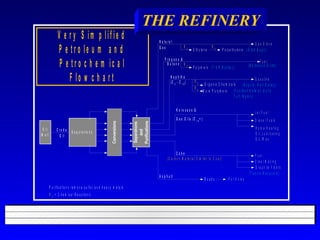
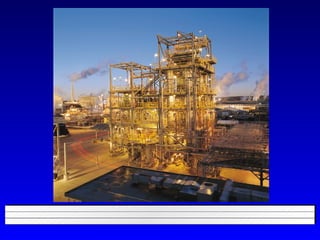
THE REFINERY
What Is Crude Oil? Crude Oil is a liquid mixture of  thousands  of organic chemicals found underground.  It is the result of organic matter decaying over thousands of years;   hence the name   fossil fuel Crude oil is found all over the world and varies tremendously in its  density ,  aromatics ,  sulfur , and  metals content
Major Refinery Products LPG (Propane/Butane) GASOLINE (hundreds of blends) JET FUELS DIESEL FUELS HEATING OILS GREASES ASPHALTS COKE (not the kind you drink )
Gasoline Specifications Gasoline must meet many criteria which change with the time of year and geographic location.  Some critical specifications are: Vapor Pressure Octane Aromatics / Benzene Content Sulfur Content Gasolines are always a  blend  of a number of streams in the refinery
Other Specifications Other refinery products must meet other specifications such as: Cetane number Density Pour Point Flash Point Viscosity
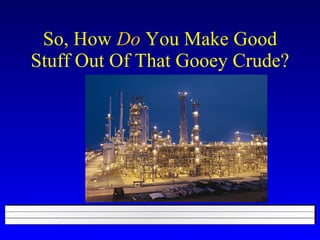
So, How  Do  You Make Good Stuff Out Of That Gooey Crude?
So, How  Do  You Make Good Stuff Out Of That Gooey Crude? REACTIONS & SEPARATIONS
So, How  Do  You Make Good Stuff Out Of That Gooey Crude? Separate crude into  fractions Convert low octane components to higher octane components Convert the very heavy stuff to heavy oils Convert heavy oils to  gasoline,diesel,jet fuel Remove sulfur/nitrogen through reaction Blend intermediate streams together to meet product specifications
SEPARATIONS
SEPARATIONS - CRUDE FRACTIONATION HUGE  DISTILLATION   COLUMNS ATMOSPHERIC  DISTILLATION VACUUM  DISTILLATION TYPICAL SIZE: 150,000 BARRELS/DAY 750 DEGREES F
OTHER SEPARATIONS FLASH DISTILLATION ABSORPTION ADSORPTION SETTLING (WATER/OIL)
REACTIONS
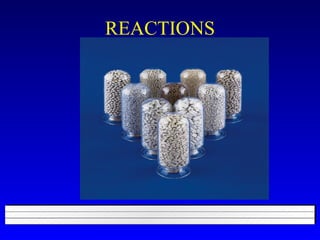
REACTIONS Almost all the reactions in the refinery use special  catalysts  that increase the  rate  and  selectivity  of the reaction.  This improves efficiency and reduces unwanted byproducts.
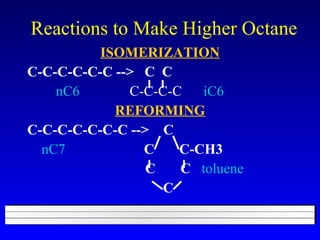
Reactions to Make Higher Octane ISOMERIZATION C-C-C-C-C-C -->  C  C nC6   C-C-C-C  iC6 REFORMING C-C-C-C-C-C-C -->   C nC7  C  C-CH3 C  C   toluene C
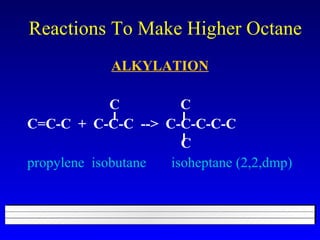
Reactions To Make Higher Octane ALKYLATION C  C C=C-C  +  C-C-C  -->  C-C-C-C-C C propylene  isobutane  isoheptane (2,2,dmp)
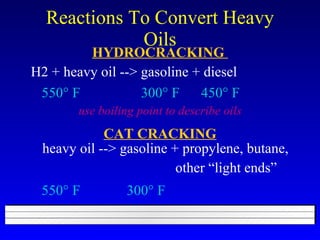
Reactions To Convert Heavy Oils HYDROCRACKING  H2 + heavy oil --> gasoline + diesel 550   F  300   F  450   F   use boiling point to describe oils CAT CRACKING heavy oil --> gasoline + propylene, butane, other “light ends” 550   F  300   F
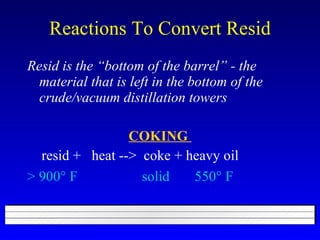
Reactions To Convert Resid Resid is the “bottom of the barrel” - the material that is left in the bottom of the crude/vacuum distillation towers COKING  resid +  heat -->  coke + heavy oil > 900   F  solid  550   F
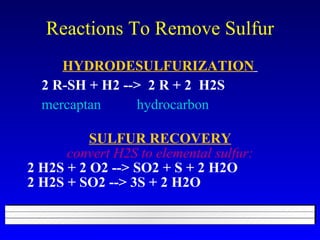
Reactions To Remove Sulfur HYDRODESULFURIZATION   2 R-SH + H2 -->  2 R + 2  H2S mercaptan  hydrocarbon   SULFUR RECOVERY convert H2S to elemental sulfur: 2 H2S + 2 O2 --> SO2 + S + 2 H2O 2 H2S + SO2 --> 3S + 2 H2O
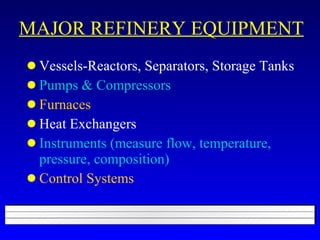
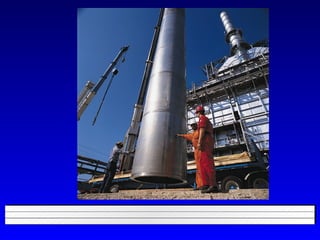
MAJOR REFINERY EQUIPMENT Vessels-Reactors, Separators, Storage Tanks Pumps & Compressors Furnaces Heat Exchangers Instruments (measure flow, temperature, pressure, composition) Control Systems


MINIMIZING POLLUTION Operate Furnaces Efficiently Waste Material Goes To The Flare Stack Avoid Spills & Accidental Releases Special Treatment of Sewer Water Lots of Paper Work!
WHAT HAPPENS TO THE BAD STUFF IN THE CRUDE? Sulfur converted to elemental sulfur in high sulfur fuel oil in coke Heavy Metals (nickel, vanadium) in high sulfur fuel oil and coke Nitrogen (organic nitrogen) most is converted to ammonia and neutralized in high sulfur fuel oil and coke
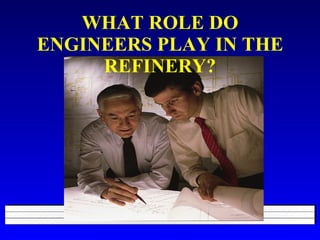
WHAT ROLE DO ENGINEERS PLAY IN THE REFINERY?
What Role Do Chemical Engineers Play? Operations Engineer Maintenance Engineer Control Systems Engineer Design Engineer Health/Safety/Environmental Engineer Planning / Scheduling Engineer Reliability Engineer Plant Manager
Other Ways Chemical Engineers Support The Refining Industry Research & Development Engineers Technical Sales Engineers Engineering & Construction Engineers Governmental Regulators (EPA) University Professors
Other Engineering Disciplines In The Refinery Mechanical Engineers - design & maintenance of compressors, vessels … Electrical Engineers - electrical, instrumentation, controls Computer Scientists - main plant control & information systems
Where to get more information Other training sessions List books, articles, electronic sources Consulting services, other sources
Summary Refineries are  very complicated  chemical processing plants that use  reactions  and  separations  to convert crude oil into gasoline and other valuable products Chemical engineers  play an important role in keeping these plants running safely and efficiently

Oil Refinery ----- An Intro

  • 1.
    What Goes OnIn An Oil Refinery? --------AIChE Speaker--------- this presentation is probably too long; pick and choose from this material
  • 2.
    Introduction IntroduceYourself Explain Why You Are Here Explain Why You Are Talking About Refineries
  • 3.
    Agenda this presentationis probably too long, select from: Introduction What is the Purpose of an Oil Refinery? What Goes In/Out of the Refinery How Do You Get from Crude Oil to Products? Separations Chemical Reactions cont...
  • 4.
    Agenda - Cont. How Do You Get from Crude Oil to Products? Separations Chemical Reactions Major Equipment Minimizing Pollution What do The Chemical Engineers Do?
  • 5.
    Overview THEPURPOSE OF AN OIL REFINERY IS TO TRANSFORM RELATIVELY LOW VALUE CRUDE OIL INTO HIGH VALUE PRODUCTS AS EFFICIENTLY, PROFITABLY AND ENVIRONMENTALLY SOUND A WAY AS POSSIBLE
  • 6.
    Overview - Cont. The price and quality of crudes is constantly changing. The price and specifications of the products is constantly changing. Government regulations add additional constraints. There is not much differential between the price of crude and products. HOW DO I KEEP IN BUSINESS?
  • 7.
    How Do IKeep In Business ? I need to design and revamp the plant utilizing the latest technology to be more efficient I need to make the plant more flexible and responsive I need to operate (control) the plant in the most efficient manner possible I need to keep the equipment running all the time I NEED CHEMICAL ENGINEERS!
  • 8.
    OK, But... WHATGOES ON IN AN OIL REFINERY?
  • 9.
  • 10.
    What Is CrudeOil? Crude Oil is a liquid mixture of thousands of organic chemicals found underground. It is the result of organic matter decaying over thousands of years; hence the name fossil fuel Crude oil is found all over the world and varies tremendously in its density , aromatics , sulfur , and metals content
  • 11.
    Major Refinery ProductsLPG (Propane/Butane) GASOLINE (hundreds of blends) JET FUELS DIESEL FUELS HEATING OILS GREASES ASPHALTS COKE (not the kind you drink )
  • 12.
    Gasoline Specifications Gasolinemust meet many criteria which change with the time of year and geographic location. Some critical specifications are: Vapor Pressure Octane Aromatics / Benzene Content Sulfur Content Gasolines are always a blend of a number of streams in the refinery
  • 13.
    Other Specifications Otherrefinery products must meet other specifications such as: Cetane number Density Pour Point Flash Point Viscosity
  • 14.
    So, How Do You Make Good Stuff Out Of That Gooey Crude?
  • 15.
    So, How Do You Make Good Stuff Out Of That Gooey Crude?
  • 16.
    So, How Do You Make Good Stuff Out Of That Gooey Crude? REACTIONS & SEPARATIONS
  • 17.
    So, How Do You Make Good Stuff Out Of That Gooey Crude? Separate crude into fractions Convert low octane components to higher octane components Convert the very heavy stuff to heavy oils Convert heavy oils to gasoline,diesel,jet fuel Remove sulfur/nitrogen through reaction Blend intermediate streams together to meet product specifications
  • 18.
  • 19.
    SEPARATIONS - CRUDEFRACTIONATION HUGE DISTILLATION COLUMNS ATMOSPHERIC DISTILLATION VACUUM DISTILLATION TYPICAL SIZE: 150,000 BARRELS/DAY 750 DEGREES F
  • 20.
    OTHER SEPARATIONS FLASHDISTILLATION ABSORPTION ADSORPTION SETTLING (WATER/OIL)
  • 21.
  • 22.
    REACTIONS Almost allthe reactions in the refinery use special catalysts that increase the rate and selectivity of the reaction. This improves efficiency and reduces unwanted byproducts.
  • 23.
    Reactions to MakeHigher Octane ISOMERIZATION C-C-C-C-C-C --> C C nC6 C-C-C-C iC6 REFORMING C-C-C-C-C-C-C --> C nC7 C C-CH3 C C toluene C
  • 24.
    Reactions To MakeHigher Octane ALKYLATION C C C=C-C + C-C-C --> C-C-C-C-C C propylene isobutane isoheptane (2,2,dmp)
  • 25.
    Reactions To ConvertHeavy Oils HYDROCRACKING H2 + heavy oil --> gasoline + diesel 550  F 300  F 450  F use boiling point to describe oils CAT CRACKING heavy oil --> gasoline + propylene, butane, other “light ends” 550  F 300  F
  • 26.
    Reactions To ConvertResid Resid is the “bottom of the barrel” - the material that is left in the bottom of the crude/vacuum distillation towers COKING resid + heat --> coke + heavy oil > 900  F solid 550  F
  • 27.
    Reactions To RemoveSulfur HYDRODESULFURIZATION 2 R-SH + H2 --> 2 R + 2 H2S mercaptan hydrocarbon SULFUR RECOVERY convert H2S to elemental sulfur: 2 H2S + 2 O2 --> SO2 + S + 2 H2O 2 H2S + SO2 --> 3S + 2 H2O
  • 28.
    MAJOR REFINERY EQUIPMENTVessels-Reactors, Separators, Storage Tanks Pumps & Compressors Furnaces Heat Exchangers Instruments (measure flow, temperature, pressure, composition) Control Systems
  • 29.
  • 30.
  • 31.
  • 32.
    MINIMIZING POLLUTION OperateFurnaces Efficiently Waste Material Goes To The Flare Stack Avoid Spills & Accidental Releases Special Treatment of Sewer Water Lots of Paper Work!
  • 33.
    WHAT HAPPENS TOTHE BAD STUFF IN THE CRUDE? Sulfur converted to elemental sulfur in high sulfur fuel oil in coke Heavy Metals (nickel, vanadium) in high sulfur fuel oil and coke Nitrogen (organic nitrogen) most is converted to ammonia and neutralized in high sulfur fuel oil and coke
  • 34.
    WHAT ROLE DOENGINEERS PLAY IN THE REFINERY?
  • 35.
    What Role DoChemical Engineers Play? Operations Engineer Maintenance Engineer Control Systems Engineer Design Engineer Health/Safety/Environmental Engineer Planning / Scheduling Engineer Reliability Engineer Plant Manager
  • 36.
    Other Ways ChemicalEngineers Support The Refining Industry Research & Development Engineers Technical Sales Engineers Engineering & Construction Engineers Governmental Regulators (EPA) University Professors
  • 37.
    Other Engineering DisciplinesIn The Refinery Mechanical Engineers - design & maintenance of compressors, vessels … Electrical Engineers - electrical, instrumentation, controls Computer Scientists - main plant control & information systems
  • 38.
    Where to getmore information Other training sessions List books, articles, electronic sources Consulting services, other sources
  • 39.
    Summary Refineries are very complicated chemical processing plants that use reactions and separations to convert crude oil into gasoline and other valuable products Chemical engineers play an important role in keeping these plants running safely and efficiently