What is Crude Oil?
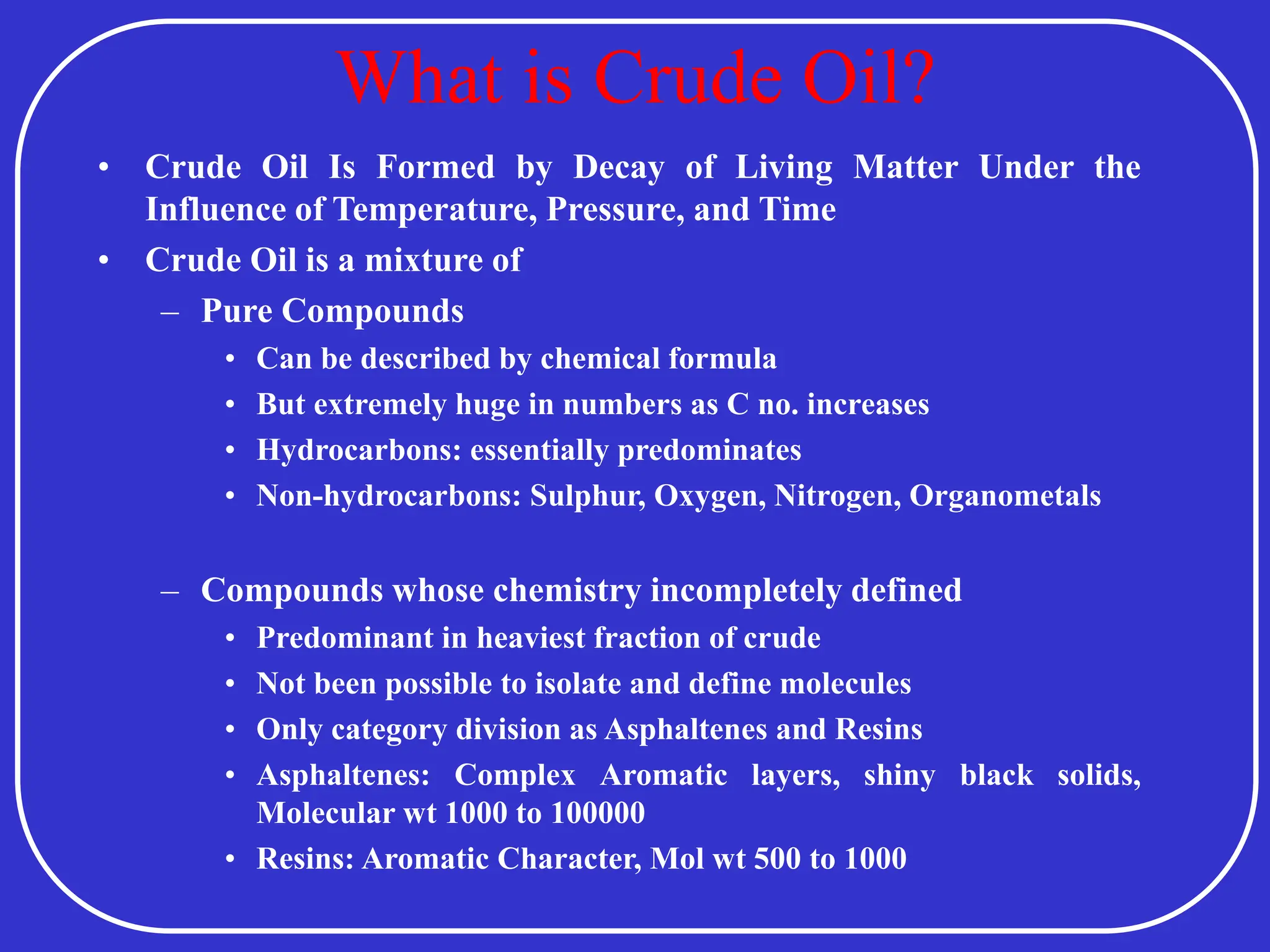
• Crude Oil Is Formed by Decay of Living Matter Under the
Influence of Temperature, Pressure, and Time
• Crude Oil is a mixture of
– Pure Compounds
• Can be described by chemical formula
• But extremely huge in numbers as C no. increases
• Hydrocarbons: essentially predominates
• Non-hydrocarbons: Sulphur, Oxygen, Nitrogen, Organometals
– Compounds whose chemistry incompletely defined
• Predominant in heaviest fraction of crude
• Not been possible to isolate and define molecules
• Only category division as Asphaltenes and Resins
• Asphaltenes: Complex Aromatic layers, shiny black solids,
Molecular wt 1000 to 100000
• Resins: Aromatic Character, Mol wt 500 to 1000
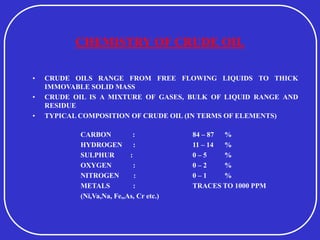
CHEMISTRY OF CRUDE OIL
• CRUDE OILS RANGE FROM FREE FLOWING LIQUIDS TO THICK
IMMOVABLE SOLID MASS
• CRUDE OIL IS A MIXTURE OF GASES, BULK OF LIQUID RANGE AND
RESIDUE
• TYPICAL COMPOSITION OF CRUDE OIL (IN TERMS OF ELEMENTS)
CARBON : 84 – 87 %
HYDROGEN : 11 – 14 %
SULPHUR : 0 – 5 %
OXYGEN : 0 – 2 %
NITROGEN : 0 – 1 %
METALS : TRACES TO 1000 PPM
(Ni,Va,Na, Fe,,As, Cr etc.)
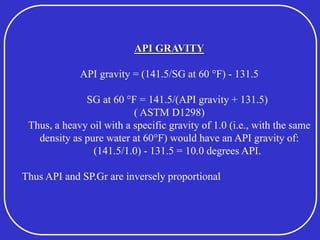
API GRAVITY
API gravity = (141.5/SG at 60 °F) - 131.5
SG at 60 °F = 141.5/(API gravity + 131.5)
( ASTM D1298)
Thus, a heavy oil with a specific gravity of 1.0 (i.e., with the same
density as pure water at 60°F) would have an API gravity of:
(141.5/1.0) - 131.5 = 10.0 degrees API.
Thus API and SP.Gr are inversely proportional
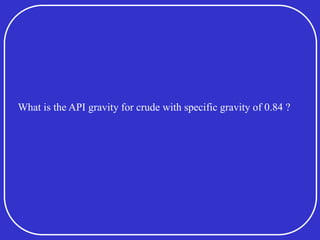
What is the API gravity for crude with specific gravity of 0.84 ?
CRUDE CLASSIFICATIONS
by gravity
• Light crude oil is defined as having an API
gravity higher than 31.1 °API
• Medium oil is defined as having an API
gravity between 22.3 °API and 31.1 °API
• Heavy oil is defined as having an API
gravity below 22.3 °API.
http://en.wikipedia.org/wiki/API_gravity
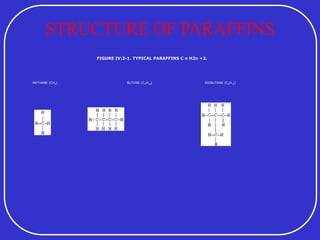
FIGURE IV:2-1. TYPICAL PARAFFINS C n H2n +2.
METHANE (CH4) BUTANE (C4H10) ISOBUTANE (C4H10)
STRUCTURE OF PARAFFINS
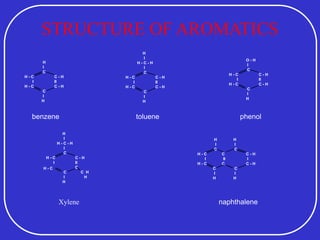
STRUCTURE OF AROMATICS
H
I
H - C - H
I
H H
O - H
C
I I
I
H - C C - H
C C
C
I II
H - C C C - H
H - C C - H
H - C C - H
I II I
I II
C
H - C C C - H
H - C C - H
I
C C
C
H
I I
I
toluene
H H
H
naphthalene
phenol
H
I
H - C - H
I
C
H - C C - H
I II
H - C C
C H
H
C
I
H
Xylene
H
I
C
H - C C - H
I II
H - C C - H
C
I
H
benzene
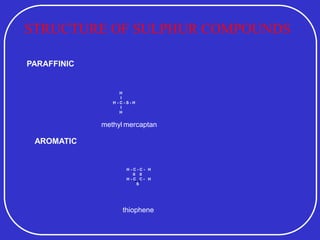
SULPHUR COMPOUNDS
• ORGANIC COMPOUNDS OF SULPHUR FOUND IN PETROLEUM
PRODUCTS
– HYDROCARBON DERIVATIVES WHERE ONE OR MORE C - H IS
REPLACED BY C - S
– SULPHUR HETERO CYCLES, ESSENTIALLY DERIVATIVES OF
THIOPHENE
THIO ALKANES
– PRINCIPAL TYPES ARE MERCAPTANS, SULPHIDES (OR
THIOETHERS) AND DISULPHIDES
– SULPHUR COMPOUNDS AFFECT MATERIAL COMPATIBILITY
(CORROSION), EMISSIONS (STACK GASES, EXHAUSTS) AND
CATALYSTS
STRUCTURE OF SULPHUR COMPOUNDS
PARAFFINIC
H
I
H - C - S - H
I
H
methyl mercaptan
AROMATIC
H - C - C - H
II II
H - C C - H
S
thiophene
NITROGEN COMPOUNDS
– VERY LITTLE IN FRACTIONS UPTO 300 DegC.
– NITROGEN COMPOUNDS STRONGLY AFFECT COLOR & STABILITY
– BASIC AND POISON TO CATALYST
– STRONG COKE FORMERS
OXYGEN
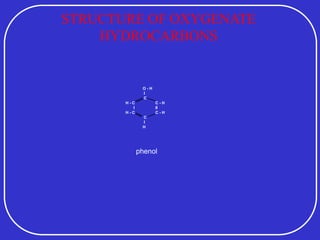
– PRESENT IN THE FORM OF ACIDS, PHENOLS, ALCOHOLS, KETONES,
ESTERS AND OXYGEN HETERO CYCLES
STRUCTURE OF OXYGENATE
HYDROCARBONS
O - H
I
C
H - C C - H
I II
H - C C - H
C
I
H
phenol
ASPHALTENES
– PRESENT IN RESIDUES REMAINING AFTER ALL USEFUL PRODUCTS
ARE SEPARATED FROM CRUDE
– HIGHLY CONDENSED LARGE AROMATIC MOLECULES RANGING
FEW THOUSANDS IN MOLECULAR MASS
– ASPHALTENE CONTENT IS REPORTED AS N-HEPTANE INSOLUBLE
MATTER
– AFFECT CATALYTIC PROCESS, BITUMEN YIELD
– POLAR GROUPS ARE ABUNDANT IN ASPHALTENES. DUE TO
PRESENCE OF SULPHUR, OXYGEN OR NITROGEN COMPOUNDS
HYDROCARBONS IMPACT
• Process feed qualities
– Naphthenes and Aromatics are good Reformer feed
– Paraffins are good FCC feed
• Product quality
– Aromatics have high octanes
– Paraffins increase pour, cloud and freeze points
– Napthenes increase smoke point
– Paraffins have lower viscosity
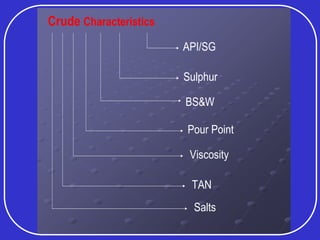
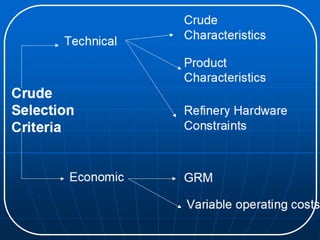
Crude Characteristics
API/SG
Sulphur
BS&W
Pour Point
Viscosity
TAN
Salts
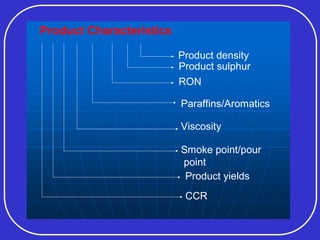
Product Characteristics
Product density
Product sulphur
RON
Paraffins/Aromatics
Smoke point/pour
point
Product yields
CCR
Viscosity
Crude Oil Characteristics
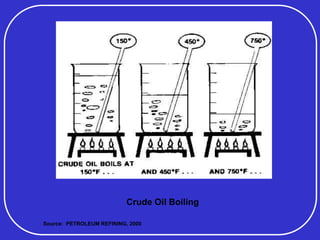
• The Most Important Characteristic of Crude
Oil is What Happens as It Heats Up
– When Raised to Its Boiling Temperature and
Held There, It Will Not Totally Evaporate
• This Means Crude Oil Can be Separated into
Components by Heating
– Distillation
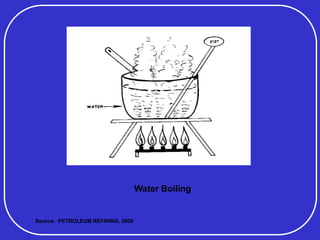
Water Boiling
Source: PETROLEUM REFINING, 2000
Crude Oil Boiling
Source: PETROLEUM REFINING, 2000
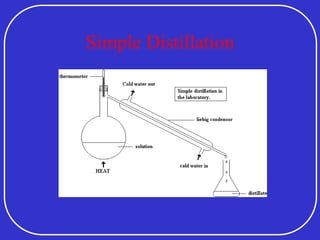
Simple Distillation
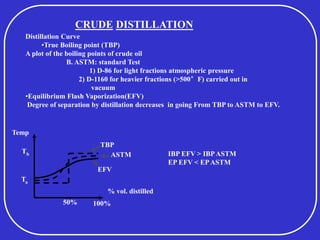
Distillation Curve
•True Boiling point (TBP)
A plot of the boiling points of crude oil
B. ASTM: standard Test
1) D-86 for light fractions atmospheric pressure
2) D-1160 for heavier fractions (>500°F) carried out in
vacuum
•Equilibrium Flash Vaporization(EFV)
Degree of separation by distillation decreases in going From TBP to ASTM to EFV.
Ta
Tb
50% 100%
Temp
% vol. distilled
ASTM
TBP
EFV
IBP EFV > IBPASTM
EP EFV < EPASTM
CRUDE DISTILLATION
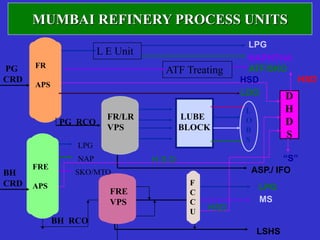
MUMBAI REFINERY PROCESS UNITS
LPG
PG
CRD
BH RCO
LPG
NAPHTHA
ATF/SKO
LDO
LSHS
MS
ASP./ IFO
LUBE
BLOCK
L
O
B
S
PG RCO
FR
APS
FR/LR
VPS
FRE
APS
BH
CRD F
C
C
U
L E Unit
ATF Treating
LPG
NAP
SKO/MTO
D
H
D
S
HSD
HSD
H S D
HSD
“S”
FRE
VPS
Crudes
High Low
Sulphur Sulphur
Lower/Upper
Zakum, Murban
(UAE)
Dubai Kuwait
Bonny Lt.
(Nigeria)
Essider
(Libya)
Brent
Blend
(N Sea)
35% 65%
[‘02-’03] [‘02-’03]
BH/Ravva
(Indg)
Gross Refinery Margin [GRM]
• To access the profitability of the crude
GRM = Product Value –
Crude Cost –
Variable Costs.
Variable Costs
• They are the costs of various chemicals and utilities
used while processing the crude.
• Depend on the grade of the crude being
processed.
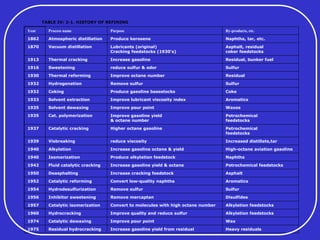
TABLE IV: 2-1. HISTORY OF REFINING
Year Process name Purpose By-products, etc.
1862 Atmospheric distillation Produce kerosene Naphtha, tar, etc.
1870 Vacuum distillation Lubricants (original)
Cracking feedstocks (1930's)
Asphalt, residual
coker feedstocks
1913 Thermal cracking Increase gasoline Residual, bunker fuel
1916 Sweetening reduce sulfur & odor Sulfur
1930 Thermal reforming Improve octane number Residual
1932 Hydrogenation Remove sulfur Sulfur
1932 Coking Produce gasoline basestocks Coke
1933 Solvent extraction Improve lubricant viscosity index Aromatics
1935 Solvent dewaxing Improve pour point Waxes
1935 Cat. polymerization Improve gasoline yield
& octane number
Petrochemical
feedstocks
1937 Catalytic cracking Higher octane gasoline Petrochemical
feedstocks
1939 Visbreaking reduce viscosity Increased distillate,tar
1940 Alkylation Increase gasoline octane & yield High-octane aviation gasoline
1940 Isomerization Produce alkylation feedstock Naphtha
1942 Fluid catalytic cracking Increase gasoline yield & octane Petrochemical feedstocks
1950 Deasphalting Increase cracking feedstock Asphalt
1952 Catalytic reforming Convert low-quality naphtha Aromatics
1954 Hydrodesulfurization Remove sulfur Sulfur
1956 Inhibitor sweetening Remove mercaptan Disulfides
1957 Catalytic isomerization Convert to molecules with high octane number Alkylation feedstocks
1960 Hydrocracking Improve quality and reduce sulfur Alkylation feedstocks
1974 Catalytic dewaxing Improve pour point Wax
1975 Residual hydrocracking Increase gasoline yield from residual Heavy residuals
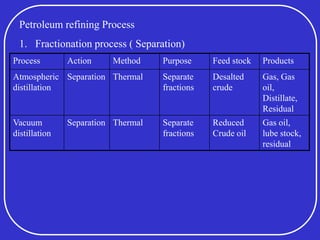
Petroleum refining Process
1. Fractionation process ( Separation)
Process Action Method Purpose Feed stock Products
Atmospheric
distillation
Separation Thermal Separate
fractions
Desalted
crude
Gas, Gas
oil,
Distillate,
Residual
Vacuum
distillation
Separation Thermal Separate
fractions
Reduced
Crude oil
Gas oil,
lube stock,
residual
Process Action Method Purpose Feed stock Products
Catalytic
cracking
Alteration Catalytic Upgrade
gasoline
VPS side
streams
Gasoline,
residue
Coking Polymerize Thermal Convert
vacuum
residuals
Gas oil, coke
distillate
Gasoline,
petrochemical
feedstock
Hydro-
cracking
Hydrogenate Catalytic Convert to
lighter HC's
Gas oil,
cracked oil,
residual
Lighter,
higher-quality
products
Hydrogen
steam
reforming
Decompose Thermal/
catalytic
Produce
hydrogen
Desulfurized
gas, O2,
steam
Hydrogen,
CO, CO2
Visbreaking Decompose Thermal reduce
viscosity
Atmospheric
tower residual
Distillate, tar
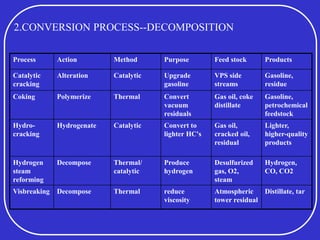
2.CONVERSION PROCESS--DECOMPOSITION
Process Action Method Purpose Feed stock Products
Catalytic
reforming
Alteration/
dehydration
Catalytic Upgrade low-
octane
naphtha
Hydrotreated
naphtha
High oct.
Reformate/
aromatic
Isomerization Rearrange Catalytic Convert
straight chain
to branch
Butane,
pentane,
hexane
Isobutane/
pentane/
hexane
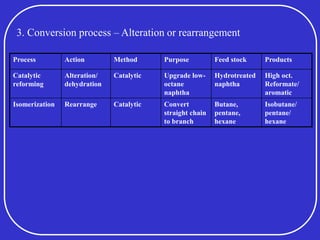
3. Conversion process – Alteration or rearrangement
Process Action Method Purpose Feed stock Products
Amine treating Treatment Absorption Remove acidic
contaminants
Sour gas, HCs
w/CO2 & H2S
Acid free gases &
liquid HCs
Desalting Dehydration Absorption Remove
contaminants
Crude oil Desalted crude oil
Furfural extraction Solvent extr. Absorption Upgrade mid
distillate & lubes
Cycle oils & lube
feed-stocks
High quality diesel
& lube oil
Hydrodesulfurization Treatment Catalytic Remove sulfur,
contaminants
High-sulfur
residual/ gas oil
Desulfurized olefins
Hydrotreating Hydrogenation Catalytic Remove impurities,
saturate HC's
Residuals, cracked
HC's
Cracker feed,
distillate, lube
Solvent deasphalting Treatment Absorption Remove asphalt Vac. tower residual,
propane
Heavy lube oil,
asphalt
Solvent dewaxing Treatment Cool/ filter Remove wax from
lube stocks
Vac. tower lube oils Dewaxed lube
basestock
Solvent extraction Solvent extr Abspt/
precip.
Remove
aromatics
VPS side streams High VI oils
Sweetening Treatment Catalytic Remv H2S,
convert
mercaptan
Untreated
distillate/gasoline
High-quality
distillate/gasoline
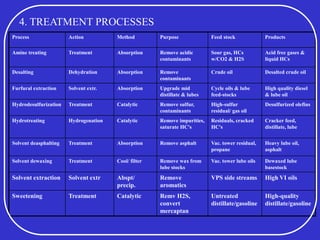
4. TREATMENT PROCESSES
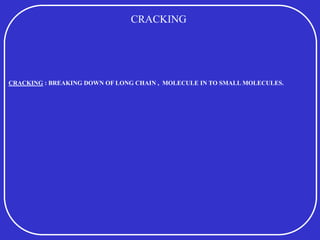
CRACKING : BREAKING DOWN OF LONG CHAIN , MOLECULE IN TO SMALL MOLECULES.
CRACKING
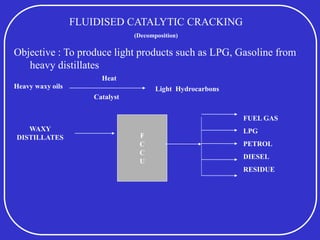
FLUIDISED CATALYTIC CRACKING
(Decomposition)
Objective : To produce light products such as LPG, Gasoline from
heavy distillates
F
C
C
U
WAXY
DISTILLATES
FUEL GAS
LPG
PETROL
DIESEL
RESIDUE
Heavy waxy oils
Catalyst
Heat
Light Hydrocarbons
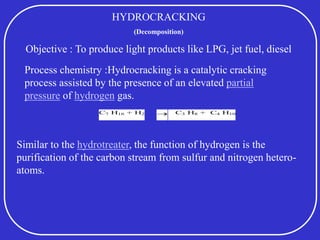
HYDROCRACKING
(Decomposition)
Objective : To produce light products like LPG, jet fuel, diesel
Process chemistry :Hydrocracking is a catalytic cracking
process assisted by the presence of an elevated partial
pressure of hydrogen gas.
C7 H16 + H2  C3 H8 + C4 H10
Similar to the hydrotreater, the function of hydrogen is the
purification of the carbon stream from sulfur and nitrogen hetero-
atoms.
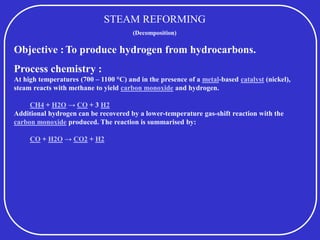
STEAM REFORMING
(Decomposition)
Objective :To produce hydrogen from hydrocarbons.
Process chemistry :
At high temperatures (700 – 1100 °C) and in the presence of a metal-based catalyst (nickel),
steam reacts with methane to yield carbon monoxide and hydrogen.
CH4 + H2O → CO + 3 H2
Additional hydrogen can be recovered by a lower-temperature gas-shift reaction with the
carbon monoxide produced. The reaction is summarised by:
CO + H2O → CO2 + H2
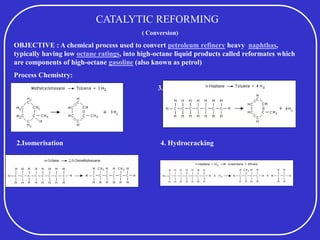
CATALYTIC REFORMING
( Conversion)
OBJECTIVE : A chemical process used to convert petroleum refinery heavy naphthas,
typically having low octane ratings, into high-octane liquid products called reformates which
are components of high-octane gasoline (also known as petrol)
Process Chemistry:
1. Dehydrogenation 3. Dehydrogenation + Aromitoisation
2.Isomerisation 4. Hydrocracking
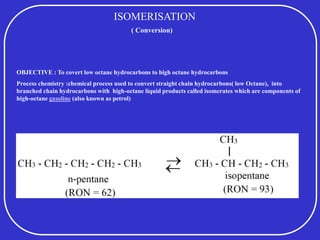
ISOMERISATION
OBJECTIVE : To covert low octane hydrocarbons to high octane hydrocarbons
Process chemistry :chemical process used to convert straight chain hydrocarbons( low Octane), into
branched chain hydrocarbons with high-octane liquid products called isomerates which are components of
high-octane gasoline (also known as petrol)
( Conversion)
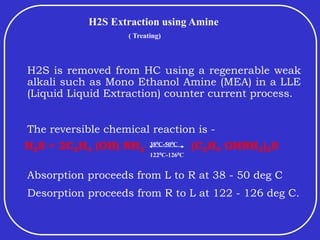
H2S Extraction using Amine
( Treating)
H2S is removed from HC using a regenerable weak
alkali such as Mono Ethanol Amine (MEA) in a LLE
(Liquid Liquid Extraction) counter current process.
The reversible chemical reaction is -
H2S + 2C2H4 (OH) NH2 (C2H4 OHNH3)2S
Absorption proceeds from L to R at 38 - 50 deg C
Desorption proceeds from R to L at 122 - 126 deg C.
380C-500C
1220C-1260C
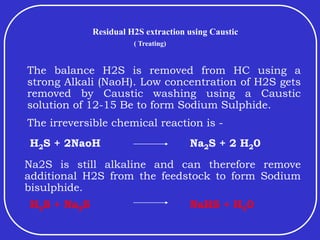
Residual H2S extraction using Caustic
The balance H2S is removed from HC using a
strong Alkali (NaoH). Low concentration of H2S gets
removed by Caustic washing using a Caustic
solution of 12-15 Be to form Sodium Sulphide.
The irreversible chemical reaction is -
H2S + 2NaoH Na2S + 2 H20
Na2S is still alkaline and can therefore remove
additional H2S from the feedstock to form Sodium
bisulphide.
H2S + Na2S NaHS + H20
( Treating)
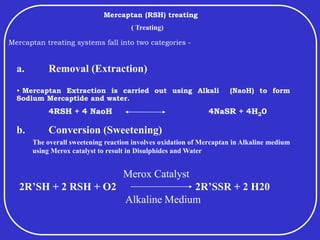
Mercaptan (RSH) treating
Mercaptan treating systems fall into two categories -
• Mercaptan Extraction is carried out using Alkali (NaoH) to form
Sodium Mercaptide and water.
4RSH + 4 NaoH 4NaSR + 4H20
Merox Catalyst
2R’SH + 2 RSH + O2 2R’SSR + 2 H20
Alkaline Medium
b. Conversion (Sweetening)
a. Removal (Extraction)
The overall sweetening reaction involves oxidation of Mercaptan in Alkaline medium
using Merox catalyst to result in Disulphides and Water
( Treating)
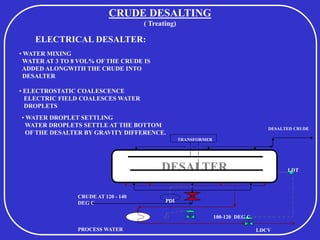
CRUDE DESALTING
( Treating)
ELECTRICAL DESALTER:
• ELECTROSTATIC COALESCENCE
ELECTRIC FIELD COALESCES WATER
DROPLETS
• WATER DROPLET SETTLING
WATER DROPLETS SETTLE AT THE BOTTOM
OF THE DESALTER BY GRAVITY DIFFERENCE.
• WATER MIXING
WATER AT 3 TO 8 VOL% OF THE CRUDE IS
ADDED ALONGWITH THE CRUDE INTO
DESALTER
DESALTER
CRUDE AT 120 - 140
DEG C
PROCESS WATER
LDT
LDCV
TRANSFORMER
100-120 DEG C
PDI
DESALTED CRUDE
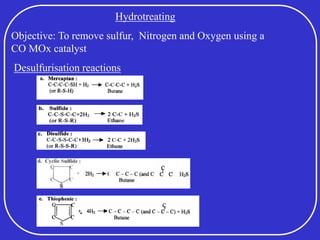
Hydrotreating
Objective: To remove sulfur, Nitrogen and Oxygen using a
CO MOx catalyst
Desulfurisation reactions
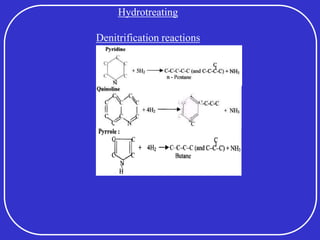
Hydrotreating
Denitrification reactions
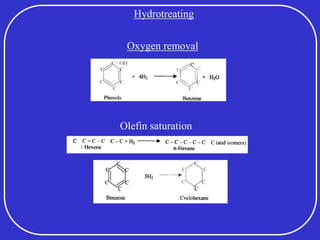
Oxygen removal
Hydrotreating
Olefin saturation
Solvent extraction
Uses the principle of relative solubility of solute in immiscible solvent
Used where distillation ( azeotropic) and other separation process are
difficult and not economical
Some of the solvents used are Normal methyl pyridole, propane,
Furfurol, phenol etc.
Two phases on addition of solvent, the solvent rich phase( extract) and the
solvent lean phase( raffinate)
PROPERTIES OF FEED STOCKS AND PRODUCTS
Viscosity : Resistance to flow, Usually measured @ 100DegF
in centistokes.
Cloud point : The temperature at which the first trace of wax
starts to separate out, causing it to become turbid or cloudy
Pour point : The temperature at which the oil ceases to flow.
The wax in the oil will solidify in cold weather. This will
happen on reduction of temperature below the cloud point.
Flash point : The temperature above which the oil will
spontaneously combust. Fractions in the vacuum tower are the
least combustible, they are heavy.
Fire point : The lowest temperature at which application of a
test flame to the oil sample surface causes the vapor of the oil
to ignite and burn for at least five seconds.
Reid vapor pressure : Indicates the relative percentage of gaseous
and lighter hydrocarbons in hydrocarbon. The higher the reid
vapor pressure, the more volatile is the hydrocarbon.
Acidity : Total acid number or TAN to measure the acidity. It is a
measure of Naphthenic acid content in the crude.
Salt content : Measured in crude in terms of parts per thousand
barrels (ptb) of crude oil. It is removed in desalter by washing and
settling many chlorides and sulfides of Na, K,Ca,Mg
Metals : Na, V, Hg, Ni present in various streams are poisonous to
catalyst
Smoke point : The maximum height in mm at which oil will burn
without smoke. High aromatics indicate low smoke point. Higher
the paraffin content, higher the smoke point. Normally measured
for kerosene ( 18mm)
Octane Number: Percentage of Isooctane( 2,2,4 tri methyl pentane) in
a blend of normal heptane matches the same knocking intensity of the
product.
RON : Research octane applied for engines with low speed, MON:
applied at higher speeds, RON and MON are tested at different
conditions. Antiknock index = (RON + MON)/2
Aniline Point : Temperature at which equal volumes of Aniline and oil
is miscible. A low aniline point indicates high aromatics and a low
diesel index.
Weathering : Normally performed for LPG. 95% of LPG sample
should evaporate at a temperature of 2 DegC. The test is intended to
check the presence of heavier hydrocarbons which may not readily
vaporise.
Thermal oxidation stability : Property which ensures that the oil does
not deteriorate due to long storage under exposure to atmosphere and
temperature.
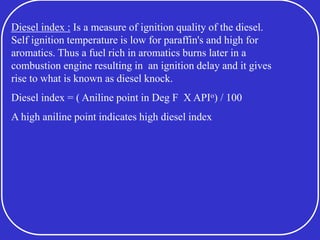
Diesel index : Is a measure of ignition quality of the diesel.
Self ignition temperature is low for paraffin's and high for
aromatics. Thus a fuel rich in aromatics burns later in a
combustion engine resulting in an ignition delay and it gives
rise to what is known as diesel knock.
Diesel index = ( Aniline point in Deg F X APIo) / 100
A high aniline point indicates high diesel index

Refinery chemistry for non technical backgorund

  • 1.
    What is CrudeOil? • Crude Oil Is Formed by Decay of Living Matter Under the Influence of Temperature, Pressure, and Time • Crude Oil is a mixture of – Pure Compounds • Can be described by chemical formula • But extremely huge in numbers as C no. increases • Hydrocarbons: essentially predominates • Non-hydrocarbons: Sulphur, Oxygen, Nitrogen, Organometals – Compounds whose chemistry incompletely defined • Predominant in heaviest fraction of crude • Not been possible to isolate and define molecules • Only category division as Asphaltenes and Resins • Asphaltenes: Complex Aromatic layers, shiny black solids, Molecular wt 1000 to 100000 • Resins: Aromatic Character, Mol wt 500 to 1000
  • 2.
    CHEMISTRY OF CRUDEOIL • CRUDE OILS RANGE FROM FREE FLOWING LIQUIDS TO THICK IMMOVABLE SOLID MASS • CRUDE OIL IS A MIXTURE OF GASES, BULK OF LIQUID RANGE AND RESIDUE • TYPICAL COMPOSITION OF CRUDE OIL (IN TERMS OF ELEMENTS) CARBON : 84 – 87 % HYDROGEN : 11 – 14 % SULPHUR : 0 – 5 % OXYGEN : 0 – 2 % NITROGEN : 0 – 1 % METALS : TRACES TO 1000 PPM (Ni,Va,Na, Fe,,As, Cr etc.)
  • 3.
    API GRAVITY API gravity= (141.5/SG at 60 °F) - 131.5 SG at 60 °F = 141.5/(API gravity + 131.5) ( ASTM D1298) Thus, a heavy oil with a specific gravity of 1.0 (i.e., with the same density as pure water at 60°F) would have an API gravity of: (141.5/1.0) - 131.5 = 10.0 degrees API. Thus API and SP.Gr are inversely proportional
  • 4.
    What is theAPI gravity for crude with specific gravity of 0.84 ?
  • 5.
    CRUDE CLASSIFICATIONS by gravity •Light crude oil is defined as having an API gravity higher than 31.1 °API • Medium oil is defined as having an API gravity between 22.3 °API and 31.1 °API • Heavy oil is defined as having an API gravity below 22.3 °API. http://en.wikipedia.org/wiki/API_gravity
  • 6.
    FIGURE IV:2-1. TYPICALPARAFFINS C n H2n +2. METHANE (CH4) BUTANE (C4H10) ISOBUTANE (C4H10) STRUCTURE OF PARAFFINS
  • 7.
    STRUCTURE OF AROMATICS H I H- C - H I H H O - H C I I I H - C C - H C C C I II H - C C C - H H - C C - H H - C C - H I II I I II C H - C C C - H H - C C - H I C C C H I I I toluene H H H naphthalene phenol H I H - C - H I C H - C C - H I II H - C C C H H C I H Xylene H I C H - C C - H I II H - C C - H C I H benzene
  • 8.
    SULPHUR COMPOUNDS • ORGANICCOMPOUNDS OF SULPHUR FOUND IN PETROLEUM PRODUCTS – HYDROCARBON DERIVATIVES WHERE ONE OR MORE C - H IS REPLACED BY C - S – SULPHUR HETERO CYCLES, ESSENTIALLY DERIVATIVES OF THIOPHENE THIO ALKANES – PRINCIPAL TYPES ARE MERCAPTANS, SULPHIDES (OR THIOETHERS) AND DISULPHIDES – SULPHUR COMPOUNDS AFFECT MATERIAL COMPATIBILITY (CORROSION), EMISSIONS (STACK GASES, EXHAUSTS) AND CATALYSTS
  • 9.
    STRUCTURE OF SULPHURCOMPOUNDS PARAFFINIC H I H - C - S - H I H methyl mercaptan AROMATIC H - C - C - H II II H - C C - H S thiophene
  • 10.
    NITROGEN COMPOUNDS – VERYLITTLE IN FRACTIONS UPTO 300 DegC. – NITROGEN COMPOUNDS STRONGLY AFFECT COLOR & STABILITY – BASIC AND POISON TO CATALYST – STRONG COKE FORMERS OXYGEN – PRESENT IN THE FORM OF ACIDS, PHENOLS, ALCOHOLS, KETONES, ESTERS AND OXYGEN HETERO CYCLES
  • 11.
    STRUCTURE OF OXYGENATE HYDROCARBONS O- H I C H - C C - H I II H - C C - H C I H phenol
  • 12.
    ASPHALTENES – PRESENT INRESIDUES REMAINING AFTER ALL USEFUL PRODUCTS ARE SEPARATED FROM CRUDE – HIGHLY CONDENSED LARGE AROMATIC MOLECULES RANGING FEW THOUSANDS IN MOLECULAR MASS – ASPHALTENE CONTENT IS REPORTED AS N-HEPTANE INSOLUBLE MATTER – AFFECT CATALYTIC PROCESS, BITUMEN YIELD – POLAR GROUPS ARE ABUNDANT IN ASPHALTENES. DUE TO PRESENCE OF SULPHUR, OXYGEN OR NITROGEN COMPOUNDS
  • 13.
    HYDROCARBONS IMPACT • Processfeed qualities – Naphthenes and Aromatics are good Reformer feed – Paraffins are good FCC feed • Product quality – Aromatics have high octanes – Paraffins increase pour, cloud and freeze points – Napthenes increase smoke point – Paraffins have lower viscosity
  • 14.
  • 15.
    Product Characteristics Product density Productsulphur RON Paraffins/Aromatics Smoke point/pour point Product yields CCR Viscosity
  • 16.
    Crude Oil Characteristics •The Most Important Characteristic of Crude Oil is What Happens as It Heats Up – When Raised to Its Boiling Temperature and Held There, It Will Not Totally Evaporate • This Means Crude Oil Can be Separated into Components by Heating – Distillation
  • 17.
  • 18.
    Crude Oil Boiling Source:PETROLEUM REFINING, 2000
  • 19.
  • 20.
    Distillation Curve •True Boilingpoint (TBP) A plot of the boiling points of crude oil B. ASTM: standard Test 1) D-86 for light fractions atmospheric pressure 2) D-1160 for heavier fractions (>500°F) carried out in vacuum •Equilibrium Flash Vaporization(EFV) Degree of separation by distillation decreases in going From TBP to ASTM to EFV. Ta Tb 50% 100% Temp % vol. distilled ASTM TBP EFV IBP EFV > IBPASTM EP EFV < EPASTM CRUDE DISTILLATION
  • 21.
    MUMBAI REFINERY PROCESSUNITS LPG PG CRD BH RCO LPG NAPHTHA ATF/SKO LDO LSHS MS ASP./ IFO LUBE BLOCK L O B S PG RCO FR APS FR/LR VPS FRE APS BH CRD F C C U L E Unit ATF Treating LPG NAP SKO/MTO D H D S HSD HSD H S D HSD “S” FRE VPS
  • 22.
    Crudes High Low Sulphur Sulphur Lower/Upper Zakum,Murban (UAE) Dubai Kuwait Bonny Lt. (Nigeria) Essider (Libya) Brent Blend (N Sea) 35% 65% [‘02-’03] [‘02-’03] BH/Ravva (Indg)
  • 24.
    Gross Refinery Margin[GRM] • To access the profitability of the crude GRM = Product Value – Crude Cost – Variable Costs. Variable Costs • They are the costs of various chemicals and utilities used while processing the crude. • Depend on the grade of the crude being processed.
  • 25.
    TABLE IV: 2-1.HISTORY OF REFINING Year Process name Purpose By-products, etc. 1862 Atmospheric distillation Produce kerosene Naphtha, tar, etc. 1870 Vacuum distillation Lubricants (original) Cracking feedstocks (1930's) Asphalt, residual coker feedstocks 1913 Thermal cracking Increase gasoline Residual, bunker fuel 1916 Sweetening reduce sulfur & odor Sulfur 1930 Thermal reforming Improve octane number Residual 1932 Hydrogenation Remove sulfur Sulfur 1932 Coking Produce gasoline basestocks Coke 1933 Solvent extraction Improve lubricant viscosity index Aromatics 1935 Solvent dewaxing Improve pour point Waxes 1935 Cat. polymerization Improve gasoline yield & octane number Petrochemical feedstocks 1937 Catalytic cracking Higher octane gasoline Petrochemical feedstocks 1939 Visbreaking reduce viscosity Increased distillate,tar 1940 Alkylation Increase gasoline octane & yield High-octane aviation gasoline 1940 Isomerization Produce alkylation feedstock Naphtha 1942 Fluid catalytic cracking Increase gasoline yield & octane Petrochemical feedstocks 1950 Deasphalting Increase cracking feedstock Asphalt 1952 Catalytic reforming Convert low-quality naphtha Aromatics 1954 Hydrodesulfurization Remove sulfur Sulfur 1956 Inhibitor sweetening Remove mercaptan Disulfides 1957 Catalytic isomerization Convert to molecules with high octane number Alkylation feedstocks 1960 Hydrocracking Improve quality and reduce sulfur Alkylation feedstocks 1974 Catalytic dewaxing Improve pour point Wax 1975 Residual hydrocracking Increase gasoline yield from residual Heavy residuals
  • 26.
    Petroleum refining Process 1.Fractionation process ( Separation) Process Action Method Purpose Feed stock Products Atmospheric distillation Separation Thermal Separate fractions Desalted crude Gas, Gas oil, Distillate, Residual Vacuum distillation Separation Thermal Separate fractions Reduced Crude oil Gas oil, lube stock, residual
  • 27.
    Process Action MethodPurpose Feed stock Products Catalytic cracking Alteration Catalytic Upgrade gasoline VPS side streams Gasoline, residue Coking Polymerize Thermal Convert vacuum residuals Gas oil, coke distillate Gasoline, petrochemical feedstock Hydro- cracking Hydrogenate Catalytic Convert to lighter HC's Gas oil, cracked oil, residual Lighter, higher-quality products Hydrogen steam reforming Decompose Thermal/ catalytic Produce hydrogen Desulfurized gas, O2, steam Hydrogen, CO, CO2 Visbreaking Decompose Thermal reduce viscosity Atmospheric tower residual Distillate, tar 2.CONVERSION PROCESS--DECOMPOSITION
  • 28.
    Process Action MethodPurpose Feed stock Products Catalytic reforming Alteration/ dehydration Catalytic Upgrade low- octane naphtha Hydrotreated naphtha High oct. Reformate/ aromatic Isomerization Rearrange Catalytic Convert straight chain to branch Butane, pentane, hexane Isobutane/ pentane/ hexane 3. Conversion process – Alteration or rearrangement
  • 29.
    Process Action MethodPurpose Feed stock Products Amine treating Treatment Absorption Remove acidic contaminants Sour gas, HCs w/CO2 & H2S Acid free gases & liquid HCs Desalting Dehydration Absorption Remove contaminants Crude oil Desalted crude oil Furfural extraction Solvent extr. Absorption Upgrade mid distillate & lubes Cycle oils & lube feed-stocks High quality diesel & lube oil Hydrodesulfurization Treatment Catalytic Remove sulfur, contaminants High-sulfur residual/ gas oil Desulfurized olefins Hydrotreating Hydrogenation Catalytic Remove impurities, saturate HC's Residuals, cracked HC's Cracker feed, distillate, lube Solvent deasphalting Treatment Absorption Remove asphalt Vac. tower residual, propane Heavy lube oil, asphalt Solvent dewaxing Treatment Cool/ filter Remove wax from lube stocks Vac. tower lube oils Dewaxed lube basestock Solvent extraction Solvent extr Abspt/ precip. Remove aromatics VPS side streams High VI oils Sweetening Treatment Catalytic Remv H2S, convert mercaptan Untreated distillate/gasoline High-quality distillate/gasoline 4. TREATMENT PROCESSES
  • 30.
    CRACKING : BREAKINGDOWN OF LONG CHAIN , MOLECULE IN TO SMALL MOLECULES. CRACKING
  • 31.
    FLUIDISED CATALYTIC CRACKING (Decomposition) Objective: To produce light products such as LPG, Gasoline from heavy distillates F C C U WAXY DISTILLATES FUEL GAS LPG PETROL DIESEL RESIDUE Heavy waxy oils Catalyst Heat Light Hydrocarbons
  • 32.
    HYDROCRACKING (Decomposition) Objective : Toproduce light products like LPG, jet fuel, diesel Process chemistry :Hydrocracking is a catalytic cracking process assisted by the presence of an elevated partial pressure of hydrogen gas. C7 H16 + H2  C3 H8 + C4 H10 Similar to the hydrotreater, the function of hydrogen is the purification of the carbon stream from sulfur and nitrogen hetero- atoms.
  • 33.
    STEAM REFORMING (Decomposition) Objective :Toproduce hydrogen from hydrocarbons. Process chemistry : At high temperatures (700 – 1100 °C) and in the presence of a metal-based catalyst (nickel), steam reacts with methane to yield carbon monoxide and hydrogen. CH4 + H2O → CO + 3 H2 Additional hydrogen can be recovered by a lower-temperature gas-shift reaction with the carbon monoxide produced. The reaction is summarised by: CO + H2O → CO2 + H2
  • 34.
    CATALYTIC REFORMING ( Conversion) OBJECTIVE: A chemical process used to convert petroleum refinery heavy naphthas, typically having low octane ratings, into high-octane liquid products called reformates which are components of high-octane gasoline (also known as petrol) Process Chemistry: 1. Dehydrogenation 3. Dehydrogenation + Aromitoisation 2.Isomerisation 4. Hydrocracking
  • 35.
    ISOMERISATION OBJECTIVE : Tocovert low octane hydrocarbons to high octane hydrocarbons Process chemistry :chemical process used to convert straight chain hydrocarbons( low Octane), into branched chain hydrocarbons with high-octane liquid products called isomerates which are components of high-octane gasoline (also known as petrol) ( Conversion)
  • 36.
    H2S Extraction usingAmine ( Treating) H2S is removed from HC using a regenerable weak alkali such as Mono Ethanol Amine (MEA) in a LLE (Liquid Liquid Extraction) counter current process. The reversible chemical reaction is - H2S + 2C2H4 (OH) NH2 (C2H4 OHNH3)2S Absorption proceeds from L to R at 38 - 50 deg C Desorption proceeds from R to L at 122 - 126 deg C. 380C-500C 1220C-1260C
  • 37.
    Residual H2S extractionusing Caustic The balance H2S is removed from HC using a strong Alkali (NaoH). Low concentration of H2S gets removed by Caustic washing using a Caustic solution of 12-15 Be to form Sodium Sulphide. The irreversible chemical reaction is - H2S + 2NaoH Na2S + 2 H20 Na2S is still alkaline and can therefore remove additional H2S from the feedstock to form Sodium bisulphide. H2S + Na2S NaHS + H20 ( Treating)
  • 38.
    Mercaptan (RSH) treating Mercaptantreating systems fall into two categories - • Mercaptan Extraction is carried out using Alkali (NaoH) to form Sodium Mercaptide and water. 4RSH + 4 NaoH 4NaSR + 4H20 Merox Catalyst 2R’SH + 2 RSH + O2 2R’SSR + 2 H20 Alkaline Medium b. Conversion (Sweetening) a. Removal (Extraction) The overall sweetening reaction involves oxidation of Mercaptan in Alkaline medium using Merox catalyst to result in Disulphides and Water ( Treating)
  • 39.
    CRUDE DESALTING ( Treating) ELECTRICALDESALTER: • ELECTROSTATIC COALESCENCE ELECTRIC FIELD COALESCES WATER DROPLETS • WATER DROPLET SETTLING WATER DROPLETS SETTLE AT THE BOTTOM OF THE DESALTER BY GRAVITY DIFFERENCE. • WATER MIXING WATER AT 3 TO 8 VOL% OF THE CRUDE IS ADDED ALONGWITH THE CRUDE INTO DESALTER DESALTER CRUDE AT 120 - 140 DEG C PROCESS WATER LDT LDCV TRANSFORMER 100-120 DEG C PDI DESALTED CRUDE
  • 40.
    Hydrotreating Objective: To removesulfur, Nitrogen and Oxygen using a CO MOx catalyst Desulfurisation reactions
  • 41.
  • 42.
  • 43.
    Solvent extraction Uses theprinciple of relative solubility of solute in immiscible solvent Used where distillation ( azeotropic) and other separation process are difficult and not economical Some of the solvents used are Normal methyl pyridole, propane, Furfurol, phenol etc. Two phases on addition of solvent, the solvent rich phase( extract) and the solvent lean phase( raffinate)
  • 44.
    PROPERTIES OF FEEDSTOCKS AND PRODUCTS Viscosity : Resistance to flow, Usually measured @ 100DegF in centistokes. Cloud point : The temperature at which the first trace of wax starts to separate out, causing it to become turbid or cloudy Pour point : The temperature at which the oil ceases to flow. The wax in the oil will solidify in cold weather. This will happen on reduction of temperature below the cloud point. Flash point : The temperature above which the oil will spontaneously combust. Fractions in the vacuum tower are the least combustible, they are heavy. Fire point : The lowest temperature at which application of a test flame to the oil sample surface causes the vapor of the oil to ignite and burn for at least five seconds.
  • 45.
    Reid vapor pressure: Indicates the relative percentage of gaseous and lighter hydrocarbons in hydrocarbon. The higher the reid vapor pressure, the more volatile is the hydrocarbon. Acidity : Total acid number or TAN to measure the acidity. It is a measure of Naphthenic acid content in the crude. Salt content : Measured in crude in terms of parts per thousand barrels (ptb) of crude oil. It is removed in desalter by washing and settling many chlorides and sulfides of Na, K,Ca,Mg Metals : Na, V, Hg, Ni present in various streams are poisonous to catalyst Smoke point : The maximum height in mm at which oil will burn without smoke. High aromatics indicate low smoke point. Higher the paraffin content, higher the smoke point. Normally measured for kerosene ( 18mm)
  • 46.
    Octane Number: Percentageof Isooctane( 2,2,4 tri methyl pentane) in a blend of normal heptane matches the same knocking intensity of the product. RON : Research octane applied for engines with low speed, MON: applied at higher speeds, RON and MON are tested at different conditions. Antiknock index = (RON + MON)/2 Aniline Point : Temperature at which equal volumes of Aniline and oil is miscible. A low aniline point indicates high aromatics and a low diesel index. Weathering : Normally performed for LPG. 95% of LPG sample should evaporate at a temperature of 2 DegC. The test is intended to check the presence of heavier hydrocarbons which may not readily vaporise. Thermal oxidation stability : Property which ensures that the oil does not deteriorate due to long storage under exposure to atmosphere and temperature.
  • 47.
    Diesel index :Is a measure of ignition quality of the diesel. Self ignition temperature is low for paraffin's and high for aromatics. Thus a fuel rich in aromatics burns later in a combustion engine resulting in an ignition delay and it gives rise to what is known as diesel knock. Diesel index = ( Aniline point in Deg F X APIo) / 100 A high aniline point indicates high diesel index