OIL POLLUTION
Submitted To :
Dr. D. T. Vaghela Sir
Asst. Prof.
College of Fisheries Veraval
Submitted By :
Mr. H. M. Chudasama
J3-00106-2009
CONTENT
 Introduction
 Crude oil & It’s fraction
 Sources of oil pollution
 Treatment of oil spill at sea beach cleaning
 Toxicity of petroleum hydrocarbons
 Ecological impact of oil pollution
 Case study
 Reference
INTRODUCTION
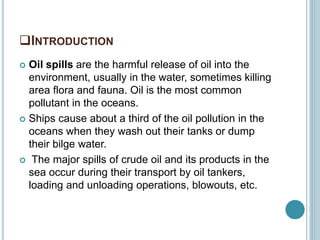
 Oil spills are the harmful release of oil into the
environment, usually in the water, sometimes killing
area flora and fauna. Oil is the most common
pollutant in the oceans.
 Ships cause about a third of the oil pollution in the
oceans when they wash out their tanks or dump
their bilge water.
 The major spills of crude oil and its products in the
sea occur during their transport by oil tankers,
loading and unloading operations, blowouts, etc.
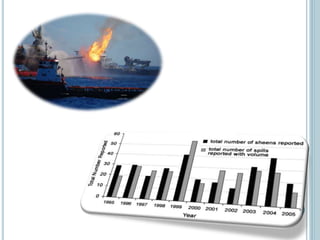
 Oil spills are very difficult to clean up. Oil spills can
be controlled by chemical dispersion, combustion,
mechanical containment and adsorption. Spills may
take weeks, months or even years to clean up.
 Oil spills can be partially controlled by chemical
dispersion, combustion, mechanical containment
and adsorption. They have destructive effects on
coastal ecosystems.
CRUDE OIL & IT’S FRACTION
 crude oil is a naturally occurring, flammable liquid
consisting of a complex mixture of hydrocarbons of
various molecular weights and other liquid organic
compounds, that are found in geologic formations
beneath the Earth's surface.
 A fossil fuel, it is formed when large quantities of
dead organisms, usually zooplankton and algae,
are buried underneath sedimentary rock and
undergo intense heat and pressure.
 The use of fossil fuels such as petroleum can have
a negative impact on Earth's biosphere, releasing
pollutants and greenhouse gases into the air and
damaging ecosystems through events such as oil
spills. Concern over the depletion of the earth's
finite reserves of oil, and the effect this would have
on a society dependant on it, is a field known as
peak oil.
 Oil spills at sea are generally much more damaging
than those on land, since they can spread for
hundreds of nautical miles in a thin oil slick which
can cover beaches with a thin coating of oil.
SOURCES OF OIL POLLUTION
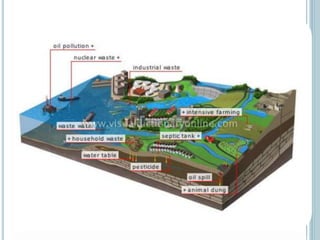
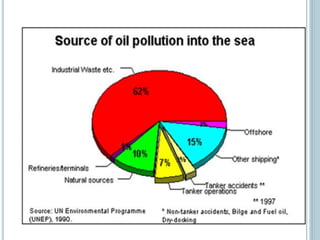
 Oil spills are an unfortunate byproduct of the human
way of life. A number of things cause oil spills,
ranging from carelessness to deliberate dumping.
 Many people are familiar with tanker accidents,
since they are highly publicized and they release
large volumes of oil into the ocean. In fact, only a
small percentage of global oil spills are related to
tanker accidents such as explosions, hull failure,
running aground, and collisions.
CAUSES
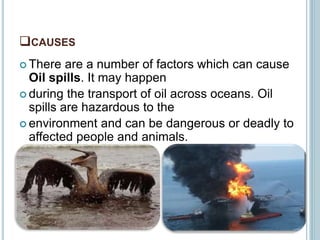
 There are a number of factors which can cause
Oil spills. It may happen
 during the transport of oil across oceans. Oil
spills are hazardous to the
 environment and can be dangerous or deadly to
affected people and animals.
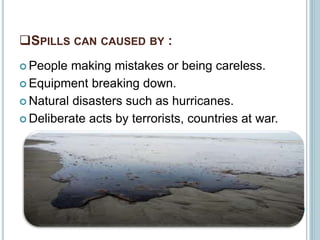
SPILLS CAN CAUSED BY :
 People making mistakes or being careless.
 Equipment breaking down.
 Natural disasters such as hurricanes.
 Deliberate acts by terrorists, countries at war.
SEA-BASED
 Accidental oil spills from tankers; other commercial
vessels; grounded and abandoned vessels; oil
platforms (blowouts); pipelines.
 Deliberate, operational discharges of oil from all
kinds of commercial vessels (ship- or cargo-related
discharges);oil platforms; pipelines.
 Emissions of nmVOCs and PAHs from tankers and
pleasure craft, and from oil extraction.
 Other ship-related activities (dry docking,
scrapping).
 Other activities (dumping of oily waste, etc.)
LAND-BASED
 Discharges of untreated or insufficiently treated
municipal sewage and storm water (urban runoff).
 Discharges with rivers.
 Discharges of untreated or insufficiently treated
waste water from coastal industries.
 Accidental or operational discharges of oil from
coastal refineries, oil storage facilities, oil terminals,
and reception facilities.
 Emissions of gaseous hydrocarbons from oil-
handling onshore facilities (terminals, refineries,
filling stations) and from vehicles exhaust (traffic).
TREATMENT OF OIL SPILLS AT SEA BEACH
CLEANING
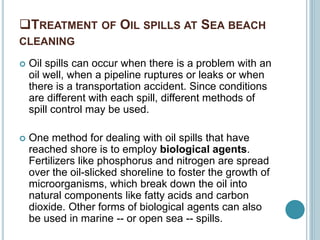
 Oil spills can occur when there is a problem with an
oil well, when a pipeline ruptures or leaks or when
there is a transportation accident. Since conditions
are different with each spill, different methods of
spill control may be used.
 One method for dealing with oil spills that have
reached shore is to employ biological agents.
Fertilizers like phosphorus and nitrogen are spread
over the oil-slicked shoreline to foster the growth of
microorganisms, which break down the oil into
natural components like fatty acids and carbon
dioxide. Other forms of biological agents can also
be used in marine -- or open sea -- spills.
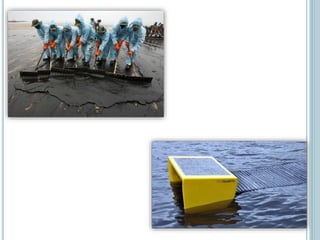
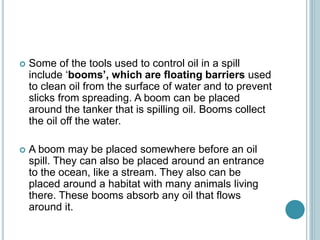
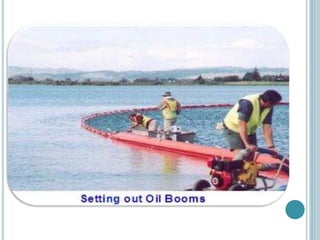
 Some of the tools used to control oil in a spill
include ‘booms’, which are floating barriers used
to clean oil from the surface of water and to prevent
slicks from spreading. A boom can be placed
around the tanker that is spilling oil. Booms collect
the oil off the water.
 A boom may be placed somewhere before an oil
spill. They can also be placed around an entrance
to the ocean, like a stream. They also can be
placed around a habitat with many animals living
there. These booms absorb any oil that flows
around it.
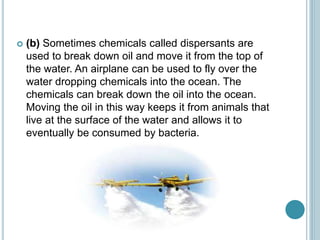
 (b) Sometimes chemicals called dispersants are
used to break down oil and move it from the top of
the water. An airplane can be used to fly over the
water dropping chemicals into the ocean. The
chemicals can break down the oil into the ocean.
Moving the oil in this way keeps it from animals that
live at the surface of the water and allows it to
eventually be consumed by bacteria.
TOXICITY OF PETROLEUM HYDROCARBONS
 Toxicity from hydrocarbon ingestion can affect
many different organs, but the lungs are the most
commonly affected organ. The chemical properties
of the individual hydrocarbon determine the specific
toxicity, while the dose and route of ingestion affect
which organs are exposed to the toxicity.
 Unlike the aromatic or aliphatic hydrocarbons, the
halogenated hydrocarbons tend to cause a wider
range of toxicity.
ECOLOGICAL IMPACT OF OIL POLLUTION
 Spilled oil poses serious threats to fresh water and
marine environments, affecting surface resources and a
wide range of subsurface organisms that are linked in a
complex food chain that includes human food resources.
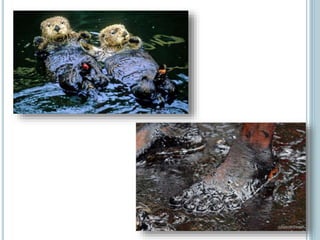
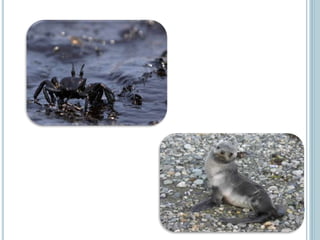
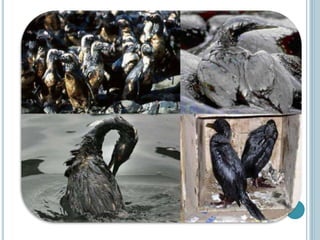
 Spilled oil can harm the environment in several ways,
including the physical damages that directly impact
wildlife and their habitats (such as coating birds or
mammals with a layer of oil), and the toxicity of the oil
itself, which can poison exposed organisms.
 The severity of an oil spill's impact depends on a variety
of factors, including the physical properties of the oil,
whether petroleum-based oils or non petroleum-based
oils, and the natural actions of the receiving waters on
the oil.
SOME OF THE MAJOR GLOBAL MARINE OIL
SPILLS
 (a) Argo Merchant - On December 15, 1976, the
Argo Merchant ran aground on Fishing Rip
(Nantucket Shoals), 29 nautical miles southeast of
Nantucket Island, Massachusetts in high winds and
ten foot seas. Later, the vessel broke apart and
spilled its entire cargo of 7.7 million gallons of fuel
oil.
 (b) Amoco Cadiz - The Amoco Cadiz encountered
stormy weather and ran aground off the coast of
Brittany, France on March 16, 1978. Its entire cargo
of 68.7 million gallons of oil spilled into the sea.
 (c) Burmah Agate - On November 1, 1979, the
Burmah Agate collided with the freighter Mimosa
southeast of Galveston Entrance in the Gulf of
Mexico, resulting explosion and a fire that affected
an estimated 2.6 million gallons of oil to release into
the environment, and another 7.8 million gallons to
consume by the fire.

 (d) Ixtoc I - The 2-mile-deep exploratory well, Ixtoc
I, blew out on June 3, 1979 in the Bay of Campeche
off Ciudad del Carmen, Mexico. By the time the well
was brought under control in March, 1980, an
estimated 140 million gallons of oil had spilled into
the bay.
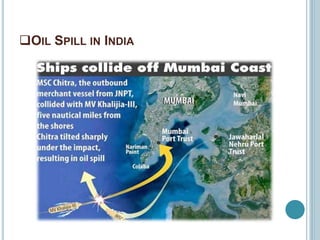
OIL SPILL IN INDIA
Oil Pollution
Oil Pollution

Oil Pollution

  • 1.
    OIL POLLUTION Submitted To: Dr. D. T. Vaghela Sir Asst. Prof. College of Fisheries Veraval Submitted By : Mr. H. M. Chudasama J3-00106-2009
  • 2.
    CONTENT  Introduction  Crudeoil & It’s fraction  Sources of oil pollution  Treatment of oil spill at sea beach cleaning  Toxicity of petroleum hydrocarbons  Ecological impact of oil pollution  Case study  Reference
  • 3.
    INTRODUCTION  Oil spillsare the harmful release of oil into the environment, usually in the water, sometimes killing area flora and fauna. Oil is the most common pollutant in the oceans.  Ships cause about a third of the oil pollution in the oceans when they wash out their tanks or dump their bilge water.  The major spills of crude oil and its products in the sea occur during their transport by oil tankers, loading and unloading operations, blowouts, etc.
  • 4.
     Oil spillsare very difficult to clean up. Oil spills can be controlled by chemical dispersion, combustion, mechanical containment and adsorption. Spills may take weeks, months or even years to clean up.  Oil spills can be partially controlled by chemical dispersion, combustion, mechanical containment and adsorption. They have destructive effects on coastal ecosystems.
  • 6.
    CRUDE OIL &IT’S FRACTION  crude oil is a naturally occurring, flammable liquid consisting of a complex mixture of hydrocarbons of various molecular weights and other liquid organic compounds, that are found in geologic formations beneath the Earth's surface.  A fossil fuel, it is formed when large quantities of dead organisms, usually zooplankton and algae, are buried underneath sedimentary rock and undergo intense heat and pressure.
  • 7.
     The useof fossil fuels such as petroleum can have a negative impact on Earth's biosphere, releasing pollutants and greenhouse gases into the air and damaging ecosystems through events such as oil spills. Concern over the depletion of the earth's finite reserves of oil, and the effect this would have on a society dependant on it, is a field known as peak oil.  Oil spills at sea are generally much more damaging than those on land, since they can spread for hundreds of nautical miles in a thin oil slick which can cover beaches with a thin coating of oil.
  • 8.
    SOURCES OF OILPOLLUTION  Oil spills are an unfortunate byproduct of the human way of life. A number of things cause oil spills, ranging from carelessness to deliberate dumping.  Many people are familiar with tanker accidents, since they are highly publicized and they release large volumes of oil into the ocean. In fact, only a small percentage of global oil spills are related to tanker accidents such as explosions, hull failure, running aground, and collisions.
  • 11.
    CAUSES  There area number of factors which can cause Oil spills. It may happen  during the transport of oil across oceans. Oil spills are hazardous to the  environment and can be dangerous or deadly to affected people and animals.
  • 13.
    SPILLS CAN CAUSEDBY :  People making mistakes or being careless.  Equipment breaking down.  Natural disasters such as hurricanes.  Deliberate acts by terrorists, countries at war.
  • 14.
    SEA-BASED  Accidental oilspills from tankers; other commercial vessels; grounded and abandoned vessels; oil platforms (blowouts); pipelines.  Deliberate, operational discharges of oil from all kinds of commercial vessels (ship- or cargo-related discharges);oil platforms; pipelines.  Emissions of nmVOCs and PAHs from tankers and pleasure craft, and from oil extraction.  Other ship-related activities (dry docking, scrapping).  Other activities (dumping of oily waste, etc.)
  • 15.
    LAND-BASED  Discharges ofuntreated or insufficiently treated municipal sewage and storm water (urban runoff).  Discharges with rivers.  Discharges of untreated or insufficiently treated waste water from coastal industries.  Accidental or operational discharges of oil from coastal refineries, oil storage facilities, oil terminals, and reception facilities.  Emissions of gaseous hydrocarbons from oil- handling onshore facilities (terminals, refineries, filling stations) and from vehicles exhaust (traffic).
  • 16.
    TREATMENT OF OILSPILLS AT SEA BEACH CLEANING  Oil spills can occur when there is a problem with an oil well, when a pipeline ruptures or leaks or when there is a transportation accident. Since conditions are different with each spill, different methods of spill control may be used.  One method for dealing with oil spills that have reached shore is to employ biological agents. Fertilizers like phosphorus and nitrogen are spread over the oil-slicked shoreline to foster the growth of microorganisms, which break down the oil into natural components like fatty acids and carbon dioxide. Other forms of biological agents can also be used in marine -- or open sea -- spills.
  • 18.
     Some ofthe tools used to control oil in a spill include ‘booms’, which are floating barriers used to clean oil from the surface of water and to prevent slicks from spreading. A boom can be placed around the tanker that is spilling oil. Booms collect the oil off the water.  A boom may be placed somewhere before an oil spill. They can also be placed around an entrance to the ocean, like a stream. They also can be placed around a habitat with many animals living there. These booms absorb any oil that flows around it.
  • 20.
     (b) Sometimeschemicals called dispersants are used to break down oil and move it from the top of the water. An airplane can be used to fly over the water dropping chemicals into the ocean. The chemicals can break down the oil into the ocean. Moving the oil in this way keeps it from animals that live at the surface of the water and allows it to eventually be consumed by bacteria.
  • 21.
    TOXICITY OF PETROLEUMHYDROCARBONS  Toxicity from hydrocarbon ingestion can affect many different organs, but the lungs are the most commonly affected organ. The chemical properties of the individual hydrocarbon determine the specific toxicity, while the dose and route of ingestion affect which organs are exposed to the toxicity.  Unlike the aromatic or aliphatic hydrocarbons, the halogenated hydrocarbons tend to cause a wider range of toxicity.
  • 22.
    ECOLOGICAL IMPACT OFOIL POLLUTION  Spilled oil poses serious threats to fresh water and marine environments, affecting surface resources and a wide range of subsurface organisms that are linked in a complex food chain that includes human food resources.  Spilled oil can harm the environment in several ways, including the physical damages that directly impact wildlife and their habitats (such as coating birds or mammals with a layer of oil), and the toxicity of the oil itself, which can poison exposed organisms.  The severity of an oil spill's impact depends on a variety of factors, including the physical properties of the oil, whether petroleum-based oils or non petroleum-based oils, and the natural actions of the receiving waters on the oil.
  • 26.
    SOME OF THEMAJOR GLOBAL MARINE OIL SPILLS  (a) Argo Merchant - On December 15, 1976, the Argo Merchant ran aground on Fishing Rip (Nantucket Shoals), 29 nautical miles southeast of Nantucket Island, Massachusetts in high winds and ten foot seas. Later, the vessel broke apart and spilled its entire cargo of 7.7 million gallons of fuel oil.  (b) Amoco Cadiz - The Amoco Cadiz encountered stormy weather and ran aground off the coast of Brittany, France on March 16, 1978. Its entire cargo of 68.7 million gallons of oil spilled into the sea.
  • 27.
     (c) BurmahAgate - On November 1, 1979, the Burmah Agate collided with the freighter Mimosa southeast of Galveston Entrance in the Gulf of Mexico, resulting explosion and a fire that affected an estimated 2.6 million gallons of oil to release into the environment, and another 7.8 million gallons to consume by the fire.   (d) Ixtoc I - The 2-mile-deep exploratory well, Ixtoc I, blew out on June 3, 1979 in the Bay of Campeche off Ciudad del Carmen, Mexico. By the time the well was brought under control in March, 1980, an estimated 140 million gallons of oil had spilled into the bay.
  • 28.