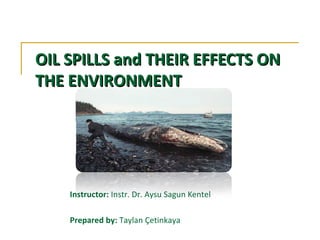
OIL SPILLSOIL SPILLS andand THEIR EFFECTS ONTHEIR EFFECTS ON
THE ENVIRONMENTTHE ENVIRONMENT
Instructor: Instr. Dr. Aysu Sagun Kentel
Prepared by: Taylan Çetinkaya
OutlineOutline
 Motivation
 Introduction
 Impact on the environment
 Clean-up Methods
 Exxon Valdez & Deepwater Horizon Oil Spills
 Conclusions
 References
 Recommended Reading
MotivationMotivation
 Recent Gulf of Mexico Oil Spill (Deepwater Horizon or BP Oil Spill)
 Nature of the disasters: Man-made
 Size of the disasters
 Technology in offshore oil platforms
 Effects on natural balance
IntroductionIntroduction
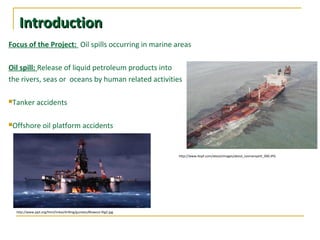
Focus of the Project: Oil spills occurring in marine areas
Oil spill: Release of liquid petroleum products into
the rivers, seas or oceans by human related activities
Tanker accidents
Offshore oil platform accidents
http://www.itopf.com/about/images/about_tasmanspirit_000.JPG
http://www.japt.org/html/iinkai/drilling/guinees/Blowout-Rig2.jpg
Introduction (cont.)Introduction (cont.)
 Tanker accidents: Running aground, collisions with other vessels, fires and
explosions on the ship
- Torrey Canyon spill (1967): 132.5 million liters of oil
- Amoco Cadiz spill (1978): 260 million liters
- Exxon Valdez spill (1989): 41.7 million liters
 Offshore oil platform accidents: Fires/explosions on the platform, leakage from
the wells located on the seafloor
- Ixtoc I spill (1979): 530 million liters
- Deepwater Horizon spill (2010): 780 million liters
ImpactImpact onon thethe EnvironmentEnvironment
 Natural Environment
 Short and long-term damages to the ecosystem
 Social Environment
 Suffering economy = suffering people
 Damage to the recreational areas
 Psychological effects
 Built Environment
 Loss of tankers & offshore oil platforms, fisheries
Impact on the Environment (cont.)Impact on the Environment (cont.)
 Natural Environment:
 Immediate death of species
 Long –term effects: Reduced reproduction, years of recovery
 Sea & soil pollution
 Disrupted natural balance
 Social Environment:
 Loss of jobs, decreased incomes
 Damage to recreational areas: Fishing, beaches, natural parks
 Sorrow and depression
 Built Environment:
 Loss of tankers and offshore platforms
Impact on the Environment (cont.)Impact on the Environment (cont.)
 Light oil: Remains on near surface, evaporates quickly, but highly lethal
 Medium & heavy oil: lower water columns, long-term damage
 Damage to habitat: Physical contact, ingestion, inhalation and absorption
 Plankton, algae, fish eggs, and the larvae of invertebrates: base of food chain
 Clogged blowholes of whales/dolphins: drowning
 Oiled skin/fur/feathers: loss of insulation; hypothermia
 Ingesting and inhaling oil: sudden death or internal organ damage
 Immune system suppression: vulnerability to other diseases
 !! Limited/impaired reproduction capability !!
Clean-up MethodsClean-up Methods
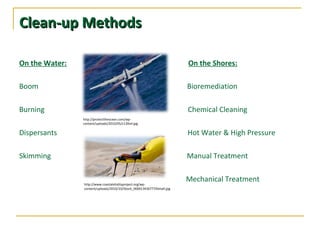
On the Water: On the Shores:
Boom Bioremediation
Burning Chemical Cleaning
Dispersants Hot Water & High Pressure
Skimming Manual Treatment
Mechanical Treatment
http://protecttheocean.com/wp-
content/uploads/2010/05/c130oil.jpg
http://www.coastalvitalityproject.org/wp-
content/uploads/2010/10/iStock_000013436777XSmall.jpg
Clean-up MethodsClean-up Methods (cont.)(cont.)
 On the use of dispersants:
 To break off oil droplets from the slick to prevent re-coalesce
 Standard usage: Oil ratio of 1:20
 Reduces the risk of contact
 May remove natural oils on animal skins hypothermia
 More dangerous for some species than the spill itself
 Chemical may disrupt chemical balance of water
 Disperses oil further spreading of oil into lower water column
Exxon Valez Oil SpillExxon Valez Oil Spill
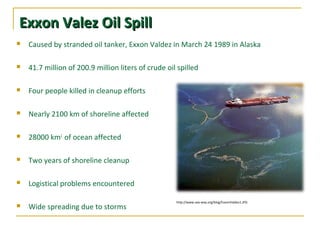
 Caused by stranded oil tanker, Exxon Valdez in March 24 1989 in Alaska
 41.7 million of 200.9 million liters of crude oil spilled
 Four people killed in cleanup efforts
 Nearly 2100 km of shoreline affected
 28000 km2
of ocean affected
 Two years of shoreline cleanup
 Logistical problems encountered
 Wide spreading due to storms
http://www.sea-way.org/blog/ExxonValdez1.JPG
Exxon Valdez Oil Spill (cont.)Exxon Valdez Oil Spill (cont.)
Economical Impact:
Recreational Fishing, Tourism, Existence Value, Wildlife Replacement & Care Losses
Estimated total loss of the state and government: Over $5 billion
Animal replacement: Cost of $218 million in first week for only four mainly affected
species : otters, seals, sea birds, eagles
Ongoing effects
On the company Exxon: $4.3 billion for cleanup, resident compensation and fines
Exxon Valdez Oil Spill (cont.)Exxon Valdez Oil Spill (cont.)
Environmental Impact:
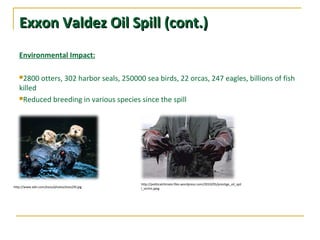
2800 otters, 302 harbor seals, 250000 sea birds, 22 orcas, 247 eagles, billions of fish
killed
Reduced breeding in various species since the spill
http://www.adn.com/evos/photos/evos29l.jpg
http://politicalclimate.files.wordpress.com/2010/05/prestige_oil_spil
l_victim.jpeg
Deepwater Horizon Oil SpillDeepwater Horizon Oil Spill
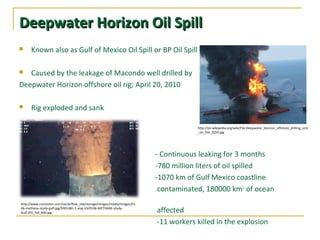
 Known also as Gulf of Mexico Oil Spill or BP Oil Spill
 Caused by the leakage of Macondo well drilled by
Deepwater Horizon offshore oil rig; April 20, 2010
 Rig exploded and sank
- Continuous leaking for 3 months
-780 million liters of oil spilled
-1070 km of Gulf Mexico coastline
contaminated, 180000 km2
of ocean
affected
-11 workers killed in the explosion
http://www.csmonitor.com/var/ezflow_site/storage/images/media/images/01
06-methane-study-gulf.jpg/9301481-1-eng-US/0106-METHANE-study-
Gulf.JPG_full_600.jpg
http://en.wikipedia.org/wiki/File:Deepwater_Horizon_offshore_drilling_unit
_on_fire_2010.jpg
Deepwater Horizon Oil Spill (cont.)Deepwater Horizon Oil Spill (cont.)
Economical Impact:
Recreational and commercial fishing, tourism, existence value, wildlife replacement
& care losses: still not fully known
As of the end of 2010: Clean-up efforts costing about $40 billion
$5 billion paid by BP to claimants and nearly $20 billion to response efforts
Deepwater Horizon Oil Spill (cont.)Deepwater Horizon Oil Spill (cont.)
Environmental Impact:
Reported deaths 3 months after the accident:  997 birds, 400 sea turtles, 47 sea
mammals
Corals, lobsters, crabs, oysters, clams, zooplankton, starfish and sand-dwelling
organisms: likely to be affected for decades
Wetland vegetation: habitat for many species; long-term damage
Too recent to assess long-term damage
ConclusionsConclusions
 Highest toxicity: Early in spill events Quick response
 Clean-up efforts may also be harmful
 Further developments on ship and oil platform designs
 Further research on clean-up chemicals
 Organized, trained response/clean-up personnel and volunteers
 Environmental education
 Corporates: Environment oriented rather than profit oriented
ReferencesReferences
 http://gcaptain.com/historys-10-most-famous-oil-spills/?808
 http://alaska.fws.gov/media/unalaska/Oil%20Spill%20Fact%20Sheet.pdf
 http://library.thinkquest.org/10867/cleanup/methods/index.shtml
 http://response.restoration.noaa.gov/book_shelf/681_Chapter5.pdf
 http://www.eoearth.org/article/Exxon_Valdez_oil_spill?topic=58075#gen2
 http://useconomy.about.com/od/suppl1/p/Exxon_Valdez_Oil_Spill_Economic_Impact.htm
 http://environment.about.com/od/petroleum/a/oil_spills_and_environment.htm
 http://www.oilspillcommission.gov/sites/default/files/documents/FinalReportIntro.pdf
 http://www.cbc.ca/news/world/story/2010/10/19/f-bp-oil-spill-numbers.html
 http://www.bp.com/sectiongenericarticle800.do?categoryId=9036575&contentId=7067541
 http://www.eoearth.org/article/Deepwater_Horizon_oil_spill?topic=50364#gen30
 http://www.biologicaldiversity.org/programs/public_lands/energy/dirty_energy_development/oil_and_gas/gulf_oil_spill/a
_deadly_toll.html
Recommended ReadingRecommended Reading
 Oil Spill Commission
http://www.oilspillcommission.gov
 National Oceanic and Atmospheric Administration
http://www.noaa.gov

Oil spills

  • 1.
    OIL SPILLSOIL SPILLSandand THEIR EFFECTS ONTHEIR EFFECTS ON THE ENVIRONMENTTHE ENVIRONMENT Instructor: Instr. Dr. Aysu Sagun Kentel Prepared by: Taylan Çetinkaya
  • 2.
    OutlineOutline  Motivation  Introduction Impact on the environment  Clean-up Methods  Exxon Valdez & Deepwater Horizon Oil Spills  Conclusions  References  Recommended Reading
  • 3.
    MotivationMotivation  Recent Gulfof Mexico Oil Spill (Deepwater Horizon or BP Oil Spill)  Nature of the disasters: Man-made  Size of the disasters  Technology in offshore oil platforms  Effects on natural balance
  • 4.
    IntroductionIntroduction Focus of theProject: Oil spills occurring in marine areas Oil spill: Release of liquid petroleum products into the rivers, seas or oceans by human related activities Tanker accidents Offshore oil platform accidents http://www.itopf.com/about/images/about_tasmanspirit_000.JPG http://www.japt.org/html/iinkai/drilling/guinees/Blowout-Rig2.jpg
  • 5.
    Introduction (cont.)Introduction (cont.) Tanker accidents: Running aground, collisions with other vessels, fires and explosions on the ship - Torrey Canyon spill (1967): 132.5 million liters of oil - Amoco Cadiz spill (1978): 260 million liters - Exxon Valdez spill (1989): 41.7 million liters  Offshore oil platform accidents: Fires/explosions on the platform, leakage from the wells located on the seafloor - Ixtoc I spill (1979): 530 million liters - Deepwater Horizon spill (2010): 780 million liters
  • 6.
    ImpactImpact onon thetheEnvironmentEnvironment  Natural Environment  Short and long-term damages to the ecosystem  Social Environment  Suffering economy = suffering people  Damage to the recreational areas  Psychological effects  Built Environment  Loss of tankers & offshore oil platforms, fisheries
  • 7.
    Impact on theEnvironment (cont.)Impact on the Environment (cont.)  Natural Environment:  Immediate death of species  Long –term effects: Reduced reproduction, years of recovery  Sea & soil pollution  Disrupted natural balance  Social Environment:  Loss of jobs, decreased incomes  Damage to recreational areas: Fishing, beaches, natural parks  Sorrow and depression  Built Environment:  Loss of tankers and offshore platforms
  • 8.
    Impact on theEnvironment (cont.)Impact on the Environment (cont.)  Light oil: Remains on near surface, evaporates quickly, but highly lethal  Medium & heavy oil: lower water columns, long-term damage  Damage to habitat: Physical contact, ingestion, inhalation and absorption  Plankton, algae, fish eggs, and the larvae of invertebrates: base of food chain  Clogged blowholes of whales/dolphins: drowning  Oiled skin/fur/feathers: loss of insulation; hypothermia  Ingesting and inhaling oil: sudden death or internal organ damage  Immune system suppression: vulnerability to other diseases  !! Limited/impaired reproduction capability !!
  • 9.
    Clean-up MethodsClean-up Methods Onthe Water: On the Shores: Boom Bioremediation Burning Chemical Cleaning Dispersants Hot Water & High Pressure Skimming Manual Treatment Mechanical Treatment http://protecttheocean.com/wp- content/uploads/2010/05/c130oil.jpg http://www.coastalvitalityproject.org/wp- content/uploads/2010/10/iStock_000013436777XSmall.jpg
  • 10.
    Clean-up MethodsClean-up Methods(cont.)(cont.)  On the use of dispersants:  To break off oil droplets from the slick to prevent re-coalesce  Standard usage: Oil ratio of 1:20  Reduces the risk of contact  May remove natural oils on animal skins hypothermia  More dangerous for some species than the spill itself  Chemical may disrupt chemical balance of water  Disperses oil further spreading of oil into lower water column
  • 11.
    Exxon Valez OilSpillExxon Valez Oil Spill  Caused by stranded oil tanker, Exxon Valdez in March 24 1989 in Alaska  41.7 million of 200.9 million liters of crude oil spilled  Four people killed in cleanup efforts  Nearly 2100 km of shoreline affected  28000 km2 of ocean affected  Two years of shoreline cleanup  Logistical problems encountered  Wide spreading due to storms http://www.sea-way.org/blog/ExxonValdez1.JPG
  • 12.
    Exxon Valdez OilSpill (cont.)Exxon Valdez Oil Spill (cont.) Economical Impact: Recreational Fishing, Tourism, Existence Value, Wildlife Replacement & Care Losses Estimated total loss of the state and government: Over $5 billion Animal replacement: Cost of $218 million in first week for only four mainly affected species : otters, seals, sea birds, eagles Ongoing effects On the company Exxon: $4.3 billion for cleanup, resident compensation and fines
  • 13.
    Exxon Valdez OilSpill (cont.)Exxon Valdez Oil Spill (cont.) Environmental Impact: 2800 otters, 302 harbor seals, 250000 sea birds, 22 orcas, 247 eagles, billions of fish killed Reduced breeding in various species since the spill http://www.adn.com/evos/photos/evos29l.jpg http://politicalclimate.files.wordpress.com/2010/05/prestige_oil_spil l_victim.jpeg
  • 14.
    Deepwater Horizon OilSpillDeepwater Horizon Oil Spill  Known also as Gulf of Mexico Oil Spill or BP Oil Spill  Caused by the leakage of Macondo well drilled by Deepwater Horizon offshore oil rig; April 20, 2010  Rig exploded and sank - Continuous leaking for 3 months -780 million liters of oil spilled -1070 km of Gulf Mexico coastline contaminated, 180000 km2 of ocean affected -11 workers killed in the explosion http://www.csmonitor.com/var/ezflow_site/storage/images/media/images/01 06-methane-study-gulf.jpg/9301481-1-eng-US/0106-METHANE-study- Gulf.JPG_full_600.jpg http://en.wikipedia.org/wiki/File:Deepwater_Horizon_offshore_drilling_unit _on_fire_2010.jpg
  • 15.
    Deepwater Horizon OilSpill (cont.)Deepwater Horizon Oil Spill (cont.) Economical Impact: Recreational and commercial fishing, tourism, existence value, wildlife replacement & care losses: still not fully known As of the end of 2010: Clean-up efforts costing about $40 billion $5 billion paid by BP to claimants and nearly $20 billion to response efforts
  • 16.
    Deepwater Horizon OilSpill (cont.)Deepwater Horizon Oil Spill (cont.) Environmental Impact: Reported deaths 3 months after the accident:  997 birds, 400 sea turtles, 47 sea mammals Corals, lobsters, crabs, oysters, clams, zooplankton, starfish and sand-dwelling organisms: likely to be affected for decades Wetland vegetation: habitat for many species; long-term damage Too recent to assess long-term damage
  • 17.
    ConclusionsConclusions  Highest toxicity:Early in spill events Quick response  Clean-up efforts may also be harmful  Further developments on ship and oil platform designs  Further research on clean-up chemicals  Organized, trained response/clean-up personnel and volunteers  Environmental education  Corporates: Environment oriented rather than profit oriented
  • 18.
    ReferencesReferences  http://gcaptain.com/historys-10-most-famous-oil-spills/?808  http://alaska.fws.gov/media/unalaska/Oil%20Spill%20Fact%20Sheet.pdf http://library.thinkquest.org/10867/cleanup/methods/index.shtml  http://response.restoration.noaa.gov/book_shelf/681_Chapter5.pdf  http://www.eoearth.org/article/Exxon_Valdez_oil_spill?topic=58075#gen2  http://useconomy.about.com/od/suppl1/p/Exxon_Valdez_Oil_Spill_Economic_Impact.htm  http://environment.about.com/od/petroleum/a/oil_spills_and_environment.htm  http://www.oilspillcommission.gov/sites/default/files/documents/FinalReportIntro.pdf  http://www.cbc.ca/news/world/story/2010/10/19/f-bp-oil-spill-numbers.html  http://www.bp.com/sectiongenericarticle800.do?categoryId=9036575&contentId=7067541  http://www.eoearth.org/article/Deepwater_Horizon_oil_spill?topic=50364#gen30  http://www.biologicaldiversity.org/programs/public_lands/energy/dirty_energy_development/oil_and_gas/gulf_oil_spill/a _deadly_toll.html
  • 19.
    Recommended ReadingRecommended Reading Oil Spill Commission http://www.oilspillcommission.gov  National Oceanic and Atmospheric Administration http://www.noaa.gov