Oil pollution
BY
MANIMARAN.G
I ST MSC BIOTECHNOLOGY
INTRODUCTION
 An oil spill is the release of liquid petroleum hydrocarbons
into the environment, especially the marine ecosystem, due to
human activity, and is a form of pollution
 Louisiana On April 20, 2010, an explosion at the BP Deep
water Horizon oil rig released over 130 million gallons of
crude oil into the Gulf of Mexico. It was the biggest oil spill
ever in U.S. waters
2
sources
 Accidents involving
 Tankers
 Barges
 Pipelines
 Refineries,
3
Effects
 On marine ecosystem
 On birds
 On man
 On land
4
Effects on marine ecosystem
 Oil on ocean surfaces is harmful to many forms of aquatic life
because it prevents sufficient amounts of sunlight from
penetrating the surface, and it also reduces the level of
dissolved oxygen.
 Crude oil ruins the insulating and waterproofing properties of
feathers and fur, and thus oil-coated birds and marine mammals
may die from hypothermia.
5
 When exposed to oil, adult fish may experience reduced
growth, enlarged livers, changes in heart and respiration rates,
fin erosion and reproduction impairment. Fish eggs and larvae
can be especially sensitive to lethal and sub lethal impacts.
Even when lethal impacts are not observed, oil can make fish
and shellfish unsafe for humans to eat.
6
Effects in man
 Humans exposed to oil and gas from spills. These effects can
be grouped into respiratory damage, liver damage,
decreased immunity, increased cancer risk, reproductive
damage and higher levels of some toxics (hydrocarbons and
heavy metals).
7
Effects in bird
 Oil can sink their natural buoyancy and literally drag them
into a watery grave. And the birds that try to clean themselves
ingest a sticky poison that ravages their livers, lungs, and
intestines.
8
Effects on land
 As spilled oil on land prevents water absorption by the soil,
spills on agricultural locations or grasslands have the effect of
choking off plant life.
9
Treatment methods
 Physical
 Chemical
 Biological
10
Physical methods
 Physical barriers for the mechanical prevention of oil
spreading.
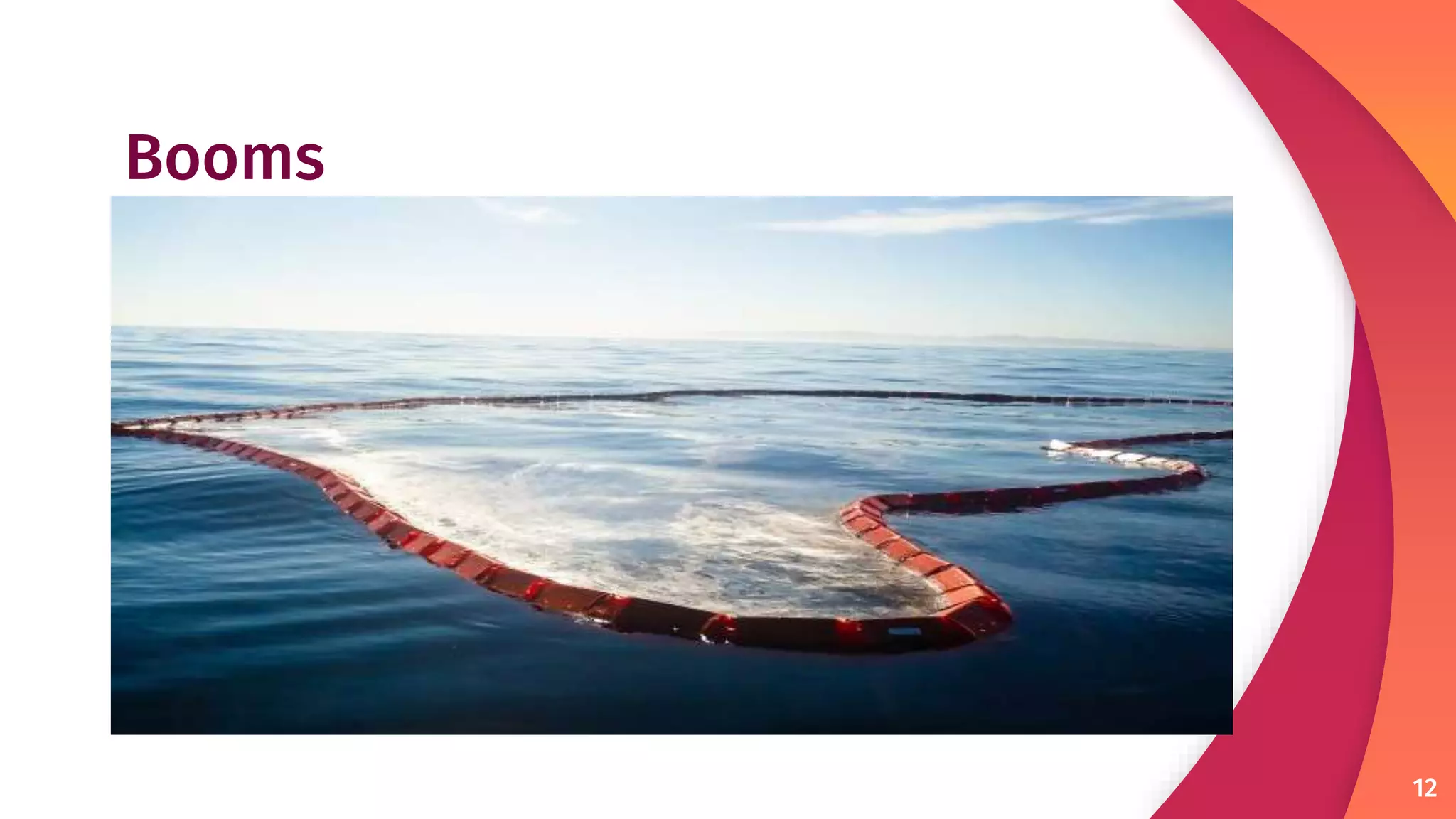
 Booms - Fire resistant booms are used in order to restrict the
burning area, especially when controlled burning is applied.
 Skimmers - Skimmers are usually propylene mop-like pads
that are placed on the ocean surface to adsorb the spilled oil
film.
 Natural and synthetic absorbing materials - These have a
sponge-like behavior, used to control a large variety of spills by
removing some of the spilled oil and serving as a physical
barrier that limits oil migration.
11
Booms
12
skimmers
13
Chemical method
 Spraying dispersants that make the oil more compact and
ease the cleanup process, even though they might affect
wildlife and coral reefs. Dispersants can be sprayed
 From airplanes into the slicks – a traditional method usually
consisting of a surfactants and solvents mixture which act like a
soap. The result is the fine dispersing of oil and its mixing with
water, followed by an increased efficiency of the natural
microbial degradation processes.
14
Biological method
 Bacteria can be used to clean up oil spills in the ocean
through bioremediation. Specific bacteria can be used to
bioremediation specific contaminants, such as hydrocarbons,
which are present in oil and gasoline.
 Pseudomonas ability to readily degrade oil to recalcitrant
PAHs . Pseudomonas species high bioremediation potential.
Pseudomonas putida is capable of utilizing naphthalene as its
sole source of carbon and energy through metabolic pathway.
15
 Pseudomonas strains are capable of degrading petroleum
hydrocarbons and aromatic hydrocarbons such as benzene,
toluene, ethylbenzene, and xylene.
16
17

Oil pollution ppt

  • 1.
  • 2.
    INTRODUCTION  An oilspill is the release of liquid petroleum hydrocarbons into the environment, especially the marine ecosystem, due to human activity, and is a form of pollution  Louisiana On April 20, 2010, an explosion at the BP Deep water Horizon oil rig released over 130 million gallons of crude oil into the Gulf of Mexico. It was the biggest oil spill ever in U.S. waters 2
  • 3.
    sources  Accidents involving Tankers  Barges  Pipelines  Refineries, 3
  • 4.
    Effects  On marineecosystem  On birds  On man  On land 4
  • 5.
    Effects on marineecosystem  Oil on ocean surfaces is harmful to many forms of aquatic life because it prevents sufficient amounts of sunlight from penetrating the surface, and it also reduces the level of dissolved oxygen.  Crude oil ruins the insulating and waterproofing properties of feathers and fur, and thus oil-coated birds and marine mammals may die from hypothermia. 5
  • 6.
     When exposedto oil, adult fish may experience reduced growth, enlarged livers, changes in heart and respiration rates, fin erosion and reproduction impairment. Fish eggs and larvae can be especially sensitive to lethal and sub lethal impacts. Even when lethal impacts are not observed, oil can make fish and shellfish unsafe for humans to eat. 6
  • 7.
    Effects in man Humans exposed to oil and gas from spills. These effects can be grouped into respiratory damage, liver damage, decreased immunity, increased cancer risk, reproductive damage and higher levels of some toxics (hydrocarbons and heavy metals). 7
  • 8.
    Effects in bird Oil can sink their natural buoyancy and literally drag them into a watery grave. And the birds that try to clean themselves ingest a sticky poison that ravages their livers, lungs, and intestines. 8
  • 9.
    Effects on land As spilled oil on land prevents water absorption by the soil, spills on agricultural locations or grasslands have the effect of choking off plant life. 9
  • 10.
    Treatment methods  Physical Chemical  Biological 10
  • 11.
    Physical methods  Physicalbarriers for the mechanical prevention of oil spreading.  Booms - Fire resistant booms are used in order to restrict the burning area, especially when controlled burning is applied.  Skimmers - Skimmers are usually propylene mop-like pads that are placed on the ocean surface to adsorb the spilled oil film.  Natural and synthetic absorbing materials - These have a sponge-like behavior, used to control a large variety of spills by removing some of the spilled oil and serving as a physical barrier that limits oil migration. 11
  • 12.
  • 13.
  • 14.
    Chemical method  Sprayingdispersants that make the oil more compact and ease the cleanup process, even though they might affect wildlife and coral reefs. Dispersants can be sprayed  From airplanes into the slicks – a traditional method usually consisting of a surfactants and solvents mixture which act like a soap. The result is the fine dispersing of oil and its mixing with water, followed by an increased efficiency of the natural microbial degradation processes. 14
  • 15.
    Biological method  Bacteriacan be used to clean up oil spills in the ocean through bioremediation. Specific bacteria can be used to bioremediation specific contaminants, such as hydrocarbons, which are present in oil and gasoline.  Pseudomonas ability to readily degrade oil to recalcitrant PAHs . Pseudomonas species high bioremediation potential. Pseudomonas putida is capable of utilizing naphthalene as its sole source of carbon and energy through metabolic pathway. 15
  • 16.
     Pseudomonas strainsare capable of degrading petroleum hydrocarbons and aromatic hydrocarbons such as benzene, toluene, ethylbenzene, and xylene. 16
  • 17.