QoS Aware Adaptive
Subcarrier Allocation
in OFDMA Systems
Mustafa Ergen & Sinem Coleri
{ergen,csinem}@eecs.berkeley.edu
University of California Berkeley
Introduction






Motivation
Orthogonal Frequency Division Multiple Access(OFDMA)
OFDMA System
Resource Allocation Problem
Algorithms






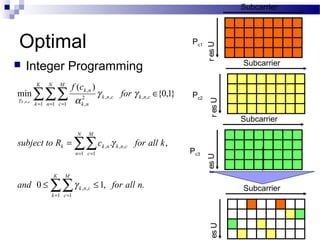
Optimal
Suboptimal

Simulation
Conclusion
Motivation


Broadband Wireless Access
 Ex:



IEEE 802.16, Wireless MAN

OFDM
 Eliminates



OFDMA

InterSymbol Interference
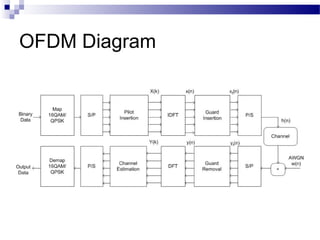
OFDM Diagram
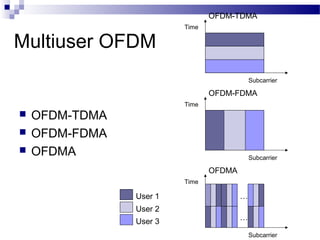
OFDM-TDMA

Multiuser OFDM

Time

Subcarrier

OFDM-FDMA
Time





OFDM-TDMA
OFDM-FDMA
OFDMA

Subcarrier

OFDMA
Time

User 1
User 2
User 3

…
…
Subcarrier
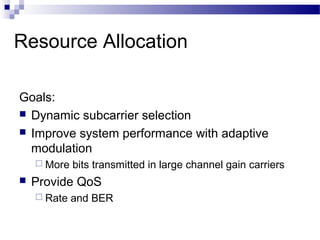
Resource Allocation
Goals:
 Dynamic subcarrier selection
 Improve system performance with adaptive
modulation
 More



bits transmitted in large channel gain carriers

Provide QoS
 Rate

and BER
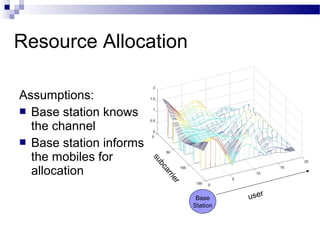
Resource Allocation

ri
ar
bc
su

Assumptions:
 Base station knows
the channel
 Base station informs
the mobiles for
allocation

er
Base
Station

user
System
oCoS=Ptotal for downlink
oCoS=Pu
for uplink

Application

Network
rQoS=[rR,rBER]

oQoS=[oR,oBER,oCoS]

Resource Allocation
[User x Subcarrier]
Physical Layer
OFDMA
Resource Allocation RATE:
BER:

[12

6

6

8

]

[1e-2 1e-2 1e-4 1e-4]

Resource Allocation
Subcarrier

r es U

Channel

QoS

64-QAM
16-QAM
4-QAM
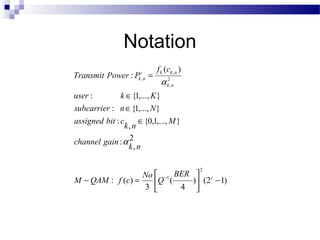
Notation
Transmit Power : Pkc,n =

f k (ck , n )

α k2,n

user :
k ∈ {1,..., K }
subcarrier : n ∈ {1,..., N }
assigned bit : c
∈ {0,1,..., M }
k, n
channel gain : α 2
k, n
No  −1 BER
M − QAM : f (c) =
Q (
3 
4

2


) (2c − 1)

K

min
γ k ,n ,c

N

M

∑∑∑

f ( ck , n )

k =1 n =1 c =1

subject to Rk =

α

N

2
k ,n

γ k ,n ,c for γ k ,n ,c ∈{0,1}

M

∑∑ c

k ,n

.γ k ,n ,c for all k ,

n =1 c =1

and 0 ≤

K

M

∑∑ γ

k , n ,c

Pc2

Pc3

r es U

Integer Programming

≤ 1, for all n.

Subcarrier

Subcarrier

Subcarrier

k =1 c =1

es U



Pc1

r es U

Optimal

r es U

Subcarrier
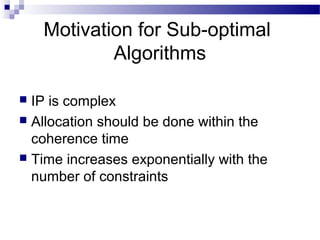
Motivation for Sub-optimal
Algorithms
IP is complex
 Allocation should be done within the
coherence time
 Time increases exponentially with the
number of constraints

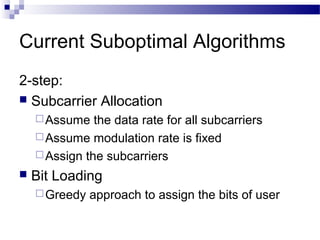
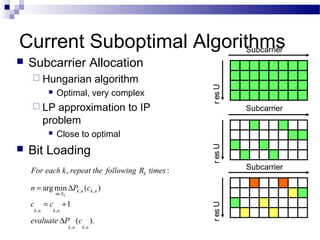
Current Suboptimal Algorithms
2-step:
 Subcarrier Allocation
 Assume

the data rate for all subcarriers
 Assume modulation rate is fixed
 Assign the subcarriers


Bit Loading
 Greedy

approach to assign the bits of user
Current Suboptimal Algorithms
Subcarrier
 Hungarian

algorithm

Optimal, very complex



 LP

approximation to IP
problem



Bit Loading
For each k , repeat the following Rk times :
n = arg min ∆Pk ,n (ck ,n )
n∈S k

c

k ,n

=c

Subcarrier

Close to optimal
r es U



r es U

Subcarrier Allocation

k ,n

+1

evaluate ∆P (c ).
k ,n

k ,n

r es U



Subcarrier
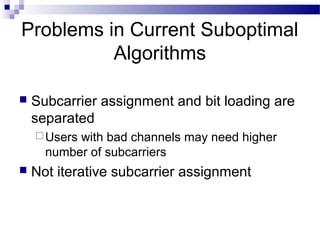
Problems in Current Suboptimal
Algorithms


Subcarrier assignment and bit loading are
separated
 Users

with bad channels may need higher
number of subcarriers



Not iterative subcarrier assignment
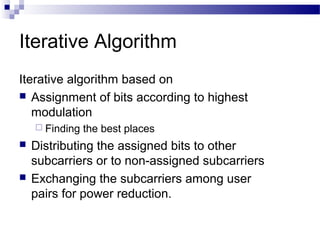
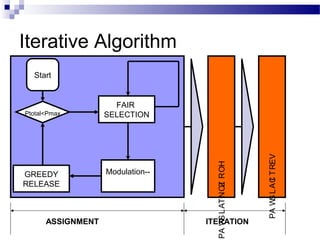
Iterative Algorithm
Iterative algorithm based on
 Assignment of bits according to highest
modulation
 Finding





the best places

Distributing the assigned bits to other
subcarriers or to non-assigned subcarriers
Exchanging the subcarriers among user
pairs for power reduction.
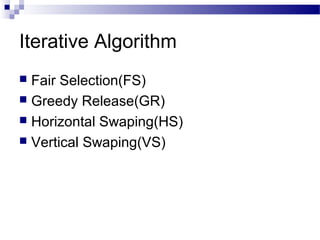
Iterative Algorithm
Fair Selection(FS)
 Greedy Release(GR)
 Horizontal Swaping(HS)
 Vertical Swaping(VS)

Iterative Algorithm
Start

ASSIGNMENT

Modulation--

ITERATION

PA W L A C T REV
S
I

GREEDY
RELEASE

PA W L AT N OZ R OH
S
I

Ptotal<Pmax

FAIR
SELECTION
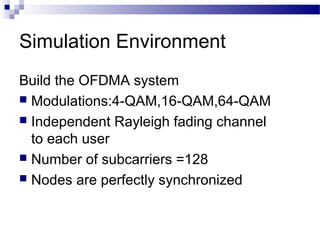
Simulation Environment
Build the OFDMA system
 Modulations:4-QAM,16-QAM,64-QAM
 Independent Rayleigh fading channel
to each user
 Number of subcarriers =128
 Nodes are perfectly synchronized
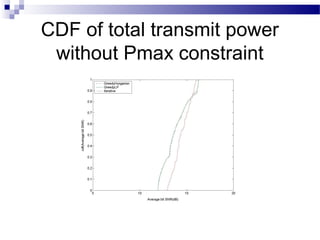
CDF of total transmit power
without Pmax constraint
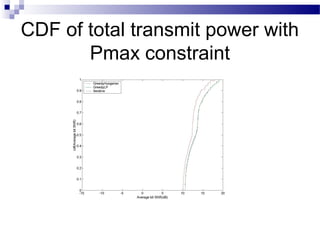
CDF of total transmit power with
Pmax constraint
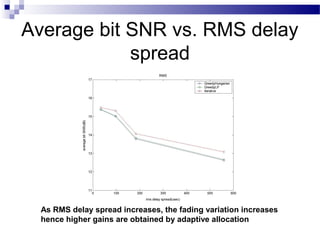
Average bit SNR vs. RMS delay
spread

As RMS delay spread increases, the fading variation increases
hence higher gains are obtained by adaptive allocation
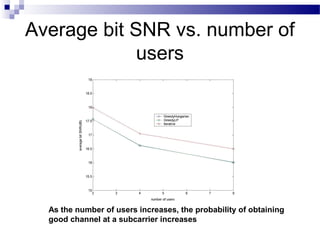
Average bit SNR vs. number of
users

As the number of users increases, the probability of obtaining
good channel at a subcarrier increases
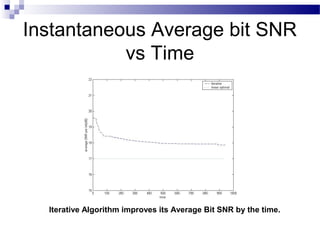
Instantaneous Average bit SNR
vs Time

Iterative Algorithm improves its Average Bit SNR by the time.
Conclusion


OFDMA
 Broadband



Wireless Access

Resource Allocation
 Channel

Information
 QoS Requirement


Optimal Algorithms
 complex



Iterative Algorithms

Ofdma 1

Editor's Notes

  • #3 The analysis, Research and consultancy (ARC) group forecasts that the fixed wireless deployments in both homes and business will reach 28 million by 2005. 802.16 comiitee broadband wireless access based on OFDMA.
  • #4 BWA is alternative to DSL technologies Physical layer should mitigate non LOS environments in indoor. 802.16 10-66GHz 802.16a 2-11GHz
  • #7 Instead of assigning a fixed frequency or time slot to each user, the performance will increase. The users will not use the subcarriers that are in deep fade. The performance will increase since it is quite unlikely that this subcarriers will be in deep fade for all the other users.