ERUPTION AND SHEDDINGERUPTION AND SHEDDING
OF TEETHOF TEETH
Dr.sangameshwarDr.sangameshwar
POST GRADUATE IN DEPT. OFPOST GRADUATE IN DEPT. OF
PEDODONTICSPEDODONTICS
BAPUJI DENTAL COLLEGE AND HOSPITALBAPUJI DENTAL COLLEGE AND HOSPITAL
DAVANGEREDAVANGERE
CONTENTSCONTENTS
 INTRODUCTIONINTRODUCTION
 DEFINITIONSDEFINITIONS
 PHASES OF TOOTH ERUPTIONPHASES OF TOOTH ERUPTION
 THEORIES OF TOOTH ERUPTIONTHEORIES OF TOOTH ERUPTION
 CHRONOLOGY OF TOOTH ERUPTIONCHRONOLOGY OF TOOTH ERUPTION
 FACTORS INFLUENCING ERUPTION OF TEETHFACTORS INFLUENCING ERUPTION OF TEETH
 ABNORMALITIES OF ERUPTIONABNORMALITIES OF ERUPTION
 SHEDDING OF DECIDUOUS TEETHSHEDDING OF DECIDUOUS TEETH
 CONCLUSIONCONCLUSION
 REFERENCESREFERENCES
INTRODUCTIONINTRODUCTION
erumpere = break outerumpere = break out
 James K AveryJames K Avery—— Eruption is the movement of the teeth throughEruption is the movement of the teeth through
the bone of the jaws and the overlying mucosa to appear andthe bone of the jaws and the overlying mucosa to appear and
function in the oral cavity.function in the oral cavity.
 OrbansOrbans —— Eruption is axial or occlusal movement of the tooth fromEruption is axial or occlusal movement of the tooth from
its developmental position within the jaw to its functional position inits developmental position within the jaw to its functional position in
the occlusionthe occlusion
DEFINITIONS:DEFINITIONS:
NOLLA STAGES OF TOOTHNOLLA STAGES OF TOOTH
DEVELOPMENT(1952)DEVELOPMENT(1952)
10.Root apex completed.
9.Root almost completed,open apex.
8.Two thirds of root completed.
7.One third of root completed.
6.Crown completed.
5.Crown almost completed.
4.Two thirds of crown completed.
3.One third of crown completed.
2.Initial calcification.
1.Crypt present.
0.Crypt absent.
PHASES OF TOOTH ERUPTIONPHASES OF TOOTH ERUPTION
 Preeruptive phase:Preeruptive phase:
 Eruptive or Prefunctional phase:Eruptive or Prefunctional phase:
 Posteruptive or functional phase:Posteruptive or functional phase:
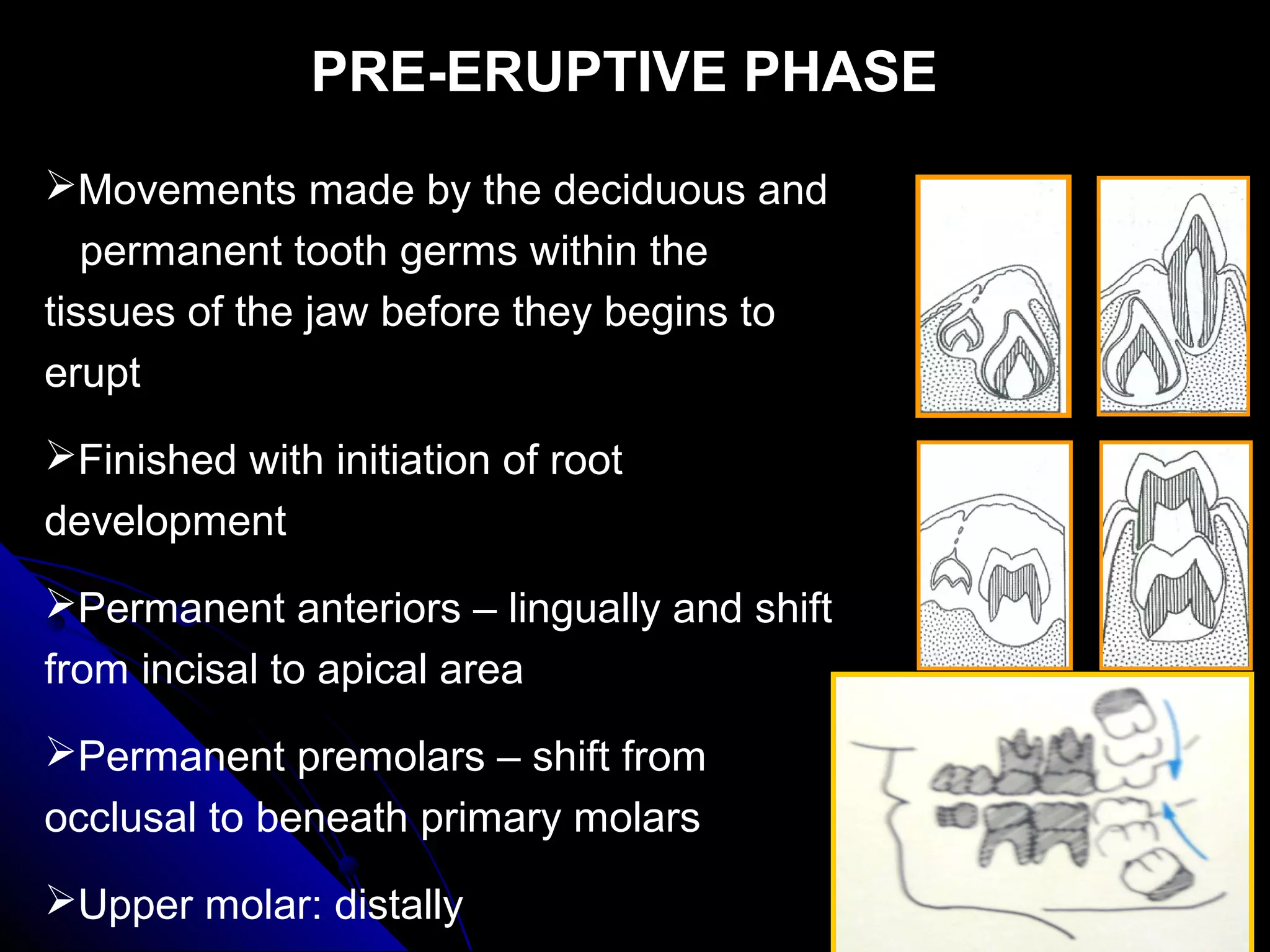
PRE-ERUPTIVE PHASEPRE-ERUPTIVE PHASE
Movements made by the deciduous and
permanent tooth germs within the
tissues of the jaw before they begins to
erupt
Finished with initiation of root
development
Permanent anteriors – lingually and shift
from incisal to apical area
Permanent premolars – shift from
occlusal to beneath primary molars
Upper molar: distally
a) total bodily movement
b) eccentric growth
Pre eruptive phase
Histology
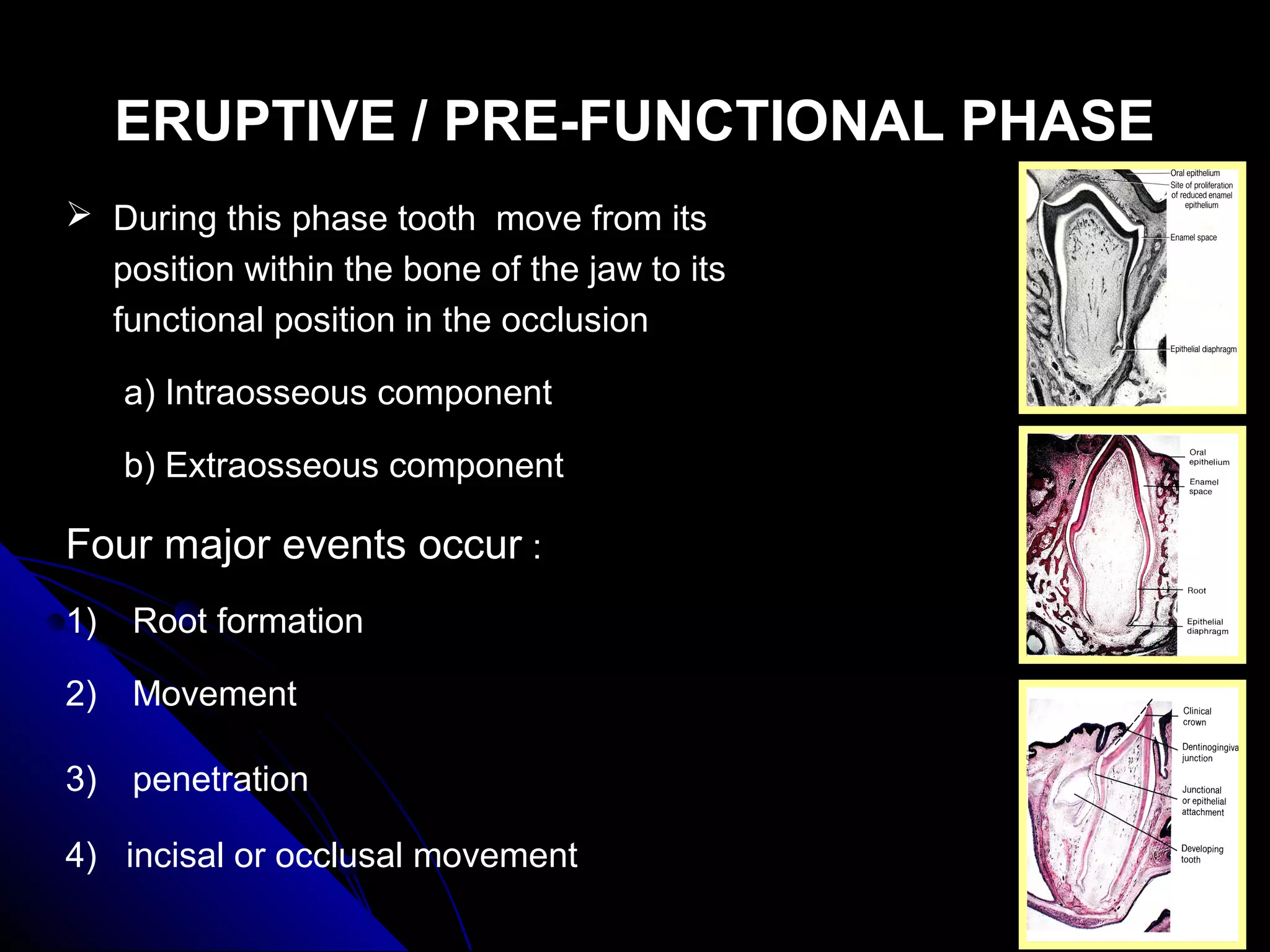
ERUPTIVE / PRE-FUNCTIONAL PHASEERUPTIVE / PRE-FUNCTIONAL PHASE
 During this phase tooth move from its
position within the bone of the jaw to its
functional position in the occlusion
a) Intraosseous component
b) Extraosseous component
Four major events occur :
1) Root formation
2) Movement
3) penetration
4) incisal or occlusal movement
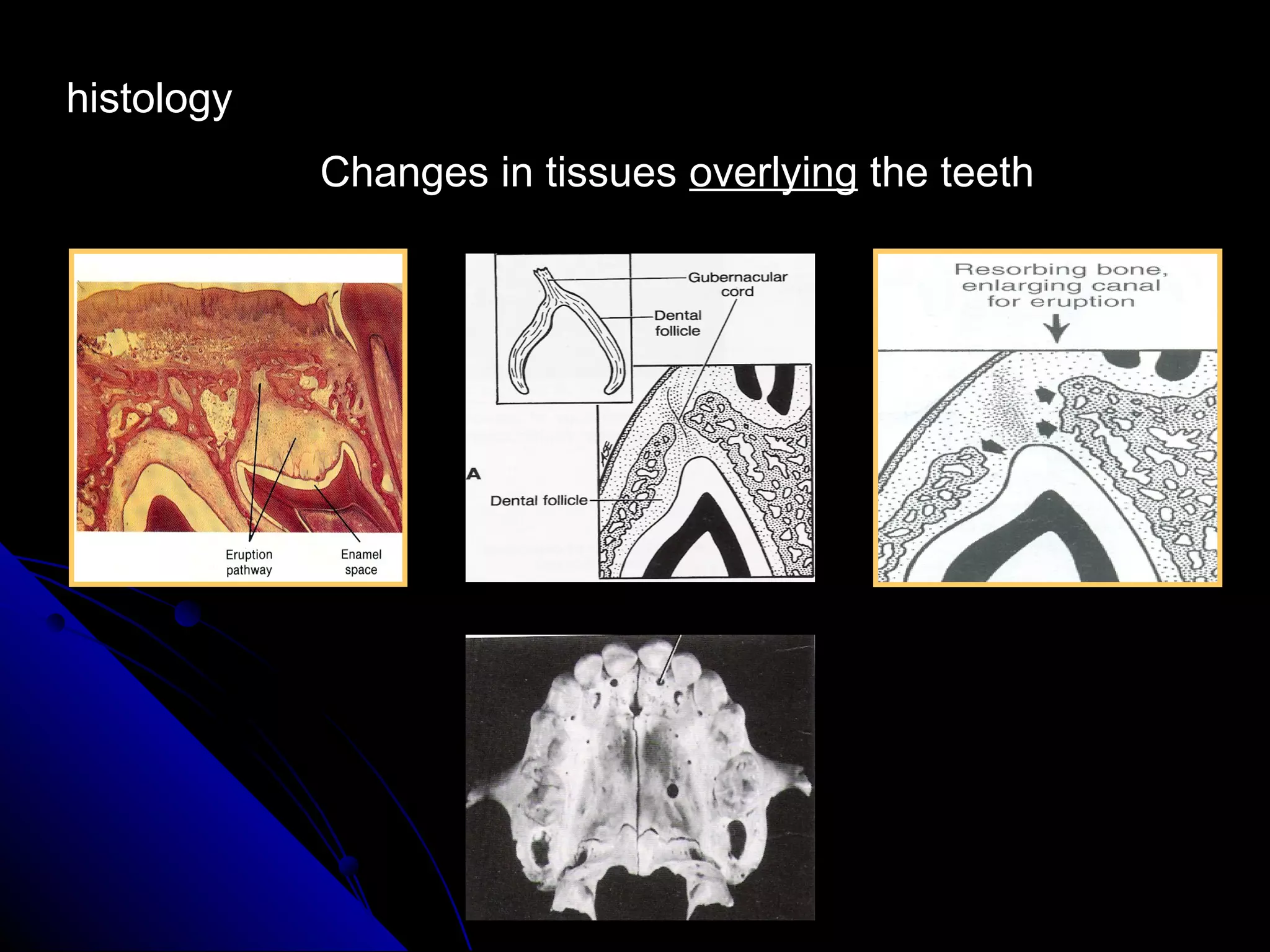
Changes in tissues overlying the teeth
histology
Changes in tissues surrounding the teeth
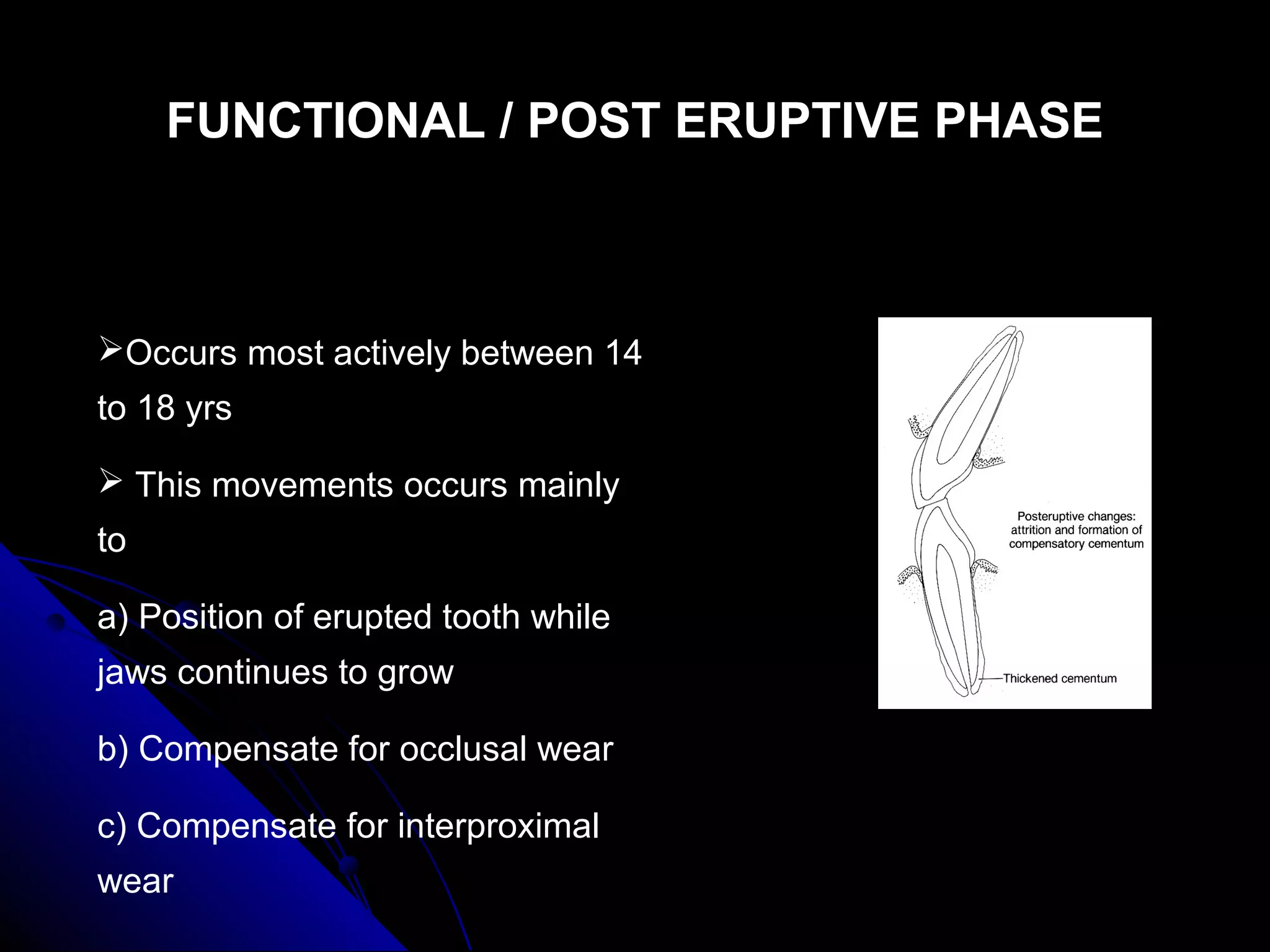
FUNCTIONAL / POST ERUPTIVE PHASEFUNCTIONAL / POST ERUPTIVE PHASE
Occurs most actively between 14
to 18 yrs
 This movements occurs mainly
to
a) Position of erupted tooth while
jaws continues to grow
b) Compensate for occlusal wear
c) Compensate for interproximal
wear
THEORIES OF ERUPTIONTHEORIES OF ERUPTION
 Papillary constriction theoryPapillary constriction theory
 Bony remodelingBony remodeling
 Epithelial path theoryEpithelial path theory
 Cushion hammock theoryCushion hammock theory
 Root formation theoryRoot formation theory
 Vascular pressureVascular pressure
 Periodontal ligament tractionPeriodontal ligament traction
PAPILLARY CONSTRICTION THEORYPAPILLARY CONSTRICTION THEORY::
 Dental papilla constricts because ofDental papilla constricts because of
decrease in the volume of the pulpdecrease in the volume of the pulp
cavity by continuous dentine formationcavity by continuous dentine formation
and this generates propulsive forceand this generates propulsive force
BONY REMODELLING:BONY REMODELLING:

Bony remodeling of the crypt wall isBony remodeling of the crypt wall is
important to achieve tooth eruptionimportant to achieve tooth eruption
 In some experiments tooth germ isIn some experiments tooth germ is
removed but follicle is left in positionremoved but follicle is left in position
the eruptive pathway still forms in thethe eruptive pathway still forms in the
bonebone
 This clearly indicates the dental follicleThis clearly indicates the dental follicle
not the bone as the major determinantnot the bone as the major determinant
in tooth eruptionin tooth eruption
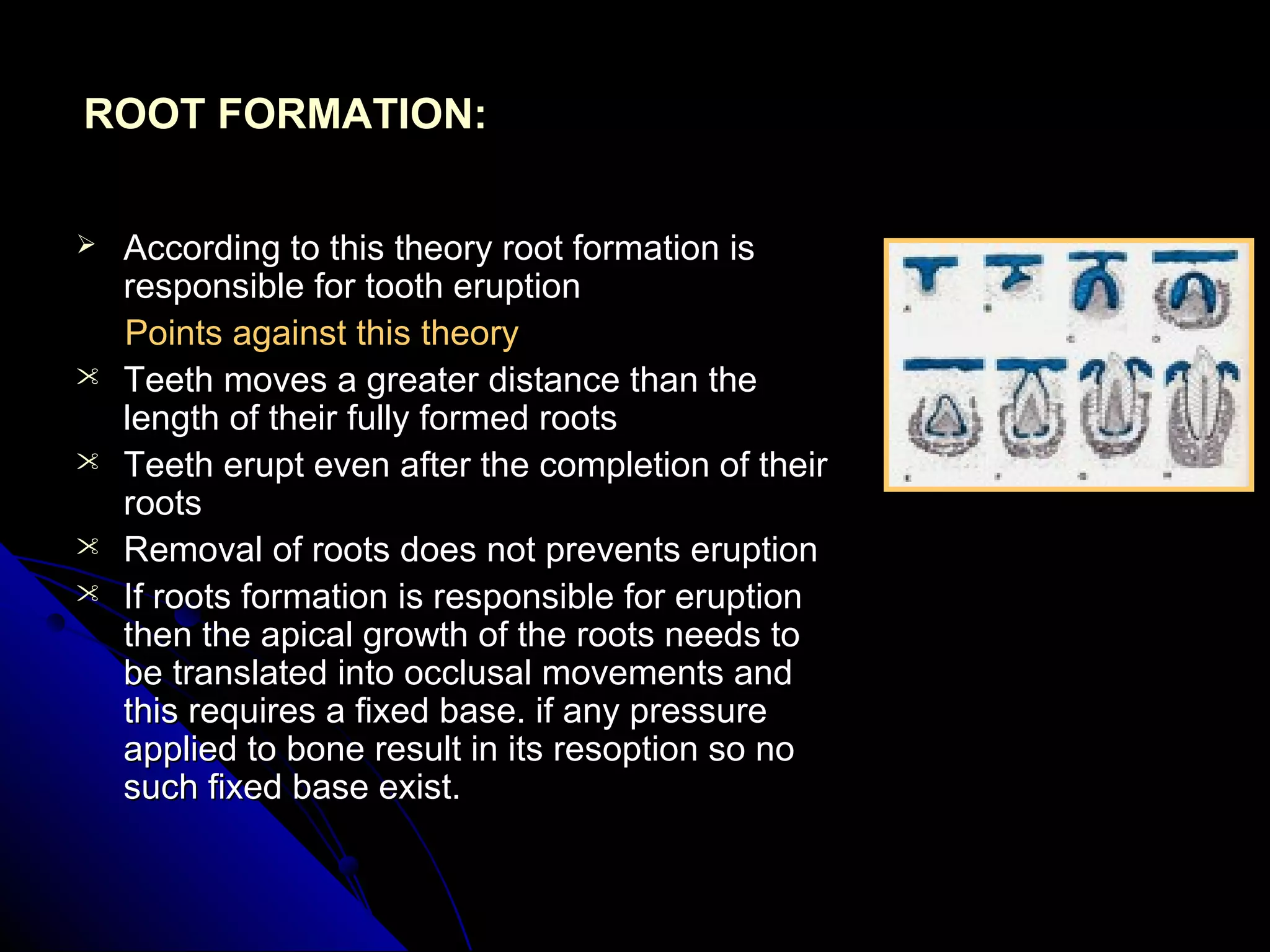
ROOT FORMATION:ROOT FORMATION:
 According to this theory root formation isAccording to this theory root formation is
responsible for tooth eruptionresponsible for tooth eruption
Points against this theoryPoints against this theory
 Teeth moves a greater distance than theTeeth moves a greater distance than the
length of their fully formed rootslength of their fully formed roots
 Teeth erupt even after the completion of theirTeeth erupt even after the completion of their
rootsroots
 Removal of roots does not prevents eruptionRemoval of roots does not prevents eruption
 If roots formation is responsible for eruptionIf roots formation is responsible for eruption
then the apical growth of the roots needs tothen the apical growth of the roots needs to
be translated into occlusal movements andbe translated into occlusal movements and
this requires a fixed base. if any pressurethis requires a fixed base. if any pressure
applied to bone result in its resoption so noapplied to bone result in its resoption so no
such fixed base exist.such fixed base exist.
EPITHELIAL PATH THEORY:EPITHELIAL PATH THEORY:
 Hair, nail and salivary gland are end product of epithelial downHair, nail and salivary gland are end product of epithelial down
growth. they return to the surfacegrowth. they return to the surface
 Enamel is also an epithelial structure and so return back to theEnamel is also an epithelial structure and so return back to the
surfacesurface
CUSHION HAMMOCK THEORY:CUSHION HAMMOCK THEORY:
 This theory states that pulp grows and pushes against the cushionThis theory states that pulp grows and pushes against the cushion
hammock ligament which passes from one side of the socket to thehammock ligament which passes from one side of the socket to the
oppositeopposite
 But recent works shows that this hammock ligament does not extendBut recent works shows that this hammock ligament does not extend
across the socket, but only separates the pulp from the follicleacross the socket, but only separates the pulp from the follicle
VASCULAR PRESSURE:VASCULAR PRESSURE:
 Local volume changes can produce tooth movementsLocal volume changes can produce tooth movements
 Ground substance swell up to 50 % With addition ofGround substance swell up to 50 % With addition of
water and this differential pressure is sufficient to causewater and this differential pressure is sufficient to cause
tooth movementstooth movements
Points againstPoints against
 Surgical excision of tooth and vasculature does notSurgical excision of tooth and vasculature does not
prevent eruptionprevent eruption
Periodontal ligament traction:Periodontal ligament traction:
 There is good evidence available thatThere is good evidence available that
eruptive force resides in ligament-follicleeruptive force resides in ligament-follicle
complexcomplex
 The follicle before it becomes periodontalThe follicle before it becomes periodontal
ligament also play role in tooth eruption byligament also play role in tooth eruption by
providing eruptive pathwayproviding eruptive pathway
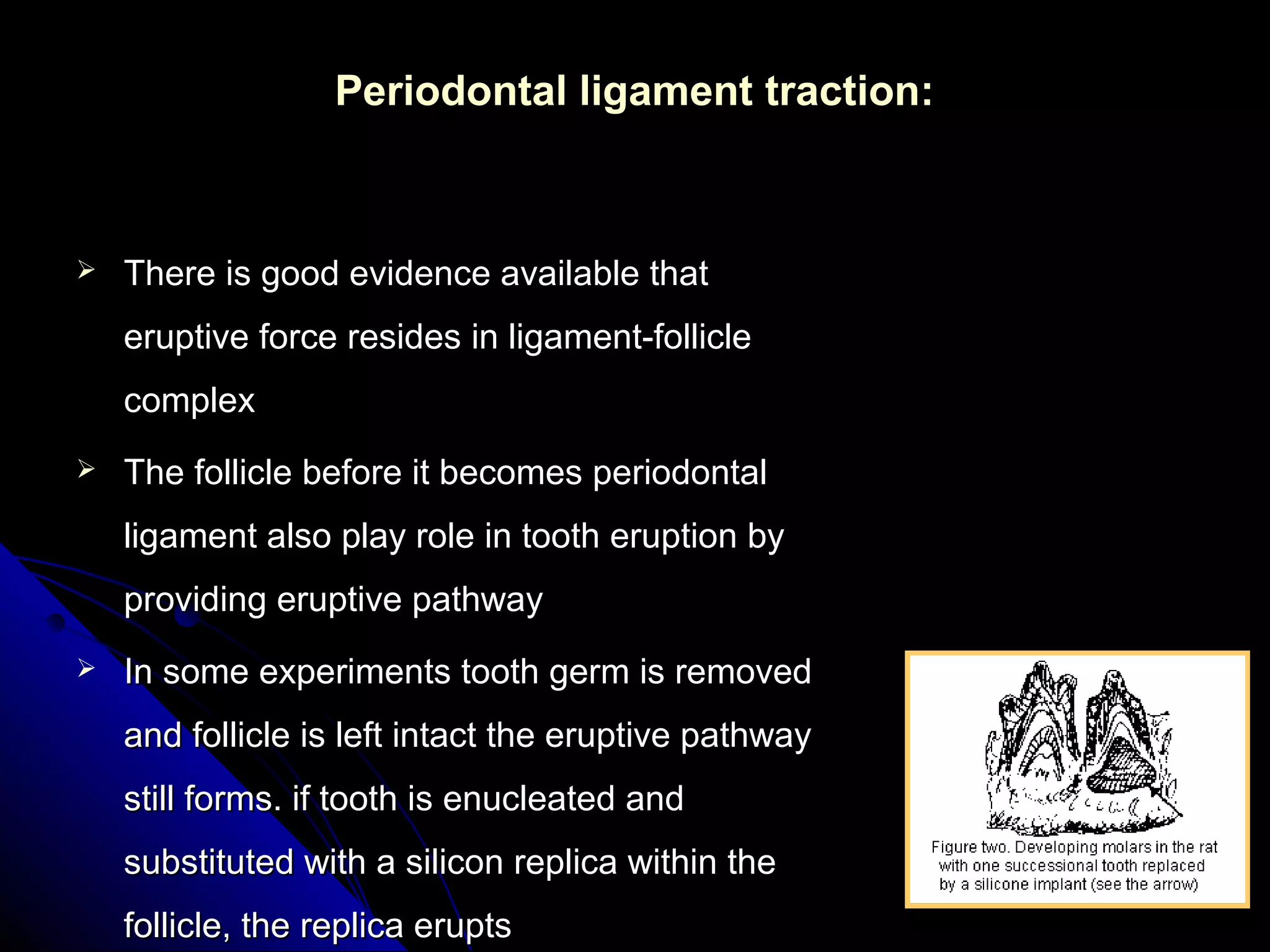
 In some experiments tooth germ is removedIn some experiments tooth germ is removed
and follicle is left intact the eruptive pathwayand follicle is left intact the eruptive pathway
still forms. if tooth is enucleated andstill forms. if tooth is enucleated and
substituted with a silicon replica within thesubstituted with a silicon replica within the
follicle, the replica eruptsfollicle, the replica erupts
 If the normal architecture of the periodontalIf the normal architecture of the periodontal
ligament is disturbed experimentally byligament is disturbed experimentally by
interfering with collagen synthesis, eruptioninterfering with collagen synthesis, eruption
is either slowed or stoppedis either slowed or stopped
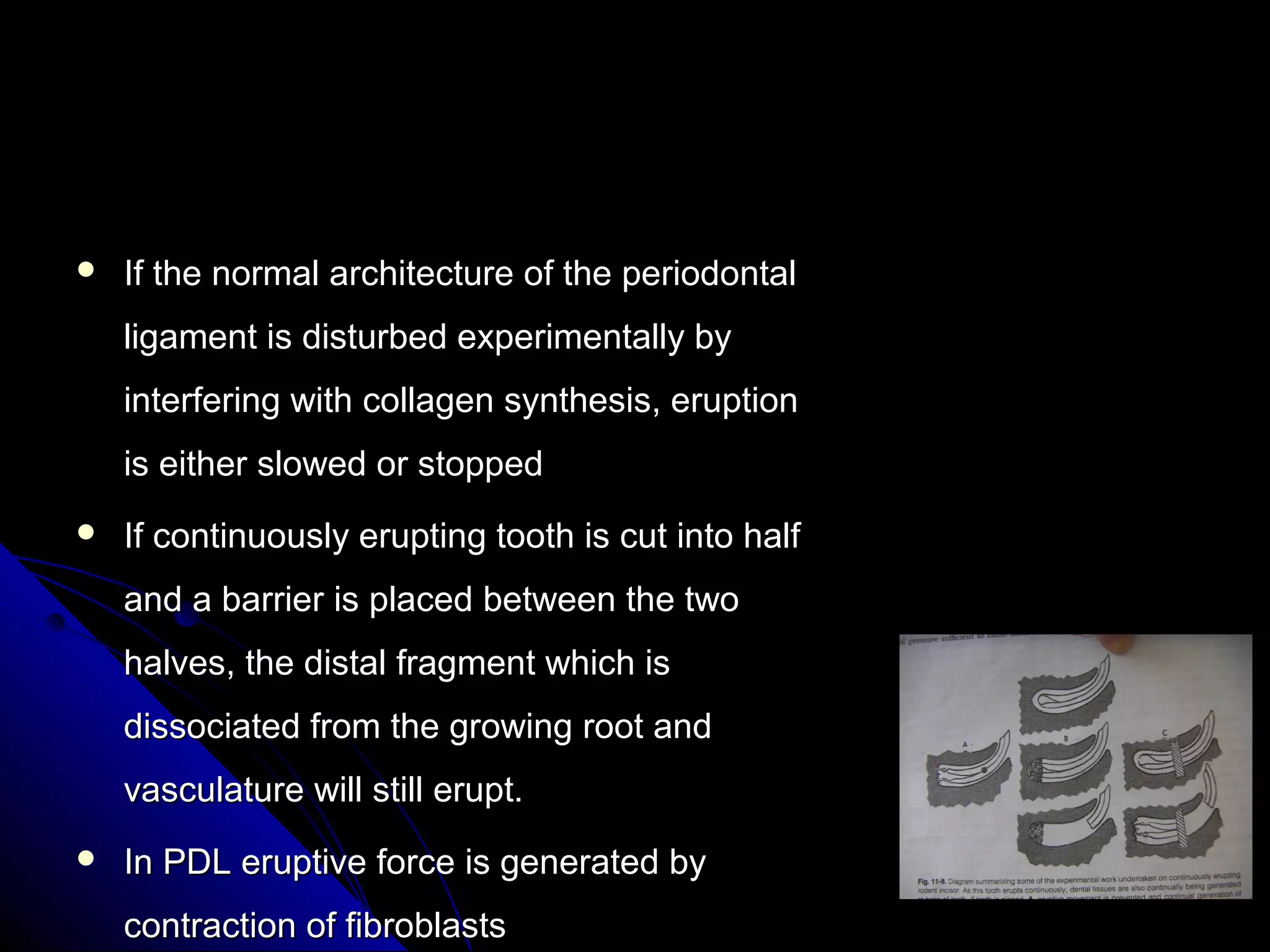
 If continuously erupting tooth is cut into halfIf continuously erupting tooth is cut into half
and a barrier is placed between the twoand a barrier is placed between the two
halves, the distal fragment which ishalves, the distal fragment which is
dissociated from the growing root anddissociated from the growing root and
vasculature will still erupt.vasculature will still erupt.
 In PDL eruptive force is generated byIn PDL eruptive force is generated by
contraction of fibroblastscontraction of fibroblasts
CHRONOLOGYCHRONOLOGY
Chronos + Logos
Time Study
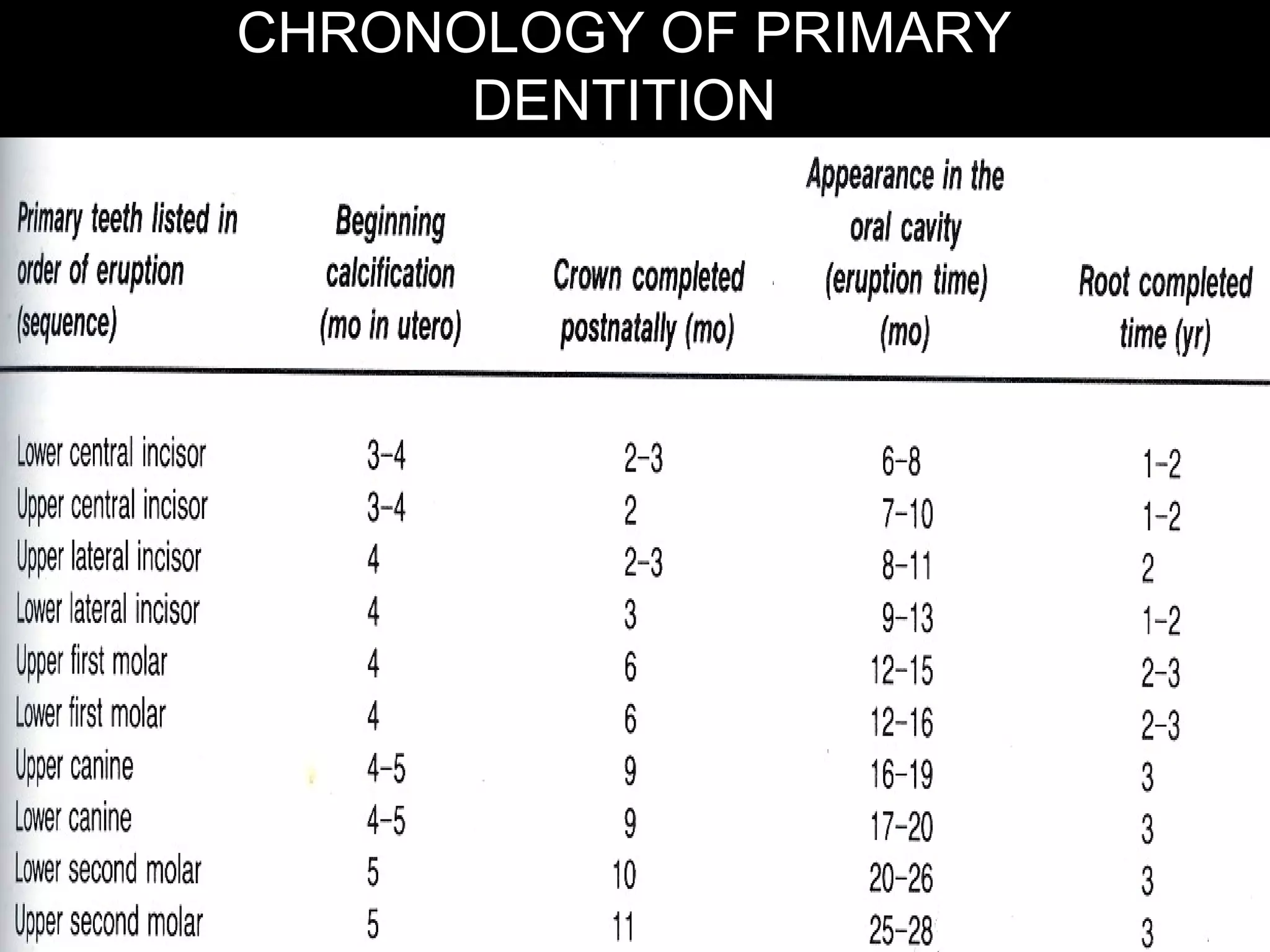
CHRONOLOGY OF PRIMARYCHRONOLOGY OF PRIMARY
DENTITIONDENTITION
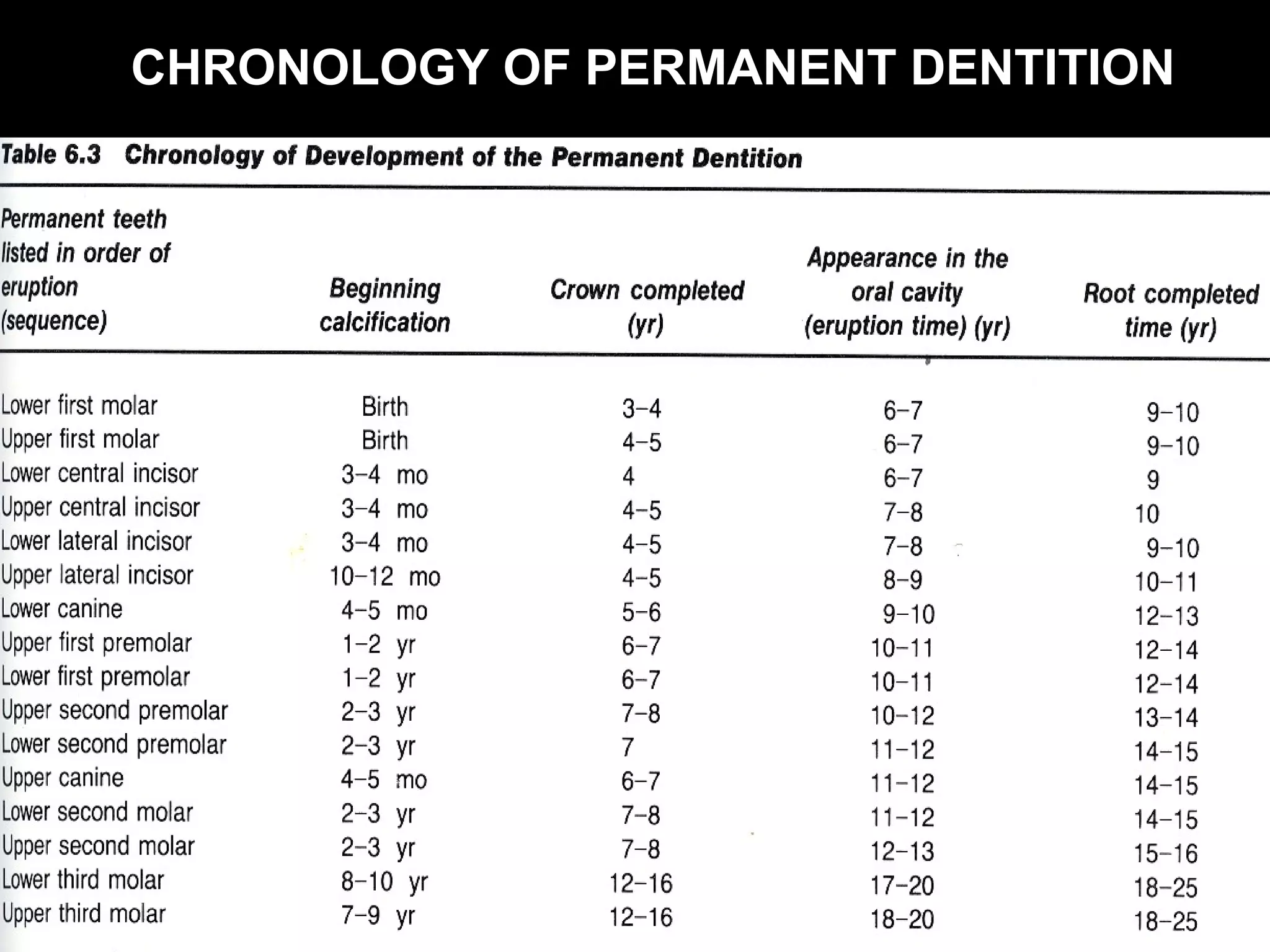
CHRONOLOGY OF PERMANENT DENTITION
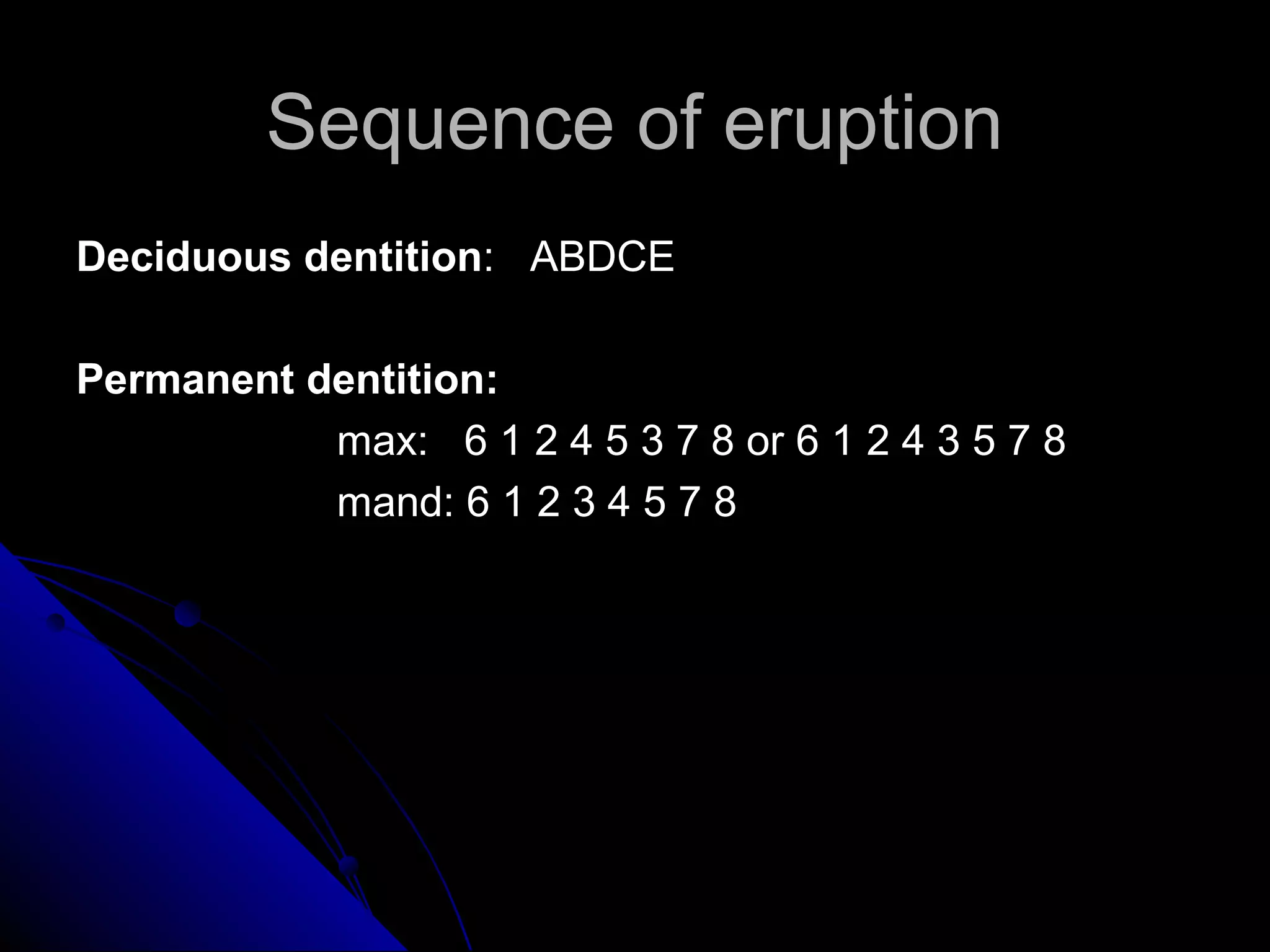
Sequence of eruptionSequence of eruption
Deciduous dentitionDeciduous dentition: ABDCE: ABDCE
Permanent dentition:Permanent dentition:
max: 6 1 2 4 5 3 7 8 or 6 1 2 4 3 5 7 8max: 6 1 2 4 5 3 7 8 or 6 1 2 4 3 5 7 8
mand: 6 1 2 3 4 5 7 8mand: 6 1 2 3 4 5 7 8
 Eruption occurs earlier in girls than boysEruption occurs earlier in girls than boys
 Maxillary teeth calcifies first while Mandibular teeth erupts firstMaxillary teeth calcifies first while Mandibular teeth erupts first
 Difference in 1 or 2 months on either sides should not be consideredDifference in 1 or 2 months on either sides should not be considered
abnormalabnormal
Clinical importance:Clinical importance:
 Mandibular canine erupts before I & II PM, This will aid in maintainingMandibular canine erupts before I & II PM, This will aid in maintaining
adequate arch length & prevents the lingual tipping of incisorsadequate arch length & prevents the lingual tipping of incisors
 If mandibular ll permanent molar erupts before ll pm,causes mesialIf mandibular ll permanent molar erupts before ll pm,causes mesial
migration of l molar and encroachment of space needed for ll pmmigration of l molar and encroachment of space needed for ll pm
 In case of early loss of maxillary primary molar, permanent l molar willIn case of early loss of maxillary primary molar, permanent l molar will
drift mesially resulting in locked maxillary canine usually on labial sidedrift mesially resulting in locked maxillary canine usually on labial side
FACTORS INFLUENCING ERUPTION OF TEETHFACTORS INFLUENCING ERUPTION OF TEETH
General factorsGeneral factors
 GeneticsGenetics
 SexSex
 Socioeconomical conditionsSocioeconomical conditions
 Birth weightBirth weight
Local factorsLocal factors
 AnkylosisAnkylosis
 PathologyPathology
 TraumaTrauma
 Early loss of deciduousEarly loss of deciduous
teethteeth
ANKYLOSISANKYLOSIS::
 It is also known as infraocclusionIt is also known as infraocclusion
 Mandibular primary molars are commonlyMandibular primary molars are commonly
involvedinvolved
 Primary anteriors are least involvedPrimary anteriors are least involved
Causes:Causes:
-Unknown-Unknown
-three theories are proposed-three theories are proposed
1)it fallows familial pattern1)it fallows familial pattern
2)congenital absence of permanent teeth2)congenital absence of permanent teeth
leads to Ankylosis of primaryleads to Ankylosis of primary
3)During resoption and repair process, if3)During resoption and repair process, if
repair process prevails the resoptionrepair process prevails the resoption
then tooth may be ankylosedthen tooth may be ankylosed
DIAGNOSIS:DIAGNOSIS:
 Not mobile even in case of advance rootNot mobile even in case of advance root
resorptionresorption
 Tapping suspected tooth and adjacent normalTapping suspected tooth and adjacent normal
tooth with blunt instrument and comparing thetooth with blunt instrument and comparing the
sounds, ankylosed tooth have solid soundsounds, ankylosed tooth have solid sound
where as normal tooth have cushioned soundwhere as normal tooth have cushioned sound
 Radiographs shows the break in the continuityRadiographs shows the break in the continuity
in periodontal ligamentin periodontal ligament
MANEGMENTMANEGMENT::
 Wait and watch for normal exfoliationWait and watch for normal exfoliation
 If permanent successor of primary teeth areIf permanent successor of primary teeth are
missing then functional occlusion achieved withmissing then functional occlusion achieved with
stainless steel crown/overlaysstainless steel crown/overlays
Systemic factorsSystemic factors
 Downs syndromeDowns syndrome
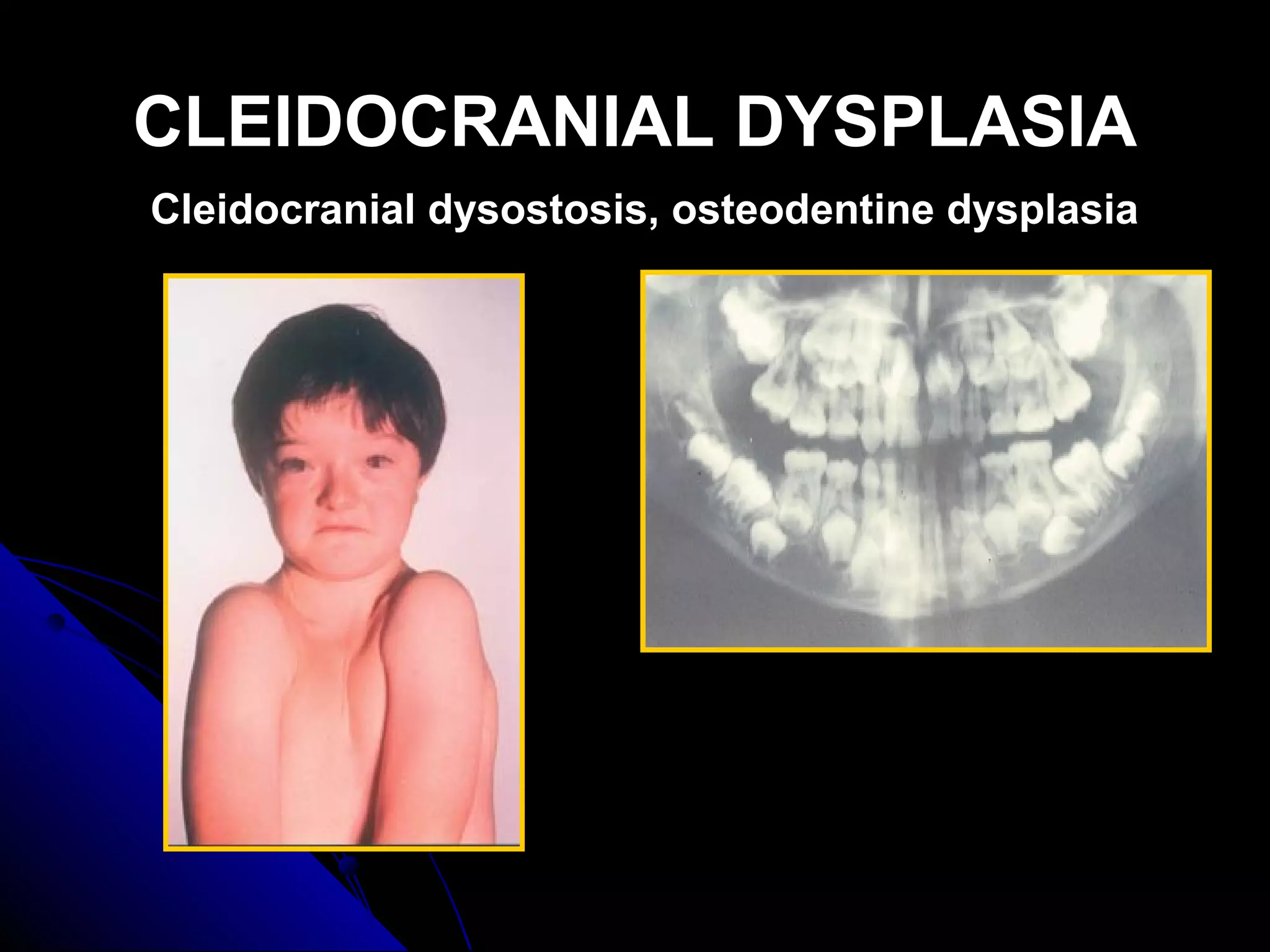
 Cleidocranial dysplasiaCleidocranial dysplasia
 HypothyroidismHypothyroidism
 HypopituitarismHypopituitarism
 Other causesOther causes
DOWN SYNDROMEDOWN SYNDROME
CLEIDOCRANIAL DYSPLASIACLEIDOCRANIAL DYSPLASIA
Cleidocranial dysostosis, osteodentine dysplasia
HYPOTHYROIDISMHYPOTHYROIDISM
Congenital: cretinismCongenital: cretinism
Acquired: juvenile hypothyroidismAcquired: juvenile hypothyroidism
HYPOPITUTARISMHYPOPITUTARISM
ABNORMALITIES OF TOOTH ERUPTIONABNORMALITIES OF TOOTH ERUPTION
 Teething and difficult eruption:Teething and difficult eruption:
 It is a process by which teeth erupt afterIt is a process by which teeth erupt after
penetration of the overlying gumspenetration of the overlying gums
 Clinical features:Clinical features:
 Local signsLocal signs
 Hyperemia of mucosaHyperemia of mucosa
 Facial rashFacial rash
 PainPain
 Drooling of salivaDrooling of saliva
 Gum rubbingGum rubbing
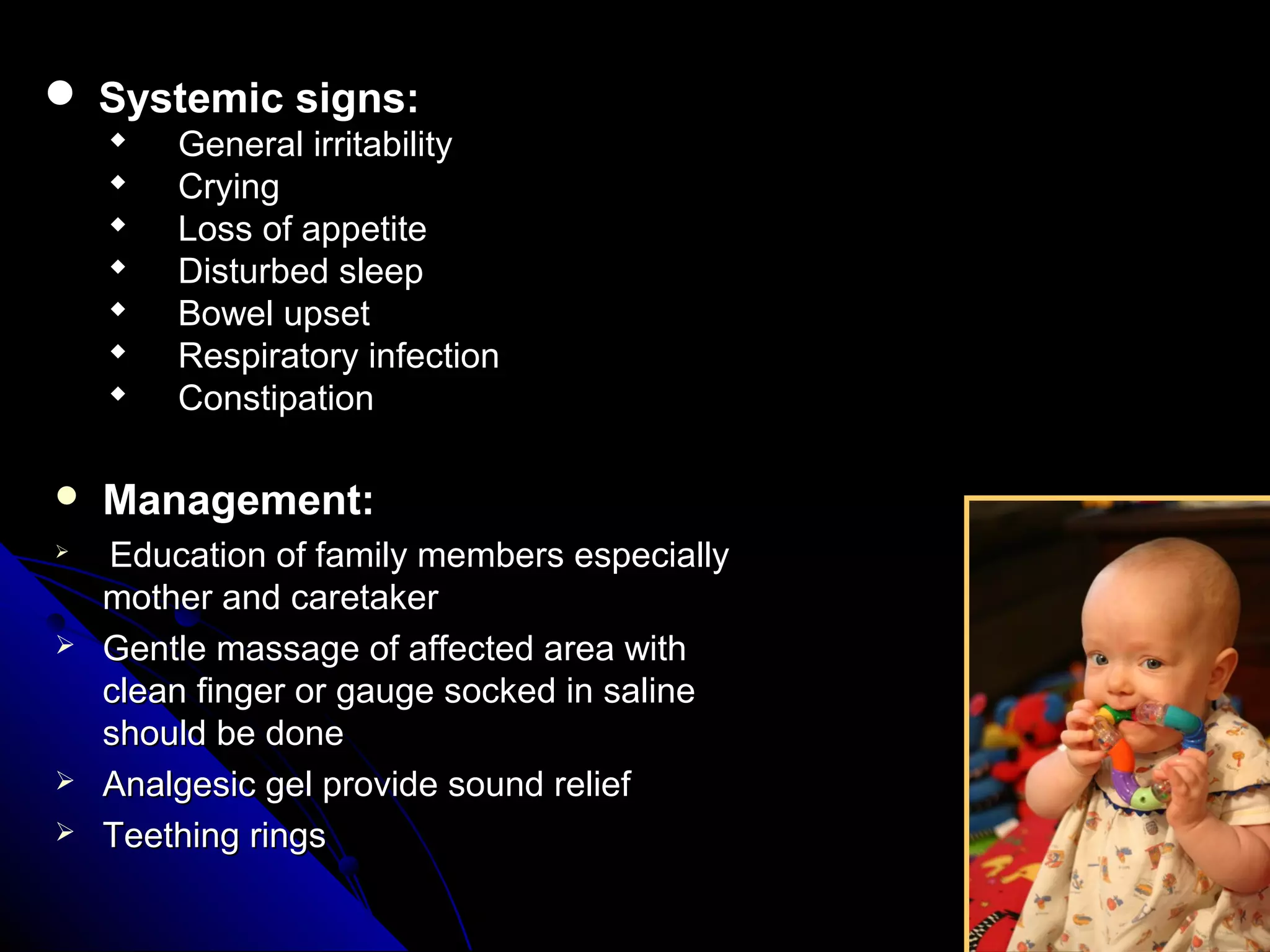
 Management:Management:

Education of family members especiallyEducation of family members especially
mother and caretakermother and caretaker
 Gentle massage of affected area withGentle massage of affected area with
clean finger or gauge socked in salineclean finger or gauge socked in saline
should be doneshould be done
 Analgesic gel provide sound reliefAnalgesic gel provide sound relief
 Teething ringsTeething rings
 Systemic signs:Systemic signs:
 General irritabilityGeneral irritability
 CryingCrying
 Loss of appetiteLoss of appetite
 Disturbed sleepDisturbed sleep
 Bowel upsetBowel upset
 Respiratory infectionRespiratory infection
 ConstipationConstipation
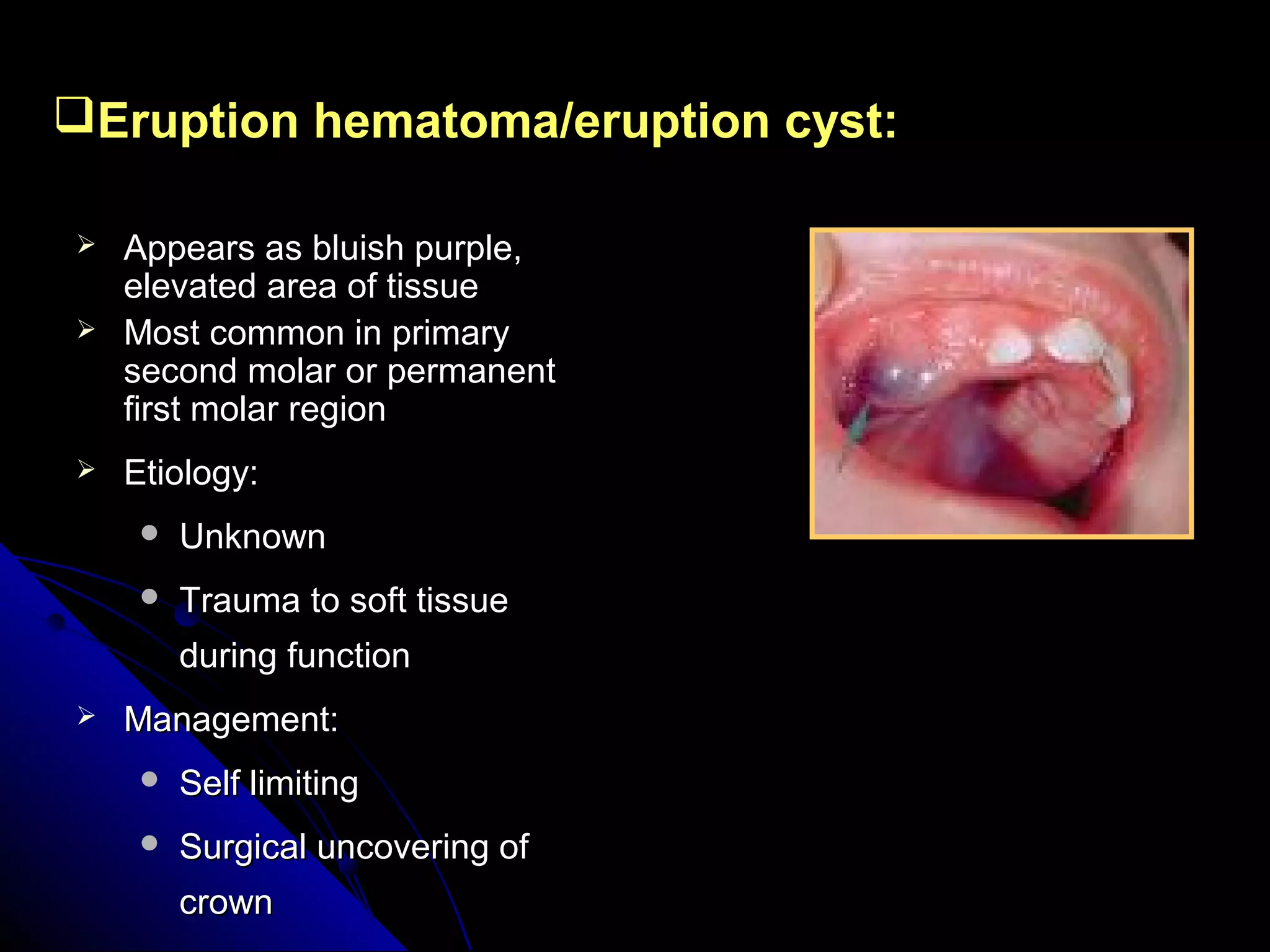
Eruption hematoma/eruption cyst:Eruption hematoma/eruption cyst:
 Appears as bluish purple,Appears as bluish purple,
elevated area of tissueelevated area of tissue
 Most common in primaryMost common in primary
second molar or permanentsecond molar or permanent
first molar regionfirst molar region
 Etiology:Etiology:
 UnknownUnknown
 Trauma to soft tissueTrauma to soft tissue
during functionduring function
 Management:Management:
 Self limitingSelf limiting
 Surgical uncovering ofSurgical uncovering of
crowncrown
 Eruption sequestrumEruption sequestrum::
 Appears at the time of eruptionAppears at the time of eruption
of first permanent molarof first permanent molar
 Composed of nonviable boneComposed of nonviable bone
some times cementum andsome times cementum and
dentinedentine
 They have no clinicalThey have no clinical
significancesignificance
 They resolve itselfThey resolve itself
 NATAL AND NEONATAL TEETH:
Congenital teeth/Fetal teeth/Predeciduous teethCongenital teeth/Fetal teeth/Predeciduous teeth
 Natal : birthNatal : birth
 Neonatal : <30 days of birthNeonatal : <30 days of birth
 Natal teeth appears more frequently than neonatalNatal teeth appears more frequently than neonatal
teeth in a ration of 3:1teeth in a ration of 3:1
 About 85% are Mandibular incisors and only smallAbout 85% are Mandibular incisors and only small
percent are supernumary teethpercent are supernumary teeth
 Problems :Problems :
-If they are mobile child may swallow these teeth-If they are mobile child may swallow these teeth
-sharp incisal edges of teeth may lacerate lingual-sharp incisal edges of teeth may lacerate lingual
surface of tonguesurface of tongue
-may cause difficulty in breast feeding-may cause difficulty in breast feeding
 These teeth are associated withThese teeth are associated with 3 syndromes3 syndromes
1)Chondroectodermal dysplasia or Ellis van creveld syndrome1)Chondroectodermal dysplasia or Ellis van creveld syndrome
2) Hallermann streiff syndrome2) Hallermann streiff syndrome
3)Pachyonychia congenital syndrome3)Pachyonychia congenital syndrome
management:management:
*Rounding of incisal edges*Rounding of incisal edges
*Extraction*Extraction
SHEDDINGSHEDDING
 DEFINITION:DEFINITION:
 OrbansOrbans -- physiologic process resulting in elimination of deciduousphysiologic process resulting in elimination of deciduous
dentitiondentition
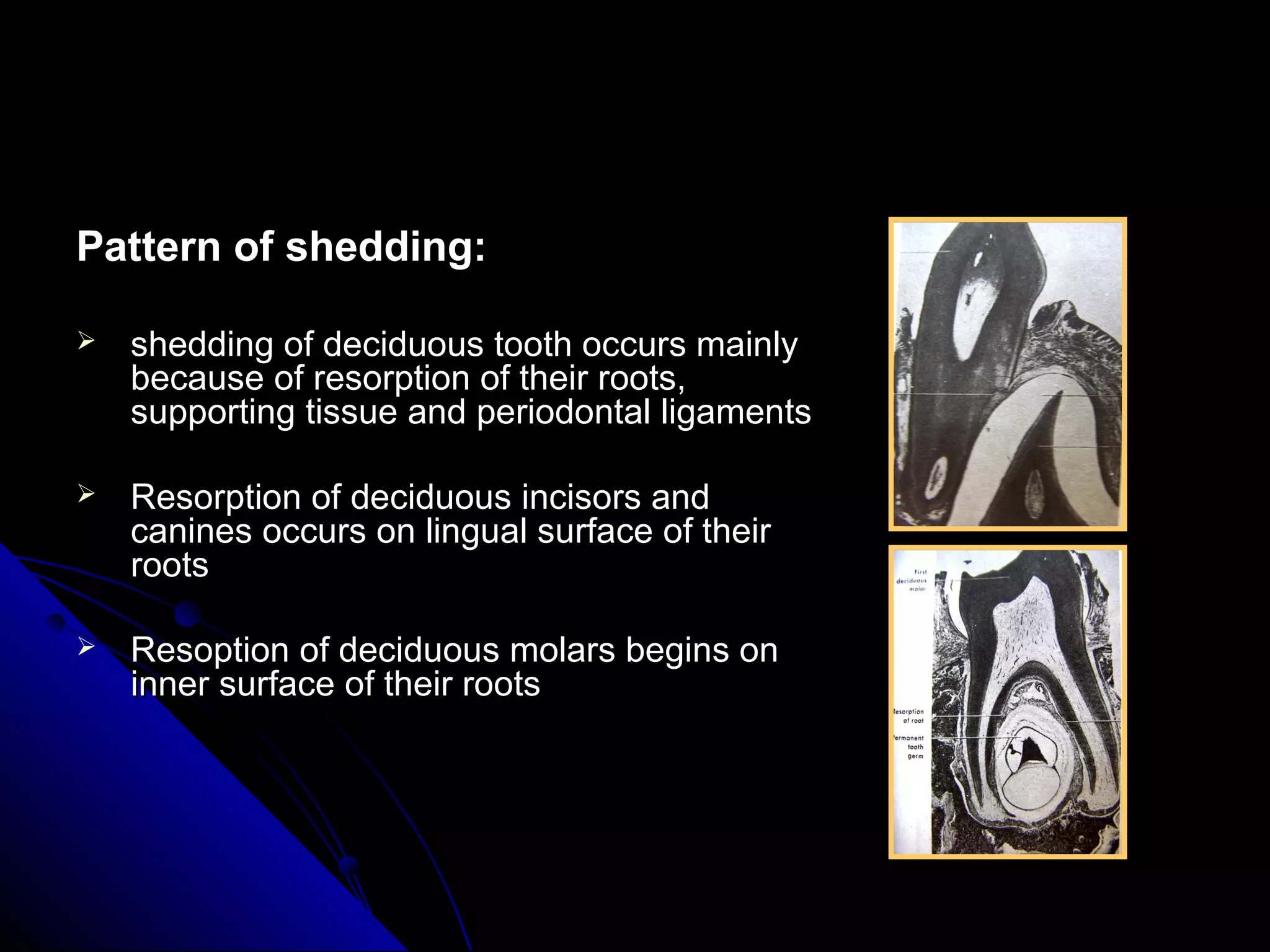
Pattern of shedding:Pattern of shedding:
 shedding of deciduous tooth occurs mainlyshedding of deciduous tooth occurs mainly
because of resorption of their roots,because of resorption of their roots,
supporting tissue and periodontal ligamentssupporting tissue and periodontal ligaments
 Resorption of deciduous incisors andResorption of deciduous incisors and
canines occurs on lingual surface of theircanines occurs on lingual surface of their
rootsroots
 Resoption of deciduous molars begins onResoption of deciduous molars begins on
inner surface of their rootsinner surface of their roots
 Pattern of exfoliation is symmetrical for Rt & LtPattern of exfoliation is symmetrical for Rt & Lt
side of mouthside of mouth
 Mandibular teeth shed before their maxillaryMandibular teeth shed before their maxillary
counterpartcounterpart
 Exfoliation in girls is earlier than boysExfoliation in girls is earlier than boys
MECHANISM OF SHEDDING:MECHANISM OF SHEDDING:
 This mechanism is not fully understoodThis mechanism is not fully understood
 Pressure from erupting successional tooth plays key rolePressure from erupting successional tooth plays key role
 Forces of mastication also aids in sheddingForces of mastication also aids in shedding
 Not much is known about the resoption of dental soft tissueNot much is known about the resoption of dental soft tissue
 It occurs in two formsIt occurs in two forms
1)Fibroblast exhibits signs of interference with normal1)Fibroblast exhibits signs of interference with normal
cellular processes such as secretion as well ascellular processes such as secretion as well as
other cytotoxic alterations that eventually leads toother cytotoxic alterations that eventually leads to cell deathcell death
2)Fibroblast shows apoptosis2)Fibroblast shows apoptosis
Clinical considerationClinical consideration
 REMNANTS OF DECIDUOUSREMNANTS OF DECIDUOUS
TEETH:TEETH:
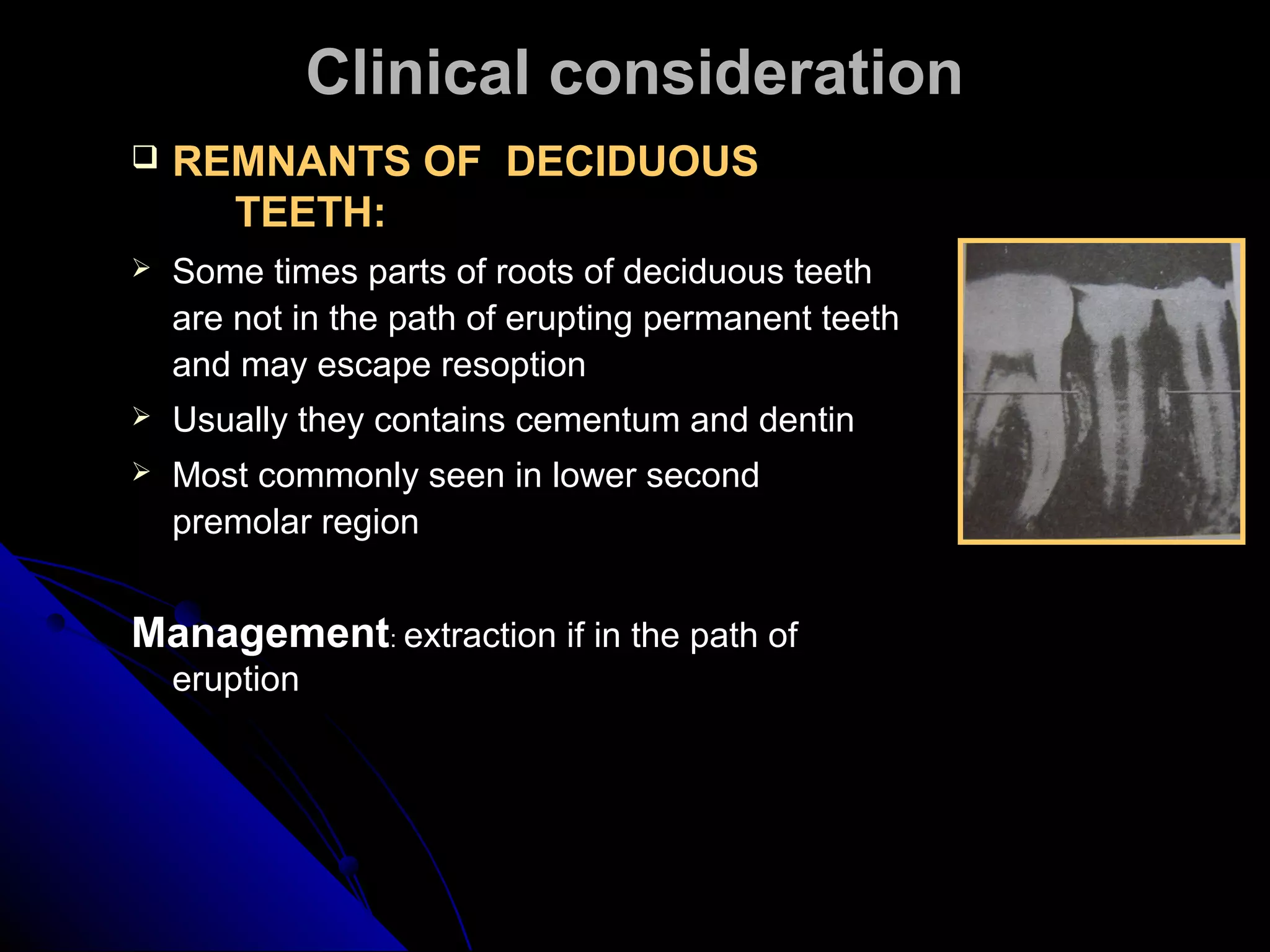
 Some times parts of roots of deciduous teethSome times parts of roots of deciduous teeth
are not in the path of erupting permanent teethare not in the path of erupting permanent teeth
and may escape resoptionand may escape resoption
 Usually they contains cementum and dentinUsually they contains cementum and dentin
 Most commonly seen in lower secondMost commonly seen in lower second
premolar regionpremolar region
ManagementManagement:: extraction if in the path ofextraction if in the path of
eruptioneruption
 RETAINED DECIDUOUSRETAINED DECIDUOUS
TEETH:TEETH:
CausesCauses::
# absence of permanent# absence of permanent
successorsuccessor
# ankylosed/impacted# ankylosed/impacted
permanent teethpermanent teeth
 commonly retained tooth is uppercommonly retained tooth is upper
lateral incisorlateral incisor
 SUBMERGED DECIDUOUS TOOTH:SUBMERGED DECIDUOUS TOOTH:
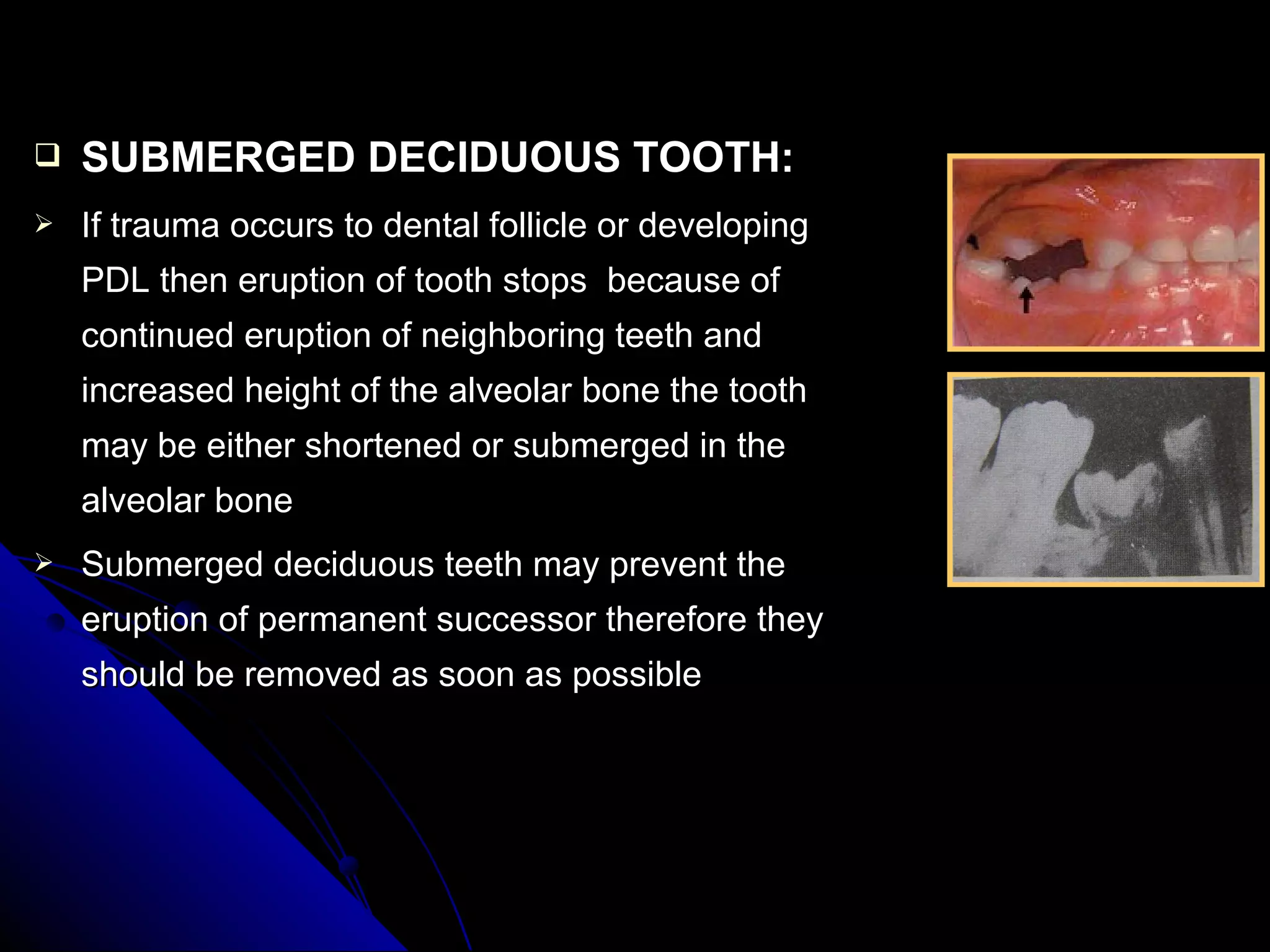
 If trauma occurs to dental follicle or developingIf trauma occurs to dental follicle or developing
PDL then eruption of tooth stops because ofPDL then eruption of tooth stops because of
continued eruption of neighboring teeth andcontinued eruption of neighboring teeth and
increased height of the alveolar bone the toothincreased height of the alveolar bone the tooth
may be either shortened or submerged in themay be either shortened or submerged in the
alveolar bonealveolar bone
 Submerged deciduous teeth may prevent theSubmerged deciduous teeth may prevent the
eruption of permanent successor therefore theyeruption of permanent successor therefore they
should be removed as soon as possibleshould be removed as soon as possible
REFERENCESREFERENCES
Oral Histology : Richard TencateOral Histology : Richard Tencate
Oral Histology And Embryology : OrbansOral Histology And Embryology : Orbans
Oral Histology : James. K.AveryOral Histology : James. K.Avery
Dentistry For The Child And Adolescent :Mc DonaldDentistry For The Child And Adolescent :Mc Donald
Color Atlas Of Anatomy- BerkowitzColor Atlas Of Anatomy- Berkowitz
Textbook of pedodontics : Shobha tandonTextbook of pedodontics : Shobha tandon
Eruption and shedding of teeth

Eruption and shedding of teeth

  • 2.
    ERUPTION AND SHEDDINGERUPTIONAND SHEDDING OF TEETHOF TEETH Dr.sangameshwarDr.sangameshwar POST GRADUATE IN DEPT. OFPOST GRADUATE IN DEPT. OF PEDODONTICSPEDODONTICS BAPUJI DENTAL COLLEGE AND HOSPITALBAPUJI DENTAL COLLEGE AND HOSPITAL DAVANGEREDAVANGERE
  • 3.
    CONTENTSCONTENTS  INTRODUCTIONINTRODUCTION  DEFINITIONSDEFINITIONS PHASES OF TOOTH ERUPTIONPHASES OF TOOTH ERUPTION  THEORIES OF TOOTH ERUPTIONTHEORIES OF TOOTH ERUPTION  CHRONOLOGY OF TOOTH ERUPTIONCHRONOLOGY OF TOOTH ERUPTION  FACTORS INFLUENCING ERUPTION OF TEETHFACTORS INFLUENCING ERUPTION OF TEETH  ABNORMALITIES OF ERUPTIONABNORMALITIES OF ERUPTION  SHEDDING OF DECIDUOUS TEETHSHEDDING OF DECIDUOUS TEETH  CONCLUSIONCONCLUSION  REFERENCESREFERENCES
  • 4.
  • 5.
    erumpere = breakouterumpere = break out  James K AveryJames K Avery—— Eruption is the movement of the teeth throughEruption is the movement of the teeth through the bone of the jaws and the overlying mucosa to appear andthe bone of the jaws and the overlying mucosa to appear and function in the oral cavity.function in the oral cavity.  OrbansOrbans —— Eruption is axial or occlusal movement of the tooth fromEruption is axial or occlusal movement of the tooth from its developmental position within the jaw to its functional position inits developmental position within the jaw to its functional position in the occlusionthe occlusion DEFINITIONS:DEFINITIONS:
  • 6.
    NOLLA STAGES OFTOOTHNOLLA STAGES OF TOOTH DEVELOPMENT(1952)DEVELOPMENT(1952) 10.Root apex completed. 9.Root almost completed,open apex. 8.Two thirds of root completed. 7.One third of root completed. 6.Crown completed. 5.Crown almost completed. 4.Two thirds of crown completed. 3.One third of crown completed. 2.Initial calcification. 1.Crypt present. 0.Crypt absent.
  • 7.
    PHASES OF TOOTHERUPTIONPHASES OF TOOTH ERUPTION  Preeruptive phase:Preeruptive phase:  Eruptive or Prefunctional phase:Eruptive or Prefunctional phase:  Posteruptive or functional phase:Posteruptive or functional phase:
  • 8.
    PRE-ERUPTIVE PHASEPRE-ERUPTIVE PHASE Movementsmade by the deciduous and permanent tooth germs within the tissues of the jaw before they begins to erupt Finished with initiation of root development Permanent anteriors – lingually and shift from incisal to apical area Permanent premolars – shift from occlusal to beneath primary molars Upper molar: distally
  • 9.
    a) total bodilymovement b) eccentric growth Pre eruptive phase Histology
  • 10.
    ERUPTIVE / PRE-FUNCTIONALPHASEERUPTIVE / PRE-FUNCTIONAL PHASE  During this phase tooth move from its position within the bone of the jaw to its functional position in the occlusion a) Intraosseous component b) Extraosseous component Four major events occur : 1) Root formation 2) Movement 3) penetration 4) incisal or occlusal movement
  • 11.
    Changes in tissuesoverlying the teeth histology
  • 12.
    Changes in tissuessurrounding the teeth
  • 13.
    FUNCTIONAL / POSTERUPTIVE PHASEFUNCTIONAL / POST ERUPTIVE PHASE Occurs most actively between 14 to 18 yrs  This movements occurs mainly to a) Position of erupted tooth while jaws continues to grow b) Compensate for occlusal wear c) Compensate for interproximal wear
  • 14.
    THEORIES OF ERUPTIONTHEORIESOF ERUPTION  Papillary constriction theoryPapillary constriction theory  Bony remodelingBony remodeling  Epithelial path theoryEpithelial path theory  Cushion hammock theoryCushion hammock theory  Root formation theoryRoot formation theory  Vascular pressureVascular pressure  Periodontal ligament tractionPeriodontal ligament traction
  • 15.
    PAPILLARY CONSTRICTION THEORYPAPILLARYCONSTRICTION THEORY::  Dental papilla constricts because ofDental papilla constricts because of decrease in the volume of the pulpdecrease in the volume of the pulp cavity by continuous dentine formationcavity by continuous dentine formation and this generates propulsive forceand this generates propulsive force BONY REMODELLING:BONY REMODELLING:  Bony remodeling of the crypt wall isBony remodeling of the crypt wall is important to achieve tooth eruptionimportant to achieve tooth eruption  In some experiments tooth germ isIn some experiments tooth germ is removed but follicle is left in positionremoved but follicle is left in position the eruptive pathway still forms in thethe eruptive pathway still forms in the bonebone  This clearly indicates the dental follicleThis clearly indicates the dental follicle not the bone as the major determinantnot the bone as the major determinant in tooth eruptionin tooth eruption
  • 16.
    ROOT FORMATION:ROOT FORMATION: According to this theory root formation isAccording to this theory root formation is responsible for tooth eruptionresponsible for tooth eruption Points against this theoryPoints against this theory  Teeth moves a greater distance than theTeeth moves a greater distance than the length of their fully formed rootslength of their fully formed roots  Teeth erupt even after the completion of theirTeeth erupt even after the completion of their rootsroots  Removal of roots does not prevents eruptionRemoval of roots does not prevents eruption  If roots formation is responsible for eruptionIf roots formation is responsible for eruption then the apical growth of the roots needs tothen the apical growth of the roots needs to be translated into occlusal movements andbe translated into occlusal movements and this requires a fixed base. if any pressurethis requires a fixed base. if any pressure applied to bone result in its resoption so noapplied to bone result in its resoption so no such fixed base exist.such fixed base exist.
  • 17.
    EPITHELIAL PATH THEORY:EPITHELIALPATH THEORY:  Hair, nail and salivary gland are end product of epithelial downHair, nail and salivary gland are end product of epithelial down growth. they return to the surfacegrowth. they return to the surface  Enamel is also an epithelial structure and so return back to theEnamel is also an epithelial structure and so return back to the surfacesurface CUSHION HAMMOCK THEORY:CUSHION HAMMOCK THEORY:  This theory states that pulp grows and pushes against the cushionThis theory states that pulp grows and pushes against the cushion hammock ligament which passes from one side of the socket to thehammock ligament which passes from one side of the socket to the oppositeopposite  But recent works shows that this hammock ligament does not extendBut recent works shows that this hammock ligament does not extend across the socket, but only separates the pulp from the follicleacross the socket, but only separates the pulp from the follicle
  • 18.
    VASCULAR PRESSURE:VASCULAR PRESSURE: Local volume changes can produce tooth movementsLocal volume changes can produce tooth movements  Ground substance swell up to 50 % With addition ofGround substance swell up to 50 % With addition of water and this differential pressure is sufficient to causewater and this differential pressure is sufficient to cause tooth movementstooth movements Points againstPoints against  Surgical excision of tooth and vasculature does notSurgical excision of tooth and vasculature does not prevent eruptionprevent eruption
  • 19.
    Periodontal ligament traction:Periodontalligament traction:  There is good evidence available thatThere is good evidence available that eruptive force resides in ligament-follicleeruptive force resides in ligament-follicle complexcomplex  The follicle before it becomes periodontalThe follicle before it becomes periodontal ligament also play role in tooth eruption byligament also play role in tooth eruption by providing eruptive pathwayproviding eruptive pathway  In some experiments tooth germ is removedIn some experiments tooth germ is removed and follicle is left intact the eruptive pathwayand follicle is left intact the eruptive pathway still forms. if tooth is enucleated andstill forms. if tooth is enucleated and substituted with a silicon replica within thesubstituted with a silicon replica within the follicle, the replica eruptsfollicle, the replica erupts
  • 20.
     If thenormal architecture of the periodontalIf the normal architecture of the periodontal ligament is disturbed experimentally byligament is disturbed experimentally by interfering with collagen synthesis, eruptioninterfering with collagen synthesis, eruption is either slowed or stoppedis either slowed or stopped  If continuously erupting tooth is cut into halfIf continuously erupting tooth is cut into half and a barrier is placed between the twoand a barrier is placed between the two halves, the distal fragment which ishalves, the distal fragment which is dissociated from the growing root anddissociated from the growing root and vasculature will still erupt.vasculature will still erupt.  In PDL eruptive force is generated byIn PDL eruptive force is generated by contraction of fibroblastscontraction of fibroblasts
  • 21.
  • 22.
    CHRONOLOGY OF PRIMARYCHRONOLOGYOF PRIMARY DENTITIONDENTITION
  • 23.
  • 24.
    Sequence of eruptionSequenceof eruption Deciduous dentitionDeciduous dentition: ABDCE: ABDCE Permanent dentition:Permanent dentition: max: 6 1 2 4 5 3 7 8 or 6 1 2 4 3 5 7 8max: 6 1 2 4 5 3 7 8 or 6 1 2 4 3 5 7 8 mand: 6 1 2 3 4 5 7 8mand: 6 1 2 3 4 5 7 8
  • 25.
     Eruption occursearlier in girls than boysEruption occurs earlier in girls than boys  Maxillary teeth calcifies first while Mandibular teeth erupts firstMaxillary teeth calcifies first while Mandibular teeth erupts first  Difference in 1 or 2 months on either sides should not be consideredDifference in 1 or 2 months on either sides should not be considered abnormalabnormal Clinical importance:Clinical importance:  Mandibular canine erupts before I & II PM, This will aid in maintainingMandibular canine erupts before I & II PM, This will aid in maintaining adequate arch length & prevents the lingual tipping of incisorsadequate arch length & prevents the lingual tipping of incisors  If mandibular ll permanent molar erupts before ll pm,causes mesialIf mandibular ll permanent molar erupts before ll pm,causes mesial migration of l molar and encroachment of space needed for ll pmmigration of l molar and encroachment of space needed for ll pm  In case of early loss of maxillary primary molar, permanent l molar willIn case of early loss of maxillary primary molar, permanent l molar will drift mesially resulting in locked maxillary canine usually on labial sidedrift mesially resulting in locked maxillary canine usually on labial side
  • 26.
    FACTORS INFLUENCING ERUPTIONOF TEETHFACTORS INFLUENCING ERUPTION OF TEETH General factorsGeneral factors  GeneticsGenetics  SexSex  Socioeconomical conditionsSocioeconomical conditions  Birth weightBirth weight
  • 27.
    Local factorsLocal factors AnkylosisAnkylosis  PathologyPathology  TraumaTrauma  Early loss of deciduousEarly loss of deciduous teethteeth
  • 28.
    ANKYLOSISANKYLOSIS::  It isalso known as infraocclusionIt is also known as infraocclusion  Mandibular primary molars are commonlyMandibular primary molars are commonly involvedinvolved  Primary anteriors are least involvedPrimary anteriors are least involved Causes:Causes: -Unknown-Unknown -three theories are proposed-three theories are proposed 1)it fallows familial pattern1)it fallows familial pattern 2)congenital absence of permanent teeth2)congenital absence of permanent teeth leads to Ankylosis of primaryleads to Ankylosis of primary 3)During resoption and repair process, if3)During resoption and repair process, if repair process prevails the resoptionrepair process prevails the resoption then tooth may be ankylosedthen tooth may be ankylosed
  • 29.
    DIAGNOSIS:DIAGNOSIS:  Not mobileeven in case of advance rootNot mobile even in case of advance root resorptionresorption  Tapping suspected tooth and adjacent normalTapping suspected tooth and adjacent normal tooth with blunt instrument and comparing thetooth with blunt instrument and comparing the sounds, ankylosed tooth have solid soundsounds, ankylosed tooth have solid sound where as normal tooth have cushioned soundwhere as normal tooth have cushioned sound  Radiographs shows the break in the continuityRadiographs shows the break in the continuity in periodontal ligamentin periodontal ligament MANEGMENTMANEGMENT::  Wait and watch for normal exfoliationWait and watch for normal exfoliation  If permanent successor of primary teeth areIf permanent successor of primary teeth are missing then functional occlusion achieved withmissing then functional occlusion achieved with stainless steel crown/overlaysstainless steel crown/overlays
  • 30.
    Systemic factorsSystemic factors Downs syndromeDowns syndrome  Cleidocranial dysplasiaCleidocranial dysplasia  HypothyroidismHypothyroidism  HypopituitarismHypopituitarism  Other causesOther causes
  • 31.
  • 32.
  • 33.
    HYPOTHYROIDISMHYPOTHYROIDISM Congenital: cretinismCongenital: cretinism Acquired:juvenile hypothyroidismAcquired: juvenile hypothyroidism HYPOPITUTARISMHYPOPITUTARISM
  • 34.
    ABNORMALITIES OF TOOTHERUPTIONABNORMALITIES OF TOOTH ERUPTION  Teething and difficult eruption:Teething and difficult eruption:  It is a process by which teeth erupt afterIt is a process by which teeth erupt after penetration of the overlying gumspenetration of the overlying gums  Clinical features:Clinical features:  Local signsLocal signs  Hyperemia of mucosaHyperemia of mucosa  Facial rashFacial rash  PainPain  Drooling of salivaDrooling of saliva  Gum rubbingGum rubbing
  • 35.
     Management:Management:  Education offamily members especiallyEducation of family members especially mother and caretakermother and caretaker  Gentle massage of affected area withGentle massage of affected area with clean finger or gauge socked in salineclean finger or gauge socked in saline should be doneshould be done  Analgesic gel provide sound reliefAnalgesic gel provide sound relief  Teething ringsTeething rings  Systemic signs:Systemic signs:  General irritabilityGeneral irritability  CryingCrying  Loss of appetiteLoss of appetite  Disturbed sleepDisturbed sleep  Bowel upsetBowel upset  Respiratory infectionRespiratory infection  ConstipationConstipation
  • 36.
    Eruption hematoma/eruption cyst:Eruptionhematoma/eruption cyst:  Appears as bluish purple,Appears as bluish purple, elevated area of tissueelevated area of tissue  Most common in primaryMost common in primary second molar or permanentsecond molar or permanent first molar regionfirst molar region  Etiology:Etiology:  UnknownUnknown  Trauma to soft tissueTrauma to soft tissue during functionduring function  Management:Management:  Self limitingSelf limiting  Surgical uncovering ofSurgical uncovering of crowncrown
  • 37.
     Eruption sequestrumEruptionsequestrum::  Appears at the time of eruptionAppears at the time of eruption of first permanent molarof first permanent molar  Composed of nonviable boneComposed of nonviable bone some times cementum andsome times cementum and dentinedentine  They have no clinicalThey have no clinical significancesignificance  They resolve itselfThey resolve itself
  • 38.
     NATAL ANDNEONATAL TEETH: Congenital teeth/Fetal teeth/Predeciduous teethCongenital teeth/Fetal teeth/Predeciduous teeth  Natal : birthNatal : birth  Neonatal : <30 days of birthNeonatal : <30 days of birth  Natal teeth appears more frequently than neonatalNatal teeth appears more frequently than neonatal teeth in a ration of 3:1teeth in a ration of 3:1  About 85% are Mandibular incisors and only smallAbout 85% are Mandibular incisors and only small percent are supernumary teethpercent are supernumary teeth  Problems :Problems : -If they are mobile child may swallow these teeth-If they are mobile child may swallow these teeth -sharp incisal edges of teeth may lacerate lingual-sharp incisal edges of teeth may lacerate lingual surface of tonguesurface of tongue -may cause difficulty in breast feeding-may cause difficulty in breast feeding
  • 39.
     These teethare associated withThese teeth are associated with 3 syndromes3 syndromes 1)Chondroectodermal dysplasia or Ellis van creveld syndrome1)Chondroectodermal dysplasia or Ellis van creveld syndrome 2) Hallermann streiff syndrome2) Hallermann streiff syndrome 3)Pachyonychia congenital syndrome3)Pachyonychia congenital syndrome management:management: *Rounding of incisal edges*Rounding of incisal edges *Extraction*Extraction
  • 40.
    SHEDDINGSHEDDING  DEFINITION:DEFINITION:  OrbansOrbans-- physiologic process resulting in elimination of deciduousphysiologic process resulting in elimination of deciduous dentitiondentition
  • 41.
    Pattern of shedding:Patternof shedding:  shedding of deciduous tooth occurs mainlyshedding of deciduous tooth occurs mainly because of resorption of their roots,because of resorption of their roots, supporting tissue and periodontal ligamentssupporting tissue and periodontal ligaments  Resorption of deciduous incisors andResorption of deciduous incisors and canines occurs on lingual surface of theircanines occurs on lingual surface of their rootsroots  Resoption of deciduous molars begins onResoption of deciduous molars begins on inner surface of their rootsinner surface of their roots
  • 42.
     Pattern ofexfoliation is symmetrical for Rt & LtPattern of exfoliation is symmetrical for Rt & Lt side of mouthside of mouth  Mandibular teeth shed before their maxillaryMandibular teeth shed before their maxillary counterpartcounterpart  Exfoliation in girls is earlier than boysExfoliation in girls is earlier than boys
  • 43.
    MECHANISM OF SHEDDING:MECHANISMOF SHEDDING:  This mechanism is not fully understoodThis mechanism is not fully understood  Pressure from erupting successional tooth plays key rolePressure from erupting successional tooth plays key role  Forces of mastication also aids in sheddingForces of mastication also aids in shedding  Not much is known about the resoption of dental soft tissueNot much is known about the resoption of dental soft tissue  It occurs in two formsIt occurs in two forms 1)Fibroblast exhibits signs of interference with normal1)Fibroblast exhibits signs of interference with normal cellular processes such as secretion as well ascellular processes such as secretion as well as other cytotoxic alterations that eventually leads toother cytotoxic alterations that eventually leads to cell deathcell death 2)Fibroblast shows apoptosis2)Fibroblast shows apoptosis
  • 44.
    Clinical considerationClinical consideration REMNANTS OF DECIDUOUSREMNANTS OF DECIDUOUS TEETH:TEETH:  Some times parts of roots of deciduous teethSome times parts of roots of deciduous teeth are not in the path of erupting permanent teethare not in the path of erupting permanent teeth and may escape resoptionand may escape resoption  Usually they contains cementum and dentinUsually they contains cementum and dentin  Most commonly seen in lower secondMost commonly seen in lower second premolar regionpremolar region ManagementManagement:: extraction if in the path ofextraction if in the path of eruptioneruption
  • 45.
     RETAINED DECIDUOUSRETAINEDDECIDUOUS TEETH:TEETH: CausesCauses:: # absence of permanent# absence of permanent successorsuccessor # ankylosed/impacted# ankylosed/impacted permanent teethpermanent teeth  commonly retained tooth is uppercommonly retained tooth is upper lateral incisorlateral incisor
  • 46.
     SUBMERGED DECIDUOUSTOOTH:SUBMERGED DECIDUOUS TOOTH:  If trauma occurs to dental follicle or developingIf trauma occurs to dental follicle or developing PDL then eruption of tooth stops because ofPDL then eruption of tooth stops because of continued eruption of neighboring teeth andcontinued eruption of neighboring teeth and increased height of the alveolar bone the toothincreased height of the alveolar bone the tooth may be either shortened or submerged in themay be either shortened or submerged in the alveolar bonealveolar bone  Submerged deciduous teeth may prevent theSubmerged deciduous teeth may prevent the eruption of permanent successor therefore theyeruption of permanent successor therefore they should be removed as soon as possibleshould be removed as soon as possible
  • 49.
    REFERENCESREFERENCES Oral Histology :Richard TencateOral Histology : Richard Tencate Oral Histology And Embryology : OrbansOral Histology And Embryology : Orbans Oral Histology : James. K.AveryOral Histology : James. K.Avery Dentistry For The Child And Adolescent :Mc DonaldDentistry For The Child And Adolescent :Mc Donald Color Atlas Of Anatomy- BerkowitzColor Atlas Of Anatomy- Berkowitz Textbook of pedodontics : Shobha tandonTextbook of pedodontics : Shobha tandon