Deep Ocean Marianas Trench By Mike Valdez
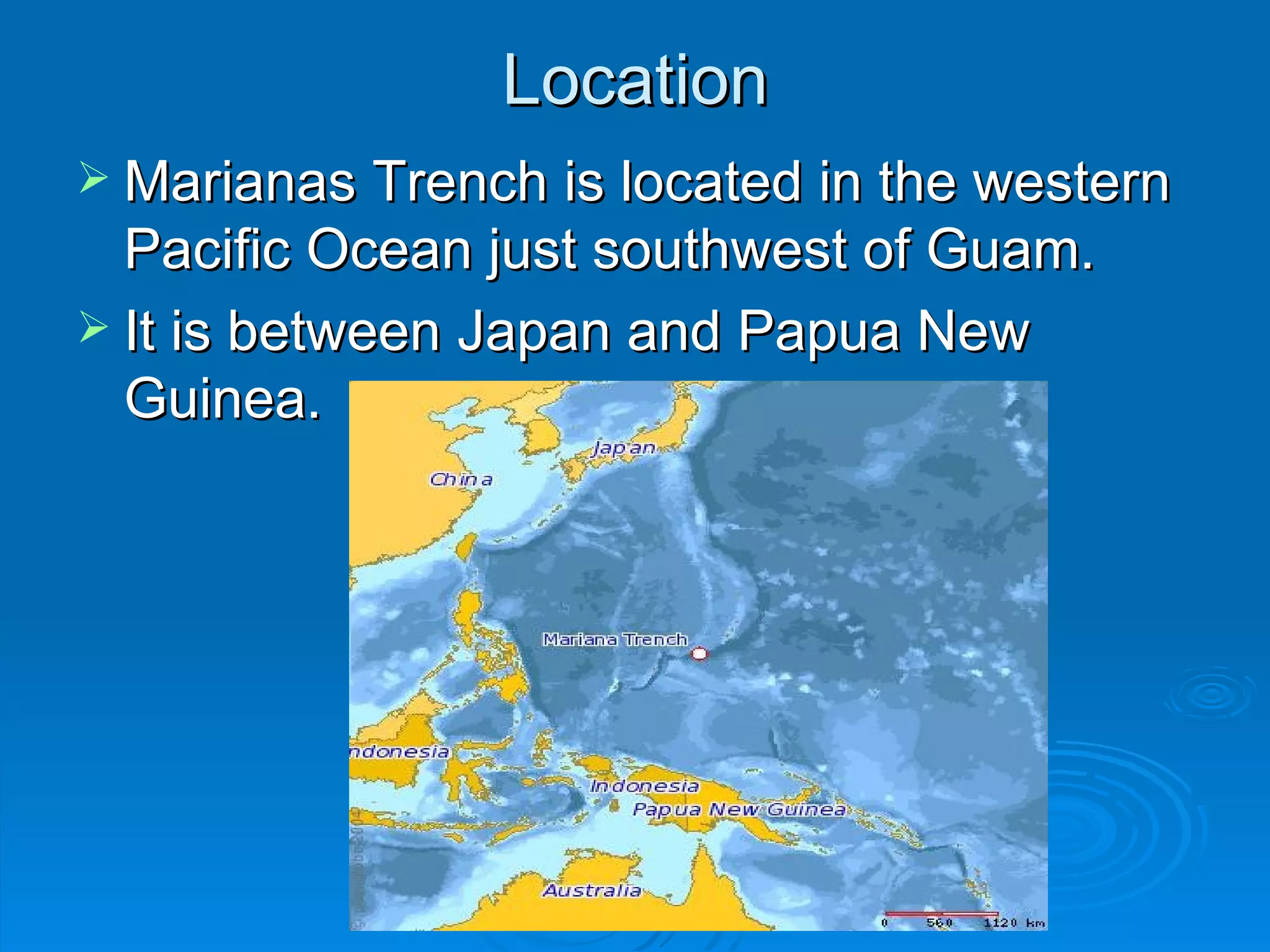
Location Marianas Trench is located in the western Pacific Ocean just southwest of Guam. It is between Japan and Papua New Guinea.
Environmental conditions Since the trench is 11,033 meters (36,201 feet) deep the pressure at the bottom of the trench is 8 tons per square inch. The temperature is about 1-4 degrees Celsius or 34-39 degrees F. Light is not abundant after 150 meters and color is not visible to the human eye. The floor is made up of “ooze” or animal skeletons, shells, and decaying microorganisms.
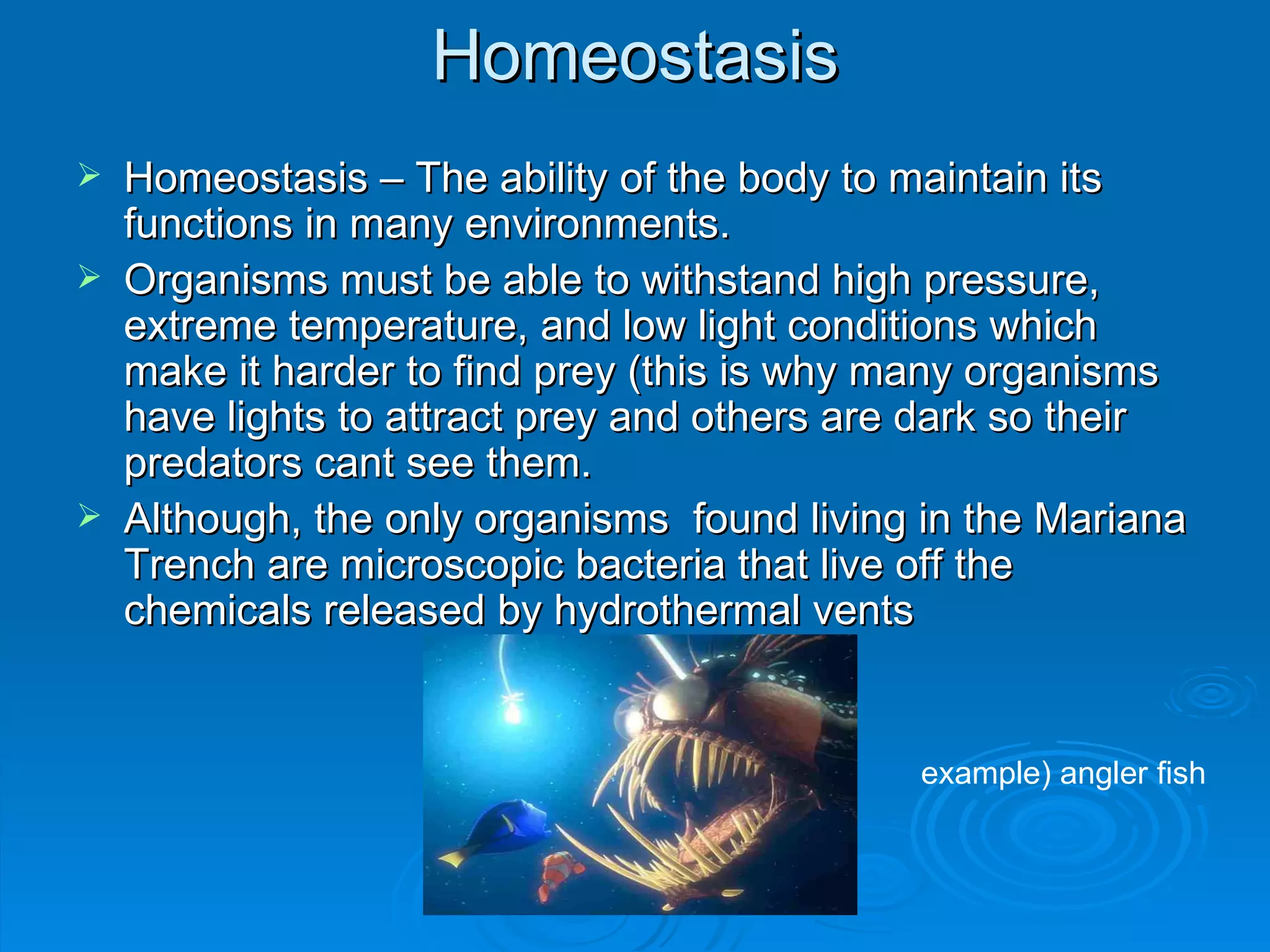
Homeostasis Homeostasis – The ability of the body to maintain its functions in many environments. Organisms must be able to withstand high pressure, extreme temperature, and low light conditions which make it harder to find prey (this is why many organisms have lights to attract prey and others are dark so their predators cant see them. Although, the only organisms  found living in the Mariana Trench are microscopic bacteria that live off the chemicals released by hydrothermal vents example) angler fish
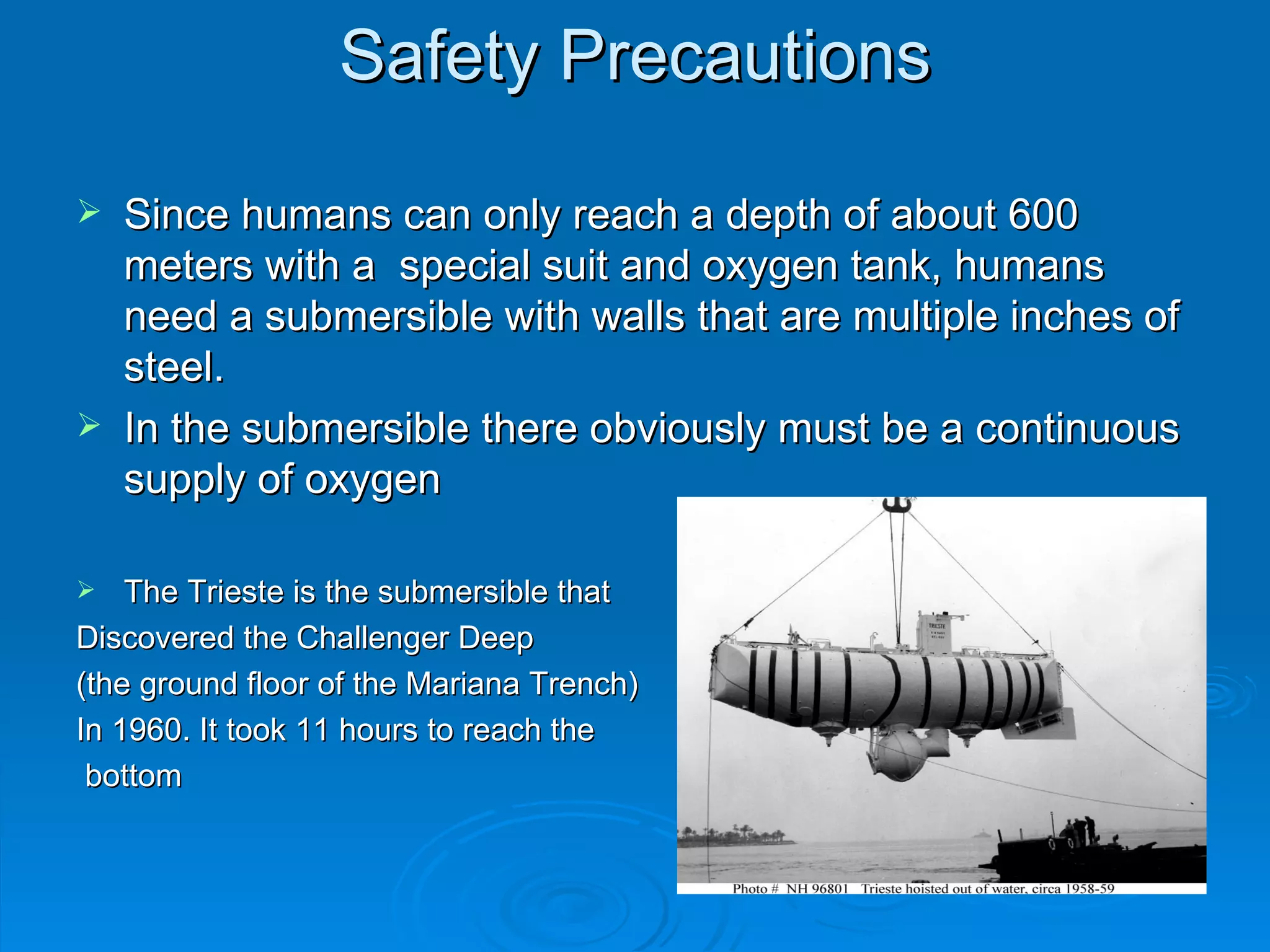
Safety Precautions Since humans can only reach a depth of about 600 meters with a  special suit and oxygen tank, humans need a submersible with walls that are multiple inches of steel. In the submersible there obviously must be a continuous supply of oxygen The Trieste is the submersible that  Discovered the Challenger Deep  (the ground floor of the Mariana Trench) In 1960. It took 11 hours to reach the bottom
Organ Systems affected Respiratory – Your lungs would have no volume to take in oxygen. Skeletal – Your bones would be crushed by 8 tons PSI. Nervous – Hypothermia would set in due to the temperature.
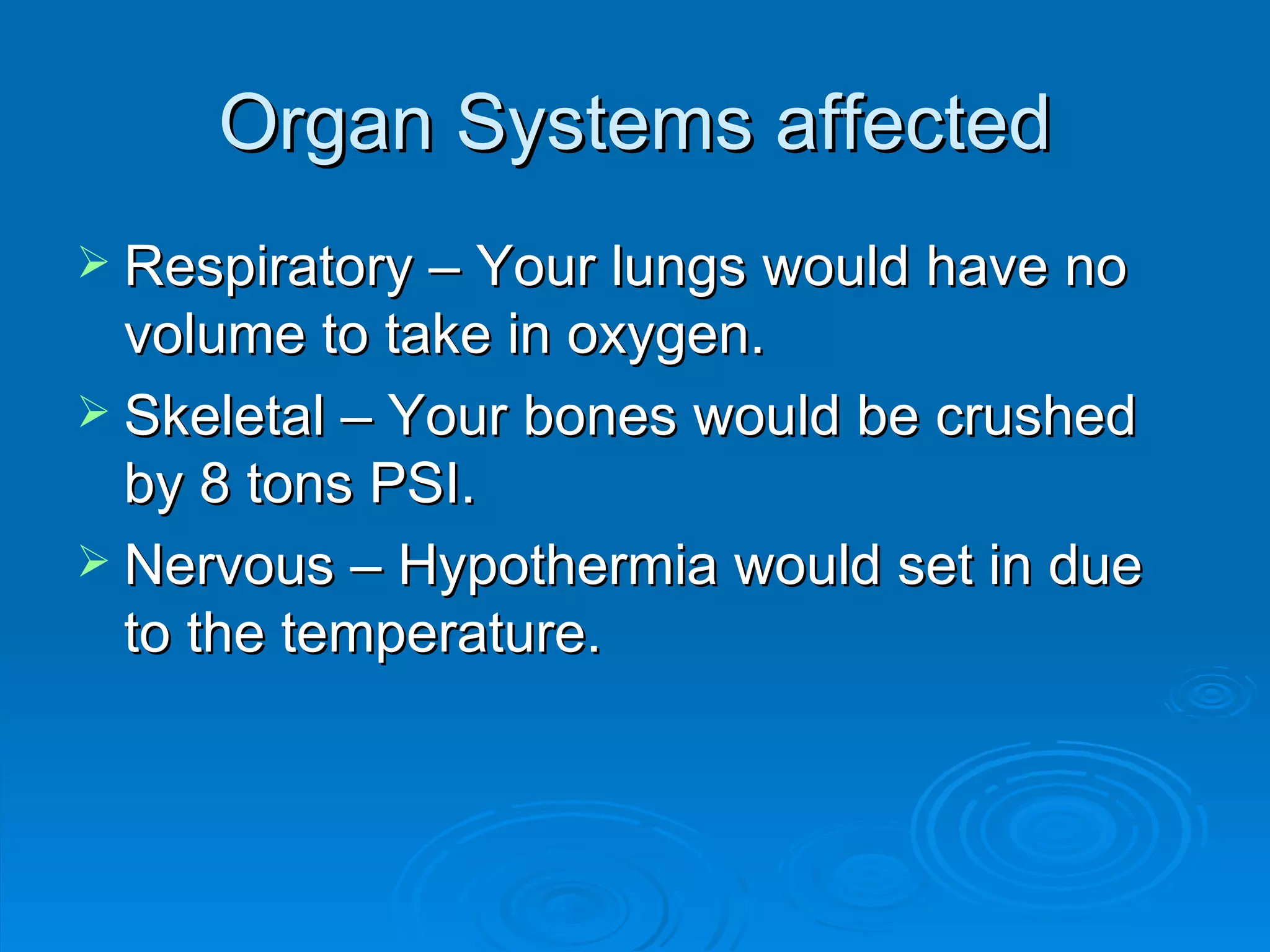
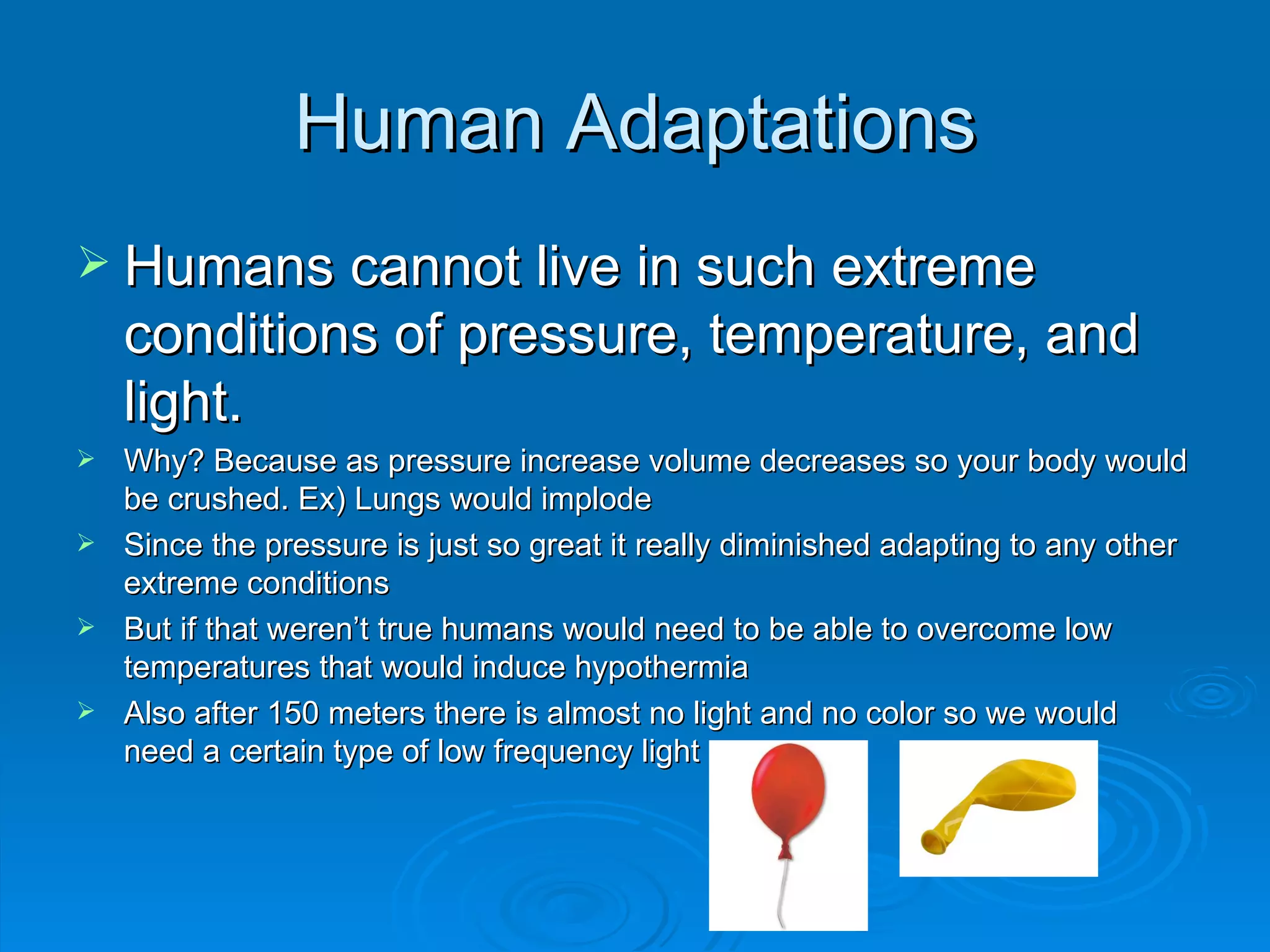
Human Adaptations Humans cannot live in such extreme conditions of pressure, temperature, and light. Why? Because as pressure increase volume decreases so your body would be crushed. Ex) Lungs would implode Since the pressure is just so great it really diminished adapting to any other extreme conditions But if that weren’t true humans would need to be able to overcome low temperatures that would induce hypothermia Also after 150 meters there is almost no light and no color so we would need a certain type of low frequency light
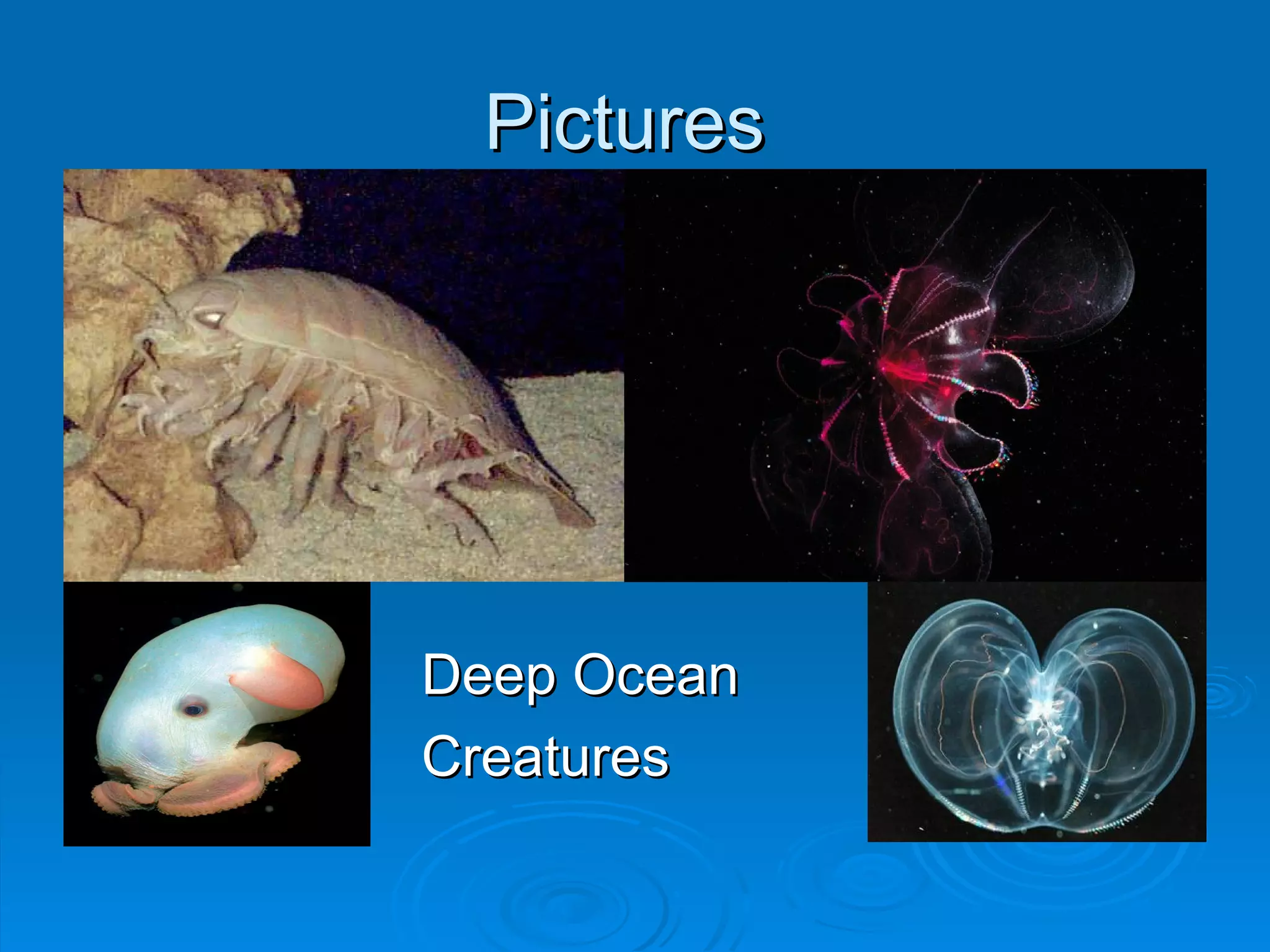
Pictures  Deep Ocean Creatures

deep ocean

  • 1.
    Deep Ocean MarianasTrench By Mike Valdez
  • 2.
    Location Marianas Trenchis located in the western Pacific Ocean just southwest of Guam. It is between Japan and Papua New Guinea.
  • 3.
    Environmental conditions Sincethe trench is 11,033 meters (36,201 feet) deep the pressure at the bottom of the trench is 8 tons per square inch. The temperature is about 1-4 degrees Celsius or 34-39 degrees F. Light is not abundant after 150 meters and color is not visible to the human eye. The floor is made up of “ooze” or animal skeletons, shells, and decaying microorganisms.
  • 4.
    Homeostasis Homeostasis –The ability of the body to maintain its functions in many environments. Organisms must be able to withstand high pressure, extreme temperature, and low light conditions which make it harder to find prey (this is why many organisms have lights to attract prey and others are dark so their predators cant see them. Although, the only organisms found living in the Mariana Trench are microscopic bacteria that live off the chemicals released by hydrothermal vents example) angler fish
  • 5.
    Safety Precautions Sincehumans can only reach a depth of about 600 meters with a special suit and oxygen tank, humans need a submersible with walls that are multiple inches of steel. In the submersible there obviously must be a continuous supply of oxygen The Trieste is the submersible that Discovered the Challenger Deep (the ground floor of the Mariana Trench) In 1960. It took 11 hours to reach the bottom
  • 6.
    Organ Systems affectedRespiratory – Your lungs would have no volume to take in oxygen. Skeletal – Your bones would be crushed by 8 tons PSI. Nervous – Hypothermia would set in due to the temperature.
  • 7.
    Human Adaptations Humanscannot live in such extreme conditions of pressure, temperature, and light. Why? Because as pressure increase volume decreases so your body would be crushed. Ex) Lungs would implode Since the pressure is just so great it really diminished adapting to any other extreme conditions But if that weren’t true humans would need to be able to overcome low temperatures that would induce hypothermia Also after 150 meters there is almost no light and no color so we would need a certain type of low frequency light
  • 8.
    Pictures DeepOcean Creatures