SHARATH KUMAR M.S.
670064358
GEOM363 Themes In Climate Change
Renewable Energy engineering
University of Exeter
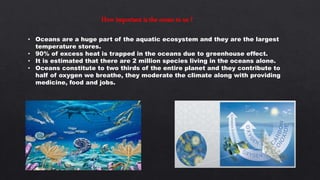
• Oceans are a huge part of the aquatic ecosystem and they are the largest
temperature stores.
• 90% of excess heat is trapped in the oceans due to greenhouse effect.
• It is estimated that there are 2 million species living in the oceans alone.
• Oceans constitute to two thirds of the entire planet and they contribute to
half of oxygen we breathe, they moderate the climate along with providing
medicine, food and jobs.
How important is the ocean to us ?
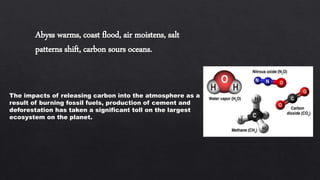
Abyss warms, coast flood, air moistens, salt
patterns shift, carbon sours oceans.
The impacts of releasing carbon into the atmosphere as a
result of burning fossil fuels, production of cement and
deforestation has taken a significant toll on the largest
ecosystem on the planet.
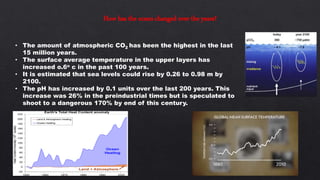
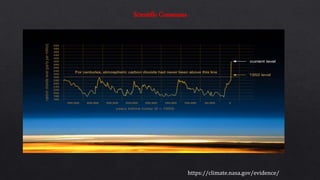
• The amount of atmospheric CO2 has been the highest in the last
15 million years.
• The surface average temperature in the upper layers has
increased o.6o c in the past 100 years.
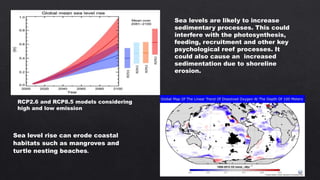
• It is estimated that sea levels could rise by 0.26 to 0.98 m by
2100.
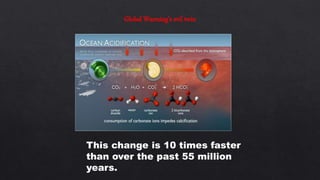
• The pH has increased by 0.1 units over the last 200 years. This
increase was 26% in the preindustrial times but is speculated to
shoot to a dangerous 170% by end of this century.
How has the ocean changed over the years?
https://climate.nasa.gov/evidence/
Scientific Consensus
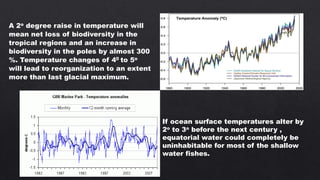
A 2o degree raise in temperature will
mean net loss of biodiversity in the
tropical regions and an increase in
biodiversity in the poles by almost 300
%. Temperature changes of 40 to 5o
will lead to reorganization to an extent
more than last glacial maximum.
If ocean surface temperatures alter by
2o to 3o before the next century ,
equatorial water could completely be
uninhabitable for most of the shallow
water fishes.
Sea levels are likely to increase
sedimentary processes. This could
interfere with the photosynthesis,
feeding, recruitment and other key
psychological reef processes. It
could also cause an increased
sedimentation due to shoreline
erosion.
Sea level rise can erode coastal
habitats such as mangroves and
turtle nesting beaches.
RCP2.6 and RCP8.5 models considering
high and low emission
Global Warming’s evil twin
This change is 10 times faster
than over the past 55 million
years.
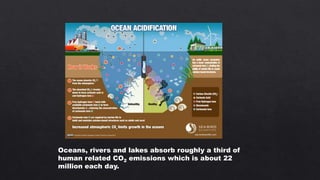
Oceans, rivers and lakes absorb roughly a third of
human related CO2 emissions which is about 22
million each day.
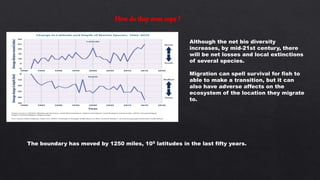
How do they even cope ?
Although the net bio diversity
increases, by mid-21st century, there
will be net losses and local extinctions
of several species.
Migration can spell survival for fish to
able to make a transition, but it can
also have adverse affects on the
ecosystem of the location they migrate
to.
The boundary has moved by 1250 miles, 100 latitudes in the last fifty years.
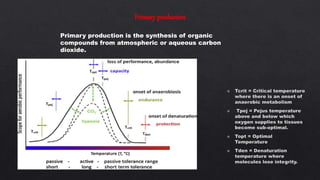
Primary production
Primary production is the synthesis of organic
compounds from atmospheric or aqueous carbon
dioxide.
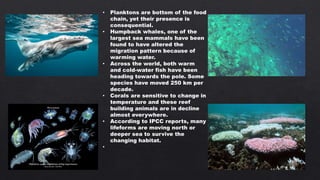
• Planktons are bottom of the food
chain, yet their presence is
consequential.
• Humpback whales, one of the
largest sea mammals have been
found to have altered the
migration pattern because of
warming water.
• Across the world, both warm
and cold-water fish have been
heading towards the pole. Some
species have moved 250 km per
decade.
• Corals are sensitive to change in
temperature and these reef
building animals are in decline
almost everywhere.
• According to IPCC reports, many
lifeforms are moving north or
deeper sea to survive the
changing habitat.
•
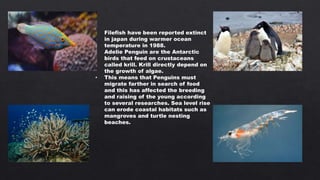
• Filefish have been reported extinct
in japan during warmer ocean
temperature in 1988.
• Adelie Penguin are the Antarctic
birds that feed on crustaceans
called krill. Krill directly depend on
the growth of algae.
• This means that Penguins must
migrate farther in search of food
and this has affected the breeding
and raising of the young according
to several researches. Sea level rise
can erode coastal habitats such as
mangroves and turtle nesting
beaches.
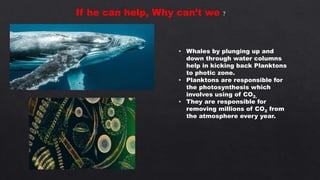
• Whales by plunging up and
down through water columns
help in kicking back Planktons
to photic zone.
• Planktons are responsible for
the photosynthesis which
involves using of CO2.
• They are responsible for
removing millions of CO2 from
the atmosphere every year.
If he can help, Why can’t we ?
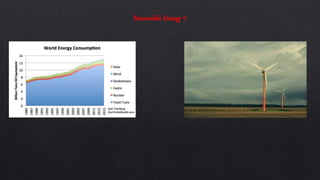
Renewable Energy !!
1. https://news.nationalgeographic.com/news/2014/03/140331-global-warming-
climate-change-ipcc-animals-science-environment/
2. http://www.oceanacidification.org.uk/
3. https://sea-birdscientific.com/
4. https://climate.nasa.gov/evidence
5. https://www.theguardian.com/environment/2012/oct/01/great-barrier-reef-
coral-cover
6. Gregg, W. W., M. E. Conkright, P. Ginoux, J. E. O'Reilly, and N. W. Casey
(2003), Ocean primary production and climate: Global decadal changes,
Geophys. Res. Lett., 30, 1809, doi:10.1029/2003GL016889,
7. Stroeve, J., M. M. Holland, W. Meier, T. Scambos, and M. Serreze (2007),
Arctic sea ice decline: Faster than forecast, Geophys. Res. Lett., 34,
L09501, doi:10.1029/2007GL029703.
8. Cao, L., and K. Caldeira (2008), Atmospheric CO2 stabilization and ocean
acidification, Geophys. Res. Lett., 35, L19609, doi:10.1029/2008GL035072.
9. Meredith, M. P., and J. C. King (2005), Rapid climate change in the ocean
west of the Antarctic Peninsula during the second half of the 20th century,
Geophys. Res. Lett., 32, L19604, doi:10.1029/2005GL024042.

Ocean and climate change

  • 1.
    SHARATH KUMAR M.S. 670064358 GEOM363Themes In Climate Change Renewable Energy engineering University of Exeter
  • 2.
    • Oceans area huge part of the aquatic ecosystem and they are the largest temperature stores. • 90% of excess heat is trapped in the oceans due to greenhouse effect. • It is estimated that there are 2 million species living in the oceans alone. • Oceans constitute to two thirds of the entire planet and they contribute to half of oxygen we breathe, they moderate the climate along with providing medicine, food and jobs. How important is the ocean to us ?
  • 3.
    Abyss warms, coastflood, air moistens, salt patterns shift, carbon sours oceans. The impacts of releasing carbon into the atmosphere as a result of burning fossil fuels, production of cement and deforestation has taken a significant toll on the largest ecosystem on the planet.
  • 4.
    • The amountof atmospheric CO2 has been the highest in the last 15 million years. • The surface average temperature in the upper layers has increased o.6o c in the past 100 years. • It is estimated that sea levels could rise by 0.26 to 0.98 m by 2100. • The pH has increased by 0.1 units over the last 200 years. This increase was 26% in the preindustrial times but is speculated to shoot to a dangerous 170% by end of this century. How has the ocean changed over the years?
  • 5.
  • 6.
    A 2o degreeraise in temperature will mean net loss of biodiversity in the tropical regions and an increase in biodiversity in the poles by almost 300 %. Temperature changes of 40 to 5o will lead to reorganization to an extent more than last glacial maximum. If ocean surface temperatures alter by 2o to 3o before the next century , equatorial water could completely be uninhabitable for most of the shallow water fishes.
  • 7.
    Sea levels arelikely to increase sedimentary processes. This could interfere with the photosynthesis, feeding, recruitment and other key psychological reef processes. It could also cause an increased sedimentation due to shoreline erosion. Sea level rise can erode coastal habitats such as mangroves and turtle nesting beaches. RCP2.6 and RCP8.5 models considering high and low emission
  • 8.
    Global Warming’s eviltwin This change is 10 times faster than over the past 55 million years.
  • 9.
    Oceans, rivers andlakes absorb roughly a third of human related CO2 emissions which is about 22 million each day.
  • 10.
    How do theyeven cope ? Although the net bio diversity increases, by mid-21st century, there will be net losses and local extinctions of several species. Migration can spell survival for fish to able to make a transition, but it can also have adverse affects on the ecosystem of the location they migrate to. The boundary has moved by 1250 miles, 100 latitudes in the last fifty years.
  • 11.
    Primary production Primary productionis the synthesis of organic compounds from atmospheric or aqueous carbon dioxide.
  • 12.
    • Planktons arebottom of the food chain, yet their presence is consequential. • Humpback whales, one of the largest sea mammals have been found to have altered the migration pattern because of warming water. • Across the world, both warm and cold-water fish have been heading towards the pole. Some species have moved 250 km per decade. • Corals are sensitive to change in temperature and these reef building animals are in decline almost everywhere. • According to IPCC reports, many lifeforms are moving north or deeper sea to survive the changing habitat. •
  • 13.
    • Filefish havebeen reported extinct in japan during warmer ocean temperature in 1988. • Adelie Penguin are the Antarctic birds that feed on crustaceans called krill. Krill directly depend on the growth of algae. • This means that Penguins must migrate farther in search of food and this has affected the breeding and raising of the young according to several researches. Sea level rise can erode coastal habitats such as mangroves and turtle nesting beaches.
  • 14.
    • Whales byplunging up and down through water columns help in kicking back Planktons to photic zone. • Planktons are responsible for the photosynthesis which involves using of CO2. • They are responsible for removing millions of CO2 from the atmosphere every year. If he can help, Why can’t we ?
  • 15.
  • 16.
    1. https://news.nationalgeographic.com/news/2014/03/140331-global-warming- climate-change-ipcc-animals-science-environment/ 2. http://www.oceanacidification.org.uk/ 3.https://sea-birdscientific.com/ 4. https://climate.nasa.gov/evidence 5. https://www.theguardian.com/environment/2012/oct/01/great-barrier-reef- coral-cover 6. Gregg, W. W., M. E. Conkright, P. Ginoux, J. E. O'Reilly, and N. W. Casey (2003), Ocean primary production and climate: Global decadal changes, Geophys. Res. Lett., 30, 1809, doi:10.1029/2003GL016889, 7. Stroeve, J., M. M. Holland, W. Meier, T. Scambos, and M. Serreze (2007), Arctic sea ice decline: Faster than forecast, Geophys. Res. Lett., 34, L09501, doi:10.1029/2007GL029703. 8. Cao, L., and K. Caldeira (2008), Atmospheric CO2 stabilization and ocean acidification, Geophys. Res. Lett., 35, L19609, doi:10.1029/2008GL035072. 9. Meredith, M. P., and J. C. King (2005), Rapid climate change in the ocean west of the Antarctic Peninsula during the second half of the 20th century, Geophys. Res. Lett., 32, L19604, doi:10.1029/2005GL024042.