COOPERATIVE MANAGEMENT : TRANSFORMING
VISIONS TO ACTION PLANS
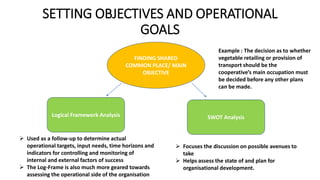
SETTING OBJECTIVES AND OPERATIONAL
GOALS
FINDING SHARED
COMMON PLACE/ MAIN
OBJECTIVE
Example : The decision as to whether
vegetable retailing or provision of
transport should be the
cooperative’s main occupation must
be decided before any other plans
can be made.
Logical Framework Analysis SWOT Analysis
 Focuses the discussion on possible avenues to
take
 Helps assess the state of and plan for
organisational development.
 Used as a follow-up to determine actual
operational targets, input needs, time horizons and
indicators for controlling and monitoring of
internal and external factors of success
 The Log-Frame is also much more geared towards
assessing the operational side of the organisation
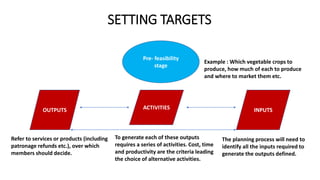
SETTING TARGETS
Pre- feasibility
stage
Example : Which vegetable crops to
produce, how much of each to produce
and where to market them etc.
OUTPUTS ACTIVITIES INPUTS
Refer to services or products (including
patronage refunds etc.), over which
members should decide.
To generate each of these outputs
requires a series of activities. Cost, time
and productivity are the criteria leading
the choice of alternative activities.
The planning process will need to
identify all the inputs required to
generate the outputs defined.
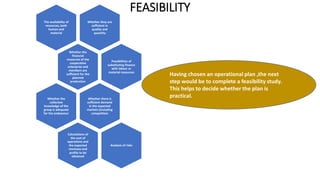
FEASIBILITY
Having chosen an operational plan ,the next
step would be to complete a feasibility study.
This helps to decide whether the plan is
practical.
Whether they are
sufficient in
quality and
quantity
The availability of
resources, both
human and
material
Whether the
financial
resources of the
cooperative
enterprise and
members are
sufficient for the
planned
production
Possibilities of
substituting finance
with labour or
material resources
Whether there is
sufficient demand
in the expected
markets (including
competition
Whether the
collective
knowledge of the
group is adequate
for the endeavour
Calculations of
the cost of
operations and
the expected
revenues and
profits to be
obtained
Analysis of risks
PLANNING IMPLEMENTATION OF ACTIVITIES
Management or business plan
A business plan is essentially a set of
guidelines for the group enterprise.
 A statement of main and sub-objectives
 Specific targets for various activities and phases (what will be achieved in the first
month, after six months etc.
 Assignments of responsibilities (who does what, when, how?) A clear statement of
responsibilities will help to ensure that the objectives and targets above are realised.
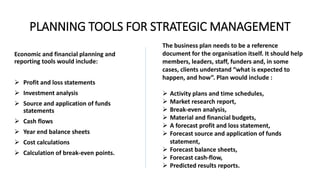
PLANNING TOOLS FOR STRATEGIC MANAGEMENT
Economic and financial planning and
reporting tools would include:
 Profit and loss statements
 Investment analysis
 Source and application of funds
statements
 Cash flows
 Year end balance sheets
 Cost calculations
 Calculation of break-even points.
The business plan needs to be a reference
document for the organisation itself. It should help
members, leaders, staff, funders and, in some
cases, clients understand “what is expected to
happen, and how”. Plan would include :
 Activity plans and time schedules,
 Market research report,
 Break-even analysis,
 Material and financial budgets,
 A forecast profit and loss statement,
 Forecast source and application of funds
statement,
 Forecast balance sheets,
 Forecast cash-flow,
 Predicted results reports.
PLANNING TOOLS FOR STRATEGIC MANAGEMENT
A full and regular reporting of results, showing a comparison between what was supposed
to be achieved and what has been achieved forms the basis for participative monitoring
and evaluation as well as providing useful guidance for how activities could be continued
Stock level and inventory reports
Income and sales statements
Profit and loss statements
Budgetary variance reports
Source and application of funds statements
Revised short- or long-term sales forecasts and market predictions
Balance sheets for the previous and current period
Forecast profit and loss account for next period
Proposed expenditure budgets for next period
Forecast cash flow for next period.
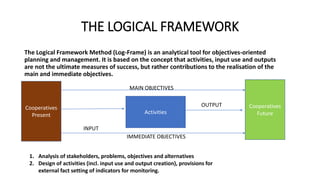
THE LOGICAL FRAMEWORK
The Logical Framework Method (Log-Frame) is an analytical tool for objectives-oriented
planning and management. It is based on the concept that activities, input use and outputs
are not the ultimate measures of success, but rather contributions to the realisation of the
main and immediate objectives.
Cooperatives
Present
Cooperatives
FutureActivities
MAIN OBJECTIVES
IMMEDIATE OBJECTIVES
INPUT
OUTPUT
1. Analysis of stakeholders, problems, objectives and alternatives
2. Design of activities (incl. input use and output creation), provisions for
external fact setting of indicators for monitoring.
ANALYSIS OF STAKEHOLDER INTERESTS
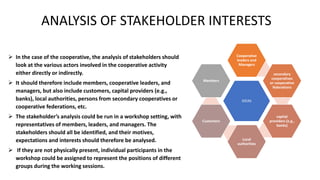
 In the case of the cooperative, the analysis of stakeholders should
look at the various actors involved in the cooperative activity
either directly or indirectly.
 It should therefore include members, cooperative leaders, and
managers, but also include customers, capital providers (e.g.,
banks), local authorities, persons from secondary cooperatives or
cooperative federations, etc.
 The stakeholder’s analysis could be run in a workshop setting, with
representatives of members, leaders, and managers. The
stakeholders should all be identified, and their motives,
expectations and interests should therefore be analysed.
 If they are not physically present, individual participants in the
workshop could be assigned to represent the positions of different
groups during the working sessions.
IDEAS
Cooperative
leaders and
Managers
secondary
cooperatives
or cooperative
federations
capital
providers (e.g.,
banks)
Local
authorities
Customers
Members
Strengths, Weaknesses, Opportunities and
Threats: SWOT analysis
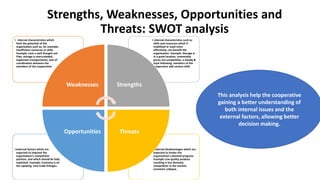
This analysis help the cooperative
gaining a better understanding of
both internal issues and the
external factors, allowing better
decision making.
• external disadvantages which are
expected to hinder the
organisation’s planned progress.
Example Low quality produce
resulting is less demand,
competition in the market,
economic collapse.
•external factors which are
expected to improve the
organisation’s competitive
position, and which should be fully
exploited. Example: Economy is on
the upswing, new trade linkages.
• internal characteristics such as
skills and resources which if
mobilised or used more
effectively, can benefit the
organisation. Example: Storage is
in a good location, commodity
prices are competitive, a steady &
loyal following, members of the
cooperative add various skills
• internal characteristics which
limit the potential of the
organisation such as, for example,
insufficient resources or skills.
Example: Lack a well-thought out
Plan, storage is overcrowded,
expensive transportation, lack of
coordination between the
members of the cooperative.
Weaknesses Strengths
ThreatsOpportunities
PLANNING RELATIONSHIPS AND ASSIGNING
RESPONSIBILITIES
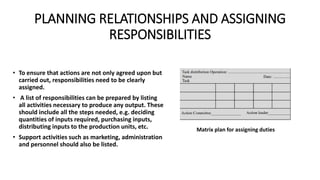
• To ensure that actions are not only agreed upon but
carried out, responsibilities need to be clearly
assigned.
• A list of responsibilities can be prepared by listing
all activities necessary to produce any output. These
should include all the steps needed, e.g. deciding
quantities of inputs required, purchasing inputs,
distributing inputs to the production units, etc.
• Support activities such as marketing, administration
and personnel should also be listed.
Matrix plan for assigning duties
PLANNING RELATIONSHIPS AND ASSIGNING
RESPONSIBILITIES
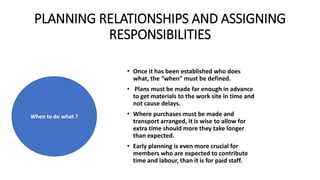
• Once it has been established who does
what, the “when” must be defined.
• Plans must be made far enough in advance
to get materials to the work site in time and
not cause delays.
• Where purchases must be made and
transport arranged, it is wise to allow for
extra time should more they take longer
than expected.
• Early planning is even more crucial for
members who are expected to contribute
time and labour, than it is for paid staff.
When to do what ?
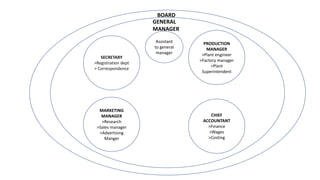
SECRETARY
>Registration dept
> Correspondence
CHIEF
ACCOUNTANT
>Finance
>Wages
>Costing
MARKETING
MANAGER
>Research
>Sales manager
>Advertising
Manger
PRODUCTION
MANAGER
>Plant engineer
>Factory manager
>Plant
Superintendent
Assistant
to general
manager
GENERAL
MANAGER
BOARD

Cooperative management

  • 1.
    COOPERATIVE MANAGEMENT :TRANSFORMING VISIONS TO ACTION PLANS
  • 2.
    SETTING OBJECTIVES ANDOPERATIONAL GOALS FINDING SHARED COMMON PLACE/ MAIN OBJECTIVE Example : The decision as to whether vegetable retailing or provision of transport should be the cooperative’s main occupation must be decided before any other plans can be made. Logical Framework Analysis SWOT Analysis  Focuses the discussion on possible avenues to take  Helps assess the state of and plan for organisational development.  Used as a follow-up to determine actual operational targets, input needs, time horizons and indicators for controlling and monitoring of internal and external factors of success  The Log-Frame is also much more geared towards assessing the operational side of the organisation
  • 3.
    SETTING TARGETS Pre- feasibility stage Example: Which vegetable crops to produce, how much of each to produce and where to market them etc. OUTPUTS ACTIVITIES INPUTS Refer to services or products (including patronage refunds etc.), over which members should decide. To generate each of these outputs requires a series of activities. Cost, time and productivity are the criteria leading the choice of alternative activities. The planning process will need to identify all the inputs required to generate the outputs defined.
  • 4.
    FEASIBILITY Having chosen anoperational plan ,the next step would be to complete a feasibility study. This helps to decide whether the plan is practical. Whether they are sufficient in quality and quantity The availability of resources, both human and material Whether the financial resources of the cooperative enterprise and members are sufficient for the planned production Possibilities of substituting finance with labour or material resources Whether there is sufficient demand in the expected markets (including competition Whether the collective knowledge of the group is adequate for the endeavour Calculations of the cost of operations and the expected revenues and profits to be obtained Analysis of risks
  • 5.
    PLANNING IMPLEMENTATION OFACTIVITIES Management or business plan A business plan is essentially a set of guidelines for the group enterprise.  A statement of main and sub-objectives  Specific targets for various activities and phases (what will be achieved in the first month, after six months etc.  Assignments of responsibilities (who does what, when, how?) A clear statement of responsibilities will help to ensure that the objectives and targets above are realised.
  • 6.
    PLANNING TOOLS FORSTRATEGIC MANAGEMENT Economic and financial planning and reporting tools would include:  Profit and loss statements  Investment analysis  Source and application of funds statements  Cash flows  Year end balance sheets  Cost calculations  Calculation of break-even points. The business plan needs to be a reference document for the organisation itself. It should help members, leaders, staff, funders and, in some cases, clients understand “what is expected to happen, and how”. Plan would include :  Activity plans and time schedules,  Market research report,  Break-even analysis,  Material and financial budgets,  A forecast profit and loss statement,  Forecast source and application of funds statement,  Forecast balance sheets,  Forecast cash-flow,  Predicted results reports.
  • 7.
    PLANNING TOOLS FORSTRATEGIC MANAGEMENT A full and regular reporting of results, showing a comparison between what was supposed to be achieved and what has been achieved forms the basis for participative monitoring and evaluation as well as providing useful guidance for how activities could be continued Stock level and inventory reports Income and sales statements Profit and loss statements Budgetary variance reports Source and application of funds statements Revised short- or long-term sales forecasts and market predictions Balance sheets for the previous and current period Forecast profit and loss account for next period Proposed expenditure budgets for next period Forecast cash flow for next period.
  • 8.
    THE LOGICAL FRAMEWORK TheLogical Framework Method (Log-Frame) is an analytical tool for objectives-oriented planning and management. It is based on the concept that activities, input use and outputs are not the ultimate measures of success, but rather contributions to the realisation of the main and immediate objectives. Cooperatives Present Cooperatives FutureActivities MAIN OBJECTIVES IMMEDIATE OBJECTIVES INPUT OUTPUT 1. Analysis of stakeholders, problems, objectives and alternatives 2. Design of activities (incl. input use and output creation), provisions for external fact setting of indicators for monitoring.
  • 9.
    ANALYSIS OF STAKEHOLDERINTERESTS  In the case of the cooperative, the analysis of stakeholders should look at the various actors involved in the cooperative activity either directly or indirectly.  It should therefore include members, cooperative leaders, and managers, but also include customers, capital providers (e.g., banks), local authorities, persons from secondary cooperatives or cooperative federations, etc.  The stakeholder’s analysis could be run in a workshop setting, with representatives of members, leaders, and managers. The stakeholders should all be identified, and their motives, expectations and interests should therefore be analysed.  If they are not physically present, individual participants in the workshop could be assigned to represent the positions of different groups during the working sessions. IDEAS Cooperative leaders and Managers secondary cooperatives or cooperative federations capital providers (e.g., banks) Local authorities Customers Members
  • 10.
    Strengths, Weaknesses, Opportunitiesand Threats: SWOT analysis This analysis help the cooperative gaining a better understanding of both internal issues and the external factors, allowing better decision making. • external disadvantages which are expected to hinder the organisation’s planned progress. Example Low quality produce resulting is less demand, competition in the market, economic collapse. •external factors which are expected to improve the organisation’s competitive position, and which should be fully exploited. Example: Economy is on the upswing, new trade linkages. • internal characteristics such as skills and resources which if mobilised or used more effectively, can benefit the organisation. Example: Storage is in a good location, commodity prices are competitive, a steady & loyal following, members of the cooperative add various skills • internal characteristics which limit the potential of the organisation such as, for example, insufficient resources or skills. Example: Lack a well-thought out Plan, storage is overcrowded, expensive transportation, lack of coordination between the members of the cooperative. Weaknesses Strengths ThreatsOpportunities
  • 11.
    PLANNING RELATIONSHIPS ANDASSIGNING RESPONSIBILITIES • To ensure that actions are not only agreed upon but carried out, responsibilities need to be clearly assigned. • A list of responsibilities can be prepared by listing all activities necessary to produce any output. These should include all the steps needed, e.g. deciding quantities of inputs required, purchasing inputs, distributing inputs to the production units, etc. • Support activities such as marketing, administration and personnel should also be listed. Matrix plan for assigning duties
  • 12.
    PLANNING RELATIONSHIPS ANDASSIGNING RESPONSIBILITIES • Once it has been established who does what, the “when” must be defined. • Plans must be made far enough in advance to get materials to the work site in time and not cause delays. • Where purchases must be made and transport arranged, it is wise to allow for extra time should more they take longer than expected. • Early planning is even more crucial for members who are expected to contribute time and labour, than it is for paid staff. When to do what ?
  • 13.
    SECRETARY >Registration dept > Correspondence CHIEF ACCOUNTANT >Finance >Wages >Costing MARKETING MANAGER >Research >Salesmanager >Advertising Manger PRODUCTION MANAGER >Plant engineer >Factory manager >Plant Superintendent Assistant to general manager GENERAL MANAGER BOARD