Chapter 6:
  Coastal Systems and Low-lying
              Areas
                     Coordinating Lead Authors
         Robert J. Nicholls (UK) and Poh Poh Wong (Singapore)

                          Lead Authors
 Virginia Burkett (USA), Jorge Codignotto (Argentina), John Hay
(New Zealand), Roger McLean (Australia), Sachooda Ragoonaden
            (Mauritius), Colin D. Woodroffe (Australia)

                                          Contributing Authors
Pamela Abuodha (Kenya), Julie Arblaster (USA/Australia), Barbara Brown (UK), Don Forbes (Canada), Jim Hall
 (UK), Sari Kovats (UK), Jason Lowe (UK), Kathy McInnes (Australia), Susanne Moser (USA), Susanne Rupp-
                         Armstrong (UK), Yoshiki Saito (Japan), Richard Tol (Ireland)

                                             Review Editors
                Job Dronkers (Netherlands), Geoff Love (Australia), Jin-Eong Ong (Malaysia)
The coastal system
Main conclusions
• Coasts are experiencing the adverse consequences of hazards
  related to climate and sea level [*** D].
• Coasts will be exposed to increasing risks over coming decades
  due to many compounding climate-change factors [*** D].
• The impact of climate change on coasts is exacerbated by
  increasing human-induced pressures [*** C].
• Adaptation for the coasts of developing countries will be more
  challenging than for coasts of developed countries, due to
  constraints on adaptive capacity [** D].
• Adaptation costs for vulnerable coasts are much less than the
  costs of inaction [** N].
• The unavoidability of sea-level rise even in the longer-term
  frequently conflicts with present-day human development
  patterns and trends [** N].
Observed impacts
       due to climate variability and change

• Storms already impose substantial costs on coastal
  societies.
• Annually, about 120 million people are exposed to
  tropical cyclone hazards which had killed 250,000
  people from 1980 to 2000.
• Through the 20th Century, global rise of sea level
  contributed to increased coastal inundation, erosion
  and ecosystem losses, but with considerable local
  and regional variation due to other factors.
• Late 20th Century effects of rising temperature
  include loss of sea ice, thawing of permafrost and
  associated coastal retreat, and more frequent coral
  bleaching and mortality.
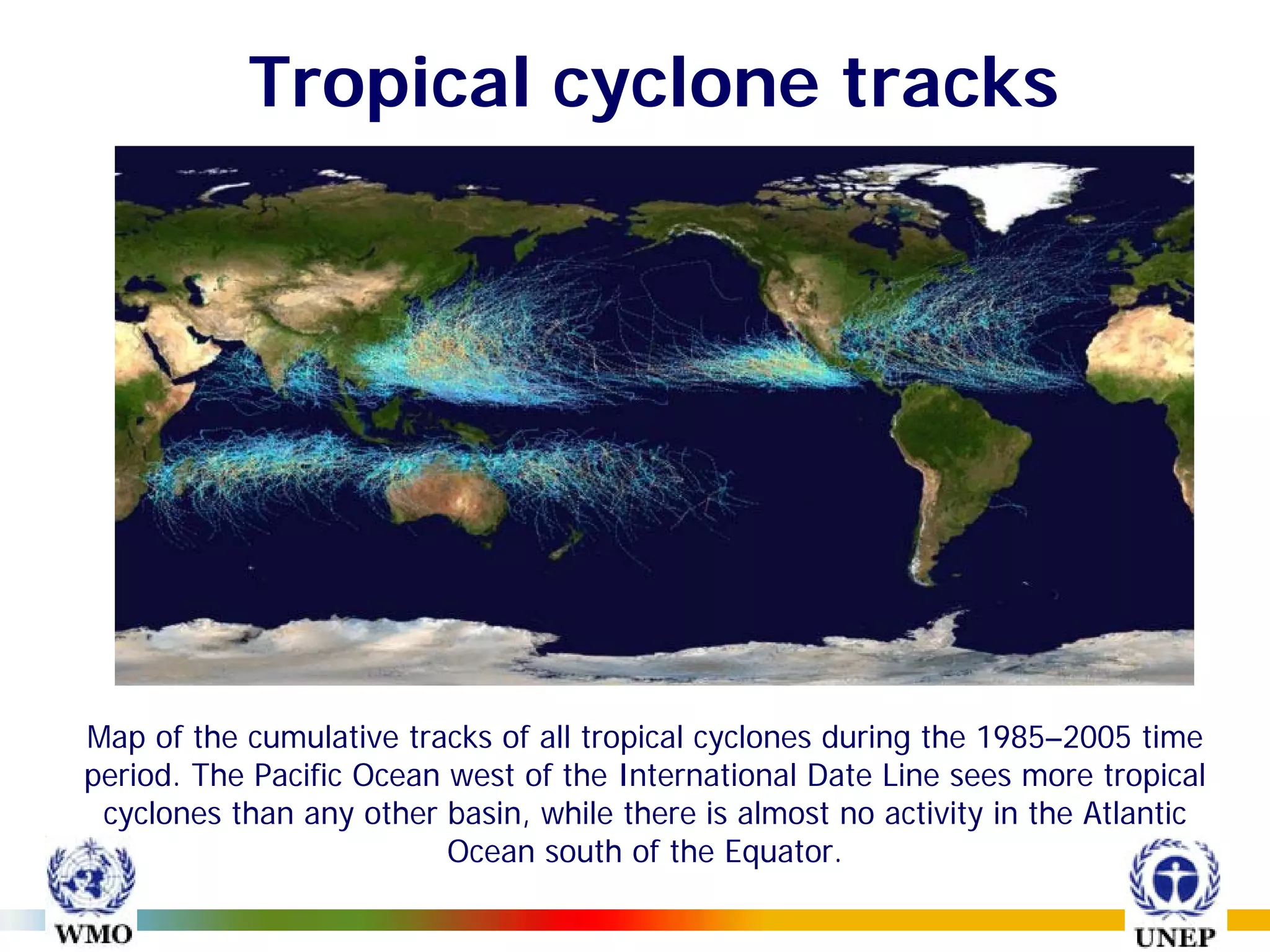
Tropical cyclone tracks


Map of the cumulative tracks of all tropical cyclones during the 1985–2005 time
period. The Pacific Ocean west of the International Date Line sees more tropical
 cyclones than any other basin, while there is almost no activity in the Atlantic
                          Ocean south of the Equator.
Mississippi delta – post-Katrina


  Areas in red were converted to open water during the hurricane.
  Yellow lines on index map of Louisiana show tracks of Hurricane
  Katrina on right and Hurricane Rita on left
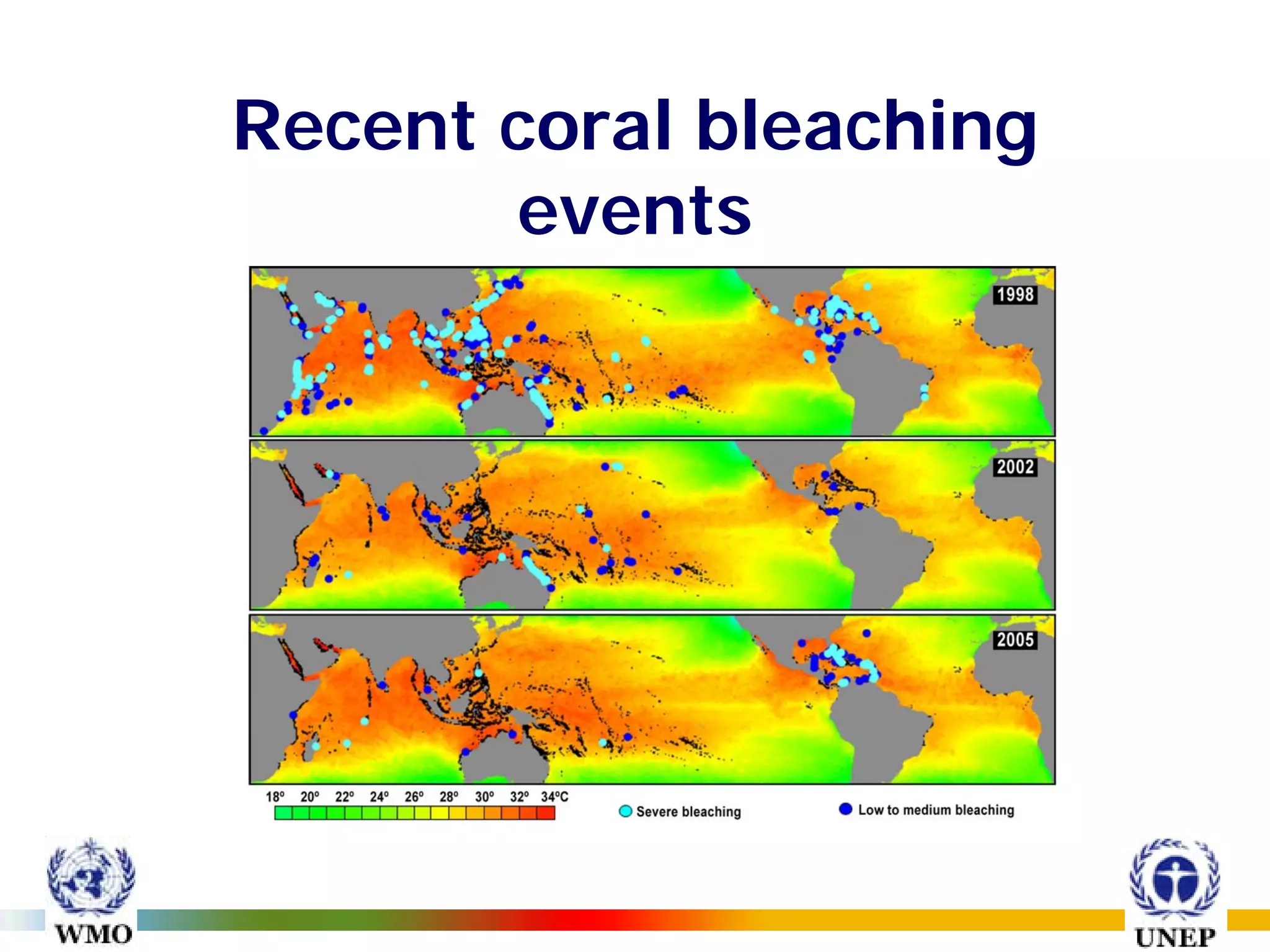
Recent coral bleaching
       events
Climate risks will increase
          through the 21st Century
 Climate Driver (trend)        Main Physical and Ecosystem Effects on Coastal Systems
                               Increased CO2 fertilisation; Decreased seawater pH (or ‘ocean acidification’) negatively
CO2 concentration (↑)                        impacting coral reefs and other pH sensitive organisms.
                                  Increased stratification/changed circulation; Reduced incidence of sea ice at higher
    Sea surface               latitudes; Increased coral bleaching and mortality; Poleward species migration; Increased
temperature (SST) (↑,                                                 algal blooms.
        R)
                                Inundation, flood and storm damage; Erosion; Saltwater Intrusion; Rising water tables/
        Sea level (↑, R)                            impeded drainage; Wetland loss (and change).
                                 Increased extreme water levels and wave heights; Increased episodic erosion, storm
           Intensity (↑, R)                        damage, risk of flooding and defence failure;
Storm


          Frequency (?, R)          Altered surges and storm waves and hence risk of storm damage and flooding.

            Track (?,R)
        Wave climate           Altered wave conditions, including swell; Altered patterns of erosion and accretion; Re-
                                                            orientation of beach planform.
           (?, R)
         Run-off (R)          Altered flood risk in coastal lowlands; Altered water quality/salinity; Altered fluvial sediment
                                                      supply; Altered circulation and nutrient supply.


        These phenomena will vary considerably at regional and local scales, but
           the impacts are virtually certain to be overwhelmingly negative.
Extreme sea-level simulations

                     Cairns, Australia
                            Current climate
                             2050 climate
                             Cairns road network
Major impact types
• Corals are threatened with increased bleaching and mortality
  due to rising sea surface temperatures.
• Coastal wetland ecosystems, such as salt marshes and
  mangroves, are especially threatened where they are sediment-
  starved or constrained on their landward margin.
• Degradation of coastal ecosystems, especially wetlands and
  coral reefs, has serious implications for the well-being of
  societies dependent on the coastal ecosystems for goods and
  services.
• Increased flooding and the degradation of freshwater, fisheries
  and other resources could impact hundreds of millions of people
  and socio-economic costs will escalate as a result of climate
  change for coasts.
Coasts and people
Population and economic density in the coastal zone is greater than
                other areas of the earth’s surface.
Climate change in the coastal
 zone is an additional stress
• Human utilisation of the coast increased dramatically during
  the 20th century
• This trend is virtually certain to continue through the 21st
  century and coastal population could grow from 1.2 billion
  people (in 1990) to 1.8 to 5.2 billion people by the 2080s.
• Increasing numbers of people and assets at risk at the coast
  are subject to additional stresses by land-use and hydrological
  changes in catchments, including dams that reduce sediment
  supply to the coast.
Threatened deltas


Relative vulnerability of coastal deltas as indicated by the indicative
population potentially displaced by current sea-level trends to 2050
(Extreme > 1 million; high 1 million to 50,000; medium 50,000 to 5,000)
Threatened areas

• Populated deltas (especially Asian megadeltas), low-
  lying coastal urban areas, and atolls are key societal
  hotspots of coastal vulnerability, occurring where the
  stresses on natural systems coincide with low human
  adaptive capacity and high exposure.
• Regionally, south, south-east and east Asia, Africa
  and small islands are most vulnerable.
• Climate change therefore reinforces the desirability of
  managing coasts in an integrated manner.
Integrated assessment of
      sea-level rise
Adaptation is challenging,
especially in developed countries
 • While physical exposure can significantly influence the
   vulnerability for both human populations and natural systems, a
   lack of adaptive capacity is often the most important factor that
   creates a hotspot of human vulnerability.
 • Adaptive capacity is largely dependent upon development
   status.
 • Hence, while developing nations may have the political or
   societal will to protect or relocate people who live in low-lying
   coastal zones, their vulnerability is much greater than a
   developed nation in an identical coastal setting.
 • Vulnerability will also vary between developing countries, while
   developed countries are not insulated from the adverse
   consequences of extreme events.
Many adaptation options are
          available
    Coastal       Adaptation Objectives     Adaptation Responses                  Examples
   Adaptation     (Klein and Tol, 1997)   (after Cooper et al., 2002;
 (IPCC CZMS,                                    DEFRA, 2001)
     1990)
                                          Advance the line              Land claim; polders

Protect         Increased robustness      Hold the line                 Dyke; beach nourishment

Accommodate     Increased flexibility                                   'Flood proof' buildings
                                                                        Floating agricultural systems

                                          Retreat the line              Managed realignment
Retreat         Enhanced adaptability     Limited intervention          Ad hoc seawall
                                          No intervention               Monitoring only

                Reversing maladaptive     Sustainable adaptation        Wetland restoration
                trends

                Improved awareness and    Community-focussed            Flood hazard mapping; flood
                preparedness              adaptation                    warnings
Inaction will cost more than
         adaptation
• Adaptation costs for climate change are much lower than
  damage costs without adaptation for most developed coasts,
  even considering only property losses and human deaths.
• As post-event impacts on coastal businesses, people, housing,
  public and private social institutions, natural resources, and the
  environment generally go unrecognised in disaster cost
  accounting, the full benefits of adaptation are even larger.
• Without adaptation, the high-end sea-level scenarios combined
  with other climate change (e.g., increased storm intensity) are
  as likely as not to make some islands and low-lying areas
  uninhabitable by 2100, so effective adaptation is urgently
  required.
Sea-level rise will continue
           beyond 2100
•   Sea-level rise has substantial
    inertia and will continue beyond
    2100 for many centuries.
•   Irreversible breakdown of the
    West Antarctica and/or
    Greenland ice sheets, if
    triggered by rising temperature,                        6000
                                                                       Land area (10^3 km^2)
    would make this long-term rise                          5000
                                                                       Population (millions)
                                                                       GDP MER (US$ billions)

    significantly larger, ultimately                                   GDP PPP (US$ billions)


                                       Count (see legend)
    questioning the viability of
                                                            4000


    many coastal settlements across                         3000


    the globe.                                              2000


                                                            1000


                                                               0
                                                                   0          2            4         6           8   10
                                                                                   Height above high water (m)
Implications of long-term
            change
• Settlement patterns also have substantial inertia, and
  this issue presents a challenge for long-term coastal
  spatial planning.
• Stabilisation of climate could reduce the risks of ice
  sheet breakdown, and reduce but not stop sea-level
  rise due to thermal expansion.
• Hence, it is now more apparent than the TAR that
  the most appropriate response to sea-level rise for
  coastal areas is a combination of adaptation to deal
  with the inevitable rise, and mitigation to limit the
  long-term rise to a manageable level.
Conclusions
• Climate change and sea-level rise present
  significant challenges for coastal areas.
• While our knowledge needs to be expanded a
  range of response options are available.
• A combination of adaptation and mitigation
  would seem most appropriate.

Climate changes impact on coastal regions

  • 1.
    Chapter 6: Coastal Systems and Low-lying Areas Coordinating Lead Authors Robert J. Nicholls (UK) and Poh Poh Wong (Singapore) Lead Authors Virginia Burkett (USA), Jorge Codignotto (Argentina), John Hay (New Zealand), Roger McLean (Australia), Sachooda Ragoonaden (Mauritius), Colin D. Woodroffe (Australia) Contributing Authors Pamela Abuodha (Kenya), Julie Arblaster (USA/Australia), Barbara Brown (UK), Don Forbes (Canada), Jim Hall (UK), Sari Kovats (UK), Jason Lowe (UK), Kathy McInnes (Australia), Susanne Moser (USA), Susanne Rupp- Armstrong (UK), Yoshiki Saito (Japan), Richard Tol (Ireland) Review Editors Job Dronkers (Netherlands), Geoff Love (Australia), Jin-Eong Ong (Malaysia)
  • 2.
  • 3.
    Main conclusions • Coastsare experiencing the adverse consequences of hazards related to climate and sea level [*** D]. • Coasts will be exposed to increasing risks over coming decades due to many compounding climate-change factors [*** D]. • The impact of climate change on coasts is exacerbated by increasing human-induced pressures [*** C]. • Adaptation for the coasts of developing countries will be more challenging than for coasts of developed countries, due to constraints on adaptive capacity [** D]. • Adaptation costs for vulnerable coasts are much less than the costs of inaction [** N]. • The unavoidability of sea-level rise even in the longer-term frequently conflicts with present-day human development patterns and trends [** N].
  • 4.
    Observed impacts due to climate variability and change • Storms already impose substantial costs on coastal societies. • Annually, about 120 million people are exposed to tropical cyclone hazards which had killed 250,000 people from 1980 to 2000. • Through the 20th Century, global rise of sea level contributed to increased coastal inundation, erosion and ecosystem losses, but with considerable local and regional variation due to other factors. • Late 20th Century effects of rising temperature include loss of sea ice, thawing of permafrost and associated coastal retreat, and more frequent coral bleaching and mortality.
  • 5.
    Tropical cyclone tracks Mapof the cumulative tracks of all tropical cyclones during the 1985–2005 time period. The Pacific Ocean west of the International Date Line sees more tropical cyclones than any other basin, while there is almost no activity in the Atlantic Ocean south of the Equator.
  • 6.
    Mississippi delta –post-Katrina Areas in red were converted to open water during the hurricane. Yellow lines on index map of Louisiana show tracks of Hurricane Katrina on right and Hurricane Rita on left
  • 7.
  • 8.
    Climate risks willincrease through the 21st Century Climate Driver (trend) Main Physical and Ecosystem Effects on Coastal Systems Increased CO2 fertilisation; Decreased seawater pH (or ‘ocean acidification’) negatively CO2 concentration (↑) impacting coral reefs and other pH sensitive organisms. Increased stratification/changed circulation; Reduced incidence of sea ice at higher Sea surface latitudes; Increased coral bleaching and mortality; Poleward species migration; Increased temperature (SST) (↑, algal blooms. R) Inundation, flood and storm damage; Erosion; Saltwater Intrusion; Rising water tables/ Sea level (↑, R) impeded drainage; Wetland loss (and change). Increased extreme water levels and wave heights; Increased episodic erosion, storm Intensity (↑, R) damage, risk of flooding and defence failure; Storm Frequency (?, R) Altered surges and storm waves and hence risk of storm damage and flooding. Track (?,R) Wave climate Altered wave conditions, including swell; Altered patterns of erosion and accretion; Re- orientation of beach planform. (?, R) Run-off (R) Altered flood risk in coastal lowlands; Altered water quality/salinity; Altered fluvial sediment supply; Altered circulation and nutrient supply. These phenomena will vary considerably at regional and local scales, but the impacts are virtually certain to be overwhelmingly negative.
  • 9.
    Extreme sea-level simulations Cairns, Australia Current climate 2050 climate Cairns road network
  • 10.
    Major impact types •Corals are threatened with increased bleaching and mortality due to rising sea surface temperatures. • Coastal wetland ecosystems, such as salt marshes and mangroves, are especially threatened where they are sediment- starved or constrained on their landward margin. • Degradation of coastal ecosystems, especially wetlands and coral reefs, has serious implications for the well-being of societies dependent on the coastal ecosystems for goods and services. • Increased flooding and the degradation of freshwater, fisheries and other resources could impact hundreds of millions of people and socio-economic costs will escalate as a result of climate change for coasts.
  • 11.
    Coasts and people Populationand economic density in the coastal zone is greater than other areas of the earth’s surface.
  • 12.
    Climate change inthe coastal zone is an additional stress • Human utilisation of the coast increased dramatically during the 20th century • This trend is virtually certain to continue through the 21st century and coastal population could grow from 1.2 billion people (in 1990) to 1.8 to 5.2 billion people by the 2080s. • Increasing numbers of people and assets at risk at the coast are subject to additional stresses by land-use and hydrological changes in catchments, including dams that reduce sediment supply to the coast.
  • 13.
    Threatened deltas Relative vulnerabilityof coastal deltas as indicated by the indicative population potentially displaced by current sea-level trends to 2050 (Extreme > 1 million; high 1 million to 50,000; medium 50,000 to 5,000)
  • 14.
    Threatened areas • Populateddeltas (especially Asian megadeltas), low- lying coastal urban areas, and atolls are key societal hotspots of coastal vulnerability, occurring where the stresses on natural systems coincide with low human adaptive capacity and high exposure. • Regionally, south, south-east and east Asia, Africa and small islands are most vulnerable. • Climate change therefore reinforces the desirability of managing coasts in an integrated manner.
  • 15.
  • 16.
    Adaptation is challenging, especiallyin developed countries • While physical exposure can significantly influence the vulnerability for both human populations and natural systems, a lack of adaptive capacity is often the most important factor that creates a hotspot of human vulnerability. • Adaptive capacity is largely dependent upon development status. • Hence, while developing nations may have the political or societal will to protect or relocate people who live in low-lying coastal zones, their vulnerability is much greater than a developed nation in an identical coastal setting. • Vulnerability will also vary between developing countries, while developed countries are not insulated from the adverse consequences of extreme events.
  • 17.
    Many adaptation optionsare available Coastal Adaptation Objectives Adaptation Responses Examples Adaptation (Klein and Tol, 1997) (after Cooper et al., 2002; (IPCC CZMS, DEFRA, 2001) 1990) Advance the line Land claim; polders Protect Increased robustness Hold the line Dyke; beach nourishment Accommodate Increased flexibility 'Flood proof' buildings Floating agricultural systems Retreat the line Managed realignment Retreat Enhanced adaptability Limited intervention Ad hoc seawall No intervention Monitoring only Reversing maladaptive Sustainable adaptation Wetland restoration trends Improved awareness and Community-focussed Flood hazard mapping; flood preparedness adaptation warnings
  • 18.
    Inaction will costmore than adaptation • Adaptation costs for climate change are much lower than damage costs without adaptation for most developed coasts, even considering only property losses and human deaths. • As post-event impacts on coastal businesses, people, housing, public and private social institutions, natural resources, and the environment generally go unrecognised in disaster cost accounting, the full benefits of adaptation are even larger. • Without adaptation, the high-end sea-level scenarios combined with other climate change (e.g., increased storm intensity) are as likely as not to make some islands and low-lying areas uninhabitable by 2100, so effective adaptation is urgently required.
  • 19.
    Sea-level rise willcontinue beyond 2100 • Sea-level rise has substantial inertia and will continue beyond 2100 for many centuries. • Irreversible breakdown of the West Antarctica and/or Greenland ice sheets, if triggered by rising temperature, 6000 Land area (10^3 km^2) would make this long-term rise 5000 Population (millions) GDP MER (US$ billions) significantly larger, ultimately GDP PPP (US$ billions) Count (see legend) questioning the viability of 4000 many coastal settlements across 3000 the globe. 2000 1000 0 0 2 4 6 8 10 Height above high water (m)
  • 20.
    Implications of long-term change • Settlement patterns also have substantial inertia, and this issue presents a challenge for long-term coastal spatial planning. • Stabilisation of climate could reduce the risks of ice sheet breakdown, and reduce but not stop sea-level rise due to thermal expansion. • Hence, it is now more apparent than the TAR that the most appropriate response to sea-level rise for coastal areas is a combination of adaptation to deal with the inevitable rise, and mitigation to limit the long-term rise to a manageable level.
  • 21.
    Conclusions • Climate changeand sea-level rise present significant challenges for coastal areas. • While our knowledge needs to be expanded a range of response options are available. • A combination of adaptation and mitigation would seem most appropriate.