FARMING METHODS
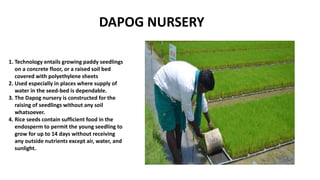
1. Technology entails growing paddy seedlings
on a concrete floor, or a raised soil bed
covered with polyethylene sheets
2. Used especially in places where supply of
water in the seed-bed is dependable.
3. The Dapog nursery is constructed for the
raising of seedlings without any soil
whatsoever.
4. Rice seeds contain sufficient food in the
endosperm to permit the young seedling to
grow for up to 14 days without receiving
any outside nutrients except air, water, and
sunlight.
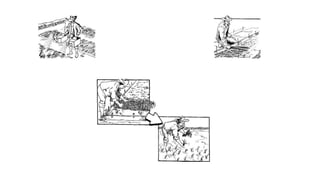
DAPOG NURSERY
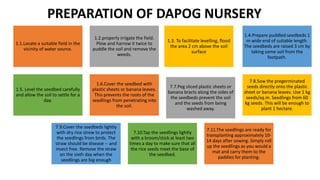
1.1.Locate a suitable field in the
vicinity of water source.
1.2.properly irrigate the field.
Plow and harrow it twice to
puddle the soil and remove the
weeds.
1.3. To facilitate levelling, flood
the area 2 cm above the soil
surface
1.4.Prepare puddled seedbeds 1
m wide end of suitable length.
The seedbeds are raised 3 cm by
taking some soil from the
footpath.
1.5. Level the seedbed carefully
and allow the soil to settle for a
day.
1.6.Cover the seedbed with
plastic sheets or banana leaves.
This prevents the roots of the
seedlings from penetrating into
the soil.
7.7.Peg sliced plastic sheets or
banana bracts along the sides of
the seedbeds prevent the soil
and the seeds from being
washed away.
7.8.Sow the pregerminated
seeds directly onto the plastic
sheet or banana leaves. Use 1 kg
seeds/sq.m. Seedlings from 60
kg seeds. This will be enough to
plant 1 hectare.
7.9.Cover the seedbeds lightly
with dry rice strew to protect
the seedlings from birds. The
straw should be disease -- and
insect free. Remove the straw
on the sixth day when the
seedlings are big enough
7.10.Tap the seedlings lightly
with a broom/stick at least two
times a day to make sure that all
the rice seeds meet the base of
the seedbed.
7.11.The seedlings are ready for
transplanting approximately 10-
14 days after sowing. Simply roll
up the seedlings as you would a
mat and carry them to the
paddies for planting.

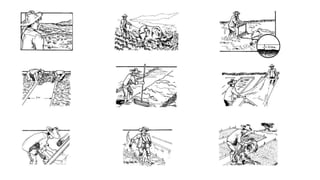
PREPARATION OF DAPOG NURSERY
ADVANTAGES OF DAPOG NURSERY
1. Seedlings are ready for transplant by 14 days
2. Saves 50% time in comparison to traditional method
3. Occupies smaller portion of land for nursery i.e. 30
sq. m. for 1 ha
4. Helpful in conditions of damage caused by weather
hazards such as floods and pest-disease attack.
5. Labour required for removing seedlings from
seedbed is less than 1/4 compared to the wet bed
method
6. Easy to transport seedlings from seed bed to the
rice paddy
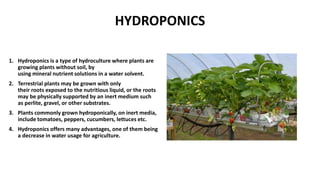
HYDROPONICS
1. Hydroponics is a type of hydroculture where plants are
growing plants without soil, by
using mineral nutrient solutions in a water solvent.
2. Terrestrial plants may be grown with only
their roots exposed to the nutritious liquid, or the roots
may be physically supported by an inert medium such
as perlite, gravel, or other substrates.
3. Plants commonly grown hydroponically, on inert media,
include tomatoes, peppers, cucumbers, lettuces etc.
4. Hydroponics offers many advantages, one of them being
a decrease in water usage for agriculture.
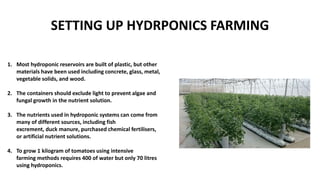
SETTING UP HYDRPONICS FARMING
1. Most hydroponic reservoirs are built of plastic, but other
materials have been used including concrete, glass, metal,
vegetable solids, and wood.
2. The containers should exclude light to prevent algae and
fungal growth in the nutrient solution.
3. The nutrients used in hydroponic systems can come from
many of different sources, including fish
excrement, duck manure, purchased chemical fertilisers,
or artificial nutrient solutions.
4. To grow 1 kilogram of tomatoes using intensive
farming methods requires 400 of water but only 70 litres
using hydroponics.
ADVANTAGES OF HYDROPONICS
1. It can produce crops much faster in the same amount of space.
2. It allows more control over whether a plant is vegetative i.e..,
growing leaves, stems, roots vs. generative flowers, fruit, seeds.
3. It often uses sub irrigation techniques which allow for leftover
water and nutrients from being wasted and/or released into
waterways.
4. It is easier to produce crops that might not grow in an area with
hydroponics. For example, growing a very acid-desiring crop in an
area with a high PH.
5. Hydroponics can be less labour-intensive example as it involves no
weeding
6. Compared to traditional soil-based horticulture, hydroponics may
be less labour-intensive.
7. The technique offers year-round production
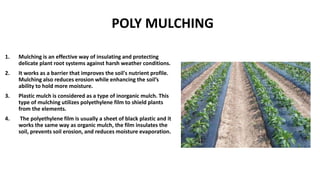
POLY MULCHING
1. Mulching is an effective way of insulating and protecting
delicate plant root systems against harsh weather conditions.
2. It works as a barrier that improves the soil's nutrient profile.
Mulching also reduces erosion while enhancing the soil’s
ability to hold more moisture.
3. Plastic mulch is considered as a type of inorganic mulch. This
type of mulching utilizes polyethylene film to shield plants
from the elements.
4. The polyethylene film is usually a sheet of black plastic and it
works the same way as organic mulch, the film insulates the
soil, prevents soil erosion, and reduces moisture evaporation.
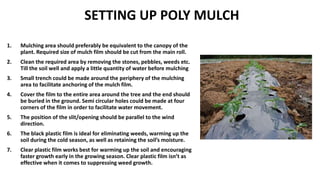
SETTING UP POLY MULCH
1. Mulching area should preferably be equivalent to the canopy of the
plant. Required size of mulch film should be cut from the main roll.
2. Clean the required area by removing the stones, pebbles, weeds etc.
Till the soil well and apply a little quantity of water before mulching
3. Small trench could be made around the periphery of the mulching
area to facilitate anchoring of the mulch film.
4. Cover the film to the entire area around the tree and the end should
be buried in the ground. Semi circular holes could be made at four
corners of the film in order to facilitate water movement.
5. The position of the slit/opening should be parallel to the wind
direction.
6. The black plastic film is ideal for eliminating weeds, warming up the
soil during the cold season, as well as retaining the soil’s moisture.
7. Clear plastic film works best for warming up the soil and encouraging
faster growth early in the growing season. Clear plastic film isn’t as
effective when it comes to suppressing weed growth.
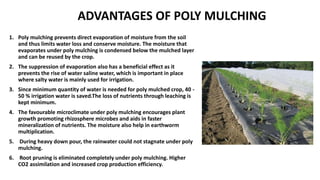
ADVANTAGES OF POLY MULCHING
1. Poly mulching prevents direct evaporation of moisture from the soil
and thus limits water loss and conserve moisture. The moisture that
evaporates under poly mulching is condensed below the mulched layer
and can be reused by the crop.
2. The suppression of evaporation also has a beneficial effect as it
prevents the rise of water saline water, which is important in place
where salty water is mainly used for irrigation.
3. Since minimum quantity of water is needed for poly mulched crop, 40 -
50 % irrigation water is saved.The loss of nutrients through leaching is
kept minimum.
4. The favourable microclimate under poly mulching encourages plant
growth promoting rhizosphere microbes and aids in faster
mineralization of nutrients. The moisture also help in earthworm
multiplication.
5. During heavy down pour, the rainwater could not stagnate under poly
mulching.
6. Root pruning is eliminated completely under poly mulching. Higher
CO2 assimilation and increased crop production efficiency.
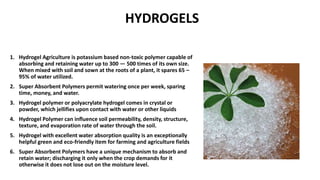
HYDROGELS
1. Hydrogel Agriculture is potassium based non-toxic polymer capable of
absorbing and retaining water up to 300 — 500 times of its own size.
When mixed with soil and sown at the roots of a plant, it spares 65 –
95% of water utilized.
2. Super Absorbent Polymers permit watering once per week, sparing
time, money, and water.
3. Hydrogel polymer or polyacrylate hydrogel comes in crystal or
powder, which jellifies upon contact with water or other liquids
4. Hydrogel Polymer can influence soil permeability, density, structure,
texture, and evaporation rate of water through the soil.
5. Hydrogel with excellent water absorption quality is an exceptionally
helpful green and eco-friendly item for farming and agriculture fields
6. Super Absorbent Polymers have a unique mechanism to absorb and
retain water; discharging it only when the crop demands for it
otherwise it does not lose out on the moisture level.
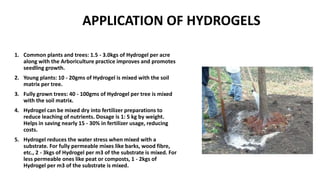
APPLICATION OF HYDROGELS
1. Common plants and trees: 1.5 - 3.0kgs of Hydrogel per acre
along with the Arboriculture practice improves and promotes
seedling growth.
2. Young plants: 10 - 20gms of Hydrogel is mixed with the soil
matrix per tree.
3. Fully grown trees: 40 - 100gms of Hydrogel per tree is mixed
with the soil matrix.
4. Hydrogel can be mixed dry into fertilizer preparations to
reduce leaching of nutrients. Dosage is 1: 5 kg by weight.
Helps in saving nearly 15 - 30% in fertilizer usage, reducing
costs.
5. Hydrogel reduces the water stress when mixed with a
substrate. For fully permeable mixes like barks, wood fibre,
etc., 2 - 3kgs of Hydrogel per m3 of the substrate is mixed. For
less permeable ones like peat or composts, 1 - 2kgs of
Hydrogel per m3 of the substrate is mixed.
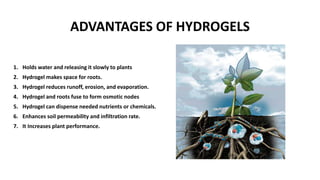
ADVANTAGES OF HYDROGELS
1. Holds water and releasing it slowly to plants
2. Hydrogel makes space for roots.
3. Hydrogel reduces runoff, erosion, and evaporation.
4. Hydrogel and roots fuse to form osmotic nodes
5. Hydrogel can dispense needed nutrients or chemicals.
6. Enhances soil permeability and infiltration rate.
7. It Increases plant performance.
AGRICULTURE TOOLS AND MACHINARY
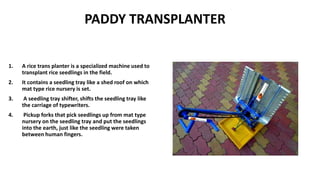
PADDY TRANSPLANTER
1. A rice trans planter is a specialized machine used to
transplant rice seedlings in the field.
2. It contains a seedling tray like a shed roof on which
mat type rice nursery is set.
3. A seedling tray shifter, shifts the seedling tray like
the carriage of typewriters.
4. Pickup forks that pick seedlings up from mat type
nursery on the seedling tray and put the seedlings
into the earth, just like the seedling were taken
between human fingers.
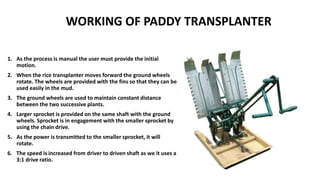
WORKING OF PADDY TRANSPLANTER
1. As the process is manual the user must provide the initial
motion.
2. When the rice transplanter moves forward the ground wheels
rotate. The wheels are provided with the fins so that they can be
used easily in the mud.
3. The ground wheels are used to maintain constant distance
between the two successive plants.
4. Larger sprocket is provided on the same shaft with the ground
wheels. Sprocket is in engagement with the smaller sprocket by
using the chain drive.
5. As the power is transmitted to the smaller sprocket, it will
rotate.
6. The speed is increased from driver to driven shaft as we it uses a
3:1 drive ratio.
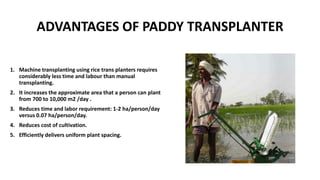
ADVANTAGES OF PADDY TRANSPLANTER
1. Machine transplanting using rice trans planters requires
considerably less time and labour than manual
transplanting.
2. It increases the approximate area that a person can plant
from 700 to 10,000 m2 /day .
3. Reduces time and labor requirement: 1-2 ha/person/day
versus 0.07 ha/person/day.
4. Reduces cost of cultivation.
5. Efficiently delivers uniform plant spacing.
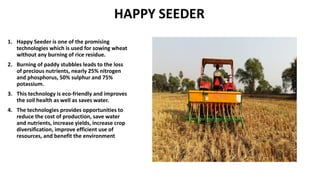
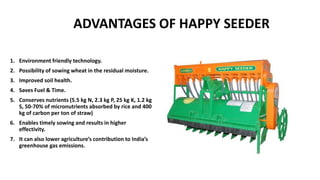
HAPPY SEEDER
1. Happy Seeder is one of the promising
technologies which is used for sowing wheat
without any burning of rice residue.
2. Burning of paddy stubbles leads to the loss
of precious nutrients, nearly 25% nitrogen
and phosphorus, 50% sulphur and 75%
potassium.
3. This technology is eco-friendly and improves
the soil health as well as saves water.
4. The technologies provides opportunities to
reduce the cost of production, save water
and nutrients, increase yields, increase crop
diversification, improve efficient use of
resources, and benefit the environment
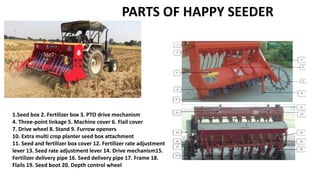
1.Seed box 2. Fertilizer box 3. PTO drive mechanism
4. Three-point linkage 5. Machine cover 6. Flail cover
7. Drive wheel 8. Stand 9. Furrow openers
10. Extra multi crop planter seed box attachment
11. Seed and fertilizer box cover 12. Fertilizer rate adjustment
lever 13. Seed rate adjustment lever 14. Drive mechanism15.
Fertilizer delivery pipe 16. Seed delivery pipe 17. Frame 18.
Flails 19. Seed boot 20. Depth control wheel
PARTS OF HAPPY SEEDER
ADVANTAGES OF HAPPY SEEDER
1. Environment friendly technology.
2. Possibility of sowing wheat in the residual moisture.
3. Improved soil health.
4. Saves Fuel & Time.
5. Conserves nutrients (5.5 kg N, 2.3 kg P, 25 kg K, 1.2 kg
S, 50-70% of micronutrients absorbed by rice and 400
kg of carbon per ton of straw)
6. Enables timely sowing and results in higher
effectivity.
7. It can also lower agriculture’s contribution to India’s
greenhouse gas emissions.
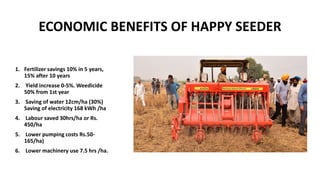
ECONOMIC BENEFITS OF HAPPY SEEDER
1. Fertilizer savings 10% in 5 years,
15% after 10 years
2. Yield increase 0-5%. Weedicide
50% from 1st year
3. Saving of water 12cm/ha (30%)
Saving of electricity 168 kWh /ha
4. Labour saved 30hrs/ha or Rs.
450/ha
5. Lower pumping costs Rs.50-
165/ha)
6. Lower machinery use 7.5 hrs /ha.
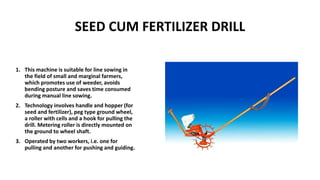
SEED CUM FERTILIZER DRILL
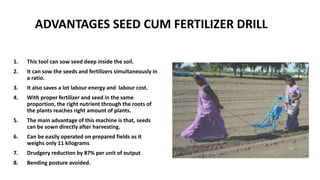
1. This machine is suitable for line sowing in
the field of small and marginal farmers,
which promotes use of weeder, avoids
bending posture and saves time consumed
during manual line sowing.
2. Technology involves handle and hopper (for
seed and fertilizer), peg type ground wheel,
a roller with cells and a hook for pulling the
drill. Metering roller is directly mounted on
the ground to wheel shaft.
3. Operated by two workers, i.e. one for
pulling and another for pushing and guiding.
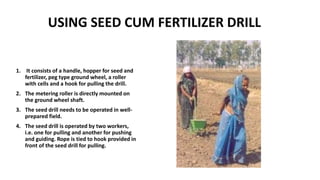
USING SEED CUM FERTILIZER DRILL
1. It consists of a handle, hopper for seed and
fertilizer, peg type ground wheel, a roller
with cells and a hook for pulling the drill.
2. The metering roller is directly mounted on
the ground wheel shaft.
3. The seed drill needs to be operated in well-
prepared field.
4. The seed drill is operated by two workers,
i.e. one for pulling and another for pushing
and guiding. Rope is tied to hook provided in
front of the seed drill for pulling.
ADVANTAGES SEED CUM FERTILIZER DRILL
1. This tool can sow seed deep inside the soil.
2. It can sow the seeds and fertilizers simultaneously in
a ratio.
3. It also saves a lot labour energy and labour cost.
4. With proper fertilizer and seed in the same
proportion, the right nutrient through the roots of
the plants reaches right amount of plants.
5. The main advantage of this machine is that, seeds
can be sown directly after harvesting.
6. Can be easily operated on prepared fields as it
weighs only 11 kilograms
7. Drudgery reduction by 87% per unit of output
8. Bending posture avoided.
JUTE SEED DRILL
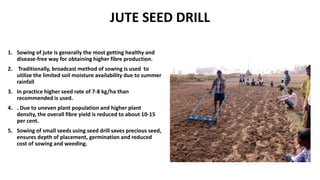
1. Sowing of jute is generally the most getting healthy and
disease-free way for obtaining higher fibre production.
2. Traditionally, broadcast method of sowing is used to
utilize the limited soil moisture availability due to summer
rainfall
3. In practice higher seed rate of 7-8 kg/ha than
recommended is used.
4. . Due to uneven plant population and higher plant
density, the overall fibre yield is reduced to about 10-15
per cent.
5. Sowing of small seeds using seed drill saves precious seed,
ensures depth of placement, germination and reduced
cost of sowing and weeding.
WORKING OF JUTE SEED DRILL
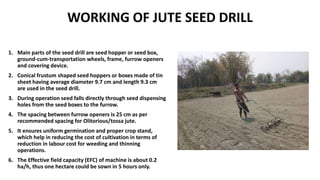
1. Main parts of the seed drill are seed hopper or seed box,
ground-cum-transportation wheels, frame, furrow openers
and covering device.
2. Conical frustum shaped seed hoppers or boxes made of tin
sheet having average diameter 9.7 cm and length 9.3 cm
are used in the seed drill.
3. During operation seed falls directly through seed dispensing
holes from the seed boxes to the furrow.
4. The spacing between furrow openers is 25 cm as per
recommended spacing for Olitorious/tossa jute.
5. It ensures uniform germination and proper crop stand,
which help in reducing the cost of cultivation in terms of
reduction in labour cost for weeding and thinning
operations.
6. The Effective field capacity (EFC) of machine is about 0.2
ha/h, thus one hectare could be sown in 5 hours only.
ADVANTAGES OF JUTE SEED DRILL
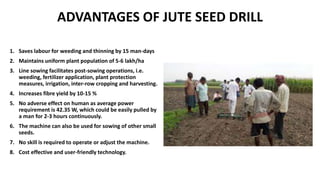
1. Saves labour for weeding and thinning by 15 man-days
2. Maintains uniform plant population of 5-6 lakh/ha
3. Line sowing facilitates post-sowing operations, i.e.
weeding, fertilizer application, plant protection
measures, irrigation, inter-row cropping and harvesting.
4. Increases fibre yield by 10-15 %
5. No adverse effect on human as average power
requirement is 42.35 W, which could be easily pulled by
a man for 2-3 hours continuously.
6. The machine can also be used for sowing of other small
seeds.
7. No skill is required to operate or adjust the machine.
8. Cost effective and user-friendly technology.
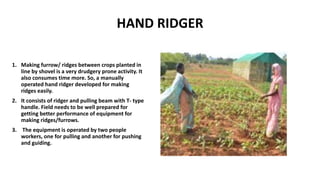
HAND RIDGER
1. Making furrow/ ridges between crops planted in
line by shovel is a very drudgery prone activity. It
also consumes time more. So, a manually
operated hand ridger developed for making
ridges easily.
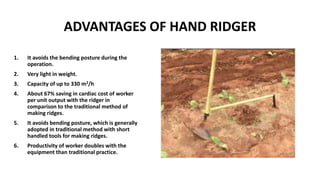
2. It consists of ridger and pulling beam with T- type
handle. Field needs to be well prepared for
getting better performance of equipment for
making ridges/furrows.
3. The equipment is operated by two people
workers, one for pulling and another for pushing
and guiding.
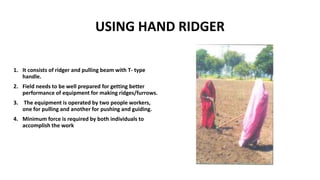
USING HAND RIDGER
1. It consists of ridger and pulling beam with T- type
handle.
2. Field needs to be well prepared for getting better
performance of equipment for making ridges/furrows.
3. The equipment is operated by two people workers,
one for pulling and another for pushing and guiding.
4. Minimum force is required by both individuals to
accomplish the work
ADVANTAGES OF HAND RIDGER
1. It avoids the bending posture during the
operation.
2. Very light in weight.
3. Capacity of up to 330 m2/h
4. About 67% saving in cardiac cost of worker
per unit output with the ridger in
comparison to the traditional method of
making ridges.
5. It avoids bending posture, which is generally
adopted in traditional method with short
handled tools for making ridges.
6. Productivity of worker doubles with the
equipment than traditional practice.
GROUNDNUT DECORTICATOR
1. Traditionally groundnut was decorticated by fingertips or
beating on stones etc. which are drudgery prone and is time
consuming actions.
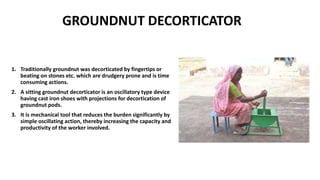
2. A sitting groundnut decorticator is an oscillatory type device
having cast iron shoes with projections for decortication of
groundnut pods.
3. It is mechanical tool that reduces the burden significantly by
simple oscillating action, thereby increasing the capacity and
productivity of the worker involved.
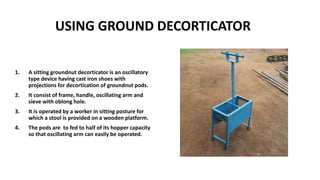
USING GROUND DECORTICATOR
1. A sitting groundnut decorticator is an oscillatory
type device having cast iron shoes with
projections for decortication of groundnut pods.
2. It consist of frame, handle, oscillating arm and
sieve with oblong hole.
3. It is operated by a worker in sitting posture for
which a stool is provided on a wooden platform.
4. The pods are to fed to half of its hopper capacity
so that oscillating arm can easily be operated.
ADVANTAGES OF GROUNDNUT DECORTICATOR
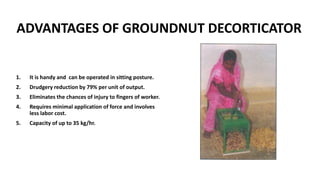
1. It is handy and can be operated in sitting posture.
2. Drudgery reduction by 79% per unit of output.
3. Eliminates the chances of injury to fingers of worker.
4. Requires minimal application of force and involves
less labor cost.
5. Capacity of up to 35 kg/hr.
PEST CONTROL
SOLAR LIGHT TRAP
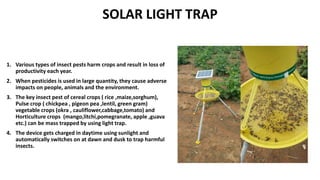
1. Various types of insect pests harm crops and result in loss of
productivity each year.
2. When pesticides is used in large quantity, they cause adverse
impacts on people, animals and the environment.
3. The key insect pest of cereal crops ( rice ,maize,sorghum),
Pulse crop ( chickpea , pigeon pea ,lentil, green gram)
vegetable crops (okra , cauliflower,cabbage,tomato) and
Horticulture crops (mango,litchi,pomegranate, apple ,guava
etc.) can be mass trapped by using light trap.
4. The device gets charged in daytime using sunlight and
automatically switches on at dawn and dusk to trap harmful
insects.
WORKING OF SOLAR LIGHT TRAP
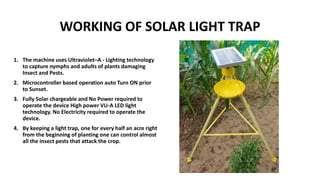
1. The machine uses Ultraviolet–A - Lighting technology
to capture nymphs and adults of plants damaging
Insect and Pests.
2. Microcontroller based operation auto Turn ON prior
to Sunset.
3. Fully Solar chargeable and No Power required to
operate the device High power VU-A LED light
technology. No Electricity required to operate the
device.
4. By keeping a light trap, one for every half an acre right
from the beginning of planting one can control almost
all the insect pests that attack the crop.
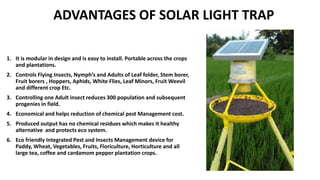
ADVANTAGES OF SOLAR LIGHT TRAP
1. It is modular in design and is easy to install. Portable across the crops
and plantations.
2. Controls Flying Insects, Nymph’s and Adults of Leaf folder, Stem borer,
Fruit borers , Hoppers, Aphids, White Flies, Leaf Minors, Fruit Weevil
and different crop Etc.
3. Controlling one Adult insect reduces 300 population and subsequent
progenies in field.
4. Economical and helps reduction of chemical pest Management cost.
5. Produced output has no chemical residues which makes it healthy
alternative and protects eco system.
6. Eco friendly Integrated Pest and Insects Management device for
Paddy, Wheat, Vegetables, Fruits, Floriculture, Horticulture and all
large tea, coffee and cardamom pepper plantation crops.
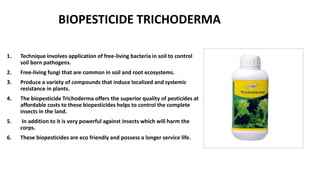
BIOPESTICIDE TRICHODERMA
1. Technique involves application of free-living bacteria in soil to control
soil born pathogens.
2. Free-living fungi that are common in soil and root ecosystems.
3. Produce a variety of compounds that induce localized and systemic
resistance in plants.
4. The biopesticide Trichoderma offers the superior quality of pesticides at
affordable costs to these biopesticides helps to control the complete
insects in the land.
5. In addition to it is very powerful against insects which will harm the
corps.
6. These biopesticides are eco friendly and possess a longer service life.
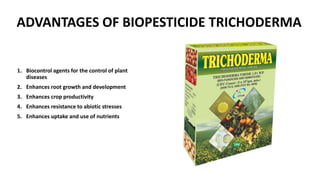
ADVANTAGES OF BIOPESTICIDE TRICHODERMA
1. Biocontrol agents for the control of plant
diseases
2. Enhances root growth and development
3. Enhances crop productivity
4. Enhances resistance to abiotic stresses
5. Enhances uptake and use of nutrients

Technologies for smallholders

  • 1.
  • 2.
    1. Technology entailsgrowing paddy seedlings on a concrete floor, or a raised soil bed covered with polyethylene sheets 2. Used especially in places where supply of water in the seed-bed is dependable. 3. The Dapog nursery is constructed for the raising of seedlings without any soil whatsoever. 4. Rice seeds contain sufficient food in the endosperm to permit the young seedling to grow for up to 14 days without receiving any outside nutrients except air, water, and sunlight. DAPOG NURSERY
  • 3.
    1.1.Locate a suitablefield in the vicinity of water source. 1.2.properly irrigate the field. Plow and harrow it twice to puddle the soil and remove the weeds. 1.3. To facilitate levelling, flood the area 2 cm above the soil surface 1.4.Prepare puddled seedbeds 1 m wide end of suitable length. The seedbeds are raised 3 cm by taking some soil from the footpath. 1.5. Level the seedbed carefully and allow the soil to settle for a day. 1.6.Cover the seedbed with plastic sheets or banana leaves. This prevents the roots of the seedlings from penetrating into the soil. 7.7.Peg sliced plastic sheets or banana bracts along the sides of the seedbeds prevent the soil and the seeds from being washed away. 7.8.Sow the pregerminated seeds directly onto the plastic sheet or banana leaves. Use 1 kg seeds/sq.m. Seedlings from 60 kg seeds. This will be enough to plant 1 hectare. 7.9.Cover the seedbeds lightly with dry rice strew to protect the seedlings from birds. The straw should be disease -- and insect free. Remove the straw on the sixth day when the seedlings are big enough 7.10.Tap the seedlings lightly with a broom/stick at least two times a day to make sure that all the rice seeds meet the base of the seedbed. 7.11.The seedlings are ready for transplanting approximately 10- 14 days after sowing. Simply roll up the seedlings as you would a mat and carry them to the paddies for planting. PREPARATION OF DAPOG NURSERY
  • 6.
    ADVANTAGES OF DAPOGNURSERY 1. Seedlings are ready for transplant by 14 days 2. Saves 50% time in comparison to traditional method 3. Occupies smaller portion of land for nursery i.e. 30 sq. m. for 1 ha 4. Helpful in conditions of damage caused by weather hazards such as floods and pest-disease attack. 5. Labour required for removing seedlings from seedbed is less than 1/4 compared to the wet bed method 6. Easy to transport seedlings from seed bed to the rice paddy
  • 7.
    HYDROPONICS 1. Hydroponics isa type of hydroculture where plants are growing plants without soil, by using mineral nutrient solutions in a water solvent. 2. Terrestrial plants may be grown with only their roots exposed to the nutritious liquid, or the roots may be physically supported by an inert medium such as perlite, gravel, or other substrates. 3. Plants commonly grown hydroponically, on inert media, include tomatoes, peppers, cucumbers, lettuces etc. 4. Hydroponics offers many advantages, one of them being a decrease in water usage for agriculture.
  • 8.
    SETTING UP HYDRPONICSFARMING 1. Most hydroponic reservoirs are built of plastic, but other materials have been used including concrete, glass, metal, vegetable solids, and wood. 2. The containers should exclude light to prevent algae and fungal growth in the nutrient solution. 3. The nutrients used in hydroponic systems can come from many of different sources, including fish excrement, duck manure, purchased chemical fertilisers, or artificial nutrient solutions. 4. To grow 1 kilogram of tomatoes using intensive farming methods requires 400 of water but only 70 litres using hydroponics.
  • 9.
    ADVANTAGES OF HYDROPONICS 1.It can produce crops much faster in the same amount of space. 2. It allows more control over whether a plant is vegetative i.e.., growing leaves, stems, roots vs. generative flowers, fruit, seeds. 3. It often uses sub irrigation techniques which allow for leftover water and nutrients from being wasted and/or released into waterways. 4. It is easier to produce crops that might not grow in an area with hydroponics. For example, growing a very acid-desiring crop in an area with a high PH. 5. Hydroponics can be less labour-intensive example as it involves no weeding 6. Compared to traditional soil-based horticulture, hydroponics may be less labour-intensive. 7. The technique offers year-round production
  • 10.
    POLY MULCHING 1. Mulchingis an effective way of insulating and protecting delicate plant root systems against harsh weather conditions. 2. It works as a barrier that improves the soil's nutrient profile. Mulching also reduces erosion while enhancing the soil’s ability to hold more moisture. 3. Plastic mulch is considered as a type of inorganic mulch. This type of mulching utilizes polyethylene film to shield plants from the elements. 4. The polyethylene film is usually a sheet of black plastic and it works the same way as organic mulch, the film insulates the soil, prevents soil erosion, and reduces moisture evaporation.
  • 11.
    SETTING UP POLYMULCH 1. Mulching area should preferably be equivalent to the canopy of the plant. Required size of mulch film should be cut from the main roll. 2. Clean the required area by removing the stones, pebbles, weeds etc. Till the soil well and apply a little quantity of water before mulching 3. Small trench could be made around the periphery of the mulching area to facilitate anchoring of the mulch film. 4. Cover the film to the entire area around the tree and the end should be buried in the ground. Semi circular holes could be made at four corners of the film in order to facilitate water movement. 5. The position of the slit/opening should be parallel to the wind direction. 6. The black plastic film is ideal for eliminating weeds, warming up the soil during the cold season, as well as retaining the soil’s moisture. 7. Clear plastic film works best for warming up the soil and encouraging faster growth early in the growing season. Clear plastic film isn’t as effective when it comes to suppressing weed growth.
  • 12.
    ADVANTAGES OF POLYMULCHING 1. Poly mulching prevents direct evaporation of moisture from the soil and thus limits water loss and conserve moisture. The moisture that evaporates under poly mulching is condensed below the mulched layer and can be reused by the crop. 2. The suppression of evaporation also has a beneficial effect as it prevents the rise of water saline water, which is important in place where salty water is mainly used for irrigation. 3. Since minimum quantity of water is needed for poly mulched crop, 40 - 50 % irrigation water is saved.The loss of nutrients through leaching is kept minimum. 4. The favourable microclimate under poly mulching encourages plant growth promoting rhizosphere microbes and aids in faster mineralization of nutrients. The moisture also help in earthworm multiplication. 5. During heavy down pour, the rainwater could not stagnate under poly mulching. 6. Root pruning is eliminated completely under poly mulching. Higher CO2 assimilation and increased crop production efficiency.
  • 13.
    HYDROGELS 1. Hydrogel Agricultureis potassium based non-toxic polymer capable of absorbing and retaining water up to 300 — 500 times of its own size. When mixed with soil and sown at the roots of a plant, it spares 65 – 95% of water utilized. 2. Super Absorbent Polymers permit watering once per week, sparing time, money, and water. 3. Hydrogel polymer or polyacrylate hydrogel comes in crystal or powder, which jellifies upon contact with water or other liquids 4. Hydrogel Polymer can influence soil permeability, density, structure, texture, and evaporation rate of water through the soil. 5. Hydrogel with excellent water absorption quality is an exceptionally helpful green and eco-friendly item for farming and agriculture fields 6. Super Absorbent Polymers have a unique mechanism to absorb and retain water; discharging it only when the crop demands for it otherwise it does not lose out on the moisture level.
  • 14.
    APPLICATION OF HYDROGELS 1.Common plants and trees: 1.5 - 3.0kgs of Hydrogel per acre along with the Arboriculture practice improves and promotes seedling growth. 2. Young plants: 10 - 20gms of Hydrogel is mixed with the soil matrix per tree. 3. Fully grown trees: 40 - 100gms of Hydrogel per tree is mixed with the soil matrix. 4. Hydrogel can be mixed dry into fertilizer preparations to reduce leaching of nutrients. Dosage is 1: 5 kg by weight. Helps in saving nearly 15 - 30% in fertilizer usage, reducing costs. 5. Hydrogel reduces the water stress when mixed with a substrate. For fully permeable mixes like barks, wood fibre, etc., 2 - 3kgs of Hydrogel per m3 of the substrate is mixed. For less permeable ones like peat or composts, 1 - 2kgs of Hydrogel per m3 of the substrate is mixed.
  • 15.
    ADVANTAGES OF HYDROGELS 1.Holds water and releasing it slowly to plants 2. Hydrogel makes space for roots. 3. Hydrogel reduces runoff, erosion, and evaporation. 4. Hydrogel and roots fuse to form osmotic nodes 5. Hydrogel can dispense needed nutrients or chemicals. 6. Enhances soil permeability and infiltration rate. 7. It Increases plant performance.
  • 16.
  • 17.
    PADDY TRANSPLANTER 1. Arice trans planter is a specialized machine used to transplant rice seedlings in the field. 2. It contains a seedling tray like a shed roof on which mat type rice nursery is set. 3. A seedling tray shifter, shifts the seedling tray like the carriage of typewriters. 4. Pickup forks that pick seedlings up from mat type nursery on the seedling tray and put the seedlings into the earth, just like the seedling were taken between human fingers.
  • 18.
    WORKING OF PADDYTRANSPLANTER 1. As the process is manual the user must provide the initial motion. 2. When the rice transplanter moves forward the ground wheels rotate. The wheels are provided with the fins so that they can be used easily in the mud. 3. The ground wheels are used to maintain constant distance between the two successive plants. 4. Larger sprocket is provided on the same shaft with the ground wheels. Sprocket is in engagement with the smaller sprocket by using the chain drive. 5. As the power is transmitted to the smaller sprocket, it will rotate. 6. The speed is increased from driver to driven shaft as we it uses a 3:1 drive ratio.
  • 19.
    ADVANTAGES OF PADDYTRANSPLANTER 1. Machine transplanting using rice trans planters requires considerably less time and labour than manual transplanting. 2. It increases the approximate area that a person can plant from 700 to 10,000 m2 /day . 3. Reduces time and labor requirement: 1-2 ha/person/day versus 0.07 ha/person/day. 4. Reduces cost of cultivation. 5. Efficiently delivers uniform plant spacing.
  • 20.
    HAPPY SEEDER 1. HappySeeder is one of the promising technologies which is used for sowing wheat without any burning of rice residue. 2. Burning of paddy stubbles leads to the loss of precious nutrients, nearly 25% nitrogen and phosphorus, 50% sulphur and 75% potassium. 3. This technology is eco-friendly and improves the soil health as well as saves water. 4. The technologies provides opportunities to reduce the cost of production, save water and nutrients, increase yields, increase crop diversification, improve efficient use of resources, and benefit the environment
  • 21.
    1.Seed box 2.Fertilizer box 3. PTO drive mechanism 4. Three-point linkage 5. Machine cover 6. Flail cover 7. Drive wheel 8. Stand 9. Furrow openers 10. Extra multi crop planter seed box attachment 11. Seed and fertilizer box cover 12. Fertilizer rate adjustment lever 13. Seed rate adjustment lever 14. Drive mechanism15. Fertilizer delivery pipe 16. Seed delivery pipe 17. Frame 18. Flails 19. Seed boot 20. Depth control wheel PARTS OF HAPPY SEEDER
  • 22.
    ADVANTAGES OF HAPPYSEEDER 1. Environment friendly technology. 2. Possibility of sowing wheat in the residual moisture. 3. Improved soil health. 4. Saves Fuel & Time. 5. Conserves nutrients (5.5 kg N, 2.3 kg P, 25 kg K, 1.2 kg S, 50-70% of micronutrients absorbed by rice and 400 kg of carbon per ton of straw) 6. Enables timely sowing and results in higher effectivity. 7. It can also lower agriculture’s contribution to India’s greenhouse gas emissions.
  • 23.
    ECONOMIC BENEFITS OFHAPPY SEEDER 1. Fertilizer savings 10% in 5 years, 15% after 10 years 2. Yield increase 0-5%. Weedicide 50% from 1st year 3. Saving of water 12cm/ha (30%) Saving of electricity 168 kWh /ha 4. Labour saved 30hrs/ha or Rs. 450/ha 5. Lower pumping costs Rs.50- 165/ha) 6. Lower machinery use 7.5 hrs /ha.
  • 24.
    SEED CUM FERTILIZERDRILL 1. This machine is suitable for line sowing in the field of small and marginal farmers, which promotes use of weeder, avoids bending posture and saves time consumed during manual line sowing. 2. Technology involves handle and hopper (for seed and fertilizer), peg type ground wheel, a roller with cells and a hook for pulling the drill. Metering roller is directly mounted on the ground to wheel shaft. 3. Operated by two workers, i.e. one for pulling and another for pushing and guiding.
  • 25.
    USING SEED CUMFERTILIZER DRILL 1. It consists of a handle, hopper for seed and fertilizer, peg type ground wheel, a roller with cells and a hook for pulling the drill. 2. The metering roller is directly mounted on the ground wheel shaft. 3. The seed drill needs to be operated in well- prepared field. 4. The seed drill is operated by two workers, i.e. one for pulling and another for pushing and guiding. Rope is tied to hook provided in front of the seed drill for pulling.
  • 26.
    ADVANTAGES SEED CUMFERTILIZER DRILL 1. This tool can sow seed deep inside the soil. 2. It can sow the seeds and fertilizers simultaneously in a ratio. 3. It also saves a lot labour energy and labour cost. 4. With proper fertilizer and seed in the same proportion, the right nutrient through the roots of the plants reaches right amount of plants. 5. The main advantage of this machine is that, seeds can be sown directly after harvesting. 6. Can be easily operated on prepared fields as it weighs only 11 kilograms 7. Drudgery reduction by 87% per unit of output 8. Bending posture avoided.
  • 27.
    JUTE SEED DRILL 1.Sowing of jute is generally the most getting healthy and disease-free way for obtaining higher fibre production. 2. Traditionally, broadcast method of sowing is used to utilize the limited soil moisture availability due to summer rainfall 3. In practice higher seed rate of 7-8 kg/ha than recommended is used. 4. . Due to uneven plant population and higher plant density, the overall fibre yield is reduced to about 10-15 per cent. 5. Sowing of small seeds using seed drill saves precious seed, ensures depth of placement, germination and reduced cost of sowing and weeding.
  • 28.
    WORKING OF JUTESEED DRILL 1. Main parts of the seed drill are seed hopper or seed box, ground-cum-transportation wheels, frame, furrow openers and covering device. 2. Conical frustum shaped seed hoppers or boxes made of tin sheet having average diameter 9.7 cm and length 9.3 cm are used in the seed drill. 3. During operation seed falls directly through seed dispensing holes from the seed boxes to the furrow. 4. The spacing between furrow openers is 25 cm as per recommended spacing for Olitorious/tossa jute. 5. It ensures uniform germination and proper crop stand, which help in reducing the cost of cultivation in terms of reduction in labour cost for weeding and thinning operations. 6. The Effective field capacity (EFC) of machine is about 0.2 ha/h, thus one hectare could be sown in 5 hours only.
  • 29.
    ADVANTAGES OF JUTESEED DRILL 1. Saves labour for weeding and thinning by 15 man-days 2. Maintains uniform plant population of 5-6 lakh/ha 3. Line sowing facilitates post-sowing operations, i.e. weeding, fertilizer application, plant protection measures, irrigation, inter-row cropping and harvesting. 4. Increases fibre yield by 10-15 % 5. No adverse effect on human as average power requirement is 42.35 W, which could be easily pulled by a man for 2-3 hours continuously. 6. The machine can also be used for sowing of other small seeds. 7. No skill is required to operate or adjust the machine. 8. Cost effective and user-friendly technology.
  • 30.
    HAND RIDGER 1. Makingfurrow/ ridges between crops planted in line by shovel is a very drudgery prone activity. It also consumes time more. So, a manually operated hand ridger developed for making ridges easily. 2. It consists of ridger and pulling beam with T- type handle. Field needs to be well prepared for getting better performance of equipment for making ridges/furrows. 3. The equipment is operated by two people workers, one for pulling and another for pushing and guiding.
  • 31.
    USING HAND RIDGER 1.It consists of ridger and pulling beam with T- type handle. 2. Field needs to be well prepared for getting better performance of equipment for making ridges/furrows. 3. The equipment is operated by two people workers, one for pulling and another for pushing and guiding. 4. Minimum force is required by both individuals to accomplish the work
  • 32.
    ADVANTAGES OF HANDRIDGER 1. It avoids the bending posture during the operation. 2. Very light in weight. 3. Capacity of up to 330 m2/h 4. About 67% saving in cardiac cost of worker per unit output with the ridger in comparison to the traditional method of making ridges. 5. It avoids bending posture, which is generally adopted in traditional method with short handled tools for making ridges. 6. Productivity of worker doubles with the equipment than traditional practice.
  • 33.
    GROUNDNUT DECORTICATOR 1. Traditionallygroundnut was decorticated by fingertips or beating on stones etc. which are drudgery prone and is time consuming actions. 2. A sitting groundnut decorticator is an oscillatory type device having cast iron shoes with projections for decortication of groundnut pods. 3. It is mechanical tool that reduces the burden significantly by simple oscillating action, thereby increasing the capacity and productivity of the worker involved.
  • 34.
    USING GROUND DECORTICATOR 1.A sitting groundnut decorticator is an oscillatory type device having cast iron shoes with projections for decortication of groundnut pods. 2. It consist of frame, handle, oscillating arm and sieve with oblong hole. 3. It is operated by a worker in sitting posture for which a stool is provided on a wooden platform. 4. The pods are to fed to half of its hopper capacity so that oscillating arm can easily be operated.
  • 35.
    ADVANTAGES OF GROUNDNUTDECORTICATOR 1. It is handy and can be operated in sitting posture. 2. Drudgery reduction by 79% per unit of output. 3. Eliminates the chances of injury to fingers of worker. 4. Requires minimal application of force and involves less labor cost. 5. Capacity of up to 35 kg/hr.
  • 36.
  • 37.
    SOLAR LIGHT TRAP 1.Various types of insect pests harm crops and result in loss of productivity each year. 2. When pesticides is used in large quantity, they cause adverse impacts on people, animals and the environment. 3. The key insect pest of cereal crops ( rice ,maize,sorghum), Pulse crop ( chickpea , pigeon pea ,lentil, green gram) vegetable crops (okra , cauliflower,cabbage,tomato) and Horticulture crops (mango,litchi,pomegranate, apple ,guava etc.) can be mass trapped by using light trap. 4. The device gets charged in daytime using sunlight and automatically switches on at dawn and dusk to trap harmful insects.
  • 38.
    WORKING OF SOLARLIGHT TRAP 1. The machine uses Ultraviolet–A - Lighting technology to capture nymphs and adults of plants damaging Insect and Pests. 2. Microcontroller based operation auto Turn ON prior to Sunset. 3. Fully Solar chargeable and No Power required to operate the device High power VU-A LED light technology. No Electricity required to operate the device. 4. By keeping a light trap, one for every half an acre right from the beginning of planting one can control almost all the insect pests that attack the crop.
  • 39.
    ADVANTAGES OF SOLARLIGHT TRAP 1. It is modular in design and is easy to install. Portable across the crops and plantations. 2. Controls Flying Insects, Nymph’s and Adults of Leaf folder, Stem borer, Fruit borers , Hoppers, Aphids, White Flies, Leaf Minors, Fruit Weevil and different crop Etc. 3. Controlling one Adult insect reduces 300 population and subsequent progenies in field. 4. Economical and helps reduction of chemical pest Management cost. 5. Produced output has no chemical residues which makes it healthy alternative and protects eco system. 6. Eco friendly Integrated Pest and Insects Management device for Paddy, Wheat, Vegetables, Fruits, Floriculture, Horticulture and all large tea, coffee and cardamom pepper plantation crops.
  • 40.
    BIOPESTICIDE TRICHODERMA 1. Techniqueinvolves application of free-living bacteria in soil to control soil born pathogens. 2. Free-living fungi that are common in soil and root ecosystems. 3. Produce a variety of compounds that induce localized and systemic resistance in plants. 4. The biopesticide Trichoderma offers the superior quality of pesticides at affordable costs to these biopesticides helps to control the complete insects in the land. 5. In addition to it is very powerful against insects which will harm the corps. 6. These biopesticides are eco friendly and possess a longer service life.
  • 41.
    ADVANTAGES OF BIOPESTICIDETRICHODERMA 1. Biocontrol agents for the control of plant diseases 2. Enhances root growth and development 3. Enhances crop productivity 4. Enhances resistance to abiotic stresses 5. Enhances uptake and use of nutrients

Editor's Notes

  • #13 All the advantages seem important.