Understand
the main
trends in
global trade
Find new
market
opportunities
Advocate
policy
changes
Formulate
export
strategy
Assess your
performance
Prepare
negotiations
Diversify
your
portfolio
Increase your
income with
the
knowledge
IMPORTANCE OF
MARKET ANALYSIS
MARKET ANALYSIS
Market Research
Finding out
what products
the market
demands
Finding out
how the
market works.
Market analysis is a sub-section
of Agricultural Marketing &
Agribusiness, whereby market
research activities are
undertaken.
The channels through
which products pass.?
Who the important
people and companies
are?
How they do their
business and who they
currently buy from
(sourcing)?
Their interest
in trading with farmers
from your area.
Who they sell to?
•Product
specifications –
varieties, colour, size,
grade, quality, and
packaging,
•Prices – price
patterns, price
variations according
to the season, quality
and supply,
•Supply – volumes,
competing suppliers
and seasonality.
•Preferences of
customers and
consumers
•Opportunities for
additional products to
be marketed.
CO- OPERATIVE MARKETING
 Cooperatives can become important tool of economic
development in rural India.
 It gives an idea of collective efforts to achieve specific
objective to carry out marketing strategy for agricultural
products.
 The cooperative marketing can be great as the private and
open marketing system idea have many defects in them
 This It is defined as form of organization, where in person
voluntarily associate together as human beings, based on
equality for the promotion if economic interests of
themselves.
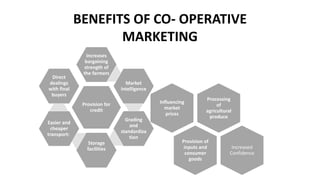
Provision for
credit
Increases
bargaining
strength of
the farmers
Market
intelligence
Grading
and
standardiza
tion
Storage
facilities
Easier and
cheaper
transport:
Direct
dealings
with final
buyers
Processing
of
agricultural
produce
Influencing
market
prices
Provision of
inputs and
consumer
goods
Increased
Confidence
BENEFITS OF CO- OPERATIVE
MARKETING
https://Z.gov.in
BRANDING
• Branding is one of the most important factors influencing an
item’s success or failure in today’s marketplace. A brand is
the combination of name, words, symbols or design that
identifies the product and its company and differentiates it
from competition
• A brand offers instant product recognition and
identification.
• Consumers identify branded products and, as a result of
effective advertising, have confidence in product quality.
• Consumers identify branded products and, as a result of
effective advertising, have confidence in product quality.
BENEFITS OF BRANDING
Differentiation Conveys value
Builds brand loyalty Builds pride
Speaks to the
customers Attract
customers
ORGANIC CERTIFICATION
 India Organic Certification is a label given to organic
products after validation, which ensures that the
product or raw materials used in the product were
grown through organic farming - without any
chemical fertilizers, pesticides, or induced
hormones.
 A trademark - "India Organic" will be granted based
on compliance with the National Standards for
Organic Production (NSOP). Communicating the
genuineness as well as the origin of the product,
this trademark will be owned by the Government of
India.
 The certification is issued by testing centres
accredited by the Agricultural and Processed Food
Products Export Development Authority (APEDA),
under the National Program for Organic
Production of the Government of India. http://apeda.gov.in/apedawebsit
e/organic/Organic_Products.htm
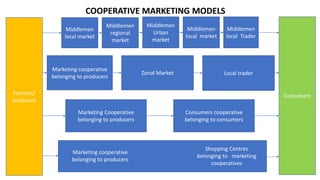
Farmers/
producers
Consumers
Middlemen
local market
Middlemen
regional
market
Middlemen
Urban
market
Middlemen
local market
Middlemen
local Trader
Marketing cooperative
belonging to producers
Zonal Market Local trader
Marketing Cooperative
belonging to producers
Consumers cooperative
belonging to consumers
Marketing cooperative
belonging to producers
Shopping Centres
belonging to marketing
cooperatives
COOPERATIVE MARKETING MODELS
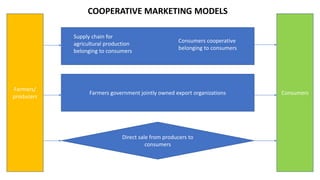
Farmers/
producers
ConsumersFarmers government jointly owned export organizations
Direct sale from producers to
consumers
Supply chain for
agricultural production
belonging to consumers
Consumers cooperative
belonging to consumers
COOPERATIVE MARKETING MODELS

Cooperative marketing training

  • 1.
    Understand the main trends in globaltrade Find new market opportunities Advocate policy changes Formulate export strategy Assess your performance Prepare negotiations Diversify your portfolio Increase your income with the knowledge IMPORTANCE OF MARKET ANALYSIS
  • 2.
    MARKET ANALYSIS Market Research Findingout what products the market demands Finding out how the market works. Market analysis is a sub-section of Agricultural Marketing & Agribusiness, whereby market research activities are undertaken. The channels through which products pass.? Who the important people and companies are? How they do their business and who they currently buy from (sourcing)? Their interest in trading with farmers from your area. Who they sell to? •Product specifications – varieties, colour, size, grade, quality, and packaging, •Prices – price patterns, price variations according to the season, quality and supply, •Supply – volumes, competing suppliers and seasonality. •Preferences of customers and consumers •Opportunities for additional products to be marketed.
  • 3.
    CO- OPERATIVE MARKETING Cooperatives can become important tool of economic development in rural India.  It gives an idea of collective efforts to achieve specific objective to carry out marketing strategy for agricultural products.  The cooperative marketing can be great as the private and open marketing system idea have many defects in them  This It is defined as form of organization, where in person voluntarily associate together as human beings, based on equality for the promotion if economic interests of themselves.
  • 4.
    Provision for credit Increases bargaining strength of thefarmers Market intelligence Grading and standardiza tion Storage facilities Easier and cheaper transport: Direct dealings with final buyers Processing of agricultural produce Influencing market prices Provision of inputs and consumer goods Increased Confidence BENEFITS OF CO- OPERATIVE MARKETING
  • 5.
  • 6.
    BRANDING • Branding isone of the most important factors influencing an item’s success or failure in today’s marketplace. A brand is the combination of name, words, symbols or design that identifies the product and its company and differentiates it from competition • A brand offers instant product recognition and identification. • Consumers identify branded products and, as a result of effective advertising, have confidence in product quality. • Consumers identify branded products and, as a result of effective advertising, have confidence in product quality.
  • 7.
    BENEFITS OF BRANDING DifferentiationConveys value Builds brand loyalty Builds pride Speaks to the customers Attract customers
  • 8.
    ORGANIC CERTIFICATION  IndiaOrganic Certification is a label given to organic products after validation, which ensures that the product or raw materials used in the product were grown through organic farming - without any chemical fertilizers, pesticides, or induced hormones.  A trademark - "India Organic" will be granted based on compliance with the National Standards for Organic Production (NSOP). Communicating the genuineness as well as the origin of the product, this trademark will be owned by the Government of India.  The certification is issued by testing centres accredited by the Agricultural and Processed Food Products Export Development Authority (APEDA), under the National Program for Organic Production of the Government of India. http://apeda.gov.in/apedawebsit e/organic/Organic_Products.htm
  • 9.
    Farmers/ producers Consumers Middlemen local market Middlemen regional market Middlemen Urban market Middlemen local market Middlemen localTrader Marketing cooperative belonging to producers Zonal Market Local trader Marketing Cooperative belonging to producers Consumers cooperative belonging to consumers Marketing cooperative belonging to producers Shopping Centres belonging to marketing cooperatives COOPERATIVE MARKETING MODELS
  • 10.
    Farmers/ producers ConsumersFarmers government jointlyowned export organizations Direct sale from producers to consumers Supply chain for agricultural production belonging to consumers Consumers cooperative belonging to consumers COOPERATIVE MARKETING MODELS