MADE BY SHREYAN DAS
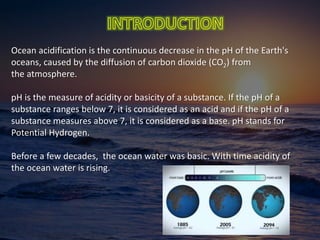
Ocean acidification is the continuous decrease in the pH of the Earth's
oceans, caused by the diffusion of carbon dioxide (CO2) from
the atmosphere.
pH is the measure of acidity or basicity of a substance. If the pH of a
substance ranges below 7, it is considered as an acid and if the pH of a
substance measures above 7, it is considered as a base. pH stands for
Potential Hydrogen.
Before a few decades, the ocean water was basic. With time acidity of
the ocean water is rising.
• The main cause of ocean acidification is the atmospheric
Carbon-dioxide. When the atmospheric carbon-dioxide
dissolves in water it forms Carbonic Acid and finally splits
Bicarbonate ion (HCO3
-) and Hydrogen (H-). This
absorption of carbon in water is called Carbon
Sequestration.
• Moreover deforestation, use of petroleum, et cetera are
other factors contributing indirectly to this acidification
ANTARCTIC OCEAN
PACIFIC OCEAN
ARIABIAN SEA
o Marine animals are unable to survive.
o Destruction of Food Web
o Several ocean goods and services are likely to be damaged by
future ocean acidification.
o Calcification
o Vulnerable Shelled animals
Changes in ocean chemistry can have extensive direct and
indirect effects on organisms and their habitats. One of the most
important impact is increasing ocean acidity relates to the
production of shells and plates out of calcium
carbonate (CaCO3). This process is called calcification.
Calcification involves the conversion of dissolved ions into
solid CaCO3 structures. After they are formed, such structures
are vulnerable to dissolution unless the surrounding seawater
contains saturating concentrations of carbonate ions (CO3
2−).
PRESERVATION
SOME PROGRAMS WORKING FOR THESE ACIDIFICATION ARE:
1. Ocean Acidification Program (OAP) by National Oceanic and
Atmospheric Administration (NOAA)
2. UK Ocean Acidification (UKOA) Programs and Researches
3. Precision Measurement and Equipment Laboratory (PMEL) which is
another sub-division of NOAA.
STEPS TAKEN BY THESE PROGRAMS:
1. Creating Public Awareness
2. Conducting researches that help in maximum expansion of knowledge
and taking appropriate actions for reduction in this ocean acidifications.
3. Drafting plans for future reduction of the same with several other co-
operations.
Till date no steps have been taken as such for the reduction of the
acidification.
We can adopt the following measures for our contribution towards
this acidification:
1. We can reduce our carbon footprint by: switching to energy
efficient products, dropping the temperature of our water heaters
from 60o C to 400 C and by switching of appliances at the plug
point.
2. By planting trees through processes like Reforestation and
aforestation.
3. Reducing our vehicle use which is a major cause for emission of
carbon-dioxide.
4. By using the three R’s of waste management
Ocean Acidification

Ocean Acidification

  • 1.
  • 2.
    Ocean acidification isthe continuous decrease in the pH of the Earth's oceans, caused by the diffusion of carbon dioxide (CO2) from the atmosphere. pH is the measure of acidity or basicity of a substance. If the pH of a substance ranges below 7, it is considered as an acid and if the pH of a substance measures above 7, it is considered as a base. pH stands for Potential Hydrogen. Before a few decades, the ocean water was basic. With time acidity of the ocean water is rising.
  • 3.
    • The maincause of ocean acidification is the atmospheric Carbon-dioxide. When the atmospheric carbon-dioxide dissolves in water it forms Carbonic Acid and finally splits Bicarbonate ion (HCO3 -) and Hydrogen (H-). This absorption of carbon in water is called Carbon Sequestration. • Moreover deforestation, use of petroleum, et cetera are other factors contributing indirectly to this acidification
  • 4.
  • 5.
    o Marine animalsare unable to survive. o Destruction of Food Web o Several ocean goods and services are likely to be damaged by future ocean acidification. o Calcification o Vulnerable Shelled animals
  • 6.
    Changes in oceanchemistry can have extensive direct and indirect effects on organisms and their habitats. One of the most important impact is increasing ocean acidity relates to the production of shells and plates out of calcium carbonate (CaCO3). This process is called calcification. Calcification involves the conversion of dissolved ions into solid CaCO3 structures. After they are formed, such structures are vulnerable to dissolution unless the surrounding seawater contains saturating concentrations of carbonate ions (CO3 2−).
  • 7.
  • 8.
    SOME PROGRAMS WORKINGFOR THESE ACIDIFICATION ARE: 1. Ocean Acidification Program (OAP) by National Oceanic and Atmospheric Administration (NOAA) 2. UK Ocean Acidification (UKOA) Programs and Researches 3. Precision Measurement and Equipment Laboratory (PMEL) which is another sub-division of NOAA. STEPS TAKEN BY THESE PROGRAMS: 1. Creating Public Awareness 2. Conducting researches that help in maximum expansion of knowledge and taking appropriate actions for reduction in this ocean acidifications. 3. Drafting plans for future reduction of the same with several other co- operations. Till date no steps have been taken as such for the reduction of the acidification.
  • 9.
    We can adoptthe following measures for our contribution towards this acidification: 1. We can reduce our carbon footprint by: switching to energy efficient products, dropping the temperature of our water heaters from 60o C to 400 C and by switching of appliances at the plug point. 2. By planting trees through processes like Reforestation and aforestation. 3. Reducing our vehicle use which is a major cause for emission of carbon-dioxide. 4. By using the three R’s of waste management