ORGANIC CERTIFICATION
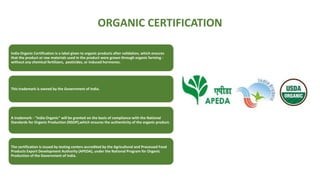
India Organic Certification is a label given to organic products after validation, which ensures
that the product or raw materials used in the product were grown through organic farming -
without any chemical fertilizers, pesticides, or induced hormones.
This trademark is owned by the Government of India.
A trademark - "India Organic" will be granted on the basis of compliance with the National
Standards for Organic Production (NSOP),which ensures the authenticity of the organic product.
The certification is issued by testing centers accredited by the Agricultural and Processed Food
Products Export Development Authority (APEDA), under the National Program for Organic
Production of the Government of India.
CERTIFICATION PROCEDURE
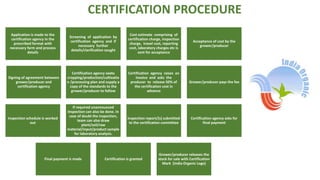
Application is made to the
certification agency in the
prescribed format with
necessary farm and process
details
Screening of application by
certification agency and if
necessary further
details/clarification sought
Cost estimate comprising of
certification charge, inspection
charge, travel cost, reporting
cost, laboratory charges etc is
sent for acceptance
Acceptance of cost by the
grower/producer
Signing of agreement between
grower/producer and
certification agency
Certification agency seeks
cropping/production/cultivatio
n /processing plan and supply a
copy of the standards to the
grower/producer to follow
Certification agency raises an
invoice and asks the
producer to release 50% of
the certification cost in
advance
Grower/producer pays the fee
Inspection schedule is worked
out
If required unannounced
inspection can also be done. In
case of doubt the inspection,
team can also draw
plant/soil/raw
material/input/product sample
for laboratory analysis.
Inspection report/(s) submitted
to the certification committee
Certification agency asks for
final payment
Final payment is made Certification is granted
Grower/producer releases the
stock for sale with Certification
Mark (India Organic Logo)
CONVERSION REQUIREMENTS
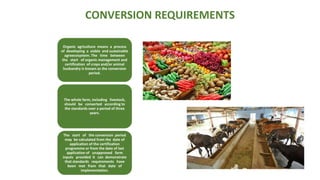
Organic agriculture means a process
of developing a viable and sustainable
agroecosystem. The time between
the start of organic management and
certification of crops and/or animal
husbandry is known as the conversion
period.
The whole farm, including livestock,
should be converted according to
the standards over a period of three
years.
The start of the conversion period
may be calculated from the date of
application of the certification
programme or from the date of last
application of unapproved farm
inputs provided it can demonstrate
that standards requirements have
been met from that date of
implementation.
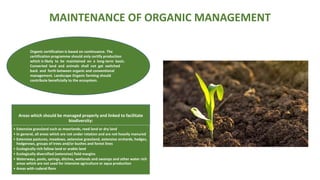
MAINTENANCE OF ORGANIC MANAGEMENT
Areas which should be managed properly and linked to facilitate
biodiversity:
• Extensive grassland such as moorlands, reed land or dry land
• In general, all areas which are not under rotation and are not heavily manured
• Extensive pastures, meadows, extensive grassland, extensive orchards, hedges,
hedgerows, groups of trees and/or bushes and forest lines
• Ecologically rich fallow land or arable land
• Ecologically diversified (extensive) field margins
• Waterways, pools, springs, ditches, wetlands and swamps and other water rich
areas which are not used for intensive agriculture or aqua production
• Areas with ruderal flora
Organic certification is based on continuance. The
certification programme should only certify production
which is likely to be maintained on a long-term basis.
Converted land and animals shall not get switched
back and forth between organic and conventional
management. Landscape Organic farming should
contribute beneficially to the ecosystem.
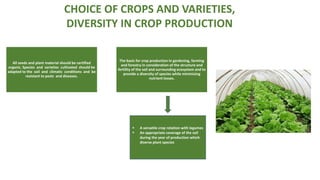
All seeds and plant material should be certified
organic. Species and varieties cultivated should be
adapted to the soil and climatic conditions and be
resistant to pests and diseases.
The basis for crop production in gardening, farming
and forestry in consideration of the structure and
fertility of the soil and surrounding ecosystem and to
provide a diversity of species while minimising
nutrient losses.
 A versatile crop rotation with legumes
 An appropriate coverage of the soil
during the year of production which
diverse plant species
CHOICE OF CROPS AND VARIETIES,
DIVERSITY IN CROP PRODUCTION
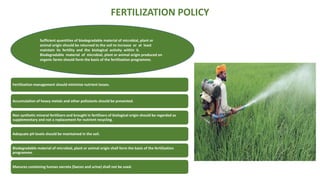
FERTILIZATION POLICY
Fertilization management should minimize nutrient losses.
Accumulation of heavy metals and other pollutants should be prevented.
Non synthetic mineral fertilizers and brought in fertilizers of biological origin should be regarded as
supplementary and not a replacement for nutrient recycling.
Adequate pH levels should be maintained in the soil.
Biodegradable material of microbial, plant or animal origin shall form the basis of the fertilization
programme.
Manures containing human excreta (faeces and urine) shall not be used.
Sufficient quantities of biodegradable material of microbial, plant or
animal origin should be returned to the soil to increase or at least
maintain its fertility and the biological activity within it.
Biodegradable material of microbial, plant or animal origin produced on
organic farms should form the basis of the fertilization programme.
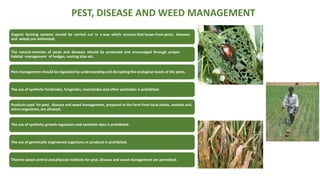
PEST, DISEASE AND WEED MANAGEMENT
Organic farming systems should be carried out in a way which ensures that losses from pests, diseases
and weeds are minimized.
The natural enemies of pests and diseases should be protected and encouraged through proper
habitat management of hedges, nesting sites etc.
Pest management should be regulated by understanding and disrupting the ecological needs of the pests.
The use of synthetic herbicides, fungicides, insecticides and other pesticides is prohibited.
Products used for pest, disease and weed management, prepared at the farm from local plants, animals and
micro-organisms, are allowed.
The use of synthetic growth regulators and synthetic dyes is prohibited.
The use of genetically engineered organisms or products is prohibited.
Thermic weed control and physical methods for pest, disease and weed management are permitted.
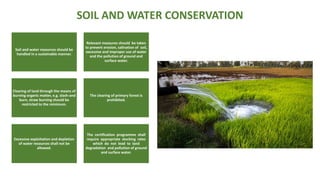
SOIL AND WATER CONSERVATION
Soil and water resources should be
handled in a sustainable manner.
Relevant measures should be taken
to prevent erosion, salination of soil,
excessive and improper use of water
and the pollution of ground and
surface water.
Clearing of land through the means of
burning organic matter, e.g. slash-and
burn, straw burning should be
restricted to the minimum.
The clearing of primary forest is
prohibited.
Excessive exploitation and depletion
of water resources shall not be
allowed.
The certification programme shall
require appropriate stocking rates
which do not lead to land
degradation and pollution of ground
and surface water.
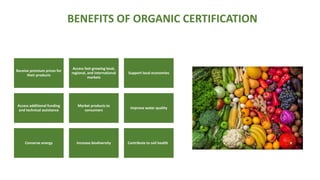
BENEFITS OF ORGANIC CERTIFICATION
Receive premium prices for
their products
Access fast-growing local,
regional, and international
markets
Support local economies
Access additional funding
and technical assistance
Market products to
consumers
Improve water quality
Conserve energy Increase biodiversity Contribute to soil health
THANK YOU !!

Agriculture organic certification

  • 1.
  • 2.
    ORGANIC CERTIFICATION India OrganicCertification is a label given to organic products after validation, which ensures that the product or raw materials used in the product were grown through organic farming - without any chemical fertilizers, pesticides, or induced hormones. This trademark is owned by the Government of India. A trademark - "India Organic" will be granted on the basis of compliance with the National Standards for Organic Production (NSOP),which ensures the authenticity of the organic product. The certification is issued by testing centers accredited by the Agricultural and Processed Food Products Export Development Authority (APEDA), under the National Program for Organic Production of the Government of India.
  • 3.
    CERTIFICATION PROCEDURE Application ismade to the certification agency in the prescribed format with necessary farm and process details Screening of application by certification agency and if necessary further details/clarification sought Cost estimate comprising of certification charge, inspection charge, travel cost, reporting cost, laboratory charges etc is sent for acceptance Acceptance of cost by the grower/producer Signing of agreement between grower/producer and certification agency Certification agency seeks cropping/production/cultivatio n /processing plan and supply a copy of the standards to the grower/producer to follow Certification agency raises an invoice and asks the producer to release 50% of the certification cost in advance Grower/producer pays the fee Inspection schedule is worked out If required unannounced inspection can also be done. In case of doubt the inspection, team can also draw plant/soil/raw material/input/product sample for laboratory analysis. Inspection report/(s) submitted to the certification committee Certification agency asks for final payment Final payment is made Certification is granted Grower/producer releases the stock for sale with Certification Mark (India Organic Logo)
  • 4.
    CONVERSION REQUIREMENTS Organic agriculturemeans a process of developing a viable and sustainable agroecosystem. The time between the start of organic management and certification of crops and/or animal husbandry is known as the conversion period. The whole farm, including livestock, should be converted according to the standards over a period of three years. The start of the conversion period may be calculated from the date of application of the certification programme or from the date of last application of unapproved farm inputs provided it can demonstrate that standards requirements have been met from that date of implementation.
  • 5.
    MAINTENANCE OF ORGANICMANAGEMENT Areas which should be managed properly and linked to facilitate biodiversity: • Extensive grassland such as moorlands, reed land or dry land • In general, all areas which are not under rotation and are not heavily manured • Extensive pastures, meadows, extensive grassland, extensive orchards, hedges, hedgerows, groups of trees and/or bushes and forest lines • Ecologically rich fallow land or arable land • Ecologically diversified (extensive) field margins • Waterways, pools, springs, ditches, wetlands and swamps and other water rich areas which are not used for intensive agriculture or aqua production • Areas with ruderal flora Organic certification is based on continuance. The certification programme should only certify production which is likely to be maintained on a long-term basis. Converted land and animals shall not get switched back and forth between organic and conventional management. Landscape Organic farming should contribute beneficially to the ecosystem.
  • 6.
    All seeds andplant material should be certified organic. Species and varieties cultivated should be adapted to the soil and climatic conditions and be resistant to pests and diseases. The basis for crop production in gardening, farming and forestry in consideration of the structure and fertility of the soil and surrounding ecosystem and to provide a diversity of species while minimising nutrient losses.  A versatile crop rotation with legumes  An appropriate coverage of the soil during the year of production which diverse plant species CHOICE OF CROPS AND VARIETIES, DIVERSITY IN CROP PRODUCTION
  • 7.
    FERTILIZATION POLICY Fertilization managementshould minimize nutrient losses. Accumulation of heavy metals and other pollutants should be prevented. Non synthetic mineral fertilizers and brought in fertilizers of biological origin should be regarded as supplementary and not a replacement for nutrient recycling. Adequate pH levels should be maintained in the soil. Biodegradable material of microbial, plant or animal origin shall form the basis of the fertilization programme. Manures containing human excreta (faeces and urine) shall not be used. Sufficient quantities of biodegradable material of microbial, plant or animal origin should be returned to the soil to increase or at least maintain its fertility and the biological activity within it. Biodegradable material of microbial, plant or animal origin produced on organic farms should form the basis of the fertilization programme.
  • 8.
    PEST, DISEASE ANDWEED MANAGEMENT Organic farming systems should be carried out in a way which ensures that losses from pests, diseases and weeds are minimized. The natural enemies of pests and diseases should be protected and encouraged through proper habitat management of hedges, nesting sites etc. Pest management should be regulated by understanding and disrupting the ecological needs of the pests. The use of synthetic herbicides, fungicides, insecticides and other pesticides is prohibited. Products used for pest, disease and weed management, prepared at the farm from local plants, animals and micro-organisms, are allowed. The use of synthetic growth regulators and synthetic dyes is prohibited. The use of genetically engineered organisms or products is prohibited. Thermic weed control and physical methods for pest, disease and weed management are permitted.
  • 9.
    SOIL AND WATERCONSERVATION Soil and water resources should be handled in a sustainable manner. Relevant measures should be taken to prevent erosion, salination of soil, excessive and improper use of water and the pollution of ground and surface water. Clearing of land through the means of burning organic matter, e.g. slash-and burn, straw burning should be restricted to the minimum. The clearing of primary forest is prohibited. Excessive exploitation and depletion of water resources shall not be allowed. The certification programme shall require appropriate stocking rates which do not lead to land degradation and pollution of ground and surface water.
  • 10.
    BENEFITS OF ORGANICCERTIFICATION Receive premium prices for their products Access fast-growing local, regional, and international markets Support local economies Access additional funding and technical assistance Market products to consumers Improve water quality Conserve energy Increase biodiversity Contribute to soil health
  • 11.