intellectual
disability
• Intellectual Disability (or ID) is a term used when a
person has certain limitations in cognitive
functioning and skills, including communication,
social and self-care skills.
• People with intellectual disabilities can and do
learn new skills, but they learn them more slowly.
• The term "mental retardation" is no longer used,
as it's offensive and has a negative tone
Definition of intellectual disability
“Significantly sub-average general intellectual
functioning, existing concurrently with deficits
in adaptive behavior and manifested during the
developmental period, that adversely affects a
child’s educational performance”
Definition of intellectual disability
Characterized by significant limitations both in
intellectual functioning and adaptive behavior,
which covers many everyday social and practical
skills. The disability originates before the age of
18.
Definition of intellectual disability
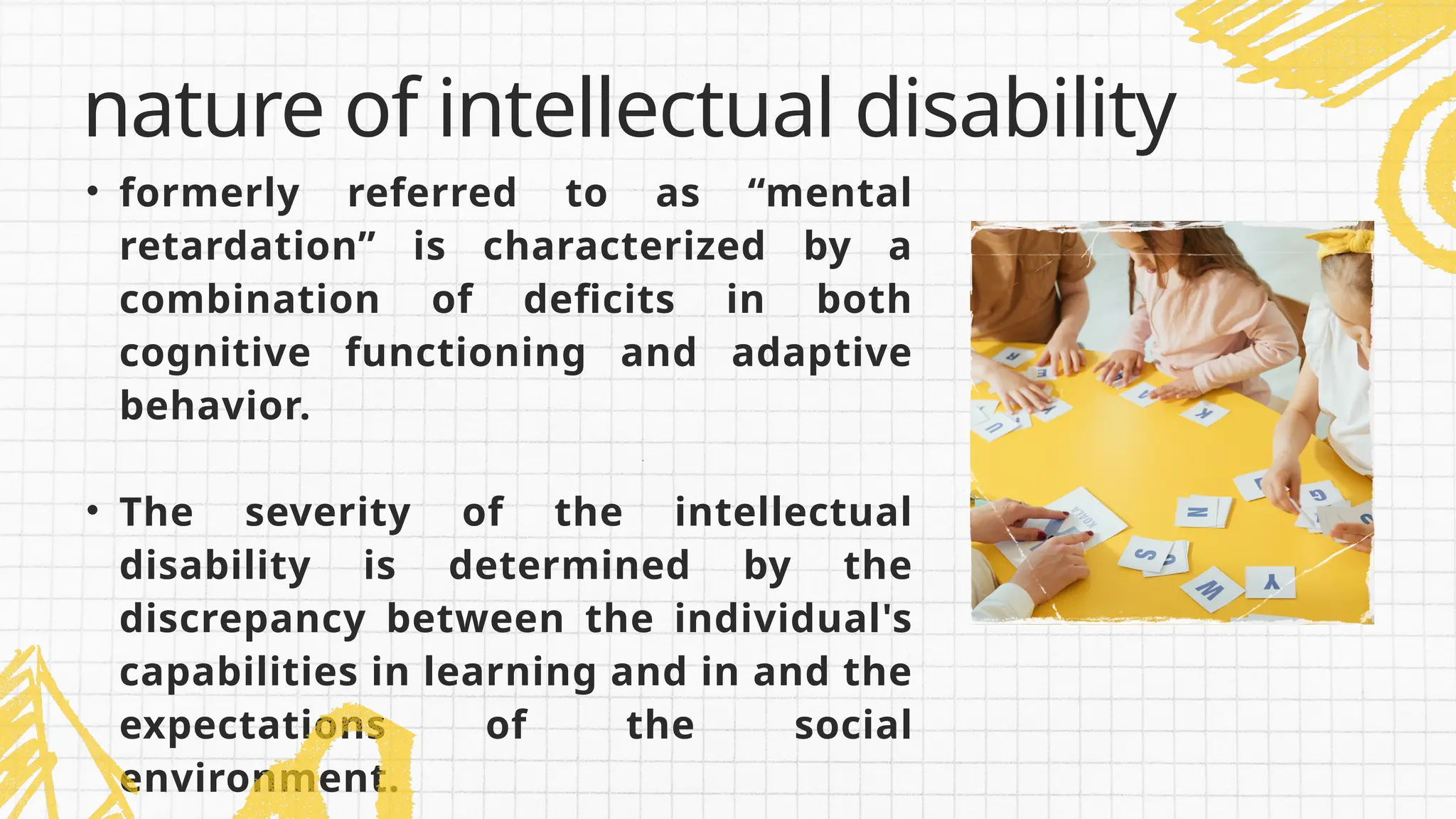
• formerly referred to as “mental
retardation” is characterized by a
combination of deficits in both
cognitive functioning and adaptive
behavior.
• The severity of the intellectual
disability is determined by the
discrepancy between the individual's
capabilities in learning and in and the
expectations of the social
environment.
nature of intellectual disability
• Intellectual disability is a term used
when a person has certain limitations
in mental functioning and skills such
as communicating, taking care of
himself/herself and social skills.
• These limitations cause a child to
learn and develop more slowly than a
typical child.
nature of intellectual disability
1.Failure to meet intellectual milestones.
2. Sitting, crawling, or walking later than other children.
3. Problems learning to talk or trouble speaking clearly.
4. Memory problems and Inability to think logically.
5. Inability to understand the consequences of actions.
6. Childish behavior inconsistent with the child’s age.
7. Lack of curiosity.
8. Learning difficulties as IQ below 70.
9. Inability to lead a fully independent life due to
challenges communicating, taking care of.
symptoms of intellectual disability
1. Aggression and dependency.
2. Withdrawal from social activities.
3. Attention-seeking behavior.
4. Depression during adolescent and teen years.
5. Lack of impulse control and passivity.
6. Tendency toward self-injury.
7. Stubbornness and low self-esteem.
8. Low tolerance for frustration.
9. Psychotic disorders and difficulty paying attention.
10. Some people with ID may also have specific physical
characteristics. These can include having a short stature or
facial abnormalities.
behavioral issues
• Intellectual disability is the most common developmental
disability.
• Approximately 6.5 million people in the United States
have an intellectual disability. (IDEA)
• In the Philippines, intellectual disability comprises 7.02%
of the total population of persons with disabilities. (2000
National Statistics Office Census)
prevalence of intellectual
disability
• Intellectual disability formerly known as mental retardation
can be caused by injury, disease, or a problem in the brain.
For many children, the cause of their intellectual disability is
unknown.
• Some causes of intellectual disability such as Down
syndrome, Fetal Alcohol Syndrome, Fragile X syndrome, birth
defects, and infections can happen before birth. Some
happen while a baby is being born or soon after birth.
• Other causes of intellectual disability do not occur until a
child is older; these might include severe head injury,
infections or
causes of intellectual
disability
Etiology and Classifications of Intellectual
Disability
1.Chromosomal
disorders
2.inborn errors of
metabolism
3.developmental
disorder of brain
formation
4.environmental
influences
1.anoxia
2.low birth weight
(LBW)
3.syphilis and herpes
simplex
1.biological
2.psychological
3.child abuse and
neglect
prenatal causes perinatal causes postnatal causes
1. Behavior therapy.
2. Occupational therapy.
3. Counseling.
4. Medication, in some cases.
treatment of intellectual disability
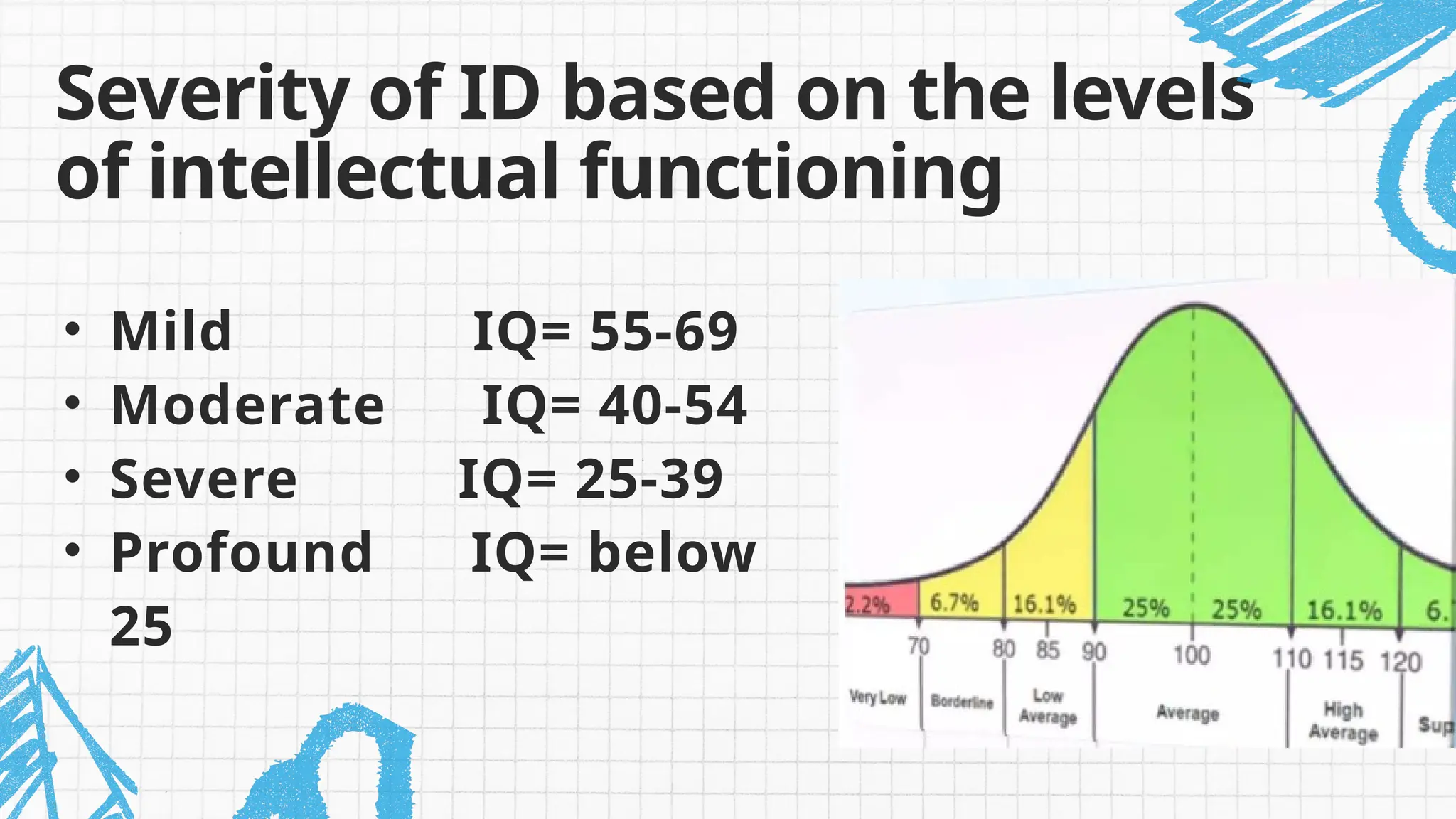
Severity of ID based on the levels
of intellectual functioning
• Mild IQ= 55-69
• Moderate IQ= 40-54
• Severe IQ= 25-39
• Profound IQ= below
25
• Other Intellectual Disability People in this category are
often physically impaired, have hearing loss, are
nonverbal, or have a physical disability. These factors
may prevent your child’s doctor from conducting
screening tests.
• Unspecified Intellectual Disability If your child has an
unspecified ID, they will show symptoms of ID, but their
doctor doesn’t have enough information to determine
their level of disability.
levels of intellectual disability
Someone with intellectual disability has limitations in two
areas. These areas are:
1. Intellectual functioning. Also known as IQ, this refers to a
person’s ability to learn, reason, make decisions, and solve
problems.
2. Adaptive behaviors. These are skills necessary for day-to-
day life, such as being able to communicate effectively,
interact with others, and take care of oneself.
limitations of intellectual disabilities
• Students learn at a slower rate than peers;
• They require more repetition;
• They need additional time;
• They think in concrete terms;
• They require “hands-on” learning;
• They have impaired social interaction skills;
• Students have impaired language skills (receptive and
expressive);
• They require assignments or projects to be task analyzed
or broken into small steps.
• Students need direct instruction; they don’t pick things up
through observation as peers do.
Classroom implications
Thank
you very
much

intellectual disability.................

  • 1.
  • 2.
    • Intellectual Disability(or ID) is a term used when a person has certain limitations in cognitive functioning and skills, including communication, social and self-care skills. • People with intellectual disabilities can and do learn new skills, but they learn them more slowly. • The term "mental retardation" is no longer used, as it's offensive and has a negative tone Definition of intellectual disability
  • 3.
    “Significantly sub-average generalintellectual functioning, existing concurrently with deficits in adaptive behavior and manifested during the developmental period, that adversely affects a child’s educational performance” Definition of intellectual disability
  • 4.
    Characterized by significantlimitations both in intellectual functioning and adaptive behavior, which covers many everyday social and practical skills. The disability originates before the age of 18. Definition of intellectual disability
  • 5.
    • formerly referredto as “mental retardation” is characterized by a combination of deficits in both cognitive functioning and adaptive behavior. • The severity of the intellectual disability is determined by the discrepancy between the individual's capabilities in learning and in and the expectations of the social environment. nature of intellectual disability
  • 6.
    • Intellectual disabilityis a term used when a person has certain limitations in mental functioning and skills such as communicating, taking care of himself/herself and social skills. • These limitations cause a child to learn and develop more slowly than a typical child. nature of intellectual disability
  • 7.
    1.Failure to meetintellectual milestones. 2. Sitting, crawling, or walking later than other children. 3. Problems learning to talk or trouble speaking clearly. 4. Memory problems and Inability to think logically. 5. Inability to understand the consequences of actions. 6. Childish behavior inconsistent with the child’s age. 7. Lack of curiosity. 8. Learning difficulties as IQ below 70. 9. Inability to lead a fully independent life due to challenges communicating, taking care of. symptoms of intellectual disability
  • 8.
    1. Aggression anddependency. 2. Withdrawal from social activities. 3. Attention-seeking behavior. 4. Depression during adolescent and teen years. 5. Lack of impulse control and passivity. 6. Tendency toward self-injury. 7. Stubbornness and low self-esteem. 8. Low tolerance for frustration. 9. Psychotic disorders and difficulty paying attention. 10. Some people with ID may also have specific physical characteristics. These can include having a short stature or facial abnormalities. behavioral issues
  • 9.
    • Intellectual disabilityis the most common developmental disability. • Approximately 6.5 million people in the United States have an intellectual disability. (IDEA) • In the Philippines, intellectual disability comprises 7.02% of the total population of persons with disabilities. (2000 National Statistics Office Census) prevalence of intellectual disability
  • 10.
    • Intellectual disabilityformerly known as mental retardation can be caused by injury, disease, or a problem in the brain. For many children, the cause of their intellectual disability is unknown. • Some causes of intellectual disability such as Down syndrome, Fetal Alcohol Syndrome, Fragile X syndrome, birth defects, and infections can happen before birth. Some happen while a baby is being born or soon after birth. • Other causes of intellectual disability do not occur until a child is older; these might include severe head injury, infections or causes of intellectual disability
  • 11.
    Etiology and Classificationsof Intellectual Disability 1.Chromosomal disorders 2.inborn errors of metabolism 3.developmental disorder of brain formation 4.environmental influences 1.anoxia 2.low birth weight (LBW) 3.syphilis and herpes simplex 1.biological 2.psychological 3.child abuse and neglect prenatal causes perinatal causes postnatal causes
  • 12.
    1. Behavior therapy. 2.Occupational therapy. 3. Counseling. 4. Medication, in some cases. treatment of intellectual disability
  • 13.
    Severity of IDbased on the levels of intellectual functioning • Mild IQ= 55-69 • Moderate IQ= 40-54 • Severe IQ= 25-39 • Profound IQ= below 25
  • 14.
    • Other IntellectualDisability People in this category are often physically impaired, have hearing loss, are nonverbal, or have a physical disability. These factors may prevent your child’s doctor from conducting screening tests. • Unspecified Intellectual Disability If your child has an unspecified ID, they will show symptoms of ID, but their doctor doesn’t have enough information to determine their level of disability. levels of intellectual disability
  • 15.
    Someone with intellectualdisability has limitations in two areas. These areas are: 1. Intellectual functioning. Also known as IQ, this refers to a person’s ability to learn, reason, make decisions, and solve problems. 2. Adaptive behaviors. These are skills necessary for day-to- day life, such as being able to communicate effectively, interact with others, and take care of oneself. limitations of intellectual disabilities
  • 16.
    • Students learnat a slower rate than peers; • They require more repetition; • They need additional time; • They think in concrete terms; • They require “hands-on” learning; • They have impaired social interaction skills; • Students have impaired language skills (receptive and expressive); • They require assignments or projects to be task analyzed or broken into small steps. • Students need direct instruction; they don’t pick things up through observation as peers do. Classroom implications
  • 17.

Editor's Notes