LEARNING DISABILITY
OCCUPATIONAL THERAPY
MANAGEMENT
Ms Kaaynat Khan
Occupational Therapist
Learning Disability
• Neurodevelopmental disorder of biological origin
• learning difficulty and problems in acquiring academic skills markedly
below age level and manifested in the early school years
• Lasting for at least 6 months
• Not attributed to intellectual disabilities, developmental disorders, or
neurological or motor disorders.
• specified as having impairment in reading, written expression and,
mathematics.
• Mild, moderate, severe
Evaluation
• The occupational therapy evaluation is an important component of the
multidisciplinary assessment process.
• Purpose is to identify the areas of strengths and weaknesses of an individual.
General evaluation
• History
• Open ended interview
• Naturalistic observation
Standardized test
• Sensory Profile
• Berry Buktenica Developmental
Test
• Evaluation Tool Of Children's
Handwriting
• Dynamic Occupational Therapy
Cognitive assessment for
children
• Behaviour Rating Inventory Of
Executive Functions
Child Sensory Profile 2
Caregiver questionnaire for children
ages 3–14 years.
Evaluate a child's sensory processing
patterns in the context of home, school,
and community-based activities
5–20 minutes
Berry Buktenica Developmental Test
Ages: 2 through 100 years
3 tests:
• Visual-Motor Integration
• Visual Perception
• Motor Coordination
15 minutes
Evaluation Tool Of Children’s Handwriting
(ETCH)
Ages: Grades 1 to 6
Assesses Manuscript and cursive
handwriting skills for
• Legibility components
• Pencil grasp
• Hand preference
• Pencil pressure
• Manipulative skills with the writing
tool Classroom observations
15-25 minutes
Dynamic Occupational Therapy Cognitive
Assessment For Children
Ages: 6 to 12 years
22 subtests in 5 areas of cognition:
• Orientation
• Spatial Perception
• Praxis
• Visuo-motor Construction
• Thinking Operations
1-1/2 hours
Behaviour Rating Inventory Of Executive
Function
Age: 5 years to 18 years
Eight clinical scales
• Inhibit
• Shift
• emotional control
• Initiate
• working memory
• plan/organize
• organization of materials
• monitor
10-15 minutes
INTERVENTION
Occupational Areas
ADL Learning Work
Play and Leisure Social Participation
Occupational Components
Sensory
Integration
Cognition
Executive
functions
Prewriting
skills
Adaptation of
environment
Adaptation of
task
Assistive
devices and
technology
Intervention
for
accompanying
deficits
Sensory Integration
Sensory processing activities
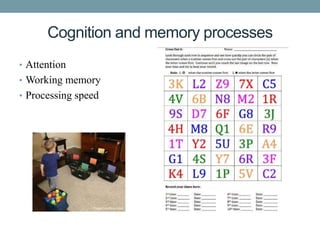
Cognition and memory processes
• Attention
• Working memory
• Processing speed
Visual Perception
Executive functions
• Organisation
• Self management in time and
space
• Planning
Prewriting Skills
COMPENSATORY TECHNIQUES
Adaptation of task
• Reducing length of written tasks to suit a student’s endurance
• Adapting time required for learning/working based on attention
span
• Adapting the instruction for an activity and adapting rules of a
game
Adaptation of environment
• Ergonomic design for sitting
• Height
• Type of pen
• Placement of students seat
Assistive devices and technology
• Adapted keyboard
• Electronic Calendar
• Time tables
• Slanted writing board
• Pencil grips
• Talking calculator
• Pen reader
Intervention for accompanying deficits
Attention deficit hyperactive disorder
• Attention
• Level of arousal
• Modulating responses
• Adapted computer programs
• Weighted vest
Development coordination disorder
• Motor and perceptual skills
• Postural control
• Coordination
• Movement planning and execution of movements in time and
space
Sensory modulation and processing
disorders
• Sensory integration
• Brain gym
References
• https://disabilitycreditcanada.com/14-assistive-technologies-
individuals-learning-disability/
Learning disability

Learning disability