Occupational
Health Services
Dr. Ajayi po
Department of Community Medicine
EKSUTH ADO EKITI
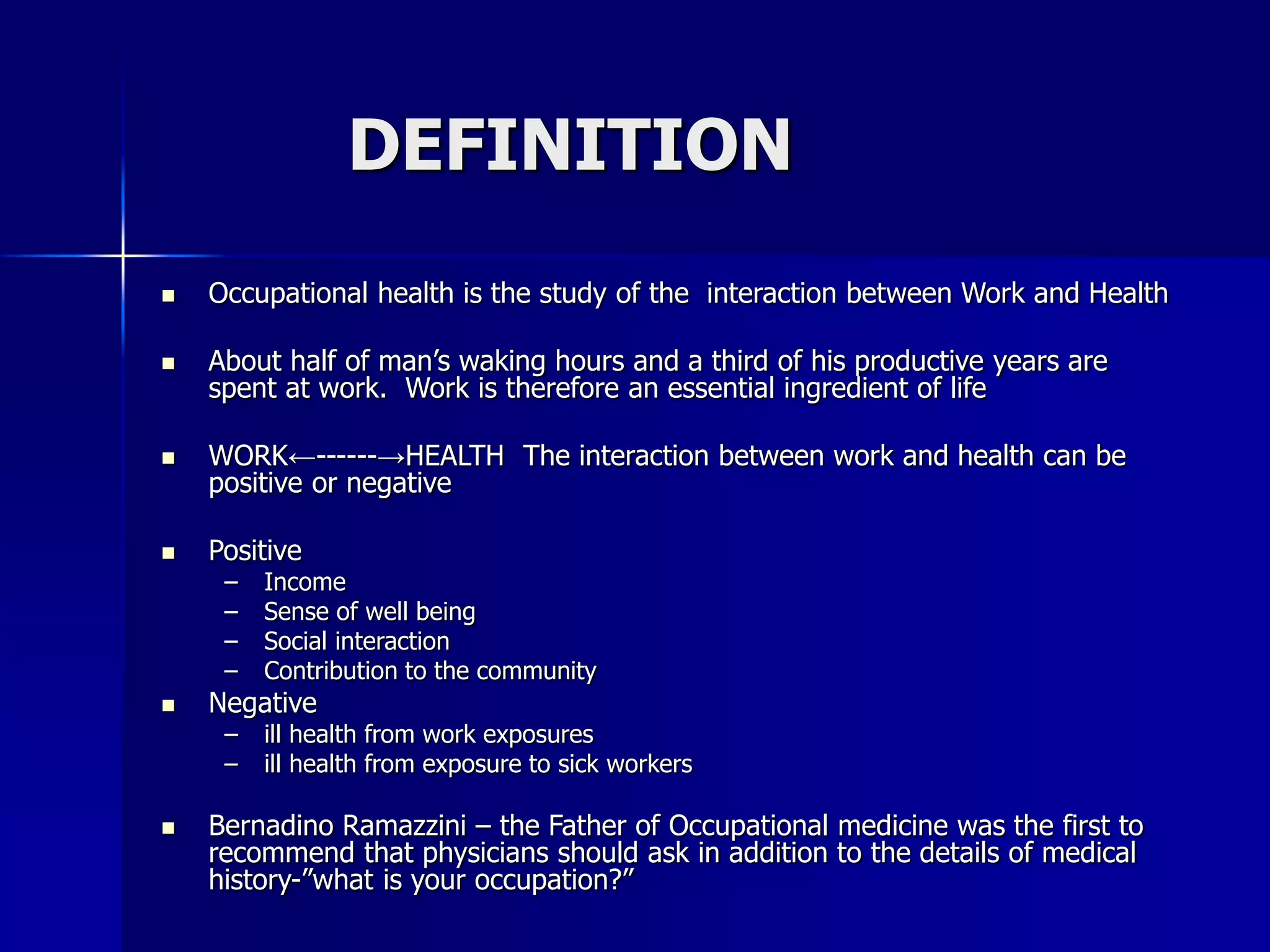
DEFINITION
 Occupational health is the study of the interaction between Work and Health
 About half of man’s waking hours and a third of his productive years are
spent at work. Work is therefore an essential ingredient of life
 WORK←------→HEALTH The interaction between work and health can be
positive or negative
 Positive
– Income
– Sense of well being
– Social interaction
– Contribution to the community
 Negative
– ill health from work exposures
– ill health from exposure to sick workers
 Bernadino Ramazzini – the Father of Occupational medicine was the first to
recommend that physicians should ask in addition to the details of medical
history-”what is your occupation?”
The ILO in 1950 defined the goals
of occupational health as follows:
 The promotion and maintenance of the highest
degree of physical, mental and social well being of
workers in all occupation.
 The prevention among workers of departures from
health caused by their working conditions.
 The protection of workers in their employment from
risks resulting from factors adverse to health.
 The placement and maintenance of workers in an
occupational environment adapted to his
physiological and psychological equipment and to
summarize- the adaptation of work to man and
each man to his job.
INTERACTION B/T WORK
AND HEALTH
 WORK ENVIROMENT
 WORKER’S CHARACTERISTICS
(HOST FACTORS)
WORK ENVIROMENT
 PHYSICAL – Sound, Temperature,
Light, Pressure, Vibration,
 CHEMICAL – Lead, Solvents, Pesticides
 BIOLOGICAL – Viruses, Bacteria,
Plants, Animal products
 MECHANICAL – Work tools
 PSYCHOSOCIAL – Interaction with
other workers, work conditions, work
organization
WORKERS’
CHARACTERISTICS
(HOST FACTORS)
 AGE
 PERSONAL HYGIENE
 IMMUNITY
 SOCIAL HABITS
 PRE-EXISTENT DISEASE
SCOPE OF DISEASES SEEN
IN OH PRACTICE
 WORK RELATED- factors at work contribute to its
occurrence
 WORK AGGRAVATED- factors at work aggravate it
 OCCUPATIONAL DISEASES- direct causal
relationship between disease and specific
occupational hazards
 DISEASES THAT AFFECT WORK OUTPUT- these are
general diseases which affect members of the
community
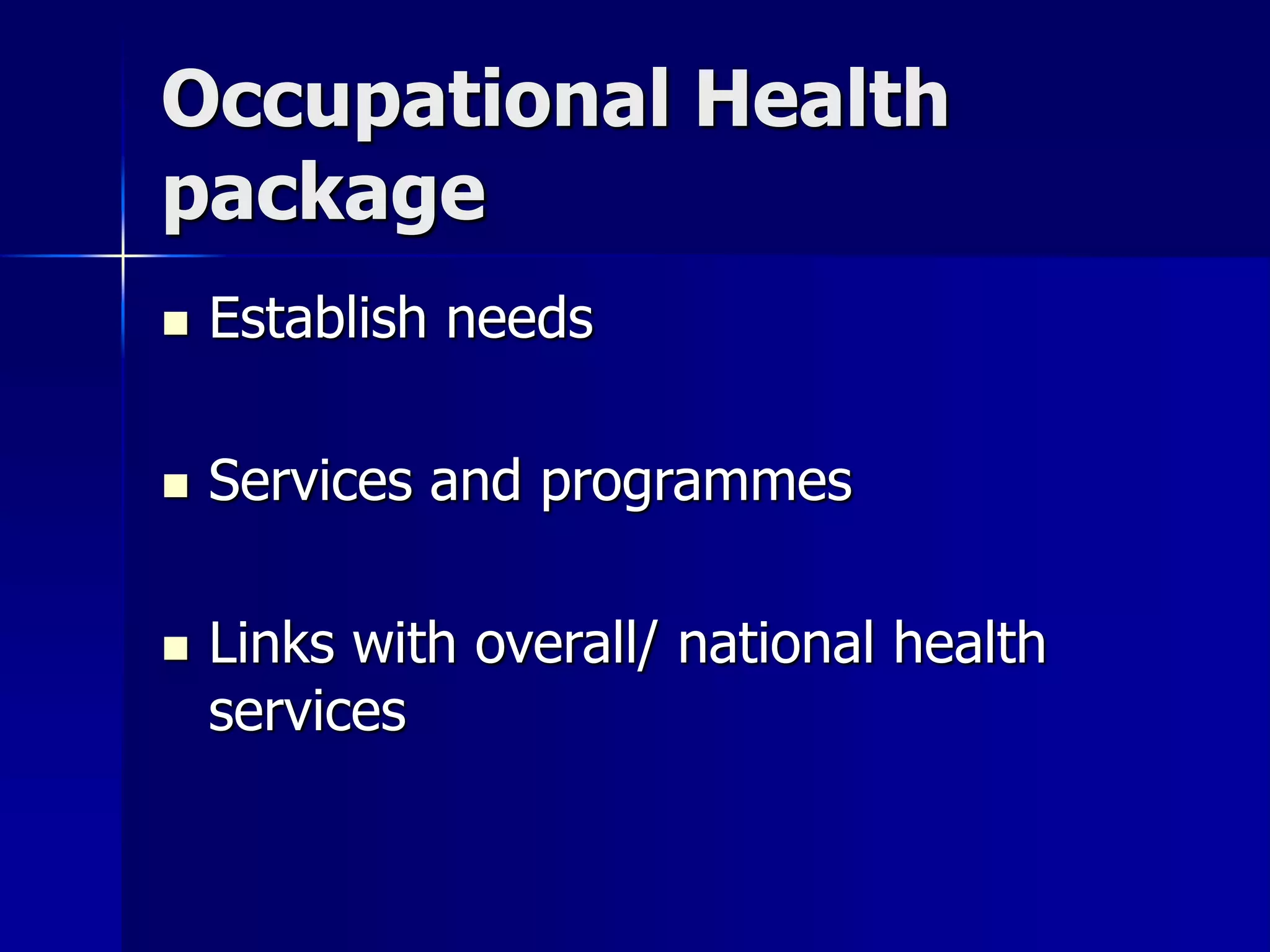
Occupational Health
package
 Establish needs
 Services and programmes
 Links with overall/ national health
services
Establish needs
 Type of industry-Service or manufacturing
 Raw materials
 Intermediate products
 End products
 Size of workforce
 Small scale(less than 50), medium (50-
500)and large scale(above 500)
 Small groups with similar exposures
 Include administrative staff
Needs…
 Walk through survey
 Work in progress
 Hazard assessment
 Emissions
 Assess needs for protective equipment
Needs.. PRINCIPAL DISCIPLINES IN OH & S &
THEIR WORK(multisectoral/multidisplinary)
 Staffing; OH physician
 OH nurse
 Occ Hygienist
 Safety engineer/Ergonomists
 Toxicologist
 Ind. Psychologist
 Physiotherapist
Definition of OHS
 Occupational health services is defined as
services entrusted with essentially
preventive functions and responsible for
advising the employer, the workers and their
representatives in the undertaking on the
requirements for establishing and
maintaining a safe and healthy working
environment which will facilitate optimal
physical and mental health in relation to
work and the adaptation of work to the
capabilities of workers in the light of their
state of physical and mental health.
Types of OHS
 Area type OHS
 Estate type OHS
FUNCTION OF OHS
FUNCTIONS OF AN OH SERVICE
1. Pre-employment medical examination
– general & specific (pre-placement)
2. Periodic medical examination
3. Other medical examinations & audits
4. Provision primary medical care + first aid
5. Environmental monitoring & safety
6. Social and welfare services provision
7. Control of workplace effluents
8. Maintenance of medical records
9. Industrial health education
10. Factory health development (health
services
provision, planning & re-planning)
11. Rehabilitation services – physical,
occupational & economic/social.
Services
 Pre-placement Medical Examination
 OH questionnaire
 Physical exam
 Baseline parameters as indicated by work
exposures
Services
 Return to duty medical examination
 Periodic Medical Examination
 General examination and screening for non
occupational disease
 Screening for occupational disease
Service
 Treatment – basic /comprehensive care for
workers and family
 Curative
 General, non-occupational diseases
 Occupational diseases
 First aid
 Rehabilitative
 Functional
 Psychological
Services
 Counseling
 Identification of symptoms of stress in the
individual and in workforce
 Management of stress at work
 Management of social problems at
work/home e.g alcoholism, smoking.
Services
 Record keeping
 Details of employment
 Details of exposures and airborne
concentrations
 Sickness absence: number, duration,
diagnosis
Services
 Sickness Absence
 Record of illness
 Number of spells of sickness absence
 Duration of spells
 Diagnosis and summary of treatment received
 Response to treatment
Services
 Health Promotion
 Adequate rest/ relaxation periods
 Facilities for recreation, tennis, badminton
 Facilities for fitness- gymnasium
 Nutritional advice – weight control
 Provision of subsidized meals
 Smoking cessation programmes
 Family planning
Services
 Identification and evaluation of hazards
 Identification –
 walk through survey
 clinical records
 observational studies
 Evaluation
 Environmental monitoring: monitoring of work
environment to quantify the amount of pollutant in the
environment
Personal monitoring: measurement of amount of
pollutant that comes in contact with individual worker
e.g noise, dose meter film badge,
 Biological monitoring: assessment of exposures using
biological samples for workers e.g blood, urine.
Services
 Control of hazards
Modification of Equipment
Elimination/ substitution
Enclosure e.g guarding
Repair and maintenance
Services
 Control of hazards
 Modification of work environment
– ventilation, dust suppression, good house-
keeping
– Others – provision of safety shower, fire
extinguisher
Services
 Control of hazards
Modification of Personnel
Personal protection
personal protective equipment
personal hygiene
Immunization
safe work practice
Services
 Health Education
 Importance of safe work practices
 Use of protective equipment
 First aid measures
Services
 Administrative
 Selection, supervision and training of workers
 Promotion of good organization, job content,
work environment
 Management meetings
Services
 Surveillance of Catering and other Welfare
Facilities
 Screening of food vendors for TB, GI parasites
 Separate premises for eating. Inspection of premises.
Food inspection
 Toilet facilities, water supply
 Accommodation for clothing not used at work
 Transportation facilities
 Accommodation.
 Recreation
 Child care
Services
 Accident Prevention Programme
 Safety committee comprising of safety
representatives, nurse, physicians, safety
engineers, hygienists and members of staff
 Committee should issue recommendations/
code of practice in the event of an accident
 Committee should be involved in accident
investigation. First aid kit must be provided
ideally one per unit.
 First aiders must be trained and be able to
respond to emergencies
Services
 Disaster management
 Evacuation procedures
first aid measures
other aids priorities. Persons/ institutions to
contact e.g phone number for hospital
ambulance services, fire station e.t.c
referral centers – nearest secondary or tertiary
health centre. Early referral.
Rehearsal of above e.g fire drills, location of fire exits,
assembly points e.t.c
Services
 Control of environment outside
workplace
 Chemical-
 Physical
 Biological
 Treatment of effluents
Linkages
 National Health Services
 Workplace- PHC centre
 Referral to secondary and tertiary
institutions
 National data bank
 Factory inspectorate and MOH
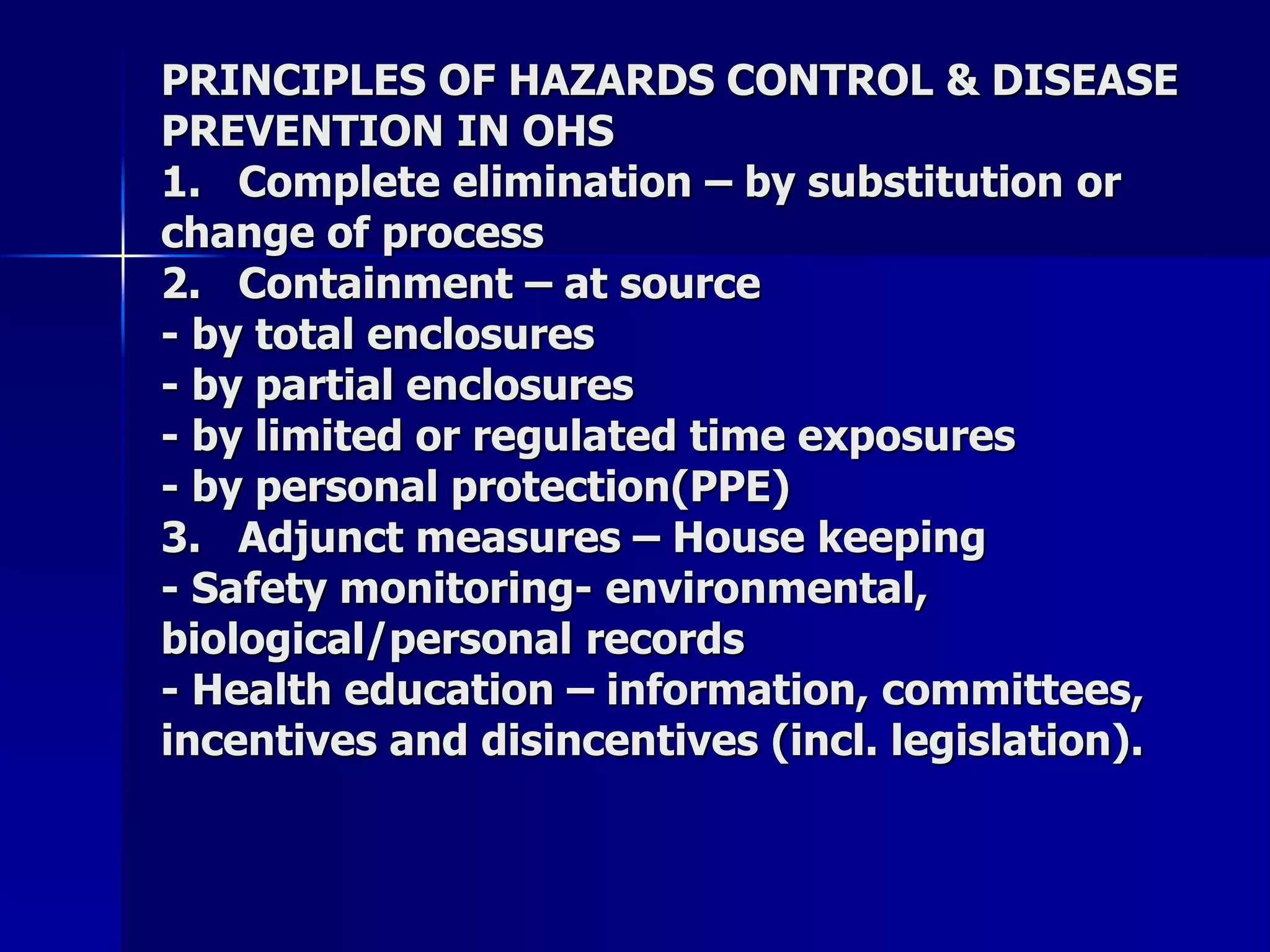
PRINCIPLES OF HAZARDS CONTROL & DISEASE
PREVENTION IN OHS
1. Complete elimination – by substitution or
change of process
2. Containment – at source
- by total enclosures
- by partial enclosures
- by limited or regulated time exposures
- by personal protection(PPE)
3. Adjunct measures – House keeping
- Safety monitoring- environmental,
biological/personal records
- Health education – information, committees,
incentives and disincentives (incl. legislation).

Occupational Health SERVICES.ppt

  • 1.
    Occupational Health Services Dr. Ajayipo Department of Community Medicine EKSUTH ADO EKITI
  • 2.
    DEFINITION  Occupational healthis the study of the interaction between Work and Health  About half of man’s waking hours and a third of his productive years are spent at work. Work is therefore an essential ingredient of life  WORK←------→HEALTH The interaction between work and health can be positive or negative  Positive – Income – Sense of well being – Social interaction – Contribution to the community  Negative – ill health from work exposures – ill health from exposure to sick workers  Bernadino Ramazzini – the Father of Occupational medicine was the first to recommend that physicians should ask in addition to the details of medical history-”what is your occupation?”
  • 3.
    The ILO in1950 defined the goals of occupational health as follows:  The promotion and maintenance of the highest degree of physical, mental and social well being of workers in all occupation.  The prevention among workers of departures from health caused by their working conditions.  The protection of workers in their employment from risks resulting from factors adverse to health.  The placement and maintenance of workers in an occupational environment adapted to his physiological and psychological equipment and to summarize- the adaptation of work to man and each man to his job.
  • 4.
    INTERACTION B/T WORK ANDHEALTH  WORK ENVIROMENT  WORKER’S CHARACTERISTICS (HOST FACTORS)
  • 5.
    WORK ENVIROMENT  PHYSICAL– Sound, Temperature, Light, Pressure, Vibration,  CHEMICAL – Lead, Solvents, Pesticides  BIOLOGICAL – Viruses, Bacteria, Plants, Animal products  MECHANICAL – Work tools  PSYCHOSOCIAL – Interaction with other workers, work conditions, work organization
  • 6.
    WORKERS’ CHARACTERISTICS (HOST FACTORS)  AGE PERSONAL HYGIENE  IMMUNITY  SOCIAL HABITS  PRE-EXISTENT DISEASE
  • 7.
    SCOPE OF DISEASESSEEN IN OH PRACTICE  WORK RELATED- factors at work contribute to its occurrence  WORK AGGRAVATED- factors at work aggravate it  OCCUPATIONAL DISEASES- direct causal relationship between disease and specific occupational hazards  DISEASES THAT AFFECT WORK OUTPUT- these are general diseases which affect members of the community
  • 8.
    Occupational Health package  Establishneeds  Services and programmes  Links with overall/ national health services
  • 9.
    Establish needs  Typeof industry-Service or manufacturing  Raw materials  Intermediate products  End products  Size of workforce  Small scale(less than 50), medium (50- 500)and large scale(above 500)  Small groups with similar exposures  Include administrative staff
  • 10.
    Needs…  Walk throughsurvey  Work in progress  Hazard assessment  Emissions  Assess needs for protective equipment
  • 11.
    Needs.. PRINCIPAL DISCIPLINESIN OH & S & THEIR WORK(multisectoral/multidisplinary)  Staffing; OH physician  OH nurse  Occ Hygienist  Safety engineer/Ergonomists  Toxicologist  Ind. Psychologist  Physiotherapist
  • 12.
    Definition of OHS Occupational health services is defined as services entrusted with essentially preventive functions and responsible for advising the employer, the workers and their representatives in the undertaking on the requirements for establishing and maintaining a safe and healthy working environment which will facilitate optimal physical and mental health in relation to work and the adaptation of work to the capabilities of workers in the light of their state of physical and mental health.
  • 13.
    Types of OHS Area type OHS  Estate type OHS
  • 14.
  • 15.
    FUNCTIONS OF ANOH SERVICE 1. Pre-employment medical examination – general & specific (pre-placement) 2. Periodic medical examination 3. Other medical examinations & audits 4. Provision primary medical care + first aid 5. Environmental monitoring & safety 6. Social and welfare services provision 7. Control of workplace effluents 8. Maintenance of medical records 9. Industrial health education 10. Factory health development (health services provision, planning & re-planning) 11. Rehabilitation services – physical, occupational & economic/social.
  • 16.
    Services  Pre-placement MedicalExamination  OH questionnaire  Physical exam  Baseline parameters as indicated by work exposures
  • 17.
    Services  Return toduty medical examination  Periodic Medical Examination  General examination and screening for non occupational disease  Screening for occupational disease
  • 18.
    Service  Treatment –basic /comprehensive care for workers and family  Curative  General, non-occupational diseases  Occupational diseases  First aid  Rehabilitative  Functional  Psychological
  • 19.
    Services  Counseling  Identificationof symptoms of stress in the individual and in workforce  Management of stress at work  Management of social problems at work/home e.g alcoholism, smoking.
  • 20.
    Services  Record keeping Details of employment  Details of exposures and airborne concentrations  Sickness absence: number, duration, diagnosis
  • 21.
    Services  Sickness Absence Record of illness  Number of spells of sickness absence  Duration of spells  Diagnosis and summary of treatment received  Response to treatment
  • 22.
    Services  Health Promotion Adequate rest/ relaxation periods  Facilities for recreation, tennis, badminton  Facilities for fitness- gymnasium  Nutritional advice – weight control  Provision of subsidized meals  Smoking cessation programmes  Family planning
  • 23.
    Services  Identification andevaluation of hazards  Identification –  walk through survey  clinical records  observational studies  Evaluation  Environmental monitoring: monitoring of work environment to quantify the amount of pollutant in the environment Personal monitoring: measurement of amount of pollutant that comes in contact with individual worker e.g noise, dose meter film badge,  Biological monitoring: assessment of exposures using biological samples for workers e.g blood, urine.
  • 24.
    Services  Control ofhazards Modification of Equipment Elimination/ substitution Enclosure e.g guarding Repair and maintenance
  • 25.
    Services  Control ofhazards  Modification of work environment – ventilation, dust suppression, good house- keeping – Others – provision of safety shower, fire extinguisher
  • 26.
    Services  Control ofhazards Modification of Personnel Personal protection personal protective equipment personal hygiene Immunization safe work practice
  • 27.
    Services  Health Education Importance of safe work practices  Use of protective equipment  First aid measures
  • 28.
    Services  Administrative  Selection,supervision and training of workers  Promotion of good organization, job content, work environment  Management meetings
  • 29.
    Services  Surveillance ofCatering and other Welfare Facilities  Screening of food vendors for TB, GI parasites  Separate premises for eating. Inspection of premises. Food inspection  Toilet facilities, water supply  Accommodation for clothing not used at work  Transportation facilities  Accommodation.  Recreation  Child care
  • 30.
    Services  Accident PreventionProgramme  Safety committee comprising of safety representatives, nurse, physicians, safety engineers, hygienists and members of staff  Committee should issue recommendations/ code of practice in the event of an accident  Committee should be involved in accident investigation. First aid kit must be provided ideally one per unit.  First aiders must be trained and be able to respond to emergencies
  • 31.
    Services  Disaster management Evacuation procedures first aid measures other aids priorities. Persons/ institutions to contact e.g phone number for hospital ambulance services, fire station e.t.c referral centers – nearest secondary or tertiary health centre. Early referral. Rehearsal of above e.g fire drills, location of fire exits, assembly points e.t.c
  • 32.
    Services  Control ofenvironment outside workplace  Chemical-  Physical  Biological  Treatment of effluents
  • 33.
    Linkages  National HealthServices  Workplace- PHC centre  Referral to secondary and tertiary institutions  National data bank  Factory inspectorate and MOH
  • 34.
    PRINCIPLES OF HAZARDSCONTROL & DISEASE PREVENTION IN OHS 1. Complete elimination – by substitution or change of process 2. Containment – at source - by total enclosures - by partial enclosures - by limited or regulated time exposures - by personal protection(PPE) 3. Adjunct measures – House keeping - Safety monitoring- environmental, biological/personal records - Health education – information, committees, incentives and disincentives (incl. legislation).