Management
of Occupational
Exposures to
HBV, HCV, & HIV
Annual Report 2012
Sharp Injuries and Body Fluid Exposure:-
Number Percentage
Physicians 27 36%
Nursing Staff 35 46.7%
Technicians 5 6.6%
HK Staff 8 10.7%
TOTAL 75 ***
H B V
Hapedna Virus double stranded DNA
Risk for Occupational
Transmission of HBV
►HBsAg& HBeAg-positive blood :
 The risk of developing clinical hepatitis is
22%– 31%;
 The risk of developing serologic evidence of
HBV infection is 37%–62%.
►HBsAg-positive, HBeAg-negative blood
 The risk of developing clinical hepatitis is
1%–6%;
 The risk of developing serologic evidence of
HBV infection is 23%–37%
Control of HBV transmission
- All HCW should receive Hepatitis B vaccine
series at 0,1, 6 After 1-2 months check your
immunity .You may be:
 responder (HBs Ab > 10 ml U/ml)
 non-responder (HBs Ab < 10 ml U/ml), receive
Hepatitis B vaccine second series .After 1-2
months check your immunity
H C V
Flavi virus.
It is a single stranded RNA
Risk for Occupational
transmission of HCV
 HCV-positive source is 1.8% (range: 0%–7%)
rarely occurs from mucous membrane.
H I V
Retrovirus with 2 single stranded RNA
Risk for Occupational
Transmission of HIV
The risks for occupational transmission of HIV vary
with the type and severity of exposure:
♦ In percutaneous exposure 0.3% ( 0.2%–0.5%)
♦ In mucous membrane exposure,
approximately 0.09% ( 0.006%–0.5%)
A percutaneous injury or contact of mucous
membrane or nonintact skin
WITH
 Blood ,tissue and body fluids
 Semen and vaginal secretions ,
 CSF, synovial , pleural , peritoneal , pericardial& amniotic fluid
 Feces, nasal secretions, saliva, sputum, sweat,
tears, urine, and vomitus are not considered
potentially infectious unless they contain blood.
 Contact without barrier protection to concentrated virus in lab
 Human bites: evaluation of HCP + Patient .
Treatment of an Exposure
Site
Wash needle stick and cuts with soap and water
 Flush splashes to the nose, mouth, or skin with
water
 Irrigate eyes with clean water, saline
THEN
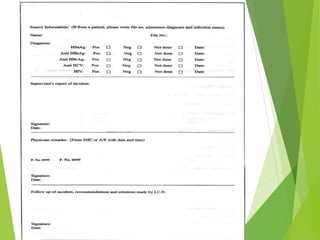
 Report the incident to your supervisor
 Immediately seek medical treatment
Evaluation of the Source
 HEPATITIS B MARKERS
 ANTI- HCV
 ANTI - HIV
Evaluation of the HCW
 HEPATITIS B MARKERS
 ANTI- HCV
 ANTI – HIV
 LFT in HCV Source
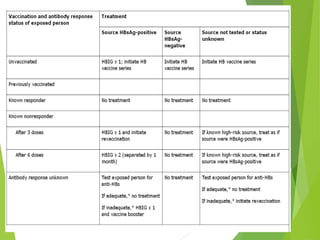
A. HBs Ag +ve source.
a. Unvaccinated HCW
Hepatitis B immunoglobulin (HBIG)
10-12 IU/Kg(500 IU)
+
Hepatitis B vaccine series
≈ PEP should be administered as soon as
possible after exposure(preferably within
24 hours). The effectiveness of HBIG
when administered >7 days after is unknown.
b. In previously vaccinated HCW
i. Known responder (HBs Ab > 10 ml U/ml);
no treatment.
ii. If non-responder
HBIG within 24 hours + Hepatitis B
vaccination at the same time.
OR
Second dose of HBIG can be given 1month later.
HCV Positive Source
A short course of interferon started
early in the course of acute hepatitis C
is associated with a higher rate of
resolution.
≈ Perform baseline testing for anti-HCV and ALT
≈ Earlier diagnosis of HCV infection is desired,
testing for HCV RNA
(R-T PCR QUALITATIVE AND QUANTITAVE )
≈ Perform follow-up testing (e.g., at 4 & 6 months)
for anti-HCV and ALT .
≈ Confirm all anti-HCV positive results.
HIV Positive Source
Several Factors may increase the risk
of transmission:-
a. If HCW is exposed to a large quantity of blood.
b. A procedure that involved a needle is placed
directly in a vein or artery or a deep injury.
c. If the source patient is in the terminal illness.
d. If the injury is deep with hollow-bore needles
or penetrating sharps-related event.
PEP in Percutaneous
Exposure
Class 1 asymptomatic HIV infection or known low viral load
(e.g., (<1,500 RNA copies.ml).
Class 2 symptomatic HIV infection, AIDS, acute zero conversion,
or known high viral load.
PEP in Mucous Membrane
Exposure
Class 1 asymptomatic HIV infection or known low viral
load (e.g., (<1,500 RNA copies.ml).
Class 2 symptomatic HIV infection, AIDS, acute sero
conversion, or known high viral load.
Antiretroviral Agents for PEP
≈ Nucleoside reverse transcriptase inhibitors
(NRTIs).
≈ Nucleotide reverse transcriptase inhibitors
(NtRTIs).
≈ Nonnucleoside reverse transcriptase inhibitors
(NNRTIs),
≈ Protease inhibitors(PIs), and a single fusion
inhibitor.
HIV PEP should regimen
(zidovudine (AZT) + lamivudine (3TC)
complete a full 4-week )
HCP Follow-up
≈ Anti- HIV test at 6 weeks, 3 months,
6 months
Extending follow-up to 12 months
≈ EIA standard test
≈ direct virus assays not recommended
TUBERCULOSIS
(TB)
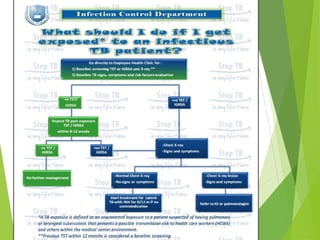
Involve face –to-face contact with
infectious TB patients :-
a. Entering patient rooms ( patient is present or not).
c. Participating in aerosol-generating procedures.
d. Participating in specimen processing (culture ).
e. Installing, maintaining, or replacing environmental
control in areas in which persons with TB are
encountered
TB CONTROL PROGRAM
 Baseline screening should be done at the
time of hire.
A two-step TST should be performed when the initial
TST is negative 1--3 weeks after the first.
  Screen HCP at risk annually (i.e., symptom screen
& TST for HCWs with baseline negative results).
  If the HCP is converter recently, preventive therapy
should be considered.
  Chest radiograph are performed ONLY on those with
recently positive TST and symptomatic.
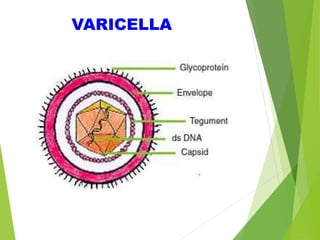
VARICELLA
Chicken pox
TRANSMISSION
¤ AIRBORNE
¤ CONTACT
PERIOD OF OMMUNICABILITY
▀ 1 – 2 days before
the rash
▀ 4-5 days after until all
vesicles are crusted
Varicella Zoster
 Transmitted by
CONTACT
 COMMUNICABLE
until all vesicles
are crusted
Exposure
 A. Varicella:
• Patients in the same room .
• Face to face contact or (5 minutes or more).
• Visit by a contagious person.
 B. Zoster:
Intimate contact (e.g. touching or hugging)
with a contagious person with exposed
zoster lesions.
 Vaccine
Given to susceptible contacts within 3 days of exposure
may prevent or significantly modify disease.
 Immunoglobulins VZIG ( within 4days)
 Susceptible immunocompromised patients
 Susceptible pregnant women. (there is no assurance
that VZIG will prevent congenital malformations in
the fetus, but it may modify varicella severity ).
 Sick leave
Remain off work from days 10-21 post exposure
Occupational

Occupational

  • 2.
  • 3.
    Annual Report 2012 SharpInjuries and Body Fluid Exposure:- Number Percentage Physicians 27 36% Nursing Staff 35 46.7% Technicians 5 6.6% HK Staff 8 10.7% TOTAL 75 ***
  • 4.
    H B V HapednaVirus double stranded DNA
  • 5.
    Risk for Occupational Transmissionof HBV ►HBsAg& HBeAg-positive blood :  The risk of developing clinical hepatitis is 22%– 31%;  The risk of developing serologic evidence of HBV infection is 37%–62%. ►HBsAg-positive, HBeAg-negative blood  The risk of developing clinical hepatitis is 1%–6%;  The risk of developing serologic evidence of HBV infection is 23%–37%
  • 6.
    Control of HBVtransmission - All HCW should receive Hepatitis B vaccine series at 0,1, 6 After 1-2 months check your immunity .You may be:  responder (HBs Ab > 10 ml U/ml)  non-responder (HBs Ab < 10 ml U/ml), receive Hepatitis B vaccine second series .After 1-2 months check your immunity
  • 7.
    H C V Flavivirus. It is a single stranded RNA
  • 8.
    Risk for Occupational transmissionof HCV  HCV-positive source is 1.8% (range: 0%–7%) rarely occurs from mucous membrane.
  • 9.
    H I V Retroviruswith 2 single stranded RNA
  • 10.
    Risk for Occupational Transmissionof HIV The risks for occupational transmission of HIV vary with the type and severity of exposure: ♦ In percutaneous exposure 0.3% ( 0.2%–0.5%) ♦ In mucous membrane exposure, approximately 0.09% ( 0.006%–0.5%)
  • 11.
    A percutaneous injuryor contact of mucous membrane or nonintact skin WITH  Blood ,tissue and body fluids  Semen and vaginal secretions ,  CSF, synovial , pleural , peritoneal , pericardial& amniotic fluid  Feces, nasal secretions, saliva, sputum, sweat, tears, urine, and vomitus are not considered potentially infectious unless they contain blood.  Contact without barrier protection to concentrated virus in lab  Human bites: evaluation of HCP + Patient .
  • 12.
    Treatment of anExposure Site Wash needle stick and cuts with soap and water  Flush splashes to the nose, mouth, or skin with water  Irrigate eyes with clean water, saline THEN  Report the incident to your supervisor  Immediately seek medical treatment
  • 15.
    Evaluation of theSource  HEPATITIS B MARKERS  ANTI- HCV  ANTI - HIV
  • 16.
    Evaluation of theHCW  HEPATITIS B MARKERS  ANTI- HCV  ANTI – HIV  LFT in HCV Source
  • 20.
    A. HBs Ag+ve source. a. Unvaccinated HCW Hepatitis B immunoglobulin (HBIG) 10-12 IU/Kg(500 IU) + Hepatitis B vaccine series ≈ PEP should be administered as soon as possible after exposure(preferably within 24 hours). The effectiveness of HBIG when administered >7 days after is unknown.
  • 21.
    b. In previouslyvaccinated HCW i. Known responder (HBs Ab > 10 ml U/ml); no treatment. ii. If non-responder HBIG within 24 hours + Hepatitis B vaccination at the same time. OR Second dose of HBIG can be given 1month later.
  • 22.
    HCV Positive Source Ashort course of interferon started early in the course of acute hepatitis C is associated with a higher rate of resolution.
  • 23.
    ≈ Perform baselinetesting for anti-HCV and ALT ≈ Earlier diagnosis of HCV infection is desired, testing for HCV RNA (R-T PCR QUALITATIVE AND QUANTITAVE ) ≈ Perform follow-up testing (e.g., at 4 & 6 months) for anti-HCV and ALT . ≈ Confirm all anti-HCV positive results.
  • 24.
    HIV Positive Source SeveralFactors may increase the risk of transmission:- a. If HCW is exposed to a large quantity of blood. b. A procedure that involved a needle is placed directly in a vein or artery or a deep injury. c. If the source patient is in the terminal illness. d. If the injury is deep with hollow-bore needles or penetrating sharps-related event.
  • 25.
    PEP in Percutaneous Exposure Class1 asymptomatic HIV infection or known low viral load (e.g., (<1,500 RNA copies.ml). Class 2 symptomatic HIV infection, AIDS, acute zero conversion, or known high viral load.
  • 26.
    PEP in MucousMembrane Exposure Class 1 asymptomatic HIV infection or known low viral load (e.g., (<1,500 RNA copies.ml). Class 2 symptomatic HIV infection, AIDS, acute sero conversion, or known high viral load.
  • 27.
    Antiretroviral Agents forPEP ≈ Nucleoside reverse transcriptase inhibitors (NRTIs). ≈ Nucleotide reverse transcriptase inhibitors (NtRTIs). ≈ Nonnucleoside reverse transcriptase inhibitors (NNRTIs), ≈ Protease inhibitors(PIs), and a single fusion inhibitor. HIV PEP should regimen (zidovudine (AZT) + lamivudine (3TC) complete a full 4-week )
  • 28.
    HCP Follow-up ≈ Anti-HIV test at 6 weeks, 3 months, 6 months Extending follow-up to 12 months ≈ EIA standard test ≈ direct virus assays not recommended
  • 29.
  • 30.
    Involve face –to-facecontact with infectious TB patients :- a. Entering patient rooms ( patient is present or not). c. Participating in aerosol-generating procedures. d. Participating in specimen processing (culture ). e. Installing, maintaining, or replacing environmental control in areas in which persons with TB are encountered
  • 31.
    TB CONTROL PROGRAM Baseline screening should be done at the time of hire. A two-step TST should be performed when the initial TST is negative 1--3 weeks after the first.   Screen HCP at risk annually (i.e., symptom screen & TST for HCWs with baseline negative results).   If the HCP is converter recently, preventive therapy should be considered.   Chest radiograph are performed ONLY on those with recently positive TST and symptomatic.
  • 33.
  • 34.
    Chicken pox TRANSMISSION ¤ AIRBORNE ¤CONTACT PERIOD OF OMMUNICABILITY ▀ 1 – 2 days before the rash ▀ 4-5 days after until all vesicles are crusted
  • 35.
    Varicella Zoster  Transmittedby CONTACT  COMMUNICABLE until all vesicles are crusted
  • 36.
    Exposure  A. Varicella: •Patients in the same room . • Face to face contact or (5 minutes or more). • Visit by a contagious person.  B. Zoster: Intimate contact (e.g. touching or hugging) with a contagious person with exposed zoster lesions.
  • 37.
     Vaccine Given tosusceptible contacts within 3 days of exposure may prevent or significantly modify disease.  Immunoglobulins VZIG ( within 4days)  Susceptible immunocompromised patients  Susceptible pregnant women. (there is no assurance that VZIG will prevent congenital malformations in the fetus, but it may modify varicella severity ).  Sick leave Remain off work from days 10-21 post exposure