BRACHIAL PLEXUS INJURY
PRESENTATION BY
Ashish Parashar
Lecturer, Physiotherapy
Debasis Rout
Lecturer, Occupational Therapy
COMPOSITE REGIONAL CENTRE FOR SKILL DEVELOPMENT, REHABILITATION &
EMPOWERMENT OF PERSONS WITH DISABILITIES (DIVYANGJAN), RAJNANDGAON
(Under the Administrative Control of NIEPID, Secunderabad)
Department of Empowerment of Persons with Disabilities (Divyangjan), MSJ&E, Govt. of India.
Old District Hospital Campus, Rajnandgaon, Chattishgarh-491441
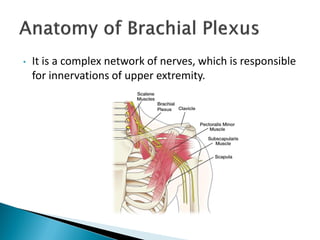
• It is a complex network of nerves, which is responsible
for innervations of upper extremity.
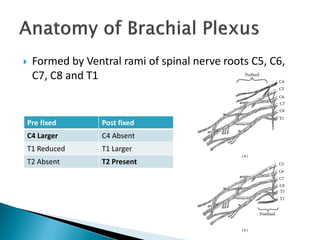
 Formed by Ventral rami of spinal nerve roots C5, C6,
C7, C8 and T1
Pre fixed Post fixed
C4 Larger C4 Absent
T1 Reduced T1 Larger
T2 Absent T2 Present
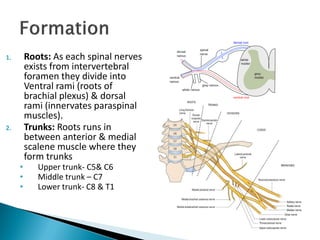
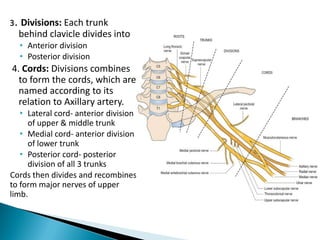
1. Roots: As each spinal nerves
exists from intervertebral
foramen they divide into
Ventral rami (roots of
brachial plexus) & dorsal
rami (innervates paraspinal
muscles).
2. Trunks: Roots runs in
between anterior & medial
scalene muscle where they
form trunks
• Upper trunk- C5& C6
• Middle trunk – C7
• Lower trunk- C8 & T1
3. Divisions: Each trunk
behind clavicle divides into
• Anterior division
• Posterior division
4. Cords: Divisions combines
to form the cords, which are
named according to its
relation to Axillary artery.
• Lateral cord- anterior division
of upper & middle trunk
• Medial cord- anterior division
of lower trunk
• Posterior cord- posterior
division of all 3 trunks
Cords then divides and recombines
to form major nerves of upper
limb.
5. Branches:
• Supraclavicular region- From roots & Trunks
• Infraclavicular region- from cords
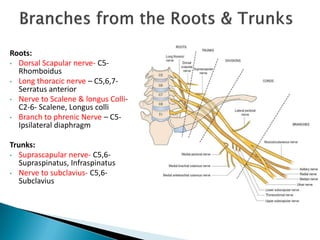
Roots:
• Dorsal Scapular nerve- C5-
Rhomboidus
• Long thoracic nerve – C5,6,7-
Serratus anterior
• Nerve to Scalene & longus Colli-
C2-6- Scalene, Longus colli
• Branch to phrenic Nerve – C5-
Ipsilateral diaphragm
Trunks:
• Suprascapular nerve- C5,6-
Supraspinatus, Infraspinatus
• Nerve to subclavius- C5,6-
Subclavius
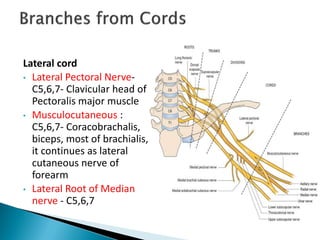
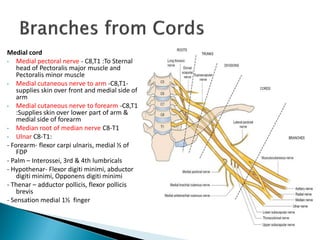
Lateral cord
• Lateral Pectoral Nerve-
C5,6,7- Clavicular head of
Pectoralis major muscle
• Musculocutaneous :
C5,6,7- Coracobrachalis,
biceps, most of brachialis,
it continues as lateral
cutaneous nerve of
forearm
• Lateral Root of Median
nerve - C5,6,7
Medial cord
• Medial pectoral nerve - C8,T1 :To Sternal
head of Pectoralis major muscle and
Pectoralis minor muscle
• Medial cutaneous nerve to arm -C8,T1-
supplies skin over front and medial side of
arm
• Medial cutaneous nerve to forearm -C8,T1
:Supplies skin over lower part of arm &
medial side of forearm
• Median root of median nerve C8-T1
• Ulnar C8-T1:
- Forearm- flexor carpi ulnaris, medial ½ of
FDP
- Palm – Interossei, 3rd & 4th lumbricals
- Hypothenar- Flexor digiti minimi, abductor
digiti minimi, Opponens digiti minimi
- Thenar – adductor pollicis, flexor pollicis
brevis
- Sensation medial 1½ finger
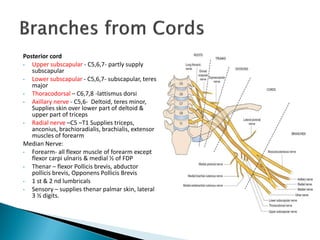
Posterior cord
• Upper subscapular - C5,6,7- partly supply
subscapular
• Lower subscapular - C5,6,7- subscapular, teres
major
• Thoracodorsal – C6,7,8 -lattismus dorsi
• Axillary nerve - C5,6- Deltoid, teres minor,
Supplies skin over lower part of deltoid &
upper part of triceps
• Radial nerve –C5 –T1 Supplies triceps,
anconius, brachioradialis, brachialis, extensor
muscles of forearm
Median Nerve:
• Forearm- all flexor muscle of forearm except
flexor carpi ulnaris & medial ½ of FDP
• Thenar – flexor Pollicis brevis, abductor
pollicis brevis, Opponens Pollicis Brevis
• 1 st & 2 nd lumbricals
• Sensory – supplies thenar palmar skin, lateral
3 ½ digits.
 Road traffic injuries
 Various other accidents – in factories, building sites,
sports, severe falls
 Iatrogenic (ligatures, drills, mastectomies, resection of
1 st rib etc)
 Obstetric palsy
 Gunshot wounds
 Tumors
 Secondary compression from trauma (Callus, fibrous
band, scar)
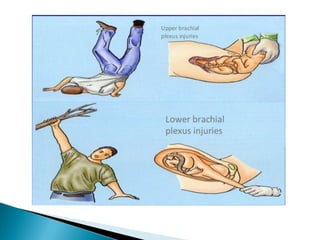
Traction/Over stretching: The mechanism is violent traction of upper
limb against the body (like RTA, other accident etc.)
 Increased angle between head & neck Results in C5, C6, C7 root or
upper trunk disruption.
 When upper limb is abducted above level of head with considerable
force, can result in avulsion of C8,T1 roots or lower trunk
Compression:
 Fracture of clavicle and callus formation may lead to compression of
lower trunk
 Tumors
 Haemorrhage
 Direct blow to side of neck
Penetrating wounds/direct trauma:
 Includes stab/gunshot wound
 Direct blow to supraclavicular fossa over Erb’s point
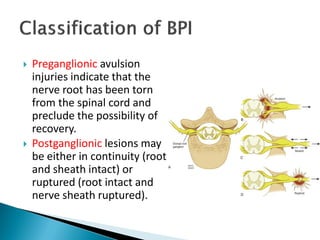
 Preganglionic avulsion
injuries indicate that the
nerve root has been torn
from the spinal cord and
preclude the possibility of
recovery.
 Postganglionic lesions may
be either in continuity (root
and sheath intact) or
ruptured (root intact and
nerve sheath ruptured).
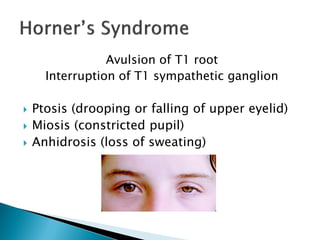
Avulsion of T1 root
Interruption of T1 sympathetic ganglion
 Ptosis (drooping or falling of upper eyelid)
 Miosis (constricted pupil)
 Anhidrosis (loss of sweating)
COMPLETE :
Typically, these cases present with avulsion of the C7, C8
and T1 roots and rupture of the C5 and C6 roots
INCOMPLETE :
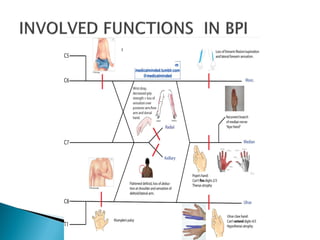
 Upper plexus palsy- Affecting the C5, C6 +/- C7 roots
 lower plexus palsy affecting the C8 and T1 roots
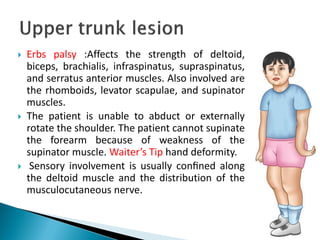
 Erbs palsy :Affects the strength of deltoid,
biceps, brachialis, infraspinatus, supraspinatus,
and serratus anterior muscles. Also involved are
the rhomboids, levator scapulae, and supinator
muscles.
 The patient is unable to abduct or externally
rotate the shoulder. The patient cannot supinate
the forearm because of weakness of the
supinator muscle. Waiter’s Tip hand deformity.
 Sensory involvement is usually confined along
the deltoid muscle and the distribution of the
musculocutaneous nerve.
 The middle trunk offers a major neural contribution to
the radial nerve.
 Weakens the extensor muscles of the arm and
forearm, excluding the brachioradialis, which receives
primary innervation from the C6 nerve root.
 Sensory deficit occurs along the radial distribution of
the posterior arm and forearm and along the dorsal
radial aspect of the hand.
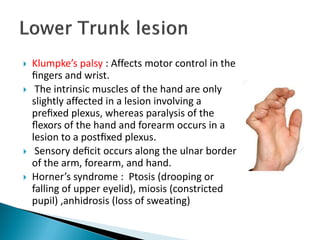
 Klumpke’s palsy : Affects motor control in the
fingers and wrist.
 The intrinsic muscles of the hand are only
slightly affected in a lesion involving a
prefixed plexus, whereas paralysis of the
flexors of the hand and forearm occurs in a
lesion to a postfixed plexus.
 Sensory deficit occurs along the ulnar border
of the arm, forearm, and hand.
 Horner’s syndrome : Ptosis (drooping or
falling of upper eyelid), miosis (constricted
pupil) ,anhidrosis (loss of sweating)
 Infraclavicular lesions include injuries to the cords or
the individual peripheral nerves of the brachial plexus
 Palsy in elbow flexion and a deficit of muscle pronators
in the forearm, wrist, and finger flexors.
 A proximal lesion injures the lateral pectoral nerve,
resulting in partial or total palsy of the upper portion
of the pectoralis major muscle.
 Sensory deficit occurs at the forearm and at the thumb
level.
 Isolated injuries to the medial cord are rare. Instead,
upper medio-ulnar injury results in palsy, which is total
in the distribution of the ulnar nerve and only partial in
the distribution of the median nerve.
 Motor deficits occur in the flexor pollicis longus muscle
and the flexor digitorum profundus muscle of the index
finger.
 Partial palsy of the lower portion of the pectoralis
muscle results in injury to the medial pectoral nerve.
 Involves the areas of distribution of the Radial, Axillary,
Subscapular, and Thoracodorsal nerves.
 The lesion results in weakness of the extensors in the
arm, with impairment of medial rotation and elevation
of the arm at the shoulder.
 Isolated injuries to the long thoracic nerve are rare
 Traumatic wounds or traction injuries to the neck
result in isolated weakness of the serratus anterior
muscle with winging of the medial border of the
scapula.
 Partial loss of scapular rotation during abduction or
flexion of the arm.
 Antero-medial shoulder dislocation is the most
frequent cause of isolated Axillary nerve lesions.
 Results in loss of active shoulder abduction.
 Sensory changes include an area of anaesthesia along
the deltoid muscle.
Assessment
Mostly
 Inability to move right upper limb/right
shoulder
 Difficulty in right hand movement
 Weakness of right upper limb
Nature and mechanisms of injury:
 High-speed, large-impact accidents i.e. fall from a speeding
motorcycle associated with preganglionic plexus injuries
 Slow-speed, small-impact accidents i.e. fall down a stairway
associated with postganglionic injuries
 Trauma, brief detail (Sharp/blunt/fracture/dislocation)
 Treatment taken
 Progression of deformity/Improvement of what function
 Physiotherapy/brace/splint
 Any occasional dislocation
 Disability
 Dominant hand
 Status of eating if right hand and hygiene if
left hand
 Sports status
 Driving
 Personal Hx: Smoking/alcohol/tobacco
 Medical Hx: Medication, surgery, Hakeem,
Chemotherapy, Radiotherapy, hospitalization
 Socioeconomic and family Hx: No. of Family members,
status of living, income
Area and nature of pain:
 constant burning, crushing pain with sudden shooting
paroxysms.
 91% experience pain for at least 3 years after their injury.
(Bruxelle and associates)
 Result of deafferentation of the spinal cord at the damaged
root level, leading to undampened excitation of the cells in
the dorsal horn of the spinal cord. That is received and
interpreted centrally as pain and is eventually felt in the
dermatomes of the avulsed nerve root.
 may also result from secondary injuries to bones or related
soft tissues.
Best to start with the patient stood with both arms and
torso exposed.
 Look at the face for Horner's syndrome
 Look for surgical scars
 muscle wasting – shoulder girdle, arm, forearm or
hand
 Deformity
 posture of the limb
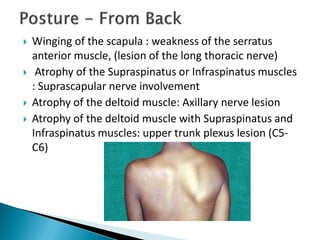
 Winging of the scapula : weakness of the serratus
anterior muscle, (lesion of the long thoracic nerve)
 Atrophy of the Supraspinatus or Infraspinatus muscles
: Suprascapular nerve involvement
 Atrophy of the deltoid muscle: Axillary nerve lesion
 Atrophy of the deltoid muscle with Supraspinatus and
Infraspinatus muscles: upper trunk plexus lesion (C5-
C6)
 Forward head posture
 Increased upper thoracic spine kyphosis,
 Protraction and elevation of the scapulae
 An increase cervical spine inclination, and backward
bending at the atlanto-occipital junction.
 The forward head posture results in muscle imbalances
that can further result in entrapment of various nerves
of the brachial plexus in the area of the thoracic outlet
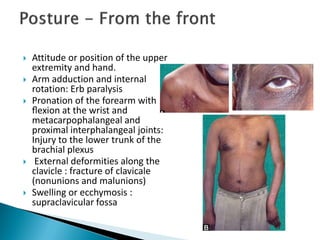
 Attitude or position of the upper
extremity and hand.
 Arm adduction and internal
rotation: Erb paralysis
 Pronation of the forearm with
flexion at the wrist and
metacarpophalangeal and
proximal interphalangeal joints:
Injury to the lower trunk of the
brachial plexus
 External deformities along the
clavicle : fracture of clavicale
(nonunions and malunions)
 Swelling or ecchymosis :
supraclavicular fossa
 Using standard goniometer: all joints of the shoulder
girdle and upper limb.
 Deficits of joint motion from immobility: contracture of
the joint capsule, adhesions in the joints, and
shortening of both muscle and tendons.
Manual muscle testing: MRC grading
0: No visible or palpable contraction (None)
1: Visible or palpable contraction with no motion(Trace)
2: Full ROM gravity eliminated (Poor)
3: Full ROM against gravity (Fair)
4: Full ROM against gravity, moderate resistance (Good)
5: Full ROM against gravity, maximum resistance
(Normal)
 Repeated tests: for measuring improvement.
 Pinpointing the site and extent of the plexus lesion.
 Rhomboids (dorsal scapular nerve – C4,5)
◦ Push shoulder blades together
 Serratus anterior (long thoracic nerve - C5,6,7)
◦ The classic test is wall-press test.
◦ In BPI, the patient may be unable to lift the arm. The arm
should be supported by the examiner with one hand and the
patient asked to push forward as if trying to open a door. At
the same time the examiner should hold the lower pole of the
scapula with another hand.
 Supraspinatus (suprascapular nerve - C5,6)
◦ Test shoulder abduction in the scapular plane with the thumb
pointing downwards.
 Infraspinatus (suprascapular nerve - C5,6)
◦ Test external rotation with the shoulder in adduction and the
elbow flexed.
 Pectoralis major (lateral and medial pectoral nerves)
Clavicular head (C5,6)
 Atrophy would imply lateral cord injury.
 Ask the patient to touch their contralateral shoulder (and the
examiner palpates for evidence of contraction).
Sternocostal head (C7,8,T1)
• Atrophy would imply medial cord injury.
• Ask the patient to push against the hip (and the examiner
palpates the axillary fold).
 Latissimus dorsi (Thoracodorsal nerve – C6,7,8)
◦ While the arm is supported in a flexed position, ask the patient to
push down (while the examiner palpates for musle contraction).
 Subscapularis (upper and lower subscapular nerves –
C5,6,7)
◦ Belly-press sign. Ask the patient to bring the elbows forward while
pressing the belly. A flexed wrist relative to the normal side indicates
a positive sign.
 Deltoids (Axillary nerve – C5,6)
◦ Extend, abduct and flex the shoulder to test the posterior, middle
and anterior parts respectively.
 Teres minor (axillary nerve – C5,6)
◦ Test external rotation with the shoulder in abduction and the elbow
flexed.
 Elbow flexion (C5,6)
 Elbow extension (C7,8)
 Forearm supination (C6)
 Forearm pronation (C7,8)
 Wrist flexion/extension (C6,7)
 MCPJ flexion/extension (C7,8)
 Grip (C8)
 Fingers abduction (T1)
 Include light touch, temperature, deep pressure,
stereognosis, and two-point discrimination
 Establish normal sensation in an uninjured area (such
as forehead or sternum).
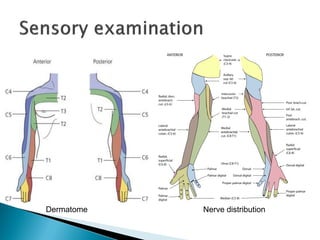
 First, assess the dermatomes (C5-lateral elbow; C6-
thumb tip; C7-middle finger tip; C8-little finger tip; T1-
medial elbow) and then if necessary such as in
infraclavicular BPI, examine according to the terminal
branch distribution.
Dermatome Nerve distribution
 Brachioradialis reflex: C6 nerve root level: signifies damage
in the C6 nerve root level, the upper trunk or posterior cord
of the brachial plexus, the radial nerve, or the
brachioradialis musculotendinous unit
 Biceps reflex: C5, and to a lesser extent, the C6 : indicates
damage to the C5 nerve root level, the upper trunk or
lateral cord of the brachial plexus, musculocutaneous
nerve, or biceps musculotendinous unit.
 Triceps reflex: C7 nerve root level: signifies damage to the
C7 nerve root, middle trunk or posterior cord of the
brachial plexus, radial nerve, or triceps musculotendinous
unit.
 Loss of sensation and muscle control results in a loss of
gross and fine motor coordination
 Purdue pegboard test
 Disruption of the subclavian or axillary arteries occurs
in the presence of severe brachial plexus injuries,
particularly with associated fractures of the clavicle.
 vasomotor changes: dusky, cool skin indicating venous
insufficiency.
 Assesses the brachial and radial pulses.
Method:
Volumetric -submerges the patient’s hand in a lucite
container and measures the amount of water displaced
using a 500-ml graduated
Circumferential measurements of the hand and forearm
Rated from 1 to 3, with 1 being minimal edema and 3
being severe or pitting edema.
 Tinel’s sign : By tapping over the brachial plexus above the
clavicle
 It is an important clinical sign to determine the location of a
neuroma or to judge the regeneration of injured nerves.
 If the Tinel’s sign remains fixed at a point over a period of time
this implies retardation of progressive regeneration and
warrants surgical exploration.
 If the same advances from supra to Infraclavicular region and
then to the arm and the forearm, a wait and see attitude is
recommended.
 Presence of a localized tenderness, revealed by tapping above
the clavicle, possible neuroma resulting from disruption of part
of the plexus.(fourth- or fifth-degree nerve injury)
Self-care activities :
 Feeding
 Bathing
 Grooming
 Dressing
 X-ray:Cervical spine, clavicle, scapula, chest and
upper extremity.
 MRI
 Electromyography (EMG)
 Nerve conduction velocity (NCV)
 Strength Duration curve (S-D Curve)
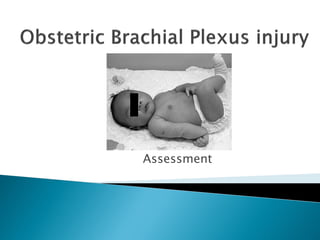
Assessment
 Gestational age, birth weight, delivery history, Prolong
ed second stage of labor(over 60 minutes)
possible shoulder dystocia, include presentation, Fetal
macrosomia, Use of assistive techniques-forceps to aid
delivery. Maternal obesity, Gestational diabetes.
 Complications after birth: possible respiratory
issues (phrenic nerve:hemidiaphragm), possible Facial
Palsy, Horner’s Syndrome, torticollis
 Developmental history
 Position of head in relation to extremity
 Position of extremity in relation to rest of body. If possi
ble, observe in a variety of developmental positions
 Spontaneous movement
 Horner signs
 Check for evidence of circulatory issues
Important to assess total body control before focusing o
n affected extremity
 Muscle tone/bulk
 Quality of movement: head and trunk control
 Symmetry: include not only body symmetry but
also visual, auditory, oral symmetry
 Joint integrity: check for subluxations, joint
capsule tightness, glenohumeral changes
 Passive Range of Motion: take into account
physiological flexion, potential shoulder
subluxation or radial head dislocation, need to
promote scapulo‐humeral rhythm when testing
 Active Range of Motion: use of faces, toys, etc
Motor Assessment:- videotaping provides objective
documentation of motion on serial visits.
Motor assessment can be done by many measures –
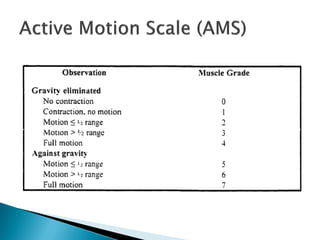
 Active Motion Scale (AMS)
 Gilbert and Tassin Scale.
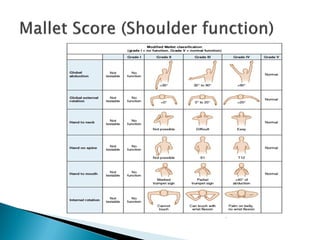
 Mallet score
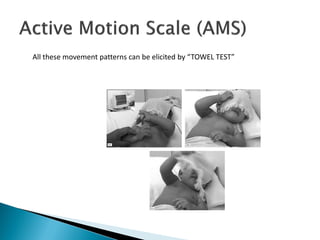
 It is an eight-grade, ordinal scale.
 It is used to quantify UE strength by observing
spontaneous, active movements both without and
against gravity in 3 positions - supine, side-lying, &
sitting.
 It assesses 15 movement patterns –
Shoulder abd., add., flexion, ER & IR; Elbow flexion &
extension; FA supination & pronation; Wrist, finger &
thumb flexion & extension.
All these movement patterns can be elicited by “TOWEL TEST”
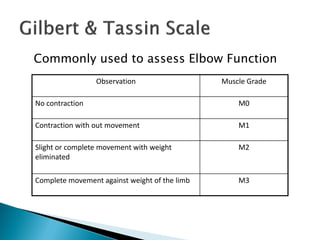
Commonly used to assess Elbow Function
Observation Muscle Grade
No contraction M0
Contraction with out movement M1
Slight or complete movement with weight
eliminated
M2
Complete movement against weight of the limb M3
Narakas Sensory Grading System
S0- No reaction to painful or other stimuli
S1 – Reaction to painful stimuli, none to touch
S2 – reaction to touch, not to light touch
S3 – Apparently normal sensation
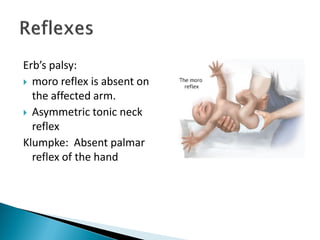
Erb’s palsy:
 moro reflex is absent on
the affected arm.
 Asymmetric tonic neck
reflex
Klumpke: Absent palmar
reflex of the hand
 X-ray:
All newborns with possible injuries should have x‐rays
of the cervical spine and involved extremity to rule
out clavicular and humeral fractures.
 MRI
 EMG
 NCV
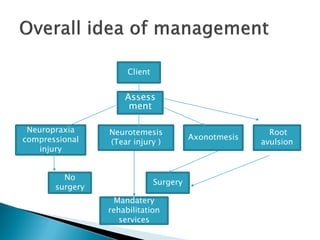
Client
Neuropraxia
compressional
injury
Neurotemesis
(Tear injury )
Assess
ment
Axonotmesis
Root
avulsion
No
surgery
Surgery
Mandatery
rehabilitation
services
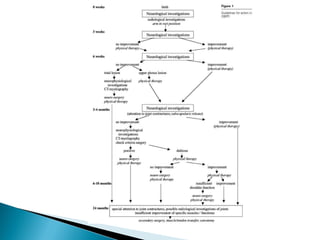
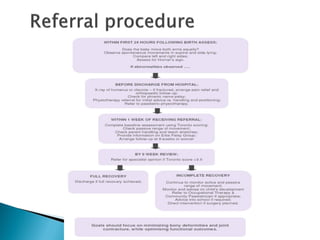
 Early diagnosis and follow-up, if possible, within two to
three weeks after the child’s birth [21]
 Conservative treatment should involve a
multidisciplinary team, composed of physiatrists,
clinical neurophysiologist, neurosurgeons, occupational
therapists, and physiotherapists
 Electrical stimulation/electrostimulation is a
complementary means or technique used in conservative
therapies for the rehabilitation of brachial plexus palsy
[4,19], that promotes gaining muscle tone/strength on the
affected muscles, and significant improvements in the
mobility of the injured limb.
 These therapies aim to ensure the conditions needed for
the functional recovery of the limb following nerve
regeneration, which implies the prevention of muscle
shrinkage, sagging, joint deformities, and muscle
contractures [20,21]
 Most studies reveal that conservative treatment performed
by therapists significantly reduces injuries, removing the
need for surgical intervention [28,29].
 There are different tools that are used as means and/or
complementary techniques to the
conservative/surgical treatment of neonatal brachial
plexus palsy, such as electrostimulation, botulinum
toxin injection, thermoplastic splints, posterior and
anterior temporary splints (for physiological
positioning, facilitating functional motor function, and
preventing vicious postures. and constraint induced
movement therapy [20,21].
 Constraint induced movement therapy demonstrates
that performing activities at home for one hour a day
can improve mobility, functional capacity, speed, range
of motion, and hand manipulation ability [23].
 Surgical nerve reconstruction may be necessary for
rehabilitating patients with neonatal brachial plexus palsy,
especially children who do not show spontaneous recovery
during the first months of life [17].
 When surgical intervention is required, both primary and
secondary microsurgeries are available. Primary
microsurgery techniques include recession and
reconstruction of the neuroma, neurolysis, and nerve
transfer [16,20,22]. Studies reveal that, as a primary
surgery for neonatal brachial plexus palsy, neurolysis
combined with nerve transfer produces good results [34].
 In situations where the lesion affects the suprascapular
nerve, shoulder function is impaired (abduction and
external rotation). Grafts extracted from the proximal
C5 root stump or the accessory nerve are often used to
reconstruct the suprascapular nerve. The use of the
phrenic nerve has also been shown to provide a similar
level of recovery to the use of the median nerve,
increasing the number of graft options available to
recover suprascapular nerve function [24].
 In Erb’s palsy, affecting shoulder abduction and
external rotation, elbow flexion, and forearm
supination, and when there is no evidence of
spontaneous recovery, surgery is a valid treatment
option
 The Oberlin’s procedure involves the transfer of the
ulnar nerve to the cutaneous nerve and is an effective
way of recovering the elbow function, improving elbow
flexion and leading to increased functional use of the
affected limb [25].
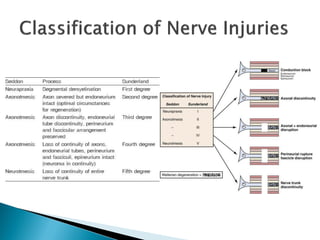
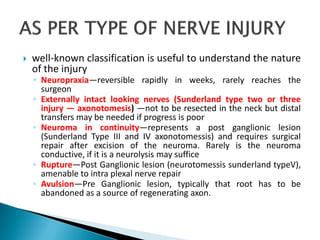
 well-known classification is useful to understand the nature
of the injury
◦ Neuropraxia—reversible rapidly in weeks, rarely reaches the
surgeon
◦ Externally intact looking nerves (Sunderland type two or three
injury — axonotomesis) —not to be resected in the neck but distal
transfers may be needed if progress is poor
◦ Neuroma in continuity—represents a post ganglionic lesion
(Sunderland Type III and IV axonotomessis) and requires surgical
repair after excision of the neuroma. Rarely is the neuroma
conductive, if it is a neurolysis may suffice
◦ Rupture—Post Ganglionic lesion (neurotomessis sunderland typeV),
amenable to intra plexal nerve repair
◦ Avulsion—Pre Ganglionic lesion, typically that root has to be
abandoned as a source of regenerating axon.
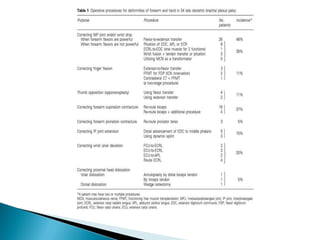
 Tendon transfers using available muscles
 Trapezius transfer to stabilize shoulder
 Shoulder and wrist arthrodesis to improve
posture
 Free Functional muscle transfer—can always
be attempted as the donor muscle is
uninjured and has never been denervated.
 Nerve Reconstruction
 Management of Late Deformity
 Fixing Shoulder Subluxation and Dislocation
 Tendon Transfers
 Results vary depending on multiple parameters
 Age of patient-younger patients get better results
 Time between injury and surgery-earlier the better-first 3
months is the best period
 Extent of injury-partial plexus injuries have superior
results, especially upper plexus injuries
 Rehab facility-people on good rehab programmes show
greater functionality and weight tolerance.
 Babhulkar and Thatte-analyzed a small
subset of the data in Bombay Hospital
over a 4 year period where at least 2 years
(approx.)
 When the delay for operation was more than 6 months, it
affected the outcome significantly.
 Patients with upper trunk injury showed maximum number of
good results (70%) while those with global plexopathy showed
good outcome in only 20%, fair in 36% and poor in 44%.
 In global plexopathy, those having preganglionic injury had the
worst outcome in the group. Outcome was inversely
proportional to number of avulsed roots.
 Pre-ganglionic injuries showed significantly poorer outcome
than post-ganglionic injuries
 Outcome with primary coaptation without nerve graft had
significantly better result than the patients where the nerve
graft was used.
 Positioning and handling
 Sensory stimulation
 Range of motion exercises
 Presence of a clavicular fracture is associated with
osseous deformity;
 Restriction of shoulder external rotation, due to
contracture of subscapularis and the anterior
shoulder capsule - in extreme cases this can lead
to posterior subluxation of the shoulder;
 Restriction of scapulo-humeral angle due to
contracture of latissimus dorsi and teres major;
 Loss of full elbow extension, exacerbated by
dislocation of the radial head through forced
supination;
 Loss of full supination;
 Loss of pronation;
 Loss of full extension of wrist and fingers;
 Loss of thumb abduction and opposition.
 Shoulder Exercises
 A Gently grasp your baby’s forearm and hold their shoulder
blade down firmly with the palm of your hand. Then raise their
arm slowly up over their head keeping the arm close to the ear
and hold.
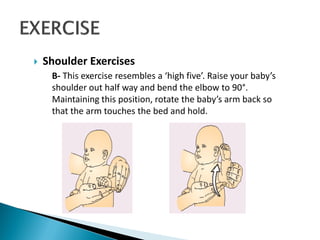
 Shoulder Exercises
B- This exercise resembles a ‘high five’. Raise your baby’s
shoulder out half way and bend the elbow to 90°.
Maintaining this position, rotate the baby’s arm back so
that the arm touches the bed and hold.
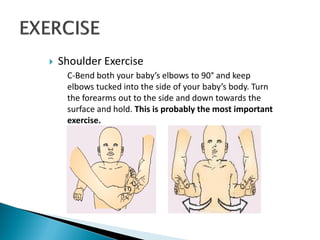
 Shoulder Exercise
C-Bend both your baby’s elbows to 90° and keep
elbows tucked into the side of your baby’s body. Turn
the forearms out to the side and down towards the
surface and hold. This is probably the most important
exercise.
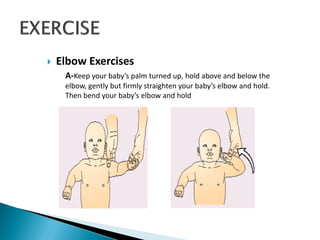
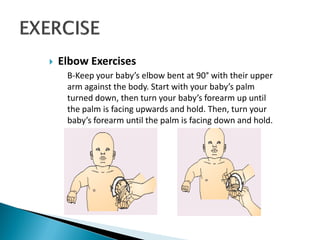
 Elbow Exercises
A-Keep your baby’s palm turned up, hold above and below the
elbow, gently but firmly straighten your baby’s elbow and hold.
Then bend your baby’s elbow and hold
 Elbow Exercises
B-Keep your baby’s elbow bent at 90° with their upper
arm against the body. Start with your baby’s palm
turned down, then turn your baby’s forearm up until
the palm is facing upwards and hold. Then, turn your
baby’s forearm until the palm is facing down and hold.
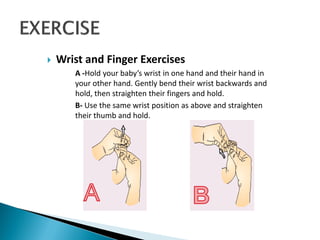
 Wrist and Finger Exercises
A -Hold your baby’s wrist in one hand and their hand in
your other hand. Gently bend their wrist backwards and
hold, then straighten their fingers and hold.
B- Use the same wrist position as above and straighten
their thumb and hold.
 Positioning and Handling
 If your baby’s arm is very floppy it should be well
supported with the hand, elbow and shoulder in
the neutral position. Often a towel under the
affected arm during sleep helps to keep the arm
in the neutral position.
 Move your baby’s arm gently for washing,
dressing and skin care. It is helpful to dress the
affected arm first and undress it last. When
washing and drying, particular care should be
taken with skin folds.
 When handling, feeding and cuddling your baby,
the affected arm should be well supported.
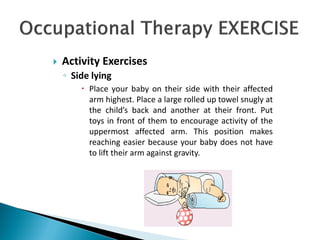
 Activity Exercises
◦ Side lying
 Place your baby on their side with their affected
arm highest. Place a large rolled up towel snugly at
the child’s back and another at their front. Put
toys in front of them to encourage activity of the
uppermost affected arm. This position makes
reaching easier because your baby does not have
to lift their arm against gravity.
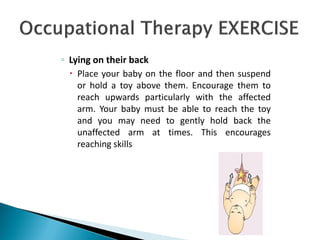
◦ Lying on their back
 Place your baby on the floor and then suspend
or hold a toy above them. Encourage them to
reach upwards particularly with the affected
arm. Your baby must be able to reach the toy
and you may need to gently hold back the
unaffected arm at times. This encourages
reaching skills
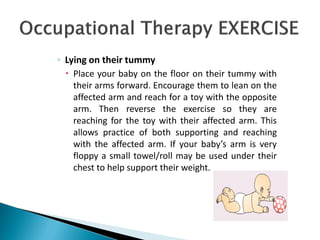
◦ Lying on their tummy
 Place your baby on the floor on their tummy with
their arms forward. Encourage them to lean on the
affected arm and reach for a toy with the opposite
arm. Then reverse the exercise so they are
reaching for the toy with their affected arm. This
allows practice of both supporting and reaching
with the affected arm. If your baby’s arm is very
floppy a small towel/roll may be used under their
chest to help support their weight.
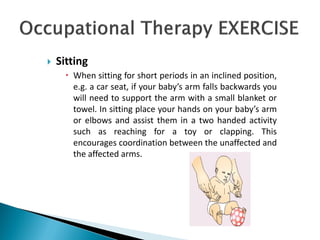
 Sitting
 When sitting for short periods in an inclined position,
e.g. a car seat, if your baby’s arm falls backwards you
will need to support the arm with a small blanket or
towel. In sitting place your hands on your baby’s arm
or elbows and assist them in a two handed activity
such as reaching for a toy or clapping. This
encourages coordination between the unaffected and
the affected arms.
 Classroom management;
 Access to PE and sport;
 leisure activities;
 Confidence;
 Self-esteem;
 The need for secondary surgical intervention in the
future.
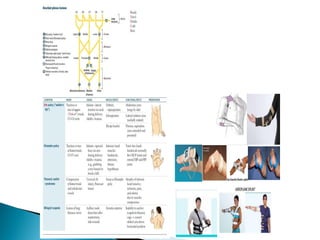
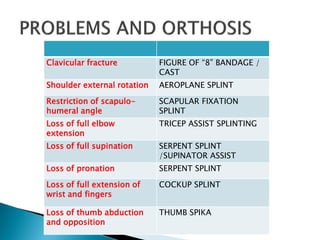
Clavicular fracture FIGURE OF “8” BANDAGE /
CAST
Shoulder external rotation AEROPLANE SPLINT
Restriction of scapulo-
humeral angle
SCAPULAR FIXATION
SPLINT
Loss of full elbow
extension
TRICEP ASSIST SPLINTING
Loss of full supination SERPENT SPLINT
/SUPINATOR ASSIST
Loss of pronation SERPENT SPLINT
Loss of full extension of
wrist and fingers
COCKUP SPLINT
Loss of thumb abduction
and opposition
THUMB SPIKA
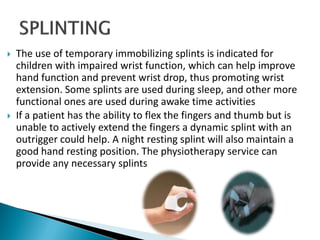
 The use of temporary immobilizing splints is indicated for
children with impaired wrist function, which can help improve
hand function and prevent wrist drop, thus promoting wrist
extension. Some splints are used during sleep, and other more
functional ones are used during awake time activities
 If a patient has the ability to flex the fingers and thumb but is
unable to actively extend the fingers a dynamic splint with an
outrigger could help. A night resting splint will also maintain a
good hand resting position. The physiotherapy service can
provide any necessary splints
 Thermoplastic splints, posterior and anterior
temporary splints (for physiological positioning.
 Anterior and posterior fist or hand splints control and
prevent, at the fist level, extreme ulnar flexion and
deviation.
 Anterior splints can simultaneously control thumb
adduction, and posterior splints allow more freedom
of the child’s palm)
 ERBS PALSY-
 B/L Over head activity
 BASKET THE BALL (play )
 Lets go selling in a over head basket (play )
 Remove your tee( activity ) etc…
 WRIST DROP-
 Pushing the wall
 Rolling a bread
 Making the puppet to dance
 RADIAL CLAW HAND
 Putty activity
 Play carrom
 Water colour
 APE HAND-
 Throwing a ball
 Catching a ball hold the glass till filled
 LOSS OF SHOULDER ABDUCTION –
 Flap like a bird
 fly like an aeroplanene etc.
 Obvious truncal asymmetries;
 Residual unsightly scarring;
 Poor body image;
 Peer pressure;
 Maintain joint range of movement
 Use static splinting to maintain good resting
position of the hand
 Encourage active exercises for muscle groups that
are working
 Maximize function if necessary by modification of
activities and possibly dynamic splinting
 OT for assessment and improvement of
independent ADLs
 Check balance and posture, if necessary treat
appropriately
 Once there is evidence of recovery start
progressing exercise to incorporate gravity
eliminated exercises and active assisted exercises
 If appropriate discuss early return to work and
hobbies
 All patients with brachial plexus injury need early
referral to a person specializing in treating it
 Patients get better results with earlier referral
 All patients can be offered some modality of treatment
irrespective of time of referral
 No patient must be abandoned without offering
treatment and rehabilitation.
BRACHIAL PLEXUS INJURY: EVALUATION AND MANAGEMENT

BRACHIAL PLEXUS INJURY: EVALUATION AND MANAGEMENT

  • 1.
    BRACHIAL PLEXUS INJURY PRESENTATIONBY Ashish Parashar Lecturer, Physiotherapy Debasis Rout Lecturer, Occupational Therapy COMPOSITE REGIONAL CENTRE FOR SKILL DEVELOPMENT, REHABILITATION & EMPOWERMENT OF PERSONS WITH DISABILITIES (DIVYANGJAN), RAJNANDGAON (Under the Administrative Control of NIEPID, Secunderabad) Department of Empowerment of Persons with Disabilities (Divyangjan), MSJ&E, Govt. of India. Old District Hospital Campus, Rajnandgaon, Chattishgarh-491441
  • 2.
    • It isa complex network of nerves, which is responsible for innervations of upper extremity.
  • 3.
     Formed byVentral rami of spinal nerve roots C5, C6, C7, C8 and T1 Pre fixed Post fixed C4 Larger C4 Absent T1 Reduced T1 Larger T2 Absent T2 Present
  • 4.
    1. Roots: Aseach spinal nerves exists from intervertebral foramen they divide into Ventral rami (roots of brachial plexus) & dorsal rami (innervates paraspinal muscles). 2. Trunks: Roots runs in between anterior & medial scalene muscle where they form trunks • Upper trunk- C5& C6 • Middle trunk – C7 • Lower trunk- C8 & T1
  • 5.
    3. Divisions: Eachtrunk behind clavicle divides into • Anterior division • Posterior division 4. Cords: Divisions combines to form the cords, which are named according to its relation to Axillary artery. • Lateral cord- anterior division of upper & middle trunk • Medial cord- anterior division of lower trunk • Posterior cord- posterior division of all 3 trunks Cords then divides and recombines to form major nerves of upper limb.
  • 6.
    5. Branches: • Supraclavicularregion- From roots & Trunks • Infraclavicular region- from cords
  • 7.
    Roots: • Dorsal Scapularnerve- C5- Rhomboidus • Long thoracic nerve – C5,6,7- Serratus anterior • Nerve to Scalene & longus Colli- C2-6- Scalene, Longus colli • Branch to phrenic Nerve – C5- Ipsilateral diaphragm Trunks: • Suprascapular nerve- C5,6- Supraspinatus, Infraspinatus • Nerve to subclavius- C5,6- Subclavius
  • 8.
    Lateral cord • LateralPectoral Nerve- C5,6,7- Clavicular head of Pectoralis major muscle • Musculocutaneous : C5,6,7- Coracobrachalis, biceps, most of brachialis, it continues as lateral cutaneous nerve of forearm • Lateral Root of Median nerve - C5,6,7
  • 9.
    Medial cord • Medialpectoral nerve - C8,T1 :To Sternal head of Pectoralis major muscle and Pectoralis minor muscle • Medial cutaneous nerve to arm -C8,T1- supplies skin over front and medial side of arm • Medial cutaneous nerve to forearm -C8,T1 :Supplies skin over lower part of arm & medial side of forearm • Median root of median nerve C8-T1 • Ulnar C8-T1: - Forearm- flexor carpi ulnaris, medial ½ of FDP - Palm – Interossei, 3rd & 4th lumbricals - Hypothenar- Flexor digiti minimi, abductor digiti minimi, Opponens digiti minimi - Thenar – adductor pollicis, flexor pollicis brevis - Sensation medial 1½ finger
  • 10.
    Posterior cord • Uppersubscapular - C5,6,7- partly supply subscapular • Lower subscapular - C5,6,7- subscapular, teres major • Thoracodorsal – C6,7,8 -lattismus dorsi • Axillary nerve - C5,6- Deltoid, teres minor, Supplies skin over lower part of deltoid & upper part of triceps • Radial nerve –C5 –T1 Supplies triceps, anconius, brachioradialis, brachialis, extensor muscles of forearm Median Nerve: • Forearm- all flexor muscle of forearm except flexor carpi ulnaris & medial ½ of FDP • Thenar – flexor Pollicis brevis, abductor pollicis brevis, Opponens Pollicis Brevis • 1 st & 2 nd lumbricals • Sensory – supplies thenar palmar skin, lateral 3 ½ digits.
  • 11.
     Road trafficinjuries  Various other accidents – in factories, building sites, sports, severe falls  Iatrogenic (ligatures, drills, mastectomies, resection of 1 st rib etc)  Obstetric palsy  Gunshot wounds  Tumors  Secondary compression from trauma (Callus, fibrous band, scar)
  • 12.
    Traction/Over stretching: Themechanism is violent traction of upper limb against the body (like RTA, other accident etc.)  Increased angle between head & neck Results in C5, C6, C7 root or upper trunk disruption.  When upper limb is abducted above level of head with considerable force, can result in avulsion of C8,T1 roots or lower trunk Compression:  Fracture of clavicle and callus formation may lead to compression of lower trunk  Tumors  Haemorrhage  Direct blow to side of neck Penetrating wounds/direct trauma:  Includes stab/gunshot wound  Direct blow to supraclavicular fossa over Erb’s point
  • 15.
     Preganglionic avulsion injuriesindicate that the nerve root has been torn from the spinal cord and preclude the possibility of recovery.  Postganglionic lesions may be either in continuity (root and sheath intact) or ruptured (root intact and nerve sheath ruptured).
  • 16.
    Avulsion of T1root Interruption of T1 sympathetic ganglion  Ptosis (drooping or falling of upper eyelid)  Miosis (constricted pupil)  Anhidrosis (loss of sweating)
  • 17.
    COMPLETE : Typically, thesecases present with avulsion of the C7, C8 and T1 roots and rupture of the C5 and C6 roots INCOMPLETE :  Upper plexus palsy- Affecting the C5, C6 +/- C7 roots  lower plexus palsy affecting the C8 and T1 roots
  • 18.
     Erbs palsy:Affects the strength of deltoid, biceps, brachialis, infraspinatus, supraspinatus, and serratus anterior muscles. Also involved are the rhomboids, levator scapulae, and supinator muscles.  The patient is unable to abduct or externally rotate the shoulder. The patient cannot supinate the forearm because of weakness of the supinator muscle. Waiter’s Tip hand deformity.  Sensory involvement is usually confined along the deltoid muscle and the distribution of the musculocutaneous nerve.
  • 19.
     The middletrunk offers a major neural contribution to the radial nerve.  Weakens the extensor muscles of the arm and forearm, excluding the brachioradialis, which receives primary innervation from the C6 nerve root.  Sensory deficit occurs along the radial distribution of the posterior arm and forearm and along the dorsal radial aspect of the hand.
  • 20.
     Klumpke’s palsy: Affects motor control in the fingers and wrist.  The intrinsic muscles of the hand are only slightly affected in a lesion involving a prefixed plexus, whereas paralysis of the flexors of the hand and forearm occurs in a lesion to a postfixed plexus.  Sensory deficit occurs along the ulnar border of the arm, forearm, and hand.  Horner’s syndrome : Ptosis (drooping or falling of upper eyelid), miosis (constricted pupil) ,anhidrosis (loss of sweating)
  • 21.
     Infraclavicular lesionsinclude injuries to the cords or the individual peripheral nerves of the brachial plexus
  • 22.
     Palsy inelbow flexion and a deficit of muscle pronators in the forearm, wrist, and finger flexors.  A proximal lesion injures the lateral pectoral nerve, resulting in partial or total palsy of the upper portion of the pectoralis major muscle.  Sensory deficit occurs at the forearm and at the thumb level.
  • 23.
     Isolated injuriesto the medial cord are rare. Instead, upper medio-ulnar injury results in palsy, which is total in the distribution of the ulnar nerve and only partial in the distribution of the median nerve.  Motor deficits occur in the flexor pollicis longus muscle and the flexor digitorum profundus muscle of the index finger.  Partial palsy of the lower portion of the pectoralis muscle results in injury to the medial pectoral nerve.
  • 24.
     Involves theareas of distribution of the Radial, Axillary, Subscapular, and Thoracodorsal nerves.  The lesion results in weakness of the extensors in the arm, with impairment of medial rotation and elevation of the arm at the shoulder.
  • 25.
     Isolated injuriesto the long thoracic nerve are rare  Traumatic wounds or traction injuries to the neck result in isolated weakness of the serratus anterior muscle with winging of the medial border of the scapula.  Partial loss of scapular rotation during abduction or flexion of the arm.
  • 26.
     Antero-medial shoulderdislocation is the most frequent cause of isolated Axillary nerve lesions.  Results in loss of active shoulder abduction.  Sensory changes include an area of anaesthesia along the deltoid muscle.
  • 27.
  • 28.
    Mostly  Inability tomove right upper limb/right shoulder  Difficulty in right hand movement  Weakness of right upper limb
  • 29.
    Nature and mechanismsof injury:  High-speed, large-impact accidents i.e. fall from a speeding motorcycle associated with preganglionic plexus injuries  Slow-speed, small-impact accidents i.e. fall down a stairway associated with postganglionic injuries  Trauma, brief detail (Sharp/blunt/fracture/dislocation)  Treatment taken  Progression of deformity/Improvement of what function  Physiotherapy/brace/splint  Any occasional dislocation
  • 30.
     Disability  Dominanthand  Status of eating if right hand and hygiene if left hand  Sports status  Driving
  • 31.
     Personal Hx:Smoking/alcohol/tobacco  Medical Hx: Medication, surgery, Hakeem, Chemotherapy, Radiotherapy, hospitalization  Socioeconomic and family Hx: No. of Family members, status of living, income
  • 32.
    Area and natureof pain:  constant burning, crushing pain with sudden shooting paroxysms.  91% experience pain for at least 3 years after their injury. (Bruxelle and associates)  Result of deafferentation of the spinal cord at the damaged root level, leading to undampened excitation of the cells in the dorsal horn of the spinal cord. That is received and interpreted centrally as pain and is eventually felt in the dermatomes of the avulsed nerve root.  may also result from secondary injuries to bones or related soft tissues.
  • 33.
    Best to startwith the patient stood with both arms and torso exposed.  Look at the face for Horner's syndrome  Look for surgical scars  muscle wasting – shoulder girdle, arm, forearm or hand  Deformity  posture of the limb
  • 34.
     Winging ofthe scapula : weakness of the serratus anterior muscle, (lesion of the long thoracic nerve)  Atrophy of the Supraspinatus or Infraspinatus muscles : Suprascapular nerve involvement  Atrophy of the deltoid muscle: Axillary nerve lesion  Atrophy of the deltoid muscle with Supraspinatus and Infraspinatus muscles: upper trunk plexus lesion (C5- C6)
  • 35.
     Forward headposture  Increased upper thoracic spine kyphosis,  Protraction and elevation of the scapulae  An increase cervical spine inclination, and backward bending at the atlanto-occipital junction.  The forward head posture results in muscle imbalances that can further result in entrapment of various nerves of the brachial plexus in the area of the thoracic outlet
  • 36.
     Attitude orposition of the upper extremity and hand.  Arm adduction and internal rotation: Erb paralysis  Pronation of the forearm with flexion at the wrist and metacarpophalangeal and proximal interphalangeal joints: Injury to the lower trunk of the brachial plexus  External deformities along the clavicle : fracture of clavicale (nonunions and malunions)  Swelling or ecchymosis : supraclavicular fossa
  • 37.
     Using standardgoniometer: all joints of the shoulder girdle and upper limb.  Deficits of joint motion from immobility: contracture of the joint capsule, adhesions in the joints, and shortening of both muscle and tendons.
  • 38.
    Manual muscle testing:MRC grading 0: No visible or palpable contraction (None) 1: Visible or palpable contraction with no motion(Trace) 2: Full ROM gravity eliminated (Poor) 3: Full ROM against gravity (Fair) 4: Full ROM against gravity, moderate resistance (Good) 5: Full ROM against gravity, maximum resistance (Normal)  Repeated tests: for measuring improvement.  Pinpointing the site and extent of the plexus lesion.
  • 39.
     Rhomboids (dorsalscapular nerve – C4,5) ◦ Push shoulder blades together  Serratus anterior (long thoracic nerve - C5,6,7) ◦ The classic test is wall-press test. ◦ In BPI, the patient may be unable to lift the arm. The arm should be supported by the examiner with one hand and the patient asked to push forward as if trying to open a door. At the same time the examiner should hold the lower pole of the scapula with another hand.
  • 40.
     Supraspinatus (suprascapularnerve - C5,6) ◦ Test shoulder abduction in the scapular plane with the thumb pointing downwards.  Infraspinatus (suprascapular nerve - C5,6) ◦ Test external rotation with the shoulder in adduction and the elbow flexed.
  • 41.
     Pectoralis major(lateral and medial pectoral nerves) Clavicular head (C5,6)  Atrophy would imply lateral cord injury.  Ask the patient to touch their contralateral shoulder (and the examiner palpates for evidence of contraction). Sternocostal head (C7,8,T1) • Atrophy would imply medial cord injury. • Ask the patient to push against the hip (and the examiner palpates the axillary fold).
  • 42.
     Latissimus dorsi(Thoracodorsal nerve – C6,7,8) ◦ While the arm is supported in a flexed position, ask the patient to push down (while the examiner palpates for musle contraction).  Subscapularis (upper and lower subscapular nerves – C5,6,7) ◦ Belly-press sign. Ask the patient to bring the elbows forward while pressing the belly. A flexed wrist relative to the normal side indicates a positive sign.  Deltoids (Axillary nerve – C5,6) ◦ Extend, abduct and flex the shoulder to test the posterior, middle and anterior parts respectively.  Teres minor (axillary nerve – C5,6) ◦ Test external rotation with the shoulder in abduction and the elbow flexed.
  • 43.
     Elbow flexion(C5,6)  Elbow extension (C7,8)  Forearm supination (C6)  Forearm pronation (C7,8)  Wrist flexion/extension (C6,7)  MCPJ flexion/extension (C7,8)  Grip (C8)  Fingers abduction (T1)
  • 44.
     Include lighttouch, temperature, deep pressure, stereognosis, and two-point discrimination  Establish normal sensation in an uninjured area (such as forehead or sternum).  First, assess the dermatomes (C5-lateral elbow; C6- thumb tip; C7-middle finger tip; C8-little finger tip; T1- medial elbow) and then if necessary such as in infraclavicular BPI, examine according to the terminal branch distribution.
  • 45.
  • 46.
     Brachioradialis reflex:C6 nerve root level: signifies damage in the C6 nerve root level, the upper trunk or posterior cord of the brachial plexus, the radial nerve, or the brachioradialis musculotendinous unit  Biceps reflex: C5, and to a lesser extent, the C6 : indicates damage to the C5 nerve root level, the upper trunk or lateral cord of the brachial plexus, musculocutaneous nerve, or biceps musculotendinous unit.  Triceps reflex: C7 nerve root level: signifies damage to the C7 nerve root, middle trunk or posterior cord of the brachial plexus, radial nerve, or triceps musculotendinous unit.
  • 47.
     Loss ofsensation and muscle control results in a loss of gross and fine motor coordination  Purdue pegboard test
  • 48.
     Disruption ofthe subclavian or axillary arteries occurs in the presence of severe brachial plexus injuries, particularly with associated fractures of the clavicle.  vasomotor changes: dusky, cool skin indicating venous insufficiency.  Assesses the brachial and radial pulses.
  • 49.
    Method: Volumetric -submerges thepatient’s hand in a lucite container and measures the amount of water displaced using a 500-ml graduated Circumferential measurements of the hand and forearm Rated from 1 to 3, with 1 being minimal edema and 3 being severe or pitting edema.
  • 50.
     Tinel’s sign: By tapping over the brachial plexus above the clavicle  It is an important clinical sign to determine the location of a neuroma or to judge the regeneration of injured nerves.  If the Tinel’s sign remains fixed at a point over a period of time this implies retardation of progressive regeneration and warrants surgical exploration.  If the same advances from supra to Infraclavicular region and then to the arm and the forearm, a wait and see attitude is recommended.  Presence of a localized tenderness, revealed by tapping above the clavicle, possible neuroma resulting from disruption of part of the plexus.(fourth- or fifth-degree nerve injury)
  • 51.
    Self-care activities : Feeding  Bathing  Grooming  Dressing
  • 52.
     X-ray:Cervical spine,clavicle, scapula, chest and upper extremity.  MRI  Electromyography (EMG)  Nerve conduction velocity (NCV)  Strength Duration curve (S-D Curve)
  • 53.
  • 54.
     Gestational age,birth weight, delivery history, Prolong ed second stage of labor(over 60 minutes) possible shoulder dystocia, include presentation, Fetal macrosomia, Use of assistive techniques-forceps to aid delivery. Maternal obesity, Gestational diabetes.  Complications after birth: possible respiratory issues (phrenic nerve:hemidiaphragm), possible Facial Palsy, Horner’s Syndrome, torticollis  Developmental history
  • 55.
     Position ofhead in relation to extremity  Position of extremity in relation to rest of body. If possi ble, observe in a variety of developmental positions  Spontaneous movement  Horner signs  Check for evidence of circulatory issues
  • 56.
    Important to assesstotal body control before focusing o n affected extremity  Muscle tone/bulk  Quality of movement: head and trunk control  Symmetry: include not only body symmetry but also visual, auditory, oral symmetry
  • 57.
     Joint integrity:check for subluxations, joint capsule tightness, glenohumeral changes  Passive Range of Motion: take into account physiological flexion, potential shoulder subluxation or radial head dislocation, need to promote scapulo‐humeral rhythm when testing  Active Range of Motion: use of faces, toys, etc
  • 58.
    Motor Assessment:- videotapingprovides objective documentation of motion on serial visits. Motor assessment can be done by many measures –  Active Motion Scale (AMS)  Gilbert and Tassin Scale.  Mallet score
  • 59.
     It isan eight-grade, ordinal scale.  It is used to quantify UE strength by observing spontaneous, active movements both without and against gravity in 3 positions - supine, side-lying, & sitting.  It assesses 15 movement patterns – Shoulder abd., add., flexion, ER & IR; Elbow flexion & extension; FA supination & pronation; Wrist, finger & thumb flexion & extension.
  • 60.
    All these movementpatterns can be elicited by “TOWEL TEST”
  • 62.
    Commonly used toassess Elbow Function Observation Muscle Grade No contraction M0 Contraction with out movement M1 Slight or complete movement with weight eliminated M2 Complete movement against weight of the limb M3
  • 64.
    Narakas Sensory GradingSystem S0- No reaction to painful or other stimuli S1 – Reaction to painful stimuli, none to touch S2 – reaction to touch, not to light touch S3 – Apparently normal sensation
  • 65.
    Erb’s palsy:  mororeflex is absent on the affected arm.  Asymmetric tonic neck reflex Klumpke: Absent palmar reflex of the hand
  • 66.
     X-ray: All newbornswith possible injuries should have x‐rays of the cervical spine and involved extremity to rule out clavicular and humeral fractures.  MRI  EMG  NCV
  • 70.
  • 71.
     Early diagnosisand follow-up, if possible, within two to three weeks after the child’s birth [21]  Conservative treatment should involve a multidisciplinary team, composed of physiatrists, clinical neurophysiologist, neurosurgeons, occupational therapists, and physiotherapists
  • 72.
     Electrical stimulation/electrostimulationis a complementary means or technique used in conservative therapies for the rehabilitation of brachial plexus palsy [4,19], that promotes gaining muscle tone/strength on the affected muscles, and significant improvements in the mobility of the injured limb.  These therapies aim to ensure the conditions needed for the functional recovery of the limb following nerve regeneration, which implies the prevention of muscle shrinkage, sagging, joint deformities, and muscle contractures [20,21]  Most studies reveal that conservative treatment performed by therapists significantly reduces injuries, removing the need for surgical intervention [28,29].
  • 73.
     There aredifferent tools that are used as means and/or complementary techniques to the conservative/surgical treatment of neonatal brachial plexus palsy, such as electrostimulation, botulinum toxin injection, thermoplastic splints, posterior and anterior temporary splints (for physiological positioning, facilitating functional motor function, and preventing vicious postures. and constraint induced movement therapy [20,21].
  • 74.
     Constraint inducedmovement therapy demonstrates that performing activities at home for one hour a day can improve mobility, functional capacity, speed, range of motion, and hand manipulation ability [23].
  • 75.
     Surgical nervereconstruction may be necessary for rehabilitating patients with neonatal brachial plexus palsy, especially children who do not show spontaneous recovery during the first months of life [17].  When surgical intervention is required, both primary and secondary microsurgeries are available. Primary microsurgery techniques include recession and reconstruction of the neuroma, neurolysis, and nerve transfer [16,20,22]. Studies reveal that, as a primary surgery for neonatal brachial plexus palsy, neurolysis combined with nerve transfer produces good results [34].
  • 76.
     In situationswhere the lesion affects the suprascapular nerve, shoulder function is impaired (abduction and external rotation). Grafts extracted from the proximal C5 root stump or the accessory nerve are often used to reconstruct the suprascapular nerve. The use of the phrenic nerve has also been shown to provide a similar level of recovery to the use of the median nerve, increasing the number of graft options available to recover suprascapular nerve function [24].
  • 77.
     In Erb’spalsy, affecting shoulder abduction and external rotation, elbow flexion, and forearm supination, and when there is no evidence of spontaneous recovery, surgery is a valid treatment option  The Oberlin’s procedure involves the transfer of the ulnar nerve to the cutaneous nerve and is an effective way of recovering the elbow function, improving elbow flexion and leading to increased functional use of the affected limb [25].
  • 78.
     well-known classificationis useful to understand the nature of the injury ◦ Neuropraxia—reversible rapidly in weeks, rarely reaches the surgeon ◦ Externally intact looking nerves (Sunderland type two or three injury — axonotomesis) —not to be resected in the neck but distal transfers may be needed if progress is poor ◦ Neuroma in continuity—represents a post ganglionic lesion (Sunderland Type III and IV axonotomessis) and requires surgical repair after excision of the neuroma. Rarely is the neuroma conductive, if it is a neurolysis may suffice ◦ Rupture—Post Ganglionic lesion (neurotomessis sunderland typeV), amenable to intra plexal nerve repair ◦ Avulsion—Pre Ganglionic lesion, typically that root has to be abandoned as a source of regenerating axon.
  • 79.
     Tendon transfersusing available muscles  Trapezius transfer to stabilize shoulder  Shoulder and wrist arthrodesis to improve posture  Free Functional muscle transfer—can always be attempted as the donor muscle is uninjured and has never been denervated.
  • 81.
     Nerve Reconstruction Management of Late Deformity  Fixing Shoulder Subluxation and Dislocation  Tendon Transfers
  • 82.
     Results varydepending on multiple parameters  Age of patient-younger patients get better results  Time between injury and surgery-earlier the better-first 3 months is the best period  Extent of injury-partial plexus injuries have superior results, especially upper plexus injuries  Rehab facility-people on good rehab programmes show greater functionality and weight tolerance.
  • 83.
     Babhulkar andThatte-analyzed a small subset of the data in Bombay Hospital over a 4 year period where at least 2 years (approx.)
  • 84.
     When thedelay for operation was more than 6 months, it affected the outcome significantly.  Patients with upper trunk injury showed maximum number of good results (70%) while those with global plexopathy showed good outcome in only 20%, fair in 36% and poor in 44%.  In global plexopathy, those having preganglionic injury had the worst outcome in the group. Outcome was inversely proportional to number of avulsed roots.  Pre-ganglionic injuries showed significantly poorer outcome than post-ganglionic injuries  Outcome with primary coaptation without nerve graft had significantly better result than the patients where the nerve graft was used.
  • 86.
     Positioning andhandling  Sensory stimulation  Range of motion exercises
  • 87.
     Presence ofa clavicular fracture is associated with osseous deformity;  Restriction of shoulder external rotation, due to contracture of subscapularis and the anterior shoulder capsule - in extreme cases this can lead to posterior subluxation of the shoulder;  Restriction of scapulo-humeral angle due to contracture of latissimus dorsi and teres major;  Loss of full elbow extension, exacerbated by dislocation of the radial head through forced supination;  Loss of full supination;  Loss of pronation;  Loss of full extension of wrist and fingers;  Loss of thumb abduction and opposition.
  • 88.
     Shoulder Exercises A Gently grasp your baby’s forearm and hold their shoulder blade down firmly with the palm of your hand. Then raise their arm slowly up over their head keeping the arm close to the ear and hold.
  • 89.
     Shoulder Exercises B-This exercise resembles a ‘high five’. Raise your baby’s shoulder out half way and bend the elbow to 90°. Maintaining this position, rotate the baby’s arm back so that the arm touches the bed and hold.
  • 90.
     Shoulder Exercise C-Bendboth your baby’s elbows to 90° and keep elbows tucked into the side of your baby’s body. Turn the forearms out to the side and down towards the surface and hold. This is probably the most important exercise.
  • 91.
     Elbow Exercises A-Keepyour baby’s palm turned up, hold above and below the elbow, gently but firmly straighten your baby’s elbow and hold. Then bend your baby’s elbow and hold
  • 92.
     Elbow Exercises B-Keepyour baby’s elbow bent at 90° with their upper arm against the body. Start with your baby’s palm turned down, then turn your baby’s forearm up until the palm is facing upwards and hold. Then, turn your baby’s forearm until the palm is facing down and hold.
  • 93.
     Wrist andFinger Exercises A -Hold your baby’s wrist in one hand and their hand in your other hand. Gently bend their wrist backwards and hold, then straighten their fingers and hold. B- Use the same wrist position as above and straighten their thumb and hold.
  • 94.
     Positioning andHandling  If your baby’s arm is very floppy it should be well supported with the hand, elbow and shoulder in the neutral position. Often a towel under the affected arm during sleep helps to keep the arm in the neutral position.  Move your baby’s arm gently for washing, dressing and skin care. It is helpful to dress the affected arm first and undress it last. When washing and drying, particular care should be taken with skin folds.  When handling, feeding and cuddling your baby, the affected arm should be well supported.
  • 95.
     Activity Exercises ◦Side lying  Place your baby on their side with their affected arm highest. Place a large rolled up towel snugly at the child’s back and another at their front. Put toys in front of them to encourage activity of the uppermost affected arm. This position makes reaching easier because your baby does not have to lift their arm against gravity.
  • 96.
    ◦ Lying ontheir back  Place your baby on the floor and then suspend or hold a toy above them. Encourage them to reach upwards particularly with the affected arm. Your baby must be able to reach the toy and you may need to gently hold back the unaffected arm at times. This encourages reaching skills
  • 97.
    ◦ Lying ontheir tummy  Place your baby on the floor on their tummy with their arms forward. Encourage them to lean on the affected arm and reach for a toy with the opposite arm. Then reverse the exercise so they are reaching for the toy with their affected arm. This allows practice of both supporting and reaching with the affected arm. If your baby’s arm is very floppy a small towel/roll may be used under their chest to help support their weight.
  • 98.
     Sitting  Whensitting for short periods in an inclined position, e.g. a car seat, if your baby’s arm falls backwards you will need to support the arm with a small blanket or towel. In sitting place your hands on your baby’s arm or elbows and assist them in a two handed activity such as reaching for a toy or clapping. This encourages coordination between the unaffected and the affected arms.
  • 99.
     Classroom management; Access to PE and sport;  leisure activities;  Confidence;  Self-esteem;  The need for secondary surgical intervention in the future.
  • 100.
    Clavicular fracture FIGUREOF “8” BANDAGE / CAST Shoulder external rotation AEROPLANE SPLINT Restriction of scapulo- humeral angle SCAPULAR FIXATION SPLINT Loss of full elbow extension TRICEP ASSIST SPLINTING Loss of full supination SERPENT SPLINT /SUPINATOR ASSIST Loss of pronation SERPENT SPLINT Loss of full extension of wrist and fingers COCKUP SPLINT Loss of thumb abduction and opposition THUMB SPIKA
  • 101.
     The useof temporary immobilizing splints is indicated for children with impaired wrist function, which can help improve hand function and prevent wrist drop, thus promoting wrist extension. Some splints are used during sleep, and other more functional ones are used during awake time activities  If a patient has the ability to flex the fingers and thumb but is unable to actively extend the fingers a dynamic splint with an outrigger could help. A night resting splint will also maintain a good hand resting position. The physiotherapy service can provide any necessary splints
  • 102.
     Thermoplastic splints,posterior and anterior temporary splints (for physiological positioning.  Anterior and posterior fist or hand splints control and prevent, at the fist level, extreme ulnar flexion and deviation.  Anterior splints can simultaneously control thumb adduction, and posterior splints allow more freedom of the child’s palm)
  • 104.
     ERBS PALSY- B/L Over head activity  BASKET THE BALL (play )  Lets go selling in a over head basket (play )  Remove your tee( activity ) etc…  WRIST DROP-  Pushing the wall  Rolling a bread  Making the puppet to dance  RADIAL CLAW HAND  Putty activity  Play carrom  Water colour  APE HAND-  Throwing a ball  Catching a ball hold the glass till filled  LOSS OF SHOULDER ABDUCTION –  Flap like a bird  fly like an aeroplanene etc.
  • 105.
     Obvious truncalasymmetries;  Residual unsightly scarring;  Poor body image;  Peer pressure;
  • 106.
     Maintain jointrange of movement  Use static splinting to maintain good resting position of the hand  Encourage active exercises for muscle groups that are working  Maximize function if necessary by modification of activities and possibly dynamic splinting  OT for assessment and improvement of independent ADLs  Check balance and posture, if necessary treat appropriately  Once there is evidence of recovery start progressing exercise to incorporate gravity eliminated exercises and active assisted exercises  If appropriate discuss early return to work and hobbies
  • 107.
     All patientswith brachial plexus injury need early referral to a person specializing in treating it  Patients get better results with earlier referral  All patients can be offered some modality of treatment irrespective of time of referral  No patient must be abandoned without offering treatment and rehabilitation.