A Presentation on Concept of
PLANNING and its method
Presented by:
 Bishow Bandhu Khadka
 Dinesh Bista
 Jeevan Chapagain
 Nabin Jamkatel
 Rajiv Gupta
Planning
▪ Definition
Planning is the process of setting goals and choosing the actions to
achieve those goals.
It attempts to define the future road map of an organization.
Planning takes organization to where it wants to be.
It is the prime instrument for directing efforts.
According to Ricky Griffin “ Planning is setting an organization’s goal
and deciding how best to achieve them.”
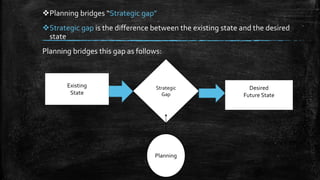
Planning bridges “Strategic gap”
Strategic gap is the difference between the existing state and the desired
state
Planning bridges this gap as follows:
Existing
State
Strategic
Gap
Desired
Future State
Planning
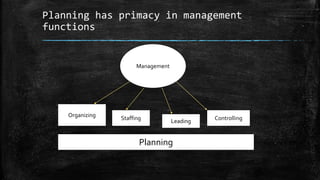
Planning has primacy in management
functions
Management
Organizing
Staffing
Leading
Controlling
Planning
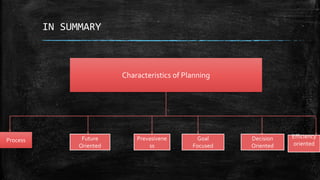
Characteristics
▪ Process
o Planning is a process.
o It is a step-by-step systematic way of doing things.
o It involves creative thinking and imagination.
 Future-oriented
o Planning anticipates future opportunities and threats.
o It gives direction to the organization.
o It deals with incertainty.
▪ Prevasiveness
o Planning is the function of every manager.
o Its nature and scope differ according to level of manager.
o Top manager set mission and objectives.
o Lower managers execute the plans.
 Goal-focused
o It sets goal and selects actions to achieve them.
o It entails commitment of resources to selected actions.
o Not based on hunch or guesswork.
o Actions are selected from among alternatives.
▪ Decision-oriented
o Involves decision at all levels of management.
o Involves interdependent set of decisions.
o Coordinates various activities through decisions.
 Efficiency-oriented
o Efficiency means greater output at lower costs.
o Alternatives are evaluated on the basis of efficiency.
IN SUMMARY
Characteristics of Planning
Process Future
Oriented
Prevasivene
ss
Goal
Focused
Decision
Oriented
Efficiency
oriented
Importance
 Uncertainty Reduction
Predetermines future targets and actions
Forces manager to think ahead, anticipate change, consider the
impact of change and develop appropriate responses
Provides roadmap fro future and avoids problem in future
 Goal Focus
Defines goals and determines courses of action to achieve them
Planning facilitates decision making
It establishes priorities and gives direction
▪ Better Coordination
Facilitates better mobilization, allocation and coordination of resources
Communication about plan avoids confusion
Integrated thinking is promoted
 Efficiency Promotion
 Facilitates efficient use of resources
It is a rational approach for goal achievement
Helps to do job correctly
Reduces cost by eliminating waste and avoiding duplication in efforts
 Environmental Adaptation
Identifies environmental opportunities
Helps organizations adapt to change
Encourages innovation and creativity
Change management becomes effective
 Commitment
Ensures commitment of managers and employees
Facilitates internalization of individual goals with organizational goals
Commits resources for the future periods
Encourages sense of involvement and team spirit
 Control
Control is not possible without planning
Sets standards of performance for control
Actual performance is compared with planned targets to make
corrections
Limitation
▪ Does not work in a Dynamic Environment
Planning is based on the anticipation of future happenings
Future is uncertain and dynamic, so the future anticipations are not always
true
Planning as the basis of success is like a leap in the dark.
 Reduces Creativity
All the activities connected with the attainment of objectives of the
organization are pre-determined.
Employees do not think about appropriate ways of discovering new
alternatives
According toTerry, “Planning strangulates the initiative of the employees
and compels them to work in an inflexible manner.”
▪ Involves Huge Costs
Planning becomes meaningful only after traversing a long path
During this entire period the managers remain busy in collecting a lot
of information and analyzing it
In this way, when so many people remain busy in the same activity,
the organization is bound to face huge costs
 Time-consuming Process
Planning is a long process so it cannot face sudden emergencies
Sudden emergencies can be in the form of some unforeseen problem
and there has been no planning for all these situations beforehand
and which now requires immediate decision.
In such a situation, if the manager thinks of completing the planning
process before taking some decision, it may be possible that the
situations may worsen or the chance of earning profit may slip away
 Does Not Guarantee Success
 Sometimes the managers think that planning solves all their problems
 Such thinking makes them neglect their real work and the adverse effect of such an
attitude has to be faced by the organization
 In this way, planning offers the managers a false sense of security and makes them
careless
 Internal rigidity
 Internal rigidity may be related to organizational and human psychology policy,
procedure and capital investment which create problem in the process of
implementation
 Staff may not like the changes that may occur frequently in the working procedure.
So rigidity may create problem in planning.
Methods Of Planning
▪ Top-down Method
It is top management driven
Top manager determine goals and formulate plans
Plans are communicated with middle and lower level managers for
implementation
Used in highly centralized organization
Top managers only have role in planning
 Bottom-up Method
Driven by middle and lower level managers
Plans are formulated at operational level
Top management reviews and approves the plan
Decentralized approach to planning
Those responsible for implementation are involved in planning
 Participative Method
 It is a blend of top-down and bottom-up method
Top management provides broad premises, parameters and
guidelines for planning to middle and lower level management
Middle and lower level management formulates the plans and
forwards them to top management
Management By Objective(MBO) is its example
This method provides flexibility in planning
All levels of managers are involved in planning process
 Team Method
Job of planning is entrusted to work a team
The members of the team posses multiple skills in planning
Team members can be line manager and staff experts
Team function as a unit
Team prepares draft plans and forward to the top management
Plans are reviewed and finalized by top management
Any
Queries???

planning and its methods

  • 1.
    A Presentation onConcept of PLANNING and its method Presented by:  Bishow Bandhu Khadka  Dinesh Bista  Jeevan Chapagain  Nabin Jamkatel  Rajiv Gupta
  • 2.
    Planning ▪ Definition Planning isthe process of setting goals and choosing the actions to achieve those goals. It attempts to define the future road map of an organization. Planning takes organization to where it wants to be. It is the prime instrument for directing efforts. According to Ricky Griffin “ Planning is setting an organization’s goal and deciding how best to achieve them.”
  • 3.
    Planning bridges “Strategicgap” Strategic gap is the difference between the existing state and the desired state Planning bridges this gap as follows: Existing State Strategic Gap Desired Future State Planning
  • 4.
    Planning has primacyin management functions Management Organizing Staffing Leading Controlling Planning
  • 5.
    Characteristics ▪ Process o Planningis a process. o It is a step-by-step systematic way of doing things. o It involves creative thinking and imagination.  Future-oriented o Planning anticipates future opportunities and threats. o It gives direction to the organization. o It deals with incertainty.
  • 6.
    ▪ Prevasiveness o Planningis the function of every manager. o Its nature and scope differ according to level of manager. o Top manager set mission and objectives. o Lower managers execute the plans.  Goal-focused o It sets goal and selects actions to achieve them. o It entails commitment of resources to selected actions. o Not based on hunch or guesswork. o Actions are selected from among alternatives.
  • 7.
    ▪ Decision-oriented o Involvesdecision at all levels of management. o Involves interdependent set of decisions. o Coordinates various activities through decisions.  Efficiency-oriented o Efficiency means greater output at lower costs. o Alternatives are evaluated on the basis of efficiency.
  • 8.
    IN SUMMARY Characteristics ofPlanning Process Future Oriented Prevasivene ss Goal Focused Decision Oriented Efficiency oriented
  • 9.
    Importance  Uncertainty Reduction Predeterminesfuture targets and actions Forces manager to think ahead, anticipate change, consider the impact of change and develop appropriate responses Provides roadmap fro future and avoids problem in future  Goal Focus Defines goals and determines courses of action to achieve them Planning facilitates decision making It establishes priorities and gives direction
  • 10.
    ▪ Better Coordination Facilitatesbetter mobilization, allocation and coordination of resources Communication about plan avoids confusion Integrated thinking is promoted  Efficiency Promotion  Facilitates efficient use of resources It is a rational approach for goal achievement Helps to do job correctly Reduces cost by eliminating waste and avoiding duplication in efforts
  • 11.
     Environmental Adaptation Identifiesenvironmental opportunities Helps organizations adapt to change Encourages innovation and creativity Change management becomes effective  Commitment Ensures commitment of managers and employees Facilitates internalization of individual goals with organizational goals Commits resources for the future periods Encourages sense of involvement and team spirit
  • 12.
     Control Control isnot possible without planning Sets standards of performance for control Actual performance is compared with planned targets to make corrections
  • 13.
    Limitation ▪ Does notwork in a Dynamic Environment Planning is based on the anticipation of future happenings Future is uncertain and dynamic, so the future anticipations are not always true Planning as the basis of success is like a leap in the dark.  Reduces Creativity All the activities connected with the attainment of objectives of the organization are pre-determined. Employees do not think about appropriate ways of discovering new alternatives According toTerry, “Planning strangulates the initiative of the employees and compels them to work in an inflexible manner.”
  • 14.
    ▪ Involves HugeCosts Planning becomes meaningful only after traversing a long path During this entire period the managers remain busy in collecting a lot of information and analyzing it In this way, when so many people remain busy in the same activity, the organization is bound to face huge costs  Time-consuming Process Planning is a long process so it cannot face sudden emergencies Sudden emergencies can be in the form of some unforeseen problem and there has been no planning for all these situations beforehand and which now requires immediate decision. In such a situation, if the manager thinks of completing the planning process before taking some decision, it may be possible that the situations may worsen or the chance of earning profit may slip away
  • 15.
     Does NotGuarantee Success  Sometimes the managers think that planning solves all their problems  Such thinking makes them neglect their real work and the adverse effect of such an attitude has to be faced by the organization  In this way, planning offers the managers a false sense of security and makes them careless  Internal rigidity  Internal rigidity may be related to organizational and human psychology policy, procedure and capital investment which create problem in the process of implementation  Staff may not like the changes that may occur frequently in the working procedure. So rigidity may create problem in planning.
  • 16.
    Methods Of Planning ▪Top-down Method It is top management driven Top manager determine goals and formulate plans Plans are communicated with middle and lower level managers for implementation Used in highly centralized organization Top managers only have role in planning
  • 17.
     Bottom-up Method Drivenby middle and lower level managers Plans are formulated at operational level Top management reviews and approves the plan Decentralized approach to planning Those responsible for implementation are involved in planning
  • 18.
     Participative Method It is a blend of top-down and bottom-up method Top management provides broad premises, parameters and guidelines for planning to middle and lower level management Middle and lower level management formulates the plans and forwards them to top management Management By Objective(MBO) is its example This method provides flexibility in planning All levels of managers are involved in planning process
  • 19.
     Team Method Jobof planning is entrusted to work a team The members of the team posses multiple skills in planning Team members can be line manager and staff experts Team function as a unit Team prepares draft plans and forward to the top management Plans are reviewed and finalized by top management
  • 20.