Organizationa
l Goals
Presented by
Aglaia
Organizational Goals
• Organizational goals are strategically set
objectives that outline expected results and guide
employees’ efforts.
• Purposes of organizational goals are to provide
direction to employees of the organization.
• Goals are critical to organizational effectiveness as
they serve as an objective for the employees and
they work to achieve it.
• Organizational goals differ in three different
criteria’s; level, area, and time frame. Let’s look at
these criteria’s of goals;
Level
• Organizational goal differs in the level of the
organization structure or hierarchy.
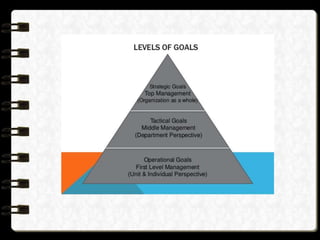
• Organization structure consist of there part;
top-level, mid-level and lower-level or first-line
managers.
• For each level, the goals should be different
and more specific; suitable for the level.
• “Increase profit and market share” is a suitable
goal for top-level managers but not for the
lower level managers.
• “Increase output by 12%” is a suitable goal for
lower-level managers.
Area
• Organization set different goals for different
areas more specifically different departments.
• An organization may have many departments
within its structure; marketing, finance,
operations, accounts, human resource, legal and
more.
• Each department should have a different goal;
which specifies the departments about their
task but is in line with the whole organization’s
goal.
Time Frame
• Organizations have many goals across
different time frames. “Open 500 branch
across the country” is a suitable long-term
goal for a bank; “LC issue should increase
by 50% within six months” short-term goal
for a bank.
• The difference in goals required because of
the organization’s level, area or
department, and time frame.
Types of Organizational Goals
Based on 3 three criteria’s goals can be
categorized into three types.
1. Strategic Goals.
2. Tactical Goals.
3. Operational Goals.
Strategic Goals
• They are goals set by and for top
management of the organization.
• These goals are made by focusing on
broad general issues.
• They are usually long-term and from this
goal, other goals are made and set for
different time-frames and area.
Tactical Goals
• They are set for middle managers.
• These goals focus on how to operationalize
actions necessary to achieve the strategic
goals.
• Middle managers of various departments
are usually responsible for their attainment.
• They are set by the middle managers, but
often top-managers set tactical goals for
the middle managers.
Operational Goals
• They are set by and for lower-level
managers.
• They are usually made to tackle shorter-
term issues associated with the tactical
goals and lower-managers are responsible
for their attainment.
• The 3 levels of goals within an organization
form a hierarchy of goals, with lower-level
goals forming a means-end chain with the
next level of goals.
Importance and purpose of
organizational goals
• Organizational goals, often used interchangeably, are
the ends toward which activity is aimed. Goals are
desired outcomes for individuals, groups, or entire
organizations.
• They represent not only the end point of planning but
also the end toward which all other managerial
functions are aimed.
• In fact, objectives are set in relation to a particular time
period and thus the same objective is not repeated
year after year, month after month or day after day.
• Goals are critical to organizational effectiveness as they
serve a number of purposes. Organizations have
several different kinds of goals, all of which must be
appropriately managed.
4 reasons why goals are important
1. Goals Provide Guidance and Direction.
2. Goals Intensely Planning and Actions
3. Goals Motivate.
4. Goals Help in Control.
Goals Provide Guidance and Direction
• It provide guidance and a unified direction for people in
the organization.
• They show the employees where the organization is
going and why getting it is important.
• It simply define what the organization wants.
Goals Intensely Planning and Actions
• Goal-setting does intensely affect aspects of planning.
• Effective goal setting facilitates good planning and good
planning facilitates future goal setting.
• Goals are desired outcomes for organizations and plans
are the best-perceived ways to reach them. So a proper
goal is helpful for setting a proper plan.
Goals Motivate
• Goals also can serve as a motivational source for
employees. Goals should be specific and moderately
difficult can inspire people to work harder, especially if
attaining the goal is going to result in rewards.
• For goals to be a tool of motivation; organization requires
effective reward system and friendly work environment.
Goals Help in Control
• Goals act as a mechanism for control and evaluation.
Performance can be measured and evaluated in the future
in terms of how successfully today’s goals are
accomplished.
• Goals can serve these purposes and much more; if people
in charge of setting goals can overcome the barriers and set
it in a proper and effective manner.
Thank you
Lintels
For more…. Mail to aglaiaconnect2018@gmail.com

Organisational goals

  • 1.
  • 2.
    Organizational Goals • Organizationalgoals are strategically set objectives that outline expected results and guide employees’ efforts. • Purposes of organizational goals are to provide direction to employees of the organization. • Goals are critical to organizational effectiveness as they serve as an objective for the employees and they work to achieve it. • Organizational goals differ in three different criteria’s; level, area, and time frame. Let’s look at these criteria’s of goals;
  • 3.
    Level • Organizational goaldiffers in the level of the organization structure or hierarchy. • Organization structure consist of there part; top-level, mid-level and lower-level or first-line managers. • For each level, the goals should be different and more specific; suitable for the level. • “Increase profit and market share” is a suitable goal for top-level managers but not for the lower level managers. • “Increase output by 12%” is a suitable goal for lower-level managers.
  • 5.
    Area • Organization setdifferent goals for different areas more specifically different departments. • An organization may have many departments within its structure; marketing, finance, operations, accounts, human resource, legal and more. • Each department should have a different goal; which specifies the departments about their task but is in line with the whole organization’s goal.
  • 6.
    Time Frame • Organizationshave many goals across different time frames. “Open 500 branch across the country” is a suitable long-term goal for a bank; “LC issue should increase by 50% within six months” short-term goal for a bank. • The difference in goals required because of the organization’s level, area or department, and time frame.
  • 7.
    Types of OrganizationalGoals Based on 3 three criteria’s goals can be categorized into three types. 1. Strategic Goals. 2. Tactical Goals. 3. Operational Goals.
  • 8.
    Strategic Goals • Theyare goals set by and for top management of the organization. • These goals are made by focusing on broad general issues. • They are usually long-term and from this goal, other goals are made and set for different time-frames and area.
  • 9.
    Tactical Goals • Theyare set for middle managers. • These goals focus on how to operationalize actions necessary to achieve the strategic goals. • Middle managers of various departments are usually responsible for their attainment. • They are set by the middle managers, but often top-managers set tactical goals for the middle managers.
  • 10.
    Operational Goals • Theyare set by and for lower-level managers. • They are usually made to tackle shorter- term issues associated with the tactical goals and lower-managers are responsible for their attainment. • The 3 levels of goals within an organization form a hierarchy of goals, with lower-level goals forming a means-end chain with the next level of goals.
  • 11.
    Importance and purposeof organizational goals • Organizational goals, often used interchangeably, are the ends toward which activity is aimed. Goals are desired outcomes for individuals, groups, or entire organizations. • They represent not only the end point of planning but also the end toward which all other managerial functions are aimed. • In fact, objectives are set in relation to a particular time period and thus the same objective is not repeated year after year, month after month or day after day. • Goals are critical to organizational effectiveness as they serve a number of purposes. Organizations have several different kinds of goals, all of which must be appropriately managed.
  • 12.
    4 reasons whygoals are important 1. Goals Provide Guidance and Direction. 2. Goals Intensely Planning and Actions 3. Goals Motivate. 4. Goals Help in Control.
  • 13.
    Goals Provide Guidanceand Direction • It provide guidance and a unified direction for people in the organization. • They show the employees where the organization is going and why getting it is important. • It simply define what the organization wants. Goals Intensely Planning and Actions • Goal-setting does intensely affect aspects of planning. • Effective goal setting facilitates good planning and good planning facilitates future goal setting. • Goals are desired outcomes for organizations and plans are the best-perceived ways to reach them. So a proper goal is helpful for setting a proper plan.
  • 14.
    Goals Motivate • Goalsalso can serve as a motivational source for employees. Goals should be specific and moderately difficult can inspire people to work harder, especially if attaining the goal is going to result in rewards. • For goals to be a tool of motivation; organization requires effective reward system and friendly work environment. Goals Help in Control • Goals act as a mechanism for control and evaluation. Performance can be measured and evaluated in the future in terms of how successfully today’s goals are accomplished. • Goals can serve these purposes and much more; if people in charge of setting goals can overcome the barriers and set it in a proper and effective manner.
  • 15.
    Thank you Lintels For more….Mail to aglaiaconnect2018@gmail.com