Obesity in
Elderly
Roxana Aminbakhsh, MD.
Geriatrition
Introduction
 Obesity is defined as an unhealthy excess
of body fat which enhances the risk of
morbidity and untimely mortality.
Introduction
 It is accompanied by ;
Burden of chronic diseases,
Metabolic complications,
Worsening of quality of life.
 More importantly:
Obesity exacerbates the age related decline in
physical function  Frailty & Disability.
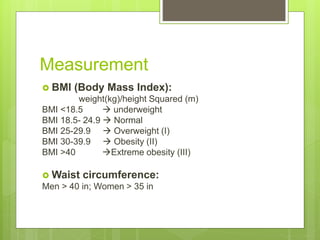
Measurement
 BMI (Body Mass Index):
weight(kg)/height Squared (m)
BMI <18.5  underweight
BMI 18.5- 24.9  Normal
BMI 25-29.9  Overweight (I)
BMI 30-39.9  Obesity (II)
BMI >40 Extreme obesity (III)
 Waist circumference:
Men > 40 in; Women > 35 in
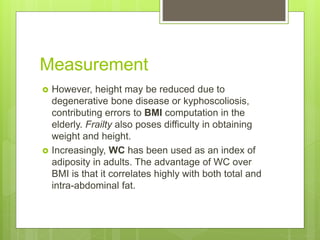
Measurement
 However, height may be reduced due to
degenerative bone disease or kyphoscoliosis,
contributing errors to BMI computation in the
elderly. Frailty also poses difficulty in obtaining
weight and height.
 Increasingly, WC has been used as an index of
adiposity in adults. The advantage of WC over
BMI is that it correlates highly with both total and
intra-abdominal fat.
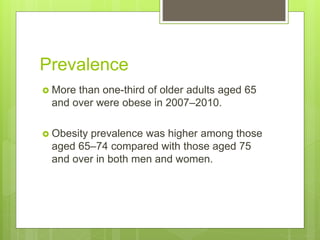
Prevalence
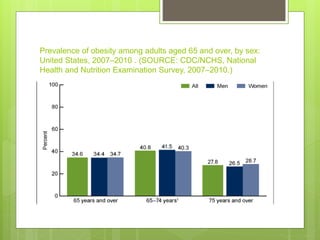
 More than one-third of older adults aged 65
and over were obese in 2007–2010.
 Obesity prevalence was higher among those
aged 65‒74 compared with those aged 75
and over in both men and women.
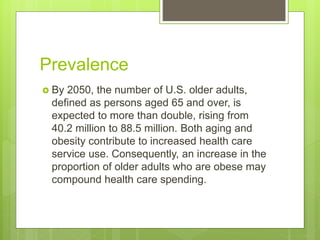
Prevalence
 By 2050, the number of U.S. older adults,
defined as persons aged 65 and over, is
expected to more than double, rising from
40.2 million to 88.5 million. Both aging and
obesity contribute to increased health care
service use. Consequently, an increase in the
proportion of older adults who are obese may
compound health care spending.
Prevalence of obesity among adults aged 65 and over, by sex:
United States, 2007–2010 . (SOURCE: CDC/NCHS, National
Health and Nutrition Examination Survey, 2007‒2010.)
Prevalence
 IS there any differences in the prevalence
of obesity among older adults by race and
ethnicity?
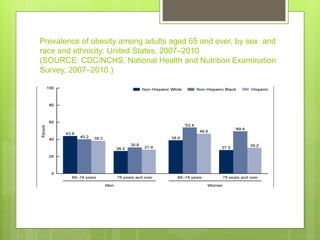
Prevalence of obesity among adults aged 65 and over, by sex and
race and ethnicity: United States, 2007–2010
(SOURCE: CDC/NCHS, National Health and Nutrition Examination
Survey, 2007‒2010.)
Prevalence
 Is there any differences in the prevalence
of obesity among older adults by race and
ethnicity?
 There were no significant differences in
obesity prevalence by race and ethnicity
among men. However, the prevalence of
obesity differed by race and ethnicity among
women.
Prevalence
 Is there any differences in the prevalence
of obesity among older adults by
educational attainment?
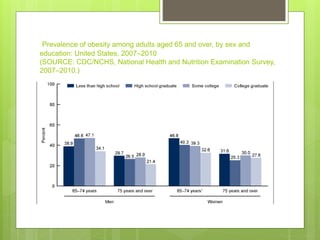
Prevalence of obesity among adults aged 65 and over, by sex and
education: United States, 2007–2010
(SOURCE: CDC/NCHS, National Health and Nutrition Examination Survey,
2007‒2010.)
Prevalence
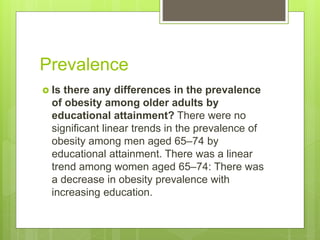
 Is there any differences in the prevalence
of obesity among older adults by
educational attainment? There were no
significant linear trends in the prevalence of
obesity among men aged 65–74 by
educational attainment. There was a linear
trend among women aged 65‒74: There was
a decrease in obesity prevalence with
increasing education.
Body composition & aging
 After the age of 30 years, There is a
progressive decrease in fat-free mass (FFM),
such as muscles and bone and an increase in
fat mass.
 Aging is also associated with the redistribution
of body fat (Central obesity).
Body composition & aging
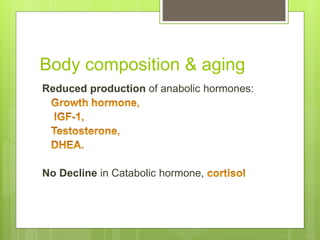
Reduced production of anabolic hormones:
No Decline in Catabolic hormone,
Causes of Obesity in Elderly
 Obesity results when:
Total energy intake >energy out put
What happens to energy intake in elderly?
Causes of Obesity in Elderly
 Obesity results when:
Total energy intake >energy out put
What happens to energy intake in elderly?
Energy intake neither changes nor declines with
advancing age. Hence, the decrease in total
energy output (EO) is an important contributor
to obesity in elderly.
Causes of Obesity in Elderly
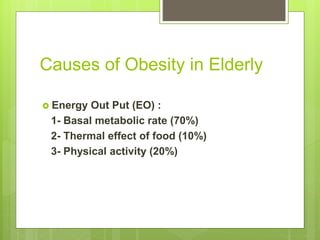
 Energy Out Put (EO) :
1- Basal metabolic rate (70%)
2- Thermal effect of food (10%)
3- Physical activity (20%)
Causes of Obesity in Elderly
 What happens to basal metabolic rate?
Causes of Obesity in Elderly
 What happens to basal metabolic rate?
It decreases because of decrease in FFM.
Causes of Obesity in Elderly
 What happens to basal metabolic rate?
It decreases because of decrease in FFM.
 What is the thermic effect of food (TEF)
and what happens to it?
Causes of Obesity in Elderly
 What happens to basal metabolic rate?
It decreases because of decrease in FFM.
 What is the thermic effect of food (TEF)
and what happens to it?
Causes of Obesity in Elderly
 Thermic effect of food (TEF) is simply the
energy used in digestion, absorption and
distribution of nutrients.
 Thermic effect of food (TEF) also declines
with ageing.
Causes of Obesity in Elderly
 What about the physical activity
component?
Causes of Obesity in Elderly
 What about the physical activity
component?
Actually the declines in physical activity with
ageing contributes to almost 50% of the
reduction in EO that occurs with ageing.
Mortality
 Obesity is associated with a higher relative
risk of death for younger adults than for older
ones.
 An elevated BMI  increase in absolute
mortality and health risk linearly up to 75
years of age.
 One explanation for this demographic shift is
selective mortality.
Comorbid conditions
 Insulin resistance & type II DM
 Dyslipidemia (high TG, Low HDL)
 HTN
 CAD
 Increase in joint immobility and arthritis
 Obstructive sleep apnea
 Neoplasia
 Urinary incontinence
Comorbid conditions
 Higher rate of Nursing home admission.
 Frailty syndrome (96% of community- living
obese (BMI >30) elderly (65-80 years old) are
frail.
 Relative sarcopenia,
 Functional dependence and poor quality of
life.
Beneficial effects of Obesity
 Decrease in osteoporosis- related fractures:
1- Increased adipose tissue conversion of
androstenedione to estrone.
2- Extra cushioning provided by body fat.
Mechanisms by which obesity
increases mortality & morbidity
 Adipose tissue is recognized as a source of
inflammatory mediators by producing
cytokines such as:


 It is postulated that visceral fat ( Intra-
abdominal fat) is most responsible for
producing these cytokines.
Effects of intentional weight loss
in older adults
 Weight loss results in decrease in both fat
mass (75%) and FFM (25%), it is possible
that weight loss in obese older persons could
worsen the age related loss in muscle mass.
Physical function- quality of life
 It is well known that weight loss improves or
normalizes metabolic abnormalities
associated with obesity in young and middle
aged persons. Clinical trials shows similar
results in elderly.
 Weight loss in combination with exercise
training showed beneficial effect on muscle
strength.
Physical function- quality of life
 One study demonstrated that diet- induced
weight loss programs can indeed improve
both endurance capacity and exercise
tolerance in obese older adults despite loss
of FFM.
Bone mineral density
 A clinical trial conducted in young and
middle- aged persons showed that diet-
induced weight loss, but not exercise –
induced weight loss, is associated with
decrease in bone mineral density (BMD).
 However, one study showed that moderate
weight loss even when combined with
exercise decreases BMD in elderly.
Mortality
 In epidemiologic studies, it has been
observed that older adults who lost weight, or
who experienced weight recycling, had an
increased relative mortality risk compared
to those who were weight- stable.
Effects of intentional weight loss
in older adults
 SHOULD OBESE ELDERLY LOSE WEIGHT
OR NOT?
Weight Loss

.
Weight Loss
 HOW?
Lifestyle interventions
 HOW?
 Life- style intervention is just in
older subjects as in younger ones.
Diet Therapy
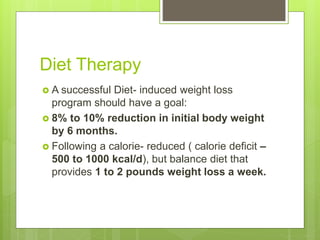
 A successful Diet- induced weight loss
program should have a goal:
 8% to 10% reduction in initial body weight
by 6 months.
 Following a calorie- reduced ( calorie deficit –
500 to 1000 kcal/d), but balance diet that
provides 1 to 2 pounds weight loss a week.
Exercise Therapy
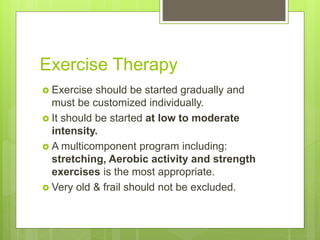
 Exercise should be started gradually and
must be customized individually.
 It should be started at low to moderate
intensity.
 A multicomponent program including:
stretching, Aerobic activity and strength
exercises is the most appropriate.
 Very old & frail should not be excluded.
Exercise Therapy
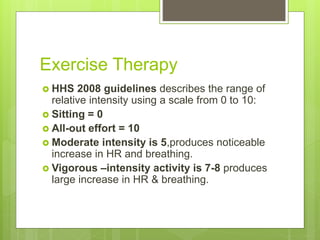
 HHS 2008 guidelines describes the range of
relative intensity using a scale from 0 to 10:
 Sitting = 0
 All-out effort = 10
 Moderate intensity is 5,produces noticeable
increase in HR and breathing.
 Vigorous –intensity activity is 7-8 produces
large increase in HR & breathing.
Exercise Therapy
Talk Test
 During moderate intensity exercise patient
should be able to talk without pauses, but not
sing.
 During vigorous activity, a person cannot say
more than few words without pausing for
breath.
Pharmacotherapy
 Limited data are available.
 Can increase in likelihood of noncompliance
and errors.
 All medications should be carefully reviewed
for interactions.
 Antipsychotics, antidepressants,
anticonvulsants, steroids can cause weight
gain.
Bariatric Surgery
 The available evidence for safety and
effectiveness is insufficient.
 It should be considered for selective older adults
who have disabling obesity that can be
ameliorated with weight loss and have failed
multiple weight loss attempts in the past.
 The multidisciplinary team should evaluate the
case carefully prior to surgery.
References
 Brocklehurst’s Textbook of Geriatric Medicine
and Gerontology, 7th Edition,
 Geriatrics Review Syllabus, 8th edition
 British Medical Bulletin, Volume 97, Issue Pp.
169-196,
 The American Journal of Clinical Nutrition,
 CDC/NCHS, National Health and Nutrition
Examination Survey, 2007‒2010.

Obesity power point 2018

  • 1.
  • 2.
    Introduction  Obesity isdefined as an unhealthy excess of body fat which enhances the risk of morbidity and untimely mortality.
  • 3.
    Introduction  It isaccompanied by ; Burden of chronic diseases, Metabolic complications, Worsening of quality of life.  More importantly: Obesity exacerbates the age related decline in physical function  Frailty & Disability.
  • 4.
    Measurement  BMI (BodyMass Index): weight(kg)/height Squared (m) BMI <18.5  underweight BMI 18.5- 24.9  Normal BMI 25-29.9  Overweight (I) BMI 30-39.9  Obesity (II) BMI >40 Extreme obesity (III)  Waist circumference: Men > 40 in; Women > 35 in
  • 5.
    Measurement  However, heightmay be reduced due to degenerative bone disease or kyphoscoliosis, contributing errors to BMI computation in the elderly. Frailty also poses difficulty in obtaining weight and height.  Increasingly, WC has been used as an index of adiposity in adults. The advantage of WC over BMI is that it correlates highly with both total and intra-abdominal fat.
  • 6.
    Prevalence  More thanone-third of older adults aged 65 and over were obese in 2007–2010.  Obesity prevalence was higher among those aged 65‒74 compared with those aged 75 and over in both men and women.
  • 7.
    Prevalence  By 2050,the number of U.S. older adults, defined as persons aged 65 and over, is expected to more than double, rising from 40.2 million to 88.5 million. Both aging and obesity contribute to increased health care service use. Consequently, an increase in the proportion of older adults who are obese may compound health care spending.
  • 8.
    Prevalence of obesityamong adults aged 65 and over, by sex: United States, 2007–2010 . (SOURCE: CDC/NCHS, National Health and Nutrition Examination Survey, 2007‒2010.)
  • 9.
    Prevalence  IS thereany differences in the prevalence of obesity among older adults by race and ethnicity?
  • 10.
    Prevalence of obesityamong adults aged 65 and over, by sex and race and ethnicity: United States, 2007–2010 (SOURCE: CDC/NCHS, National Health and Nutrition Examination Survey, 2007‒2010.)
  • 11.
    Prevalence  Is thereany differences in the prevalence of obesity among older adults by race and ethnicity?  There were no significant differences in obesity prevalence by race and ethnicity among men. However, the prevalence of obesity differed by race and ethnicity among women.
  • 12.
    Prevalence  Is thereany differences in the prevalence of obesity among older adults by educational attainment?
  • 13.
    Prevalence of obesityamong adults aged 65 and over, by sex and education: United States, 2007–2010 (SOURCE: CDC/NCHS, National Health and Nutrition Examination Survey, 2007‒2010.)
  • 14.
    Prevalence  Is thereany differences in the prevalence of obesity among older adults by educational attainment? There were no significant linear trends in the prevalence of obesity among men aged 65–74 by educational attainment. There was a linear trend among women aged 65‒74: There was a decrease in obesity prevalence with increasing education.
  • 15.
    Body composition &aging  After the age of 30 years, There is a progressive decrease in fat-free mass (FFM), such as muscles and bone and an increase in fat mass.  Aging is also associated with the redistribution of body fat (Central obesity).
  • 16.
    Body composition &aging Reduced production of anabolic hormones: No Decline in Catabolic hormone,
  • 17.
    Causes of Obesityin Elderly  Obesity results when: Total energy intake >energy out put What happens to energy intake in elderly?
  • 18.
    Causes of Obesityin Elderly  Obesity results when: Total energy intake >energy out put What happens to energy intake in elderly? Energy intake neither changes nor declines with advancing age. Hence, the decrease in total energy output (EO) is an important contributor to obesity in elderly.
  • 19.
    Causes of Obesityin Elderly  Energy Out Put (EO) : 1- Basal metabolic rate (70%) 2- Thermal effect of food (10%) 3- Physical activity (20%)
  • 20.
    Causes of Obesityin Elderly  What happens to basal metabolic rate?
  • 21.
    Causes of Obesityin Elderly  What happens to basal metabolic rate? It decreases because of decrease in FFM.
  • 22.
    Causes of Obesityin Elderly  What happens to basal metabolic rate? It decreases because of decrease in FFM.  What is the thermic effect of food (TEF) and what happens to it?
  • 23.
    Causes of Obesityin Elderly  What happens to basal metabolic rate? It decreases because of decrease in FFM.  What is the thermic effect of food (TEF) and what happens to it?
  • 24.
    Causes of Obesityin Elderly  Thermic effect of food (TEF) is simply the energy used in digestion, absorption and distribution of nutrients.  Thermic effect of food (TEF) also declines with ageing.
  • 25.
    Causes of Obesityin Elderly  What about the physical activity component?
  • 26.
    Causes of Obesityin Elderly  What about the physical activity component? Actually the declines in physical activity with ageing contributes to almost 50% of the reduction in EO that occurs with ageing.
  • 27.
    Mortality  Obesity isassociated with a higher relative risk of death for younger adults than for older ones.  An elevated BMI  increase in absolute mortality and health risk linearly up to 75 years of age.  One explanation for this demographic shift is selective mortality.
  • 28.
    Comorbid conditions  Insulinresistance & type II DM  Dyslipidemia (high TG, Low HDL)  HTN  CAD  Increase in joint immobility and arthritis  Obstructive sleep apnea  Neoplasia  Urinary incontinence
  • 29.
    Comorbid conditions  Higherrate of Nursing home admission.  Frailty syndrome (96% of community- living obese (BMI >30) elderly (65-80 years old) are frail.  Relative sarcopenia,  Functional dependence and poor quality of life.
  • 30.
    Beneficial effects ofObesity  Decrease in osteoporosis- related fractures: 1- Increased adipose tissue conversion of androstenedione to estrone. 2- Extra cushioning provided by body fat.
  • 31.
    Mechanisms by whichobesity increases mortality & morbidity  Adipose tissue is recognized as a source of inflammatory mediators by producing cytokines such as:    It is postulated that visceral fat ( Intra- abdominal fat) is most responsible for producing these cytokines.
  • 32.
    Effects of intentionalweight loss in older adults  Weight loss results in decrease in both fat mass (75%) and FFM (25%), it is possible that weight loss in obese older persons could worsen the age related loss in muscle mass.
  • 33.
    Physical function- qualityof life  It is well known that weight loss improves or normalizes metabolic abnormalities associated with obesity in young and middle aged persons. Clinical trials shows similar results in elderly.  Weight loss in combination with exercise training showed beneficial effect on muscle strength.
  • 34.
    Physical function- qualityof life  One study demonstrated that diet- induced weight loss programs can indeed improve both endurance capacity and exercise tolerance in obese older adults despite loss of FFM.
  • 35.
    Bone mineral density A clinical trial conducted in young and middle- aged persons showed that diet- induced weight loss, but not exercise – induced weight loss, is associated with decrease in bone mineral density (BMD).  However, one study showed that moderate weight loss even when combined with exercise decreases BMD in elderly.
  • 36.
    Mortality  In epidemiologicstudies, it has been observed that older adults who lost weight, or who experienced weight recycling, had an increased relative mortality risk compared to those who were weight- stable.
  • 37.
    Effects of intentionalweight loss in older adults  SHOULD OBESE ELDERLY LOSE WEIGHT OR NOT?
  • 38.
  • 39.
  • 40.
    Lifestyle interventions  HOW? Life- style intervention is just in older subjects as in younger ones.
  • 41.
    Diet Therapy  Asuccessful Diet- induced weight loss program should have a goal:  8% to 10% reduction in initial body weight by 6 months.  Following a calorie- reduced ( calorie deficit – 500 to 1000 kcal/d), but balance diet that provides 1 to 2 pounds weight loss a week.
  • 42.
    Exercise Therapy  Exerciseshould be started gradually and must be customized individually.  It should be started at low to moderate intensity.  A multicomponent program including: stretching, Aerobic activity and strength exercises is the most appropriate.  Very old & frail should not be excluded.
  • 43.
    Exercise Therapy  HHS2008 guidelines describes the range of relative intensity using a scale from 0 to 10:  Sitting = 0  All-out effort = 10  Moderate intensity is 5,produces noticeable increase in HR and breathing.  Vigorous –intensity activity is 7-8 produces large increase in HR & breathing.
  • 44.
    Exercise Therapy Talk Test During moderate intensity exercise patient should be able to talk without pauses, but not sing.  During vigorous activity, a person cannot say more than few words without pausing for breath.
  • 45.
    Pharmacotherapy  Limited dataare available.  Can increase in likelihood of noncompliance and errors.  All medications should be carefully reviewed for interactions.  Antipsychotics, antidepressants, anticonvulsants, steroids can cause weight gain.
  • 46.
    Bariatric Surgery  Theavailable evidence for safety and effectiveness is insufficient.  It should be considered for selective older adults who have disabling obesity that can be ameliorated with weight loss and have failed multiple weight loss attempts in the past.  The multidisciplinary team should evaluate the case carefully prior to surgery.
  • 47.
    References  Brocklehurst’s Textbookof Geriatric Medicine and Gerontology, 7th Edition,  Geriatrics Review Syllabus, 8th edition  British Medical Bulletin, Volume 97, Issue Pp. 169-196,  The American Journal of Clinical Nutrition,  CDC/NCHS, National Health and Nutrition Examination Survey, 2007‒2010.