OBESITPAOLA MANSILLA LETELIER, MD
ENDOCRINOLOGIST
THYROID AND ENDOCRINE CENTER
TEXT
LEARNING OBJECTIVES
▸Apply counseling strategies to promote behavior change in
patients with obesity
▸Learn about new guidelines for management of Obesity
▸Select adequate obesity medications taking into account
patient’s Comorbidities
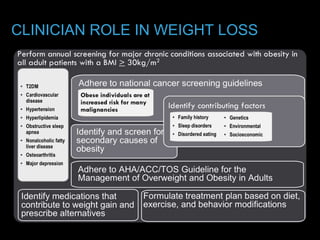
CLINICIAN ROLE IN WEIGHT LOSS
OBESITY
DEFINITIONS
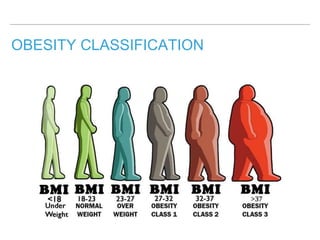
▸Obesity: Body Mass Index (BMI) of 30 kg/m2 or higher.
▸Body Mass Index (BMI): A measure of an adult’s weight in
relation to his or her height, calculated by using the adult’s
weight in kilograms divided by the square of his or her height
in meters.
OBESITY CLASSIFICATION
OBESITY
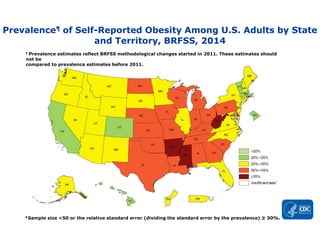
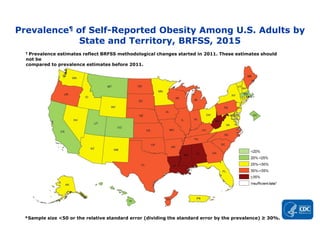
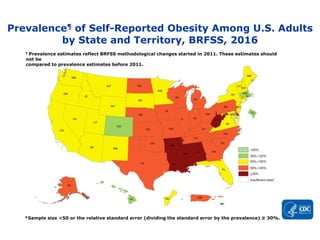
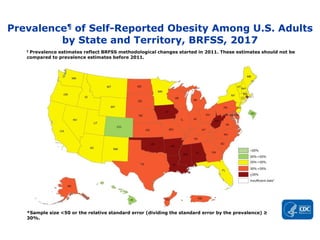
OBESITY PREVALENCE MAPS
▸Adult obesity prevalence by state and territory using self-reported information from the Behavioral
Risk Factor Surveillance System.
▸Obesity is common, serious, and costly
▸The prevalence of obesity was 39.8% and affected about 93.3 million of US adults in 2015~2016.
▸Obesity-related conditions include heart disease, stroke, type 2 diabetes and certain types of
cancer that are some of the leading causes of preventable, premature death. [Read
guidelinesExternal
]
▸The estimated annual medical cost of obesity in the United States was $147 billion in 2008 US
dollars; the medical cost for people who have obesity was $1,429 higher than those of normal
weight
CDC National Center for Health Statistics (NCHS) data briefCdc-pdf
PDF-603KB
TEXT
OBESITY
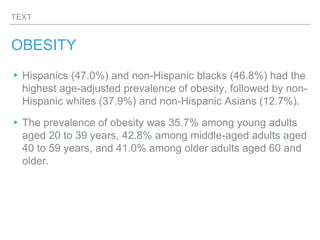
▸Hispanics (47.0%) and non-Hispanic blacks (46.8%) had the
highest age-adjusted prevalence of obesity, followed by non-
Hispanic whites (37.9%) and non-Hispanic Asians (12.7%).
▸The prevalence of obesity was 35.7% among young adults
aged 20 to 39 years, 42.8% among middle-aged adults aged
40 to 59 years, and 41.0% among older adults aged 60 and
older.
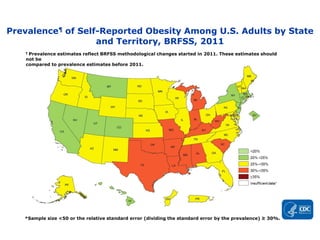
Prevalence¶ of Self-Reported Obesity Among U.S. Adults by State
and Territory, BRFSS, 2011
*Sample size <50 or the relative standard error (dividing the standard error by the prevalence) ≥ 30%.
¶ Prevalence estimates reflect BRFSS methodological changes started in 2011. These estimates should
not be
compared to prevalence estimates before 2011.
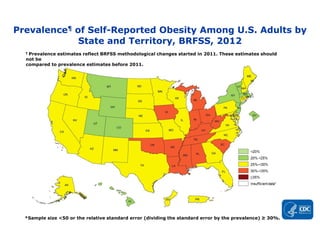
Prevalence¶ of Self-Reported Obesity Among U.S. Adults by
State and Territory, BRFSS, 2012
*Sample size <50 or the relative standard error (dividing the standard error by the prevalence) ≥ 30%.
¶ Prevalence estimates reflect BRFSS methodological changes started in 2011. These estimates should
not be
compared to prevalence estimates before 2011.
Prevalence¶ of Self-Reported Obesity Among U.S. Adults by
State and Territory, BRFSS, 2013
*Sample size <50 or the relative standard error (dividing the standard error by the prevalence) ≥ 30%.
¶ Prevalence estimates reflect BRFSS methodological changes started in 2011. These estimates should
not be
compared to prevalence estimates before 2011.
Prevalence¶ of Self-Reported Obesity Among U.S. Adults by State
and Territory, BRFSS, 2014
*Sample size <50 or the relative standard error (dividing the standard error by the prevalence) ≥ 30%.
¶ Prevalence estimates reflect BRFSS methodological changes started in 2011. These estimates should
not be
compared to prevalence estimates before 2011.
Prevalence¶ of Self-Reported Obesity Among U.S. Adults by
State and Territory, BRFSS, 2015
*Sample size <50 or the relative standard error (dividing the standard error by the prevalence) ≥ 30%.
¶ Prevalence estimates reflect BRFSS methodological changes started in 2011. These estimates should
not be
compared to prevalence estimates before 2011.
Prevalence¶ of Self-Reported Obesity Among U.S. Adults
by State and Territory, BRFSS, 2016
*Sample size <50 or the relative standard error (dividing the standard error by the prevalence) ≥ 30%.
¶ Prevalence estimates reflect BRFSS methodological changes started in 2011. These estimates should
not be
compared to prevalence estimates before 2011.
Prevalence¶ of Self-Reported Obesity Among U.S. Adults
by State and Territory, BRFSS, 2017
¶ Prevalence estimates reflect BRFSS methodological changes started in 2011. These estimates should not be
compared to prevalence estimates before 2011.
*Sample size <50 or the relative standard error (dividing the standard error by the prevalence) ≥
30%.
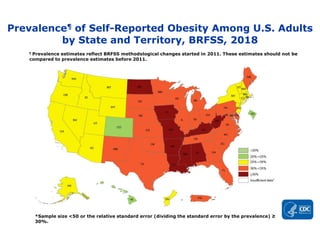
Prevalence¶ of Self-Reported Obesity Among U.S. Adults
by State and Territory, BRFSS, 2018
¶ Prevalence estimates reflect BRFSS methodological changes started in 2011. These estimates should not be
compared to prevalence estimates before 2011.
*Sample size <50 or the relative standard error (dividing the standard error by the prevalence) ≥
30%.
OBESITY
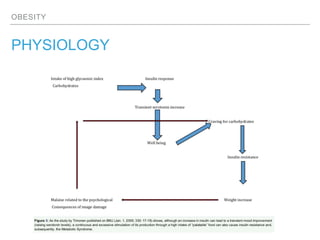
PHYSIOLOGY
OBESITY
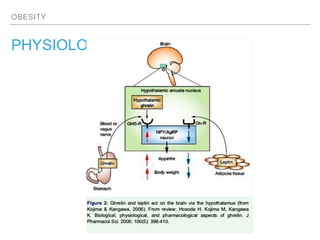
PHYSIOLOGY
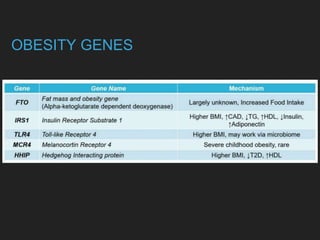
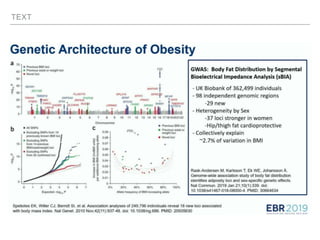
OBESITY GENES
TEXT
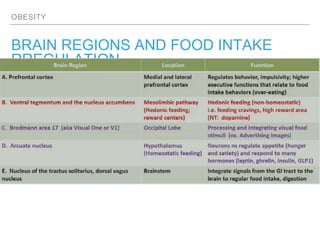
OBESITY
BRAIN REGIONS AND FOOD INTAKE
RREGULATION
OBESITY
OBESITY
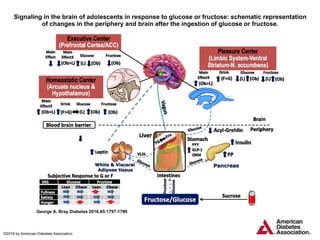
Signaling in the brain of adolescents in response to glucose or fructose: schematic representation
of changes in the periphery and brain after the ingestion of glucose or fructose.
George A. Bray Diabetes 2016;65:1797-1799
©2016 by American Diabetes Association
TEXT
OBESITY
MANAGEMEN
T
TEXT
TEXT
NUTRITION
“LET FOOD
BE THY
MEDICINE”Hippocrates
OBESITY
NUTRITION
▸Reduced-calorie meal plan and macronutrient
composition.Reducing total energy (caloric) intake should be
the main component of any weight-loss intervention.
▸Modifying macronutrient composition may be considered to
optimize adherence, eating patterns, weight loss, metabolic
profiles, risk factor reduction, and/or clinical outcomes
OBESITY
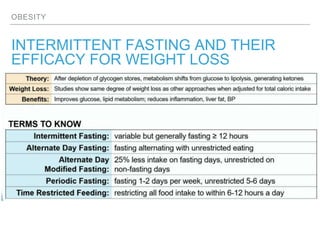
INTERMITTENT FASTING AND THEIR
EFFICACY FOR WEIGHT LOSS
OBESITY
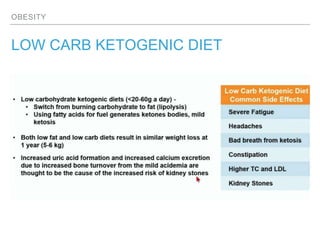
LOW CARB KETOGENIC DIET
PHYSICAL
ACTIVITY
OBESITY
PHYSICAL ACTIVITY
▸Aerobic physical activity training should be prescribed to patients with overweight or
obesity as a component of lifestyle intervention; the ultimate goal should be ≥150
min/week of moderate exercise performed during 3 to 5 daily sessions per week
▸Behavioral lifestyle intervention and support should be intensified if patients do not
achieve a 2.5% weight loss in the first month of treatment, as early weight reduction is a
key predictor of long- term weight-loss success
▸Promote fat loss while preserving fat-free mass; the goal should be resistance training 2
to 3 times per week consisting of single-set exercises that use the major muscle groups
▸Behavioral lifestyle intervention should be tailored to a patient’s ethnic, cultural,
socioeconomic, and educational background
▸Reduce sedentary behavior
AMERICAN ASSOCIATION OF CLINICAL ENDOCRINOLOGISTS AND AMERICAN COLLEGE OF ENDOCRINOLOGY COMPREHENSIVE CLINICAL PRACTICE GUIDELINES FOR MEDICAL CARE OF PATIENTS
WITH OBESITY W. Timothy Garvey, Jeffrey I. Mechanick, Elise M. Brett, Alan J. Garber, Daniel L. Hurley, Ania M. Jastreboff, Karl Nadolsky, Rachel Pessah-Pollack, Raymond Plodkowski, and Reviewers of the
AACE/ACE Obesity Clinical Practice Guidelines. Endocrine Practice 2016 22:Supplement 3, 1-203
OBESITY
OBESITY
FUN ACTIVITIES
BEHAVIOR
THERAPY
OBESITY
BEHAVIOR THERAPY
▸Self-monitoring of weight, food intake, and physical activity
▸Clear and reasonable goal-setting
▸Education pertaining to obesity, nutrition, and physical activity
▸Face-to-face and group meetings
▸Stimulus control
▸Systematic approaches for problem solving
▸Stress reduction
TEXT
BEHAVIOR THERAPY
▸Cognitive restructuring: cognitive behavioral therapy],
motivational interviewing
BARIATRIC
PROCEDU
RES
TEXT
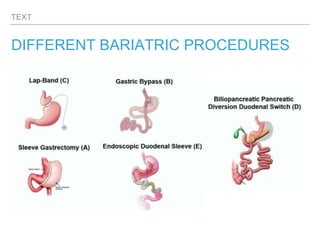
DIFFERENT BARIATRIC PROCEDURES
OBESITY
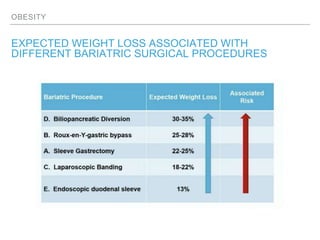
EXPECTED WEIGHT LOSS ASSOCIATED WITH
DIFFERENT BARIATRIC SURGICAL PROCEDURES
OBESITY
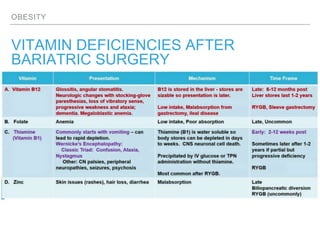
VITAMIN DEFICIENCIES AFTER
BARIATRIC SURGERY
NON-
SURGICAL
PROCEDU
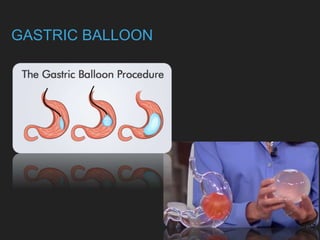
GASTRIC BALLOON
MEDICAL
THERAPY
OBESITY
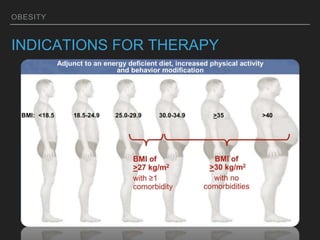
INDICATIONS FOR THERAPY
OBESITY
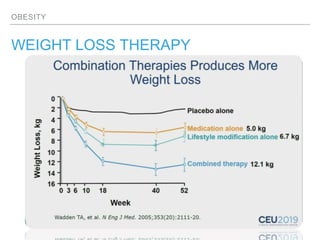
WEIGHT LOSS THERAPY
THERE IS NO
PERFECT DRUG
OBESITY
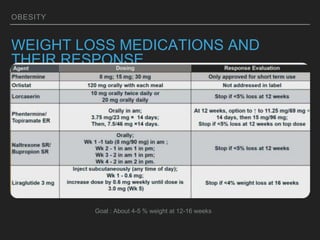
WEIGHT LOSS MEDICATIONS AND
THEIR RESPONSE
Goal : About 4-5 % weight at 12-16 weeks
OBESITY
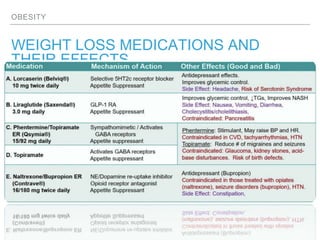
WEIGHT LOSS MEDICATIONS AND
THEIR EFFECTS
OBESITY
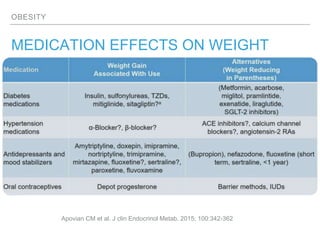
MEDICATION EFFECTS ON WEIGHT
Apovian CM et al. J clin Endocrinol Metab. 2015; 100:342-362
OBESITY
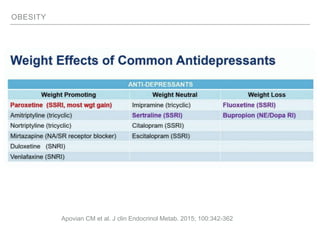
Apovian CM et al. J clin Endocrinol Metab. 2015; 100:342-362
OBESITY
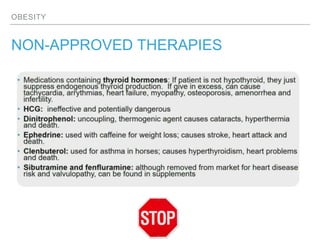
NON-APPROVED THERAPIES
OBESITY
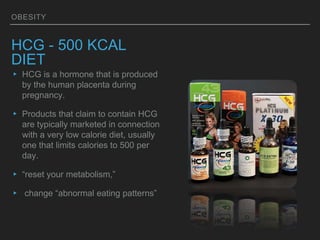
HCG - 500 KCAL
DIET
▸ HCG is a hormone that is produced
by the human placenta during
pregnancy.
▸ Products that claim to contain HCG
are typically marketed in connection
with a very low calorie diet, usually
one that limits calories to 500 per
day.
▸ “reset your metabolism,”
▸ change “abnormal eating patterns”
WEIGHT
LOSS
THERAPY IN
DIABETES
OBESITY
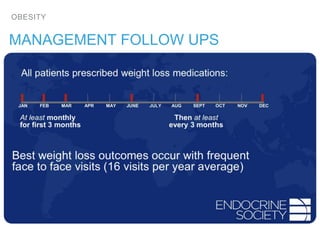
MANAGEMENT FOLLOW UPS
OBESITY
OBESITY
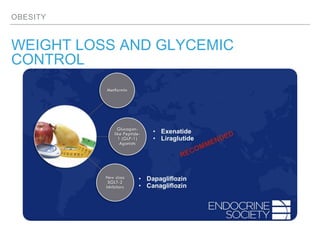
WEIGHT LOSS AND GLYCEMIC
CONTROL
OBESITY
OBESITY
TEXT
OBESITY
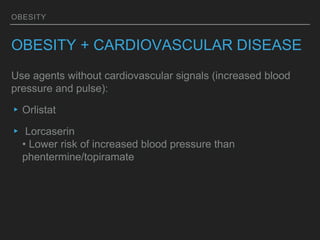
OBESITY + CARDIOVASCULAR DISEASE
Use agents without cardiovascular signals (increased blood
pressure and pulse):
▸Orlistat
▸ Lorcaserin
• Lower risk of increased blood pressure than
phentermine/topiramate
OBESITY
SUMMARY
▸ First guideline that specifically names anti-obesity medications and recommended doses
Patient selection criteria:
▸ BMI >27 kg/m2 with one comorbidity
▸ BMI >30 kg/m2 with no comorbidities
▸ Diet, exercise and behavior modification is the foundation of any weight management plan
▸ Provides a blueprint on medications that cause weight gain and their alternatives
▸ New paradigm: treat weight first, then comorbid condition(s
OBESITY
SUMMARY
▸Medications can drive weight gain and they can also help patients lose weight and keep it
off
▸Before prescribing, review current medications and try to d/c those causing gain
▸KNOW drug profiles - prescribe the right medication for the right patient
▸Always encourage patient to follow lifestyle changes
▸Evaluate response at ~ 12 weeks on drug and change or increase if weight loss is < 5%
▸MOTIVATE your patient
▸BE AN EXAMPLE
THANKS!!
TEXT

Obesity

  • 1.
    OBESITPAOLA MANSILLA LETELIER,MD ENDOCRINOLOGIST THYROID AND ENDOCRINE CENTER
  • 2.
    TEXT LEARNING OBJECTIVES ▸Apply counselingstrategies to promote behavior change in patients with obesity ▸Learn about new guidelines for management of Obesity ▸Select adequate obesity medications taking into account patient’s Comorbidities
  • 3.
    CLINICIAN ROLE INWEIGHT LOSS
  • 4.
    OBESITY DEFINITIONS ▸Obesity: Body MassIndex (BMI) of 30 kg/m2 or higher. ▸Body Mass Index (BMI): A measure of an adult’s weight in relation to his or her height, calculated by using the adult’s weight in kilograms divided by the square of his or her height in meters.
  • 5.
  • 6.
    OBESITY OBESITY PREVALENCE MAPS ▸Adultobesity prevalence by state and territory using self-reported information from the Behavioral Risk Factor Surveillance System. ▸Obesity is common, serious, and costly ▸The prevalence of obesity was 39.8% and affected about 93.3 million of US adults in 2015~2016. ▸Obesity-related conditions include heart disease, stroke, type 2 diabetes and certain types of cancer that are some of the leading causes of preventable, premature death. [Read guidelinesExternal ] ▸The estimated annual medical cost of obesity in the United States was $147 billion in 2008 US dollars; the medical cost for people who have obesity was $1,429 higher than those of normal weight CDC National Center for Health Statistics (NCHS) data briefCdc-pdf PDF-603KB
  • 7.
    TEXT OBESITY ▸Hispanics (47.0%) andnon-Hispanic blacks (46.8%) had the highest age-adjusted prevalence of obesity, followed by non- Hispanic whites (37.9%) and non-Hispanic Asians (12.7%). ▸The prevalence of obesity was 35.7% among young adults aged 20 to 39 years, 42.8% among middle-aged adults aged 40 to 59 years, and 41.0% among older adults aged 60 and older.
  • 8.
    Prevalence¶ of Self-ReportedObesity Among U.S. Adults by State and Territory, BRFSS, 2011 *Sample size <50 or the relative standard error (dividing the standard error by the prevalence) ≥ 30%. ¶ Prevalence estimates reflect BRFSS methodological changes started in 2011. These estimates should not be compared to prevalence estimates before 2011.
  • 9.
    Prevalence¶ of Self-ReportedObesity Among U.S. Adults by State and Territory, BRFSS, 2012 *Sample size <50 or the relative standard error (dividing the standard error by the prevalence) ≥ 30%. ¶ Prevalence estimates reflect BRFSS methodological changes started in 2011. These estimates should not be compared to prevalence estimates before 2011.
  • 10.
    Prevalence¶ of Self-ReportedObesity Among U.S. Adults by State and Territory, BRFSS, 2013 *Sample size <50 or the relative standard error (dividing the standard error by the prevalence) ≥ 30%. ¶ Prevalence estimates reflect BRFSS methodological changes started in 2011. These estimates should not be compared to prevalence estimates before 2011.
  • 11.
    Prevalence¶ of Self-ReportedObesity Among U.S. Adults by State and Territory, BRFSS, 2014 *Sample size <50 or the relative standard error (dividing the standard error by the prevalence) ≥ 30%. ¶ Prevalence estimates reflect BRFSS methodological changes started in 2011. These estimates should not be compared to prevalence estimates before 2011.
  • 12.
    Prevalence¶ of Self-ReportedObesity Among U.S. Adults by State and Territory, BRFSS, 2015 *Sample size <50 or the relative standard error (dividing the standard error by the prevalence) ≥ 30%. ¶ Prevalence estimates reflect BRFSS methodological changes started in 2011. These estimates should not be compared to prevalence estimates before 2011.
  • 13.
    Prevalence¶ of Self-ReportedObesity Among U.S. Adults by State and Territory, BRFSS, 2016 *Sample size <50 or the relative standard error (dividing the standard error by the prevalence) ≥ 30%. ¶ Prevalence estimates reflect BRFSS methodological changes started in 2011. These estimates should not be compared to prevalence estimates before 2011.
  • 14.
    Prevalence¶ of Self-ReportedObesity Among U.S. Adults by State and Territory, BRFSS, 2017 ¶ Prevalence estimates reflect BRFSS methodological changes started in 2011. These estimates should not be compared to prevalence estimates before 2011. *Sample size <50 or the relative standard error (dividing the standard error by the prevalence) ≥ 30%.
  • 15.
    Prevalence¶ of Self-ReportedObesity Among U.S. Adults by State and Territory, BRFSS, 2018 ¶ Prevalence estimates reflect BRFSS methodological changes started in 2011. These estimates should not be compared to prevalence estimates before 2011. *Sample size <50 or the relative standard error (dividing the standard error by the prevalence) ≥ 30%.
  • 16.
  • 17.
  • 18.
  • 19.
  • 20.
    OBESITY BRAIN REGIONS ANDFOOD INTAKE RREGULATION
  • 21.
  • 22.
  • 23.
    Signaling in thebrain of adolescents in response to glucose or fructose: schematic representation of changes in the periphery and brain after the ingestion of glucose or fructose. George A. Bray Diabetes 2016;65:1797-1799 ©2016 by American Diabetes Association
  • 24.
  • 25.
  • 26.
  • 27.
  • 28.
  • 29.
  • 31.
    OBESITY NUTRITION ▸Reduced-calorie meal planand macronutrient composition.Reducing total energy (caloric) intake should be the main component of any weight-loss intervention. ▸Modifying macronutrient composition may be considered to optimize adherence, eating patterns, weight loss, metabolic profiles, risk factor reduction, and/or clinical outcomes
  • 32.
    OBESITY INTERMITTENT FASTING ANDTHEIR EFFICACY FOR WEIGHT LOSS
  • 33.
  • 34.
  • 35.
    OBESITY PHYSICAL ACTIVITY ▸Aerobic physicalactivity training should be prescribed to patients with overweight or obesity as a component of lifestyle intervention; the ultimate goal should be ≥150 min/week of moderate exercise performed during 3 to 5 daily sessions per week ▸Behavioral lifestyle intervention and support should be intensified if patients do not achieve a 2.5% weight loss in the first month of treatment, as early weight reduction is a key predictor of long- term weight-loss success ▸Promote fat loss while preserving fat-free mass; the goal should be resistance training 2 to 3 times per week consisting of single-set exercises that use the major muscle groups ▸Behavioral lifestyle intervention should be tailored to a patient’s ethnic, cultural, socioeconomic, and educational background ▸Reduce sedentary behavior AMERICAN ASSOCIATION OF CLINICAL ENDOCRINOLOGISTS AND AMERICAN COLLEGE OF ENDOCRINOLOGY COMPREHENSIVE CLINICAL PRACTICE GUIDELINES FOR MEDICAL CARE OF PATIENTS WITH OBESITY W. Timothy Garvey, Jeffrey I. Mechanick, Elise M. Brett, Alan J. Garber, Daniel L. Hurley, Ania M. Jastreboff, Karl Nadolsky, Rachel Pessah-Pollack, Raymond Plodkowski, and Reviewers of the AACE/ACE Obesity Clinical Practice Guidelines. Endocrine Practice 2016 22:Supplement 3, 1-203
  • 36.
  • 37.
  • 38.
  • 39.
    OBESITY BEHAVIOR THERAPY ▸Self-monitoring ofweight, food intake, and physical activity ▸Clear and reasonable goal-setting ▸Education pertaining to obesity, nutrition, and physical activity ▸Face-to-face and group meetings ▸Stimulus control ▸Systematic approaches for problem solving ▸Stress reduction
  • 40.
    TEXT BEHAVIOR THERAPY ▸Cognitive restructuring:cognitive behavioral therapy], motivational interviewing
  • 41.
  • 42.
  • 43.
    OBESITY EXPECTED WEIGHT LOSSASSOCIATED WITH DIFFERENT BARIATRIC SURGICAL PROCEDURES
  • 44.
  • 45.
  • 46.
  • 47.
  • 48.
  • 49.
  • 50.
  • 51.
    OBESITY WEIGHT LOSS MEDICATIONSAND THEIR RESPONSE Goal : About 4-5 % weight at 12-16 weeks
  • 52.
  • 53.
    OBESITY MEDICATION EFFECTS ONWEIGHT Apovian CM et al. J clin Endocrinol Metab. 2015; 100:342-362
  • 54.
    OBESITY Apovian CM etal. J clin Endocrinol Metab. 2015; 100:342-362
  • 55.
  • 56.
    OBESITY HCG - 500KCAL DIET ▸ HCG is a hormone that is produced by the human placenta during pregnancy. ▸ Products that claim to contain HCG are typically marketed in connection with a very low calorie diet, usually one that limits calories to 500 per day. ▸ “reset your metabolism,” ▸ change “abnormal eating patterns”
  • 57.
  • 58.
  • 59.
  • 60.
    OBESITY WEIGHT LOSS ANDGLYCEMIC CONTROL
  • 61.
  • 62.
  • 63.
  • 64.
    OBESITY OBESITY + CARDIOVASCULARDISEASE Use agents without cardiovascular signals (increased blood pressure and pulse): ▸Orlistat ▸ Lorcaserin • Lower risk of increased blood pressure than phentermine/topiramate
  • 65.
    OBESITY SUMMARY ▸ First guidelinethat specifically names anti-obesity medications and recommended doses Patient selection criteria: ▸ BMI >27 kg/m2 with one comorbidity ▸ BMI >30 kg/m2 with no comorbidities ▸ Diet, exercise and behavior modification is the foundation of any weight management plan ▸ Provides a blueprint on medications that cause weight gain and their alternatives ▸ New paradigm: treat weight first, then comorbid condition(s
  • 66.
    OBESITY SUMMARY ▸Medications can driveweight gain and they can also help patients lose weight and keep it off ▸Before prescribing, review current medications and try to d/c those causing gain ▸KNOW drug profiles - prescribe the right medication for the right patient ▸Always encourage patient to follow lifestyle changes ▸Evaluate response at ~ 12 weeks on drug and change or increase if weight loss is < 5% ▸MOTIVATE your patient ▸BE AN EXAMPLE
  • 67.
  • 68.

Editor's Notes

  • #24 Signaling in the brain of adolescents in response to glucose or fructose: schematic representation of changes in the periphery and brain after the ingestion of glucose or fructose. Subjective responses using variable analog scales (VAS) are shown in the lower-left corner for hunger, fullness, and satiety where differences were detected. Both glucose and fructose are absorbed, but fructose is largely cleared in the liver, where it stimulates de novo lipogenesis. Glucose is taken up by many tissues and stimulates insulin release from the pancreas more so in the adolescents with obesity than in lean adolescents. Both monosaccharides reduce circulating acyl-ghrelin concentrations. Effects of glucose and fructose on cerebral blood flow relative to baseline are shown by arrows in major regions of the brain: the prefrontal cortex, which has major executive functions; the hypothalamus, which modulates appetite; and the limbic system and striatum-thalamus, which encompass the reward feature of food. Solid lines represent neural connections and dashed lines circulating connections. ‡Adjusted for acyl-ghrelin and insulin. ACC, anterior cingulate cortex; F, fructose; Fru, fructose; G, glucose; GLP-1, glucagon like peptide 1; L, lean adolescents; N. accumbens, nucleus accumbens; Ob, adolescents with obesity; OXM, oxyntomodulin; PP, pancreatic polypeptide; PYY, polypeptide YY; TG, triglyceride.