Obesity in Germany
Introduction
   Obesity is a widespread phenomenon.
   It has doubled since 1980.

   In 2008 more than 1.4 billion adults
    (>20y) were overweight

   Definition: abnormal or excessive fat
    accumulation that may impair health.
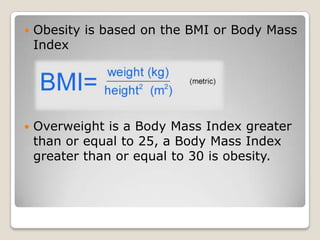
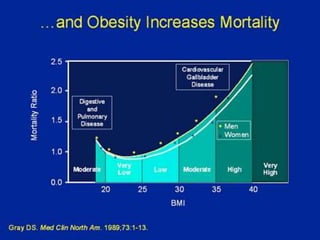
   Obesity is based on the BMI or Body Mass
    Index


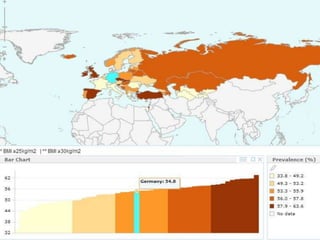
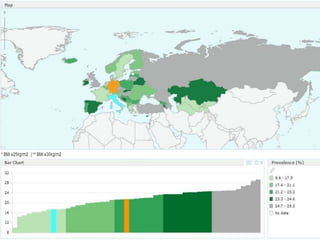
   Overweight is a Body Mass Index greater
    than or equal to 25, a Body Mass Index
    greater than or equal to 30 is obesity.
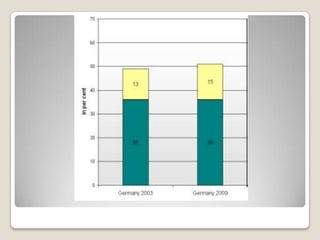
   The 2009 results of the German Federal
    Statistics Office:

 Every second German is overweight
 Every sixth is actually obese.
   Health implications are enormous
    ◦ Higher risk to develop a multitude of
      comorbidities
      Type2 diabetes mellitus
      Coronary heart disease
      Some cancer types
Evolution
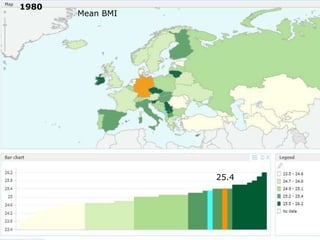
1980
       Mean BMI


                  25.4
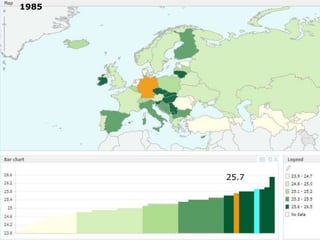
1985


       25.7
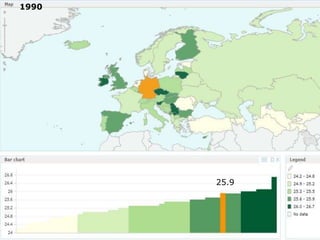
1990


       25.9
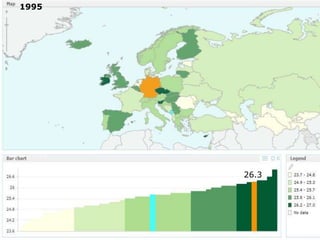
1995


       26.3
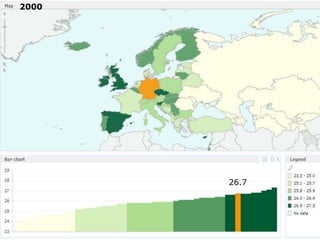
2000


       26.7
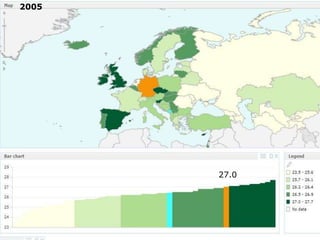
2005


       27.0
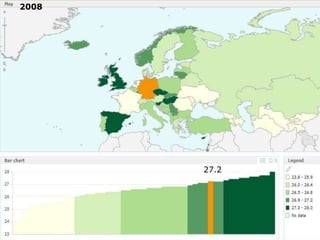
2008


       27.2
Causes
   Most people consume more calories than
    they burn.

    Eating too much and exercising too little.

    Many other factors
   Age:
    ◦ As you get older, your body’s ability to
      metabolize food slows down.
   Gender:
    ◦ Men have a higher resting metabolic rate.
   Genetics:
    ◦ Obesity related genes could affect how we
      metabolise food or store fat.
    ◦ Not destined to be obese, you have a higher
      risk.
   Environmental factors:
    ◦ Closely related to nutrition an physical activity.
   Physical activity:
    ◦ Active individuals require more calories than
      less active ones to maintain their weight.
   Illness:
    ◦ Hormone problems may slow down metabolism
 Medication
 Psychological factors:
    ◦ Many people eat in response to negative
      emotions.
Initiatives
To lower the obesity rate in Germany
   The government:
    ◦ 2007: shocking study showed the severity of
      the obesity problem in Germany

    ◦ 2008: German Government developed 21
      initiatives to improve living in Germany


       => Initiative 14 concerns obesity
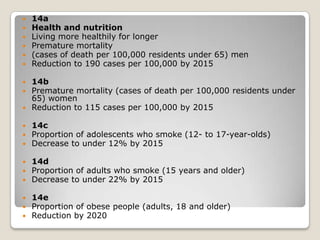
   14a
   Health and nutrition
   Living more healthily for longer
   Premature mortality
   (cases of death per 100,000 residents under 65) men
   Reduction to 190 cases per 100,000 by 2015

 14b
 Premature mortality (cases of death per 100,000 residents under
  65) women
 Reduction to 115 cases per 100,000 by 2015

   14c
   Proportion of adolescents who smoke (12- to 17-year-olds)
   Decrease to under 12% by 2015

   14d
   Proportion of adults who smoke (15 years and older)
   Decrease to under 22% by 2015

   14e
   Proportion of obese people (adults, 18 and older)
   Reduction by 2020
   2008 -> 2020 = 12 years to reduce the
    obesity rate in Germany

   30 000 000 Euros
List of initiatives
 Education on healthy eating and physical
  activity;
 Tougher standards on school food
  programs;
 Better product labeling by the food
  industry;
 Reduced advertising by the makers of
  sweets and junk food that target children;
Typical German Food
FIT instead of FAT campaign
 Improving the quality of food offered in
  schools and hospitals;
 Encouraging children to participate in
  physical activity.
German    Politics seem to be aware of the
problem.

But if we are honest; they don’t seem to
take that much action to really adress
obesity, which is a big risk to public health…
Consequenses
   METABOLIC SYNDROME
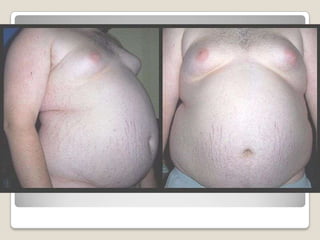
    ◦   Central obesity
    ◦   Reduced HDL-cholesterol
    ◦   Raised blood pressure
    ◦   High fasting blood sugar 


    DIABETES MELLITUS TYPE II

   LEADS TO CARDIOVASCULAR DISEASE !!!
   CARDIOVASCULAR DISEASE
    ◦   Heart attack
    ◦   Coronary artery disease (angina pectoris)
    ◦   Stroke – TIA
    ◦   Peripheral artery disease (claudicatio
        intermittens)
   CANCER
    ◦ Hormone related cancers such as
      breast, endometrium, ovary, cervix and
      testicles
    ◦ Also : pancreas, colon, rectum, kidney
   GALLSTONES
    ◦ 3 to 5 times more often than in non-obese
      people (especially women)
    ◦ Often painless
    ◦ Can cause gallstone attacks, acute
      inflammation of the gall and of the pancreas
   HIATUS HERNIA AND INFLAMMATION OF THE
    OESOPHAGUS
   LUNG FUNCTION – RESPIRATORY DISEASE
    ◦ Asthma : obesity increases risk by 50 %
    ◦ Obstructive sleep apnea : 50 % – 75 % are obese
   MUSCULOSKELETAL DISORDERS
    ◦ Arthritis : knee and hip
    ◦ Obese patients account for one-third of all joint
      replacement operations
    ◦ Lower back pain, lower limb pain
   REPRODUCTION
    ◦ Women
      PCOS
      Increased risk of early and late miscarriage
      Gestational diabetes
      Preeclampsia
      Complications during labor and delivery
      Slightly increased chance of bearing a child with
       congenital anomalies
      Correlation between increasing BMI and problems
       with arousal, lubrication, orgasm, and satisfaction
◦ Men
  BMI > 35 -> low sperm count and poor sperm
   motility
  Erectile dysfunction increases with increasing BMI
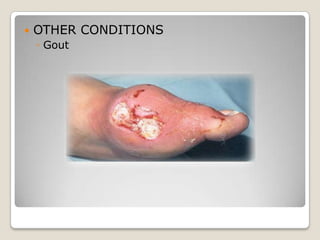
   OTHER CONDITIONS
    ◦ Gout
◦ Chronic kidney disease
◦ Non-alcoholic fatty liver disease
◦ Alzheimer’s disease (risk is increased by 42
  %)
   http://www.minurses.org/files/files/Nursing%20Practice/CE_Obesity.pdf
   http://www.who.int/mediacentre/factsheets/fs311/en/
   http://www.berlin-institut.org/online-handbookdemography/overweight.html
   Zelissen, Pierre. Obesitas en overgewicht : oorzaken, gevolgen en behandeling.
    Davidsfonds Leuven, 2003.

   Daansen, Peter. Leven met obesitas. Bohn Stafleu van Loghum, 2005.

   http://www.hsph.harvard.edu/obesity-prevention-source/obesity-
    consequences/health-effects/index.html

   http://en.wikipedia.org/wiki/Metabolic_syndrome

   http://www.medscape.org/viewarticle/484768_2

   http://trialx.com/curetalk/2011/03/gout-clinical-trials-treatments-research-
    sites/
   http://www.who.int/mediacentre/factsheets/fs311/en/


References

Obesity in germany

  • 1.
  • 2.
  • 3.
    Obesity is a widespread phenomenon.  It has doubled since 1980.  In 2008 more than 1.4 billion adults (>20y) were overweight  Definition: abnormal or excessive fat accumulation that may impair health.
  • 4.
    Obesity is based on the BMI or Body Mass Index  Overweight is a Body Mass Index greater than or equal to 25, a Body Mass Index greater than or equal to 30 is obesity.
  • 5.
    The 2009 results of the German Federal Statistics Office:  Every second German is overweight  Every sixth is actually obese.
  • 6.
    Health implications are enormous ◦ Higher risk to develop a multitude of comorbidities  Type2 diabetes mellitus  Coronary heart disease  Some cancer types
  • 7.
  • 8.
    1980 Mean BMI 25.4
  • 9.
    1985 25.7
  • 10.
    1990 25.9
  • 11.
    1995 26.3
  • 12.
    2000 26.7
  • 13.
    2005 27.0
  • 14.
    2008 27.2
  • 18.
  • 19.
    Most people consume more calories than they burn. Eating too much and exercising too little. Many other factors
  • 20.
    Age: ◦ As you get older, your body’s ability to metabolize food slows down.  Gender: ◦ Men have a higher resting metabolic rate.  Genetics: ◦ Obesity related genes could affect how we metabolise food or store fat. ◦ Not destined to be obese, you have a higher risk.
  • 21.
    Environmental factors: ◦ Closely related to nutrition an physical activity.  Physical activity: ◦ Active individuals require more calories than less active ones to maintain their weight.  Illness: ◦ Hormone problems may slow down metabolism
  • 22.
     Medication  Psychologicalfactors: ◦ Many people eat in response to negative emotions.
  • 23.
    Initiatives To lower theobesity rate in Germany
  • 24.
    The government: ◦ 2007: shocking study showed the severity of the obesity problem in Germany ◦ 2008: German Government developed 21 initiatives to improve living in Germany => Initiative 14 concerns obesity
  • 25.
    14a  Health and nutrition  Living more healthily for longer  Premature mortality  (cases of death per 100,000 residents under 65) men  Reduction to 190 cases per 100,000 by 2015  14b  Premature mortality (cases of death per 100,000 residents under 65) women  Reduction to 115 cases per 100,000 by 2015  14c  Proportion of adolescents who smoke (12- to 17-year-olds)  Decrease to under 12% by 2015  14d  Proportion of adults who smoke (15 years and older)  Decrease to under 22% by 2015  14e  Proportion of obese people (adults, 18 and older)  Reduction by 2020
  • 27.
    2008 -> 2020 = 12 years to reduce the obesity rate in Germany  30 000 000 Euros
  • 28.
    List of initiatives Education on healthy eating and physical activity;  Tougher standards on school food programs;  Better product labeling by the food industry;  Reduced advertising by the makers of sweets and junk food that target children;
  • 29.
  • 31.
    FIT instead ofFAT campaign  Improving the quality of food offered in schools and hospitals;  Encouraging children to participate in physical activity.
  • 32.
    German Politics seem to be aware of the problem. But if we are honest; they don’t seem to take that much action to really adress obesity, which is a big risk to public health…
  • 33.
  • 34.
    METABOLIC SYNDROME ◦ Central obesity ◦ Reduced HDL-cholesterol ◦ Raised blood pressure ◦ High fasting blood sugar  DIABETES MELLITUS TYPE II  LEADS TO CARDIOVASCULAR DISEASE !!!
  • 36.
    CARDIOVASCULAR DISEASE ◦ Heart attack ◦ Coronary artery disease (angina pectoris) ◦ Stroke – TIA ◦ Peripheral artery disease (claudicatio intermittens)
  • 37.
    CANCER ◦ Hormone related cancers such as breast, endometrium, ovary, cervix and testicles ◦ Also : pancreas, colon, rectum, kidney
  • 38.
    GALLSTONES ◦ 3 to 5 times more often than in non-obese people (especially women) ◦ Often painless ◦ Can cause gallstone attacks, acute inflammation of the gall and of the pancreas
  • 39.
    HIATUS HERNIA AND INFLAMMATION OF THE OESOPHAGUS  LUNG FUNCTION – RESPIRATORY DISEASE ◦ Asthma : obesity increases risk by 50 % ◦ Obstructive sleep apnea : 50 % – 75 % are obese  MUSCULOSKELETAL DISORDERS ◦ Arthritis : knee and hip ◦ Obese patients account for one-third of all joint replacement operations ◦ Lower back pain, lower limb pain
  • 40.
    REPRODUCTION ◦ Women  PCOS  Increased risk of early and late miscarriage  Gestational diabetes  Preeclampsia  Complications during labor and delivery  Slightly increased chance of bearing a child with congenital anomalies  Correlation between increasing BMI and problems with arousal, lubrication, orgasm, and satisfaction
  • 41.
    ◦ Men BMI > 35 -> low sperm count and poor sperm motility  Erectile dysfunction increases with increasing BMI
  • 42.
    OTHER CONDITIONS ◦ Gout
  • 43.
    ◦ Chronic kidneydisease ◦ Non-alcoholic fatty liver disease ◦ Alzheimer’s disease (risk is increased by 42 %)
  • 45.
    http://www.minurses.org/files/files/Nursing%20Practice/CE_Obesity.pdf  http://www.who.int/mediacentre/factsheets/fs311/en/  http://www.berlin-institut.org/online-handbookdemography/overweight.html  Zelissen, Pierre. Obesitas en overgewicht : oorzaken, gevolgen en behandeling. Davidsfonds Leuven, 2003.   Daansen, Peter. Leven met obesitas. Bohn Stafleu van Loghum, 2005.   http://www.hsph.harvard.edu/obesity-prevention-source/obesity- consequences/health-effects/index.html   http://en.wikipedia.org/wiki/Metabolic_syndrome   http://www.medscape.org/viewarticle/484768_2   http://trialx.com/curetalk/2011/03/gout-clinical-trials-treatments-research- sites/  http://www.who.int/mediacentre/factsheets/fs311/en/ References