www.karnim.com
ANYONE CAN GET
WHOEVER YOU ARE, WE CAN HELP!
www.karnim.com
What is Diabetes?
www.karnim.com
The condition, marked by high blood sugar, is on the rise worldwide.
Diabetes is a disease that's characterized by high blood sugar, which doctors refer to as
hyperglycemia.
What makes type 2 diabetes different from type 1 diabetes, gestational diabetes, and other types
of diabetes is the underlying cause of high blood sugar. In type 2 diabetes, the two main
contributors to high blood sugar are insulin resistance and reduced production of insulin by the
pancreas.
Insulin Resistance
Insulin resistance is a state in which the body’s cells do not use insulin efficiently. As a result, it
takes more insulin than normal to transport glucose (the main type of sugar found in the
bloodstream) into cells, where it can be used for fuel or stored for later use.
It’s not entirely clear why some people develop insulin resistance and others don’t. Obesity,
which is the main risk factor for developing type 2 diabetes. is known to increase insulin
resistance.
But not all people with type 2 diabetes are obese — and not all obese people develop the
condition — so other issues such as genetics are contributing factors as well.
Reduced Insulin Production
Insulin resistance develops over time, and as the body becomes more and more insulin resistant,
the pancreas responds by releasing more and more insulin. This higher-than-normal level of
insulin in the bloodstream is called hyperinsulinemia.
For a while, the pancreas may be able to keep up with the body’s increased need for insulin, and
blood sugar levels may stay within the normal range — about 70 to 100 mg/dl before meals and
lower than 140 mg/dl after meals. Eventually, however, the pancreas can no longer keep up, and
blood sugar levels begin to rise.
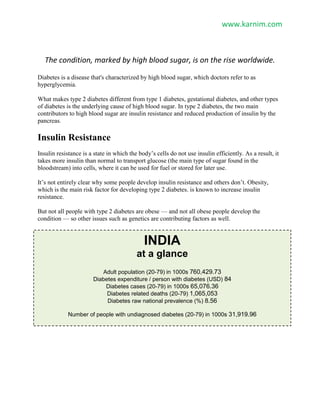
INDIA
at a glance
Adult population (20-79) in 1000s 760,429.73
Diabetes expenditure / person with diabetes (USD) 84
Diabetes cases (20-79) in 1000s 65,076.36
Diabetes related deaths (20-79) 1,065,053
Diabetes raw national prevalence (%) 8.56
Number of people with undiagnosed diabetes (20-79) in 1000s 31,919.96
www.karnim.com
Reduced Insulin Production
Insulin resistance develops over time, and as the body becomes more and more insulin resistant,
the pancreas responds by releasing more and more insulin. This higher-than-normal level of
insulin in the bloodstream is called hyperinsulinemia.
For a while, the pancreas may be able to keep up with the body’s increased need for insulin, and
blood sugar levels may stay within the normal range — about 70 to 100 mg/dl before meals and
lower than 140 mg/dl after meals. Eventually, however, the pancreas can no longer keep up, and
blood sugar levels begin to rise.
In the early stages, higher-than-normal blood sugar may cause no symptoms. But catching it
early is important, because over time, high blood sugar can have negative effects on just about
every part of the body.
Type 2 Diabetes Symptoms
Fatigue, increased thirst, irritability, and hunger – type 2 diabetes
causes many symptoms that can be mistaken for other conditions.
Because type 2 diabetes develops slowly, and symptoms generally come on gradually, they may
go unnoticed for a long time, or they may be attributed to something else.
For example, increased thirst may be chalked up to a hot summer, or fatigue may be interpreted
as a sign of aging or stress.
This is unfortunate, because even short-term high blood sugar diminishes your quality of life.
And if high blood sugar persists for a long time, it can eventually cause complications such as
eye or kidney disease that cannot be completely reversed with improved blood sugar control.
Type 2 diabetes can cause a wide range of signs and symptoms, including:
 Fatigue
 Dry mouth
 Thirst
 Excessive urination
 Hunger
 Weight loss
 Blurry vision
 Cloudy thinking
 Irritability
 Wounds that won't heal
www.karnim.com
Frequent infections may also be a sign of type 2 diabetes. In women, vaginal yeast infections are
particularly common. Yeast infections can also occur on the skin and, in men, in the groin.
Other infections associated with undiagnosed type 2 diabetes include gum infections, urinary
tract infections (particularly in women), slowly healing wounds with subsequent infections, and
infections of the feet.
Symptoms in Men
Type 2 diabetes symptoms are generally the same for men and women.
However, urological problems such as erectile dysfunction (ED) — the inability to achieve or
maintain an erection — have been associated with all forms of diabetes, including type 2.
According to the National Diabetes Information Clearinghouse, 20 to 75 percent of men with any
type of diabetes have ED.
Researchers believe diabetes causes sexual function problems in men due to damage to the
body's autonomic nervous system (ANS), which controls circulation.
If you have the symptoms of ED, it may be a sign you have diabetes.
Another urological problem associated with diabetes in men is retrograde ejaculation, or the
release of semen into the bladder during ejaculation. Symptoms include reduced semen during
ejaculation.
Symptoms in Women
Women with type 2 diabetes are at increased risk for vaginal yeast infections.
This is because type 2 diabetes has been associated with increased yeast in the vaginal area.
Experts believe these vaginal infections will also lead to urinary tract and bladder infections, as
both yeast and bacteria multiply when blood sugar is elevated.
www.karnim.com
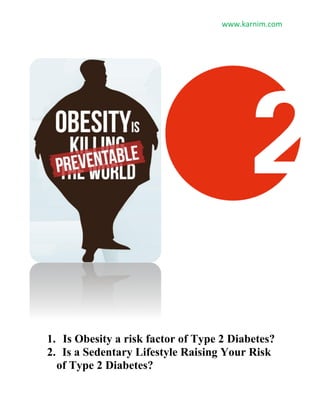
1. Is Obesity a risk factor of Type 2 Diabetes?
2. Is a Sedentary Lifestyle Raising Your Risk
of Type 2 Diabetes?
www.karnim.com
As obesity becomes a bigger issue worldwide, so does the risk of type 2
diabetes.
Obesity, or the state of having too much body fat, is a fast-growing problem: More than one-third
of adults, almost 18 percent of children and more than 20 percent of teenagers are now obese in
the United States, according to the Centers for Disease Control and Prevention (CDC).
Obesity can also raise the risk of many health problems, including type 2 diabetes. In fact, it’s
the number-one risk factor for type 2 diabetes.
Body Mass Index (BMI)
Obesity is generally assessed using body mass index, or BMI, which takes both height and
weight into account and is expressed in units of kg/m2
(kilograms per meter squared).
You can calculate your BMI by finding your weight in kilograms and your height in meters and
plugging them into our online BMI calculator.
Note that children should use a different BMI calculator than adults. The CDC provides this
calculator for children ages 2 through 19.
BMI levels for adults are categorized as follows:
 Normal weight: 18.5 to 24.9
 Overweight: 25 to 29.9
 Obesity: 30 or greater
BMI is fairly accurate at identifying adults as normal weight, overweight, or obese, with a few
exceptions: It may overestimate body fat in muscular individuals such as athletes, and it may
underestimate body fat in older people and others who have lost muscle mass.
The relative risk of developing type 2 diabetes begins to rise at a BMI of 25, and gets
progressively higher as BMI increases.
However, in some ethnic groups, notably South Asians, the risk of type 2 diabetes has been
found to start at a lower BMI than for the general American population. For this group,
overweight — and increased risk of type 2 diabetes — begins at a BMI of 23.1.
Waist Circumference
BMI is not the only tool for assessing diabetes risk. In 2012, researchers in England reviewed
data on more than 28,500 people enrolled in the EPIC (European Prospective Investigation into
www.karnim.com
Cancer and Nutrition) study to see how waist circumference influenced the risk of developing
type 2 diabetes.
Their findings included the following:
 Overweight men with a waist circumference of 40 inches or more had a 10-year
incidence of diabetes similar to obese men with the same waist circumference.
 Overweight women with a waist circumference of 35 inches or more had a 10-year
incidence of diabetes similar to obese women with the same waist circumference.
 Obese men with a waist circumference of 40 inches or more were 22 times more likely to
develop diabetes than men with a BMI between 18.5 and 22.4 and a waist circumference
of less than 37 inches.
 Obese women with a waist circumference of 35 inches or more were almost 32 times
more likely to develop diabetes than women with a BMI between 18.5 and 22.4 and a
waist smaller than 31 inches.
Unlike BMI, which reflects overall fatness, waist circumference gives a measure of the amount
of visceral fat, or fat surrounding the abdominal organs. Abdominal fat (around the waistline) is
strongly linked to type 2 diabetes.
Sitting too much may be endangering your health.
Type 2 diabetes is often called a "lifestyle disease," because many of its risk factors are related to
how people live. The good news: Those risk factors are modifiable, meaning you can take steps
to change them.
One risk factor that's been getting attention lately is being sedentary, or spending prolonged
amounts of time sitting.
Risks of Inactivity
Numerous studies have examined the effects of being sedentary. Some measure being sedentary
by the daily number of hours spent sitting while others use the number of hours spent watching
television every day.
In either case, the more hours spent being sedentary, the higher risk of chronic health problems,
including higher blood sugar levels, higher levels of insulin resistance, obesity, type 2 diabetes,
cardiovascular disease, cancer, and even an increased risk of death.
People who are sedentary also tend to spend less time outdoors, so they may have lower vitamin
D levels than people who get out more. (The body makes its own vitamin D when skin is
exposed to sunlight.)
Low vitamin D levels have been associated with a higher risk of type 2 diabetes, although it is
not yet clear whether the vitamin D itself is the cause of the increased risk.
www.karnim.com
Physical Activity
Physical activity is generally defined as "any bodily movement produced by skeletal muscles that
results in energy expenditure." Many health organizations currently recommend that most adults
perform at least 30 minutes of physical activity daily.
The American College of Sports Medicine also recommends performing strength training (two to
three times a week) and flexibility exercises and exercises that improve balance, such as tai chi
(two to three times a week).
Following these recommendations may not be enough to improve health or prevent chronic
disease, however, if you spend the rest of the day sitting. The simple solution:
Get up and move more.
Becoming More Active
Unfortunately, the American way of life encourages being sedentary with its increased use of
computers, for both work and entertainment; fewer physically active jobs; and cities and rural
areas that are difficult to navigate on foot or by bicycle.
So what should you do to push back against this trend and get more active?
 Anything that gets you out of your chair periodically standing, walking, stretching, doing
household chores is better than spending uninterrupted hours sitting.
 Set a timer, if necessary, to remind yourself to get up every 30 to 60 minutes.
 Even if you normally work sitting down, stand up to talk on the phone or perform other
functions that can be done standing.
 Use a pedometer to tally your daily steps, and challenge yourself to gradually increase
how much you walk.
 Rather than shopping online, go to brick-and-mortar stores so you can walk around while
looking at merchandise.
 Plan more recreational activities, such as taking dance classes or walks in a park.
 At work: Take the stairs, not the elevator or escalator.
Make It Fun
People are more inclined to engage in activities they perceive as pleasurable, so get adventurous
and find the ones you most enjoy. You'll likely love those mini-breaks and being more active,
and you'll be taking the right steps toward reducing your risk of type 2 diabetes and improving
your overall health.
www.karnim.com
Preventing complications
www.karnim.com
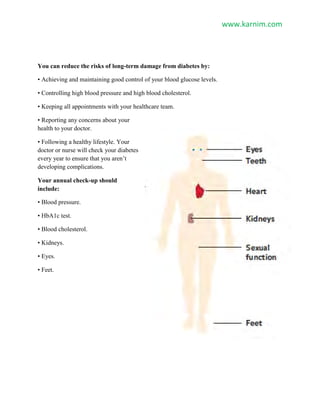
You can reduce the risks of long-term damage from diabetes by:
• Achieving and maintaining good control of your blood glucose levels.
• Controlling high blood pressure and high blood cholesterol.
• Keeping all appointments with your healthcare team.
• Reporting any concerns about your
health to your doctor.
• Following a healthy lifestyle. Your
doctor or nurse will check your diabetes
every year to ensure that you aren’t
developing complications.
Your annual check-up should
include:
• Blood pressure.
• HbA1c test.
• Blood cholesterol.
• Kidneys.
• Eyes.
• Feet.
www.karnim.com
Membership Form
Diabetes is increasing worldwide. According to Diabetes Atlas published by the International Diabetes Federation
(IDF), there were an estimated 40 million persons with diabetes in India in 2007 and this number is predicted to rise
to almost 70 million people by 2025. The countries with the largest number of diabetic people will be India, China
and USA by 2030. Karnim Club conducts and support local and large-scale effort leading to the control and
treatment of diabetes and its complications through Education, Prevention and Awareness.
Karnim Club offers opportunity that fits your lifestyle. Whether you are looking to lend a helping hand, pursue a
leadership role or attend club meetings, Karnim Club has an option for you.
Why You Should Get Involved, In Karnim Club you can use your time to make an impact locally and around the
Nation .Through experience as a Karnim Club Member, you will help people in need, develop awareness and
network with fellow members.
Benefits: 1. Get Monthly updates regarding your diet plan 2. Get Online help of your query regarding diabetes 3.
Get 10% discount on first purchase of Karnim Caps.
So, Be Part of Something that Matters
Surname : …………………………………..Name:………………………… Middle name: ……………………
Postal address:………………………………………………………………………………………………………...
…………………………………………………………………………………………………………………………..
.………………………………………………………………………………………………………………………….
Phone (Res):……………………………………………………………………. (O) Fax: Mobile:…………………
Email :…………………………………………………………………………
PAN No. :………………………...
Date of Birth :…………………………………… Marital Status: Married / Unmarried Educational
Qualification: ………………………………………………… Blood Group :…………………………………
Fill the Form/send your above details through email to pmt@unijules.com.
For more information about working with diabetes partners and organizations contact Karnim Clubs Services
Department at pmt@unijules.com
Allotted Membership no:
…………………….Club Only: Life / Ordinary
membership

How To Control Obesity?

  • 1.
  • 2.
  • 3.
    www.karnim.com The condition, markedby high blood sugar, is on the rise worldwide. Diabetes is a disease that's characterized by high blood sugar, which doctors refer to as hyperglycemia. What makes type 2 diabetes different from type 1 diabetes, gestational diabetes, and other types of diabetes is the underlying cause of high blood sugar. In type 2 diabetes, the two main contributors to high blood sugar are insulin resistance and reduced production of insulin by the pancreas. Insulin Resistance Insulin resistance is a state in which the body’s cells do not use insulin efficiently. As a result, it takes more insulin than normal to transport glucose (the main type of sugar found in the bloodstream) into cells, where it can be used for fuel or stored for later use. It’s not entirely clear why some people develop insulin resistance and others don’t. Obesity, which is the main risk factor for developing type 2 diabetes. is known to increase insulin resistance. But not all people with type 2 diabetes are obese — and not all obese people develop the condition — so other issues such as genetics are contributing factors as well. Reduced Insulin Production Insulin resistance develops over time, and as the body becomes more and more insulin resistant, the pancreas responds by releasing more and more insulin. This higher-than-normal level of insulin in the bloodstream is called hyperinsulinemia. For a while, the pancreas may be able to keep up with the body’s increased need for insulin, and blood sugar levels may stay within the normal range — about 70 to 100 mg/dl before meals and lower than 140 mg/dl after meals. Eventually, however, the pancreas can no longer keep up, and blood sugar levels begin to rise. INDIA at a glance Adult population (20-79) in 1000s 760,429.73 Diabetes expenditure / person with diabetes (USD) 84 Diabetes cases (20-79) in 1000s 65,076.36 Diabetes related deaths (20-79) 1,065,053 Diabetes raw national prevalence (%) 8.56 Number of people with undiagnosed diabetes (20-79) in 1000s 31,919.96
  • 4.
    www.karnim.com Reduced Insulin Production Insulinresistance develops over time, and as the body becomes more and more insulin resistant, the pancreas responds by releasing more and more insulin. This higher-than-normal level of insulin in the bloodstream is called hyperinsulinemia. For a while, the pancreas may be able to keep up with the body’s increased need for insulin, and blood sugar levels may stay within the normal range — about 70 to 100 mg/dl before meals and lower than 140 mg/dl after meals. Eventually, however, the pancreas can no longer keep up, and blood sugar levels begin to rise. In the early stages, higher-than-normal blood sugar may cause no symptoms. But catching it early is important, because over time, high blood sugar can have negative effects on just about every part of the body. Type 2 Diabetes Symptoms Fatigue, increased thirst, irritability, and hunger – type 2 diabetes causes many symptoms that can be mistaken for other conditions. Because type 2 diabetes develops slowly, and symptoms generally come on gradually, they may go unnoticed for a long time, or they may be attributed to something else. For example, increased thirst may be chalked up to a hot summer, or fatigue may be interpreted as a sign of aging or stress. This is unfortunate, because even short-term high blood sugar diminishes your quality of life. And if high blood sugar persists for a long time, it can eventually cause complications such as eye or kidney disease that cannot be completely reversed with improved blood sugar control. Type 2 diabetes can cause a wide range of signs and symptoms, including:  Fatigue  Dry mouth  Thirst  Excessive urination  Hunger  Weight loss  Blurry vision  Cloudy thinking  Irritability  Wounds that won't heal
  • 5.
    www.karnim.com Frequent infections mayalso be a sign of type 2 diabetes. In women, vaginal yeast infections are particularly common. Yeast infections can also occur on the skin and, in men, in the groin. Other infections associated with undiagnosed type 2 diabetes include gum infections, urinary tract infections (particularly in women), slowly healing wounds with subsequent infections, and infections of the feet. Symptoms in Men Type 2 diabetes symptoms are generally the same for men and women. However, urological problems such as erectile dysfunction (ED) — the inability to achieve or maintain an erection — have been associated with all forms of diabetes, including type 2. According to the National Diabetes Information Clearinghouse, 20 to 75 percent of men with any type of diabetes have ED. Researchers believe diabetes causes sexual function problems in men due to damage to the body's autonomic nervous system (ANS), which controls circulation. If you have the symptoms of ED, it may be a sign you have diabetes. Another urological problem associated with diabetes in men is retrograde ejaculation, or the release of semen into the bladder during ejaculation. Symptoms include reduced semen during ejaculation. Symptoms in Women Women with type 2 diabetes are at increased risk for vaginal yeast infections. This is because type 2 diabetes has been associated with increased yeast in the vaginal area. Experts believe these vaginal infections will also lead to urinary tract and bladder infections, as both yeast and bacteria multiply when blood sugar is elevated.
  • 6.
    www.karnim.com 1. Is Obesitya risk factor of Type 2 Diabetes? 2. Is a Sedentary Lifestyle Raising Your Risk of Type 2 Diabetes?
  • 7.
    www.karnim.com As obesity becomesa bigger issue worldwide, so does the risk of type 2 diabetes. Obesity, or the state of having too much body fat, is a fast-growing problem: More than one-third of adults, almost 18 percent of children and more than 20 percent of teenagers are now obese in the United States, according to the Centers for Disease Control and Prevention (CDC). Obesity can also raise the risk of many health problems, including type 2 diabetes. In fact, it’s the number-one risk factor for type 2 diabetes. Body Mass Index (BMI) Obesity is generally assessed using body mass index, or BMI, which takes both height and weight into account and is expressed in units of kg/m2 (kilograms per meter squared). You can calculate your BMI by finding your weight in kilograms and your height in meters and plugging them into our online BMI calculator. Note that children should use a different BMI calculator than adults. The CDC provides this calculator for children ages 2 through 19. BMI levels for adults are categorized as follows:  Normal weight: 18.5 to 24.9  Overweight: 25 to 29.9  Obesity: 30 or greater BMI is fairly accurate at identifying adults as normal weight, overweight, or obese, with a few exceptions: It may overestimate body fat in muscular individuals such as athletes, and it may underestimate body fat in older people and others who have lost muscle mass. The relative risk of developing type 2 diabetes begins to rise at a BMI of 25, and gets progressively higher as BMI increases. However, in some ethnic groups, notably South Asians, the risk of type 2 diabetes has been found to start at a lower BMI than for the general American population. For this group, overweight — and increased risk of type 2 diabetes — begins at a BMI of 23.1. Waist Circumference BMI is not the only tool for assessing diabetes risk. In 2012, researchers in England reviewed data on more than 28,500 people enrolled in the EPIC (European Prospective Investigation into
  • 8.
    www.karnim.com Cancer and Nutrition)study to see how waist circumference influenced the risk of developing type 2 diabetes. Their findings included the following:  Overweight men with a waist circumference of 40 inches or more had a 10-year incidence of diabetes similar to obese men with the same waist circumference.  Overweight women with a waist circumference of 35 inches or more had a 10-year incidence of diabetes similar to obese women with the same waist circumference.  Obese men with a waist circumference of 40 inches or more were 22 times more likely to develop diabetes than men with a BMI between 18.5 and 22.4 and a waist circumference of less than 37 inches.  Obese women with a waist circumference of 35 inches or more were almost 32 times more likely to develop diabetes than women with a BMI between 18.5 and 22.4 and a waist smaller than 31 inches. Unlike BMI, which reflects overall fatness, waist circumference gives a measure of the amount of visceral fat, or fat surrounding the abdominal organs. Abdominal fat (around the waistline) is strongly linked to type 2 diabetes. Sitting too much may be endangering your health. Type 2 diabetes is often called a "lifestyle disease," because many of its risk factors are related to how people live. The good news: Those risk factors are modifiable, meaning you can take steps to change them. One risk factor that's been getting attention lately is being sedentary, or spending prolonged amounts of time sitting. Risks of Inactivity Numerous studies have examined the effects of being sedentary. Some measure being sedentary by the daily number of hours spent sitting while others use the number of hours spent watching television every day. In either case, the more hours spent being sedentary, the higher risk of chronic health problems, including higher blood sugar levels, higher levels of insulin resistance, obesity, type 2 diabetes, cardiovascular disease, cancer, and even an increased risk of death. People who are sedentary also tend to spend less time outdoors, so they may have lower vitamin D levels than people who get out more. (The body makes its own vitamin D when skin is exposed to sunlight.) Low vitamin D levels have been associated with a higher risk of type 2 diabetes, although it is not yet clear whether the vitamin D itself is the cause of the increased risk.
  • 9.
    www.karnim.com Physical Activity Physical activityis generally defined as "any bodily movement produced by skeletal muscles that results in energy expenditure." Many health organizations currently recommend that most adults perform at least 30 minutes of physical activity daily. The American College of Sports Medicine also recommends performing strength training (two to three times a week) and flexibility exercises and exercises that improve balance, such as tai chi (two to three times a week). Following these recommendations may not be enough to improve health or prevent chronic disease, however, if you spend the rest of the day sitting. The simple solution: Get up and move more. Becoming More Active Unfortunately, the American way of life encourages being sedentary with its increased use of computers, for both work and entertainment; fewer physically active jobs; and cities and rural areas that are difficult to navigate on foot or by bicycle. So what should you do to push back against this trend and get more active?  Anything that gets you out of your chair periodically standing, walking, stretching, doing household chores is better than spending uninterrupted hours sitting.  Set a timer, if necessary, to remind yourself to get up every 30 to 60 minutes.  Even if you normally work sitting down, stand up to talk on the phone or perform other functions that can be done standing.  Use a pedometer to tally your daily steps, and challenge yourself to gradually increase how much you walk.  Rather than shopping online, go to brick-and-mortar stores so you can walk around while looking at merchandise.  Plan more recreational activities, such as taking dance classes or walks in a park.  At work: Take the stairs, not the elevator or escalator. Make It Fun People are more inclined to engage in activities they perceive as pleasurable, so get adventurous and find the ones you most enjoy. You'll likely love those mini-breaks and being more active, and you'll be taking the right steps toward reducing your risk of type 2 diabetes and improving your overall health.
  • 10.
  • 11.
    www.karnim.com You can reducethe risks of long-term damage from diabetes by: • Achieving and maintaining good control of your blood glucose levels. • Controlling high blood pressure and high blood cholesterol. • Keeping all appointments with your healthcare team. • Reporting any concerns about your health to your doctor. • Following a healthy lifestyle. Your doctor or nurse will check your diabetes every year to ensure that you aren’t developing complications. Your annual check-up should include: • Blood pressure. • HbA1c test. • Blood cholesterol. • Kidneys. • Eyes. • Feet.
  • 12.
    www.karnim.com Membership Form Diabetes isincreasing worldwide. According to Diabetes Atlas published by the International Diabetes Federation (IDF), there were an estimated 40 million persons with diabetes in India in 2007 and this number is predicted to rise to almost 70 million people by 2025. The countries with the largest number of diabetic people will be India, China and USA by 2030. Karnim Club conducts and support local and large-scale effort leading to the control and treatment of diabetes and its complications through Education, Prevention and Awareness. Karnim Club offers opportunity that fits your lifestyle. Whether you are looking to lend a helping hand, pursue a leadership role or attend club meetings, Karnim Club has an option for you. Why You Should Get Involved, In Karnim Club you can use your time to make an impact locally and around the Nation .Through experience as a Karnim Club Member, you will help people in need, develop awareness and network with fellow members. Benefits: 1. Get Monthly updates regarding your diet plan 2. Get Online help of your query regarding diabetes 3. Get 10% discount on first purchase of Karnim Caps. So, Be Part of Something that Matters Surname : …………………………………..Name:………………………… Middle name: …………………… Postal address:………………………………………………………………………………………………………... ………………………………………………………………………………………………………………………….. .…………………………………………………………………………………………………………………………. Phone (Res):……………………………………………………………………. (O) Fax: Mobile:………………… Email :………………………………………………………………………… PAN No. :………………………... Date of Birth :…………………………………… Marital Status: Married / Unmarried Educational Qualification: ………………………………………………… Blood Group :………………………………… Fill the Form/send your above details through email to pmt@unijules.com. For more information about working with diabetes partners and organizations contact Karnim Clubs Services Department at pmt@unijules.com Allotted Membership no: …………………….Club Only: Life / Ordinary membership