
Oberlin Nerve Transfer for Elbow
flexion in Brachial Plexus Injury
Somsak Leechavengvongs, M.D.
Institute of Orthopedics, Lerdsin Hospital
Bangkok Thailand
Oberlin Procedure
• Oberlin 1(1994)
- 1 part of ulnar nerve to biceps branch
• Oberlin 2 (2006)
- 1 part of ulnar nerve to biceps branch
- 1 part of median nerve to brachialis
branch
Prof. Christophe Oberlin
J Hand Surg 1994;19A:232-237
Prof. C. Oberlin
Bichat Hospital
Paris
Restoration of Elbow Flexion
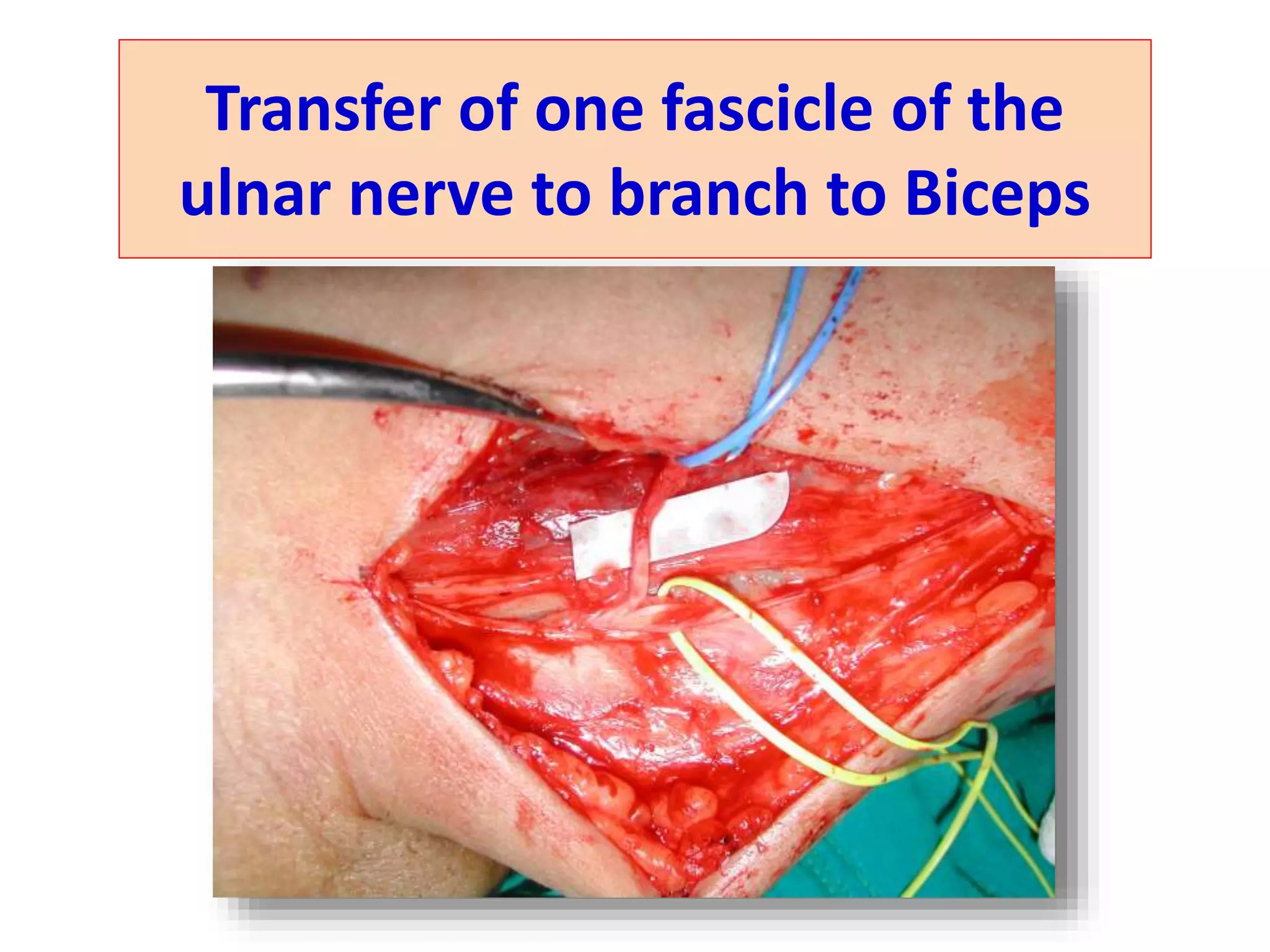
Transfer of one fascicle of the
ulnar nerve to branch to Biceps
J Hand Surg 1998;23A:250-255
 The 1st br.
always supply the short head
 The 2nd br.
is 5-53 mm (avg, 22 mm)
distal to the 1st br.
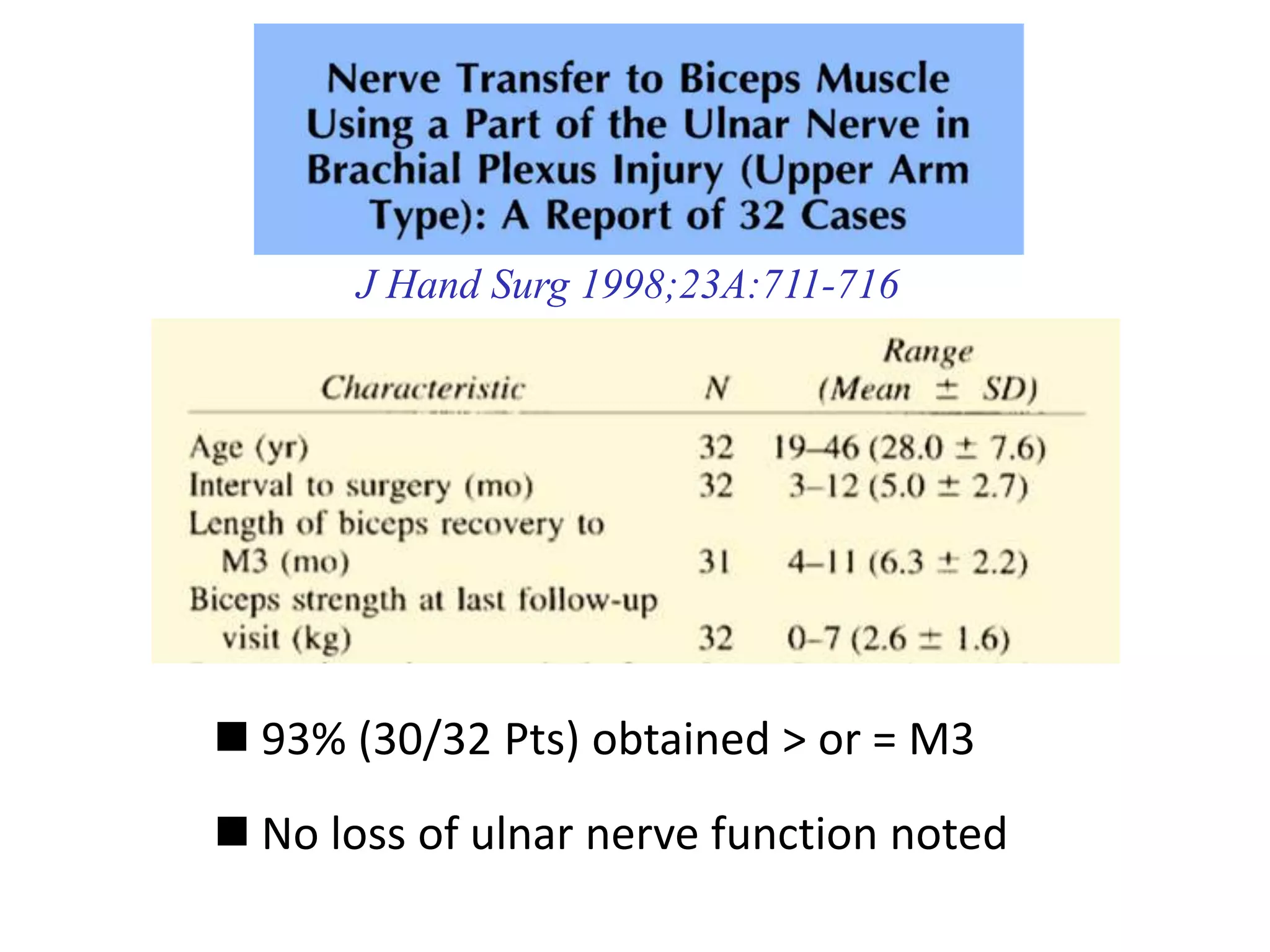
J Hand Surg 1998;23A:711-716
Ulnar nerve
Nerve to biceps
an ulnar n. fascicle
the anastomosis
‘ Oberlin I ’
Biceps
Brachialis
 93% (30/32 Pts) obtained > or = M3
 No loss of ulnar nerve function noted
J Hand Surg 1998;23A:711-716
 The ulnar nerve is closer
 The rate of recovery is faster
 No nerve graft required
 Technically uncomplicated
 No special re-education required
 Reserving the other donor nerves
J Hand Surg 1998;23A:711-716
A part of ulnar nerve transfer to
motor branch to the biceps
• From September 1992 – February 2006
• 192 cases with 112 cases more than 2 year’s
follow – up evaluation
• 93% regained >or = M3 (C5 and C6 )
• 58% regained >or = M3 (C5,C6 and C7)
• Recovery of M3 occurred between 5 and 11
months after surgery (mean, 7 mo)
A part of ulnar nerve transfer to
motor branch to the biceps
• The elbow flexion power ranged from
0.5 to 7 kg (average = 2.6 kg)
• No loss of ulnar nerve was noted after surgery
• 28% experienced transient paresthesia
in the small finger
Ulnar nerve
Median nerve
Nerve to biceps
Nerve to brachialis
Dual Nerve Transfer
for Biceps & Brachialis
Ulnar n.
Median n.
‘Oberlin II’
10 months after double nerve transfer to biceps and brachialis
using fascicle of ulnar and median nerve
Oberlin Transfer

Oberlin Transfer

  • 1.
    Oberlin Nerve Transferfor Elbow flexion in Brachial Plexus Injury Somsak Leechavengvongs, M.D. Institute of Orthopedics, Lerdsin Hospital Bangkok Thailand
  • 2.
    Oberlin Procedure • Oberlin1(1994) - 1 part of ulnar nerve to biceps branch • Oberlin 2 (2006) - 1 part of ulnar nerve to biceps branch - 1 part of median nerve to brachialis branch
  • 3.
  • 5.
    J Hand Surg1994;19A:232-237 Prof. C. Oberlin Bichat Hospital Paris Restoration of Elbow Flexion
  • 6.
    Transfer of onefascicle of the ulnar nerve to branch to Biceps
  • 7.
    J Hand Surg1998;23A:250-255  The 1st br. always supply the short head  The 2nd br. is 5-53 mm (avg, 22 mm) distal to the 1st br.
  • 8.
    J Hand Surg1998;23A:711-716 Ulnar nerve Nerve to biceps an ulnar n. fascicle the anastomosis ‘ Oberlin I ’ Biceps Brachialis
  • 9.
     93% (30/32Pts) obtained > or = M3  No loss of ulnar nerve function noted J Hand Surg 1998;23A:711-716
  • 10.
     The ulnarnerve is closer  The rate of recovery is faster  No nerve graft required  Technically uncomplicated  No special re-education required  Reserving the other donor nerves J Hand Surg 1998;23A:711-716
  • 11.
    A part ofulnar nerve transfer to motor branch to the biceps • From September 1992 – February 2006 • 192 cases with 112 cases more than 2 year’s follow – up evaluation • 93% regained >or = M3 (C5 and C6 ) • 58% regained >or = M3 (C5,C6 and C7) • Recovery of M3 occurred between 5 and 11 months after surgery (mean, 7 mo)
  • 12.
    A part ofulnar nerve transfer to motor branch to the biceps • The elbow flexion power ranged from 0.5 to 7 kg (average = 2.6 kg) • No loss of ulnar nerve was noted after surgery • 28% experienced transient paresthesia in the small finger
  • 13.
    Ulnar nerve Median nerve Nerveto biceps Nerve to brachialis Dual Nerve Transfer for Biceps & Brachialis Ulnar n. Median n. ‘Oberlin II’
  • 14.
    10 months afterdouble nerve transfer to biceps and brachialis using fascicle of ulnar and median nerve