Achilles Tendon Lengthening
Ahmad Syaukat
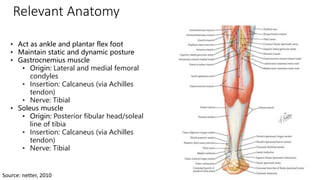
Relevant Anatomy
Source: netter, 2010
• Act as ankle and plantar flex foot
• Maintain static and dynamic posture
• Gastrocnemius muscle
• Origin: Lateral and medial femoral
condyles
• Insertion: Calcaneus (via Achilles
tendon)
• Nerve: Tibial
• Soleus muscle
• Origin: Posterior fibular head/soleal
line of tibia
• Insertion: Calcaneus (via Achilles
tendon)
• Nerve: Tibial
Gastrocnemius muscle
• The gastrocnemius comprises two heads that originate
from the posterosuperior region of the femoral condyle
• About 70% of the force of the gastrocnemius is generated
by the the medial head
• The two heads of the gastrocnemius converge to form a
large aponeurosis that merges with the soleus aponeurosis
Soleus muscle
• Formed by a large and voluminous muscle mass
• Lies deeply in relation to the gastrocnemius.
• The most powerful muscle of the ankle and
• It represents more than twice of the entire flexion force
• The aponeurosis of the soleus occupies the anterior face of this
muscle and thickens distally.
• Fuses with the aponeurosis of the gastrocnemius to give rise to the
calcaneus tendon.
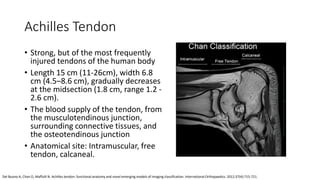
Achilles Tendon
• Strong, but of the most frequently
injured tendons of the human body
• Length 15 cm (11-26cm), width 6.8
cm (4.5–8.6 cm), gradually decreases
at the midsection (1.8 cm, range 1.2 -
2.6 cm).
• The blood supply of the tendon, from
the musculotendinous junction,
surrounding connective tissues, and
the osteotendinous junction
• Anatomical site: Intramuscular, free
tendon, calcaneal.
Del Buono A, Chan O, Maffulli N. Achilles tendon: functional anatomy and novel emerging models of imaging classification. International Orthopaedics. 2012;37(4):715-721.
Achilles Tendon Lengthening
• A surgical procedure that aims to stretch the Achilles tendon to
allow a person to walk flat-footed without a bend in the knee
• Treating Achilles tendon/gastrocnemius contracture
• Improve the dorsiflexion of ankle and correct equinus deformity
• Ideally to 10 degrees of ankle dorsiflexion past neutral with the
knee flexed and 5 degrees with the knee fully extended
• Open Or Percutaneous
Indication
Operative indications
a. Failure of nonoperative treatment to achieve and maintain
• at least 10° of ankle dorsiflexion above neutral with
• the subtalar joint in neutral alignment and the knee extended, if this
lack of flexibility causes:
i. pain under the metatarsal (MT) heads,
ii. pain along the Achilles musculotendinous continuum, and/or
iii. functional disability with gait disturbance.
S. Mosca V. Principles and Management of Pediatric Foot and Ankle Deformities and Malformations. 1st ed. Lippincott Williams & Wilkins; 2014.
Preoperative Planning
• Thorough history and physical examination
• Inquire about birht history
• Brain injury leading to cerebral palsy
• Inquire about family history
• Heritable neuromuscular disease
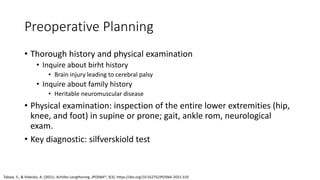
• Physical examination: inspection of the entire lower extremities (hip,
knee, and foot) in supine or prone; gait, ankle rom, neurological
exam.
• Key diagnostic: silfverskiold test
Tabaie, S., & Videckis, A. (2021). Achilles Lengthening. JPOSNA®, 3(3). https://doi.org/10.55275/JPOSNA-2021-310
Preoperative Planning
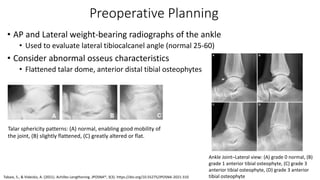
• AP and Lateral weight-bearing radiographs of the ankle
• Used to evaluate lateral tibiocalcanel angle (normal 25-60)
• Consider abnormal osseus characteristics
• Flattened talar dome, anterior distal tibial osteophytes
Talar sphericity patterns: (A) normal, enabling good mobility of
the joint, (B) slightly flattened, (C) greatly altered or flat.
Ankle Joint–Lateral view: (A) grade 0 normal, (B)
grade 1 anterior tibial osteophyte, (C) grade 3
anterior tibial osteophyte, (D) grade 3 anterior
tibial osteophyte
Tabaie, S., & Videckis, A. (2021). Achilles Lengthening. JPOSNA®, 3(3). https://doi.org/10.55275/JPOSNA-2021-310
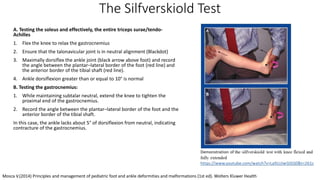
The Silfverskiold Test
A. Testing the soleus and effectively, the entire triceps surae/tendo-
Achilles
1. Flex the knee to relax the gastrocnemius
2. Ensure that the talonavicular joint is in neutral alignment (Blackdot)
3. Maximally dorsiflex the ankle joint (black arrow above foot) and record
the angle between the plantar–lateral border of the foot (red line) and
the anterior border of the tibial shaft (red line).
4. Ankle dorsiflexion greater than or equal to 10° is normal
B. Testing the gastrocnemius:
1. While maintaining subtalar neutral, extend the knee to tighten the
proximal end of the gastrocnemius.
2. Record the angle between the plantar–lateral border of the foot and the
anterior border of the tibial shaft.
In this case, the ankle lacks about 5° of dorsiflexion from neutral, indicating
contracture of the gastrocnemius.
Mosca V.(2014) Principles and management of pediatric foot and ankle deformities and malformations (1st ed). Wolters Kluwer Health
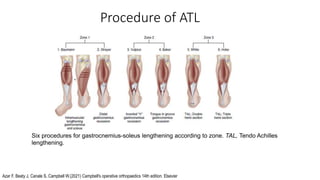
Procedure of ATL
Six procedures for gastrocnemius-soleus lengthening according to zone. TAL, Tendo Achilles
lengthening.
Azar F, Beaty J, Canale S, Campbell W.(2021) Campbell's operative orthopaedics 14th edition. Elsevier
Gastrocnemius Recession (Strayer Procedure)
Indications
• Contracture of the gastrocnemius but not the soleus as determined by the
Silfverskiold test that is creating pain, functional disability, and/or gait
disturbance
• The ankle joint can be dorsiflexed more than 10° with the subtalar joint
locked in neutral alignment and the knee flexed, but less than 10° with
the knee extended
S. Mosca V. Principles and Management of Pediatric Foot and Ankle Deformities and Malformations. 1st ed. Lippincott Williams & Wilkins; 2014.
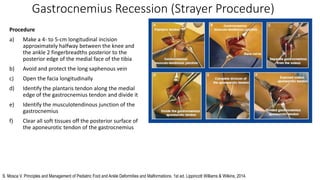
Gastrocnemius Recession (Strayer Procedure)
Procedure
a) Make a 4- to 5-cm longitudinal incision
approximately halfway between the knee and
the ankle 2 fingerbreadths posterior to the
posterior edge of the medial face of the tibia
b) Avoid and protect the long saphenous vein
c) Open the facia longitudinally
d) Identify the plantaris tendon along the medial
edge of the gastrocnemius tendon and divide it
e) Identify the musculotendinous junction of the
gastrocnemius
f) Clear all soft tissues off the posterior surface of
the aponeurotic tendon of the gastrocnemius
S. Mosca V. Principles and Management of Pediatric Foot and Ankle Deformities and Malformations. 1st ed. Lippincott Williams & Wilkins; 2014.
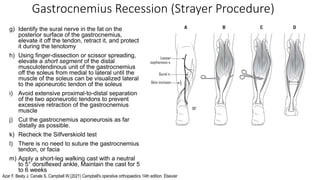
Gastrocnemius Recession (Strayer Procedure)
g) Identify the sural nerve in the fat on the
posterior surface of the gastrocnemius,
elevate it off the tendon, retract it, and protect
it during the tenotomy
h) Using finger-dissection or scissor spreading,
elevate a short segment of the distal
musculotendinous unit of the gastrocnemius
off the soleus from medial to lateral until the
muscle of the soleus can be visualized lateral
to the aponeurotic tendon of the soleus
i) Avoid extensive proximal-to-distal separation
of the two aponeurotic tendons to prevent
excessive retraction of the gastrocnemius
muscle
j) Cut the gastrocnemius aponeurosis as far
distally as possible.
k) Recheck the Silfverskiold test
l) There is no need to suture the gastrocnemius
tendon, or facia
m) Apply a short-leg walking cast with a neutral
to 5° dorsiflexed ankle, Maintain the cast for 5
to 6 weeks
Azar F, Beaty J, Canale S, Campbell W.(2021) Campbell's operative orthopaedics 14th edition. Elsevier
Gastrocnemius Recession (Strayer Procedure)
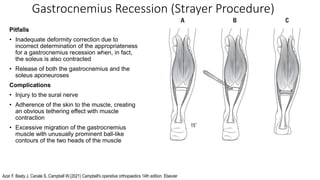
Pitfalls
• Inadequate deformity correction due to
incorrect determination of the appropriateness
for a gastrocnemius recession when, in fact,
the soleus is also contracted
• Release of both the gastrocnemius and the
soleus aponeuroses
Complications
• Injury to the sural nerve
• Adherence of the skin to the muscle, creating
an obvious tethering effect with muscle
contraction
• Excessive migration of the gastrocnemius
muscle with unusually prominent ball-like
contours of the two heads of the muscle
Azar F, Beaty J, Canale S, Campbell W.(2021) Campbell's operative orthopaedics 14th edition. Elsevier
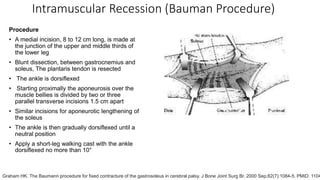
Intramuscular Recession (Bauman Procedure)
Procedure
• A medial incision, 8 to 12 cm long, is made at
the junction of the upper and middle thirds of
the lower leg
• Blunt dissection, between gastrocnemius and
soleus, The plantaris tendon is resected
• The ankle is dorsiflexed
• Starting proximally the aponeurosis over the
muscle bellies is divided by two or three
parallel transverse incisions 1.5 cm apart
• Similar incisions for aponeurotic lengthening of
the soleus
• The ankle is then gradually dorsiflexed until a
neutral position
• Apply a short-leg walking cast with the ankle
dorsiflexed no more than 10°
Graham HK. The Baumann procedure for fixed contracture of the gastrosoleus in cerebral palsy. J Bone Joint Surg Br. 2000 Sep;82(7):1084-5. PMID: 1104
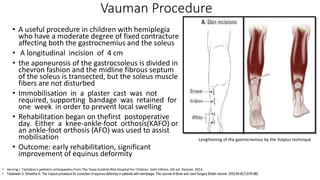
Vauman Procedure
• A useful procedure in children with hemiplegia
who have a moderate degree of fixed contracture
affecting both the gastrocnemius and the soleus
• A longitudinal incision of 4 cm
• the aponeurosis of the gastrocsoleus is divided in
chevron fashion and the midline fibrous septum
of the soleus is transected, but the soleus muscle
fibers are not disturbed
• Immobilisation in a plaster cast was not
required, supporting bandage was retained for
one week in order to prevent local swelling
• Rehabilitation began on thefirst postoperative
day. Either a knee-ankle-foot orthosis(KAFO) or
an ankle-foot orthosis (AFO) was used to assist
mobilisation
• Outcome: early rehabilitation, significant
improvement of equinus deformity
Lengthening of the gastrocnemius by the Vulpius technique
• Herring J. Tachdjian's pediatric orthopaedics From The Texas Scottish Rite Hospital For Children: Sixth Edition. 6th ed. Elsevier; 2014.
• Takahashi S, Shrestha A. The Vulpius procedure for correction of equinus deformity in patients with hemiplegia. The Journal of Bone and Joint Surgery British volume. 2002;84-B(7):978-980.
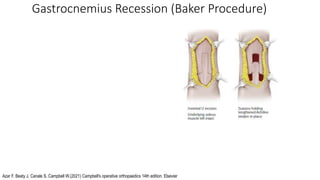
Gastrocnemius Recession (Baker Procedure)
Azar F, Beaty J, Canale S, Campbell W.(2021) Campbell's operative orthopaedics 14th edition. Elsevier
Achilles Tendon Lengthening
Indications
• Contracture of the tendo-achilles as determined by the Silfverskiold test that is creating pain, functional disability,
and/or gait disturbance
• The ankle joint can be dorsiflexed more than 10° with the subtalar joint locked in neutral alignment and the knee
flexed 90° (with an even greater lack of ankle dorsiflexion with the knee extended)
• Open or Percutaneous
• Open
• Adv: Overlengthening, complete tenotomy
• Disadv: less cosmetic
• Percutaneous:
• quick, inexpensive, and free of complications
• Cont: a percutaneous technique often doesn’t result in adequate correction and can lead to scar formation.
• Disadv: a complete tenotomy can be inadvertently created
Complication
• Complete tenotomy, rather than a lengthening,
• Excessive release of fibers in the percutaneous technique
S. Mosca V. Principles and Management of Pediatric Foot and Ankle Deformities and Malformations. 1st ed. Lippincott Williams & Wilkins; 2014.
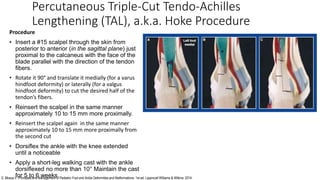
Percutaneous Triple-Cut Tendo-Achilles
Lengthening (TAL), a.k.a. Hoke Procedure
Procedure
• Insert a #15 scalpel through the skin from
posterior to anterior (in the sagittal plane) just
proximal to the calcaneus with the face of the
blade parallel with the direction of the tendon
fibers.
• Rotate it 90° and translate it medially (for a varus
hindfoot deformity) or laterally (for a valgus
hindfoot deformity) to cut the desired half of the
tendon’s fibers.
• Reinsert the scalpel in the same manner
approximately 10 to 15 mm more proximally.
• Reinsert the scalpel again in the same manner
approximately 10 to 15 mm more proximally from
the second cut
• Dorsiflex the ankle with the knee extended
until a noticeable
• Apply a short-leg walking cast with the ankle
dorsiflexed no more than 10° Maintain the cast
for 5 to 6 weeks
S. Mosca V. Principles and Management of Pediatric Foot and Ankle Deformities and Malformations. 1st ed. Lippincott Williams & Wilkins; 2014.
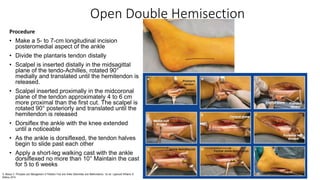
Open Double Hemisection
Procedure
• Make a 5- to 7-cm longitudinal incision
posteromedial aspect of the ankle
• Divide the plantaris tendon distally
• Scalpel is inserted distally in the midsagittal
plane of the tendo-Achilles, rotated 90°
medially and translated until the hemitendon is
released.
• Scalpel inserted proximally in the midcoronal
plane of the tendon approximately 4 to 6 cm
more proximal than the first cut. The scalpel is
rotated 90° posteriorly and translated until the
hemitendon is released
• Dorsiflex the ankle with the knee extended
until a noticeable
• As the ankle is dorsiflexed, the tendon halves
begin to slide past each other
• Apply a short-leg walking cast with the ankle
dorsiflexed no more than 10° Maintain the cast
for 5 to 6 weeks
S. Mosca V. Principles and Management of Pediatric Foot and Ankle Deformities and Malformations. 1st ed. Lippincott Williams &
Wilkins; 2014.
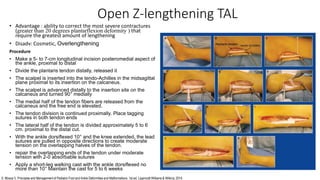
Open Z-lengthening TAL
• Advantage : ability to correct the most severe contractures
(greater than 20 degrees plantarflexion deformity ) that
require the greatest amount of lengthening
• Disadv: Cosmetic, Overlengthening
Procedure
• Make a 5- to 7-cm longitudinal incision posteromedial aspect of
the ankle, proximal to distal
• Divide the plantaris tendon distally, released it
• The scalpel is inserted into the tendo-Achilles in the midsagittal
plane proximal to its insertion on the calcaneus.
• The scalpel is advanced distally to the insertion site on the
calcaneus and turned 90° medially
• The medial half of the tendon fibers are released from the
calcaneus and the free end is elevated.
• The tendon division is continued proximally. Place tagging
sutures in both tendon ends
• The lateral half of the tendon is divided approximately 5 to 6
cm. proximal to the distal cut.
• With the ankle dorsiflexed 10° and the knee extended, the lead
sutures are pulled in opposite directions to create moderate
tension on the overlapping halves of the tendon.
• repair the overlapping ends of the tendon under moderate
tension with 2-0 absorbable sutures
• Apply a short-leg walking cast with the ankle dorsiflexed no
more than 10° Maintain the cast for 5 to 6 weeks
S. Mosca V. Principles and Management of Pediatric Foot and Ankle Deformities and Malformations. 1st ed. Lippincott Williams & Wilkins; 2014.
Post Operative Care
• Apply short leg cast
• Four – six weeks, the patient is allowed to bear full weight
• The cast is removed, and an ankle-foot orthosis in maximal
dorsiflexion or molded with AFO
• Physical therapy
Azar F, Beaty J, Canale S, Campbell W.(2021) Campbell's operative orthopaedics 14th edition. Elsevier
Complications
• Overlengthening of tendon is most common complication
• Reoccurance of contracture
• 9 – 21 % in spastic hemiplegia and diplegic children with cerebral palsy
• Casting and transitioning to an AFO to minimize reoccurance
Summary
• Achilles Lengthening correct fixed ankle equinus
• Improve ankle dorsiflexion 10° past neutral with knee flexed, 5° with knee
fully extended
• Ensure fixed ankle equines exist with both knee flexed and extended
(Silfverskiold test)
• Gastrocnemious resection (open or percutaneous) and Achilles
tendon lenthening
• Asses preoperative, intraoperative and postoperative care
References
• Azar F, Beaty J, Canale S, Campbell W.(2021) Campbell's operative orthopaedics 14th edition. Elsevier
• S. Mosca V. Principles and Management of Pediatric Foot and Ankle Deformities and Malformations. 1st ed. Lippincott
Williams & Wilkins; 2014.
• Herring J. Tachdjian's pediatric orthopaedics From The Texas Scottish Rite Hospital For Children: Sixth Edition. 6th ed.
Elsevier; 2014.
• Weinstein S, Flynn J. Lovell and Winter's pediatric orthopaedics. Philadelphia, PA: Lippincott Williams & Wilkins; 2014.
• Del Buono A, Chan O, Maffulli N. Achilles tendon: functional anatomy and novel emerging models of imaging classification.
International Orthopaedics. 2012;37(4):715-721.
• Tabaie S, Videckis A. Achilles Lengthening. jposna [Internet]. 2021Jul.26 [cited 2022Jul.15];3(3). Available from:
https://www.jposna.org/ojs/index.php/jposna/article/view/310
• Rong K, Li X, Ge W, Xu Y, Xu X. Comparison of the efficacy of three isolated gastrocnemius recession procedures in a
cadaveric model of gastrocnemius tightness. International Orthopaedics. 2015;40(2):417-423.
• Firth G, McMullan M, Chin T, Ma F, Selber P, Eizenberg N et al. Lengthening of the Gastrocnemius-Soleus Complex. 2022.
• Volpon J, Natale L. Critical evaluation of the surgical techniques to correct the equinus deformity. Revista do Colégio
Brasileiro de Cirurgiões. 2019;46(1).
• Graham HK. The Baumann procedure for fixed contracture of the gastrosoleus in cerebral palsy. J Bone Joint Surg Br. 2000
Sep;82(7):1084-5. PMID: 11041608.

Achilles Tendon Lengthening.pptx

  • 1.
  • 2.
    Relevant Anatomy Source: netter,2010 • Act as ankle and plantar flex foot • Maintain static and dynamic posture • Gastrocnemius muscle • Origin: Lateral and medial femoral condyles • Insertion: Calcaneus (via Achilles tendon) • Nerve: Tibial • Soleus muscle • Origin: Posterior fibular head/soleal line of tibia • Insertion: Calcaneus (via Achilles tendon) • Nerve: Tibial
  • 3.
    Gastrocnemius muscle • Thegastrocnemius comprises two heads that originate from the posterosuperior region of the femoral condyle • About 70% of the force of the gastrocnemius is generated by the the medial head • The two heads of the gastrocnemius converge to form a large aponeurosis that merges with the soleus aponeurosis
  • 4.
    Soleus muscle • Formedby a large and voluminous muscle mass • Lies deeply in relation to the gastrocnemius. • The most powerful muscle of the ankle and • It represents more than twice of the entire flexion force • The aponeurosis of the soleus occupies the anterior face of this muscle and thickens distally. • Fuses with the aponeurosis of the gastrocnemius to give rise to the calcaneus tendon.
  • 5.
    Achilles Tendon • Strong,but of the most frequently injured tendons of the human body • Length 15 cm (11-26cm), width 6.8 cm (4.5–8.6 cm), gradually decreases at the midsection (1.8 cm, range 1.2 - 2.6 cm). • The blood supply of the tendon, from the musculotendinous junction, surrounding connective tissues, and the osteotendinous junction • Anatomical site: Intramuscular, free tendon, calcaneal. Del Buono A, Chan O, Maffulli N. Achilles tendon: functional anatomy and novel emerging models of imaging classification. International Orthopaedics. 2012;37(4):715-721.
  • 6.
    Achilles Tendon Lengthening •A surgical procedure that aims to stretch the Achilles tendon to allow a person to walk flat-footed without a bend in the knee • Treating Achilles tendon/gastrocnemius contracture • Improve the dorsiflexion of ankle and correct equinus deformity • Ideally to 10 degrees of ankle dorsiflexion past neutral with the knee flexed and 5 degrees with the knee fully extended • Open Or Percutaneous
  • 7.
    Indication Operative indications a. Failureof nonoperative treatment to achieve and maintain • at least 10° of ankle dorsiflexion above neutral with • the subtalar joint in neutral alignment and the knee extended, if this lack of flexibility causes: i. pain under the metatarsal (MT) heads, ii. pain along the Achilles musculotendinous continuum, and/or iii. functional disability with gait disturbance. S. Mosca V. Principles and Management of Pediatric Foot and Ankle Deformities and Malformations. 1st ed. Lippincott Williams & Wilkins; 2014.
  • 8.
    Preoperative Planning • Thoroughhistory and physical examination • Inquire about birht history • Brain injury leading to cerebral palsy • Inquire about family history • Heritable neuromuscular disease • Physical examination: inspection of the entire lower extremities (hip, knee, and foot) in supine or prone; gait, ankle rom, neurological exam. • Key diagnostic: silfverskiold test Tabaie, S., & Videckis, A. (2021). Achilles Lengthening. JPOSNA®, 3(3). https://doi.org/10.55275/JPOSNA-2021-310
  • 9.
    Preoperative Planning • APand Lateral weight-bearing radiographs of the ankle • Used to evaluate lateral tibiocalcanel angle (normal 25-60) • Consider abnormal osseus characteristics • Flattened talar dome, anterior distal tibial osteophytes Talar sphericity patterns: (A) normal, enabling good mobility of the joint, (B) slightly flattened, (C) greatly altered or flat. Ankle Joint–Lateral view: (A) grade 0 normal, (B) grade 1 anterior tibial osteophyte, (C) grade 3 anterior tibial osteophyte, (D) grade 3 anterior tibial osteophyte Tabaie, S., & Videckis, A. (2021). Achilles Lengthening. JPOSNA®, 3(3). https://doi.org/10.55275/JPOSNA-2021-310
  • 10.
    The Silfverskiold Test A.Testing the soleus and effectively, the entire triceps surae/tendo- Achilles 1. Flex the knee to relax the gastrocnemius 2. Ensure that the talonavicular joint is in neutral alignment (Blackdot) 3. Maximally dorsiflex the ankle joint (black arrow above foot) and record the angle between the plantar–lateral border of the foot (red line) and the anterior border of the tibial shaft (red line). 4. Ankle dorsiflexion greater than or equal to 10° is normal B. Testing the gastrocnemius: 1. While maintaining subtalar neutral, extend the knee to tighten the proximal end of the gastrocnemius. 2. Record the angle between the plantar–lateral border of the foot and the anterior border of the tibial shaft. In this case, the ankle lacks about 5° of dorsiflexion from neutral, indicating contracture of the gastrocnemius. Mosca V.(2014) Principles and management of pediatric foot and ankle deformities and malformations (1st ed). Wolters Kluwer Health
  • 11.
    Procedure of ATL Sixprocedures for gastrocnemius-soleus lengthening according to zone. TAL, Tendo Achilles lengthening. Azar F, Beaty J, Canale S, Campbell W.(2021) Campbell's operative orthopaedics 14th edition. Elsevier
  • 12.
    Gastrocnemius Recession (StrayerProcedure) Indications • Contracture of the gastrocnemius but not the soleus as determined by the Silfverskiold test that is creating pain, functional disability, and/or gait disturbance • The ankle joint can be dorsiflexed more than 10° with the subtalar joint locked in neutral alignment and the knee flexed, but less than 10° with the knee extended S. Mosca V. Principles and Management of Pediatric Foot and Ankle Deformities and Malformations. 1st ed. Lippincott Williams & Wilkins; 2014.
  • 13.
    Gastrocnemius Recession (StrayerProcedure) Procedure a) Make a 4- to 5-cm longitudinal incision approximately halfway between the knee and the ankle 2 fingerbreadths posterior to the posterior edge of the medial face of the tibia b) Avoid and protect the long saphenous vein c) Open the facia longitudinally d) Identify the plantaris tendon along the medial edge of the gastrocnemius tendon and divide it e) Identify the musculotendinous junction of the gastrocnemius f) Clear all soft tissues off the posterior surface of the aponeurotic tendon of the gastrocnemius S. Mosca V. Principles and Management of Pediatric Foot and Ankle Deformities and Malformations. 1st ed. Lippincott Williams & Wilkins; 2014.
  • 14.
    Gastrocnemius Recession (StrayerProcedure) g) Identify the sural nerve in the fat on the posterior surface of the gastrocnemius, elevate it off the tendon, retract it, and protect it during the tenotomy h) Using finger-dissection or scissor spreading, elevate a short segment of the distal musculotendinous unit of the gastrocnemius off the soleus from medial to lateral until the muscle of the soleus can be visualized lateral to the aponeurotic tendon of the soleus i) Avoid extensive proximal-to-distal separation of the two aponeurotic tendons to prevent excessive retraction of the gastrocnemius muscle j) Cut the gastrocnemius aponeurosis as far distally as possible. k) Recheck the Silfverskiold test l) There is no need to suture the gastrocnemius tendon, or facia m) Apply a short-leg walking cast with a neutral to 5° dorsiflexed ankle, Maintain the cast for 5 to 6 weeks Azar F, Beaty J, Canale S, Campbell W.(2021) Campbell's operative orthopaedics 14th edition. Elsevier
  • 15.
    Gastrocnemius Recession (StrayerProcedure) Pitfalls • Inadequate deformity correction due to incorrect determination of the appropriateness for a gastrocnemius recession when, in fact, the soleus is also contracted • Release of both the gastrocnemius and the soleus aponeuroses Complications • Injury to the sural nerve • Adherence of the skin to the muscle, creating an obvious tethering effect with muscle contraction • Excessive migration of the gastrocnemius muscle with unusually prominent ball-like contours of the two heads of the muscle Azar F, Beaty J, Canale S, Campbell W.(2021) Campbell's operative orthopaedics 14th edition. Elsevier
  • 16.
    Intramuscular Recession (BaumanProcedure) Procedure • A medial incision, 8 to 12 cm long, is made at the junction of the upper and middle thirds of the lower leg • Blunt dissection, between gastrocnemius and soleus, The plantaris tendon is resected • The ankle is dorsiflexed • Starting proximally the aponeurosis over the muscle bellies is divided by two or three parallel transverse incisions 1.5 cm apart • Similar incisions for aponeurotic lengthening of the soleus • The ankle is then gradually dorsiflexed until a neutral position • Apply a short-leg walking cast with the ankle dorsiflexed no more than 10° Graham HK. The Baumann procedure for fixed contracture of the gastrosoleus in cerebral palsy. J Bone Joint Surg Br. 2000 Sep;82(7):1084-5. PMID: 1104
  • 17.
    Vauman Procedure • Auseful procedure in children with hemiplegia who have a moderate degree of fixed contracture affecting both the gastrocnemius and the soleus • A longitudinal incision of 4 cm • the aponeurosis of the gastrocsoleus is divided in chevron fashion and the midline fibrous septum of the soleus is transected, but the soleus muscle fibers are not disturbed • Immobilisation in a plaster cast was not required, supporting bandage was retained for one week in order to prevent local swelling • Rehabilitation began on thefirst postoperative day. Either a knee-ankle-foot orthosis(KAFO) or an ankle-foot orthosis (AFO) was used to assist mobilisation • Outcome: early rehabilitation, significant improvement of equinus deformity Lengthening of the gastrocnemius by the Vulpius technique • Herring J. Tachdjian's pediatric orthopaedics From The Texas Scottish Rite Hospital For Children: Sixth Edition. 6th ed. Elsevier; 2014. • Takahashi S, Shrestha A. The Vulpius procedure for correction of equinus deformity in patients with hemiplegia. The Journal of Bone and Joint Surgery British volume. 2002;84-B(7):978-980.
  • 18.
    Gastrocnemius Recession (BakerProcedure) Azar F, Beaty J, Canale S, Campbell W.(2021) Campbell's operative orthopaedics 14th edition. Elsevier
  • 19.
    Achilles Tendon Lengthening Indications •Contracture of the tendo-achilles as determined by the Silfverskiold test that is creating pain, functional disability, and/or gait disturbance • The ankle joint can be dorsiflexed more than 10° with the subtalar joint locked in neutral alignment and the knee flexed 90° (with an even greater lack of ankle dorsiflexion with the knee extended) • Open or Percutaneous • Open • Adv: Overlengthening, complete tenotomy • Disadv: less cosmetic • Percutaneous: • quick, inexpensive, and free of complications • Cont: a percutaneous technique often doesn’t result in adequate correction and can lead to scar formation. • Disadv: a complete tenotomy can be inadvertently created Complication • Complete tenotomy, rather than a lengthening, • Excessive release of fibers in the percutaneous technique S. Mosca V. Principles and Management of Pediatric Foot and Ankle Deformities and Malformations. 1st ed. Lippincott Williams & Wilkins; 2014.
  • 20.
    Percutaneous Triple-Cut Tendo-Achilles Lengthening(TAL), a.k.a. Hoke Procedure Procedure • Insert a #15 scalpel through the skin from posterior to anterior (in the sagittal plane) just proximal to the calcaneus with the face of the blade parallel with the direction of the tendon fibers. • Rotate it 90° and translate it medially (for a varus hindfoot deformity) or laterally (for a valgus hindfoot deformity) to cut the desired half of the tendon’s fibers. • Reinsert the scalpel in the same manner approximately 10 to 15 mm more proximally. • Reinsert the scalpel again in the same manner approximately 10 to 15 mm more proximally from the second cut • Dorsiflex the ankle with the knee extended until a noticeable • Apply a short-leg walking cast with the ankle dorsiflexed no more than 10° Maintain the cast for 5 to 6 weeks S. Mosca V. Principles and Management of Pediatric Foot and Ankle Deformities and Malformations. 1st ed. Lippincott Williams & Wilkins; 2014.
  • 21.
    Open Double Hemisection Procedure •Make a 5- to 7-cm longitudinal incision posteromedial aspect of the ankle • Divide the plantaris tendon distally • Scalpel is inserted distally in the midsagittal plane of the tendo-Achilles, rotated 90° medially and translated until the hemitendon is released. • Scalpel inserted proximally in the midcoronal plane of the tendon approximately 4 to 6 cm more proximal than the first cut. The scalpel is rotated 90° posteriorly and translated until the hemitendon is released • Dorsiflex the ankle with the knee extended until a noticeable • As the ankle is dorsiflexed, the tendon halves begin to slide past each other • Apply a short-leg walking cast with the ankle dorsiflexed no more than 10° Maintain the cast for 5 to 6 weeks S. Mosca V. Principles and Management of Pediatric Foot and Ankle Deformities and Malformations. 1st ed. Lippincott Williams & Wilkins; 2014.
  • 22.
    Open Z-lengthening TAL •Advantage : ability to correct the most severe contractures (greater than 20 degrees plantarflexion deformity ) that require the greatest amount of lengthening • Disadv: Cosmetic, Overlengthening Procedure • Make a 5- to 7-cm longitudinal incision posteromedial aspect of the ankle, proximal to distal • Divide the plantaris tendon distally, released it • The scalpel is inserted into the tendo-Achilles in the midsagittal plane proximal to its insertion on the calcaneus. • The scalpel is advanced distally to the insertion site on the calcaneus and turned 90° medially • The medial half of the tendon fibers are released from the calcaneus and the free end is elevated. • The tendon division is continued proximally. Place tagging sutures in both tendon ends • The lateral half of the tendon is divided approximately 5 to 6 cm. proximal to the distal cut. • With the ankle dorsiflexed 10° and the knee extended, the lead sutures are pulled in opposite directions to create moderate tension on the overlapping halves of the tendon. • repair the overlapping ends of the tendon under moderate tension with 2-0 absorbable sutures • Apply a short-leg walking cast with the ankle dorsiflexed no more than 10° Maintain the cast for 5 to 6 weeks S. Mosca V. Principles and Management of Pediatric Foot and Ankle Deformities and Malformations. 1st ed. Lippincott Williams & Wilkins; 2014.
  • 23.
    Post Operative Care •Apply short leg cast • Four – six weeks, the patient is allowed to bear full weight • The cast is removed, and an ankle-foot orthosis in maximal dorsiflexion or molded with AFO • Physical therapy Azar F, Beaty J, Canale S, Campbell W.(2021) Campbell's operative orthopaedics 14th edition. Elsevier
  • 24.
    Complications • Overlengthening oftendon is most common complication • Reoccurance of contracture • 9 – 21 % in spastic hemiplegia and diplegic children with cerebral palsy • Casting and transitioning to an AFO to minimize reoccurance
  • 25.
    Summary • Achilles Lengtheningcorrect fixed ankle equinus • Improve ankle dorsiflexion 10° past neutral with knee flexed, 5° with knee fully extended • Ensure fixed ankle equines exist with both knee flexed and extended (Silfverskiold test) • Gastrocnemious resection (open or percutaneous) and Achilles tendon lenthening • Asses preoperative, intraoperative and postoperative care
  • 26.
    References • Azar F,Beaty J, Canale S, Campbell W.(2021) Campbell's operative orthopaedics 14th edition. Elsevier • S. Mosca V. Principles and Management of Pediatric Foot and Ankle Deformities and Malformations. 1st ed. Lippincott Williams & Wilkins; 2014. • Herring J. Tachdjian's pediatric orthopaedics From The Texas Scottish Rite Hospital For Children: Sixth Edition. 6th ed. Elsevier; 2014. • Weinstein S, Flynn J. Lovell and Winter's pediatric orthopaedics. Philadelphia, PA: Lippincott Williams & Wilkins; 2014. • Del Buono A, Chan O, Maffulli N. Achilles tendon: functional anatomy and novel emerging models of imaging classification. International Orthopaedics. 2012;37(4):715-721. • Tabaie S, Videckis A. Achilles Lengthening. jposna [Internet]. 2021Jul.26 [cited 2022Jul.15];3(3). Available from: https://www.jposna.org/ojs/index.php/jposna/article/view/310 • Rong K, Li X, Ge W, Xu Y, Xu X. Comparison of the efficacy of three isolated gastrocnemius recession procedures in a cadaveric model of gastrocnemius tightness. International Orthopaedics. 2015;40(2):417-423. • Firth G, McMullan M, Chin T, Ma F, Selber P, Eizenberg N et al. Lengthening of the Gastrocnemius-Soleus Complex. 2022. • Volpon J, Natale L. Critical evaluation of the surgical techniques to correct the equinus deformity. Revista do Colégio Brasileiro de Cirurgiões. 2019;46(1). • Graham HK. The Baumann procedure for fixed contracture of the gastrosoleus in cerebral palsy. J Bone Joint Surg Br. 2000 Sep;82(7):1084-5. PMID: 11041608.

Editor's Notes

  • #9 Lateral view history of skeletal dysplasia, prior trauma, unknown syn-drome, prior clubfoot surgery, or could have bony causes to restrict ankle dorsiflexion.