JOEL M PAIS MBA - 2011 ALOYSIUS INSTITUTE OF MANAGEMENT AND INFORMATION TECHNOLOGY  (AIMIT) Presented By:
Summary
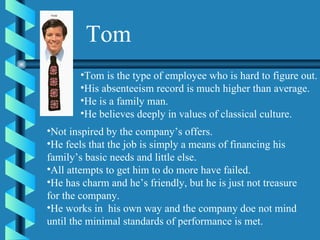
Tom Tom is the type of employee who is hard to figure out.  His absenteeism record is much higher than average.  He is a family man.  He believes deeply in values of classical culture.  Not inspired by the company’s offers.  He feels that the job is simply a means of financing his  family’s basic needs and little else.  All attempts to get him to do more have failed.  He has charm and he’s friendly, but he is just not treasure  for the company.  He works in  his own way and the company doe not mind  until the minimal standards of performance is met.
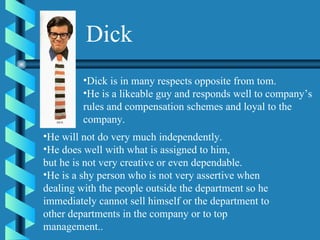
Dick Dick is in many respects opposite from tom.  He is a likeable guy and responds well to company’s  rules and compensation schemes and loyal to the  company.  He will not do very much independently.  He does well with what is assigned to him,  but he is not very creative or even dependable.  He is a shy person who is not very assertive when  dealing with the people outside the department so he  immediately cannot sell himself or the department to  other departments in the company or to top  management..
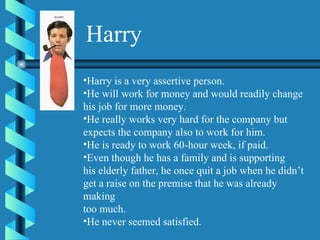
Harry Harry is a very assertive person.  He will work for money and would readily change  his job for more money.  He really works very hard for the company but  expects the company also to work for him.  He is ready to work 60-hour week, if paid.  Even though he has a family and is supporting  his elderly father, he once quit a job when he didn’t  get a raise on the premise that he was already making  too much.  He never seemed satisfied.
1. Can you explain tom’s, dick’s and harry’s motivations by one or more of the work-motivation models discussed in this chapter. ANALYSIS
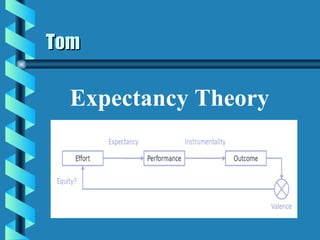
Tom Expectancy Theory
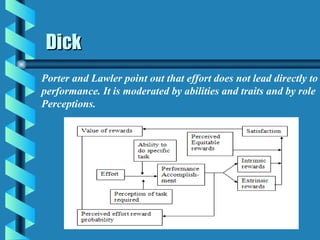
Dick Porter and Lawler point out that effort does not lead directly to  performance. It is moderated by abilities and traits and by role  Perceptions.
Harry Theory  X and Y: Theory Y: Assume that the person already likes  work Seeks responsibilities Capable of decision making Self directed Self motivated towards the goal.
2. Using Alderfer’s ERG theory, what group of core needs seems to dominate each of these three subordinates?
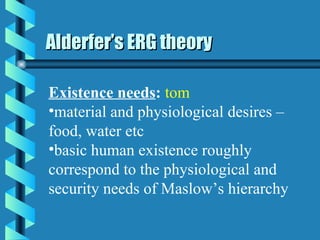
Alderfer’s ERG theory Existence needs :   tom material and physiological desires – food, water etc basic human existence roughly correspond to the physiological and security needs of Maslow’s hierarchy
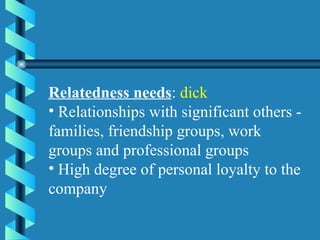
Relatedness needs :  dick   Relationships with significant others - families, friendship groups, work groups and professional groups High degree of personal loyalty to the company
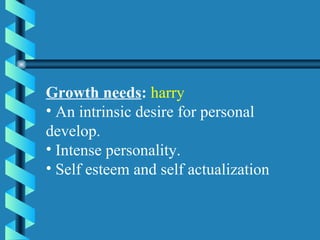
Growth needs :   harry An intrinsic desire for personal develop. Intense personality. Self esteem and self actualization
3. How, if at all, would equity theory apply to the analysis of the motivation of tom dick and harry.
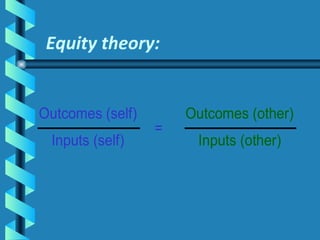
Equity theory: Equity theory proposes that individuals who perceive themselves as either under-rewarded or over-rewarded will experience distress, and that, this distress leads to efforts to restore equity within the relationship. It focuses on determining whether the distribution of resources is fair to both relational partners.
Equity theory:
THE END Thank you.

Ob case study - tom, dick, harry

  • 1.
    JOEL M PAISMBA - 2011 ALOYSIUS INSTITUTE OF MANAGEMENT AND INFORMATION TECHNOLOGY (AIMIT) Presented By:
  • 2.
  • 3.
    Tom Tom isthe type of employee who is hard to figure out. His absenteeism record is much higher than average. He is a family man. He believes deeply in values of classical culture. Not inspired by the company’s offers. He feels that the job is simply a means of financing his family’s basic needs and little else. All attempts to get him to do more have failed. He has charm and he’s friendly, but he is just not treasure for the company. He works in his own way and the company doe not mind until the minimal standards of performance is met.
  • 4.
    Dick Dick isin many respects opposite from tom. He is a likeable guy and responds well to company’s rules and compensation schemes and loyal to the company. He will not do very much independently. He does well with what is assigned to him, but he is not very creative or even dependable. He is a shy person who is not very assertive when dealing with the people outside the department so he immediately cannot sell himself or the department to other departments in the company or to top management..
  • 5.
    Harry Harry isa very assertive person. He will work for money and would readily change his job for more money. He really works very hard for the company but expects the company also to work for him. He is ready to work 60-hour week, if paid. Even though he has a family and is supporting his elderly father, he once quit a job when he didn’t get a raise on the premise that he was already making too much. He never seemed satisfied.
  • 6.
    1. Can youexplain tom’s, dick’s and harry’s motivations by one or more of the work-motivation models discussed in this chapter. ANALYSIS
  • 7.
  • 8.
    Dick Porter andLawler point out that effort does not lead directly to performance. It is moderated by abilities and traits and by role Perceptions.
  • 9.
    Harry Theory X and Y: Theory Y: Assume that the person already likes work Seeks responsibilities Capable of decision making Self directed Self motivated towards the goal.
  • 10.
    2. Using Alderfer’sERG theory, what group of core needs seems to dominate each of these three subordinates?
  • 11.
    Alderfer’s ERG theoryExistence needs : tom material and physiological desires – food, water etc basic human existence roughly correspond to the physiological and security needs of Maslow’s hierarchy
  • 12.
    Relatedness needs : dick Relationships with significant others - families, friendship groups, work groups and professional groups High degree of personal loyalty to the company
  • 13.
    Growth needs : harry An intrinsic desire for personal develop. Intense personality. Self esteem and self actualization
  • 14.
    3. How, ifat all, would equity theory apply to the analysis of the motivation of tom dick and harry.
  • 15.
    Equity theory: Equitytheory proposes that individuals who perceive themselves as either under-rewarded or over-rewarded will experience distress, and that, this distress leads to efforts to restore equity within the relationship. It focuses on determining whether the distribution of resources is fair to both relational partners.
  • 16.
  • 17.