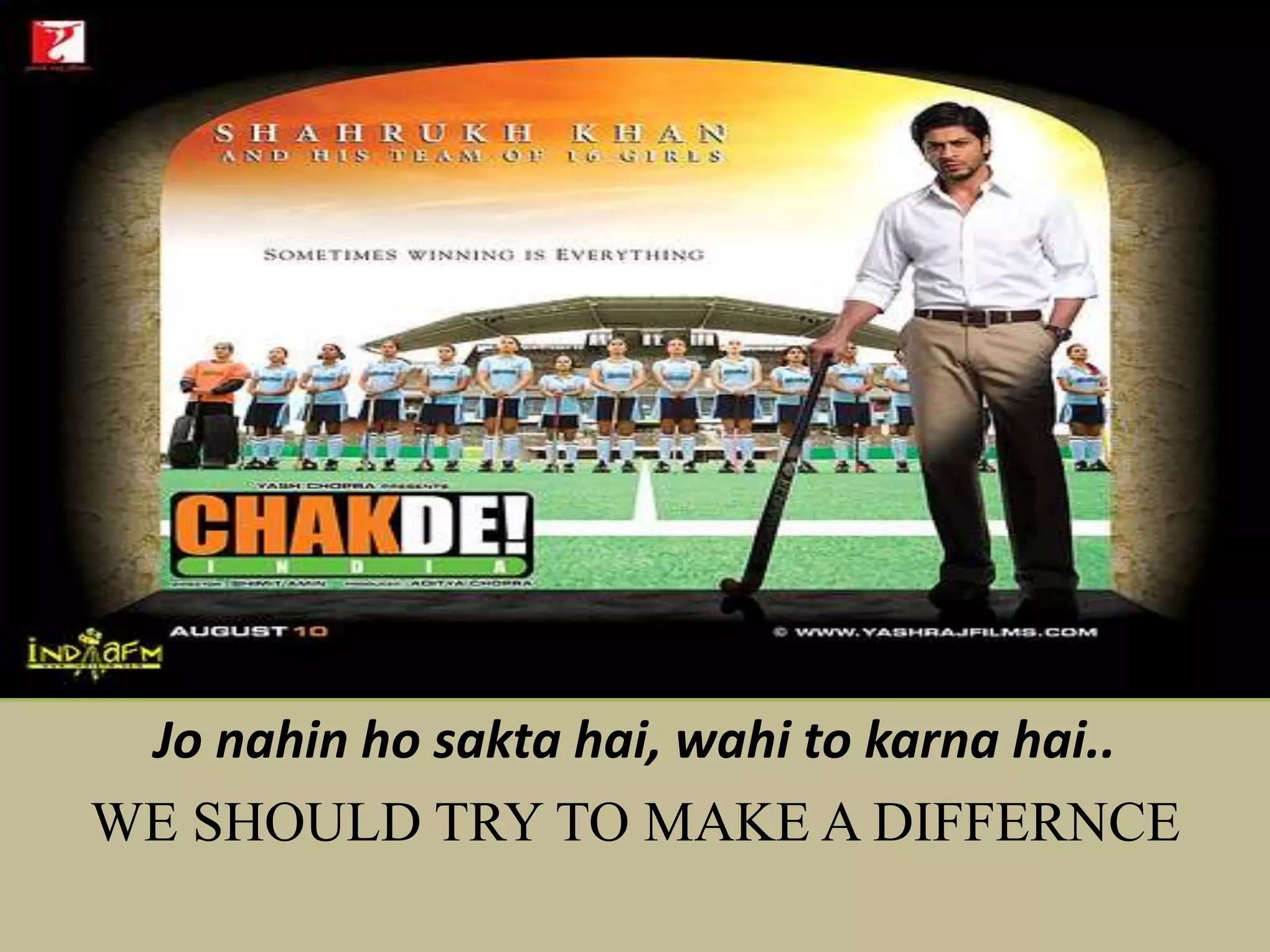
Jo nahin ho sakta hai, wahi to karna hai..
WE SHOULD TRY TO MAKE A DIFFERNCE
Background of the Movie
• Chak De India is a 2007 Bollywood movie
produced under the banner of Yash Chopda.
• The story in the movie goes side by side with the
Indian hockey team and the mental aspect arisen
between the players, coach and the audience.
• Sharukh Khan is in the lead role in the movie who
is a player and a coach of the female hocky team.
• Khan was the captain of the Indian hockey team
when they lose the final match against the
Pakistan.
• When various questions were raised against
him after Pakistan won the match, he was
under the shadow for seven years.
• And finally he came in the main stream as a
coach of female hockey team to erect the
mistake he had made earlier and to drive the
Indian hockey team to a paramount.
OB and Chak De
Chakde India is a social movie that comprises the
entire human and the behavioral aspect of the
human beings. The human attributes like
• motivation,
• perception,
• leadership,
• psychology, and
• team dynamics
are clearly and explicitly presented in the movie.
In this regard, we can call ‘chakde India” as a
behavioral movie.
Team Building
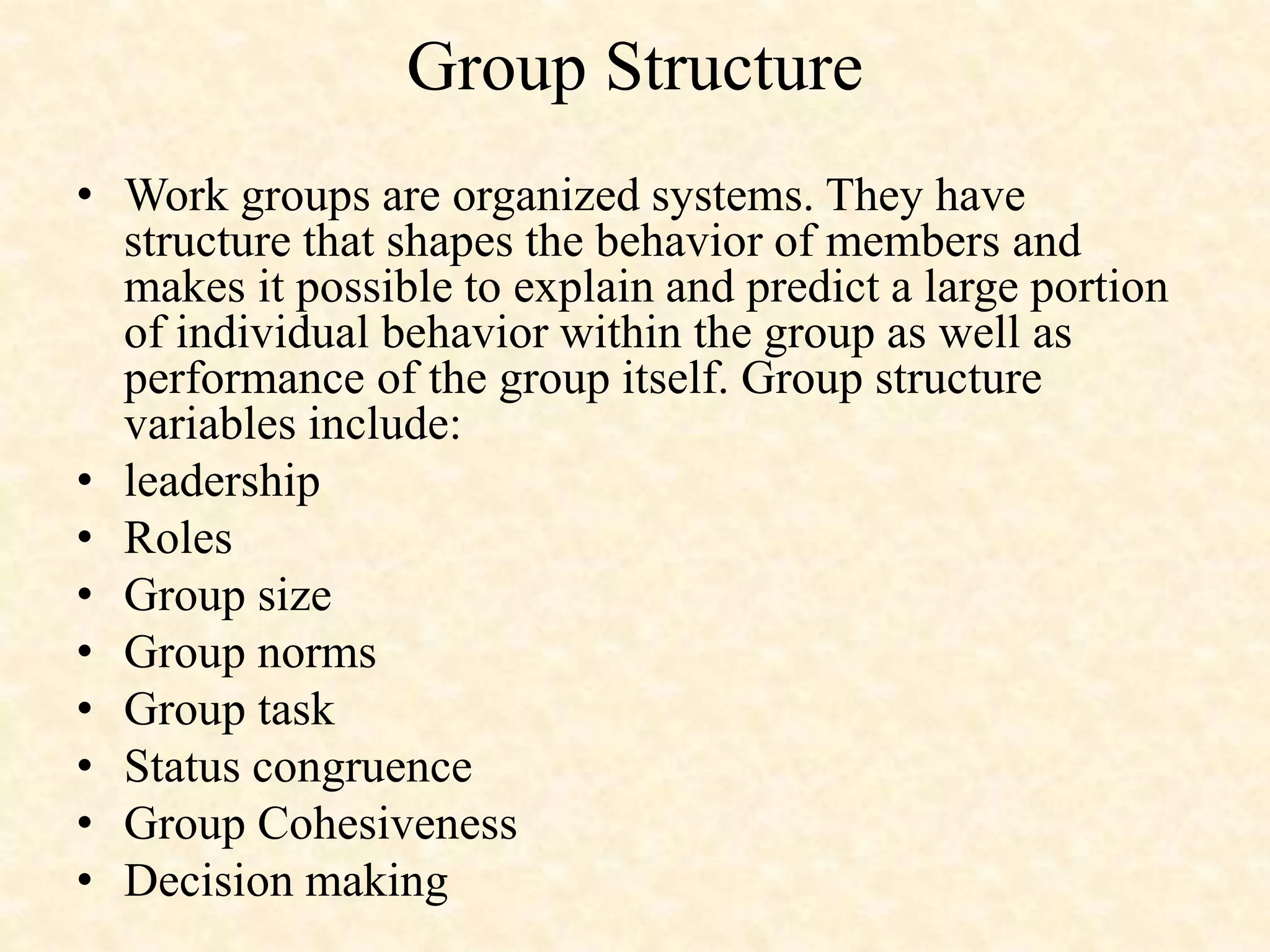
• The most important aspect of the movie is team
building process. The players from various states
with different ethnic background, language,
culture, personality and attitudes come upon a
team to play together with a common goal i.e to
play for the country. It also showed that goal can
be easily achieved if they work on the team with
the shared values and motives. In the movie,
comparatively a weaker team went up to the
hockey finals and won against the strong team
Australia.
Group Structure
• Work groups are organized systems. They have
structure that shapes the behavior of members and
makes it possible to explain and predict a large portion
of individual behavior within the group as well as
performance of the group itself. Group structure
variables include:
• leadership
• Roles
• Group size
• Group norms
• Group task
• Status congruence
• Group Cohesiveness
• Decision making
Group Formation:
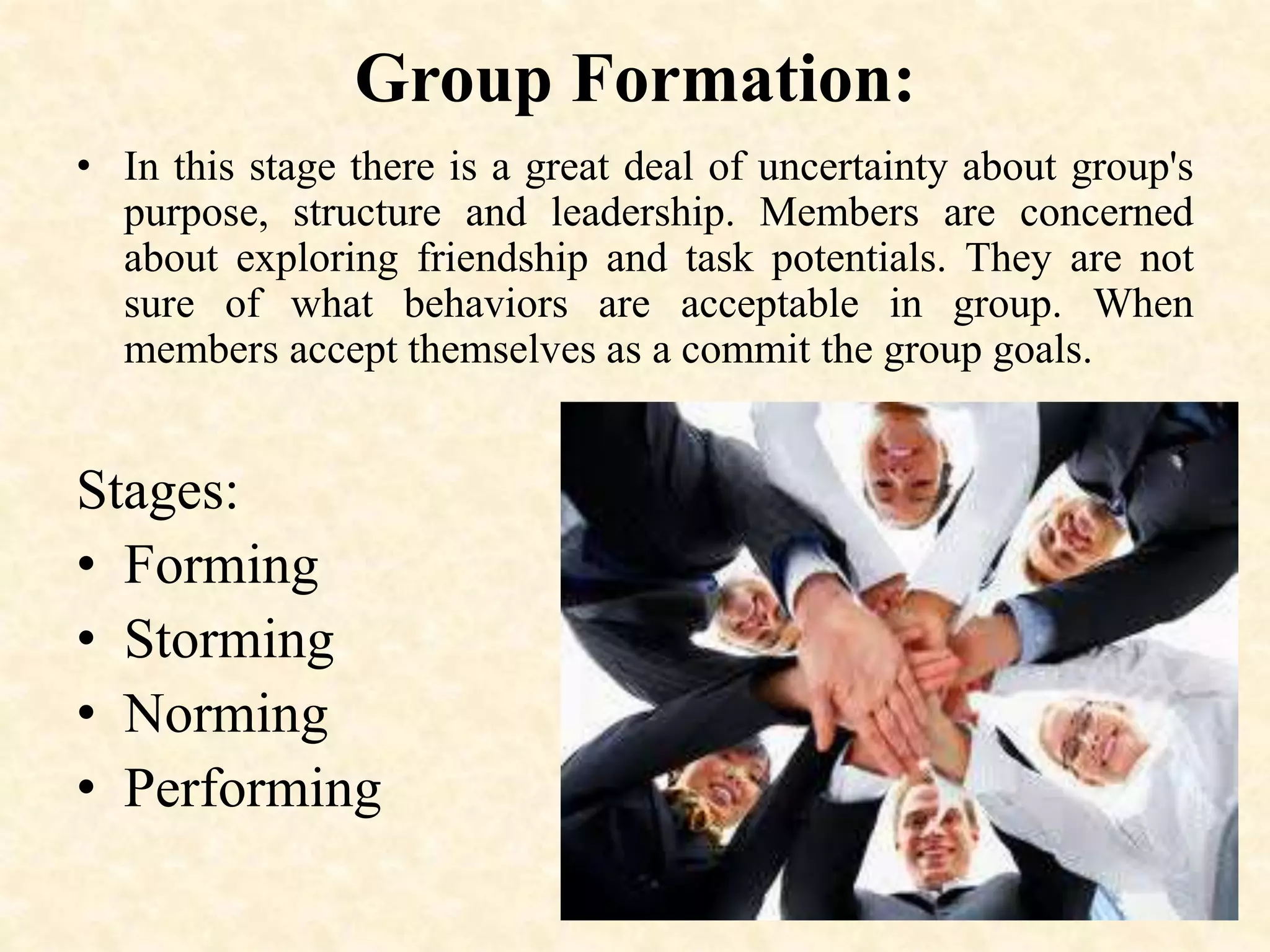
• In this stage there is a great deal of uncertainty about group's
purpose, structure and leadership. Members are concerned
about exploring friendship and task potentials. They are not
sure of what behaviors are acceptable in group. When
members accept themselves as a commit the group goals.
Stages:
• Forming
• Storming
• Norming
• Performing
Forming stage:
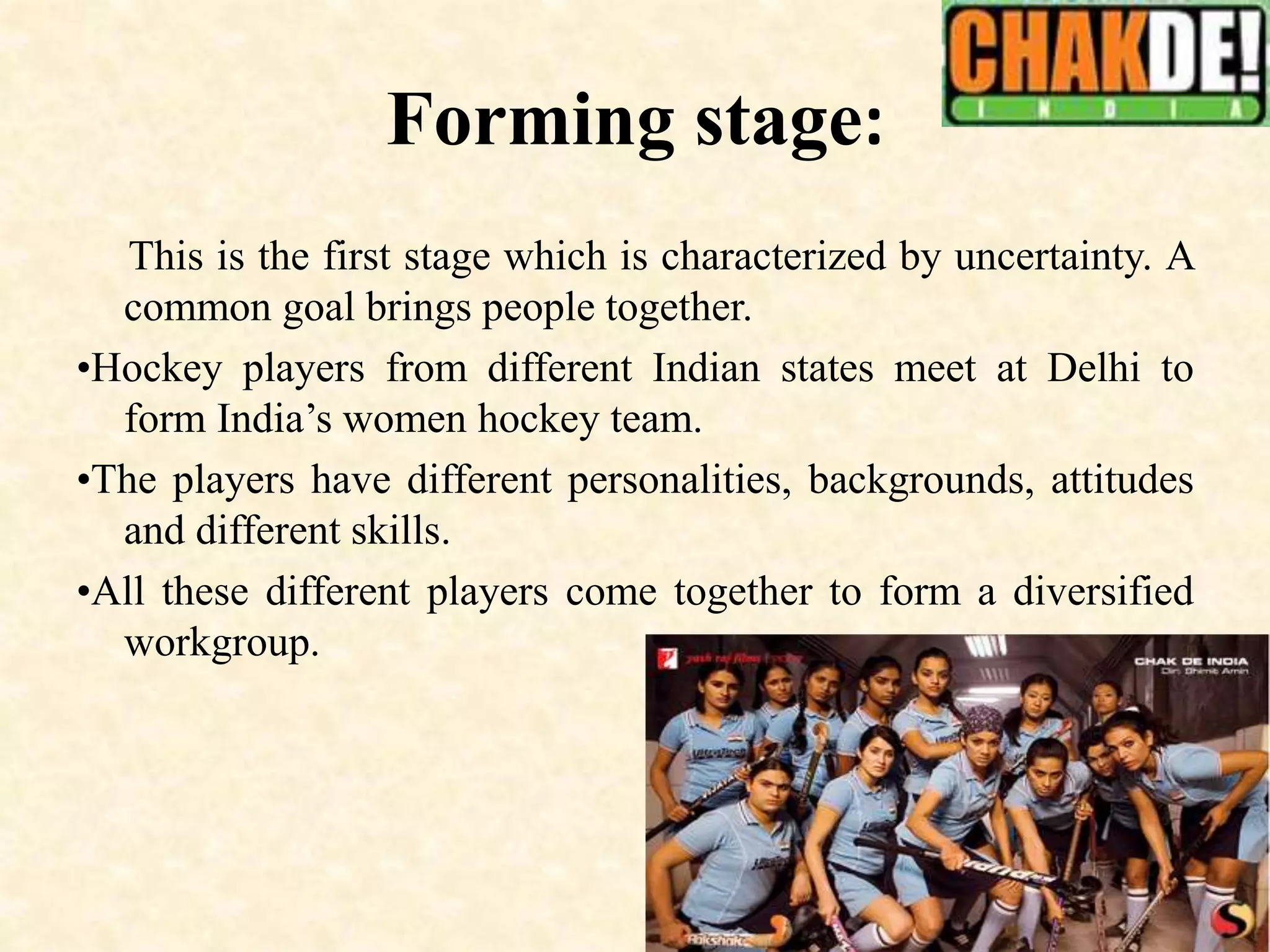
This is the first stage which is characterized by uncertainty. A
common goal brings people together.
•Hockey players from different Indian states meet at Delhi to
form India’s women hockey team.
•The players have different personalities, backgrounds, attitudes
and different skills.
•All these different players come together to form a diversified
workgroup.
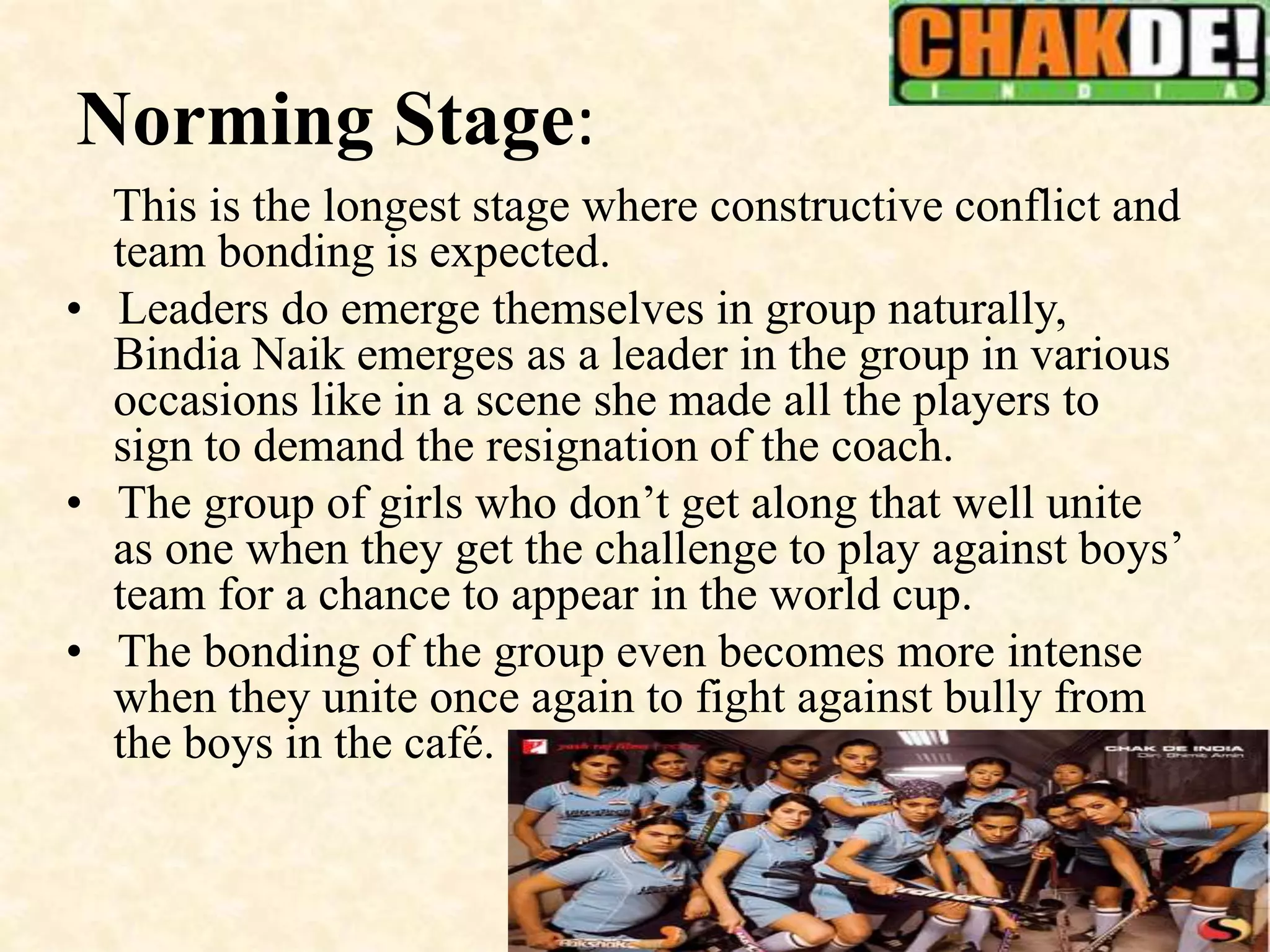
Storming stage:
Immediately after forming stage, storming stage starts.
• The players from different state are put together
randomly.
• Conflict arises when players differ in their opinions
about how they should get the beds.
• The coach motivates using negative comments to each
player by shouting and punishing them by keeping
them in a bench until they apologize.
• Keeping players on constant stress by training
rigorously which include 4a.m 10 km runs and strong
criticism of their performance in an effort to make them
work together.
• The weaknesses of the group members may become
vivid in this stage of group formation.
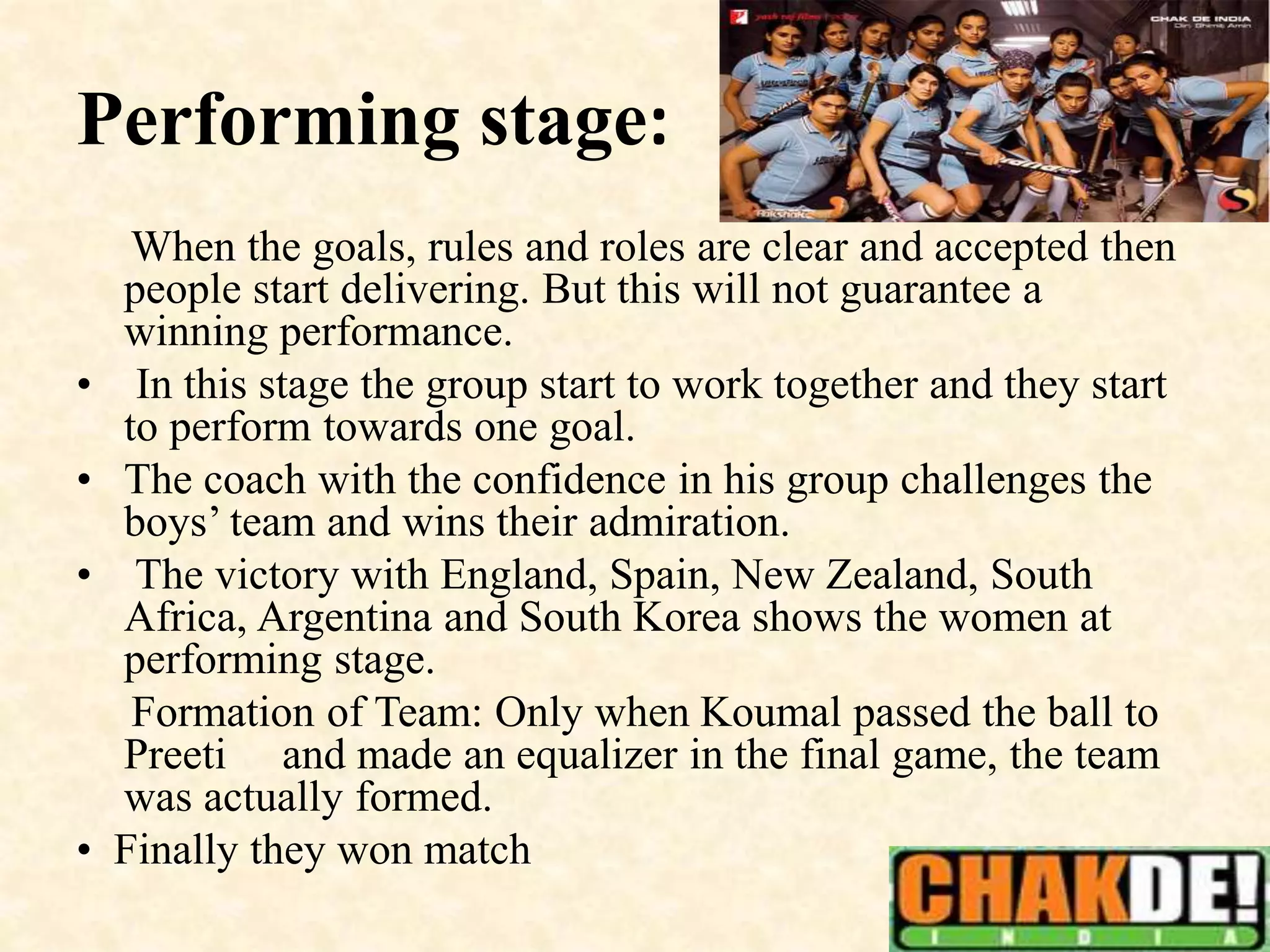
Norming Stage:
This is the longest stage where constructive conflict and
team bonding is expected.
• Leaders do emerge themselves in group naturally,
Bindia Naik emerges as a leader in the group in various
occasions like in a scene she made all the players to
sign to demand the resignation of the coach.
• The group of girls who don’t get along that well unite
as one when they get the challenge to play against boys’
team for a chance to appear in the world cup.
• The bonding of the group even becomes more intense
when they unite once again to fight against bully from
the boys in the café.
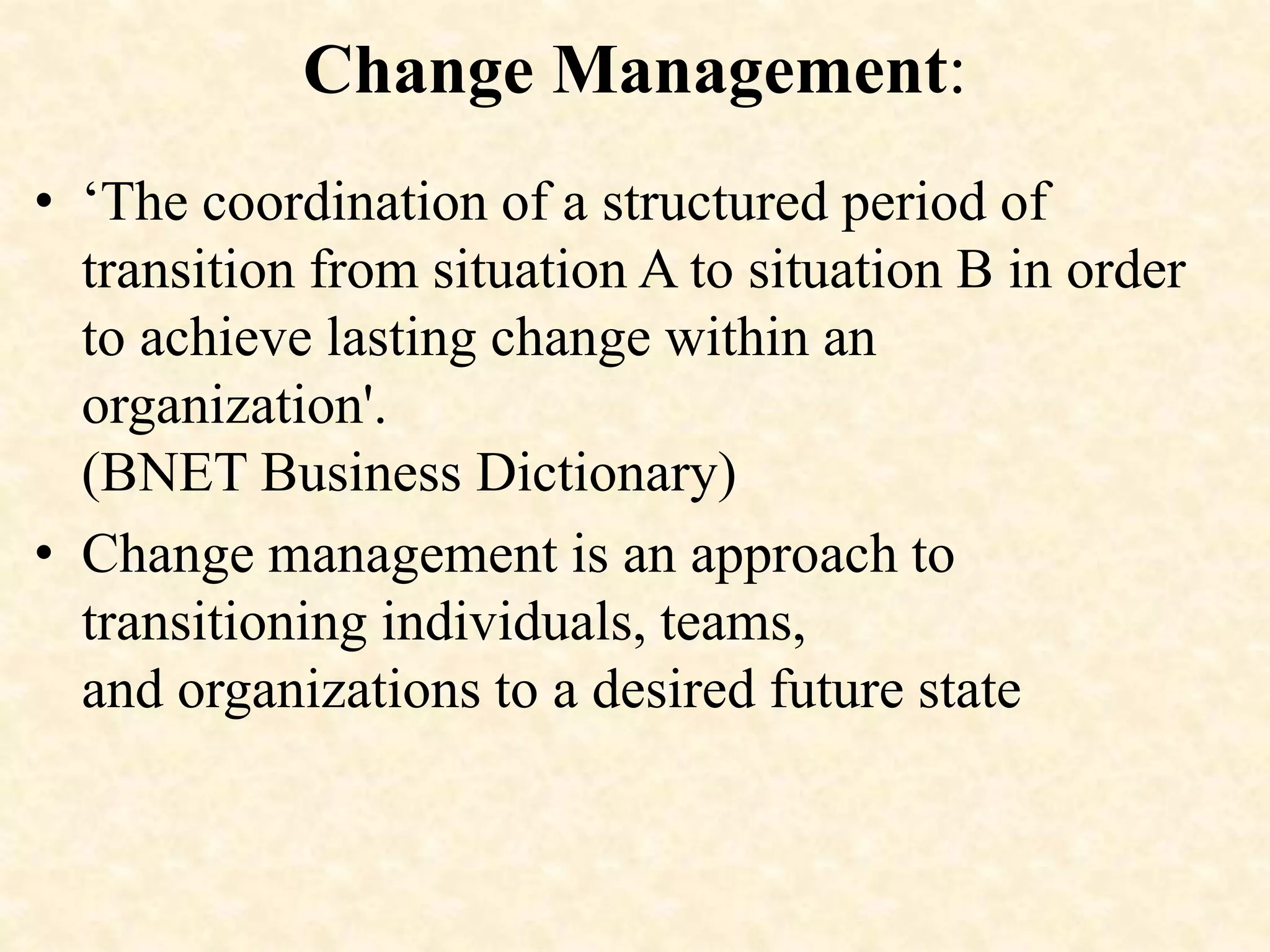
Performing stage:
When the goals, rules and roles are clear and accepted then
people start delivering. But this will not guarantee a
winning performance.
• In this stage the group start to work together and they start
to perform towards one goal.
• The coach with the confidence in his group challenges the
boys’ team and wins their admiration.
• The victory with England, Spain, New Zealand, South
Africa, Argentina and South Korea shows the women at
performing stage.
Formation of Team: Only when Koumal passed the ball to
Preeti and made an equalizer in the final game, the team
was actually formed.
• Finally they won match
Change Management:
• ‘The coordination of a structured period of
transition from situation A to situation B in order
to achieve lasting change within an
organization'.
(BNET Business Dictionary)
• Change management is an approach to
transitioning individuals, teams,
and organizations to a desired future state
• Conflict arises when players differ in their
opinions about how they should get the beds.
• They face change when they played against
boys team.
• One girl faced the team with language barriar.
• 2 of the players used to wear traditional
dresses but in team they have to wear common
uniform
• They manages all the changes they face
Group Decision Making:
• Group decision-making is a situation faced
when individuals collectively make a choice
from the alternatives before them.
The decision is then no longer attributable to
any single individual who is a member of the
group. This is because all the individuals
and social group processes such as social
influence contribute to the outcome.
• They make a common decision to play against
boys team.
• Leaders do emerge themselves in group
naturally, Bindia Naik emerges as a leader in
the group in various occasions like in a scene
she made all the players to sign to demand the
resignation of the coach.
Group Cohesiveness:
• The extent to which members are attracted to a group and
stick together.
• When discussing social groups, a group is said to be in a state
of cohesion when its members possess bonds linking them to
one another and to the group as a whole.] Members of strongly
cohesive groups are more inclined to participate readily and to
stay with the group.
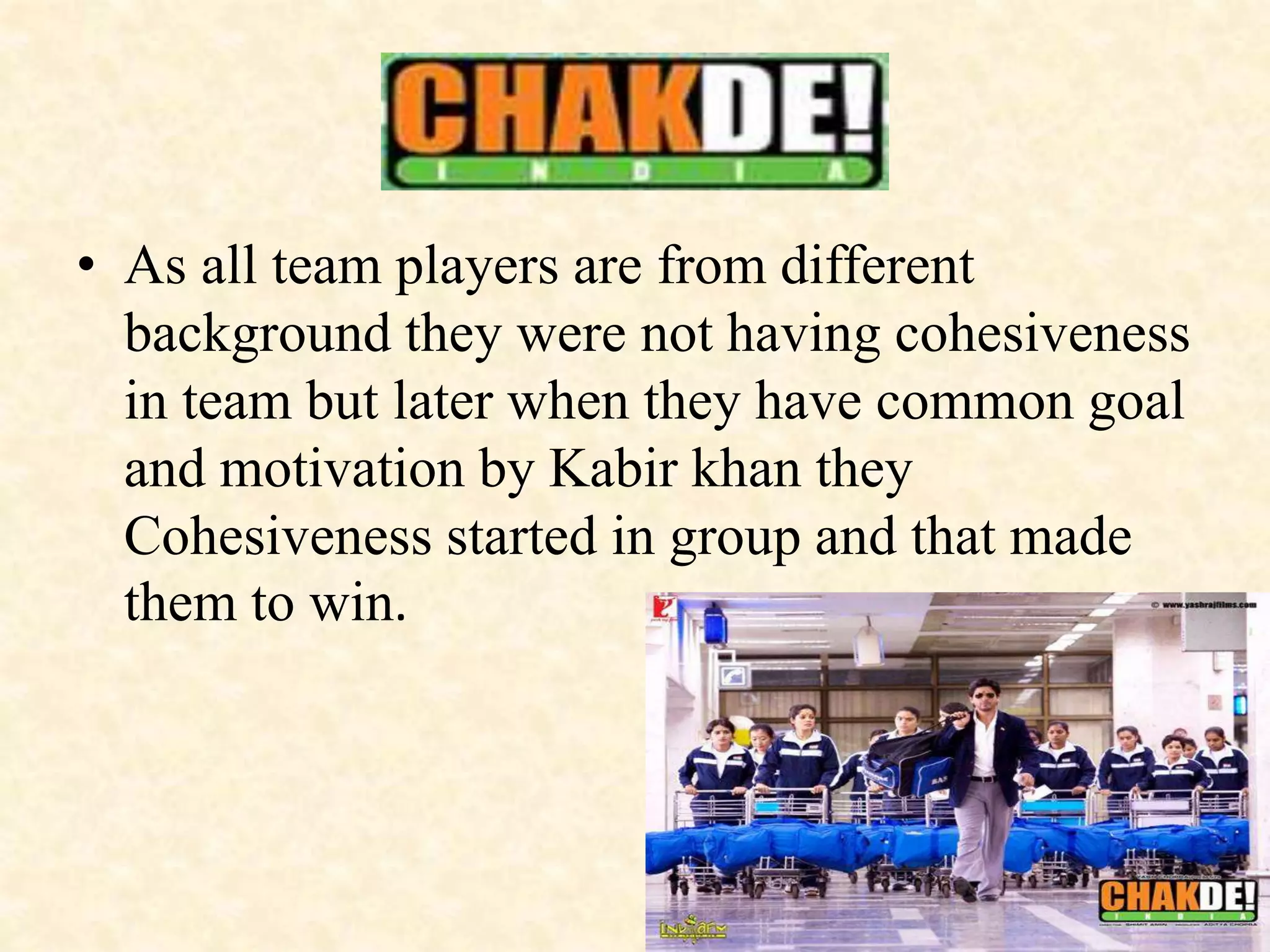
• As all team players are from different
background they were not having cohesiveness
in team but later when they have common goal
and motivation by Kabir khan they
Cohesiveness started in group and that made
them to win.
Leadership and Influence:
• Leader of the group is its principal representative and
is one individual who can legitimately exert formal
influence on the activities of the group. The leader is
responsible for the direction and goal
accomplishment of the group and can reward or
punish individual members when they do not comply
with the directions, orders or rules of the group.
Because the organization supports the leader’s
influence.
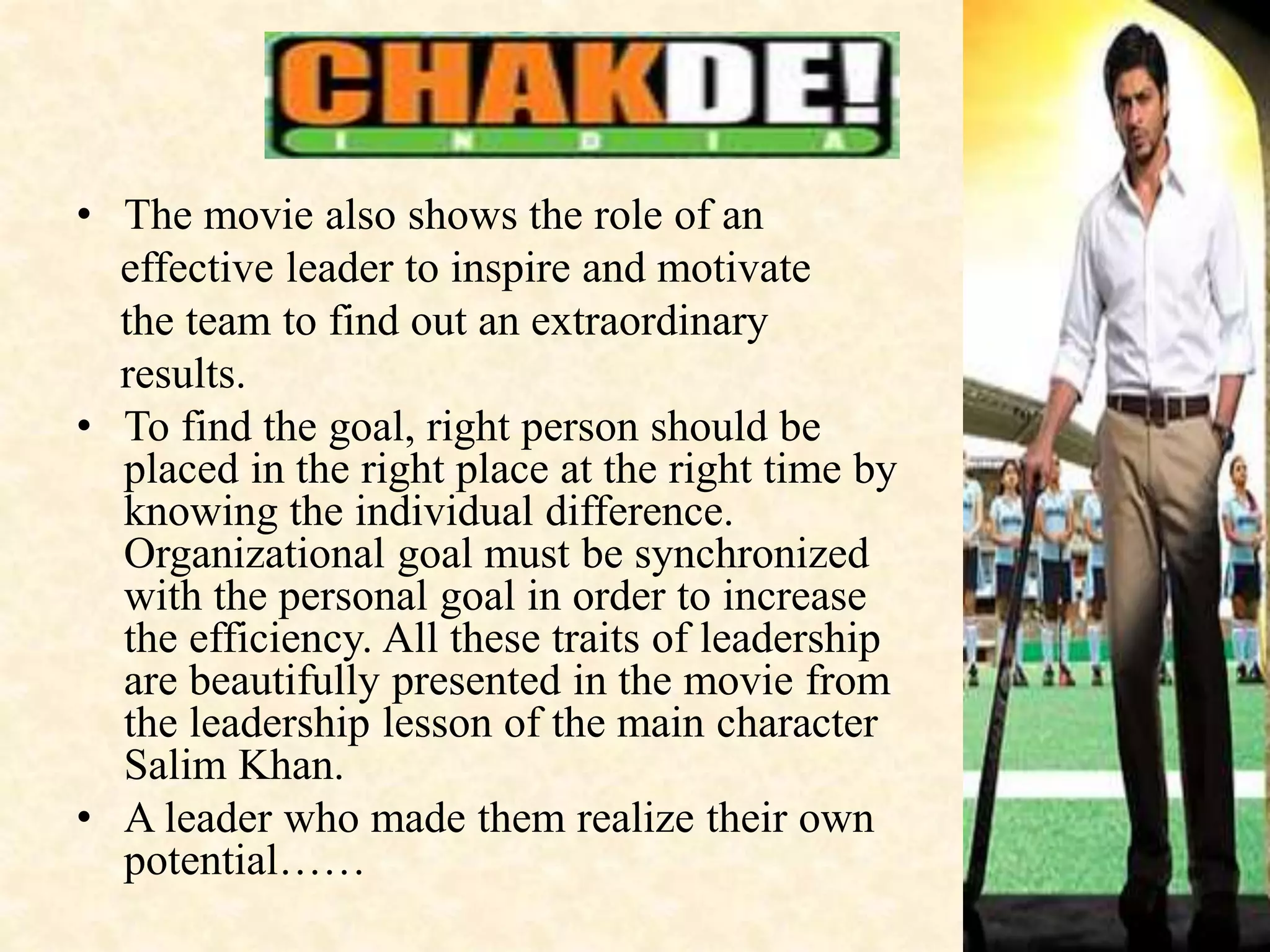
• The movie also shows the role of an
effective leader to inspire and motivate
the team to find out an extraordinary
results.
• To find the goal, right person should be
placed in the right place at the right time by
knowing the individual difference.
Organizational goal must be synchronized
with the personal goal in order to increase
the efficiency. All these traits of leadership
are beautifully presented in the movie from
the leadership lesson of the main character
Salim Khan.
• A leader who made them realize their own
potential……
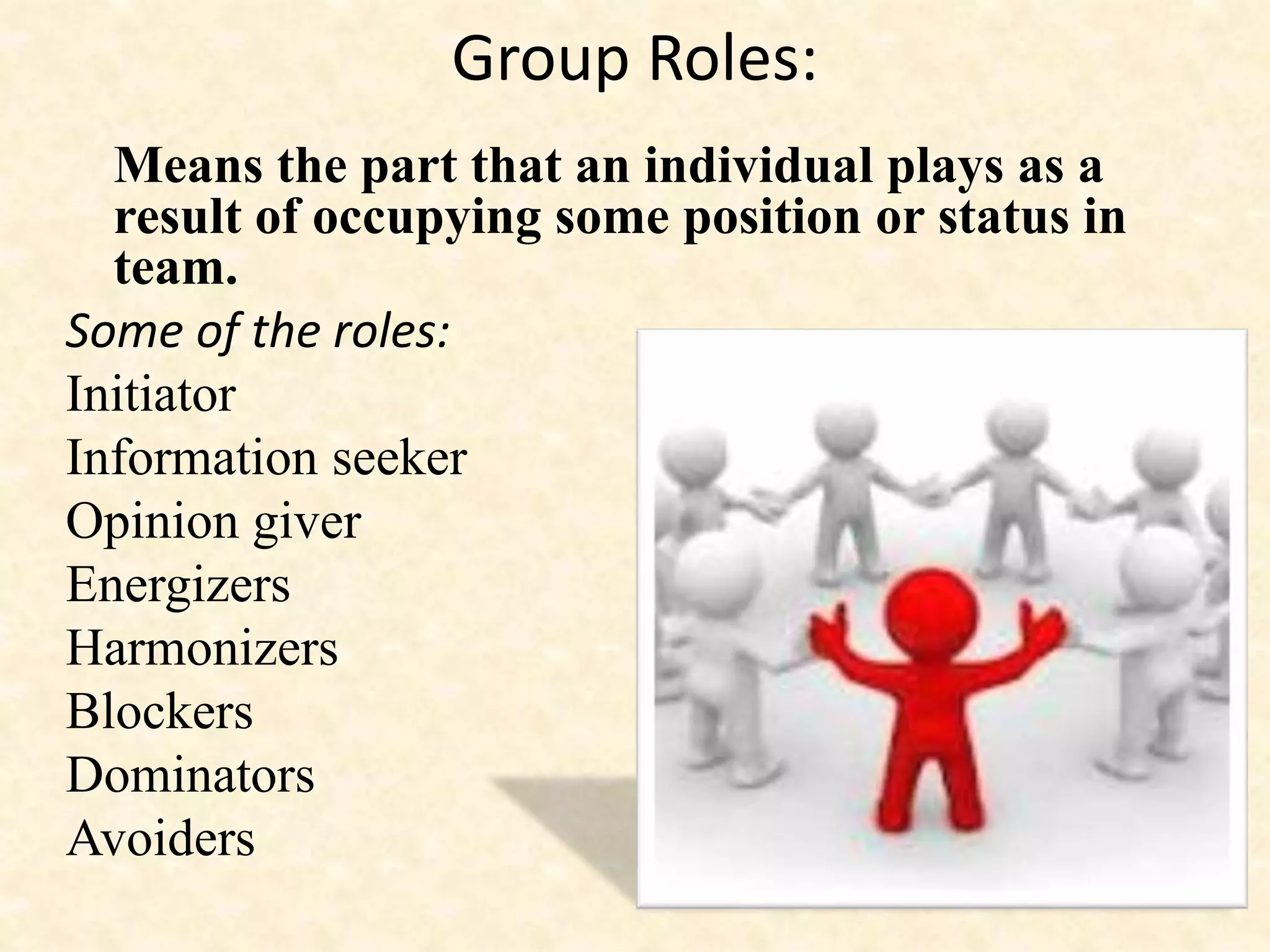
Group Roles:
Means the part that an individual plays as a
result of occupying some position or status in
team.
Some of the roles:
Initiator
Information seeker
Opinion giver
Energizers
Harmonizers
Blockers
Dominators
Avoiders
Different roles
• Only when Koumal passed the ball to Preeti
and made an equalizer in the final game.
• Kabir khan was leader
• Initiator : Vidya Sharma
• Contributor: Preeti Sabarwal & Vidya sharma
• Dominator & Blocker: Bindya Nayak
• Fallowers: Rani Diapota & Suymuyi Karkatta
etc
• Avoiders: Alia Bose, Gunjarlkani
Group Norms
• These are set of beliefs, feelings and attitudes
commonly shared by group members. These
are also referred to as rules or standards of
behavior that apply to group members.
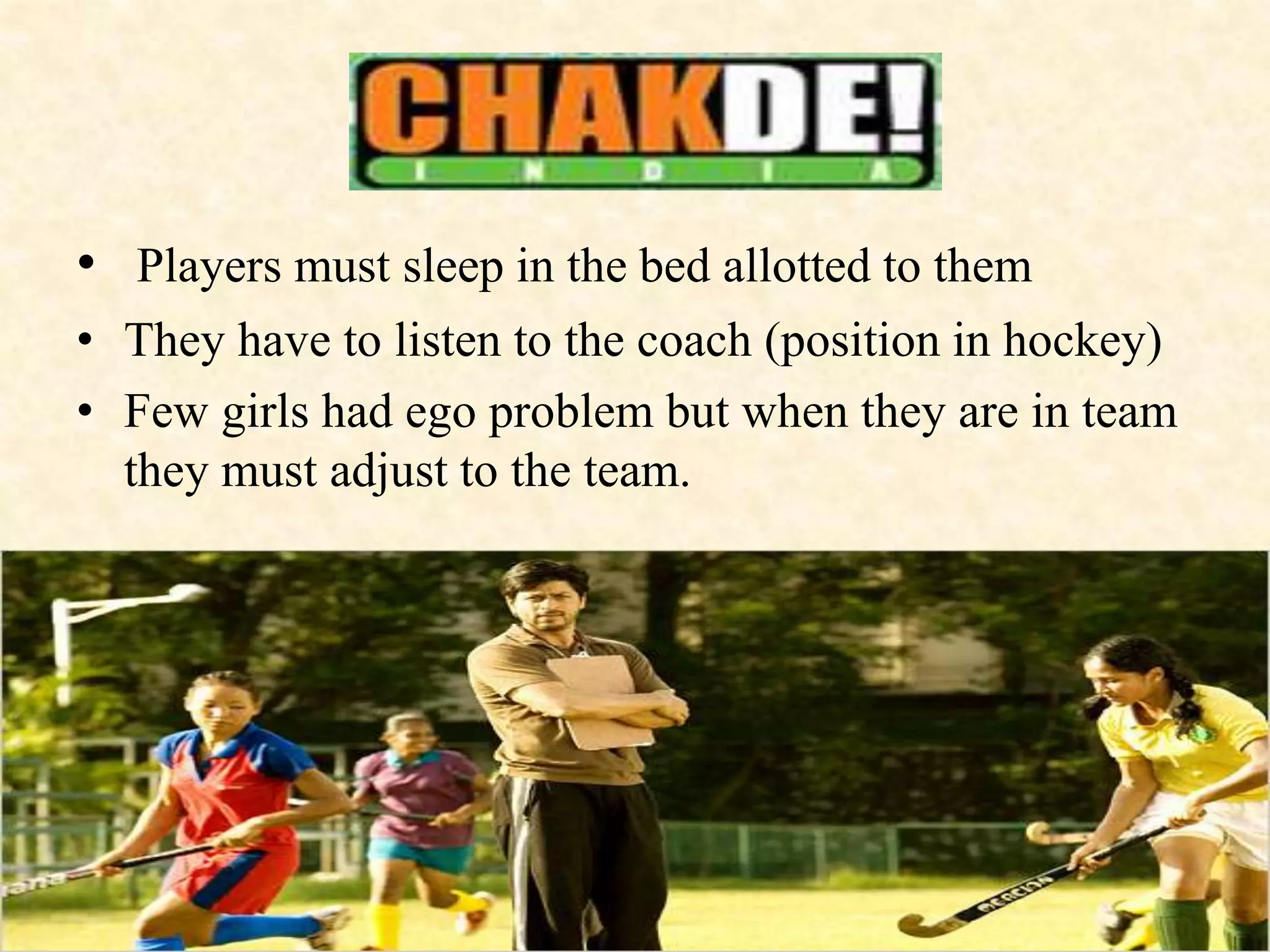
• Players must sleep in the bed allotted to them
• They have to listen to the coach (position in hockey)
• Few girls had ego problem but when they are in team
they must adjust to the team.
Conflict Management:
• Conflict management is the process of
limiting the negative aspects of conflict while
increasing the positive aspects of conflict. The
aim of conflict management is to enhance
learning and group outcomes, including
effectiveness or performance in organizational
setting . Properly managed conflict can
improve group outcomes.
• Conflict exists in the movie naturally and
sometimes is induced deliberately by the
leader. The differences between the girls
creates a natural conflicting situation. However
Kabir Khan also creates conflicts between
himself and the team so as to bond the group
together to form a team.
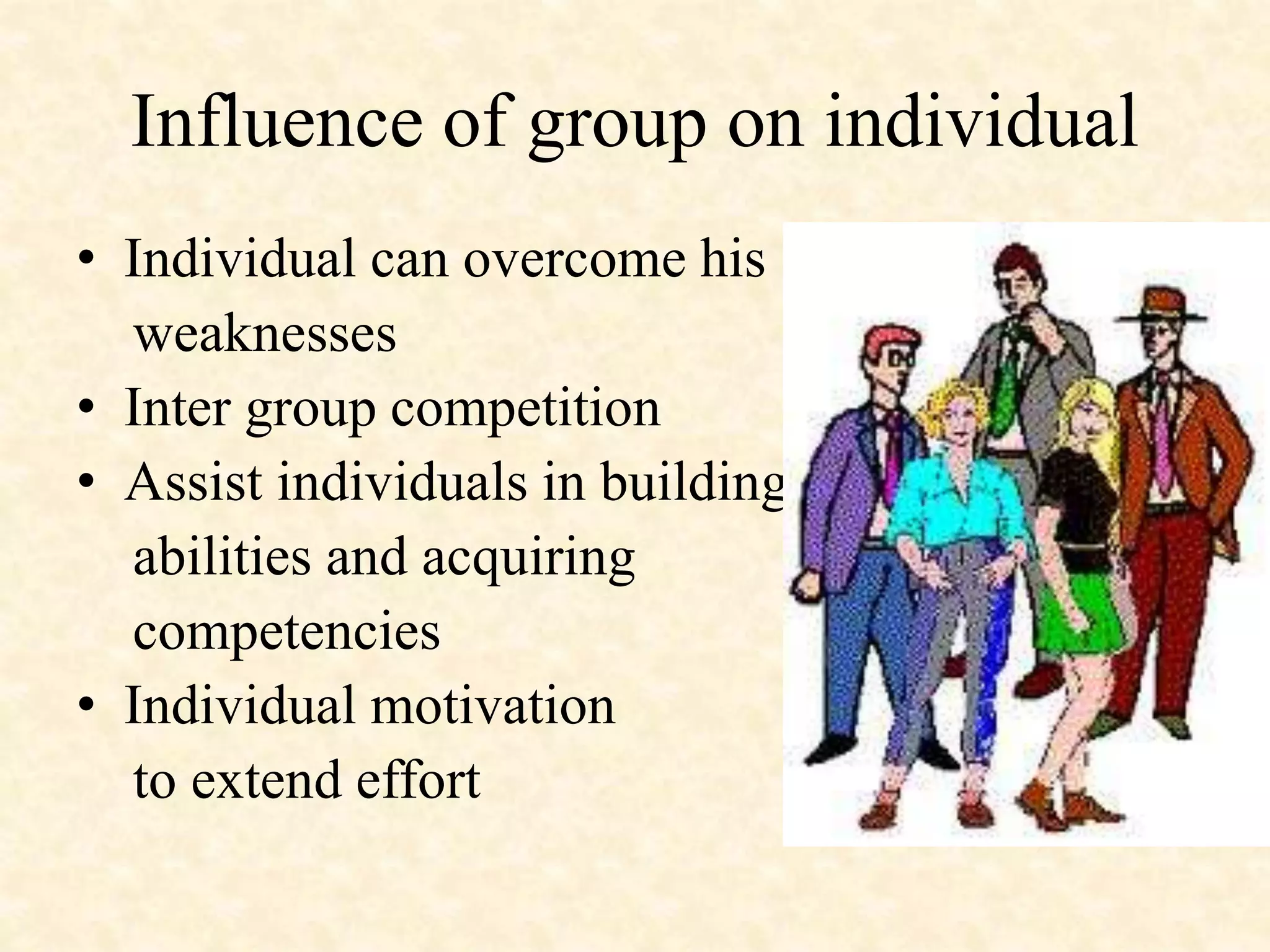
Influence of group on individual
• Individual can overcome his
weaknesses
• Inter group competition
• Assist individuals in building
abilities and acquiring
competencies
• Individual motivation
to extend effort
• Players in team encourages one an another to
play better.
• They increased their strength and decresed
their weaknesses.
• Both Preeti and Koumal were had their
personal goals but putting their personal goals
aside they gave higher priority to the team’s
goal and hence they worked together to
equalize
Conclusion
• The movie Chak De India is a very well
researched and well made movie which has all
the Organizational Behaviour theories put into
practice. It serves as a great way to learn about
the subject matters like personality, leadership,
motivation, teamwork, learning etc all have
been addressed by the movie. .
chak deIndia ppt (Organisational Behavior learning)

chak deIndia ppt (Organisational Behavior learning)

  • 1.
    Jo nahin hosakta hai, wahi to karna hai.. WE SHOULD TRY TO MAKE A DIFFERNCE
  • 2.
    Background of theMovie • Chak De India is a 2007 Bollywood movie produced under the banner of Yash Chopda. • The story in the movie goes side by side with the Indian hockey team and the mental aspect arisen between the players, coach and the audience. • Sharukh Khan is in the lead role in the movie who is a player and a coach of the female hocky team. • Khan was the captain of the Indian hockey team when they lose the final match against the Pakistan.
  • 3.
    • When variousquestions were raised against him after Pakistan won the match, he was under the shadow for seven years. • And finally he came in the main stream as a coach of female hockey team to erect the mistake he had made earlier and to drive the Indian hockey team to a paramount.
  • 4.
    OB and ChakDe Chakde India is a social movie that comprises the entire human and the behavioral aspect of the human beings. The human attributes like • motivation, • perception, • leadership, • psychology, and • team dynamics are clearly and explicitly presented in the movie. In this regard, we can call ‘chakde India” as a behavioral movie.
  • 5.
    Team Building • Themost important aspect of the movie is team building process. The players from various states with different ethnic background, language, culture, personality and attitudes come upon a team to play together with a common goal i.e to play for the country. It also showed that goal can be easily achieved if they work on the team with the shared values and motives. In the movie, comparatively a weaker team went up to the hockey finals and won against the strong team Australia.
  • 6.
    Group Structure • Workgroups are organized systems. They have structure that shapes the behavior of members and makes it possible to explain and predict a large portion of individual behavior within the group as well as performance of the group itself. Group structure variables include: • leadership • Roles • Group size • Group norms • Group task • Status congruence • Group Cohesiveness • Decision making
  • 7.
    Group Formation: • Inthis stage there is a great deal of uncertainty about group's purpose, structure and leadership. Members are concerned about exploring friendship and task potentials. They are not sure of what behaviors are acceptable in group. When members accept themselves as a commit the group goals. Stages: • Forming • Storming • Norming • Performing
  • 8.
    Forming stage: This isthe first stage which is characterized by uncertainty. A common goal brings people together. •Hockey players from different Indian states meet at Delhi to form India’s women hockey team. •The players have different personalities, backgrounds, attitudes and different skills. •All these different players come together to form a diversified workgroup.
  • 9.
    Storming stage: Immediately afterforming stage, storming stage starts. • The players from different state are put together randomly. • Conflict arises when players differ in their opinions about how they should get the beds. • The coach motivates using negative comments to each player by shouting and punishing them by keeping them in a bench until they apologize. • Keeping players on constant stress by training rigorously which include 4a.m 10 km runs and strong criticism of their performance in an effort to make them work together. • The weaknesses of the group members may become vivid in this stage of group formation.
  • 10.
    Norming Stage: This isthe longest stage where constructive conflict and team bonding is expected. • Leaders do emerge themselves in group naturally, Bindia Naik emerges as a leader in the group in various occasions like in a scene she made all the players to sign to demand the resignation of the coach. • The group of girls who don’t get along that well unite as one when they get the challenge to play against boys’ team for a chance to appear in the world cup. • The bonding of the group even becomes more intense when they unite once again to fight against bully from the boys in the café.
  • 11.
    Performing stage: When thegoals, rules and roles are clear and accepted then people start delivering. But this will not guarantee a winning performance. • In this stage the group start to work together and they start to perform towards one goal. • The coach with the confidence in his group challenges the boys’ team and wins their admiration. • The victory with England, Spain, New Zealand, South Africa, Argentina and South Korea shows the women at performing stage. Formation of Team: Only when Koumal passed the ball to Preeti and made an equalizer in the final game, the team was actually formed. • Finally they won match
  • 12.
    Change Management: • ‘Thecoordination of a structured period of transition from situation A to situation B in order to achieve lasting change within an organization'. (BNET Business Dictionary) • Change management is an approach to transitioning individuals, teams, and organizations to a desired future state
  • 13.
    • Conflict ariseswhen players differ in their opinions about how they should get the beds. • They face change when they played against boys team. • One girl faced the team with language barriar. • 2 of the players used to wear traditional dresses but in team they have to wear common uniform • They manages all the changes they face
  • 14.
    Group Decision Making: •Group decision-making is a situation faced when individuals collectively make a choice from the alternatives before them. The decision is then no longer attributable to any single individual who is a member of the group. This is because all the individuals and social group processes such as social influence contribute to the outcome.
  • 15.
    • They makea common decision to play against boys team. • Leaders do emerge themselves in group naturally, Bindia Naik emerges as a leader in the group in various occasions like in a scene she made all the players to sign to demand the resignation of the coach.
  • 16.
    Group Cohesiveness: • Theextent to which members are attracted to a group and stick together. • When discussing social groups, a group is said to be in a state of cohesion when its members possess bonds linking them to one another and to the group as a whole.] Members of strongly cohesive groups are more inclined to participate readily and to stay with the group.
  • 17.
    • As allteam players are from different background they were not having cohesiveness in team but later when they have common goal and motivation by Kabir khan they Cohesiveness started in group and that made them to win.
  • 18.
    Leadership and Influence: •Leader of the group is its principal representative and is one individual who can legitimately exert formal influence on the activities of the group. The leader is responsible for the direction and goal accomplishment of the group and can reward or punish individual members when they do not comply with the directions, orders or rules of the group. Because the organization supports the leader’s influence.
  • 19.
    • The moviealso shows the role of an effective leader to inspire and motivate the team to find out an extraordinary results. • To find the goal, right person should be placed in the right place at the right time by knowing the individual difference. Organizational goal must be synchronized with the personal goal in order to increase the efficiency. All these traits of leadership are beautifully presented in the movie from the leadership lesson of the main character Salim Khan. • A leader who made them realize their own potential……
  • 20.
    Group Roles: Means thepart that an individual plays as a result of occupying some position or status in team. Some of the roles: Initiator Information seeker Opinion giver Energizers Harmonizers Blockers Dominators Avoiders
  • 21.
    Different roles • Onlywhen Koumal passed the ball to Preeti and made an equalizer in the final game. • Kabir khan was leader • Initiator : Vidya Sharma • Contributor: Preeti Sabarwal & Vidya sharma • Dominator & Blocker: Bindya Nayak • Fallowers: Rani Diapota & Suymuyi Karkatta etc • Avoiders: Alia Bose, Gunjarlkani
  • 22.
    Group Norms • Theseare set of beliefs, feelings and attitudes commonly shared by group members. These are also referred to as rules or standards of behavior that apply to group members.
  • 23.
    • Players mustsleep in the bed allotted to them • They have to listen to the coach (position in hockey) • Few girls had ego problem but when they are in team they must adjust to the team.
  • 24.
    Conflict Management: • Conflictmanagement is the process of limiting the negative aspects of conflict while increasing the positive aspects of conflict. The aim of conflict management is to enhance learning and group outcomes, including effectiveness or performance in organizational setting . Properly managed conflict can improve group outcomes.
  • 25.
    • Conflict existsin the movie naturally and sometimes is induced deliberately by the leader. The differences between the girls creates a natural conflicting situation. However Kabir Khan also creates conflicts between himself and the team so as to bond the group together to form a team.
  • 26.
    Influence of groupon individual • Individual can overcome his weaknesses • Inter group competition • Assist individuals in building abilities and acquiring competencies • Individual motivation to extend effort
  • 27.
    • Players inteam encourages one an another to play better. • They increased their strength and decresed their weaknesses. • Both Preeti and Koumal were had their personal goals but putting their personal goals aside they gave higher priority to the team’s goal and hence they worked together to equalize
  • 28.
    Conclusion • The movieChak De India is a very well researched and well made movie which has all the Organizational Behaviour theories put into practice. It serves as a great way to learn about the subject matters like personality, leadership, motivation, teamwork, learning etc all have been addressed by the movie. .