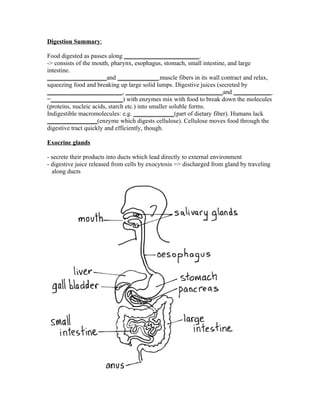
Digestion Summary:

Food digested as passes along ________________________.
-> consists of the mouth, pharynx, esophagus, stomach, small intestine, and large
intestine.
___________________and _____________ muscle fibers in its wall contract and relax,
squeezing food and breaking up large solid lumps. Digestive juices (secreted by
________________________, _______________________________and ____________
=_______________________) with enzymes mix with food to break down the molecules
(proteins, nucleic acids, starch etc.) into smaller soluble forms.
Indigestible macromolecules: e.g. _____________(part of dietary fiber). Humans lack
________________(enzyme which digests cellulose). Cellulose moves food through the
digestive tract quickly and efficiently, though.

Exocrine glands

- secrete their products into ducts which lead directly to external environment
- digestive juice released from cells by exocytosis => discharged from gland by traveling
  along ducts
Exocrine glands and their cells:


Digestive juice secretion:

- controlled by ___________ and _______________
- before food reaches stomach, sight or smell of food stimulate brain to send nerve
   impulses to _____________________in stomach wall to produce _________________.
- More gastric juice secreted when food enters stomach and comes into contact with
__________________________ and ______________________ in the stomach lining
and ________________________in the stomach wall.
 - Receptors send nerve impulses to brain -> sends impulses to ____________ gland cells
 - Receptors send nerve impulses to ___________ gland cells in stomach lining -> secrete

 hormone: ___________ -> carried to exocrine gland cells to stimulate
_______________________________ => causes ph of food in stomach to fall to about
pH 3.0
Membrane-bound digestive enzymes:

- some enzymes, produced by the wall of the small intestine, don’t mix with the food but
   remain in the ________________________ of cells on the surface of the villi
  (epithelium cells)
- the ___________________ of the enzymes are exposed to the food in the small intestine
-> digest substrates and the products of digestion can be immediately absorbed.
- After abrasion of tips of villi, the enzymes mix with food in small intestine and continue

 work


Sources of digestive enzymes:

- pepsin & trypsin harmful to exocrine gland cells which secrete them.
-> secreted as ______________________________ (a substance from which another
substance is formed) called pepsinogen and trypsinogen.
Pepsinogen: first secreted by cells in ____________________ and then activated by
_______________________(also secreted by cells in stomach wall), which converts it
into pepsin
Trypsinogen: first secreted by _____________ and enters ________________________.
Then activated by enzyme called __________________ (secreted by lining of small
intestine)

Further human physiology: digestion

  • 1.
    Digestion Summary: Food digestedas passes along ________________________. -> consists of the mouth, pharynx, esophagus, stomach, small intestine, and large intestine. ___________________and _____________ muscle fibers in its wall contract and relax, squeezing food and breaking up large solid lumps. Digestive juices (secreted by ________________________, _______________________________and ____________ =_______________________) with enzymes mix with food to break down the molecules (proteins, nucleic acids, starch etc.) into smaller soluble forms. Indigestible macromolecules: e.g. _____________(part of dietary fiber). Humans lack ________________(enzyme which digests cellulose). Cellulose moves food through the digestive tract quickly and efficiently, though. Exocrine glands - secrete their products into ducts which lead directly to external environment - digestive juice released from cells by exocytosis => discharged from gland by traveling along ducts
  • 2.
    Exocrine glands andtheir cells: Digestive juice secretion: - controlled by ___________ and _______________ - before food reaches stomach, sight or smell of food stimulate brain to send nerve impulses to _____________________in stomach wall to produce _________________. - More gastric juice secreted when food enters stomach and comes into contact with __________________________ and ______________________ in the stomach lining and ________________________in the stomach wall. - Receptors send nerve impulses to brain -> sends impulses to ____________ gland cells - Receptors send nerve impulses to ___________ gland cells in stomach lining -> secrete hormone: ___________ -> carried to exocrine gland cells to stimulate _______________________________ => causes ph of food in stomach to fall to about pH 3.0
  • 3.
    Membrane-bound digestive enzymes: -some enzymes, produced by the wall of the small intestine, don’t mix with the food but remain in the ________________________ of cells on the surface of the villi (epithelium cells) - the ___________________ of the enzymes are exposed to the food in the small intestine -> digest substrates and the products of digestion can be immediately absorbed. - After abrasion of tips of villi, the enzymes mix with food in small intestine and continue work Sources of digestive enzymes: - pepsin & trypsin harmful to exocrine gland cells which secrete them. -> secreted as ______________________________ (a substance from which another substance is formed) called pepsinogen and trypsinogen. Pepsinogen: first secreted by cells in ____________________ and then activated by _______________________(also secreted by cells in stomach wall), which converts it into pepsin Trypsinogen: first secreted by _____________ and enters ________________________. Then activated by enzyme called __________________ (secreted by lining of small intestine)