 Shri Mahila Griha Udyog Lijjat Papad, popularly
known as ‘Lijjat’ is an Indian women’s
cooperative involved in manufacturing of
various fast moving consumer goods (FMCG).
 Started in the year 1959 with an initial
investment of Rs.80 and it has an annual
turnover of around Rs.1600-1800crore with
Rs.80crore in exports (as of 2018).
 Spread all over India in 69 centres and 31
divisions in different states
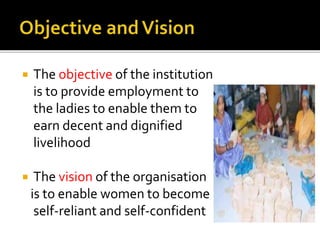
 The objective of the institution
is to provide employment to
the ladies to enable them to
earn decent and dignified
livelihood
 The vision of the organisation
is to enable women to become
self-reliant and self-confident
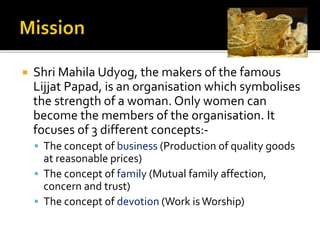
 Shri Mahila Udyog, the makers of the famous
Lijjat Papad, is an organisation which symbolises
the strength of a woman. Only women can
become the members of the organisation. It
focuses of 3 different concepts:-
 The concept of business (Production of quality goods
at reasonable prices)
 The concept of family (Mutual family affection,
concern and trust)
 The concept of devotion (Work isWorship)
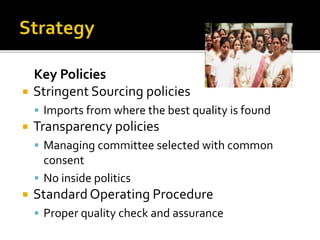
Key Policies
 Stringent Sourcing policies
 Imports from where the best quality is found
 Transparency policies
 Managing committee selected with common
consent
 No inside politics
 Standard Operating Procedure
 Proper quality check and assurance
 Business based on
 Gandhian Principles (Sarvodaya
and collective ownership)
 Profit Sharing Model
(Profits are shared among the
Members of the organization)
 Cooking skills into business model
 No equity only debt
 Debt from banks @ 12%
interest(8% paid by KVIC)
 No credit method
 Less capital expenditure and high operating expenditure
(Labour-intensive technique)
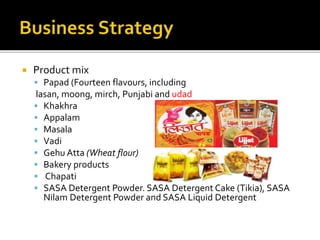
 Product mix
 Papad (Fourteen flavours, including
lasan, moong, mirch, Punjabi and udad
 Khakhra
 Appalam
 Masala
 Vadi
 Gehu Atta (Wheat flour)
 Bakery products
 Chapati
 SASA Detergent Powder. SASA Detergent Cake (Tikia), SASA
Nilam Detergent Powder and SASA Liquid Detergent
 Market segment and pricing
 Target to middle and lower class society at affordable
price
 Cost + Pricing (RM, Rolling, Packaging, Sell & Distr.)
 Prices vary from Rs. 15 (100 gm) to Rs. 300 (2.5 kg)
 Market Share
 90% in case of Papad and 15-20% in case of others
 Packaging
 Packing bags manufactured by organisation itself.
 By doing this they ensure high standards and maintain
quality.
 Also this prevents duplication of the product.
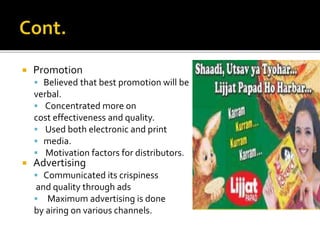
 Promotion
 Believed that best promotion will be
verbal.
 Concentrated more on
cost effectiveness and quality.
 Used both electronic and print
 media.
 Motivation factors for distributors.
 Advertising
 Communicated its crispiness
and quality through ads
 Maximum advertising is done
by airing on various channels.
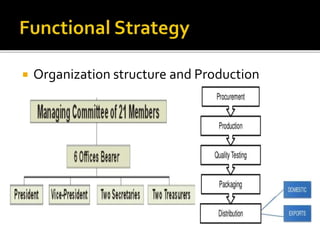
 Organization structure and Production
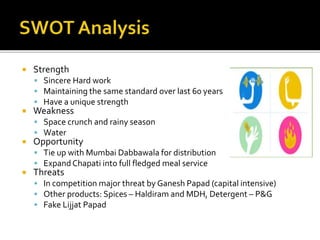
 Strength
 Sincere Hard work
 Maintaining the same standard over last 60 years
 Have a unique strength
 Weakness
 Space crunch and rainy season
 Water
 Opportunity
 Tie up with Mumbai Dabbawala for distribution
 ExpandChapati into full fledged meal service
 Threats
 In competition major threat by Ganesh Papad (capital intensive)
 Other products: Spices – Haldiram and MDH, Detergent – P&G
 Fake Lijjat Papad
 They are planning to diversify its product
portfolio by adding new products like instant
noodles and adopt automation.
 They will try to bring more innovation like
more varieties, sizes and different
combination.
 Improvement of Packaging
 The important thing to learn from this
organization is that, “sticking to its core
values the past sixty years”.The institution
make women more self- confident and self-
dependent and provides platform to improve
their status in society.
 “Successful women Entrepreneurs: Shri
MahilaGriha Udyog Lijjat Papad (Lijjat)”,
ICFAI Centre for Management Research.
Retrieved 8 Jan 2007.
 www.lijjat.com
 https://youtu.be/PCDqFafx9o4
 https://retail.economictimes.indiatimes.com/
news/food-entertainment/personal-care-pet-
supplies-liquor/minister-proposes-product-
diversification-for-lijjat/60706517
Lijjat papad

Lijjat papad

  • 2.
     Shri MahilaGriha Udyog Lijjat Papad, popularly known as ‘Lijjat’ is an Indian women’s cooperative involved in manufacturing of various fast moving consumer goods (FMCG).  Started in the year 1959 with an initial investment of Rs.80 and it has an annual turnover of around Rs.1600-1800crore with Rs.80crore in exports (as of 2018).  Spread all over India in 69 centres and 31 divisions in different states
  • 3.
     The objectiveof the institution is to provide employment to the ladies to enable them to earn decent and dignified livelihood  The vision of the organisation is to enable women to become self-reliant and self-confident
  • 4.
     Shri MahilaUdyog, the makers of the famous Lijjat Papad, is an organisation which symbolises the strength of a woman. Only women can become the members of the organisation. It focuses of 3 different concepts:-  The concept of business (Production of quality goods at reasonable prices)  The concept of family (Mutual family affection, concern and trust)  The concept of devotion (Work isWorship)
  • 5.
    Key Policies  StringentSourcing policies  Imports from where the best quality is found  Transparency policies  Managing committee selected with common consent  No inside politics  Standard Operating Procedure  Proper quality check and assurance
  • 6.
     Business basedon  Gandhian Principles (Sarvodaya and collective ownership)  Profit Sharing Model (Profits are shared among the Members of the organization)  Cooking skills into business model  No equity only debt  Debt from banks @ 12% interest(8% paid by KVIC)  No credit method  Less capital expenditure and high operating expenditure (Labour-intensive technique)
  • 7.
     Product mix Papad (Fourteen flavours, including lasan, moong, mirch, Punjabi and udad  Khakhra  Appalam  Masala  Vadi  Gehu Atta (Wheat flour)  Bakery products  Chapati  SASA Detergent Powder. SASA Detergent Cake (Tikia), SASA Nilam Detergent Powder and SASA Liquid Detergent
  • 8.
     Market segmentand pricing  Target to middle and lower class society at affordable price  Cost + Pricing (RM, Rolling, Packaging, Sell & Distr.)  Prices vary from Rs. 15 (100 gm) to Rs. 300 (2.5 kg)  Market Share  90% in case of Papad and 15-20% in case of others  Packaging  Packing bags manufactured by organisation itself.  By doing this they ensure high standards and maintain quality.  Also this prevents duplication of the product.
  • 9.
     Promotion  Believedthat best promotion will be verbal.  Concentrated more on cost effectiveness and quality.  Used both electronic and print  media.  Motivation factors for distributors.  Advertising  Communicated its crispiness and quality through ads  Maximum advertising is done by airing on various channels.
  • 10.
  • 11.
     Strength  SincereHard work  Maintaining the same standard over last 60 years  Have a unique strength  Weakness  Space crunch and rainy season  Water  Opportunity  Tie up with Mumbai Dabbawala for distribution  ExpandChapati into full fledged meal service  Threats  In competition major threat by Ganesh Papad (capital intensive)  Other products: Spices – Haldiram and MDH, Detergent – P&G  Fake Lijjat Papad
  • 12.
     They areplanning to diversify its product portfolio by adding new products like instant noodles and adopt automation.  They will try to bring more innovation like more varieties, sizes and different combination.  Improvement of Packaging
  • 13.
     The importantthing to learn from this organization is that, “sticking to its core values the past sixty years”.The institution make women more self- confident and self- dependent and provides platform to improve their status in society.
  • 14.
     “Successful womenEntrepreneurs: Shri MahilaGriha Udyog Lijjat Papad (Lijjat)”, ICFAI Centre for Management Research. Retrieved 8 Jan 2007.  www.lijjat.com  https://youtu.be/PCDqFafx9o4  https://retail.economictimes.indiatimes.com/ news/food-entertainment/personal-care-pet- supplies-liquor/minister-proposes-product- diversification-for-lijjat/60706517