Nuts for Nutrition
Alice Henneman, MS, RD, Extension Educator
UNL Extension in Lancaster County
Web: food.unl.edu • E-mail: ahenneman1@unl.edu

Know how. Know now.

A Handful of Nuts

Can a handful of nuts a day help
keep you healthy? And how much,
exactly, is a handful?

Nuts and Your Health
The 2010 Dietary Guidelines for
Americans recommend: “Choose a
variety of protein foods, which include
seafood, lean meat, poultry, eggs, beans
and peas, soy products, and unsalted
nuts and seeds.”
The Dietary Guidelines also recommend fat intake should emphasize heart
healthy monounsaturated and polyunsaturated fats, such as those found in
seafood, nuts, seeds, and oils.
Choose MyPlate (a recommended
food pattern to help people implement the dietary guidelines) states, “In
general, 1 ounce of meat, poultry, fish,
1/4 cup cooked beans, 1 egg, 1 tablespoon of peanut butter, or 1/2 ounce
of nuts or seeds can be considered as
“1-ounce equivalent” from the Protein
Foods Group.”
Nuts, with their healthy fats, are
higher in calories than some other
sources of protein and MyPlate recommends: “Choose unsalted nuts as a
snack, on salads, or in main dishes. Use
nuts to replace meat or poultry, not in
addition to these items.” At the 2,000
calorie level, MyPlate recommends
approximately 5-1/2 “1-ounce equivalents” from the Protein Group

It’s in the Bag

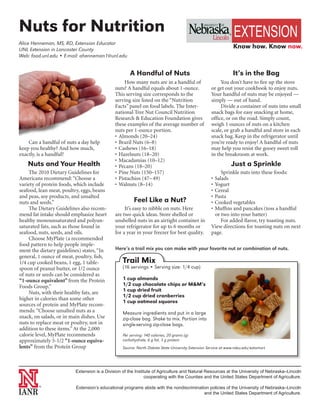
How many nuts are in a handful of
nuts? A handful equals about 1-ounce.
This serving size corresponds to the
serving size listed on the “Nutrition
Facts” panel on food labels. The International Tree Nut Council Nutrition
Research & Education Foundation gives
these examples of the average number of
nuts per 1-ounce portion.
•	 Almonds (20–24)
•	 Brazil Nuts (6–8)
•	 Cashews (16–18)
•	 Hazelnuts (18–20)
•	 Macadamias (10–12)
•	 Pecans (18–20)
•	 Pine Nuts (150–157)
•	 Pistachios (47– 49)
•	 Walnuts (8–14)

You don’t have to fire up the stove
or get out your cookbook to enjoy nuts.
Your handful of nuts may be enjoyed —
simply — out of hand.
Divide a container of nuts into small
snack bags for easy snacking at home,
office, or on the road. Simply count,
weigh 1 ounces of nuts on a kitchen
scale, or grab a handful and store in each
snack bag. Keep in the refrigerator until
you’re ready to enjoy! A handful of nuts
may help you resist the gooey sweet roll
in the breakroom at work.

Feel Like a Nut?
It’s easy to nibble on nuts. Here
are two quick ideas. Store shelled or
unshelled nuts in an airtight container in
your refrigerator for up to 6 months or
for a year in your freezer for best quality.

Just a Sprinkle
Sprinkle nuts into these foods:
•	 Salads
•	 Yogurt
•	 Cereal
•	 Pasta
•	 Cooked vegetables
•	 Muffins and pancakes (toss a handful
or two into your batter)
For added flavor, try toasting nuts.
View directions for toasting nuts on next
page.

Here’s a trail mix you can make with your favorite nut or combination of nuts.

Trail Mix

(16 servings • Serving size: 1/4 cup)
1 cup almonds
1/2 cup chocolate chips or M&M’s
1 cup dried fruit
1/2 cup dried cranberries
1 cup oatmeal squares
Measure ingredients and put in a large
zip-close bag. Shake to mix. Portion into
single-serving zip-close bags.
Per serving: 140 calories, 20 grams (g)
carbohydrate, 6 g fat, 3 g protein
Source: North Dakota State University Extension Service at www.ndsu.edu/eatsmart

Extension is a Division of the Institute of Agriculture and Natural Resources at the University of Nebraska–Lincoln
cooperating with the Counties and the United States Department of Agriculture.
®

Extension’s educational programs abide with the nondiscrimination policies of the University of Nebraska–Lincoln
and the United States Department of Agriculture.
Toasting Nuts and Seeds Using
Microwave, Oven, or Stove-Top
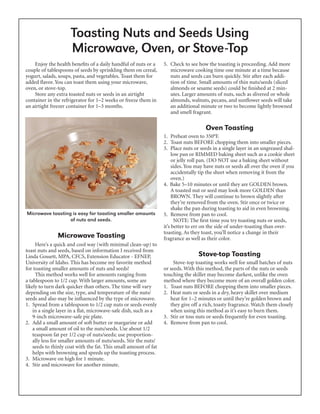
Enjoy the health benefits of a daily handful of nuts or a
couple of tablespoons of seeds by sprinkling them on cereal,
yogurt, salads, soups, pasta, and vegetables. Toast them for
added flavor. You can toast them using your microwave,
oven, or stove-top.
Store any extra toasted nuts or seeds in an airtight
container in the refrigerator for 1–2 weeks or freeze them in
an airtight freezer container for 1–3 months.

5. 	Check to see how the toasting is proceeding. Add more
microwave cooking time one minute at a time because
nuts and seeds can burn quickly. Stir after each addition of time. Small amounts of thin nuts/seeds (sliced
almonds or sesame seeds) could be finished at 2 minutes. Larger amounts of nuts, such as slivered or whole
almonds, walnuts, pecans, and sunflower seeds will take
an additional minute or two to become lightly browned
and smell fragrant.

Oven Toasting

Microwave toasting is easy for toasting smaller amounts
of nuts and seeds.

Microwave Toasting
Here’s a quick and cool way (with minimal clean-up) to
toast nuts and seeds, based on information I received from
Linda Gossett, MPA, CFCS, Extension Educator - EFNEP,
University of Idaho. This has become my favorite method
for toasting smaller amounts of nuts and seeds!
This method works well for amounts ranging from
a tablespoon to 1/2 cup. With larger amounts, some are
likely to turn dark quicker than others. The time will vary
depending on the size, type, and temperature of the nuts/
seeds and also may be influenced by the type of microwave.
1. 	Spread from a tablespoon to 1/2 cup nuts or seeds evenly
in a single layer in a flat, microwave-safe dish, such as a
9-inch microwave-safe pie plate.
2. 	Add a small amount of soft butter or margarine or add
a small amount of oil to the nuts/seeds. Use about 1/2
teaspoon fat per 1/2 cup of nuts/seeds; use proportionally less for smaller amounts of nuts/seeds. Stir the nuts/
seeds to thinly coat with the fat. This small amount of fat
helps with browning and speeds up the toasting process.
3. 	Microwave on high for 1 minute.
4. 	Stir and microwave for another minute.

1. 	Preheat oven to 350°F.
2. 	Toast nuts BEFORE chopping them into smaller pieces.
3. 	Place nuts or seeds in a single layer in an ungreased shallow pan or RIMMED baking sheet such as a cookie sheet
or jelly roll pan. (DO NOT use a baking sheet without
sides. You may have nuts or seeds all over the oven if you
accidentally tip the sheet when removing it from the
oven.)
4. Bake 5–10 minutes or until they are GOLDEN brown.
A toasted nut or seed may look more GOLDEN than
BROWN. They will continue to brown slightly after
they’re removed from the oven. Stir once or twice or
shake the pan during toasting to aid in even browning.
5. 	Remove from pan to cool.
NOTE: The first time you try toasting nuts or seeds,
it’s better to err on the side of under-toasting than overtoasting. As they toast, you’ll notice a change in their
fragrance as well as their color.

Stove-top Toasting
Stove-top toasting works well for small batches of nuts
or seeds. With this method, the parts of the nuts or seeds
touching the skillet may become darkest, unlike the oven
method where they become more of an overall golden color.
1. 	Toast nuts BEFORE chopping them into smaller pieces.
2. 	Heat nuts or seeds in a dry, heavy skillet over medium
heat for 1–2 minutes or until they’re golden brown and
they give off a rich, toasty fragrance. Watch them closely
when using this method as it’s easy to burn them.
3. 	Stir or toss nuts or seeds frequently for even toasting.
4. 	Remove from pan to cool.

Nuts for Nutrition

  • 1.
    Nuts for Nutrition AliceHenneman, MS, RD, Extension Educator UNL Extension in Lancaster County Web: food.unl.edu • E-mail: ahenneman1@unl.edu Know how. Know now. A Handful of Nuts Can a handful of nuts a day help keep you healthy? And how much, exactly, is a handful? Nuts and Your Health The 2010 Dietary Guidelines for Americans recommend: “Choose a variety of protein foods, which include seafood, lean meat, poultry, eggs, beans and peas, soy products, and unsalted nuts and seeds.” The Dietary Guidelines also recommend fat intake should emphasize heart healthy monounsaturated and polyunsaturated fats, such as those found in seafood, nuts, seeds, and oils. Choose MyPlate (a recommended food pattern to help people implement the dietary guidelines) states, “In general, 1 ounce of meat, poultry, fish, 1/4 cup cooked beans, 1 egg, 1 tablespoon of peanut butter, or 1/2 ounce of nuts or seeds can be considered as “1-ounce equivalent” from the Protein Foods Group.” Nuts, with their healthy fats, are higher in calories than some other sources of protein and MyPlate recommends: “Choose unsalted nuts as a snack, on salads, or in main dishes. Use nuts to replace meat or poultry, not in addition to these items.” At the 2,000 calorie level, MyPlate recommends approximately 5-1/2 “1-ounce equivalents” from the Protein Group It’s in the Bag How many nuts are in a handful of nuts? A handful equals about 1-ounce. This serving size corresponds to the serving size listed on the “Nutrition Facts” panel on food labels. The International Tree Nut Council Nutrition Research & Education Foundation gives these examples of the average number of nuts per 1-ounce portion. • Almonds (20–24) • Brazil Nuts (6–8) • Cashews (16–18) • Hazelnuts (18–20) • Macadamias (10–12) • Pecans (18–20) • Pine Nuts (150–157) • Pistachios (47– 49) • Walnuts (8–14) You don’t have to fire up the stove or get out your cookbook to enjoy nuts. Your handful of nuts may be enjoyed — simply — out of hand. Divide a container of nuts into small snack bags for easy snacking at home, office, or on the road. Simply count, weigh 1 ounces of nuts on a kitchen scale, or grab a handful and store in each snack bag. Keep in the refrigerator until you’re ready to enjoy! A handful of nuts may help you resist the gooey sweet roll in the breakroom at work. Feel Like a Nut? It’s easy to nibble on nuts. Here are two quick ideas. Store shelled or unshelled nuts in an airtight container in your refrigerator for up to 6 months or for a year in your freezer for best quality. Just a Sprinkle Sprinkle nuts into these foods: • Salads • Yogurt • Cereal • Pasta • Cooked vegetables • Muffins and pancakes (toss a handful or two into your batter) For added flavor, try toasting nuts. View directions for toasting nuts on next page. Here’s a trail mix you can make with your favorite nut or combination of nuts. Trail Mix (16 servings • Serving size: 1/4 cup) 1 cup almonds 1/2 cup chocolate chips or M&M’s 1 cup dried fruit 1/2 cup dried cranberries 1 cup oatmeal squares Measure ingredients and put in a large zip-close bag. Shake to mix. Portion into single-serving zip-close bags. Per serving: 140 calories, 20 grams (g) carbohydrate, 6 g fat, 3 g protein Source: North Dakota State University Extension Service at www.ndsu.edu/eatsmart Extension is a Division of the Institute of Agriculture and Natural Resources at the University of Nebraska–Lincoln cooperating with the Counties and the United States Department of Agriculture. ® Extension’s educational programs abide with the nondiscrimination policies of the University of Nebraska–Lincoln and the United States Department of Agriculture.
  • 2.
    Toasting Nuts andSeeds Using Microwave, Oven, or Stove-Top Enjoy the health benefits of a daily handful of nuts or a couple of tablespoons of seeds by sprinkling them on cereal, yogurt, salads, soups, pasta, and vegetables. Toast them for added flavor. You can toast them using your microwave, oven, or stove-top. Store any extra toasted nuts or seeds in an airtight container in the refrigerator for 1–2 weeks or freeze them in an airtight freezer container for 1–3 months. 5. Check to see how the toasting is proceeding. Add more microwave cooking time one minute at a time because nuts and seeds can burn quickly. Stir after each addition of time. Small amounts of thin nuts/seeds (sliced almonds or sesame seeds) could be finished at 2 minutes. Larger amounts of nuts, such as slivered or whole almonds, walnuts, pecans, and sunflower seeds will take an additional minute or two to become lightly browned and smell fragrant. Oven Toasting Microwave toasting is easy for toasting smaller amounts of nuts and seeds. Microwave Toasting Here’s a quick and cool way (with minimal clean-up) to toast nuts and seeds, based on information I received from Linda Gossett, MPA, CFCS, Extension Educator - EFNEP, University of Idaho. This has become my favorite method for toasting smaller amounts of nuts and seeds! This method works well for amounts ranging from a tablespoon to 1/2 cup. With larger amounts, some are likely to turn dark quicker than others. The time will vary depending on the size, type, and temperature of the nuts/ seeds and also may be influenced by the type of microwave. 1. Spread from a tablespoon to 1/2 cup nuts or seeds evenly in a single layer in a flat, microwave-safe dish, such as a 9-inch microwave-safe pie plate. 2. Add a small amount of soft butter or margarine or add a small amount of oil to the nuts/seeds. Use about 1/2 teaspoon fat per 1/2 cup of nuts/seeds; use proportionally less for smaller amounts of nuts/seeds. Stir the nuts/ seeds to thinly coat with the fat. This small amount of fat helps with browning and speeds up the toasting process. 3. Microwave on high for 1 minute. 4. Stir and microwave for another minute. 1. Preheat oven to 350°F. 2. Toast nuts BEFORE chopping them into smaller pieces. 3. Place nuts or seeds in a single layer in an ungreased shallow pan or RIMMED baking sheet such as a cookie sheet or jelly roll pan. (DO NOT use a baking sheet without sides. You may have nuts or seeds all over the oven if you accidentally tip the sheet when removing it from the oven.) 4. Bake 5–10 minutes or until they are GOLDEN brown. A toasted nut or seed may look more GOLDEN than BROWN. They will continue to brown slightly after they’re removed from the oven. Stir once or twice or shake the pan during toasting to aid in even browning. 5. Remove from pan to cool. NOTE: The first time you try toasting nuts or seeds, it’s better to err on the side of under-toasting than overtoasting. As they toast, you’ll notice a change in their fragrance as well as their color. Stove-top Toasting Stove-top toasting works well for small batches of nuts or seeds. With this method, the parts of the nuts or seeds touching the skillet may become darkest, unlike the oven method where they become more of an overall golden color. 1. Toast nuts BEFORE chopping them into smaller pieces. 2. Heat nuts or seeds in a dry, heavy skillet over medium heat for 1–2 minutes or until they’re golden brown and they give off a rich, toasty fragrance. Watch them closely when using this method as it’s easy to burn them. 3. Stir or toss nuts or seeds frequently for even toasting. 4. Remove from pan to cool.